Written By Matthew Orolowitz and published on 21 July 2026
Conserving a species on the brink of extinction requires more than passion and determination – it requires a clear, coordinated strategy. For Botha’s Lark (Spizocorys fringillaris), one of South Africa’s most threatened endemic birds, that strategy now exists in the form of the Botha’s Lark Species Action Plan.
Developed collaboratively between avifaunal specialists, academics, researchers, conservation practitioners and species experts, the Species Action Plan provides a long-term roadmap for securing the future of this remarkable grassland specialist. It establishes a shared vision for conserving Botha’s Lark over the next decade, ensuring that conservation efforts are strategic, coordinated and focused on achieving measurable outcomes.
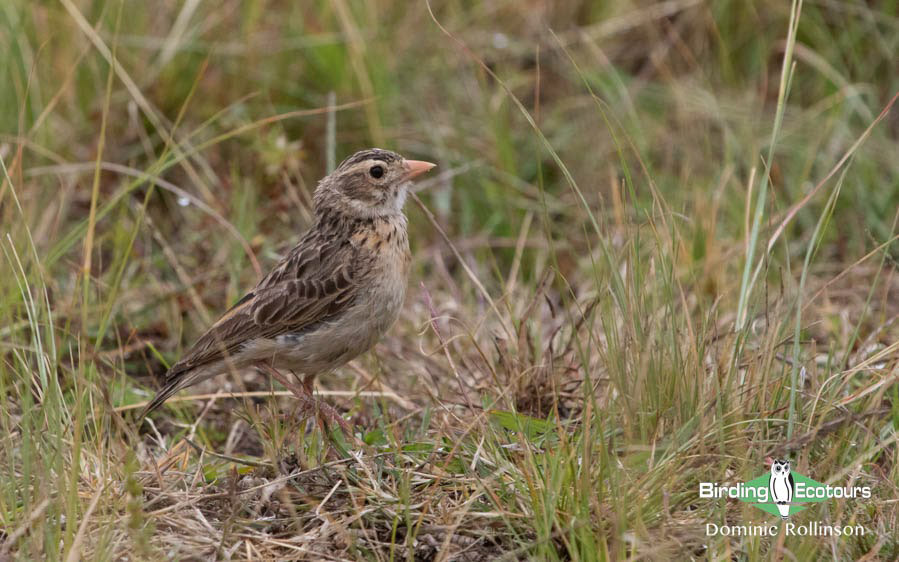
Botha’s Lark photographed in high-altitude grassland near Wakkerstroom, South Africa.
The plan is centered on five overarching goals: advancing research and monitoring, strengthening stakeholder engagement, increasing education and awareness, influencing policy and advocacy, and fostering collaboration among organizations and individuals working to conserve the species. Each of these goals is supported by a suite of actions that together provide a practical framework for guiding conservation efforts and addressing the many challenges facing this Critically Endangered species.
Developing a Species Action Plan is a significant milestone, but its true value lies in its implementation. Turning a vision into meaningful conservation action requires sustained investment, long-term commitment and strong partnerships. The generous support of Birding Ecotours has been instrumental in making this possible.
Through its support of the Birding Ecotours Fellow of Grasslands Conservation at BirdLife South Africa, Birding Ecotours has enabled extensive fieldwork across the range of Botha’s Lark. This investment has supported vital research and monitoring to improve understanding of the species’ distribution, breeding ecology, habitat requirements and the threats it faces. It has also provided the capacity to develop the Species Action Plan itself, ensuring that future conservation efforts are guided by the best available science.
The impact of this support extends far beyond the completion of the Action Plan. Over the past two years, more than 620 miles (1,000 kilometers) of field surveys have been completed across South Africa’s high-altitude grasslands, significantly improving knowledge of the species’ remaining populations. These surveys have helped to confirm a second population in the eastern Free State, an encouraging discovery for a species with an exceptionally small global population.
Strong relationships have also been established with landowners across the species’ range, resulting in access to nearly 470,000 acres (190,000 hectares) of privately owned grassland for monitoring and conservation. These partnerships are essential, as much of the remaining habitat of Botha’s Lark occurs on privately managed land. By working collaboratively with landowners, the project is laying the foundations for conservation that benefits both biodiversity and sustainable grassland management.
Several additional milestones have been achieved through this work. A standardized habitat monitoring protocol has been developed to ensure consistent data collection across sites, improving the ability to monitor changes in habitat over time. Workshops have brought together specialists to discuss key conservation challenges, while a Green Status assessment has provided valuable insights into the species’ recovery potential. Public awareness has also grown through outreach initiatives, including the production of a documentary highlighting Botha’s Lark and the importance of South Africa’s threatened grasslands.
Together, these achievements represent important progress, but perhaps the greatest accomplishment is the establishment of a shared direction for the future. The Species Action Plan ensures that research, habitat management, stakeholder engagement and conservation action are no longer isolated efforts but components of a coordinated strategy. It identifies priorities, encourages collaboration between partners and provides a framework against which conservation success can be measured over the coming decade.
Botha’s Lark remains one of South Africa’s rarest birds, and significant challenges remain before its future can be secured. Nevertheless, with a comprehensive roadmap now in place and an expanding network of dedicated partners, there is genuine reason for optimism. Every survey undertaken, landowner engaged and conservation initiative implemented improves the prospects of this remarkable endemic species.
Birding Ecotours has played a pivotal role in making this progress possible. By investing in dedicated field research and long-term conservation planning, the company has demonstrated a commitment that extends far beyond the birds its clients travel to see. Its support is helping ensure that Botha’s Lark remains a part of South Africa’s grassland heritage for generations to come.
BirdLife South Africa extends its sincere gratitude to Birding Ecotours and its clients for their continued support. Their commitment is helping transform conservation planning into meaningful action and provides renewed hope for the future of one of the country’s most threatened birds.