Romania Birding Tours
Summary of our Romania birding tours
Romania birding tours provide an excellent opportunity to explore one of Europe’s most productive birdwatching destinations, particularly during the spectacular spring migration. Birding Ecotours’ Romania birdwatching tour focuses on the world-famous Danube Delta, Europe’s largest wetland, combined with excellent birding sites in neighboring Bulgaria. This carefully designed itinerary targets a wide variety of eastern European specialties, waterbirds, and raptors while exploring diverse habitats including marshes, river channels, grasslands, and rocky hills. The Danube Delta is home to targets like Dalmatian Pelican and Pygmy Cormorant, while surrounding regions hold sought-after species such as Wallcreeper, Sombre Tit, and Western Rock Nuthatch. With expert guides and carefully selected birding locations, our Romania birding tours provide excellent opportunities to experience the region’s rich birdlife while enjoying beautiful landscapes and fascinating Balkan culture.
Read More About Romania
Introduction to Romania
The Black Sea country of Romania is yet another European birding and wildlife highlight, with our Romania birding tours providing additional highly sought-after European specialts. Forming the northeast corner of the Balkan Peninsula, the country is bordered by the Black Sea to the east, Bulgaria to the south, Serbia and Hungary to the west, and Ukraine and Moldova to the north. Romania’s area is 92,046 square miles (238,397 square kilometers), making it slightly smaller than the state of Michigan in the United States of America. Like many countries in the region Romania’s population is falling due to the migration of people out of the area. The population of Romania is 19.3 million people (2020 figures), a drop of nearly 2 million people since 2011. Bucharest is the capital of Romania and sits in the south of the country. The city is home to fabulous architecture including the infamous Palace of the Parliament, the heaviest building on Earth, built by former president Nicolae Ceaușescu.
Romania is home to the oldest known European human remains, at 40,000 years old. The Kingdom of Dacia was the first recognized single ruler of the region before the Romans arrived in 46 AD. The region has seen a multitude of rulers throughout more recent history including Goths, Slavs, Magyars (Hungary), Byzantines, Mongols (Mongolia), and Ottomans, before Romania achieved full national union in 1918. Romania fought against the Central Powers in World War One but fought alongside Germany during World War Two, before switching sides in 1944 to fight alongside the Soviet Union, a move that would lead to Romania becoming part of the Soviet Union soon after. Romania remained under Soviet influence until 1989 when a revolution saw the end of communism in the country. Romania joined the European Union in 2007.
The country’s climate is varied with hot summers and cold winters separated by distinct spring and fall (autumn) seasons. Southern Romania is relatively dry, receiving about 22 inches (570 millimeters) of rain annually. Romania’s geography is an equal mix of mountains, hills, and grasslands. The Carpathian Mountains take up most of central Romania, with the highest peak being Moldoveanu Peak at 8,346 feet (2,544 meters). The east and south of the country are mostly plains, with the Danube River forming most of Romania’s borders with Bulgaria and Serbia. The Danube emerges at the Black Sea and its delta is the largest marshland in Europe at 2,200 square miles (5,800 square kilometers). Romania is also home to vast forests, which make up around 27% of its land area. A large proportion of the country is protected through 13 national parks and three biosphere reserves. Furthermore, BirdLife International, with local partner the Romanian Ornithological Society, recognizes 130 Important Bird Areas (IBAs), sites considered important for birds. During our Romania birding tour here we will visit the Romanian part of the Danube Delta IBA and Măcin-Niculitel IBA (part of the Macin Mountains National Park), these sites all help to protect birds in Romania either directly or indirectly.
Romania birding highlights
Following International Ornithological Congress (IOC) taxonomy, Romania has a bird list of over 400 species, 21 of these species are globally threatened, such as Red-breasted Goose, Lesser White-fronted Goose, Steppe Eagle, and Saker Falcon.
Romania offers some great birds, and by combining a trip here with neighboring Bulgaria (as we do here), we can find a great many highly sought-after eastern European birds. Some of the highlight birds from the Romanian leg of the trip are outlined below.
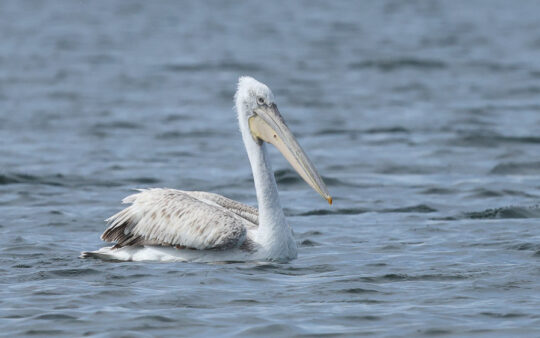
Within the Danube Delta itself we will search for Marsh Sandpiper, Collared Pratincole, Caspian Tern, Whiskered Tern, Black Stork, White Stork, Pygmy Cormorant, Eurasian Spoonbill, Purple Heron, Great Egret, Great White Pelican, and Dalmatian Pelican (the Danube is one of the best places in the world for this Near-threatened (IUCN) species of global conservation concern).
The number of birds of prey in Romania is vast, with European Honey Buzzard, Short-toed Snake Eagle, Lesser Spotted Eagle, Booted Eagle, Levant Sparrowhawk, Pallid Harrier, White-tailed Eagle, Long-legged Buzzard, Lesser Kestrel, Red-footed Falcon, and even Saker Falcon all possible during this section of our Romania birding tour. We may even come across the enigmatic and elusive Ural Owl while in the Macin Mountains National Park.
Some vibrant color will be provided by European Turtle Dove, Eurasian Hoopoe, European Roller, and European Bee-eater, plus many of the European woodpeckers, including Syrian Woodpecker, White-backed Woodpecker, and Black Woodpecker will add further variety. Passerine highlights will include Lesser Grey Shrike, Eurasian Golden Oriole, Eurasian Penduline Tit, Great Reed Warbler, Moustached Warbler, Paddyfield Warbler, Marsh Warbler, Eastern Olivaceous Warbler, Icterine Warbler, River Warbler, Savi’s Warbler, Common Rock Thrush, Isabelline Wheatear, Spanish Sparrow, and Ortolan Bunting.
Romania wildlife highlights
In addition to its wonderful avifauna, Romania is also home to some of Europe’s iconic mammals such as (Eurasian) Brown Bear, the highest concentration in Europe, plus Eurasian Lynx, Grey Wolf, (European) Wild Cat, Northern Chamois, and, thanks to a reintroduction scheme, European Bison.
Join Birding Ecotours in Romania
Our combined Bulgaria and Romania birding tour offers a vast array of amazing species and we have listed some of the highlights above, with others on our Bulgaria page. You will get to enjoy the birds in Romania along with the outstanding scenery, welcoming people, and the fantastic local food that the country has to offer.