27 May–06 June 2026
By Fraser Bell
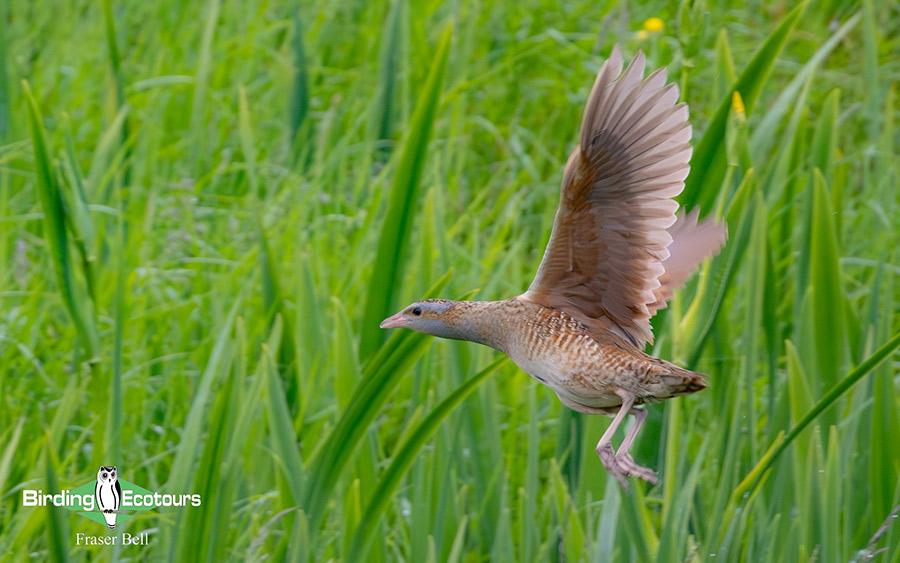
Seeing several secretive Corn Crake and hearing many more calling throughout our morning birding on the Isle of Iona was a real tour highlight.
Overview
This small-group birdwatching tour across Scotland was designed to showcase the country at its very best during the peak of the breeding season. The timing of the tour meant we enjoyed a high diversity of species in their colorful breeding plumage, set against Scotland’s iconic landscapes. The combination of excellent birding, memorable mammal encounters, comfortable accommodation, classic Scottish culture, and hearty food made for a fun and rewarding tour. We recorded 134 bird species and 15 mammal species on this Scotland in spring birding tour, see the eBird trip report here.
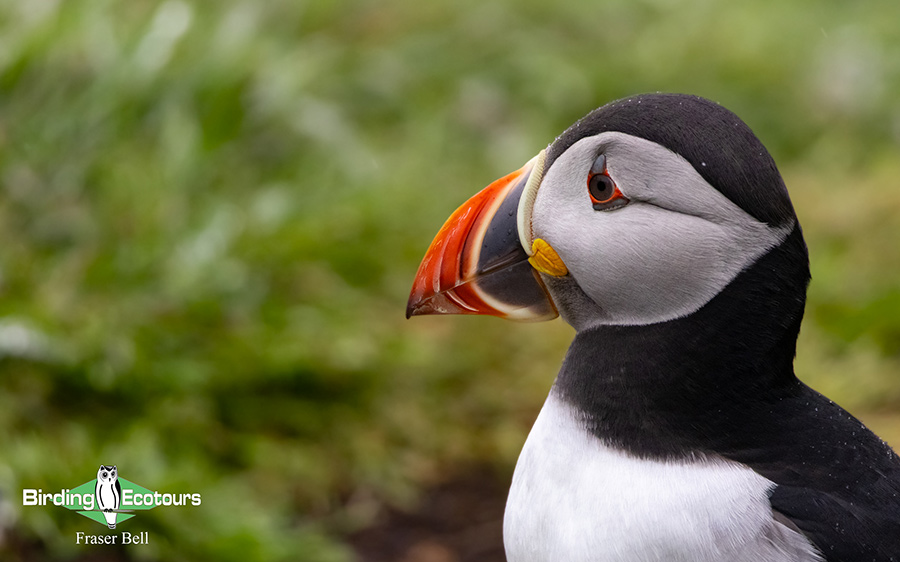
Watching Atlantic Puffin up close is always a fun experience. They are both beautiful and hilariously comical birds to spend time with.
Our birding began at the lush Loch Lomond Reserve, where broadleaf woodland and wetlands provided a great introduction to birding in Scotland, with a high diversity to start the tour. Moving on to Argyll and Bute we saw several reintroduced Eurasian Beaver, our first of many Red Squirrel, plus Common Eider, Red-throated Loon, Great Spotted Woodpecker, Garden Warbler, and Whinchat. Traveling onward we enjoyed three nights on the stunning and truly idyllic Isle of Mull. Here, one of the standout highlights of the entire tour was repeated encounters with the highly secretive Corn Crake on the Isle of Iona, as well as Twite, while on Mull we enjoyed seeing impressive White-tailed Eagle, Hen Harrier, and Eurasian Otter, large herds of Red Deer and Common Fallow Deer, as well as excellent seabird experiences during a boat trip to the Treshnish Isles, where we had a memorable experience being immersed in colonies of Atlantic Puffin, Common Murre, Razorbill, and Northern Fulmar at close range.
Departing the western isles the tour continued into the Scottish Highlands, where we were based in the Cairngorms National Park for four nights. Here we targeted different communities of bird species, from ancient Caledonian pine forest specialists such as Crested Tit, Spotted Flycatcher, Common Redstart, and Red Crossbill, to montane species including Rock Ptarmigan, Snow Bunting, and Ring Ouzel, and moorland species with lekking Black Grouse, Red Grouse, Black-throated Loon, and breeding waders on high lochs and moorland. The Cairngorms also produced excellent nocturnal wildlife encounters, including Pine Marten, Eurasian Badger, Tawny Owl, and Eurasian Woodcock. From our base in the Cairngorms we explored the dramatic Findhorn Valley, which lived up to its reputation as a perfect spot for birds of prey, then at the Moray Firth coast enjoyed shorebirds (waders) and farmland species such as Yellowhammer and Corn Bunting.
After a brief overnight in Pitlochry on our journey south, our birding concluded in the Tay River reedbeds, one of the most important wetland sites in Scotland, where we enjoyed experiencing this specialist habitat and the species that depend on it, including Western Marsh Harrier, Bearded Reedling, Common Reed Warbler, and Sedge Warbler, providing a fitting finale before the group returned to Edinburgh.
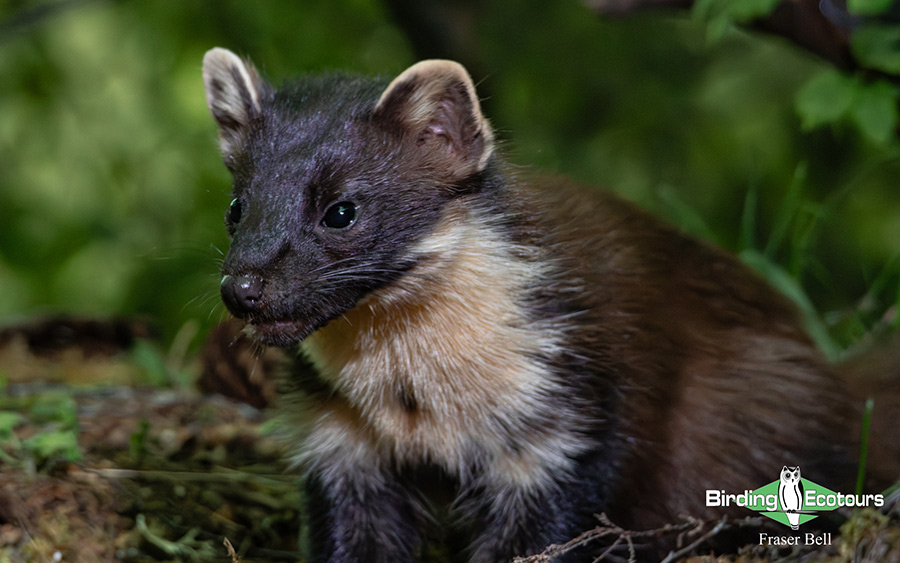
Seeing this Pine Marten during our nocturnal mammal watching session was easily the mammalian highlight of the tour.
Detailed Report
Day 1, 27th May 2026. Arrival in Edinburgh
Our small-group birdwatching tour across Scotland started with the group arriving into the capital Edinburgh. We met for a welcome dinner and discussed the upcoming tour, then had a comfortable rest before the birding began the following morning.
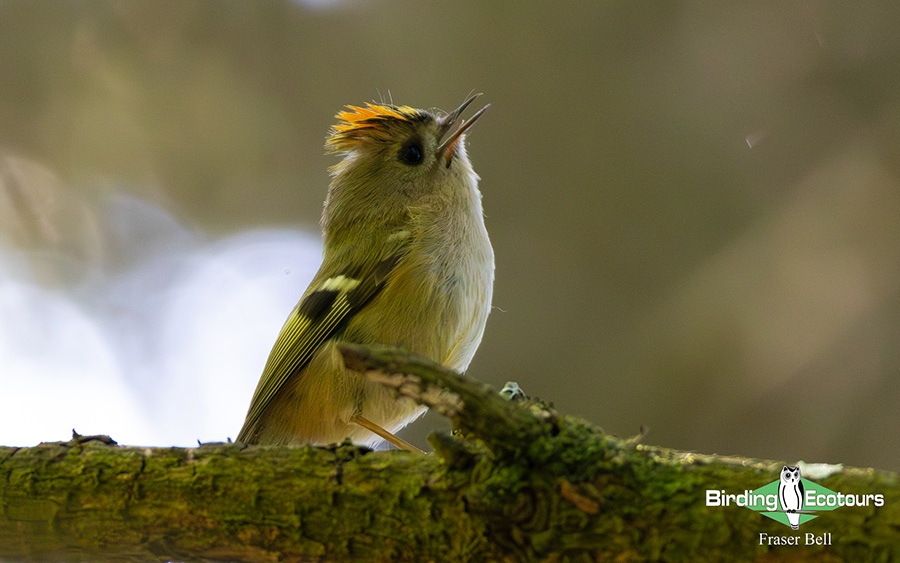
Goldcrest make up for their small size with a loud song and plenty of attitude.
Day 2, 28th May 2026. Loch Lomond and travel to coastal Argyll and Bute
Our first birding took place at the RSPB Loch Lomond reserve. We spent the morning exploring fantastic deciduous woodland, marshland, and the shore of this vast loch, providing a perfect introduction to birding in Scotland. Over the course of the morning we saw Red-breasted Merganser, Common Swift, Great Crested Grebe, Osprey, Willow Warbler, Common Chiffchaff, Sedge Warbler, Eurasian Blackcap, Goldcrest, Eurasian Nuthatch, European Stonechat, Eurasian Siskin, and Common Reed Bunting. We then departed for the western coast of Argyll and Bute, though a quick stop at the iconic Inveraray Castle gave us distant views of Spotted Flycatcher and a confiding White Wagtail.
We continued to our characterful hotel, situated on Loch Crinan, a sea loch which looks out onto the island of Jura, one of the Inner Hebrides, just across the water. Western House Martins were busy nest building on the hotel and were a joy to watch, while two male Common Eiders, and Red-throated Loon and Northern Gannet were just offshore. After dinner, we saw Common Toad and had a brilliant encounter with two Eurasian Beaver at a local wetland where they have built their lodge. These are reintroduced individuals, which are now making a comeback at several similar sites across the UK.
Day 3, 29th May 2026. The Argyll Beaver Center and travel to the Isle of Mull
We started before breakfast, birding Loch Crinan right outside our hotel, with Common Eider and handsome Black Guillemot being the highlights, alongside excellent side-by-side views of European Shag and Great Cormorant. We then visited a local hide, where we quickly saw Great Spotted Woodpecker, Great Tit, Eurasian Blue Tit, and a Red Squirrel. What a treat it was to watch the antics of this iconic and comical species at such close range. After a little searching, we also managed brief but satisfying views of a Garden Warbler in the woodland scrub around the parking area.
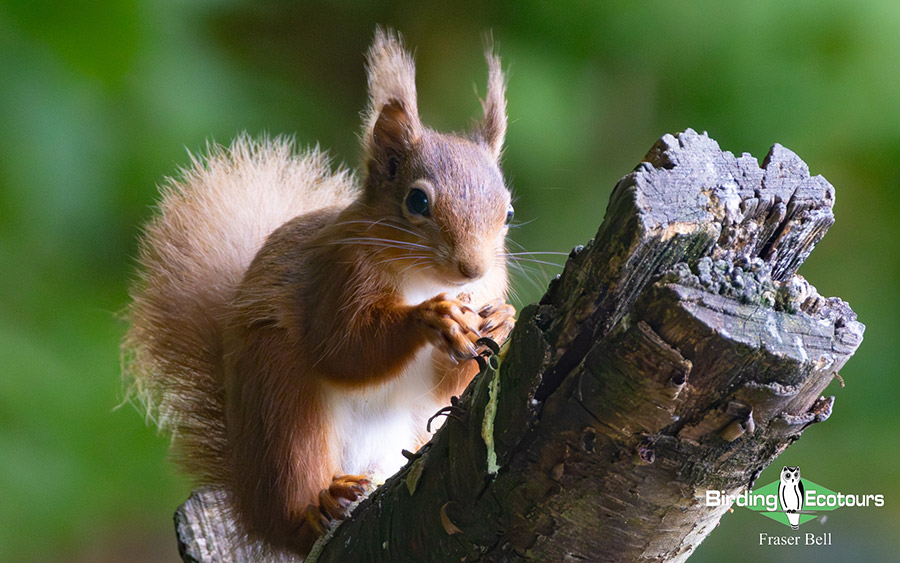
Red Squirrel are a lot of fun to watch, being both gorgeous and cheeky animals.
We then departed for Oban, where we would catch the ferry to the Isle of Mull. Not far into the journey, however, a chance sighting had us stopping to watch a couple of Whinchats on open moorland. The ferry crossing was comfortable, though periods of strong wind and rain limited sea watching. One calmer spell did provide the opportunity to see Sandwich Tern, Common Tern, Arctic Tern, Black-legged Kittiwake, and a group of Manx Shearwaters shearing effortlessly despite the high winds. Once on Mull, we travelled to Tobermory and checked into our hotel for a three-night stay, enjoying some birding along the way. While slowly driving the picturesque coastline, we added Common Ringed Plover, Common Redshank, Northern Raven, Eurasian Skylark, Northern Wheatear,and European Rock Pipit to our trip list.
Day 4, 30th May 2026. A seabird boat trip to Treshnish Isles
Today started well with close views of a mother Common Merganser and her nine cute chicks in Tobermory harbor before breakfast. Who knew that so many chicks could fit under one small (sawbill) duck! We then boarded a boat trip bound for the Treshnish Isles, where we enjoyed a wonderful diversity of Scotland’s seabirds. During the crossing we saw Great Skua, Red-throated Loon, and Manx Shearwaters. We stopped at the Isle of Staffa to admire the famous basalt columns of the fabled Fingal’s Cave, and had close-up views of Black Guillemot and European Shag.
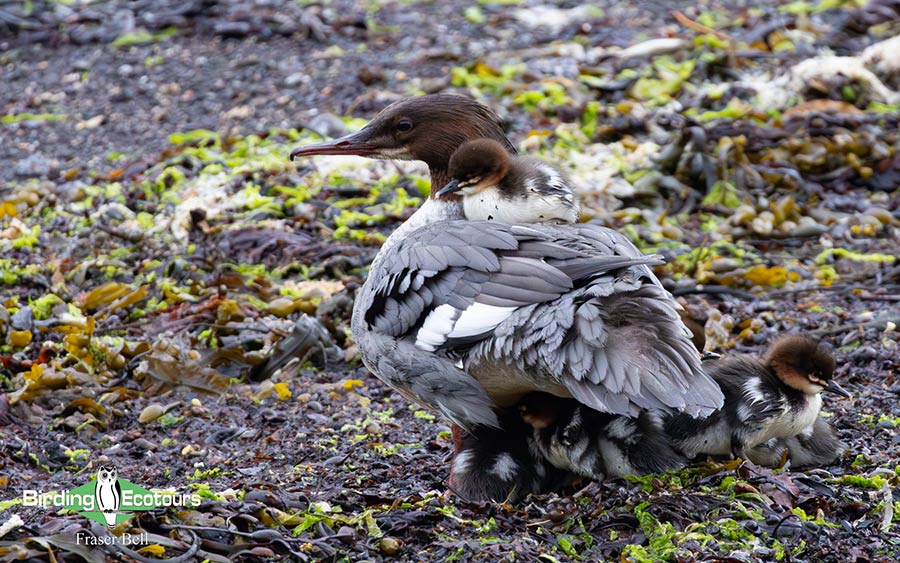
This mother Common Merganser was keeping her nine adorable chicks close by.
Once on the Isle of Lunga, we enjoyed incredibly close views of hundreds of jovial Atlantic Puffins, alongside Black-legged Kittiwakes, Razorbills, Common Murres, and Northern Fulmars. There is something truly special about being immersed in a busy seabird colony, and the wet conditions did not dampen our spirits. Other birds seen on the island included Great Skua, Common Snipe, Ruddy Turnstone, Dunlin, and some all-too-brief flyover Twite. The return journey was unfortunately very wet, and the highlight was seeing a small pod of Common Dolphin, plus many hundreds of Manx Shearwater which were a constant accompaniment on our journey.
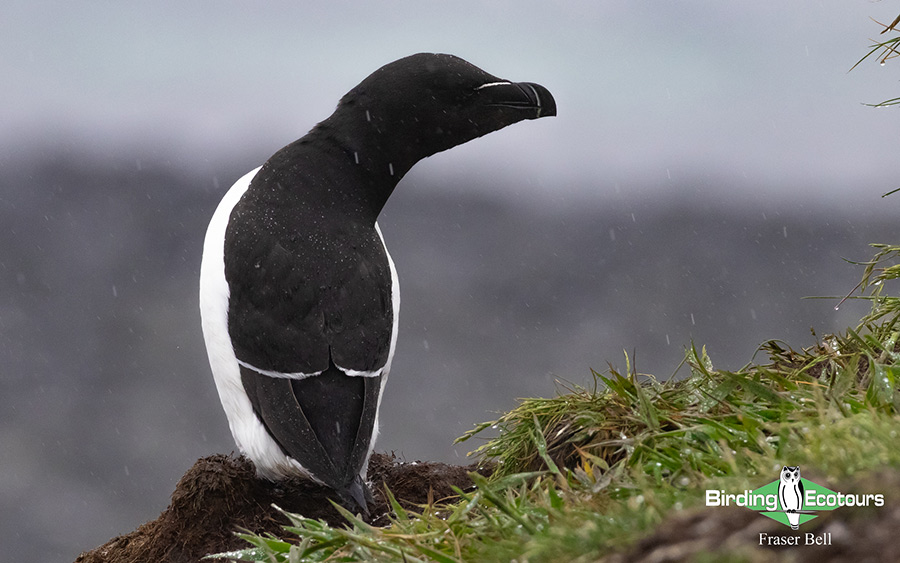
Unlike Atlantic Puffin, their smaller, comical cousins, Razorbill are sleek and elegant.
Day 5, 31st May 2026. The Isle of Iona
Today was a long day, but easily one of the tour highlights. We started early driving south down through the Isle of Mull and saw many groups of impressively large Red Deer, and bumped into a pair of male Mandarin Duck, which was quite a surprise given they are not native, and likely escapee birds. We then headed to the remote Isle of Iona, a tiny yet peaceful and idyllic island. Almost as we set foot on the island from the ferry, we heard several of our main target birds – Corn Crake with their distinctive ‘crex crex’ call. Amazingly, we did not have to wait long before seeing one, as it carefully poked its head out from the iris beds. Then, to our complete surprise for such a notoriously secretive bird, it flew out of its patch and into another dense bed farther down the road. After this perfect start, birding on the island was very enjoyable, giving us good views of wild-type Rock Dove, Song Thrush, European Greenfinch, Common Linnet, European Goldfinch, and a single Twite, which perched close to us, albeit briefly. We also saw two more Corn Crakes. Iona was brilliant. It was a special experience to explore the island while hearing the calls of the crakes throughout the morning, a remarkable spectacle on such a quaint island.
We then set about enjoying Mull’s spectacular moorland, lochs, and mountainsides, and found two of our bird of prey targets; three White-tailed Eagles and two beautiful male Hen Harriers. Both gave us excellent views, with two of the eagles locking talons and pirouetting through the sky, while one of the harriers perched on the hillside opposite us, giving us walkaway views. We also found Common Loon and Common Whitethroat, rounding off a great day of Scottish birding.
Day 6, 1st June 2026. Transfer to the Scottish Highlands
Despite the wet conditions, we birded some of Mull’s idyllic roads, which wind alongside lochs and beneath a mountainous backdrop, for a few hours in the morning. We did not find the hoped-for Golden Eagle, but did enjoy good views of Common Loon, Northern Raven, Grey Seal, Common Fallow Deer, and an amazing encounter with a pair of Eurasian Otters. The otters were feeding just offshore, a little too distant for good photographs, but we nevertheless enjoyed excellent views.
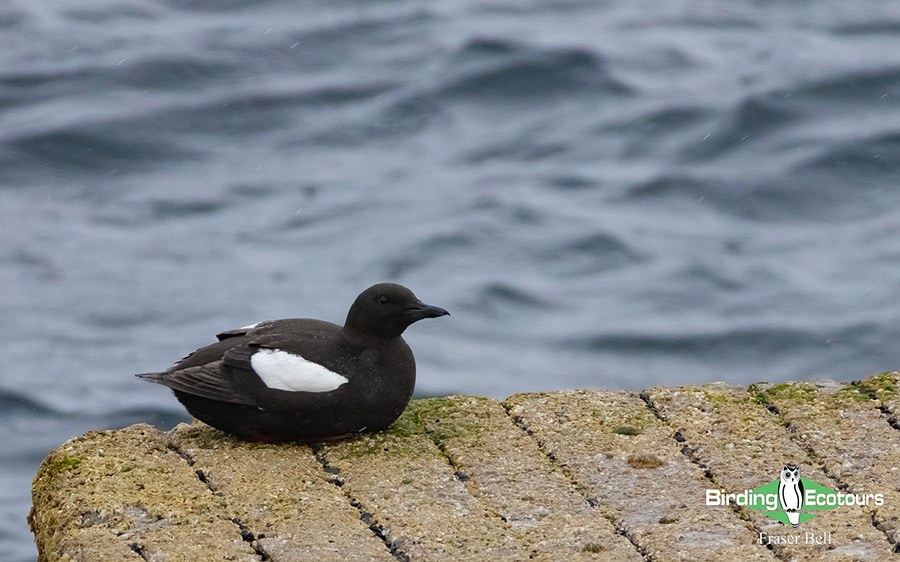
Black Guillemot are very handsome birds and are common around Mull’s coast.
We then had a comfortable crossing back to the mainland, where we saw many seabirds that we had become familiar with over the previous few days, such as Black Guillemot, Razorbill, Common Murre, Arctic Tern, and Common Tern. Much of the afternoon was taken up by transferring to Grantown-on-Spey in the Cairngorm National Park, our base for the next four nights. Some birding at marshes en route produced a lingering Pink-footed Goose (typically just a winter visitor), along with Black-headed Gull, Eurasian Blackcap, and Mistle Thrush.
Day 7, 2nd June 2026. Birding the mountains and pine forests of the Cairngorm National Park
We started well this morning, as before breakfast we saw a pair of White-throated Dipper at a local river, the birds showing well as they perched on rocks in the fast-flowing water or dipped beneath the surface in pursuit of invertebrate prey. Continuing into the peaceful ancient Caledonian pine forests, we chanced upon a Red Squirrel, then had fleeting perched views of a small party of Red Crossbill. After a hearty Scottish breakfast, we decided to take our chances and try birding Cairn Gorm, the impressive mountain that overlooks the town of Aviemore and is easily accessible, as a funicular railway allows visitors to reach a height of 3,600 feet (1,097 meters). On arrival, we enjoyed great views of a female Ring Ouzel busy collecting food for young, and a singing male Grey Wagtail which showed well despite squabbling with the local male White Wagtail.
Unfortunately, soon after our arrival, the mountain peak became cloaked in low cloud, so with visibility very poor we decided to descend and bird the pine woodland around Loch Morlich which lies at the base of Cairn Gorm. Here we found a Eurasian Teal on the shoreline, while on the edge of the woodland we found a Eurasian Jay, which proved rather secretive, and a beautiful Common Redstart singing from high in a pine tree, allowing excellent scope views. Out on the heaths beyond, European Stonechat, Tree Pipit, and Eurasian Siskin kept us company, and after some time hearing it only, a Common Cuckoo finally flew over the group for all to enjoy.
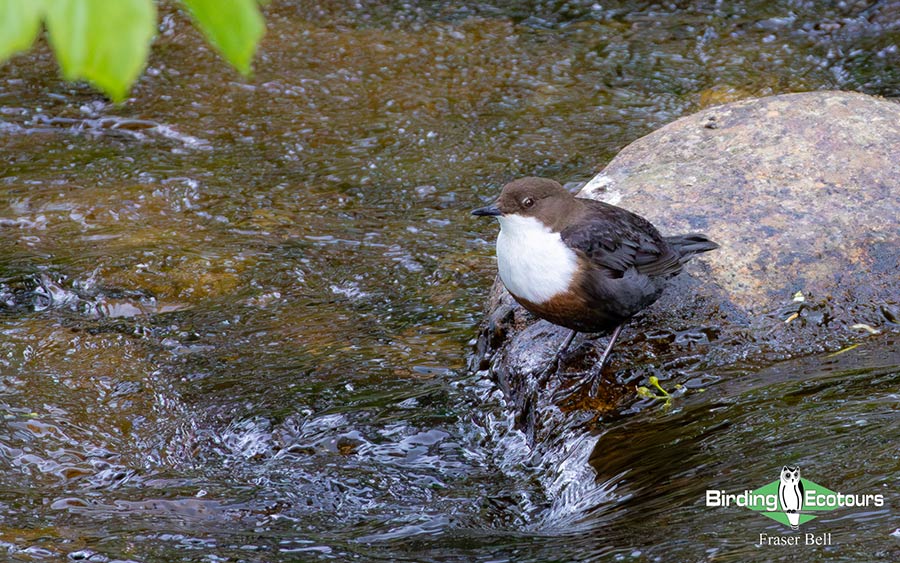
We enjoyed several sightings of White-throated Dipper during the tour.
The rain eventually caught up with us, so we decided to have lunch at a local farm shop café. Afterwards, persistent rain curtailed our birding in some deciduous birch woodland, so we instead opted to visit a whisky distillery for a tour and tasting session. Such is birding in Scotland.
Day 8, 3rd June 2026. Birding in the Cairngorm mountains
What a brilliant day. We started by seeing four male Black Grouse lekking at a local moorland. It was such fun watching these males jump and hop around, puffing out their chests and spreading their tails. Better yet, we had great views of two Common Cuckoo as they flew around the group while we watched the antics of the grouse. We then went to a local loch and enjoyed seeing a pair of beautiful Black-throated Loon in their stunning breeding plumage, along with a family of endemic Red Grouse (complete with their cute chicks) in the heather on the loch shores. We also enjoyed Eurasian Oystercatcher and Northern Lapwing with chicks, plus a very large colony of Common Gull.
After breakfast we tried our luck at Cairn Gorm mountain, and for almost an hour we had calm weather at Ptarmigan Station at the top after taking the funicular railway up. We had a great time, with three flyby European Golden Plover, a singing male Ring Ouzel, and a small group of Snow Bunting visiting the benches outside the restaurant. Best of all, we had a Rock Ptarmigan to make it a three-grouse day! Unfortunately, views were brief, and it flew higher onto the surrounding slopes before we lost it in the cloud rolling down the mountain. Once down from the mountain we checked in at Loch Morlich and were surprised to find both Red-throated Loon and Black-throated Loon, in addition to a feeding flock of hundreds Common Swift, Barn Swallow, Sand Martin, Western House Martin. What a great morning! After lunch we headed into the pine woods of Abernethy Forest, enjoying a trio of approachable Eurasian Treecreeper and several brief views of bubbling Crested Tit.
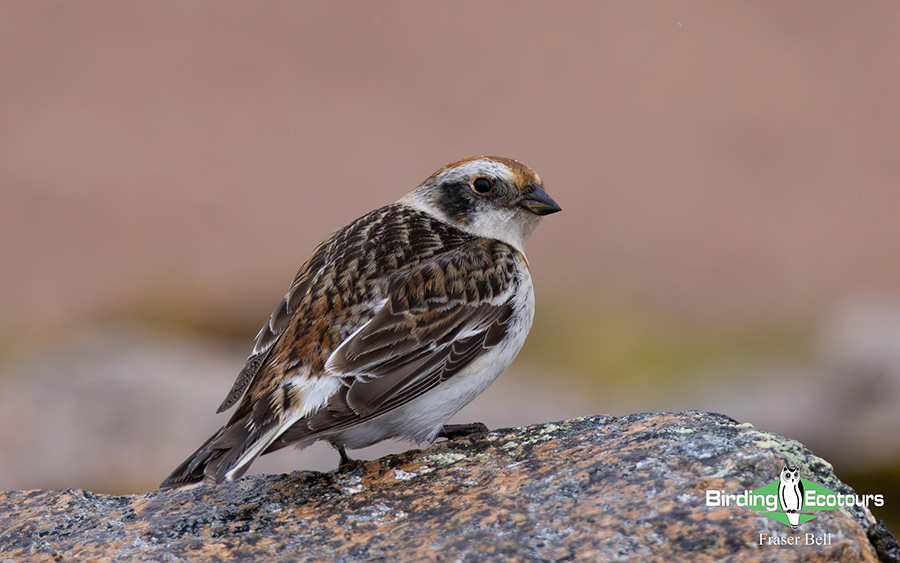
Being joined by a small flock of Snow Bunting foraging right next to our group was a real treat while at the top of Cairn Gorm.
After some down time and our evening meal, we had our one nocturnal session of the tour. We first started at a hide, seeing Long-tailed Field Mouse, Red Deer, Eurasian Badger, and a beautiful Pine Marten. The marten in particular is such a special animal, having been lost from much of its range in the UK, and is an amazing species to see up close, gorgeous and almost ghost-like, so nimble in the way it moved around in front of the hide. On the drive out we saw Eurasian Woodcock, and spent time with a family of Tawny Owl, including one fluffy chick and a territorial adult male, which came in to inspect the group when we were watching the chick perched on a low bare tree over the road.
Day 9, 4th June 2026. The Findhorn Valley and Moray Firth
After our late finish we had a more relaxed start, and after breakfast visited some excellent deciduous woodland on birch-dominated hillsides. We quickly encountered an Osprey and a large family group of Long-tailed Tit, and were able to see the brown-and-white-plumaged juveniles alongside the adults. After some time searching, we finally had great repeat views of a young male European Pied Flycatcher advertising his territory. We then departed north for the Findhorn Valley. This glacial valley makes for one of the most stunning drives in Scotland, with open moorland, grassland, and woodland patches surrounded by steep mountainsides on either side, it is a mecca for birds of prey. Within the valley we found Red-legged Partridge, Osprey, Red Kite, Common Kestrel, had two sightings of Red Squirrel, and enjoyed lunch with breathtaking views.
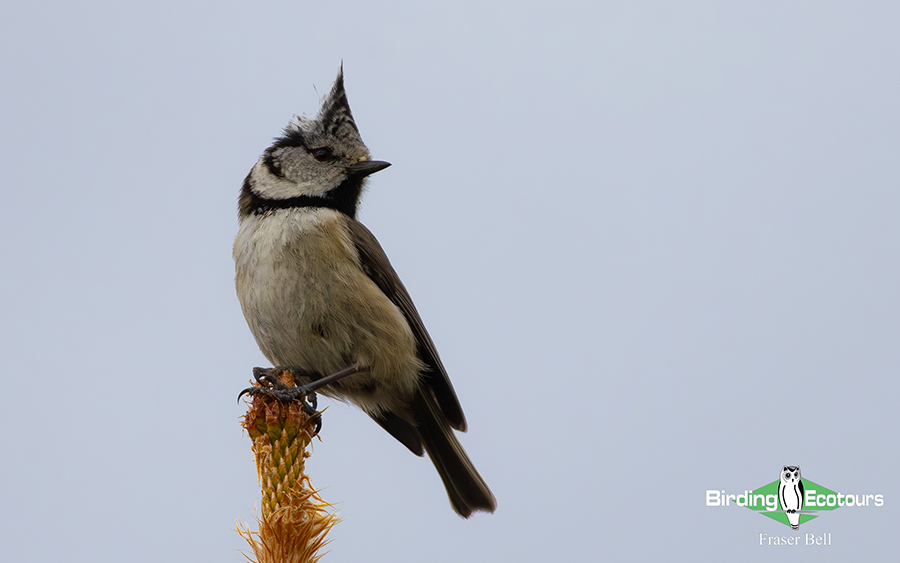
Crested Tit are among Scotland’s most iconic birds.
Heading north again, we birded the shores of the Moray Firth just east of Inverness between rain showers. This area offers different habitats from anywhere else on the tour, with a tidal coastline bordered by farmland and marshland. Here we saw Common Shelduck, Tufted Duck, Little Grebe, Red-throated Loon, Common Tern, Corn Bunting, Yellowhammer, and large numbers of Common Ringed Plover and Dunlin. After a scenic drive we returned to the Cairngorms National Park for our last night in the area before continuing south once again.
Day 10, 5th June 2026. Highland birding
Today was our final full birding day, and having had three full days in the Highlands, we spent today targeting any species we had missed or not seen as well as we had hoped. The day started well, with a gentle walk through the welcoming Caledonian pine woods where we saw three Spotted Flycatcher and had amazing views of a pair of Crested Tit. It was a brilliant final session in the pine woods, with an accompanying cast of Common Redstart, Coal Tit, Redpoll, and Eurasian Siskin. After breakfast we found Common Goldeneye, Stock Dove, and Red Kite in the grounds of our local distillery before heading back to Loch Morlich, one of our favorite birding sites of the tour. Here we had a female Common Merganser, Tree Pipit, Eurasian Jay, and a memorable sighting of a White-throated Dipper, as an adult was feeding three loud juveniles, each bird fluttering and bobbing to get its attention.
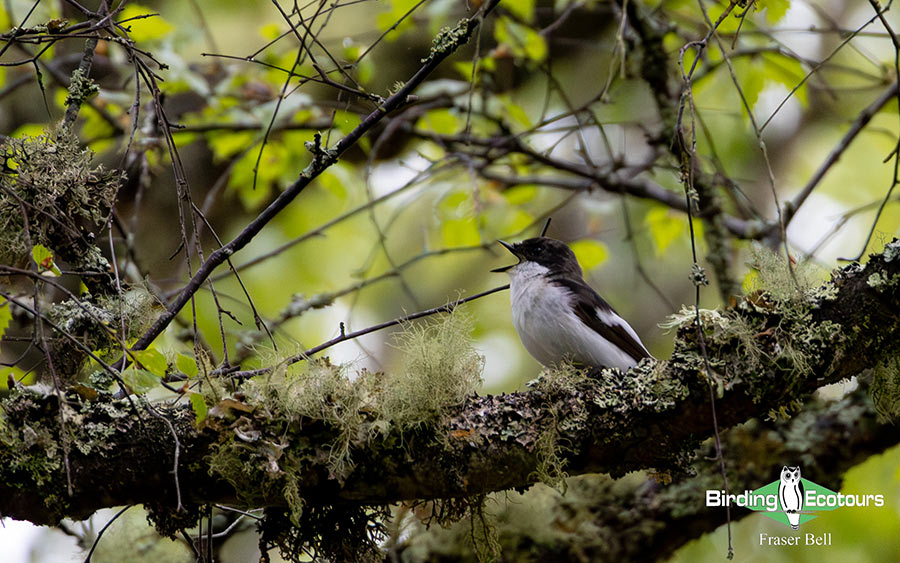
This young male European Pied Flycatcher gave us the runaround before we enjoyed repeated good looks at him.
We spent the afternoon at various woodland and wetland sites on the way south to Pitlochry, where we would spend the night. We then returned to a site for Wood Warbler, but unfortunately did not see one this time, a sober reminder of how rare this iconic woodland species has become in the UK. At the wetlands we added three waterfowl species to our trip list, with Northern Shoveler, Eurasian Wigeon, and a late Whooper Swan, in addition to many other species we had become familiar with over the course of a long week of birding in Scotland. We checked in to our plush hotel and enjoyed a final meal together.
Day 11, 6th June 2026. Birding Scotland’s largest reed bed and tour conclusion
We started with some birding in the grounds of our hotel, seeing many garden species we were familiar with, but importantly, we finally saw a perched male Eurasian Bullfinch. This species had been heard and seen briefly in flight throughout the tour, so it was very satisfying to finally see the species on the last morning together.
We then traveled south to the Tay River reedbeds, Scotland’s largest stretch of reed and an internationally important wetland area. The specialist songbirds were great here, with many Common Reed Warbler, Sedge Warbler, Common Reed Bunting, and an all too brief distant view of a male Bearded Reedling perched on the tops of some reeds. Here we enjoyed seeing many Western Marsh Harrier slowly flying across the tops of the reeds, and we were able to see male, female, and juvenile plumages. This made for a great end to the tour, and we then headed south for Edinburgh where the group parted ways.
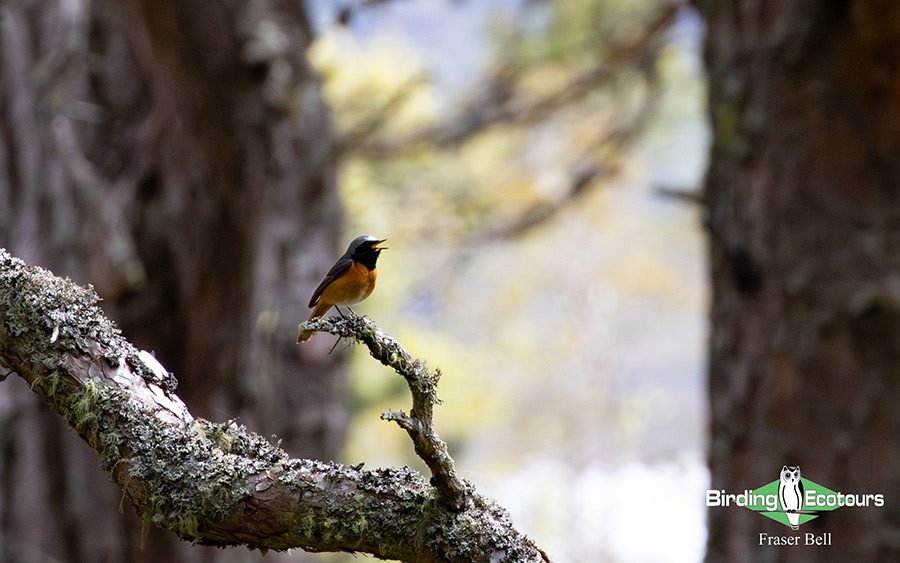
Common Redstart in breeding plumage are simply stunning.
The group had been excellent fun, and I thoroughly enjoyed showing them the great birds of Scotland. Bird of the trip was hotly contested, but the experience of seeing Corn Crake on Iona could not be beaten. Seeing three of these ultra-secretive birds so well (see the cover image), and hearing so many more as we explored the peaceful island, was an experience none of us will soon forget. Honorable mentions go to the impressive Red Kite and colorful Yellowhammer.
Bird List – Following IOC (Version 15.1 March 2026)
Water Rail was ‘heard only’ and is marked with a (H) after the common name, all other species were seen. A VU notation after species names is used to show a Vulnerable conservation status following BirdLife International, and (Introduced) is used to identify nonnative species.
| English Name | Scientific Name |
| Ducks, Geese, Swans (Anatidae) | |
| Canada Goose (Introduced) | Branta canadensis |
| Greylag Goose | Anser anser |
| Pink-footed Goose | Anser brachyrhynchus |
| Mute Swan | Cygnus olor |
| Whooper Swan | Cygnus cygnus |
| Common Shelduck | Tadorna tadorna |
| Mandarin Duck (Introduced) | Aix gallericulata |
| Northern Shoveler | Spatula clypeata |
| Eurasian Wigeon | Mareca penelope |
| Mallard | Anas platyrhynchos |
| Eurasian Teal | Anas crecca |
| Tufted Duck | Aythya fuligula |
| Common Eider | Somateria mollissima |
| Common Goldeneye | Bucephala clangula |
| Common Merganser | Mergus merganser |
| Red-breasted Merganser | Mergus serrator |
| Pheasants & Allies (Phasianidae) | |
| Red Grouse | Lagopus scotica |
| Rock Ptarmigan | Lagopus muta |
| Black Grouse | Lyrurus tetrix |
| Common Pheasant (Introduced) | Phasianus colchicus |
| Red-legged Partridge (Introduced) | Alectoris rufa |
| Swifts (Apodidae) | |
| Common Swift | Apus apus |
| Cuckoos (Cuculidae) | |
| Common Cuckoo | Cuculus canorus |
| English Name | Scientific Name |
| Pigeons & Doves (Columbidae) | |
| Rock Dove | Columba livia |
| Stock Dove | Columba oenas |
| Common Wood Pigeon | Columba palumbus |
| Eurasian Collared Dove | Streptopelia decaocto |
| Rails, Crakes & Coots (Rallidae) | |
| Water Rail (H) | Rallus aquaticus |
| Corn Crake | Crex crex |
| Grebes (Podicipedidae) | |
| Little Grebe | Tachybaptus ruficollis |
| Great Crested Grebe | Podiceps cristatus |
| Oystercatchers (Haematopodidae) | |
| Eurasian Oystercatcher | Haematopus ostralegus |
| Plovers (Charadriidae) | |
| European Golden Plover | Pluvialis apricaria |
| Common Ringed Plover | Charadrius hiaticula |
| Northern Lapwing | Vanellus vanellus |
| Sandpipers & Snipes (Scolopacidae) | |
| Eurasian Curlew | Numenius arquata |
| Eurasian Woodcock | Scolopax rusticola |
| Common Snipe | Gallinago gallinago |
| Common Sandpiper | Actitis hypoleucos |
| Common Redshank | Tringa totanus |
| Ruddy Turnstone | Arenaria interpres |
| Dunlin | Calidris alpina |
| Gulls & Terns (Laridae) | |
| Arctic Tern | Sterna paradisaea |
| Common Tern | Sterna hirundo |
| Sandwich Tern | Thalasseus sandvicensis |
| Black-legged Kittiwake – VU | Rissa tridactyla |
| Black-headed Gull | Chroicocephalus ridibundus |
| Common Gull | Larus canus |
| English Name | Scientific Name |
| European Herring Gull | Larus argentatus |
| Great Black-backed Gull | Larus marinus |
| Lesser Black-backed Gull | Larus fuscus |
| Skuas (Stercorariidae) | |
| Great Skua | Stercorarius skua |
| Auks (Alcidae) | |
| Atlantic Puffin – VU | Fratercula arctica |
| Black Guillemot | Cepphus grylle |
| Razorbill | Alca torda |
| Common Murre | Uria aalge |
| Loons (Gaviidae) | |
| Red-throated Loon | Gavia stellata |
| Black-throated Loon | Gavia arctica |
| Common Loon | Gavia immer |
| Petrels & Shearwaters (Procellariidae) | |
| Northern Fulmar | Fulmarus glacialis |
| Manx Shearwater | Puffinus puffinus |
| Gannets (Sulidae) | |
| Northern Gannet | Morus bassanus |
| Cormorants & Shags (Phalacrocoracidae) | |
| Great Cormorant | Phalacrocorax carbo |
| European Shag | Gulosus aristotelis |
| Herons & Bitterns (Ardeidae) | |
| Grey Heron | Ardea cinerea |
| Ospreys (Pandionidae) | |
| Osprey | Pandion haliaetus |
| Kites, Hawks & Eagles (Accipitridae) | |
| Eurasian Sparrowhawk | Accipiter nisus |
| Hen Harrier | Circus cyaneus |
| English Name | Scientific Name |
| Western Marsh Harrier | Circus aeruginosus |
| Red Kite | Milvus milvus |
| White-tailed Eagle | Haliaeetus albicilla |
| Common Buzzard | Buteo buteo |
| Owls (Strigidae) | |
| Tawny Owl | Strix aluco |
| Woodpeckers (Picidae) | |
| Great Spotted Woodpecker | Dendrocopos major |
| Falcons (Falconidae) | |
| Common Kestrel | Falco tinnunculus |
| Crows & Jays (Corvidae) | |
| Eurasian Jay | Garrulus glandarius |
| Eurasian Magpie | Pica pica |
| Western Jackdaw | Coloeus monedula |
| Rook | Corvus frugilegus |
| Carrion Crow | Corvus corone |
| Hooded Crow | Corvus cornix |
| Northern Raven | Corvus corax |
| Tits (Paridae) | |
| Coal Tit | Periparus ater |
| Crested Tit | Lophophanes cristatus |
| Eurasian Blue Tit | Cyanistes caeruleus |
| Great Tit | Parus major |
| Larks (Alaudidae) | |
| Eurasian Skylark | Alauda arvensis |
| Swallows & Martins (Hirundinidae) | |
| Sand Martin | Riparia riparia |
| Barn Swallow | Hirundo rustica |
| Western House Martin | Delichon urbicum |
| English Name | Scientific Name |
| Bushtits (Aegithalidae) | |
| Long-tailed Tit | Aegithalos caudatus |
| Leaf Warblers (Phylloscopidae) | |
| Willow Warbler | Phylloscopus trochilus |
| Common Chiffchaff | Phylloscopus collybita |
| Reed Warblers & Allies (Acrocephalidae) | |
| Sedge Warbler | Acrocephalus schoenobaenus |
| Common Reed Warbler | Acrocephalus scirpaceus |
| Sylviid Babblers (Sylviidae) | |
| Eurasian Blackcap | Sylvia atricapilla |
| Garden Warbler | Sylvia borin |
| Common Whitethroat | Curruca communis |
| Goldcrests (Regulidae) | |
| Goldcrest | Regulus regulus |
| Wrens (Troglodytidae) | |
| Eurasian Wren | Troglodytes troglodytes |
| Nuthatches (Sittidae) | |
| Eurasian Nuthatch | Sitta europaea |
| Treecreepers (Certhiidae) | |
| Eurasian Treecreeper | Certhia familiaris |
| Starlings (Sturnidae) | |
| Common Starling | Sturnus vulgaris |
| Thrushes (Turdidae) | |
| Song Thrush | Turdus philomelos |
| Mistle Thrush | Turdus viscivorus |
| Common Blackbird | Turdus merula |
| Ring Ouzel | Turdus torquatus |
| English Name | Scientific Name |
| Chats & Old World Flycatchers (Muscicapidae) | |
| Spotted Flycatcher | Muscicapa striata |
| European Robin | Erithacus rubecula |
| European Pied Flycatcher | Ficedula hypoleuca |
| Common Redstart | Phoenicurus phoenicurus |
| Whinchat | Saxicola rubetra |
| European Stonechat | Saxicola rubicola |
| Northern Wheatear | Oenanthe oenanthe |
| Dippers (Cinclidae) | |
| White-throated Dipper | Cinclus cinclus |
| Old World Sparrows (Passeridae) | |
| House Sparrow | Passer domesticus |
| Accentors (Prunellidae) | |
| Dunnock | Prunella modularis |
| Wagtails & Pipits (Motacillidae) | |
| Grey Wagtail | Motacilla cinerea |
| White Wagtail | Motacilla alba |
| Meadow Pipit | Anthus pratensis |
| Tree Pipit | Anthus trivialis |
| European Rock Pipit | Anthus petrosus |
| Finches (Fringillidae) | |
| Eurasian Chaffinch | Fringilla coelebs |
| Eurasian Bullfinch | Pyrrhula pyrrhula |
| European Greenfinch | Chloris chloris |
| Twite | Linaria flavirostris |
| Common Linnet | Linaria cannabina |
| Redpoll | Acanthis flammea |
| Red Crossbill | Loxia curvirostra |
| European Goldfinch | Carduelis carduelis |
| Eurasian Siskin | Spinus spinus |
| Longspurs & Snow Buntings (Calcariidae) | |
| Snow Bunting | Plectrophenax nivalis |
| Buntings (Emberizidae) | |
| Corn Bunting | Emberiza calandra |
| Yellowhammer | Emberiza citrinella |
| Common Reed Bunting | Emberiza schoeniclus |
| Species seen: | 133 |
| Species heard: | 1 |
| Total recorded: | 134 |
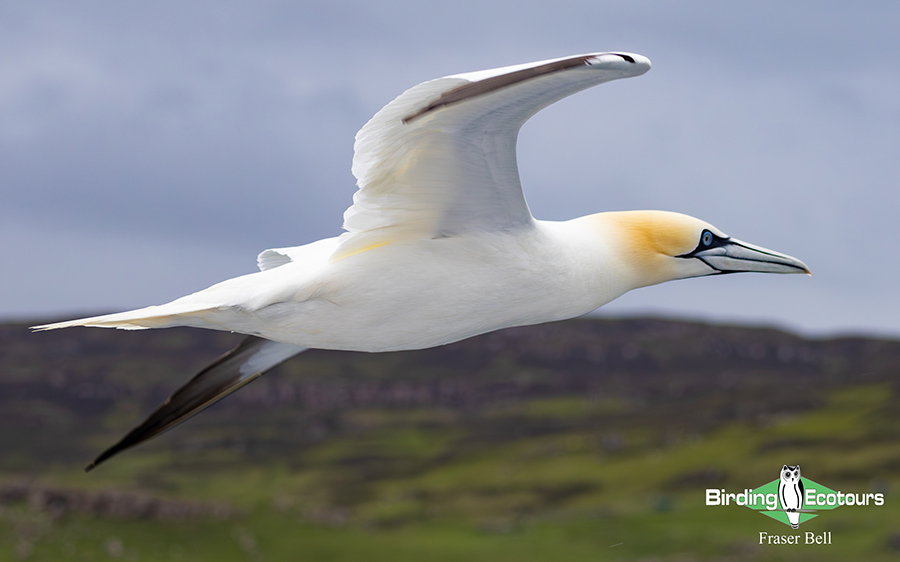
Northern Gannet are impressive birds, and several escorted us on our boat trip.
Mammal List – Following IUCN (May 2026)
| English Name | Scientific Name |
| Beavers (Castoridae) | |
| Eurasian Beaver | Castor fiber |
| Mice & Rats (Muridae) | |
| Long-tailed Field Mouse | Apodemus sylvaticus |
| Squirrels (Sciuridae) | |
| Red Squirrel | Sciurus vulgaris |
| Rabbits & Hares (Leporidae) | |
| European Hare (Introduced) | Lepus europaeus |
| Mountain Hare | Lepus timidus |
| European Rabbit (Introduced) | Oryctolagus cuniculus |
| Weasels, Badgers & Kin (Mustelidae) | |
| Eurasian Otter | Lutra lutra |
| Pine Marten | Martes martes |
| European Badger | Meles meles |
| Earless Seals (Phocidae) | |
| Grey Seal | Halichoerus grypus |
| Deer (Cervidae) | |
| European Roe Deer | Capreolus capreolus |
| Red Deer | Cervus elaphus |
| Sika Deer (Introduced) | Cervus nippon |
| Common Fallow Deer (Introduced) | Dama dama |
| Oceanic Dolphins (Delphinidae) | |
| Common Dolphin | Delphinus delphis |
| Species seen: | 15 |
This is a sample trip report. Please email us ([email protected]) for more trip reports from this destination.