23 SEPTEMBER–10 OCTOBER 2026
By Daniel Engelbrecht
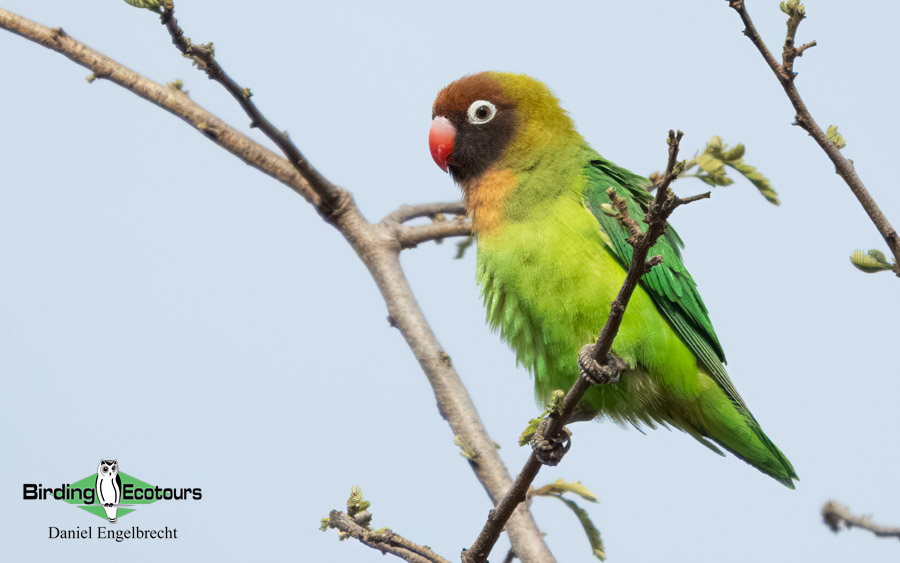
The gorgeous Black-cheeked Lovebird is one of two Zambian endemics. We had several encounters with this species during our time in Kafue National Park.
Overview
This 18-day private tour of Zambia followed the route of our Zambia Birding Tour: Endemics and Rare Birds, covering some of the country’s premier birding destinations, with a particular focus on its two endemic bird species and the rare, seldom-seen species of the remote northwest and Mutinondo Wilderness.
The tour started in Lusaka, Zambia’s capital city, before heading northeast to Mutinondo, with strategic stops in Chisamba and Mkushi en route. This first leg of the tour produced several phenomenal sightings, including the near-mythical Chestnut-headed Flufftail, Pale-billed Hornbill, Lilian’s Lovebird, Anchieta’s and Black-backed Barbets, Bocage’s Akalat, Böhm’s Flycatcher, African Spotted Creeper, Black-necked Eremomela, Laura’s Woodland Warbler, Bar-winged Weaver, Locust Finch, and Anchieta’s Sunbird, to name a few.
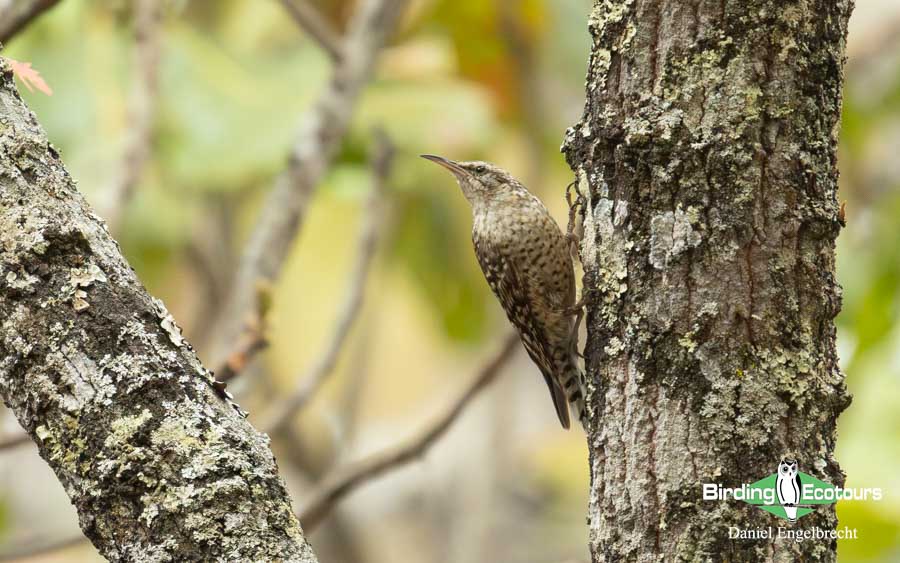
Zambia is arguably the best country to see birds closely associated with miombo woodlands, like this African Spotted Creeper.
From Mutinondo, we began the long journey west, breaking it up with overnight stops near Ndola, Chingola, and Mutanda while targeting several sought-after species along the way, such as Böhm’s Bee-eater, Red-throated Cliff Swallow, Bamboo Warbler, Souza’s Shrike, Miombo Wren-Warbler, Margaret’s Batis, Sharp-tailed Starling, Chestnut-backed Sparrow-Weaver, and Black-faced Canary. We spent four nights in the remote northwest, dividing our time between the Mwinilunga area and Nyachisala Forest, where we encountered some of the best birds of the trip. We fared well with all our targets on this leg, securing views of Vermiculated Fishing Owl, African Grass Owl, Spot-breasted Ibis, Great Snipe, Blue Quail, Spotted Thrush-Babbler, Black-collared Bulbul, Dambo Cisticola, Angola Lark, Black-and-rufous Swallow, Grimwood’s Longclaw, Bannerman’s and Bates’s Sunbirds, and Black-bellied Seedcracker.
After the northwest, we slowly made our way south to Livingstone, with a few overnight stops along the way, notably in Kafue National Park. We added several exciting species during this leg, including Zambia’s two endemic birds, Chaplin’s Barbet and Black-cheeked Lovebird, as well as Racket-tailed Roller, Dickinson’s Kestrel, and Brown-necked Parrot, to name a few. The tour concluded in Livingstone with a visit to the famous Victoria Falls, followed by a boat cruise on the Zambezi River, where we saw African Finfoot, White-crowned Lapwing, Rock Pratincole, and African Skimmer, providing a fitting end to a successful trip! Birds aside, we saw several notable mammals on this tour, including a pack of African Wild Dogs, Roan and Sable Antelope, Sharpe’s Grysbok, Puku, African Savanna Elephant, and many of the more common ungulates.
Logistically, the tour ran smoothly overall, although the notoriously poor Zambian roads resulted in several longer-than-expected travel days. Fortunately, this had little impact on our birding plans. We were also fortunate to have excellent weather throughout the tour, with rainfall on just one night and warm but manageable temperatures throughout.
A detailed daily account can be read below, and the full bird and mammal lists are located at the end of the report. More photos and details can be found in the eBird trip report here.
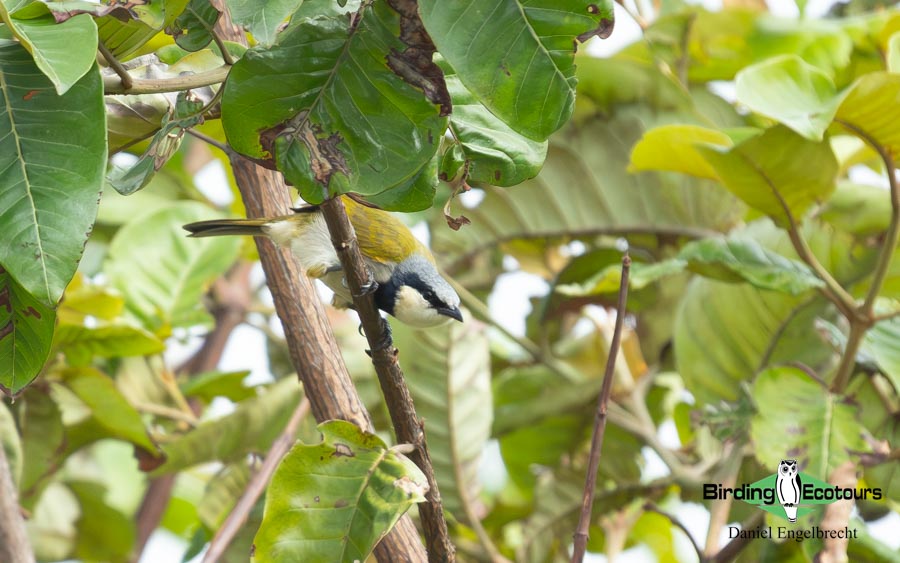
The unusual-looking Black-collared Bulbul was fairly common during our time in the northwest.
Detailed Report
Day 1, 23rd September 2026. Arrival in Lusaka and transfer to Chisamba
After a short flight from Johannesburg, David and I landed in Lusaka, Zambia’s capital, on a hot, hazy afternoon. We cleared passport control and collected our luggage with ease before meeting our driver, Justin, in the arrivals hall. We wasted no time getting started with the birding, as this afternoon would be our only chance to see the localized Lilian’s Lovebird. Our first stop was a dirt road east of Lusaka, where we spent just under an hour birding and got our trip list off to a solid start with many widespread species, including Natal Spurfowl, Red-faced Mousebird, Little Bee-eater, Tropical Boubou, Variable Sunbird, Black-and-white Mannikin, Green-winged Pytilia, and Red-billed Firefinch, to name a few.
Unfortunately, we had no luck finding the lovebirds here, and with a two-hour drive still ahead of us, time was running short. We decided to investigate one more site near the airport and, to our relief, found a single Lilian’s Lovebird investigating a potential nest hole! The population here appears to represent a natural expansion north from the lower Zambezi Valley, where the species is typically encountered. With our target acquired, we made our way north to Chisamba, spotting our first Crowned Hornbills along the way and enjoying a truly spectacular African sunset shortly before arriving at our comfortable lodge.
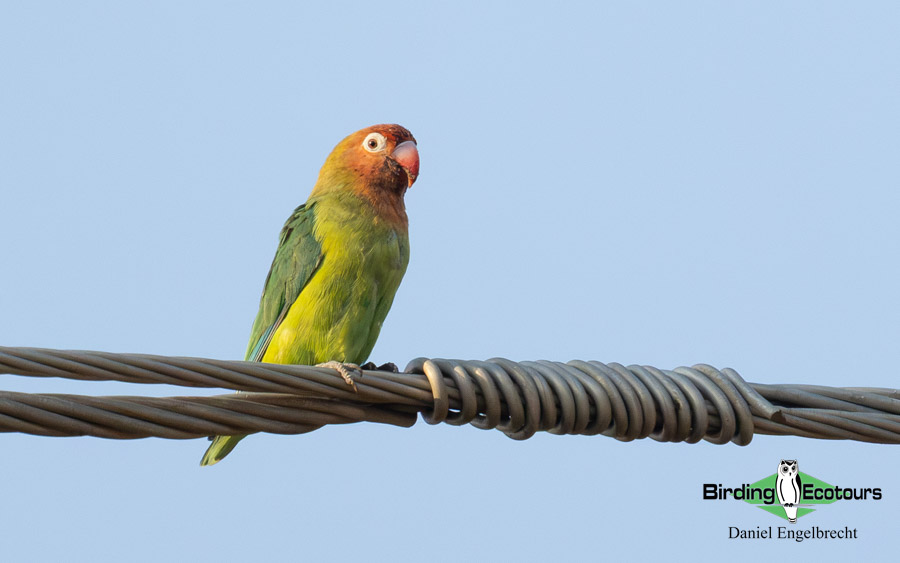
After a search, we managed to find a Lilian’s Lovebird on the outskirts of Lusaka.
Day 2, 24th September 2026. Chisamba birding and transfer to Mkushi
We were up before dawn, eager to make the most of the cooler morning hours before the heat set in. In the lodge car park, we enjoyed our first wailing Trumpeter Hornbill, as well as Black-collared Barbet and the spectacular African Paradise Flycatcher. Our plan for the morning was to bird along a stretch of road where the endemic Chaplin’s Barbet is seen with some regularity. However, before reaching the site, we were distracted by a large mixed-species flock which contained Cardinal Woodpecker, Brubru, Orange-breasted Bushshrike, Yellow-breasted Apalis, Yellow-bellied Greenbul, Scarlet-chested Sunbird, and Spectacled Weaver. We then spent a few hours working our way through the many large fruiting fig trees, the preferred food source of our target, but despite our best efforts, the barbet eluded us (for now). Despite the disappointment, we added several species to our trip list, including Namaqua Dove, African Green Pigeon, Crested Barbet, Northern Fiscal, Rufous-naped Lark, Rattling and Croaking Cisticolas, and nesting Grey-rumped Swallows. As temperatures rose, we began seeing a few soaring raptors, including Black-chested Snake Eagle, Long-crested Eagle, Lizard Buzzard, and Hooded and White-backed Vultures.
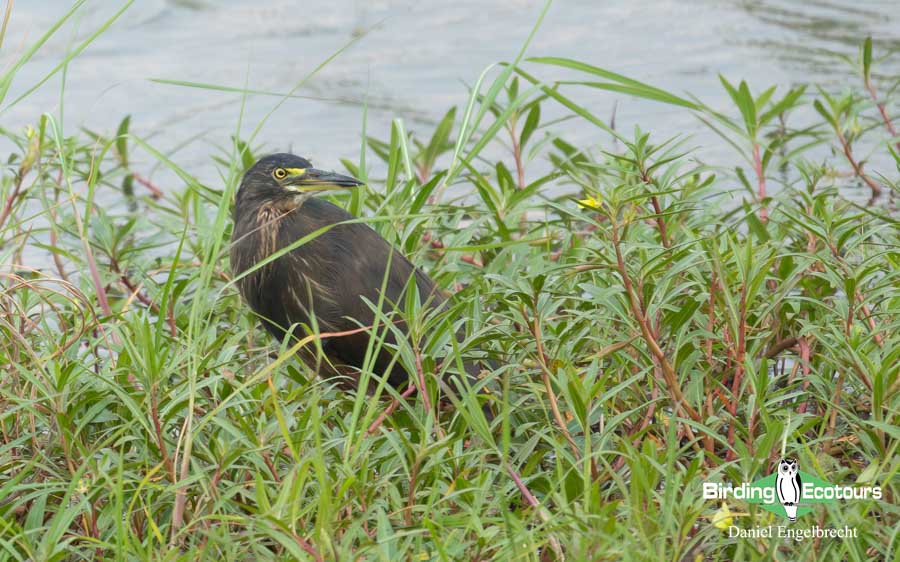
Our first Rufous-bellied Herons of the trip were seen at Huntley Farm.
We still had a long drive ahead of us, but decided to pay a quick visit to Huntley Farm, where we spent an hour exploring the woodlands and dams on the property. Here, we saw good numbers of waterbirds, including over a thousand White-faced Whistling Ducks and similar numbers of Knob-billed Ducks, along with Spur-winged Geese, Red-billed Teals, and Southern Pochards (our only sighting of the trip). Black Crakes were seen foraging in the reedbeds, and we picked out several Ruffs and a Common Sandpiper among the many Black-winged Stilts and Blacksmith Lapwings along the shoreline. Careful scanning with the scope revealed two Rufous-bellied Herons and a flock of Collared Pratincoles, and we saw our only Great White Pelicans on one of the larger dams.
After lunch, we undertook the lengthy drive to our lodge near the town of Mkushi, arriving at sunset. While unpacking the car, we heard the repetitive song of a Miombo Scrub Robin and were treated to good views of this attractive songster. The beautiful miombo woodlands around the lodge looked promising for our early morning birding session the following day, and we enjoyed a delicious dinner before heading to bed.
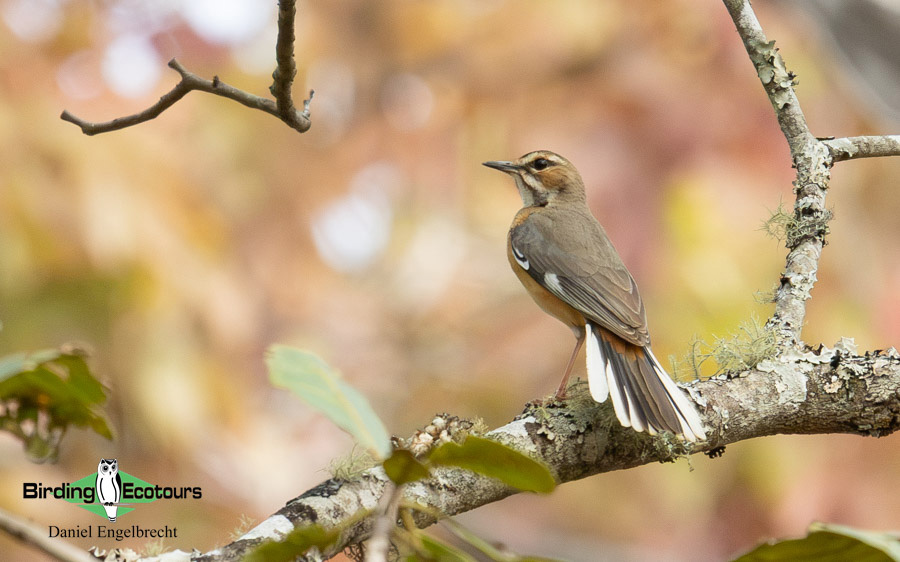
We had several good views of the attractive Miombo Scrub Robin.
Day 3, 25th September 2026. Miombo birding at Mkushi and transfer to Mutinondo
As we emerged from our rooms in the gloomy pre-dawn light, we were greeted by a loud chorus dominated by Red-chested Cuckoo, Kurrichane Thrush, White-browed Robin-Chat, Common Bulbul, and Crowned Hornbill. We then spent some time wandering through the pristine miombo woodlands, which yielded several new species, including Black-backed Barbet, African Golden and Black-headed Orioles, Chinspot Batis, Long-billed Crombec, Bleating Camaroptera, Willow Warbler, Pale and Ashy Flycatchers, White-browed Scrub Robin, Collared and White-bellied Sunbirds, and a gorgeous pair of Red-throated Twinspots. A nearby airfield held a few Plain-backed Pipits, while a patch of tall grass produced several calling Red-faced Cisticolas and flocks of Yellow Bishops.
Our pre-breakfast walk was most enjoyable, and while packing the car, we again enjoyed excellent views of the Miombo Scrub Robin before setting off on the very long drive northeast to Mutinondo Wilderness. Because of the poor road conditions throughout much of Zambia, travel is generally slow, but we made a few short stops to break up the journey. One such stop at a roadside patch of miombo woodland proved quite productive, yielding our first Stierling’s Wren-Warbler, Wood Pipit, and, best of all, a pair of Böhm’s Flycatchers, a generally scarce and inconspicuous miombo special.
We arrived at Mutinondo Wilderness in time for a late lunch and were immediately struck by the scenic beauty of this remote protected area. Massive granite inselbergs dominated the landscape, towering above the surrounding dambos (seasonally flooded wetlands) and miombo woodlands, which at this time of year were awash with a kaleidoscope of colors from the different species of Brachystegia and Monotes trees. Everywhere we looked, we were struck by vivid shades of copper, saffron, green, and gold among the leaves. Our lodge was set atop one of these inselbergs, providing spectacular 360-degree views of the surrounding landscape. We had our binoculars with us at lunch and kicked off our time at Mutinondo with views of a large flock of Olive Bee-eaters, along with a vocal Red-capped Crombec and an inquisitive Familiar Chat. David also spotted a pair of Amethyst Sunbirds constructing a well-camouflaged nest just a few feet from our dining area.
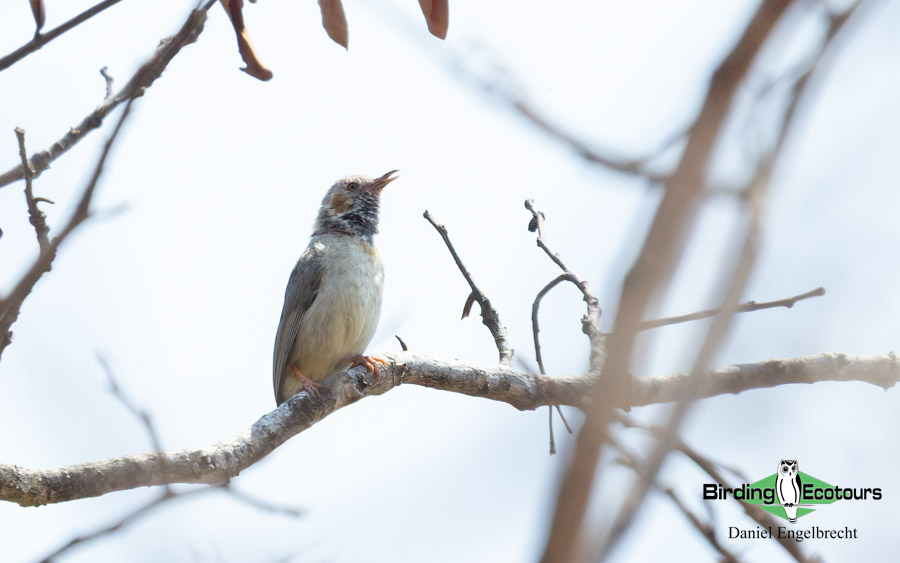
Red-capped Crombec was common in the miombo woodlands at Mutinondo.
In the afternoon, we strolled through the woodlands around the lodge, where we saw Ross’s Turaco, Yellow-fronted Tinkerbird, Black Cuckooshrike, White-tailed Blue Flycatcher, Bar-throated Apalis, Red-headed Weaver, another Böhm’s Flycatcher, Yellow-throated Bush Sparrow, and our only Reichard’s Seedeater of the trip. As we watched the sunset from the rocky outcrop, several Freckled Nightjars started calling around us, and we had good views of this unusually dark nightjar. In the distance, we could hear a covey of Whyte’s Francolins; however, the sun had already set, so there was no chance of seeing the birds. Other nocturnal species recorded that evening included Fiery-necked Nightjar and African Barred Owlet, as well as a displaying African Broadbill after dark.
Day 4, 26th September 2026. Full day birding at Mutinondo
Our plan for the morning was to spend the early hours trying to find one of the main targets of the trip, the rare and elusive Chestnut-headed Flufftail. We arrived at the dambo before sunrise and made our way through the wet grass to a swampy drainage line, where we quickly heard a responsive individual. Even by flufftail standards, I have to say that this bird is in a league of its own when it comes to possessing arcane skulking abilities. After nearly two hours of unsuccessfully trying to see the bird, we decided to head back to the car and try again in the evening. However, just as we were walking out, the flufftail started calling from right at our feet. We managed to flush the bird and had our first, brief views of this mega global bird. There were plenty of other distractions while trying to see the flufftail, including several displaying Fan-tailed Grassbirds, Flappet Lark, Marsh Widowbird, Fülleborn’s Longclaw, and our first of many Locust Finches. After a successful early morning session, we made our way back to the lodge for breakfast before setting out again, this time focusing on the miombo woodlands.
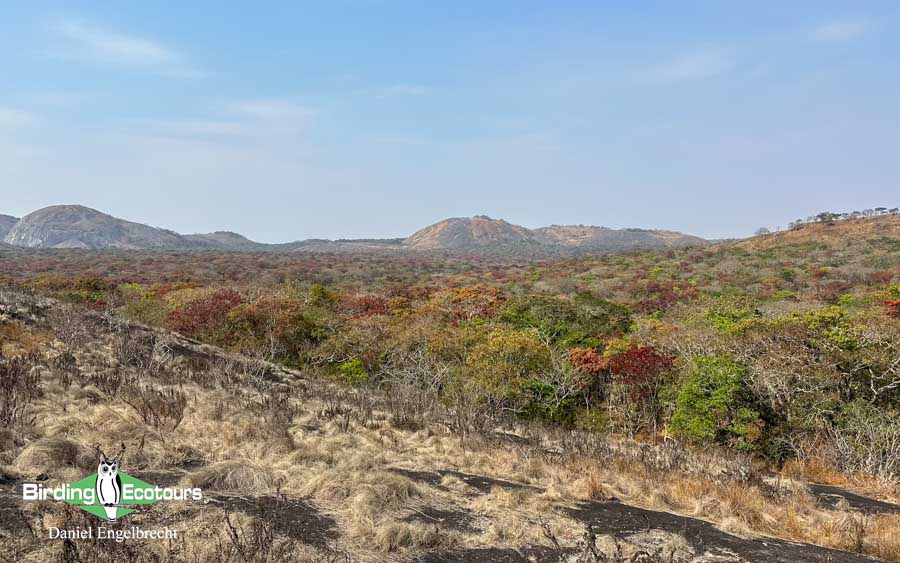
Mutinondo is a breathtaking place!
Miombo birding can be frustrating at times, and we had long stretches with very little activity, occasionally interrupted by small mixed-species flocks. Overall, the late-morning session was a bit slow, but we did see a few notable species, such as African Green Pigeon, Southern Hyliota, Green-capped Eremomela, Western Miombo Sunbird, and Black-eared Seedeater. The highlight of the morning was a stunning male Anchieta’s Sunbird, which enlivened an otherwise quiet session as midday approached. We also investigated a patch of mushitu woodland, a type of evergreen forest that grows along streams in this part of Zambia. Although the patch looked very promising, we decided to return earlier the following morning, when the birds would be more active.
We had a short break for lunch and headed out again later in the afternoon for what proved to be a rewarding outing. Again, we birded the miombo woodlands, but unlike this morning, we had a near-constant stream of activity. Mixed-species flocks yielded Green-backed Honeybird, White-breasted Cuckooshrike, Rufous-bellied and Miombo Tits, and Eastern Miombo Sunbird, all of which were new for the trip list. Just before sunset, we struck gold when we found a single Bar-winged Weaver in a flock, giving us excellent views of this rare and extremely difficult-to-find bird. We then decided to visit the same dambo where we had seen the flufftail that morning, and in the fading light, we managed to improve our views of Chestnut-headed Flufftail. The bird seemed to be showier this evening (by flufftail standards) but remained exceptionally challenging to see. On the way back to the car, we heard a Swamp Nightjar calling and were treated to our first views of this species.
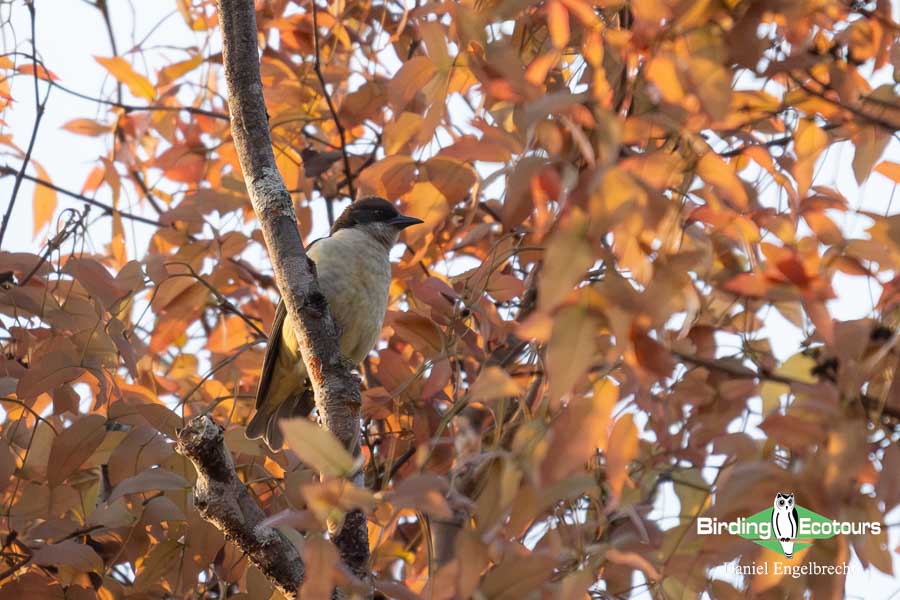
We were thrilled to find this Bar-winged Weaver foraging quietly in a mixed-species flock.
After a tasty dinner back at the lodge, we headed to bed, falling asleep to the sounds of displaying Pennant-winged Nightjars.
Day 5, 27th September 2026. Full day birding at Mutinondo
We had another full day to explore Mutinondo, this time focusing our attention on the miombo woodlands for our pre-breakfast session. We first visited an area where we had heard Whyte’s Francolin calling on our first evening here. However, despite seeing plenty of miombo birds, the francolins were nowhere to be seen or heard. Some of the new species seen on our morning walk included African Goshawk, Common Scimitarbill, Lesser Honeyguide, Yellow-bellied Hyliota, Grey Penduline Tit, Black-necked Eremomela, and Southern Black Flycatcher. We then spent time driving along the network of roads through the woodlands and alongside the dambos, stopping regularly whenever we heard activity. This yielded many of the same species.
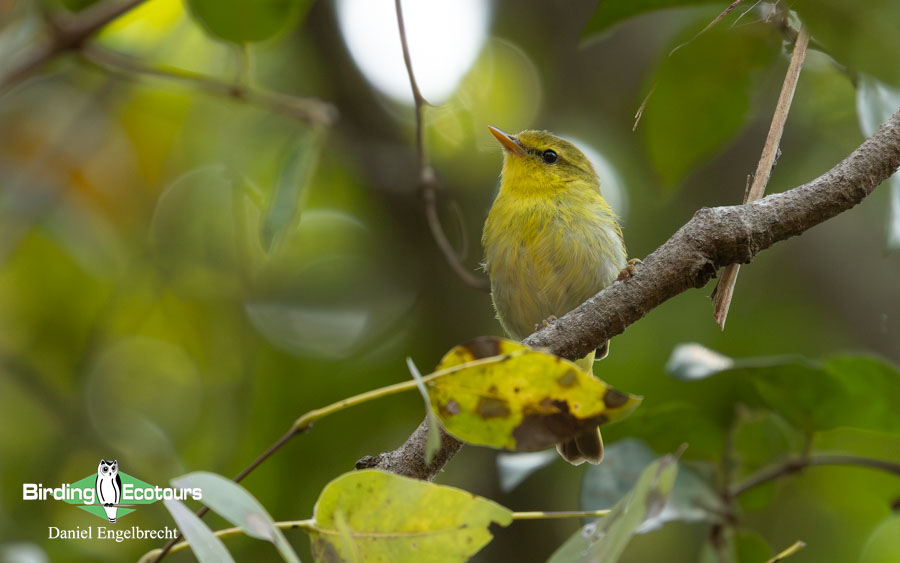
We had a few encounters with the localized Laura’s Woodland Warbler.
We had breakfast back at the lodge before making our way to the mushitu woodland that we had scouted yesterday. As expected, visiting earlier made all the difference, and we quickly started adding new birds in the form of Little Greenbul, Grey-olive Greenbul, Square-tailed Drongo, White-tailed Crested Flycatcher, and Brown-headed Apalis. Our two main targets, Laura’s Woodland Warbler and Bocage’s Akalat, showed well, with the latter requiring a bit more work. A bonus came in the form of an African Broadbill, which perched out in the open for us. On the way back to the lodge, we made a quick pre-lunch stop at another small patch of mushitu woodland, where we saw our first African Spotted Creeper, along with a raucous flock of Retz’s Helmetshrikes. At lunch, we were treated to views of a Mocking Cliff Chat that had found its way into the kitchen. After a short break during the heat of the day, we headed back out for an afternoon session.
The afternoon yielded many of the same species that we had seen over the past few days. However, we finally managed to see Pale-billed Hornbill, a fairly common species here that had so far eluded us, as well as a vocal African Cuckoo. On our way back to the lodge, just before dusk, Justin spotted a bird feeding in a small fig tree: an Anchieta’s Barbet! Unfortunately, almost as soon as I got onto the bird, it flew off, and despite our best efforts, we were unable to relocate it. Once again, we enjoyed a lovely home-cooked meal at our lodge and headed to bed early in preparation for a long day on the road tomorrow.
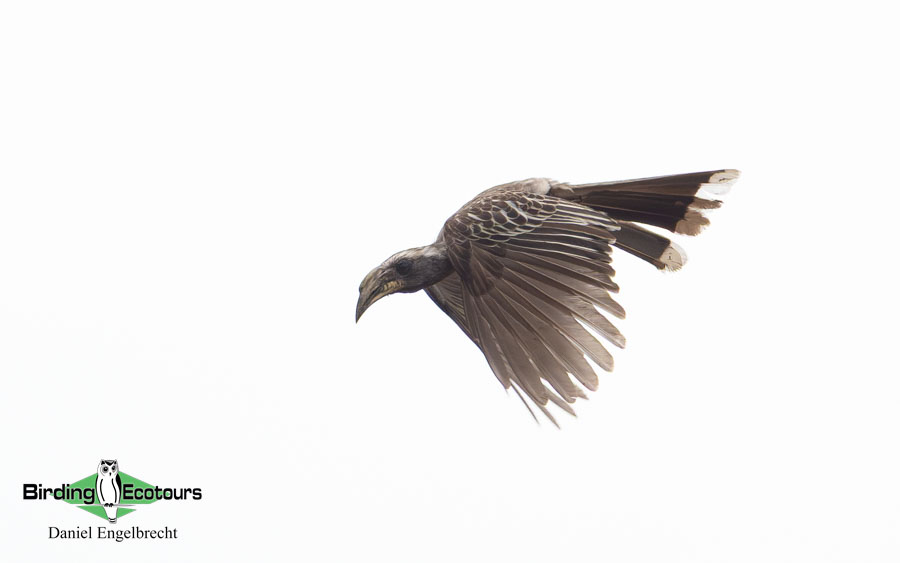
Our first Pale-billed Hornbill was seen at Mutinondo.
Day 6, 28th September 2026. Transfer to Nsobe Camp via North Swaka Forest Reserve
We had a long drive ahead of us today, so we decided to get up early and squeeze in some final birding at Mutinondo. The only new additions for the morning were Coppery-tailed Coucal and Wahlberg’s Eagle, both of which we would see again later in the trip. After leaving Mutinondo, we passed through a section of degraded miombo woodland where I heard the distinctive whistling call of a Tinkling Cisticola, which treated us to excellent views before we joined the main road and started the long drive west to Nsobe Camp.
Progress was slow, with poor roads and endless trucks being a feature of much of the day. However, we decided to take a detour through North Swaka Forest Reserve, not only to escape the main road but also to give us a chance for some birding. We spent around two hours birding along the main road that runs through this large tract of splendid, tall miombo woodland. Standout species included our best views yet of Pale-billed Hornbill, along with several other miombo specials seen earlier in the trip, such as African Spotted Creeper, Red-capped Crombec, Rufous-bellied Tit, and Miombo Scrub Robin. The detour also gave us the chance to add a few species to our Democratic Republic of the Congo (DRC) lists, as the road runs right up against the border. The drier woodlands near the western boundary of the reserve yielded a showy pair of Miombo Rock Thrushes, a Black-eared Seedeater, a Dark Chanting Goshawk, and a flushed Coqui Francolin.
We left North Swaka Forest Reserve behind and pushed on toward Nsobe Camp, arriving at dusk, and were greeted by a pair of Fiery-necked Nightjars in the camp’s parking lot.
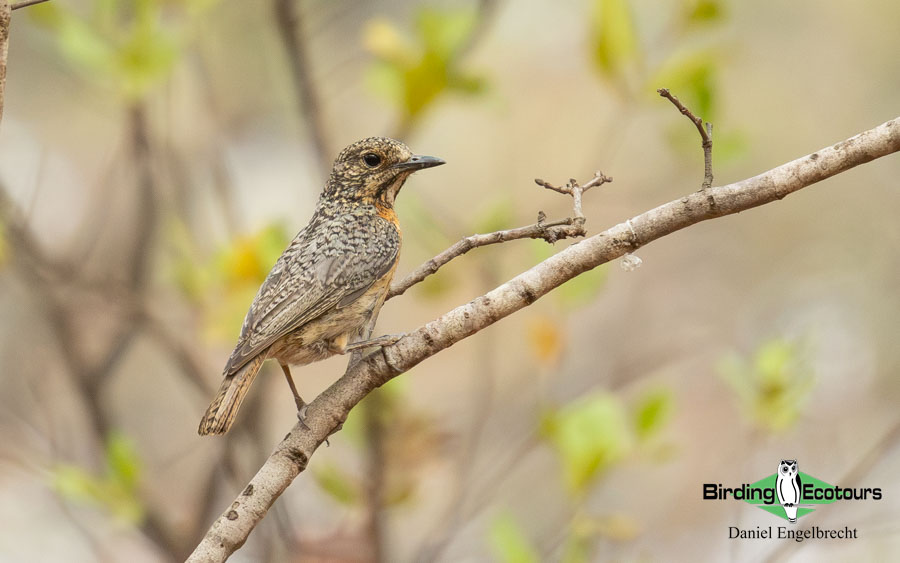
This female Miombo Rock Thrush was seen at North Swaka Forest Reserve.
Day 7, 29th September 2026. Birding Nsobe Camp and transfer to Chingola
Today, we continued our journey west to the mining town of Chingola, in the heart of Zambia’s Copperbelt. We had planned several birding stops en route, but first started with some pre-breakfast birding around Nsobe Camp, which proved exceptional. The dry evergreen forests and dams surrounding the camp were alive with birds, and over the course of two hours, we added several new trip birds, including Narina Trogon, White-fronted Bee-eater, Half-collared Kingfisher, Brown-hooded Kingfisher, Broad-billed Roller, Yellow-rumped Tinkerbird, Purple-throated Cuckooshrike, Black-fronted Bushshrike, Chirping Cisticola, Mosque Swallow, Olive Sunbird, Purple-banded Sunbird, and Dark-backed Weaver. Other notable species included the range-restricted Laura’s Woodland Warbler, which we had already seen at Mutinondo, and multiple displaying African Broadbills.
We had breakfast back at camp, where we added African Fish Eagle, Purple Swamphen, Little Heron, and Hamerkop on the dam, before heading west. Our first stop for the morning was Kafubu Bridge, which quickly delivered the hoped-for Angola Swallow, a scarce species in Zambia, along with excellent views of Chirping Cisticola and Olive Woodpecker. Next up was Mwekera College Forest, where we spent some time wandering through the miombo woodlands. The temperature was rapidly rising, and birding was slow. However, our perseverance was rewarded when we found a small flock of Böhm’s Bee-eaters, which we watched for a while as they hawked insects from their perches in the shade.
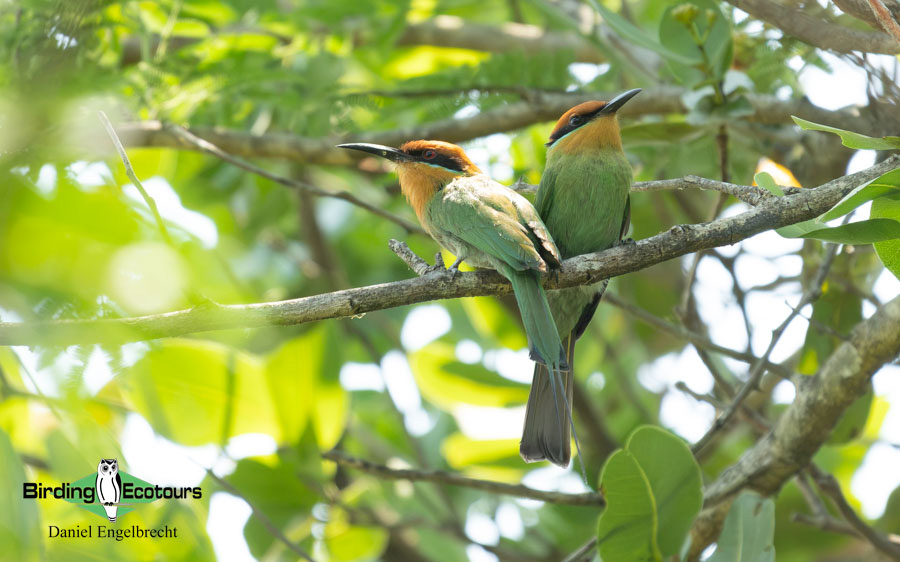
We were delighted to find these Böhm’s Bee-eaters near Kitwe.
We slowly made our way back to the main road, and on the way out, I heard the high-pitched whistle of an Arnot’s Chat. We stopped the car and soon found a family group of these attractive birds foraging in the dry woodland. While enjoying the chats, a mixed-species flock passed through, bringing with it plenty of good birds, such as Striped Kingfisher, Bennett’s and Golden-tailed Woodpeckers, Greater Honeyguide, Böhm’s Flycatcher, White-breasted and Black Cuckooshrikes, Retz’s Helmetshrike, Grey-headed Bushshrike, and Golden-breasted Bunting, among others.
Before reaching the large town of Kitwe, we stopped at a bridge over the Kafue River, where our second hirundine target for the day, Red-throated Cliff Swallow, was easily found. A short strategic stop in Kitwe for a celebratory (and much-needed) ice cream also produced Böhm’s Spinetail, completing the ‘Böhm’s trio’ for us in a single day! We spent the rest of the afternoon driving to Chingola, where we checked into our guesthouse, had an early dinner, and tried to get as much sleep as possible before another early start tomorrow.
Day 8, 30th September 2026. Transfer to Mutanda, birding en route
We set off for the entrance road to Chimfunshi Wildlife Orphanage at dawn, armed with packed breakfasts and lunches and eager to make the most of the cooler morning hours. As it turned out, we didn’t need to worry about the heat today, as most of the morning was overcast, occasionally interrupted by a light drizzle. We spent about five hours exploring the miombo woodlands and were rewarded with what was undoubtedly the best miombo birding of the trip.
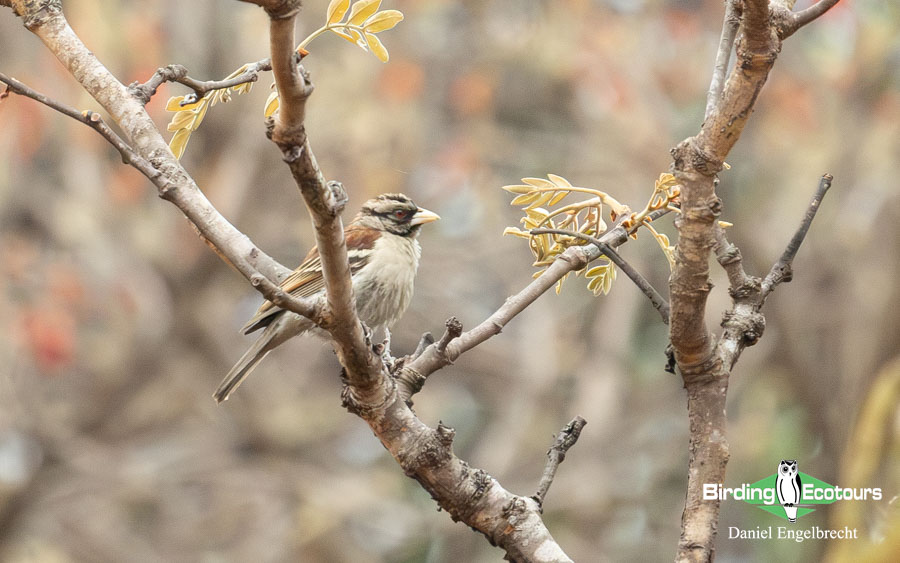
Our main target at Chimfunshi was the scarce Chestnut-backed Sparrow-Weaver.
We started strongly, securing views of Miombo Wren-Warbler within minutes of arriving, shortly followed by Green-backed Woodpecker and good numbers of Sharp-tailed Starlings. For much of our time here, we had a near-constant stream of mixed-species flocks, which yielded almost all the miombo species seen earlier in the trip, along with our main target, the rare Chestnut-backed Sparrow-Weaver, of which we saw several individuals. Other new additions included a vocal Souza’s Shrike, Scaly-throated Honeyguide, Grey-headed Kingfisher, White-crested Helmetshrike, Western Violet-backed Sunbird, and Cabanis’s Bunting. The birding here was nonstop, and at times, it was difficult to know where to look. This was truly miombo birding at its very best! It feels wrong not to elaborate on the eye-level views we had of multiple African Spotted Creepers, or the four woodpecker species foraging in the same field of view (Cardinal, Golden-tailed, Bennett’s, and Green-backed), but suffice it to say, it was spectacular.
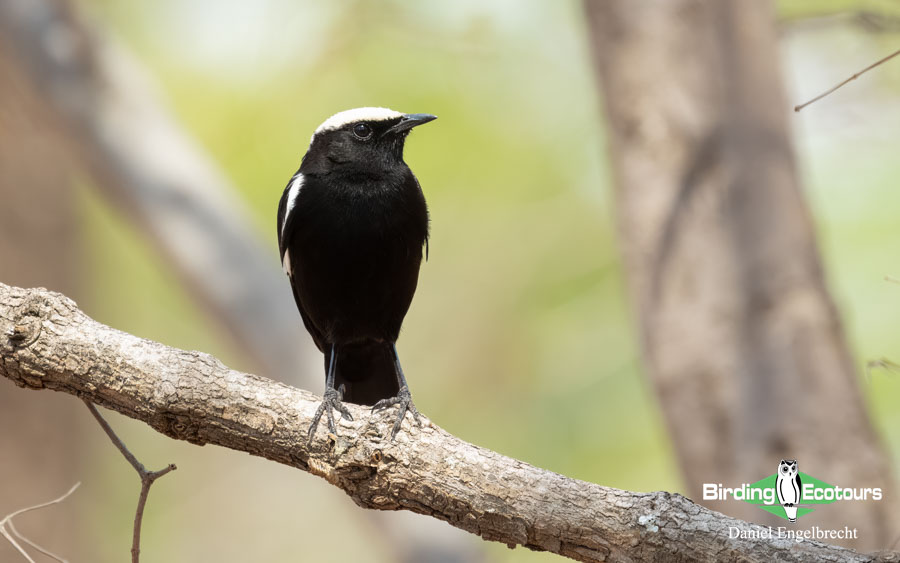
We saw Arnot’s Chats many times on this tour.
After a successful morning, we headed back to the main road, stopping at a small wetland where we managed to coax a male Red-chested Flufftail into view before continuing to Mutanda. We checked into our comfortable lodge overlooking the rushing Mutanda River and, after a break, strolled around the lodge grounds. African Thrushes were in evidence on the lawns, along with raucous Ross’s and Schalow’s Turacos vying for dominance over the soundscape. The riverine vegetation and open woodlands yielded our first Levaillant’s Cuckoo of the trip, along with a few other new species, including White-winged Black Tit, Marsh Tchagra, Moustached Grass Warbler, and African Firefinch. It took us a while to find our first Black-faced Canary; however, by the end of our late-afternoon session, we had seen several large flocks of these attractive seed-eaters. After a busy day, we enjoyed dinner overlooking the Mutanda River and discussed the many exciting target species awaiting us over the coming days in the northwest.
Day 9, 1st October 2026. Transfer to Mwinilunga and birding Chitunta Plain
As was customary on this trip, we left our lodge early and continued west toward Mwinilunga. The Mwinilunga area of northwestern Zambia offers some of the best birding in the country, with several rare and localized south-central African and Congo Basin species seldom seen elsewhere. We would spend the next four nights at two of the premier birding localities in this region, hoping to connect with many of its sought-after denizens.
We had a long drive to our first birding spot today, arriving mid-morning at a bridge over the Kabompo River, where we had two main targets. Around the bridge were large numbers of aerial feeders, including several Red-throated Cliff Swallows, Lesser Striped Swallows, Black Saw-wings, and Western House Martins, along with three swift species: Little Swift, White-rumped Swift, and Common Swift. On the river itself, we found a pair of Cassin’s Flycatchers hawking insects, a fly-by Half-collared Kingfisher, and a Mountain Wagtail searching for morsels among the boulders in the river. We then turned our attention to the tall mushitu woodland along the river, where we found our first target with little effort: the range-restricted Margaret’s Batis. We had prolonged looks at a vocal male, shortly followed by a stunning male Black-throated Wattle-eye. Other distractions included Brown-headed Apalis and Grey-olive Greenbul, before we heard the distinctive call of our second target. We positioned ourselves near a gap in the undergrowth, expecting a real struggle to lay eyes on the bird. However, much to our surprise, the Bamboo Warbler popped out into the open, giving us prolonged views of this rare species. Success! Back at the car, we saw our first Bateleur flying overhead.
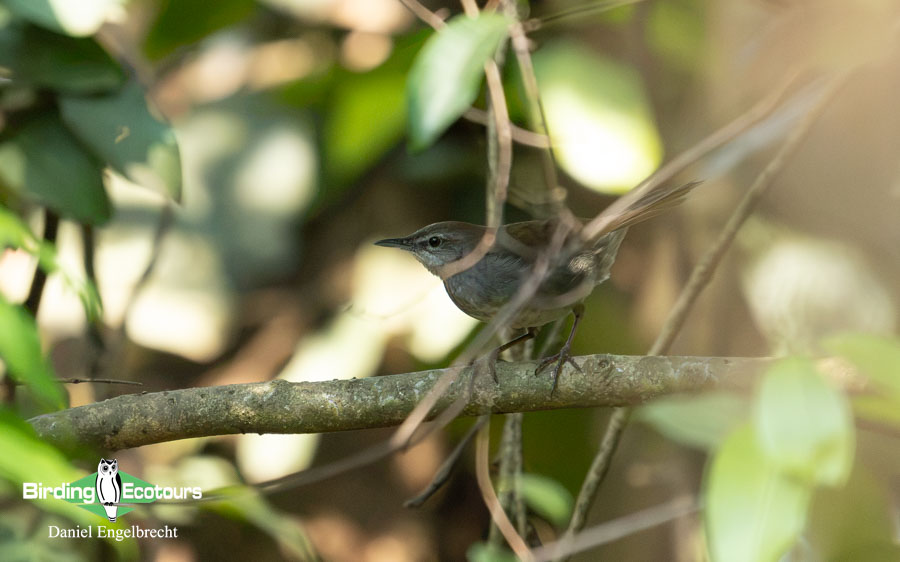
No photography awards for this one, but an excellent bird – Bamboo Warbler!
We continued the long drive to Mwinilunga, checked into our lodge, and headed north to Chitunta Plain for an afternoon session. This expansive plain consists of large areas of dry grassland as well as sizeable flooded grasslands, and we spent the rest of the afternoon successfully searching for our target species. Almost as soon as we left the car and started walking along one of the flooded grassland patches, we flushed a pair of Grimwood’s Longclaws, which landed nearby, giving us walk-away views of this exceptionally range-restricted bird. After finding the longclaws, we kept the momentum going, adding Black-and-rufous Swallow and Dambo Cisticola in quick succession, along with several Blue-breasted Bee-eaters, a pair of Locust Finches, and a flushed Swamp Nightjar.
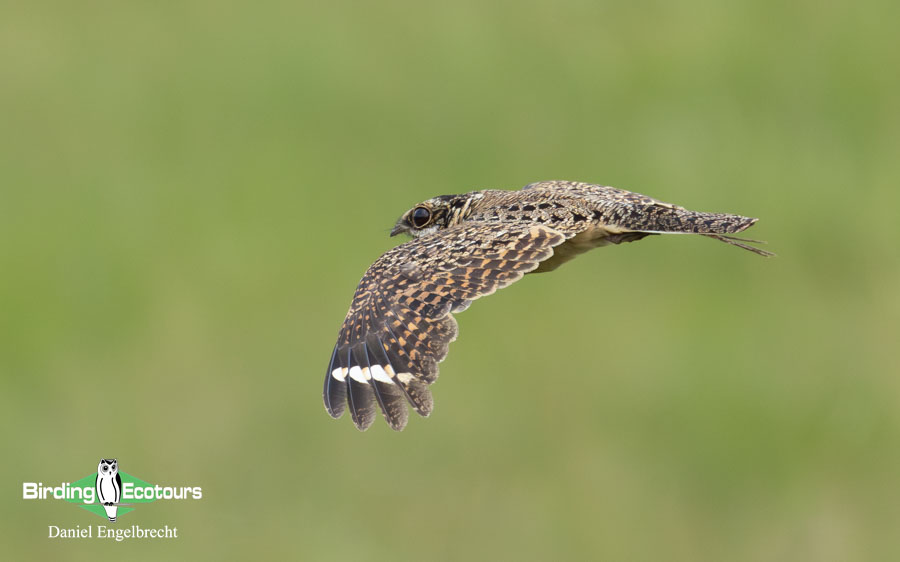
We had exceptional views of this flushed Swamp Nightjar.
The dry woodlands around the plain produced our second Tinkling Cisticola sighting of the trip, along with a flock of Hartlaub’s Babblers. The drier plains held many displaying Wing-snapping Cisticolas, Sooty Chats, and, much to our delight, a vocal Angola Lark (surely one of the best-sounding larks!). Other new additions to the trip list here included Levaillant’s Cisticola, Banded Martin, and Cape Wagtail, and we made a special effort to see the angolensis subspecies of Stout Cisticola here.
We drove back to our lodge in the late afternoon and watched another spectacular African sunset before enjoying a delicious home-cooked meal.
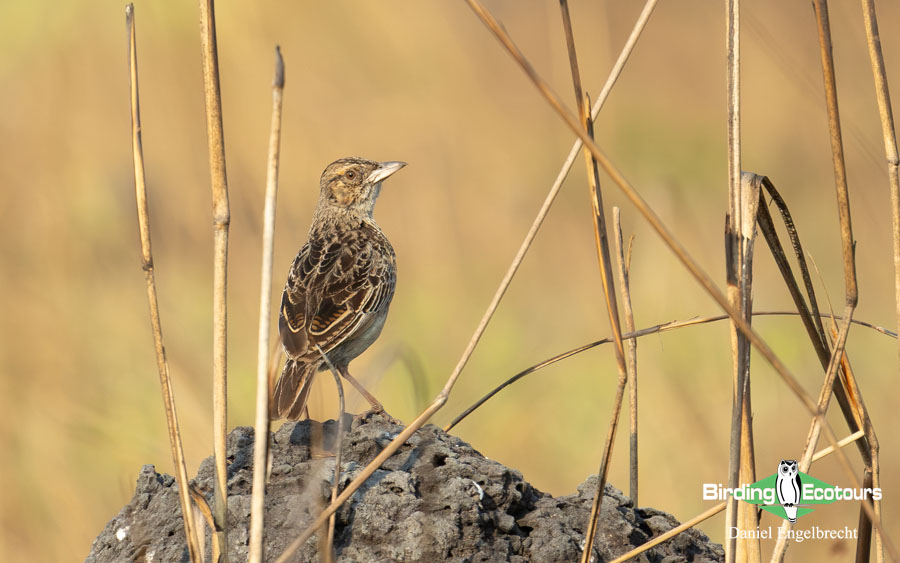
Chitunta Plain produced our best views of Angola Lark.
Day 10, 2nd October 2026. Mwinilunga birding and transfer to Nyachisala Forest
We started the day with pre-breakfast birding at our lodge, whose grounds included a large tract of miombo woodland and two dambos, one of which we had been told was flooded. As we left our rooms, I heard the repetitive, wailing call of an Olive Long-tailed Cuckoo, which we managed to call into view. Any day that starts with views of a long-tailed cuckoo is a good day! The lodge grounds and surrounding woodlands were full of birds, with African Broadbills seemingly displaying every few feet and Narina Trogons being a constant feature of the soundscape. A vocal Blue-breasted Kingfisher was a surprise, as I had expected to see this species only once we reached Nyachisala Forest, our base for the next three nights. The highlight of the morning came at the dambo, where we had close-up views of no fewer than six Lesser Jacanas, our only sighting of this species for the trip. After breakfast, we packed our bags and drove to Nyachisala Forest, making a few stops as we left Mwinilunga, where we saw Red-cheeked Cordon-bleu and Spotted Flycatcher.
Nyachisala Forest is about as remote as you can get in Zambia, and until the recent construction of a road to the DRC border, accessing the forest required a multi-hour drive along narrow sandy tracks. Luckily for us, construction of the new road was largely complete. However, the drive from Mwinilunga still took us most of the day. Before reaching Nyachisala, we detoured to Mufundu Plain, where we spent some time birding in the short, wet grassland. Here, we added a few new species, including African Woolly-necked Stork, Pale-crowned Cisticola, and Buffy Pipit, and had good looks at three longclaw species: Fülleborn’s, Rosy-throated, and Grimwood’s Longclaws. Again, we flushed a few Locust Finches, and we even had our first views of this coveted waxbill on the ground. An African Snipe flushed from a particularly wet area, and a little while later, we flushed another snipe, which looked structurally different and appeared to have extensive barring on the flanks and underwings. We managed to flush the bird a second time, this time obtaining a few record shots and confirming our suspicion that it was a Great Snipe, an unexpected early arrival.
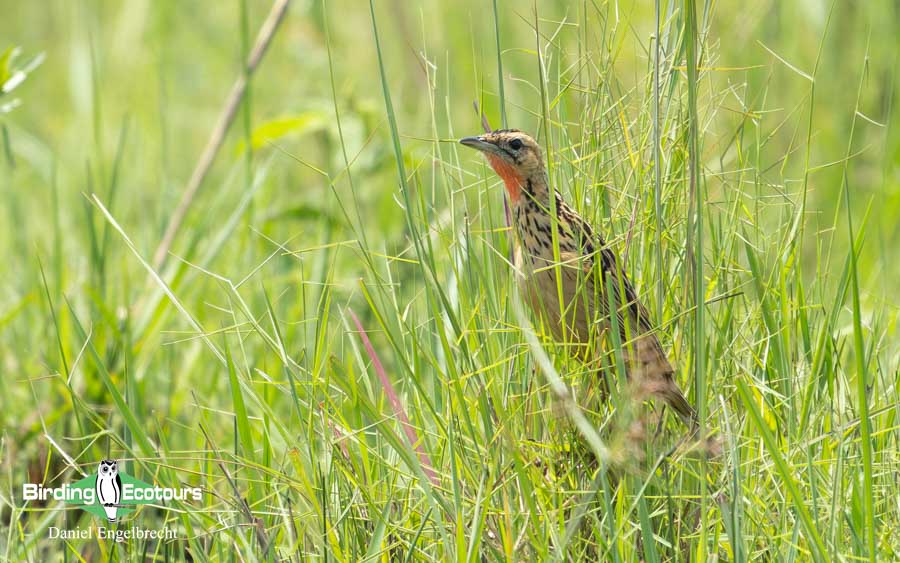
The rare Grimwood’s Longclaw was one of our main targets in the northwest.
By the time we arrived at our tented camp at Nyachisala Forest, we only had about an hour of light left to explore the surroundings. Needless to say, we wasted no time. The habitat at Nyachisala is quite unlike anything I have seen before: towering mushitu forest grows along the West Lunga River, which flows lazily past the tented camp, before suddenly giving way to tall grasslands, dambos, and open woodland. Our first afternoon session produced the attractive and unique-looking Black-collared Bulbul, a calling Afep Pigeon, which remained out of sight, several aptly named Splendid Starlings, and a Fraser’s Rufous Thrush.
As darkness fell, we enjoyed another fabulous dinner prepared by our chef before heading out to try for Vermiculated Fishing Owl, which, unfortunately, was nowhere to be seen or heard! Luckily, we would have another two nights to try for this much-wanted bird. Our owling session was not entirely unsuccessful, however, as we did see an African Wood Owl.
Day 11, 3rd October 2026. Full day birding at Nyachisala Forest
We spent the entire day birding on foot around our tented camp, returning for meals and coffee breaks, and truly making the most of this remote and seldom-visited part of Zambia. A pre-dawn start yielded Swamp Nightjar, African Wood Owl, and Fan-tailed Grassbird; however, we again had no luck with the fishing owl. Over the course of the day, we added many excellent birds to our rapidly growing trip list. The mushitu forest yielded Western Bronze-naped Pigeon, Blue-spotted Wood Dove, White-spotted Flufftail, Blue Malkoha, African Emerald Cuckoo, Honeyguide and Cabanis’s Greenbuls, and Red-capped Robin-Chat, while the striking Shining-blue Kingfisher was seen along the pristine West Lunga River. At breakfast, we heard a Spot-breasted Ibis calling tantalizingly close to our camp, but it remained hidden by the thick canopy. During our afternoon session, I heard the call of a Black-bellied Seedcracker coming from a patch of swamp forest. With a bit of careful fieldcraft, we managed to see this elusive bird. What a stunner! I should also mention that Locust Finches were seen several more times today.
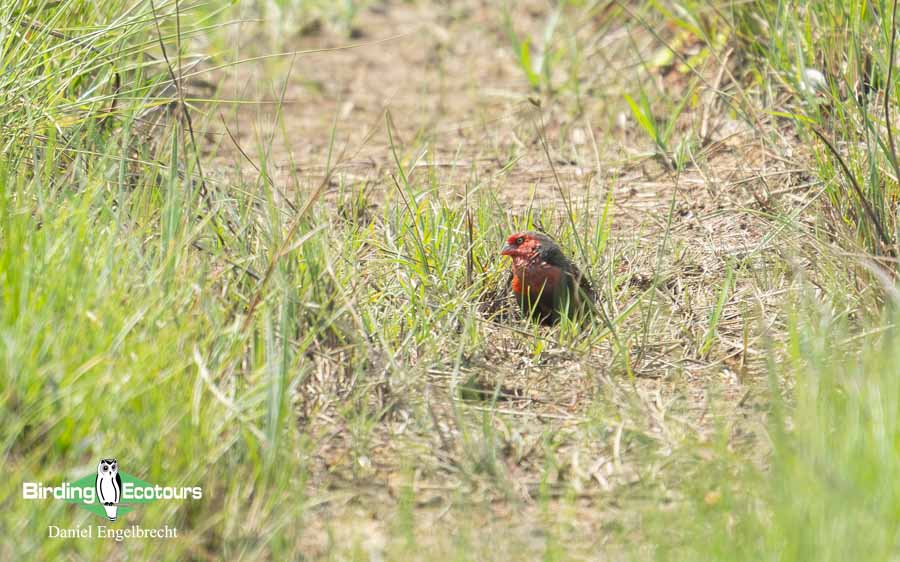
Zambia must rank as the best country to see Locust Finch.
At dusk, we waited in a clearing in the forest, with a clear view up the river, hoping to see the Spot-breasted Ibis we had heard at breakfast. It was almost dark by the time we heard what sounded like two individuals calling from farther upstream. Despite trying our best to see them, the light had failed us. All was not lost, though; we had a good idea of the general area where the birds had settled, so I decided we would walk further upstream the following morning and try to see them as they left their roost.
We returned to camp for dinner and, halfway through our meal, heard the unmistakable hooting of a Vermiculated Fishing Owl! Panic stations! We jumped up from dinner, grabbed our binoculars, cameras, and torches, and headed in the direction of the call. The bird kept calling as we got closer; however, just as I was about to shine the spotlight in its direction, it went quiet. We tried to call the bird in, but there was no response. Disappointed, we returned to camp and finished our dinner. I decided to stay up for as long as necessary to see if the bird called again, and, after four hours, it finally did! I rushed to get David, and minutes later, we were standing on the banks of the West Lunga River, watching a pair of Vermiculated Fishing Owls. Needless to say, falling asleep after that adrenaline rush was tricky.
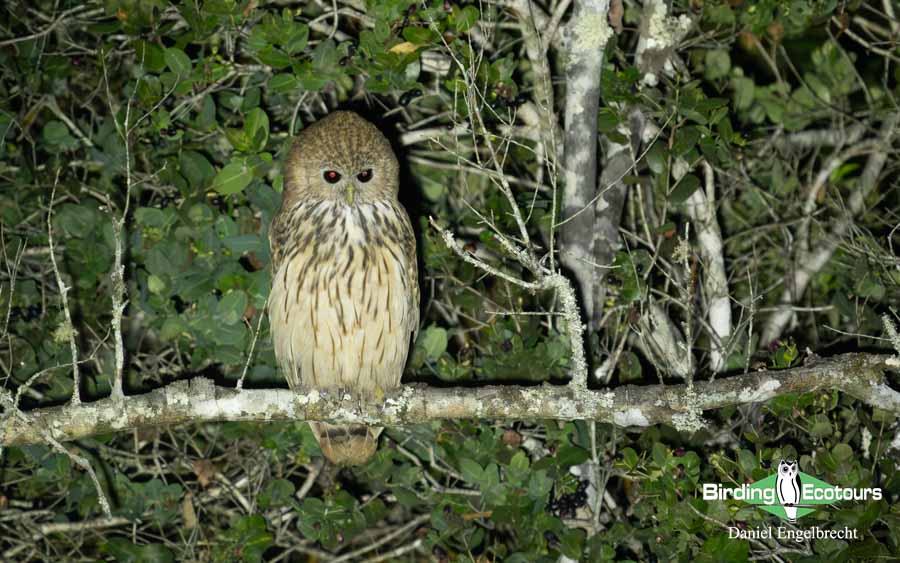
We had to work to see the sought-after Vermiculated Fishing Owl.
Day 12, 4th October 2026. Full day birding at Nyachisala Forest
We started our morning in the dark and walked to the area where we thought the ibises had settled to roost the previous evening. While waiting for first light, we enjoyed the calls of various nocturnal birds around us, including Swamp Nightjar, African Wood Owl, and Vermiculated Fishing Owl. The sun had not yet risen when we heard the Spot-breasted Ibises calling. They were a little further away than we had expected, and it was still too dark to see them. The birds continued calling for several minutes, and by then it was light enough to pick out three birds flying in the distance. They eventually made their way toward us and performed multiple low flyovers, giving us excellent views of these rarely seen forest ibises. We couldn’t believe our luck!
Once again, we spent the whole day exploring the forests, woodlands, and dambos around our tented camp on foot. This time, we secured views of the scarce Bannerman’s and Bates’s Sunbirds, along with our first Copper Sunbirds, a more widespread species. We also connected with many of the same forest species as the previous day, improving our views of several and focusing on obtaining audio recordings. A lengthy search for Blue Quail was ultimately successful when we flushed three individuals from a patch of short, moist grassland. We also added Grey and Orange-breasted Waxbills, along with the scarce Cuckoo-finch. We waited for nightfall at one of the dambos with tall grass and were rewarded with excellent views of our hoped-for African Grass Owl, always a special bird to see.
By dinner on our second full day at Nyachisala, only one major target remained: the rare and notoriously elusive Spotted Thrush-Babbler. We came up with a plan to find it the following day and turned in for an early night.
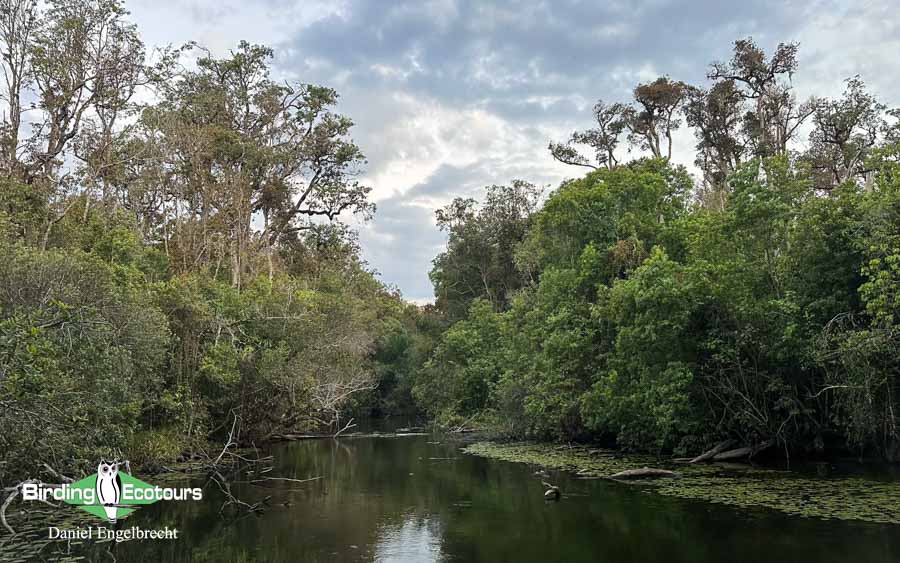
The view over the West Lunga River from our remote tented camp at Nyachisala Forest.
Day 13, 5th October 2026. Morning birding at Nyachisala Forest and transfer to Mutanda
We had found a promising-looking patch of swamp forest the previous day and decided to head there first thing this morning to try for our only remaining target. While walking to the site, a Spot-breasted Ibis flew directly over us, giving us another opportunity to see this rare bird. Just after sunrise, we arrived at the swamp forest and immediately heard a Spotted Thrush-Babbler singing. With some careful positioning and a bit of patience, we managed to get unobstructed views of the bird singing from a branch just a few feet away. Over the moon with our views, we birded our way back to camp, picking up our first Buff-throated Apalises along the way, as well as another Laura’s Woodland Warbler. We also heard a vocal Bamboo Warbler, although we didn’t try to see it after our excellent views a few days earlier. After breakfast, we explored the open woodlands north of camp, where noteworthy sightings included a displaying pair of Western Banded Snake Eagles, as well as Jacobin Cuckoo, Black-throated Canary, and Orange-winged Pytilia.
We had lunch at our tented camp before packing our bags and leaving Nyachisala Forest and its many excellent birds behind. The drive to Mutanda took up most of the remainder of the day; however, we made a quick stop at a roadside pan, where we added White-backed Duck, African Pygmy Goose, Whiskered Tern, and Squacco Heron. We arrived at our lodge in Mutanda for the second time on this trip, enjoyed a lovely dinner, and prepared ourselves for a long day in the car tomorrow.
Day 14, 6th October 2026. Transfer to Mumbwa via Kafue National Park
Today was almost entirely a travel day as we drove southeast from Mutanda to Mumbwa. Our route took us through the northern sector of Kafue National Park, where we saw our first Racket-tailed Rollers. However, we had little time to stop for birding. Further delays, including our ferry running aground while crossing the Kafue River, meant that we only reached Mumbwa at dusk.
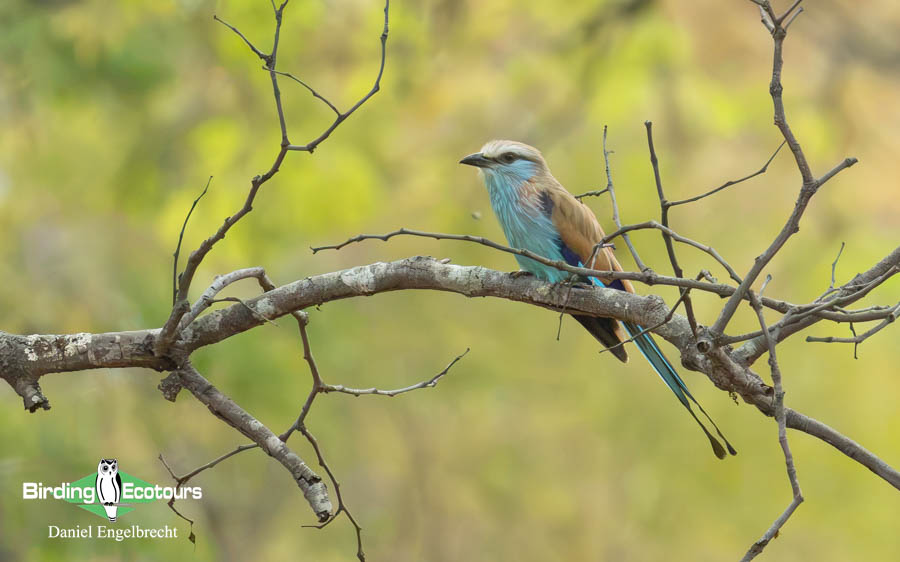
Kafue National Park yielded a few Racket-tailed Roller sightings.
Day 15, 7th October 2026. Transfer to Itezhi Tezhi via Kafue National Park
We picked up our packed breakfasts and left Mumbwa just after sunrise this morning. Our plan was to search for the endemic Chaplin’s Barbet at a site near Mumbwa before continuing south through Kafue National Park to our lodge near Itezhi Tezhi. We arrived at the barbet site expecting another lengthy search; however, just a few minutes after arriving, I heard a Chaplin’s Barbet calling from a nearby fig tree, and we managed to get excellent views. What a relief it was to finally see this Zambian endemic after failing to find it earlier in the trip.
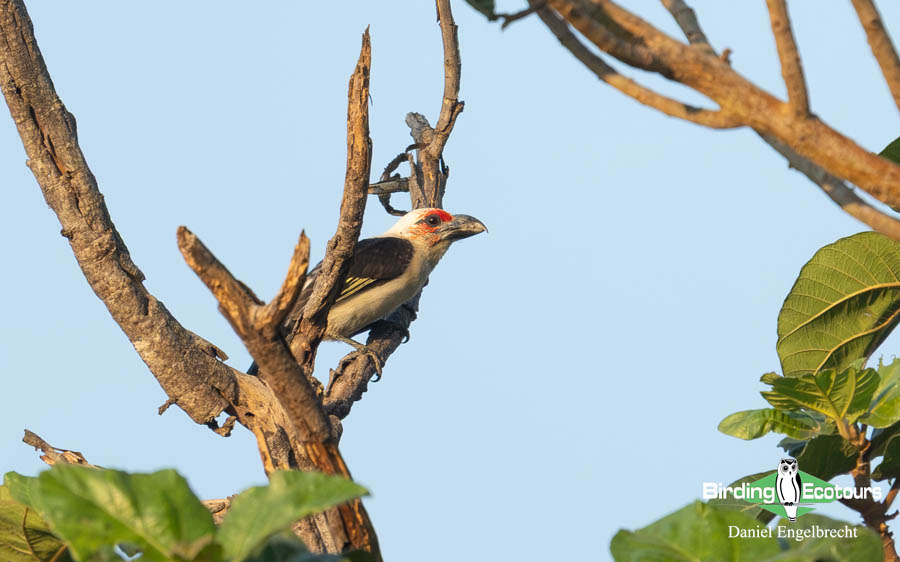
After missing the endemic Chaplin’s Barbet at the start of the tour, we were relieved to see it near Mumbwa.
We then spent most of the day making our way south through Kafue National Park, picking up many new birds along the way, including Lappet-faced Vulture, Red-necked Spurfowl, Grey Go-away-bird, Swallow-tailed Bee-eater, and Greater Blue-eared Starling. We also enjoyed another stunning sighting of Racket-tailed Roller, one of several during our time in Kafue. We stopped to scan the vast Itezhi Tezhi Dam, where we saw our only Osprey and African Spoonbill of the trip. Large mammals were also well represented, and we saw good numbers of Puku and Impala, along with Kinda Baboon, Malbrouck Monkey, Common Hippopotamus, Common Warthog, Waterbuck, and Greater Kudu. The mammalian highlight of the day, however, was a pack of African Wild Dogs.
We checked into our lodge in the afternoon and took a late-afternoon stroll around the grounds. Despite offering sweeping views over Itezhi Tezhi Dam, the walk didn’t produce any new birds.
Day 16, 8th October 2026. Full day birding in Kafue National Park
Today we had an entire day to explore Kafue National Park from our base near Itezhi Tezhi. Before breakfast, we drove through the woodlands and dense thickets around the dam, where we saw a few flocks of attractive Southern Crested Guineafowl, some of which we watched drinking from a roadside puddle. Although our morning session yielded over 80 species, the only other new bird for the trip was a large flock of Grey-headed Gulls roosting along the dam shoreline.
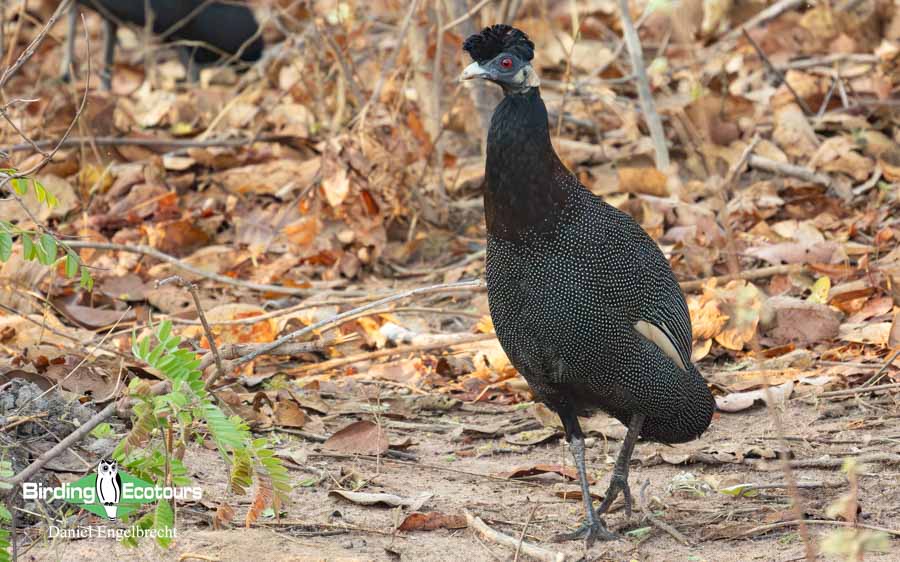
Southern Crested Guineafowl was seen in Kafue National Park.
We returned to the lodge for breakfast and headed out again after lunch, this time making our way south into the mopani woodlands. Thankfully, our main target here, the localized and endemic Black-cheeked Lovebird, didn’t put up much of a fight, and we enjoyed watching a flock of about 15 individuals feeding in a large seeding tree. We encountered several more flocks over the course of the afternoon while driving through these arid woodlands. Other noteworthy sightings included a Rufous-bellied Heron at a small pond, Senegal and Coppery-tailed Coucals, Shikra, Little Sparrowhawk, Southern Red-billed Hornbill, Racket-tailed Roller, Brown-backed Honeybird, Red-necked Falcon, Hartlaub’s Babbler, Meves’s Starling, and White-browed Sparrow-Weaver.
On our way back to the lodge at dusk, we stumbled upon a group of three Southern Ground Hornbills and saw our only Sable Antelope and Sharpe’s Grysbok of the trip, both uncommon antelope species. Another thoroughly enjoyable day in Zambia had come to an end!
Day 17, 9th October 2026. Birding in Kafue National Park and transfer to Livingstone
We had a long drive ahead of us today, but thankfully much of it took us through Kafue National Park, allowing us to enjoy some quality birding before joining the main road to Livingstone. Highlights from our morning drive south through Kafue included a displaying Black-bellied Bustard giving its bizarre call, a majestic Martial Eagle perched in a tree, the scarce Brown-necked Parrot, an African Openbill at a river crossing, and a soaring African Harrier-Hawk, all of which were new additions to the trip list. We also saw a few flocks of Black-cheeked Lovebirds flying overhead and stopped for our packed breakfast along the roadside, where hundreds of these colorful parrots were congregating, presumably to drink at a nearby waterhole. We spent half an hour watching flock after flock settle in the leafless trees just a few feet away, offering excellent opportunities for photographs and audio recordings. What an experience!
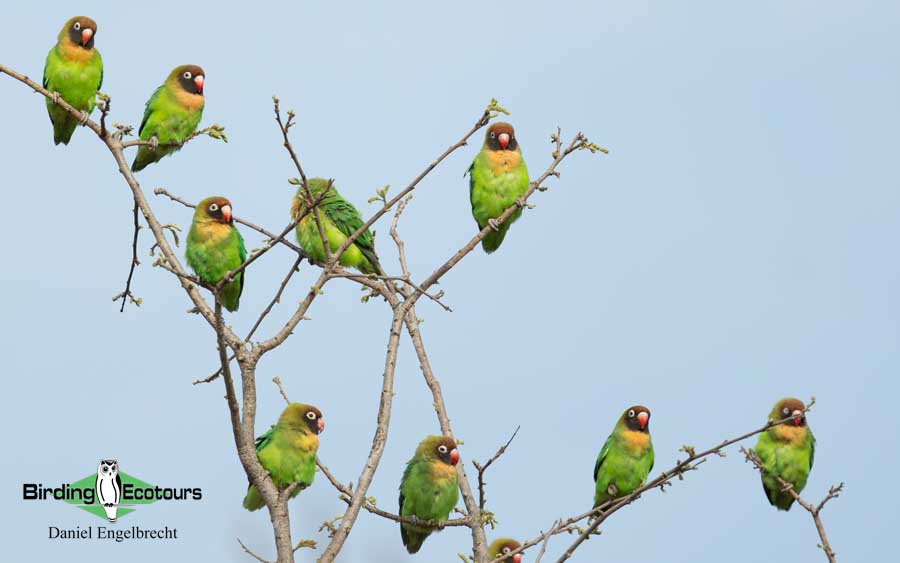
We watched large flocks of endemic Black-cheeked Lovebirds gathering to drink at breakfast!
After breakfast, we pushed on through the park, securing excellent views of a pair of Shikras before David spotted another raptor perched atop a dead tree beside the road. We drove closer and confirmed our suspicion that it was a Dickinson’s Kestrel. This species is always a challenge to connect with, and it is one of those birds you simply need to stumble upon. As we completed the formalities at the Kafue gate before leaving the park, we were entertained by a pair of very obliging Arnot’s Chats, likely on the lookout for scraps around the picnic site. Most of the afternoon was spent driving to Livingstone, where we visited the famous Victoria Falls before checking in at our lodge overlooking the Zambezi River.
In the late afternoon, we embarked on a sundowner cruise on the Zambezi River, a fitting end to an unforgettable and highly successful trip to Zambia, one of Africa’s best-kept birding secrets. The cruise gave us a marvelous sunset, views of African Savanna Elephants swimming in the river, and several excellent bird sightings, including Rock Pratincole, African Finfoot, White-crowned Lapwing, and African Skimmer. After the cruise, we enjoyed dinner overlooking the Zambezi. What a trip it had been!
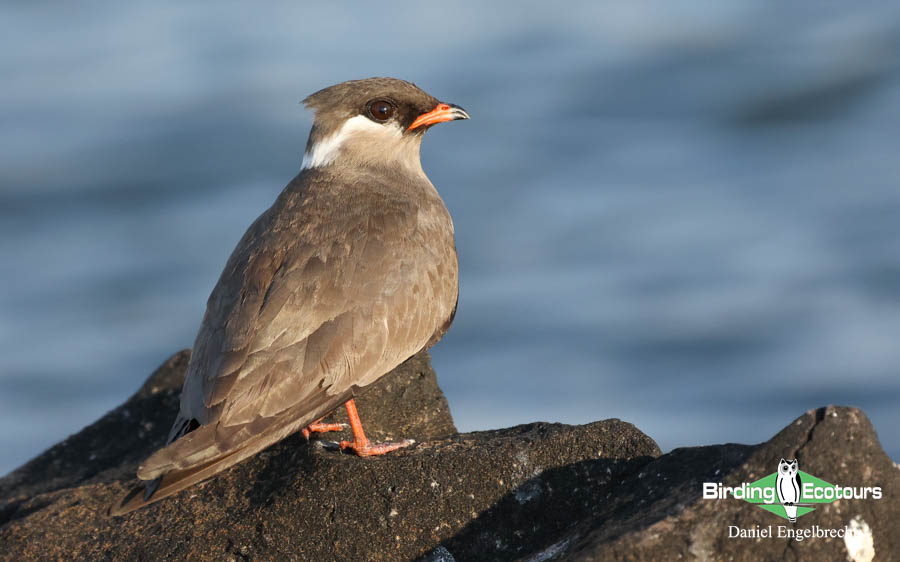
Our boat cruise on the Zambezi River produced incredible views of Rock Pratincole.
Day 18, 10th October 2026. Departure from Livingstone
David and I said our goodbyes for now, knowing that we would be birding together again in eastern South Africa in a few days, before catching our flights out of Livingstone.
Bird List – Following IOC 15.2 (April 2026)
Birds ‘heard only’ are marked with (H) after the common name, all other species were seen.
The following notation after species names is used to show conservation status following the IUCN Red List: CR = Critically Endangered, EN = Endangered, VU = Vulnerable.
| Common name | Scientific name |
| Ducks, Geese, Swans (Anatidae) | |
| White-faced Whistling Duck | Dendrocygna viduata |
| White-backed Duck | Thalassornis leuconotus |
| Spur-winged Goose | Plectropterus gambensis |
| Knob-billed Duck | Sarkidiornis melanotos |
| Egyptian Goose | Alopochen aegyptiaca |
| African Pygmy Goose | Nettapus auritus |
| African Black Duck | Anas sparsa |
| Yellow-billed Duck | Anas undulata |
| Red-billed Teal | Anas erythrorhyncha |
| Southern Pochard | Netta erythrophthalma |
| Guineafowl (Numididae) | |
| Helmeted Guineafowl | Numida meleagris |
| Southern Crested Guineafowl | Guttera edouardi |
| Pheasants & Allies (Phasianidae) | |
| Crested Francolin | Ortygornis sephaena |
| Coqui Francolin | Campocolinus coqui |
| Whyte’s Francolin (H) | Scleroptila whytei |
| Blue Quail | Synoicus adansonii |
| Natal Spurfowl | Pternistis natalensis |
| Swainson’s Spurfowl | Pternistis swainsonii |
| Red-necked Spurfowl | Pternistis afer |
| Nightjars (Caprimulgidae) | |
| Fiery-necked Nightjar | Caprimulgus pectoralis |
| Swamp Nightjar | Caprimulgus natalensis |
| Freckled Nightjar | Caprimulgus tristigma |
| Pennant-winged Nightjar (H) | Caprimulgus vexillarius |
| Swifts (Apodidae) | |
| Böhm’s Spinetail | Neafrapus boehmi |
| African Palm Swift | Cypsiurus parvus |
| Common Swift | Apus apus |
| Little Swift | Apus affinis |
| White-rumped Swift | Apus caffer |
| Turacos (Musophagidae) | |
| Grey Go-away-bird | Crinifer concolor |
| Ross’s Turaco | Tauraco rossae |
| Schalow’s Turaco | Tauraco schalowi |
| Bustards (Otididae) | |
| Black-bellied Bustard | Lissotis melanogaster |
| Cuckoos (Cuculidae) | |
| Senegal Coucal | Centropus senegalensis |
| Coppery-tailed Coucal | Centropus cupreicaudus |
| White-browed Coucal | Centropus superciliosus |
| Blue Malkoha | Ceuthmochares aereus |
| Levaillant’s Cuckoo | Clamator levaillantii |
| Jacobin Cuckoo | Clamator jacobinus |
| Diederik Cuckoo | Chrysococcyx caprius |
| Klaas’s Cuckoo | Chrysococcyx klaas |
| African Emerald Cuckoo | Chrysococcyx cupreus |
| Olive Long-tailed Cuckoo | Cercococcyx olivinus |
| Black Cuckoo | Cuculus clamosus |
| Red-chested Cuckoo | Cuculus solitarius |
| African Cuckoo | Cuculus gularis |
| Pigeons, Doves (Columbidae) | |
| Rock Dove (Introduced) | Columba livia |
| Afep Pigeon (H) | Columba unicincta |
| Western Bronze-naped Pigeon | Columba iriditorques |
| Red-eyed Dove | Streptopelia semitorquata |
| Ring-necked Dove | Streptopelia capicola |
| Laughing Dove | Spilopelia senegalensis |
| Emerald-spotted Wood Dove | Turtur chalcospilos |
| Blue-spotted Wood Dove | Turtur afer |
| Namaqua Dove | Oena capensis |
| African Green Pigeon | Treron calvus |
| Finfoots (Heliornithidae) | |
| African Finfoot | Podica senegalensis |
| Flufftails (Sarothruridae) | |
| White-spotted Flufftail (H) | Sarothrura pulchra |
| Red-chested Flufftail | Sarothrura rufa |
| Chestnut-headed Flufftail | Sarothrura lugens |
| Rails, Crakes & Coots (Rallidae) | |
| Common Moorhen | Gallinula chloropus |
| Red-knobbed Coot | Fulica cristata |
| Purple Swamphen | Porphyrio madagascariensis |
| Black Crake | Zapornia flavirostra |
| Grebes (Podicipedidae) | |
| Little Grebe | Tachybaptus ruficollis |
| Stone-curlews, Thick-knees (Burhinidae) | |
| Water Thick-knee | Burhinus vermiculatus |
| Stilts, Avocets (Recurvirostridae) | |
| Black-winged Stilt | Himantopus himantopus |
| Plovers (Charadriidae) | |
| Three-banded Plover | Thinornis tricollaris |
| Blacksmith Lapwing | Vanellus armatus |
| White-crowned Lapwing | Vanellus albiceps |
| Crowned Lapwing | Vanellus coronatus |
| African Wattled Lapwing | Vanellus senegallus |
| Kittlitz’s Plover | Anarhynchus pecuarius |
| Jacanas (Jacanidae) | |
| Lesser Jacana | Microparra capensis |
| African Jacana | Actophilornis africanus |
| Sandpipers, Snipes (Scolopacidae) | |
| Great Snipe | Gallinago media |
| African Snipe | Gallinago nigripennis |
| Common Sandpiper | Actitis hypoleucos |
| Wood Sandpiper | Tringa glareola |
| Common Greenshank | Tringa nebularia |
| Ruff | Calidris pugnax |
| Coursers, Pratincoles (Glareolidae) | |
| Collared Pratincole | Glareola pratincola |
| Rock Pratincole | Glareola nuchalis |
| Gulls, Terns, Skimmers (Laridae) | |
| African Skimmer | Rynchops flavirostris |
| Grey-headed Gull | Chroicocephalus cirrocephalus |
| Whiskered Tern | Chlidonias hybrida |
| Storks (Ciconiidae) | |
| African Openbill | Anastomus lamelligerus |
| Marabou Stork | Leptoptilos crumenifer |
| African Woolly-necked Stork | Ciconia microscelis |
| Anhingas, Darters (Anhingidae) | |
| African Darter | Anhinga rufa |
| Cormorants, Shags (Phalacrocoracidae) | |
| Reed Cormorant | Microcarbo africanus |
| Great Cormorant | Phalacrocorax lucidus |
| Ibises, Spoonbills (Threskiornithidae) | |
| African Sacred Ibis | Threskiornis aethiopicus |
| Spot-breasted Ibis | Bostrychia rara |
| Hadada Ibis | Bostrychia hagedash |
| Glossy Ibis | Plegadis falcinellus |
| African Spoonbill | Platalea alba |
| Herons, Bitterns (Ardeidae) | |
| Black-crowned Night Heron | Nycticorax nycticorax |
| Little Egret | Egretta garzetta |
| Little Heron | Butorides atricapilla |
| Rufous-bellied Heron | Ardeola rufiventris |
| Squacco Heron | Ardeola ralloides |
| Great Egret | Ardea alba |
| Yellow-billed Egret | Ardea brachyrhyncha |
| Western Cattle Egret | Ardea ibis |
| Grey Heron | Ardea cinerea |
| Purple Heron | Ardea purpurea |
| Black-headed Heron | Ardea melanocephala |
| Hamerkop (Scopidae) | |
| Hamerkop | Scopus umbretta |
| Pelicans (Pelecanidae) | |
| Great White Pelican | Pelecanus onocrotalus |
| Ospreys (Pandionidae) | |
| Osprey | Pandion haliaetus |
| Kites, Hawks, Eagles (Accipitridae) | |
| Black-winged Kite | Elanus caeruleus |
| African Harrier-Hawk | Polyboroides typus |
| Lappet-faced Vulture – EN | Torgos tracheliotos |
| Hooded Vulture – CR | Necrosyrtes monachus |
| White-backed Vulture – CR | Gyps africanus |
| Bateleur – EN | Terathopius ecaudatus |
| Western Banded Snake Eagle | Circaetus cinerascens |
| Black-chested Snake Eagle | Circaetus pectoralis |
| Brown Snake Eagle | Circaetus cinereus |
| Martial Eagle – EN | Polemaetus bellicosus |
| Long-crested Eagle | Lophaetus occipitalis |
| Wahlberg’s Eagle | Hieraaetus wahlbergi |
| Dark Chanting Goshawk | Melierax metabates |
| Lizard Buzzard | Kaupifalco monogrammicus |
| African Goshawk | Aerospiza tachiro |
| Little Sparrowhawk | Tachyspiza minulla |
| Shikra | Tachyspiza badia |
| African Marsh Harrier | Circus ranivorus |
| Black Kite | Milvus migrans |
| African Fish Eagle | Icthyophaga vocifer |
| Common Buzzard | Buteo buteo |
| Barn Owls (Tytonidae) | |
| Western Barn Owl | Tyto alba |
| African Grass Owl | Tyto capensis |
| Owls (Strigidae) | |
| African Barred Owlet (H) | Glaucidium capense |
| Vermiculated Fishing Owl | Scotopelia bouvieri |
| African Wood Owl | Strix woodfordii |
| Mousebirds (Coliidae) | |
| Speckled Mousebird | Colius striatus |
| Red-faced Mousebird | Urocolius indicus |
| Trogons (Trogonidae) | |
| Narina Trogon | Apaloderma narina |
| Hoopoes (Upupidae) | |
| Eurasian Hoopoe | Upupa epops |
| Wood Hoopoes (Phoeniculidae) | |
| Green Wood Hoopoe | Phoeniculus purpureus |
| Common Scimitarbill | Rhinopomastus cyanomelas |
| Ground Hornbills (Bucorvidae) | |
| Southern Ground Hornbill – VU | Bucorvus leadbeateri |
| Hornbills (Bucerotidae) | |
| Southern Red-billed Hornbill | Tockus rufirostris |
| Crowned Hornbill | Lophoceros alboterminatus |
| African Grey Hornbill | Lophoceros nasutus |
| Pale-billed Hornbill | Lophoceros pallidirostris |
| Trumpeter Hornbill | Bycanistes bucinator |
| Rollers (Coraciidae) | |
| Racket-tailed Roller | Coracias spatulatus |
| Lilac-breasted Roller | Coracias caudatus |
| Broad-billed Roller | Eurystomus glaucurus |
| Kingfishers (Alcedinidae) | |
| Grey-headed Kingfisher | Halcyon leucocephala |
| Brown-hooded Kingfisher | Halcyon albiventris |
| Striped Kingfisher | Halcyon chelicuti |
| Blue-breasted Kingfisher | Halcyon malimbica |
| Malachite Kingfisher | Corythornis cristatus |
| Shining-blue Kingfisher | Alcedo quadribrachys |
| Half-collared Kingfisher | Alcedo semitorquata |
| Pied Kingfisher | Ceryle rudis |
| Bee-eaters (Meropidae) | |
| Swallow-tailed Bee-eater | Merops hirundineus |
| Little Bee-eater | Merops pusillus |
| Blue-breasted Bee-eater | Merops variegatus |
| White-fronted Bee-eater | Merops bullockoides |
| Böhm’s Bee-eater | Merops boehmi |
| European Bee-eater | Merops apiaster |
| Olive Bee-eater | Merops superciliosus |
| Southern Carmine Bee-eater | Merops nubicoides |
| African Barbets (Lybiidae) | |
| Crested Barbet | Trachyphonus vaillantii |
| Anchieta’s Barbet | Stactolaema anchietae |
| Yellow-rumped Tinkerbird | Pogoniulus bilineatus |
| Yellow-fronted Tinkerbird | Pogoniulus chrysoconus |
| Chaplin’s Barbet (Endemic) – VU | Lybius chaplini |
| Black-collared Barbet | Lybius torquatus |
| Black-backed Barbet | Pogonornis minor |
| Honeyguides (Indicatoridae) | |
| Green-backed Honeybird | Prodotiscus zambesiae |
| Brown-backed Honeybird | Prodotiscus regulus |
| Lesser Honeyguide | Indicator minor |
| Scaly-throated Honeyguide | Indicator variegatus |
| Greater Honeyguide | Indicator indicator |
| Woodpeckers (Picidae) | |
| Bennett’s Woodpecker | Campethera bennettii |
| Golden-tailed Woodpecker | Campethera abingoni |
| Green-backed Woodpecker | Campethera maculosa |
| Cardinal Woodpecker | Dendropicos fuscescens |
| Olive Woodpecker | Dendropicos griseocephalus |
| Caracaras, Falcons (Falconidae) | |
| Dickinson’s Kestrel | Falco dickinsoni |
| Red-necked Falcon | Falco chicquera |
| African & New World Parrots (Psittacidae) | |
| Brown-necked Parrot | Poicephalus fuscicollis |
| Meyer’s Parrot | Poicephalus meyeri |
| Old World Parrots (Psittaculidae) | |
| Lilian’s Lovebird | Agapornis lilianae |
| Black-cheeked Lovebird (Endemic) – VU | Agapornis nigrigenis |
| African & Green Broadbills (Calyptomenidae) | |
| African Broadbill | Smithornis capensis |
| Wattle-eyes, Batises (Platysteiridae) | |
| Margaret’s Batis | Batis margaritae |
| Chinspot Batis | Batis molitor |
| Black-throated Wattle-eye | Platysteira peltata |
| Bushshrikes (Malaconotidae) | |
| Grey-headed Bushshrike | Malaconotus blanchoti |
| Black-fronted Bushshrike | Chlorophoneus nigrifrons |
| Orange-breasted Bushshrike | Chlorophoneus sulfureopectus |
| Marsh Tchagra | Bocagia minuta |
| Brown-crowned Tchagra | Tchagra australis |
| Black-crowned Tchagra | Tchagra senegalus |
| Black-backed Puffback | Dryoscopus cubla |
| Tropical Boubou | Laniarius major |
| Brubru | Nilaus afer |
| Vangas & Allies (Vangidae) | |
| White-crested Helmetshrike | Prionops plumatus |
| Retz’s Helmetshrike | Prionops retzii |
| Cuckooshrikes (Campephagidae) | |
| White-breasted Cuckooshrike | Ceblepyris pectoralis |
| Black Cuckooshrike | Campephaga flava |
| Purple-throated Cuckooshrike | Campephaga quiscalina |
| Figbirds, Old World Orioles, Piopios (Oriolidae) | |
| Black-headed Oriole | Oriolus larvatus |
| African Golden Oriole | Oriolus auratus |
| Drongos (Dicruridae) | |
| Fork-tailed Drongo | Dicrurus adsimilis |
| Square-tailed Drongo | Dicrurus ludwigii |
| Monarchs (Monarchidae) | |
| African Paradise Flycatcher | Terpsiphone viridis |
| Shrikes (Laniidae) | |
| Northern Fiscal | Lanius humeralis |
| Souza’s Shrike | Lanius souzae |
| Crows, Jays (Corvidae) | |
| Pied Crow | Corvus albus |
| White-necked Raven | Corvus albicollis |
| Fairy Flycatchers (Stenostiridae) | |
| White-tailed Blue Flycatcher | Elminia albicauda |
| White-tailed Crested Flycatcher | Elminia albonotata |
| Tits, Chickadees (Paridae) | |
| White-winged Black Tit | Melaniparus leucomelas |
| Southern Black Tit | Melaniparus niger |
| Rufous-bellied Tit | Melaniparus rufiventris |
| Miombo Tit | Melaniparus griseiventris |
| Penduline Tits (Remizidae) | |
| Grey Penduline Tit | Anthoscopus caroli |
| Larks (Alaudidae) | |
| Angola Lark | Amirafra angolensis |
| Flappet Lark | Amirafra rufocinnamomea |
| Rufous-naped Lark | Corypha africana |
| Red-capped Lark | Calandrella cinerea |
| Bulbuls (Pycnonotidae) | |
| Black-collared Bulbul | Neolestes torquatus |
| Pale-throated Greenbul | Atimastillas flavigula |
| Yellow-bellied Greenbul | Chlorocichla flaviventris |
| Honeyguide Greenbul | Baeopogon indicator |
| Little Greenbul | Eurillas virens |
| Terrestrial Brownbul | Phyllastrephus terrestris |
| Grey-olive Greenbul | Phyllastrephus cerviniventris |
| Cabanis’s Greenbul | Phyllastrephus cabanisi |
| Common Bulbul | Pycnonotus barbatus |
| Swallows, Martins (Hirundinidae) | |
| Black Saw-wing | Psalidoprocne pristoptera |
| Grey-rumped Swallow | Pseudhirundo griseopyga |
| Banded Martin | Neophedina cincta |
| Red-throated Rock Martin | Ptyonoprogne rufigula |
| Black-and-rufous Swallow | Hirundo nigrorufa |
| Barn Swallow | Hirundo rustica |
| Angola Swallow | Hirundo angolensis |
| Wire-tailed Swallow | Hirundo smithii |
| Western House Martin | Delichon urbicum |
| Lesser Striped Swallow | Cecropis abyssinica |
| Red-breasted Swallow | Cecropis semirufa |
| Mosque Swallow | Cecropis senegalensis |
| Red-throated Cliff Swallow | Petrochelidon rufigula |
| Crombecs, African Warblers (Macrosphenidae) | |
| Moustached Grass Warbler | Melocichla mentalis |
| Long-billed Crombec | Sylvietta rufescens |
| Red-capped Crombec | Sylvietta ruficapilla |
| Leaf Warblers (Phylloscopidae) | |
| Willow Warbler | Phylloscopus trochilus |
| Laura’s Woodland Warbler | Phylloscopus laurae |
| Reed Warblers & Allies (Acrocephalidae) | |
| Lesser Swamp Warbler | Acrocephalus gracilirostris |
| Grassbirds & Allies (Locustellidae) | |
| Bamboo Warbler | Locustella alfredi |
| Fan-tailed Grassbird | Catriscus brevirostris |
| Little Rush Warbler | Bradypterus baboecala |
| Cisticolas & Allies (Cisticolidae) | |
| Red-faced Cisticola | Cisticola erythrops |
| Trilling Cisticola | Cisticola woosnami |
| Rattling Cisticola | Cisticola chiniana |
| Tinkling Cisticola | Cisticola rufilatus |
| Chirping Cisticola | Cisticola pipiens |
| Levaillant’s Cisticola | Cisticola tinniens |
| Stout Cisticola | Cisticola robustus |
| Croaking Cisticola | Cisticola natalensis |
| Short-winged Cisticola | Cisticola brachypterus |
| Zitting Cisticola | Cisticola juncidis |
| Dambo Cisticola | Cisticola dambo |
| Pale-crowned Cisticola | Cisticola cinnamomeus |
| Wing-snapping Cisticola | Cisticola ayresii |
| Tawny-flanked Prinia | Prinia subflava |
| Bar-throated Apalis | Apalis thoracica |
| Yellow-breasted Apalis | Apalis flavida |
| Buff-throated Apalis | Apalis rufogularis |
| Brown-headed Apalis | Apalis alticola |
| Grey-backed Camaroptera | Camaroptera brevicaudata |
| Miombo Wren-Warbler | Calamonastes undosus |
| Stierling’s Wren-Warbler | Calamonastes stierlingi |
| Green-capped Eremomela | Eremomela scotops |
| Black-necked Eremomela | Eremomela atricollis |
| White-eyes (Zosteropidae) | |
| Southern Yellow White-eye | Zosterops anderssoni |
| Ground Babblers (Pellorneidae) | |
| Spotted Thrush-Babbler | Illadopsis turdina |
| Laughingthrushes & Allies (Leiothrichidae) | |
| Arrow-marked Babbler | Turdoides jardineii |
| Hartlaub’s Babbler | Turdoides hartlaubii |
| Hyliotas (Hyliotidae) | |
| Yellow-bellied Hyliota | Hyliota flavigaster |
| Southern Hyliota | Hyliota australis |
| Spotted Creepers (Salpornithidae) | |
| African Spotted Creeper | Salpornis salvadori |
| Starlings, Rhabdornises (Sturnidae) | |
| Common Myna (Introduced) | Acridotheres tristis |
| Greater Blue-eared Starling | Lamprotornis chalybaeus |
| Lesser Blue-eared Starling | Lamprotornis chloropterus |
| Splendid Starling | Lamprotornis splendidus |
| Meves’s Starling | Lamprotornis mevesii |
| Sharp-tailed Starling | Lamprotornis acuticaudus |
| Violet-backed Starling | Cinnyricinclus leucogaster |
| Red-winged Starling | Onychognathus morio |
| Oxpeckers (Buphagidae) | |
| Red-billed Oxpecker | Buphagus erythroryncha |
| Thrushes (Turdidae) | |
| Fraser’s Rufous Thrush | Stizorhina fraseri |
| Groundscraper Thrush | Turdus litsitsirupa |
| African Thrush | Turdus pelios |
| Kurrichane Thrush | Turdus libonyana |
| Chats, Old World Flycatchers (Muscicapidae) | |
| Miombo Scrub Robin | Tychaedon barbata |
| White-browed Scrub Robin | Cercotrichas leucophrys |
| Pale Flycatcher | Agricola pallidus |
| Grey Tit-Flycatcher | Fraseria plumbea |
| Ashy Flycatcher | Fraseria caerulescens |
| Southern Black Flycatcher | Melaenornis pammelaina |
| Böhm’s Flycatcher | Myopornis boehmi |
| African Dusky Flycatcher | Muscicapa adusta |
| Spotted Flycatcher | Muscicapa striata |
| Cassin’s Flycatcher | Muscicapa cassini |
| White-browed Robin-Chat | Cossypha heuglini |
| Red-capped Robin-Chat | Cossypha natalensis |
| Bocage’s Akalat | Sheppardia bocagei |
| Miombo Rock Thrush | Monticola angolensis |
| African Stonechat | Saxicola torquatus |
| Mocking Cliff Chat | Thamnolaea cinnamomeiventris |
| Sooty Chat | Myrmecocichla nigra |
| Arnot’s Chat | Myrmecocichla arnotti |
| Familiar Chat | Oenanthe familiaris |
| Sunbirds (Nectariniidae) | |
| Anchieta’s Sunbird | Anthreptes anchietae |
| Western Violet-backed Sunbird | Anthreptes longuemarei |
| Collared Sunbird | Hedydipna collaris |
| Bannerman’s Sunbird | Cyanomitra bannermani |
| Olive Sunbird | Cyanomitra olivacea |
| Amethyst Sunbird | Chalcomitra amethystina |
| Scarlet-chested Sunbird | Chalcomitra senegalensis |
| Eastern Miombo Sunbird | Cinnyris manoensis |
| Western Miombo Sunbird | Cinnyris gertrudis |
| Purple-banded Sunbird | Cinnyris bifasciatus |
| White-bellied Sunbird | Cinnyris talatala |
| Variable Sunbird | Cinnyris venustus |
| Bates’s Sunbird | Cinnyris batesi |
| Copper Sunbird | Cinnyris cupreus |
| Old World Sparrows, Snowfinches (Passeridae) | |
| Yellow-throated Bush Sparrow | Gymnoris superciliaris |
| Northern Grey-headed Sparrow | Passer griseus |
| House Sparrow (Introduced) | Passer domesticus |
| Weavers, Widowbirds (Ploceidae) | |
| White-browed Sparrow-Weaver | Plocepasser mahali |
| Chestnut-backed Sparrow-Weaver | Plocepasser rufoscapulatus |
| Spectacled Weaver | Ploceus ocularis |
| Holub’s Golden Weaver | Ploceus xanthops |
| Lesser Masked Weaver | Ploceus intermedius |
| Southern Masked Weaver | Ploceus velatus |
| Village Weaver | Ploceus cucullatus |
| Dark-backed Weaver | Ploceus bicolor |
| Bar-winged Weaver | Ploceus angolensis |
| Red-headed Weaver | Anaplectes rubriceps |
| Red-billed Quelea | Quelea quelea |
| Southern Red Bishop | Euplectes orix |
| Yellow Bishop | Euplectes capensis |
| Yellow-mantled Widowbird | Euplectes macroura |
| Marsh Widowbird | Euplectes hartlaubi |
| Red-collared Widowbird | Euplectes ardens |
| Waxbills, Munias & Allies (Estrildidae) | |
| Bronze Mannikin | Spermestes cucullata |
| Black-and-white Mannikin | Spermestes bicolor |
| Grey Waxbill | Glaucestrilda perreini |
| Fawn-breasted Waxbill | Estrilda paludicola |
| Common Waxbill | Estrilda astrild |
| Locust Finch | Paludipasser locustella |
| Orange-breasted Waxbill | Amandava subflava |
| Blue Waxbill | Uraeginthus angolensis |
| Red-cheeked Cordon-bleu | Uraeginthus bengalus |
| Black-bellied Seedcracker | Pyrenestes ostrinus |
| Green-winged Pytilia | Pytilia melba |
| Orange-winged Pytilia | Pytilia afra |
| Red-throated Twinspot | Hypargos niveoguttatus |
| Red-billed Firefinch | Lagonosticta senegala |
| African Firefinch | Lagonosticta rubricata |
| Jameson’s Firefinch | Lagonosticta rhodopareia |
| Indigobirds, Whydahs (Viduidae) | |
| Cuckoo-finch | Anomalospiza imberbis |
| Wagtails, Pipits (Motacillidae) | |
| Cape Wagtail | Motacilla capensis |
| Mountain Wagtail | Motacilla clara |
| African Pied Wagtail | Motacilla aguimp |
| Fülleborn’s Longclaw | Macronyx fuelleborni |
| Rosy-throated Longclaw | Macronyx ameliae |
| Grimwood’s Longclaw | Macronyx grimwoodi |
| African Pipit | Anthus cinnamomeus |
| Wood Pipit | Anthus nyassae |
| Buffy Pipit | Anthus vaalensis |
| Plain-backed Pipit | Anthus leucophrys |
| Striped Pipit | Anthus lineiventris |
| Finches, Euphonias (Fringillidae) | |
| Black-faced Canary | Crithagra capistrata |
| Black-throated Canary | Crithagra atrogularis |
| Yellow-fronted Canary | Crithagra mozambica |
| Brimstone Canary | Crithagra sulphurata |
| Reichard’s Seedeater | Crithagra reichardi |
| Black-eared Seedeater | Crithagra mennelli |
| Buntings (Emberizidae) | |
| Golden-breasted Bunting | Emberiza flaviventris |
| Cabanis’s Bunting | Emberiza cabanisi |
| Species seen: | 385 |
| Species heard: | 5 |
| Total recorded: | 390 |
Mammal List – Following Mammalwatching.com (October 2025)
The following notation after species names is used to show conservation status following the IUCN Red List: EN = Endangered, VU = Vulnerable.
| Common name | Scientific name |
| Elephants (Elephantidae) | |
| African Savanna Elephant – EN | Loxodonta africana |
| Hyraxes (Procaviidae) | |
| Bush Hyrax | Heterohyrax brucei |
| Old World Monkeys (Cercopithecidae) | |
| Malbrouck Monkey | Chlorocebus cynosuros |
| Vervet Monkey | Chlorocebus pygerythrus |
| Kinda Baboon | Papio kindae |
| Chacma Baboon | Papio ursinus |
| Squirrels (Sciuridae) | |
| Smith’s Bush Squirrel | Paraxerus cepapi |
| Canids (Canidae) | |
| African Wild Dog – EN | Lycaon pictus |
| Hippopotamuses (Hippopotamidae) | |
| Common Hippopotamus – VU | Hippopotamus amphibius |
| Bovids (Bovidae) | |
| Impala | Aepyceros melampus |
| Sharpe’s Grysbok | Raphicerus sharpei |
| Bush Duiker | Sylvicapra grimmia |
| Roan Antelope | Hippotragus equinus |
| Sable Antelope | Hippotragus niger |
| Waterbuck | Kobus ellipsiprymnus |
| Puku | Kobus vardonii |
| Southern Reedbuck | Redunca arundinum |
| Greater Kudu | Tragelaphus strepsiceros |
| Suids (Suidae) | |
| Common Warthog | Phacochoerus africanus |
| Species seen: | 19 |
This is a sample trip report. Please email us ([email protected]) for more trip reports from this destination.