02 – 19 NOVEMBER 2025
By Dominic Rollinson
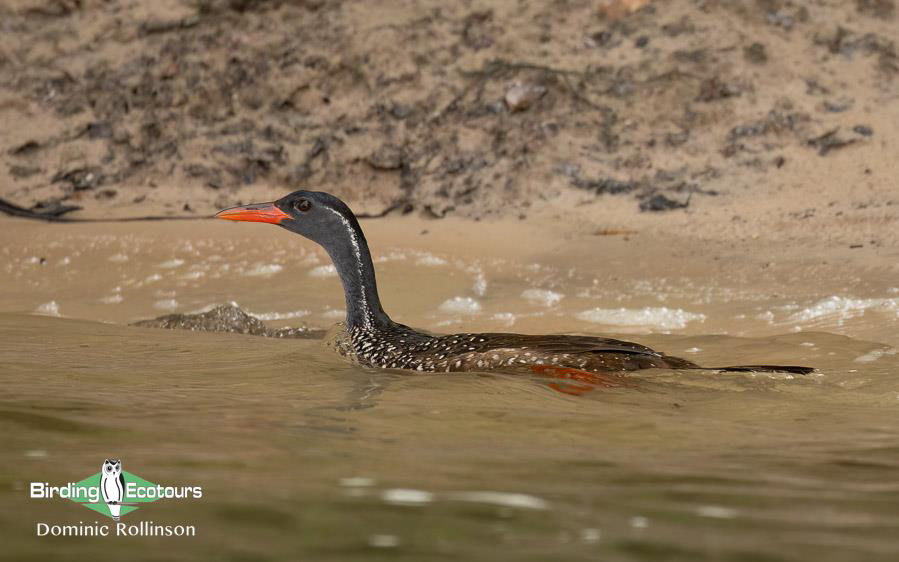
Several African Finfoots (such as this male) were seen along the Zambezi River.
Overview
The southern African subregion is incredibly bird-rich, and joining this Namibia, Okavango and Victoria Falls birding tour is a perfect way to get well acquainted with many of the subregion’s near-endemic bird species while also finding an assortment of highly prized specials. Namibia in particular shares many near-endemic bird species with its neighbor, Angola, while Botswana’s Okavango Swamps holds several rare specials (think Pel’s Fishing Owl), with the impressive Victoria Falls, in Zimbabwe, providing a spectacular finish to this diverse tour.
This tour started on the Namibian coast at Walvis Bay, where we were entertained by shorebirds, various waterbirds (including tens of thousands of flamingos) and Namib Desert bird specials, before heading inland to the Namibian Escarpment, where we found further Namibian specials. We then spent a few days in the famous Etosha National Park where arid birds and megafauna abound, before heading to the Kavango Region where arid, western bird species were replaced by their eastern, subtropical counterparts and our bird list grew rapidly. The panhandle of the Okavango Swamps was birded by boat where we found many of our targets, including the enigmatic Pel’s Fishing Owl – a dream bird for many! We then headed back into Namibia and carried on eastwards through the Kavango and Zambezi Regions to finish in the lush environment of Victoria Falls, with a certain World Heritage Site being enjoyed too!
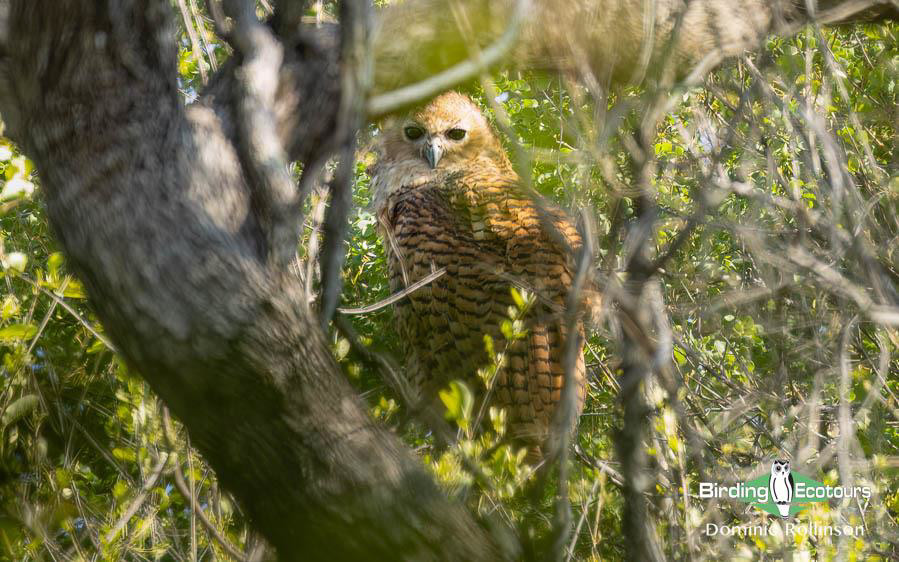
Pel’s Fishing Owl, seen in Botswana, was voted ‘bird of the trip’.
Birding highlights from our 18 days across southern Africa included Hartlaub’s Spurfowl, Ross’s and Schalow’s Turaco, Rüppell’s Korhaan, Burchell’s Sandgrouse, African Finfoot, Blue and Wattled Cranes, Rock Pratincole, African Skimmer, Double-banded Courser, Slaty Egret, White-backed Night Heron, Pel’s Fishing Owl, Violet Wood Hoopoe, Damara Red-billed, Bradfield’s and Monteiro’s Hornbills, Racket-tailed Roller, Southern Carmine Bee-eater, Pygmy Falcon, Rüppell’s Parrot, White-tailed Shrike, Swamp Boubou, Gray’s, Dune and Stark’s Larks, Carp’s Tit, Pale-throated Greenbul, Rockrunner, Luapula and Chirping Cisticolas, Bare-cheeked and Black-faced Babblers, Chestnut Weaver, Brown Firefinch and Violet-eared Waxbill.
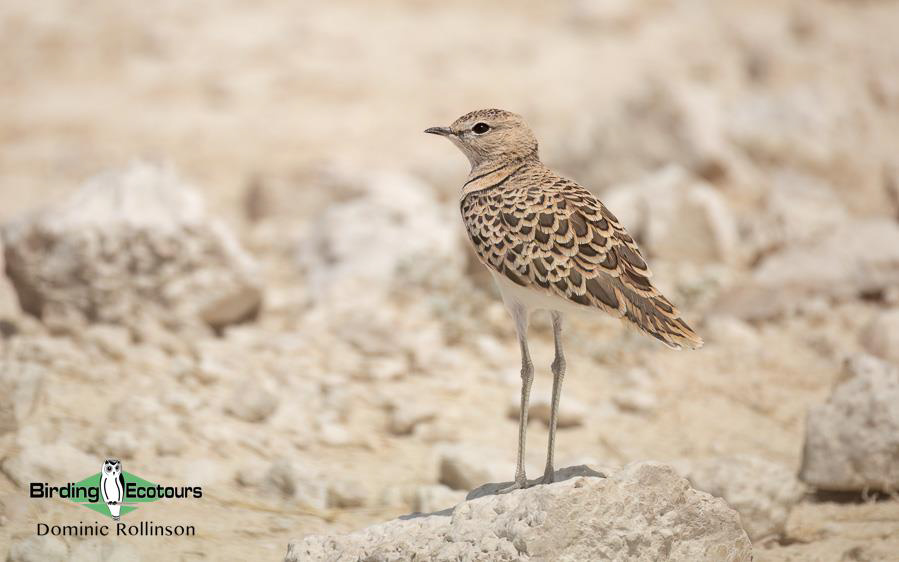
Double-banded Coursers occur in good numbers in Etosha National Park.
As always, this trip also yielded a good selection of other interesting wildlife, with mammalian highlights including African Savanna Elephant, Black Rhinoceros, Lion, African Buffalo, Black-backed Jackal, Spotted Hyena, Angolan Slender (Black) Mongoose, Kirk’s Dik-dik, Southern Oryx (Gemsbok), Southern Lechwe, Common Eland, Common Hippopotamus, Humpback Whale and Common Bottlenose Dolphin. Interesting reptiles and amphibians included Nile Crocodile, Nile and Rock Monitors, Namibian Rock Agama, Wedge-snouted Desert Lizard and Giant Bullfrog.
Bird and animal lists for this birding tour follow the report and you can also view the eBird trip report here, where you can see more bird photos. Thanks to the trip participants Mike, Marcy, Ira, Ramona, Katie, Cliff, Edith and Frank for what was a most enjoyable 18 days across southern Africa.
Detailed Report
Day 1, 2nd November 2025. Walvis Bay birding
With the entire group having arrived in Namibia over the previous few days, we decided to get an early start on our birding and met at sunrise to head into the Namib Desert to look for Dune Lark, a Namibian near endemic. Up until recently it was considered a full Namibian endemic until it was lumped with Barlow’s Lark, which also occurs in neighboring South Africa. We headed to the low red sand dunes of Rooibank, in the riverbed of the almost permanently dry Kuiseb River, about 30 minutes’ drive from Walvis Bay. With this being our first birding of the trip, the new birds came thick and fast, including the likes of Little Swift, Bokmakierie, Greater Striped Swallow, Common Waxbill and Cape Sparrow. It didn’t take long until we heard the rattling call of a couple of pairs of Dune Larks and, before long, we were enjoying extended views of this highly localized desert specialist.
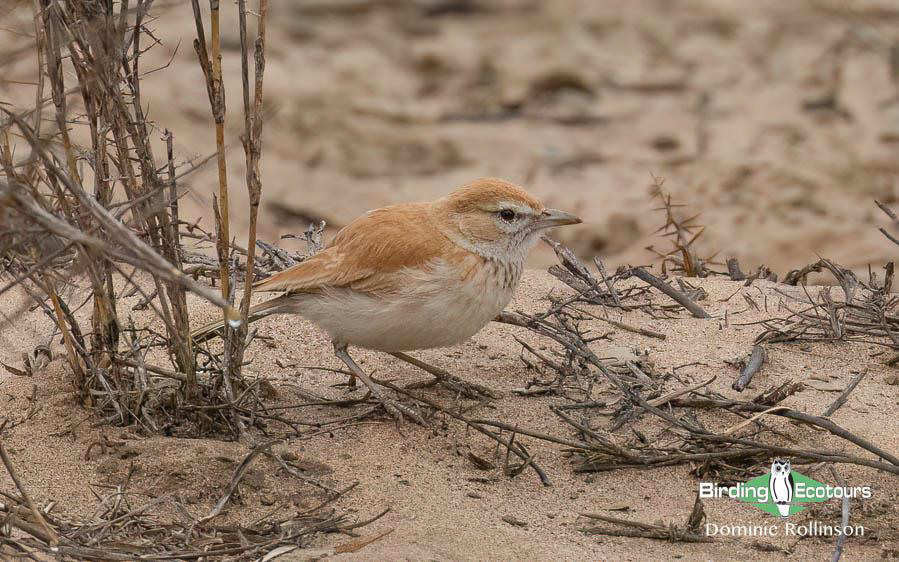
Dune Lark is reliably seen at Rooibank, near Walvis Bay.
We then headed back to our accommodation for our breakfast, complete with a flamingo-filled lagoon as a backdrop, before we again headed out looking for more localized larks. This time, we were heading north of Walvis Bay, just inland of Swakopmund, to look for Gray’s Lark. En route to Swakopmund we stopped to scan the guano platform in the hopes of finding Bank Cormorant which, unfortunately, was not to be seen today. We did find Cape, Great and Crowned Cormorants here, as well as African Oystercatcher, Eurasian Whimbrel, Ruddy Turnstone, Grey Plover, Sanderling and Common and Sandwich Terns. We also took a drive through the picturesque town of Swakopmund en route to the gravel plains for the larks, which further added Helmeted Guineafowl, Speckled Pigeon and Cape Wagtail.
Arriving at the plains near the salt works, it did not take long to hear the distant high-pitched calls of Gray’s Larks but laying eyes on them turned out to be a different matter! After about 45 minutes of hearing them calling, tantalizingly out of reach, we eventually had decent looks at a small group of feeding birds, perfectly camouflaged with their off-white plumage to match the surrounding plains. Here we were also very excited to find the ghostly white form of Tractrac Chat, which proved to be the only sighting of the trip!
Next up was a trip further into the Namib Desert to find the bizarre Welwitschia plant. This gymnosperm has both male and female plants of which we saw some great examples of both, complete with the Welwitschia Bug pollinating the plants. These plants are one of the longest-lived plants on the planet, with some specimens thought to have reached 2,000 years old!
After our time in the desert, we popped back into our accommodation (adding Orange River White-eye) and then later that afternoon we ventured out to the nearby lagoon and salt works. The highlights of the afternoon’s birding were a few Damara Terns, as well as White-fronted Plover, Bar-tailed Godwit, Caspian Tern and masses of both Greater and Lesser Flamingos.
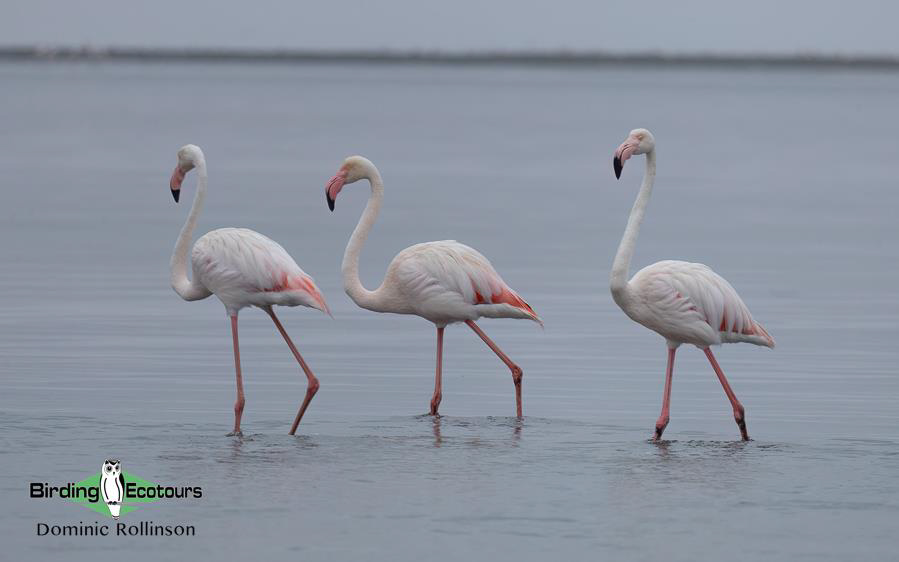
Flamingos, such as these Greater Flamingos, occur in huge numbers in Walvis Bay.
Day 2, 3rd November 2025. Walvis Bay boat cruise and birding
We again started the day with some pre-breakfast birding at the salt works, which produced a similar assortment of waders/shorebirds as the previous afternoon, as well as improved views of Chestnut-banded Plover and our first White-rumped Swift of the trip.
After breakfast we headed down to the small craft harbor for our Walvis Bay boat cruise, which is always good fun and gets us some great looks at many coastal bird species. As we arrived at the harbor we noted a few House Crows, which is not good news as they seem to be trying to establish a feral population here – this species is highly invasive and seems to negatively impact local bird populations. We then spent the next three hours or so onboard a catamaran with some excellent bird and wildlife sightings. As usual, Afro-Australian (Cape) Fur Seals came aboard our boat for a few easy fish snacks, as did the massive Great White Pelicans, while Common Bottlenose Dolphins and Humpback Whales were enjoyed (thankfully not on the boat) as they went about feeding very near to our boat. The birding was overall good, although bird numbers were relatively low. With lots of scanning though, we did manage to accumulate the likes of Parasitic Jaeger, European Storm Petrel, White-chinned Petrel, Sooty Shearwater and several Damara Terns, feeding at close quarters.
That afternoon we again popped out to the salt works, which added new birds in the form of Marsh Sandpiper and Ruff, as well as many of the regulars. That evening we enjoyed one last dinner along the coast before heading inland early the next morning.
Day 3, 4th November 2025. Walvis Bay to Erongo Mountains, Spitzkoppe birding en route
We ensured that we left Walvis Bay before dawn this morning to give us some time birding the Namib Desert before it heated up too much. As we drove through the desert, it didn’t take long for us to find a group of five Rüppell’s Korhaans right next to the highway – an important near-endemic target of the trip.
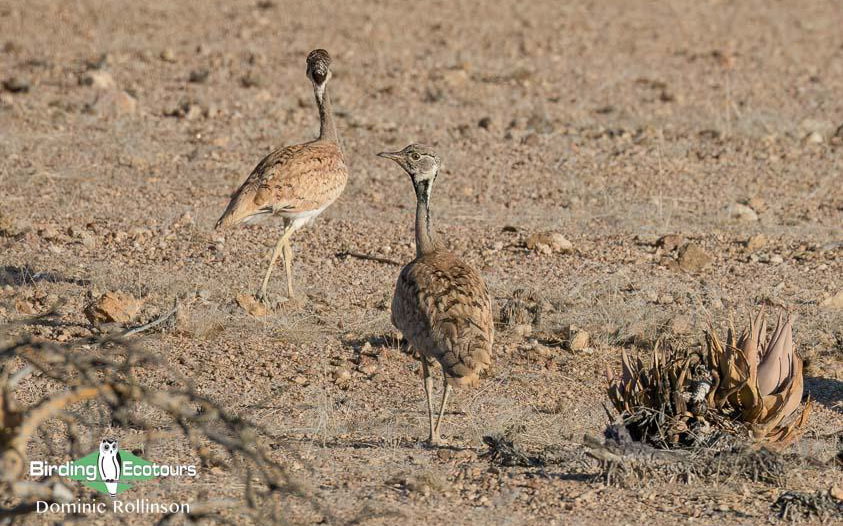
Rüppell’s Korhaans showed well as we made our way through the Namib Desert.
Once we had turned off onto the road to Spitzkoppe, we found a suite of new and interesting birds including Namaqua Dove, Namaqua Sandgrouse, Stark’s Lark (in large numbers), Karoo Chat, Yellow-bellied Eremomela and Great Sparrow. Unfortunately there was no sign of Rufous-eared Warbler in the shrubland near Spitzkoppe.
Once we arrived at Spitzkoppe (known as the Matterhorn of Africa) we immediately set out to find Herero Chat, however, after a thorough search over the next couple of hours, we came up short with this particular species. The birding in the area was, of course, very good, and during our time here we added the likes of Verreaux’s Eagle, Rock Kestrel, Peregrine Falcon, Pririt Batis, Black-chested Prinia, Layard’s Warbler, Dusky Sunbird and White-throated Canary.
We then carried on with the drive to the Erongo Mountains where we arrived at our lodge for a late lunch. While eating lunch, we were distracted by the waterhole below, where birds were coming to drink during the heat of the day and we added Red-billed Quelea, Black-faced Waxbill, Green-winged Pytilia, Shaft-tailed Whydah, Black-throated Canary and Lark-like Bunting.
Later that afternoon we took a walk around the koppies and bushveld in the nearby area and added a bunch of new birds such as Swallow-tailed Bee-eater, Rosy-faced Lovebird, Monteiro’s Hornbill, White-tailed Shrike, Rockrunner (a nice showy bird), Alpine Swift and Long-billed Crombec. Small groups of Rock Hyraxes kept us entertained as they scurried about over the boulders.
That evening, while enjoying dinner, we watched Double-banded Sandgrouse coming into drink, with Freckled Nightjars calling and flying overhead, as well as a single Black Rhinoceros also coming for a quick drink. Nobody was complaining about the dinner interruptions!
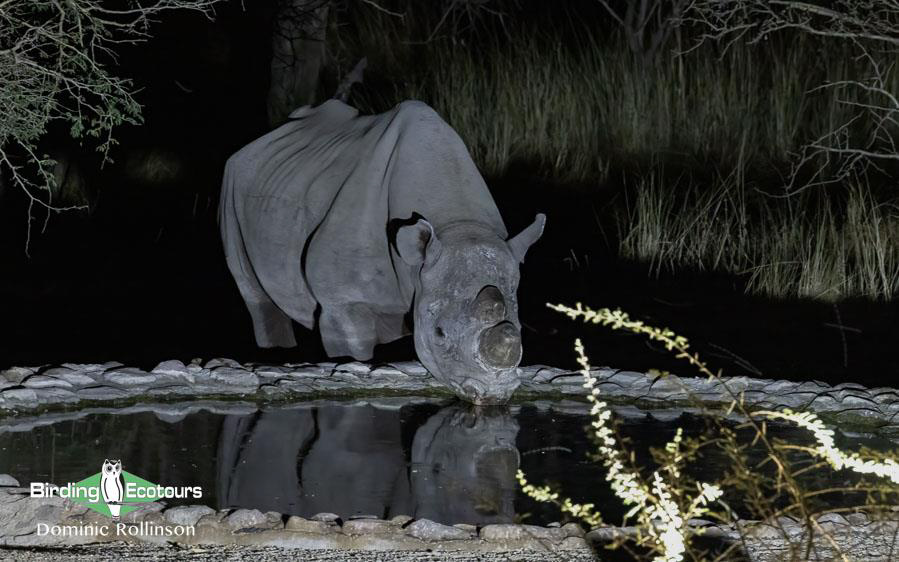
This Black Rhinoceros coming for a drink during our dinner in Erongo Mountains was a welcome bonus!
Day 4, 5th November 2025. Erongo Mountains birding
For our morning walk we birded the bushveld and koppies below the lodge in the hopes of finding the near-endemic Hartlaub’s Spurfowl, which has proven tricky over the last couple of years, but despite a distant calling bird, they would not perform for us (for now). We, however, spent a very productive couple of hours birding the dry bushveld and came back with a good haul of species including Red-billed Spurfowl, Grey Go-away-bird, Alpine and Bradfield’s Swifts, Verreaux’s Eagle (well spotted by Katie!), Pearl-spotted Owlet, Common Scimitarbill, Monteiro’s Hornbill, Swallow-tailed Bee-eater, Crimson-breasted Shrike, Burnt-necked Eremomela, Barred Wren-Warbler, Chestnut-vented Warbler, Marico Flycatcher, Kalahari Scrub Robin and the handsome Marico Sunbird.
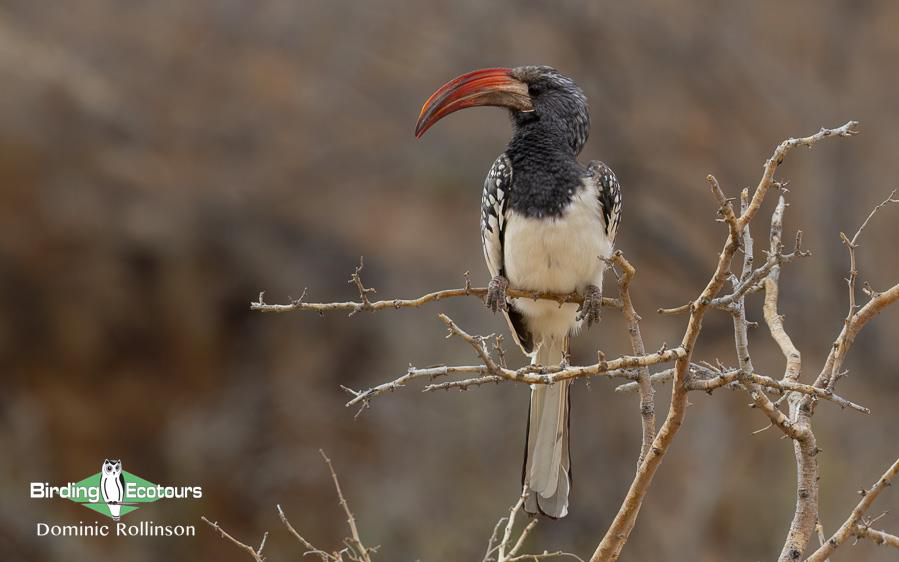
Monteiro’s Hornbills always show well in the Erongo Mountains.
We then returned to the lodge for a scrumptious breakfast (enjoying Chestnut Weaver, Red-headed Finch, Great Sparrow and Shaft-tailed Whydah drinking at the small waterhole) and Angolan Slender (Black) Mongooses feeding nearby. Afterwards, we headed out to have another go at Herero Chat, which is seen infrequently in the area. It was already quite hot by the time we were looking for the chat and we unfortunately had no luck locating it, however, we did see a bunch of other interesting birds including Black-chested Snake Eagle, Carp’s Tit, Sabota Lark, Southern Yellow-billed Hornbill and White-tailed Shrike. A couple of Black-backed Jackals was a mammalian highlight.
It was then time for lunch and some well-deserved down-time during the heat of the early afternoon, with some enjoying the swimming pool. Later that afternoon we took a drive out to the dry Omaruru Riverbed where Rüppell’s Parrot was the big target for the afternoon. It took a while walking underneath the massive camel thorn acacias, until we heard the parrots calling nearby, and then somehow Mike spotted a bird feeding up in the dense canopy. It took a lot of repositioning until it moved into a better position, and we all enjoyed prolonged scope views of this near-endemic parrot. The rest of our time here proved incredibly productive with Damara Red-billed Hornbill, Violet Wood Hoopoe, Bearded and Bennett’s Woodpeckers, Brubru, Burchell’s Starling, Groundscraper Thrush, Red-billed Buffalo Weaver and Lesser Masked Weaver all being added to the list. On our way back to the lodge we got lucky with Short-toed Rock Thrush and Purple Roller, as well as a beautiful rainbow over the Erongo Mountains.
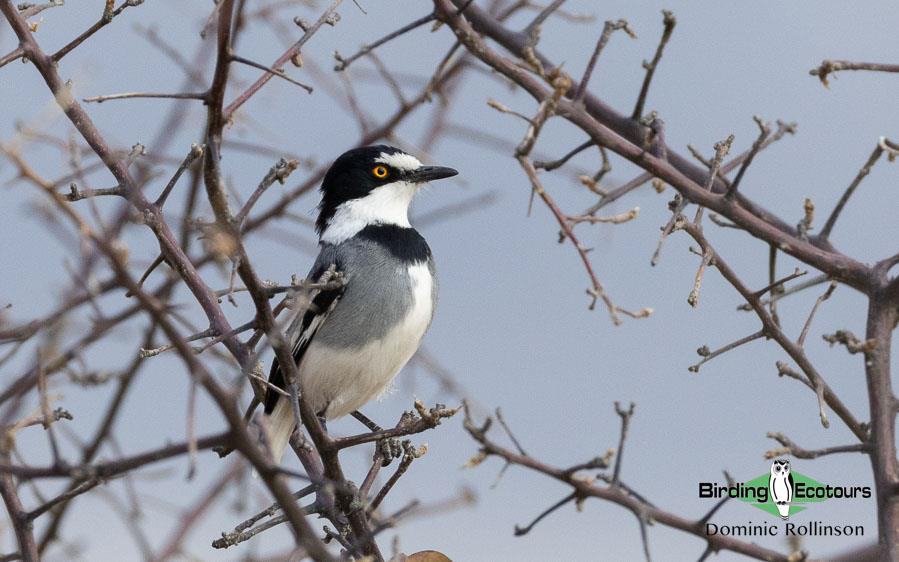
The striking White-tailed Shrike, as seen in the Erongo Mountains.
Day 5, 6th November 2025. Erongo Mountains to Etosha National Park
This morning was our final chance at seeing Hartlaub’s Spurfowl and we drove to a rocky outcrop where, upon our arrival, we immediately heard them calling. It didn’t take long until we picked out a couple of birds and all had good, yet distant, scope views, with at least four birds showing for us. Nearby, we also saw White-tailed Shrike, Barred Wren-Warbler, Great Sparrow and Cinnamon-breasted Bunting.
After breakfast we loaded the vehicle and started the next transfer northeast to Etosha National Park, where we were based for the next few nights. The drive went by without incident, with our lunch stop adding White-backed Mousebird, Lanner Falcon, Pearl-breasted Swallow and a pair of Secretarybirds (which proved to be the only sighting of the trip).
Arriving in Etosha in the mid-afternoon, we drove the main road to Okaukuejo Camp and added Northern Black Korhaan, Kori Bustard, Common Ostrich and Cape Crow. After checking into our lovely waterhole chalets (literally 50 yards from the popular floodlit waterhole) we spent a bit of time at the waterhole itself where we added Namaqua Sandgrouse, Black-headed Heron, Common Hoopoe and Spotted Flycatcher. Later that evening, after dinner, we popped back down to the waterhole where we had our first Lion sighting, as well as drinking Black Rhinoceroses and Rufous-cheeked Nightjars hawking insects in the floodlights.
Day 6, 7th November 2025. Central Etosha; birds and large game
We met bright and early for our private open-top safari drive and headed east of camp towards Gemsbokvlakte waterhole. This drive proved to be a productive few hours out and we managed more Lion sightings, as well as Black Rhinoceros, Spotted Hyena and many Southern Giraffe. The birding was also very good, and we came across the likes of Kori Bustard, Northern Black Korhaan, Crowned Lapwing, Black-winged Kite, Tawny Eagle, Gabar Goshawk, Greater Kestrel, African Grey Hornbill, Cape Penduline Tit, Kalahari Scrub Robin, Capped Wheatear and Scaly-feathered Weaver.
Back at camp we enjoyed a nice sit-down breakfast, before we loaded into the vehicle and took a drive north of camp. This drive again proved highly worthwhile as we found Pygmy Falcon, alongside the massive Sociable Weaver nests, as well as species typical of the open plains, like Double-banded Courser, Greater Kestrel, Spike-heeled, Pink-billed and Red-capped Larks, Grey-backed Sparrow-Larks, Desert and Zitting Cisticolas and African Pipits. At Wolfnes waterhole we found a pair of Spotted Thick-knees hiding in the shade.
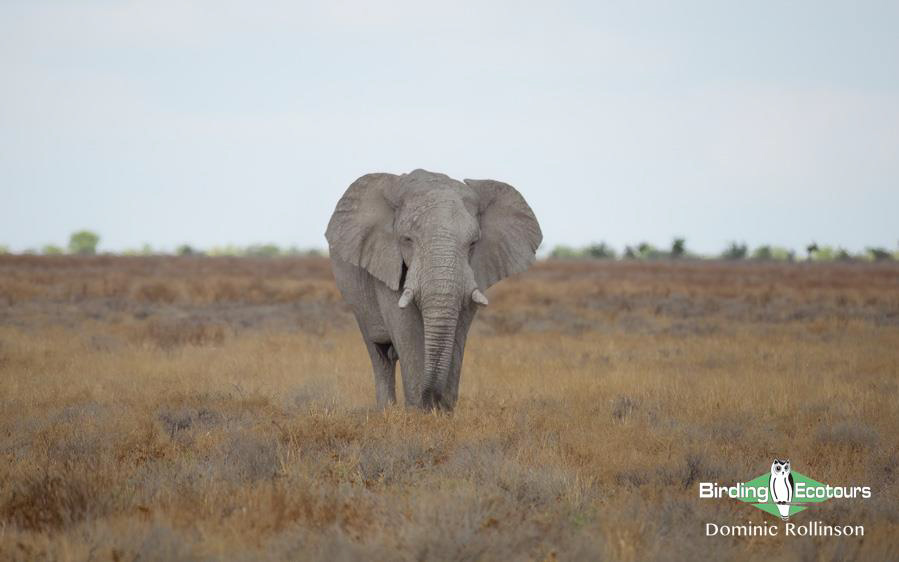
African Savanna Elephants are difficult to miss in Etosha National Park.
While eating our light lunch back at Okaukuejo, we discovered an African Cuckoo,happily sat in a nearby tree, which allowed us to study it in great detail, down to just a few yards.
It was then decided to enjoy some downtime before we took a late afternoon drive south of camp. Despite the very hot temperatures we still found a few interesting birds, with Red-crested Korhaan, European Bee-eater, Rufous-naped Lark (doing its best Flappet Lark impersonation), Chat Flycatcher and Pink-billed Lark being the highlights of the afternoon. On the mammal front, we had some really amazing African Savanna Elephant sightings as well as Black-backed Jackal, Banded Mongoose, Plains Zebra, Blue Wildebeest, Southern Giraffe and the majestic Southern Oryx (Gemsbok).
Day 7, 8th November 2025. Central to eastern Etosha; birds and large game
This morning we decided to stretch our legs and go for a short walk around camp before hitting the road east. A quick scan of the waterhole revealed a couple Lionesses as well as a slightly out-of-range Squacco Heron. Birds seen on our walk included Red-billed Spurfowl, African Cuckoo, African Grey Hornbill, Crimson-breasted Shrike and Greater Striped Swallow.
We then loaded the vehicle and checked out of Okaukuejo Camp and made our way east through the park to the eastern gate at Mokuti Lodge, where we were based for the next two nights. One of our stops along the drive was at Rietfontein waterhole, which had a good assortment of species around, including Red-billed Teal, Southern Pochard, Common Greenshank, Little Grebe, Common Buzzard and the best of the bunch, a single Black-winged Pratincole.
After most of the morning in the vehicle, we arrived at Halali Camp and quickly grabbed our lunch before heading for a walk around the camp. Bare-cheeked Babbler was the big target here, which took some finding, but eventually we found a small and confiding group of babblers. Other interesting birds included Violet Wood Hoopoe, Southern Red-billed Hornbill (as well as a Damara x Southern Red-billed Hornbill hybrid), White-crowned Shrike and Green-winged Pytilia.
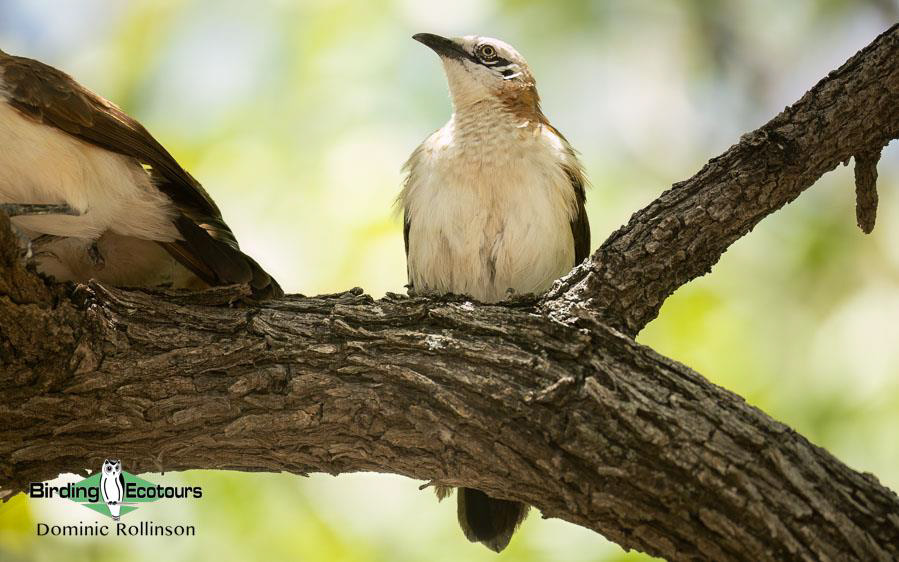
Bare-cheeked Babblers usually show well at Halali Camp and this time round was no different.
The rest of the afternoon’s drive eastwards through the park was fairly uneventful, although we added new birds in the form of Red-breasted Swallow, Red-backed Shrike and a few White-winged Terns, feeding in some flooded areas on the edge of the pan. This is the first time I have seen large amounts of water in the pan on this tour, with it normally being bone dry at this time of the year. A small group of Hartebeest was a new mammal for our list.
In the late afternoon we eventually arrived at Mokuti Lodge, where we checked in and enjoyed the remainder of the afternoon at our leisure, before enjoying a fabulous buffet dinner that evening.
Day 8, 9th November 2025. Eastern Etosha; birds and large animals
We were keen to get back into Etosha early this morning to explore the eastern side of the park and so grabbed an early sit-down breakfast and then loaded into the vehicle. We then began driving the areas around Namutoni Camp, and at Koinachas waterhole we saw Black Crake, Kalahari Scrub Robin, Red-billed Quelea, Violet-eared Waxbill, Red-billed Firefinch and Buffy Pipit. North of camp, making our way towards the Andoni Plains, we found Red-crested Korhaan, Black Cuckoo, Common Swift, Bateleur, Common Scimitarbill, Lesser Grey Shrike, Fawn-colored Lark, Southern Pied Babbler, White-browed Scrub Robin and brief sightings of a pair of flushed Burchell’s Sandgrouse which unfortunately landed out of sight.
Heading down into the impressive Andoni Plains, a huge area of open grassland, we birded a busy waterhole which held South African Shelduck, Kori Bustard, Chestnut-banded Plover, many drinking Quailfinches and several majestic Blue Cranes. The surrounding grasslands were full of Desert Cisticolas and many displaying Eastern Clapper Larks.
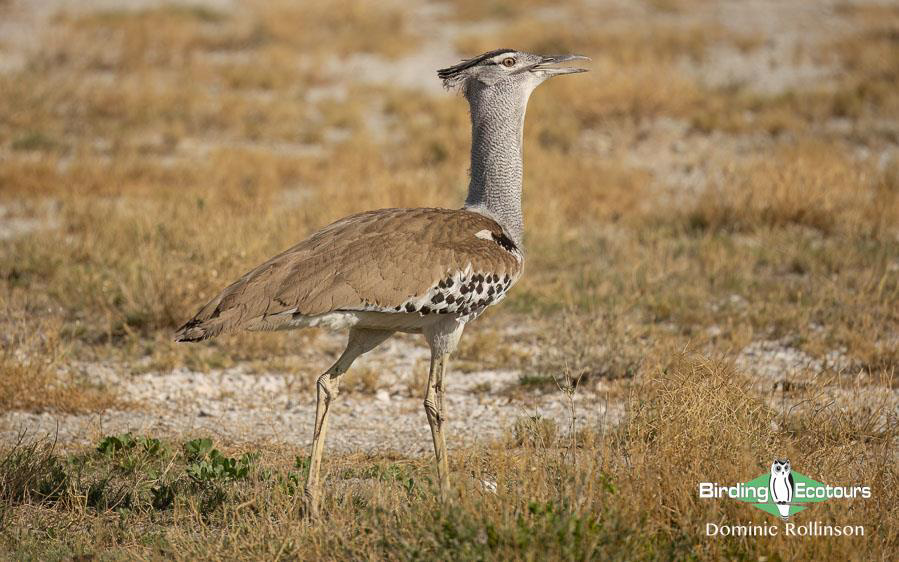
Kori Bustard, one of the heaviest flying birds in the world!
We then enjoyed some lunch at Namutoni Camp and were very pleased to bump into a group of feeding Temminck’s Coursers soon thereafter. Klein Namutoni waterhole held Wood Sandpiper, Marabou Stork and a few White-backed Vultures, but the area was otherwise quiet.
Making our way back to our lodge in the late afternoon, we found a confiding pair of Crested Francolins. After some downtime, we met for a walk around the lodge grounds in the hope of finding Black-faced Babbler. Unfortunately the babblers did not oblige, however, we did find Carp’s Tit, White-browed Scrub Robin, White-bellied Sunbird and Meyer’s Parrot. The many Smith’s Bush Squirrels were entertaining to watch as they went about chasing each other.
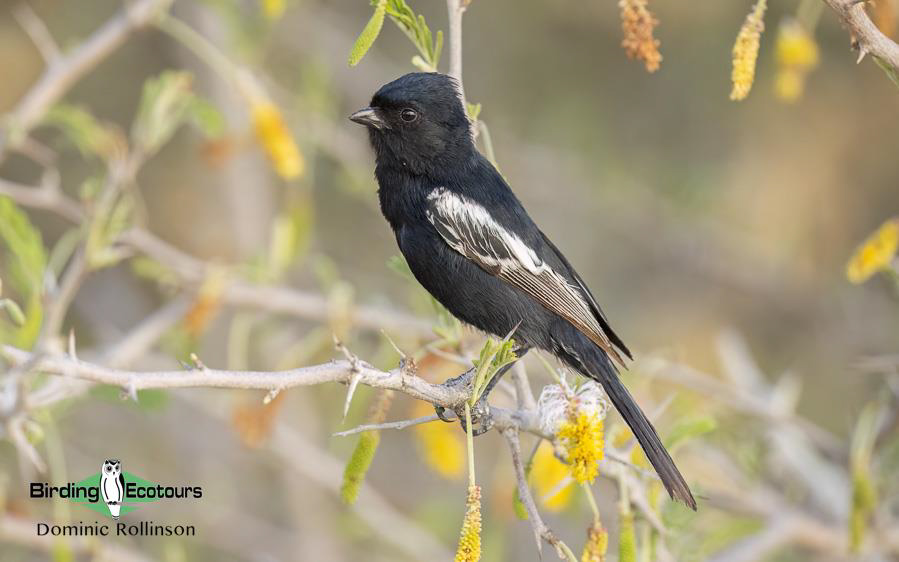
Carp’s Tit, yet another Namibian near endemic.
Day 9, 10th November 2025. Etosha National Park to the Kavango East Region
This morning we again continued our search for Black-faced Babbler, however, despite a thorough search we could not find any babblers at all. Thankfully, the birding was highly productive, and we could entertain ourselves with many other species such as Emerald-spotted Wood Dove, Senegal Coucal, Jacobin and Black Cuckoos (Frank noted their clear ‘I’m-so-saaaad’ call), Pearl-spotted Owlet, Black Cuckooshrike, Black-backed Puffback, African Paradise Flycatcher and Yellow-breasted Apalis. Small groups of Banded Mongooses were seen patrolling the lodge grounds and were good fun to watch.
We eventually had to give up on Black-faced Bablers and hope we would get them at one of the back-up spots and so packed the vehicle and started heading northeast towards the Kavango Region.
Our next stop was Roy’s Camp, where we ate our picnic lunch and hoped to find Black-faced Babbler. Thankfully, it did not take much time until we found a confiding group of babblers and we also managed to find many Rosy-faced Lovebirds, Black-backed Puffback and a pair of Bradfield’s Hornbills.
After our successful lunch stop, we carried on our way northeast and arrived at our lodge in the Kavango East Region. In the late afternoon we took a walk around the property and, with the significant move eastwards today, we were in for many new trip birds. Highlights of the afternoon’s walk included African Jacana, Pied Kingfisher, Black-collared Barbet, Swamp Boubou, Yellow-bellied Greenbul, Terrestrial Brownbul, Arrow-marked Babbler, Kurrichane Thrush, Ashy Flycatcher and White-browed Robin-Chat.
That evening we had an almighty thunderstorm and downpour during dinner, however, once it blew over, we could again enjoy the sounds of distant snorting Common Hippopotamuses in the Kavango River.
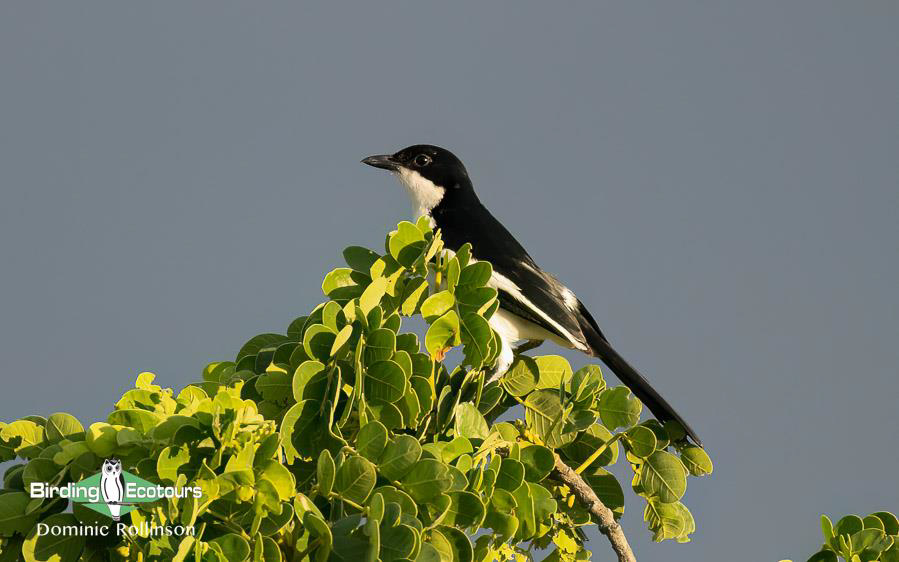
Swamp Boubous were very common along the Kavango River.
Day 10, 11th November 2025. Birding the Kavango East Region
This morning it was time for our first river boat trip of the tour, and we met at around sunrise and loaded onto the boat for an enjoyable couple hours before breakfast. Our boat cruise was along the Kavango River (as it’s known in Namibia, although in Angola it’s known as the Cubango River and Okavango River in Botswana) which forms the border with Angola. Some of the highlights of our cruise included Coppery-tailed Coucal, Collared Pratincole, Little Bittern, Rufous-bellied Heron, African Harrier-Hawk, Malachite Kingfisher, Meyer’s Parrot, Hartlaub’s Babbler, Southern Brown-throated Weaver and African Pied Wagtail.
After breakfast we headed to the Kaisosi Sewage Works, just outside of Rundu (excitingly our first sewage works of the trip), where we birded the settling ponds and floodplain. As is often the case at sewage works, there were large numbers of birds around and we spent a couple hours slowly sifting through the many birds on offer. Regular waterbirds included White-faced Whistling Duck, Red-billed Teal, Common Moorhen, Red-knobbed Coot, Great and Yellow-billed Egrets, and Purple Heron, as well as an assortment of waders including Black-winged Stilt, Common Ringed, Three-banded and Kittlitz’s Plovers, Blacksmith Lapwing, Marsh and Wood Sandpipers, Ruff, Little Stint and Collared Pratincole. Less frequently encountered species that we managed to find here included Southern Pochard, African Swamphen, Greater Painted-snipe, African Snipe, White-winged Tern, Osprey Yellow-crowned Bishop and Long-tailed Paradise Whydah.
We then headed back to our lodge and enjoyed some downtime during the heat of the early afternoon. Later that afternoon, once it had cooled down a bit, we went for another walk around the property, in the hopes of finding Ross’s Turaco. This vagrant turaco arrived a few years ago and has not left. It is an extremely rare bird in the southern African subregion, with many of the subregion’s twitchers having made the pilgrimage to come see it. We spent a good couple of hours walking around, without any success, and just before we were about to call it a day, the turaco showed well for us, with its purple body, red wings and crown and bright yellow bill and bare face – certainly a looker! Other noteworthy birds seen on our walk included Klaas’s Cuckoo, Holub’s Golden Weaver and more Southern Brown-throated Weavers.
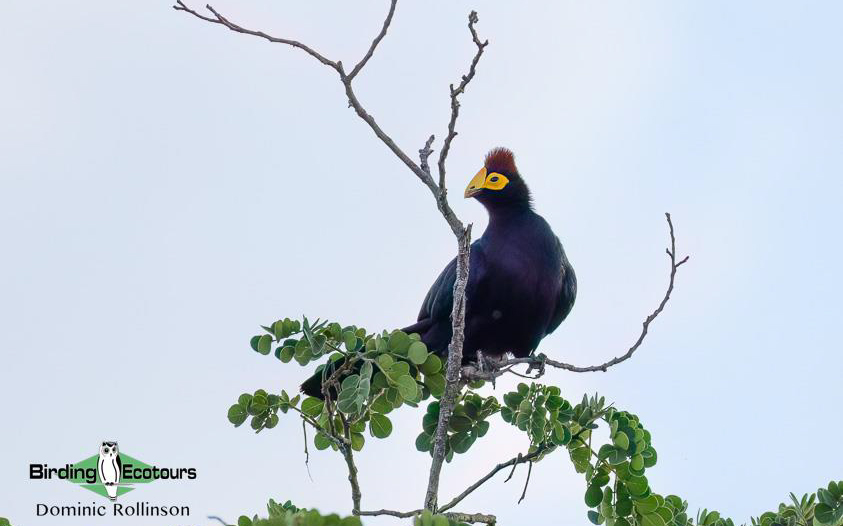
The vagrant Ross’s Turaco eventually put on a show for us.
Day 11, 12th November 2025. East through the Kavango Region and into Botswana
We decided on an early start this morning, as we wanted to bird the woodlands west of Divundu before it heated up too much. We loaded the vehicle, armed with breakfast packs, and hit the open road. As we approached our birding stop, the heavy grey clouds looked ominous, but with limited time, we decided to start birding and hope for the best. As soon as we got out of the vehicle, we found a few Sharp-tailed Starlings which showed very well – one of our primary targets here. We then started birding the woodlands and found African Golden Oriole, Striped Kingfisher, Purple Roller, Southern Black Flycatcher and Amethyst Sunbird. Just as we were getting into our birding here, the heavens opened and we were all drenched, so we decided to head back to the safety of the vehicle and try another spot.
At our next woodland birding stop we ventured deeper into the woodlands (now that the rain had passed over) and here we found Yellow-fronted Tinkerbird, Brown-crowned Tchagra, Southern Black Tit, Rattling and Tinkling Cisticolas, Neddicky (Piping Cisticola), Violet-backed Starling and Yellow-fronted Canary. We heard a nearby Souza’s Shrike call but, despite a thorough search of the area, we could not find the bird in question.
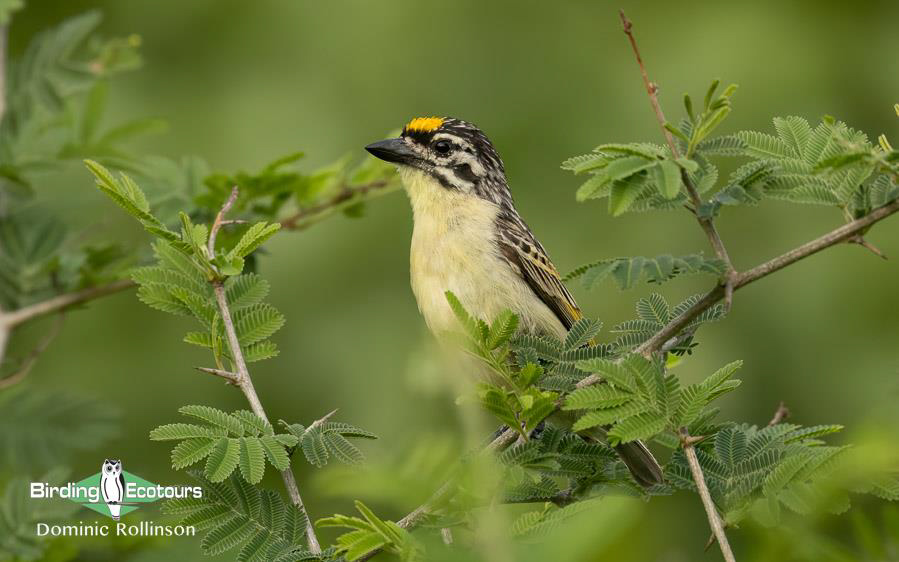
The cute Yellow-fronted Tinkerbird.
One final stop on the Kavango River revealed a few Rock Pratincoles, which are always fun to see. With our stomachs starting to rumble we carried on east through Divundu and stopped at a lodge overlooking the Kavango River for a well-deserved sit-down lunch. I set up the scope on the deck and our lunch was routinely interrupted by exciting birds such as Black Crake, Yellow-billed Stork, Glossy Ibis, Little Heron, White-headed and White-backed Vultures, Bateleur, Wahlberg’s Eagle, Banded Martin and Wire-tailed Swallow.
Next up was the border crossing into Botswana, which went by very easily and did not take much time at all. Before we knew it, we arrived at Drotsky’s Cabins near Shakawe, where we were based for the next two nights. We met up in the late afternoon to bird the riparian forest behind the campsite in the hopes of finding our main quarry in Botswana – Pel’s Fishing Owl. We met the local guide, Otto, who agreed to take us on a walk to have a first look for the owl. Unfortunately we could not find it today, however, we did find two other owl species in the form of African Wood Owl and African Barred Owlet. The birding in the riparian forest proved productive and we added White-browed Coucal, African Green Pigeon, Hartlaub’s Babbler and Yellow-bellied Greenbul, and had brief looks at Narina Trogon.
We finished what had been a busy day, on the deck enjoying a drink overlooking the Okavango Panhandle along the Okavango River (as it’s known in Botswana) with several noteworthy species giving us flybys. Some of the highlights here included African Skimmer, Yellow-billed Stork, Squacco Heron, Hamerkop and African Marsh Harrier. One of the most impressive rainbows I have ever seen was a fitting end to the day!
Day 12, 13th November 2025. Okavango Panhandle boat cruise and birding
As was now the norm, we again met just before sunrise and boarded our private boat for another enjoyable river cruise. We headed upstream towards Shakawe town and enjoyed flybys and many birds on the riverbanks and sandbars. Highlights of the morning’s cruise included Spur-winged Goose, Mourning Collared Dove, Coppery-tailed Coucal, Water Thick-knee, Long-toed Lapwing, African Skimmer, White-backed Night Heron, Goliath Heron, Hamerkop, Malachite, Brown-hooded, Giant and Pied Kingfishers, White-fronted and Blue-cheeked Bee-eaters, Greater Swamp Warbler, Chirping Cisticola, Yellow-billed Oxpecker, Fan-tailed Widowbird and African Stonechat. Unfortunately, we still could not find Pel’s Fishing Owl at any of its regular stakeouts and so we opted for another walk behind the campsite.
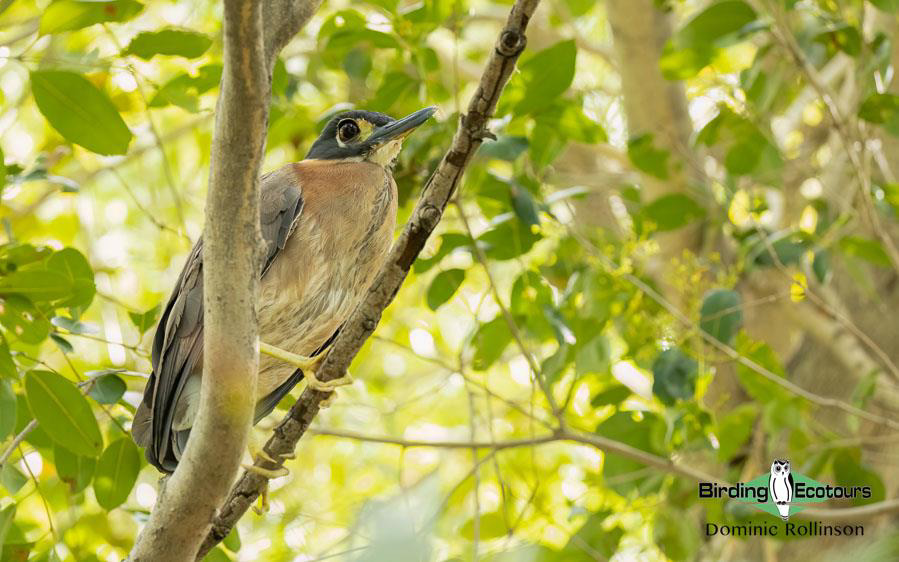
White-backed Night Herons can be very tricky to see, but were rather obliging on this tour.
This time, luck proved to be on our side, and it didn’t take long for Otto to point out a single Pel’s Fishing Owl, which took some finding, but we all eventually had good looks at this highly desired species, which turned out to be voted bird-of-the-trip! Other birds of interest in the riparian forest included Crested and Black-collared Barbets, Terrestrial, Brownbul, White-browed Robin-Chat and Spectacled Weaver. The rare papyrus-dwelling Sitatunga antelope was also seen briefly this morning as it hid deep in the papyrus and proved tricky to spot.
We then returned to our lodge for a delicious breakfast and savored our fishing owl sighting (this species being Cliff’s biggest target of the trip)! We followed breakfast with a walk around the lodge grounds, which added Southern Carmine Bee-eater, Woodland Kingfisher, Willow Warbler (a trip highlight for Marcy;), Collared Sunbird and a distantly calling Western Banded Snake Eagle.
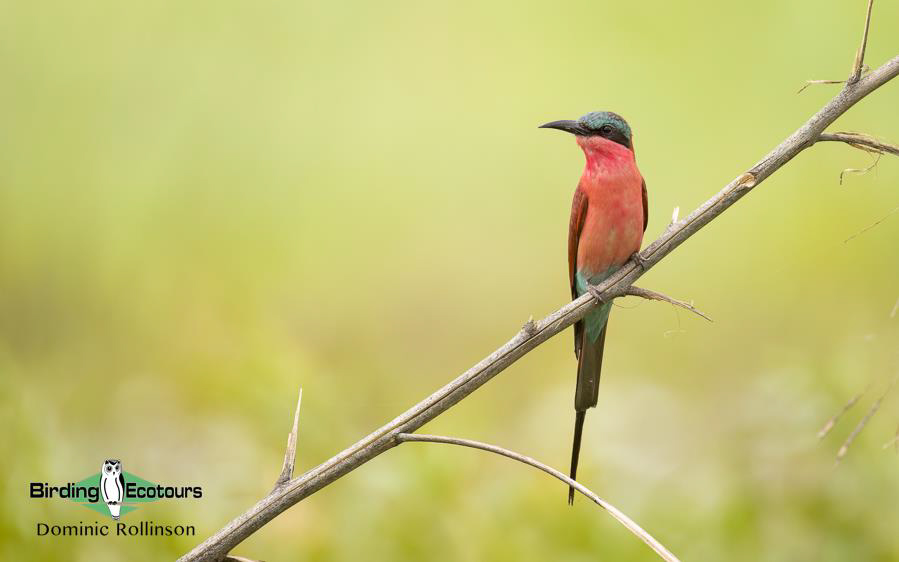
Southern Carmine Bee-eaters are always a crowd favorite.
Either side of lunch we enjoyed some downtime, before meeting again in the late afternoon for our second boat cruise. This time, we headed south of our lodge towards a floodplain, where it did not take long to find our biggest target, Slaty Egret, which we watched feeding near to the very similarly plumaged Black Heron. Other highlights of this afternoon’s boat trip included Knob-billed Duck, Coppery-tailed Coucal, African Swamphen, Greater Painted-snipe, Sanderling (an uncommon bird here), Collared Pratincole, African Skimmer, Little Bittern, Grey-rumped Swallow, Brown-throated Martin and Village Weaver. On the way back to our lodge, we enjoyed a cold drink and took in the impressive skies, with cumulonimbus clouds busy building up. That evening we had another massive thunderstorm which was quite something to experience!
Day 13, 14th November 2025. Back into Namibia and birding the Mahango area
At dawn we took another walk into the riparian forest where we had some more excellent birding. Narina Trogon showed better than the previous couple of days and we also watched an African Goshawk calling from an exposed perch. Other noteworthy birds seen this morning included African Green Pigeon, Grey-headed Kingfisher, Golden-tailed Woodpecker, Icterine Warbler, Ashy Flycatcher and Collared Sunbird. At our lodge reception we were shown the Western Barn Owl at its regular roost site.
We then had a leisurely breakfast and checked out in the late morning. As we were driving through the bushveld behind the lodge we noticed a few Magpie Shrikes and we got out the vehicle to enjoy them. This turned into a highly productive 30 minutes of acacia bushveld birding and gave our Botswana list a nice last-minute boost. Other birds seen here included Bateleur, Common Scimitarbill, Southern Red-billed Hornbill, Grey-headed Kingfisher, Acacia Pied Barbet, Crimson-breasted Shrike, Orange-breasted Bushshrike, Lesser Grey Shrike, Southern Black Tit, Long-billed Crombec, Burchell’s and Meves’s Starlings, Southern Red Bishop and Violet-eared Waxbill.
We arrived at our lodge, where we were based for one night and, while waiting for lunch, we birded the lodge grounds and saw Marabou Stork, African Sacred Ibis, African Spoonbill, another Slaty Egret and several Brown Firefinches. We even got to enjoy a Little Sparrowhawk excitedly calling from near to its nest.
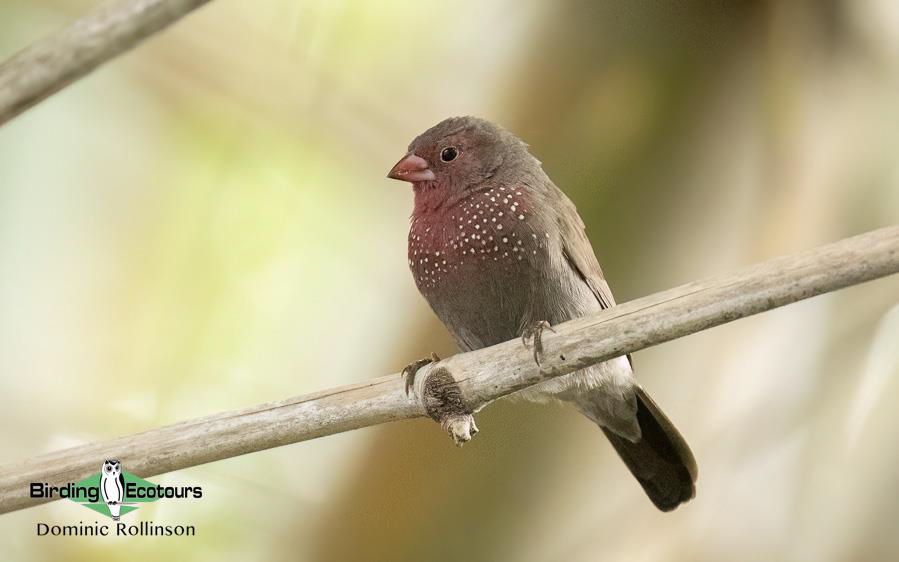
Brown Firefinches posed beautifully for us in the Mahangu area.
Later that afternoon we headed out to Mahangu Game Reserve and drove the riverside loop which was, as usual, full of animals along the floodplain, such as Impala, Southern Lechwe, Waterbuck, Common Warthog, Southern Giraffe and many wallowing Common Hippopotamuses. Bird-wise things were a little slower than usual, however we did record Swainson’s Spurfowl, African Openbill, African Woolly-necked Stork, yet another Slaty Egret, Martial Eagle, Golden-breasted Bunting and a pair of Wattled Cranes (which the group tried desperately to turn into some form of undescribed, wattled antelope)!
A quick post-dinner nocturnal foray into the floodplain added the trip’s only Square-tailed Nightjar.
Day 14, 15th November 2025. Transfer to Zambezi Region
The morning was spent birding the floodplain outside the lodge, which proved productive despite the relentless drizzle, and new trip birds came in the form of Eurasian Hobby, Mosque Swallow and Pin-tailed Whydah. The best bird of the morning was an African Crake, which was determined to play hide-and-seek with us but eventually most of us got to glimpse it. Unfortunately, we could not locate Luapula Cisticola.
After breakfast we packed the vehicle and made a big push east through the Zambezi Region (formerly the Caprivi Strip). During our lunch stop, we birded the nearby woodlands and found Striped Kingfisher, Cardinal Woodpecker, Black Cuckooshrike, Chinspot Batis, Fawn-colored Lark, Violet-backed Starling, Yellow-throated Bush Sparrow and, best of the lot, a Eurasian Nightjar which showed beautifully for us. Other notable sightings along the drive included Dark Chanting Goshawk (well spotted Ira), Greater Blue-eared Starling and Lesser Spotted Eagle.
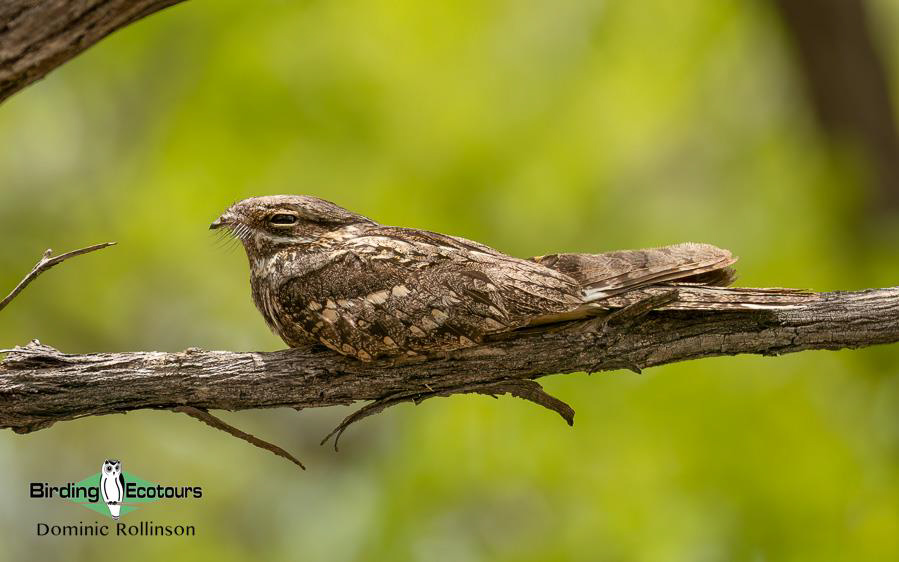
This Eurasian Nightjar was seen in the woodlands of the Zambezi region.
We arrived at our accommodation in Katima Mulilo, on the banks of the Zambezi River, in the late afternoon. With the weather having closed in, we delayed our boat cruise and decided to take it easy for the remainder of the afternoon. We did, however, squeeze in some birding and managed to find Purple-banded Sunbird and Schalow’s Turaco. A couple of us also managed brief looks at African Finfoot as it came in to roost for the night.
Day 15, 16th November 2025. Katima Mulilo birding
We awoke to the exciting prospect of a full day of Katima Mulilo birding ahead of us. We immediately got the day started with Pale-throated Greenbul seen in the lodge grounds, soon followed by improved looks at Schalow’s Turaco.
Leaving the lodge grounds, we birded the outskirts of the town where we were lucky to find Collared Palm Thrush, before pushing into some tall broadleaved woodlands. Here, the birding was excellent, with sightings of Racket-tailed and Broad-billed Rollers, Levaillant’s and Red-chested Cuckoos, Grey-headed Kingfisher, Bearded Woodpecker, African Golden and Black-headed Orioles, White-crested Helmetshrike, Grey Penduline Tit and Yellow-throated Bush Sparrow.
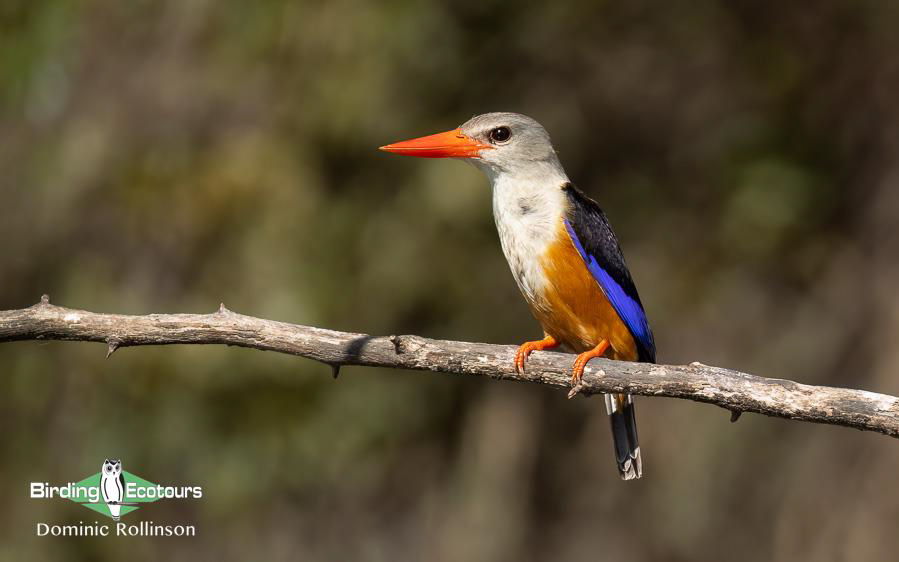
We had excellent looks at Grey-headed Kingfishers around Katima Mulilo.
After a quick breakfast we headed back out and birded the woodlands near to the lodge, which were again very birdy and here we found Chinspot Batis, Tropical Boubou, Crested Barbet and many Southern Carmine Bee-eaters. The nearby floodplain was full of birds and careful exploration of the area’s pans yielded Lesser Jacana, African Pygmy Goose, African Darter, Rufous-bellied Heron and Black Crake. The surrounding grasslands and woodlands further added Luapula Cisticola, Plain-backed Pipit, Southern Red Bishop, Flappet Lark, Cut-throat Finch, Village Indigobird and Pin-tailed Whydah.
We had a light lunch back at the lodge, followed by a very enjoyable Zambezi River boat cruise, with the highlight being multiple African Finfoot sightings of both males and females (see the front cover image). Other exciting birds seen on the boat trip included White-crowned Lapwing, African Skimmer, White-backed Night Heron, Grey-headed, Brown-hooded, Giant and Pied Kingfishers and Holub’s Golden and Thick-billed Weavers.
To finish the day we headed to another section of the Zambezi floodplain, where we enjoyed the spectacle of a massive Southern Carmine Bee-eater colony, a sure trip highlight for most. We looked for the single vagrant Northern Carmine Bee-eater which had found its way into the colony but, unfortunately, could not locate it within the mass of scarlet and green. The surrounding grasslands further added Black Coucal, Luapula Cisticola, several flyby Orange-breasted Waxbills and a distant calling Black-bellied Bustard which would not reveal itself.
That evening after dinner some of us popped out for some nocturnal birding, with African Scops Owl and Giant African Bullfrog being the highlights of this trip out.
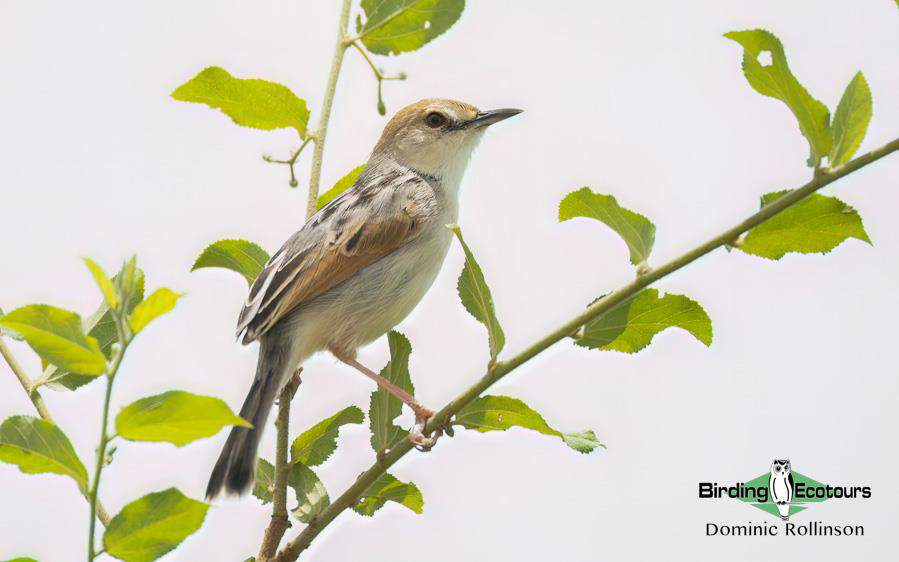
Luapula Cisticolas proved rather numerous in the floodplains around Katima Mulilo.
Day 16, 17th November 2025. Katima Mulilo to Victoria Falls
For our final morning’s birding around Katima Mulilo we went to bird some riparian forest nearby which added some quality birds like Crowned Hornbill, African Goshawk, Eastern Nicator, Bearded Scrub Robin and a calling African Emerald Cuckoo.
We again birded the woodlands and floodplain near the lodge and this time added new trip birds such as Green Wood Hoopoe, Retz’s Helmetshrike, Black-crowned Tchagra, Sand Martin and Southern Yellow White-eye.
After breakfast we said goodbye to our vehicle and were collected for our transfer to Victoria Falls. Most of the remainder of the day was allocated to the drive and border crossings, which went smoothly despite a bit of a wait for Zimbabwe visas and a massive thunderstorm upon our arrival at our lovely hotel in Victoria Falls. A few wildlife highlights of the day’s travels were Cape Buffalo and African Savanna Elephants in Chobe Game Reserve, and Chacma Baboons raiding rubbish bins at the Zimbabwe border post.
A quick walk around the hotel grounds, along the banks of the Zambezi River, yielded Collared Palm Thrush, Hamerkop, Brown-hooded Kingfisher and Tropical Boubou.
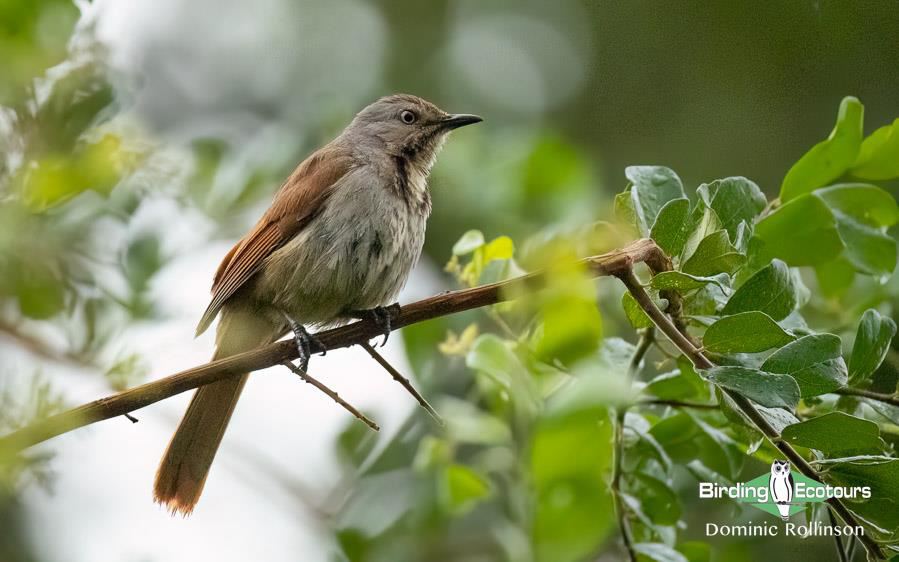
Collared Palm Thrushes were common along the Zambezi River in Zimbabwe.
Day 17, 18th November 2025. Victoria Falls birding
We were fetched early from our hotel for our game drive in the Stanley and Livingstone Private Game Reserve and then spent the remainder of the morning on our private safari. The birding here was great, and we accumulated an impressive list including the likes of Swainson’s Spurfowl, Senegal Coucal, Hooded Vulture, Brown Snake Eagle, Lesser Spotted Eagle, Gabar Goshawk, Lizard Buzzard, Striped Kingfisher, Broad-billed Roller, Eurasian Hobby, White-crested Helmetshrike, Lesser Striped Swallow, Jameson’s Firefinch and Golden-breasted Bunting. The birding highlight of the morning was when Katie spotted a small group of feeding Southern Crested Guineafowl! While on our drive we stopped for a delicious bush breakfast which was beautifully set up for us and was a truly memorable experience. We also noted a good assortment of animals on this drive, such as Common Eland, Greater Kudu, Common Warthog, Waterbuck and a single Black Rhinoceros.
We then headed back to our hotel where we took some time off, before heading out to the mighty Victoria Falls for the afternoon. We spent an enjoyable couple of hours viewing the falls from various viewpoints to fully appreciate the magnitude of this World Heritage Site. Victoria Falls is over a mile (1.7 kilometers) wide, with a maximum height of 354 feet (108 meters), with the local name Mosi-oa-Tunya meaning ‘The Smoke that Thunders’. Of course, we had our binoculars on us and also enjoyed the likes of Common Sandpiper, African Harrier-Hawk, Golden-tailed Woodpecker, Yellow-breasted Apalis, Red-faced Cisticola, Red-winged Starling, Bearded Scrub Robin and Spectacled and Thick-billed Weavers, with the highlight being a small group of showy Jameson’s Firefinches which were well found by Edith.
That evening we enjoyed a lovely final meal together (with Ira and Ramona heading off early the next morning) and reminisced over what a successful and fun trip it had been.

Victoria Falls was a perfect finish to a thoroughly enjoyable tour.
Day 18, 19th November 2025. Victoria Falls birding and departure
This morning we took a final walk around the hotel grounds, which yielded 65 species including a new bird in the form of Trumpeter Hornbill. Other notable species seen included African Goshawk, Green Wood Hoopoe, Yellow-fronted Tinkerbird, Black-collared Barbet, Orange-breasted Bushshrike, Willow Warbler, Meves’s Starling, Collared Palm Thrush, Amethyst and Scarlet-chested Sunbirds and Bronze Mannikin. We walked down to the jetty along the Zambezi River and here we had excellent views of African Finfoot as well as Marabou Stork, African Openbill and Hooded Vulture.
After a final breakfast (perhaps the tastiest breakfast of the trip) we then caught transfers to the airport and started making our long way home, with some of the group further extending their time in Zimbabwe.
Bird List – Following IOC (Version 15.1/January 2025)
Birds ‘heard only’ are marked with (H) after the common name, all other species were seen.
The following notation after species names is used to show conservation status following BirdLife International: CR = Critically Endangered, EN = Endangered, VU = Vulnerable.
| Common Name | Scientific Name |
| Ostriches (Struthionidae) | |
| Common Ostrich | Struthio camelus |
| Ducks, Geese, Swans (Anatidae) | |
| White-faced Whistling Duck | Dendrocygna viduata |
| Spur-winged Goose | Plectropterus gambensis |
| Knob-billed Duck | Sarkidiornis melanotos |
| Egyptian Goose | Alopochen aegyptiaca |
| South African Shelduck | Tadorna cana |
| African Pygmy Goose | Nettapus auritus |
| Blue-billed Teal | Spatula hottentota |
| Cape Teal | Anas capensis |
| Red-billed Teal | Anas erythrorhyncha |
| Southern Pochard | Netta erythrophthalma |
| Guineafowl (Numididae) | |
| Helmeted Guineafowl | Numida meleagris |
| Southern Crested Guineafowl | Guttera edouardi |
| Pheasants & Allies (Phasianidae) | |
| Crested Francolin | Ortygornis sephaena |
| Hartlaub’s Spurfowl | Pternistis hartlaubi |
| Red-billed Spurfowl | Pternistis adspersus |
| Swainson’s Spurfowl | Pternistis swainsonii |
| Nightjars (Caprimulgidae) | |
| European Nightjar | Caprimulgus europaeus |
| Rufous-cheeked Nightjar | Caprimulgus rufigena |
| Freckled Nightjar | Caprimulgus tristigma |
| Square-tailed Nightjar | Caprimulgus fossii |
| Swifts (Apodidae) | |
| African Palm Swift | Cypsiurus parvus |
| Alpine Swift | Tachymarptis melba |
| Common Swift | Apus apus |
| African Black Swift | Apus barbatus |
| Bradfield’s Swift | Apus bradfieldi |
| Little Swift | Apus affinis |
| White-rumped Swift | Apus caffer |
| Turacos (Musophagidae) | |
| Grey Go-away-bird | Crinifer concolor |
| Ross’s Turaco | Tauraco rossae |
| Schalow’s Turaco | Tauraco schalowi |
| Bustards (Otididae) | |
| Kori Bustard | Ardeotis kori |
| Rüppell’s Korhaan | Heterotetrax rueppelii |
| Red-crested Korhaan | Lophotis ruficrista |
| Northern Black Korhaan | Afrotis afraoides |
| Black-bellied Bustard (H) | Lissotis melanogaster |
| Cuckoos (Cuculidae) | |
| Senegal Coucal | Centropus senegalensis |
| Coppery-tailed Coucal | Centropus cupreicaudus |
| White-browed Coucal | Centropus superciliosus |
| Black Coucal | Centropus grillii |
| Levaillant’s Cuckoo | Clamator levaillantii |
| Jacobin Cuckoo | Clamator jacobinus |
| Diederik Cuckoo | Chrysococcyx caprius |
| Klaas’s Cuckoo | Chrysococcyx klaas |
| African Emerald Cuckoo (H) | Chrysococcyx cupreus |
| Black Cuckoo | Cuculus clamosus |
| Red-chested Cuckoo | Cuculus solitarius |
| African Cuckoo | Cuculus gularis |
| Sandgrouse (Pteroclidae) | |
| Namaqua Sandgrouse | Pterocles namaqua |
| Double-banded Sandgrouse | Pterocles bicinctus |
| Burchell’s Sandgrouse | Pterocles burchelli |
| Pigeons, Doves (Columbidae) | |
| Rock Dove | Columba livia |
| Speckled Pigeon | Columba guinea |
| Mourning Collared Dove | Streptopelia decipiens |
| Red-eyed Dove | Streptopelia semitorquata |
| Ring-necked Dove | Streptopelia capicola |
| Laughing Dove | Spilopelia senegalensis |
| Emerald-spotted Wood Dove | Turtur chalcospilos |
| Namaqua Dove | Oena capensis |
| African Green Pigeon | Treron calvus |
| Finfoots (Heliornithidae) | |
| African Finfoot | Podica senegalensis |
| Rails, Crakes & Coots (Rallidae) | |
| African Crake | Crecopsis egregia |
| Common Moorhen | Gallinula chloropus |
| Red-knobbed Coot | Fulica cristata |
| African Swamphen | Porphyrio madagascariensis |
| Black Crake | Zapornia flavirostra |
| Cranes (Gruidae) | |
| Wattled Crane – VU | Grus carunculata |
| Blue Crane – VU | Grus paradisea |
| Grebes (Podicipedidae) | |
| Little Grebe | Tachybaptus ruficollis |
| Black-necked Grebe | Podiceps nigricollis |
| Flamingos (Phoenicopteridae) | |
| Greater Flamingo | Phoenicopterus roseus |
| Lesser Flamingo | Phoeniconaias minor |
| Stone-curlews, Thick-knees (Burhinidae) | |
| Spotted Thick-knee | Burhinus capensis |
| Water Thick-knee | Burhinus vermiculatus |
| Oystercatchers (Haematopodidae) | |
| African Oystercatcher | Haematopus moquini |
| Stilts, Avocets (Recurvirostridae) | |
| Black-winged Stilt | Himantopus himantopus |
| Pied Avocet | Recurvirostra avosetta |
| Plovers (Charadriidae) | |
| Grey Plover – VU | Pluvialis squatarola |
| Common Ringed Plover | Charadrius hiaticula |
| Three-banded Plover | Charadrius tricollaris |
| Long-toed Lapwing | Vanellus crassirostris |
| Blacksmith Lapwing | Vanellus armatus |
| White-crowned Lapwing | Vanellus albiceps |
| Crowned Lapwing | Vanellus coronatus |
| African Wattled Lapwing | Vanellus senegallus |
| Kittlitz’s Plover | Anarhynchus pecuarius |
| Chestnut-banded Plover | Anarhynchus pallidus |
| White-fronted Plover | Anarhynchus marginatus |
| Painted-snipes (Rostratulidae) | |
| Greater Painted-snipe | Rostratula benghalensis |
| Jacanas (Jacanidae) | |
| Lesser Jacana | Microparra capensis |
| African Jacana | Actophilornis africanus |
| Sandpipers, Snipes (Scolopacidae) | |
| Eurasian Whimbrel | Numenius phaeopus |
| Bar-tailed Godwit | Limosa lapponica |
| African Snipe | Gallinago nigripennis |
| Common Sandpiper | Actitis hypoleucos |
| Marsh Sandpiper | Tringa stagnatilis |
| Wood Sandpiper | Tringa glareola |
| Common Greenshank | Tringa nebularia |
| Ruddy Turnstone | Arenaria interpres |
| Ruff | Calidris pugnax |
| Curlew Sandpiper – VU | Calidris ferruginea |
| Sanderling | Calidris alba |
| Little Stint | Calidris minuta |
| Coursers, Pratincoles (Glareolidae) | |
| Double-banded Courser | Rhinoptilus africanus |
| Temminck’s Courser | Cursorius temminckii |
| Rock Pratincole | Glareola nuchalis |
| Black-winged Pratincole | Glareola nordmanni |
| Collared Pratincole | Glareola pratincola |
| Gulls, Terns, Skimmers (Laridae) | |
| African Skimmer | Rynchops flavirostris |
| Damara Tern | Sternula balaenarum |
| Caspian Tern | Hydroprogne caspia |
| Whiskered Tern | Chlidonias hybrida |
| White-winged Tern | Chlidonias leucopterus |
| Common Tern | Sterna hirundo |
| Sandwich Tern | Thalasseus sandvicensis |
| Greater Crested Tern | Thalasseus bergii |
| Grey-headed Gull | Chroicocephalus cirrocephalus |
| Hartlaub’s Gull | Chroicocephalus hartlaubii |
| Kelp Gull | Larus dominicanus |
| Skuas (Stercorariidae) | |
| Parasitic Jaeger | Stercorarius parasiticus |
| Northern Storm Petrels (Hydrobatidae) | |
| European Storm Petrel | Hydrobates pelagicus |
| Petrels, Shearwaters, Diving Petrels (Procellariidae) | |
| White-chinned Petrel – VU | Procellaria aequinoctialis |
| Sooty Shearwater | Ardenna grisea |
| Storks (Ciconiidae) | |
| African Openbill | Anastomus lamelligerus |
| Marabou Stork | Leptoptilos crumenifer |
| Yellow-billed Stork | Mycteria ibis |
| African Woolly-necked Stork | Ciconia microscelis |
| Anhingas, Darters (Anhingidae) | |
| African Darter | Anhinga rufa |
| Cormorants, Shags (Phalacrocoracidae) | |
| Reed Cormorant | Microcarbo africanus |
| Crowned Cormorant | Microcarbo coronatus |
| Cape Cormorant – EN | Phalacrocorax capensis |
| Great Cormorant | Phalacrocorax carbo |
| Ibises, Spoonbills (Threskiornithidae) | |
| African Sacred Ibis | Threskiornis aethiopicus |
| Hadada Ibis | Bostrychia hagedash |
| Glossy Ibis | Plegadis falcinellus |
| African Spoonbill | Platalea alba |
| Herons, Bitterns (Ardeidae) | |
| Little Bittern | Botaurus minutus |
| Black-crowned Night Heron | Nycticorax nycticorax |
| Slaty Egret – VU | Egretta vinaceigula |
| Black Heron | Egretta ardesiaca |
| Little Egret | Egretta garzetta |
| White-backed Night Heron | Calherodius leuconotus |
| Little Heron | Butorides atricapilla |
| Rufous-bellied Heron | Ardeola rufiventris |
| Squacco Heron | Ardeola ralloides |
| Great Egret | Ardea alba |
| Yellow-billed Egret | Ardea brachyrhyncha |
| Western Cattle Egret | Ardea ibis |
| Grey Heron | Ardea cinerea |
| Purple Heron | Ardea purpurea |
| Black-headed Heron | Ardea melanocephala |
| Goliath Heron | Ardea goliath |
| Hamerkop (Scopidae) | |
| Hamerkop | Scopus umbretta |
| Pelicans (Pelecanidae) | |
| Great White Pelican | Pelecanus onocrotalus |
| Secretarybird (Sagittariidae) | |
| Secretarybird – EN | Sagittarius serpentarius |
| Ospreys (Pandionidae) | |
| Osprey | Pandion haliaetus |
| Kites, Hawks, Eagles (Accipitridae) | |
| Black-winged Kite | Elanus caeruleus |
| African Harrier-Hawk | Polyboroides typus |
| White-headed Vulture – CR | Trigonoceps occipitalis |
| Hooded Vulture – CR | Necrosyrtes monachus |
| White-backed Vulture – CR | Gyps africanus |
| Bateleur – EN | Terathopius ecaudatus |
| Western Banded Snake Eagle (H) | Circaetus cinerascens |
| Black-chested Snake Eagle | Circaetus pectoralis |
| Brown Snake Eagle | Circaetus cinereus |
| Martial Eagle – EN | Polemaetus bellicosus |
| Lesser Spotted Eagle | Clanga pomarina |
| Wahlberg’s Eagle | Hieraaetus wahlbergi |
| Tawny Eagle – VU | Aquila rapax |
| Verreaux’s Eagle | Aquila verreauxii |
| Gabar Goshawk | Micronisus gabar |
| Dark Chanting Goshawk | Melierax metabates |
| Pale Chanting Goshawk | Melierax canorus |
| Lizard Buzzard | Kaupifalco monogrammicus |
| African Goshawk | Aerospiza tachiro |
| Little Sparrowhawk | Tachyspiza minulla |
| African Marsh Harrier | Circus ranivorus |
| Black Kite | Milvus migrans |
| African Fish Eagle | Icthyophaga vocifer |
| Common Buzzard | Buteo buteo |
| Barn Owls (Tytonidae) | |
| Western Barn Owl | Tyto alba |
| Owls (Strigidae) | |
| Pearl-spotted Owlet | Glaucidium perlatum |
| African Barred Owlet | Glaucidium capense |
| African Scops Owl | Otus senegalensis |
| Pel’s Fishing Owl | Scotopelia peli |
| African Wood Owl | Strix woodfordii |
| Mousebirds (Coliidae) | |
| White-backed Mousebird | Colius colius |
| Red-faced Mousebird | Urocolius indicus |
| Trogons (Trogonidae) | |
| Narina Trogon | Apaloderma narina |
| Hoopoes (Upupidae) | |
| Common Hoopoe | Upupa epops |
| Wood Hoopoes (Phoeniculidae) | |
| Green Wood Hoopoe | Phoeniculus purpureus |
| Violet Wood Hoopoe | Phoeniculus damarensis |
| Common Scimitarbill | Rhinopomastus cyanomelas |
| Hornbills (Bucerotidae) | |
| Damara Red-billed Hornbill | Tockus damarensis |
| Southern Red-billed Hornbill | Tockus rufirostris |
| Monteiro’s Hornbill | Tockus monteiri |
| Southern Yellow-billed Hornbill | Tockus leucomelas |
| Bradfield’s Hornbill | Lophoceros bradfieldi |
| Crowned Hornbill | Lophoceros alboterminatus |
| African Grey Hornbill | Lophoceros nasutus |
| Trumpeter Hornbill | Bycanistes bucinator |
| Rollers (Coraciidae) | |
| Purple Roller | Coracias naevius |
| Racket-tailed Roller | Coracias spatulatus |
| Lilac-breasted Roller | Coracias caudatus |
| Broad-billed Roller | Eurystomus glaucurus |
| Kingfishers (Alcedinidae) | |
| Grey-headed Kingfisher | Halcyon leucocephala |
| Brown-hooded Kingfisher | Halcyon albiventris |
| Striped Kingfisher | Halcyon chelicuti |
| Woodland Kingfisher | Halcyon senegalensis |
| Malachite Kingfisher | Corythornis cristatus |
| Giant Kingfisher | Megaceryle maxima |
| Pied Kingfisher | Ceryle rudis |
| Bee-eaters (Meropidae) | |
| Swallow-tailed Bee-eater | Merops hirundineus |
| Little Bee-eater | Merops pusillus |
| White-fronted Bee-eater | Merops bullockoides |
| Blue-cheeked Bee-eater | Merops persicus |
| European Bee-eater | Merops apiaster |
| Southern Carmine Bee-eater | Merops nubicoides |
| African Barbets (Lybiidae) | |
| Crested Barbet | Trachyphonus vaillantii |
| Yellow-fronted Tinkerbird | Pogoniulus chrysoconus |
| Acacia Pied Barbet | Tricholaema leucomelas |
| Black-collared Barbet | Lybius torquatus |
| Honeyguides (Indicatoridae) | |
| Lesser Honeyguide | Indicator minor |
| Woodpeckers (Picidae) | |
| Bennett’s Woodpecker | Campethera bennettii |
| Golden-tailed Woodpecker | Campethera abingoni |
| Bearded Woodpecker | Chloropicus namaquus |
| Cardinal Woodpecker | Dendropicos fuscescens |
| Caracaras, Falcons (Falconidae) | |
| Pygmy Falcon | Polihierax semitorquatus |
| Rock Kestrel | Falco rupicolus |
| Greater Kestrel | Falco rupicoloides |
| Eurasian Hobby | Falco subbuteo |
| Lanner Falcon | Falco biarmicus |
| Peregrine Falcon | Falco peregrinus |
| African & New World Parrots (Psittacidae) | |
| Meyer’s Parrot | Poicephalus meyeri |
| Rüppell’s Parrot | Poicephalus rueppellii |
| Wattle-eyes, Batises (Platysteiridae) | |
| Chinspot Batis | Batis molitor |
| Pririt Batis | Batis pririt |
| White-tailed Shrike | Lanioturdus torquatus |
| Bushshrikes (Malaconotidae) | |
| Orange-breasted Bushshrike | Chlorophoneus sulfureopectus |
| Bokmakierie | Telophorus zeylonus |
| Brown-crowned Tchagra | Tchagra australis |
| Black-crowned Tchagra | Tchagra senegalus |
| Black-backed Puffback | Dryoscopus cubla |
| Tropical Boubou | Laniarius major |
| Swamp Boubou | Laniarius bicolor |
| Crimson-breasted Shrike | Laniarius atrococcineus |
| Brubru | Nilaus afer |
| Vangas & Allies (Vangidae) | |
| White-crested Helmetshrike | Prionops plumatus |
| Retz’s Helmetshrike | Prionops retzii |
| Cuckooshrikes (Campephagidae) | |
| Black Cuckooshrike | Campephaga flava |
| Figbirds, Old World Orioles, Piopios (Oriolidae) | |
| Black-headed Oriole | Oriolus larvatus |
| African Golden Oriole | Oriolus auratus |
| Drongos (Dicruridae) | |
| Fork-tailed Drongo | Dicrurus adsimilis |
| Monarchs (Monarchidae) | |
| African Paradise Flycatcher | Terpsiphone viridis |
| Shrikes (Laniidae) | |
| Southern White-crowned Shrike | Eurocephalus anguitimens |
| Magpie Shrike | Lanius melanoleucus |
| Souza’s Shrike (H) | Lanius souzae |
| Southern Fiscal | Lanius collaris |
| Lesser Grey Shrike | Lanius minor |
| Red-backed Shrike | Lanius collurio |
| Crows, Jays (Corvidae) | |
| House Crow | Corvus splendens |
| Cape Crow | Corvus capensis |
| Pied Crow | Corvus albus |
| Tits, Chickadees (Paridae) | |
| Southern Black Tit | Melaniparus niger |
| Carp’s Tit | Melaniparus carpi |
| Ashy Tit (H) | Melaniparus cinerascens |
| Penduline Tits (Remizidae) | |
| Grey Penduline Tit | Anthoscopus caroli |
| Cape Penduline Tit | Anthoscopus minutus |
| Nicators (Nicatoridae) | |
| Eastern Nicator | Nicator gularis |
| Larks (Alaudidae) | |
| Spike-heeled Lark | Chersomanes albofasciata |
| Gray’s Lark | Ammomanopsis grayi |
| Grey-backed Sparrow-Lark | Eremopterix verticalis |
| Sabota Lark | Calendulauda sabota |
| Fawn-colored Lark | Calendulauda africanoides |
| Dune Lark | Calendulauda erythrochlamys |
| Flappet Lark | Amirafra rufocinnamomea |
| Eastern Clapper Lark | Corypha fasciolata |
| Rufous-naped Lark | Corypha africana |
| Stark’s Lark | Spizocorys starki |
| Pink-billed Lark | Spizocorys conirostris |
| Red-capped Lark | Calandrella cinerea |
| Bulbuls (Pycnonotidae) | |
| Pale-throated Greenbul | Atimastillas flavigula |
| Yellow-bellied Greenbul | Chlorocichla flaviventris |
| Terrestrial Brownbul | Phyllastrephus terrestris |
| African Red-eyed Bulbul | Pycnonotus nigricans |
| Common Bulbul | Pycnonotus barbatus |
| Swallows, Martins (Hirundinidae) | |
| Grey-rumped Swallow | Pseudhirundo griseopyga |
| Banded Martin | Neophedina cincta |
| Brown-throated Martin | Riparia paludicola |
| Sand Martin | Riparia riparia |
| Large Rock Martin | Ptyonoprogne fuligula |
| Pearl-breasted Swallow | Hirundo dimidiata |
| Barn Swallow | Hirundo rustica |
| White-throated Swallow | Hirundo albigularis |
| Wire-tailed Swallow | Hirundo smithii |
| Greater Striped Swallow | Cecropis cucullata |
| Lesser Striped Swallow | Cecropis abyssinica |
| Red-breasted Swallow | Cecropis semirufa |
| Mosque Swallow | Cecropis senegalensis |
| Crombecs, African Warblers (Macrosphenidae) | |
| Rockrunner | Achaetops pycnopygius |
| Long-billed Crombec | Sylvietta rufescens |
| Leaf Warblers (Phylloscopidae) | |
| Willow Warbler | Phylloscopus trochilus |
| Reed Warblers & Allies (Acrocephalidae) | |
| Greater Swamp Warbler | Acrocephalus rufescens |
| Lesser Swamp Warbler | Acrocephalus gracilirostris |
| Icterine Warbler | Hippolais icterina |
| Grassbirds & Allies (Locustellidae) | |
| Little Rush Warbler (H) | Bradypterus baboecala |
| Cisticolas & Allies (Cisticolidae) | |
| Red-faced Cisticola | Cisticola erythrops |
| Rattling Cisticola | Cisticola chiniana |
| Tinkling Cisticola | Cisticola rufilatus |
| Luapula Cisticola | Cisticola luapula |
| Chirping Cisticola | Cisticola pipiens |
| Neddicky | Cisticola fulvicapilla |
| Zitting Cisticola | Cisticola juncidis |
| Desert Cisticola | Cisticola aridulus |
| Tawny-flanked Prinia | Prinia subflava |
| Black-chested Prinia | Prinia flavicans |
| Yellow-breasted Apalis | Apalis flavida |
| Grey-backed Camaroptera | Camaroptera brevicaudata |
| Barred Wren-Warbler | Calamonastes fasciolatus |
| Yellow-bellied Eremomela | Eremomela icteropygialis |
| Burnt-necked Eremomela | Eremomela usticollis |
| Sylviid Babblers (Sylviidae) | |
| Layard’s Warbler | Curruca layardi |
| Chestnut-vented Warbler | Curruca subcoerulea |
| White-eyes (Zosteropidae) | |
| Orange River White-eye | Zosterops pallidus |
| Southern Yellow White-eye | Zosterops anderssoni |
| Laughingthrushes & Allies (Leiothrichidae) | |
| Arrow-marked Babbler | Turdoides jardineii |
| Bare-cheeked Babbler | Turdoides gymnogenys |
| Southern Pied Babbler | Turdoides bicolor |
| Hartlaub’s Babbler | Turdoides hartlaubii |
| Black-faced Babbler | Turdoides melanops |
| Starlings, Rhabdornises (Sturnidae) | |
| Wattled Starling | Creatophora cinerea |
| Cape Starling | Lamprotornis nitens |
| Greater Blue-eared Starling | Lamprotornis chalybaeus |
| Meves’s Starling | Lamprotornis mevesii |
| Burchell’s Starling | Lamprotornis australis |
| Sharp-tailed Starling | Lamprotornis acuticaudus |
| Violet-backed Starling | Cinnyricinclus leucogaster |
| Red-winged Starling | Onychognathus morio |
| Pale-winged Starling | Onychognathus nabouroup |
| Oxpeckers (Buphagidae) | |
| Yellow-billed Oxpecker | Buphagus africanus |
| Red-billed Oxpecker | Buphagus erythrorynchus |
| Thrushes (Turdidae) | |
| Groundscraper Thrush | Turdus litsitsirupa |
| Kurrichane Thrush | Turdus libonyana |
| Chats, Old World Flycatchers (Muscicapidae) | |
| Bearded Scrub Robin | Tychaedon quadrivirgata |
| Kalahari Scrub Robin | Cercotrichas paena |
| White-browed Scrub Robin | Cercotrichas leucophrys |
| Pale Flycatcher | Agricola pallidus |
| Chat Flycatcher | Agricola infuscatus |
| Ashy Flycatcher | Fraseria caerulescens |
| Southern Black Flycatcher | Melaenornis pammelaina |
| Marico Flycatcher | Bradornis mariquensis |
| Spotted Flycatcher | Muscicapa striata |
| White-browed Robin-Chat | Cossypha heuglini |
| Collared Palm Thrush | Cichladusa arquata |
| Short-toed Rock Thrush | Monticola brevipes |
| African Stonechat | Saxicola torquatus |
| Karoo Chat | Emarginata schlegelii |
| Tractrac Chat | Emarginata tractrac |
| Mountain Chat | Myrmecocichla monticola |
| Capped Wheatear | Oenanthe pileata |
| Familiar Chat | Oenanthe familiaris |
| Sunbirds (Nectariniidae) | |
| Collared Sunbird | Hedydipna collaris |
| Amethyst Sunbird | Chalcomitra amethystina |
| Scarlet-chested Sunbird | Chalcomitra senegalensis |
| Marico Sunbird | Cinnyris mariquensis |
| Purple-banded Sunbird | Cinnyris bifasciatus |
| White-bellied Sunbird | Cinnyris talatala |
| Dusky Sunbird | Cinnyris fuscus |
| Old World Sparrows, Snowfinches (Passeridae) | |
| Yellow-throated Bush Sparrow | Gymnoris superciliaris |
| Cape Sparrow | Passer melanurus |
| Great Sparrow | Passer motitensis |
| Southern Grey-headed Sparrow | Passer diffusus |
| House Sparrow | Passer domesticus |
| Weavers, Widowbirds (Ploceidae) | |
| Red-billed Buffalo Weaver | Bubalornis niger |
| White-browed Sparrow-Weaver | Plocepasser mahali |
| Sociable Weaver | Philetairus socius |
| Scaly-feathered Weaver | Sporopipes squamifrons |
| Thick-billed Weaver | Amblyospiza albifrons |
| Spectacled Weaver | Ploceus ocularis |
| Holub’s Golden Weaver | Ploceus xanthops |
| Southern Brown-throated Weaver | Ploceus xanthopterus |
| Lesser Masked Weaver | Ploceus intermedius |
| Southern Masked Weaver | Ploceus velatus |
| Village Weaver | Ploceus cucullatus |
| Chestnut Weaver | Ploceus rubiginosus |
| Red-billed Quelea | Quelea quelea |
| Yellow-crowned Bishop | Euplectes afer |
| Southern Red Bishop | Euplectes orix |
| Fan-tailed Widowbird | Euplectes axillaris |
| Waxbills, Munias & Allies (Estrildidae) | |
| Bronze Mannikin | Spermestes cucullata |
| Black-faced Waxbill | Brunhilda erythronotos |
| Common Waxbill | Estrilda astrild |
| Quailfinch | Ortygospiza atricollis |
| Cut-throat Finch | Amadina fasciata |
| Red-headed Finch | Amadina erythrocephala |
| Orange-breasted Waxbill | Amandava subflava |
| Violet-eared Waxbill | Granatina granatina |
| Blue Waxbill | Uraeginthus angolensis |
| Green-winged Pytilia | Pytilia melba |
| Red-billed Firefinch | Lagonosticta senegala |
| Jameson’s Firefinch | Lagonosticta rhodopareia |
| Brown Firefinch | Lagonosticta nitidula |
| Indigobirds, Whydahs (Viduidae) | |
| Village Indigobird | Vidua chalybeata |
| Pin-tailed Whydah | Vidua macroura |
| Shaft-tailed Whydah | Vidua regia |
| Long-tailed Paradise Whydah | Vidua paradisaea |
| Wagtails, Pipits (Motacillidae) | |
| Cape Wagtail | Motacilla capensis |
| African Pied Wagtail | Motacilla aguimp |
| African Pipit | Anthus cinnamomeus |
| Buffy Pipit | Anthus vaalensis |
| Plain-backed Pipit | Anthus leucophrys |
| Finches, Euphonias (Fringillidae) | |
| Black-throated Canary | Crithagra atrogularis |
| Yellow-fronted Canary | Crithagra mozambica |
| White-throated Canary | Crithagra albogularis |
| Buntings (Emberizidae) | |
| Lark-like Bunting | Emberiza impetuani |
| Cinnamon-breasted Bunting | Emberiza tahapisi |
| Golden-breasted Bunting | Emberiza flaviventris |
| Total seen | 411 |
| Total heard only | 6 |
| Total recorded | 417 |
Mammal List – Following Mammalwatching.com (April 2024)
The following notation after species names is used to show conservation status following IUCN: CR = Critically Endangered, EN = Endangered, VU = Vulnerable.
| Common Name | Scientific Name |
| Elephants (Elephantidae) | |
| African Savanna Elephant – EN | Loxodonta africana |
| Hyraxes (Procaviidae) | |
| Rock Hyrax | Procavia capensis |
| Old World Monkeys (Cercopithecidae) | |
| Vervet Monkey | Chlorocebus pygerythrus |
| Chacma Baboon | Papio ursinus |
| Hares and Rabbits (Leporidae) | |
| African Savanna Hare | Lepus microtis |
| Squirrels (Sciuridae) | |
| Smith’s Bush Squirrel | Paraxerus cepapi |
| South African Ground Squirrel | Geosciurus inauris |
| Damara Ground Squirrel | Geosciurus princeps |
| Eared Seals (Otariidae) | |
| Afro-Australian Fur Seal | Arctocephalus pusillus |
| Canids (Canidae) | |
| Black-backed Jackal | Lupulella mesomelas |
| Felids (Felidae) | |
| Lion – VU | Panthera leo |
| Mongooses (Herpestidae) | |
| Angolan Slender Mongoose | Herpestes flavescens |
| Common Slender Mongoose | Herpestes sanguineus |
| Banded Mongoose | Mungos mungo |
| Hyaenas (Hyaenidae) | |
| Spotted Hyena | Crocuta crocuta |
| Rhinoceroses (Rhinocerotidae) | |
| Black Rhinoceros – CR | Diceros bicornis |
| Equines (Equidae) | |
| Plains Zebra | Equus quagga |
| Bovids (Bovidae) | |
| Impala | Aepyceros melampus |
| Hartebeest | Alcelaphus buselaphus |
| Blue Wildebeest | Connochaetes taurinus |
| Springbok | Antidorcas marsupialis |
| Damara Dik-dik | Madoqua damarensis |
| Steenbok | Raphicerus campestris |
| Bush Duiker | Sylvicapra grimmia |
| Gemsbok | Oryx gazella |
| Waterbuck | Kobus ellipsiprymnus |
| Southern Lechwe | Kobus leche |
| Cape Buffalo | Syncerus caffer |
| Common Eland | Tragelaphus oryx |
| Sitatunga | Tragelaphus spekii |
| Greater Kudu | Tragelaphus strepsiceros |
| Southern Bushbuck | Tragelaphus sylvaticus |
| Giraffes and Okapi (Giraffidae) | |
| Southern Giraffe | Giraffa giraffa |
| Suids (Suidae) | |
| Common Warthog | Phacochoerus africanus |
| Hippopotamuses (Hippopotamidae) | |
| Common Hippopotamus – VU | Hippopotamus amphibius |
| Rorquals (Balaenopteridae) | |
| Humpback Whale | Megaptera novaeangliae |
| Oceanic Dolphins (Delphinidae) | |
| Common Bottlenose Dolphin | Tursiops truncatus |
| Total seen: | 37 |
Reptile List – Following Reptiles of the World (October 2023)
| Common Name | Scientific Name |
| Crocodiles (Crocodylidae) | |
| Nile Crocodile | Crocodylus niloticus |
| Colubrid Snakes (Colubridae) | |
| Western Green Snake | Philothamnus angolensis |
| Dragons (Agamidae) | |
| Namib Rock Agama | Agama planiceps |
| Ground Agama | Agama aculeata |
| Typical Geckos (Gekkonidae) | |
| Bradfield’s Dwarf Gecko | Lygodactylus bradfieldi |
| Wall Lizards (Lacertidae) | |
| Plain Sand Lizard | Pedioplanis inornata |
| Namaqua Sand Lizard | Pedioplanis namaquensis |
| Wedge-snouted Desert Lizard | Meroles cuneirostris |
| Skinks (Scincidae) | |
| Ovambo Tree Skink | Trachylepis binotata |
| Kalahari Tree Skink | Trachylepis spilogaster |
| Wahlberg’s Striped Skink | Trachylepis wahlbergii |
| Monitor Lizards (Varanidae) | |
| Rock Monitor | Varanus albigularis |
| Nile Monitor | Varanus niloticus |
| Tortoises (Testudinidae) | |
| Leopard Tortoise | Stigmochelys pardalis |
| Total seen: | 14 |
Reptile List – Following Amphibians of the World (August 2023)
| Common Name | Scientific Name |
| True Toads (Bufonidae) | |
| Eastern Flat-backed Toad | Sclerophrys pusilla |
| African Box-headed Frogs (Pyxicephalidae) | |
| Giant African Bullfrog | Pyxicephalus adspersus |
| Total seen: | 2 |
This is a sample trip report. Please email us ([email protected]) for more trip reports from this destination.