21 FEBRUARY – 06 MARCH 2026
By Andrew Walker
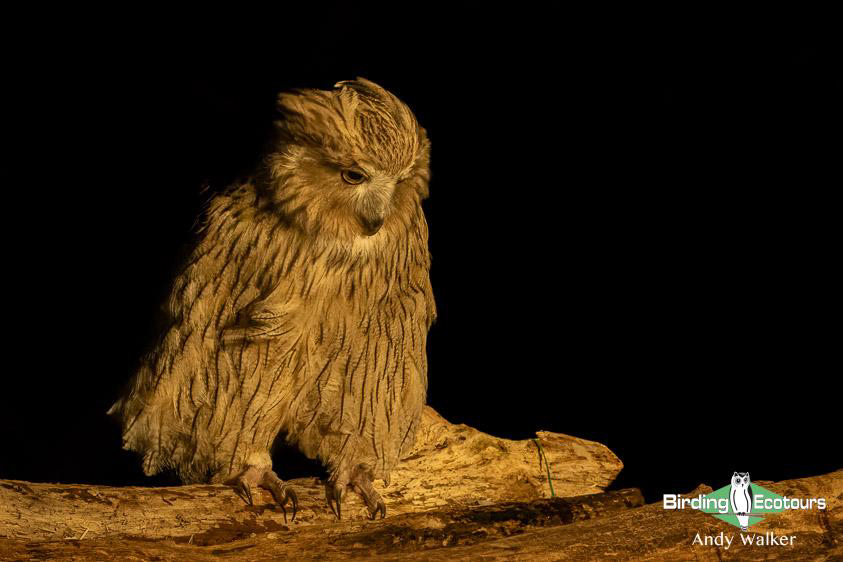
Blakiston’s Fish Owl was a much hoped-for species and we had repeated and lengthy close views.
Overview
This winter birding tour of Japan started in Kagoshima (Kyushu Island) on the 21st of February 2026 and ended on the 6th of March 2026 in Tokyo (Honshu Island). Our Japanese birding took us around southern Kyushu Island, central Honshu Island, and the famed winter wonderland of Hokkaido Island.
We spent time birding at some of the best winter birdwatching sites in Japan, including the famed Izumi Crane Observation Center, Kogawa Dam, Cape Hyuga, Karuizawa Wild Bird Sanctuary, Tsurui-Ito Tancho Sanctuary (the world famous home of the Red-crowned Crane – which was a tour highlight for many), Yoroushi Onsen, Lake Mashū (one of the most stunning places we visited on the whole tour), the Shiretoko Peninsula, Notsuke Peninsula Nature Center, and Cape Nosappu.
We recorded 162 bird species (two species were heard only), and 12 mammal species on this winter birding in Japan tour. Bird and animal lists follow the report and you can also see our eBird trip report, with lots more photos, here.
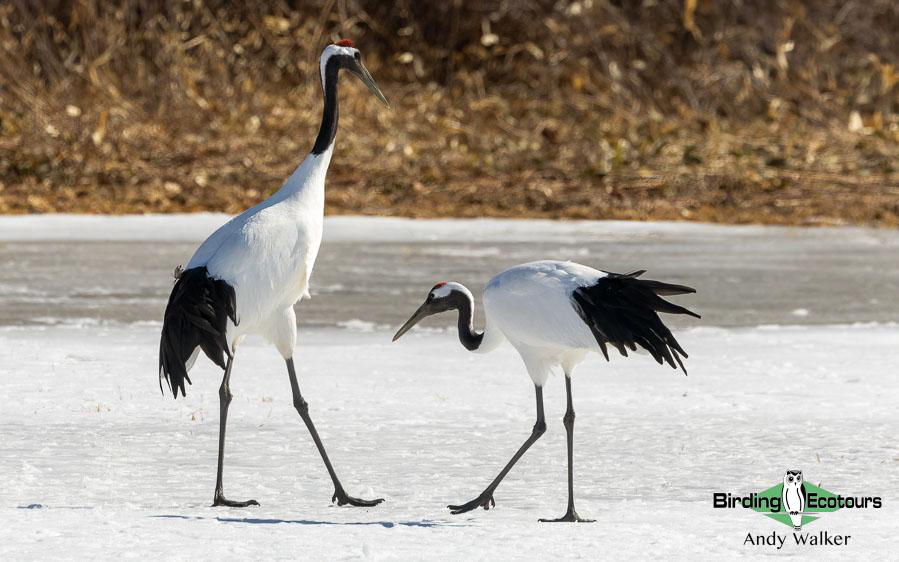
Red-crowned Crane is an important species in Japanese culture and we certainly enjoyed seeing this elegant, large crane while birding on Hokkaido in northern Japan.
Highlights of our time birding on Kyushu were many, with the stars of the show being the four species of gorgeous cranes seen so well, these were White-naped Crane, Hooded Crane, Demoiselle Crane, and Common Crane, however they got some stiff competition from some attractive breeding plumaged Saunders’s Gulls, and the excitement of seeing over 260 Japanese Murrelets loafing on the nice calm sea! Wildfowl was plentiful, with the most thrilling species being Swan Goose, Lesser White-fronted Goose, Mandarin Duck, Baikal Teal, and Falcated Duck.
At the wetlands in Kyushu we also found Black-faced Spoonbills, Eurasian Spoonbills, Northern Lapwings, and Long-billed Plovers which provided some wading and shorebird interest, with Crested Kingfishers and Common Kingfishers providing extra excitement. We had a large number of Streaked Shearwaters out at sea while looking for the murrelets, and our first Black-tailed Gulls and Vega Gulls too. In the forests on Kyushu, White-bellied Green Pigeons, Black Wood Pigeon, Japanese Green Woodpeckers, and Japanese Pygmy Woodpeckers were all found. Meanwhile, several passerines of note were also seen across the various habitats visited, including Daurian Jackdaw, Bull-headed Shrike, Varied Tit, Dusky Thrush, Siberian Pipit, Red-throated Pipit, Russet Sparrow, Meadow Bunting, Chestnut-eared Bunting, and Masked Bunting.
We had a brief visit to Honshu, where we found a great set of birds. Marshland outside of Tokyo provided us with views of nesting Oriental Storks, a hunting Eastern Marsh Harrier, a flock of Azure-winged Magpies, and some furtive Rustic Buntings. On some nearby lakes, we enjoyed sightings of Smew and American Wigeon. We then headed into the beautiful and forested mountains, where we found several gorgeous Green Pheasants, huge Mountain Hawk-Eagle, improved views of Japanese Green Woodpecker, along with our first White-backed Woodpeckers, stunning Daurian Redstart, secretive Japanese Accentor, a very showy Alpine Accentor, and one of the tour highlights, multiple flocks of Japanese Waxwings – so special! A visit to the famous “snow monkey” park provided excellent views of Japanese Macaques and we found Japanese Serow nearby too.
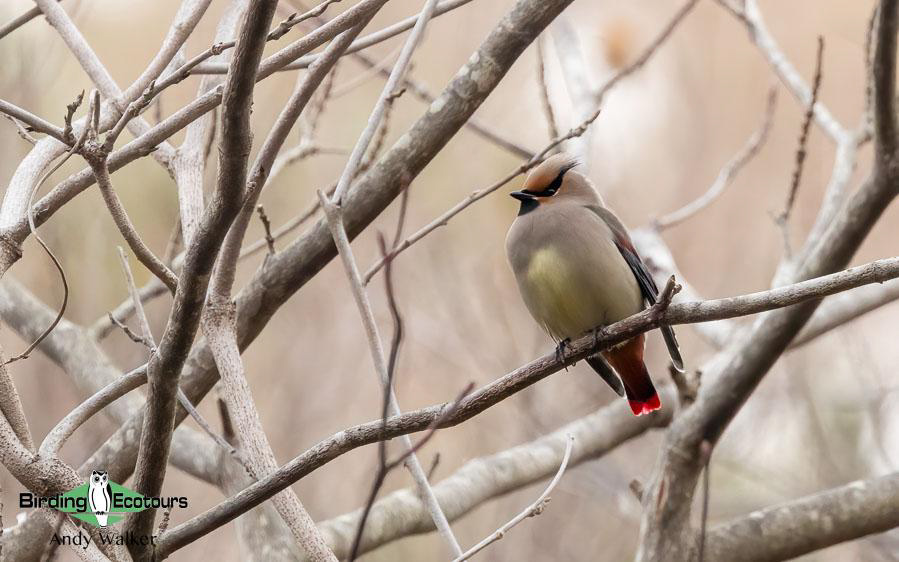
Highly sought-after nomadic Japanese Waxwing was found in good numbers this winter.
Finally, we visited the beautiful island of Hokkaido, where we were greeted by much colder weather (and some difficult birding conditions – frequent strong wind and snow showers which unfortunately put paid to our planned boat trips), but also a host of thrilling new species. Here we enjoyed such spectacles as flocks of simply stunning and regal Red-crowned Cranes, ginormous and spectacular Steller’s Sea Eagle, and the incomparable Blakiston’s Fish Owl, one of the must-see birds in Japan, we also saw a couple of Short-eared Owls, which went down well. We found lots of gulls, including Slaty-backed Gull, Black-tailed Gull, Glaucous-winged Gull, Glaucous Gull, Iceland (Thayer’s) Gull, Common (Kamchatka) Gull, and Black-headed Gull. Shorebirds were thin on the ground, but a few folks got some brief sightings of a flock of Rock Sandpipers.
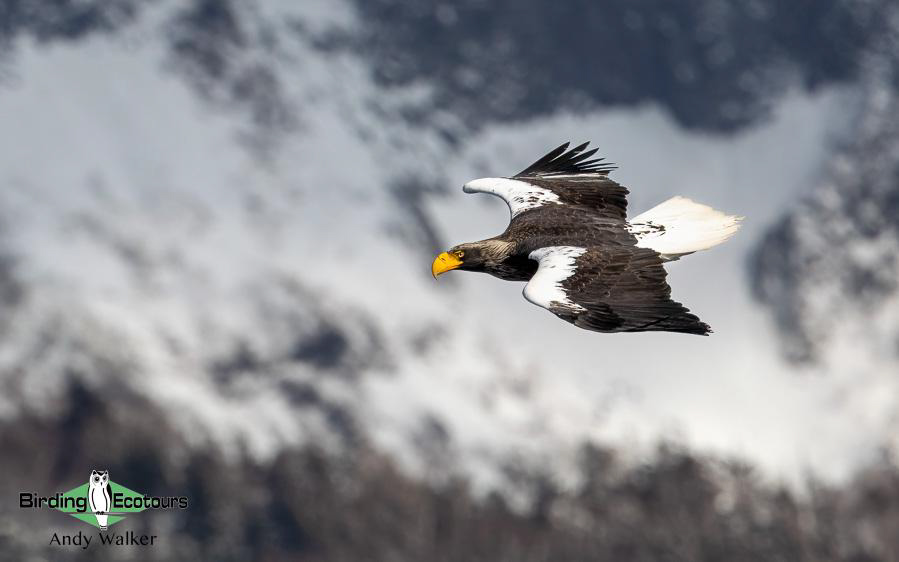
It was hard not to be impressed by the size and beauty of Steller’s Sea Eagles while birding on Hokkaido.
Ducks featured heavily on Hokkaido, with stunning close views of Harlequin Ducks being very popular with everyone, as were the sightings of Stejneger’s Scoter, Black Scoter, Long-tailed Duck, Common Goldeneye, Smew, Red-breasted Merganser, and Greater Scaup. Other wildfowl recorded included sightings of Whooper Swan, Brant Goose (Black Brant), and Taiga Bean Goose. Several auks (alcids) were found, and included Spectacled Guillemot and Crested Auklet among others. Passerines were generally thin on the ground, but we did get good sightings of Eurasian (Brandt’s) Jay, Eurasian (Baikal) Bullfinch, and brief sightings of Long-tailed Tit and Siberian Long-tailed Rosefinch along with more common and widespread species which showed well, such as Eurasian Nuthatch and Great Spotted Woodpecker. Our sightings of several flocks of Asian Rosy Finches were rather exhilarating (not least to the gales while we watched some of the flocks!) and a highly sought-after target, which we saw nicely on a few occasions. In addition to the great birds seen on Hokkaido, we also found plenty of interesting mammals. Sika Deer were a common and often spectacular sight with some males sporting huge racks of antlers, and we also saw Common Killer Whale, Sea Otter, Harbor Seal, Steller Sea Lion, and Eurasian Red Squirrel, which all added to the experience.
Detailed Report
Day 1, 21st February 2026. Arrival in Kagoshima
We met in our comfortable hotel in Kirishima, near Kagoshima for our welcome dinner and discussed our plans for the next couple of weeks of exciting winter birding across Japan.
Day 2, 22nd February 2026. Kirishima to Izumi and birding Arasaki
We departed our hotel in Kirishima after breakfast, heading for the Izumi and Arasaki area. We made a couple of riverside stops along the way, where we found our main target, Long-billed Plover. We enjoyed some good views of a pair of birds loafing on some rocks. As these were our first birding stops of the trip many new birds were found for everyone, ranging from Tufted Duck and Eurasian Wigeon, to Green Sandpiper, to Japanese Wagtail and Meadow Bunting.
Once we reached the Izumi area our birding got off to a flying start with some close up Falcated Ducks and a distant group of Japanese Cormorants. As we entered the arable land we found a nice flock of Hooded Cranes, which included a scattering of the attractive and much larger White-naped Cranes. While we were enjoying these two species, careful scanning of the flock yielded a sighting of a rare visitor to Japan, a lone Demoiselle Crane – an absolutely stunning bird. We enjoyed prolonged views of these three species of cranes and then noticed that there was also a distant Common Crane behind us in another flock of cranes. We changed our position to get a better look at the new crane species, and while watching that had a nice fly through of a female Hen Harrier. The fields here were busy with Eurasian Skylarks and Siberian Pipits. After notching up several more common and widespread species we took a short break for lunch.
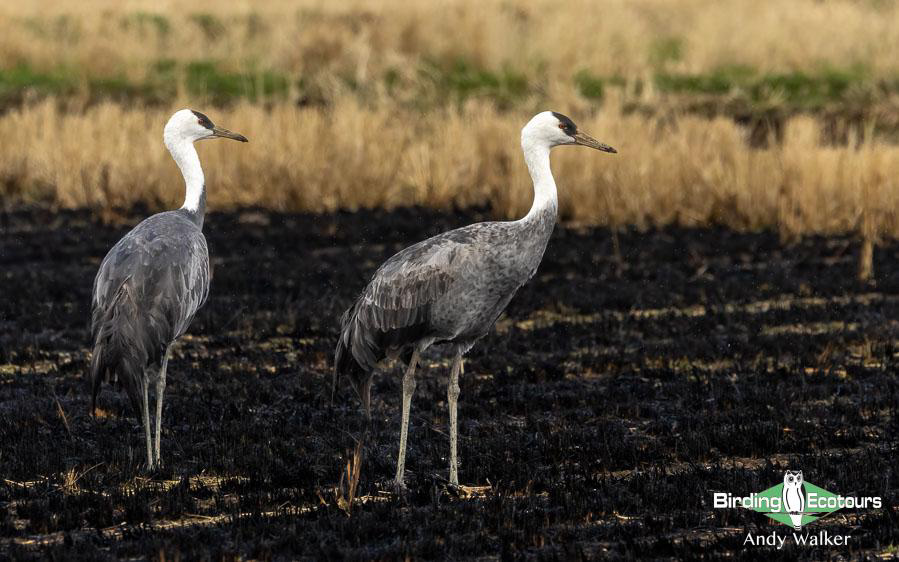
This pair of Hooded Cranes was working a burnt field and finding plenty to eat.
During the afternoon, several squally showers moved through, so we spent some time sheltering from the rain, but between the showers we saw loads more Hooded Cranes and White-naped Cranes along with a few more Common Cranes (and a couple of presumed Hooded x Common Crane hybrids). While scanning the crane fields we found a Lesser White-fronted Goose, an uncommon species in Japan, and lots of Northern Lapwings – some showing very close to us. A small burnt area of rice stubble was stacked out with Siberian Pipits and Eurasian Skylarks, but careful scanning resulted in sightings of several Red-throated Pipits and Chestnut-eared Buntings too. Here there were also Eastern Buzzards and Black Kites looking for a meal! A huge flock of Russet Sparrows provided another highlight of the afternoon as they were all lined up on electrical wires and a huge flock of Rooks contained quite a few Daurian Jackdaws too.
After a wonderful day full of great birds it was time to drive to our nearby hotel for the next two nights. As we left the site we saw a flock of Eurasian Spoonbills and Black-faced Spoonbills, while some in the group saw Little Ringed Plover and others saw Common Kingfisher.
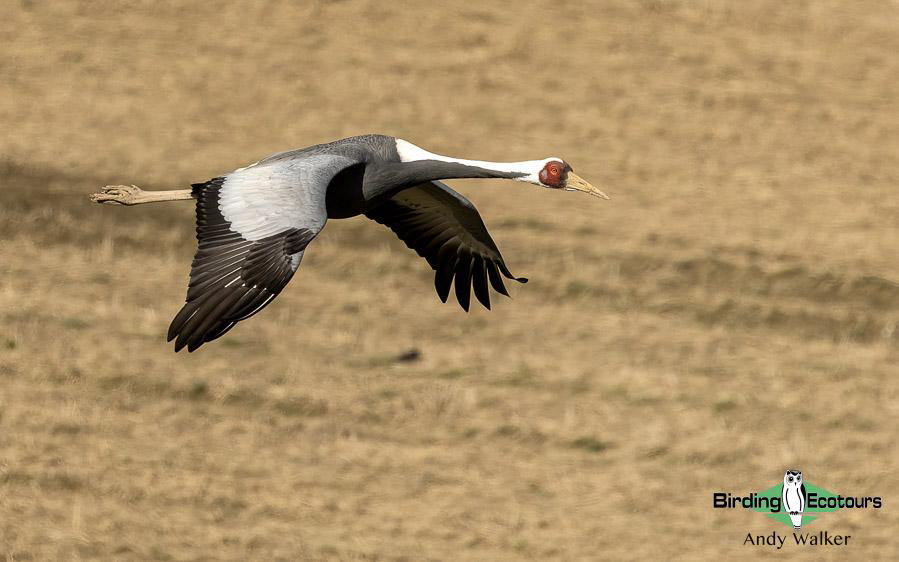
Another stunning species, White-naped Crane was seen well throughout our time in the south.
Day 3, 23rd February 2026. Morning birding at Arasaki, afternoon birding at Kogawa Dam
After an early breakfast we made our way to Arasaki ahead of the sunrise. We arrived just as the rangers were putting out grain as supplementary food for the overwintering cranes. We were subsequently treated to an awesome spectacle of the sight and sound of thousands of cranes coming in to the fields to feed. Hooded Cranes were the most numerous species, followed by White-naped Crane, these two species made up the bulk of the birds, but we were again able to pick out several Common Cranes, and the continuing Demoiselle Crane. All four species are super-attractive birds, so to have all four of them right in front of us was very special. Careful scanning of the area resulted in the great finding of two sought after geese. They were partially obscured for quite a while by the throng of crane legs, but eventually both walked into full view. Firstly a Lesser White-fronted Goose, likely the same bird seen the previous day, and secondly, the hoped-for Swan Goose that had been overwintering in the area. Both species eventually showed well for everyone. While the focus of this birding was on the cranes and geese, several other species were noted, including a Vega Gull chasing an Osprey which was carrying a fish, a flock or two of Daurian Jackdaws, and plenty of Eurasian Skylarks, Siberian Pipits, and Oriental Greenfinches.
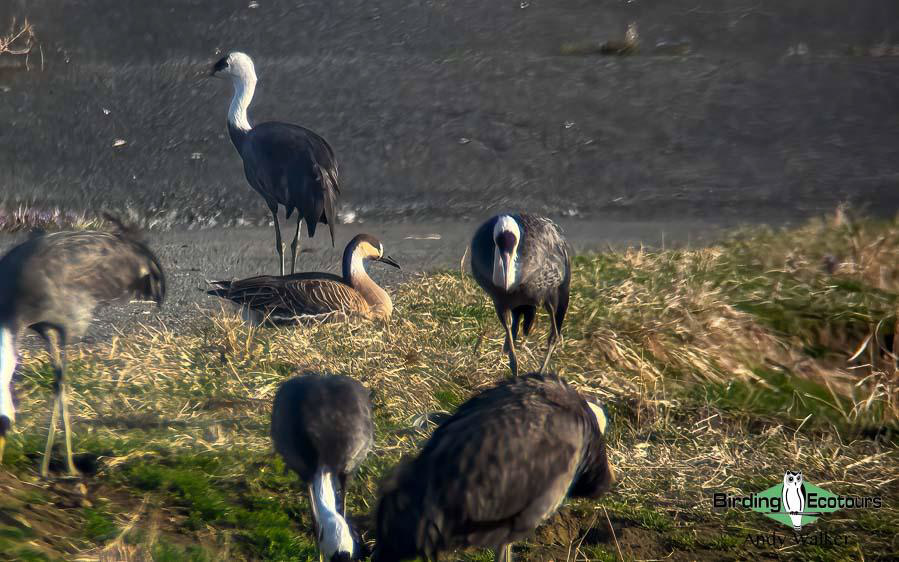
A record shot of a popular Swan Goose found in the huge Hooded Crane flock at dawn.
After enjoying one crane spectacle, we moved locations to do the same on the other side of the river, where we found even more Hooded Cranes and White-naped Cranes. Here too we found a couple more Common Cranes and some more hybrids. Birding from the viewing tower and driving nearby farm tracks gave us some good looks at plenty of other species, such as Hen Harrier, Peregrine Falcon, Common Snipe, Black-faced Spoonbill, Eurasian Spoonbill, Bull-headed Shrike, Daurian Jackdaw, Daurian Redstart, Dusky Thrush, Russet Sparrow, Common Reed Bunting, Meadow Bunting, and Chestnut-eared Bunting.
After a brief lunch break we took the short drive to nearby Kogawa Dam. A quick but productive stop at a river yielded a pair of Crested Kingfishers, a pair of Common Kingfishers, and a pair of showy, gorgeous Varied Tits. Once at the dam, we took the loop road around the waterbody and found two of our key and spectacular targets. Firstly, a small flock of Mandarin Ducks (we later saw even more birds, with one flock of over fifty individuals noted), and then secondly, a flock of over three hundred Baikal Teals. The birds were a little flighty but gave great flight views as well as excellent views sat on the water. We bumped into a couple of mixed flocks, one flock contained Japanese Pygmy Woodpecker, Cinereous (Japanese) Tit, Varied Tit, and the rather cute Long-tailed Tit. As we were exiting the circuit route we found a pair of Japanese Green Woodpeckers, one was busy eating berries in a fruiting tree. A final bonus came when a pair of Chinese Bamboo Partridges were seen, though views were brief, and as we pulled up to our hotel a flock of White-cheeked Starlings were bathing in a river.
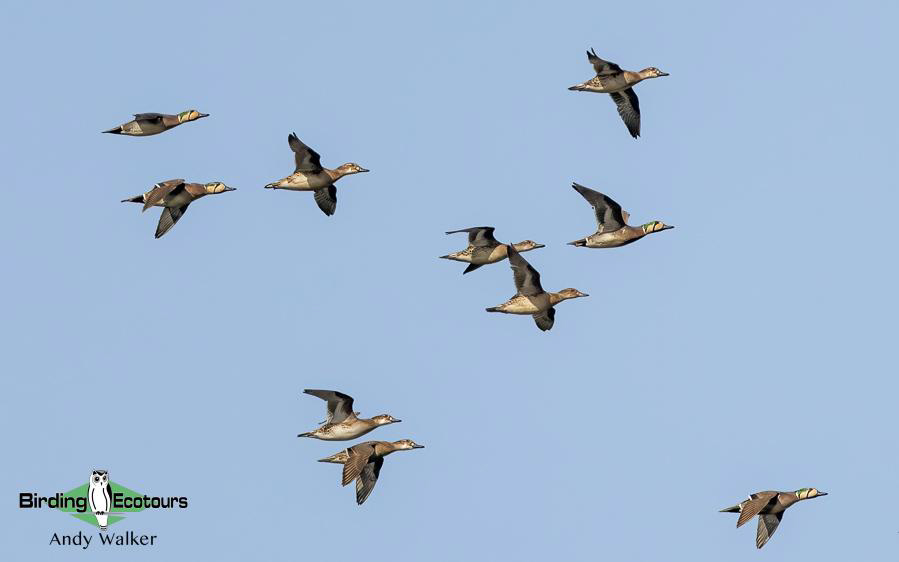
We had plenty of sightings of Baikal Teal on the water, but also some impressive flyby views.
Day 4, 24th February 2026. Izumi to Nobeoka, via birding stops at Yatsushiro and Hyuga
We had a long but productive day today. We started at dawn back at Kogawa Dam, where we waited patiently at some viewpoints and eventually got some nice flyover views of around 30 White-bellied Green Pigeons. While waiting for the green pigeons, we also had a few flyovers from several vocal Japanese Grosbeaks. The Baikal Teals and Mandarin Ducks seen the previous afternoon were again present. We also added Eurasian (Japanese) Jay this morning, and some very distant drumming sounds were considered to belong to an unseen Copper Pheasant.
After returning from our birding, we had breakfast and loaded vehicles to commence our journey north. A stop at a coastal site gave us our target Saunders’s Gulls with no effort at all, which was appreciated! We had some fairly close views of a flock of over 250 birds, several of which were in full breeding plumage and looking rather sharp. There were a few non-breeding plumaged Black-headed Gulls present and a large flock of Northern Pintails was nearby. A flighty flock of Grey Plovers and a Common Greenshank didn’t hang around, unfortunately, however several Ospreys were noted, including one with a ridiculously long fish! A final scan around the area gave us sightings of a small flock of Black-necked Grebes and some Meadow Buntings.
We next had a longer drive, crossing some spectacular landscape from the west coast to the east coast, stopping to pick up some lunch along the way. We arrived in the Hyuga area in the early afternoon, and set about the task of finding our target bird. Unfortunately, we drew a blank for that at the first site, but did see our first Black-tailed Gulls of the trip, and a few Vega Gulls. We changed locations and an initial scan of the water quickly resulted in a sighting of some distant views of our target, half a dozen Japanese Murrelets. We decided to change locations again in the hope of being able to get a bit closer to the birds, and in doing so ended up getting some really nice views of a huge count of over 260 Japanese Murrelets! The sea was quite calm, so the murrelets were nice and easy to spot and count, many birds looked rather smart in their breeding plumage too. As the afternoon drew on we started noting Streaked Shearwaters, with numbers increasing to several hundred birds present by the time we departed the site with a storm approaching. Here we also had a few Pacific Reef Herons flying around the sea and the rocky shore, while on the land we found Blue Rock Thrush, Daurian Redstart, Varied Tit, Warbling White-eye, and best of all, but only some frustratingly brief views for most, Black Wood Pigeon.
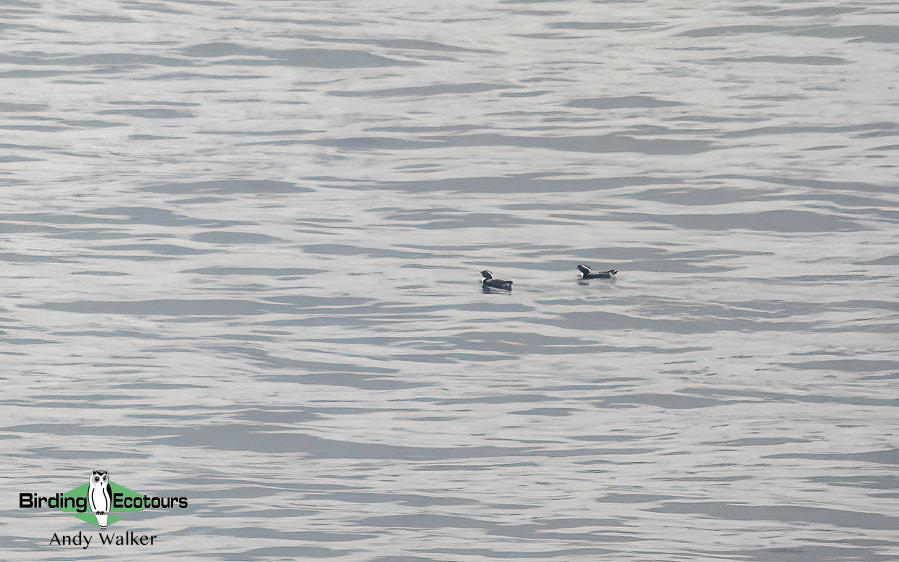
A record shot of two of over 260 Japanese Murrelets observed sat on the sea in calm conditions.
Day 5, 25th February 2026. Travel from Nobeoka to Miyazaki, flight to Tokyo
Essentially a travel day. We departed Nobeoka for Miyazaki after breakfast and arrived there in the late morning. After grabbing a quick lunch we boarded our flight to Tokyo, where we arrived at our hotel in the late afternoon. It was much colder than on Kyushu with squally heavy rain showers and some strong wind. We hoped that tomorrow would be better weather for our birding.
Day 6, 26th February 2026. Chiba to Karuizawa
We awoke to find it was very wet and windy, however shortly after we departed Chiba the weather started to improve and by the time we reached our birding site the weather was fine. A short toilet stop was productive, giving us sightings of Common Kingfisher, Dusky Thrush, Daurian Redstart, and Hawfinch. We then took a look over a huge marsh, where we were pleased to see a nesting Oriental Stork. Beneath the nest we noted hunting Eastern Marsh Harriers and then a Eurasian Sparrowhawk caught a Brown-eared Bulbul right in front of us, which was incredible to see happen!
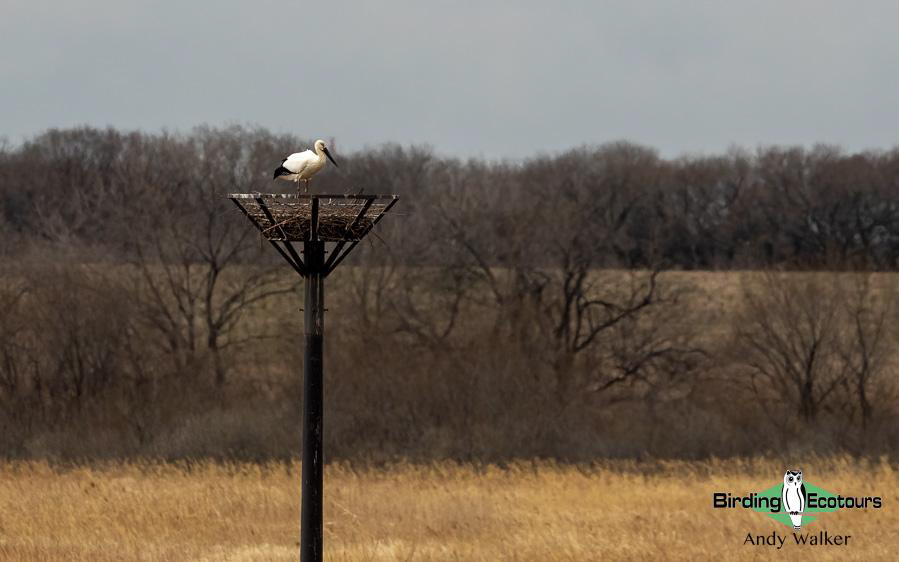
We saw this Endangered (BirdLife International/IUCN) Oriental Stork on a nesting platform and others foraging in the marshes nearby.
Driving through the marsh, we found several Common Reed Buntings and Meadow Buntings, with some folks getting a brief sighting of a couple of Rustic Buntings. A rapidly moving flock of Azure-winged Magpies made their way along a river and some ponds here held a female Smew, Gadwall, Falcated Ducks, and Baikal Teal. We then took a walk at a large reservoir, where a good number of waterfowl were present. A surprise American Wigeon was picked out of the many Eurasian Wigeons, and we then came across several flocks of Smews, including some dapper males. A lone Common Merganser was keeping to the periphery of the waterbody and at least three more Oriental Storks were in the waterside vegetation. An Osprey was busily hunting at the lake and a Peregrine Falcon flew over with a full crop. A few interesting passerine sightings included Japanese Wagtail, Dusky Thrush, Daurian Redstart, Brambling, and Hawfinch, some allowing good photo opportunities.
We grabbed a quick lunch and continued our drive towards Karuizawa. We made a few stops along the way, the first gave a great sighting of a Mountain Hawk-Eagle, along with several other species, such as Daurian Redstart and Warbling White-eye. A couple of other brief stops provided sightings of Japanese Green Woodpecker (better than our previous sighting), White-backed Woodpecker, and Japanese Pygmy Woodpecker, along with Varied Tit, Cinereous (Japanese) Tit, and Long-tailed Tit.
Day 7, 27th February 2026. Birding Karuizawa and snow monkeys
We had a very successful pre-breakfast birding session at Karuizawa where we quickly found a pair of Brown Dippers with Eurasian Wren also nearby. We then scored big with a flock of highly sought-after Japanese Waxwings (an irruptive species that is not always possible or easy to catch up with). They didn’t hang around too long before they flew off, but time enough for some good views. Not too long later we also found one of the more secretive targets we had hoped for, Japanese Accentor, which did actually show relatively well for a secretive species, but through a narrow window which made it tougher than ideal. We bumped into some tit flocks containing Coal Tit, Cinereous (Japanese) Tit, Long-tailed Tit, and a showy Eurasian Nuthatch.
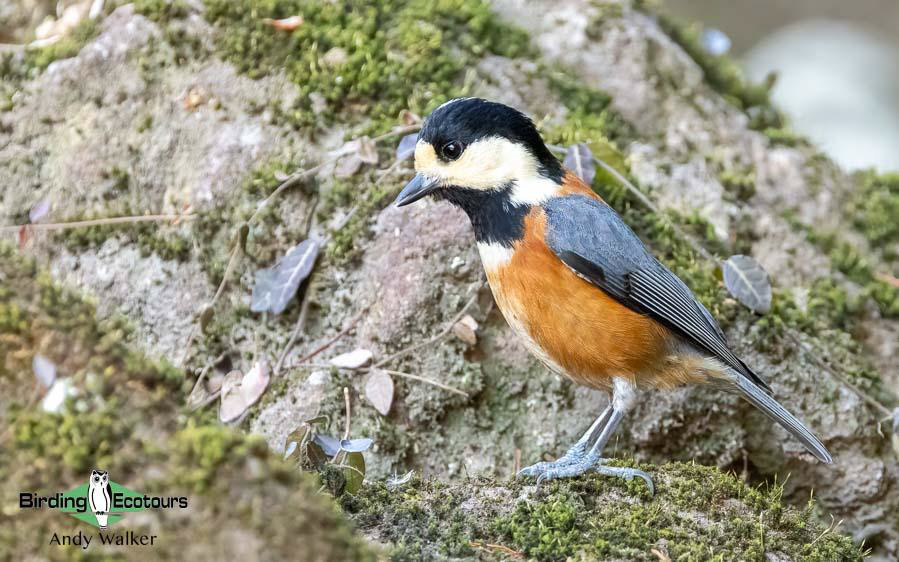
Varied Tit was one of many beautiful small birds seen during the tour.
After breakfast we took a drive through another area near town, and we connected with Green Pheasant – we saw a stunning male bird. As we continued along our way, a brief stop gave us some views of Willow Tit, Varied Tit, and Eurasian Nuthatch, with a Japanese Serow nearby too. Further along our route we found another flock of Japanese Waxwings and these gave better and more prolonged views for us. A Japanese Green Woodpecker was seen briefly, as were both Bramblings and Siskins.
After lunch we drove out to Jigokudani Yaen Koen, the “snow monkey” park. We took a walk to the hot springs, where we saw numerous Japanese Macaques going about their business, including bathing in the hot springs, which was fun to see. We also spotted a very tame and showy Alpine Accentor hanging around the hot springs, which was the avian highlight for our time in the park. We also bumped into a couple of mixed species flocks, containing a huge number of Coal Tits, with other species in the flock made up by Willow Tit, Goldcrest, Eurasian Treecreeper, Japanese Pygmy Woodpecker, and Great Spotted Woodpecker.
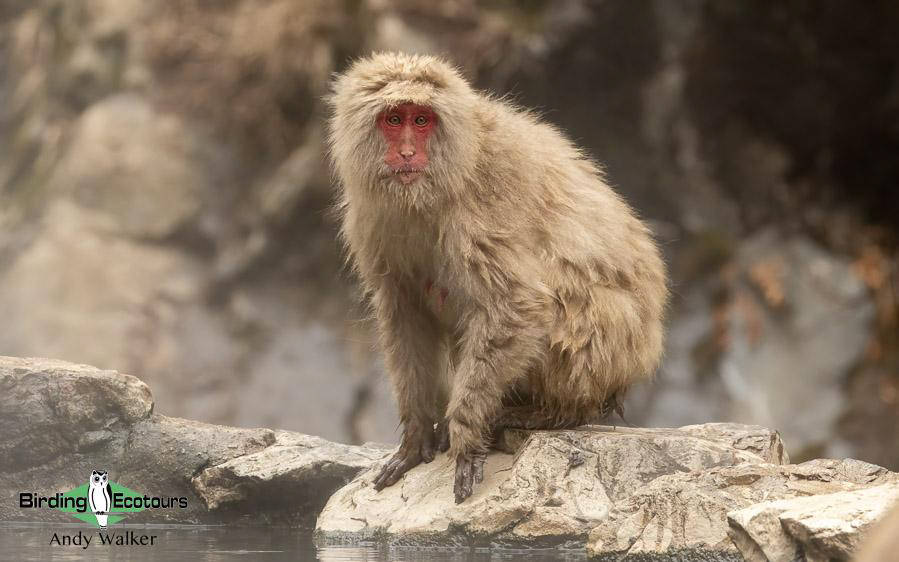
Japanese Macaques, aka “snow monkeys” were spending time in the onsen (hot spring).
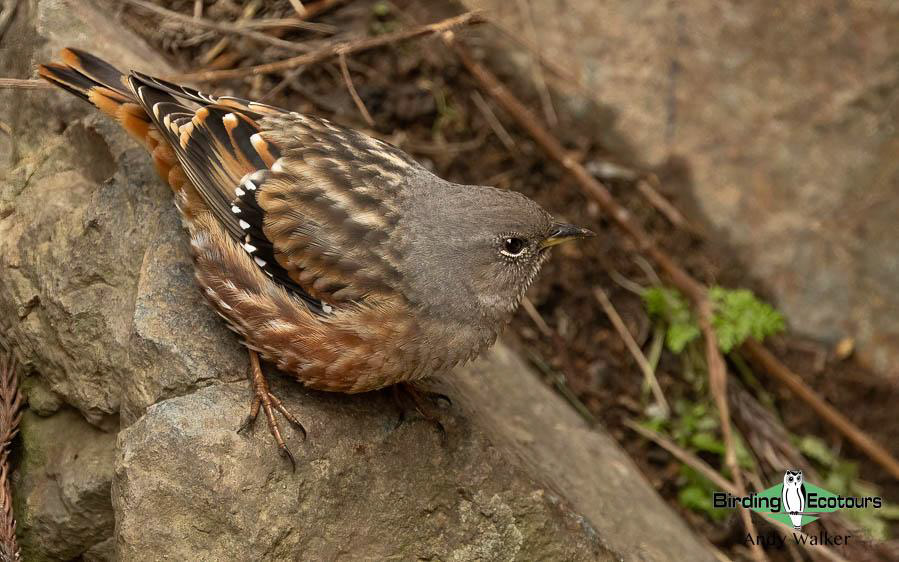
A ridiculously showy Alpine Accentor was the bird highlight of our visit to the monkey park.
Day 8, 28th February 2026. Travel between Karuizawa and Tokyo, flight to Kushiro
We had some more pre-breakfast birding around Karuizawa where we had good looks at Japanese Green Woodpecker and Great Spotted Woodpecker. Several Hawfinches and a Japanese Grosbeak were noted flying over, some Hawfinches landed but only gave brief perched views for some. We found another gorgeous Green Pheasant, and this one showed much better than our previous bird, and we were really able to appreciate its beauty. It was quite a misty morning, and our coldest of the trip so far (37oF / 3oC) but warmer than usual for the time of year. In the mist we found a flock of over 40 Rustic Buntings, with similar numbers of Dusky Thrushes too. A vocal Chinese Hwamei actually showed quite nicely here too, after a little patience. Finally, we took a drive around some forest, where we saw another flock of Japanese Waxwings and a few other birds we had seen the previous days.
After a late breakfast we took the drive back to Tokyo, where we had lunch and boarded our late afternoon flight to Kushiro on Hokkaido, ready to explore our third island, excited for what awaited our arrival.
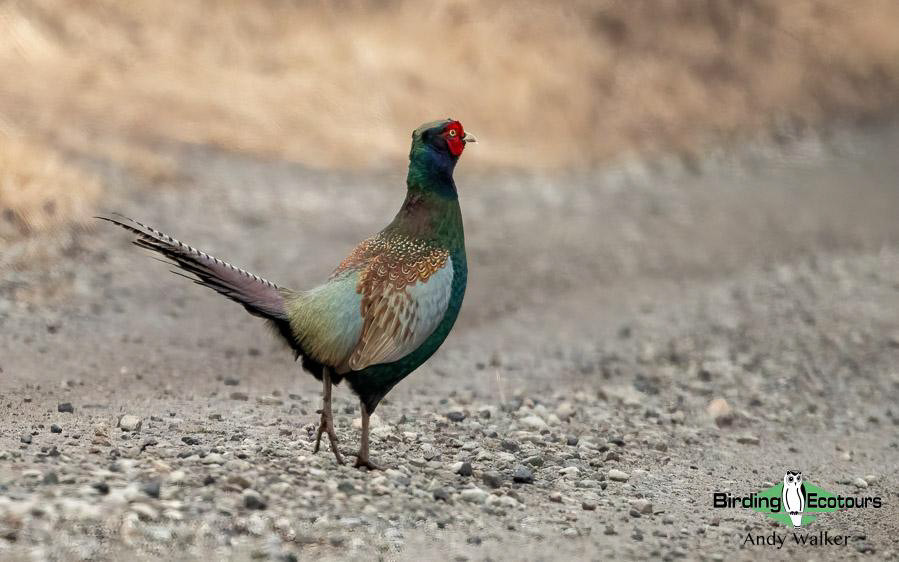
After spending time watching a skulking Green Pheasant the previous day it was nice to get a stunning male walking about right out in the open today.
Day 9, 1st March 2026. Kushiro to Yoroushi (via Tsurui-Ito Tancho Sanctuary)
After the long day yesterday, we enjoyed a good buffet breakfast at our hotel and then headed out birding. We departed Kushiro for Tsurui-Ito Tancho Sanctuary, where we spent most of the morning soaking in views of the impressive flocks of gorgeous Red-crowned Cranes, several birds were exhibiting some courtship behavior, which was interesting to watch. A few White-tailed Eagles were picked out, mostly getting hounded by flocks of Carrion Crows. Several Eastern Buzzards and Black Kites were also seen. It was rather windy, so passerines were at a premium, but we did find a wetland with some interesting birds, our first Whooper Swans and Common Goldeneye of the tour, along with better looks at Common Merganser and Tufted Ducks.
We grabbed some food from the local convenience store and drove up to a viewpoint overlooking the stunning Lake Mashū and surrounds to eat and enjoy the view. It was blowing a gale and incredibly cold, however we were rewarded by close flyby views of White-tailed Eagle and at least four simply spectacular Steller’s Sea Eagles, with some of the birds giving us eye-level views as they flew by us. A small group of our first Sika Deer of the trip showed well below our viewpoint, this species would be a frequent feature of our time on Hokkaido.
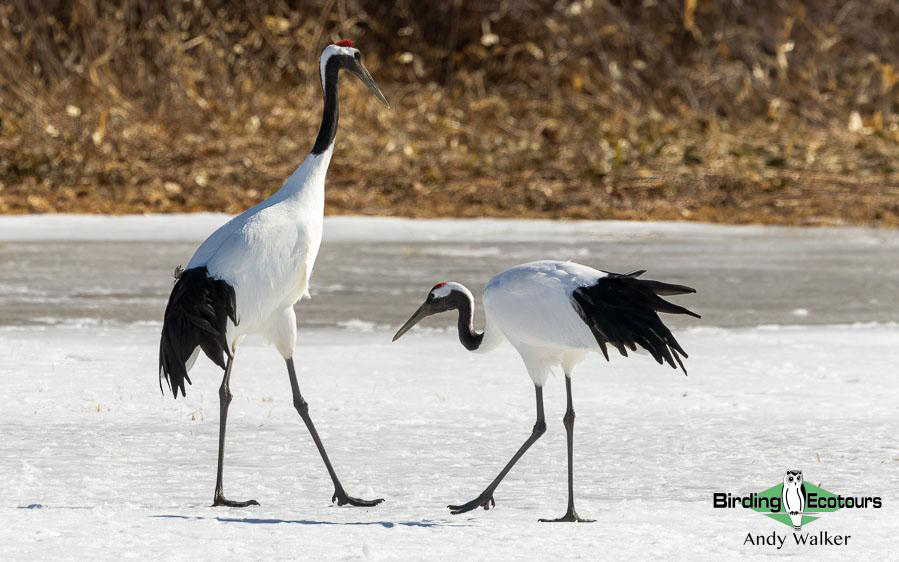
Close views of Red-crowned Cranes were understandably enjoyed!
After we had endured as much of the cold wind as possible we commenced our journey to our accommodation for the next two nights. Along the way we got some good views of Redpolls. At our accommodation, we sat and admired the birds visiting the garden and feeders, which included Great Spotted Woodpecker, Japanese Pygmy Woodpecker, Eurasian (Brandt’s) Jay, Marsh Tit, Willow Tit, Coal Tit, Cinereous (Japanese) Tit, Long-tailed Tit, and Eurasian Nuthatch.
Our wonderful traditional Japanese meal was “rudely interrupted” by one of our main tour targets, Blakiston’s Fish Owl. We got some good and close views of this most-wanted of Japanese birds. It was a huge relief to see it so quickly during our visit. After our dinner the owl even returned, giving us much more prolonged and relaxed views (see trip report cover image). It was a great end to a fantastic day of birding in Hokkaido.
Day 10, 2nd March 2026. Birding Yoroushi and Rausu
Some folks woke up early and got another great sighting of a Blakiston’s Fish Owl – not a bad way to start the day! Over breakfast, we were treated to a big flock of Eurasian (Brandt’s) Jays using the bird feeders, so giving close views. Eurasian Wren and Brown Dippers were also present, as were Red Fox and Eurasian Red Squirrel.
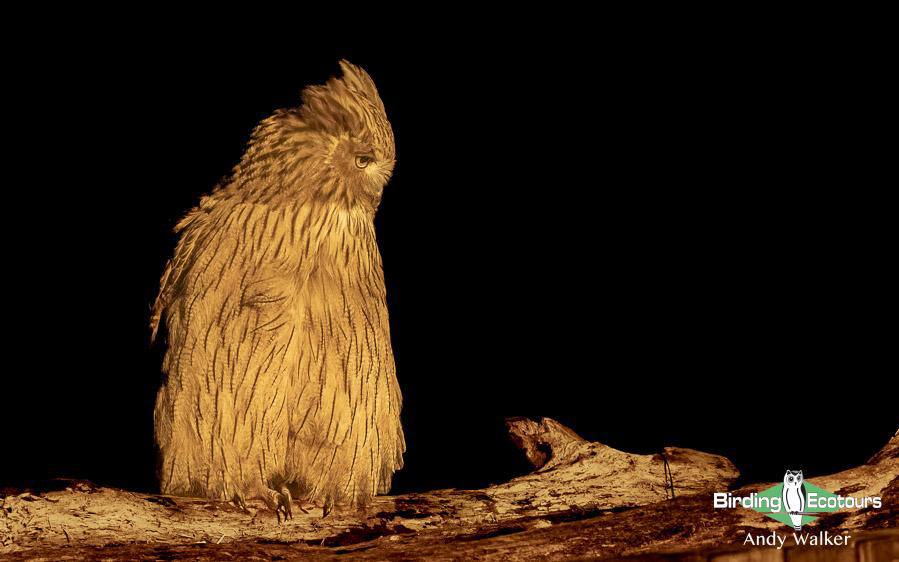
Blakiston’s Fish Owl visited the onsen several times during our stay in the evening and early morning and everyone got repeated good views of this most-wanted of birds.
After breakfast, we braved the weather and drove down to the coast and north to the town of Rausu, picking up some more Red-crowned Cranes along the way. We spent most of the day focusing our attention on the harbor and surrounds. As we approached town we could see numerous Steller’s Sea Eagles and White-tailed Eagles flying around, which was an impressive sight – there must have been over 100 eagles present. The harbor was full of Slaty-backed Gulls, which showed well, despite being frequently flushed by all the eagle activity! In with the Slaty-backed Gulls we also noted a Black-tailed Gull and a couple of Glaucous-winged Gulls. Pelagic Cormorants were quite numerous and here we also found a single Great Cormorant. The most abundant duck was Harlequin Duck, with lots seen during the day, which was fine with us, since they are beautiful birds. Other ducks seen were Common Merganser, Red-breasted Merganser, Common Goldeneye, Eurasian Wigeon, and Tufted Duck.
Unfortunately, our planned boat trip was canceled due to the poor weather, which was not surprising, but was disappointing. It was very windy with a big snowstorm heading our way. The temperature was around 28oF (-2oC), with the “feels like” temperature being around 14oF (-10oC) due to the wind chill, these were rather bracing and tough conditions.
In the afternoon, we drove south along the coastal road, stopping at some harbors along the way. These gave repeated views of many of the same species we had seen during the morning. A stop at a fish processing plant was the most productive. Here, we found a flock of several hundred Slaty-backed Gulls and in with these we picked out both Glaucous Gulls and Glaucous-winged Gulls, as well as a single Iceland (Thayer’s) Gull. Several Common (Kamchatka) Gulls were also noted flying past offshore. While looking at the gulls we also had a very brief Siberian Long-tailed Rosefinch pass through some rank vegetation and, nearby, a small flock of Whooper Swans flew over.
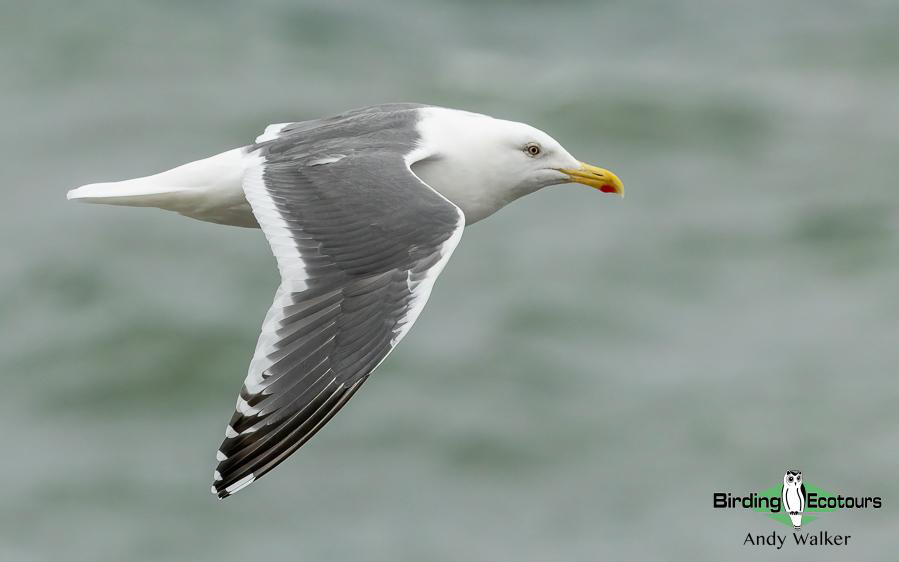
Slaty-backed Gull was very common on Hokkaido and good views were a given.
We spent the last couple of hours of light back at our accommodation, where we found Brambling and Long-tailed Tit, with the usual species, such as Eurasian Nuthatch and Marsh Tit. After our dinner and during our daily bird checklist session, the Blakiston’s Fish Owl decided to put in another performance for us, so our day ended as it had started, with a fantastic bird.
Day 11, 3rd March 2026. Yoroushi to Nemuro via birding at Shibetsu and the Notsuke peninsula
We departed our very comfortable onsen accommodation after breakfast for the final time (after seeing the usual species visiting the feeders). We drove back to the coast at Shibetsu, where we found a heap of gulls, many of the same species we had seen the previous afternoon at the same site, but numbers of some species had swelled considerably, such as Glaucous Gulls. A flock of Taiga Bean Geese flew north along the coast and several Stejneger’s Scoters and Black Scoters were noted, though viewing conditions were tough.
Once we reached the Notsuke peninsula we had to deal with some pretty atrocious weather, with strong wind and frequent snow or freezing rain showers coming straight off the sea (along with poor visibility). Despite the weather we found our main target, Asian Rosy Finch quite quickly, which was a huge relief. We enjoyed some good views of the rather flighty finch flock. We tried some seawatching, which was tough, but we managed to get some better views of both Stejneger’s Scoters and Black Scoters. On the leeward side of the coast we found Smew, Red-breasted Merganser, Common Merganser, Common Goldeneye, and Northern Pintail. A large but distant flock of Whooper Swans also contained a scattering of Brant Geese (Black Brant). Several closer small groups of Whooper Swans were also seen and they gave some nice views. Gulls were a constant feature along the peninsula, large numbers of Glaucous Gulls were apparently on the move, with many seen flying north, with good numbers also hanging around getting some rest and shelter. Common (Kamchatka) Gulls were also quite numerous, as were Slaty-backed Gulls, while lower numbers of Black-headed Gulls, Vega Gulls, Black-tailed Gulls, and Glaucous-winged Gulls were also found. The gulls were often seen getting flushed by the numerous White-tailed Eagles and Steller’s Sea Eagles that were present at the site.
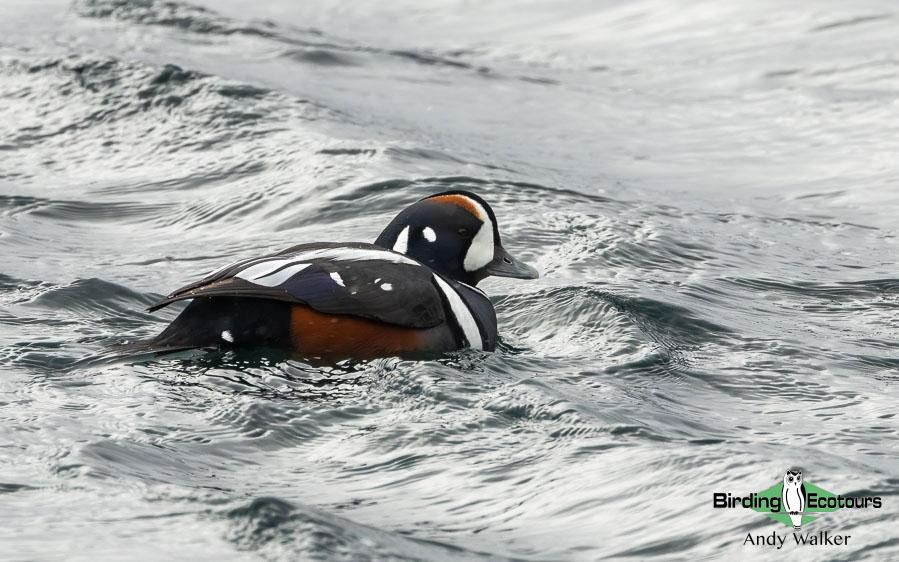
One of many gorgeous ducks seen during the tour, this Harlequin Duck showed very well.
As we left the peninsula to continue our journey south to Nemuro, a few stops along the coast gave more scoter and eagle views, and some sightings of Harlequin Duck, Greater Scaup, and more of the gulls mentioned above. We also got lucky with a sighting of two Short-eared Owls in the late afternoon as we approached our accommodation, one of the owls showed very nicely.
One of the big features of the day was the number of Sika Deer seen, with huge herds seen during the late afternoon, as well as some rather impressive males seen at close range while on the peninsula, several Red Foxes were seen, and a brief Steller Sea Lion was picked out while we were looking at scoters too.
Day 12, 4th March 2026. Birding Nemuro and Cape Nosappu
Pre- and post-breakfast birding sessions around Cape Nosappu were very productive, with a host of new trip birds seen. Long-tailed Ducks, Harlequin Ducks, Smew, Black Scoters, and Stejneger’s Scoters were all see well, lots of them at close range. Several species of auks (alcids) were seen offshore, and included Spectacled Guillemot, Pigeon Guillemot (two subspecies), Rhinoceros Auklet, Crested Auklet, Least Auklet, and Thick-billed Murre, though many of these were quite distant and viewing was not easy even with the scope, though the two guillemots showed well close inshore. Three species of loons were seen, these being Red-throated Loon, Black-throated Loon, and Pacific Loon, and four species of grebes were picked up too, with Red-necked Grebe, Great Crested Grebe, Black-necked Grebe, and Eared Grebe present.
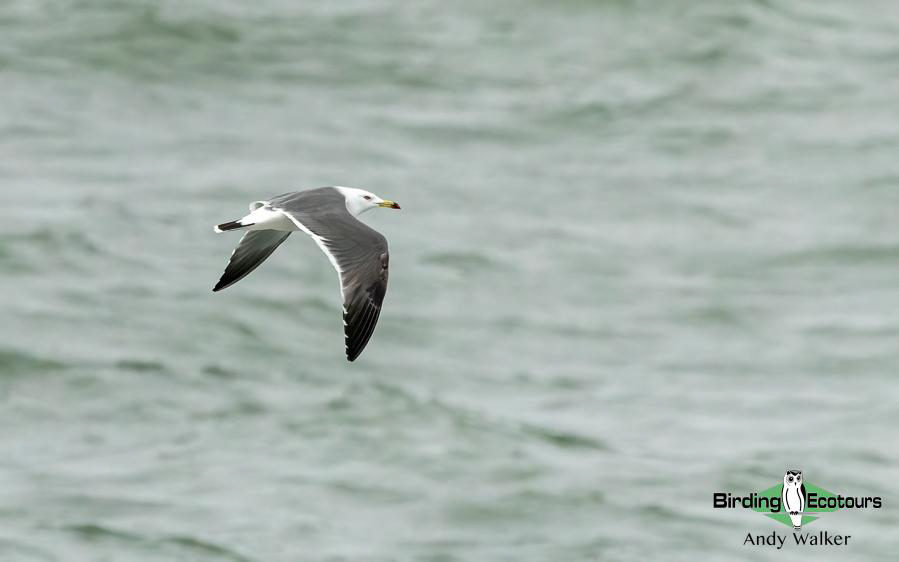
Black-tailed Gulls were the second most numerous gull species around Cape Nosappu and Nemuro during our visit.
A small flock of Rock Sandpipers flew along the coast early morning but views, though conclusive, were brief. Slaty-backed Gulls were numerous, with plenty of Black-tailed Gulls also seen. White-winged gulls were less noticeable than the previous day, but with more Glaucous-winged Gulls than Glaucous Gulls seen today. White-tailed Eagles were plentiful, with lots of Steller’s Sea Eagles also seen again, one was even observed flying over to a Russian island, as was a Rough-legged Buzzard! Sea mammals provided a highlight, with Common Killer Whales, Harbor Porpoise, Harbor Seal, and Sea Otters all seen while scanning the ocean for birds.
With lots of time scanning the water from various viewpoints, in combination with the time of year, it was unsurprising that passerines didn’t feature prominently during today’s birding, however a flock of over 140 Asian Rosy Finches was a nice surprise, as was a small flock of four Eurasian (Baikal) Bullfinches at the end of the day.
Day 13, 5th March 2026. Birding Nemuro, travel to Kushiro and flight to Tokyo
A few hardy folks took a walk in Meiji Park in the snow, but most stayed behind to rest up and enjoy a relaxed breakfast. In the park we found foraging Great Spotted Woodpecker, Eurasian Nuthatch, Coal Tit, Cinereous (Japanese) Tit, and Marsh Tit, with both Steller’s Sea Eagle and White-tailed Eagle flying overhead.
After breakfast, we departed Nemuro for our drive back to Kushiro, noting lots of Whooper Swans, Steller’s Sea Eagles, and White-tailed Eagles, a few Red-crowned Cranes, and a Crested Kingfisher along the way. We took our afternoon flight back to Tokyo and checked into our airport hotel for the last night of the tour.
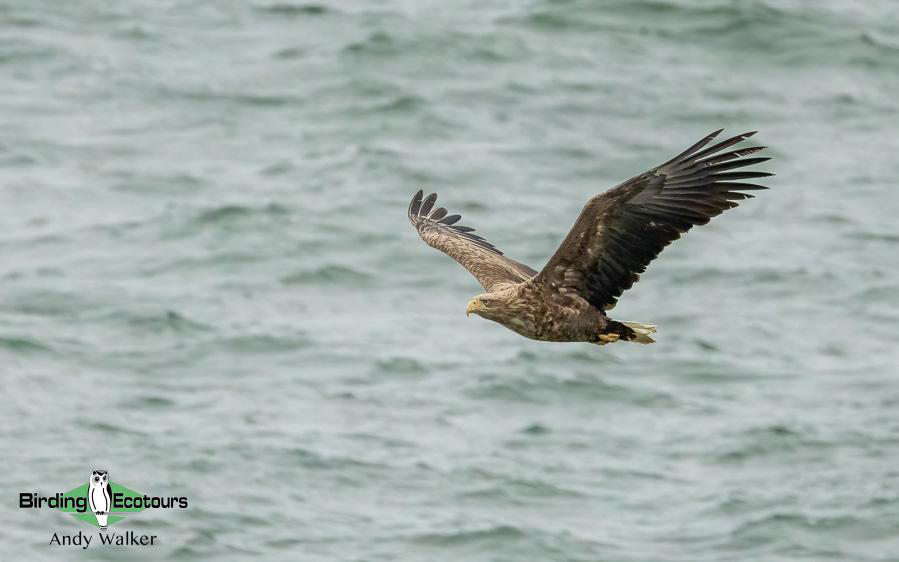
Numerous White-tailed Eagles were seen while birding in Hokkaido.
We had a “memorable” final evening meal of the tour together, during which we discussed the “bird of the trip”. It was a tough battle, with lots of fantastic contenders, however Blakiston’s Fish Owl came out on top, just! It had stiff competition from Red-crowned Crane, Steller’s Sea Eagle, Japanese Waxwing, Swan Goose, and Japanese Murrelet. We had a great trip with a wonderful group of birders from around the world, it was a lot of fun with loads of great birds and long-lasting memories. Thank you to everyone, including Chris, our local guide and driver, for making it a memorable trip. I look forward to birding with some of you again in the future.
Day 14, 6th March 2026. Departure from Tokyo
A non-birding day with departure from Tokyo. Some folks continued with our short Miyake-Jima island birding and pelagic trip, which started in the evening (see separate trip report for that, here), while others departed for their onward travel.
Bird List – Following IOC (15.1) (March 2025)
Birds ‘heard only’ are marked with (H) after the common name, all other species were seen. The following notation after species names is used to show conservation status following IUCN/BirdLife International: EN – Endangered, VU = Vulnerable.
| Common Name | Scientific Name |
| Ducks, Geese, Swans (Anatidae) | |
| Brant Goose | Branta bernicla |
| Swan Goose – EN | Anser cygnoides |
| Taiga Bean Goose | Anser fabalis |
| Lesser White-fronted Goose – VU | Anser erythropus |
| Whooper Swan | Cygnus cygnus |
| Common Shelduck | Tadorna tadorna |
| Mandarin Duck | Aix galericulata |
| Baikal Teal | Sibirionetta formosa |
| Northern Shoveler | Spatula clypeata |
| Gadwall | Mareca strepera |
| Falcated Duck | Mareca falcata |
| Eurasian Wigeon | Mareca penelope |
| American Wigeon | Mareca americana |
| Eastern Spot-billed Duck | Anas zonorhyncha |
| Mallard | Anas platyrhynchos |
| Northern Pintail | Anas acuta |
| Eurasian Teal | Anas crecca |
| Common Pochard – VU | Aythya ferina |
| Tufted Duck | Aythya fuligula |
| Greater Scaup | Aythya marila |
| Harlequin Duck | Histrionicus histrionicus |
| Stejneger’s Scoter | Melanitta stejnegeri |
| Black Scoter | Melanitta americana |
| Long-tailed Duck – VU | Clangula hyemalis |
| Common Goldeneye | Bucephala clangula |
| Smew | Mergellus albellus |
| Common Merganser | Mergus merganser |
| Red-breasted Merganser | Mergus serrator |
| Pheasants & Allies (Phasianidae) | |
| Copper Pheasant (Endemic) (H) | Syrmaticus soemmerringii |
| Green Pheasant (Endemic) | Phasianus versicolor |
| Chinese Bamboo Partridge | Bambusicola thoracicus |
| Pigeons, Doves (Columbidae) | |
| Rock Dove [Feral Pigeon] | Columba livia [dom.] |
| Black Wood Pigeon | Columba janthina |
| Oriental Turtle Dove | Streptopelia orientalis |
| White-bellied Green Pigeon | Treron sieboldii |
| Rails, Crakes & Coots (Rallidae) | |
| Common Moorhen | Gallinula chloropus |
| Eurasian Coot | Fulica atra |
| Cranes (Gruidae) | |
| White-naped Crane – VU | Antigone vipio |
| Demoiselle Crane | Grus virgo |
| Red-crowned Crane – VU | Grus japonensis |
| Common Crane | Grus grus |
| Hooded Crane – VU | Grus monacha |
| Grebes (Podicipedidae) | |
| Little Grebe | Tachybaptus ruficollis |
| Red-necked Grebe | Podiceps grisegena |
| Great Crested Grebe | Podiceps cristatus |
| Horned Grebe – VU | Podiceps auritus |
| Black-necked Grebe | Podiceps nigricollis |
| Plovers (Charadriidae) | |
| Grey Plover – VU | Pluvialis squatarola |
| Little Ringed Plover | Charadrius dubius |
| Long-billed Plover | Charadrius placidus |
| Northern Lapwing | Vanellus vanellus |
| Sandpipers, Snipes (Scolopacidae) | |
| Common Snipe | Gallinago gallinago |
| Common Sandpiper | Actitis hypoleucos |
| Green Sandpiper | Tringa ochropus |
| Common Greenshank | Tringa nebularia |
| Rock Sandpiper | Calidris ptilocnemis |
| Gulls, Terns, Skimmers (Laridae) | |
| Saunders’s Gull – VU | Saundersilarus saundersi |
| Black-headed Gull | Chroicocephalus ridibundus |
| Black-tailed Gull | Larus crassirostris |
| Common Gull | Larus canus |
| Vega Gull | Larus vegae |
| Glaucous Gull | Larus hyperboreus |
| Glaucous-winged Gull | Larus glaucescens |
| Slaty-backed Gull | Larus schistisagus |
| Iceland Gull | Larus glaucoides |
| Auks (Alcidae) | |
| Rhinoceros Auklet | Cerorhinca monocerata |
| Least Auklet | Aethia pusilla |
| Crested Auklet | Aethia cristatella |
| Spectacled Guillemot | Cepphus carbo |
| Pigeon Guillemot | Cepphus columba |
| Thick-billed Murre | Uria lomvia |
| Japanese Murrelet – VU | Synthliboramphus wumizusume |
| Loons (Gaviidae) | |
| Red-throated Loon | Gavia stellata |
| Black-throated Loon | Gavia arctica |
| Pacific Loon | Gavia pacifica |
| Petrels, Shearwaters, Diving Petrels (Procellariidae) | |
| Streaked Shearwater | Calonectris leucomelas |
| Storks (Ciconiidae) | |
| Oriental Stork – EN | Ciconia boyciana |
| Cormorants, Shags (Phalacrocoracidae) | |
| Pelagic Cormorant | Urile pelagicus |
| Japanese Cormorant | Phalacrocorax capillatus |
| Great Cormorant | Phalacrocorax carbo |
| Ibises, Spoonbills (Threskiornithidae) | |
| Eurasian Spoonbill | Platalea leucorodia |
| Black-faced Spoonbill – EN | Platalea minor |
| Herons, Bitterns (Ardeidae) | |
| Pacific Reef Heron | Egretta sacra |
| Little Egret | Egretta garzetta |
| Great Egret | Ardea alba |
| Grey Heron | Ardea cinerea |
| Ospreys (Pandionidae) | |
| Osprey | Pandion haliaetus |
| Kites, Hawks, Eagles (Accipitridae) | |
| Mountain Hawk-Eagle | Nisaetus nipalensis |
| Eurasian Sparrowhawk | Accipiter nisus |
| Hen Harrier | Circus cyaneus |
| Eastern Marsh Harrier | Circus spilonotus |
| Black Kite | Milvus migrans |
| Steller’s Sea Eagle – VU | Haliaeetus pelagicus |
| White-tailed Eagle | Haliaeetus albicilla |
| Rough-legged Buzzard | Buteo lagopus |
| Eastern Buzzard | Buteo japonicus |
| Owls (Strigidae) | |
| Short-eared Owl | Asio flammeus |
| Blakiston’s Fish Owl – EN | Ketupa blakistoni |
| Kingfishers (Alcedinidae) | |
| Common Kingfisher | Alcedo atthis |
| Crested Kingfisher | Megaceryle lugubris |
| Woodpeckers (Picidae) | |
| Japanese Pygmy Woodpecker | Yungipicus kizuki |
| Great Spotted Woodpecker | Dendrocopos major |
| White-backed Woodpecker | Dendrocopos leucotos |
| Japanese Green Woodpecker (Endemic) | Picus awokera |
| Caracaras, Falcons (Falconidae) | |
| Common Kestrel | Falco tinnunculus |
| Peregrine Falcon | Falco peregrinus |
| Shrikes (Laniidae) | |
| Bull-headed Shrike | Lanius bucephalus |
| Crows, Jays (Corvidae) | |
| Eurasian Jay | Garrulus glandarius |
| Azure-winged Magpie | Cyanopica cyanus |
| Daurian Jackdaw | Coloeus dauuricus |
| Rook | Corvus frugilegus |
| Carrion Crow | Corvus corone |
| Large-billed Crow | Corvus macrorhynchos |
| Waxwings (Bombycillidae) | |
| Japanese Waxwing | Bombycilla japonica |
| Tits, Chickadees (Paridae) | |
| Coal Tit | Periparus ater |
| Varied Tit | Sittiparus varius |
| Marsh Tit | Poecile palustris |
| Willow Tit | Poecile montanus |
| Cinereous Tit | Parus cinereus |
| Larks (Alaudidae) | |
| Eurasian Skylark | Alauda arvensis |
| Bulbuls (Pycnonotidae) | |
| Brown-eared Bulbul | Hypsipetes amaurotis |
| Swallows, Martins (Hirundinidae) | |
| Barn Swallow | Hirundo rustica |
| Asian House Martin | Delichon dasypus |
| Cettia Bush Warblers & Allies (Cettiidae) | |
| Japanese Bush Warbler (H) | Horornis diphone |
| Bushtits (Aegithalidae) | |
| Long-tailed Tit | Aegithalos caudatus |
| Cisticolas & Allies (Cisticolidae) | |
| Zitting Cisticola | Cisticola juncidis |
| White-eyes (Zosteropidae) | |
| Warbling White-eye | Zosterops japonicus |
| Laughingthrushes & Allies (Leiothrichidae) | |
| Chinese Hwamei | Garrulax canorus |
| Goldcrests, Kinglets (Regulidae) | |
| Goldcrest | Regulus regulus |
| Wrens (Troglodytidae) | |
| Eurasian Wren | Troglodytes troglodytes |
| Nuthatches (Sittidae) | |
| Eurasian Nuthatch | Sitta europaea |
| Treecreepers (Certhiidae) | |
| Eurasian Treecreeper | Certhia familiaris |
| Starlings, Rhabdornises (Sturnidae) | |
| White-cheeked Starling | Spodiopsar cineraceus |
| Common Starling | Sturnus vulgaris |
| Thrushes (Turdidae) | |
| Pale Thrush | Turdus pallidus |
| Dusky Thrush | Turdus eunomus |
| Chats, Old World Flycatchers (Muscicapidae) | |
| Daurian Redstart | Phoenicurus auroreus |
| Blue Rock Thrush | Monticola solitarius |
| Dippers (Cinclidae) | |
| Brown Dipper | Cinclus pallasii |
| Old World Sparrows, Snowfinches (Passeridae) | |
| Russet Sparrow | Passer cinnamomeus |
| Eurasian Tree Sparrow | Passer montanus |
| Accentors (Prunellidae) | |
| Alpine Accentor | Prunella collaris |
| Japanese Accentor | Prunella rubida |
| Wagtails, Pipits (Motacillidae) | |
| Grey Wagtail | Motacilla cinerea |
| White Wagtail | Motacilla alba |
| Japanese Wagtail | Motacilla grandis |
| Red-throated Pipit | Anthus cervinus |
| Siberian Pipit | Anthus japonicus |
| Finches, Euphonias (Fringillidae) | |
| Brambling | Fringilla montifringilla |
| Hawfinch | Coccothraustes coccothraustes |
| Japanese Grosbeak | Eophona personata |
| Eurasian Bullfinch | Pyrrhula pyrrhula |
| Asian Rosy Finch | Leucosticte arctoa |
| Siberian Long-tailed Rosefinch | Carpodacus sibiricus |
| Oriental Greenfinch | Chloris sinica |
| Redpoll | Acanthis flammea |
| Eurasian Siskin | Spinus spinus |
| Buntings (Emberizidae) | |
| Meadow Bunting | Emberiza cioides |
| Chestnut-eared Bunting | Emberiza fucata |
| Rustic Bunting – VU | Emberiza rustica |
| Masked Bunting | Emberiza personata |
| Common Reed Bunting | Emberiza schoeniclus |
| Total seen | 160 |
| Total heard only | 2 |
| Total recorded | 162 |
Mammal List
| Common Name | Scientific Name |
| Old World Monkeys (Cercopithecidae) | |
| Japanese Macaque (Endemic) | Macaca fuscata |
| Squirrels (Sciuridae) | |
| Eurasian Red Squirrel | Sciurus vulgaris |
| Mustelids (Mustelidae) | |
| Sea Otter | Enhydra lutris |
| American Mink | Neogale vison |
| Eared Seals (Otariidae) | |
| Steller Sea Lion | Eumetopias jubatus |
| Earless Seals (Phocidae) | |
| Harbor Seal | Phoca vitulina |
| Canids (Canidae) | |
| Japanese Raccoon Dog (Endemic) | Nyctereutes viverrinus |
| Red Fox | Vulpes vulpes |
| Bovids (Bovidae) | |
| Japanese Serow (Endemic) | Capricornis crispus |
| Deer (Cervidae) | |
| Sika Deer | Cervus nippon |
| Oceanic Dolphins (Delphinidae) | |
| Common Killer Whale | Orcinus orca |
| Porpoises (Phocoenidae) | |
| Harbor Porpoise | Phocoena phocoena |
| Total seen | 12 |
This is a sample trip report. Please email us ([email protected]) for more trip reports from this destination.