06 – 12 MARCH 2026
By Jacob Roalef
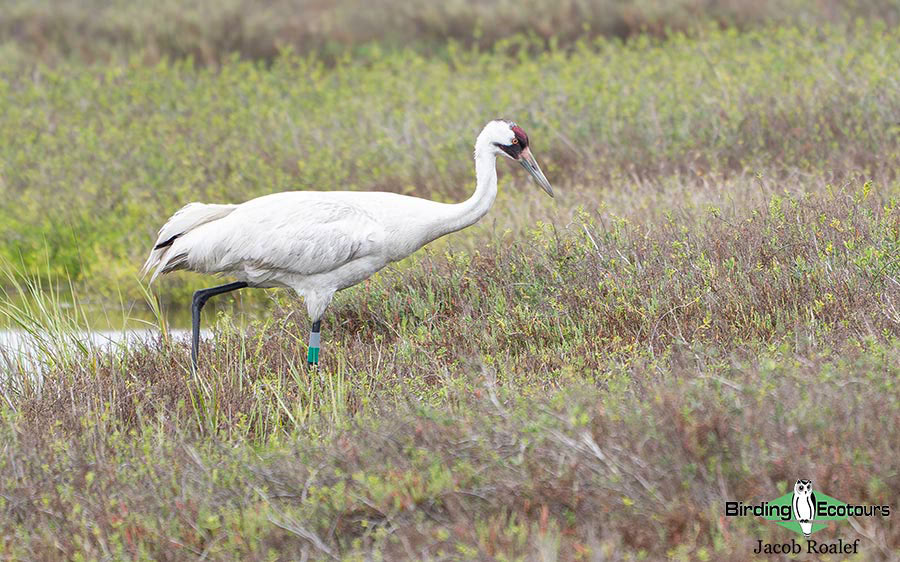
The impressive Whooping Crane was definitely a top highlight for the trip!
Overview
This short, one-week tour of Texas was a custom itinerary and route to target some key species and focus on photography while achieving our desired birding pace. These tailor-made tours are a great way to slightly alter routes or dates to better fit some schedules or goals, and we love making these for small groups. This trip through Southern Texas began on the 6th of March in Corpus Christi and concluded back there on the 12th of March. The focus was gulf coast birding and a quick run down to the Lower Rio Grande Valley. Many amazing birding destinations were visited in this short time, like Aransas National Wildlife Refuge, Leonabelle Turnbull Birding Center, Estero Llano Grande State Park, Resaca de la Palma State Park, National Butterfly Center, Santa Ana NWR, and more.
The birding in South Texas is some of the best in the entire United States and this trip proved that yet again. Despite our somewhat short itinerary and more limited geographical coverage, we tallied a fantastic list of birds and left with many great photos and fun memories. Highlight bird species included Whooping Crane, American Flamingo, Green Jay, Altamira and Audubon’s Orioles, Long-billed Thrasher, Cactus Wren, Ringed and Green Kingfishers, Red-crowned Amazon, Verdin, Great Kiskadee, Mangrove Warbler, Sprague’s Pipit, Couch’s Kingbird, Gull-billed Tern, and so many more. A total of 163 bird species were seen, with another one species as heard only, for a grand total of 164 species recorded during our time in Texas. Full bird and mammal lists can be found at the end of the report.
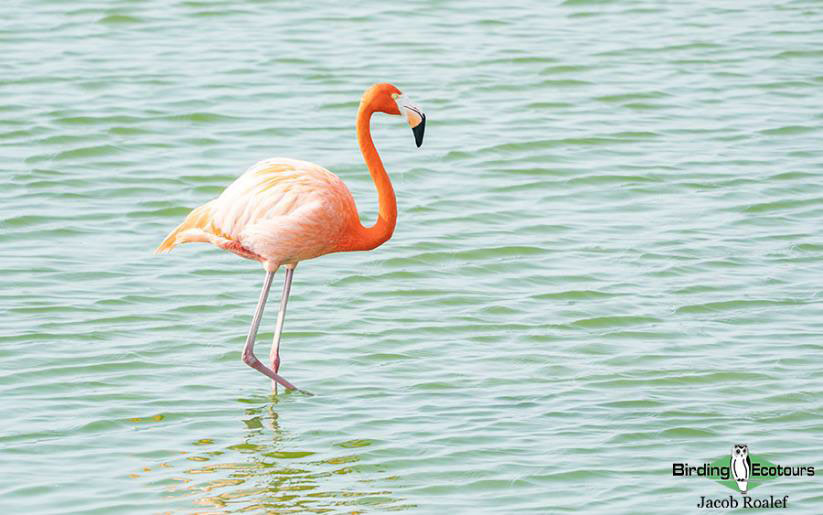
A rare American Flamingo was unexpected and gave us quite a show!
Detailed Report
Day 1, 6th March 2026. Aransas National Wildlife Refuge and Leonabelle Turnbull
Everyone had arrived in Corpus Christi the previous night so we could pack in a full day of birding today. We enjoyed a little breakfast at our hotel in Rockport and then loaded our gear up and headed north to Aransas NWR. Along the way we spotted a young White-tailed Hawk on the fenceline along the road. An excellent species and great start to our trip. Upon arrival at the refuge, we had a quick visit to the visitor’s center and then made our way to the nearby Heron Flats Trail. We began to tick our first few species for the trip, like Little Blue Heron, Common Yellowthroat, Blue-winged Teal, Common Gallinule, Great Egret, and more. We continued and decided to do the auto driving loop to really get a better sense of the park. We made a quick stop at the observation tower overlook and managed to spot an incredibly distant Whooping Crane from up top. While it was nearly a mile away, it was our first Whooping Crane for the trip and was a top target for the group. We finished the scenic loop drive and headed back to Rockport to grab a quick lunch.
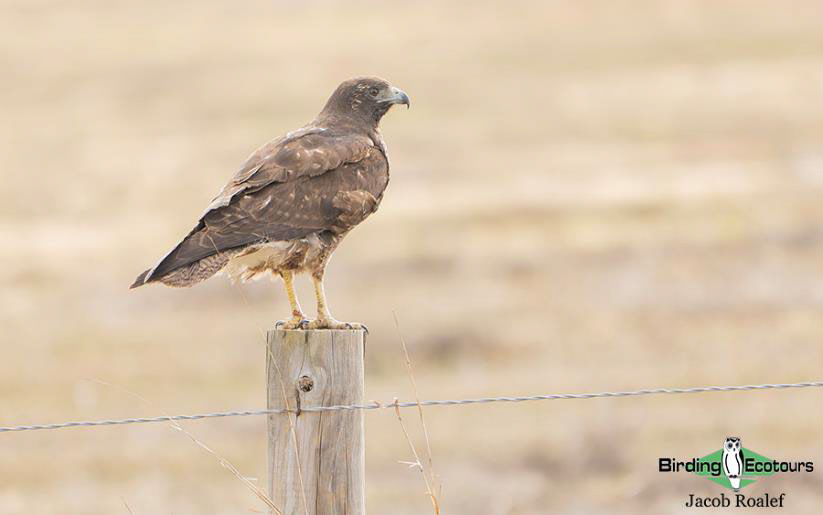
We scored some excellent views of this young White-tailed Hawk along the road.
After eating we took the ferry across the bay to the Leonabelle Turnbull Birding Center, a fantastic place for birding and photography. When we arrived, and before hitting the boardwalk trail, we checked the small patch of trees for any early migrants and found a small flock of Myrtle (Yellow-rumped) Warblers. On the boardwalk it was teeming with waterbirds, most of which were in close and allowed for amazing photo opportunities and views. The one bird that stuck out right away was the bright pink American Flamingo standing in the middle of the shallow water. This is a rare species for the United States and made for a nice, surprising treat. The species here were very numerous and included American Avocet, Black-necked Stilt, American White Pelican, Northern Shoveler, Stilt and Western Sandpipers, Roseate Spoonbill and Tricolored Heron. We soaked up all these amazing birds, in the afternoon sun, until we were too hot and tired to continue. Just before leaving, a few of us saw a Clapper Rail sneak out of the reeds for a moment, only to disappear again before others could make it back in time. Pesky bird, but still an incredible first day birding in Texas.
Day 2, 7th March 2026. Aransas Bay boat trip and Rockport area
We were full of anticipation for our scheduled boat trip out into Aransas Bay, where we would hopefully find some close-up cranes. We were off before daybreak and set sail to arrive on site for some good morning light. Our efforts were rewarded as we located a pair of Whooping Cranes not too far away! We positioned ourselves in a good location and waited, because the birds were comfortable with us and approached closer. How incredible it was to have such an amazing opportunity to see our top target so closely. The Whooping Crane fun didn’t stop there, as we spotted them all throughout the day off in the distance with a total tally of 43 of these endangered birds! While the cranes were the main attraction of our boat ride, there were still plenty of other great species to enjoy, like Seaside Sparrow, Willet, Belted Kingfisher, American Oystercatcher, Common Loon, Marbled Godwit, Franklin’s and Lesser Black-backed Gulls, Neotropic Cormorant, Reddish Egret, Merlin, and more. After a lovely time on the water with Captain Lori, we made our way back to the docks, got our legs under us, and headed off for lunch.
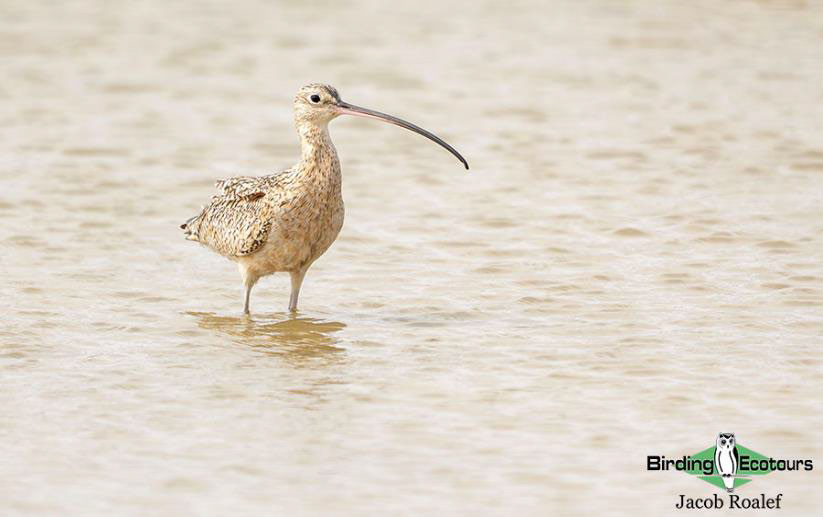
The strange Long-billed Curlew caught our attention.
After lunch we headed north towards the Guadulupe Delta Wildlife Management Area, through the town of Tivoli. This small town is about the southernmost extent of the range for Boat-tailed Grackle, so we spent a little time here until we found a few mixed in with the other blackbirds like Great-tailed Grackle, Brown-headed Cowbird, and Red-winged Blackbird. At the Buff Lake Overlook, we scanned through the waterbirds here and added White-faced Ibis, Anhinga, American Wigeon, Pied-billed Grebe, Northern Pintail, and more, to our trip list. After this we headed back to Rockport to bird near the hotel at some reservoirs and estuary areas. We managed to add a few more species to our list, like Bufflehead, Ruddy Duck, Loggerhead Shrike, and Golden-fronted Woodpecker. It had been a long, hot day, with an early start, so we took a short rest before heading out for a tasty dinner to celebrate a great day.
Day 3, 8th March 2026. Gulf Coast to the Lower Rio Grande Valley
We had a more relaxed morning as we enjoyed breakfast and packed our things to journey south to the Lower Rio Grande Valley. The weather was a little dicey this morning, with dark clouds rolling through, but we decided to give birding a shot. We stopped by Sunset Lake Park and Indian Point Pier before leaving the Corpus Christi area. In the spitting rain and wind we still managed to find some nice birds, like Piping, Semipalmated and Snowy Plovers, Black-crowned Night-Heron, and Greater Scaup. We loaded up and made the several hour drive south into the valley, with a stop along the way for lunch.
When we arrived at our hotel we checked in and took a quick break, as it was the hottest part of the day, and we had some later birding planned. We met up again mid-afternoon to hopefully find our first few valley specialties at Estero Llano Grande State Park. Despite the heat, this park was a great place for some birding. We found Plain Chachalaca, Buff-bellied Hummingbird, Green Jay, Black-crested Titmouse, Long-billed Thrasher, and Great Kiskadee, amongst others. It was a lovely afternoon and introduction to valley birding. We headed off for dinner in Harlingen and then some post-dinner birding at the nearby Whataburger restaurant. This business area is a known location for Green Parakeets to roost in the evenings. We were greeted by these squawky birds as we pulled into the lot, and we watched as more and more flew in and gathered on the wires above the restaurant. It was a little silly to see such exotic birds in the middle of a busy area, but there they were. Then it was time to head back to the hotel and get some rest before our first official day birding the LRGV.
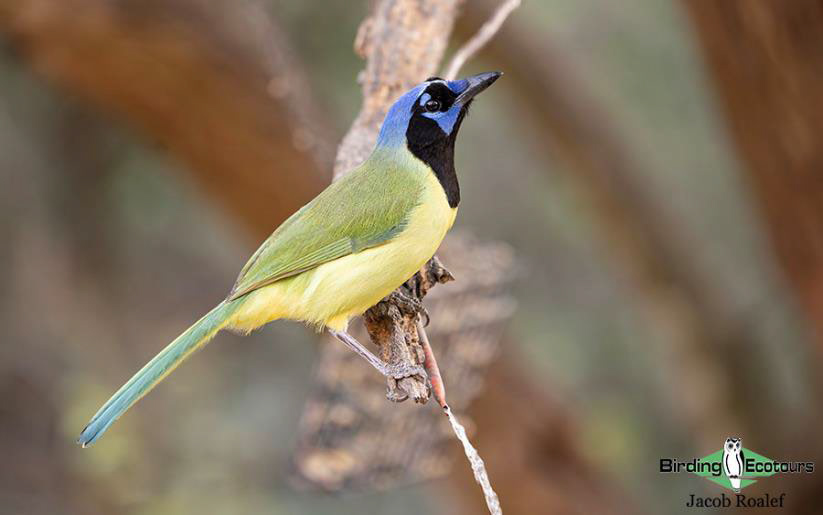
The iconic Green Jay was seen throughout the valley.
Day 4, 9th March 2026. Eastern parks of the LRGV
This game plan for today was to bird all around the eastern parks and areas of the valley so, after breakfast, we set off for Resaca de la Palma State Park. This lovely park is an excellent place to photograph certain more difficult species, which is exactly what we did, as we found Altamira Oriole, White-tipped Dove, Olive Sparrow, and more. After a lovely morning here we took off for a nearby wetland in Los Fresnos, where we found a very handsome Fulvous Whistling-Duck amongst the more expected waterbird species. From here we worked our way east towards South Padre Island, with a quick stop at a Laguna Atascosa NWR property. Here we enjoyed a pair of nesting Aplomado Falcons on their platform, and managed to pull in a Verdin for some excellent views in the desert scrub. After this we crossed the bridge to South Padre Island and had a little time to check the nearby mangroves. Thanks to the help of some other birders who steered us in the right direction, we were quickly able to find the recently split Mangrove Warbler, an excellent species for the USA. Then it was time for a late lunch on the island.
In the afternoon we headed over to the South Padre Island Birding Center to see what we could dig up. Sadly, the afternoon heat, and likely some recent construction and storms, led to a slow time here. We added Yellow-crowned Night-Heron and Green Heron to our list and enjoyed some close-up views of Black-bellied Whistling-Duck as well. After this we crossed back to the mainland to make our way back towards the hotel, with one final stop at a little boat launch area. We found several cool species like Gull-billed Tern, Black Skimmer (finally), Long-billed Curlew, Ruddy Turnstone, white morph Reddish Egret, and others. After a long, hot day, we headed back to the hotel for a short break, before dinner near the hotel.
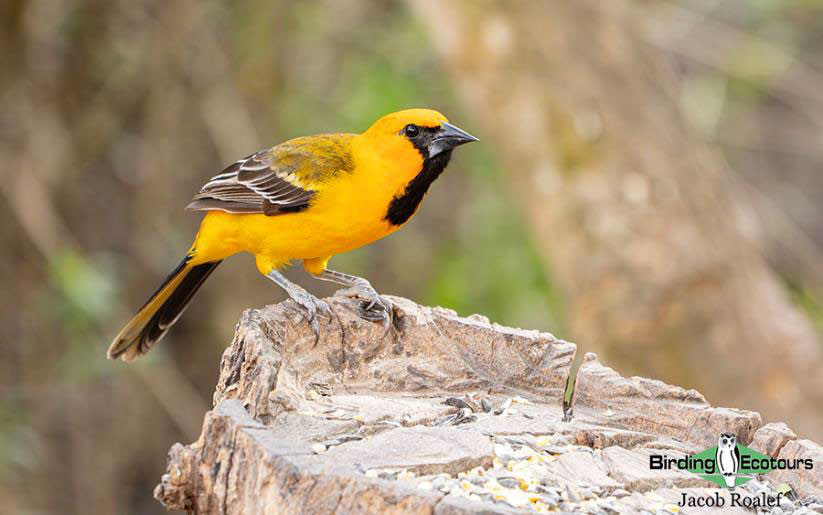
Altamira Oriole is another south Texas special we enjoyed on the trip.
Day 5, 10th March 2026. Western parks of the LRGV
Since we had covered the eastern parks yesterday, today we set our sights on the western parks of the LRGV. First up was Frontera Audubon. Unfortunately, it proved to be a slower morning here for some reason, but we still managed to enjoy our time and found Plain Chachalaca, Green Jay, Northern Cardinal, Clay-colored Thrush, Inca Dove, and others. We carried on over to Edinburgh Scenic Wetlands, where we sadly found much of the same slowness as we did at Frontera. Despite this, we still added to our trip tally, with some good valley birds like Least Grebe and Purple Martin. We headed for lunch to regroup after this slower (birdwise) morning, hoping things would pick up for us later. Our group was keen to see the Rio Grande Valley, so we passed through a section of the border wall and into Anzalduas Park to peak across to Mexico and see if we could find any birds. A few Western Meadowlarks were in the grassy fields, and an American Coot was swimming across the river.
From here, we popped over to the National Butterfly Center, which proved more active than any location thus far today. We found Audubon’s and Hooded Orioles, Eastern Screech-Owl, Ladder-backed Woodpecker, Lincoln’s Sparrow, Couch’s Kingbird, and Black Phoebe. By now we had nailed all the valley specials, aside from kingfishers, so we were searching hard for these. Our search led to various parks nearby and, while we struck out on our kingfisher hunt today, we added the gorgeous Vermillion Flycatcher and a charismatic Cactus Wren. It was getting late so we set off for dinner and then another evening of post-dinner birding. This time we set our sights on the neighborhoods of McAllen. As the sun began to set we cruised around with the windows down, listening for the distinctive squawks of our target. Eventually we heard squawks and looked up to see a small group of Red-crowned Amazons flying over. The chase was on, we hopped into the van and followed them to a few trees in front of a house, where they had joined up with some friends. We hopped out to enjoy these colorful and loud birds,then the owner of the house came out and invited us over for a closer view. A great cap to a full day birding in the valley.
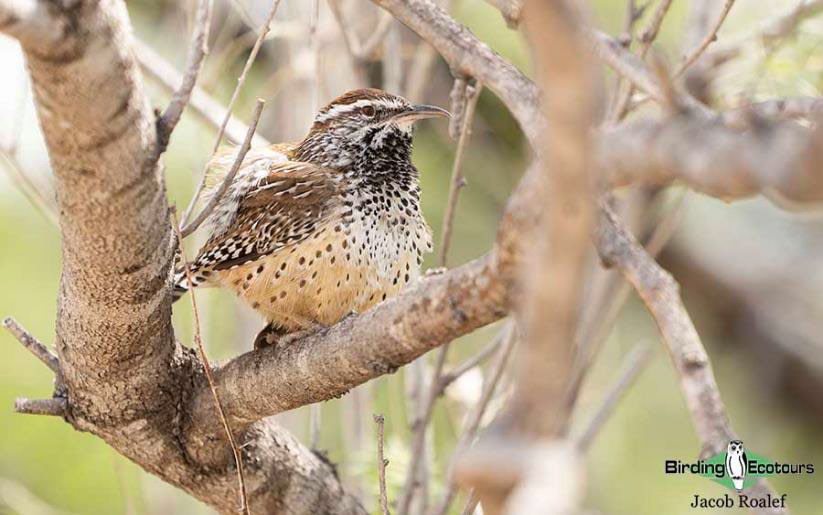
This Cactus Wren was quite a surprise for our group.
Day 6, 11th March 2026. Santa Ana NWR and back to Corpus Christi
On our final full day of the trip we had those pesky kingfishers to find, so we headed off to Santa Ana NWR, an excellent location for these targets. It was a beautiful morning, before the heat of the day crept in, so we all enjoyed a pleasant hike along the Pintail Lakes trail. We quickly found some excellent birds, like Couch’s Kingbird, Gadwall, and Eastern Phoebe. It wasn’t long before we found the cute Green Kingfisher – one down, one to go! We pressed on, scanned the ponds and noted Ruddy Duck, Least Grebe, Wilson’s Snipe, Lesser Scaup, and Northern Shoveler. We reached the back ponds, our final chance, and luck was on our side today as we spotted the giant Ringed Kingfisher up high in the trees on the final pond! With both kingfishers in the bag, we hiked back out and loaded up. We still had a little time left so we ventured over to the nearby Hanka Sod Farms. We scanned and searched these fields slowly and the light and sun at this time of day added an extra challenge. However, with enough patience and persistence, we managed to find Sprague’s Pipit amongst the numerous Horned Larks present.
We had lunch in the valley and then began the long drive back to Corpus Christi. Of course, we had our eyes peeled for birds along the way and managed to find Brewer’s Blackbird while we were slowed down at the border inspection station. These birds loved to hang out in the shady areas along the road here. As we got closer, we made one final stop at Bishop Park to check the water here. This ten-minute stop added a final bird to our trip list, in the form of a Cinnamon Teal. We finally made it back to Corpus Christi for our final dinner together to toast and celebrate what was a very fun trip, full of laughs and inside jokes, along with all the great birds.
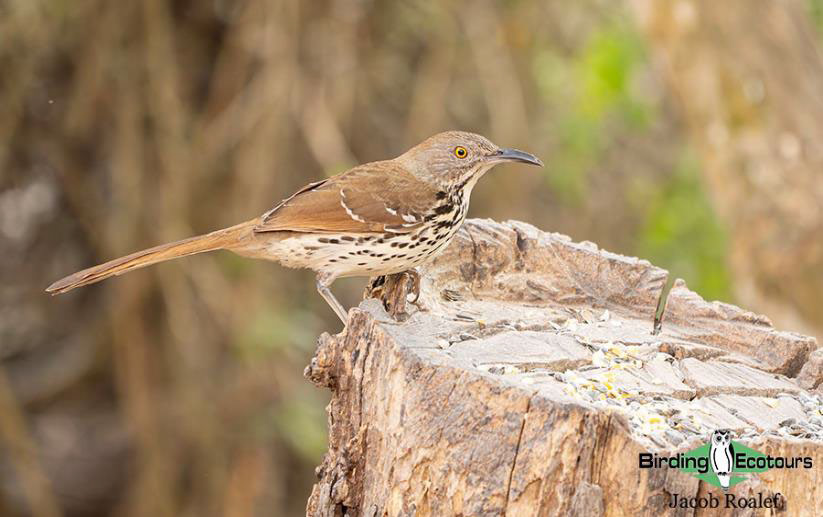
The sneaky Long-billed Thrasher came into the open and gave nice views.
Day 7, 12th March 2026. Tour conclusion
Our tour of South Texas came to its conclusion this morning, with runs to the airport before and after breakfast. Sadly, there was no time to squeeze in any extra birding as we had flights to catch and drives to make. It is always difficult when a trip comes to a close, but we all went home with some great memories, excellent photos, and a few new birds for our lists.
Bird List – Following IOC (15.1)
Birds ‘heard only’ are marked with (H) after the common name, all other species were seen.
All species were seen. The following notation after species names is used to show conservation status following BirdLife International: VU = Vulnerable. EN = Endangered
| Common Name | Scientific Name |
| Ducks, Geese, Swans (Anatidae) | |
| Black-bellied Whistling Duck | Dendrocygna autumnalis |
| Fulvous Whistling Duck | Dendrocygna bicolor |
| Cinnamon Teal | Spatula cyanoptera |
| Blue-winged Teal | Spatula discors |
| Northern Shoveler | Spatula clypeata |
| Gadwall | Mareca strepera |
| American Wigeon | Mareca americana |
| Mallard | Anas platyrhynchos |
| Mottled Duck | Anas fulvigula |
| Northern Pintail | Anas acuta |
| Green-winged Teal | Anas carolinensis |
| Greater Scaup | Aythya marila |
| Lesser Scaup | Aythya affinis |
| Bufflehead | Bucephala albeola |
| Red-breasted Merganser | Mergus serrator |
| Ruddy Duck | Oxyura jamaicensis |
| Chachalacas, Curassows, Guans (Cracidae) | |
| Plain Chachalaca | Ortalis vetula |
| Pheasants & Allies (Phasianidae) | |
| Wild Turkey | Meleagris gallopavo |
| Hummingbirds (Trochilidae) | |
| Black-chinned Hummingbird | Archilochus alexandri |
| Buff-bellied Hummingbird | Amazilia yucatanensis |
| Pigeons, Doves (Columbidae) | |
| Rock Dove (Introduced) | Columba livia |
| Eurasian Collared Dove (Introduced) | Streptopelia decaocto |
| Inca Dove | Columbina inca |
| White-tipped Dove | |
| Mourning Dove | Zenaida macroura |
| White-winged Dove | Zenaida asiatica |
| Rails, Crakes & Coots (Rallidae) | |
| Clapper Rail | Rallus crepitans |
| Common Gallinule | Gallinula galeata |
| American Coot | Fulica americana |
| Cranes (Gruidae) | |
| Sandhill Crane | Antigone canadensis |
| Whooping Crane – EN | Grus americana |
| Grebes (Podicipedidae) | |
| Least Grebe | Tachybaptus dominicus |
| Pied-billed Grebe | Podilymbus podiceps |
| Flamingos (Phoenicopteridae) | |
| American Flamingo | Phoenicopterus ruber |
| Oystercatchers (Haematopodidae) | |
| American Oystercatcher | Haematopus palliatus |
| Stilts and Avocets (Recurvirostridae) | |
| Black-necked Stilt | Himantopus mexicanus |
| American Avocet | Recurvirostra americana |
| Plovers (Charadriidae) | |
| Grey Plover – VU | Pluvialis squatarola |
| Killdeer | Charadrius vociferus |
| Semipalmated Plover | Charadrius semipalmatus |
| Piping Plover | Charadrius melodus |
| Snowy Plover | Anarhynchus nivosus |
| Sandpipers, Snipes (Scolopacidae) | |
| Long-billed Curlew | Numenius americanus |
| Marbled Godwit – VU | Limosa fedoa |
| Long-billed Dowitcher | Limnodromus scolopaceus |
| Short-billed Dowitcher – VU | Limnodromus griseus |
| Wilson’s Snipe | Gallinago delicata |
| Spotted Sandpiper | Actitis macularius |
| Solitary Sandpiper | Tringa solitaria |
| Lesser Yellowlegs – VU | Tringa flavipes |
| Willet | Tringa semipalmata |
| Greater Yellowlegs | Tringa melanoleuca |
| Ruddy Turnstone | Arenaria interpres |
| Stilt Sandpiper | Calidris himantopus |
| Sanderling | Calidris alba |
| Dunlin | Calidris alpina |
| Least Sandpiper | Calidris minutilla |
| Western Sandpiper | Calidris mauri |
| Gulls, Terns, Skimmers (Laridae) | |
| Black Skimmer | Rynchops niger |
| Gull-billed Tern | Gelochelidon nilotica |
| Caspian Tern | Hydroprogne caspia |
| Forster’s Tern | Sterna forsteri |
| Royal Tern | Thalasseus maximus |
| Laughing Gull | Leucophaeus atricilla |
| Franklin’s Gull | Leucophaeus pipixcan |
| Ring-billed Gull | Larus delawarensis |
| Lesser Black-backed Gull | Larus fuscus |
| American Herring Gull | Larus smithsonianus |
| Loons (Gaviidae) | |
| Common Loon | Gavia immer |
| Anhingas, Darters (Anhingidae) | |
| Anhinga | Anhinga anhinga |
| Cormorants, Shags (Phalacrocoracidae) | |
| Neotropic Cormorant | Nannopterum brasilianum |
| Double-crested Cormorant | Nannopterum auritum |
| Ibises, Spoonbills (Threskiornithidae) | |
| American White Ibis | Eudocimus albus |
| White-faced Ibis | Plegadis chihi |
| Roseate Spoonbill | Platalea ajaja |
| Herons, Bitterns (Ardeidae) | |
| Yellow-crowned Night Heron | Nyctanassa violacea |
| Black-crowned Night Heron | Nycticorax nycticorax |
| Little Blue Heron | Egretta caerulea |
| Tricolored Heron | Egretta tricolor |
| Reddish Egret | Egretta rufescens |
| Snowy Egret | Egretta thula |
| Green Heron | Butorides virescens |
| Great Egret | Ardea alba |
| Western Cattle Egret | Ardea ibis |
| Great Blue Heron | Ardea herodias |
| Pelicans (Pelecanidae) | |
| American White Pelican | Pelecanus erythrorhynchos |
| Brown Pelican | Pelecanus occidentalis |
| New World Vultures (Cathartidae) | |
| Black Vulture | Coragyps atratus |
| Turkey Vulture | Cathartes aura |
| Ospreys (Pandionidae) | |
| Osprey | Pandion haliaetus |
| Kites, Hawks, Eagles (Accipitridae) | |
| White-tailed Kite | Elanus leucurus |
| Cooper’s Hawk | Astur cooperii |
| Northern Harrier | Circus hudsonius |
| Harris’s Hawk | Parabuteo unicinctus |
| White-tailed Hawk | Geranoaetus albicaudatus |
| Gray Hawk | Buteo plagiatus |
| Swainson’s Hawk | Buteo swainsoni |
| Red-tailed Hawk | Buteo jamaicensis |
| Owls (Strigidae) | |
| Eastern Screech Owl | Megascops asio |
| Kingfishers (Alcedinidae) | |
| Green Kingfisher | Chloroceryle americana |
| Ringed Kingfisher | Megaceryle torquata |
| Belted Kingfisher | Megaceryle alcyon |
| Woodpeckers (Picidae) | |
| Golden-fronted Woodpecker | Melanerpes aurifrons |
| Ladder-backed Woodpecker | Dryobates scalaris |
| Caracaras, Falcons (Falconidae) | |
| Crested Caracara | Caracara plancus |
| American Kestrel | Falco sparverius |
| Aplomado Falcon | Falco femoralis |
| Merlin | Falco columbarius |
| Peregrine Falcon | Falco peregrinus |
| African & New World Parrots (Psittacidae) | |
| Red-crowned Amazon – EN | Amazona viridigenalis |
| Green Parakeet | Psittacara holochlorus |
| Tyrant Flycatchers, Calyptura (Tyrannidae) | |
| Eastern Phoebe | Sayornis phoebe |
| Black Phoebe | Sayornis nigricans |
| Vermilion Flycatcher | Pyrocephalus obscurus |
| Great Kiskadee | Pitangus sulphuratus |
| Tropical Kingbird | Tyrannus melancholicus |
| Couch’s Kingbird | Tyrannus couchii |
| Vireos, Greenlets, Shrike-babblers (Vireonidae) | |
| White-eyed Vireo | Vireo griseus |
| Shrikes (Laniidae) | |
| Loggerhead Shrike | Lanius ludovicianus |
| Crows, Jays (Corvidae) | |
| Green Jay | Cyanocorax luxuosus |
| Tits, Chickadees (Paridae) | |
| Black-crested Titmouse | Baeolophus atricristatus |
| Penduline Tits (Remizidae) | |
| Verdin | Auriparus flaviceps |
| Larks (Alaudidae) | |
| Horned Lark | Eremophila alpestris |
| Swallows, Martins (Hirundinidae) | |
| Tree Swallow | Tachycineta bicolor |
| Purple Martin | Progne subis |
| Northern Rough-winged Swallow | Stelgidopteryx serripennis |
| Barn Swallow | Hirundo rustica |
| Cave Swallow | Petrochelidon fulva |
| Goldcrests, Kinglets (Regulidae) | |
| Ruby-crowned Kinglet | Corthylio calendula |
| Wrens (Troglodytidae) | |
| Cactus Wren | Campylorhynchus brunneicapillus |
| Marsh Wren (H) | Cistothorus palustris |
| Carolina Wren | Thryothorus ludovicianus |
| Gnatcatchers (Polioptilidae) | |
| Blue-grey Gnatcatcher | Polioptila caerulea |
| Mockingbirds, Thrashers (Mimidae) | |
| Northern Mockingbird | Mimus polyglottos |
| Long-billed Thrasher | Toxostoma longirostre |
| Curve-billed Thrasher | Toxostoma curvirostre |
| Starlings, Rhabdornises (Sturnidae) | |
| European Starling (Introduced) | Sturnus vulgaris |
| Thrushes (Turdidae) | |
| Clay-colored Thrush | Turdus grayi |
| Old World Sparrows, Snowfinches (Passeridae) | |
| House Sparrow | Passer domesticus |
| Wagtails, Pipits (Motacillidae) | |
| Sprague’s Pipit – VU | Anthus spragueii |
| New World Sparrows (Passerellidae) | |
| Olive Sparrow | Arremonops rufivirgatus |
| Lark Sparrow | Chondestes grammacus |
| White-crowned Sparrow | Zonotrichia leucophrys |
| Seaside Sparrow | Ammospiza maritima |
| Savannah Sparrow | Passerculus sandwichensis |
| Lincoln’s Sparrow | Melospiza lincolnii |
| Oropendolas, New World Orioles, Blackbirds (Icteridae) | |
| Western Meadowlark | Sturnella neglecta |
| Eastern Meadowlark | Sturnella magna |
| Audubon’s Oriole | Icterus graduacauda |
| Altamira Oriole | Icterus gularis |
| Hooded Oriole | Icterus cucullatus |
| Red-winged Blackbird | Agelaius phoeniceus |
| Bronzed Cowbird | Molothrus aeneus |
| Brown-headed Cowbird | Molothrus ater |
| Brewer’s Blackbird | Euphagus cyanocephalus |
| Boat-tailed Grackle | Quiscalus major |
| Great-tailed Grackle | Quiscalus mexicanus |
| New World Warblers (Parulidae) | |
| Black-and-white Warbler | Mniotilta varia |
| Orange-crowned Warbler | Leiothlypis celata |
| Common Yellowthroat | Geothlypis trichas |
| Mangrove Warbler | Setophaga petechia |
| Myrtle Warbler (Yellow-rumped) | Setophaga coronata |
| Cardinals & Allies (Cardinalidae) | |
| Northern Cardinal | Cardinalis cardinalis |
| Pyrrhuloxia | Cardinalis sinuatus |
| Total Seen | 163 |
| Total Heard | 1 |
| Total Recorded | 164 |
Mammal List
| Common Name | Scientific Name |
| Squirrels and Relatives (Sciuridae) | |
| Fox Squirrel | Sciurus niger |
| Rabbits and Hares (Leporidae) | |
| Eastern Cottontail | Sylvilagus floridanus |
| Raccoons and Relatives (Procyonidae) | |
| Northern Raccoon | Procyon lotor |
| Oceanic Dolphins (Delphinidae) | |
| Common Bottlenose Dolphin | Tursiops truncatus |
| Deer, Elk, Mooses (Cervidae) | |
| White-tailed Deer | Odocoileus virginianus |
| Total | 5 |
This is a sample trip report. Please email us ([email protected]) for more trip reports from this destination.