01–16 SEPTEMBER 2026
By Andrew Walker
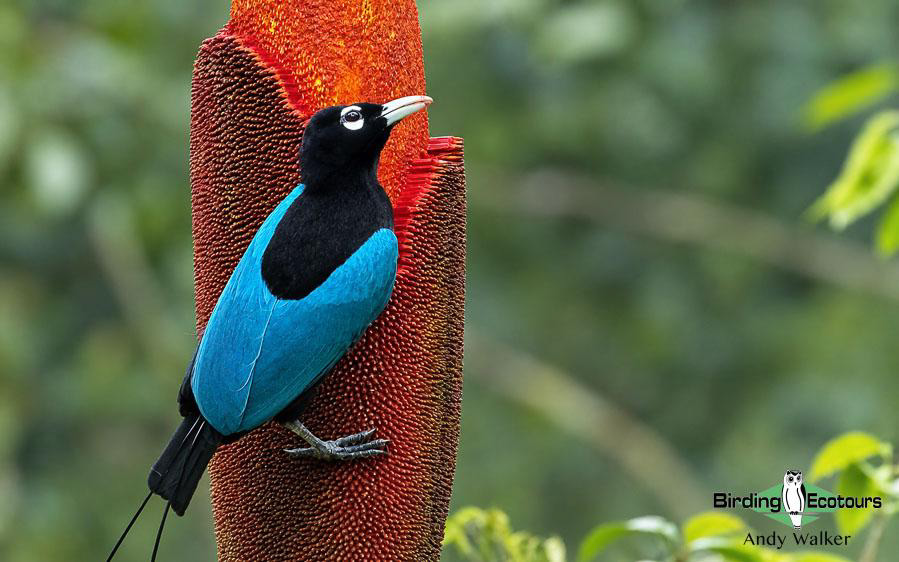
Blue Bird-of-paradise showed so closely it was tough to fit the whole bird in the frame.
Overview
This Papua New Guinea (PNG) birding tour, our second of two back-to-back tours, started in Port Moresby on the 1st of September 2026 and ended there on the 16th of September 2026. Our original itinerary included birding around Port Moresby, Mount Hagen, Wabag, Kiunga, and Tabubil (Star Mountains). However, in the weeks leading up to the tour, we had to alter our itinerary due to the suspension of flights into Kiunga Airport and the lack of suitable alternatives for entering or exiting the western region of the country. This meant we were unable to bird in the Kiunga and Tabubil areas. Fortunately, we were able to make these changes in advance of the tour rather than having to make complex plans at short notice, avoiding a potentially significant loss of time. As a result of these changes, we added time in the Mount Hagen area and enjoyed more birding time near Port Moresby, providing further opportunities to find new species.
Papua New Guinea offers opportunities to see some of the world’s best birds, and our attention was firmly focused on finding as many of these remarkable species as possible. We recorded 269 bird species during the tour, including 18 heard-only species. A detailed daily account follows below, and the various species lists are located at the end of the report. You can also access our eBird trip report here, which contains a few more photos than this report.
Highlights were numerous, including 15 species of birds-of-paradise that were seen: Blue Bird-of-paradise, Raggiana Bird-of-paradise, Lesser Bird-of-paradise, King of Saxony Bird-of-paradise, Magnificent Bird-of-paradise, Ribbon-tailed Astrapia, Princess Stephanie’s Astrapia, Brown Sicklebill, Black Sicklebill, Greater Lophorina, Growling Riflebird, Short-tailed Paradigalla, Lawes’s Parotia, Crinkle-collared Manucode, and Glossy-mantled Manucode.
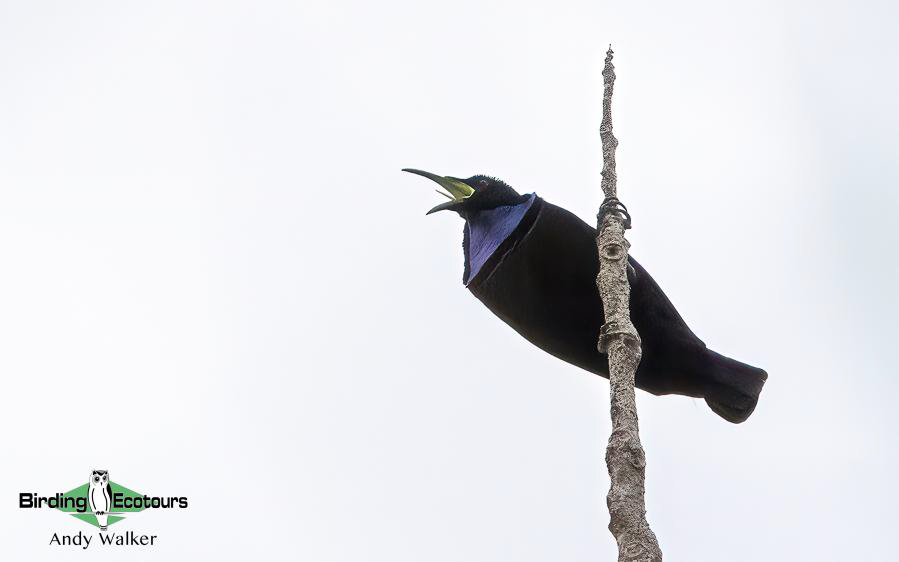
Growling Riflebird called briefly from the top of a dead tree early in the tour.
According to AviList v2025b, New Guinea has seven endemic families, including three monotypic endemic families, and during the tour we found representatives of all of these, including:
- Berryhunter (Rhagologidae): Mottled Berryhunter
- Ploughbill (Eulacestomatidae): Wattled Ploughbill
- Painted Berrypeckers (Paramythiidae): Eastern Crested Berrypecker and Tit Berrypecker
- Ifrit (Ifritidae): Blue-capped Ifrit
- Melampittas (Melampittidae): Lesser Melampitta
- Satinbirds (Cnemophilidae): Crested (Red) Satinbird and Loria’s Satinbird
- Longbills and Berrypeckers (Melanocharitidae): Several species including Pygmy Longbill, Mid-mountain Berrypecker, and Fan-tailed Berrypecker
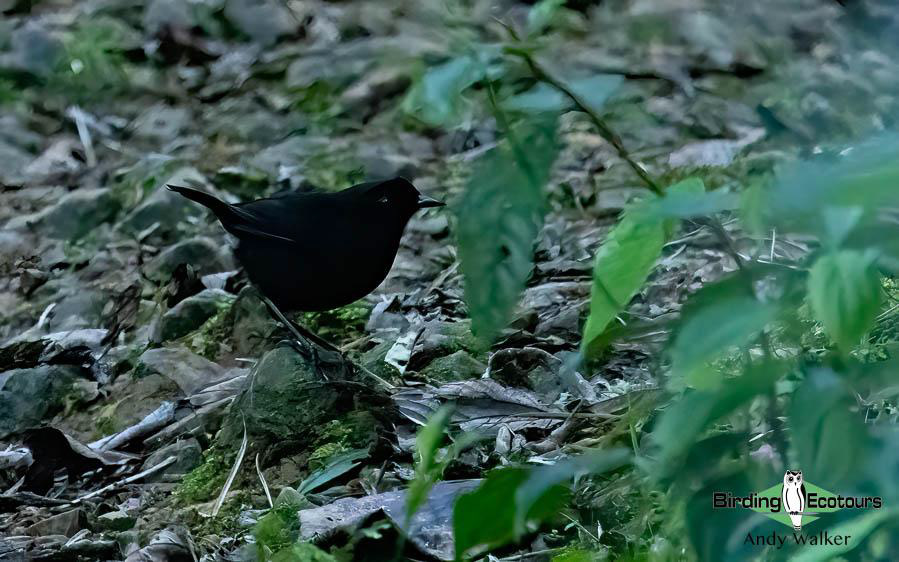
We were very pleased to get great views of Lesser Melampitta on a dark forest trail.
In addition to the spectacular birds-of-paradise and representatives of New Guinea’s endemic families, we saw numerous other standout species during the tour, including Papuan Frogmouth, Marbled Frogmouth, Barred Owlet-nightjar, Mountain Owlet-nightjar, Chestnut Forest Rail, Forbes’s Forest Rail, Papuan Harrier, Gurney’s Eagle, Long-tailed Honey Buzzard, Dwarf Fruit Dove, Great Cuckoo-Dove, Brown-headed Paradise Kingfisher, Hook-billed Kingfisher, Yellow-billed Kingfisher, Rufous-bellied Kookaburra, Papuan Dwarf Kingfisher, Blyth’s Hornbill, Brehm’s Tiger Parrot, Stella’s Lorikeet, Papuan Eclectus, Papuan Pitta, Hooded Cuckooshrike, Archbold’s Bowerbird, Fawn-breasted Bowerbird, Yellow-breasted Bowerbird, Orange-crowned Fairywren, Ornate Melidectes, Spotted Honeyeater, Rufous-naped Bellbird, Hooded Pitohui, Rusty Pitohui, Black Sittella, Papuan Sittella, White-bellied Whistler, Black-throated Robin, and Papuan Parrotfinch.
Detailed Report
Day 1, 1st September 2026. Arrival in Port Moresby
An arrival day in Port Moresby. We enjoyed our welcome dinner together and discussed what we were hoping to see on this much-anticipated Papua New Guinea birding tour. Because of the early arrivals, most participants were able to start their PNG bird lists with species seen around the hotel grounds, such as Torresian Imperial Pigeon, Forest Kingfisher, Helmeted (New Guinea) Friarbird, Brown Oriole, Australasian Figbird, White-breasted Woodswallow, and more.
Day 2, 2nd September 2026. Birding at Varirata National Park
We commenced our birding tour with a visit to Varirata National Park. After setting off at sunrise, the first few species we saw along the way included Common Kingfisher, Papuan Eclectus, and Hooded Butcherbird. An Agile Wallaby bounced its way across an area of burnt grassland in the savannah. After entering the national park, we headed straight to the Raggiana Bird-of-paradise display area. The birds put on quite a show, with at least 12 individuals counted. With several females present, the males were busy dancing and displaying – a fascinating sight. As we enjoyed the first birds-of-paradise of the tour, we also saw a pair of Brown-headed Paradise Kingfishers, though they were keeping rather hidden and remaining low in the undergrowth.
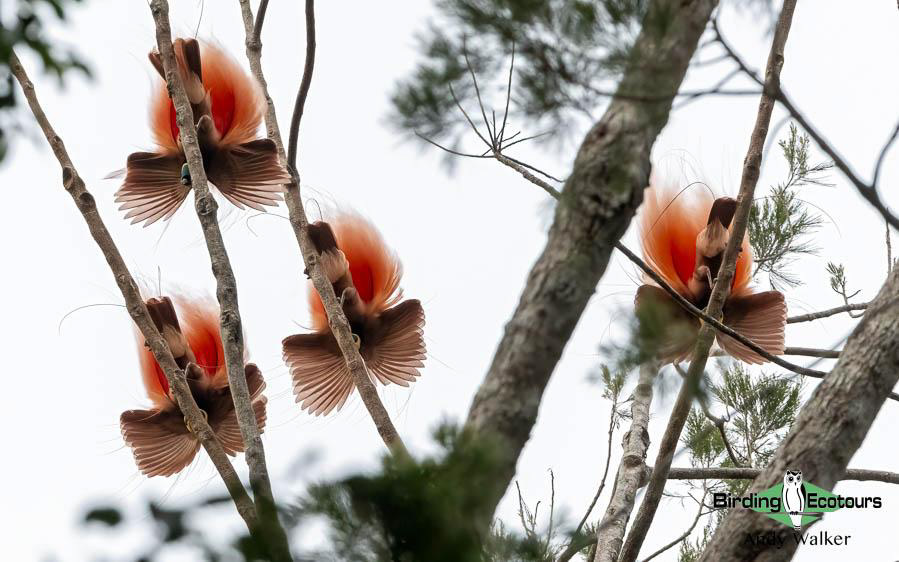
The mesmerizing sight of four male Raggiana Birds-of-paradise displaying.
Nearby, we found a roosting Papuan Frogmouth. Upon reaching a clearing, we enjoyed views of Blyth’s Hornbills, Sulphur-crested Cockatoos, Black-capped Lory, Blue-winged Kookaburra, Grey Crow, and Papuan Black Myzomela. On entering a trail we could hear a Pheasant Pigeon calling, but it wouldn’t leave cover and come into view. The same occurred with a few Papuan Scrub Robins, which were heard calling deep in the forest. We gained views of a pair of White-crowned Cuckoos that had been calling. A vocal pair of Growling Riflebirds was flying around and they too finally gave some reasonable views. A flock of more than 30 Blyth’s Hornbills provided a spectacular sight and we had sightings of Pacific Bazas, Variable Goshawks, Brahminy Kites, and an Australian Hobby.
Walking along a different trail we had a brief sighting of a Barred Owlet-nightjar and bumped into a few mixed-species flocks, which proved exciting and gave us sightings of Crinkle-collared Manucode, Growling Riflebird, Hooded Pitohui, Rusty Pitohui, Sahul Cicadabird, Boyer’s Cuckooshrike, Brown Oriole, Streak-headed Honeyeater, Elegant Honeyeater, Chestnut-bellied Fantail, Spot-winged Monarch, Golden Monarch, Frilled Monarch, White-faced Robin, Little Shrikethrush, Fairy Gerygone, and many others. Seen during the walk, but not really associated with the mixed-species flocks were Rufous-bellied Kookaburra, Papuan Dwarf Kingfisher, and Black Berrypecker.
We took a break for our picnic lunch during the heat of the middle of the day and enjoyed a fabulous sighting of a Yellow-billed Kingfisher. Following our lunch, we spent the early afternoon checking out a fruiting tree. Along the way we found a pair of roosting Barking Owls with their two fledglings. The fruiting tree contained a pair of Varied Trillers, two pairs of Barred Cuckooshrikes, several Boyer’s Cuckooshrikes, and a Red-capped Flowerpecker.
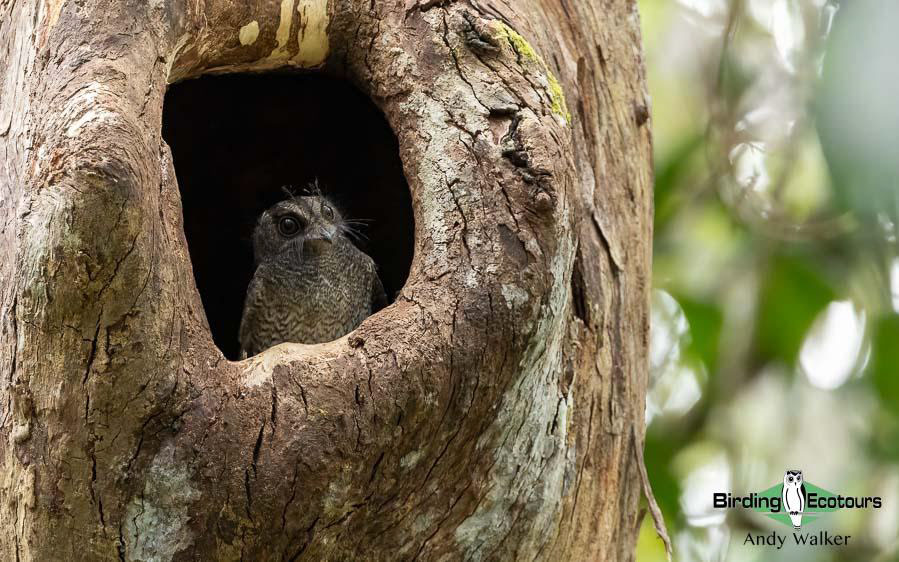
Barred Owlet-nightjar peering out of its roost hollow.
Following our birding inside the national park we made a stop in the savannah along the park entrance road. Here we enjoyed a sighting of a nesting Marbled Frogmouth, with two chicks just about visible below the adult bird. Here we also found Shining Bronze Cuckoo, Rainbow Bee-eater, White-bellied Whistler, Leaden Flycatcher, and Yellow-bellied Flyrobin. It had been a wonderful day of high-quality birds, and we made our way back to our accommodation for some rest, highly satisfied with our haul for the day.
Day 3, 3rd September 2026. Travel between Port Moresby and Mount Hagen; afternoon birding at Kumul Lodge
After breakfast, we made our way to the airport. After the usual nervous wait to see whether the flight would operate, we boarded our flight to Mount Hagen. After an almost-on-time arrival in Mount Hagen, we had some lunch and drove through the attractive countryside to Kumul Lodge, our base for the next few nights. During our drive, we saw plenty of Black Kites, along with Papuan Harrier and Brown Falcon. Some participants also saw Long-tailed Shrike, Great Woodswallow, and Pied Bush Chat along the way.
During a relaxed afternoon birding session from the Kumul Lodge balcony, we scanned the legendary bird feeders and saw two birds-of-paradise: first a female Brown Sicklebill, followed by a stunning adult male Ribbon-tailed Astrapia – a particularly impressive sight! A family group of Papuan Island Thrushes was ever-present at the bird feeders and a flock of Brehm’s Tiger Parrots showed very nicely. Several Belford’s Melidectes were rather boisterous and spent most of their visits chasing other birds away, but still Common Smoky Honeyeaters, Fan-tailed Berrypeckers, and a Friendly Fantail were able to sneak in to feed occasionally.
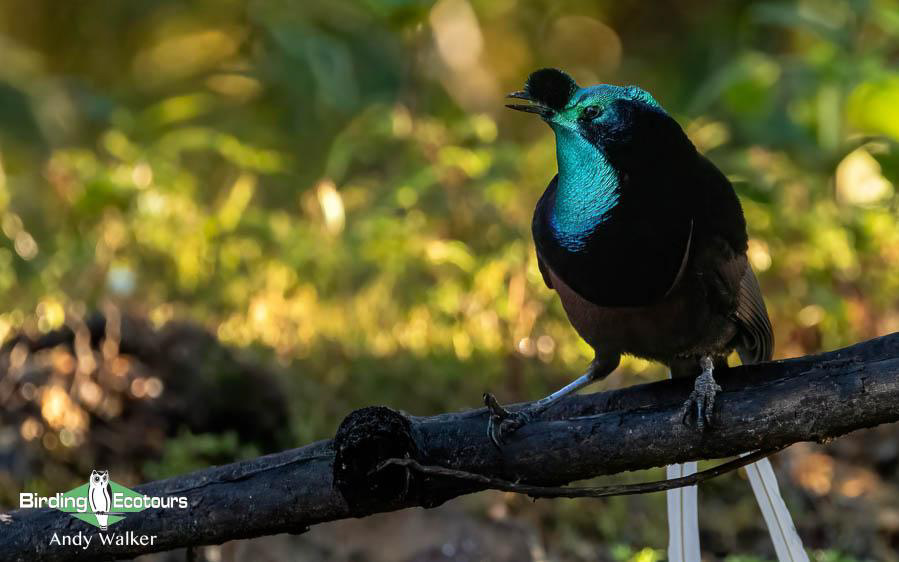
Adult male Ribbon-tailed Astrapia at the Kumul Lodge feeders.
Day 4, 4th September 2026. Birding at Kumul Lodge
Some pre-breakfast birding provided sightings of a gorgeous adult male Ribbon-tailed Astrapia, with several younger males, and two female birds present too. The adult male was impressive and we all enjoyed the lengthy eye-level views of this most-wanted bird-of-paradise. The female Brown Sicklebill was again present, as were Brehm’s Tiger Parrot, Fan-tailed Berrypecker, Papuan Island Thrush, and White-winged Robin. Two mammals were also noted around the lodge gardens: Speckled Dasyure and Calaby’s Pademelon, providing some extra excitement.
After breakfast, we took a walk through the beautiful Kumul Lodge forest, and it was highly rewarding. One of the best birds we saw was a Chestnut Forest Rail – one sat out in full view for a few moments and then walked a circuit around us, allowing everyone an opportunity to get a sighting of this rare and secretive species. Another of the top birds of the morning was Blue-capped Ifrit. A pair of birds showed reasonably well. Rufous-naped Bellbirds were vocal, with a few birds seen briefly, though one male provided prolonged views. A small family group of Tit Berrypeckers moved around us and showed well to most of the group, and eventually we found our hoped-for Eastern Crested Berrypeckers, with a pair of birds giving good views as they fed in a small fruiting tree. Other species seen during the morning walk included Glossy Swiftlet, Papuan Scrubwren, Large Scrubwren, Friendly Fantail, Dimorphic Fantail, Red-collared Myzomela, Grey-streaked Honeyeater, Regent Whistler, and Canary Flyrobin.
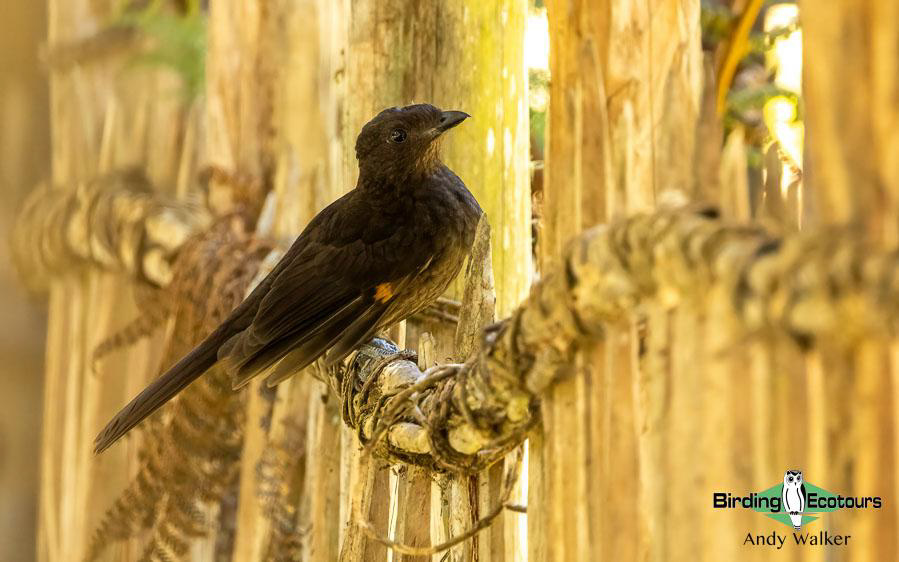
An Archbold’s Bowerbird was looking for insects around the lodge buildings at lunchtime.
During lunch, a pair of striking Stella’s Lorikeets were visiting the feeders (along with all of the other usual species) and an Archbold’s Bowerbird was looking for moths around the lodge buildings. After lunch, another walk around the lodge grounds, and more time at the feeders, gave some of us sightings of a skulking Mountain Mouse-warbler in the forest, and everyone caught up with a pretty male Regent Whistler. We improved our views of Red-collared Myzomela and Grey-streaked Honeyeater, and heard a Crested (Red) Satinbird, though it didn’t show itself. A difficult-to-view flowering tree was visited by Plum-faced Lorikeets and Orange-billed Lorikeets, but better views would have been welcome. Two Black-throated Honeyeaters were also in the tree and provided slightly better views than the lorikeets. A male Ribbon-tailed Astrapia flew in and fed right over our heads and several White-winged Robins were seen. The feeders continued to keep Brehm’s Tiger Parrots, Brown Sicklebills, Common Smoky Honeyeaters, Belford’s Melidectes, and Papuan Island Thrushes well fed.
Day 5, 5th September 2026. Birding in the Kumul Lodge area
We took a short drive from Kumul Lodge to a nearby patch of forest. It was an excellent morning, with many highly sought-after species recorded. Prior to entering the forest, some participants saw a distant female Loria’s Satinbird perched near the top of a distant tree. A Brehm’s Tiger Parrot and a female Princess Stephanie’s Astrapia were much closer.
On entering the forest we were quickly greeted by a Forbes’s Forest Rail standing in the trail. It showed a few times for us and allowed us to compare it to the Chestnut Forest Rail we had seen just the previous morning. While we were watching the rail a Lesser Melampitta started calling, so we turned our attention to this new species. Just when we were about to give up hope of a sighting of this highly secretive species, one hopped out on the trail. We all got some views and were very pleased. However, a second bird was also calling nearby, and eventually this one also hopped into view on the trail, even closer than the first bird. It showed nicely as it moved around the edge of the trail foraging, even posing briefly for some photo opportunities – a rare treat indeed! We were extremely pleased with our sightings of Forbes’s Forest Rail and Lesser Melampitta. We wondered what else might lie ahead. The morning was already shaping up to be highly memorable.
A patch of flowering shrubs held Rufous-backed Honeyeater, Common Smoky Honeyeater, Black-throated Honeyeater, and Red-collared Myzomela (and later in the day a Red-capped Flowerpecker). We reached a small clearing and we heard distantly both Brown Sicklebill and King of Saxony Bird-of-paradise calling. Eventually over the course of the morning both were seen by most of the group, though views of the male Brown Sicklebill were much better than views of the King of Saxony Bird-of-paradise.
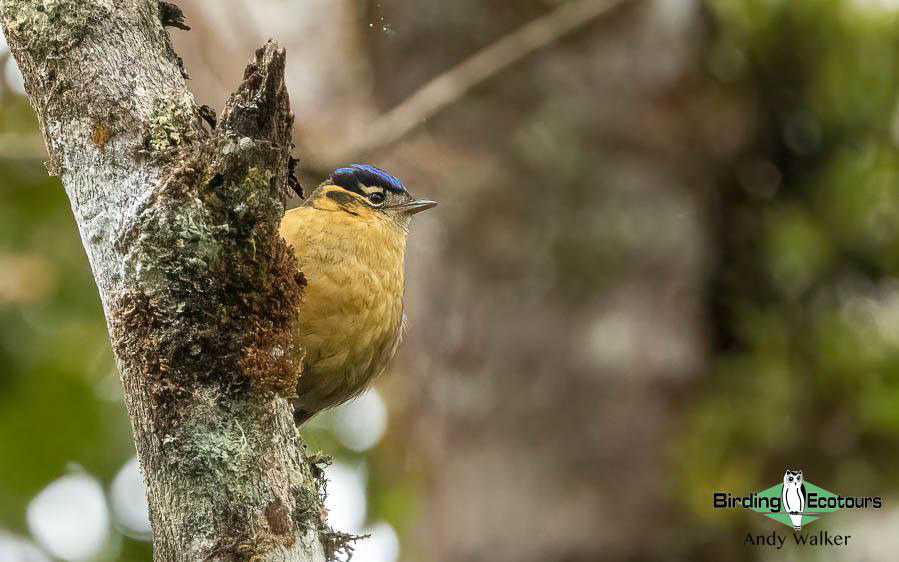
Blue-capped Ifrit peering out from behind a branch.
Our continued scanning gave us sightings of three species belonging to New Guinea endemic monotypic families: Wattled Ploughbill, Blue-capped Ifrit, and Mottled Berryhunter. A pair of Wattled Ploughbills showed at close range but remained very shy – their piercing calls teased us for some time before they eventually dropped into view in a bush right in front of us. Blue-capped Ifrits were first seen distantly, and then later in the morning two birds flew closer to us, allowing us better views than we had managed the previous day. Mottled Berryhunters were vocal for a period some distance away, but gradually they came closer and gave a few flight views, but always landed out of sight on this occasion.
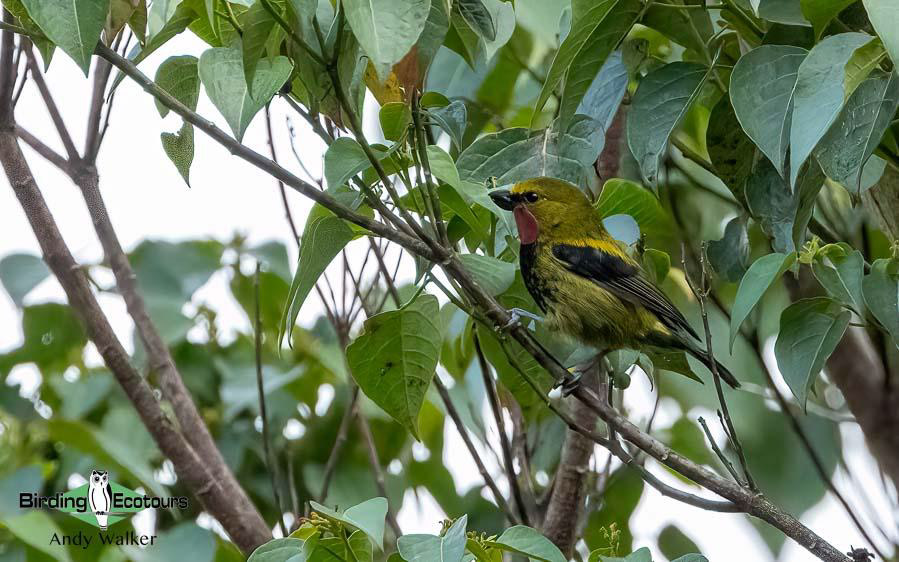
We were very pleased to see a male Wattled Ploughbill.
Additionally, we had a couple of sightings of family groups of Tit Berrypeckers and Regent Whistlers. Plenty of other birds were recorded here, including Rufous-throated Bronze Cuckoo, Rufous-naped Bellbird, Friendly Fantail, Black-bellied Cuckooshrike, Fan-tailed Berrypecker, Brown-backed Whistler, Slaty Robin, and Hooded Mannikin. Several lorikeets were seen, mostly briefly or distantly, including Orange-billed Lorikeet, Yellow-billed Lorikeet, Goldie’s Lorikeet, and Stella’s Lorikeet, though Plum-faced Lorikeet did show nicely perched close to our vantage point. Highly satisfied with our morning birding, we drove back to Kumul Lodge for lunch and some rest, noting Papuan Harrier, Black Kite, Long-tailed Shrike, and Pied Bush Chat along the way.
During the afternoon we took another walk around the Kumul Lodge grounds. It was quite hot and activity was fairly low. A pair of Black-breasted Boatbills was new for the trip, and these attractive flycatchers gave good views. A juvenile male Brown Sicklebill was a nice surprise at the feeders and bodes well for future visits. The more frequently seen adult female and a juvenile female were also present. An assortment of Ribbon-tailed Astrapias were again visiting the feeders, along with Brehm’s Tiger Parrot and Fan-tailed Berrypecker. A family group of Rufous-naped Bellbirds spent some time foraging around the room, as did the Archbold’s Bowerbird. A pair of Canary Flyrobins showed well inside the forest, along with Papuan Scrubwren. Near last light a pair of Crested (Red) Satinbirds were also seen by some participants, a great end to their day.
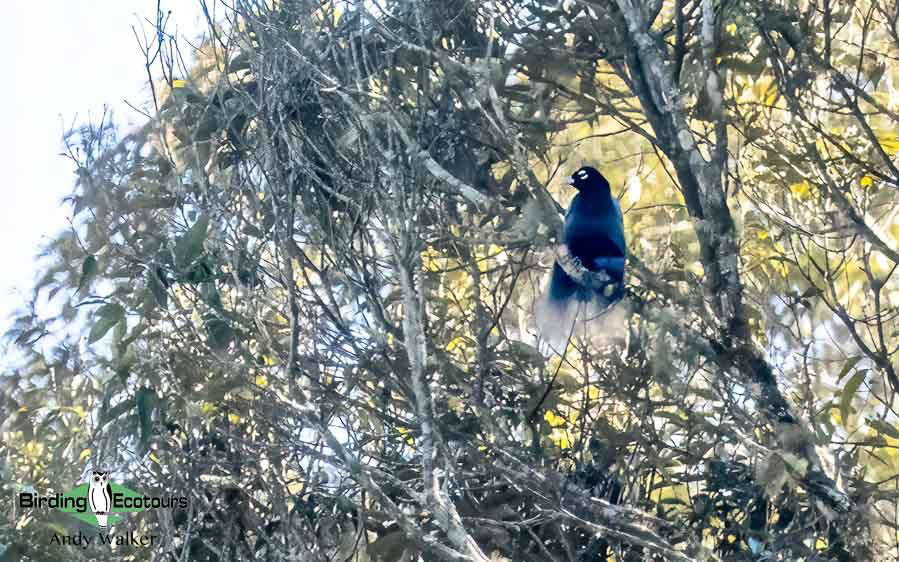
Adult male Blue Bird-of-paradise showing its breeding plumage.
Day 6, 6th September 2026. Morning birding at Kumul Lodge; afternoon birding at Komange Eco Lodge
We departed Kumul Lodge after an early breakfast and drove to a nearby patch of forest. After a short uphill hike, we staked out some fruiting trees. Vocal Yellow-browed Melidectes greeted us and several Amboyna Cuckoo-Doves were busily feeding. After a short wait, we heard our hoped-for Blue Bird-of-paradise, and before long we were getting distant views of a male bird. After a couple of fleeting views over the next hour, it finally sat out in the open for a more prolonged period, allowing some good but distant views – a particularly striking bird. As we were focused on our Blue Bird-of-paradise views, a Mountain Kingfisher was vocal, but remained hidden. Closer to us, a pair of White-shouldered Fairywrens and a Papuan Grassbird were clearly visible, and a male Greater Lophorina dropped into a small fruiting bush briefly. A roving flock of New Guinea White-eyes showed repeatedly and a male Pied Bush Chat and a Brown-breasted Gerygone were both vocal and showed occasionally. Overhead, we saw a pair of Brown Goshawks too. Prior to our departure from the site we saw Island (Papuan) Leaf Warbler and a brightly plumaged male Mountain Myzomela.
Our next stop took us to a nearby river, where we found two family groups of Torrent Flyrobins, our primary target from this stop. Here, we also saw Common Sandpiper and several Pacific Swallows. Nearby, we noted a fruiting tree containing two female Magnificent Birds-of-paradise, Black-headed Whistler, Mountain Honeyeater, and Marbled Honeyeater; however, most of these birds flew off too quickly for all to get satisfactory views. Meanwhile, a Sahul Brush Cuckoo could be heard calling in the distance.
After completing our drive to Komange Eco Lodge, we had lunch and took a short rest before heading out again for some afternoon birding. We took a walk along a nearby road, where we had some excellent views of a vocal and feeding King of Saxony Bird-of-paradise and several male Princess Stephanie’s Astrapias.
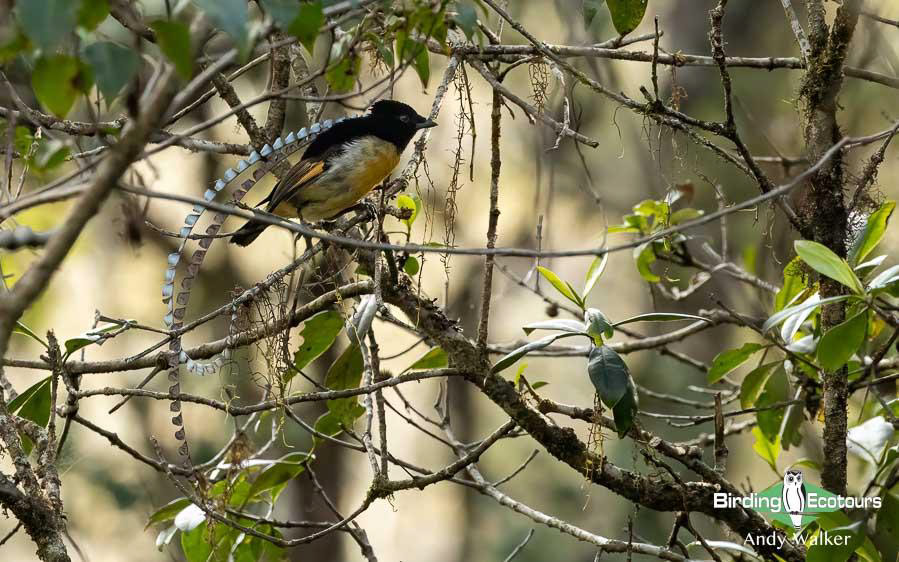
A male King of Saxony Bird-of-paradise gave eye-level views.
In addition to these top sightings, we enjoyed two sittella flocks. The first flock was made up of around 15 Black Sittellas and the second flock, about an hour later, consisted of around ten Papuan Sittellas. Stella’s Lorikeets, Plum-faced Lorikeets, and Orange-billed Lorikeets were all seen perched and at close range. We had brief sightings of Black-throated Robin, Black Fantail, and Brown-backed Whistler. A Black-breasted Boatbill was clearly visible. A few participants had a brief sighting of a Lawes’s Parotia, though it disappeared before everyone could see it and a Spotted Jewel-babbler was heard as the day drew to a close.
Day 7, 7th September 2026. Birding at Komange Eco Lodge
We had a morning walk around the Komange Eco Lodge area. We started with close views of Hooded Cuckooshrike and a pair of Blue-capped Ifrits called nearby. A small flock of Blue-faced Parrotfinches dropped in but vanished as quickly as they had arrived. Distant Fan-tailed Cuckoo and Rufous-throated Bronze Cuckoo were calling. A male and two female Tit Berrypeckers allowed close views, as did Brown-backed Whistler. Belford’s Melidectes and Common Smoky Honeyeater were vocal and conspicuous and Yellow-billed Lorikeets, Orange-billed Lorikeets, and Fairy Lorikeets were mainly giving flight views. A male Black Fantail provided slightly better views than the previous afternoon and we had our best views of Brown-breasted Gerygone to date.
Moving to a different area near the lodge, we quickly heard Orange-crowned Fairywrens. After quite a bit of effort we all eventually got reasonable views of this particularly shy species as they moved through the dense undergrowth.
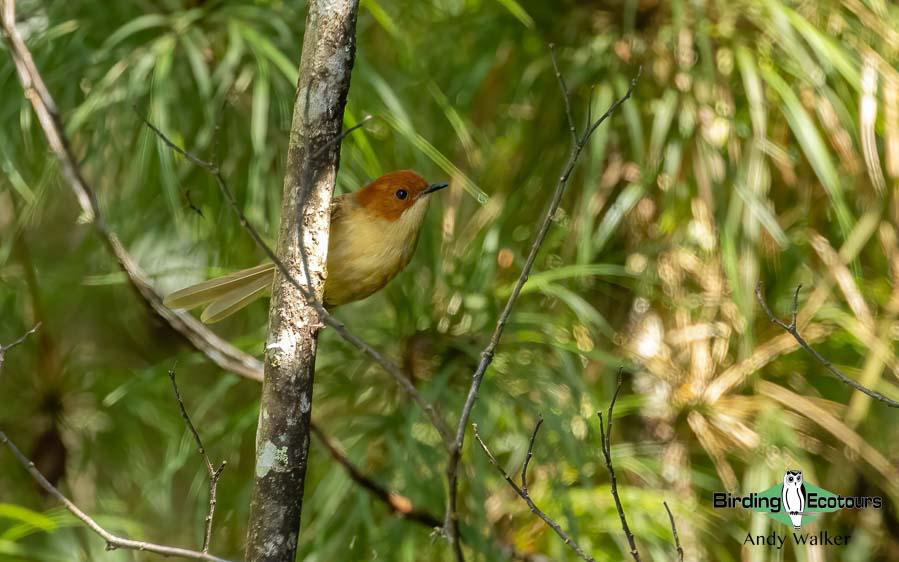
Orange-crowned Fairywren eventually showed in the open.
Not long after enjoying our Orange-crowned Fairywren sighting, we were again watching a pair of White-shouldered Fairywrens, which showed much more easily than their cousins. Several Friendly Fantails were seen, as was a female Black Fantail. A few Hooded Manakins were noted flying along the road, with a pair sitting out in the open briefly. During the morning we could hear Brown Sicklebill and King of Saxony Bird-of-paradise calling, and a pair of Princess Stephanie’s Astrapias were seen.
Back at the lodge, just prior to lunch, we had a large flock of Black Sittellas feeding in the trees around our rooms, which provided better views than the previous sighting. A very wet afternoon featuring some thunderstorms followed, so we spent some time birding off the lodge balconies. We had some sightings of Blue-capped Ifrit, New Guinea Thornbill, Black Fantail, King of Saxony Bird-of-paradise, and some others. We heard Lesser Ground Robin and Black-throated Robin, but neither showed. The rain largely stopped after our dinner, so we took a short walk near the lodge. We heard Papuan Boobook but it was distant and not interested in coming to see us. The rain soon started up again so we headed back to our rooms to get warmed up.
Day 8, 8th September 2026. Morning birding at Komange Eco Lodge; afternoon travel to Kumul Lodge
After a very wet night we were relieved to wake up to a dry morning. We spent the morning birding near the lodge and after a fair bit of effort saw a female and young male Wattled Ploughbill. One of the highlights of the morning was a sighting of the rare Papuan Parrotfinch inside the forest. Adult male Princess Stephanie’s Astrapias were vocal and looked amazing with their giant black tails. Two young male King of Saxony Birds-of-paradise were practicing their display call and we could just about make out their head plumes starting to grow out. A few family groups of Blue-capped Ifrits were loudly moving through the forest.
Both Hooded Cuckooshrike and Black-bellied Cuckooshrike were seen well, along with Little (Sepik-Ramu) Shrikethrush, Rufous-naped Bellbird, Brown-backed Whistler, and Regent Whistler too. Only some participants saw a Sclater’s Whistler briefly. Orange-billed Lorikeets and Yellow-billed Lorikeets performed a little better today, with birds of both species perched out in the open for slightly longer periods. However, the brief sighting of two Modest Tiger Parrots proved frustrating for most of us. We had some really nice sightings of Black-breasted Boatbill and Canary Flyrobin, and our best views to date of Black-throated Robin. Both Hooded Mannikin and Blue-faced Parrotfinch were noted quietly feeding in roadside vegetation and Glossy Swiftlets were constant companions as they hunted for insects along the road and a Large Woodswallow was noted overhead.
After our final lunch at Komange Eco Lodge, we drove back to Kumul Lodge for our final night at this lodge. During our drive we briefly had Papuan Harrier fly alongside the vehicle.
Once back at Kumul Lodge we spent some time birding around the lodge, though another sighting of a Calaby’s Pademelon, this time at the feeders, was a particular highlight. Ribbon-tailed Astrapia, Brown Sicklebill, and Brehm’s Tiger Parrots were highlights at the feeders, but nearby on the edge of the forest we had some sightings of a male Garnet Robin (along with White-winged Robin and Canary Flyrobin), and at last light, an Archbold’s Bowerbird flew in and showed well (given the lighting conditions). After dark, both Papuan Boobook and Mountain Owlet-nightjar were heard calling.
Day 9, 9th September 2026. Morning birding at Kumul Lodge; afternoon birding at Magic Mountain Lodge
We had a more relaxed day today, given that several of our upcoming days would require early starts. Optional pre-breakfast birding around Kumul Lodge gave some participants a sighting of Metallic Pigeon, Brehm’s Tiger Parrot, Ribbon-tailed Astrapia, and Brown Sicklebill. After breakfast, a walk around the Kumul Lodge forest resulted in nice sightings of a female and juvenile Crested (Red) Satinbird. It was interesting to watch these subtly plumaged individuals at close range. Within the forest, we had some sightings, mostly very brief, of Eastern Crested Berrypecker and Tit Berrypecker. A couple of us saw Mottled Berryhunters, which were vocal but again would not show for any length of time. We also soaked in the mountain forest views for the final time.
In the middle of the morning, we departed Kumul Lodge for the final time and took the short drive to Magic Mountain Lodge, our accommodation for the next three nights. We spent the rest of the day visiting the famous Magic Mountain bird feeders and adjacent forest. At the feeders we enjoyed exceptional close views of multiple Princess Stephanie’s Astrapias, including an incredible adult male. Several Brown Sicklebills were present, including a huge and impressive adult male along with several female and immature birds. At least two King of Saxony Birds-of-paradise were around the feeders but didn’t come in to drink. Unfortunately, the adult male had dropped its plumes since our previous visit in August. We also saw our first Short-tailed Paradigallas of the tour, a very interesting-looking bird-of-paradise.
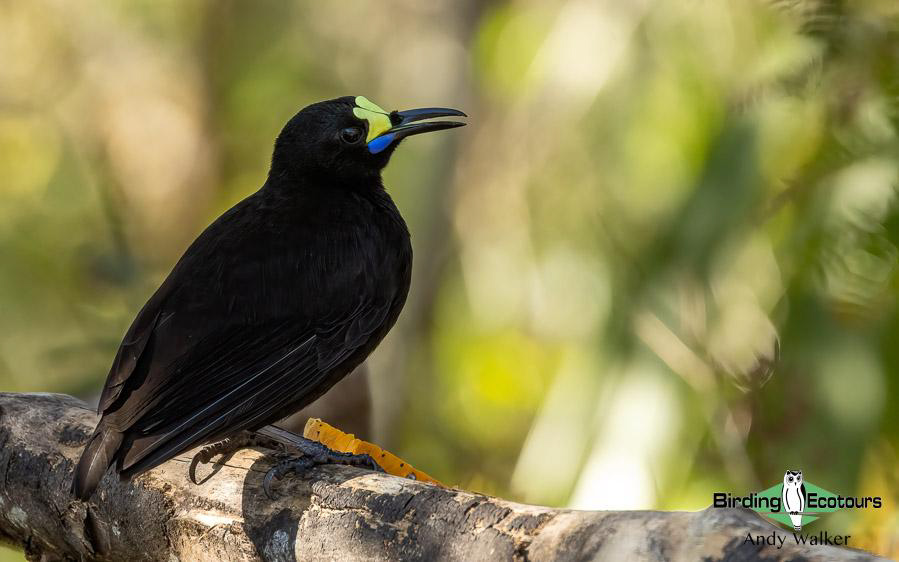
Short-tailed Paradigalla on the Magic Mountain feeders.
In addition to the four species of birds-of-paradise at the feeders, we also appreciated sightings of (Western) Bronze Ground Pigeon, Rufous-throated Bronze Cuckoo, Red-collared Myzomela, Rufous-backed Honeyeater, Yellow-browed Melidectes, Fan-tailed Berrypecker, Slaty Robin, and an extremely confiding pair of Friendly Fantails. Walking between the feeders we also had a good flyover by a Black-mantled Goshawk.
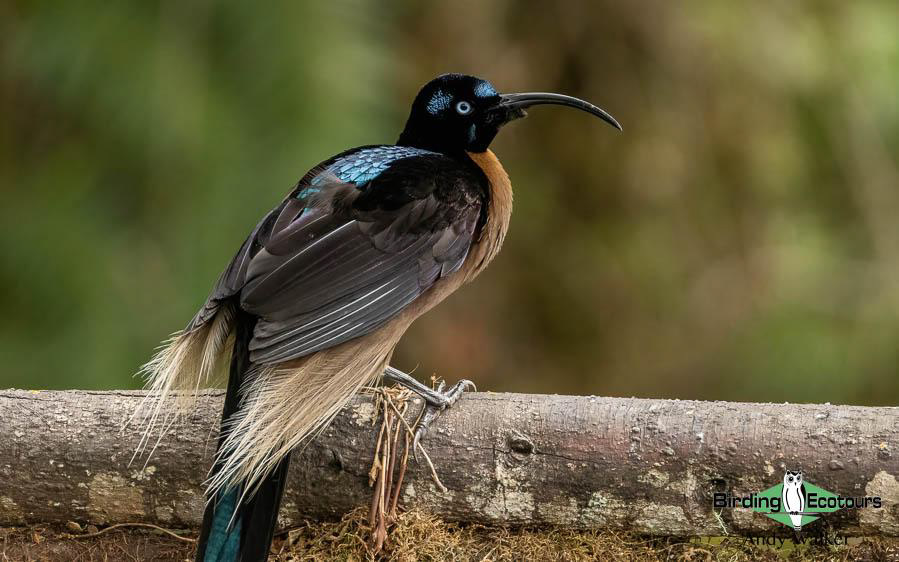
An adult male Brown Sicklebill visiting the bird feeder was a popular sight.
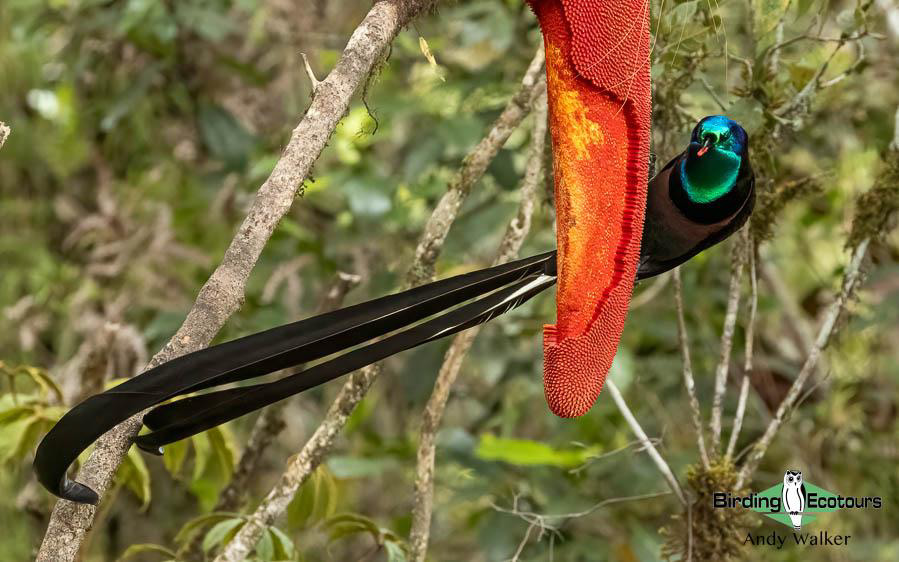
Stunning male Princess Stephanie’s Astrapia on the Magic Mountain feeders.
Day 10, 10th September 2026. Birding near Mount Hagen and at Magic Mountain Lodge
We had an absolutely sensational morning at a set of bird feeders near Magic Mountain Lodge, which far exceeded our expectations. We arrived at the site engulfed in fog, with strong winds, and seemingly poor conditions. However, this weather combination seemed to work in our favor and the feeders were full of birds. There was almost constant activity for several hours, until the weather improved and birds moved off and we also departed highly satisfied.
We had six species of birds-of-paradise visiting the feeders during the morning. Lawes’s Parotia was the most abundant visitor at the feeders and was the first opportunity for everyone in the group to get good views of this species. We saw multiple adult males, immature males, and females. During periods of brighter weather we could clearly see the colors of the parotia’s chest. A female Black Sicklebill was a new bird for our trip and was present on and off for most of the morning, as were several Brown Sicklebills. A pair of Short-tailed Paradigallas dropped into the feeders several times and showed repeatedly. A female Greater Lophorina also visited several times, but was always nervous. One of the highlights, and perhaps the most anticipated species of the tour for some participants, was the Blue Bird-of-paradise. We had managed reasonable, but distant views of an adult male a few days prior (Day 6), but the sightings today were considerably better. We saw three birds during the morning, one adult male (see trip report cover image and below) and two birds that appeared to be females or young males, and all provided excellent views. In total, we saw six species of birds-of-paradise at the feeders, representing at least 17 individuals. It was difficult to comprehend what we had just seen.
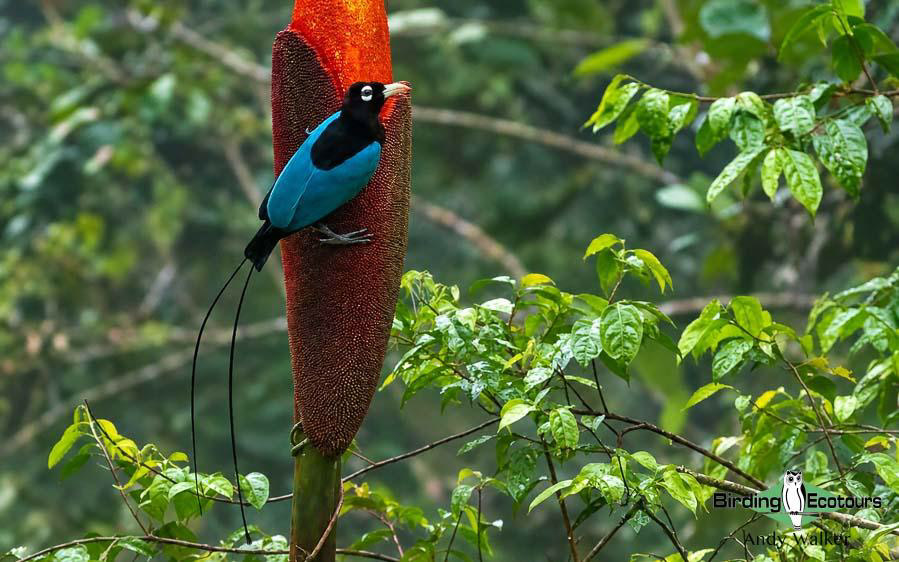
The adult male Blue Bird-of-paradise gave perfect views as it fed – a highly prized bird.
We heard some strange noises behind us in the forest. They were coming from a Dwarf Cassowary. Unfortunately the bird didn’t show itself, but it was fun to hear the interesting sounds it was making, and to know there was one around. There was very little in terms of other species at the feeders (not that anyone was complaining), but Buff-faced Scrubwren and Mountain Mouse-warbler were seen by some in the group.
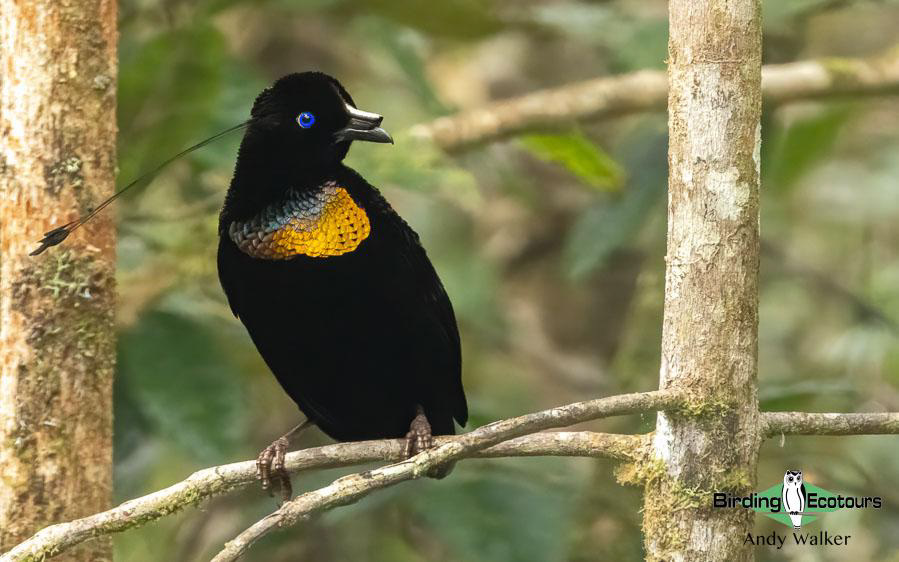
Our best sighting of Lawes’s Parotia was late in the morning, when the light had improved.
We spent some more time birding in the vicinity of the feeders, but with the improved weather birds were actually more difficult to see. We had a few more sightings of Lawes’s Parotia and a male Sclater’s Whistler in the forest. In the nearby grassland (part of which was on fire during our August visit), we enjoyed our picnic lunch and saw Papuan Harrier, Rainbow Bee-eater, Mountain Swiftlet, Papuan Grassbird, Long-tailed Shrike, Pied Bush Chat, and Australian Pipit.
Following this, we drove into Mount Hagen where we enjoyed some celebratory cake, ice creams, and drinks, before returning to Magic Mountain Lodge in the late afternoon. We had enough time to record our seventh and eighth species of birds-of-paradise for the day, with observations of Princess Stephanie’s Astrapia and King of Saxony Bird-of-paradise. We also had a few more fleeting looks at Mottled Berryhunter and another Wattled Ploughbill was heard calling nearby. Around the lodge after dinner, we had a distant Papuan Boobook and a very close Mountain Owlet-nightjar. It was an exceptional day of birding.
Day 11, 11th September 2026. Birding near Mount Hagen and at Magic Mountain Lodge
It was always going to be difficult to match the previous day. After all, it is not every day you see eight species of birds-of-paradise. Nevertheless, we had another excellent day of birding. We started the day at some bird feeders at a lower elevation than we had birded in the region before. Here, from our two bird blinds (bird hides), we had close views of multiple displaying and feeding Raggiana Birds-of-paradise – including an impressive-looking adult male and some females, a male Magnificent Bird-of-paradise feeding, and a pair of Crinkle-collared Manucodes. It was a great opportunity to observe a range of sexes and ages of these interesting and very different birds-of-paradise at close range, though the sightings of the manucodes were a little brief and distant for some in the group. Scrub Honeyeaters and Tawny-breasted Honeyeaters were frequently visiting the feeders and a Long-billed Honeyeater was nearby briefly too. A pair of Black Butcherbirds appeared at the feeders occasionally, and hearing them singing around us on several occasions was a treat, as was hearing the songs of Sahul Brush Cuckoo, Brown Oriole, Blue Jewel-babbler, and Regent Whistler during the course of the morning.
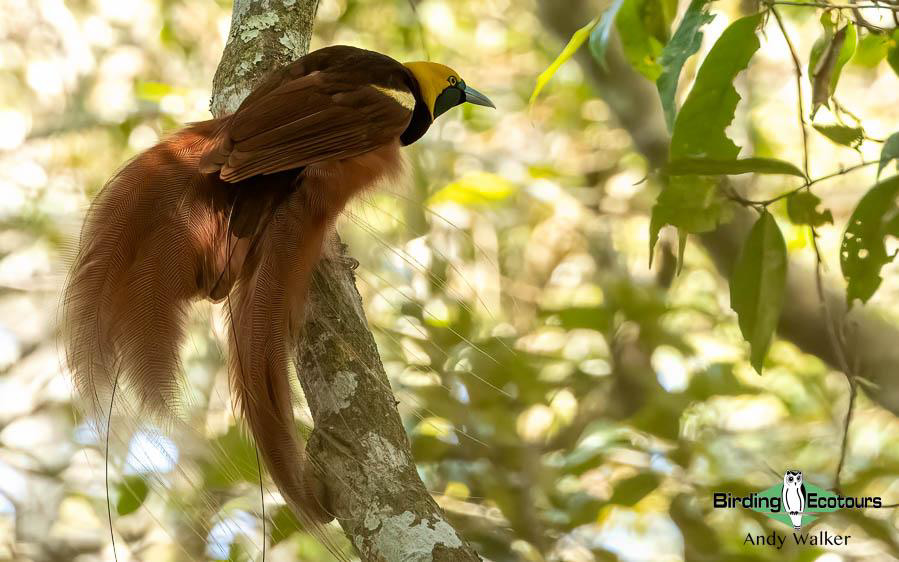
Raggiana Bird-of-paradise gave us exceptional views during our PNG birding tour.
We spent some more time birding the forest at Magic Mountain Lodge during the afternoon. We finally got some good views of an adult male Wattled Ploughbill and, although still flighty, more views of two Mottled Berryhunters, and a family group of Orange-crowned Fairywrens. Additional sightings included Brehm’s Tiger Parrot, Yellow-billed Lorikeet, Stella’s Lorikeet, a perched Papuan Mountain Pigeon, and several repeat sightings of birds-of-paradise, including Short-tailed Paradigalla, Princess Stephanie’s Astrapia, Brown Sicklebill, and King of Saxony Bird-of-paradise.
Day 12, 12th September 2026. Morning birding at Magic Mountain Lodge; afternoon transfer to Redfern Eco Tourism Lodge
After several longer days and another early start planned for tomorrow, we took a more relaxed approach today. We had a tasty late breakfast with some optional birding at the Magic Mountain feeders and took our final opportunities to view Princess Stephanie’s Astrapia, Brown Sicklebill, King of Saxony Bird-of-paradise, and Short-tailed Paradigalla. In the late morning we transferred to Redfern Eco Tourism Lodge to the north of Mount Hagen, arriving in time for lunch.
In the late afternoon we took a walk to a small river valley and forest patch near our accommodation. We found a few interesting birds in a small area of promising habitat. Here we had sightings of Papuan Harrier, Ornate Melidectes, Long-billed Honeyeater, Marbled Honeyeater, Helmeted (New Guinea) Friarbird, Great Woodswallow, Northern Fantail, and Mid-mountain Berrypecker. Two Yellow-breasted Bowerbirds were occasionally perching up in view, as did Black-headed Whistler. It was a nice selection of birds, especially considering how little effort was required to find them; we just had to brave a cold wind.
Day 13, 13th September 2026. Birding at Baiyer River
We set off from our accommodation for the little-visited Baiyer River Sanctuary, a block of productive riverine forest. Our main target was Lesser Bird-of-paradise. We walked directly into the forest in search of the species, and after negotiating a few obstacles, including a river crossing where we saw an Azure Kingfisher and some off-trail hiking through the forest, we could hear our target birds calling. Following their calls, we soon found ourselves in the forest and surrounded by calling male Lesser Birds-of-paradise. They were quite tough to see for most of the time we were observing them, and no females seemed to be around. Despite their vocalizations, they mainly remained stationary, often out of sight, and did not display fully. We had a few brief views when they were a little more out in the open and clearer to see. We also saw several males foraging later in the day.
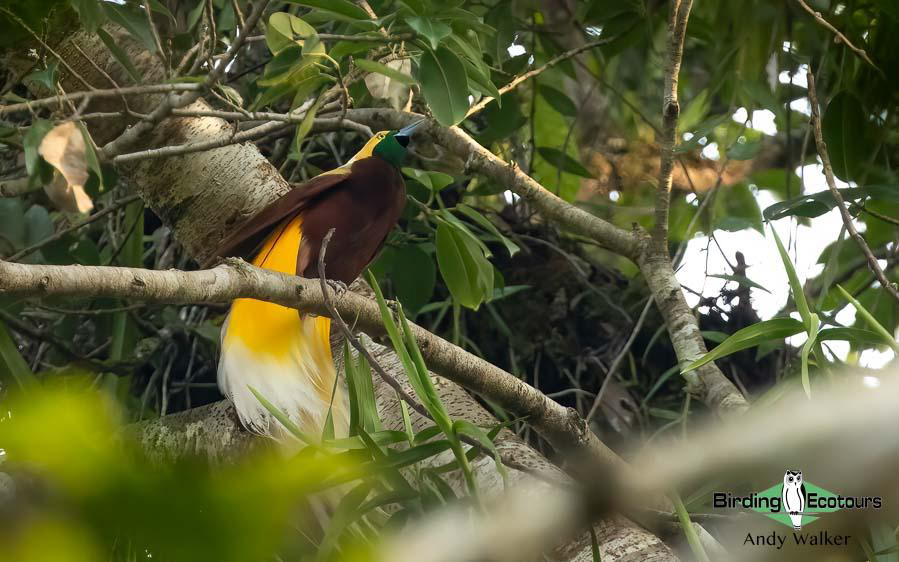
Lesser Bird-of-paradise was the final new member of the family seen during the tour.
While watching the Lesser Birds-of-paradise, and when walking to view them, we heard lots of pigeons and doves, and saw several of them too. Species recorded included Pinion’s Imperial Pigeon, Zoe’s Imperial Pigeon, Purple-tailed Imperial Pigeon, Ornate Fruit Dove, Pink-spotted Fruit Dove, Wompoo Fruit Dove, Superb Fruit Dove, and Amboyna Cuckoo-Dove. Many birds were vocalizing as we were focused on trying to observe the birds-of-paradise, including Coconut Lorikeet, Black-capped Lory, Eastern Hooded Pitta, Hooded Butcherbird, Rusty Mouse-warbler, Black-sided Robin, and Grey Whistler. A huge (and calling) Great-billed Heron flew right over us too, which was a surprise.
We had decided to maximize our time in this interesting forested area, and so brought packed breakfasts and packed lunches with us, rather than needing to rush back to our accommodation for lunch. Therefore, after our time with the Lesser Birds-of-paradise, we walked back toward the river for breakfast. Along the way we bumped into a couple of mixed-species flocks containing species such as Ochre-collared Monarch, Black-winged Monarch, Northern Fantail, Pygmy Longbill, Black-shouldered Cicadabird, and Black-browed Triller. After eating our breakfast, we spent the rest of the morning walking around a section of the forest. Here we found Hooded Pitohui, Brown Oriole, Little (Sepik-Ramu) Shrikethrush, and Black Cicadabird, but the highlight was finding a flowering tree with multiple honeyeaters feeding in it. The most abundant species in the tree was Red Myzomela, but we also saw Tawny-breasted Honeyeater, Plain Honeyeater, Meyer’s Friarbird, and, best of all, the scarce and attractive Spotted Honeyeater. The only real issue was the height of the tree—it was huge and the birds were very high up.
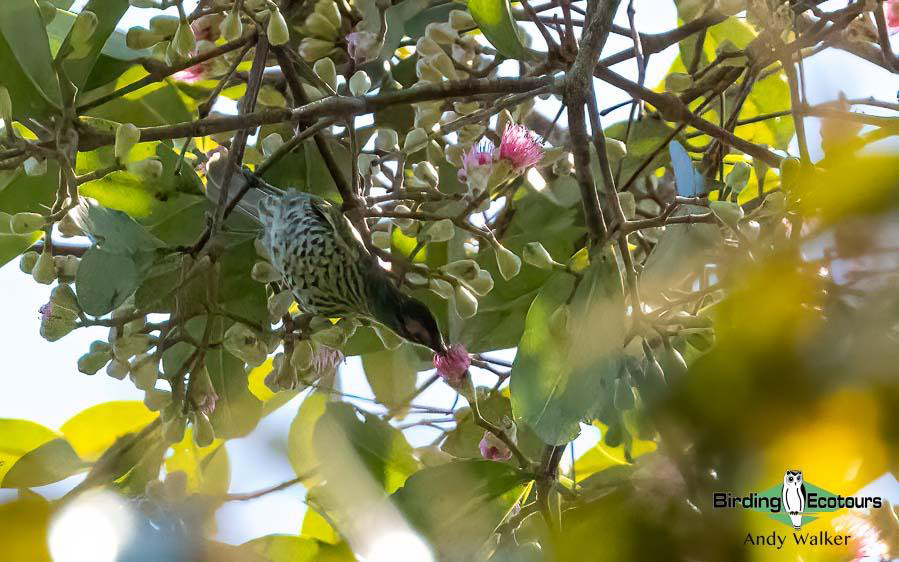
Spotted Honeyeater was a nice surprise in the flowering tree.
We ate our picnic lunch at the river. By now, the bird activity had generally dropped off, but the butterflies were out in force and several beautiful species were flying around, providing plenty of entertainment. Some in the group saw the Azure Kingfisher, and others saw Pacific Baza, Pygmy Longbill, and Black Sunbird. After lunch we took another walk in the forest, but the wind had picked up considerably and it was by now quite hot too, so activity was low. A perched view of Zoe’s Imperial Pigeon was appreciated, and a final mixed-species flock of the day contained Northern Fantail, Black-winged Monarch, and Hooded Monarch. The birding had been tough, with lots of brief sightings of many species, but it was a privilege to be birding in an area not visited by too many birders over recent years.
Day 14, 14th September 2026. Morning transfer between Mount Hagen and Port Moresby; afternoon birding at Pacific Adventist University
We had an early breakfast (with Singing Starlings in the lodge gardens) and then drove back into Mount Hagen for our morning flight to Port Moresby.
Upon landing back in the capital, we returned to our accommodation outside of the city for lunch and to sit out the hottest part of the day – a noticeable change after almost two weeks in the cooler mountains. A Papuan Frogmouth and Buff-faced Pygmy Parrot were sighted in the hotel garden, along with Orange-bellied Fruit Dove and many of the other expected species.
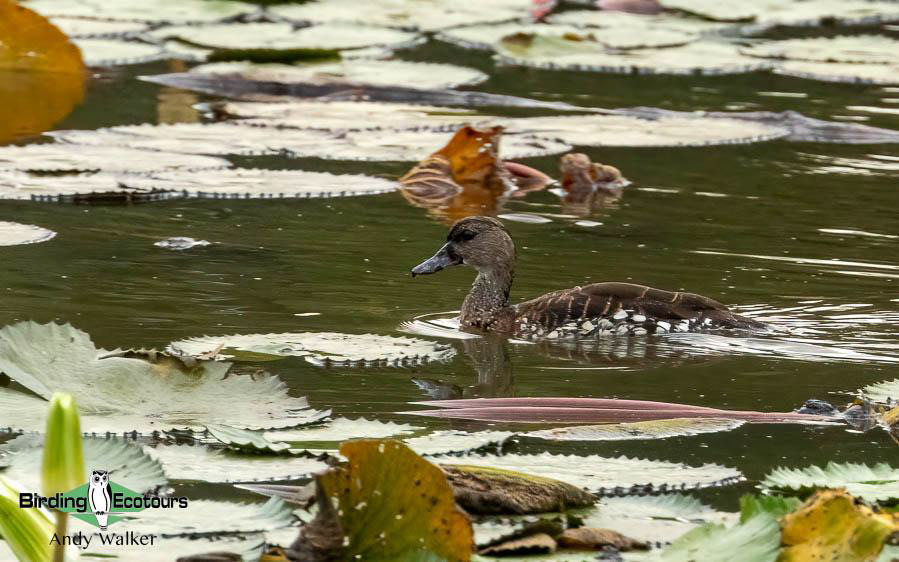
Spotted Whistling Duck was one of several new trip birds seen while birding at the Pacific Adventist University.
We spent the late afternoon birding at the Pacific Adventist University (PAU). We added a number of birds to our PNG bird lists, since this was the first time we had visited a site with water bodies during the tour. Some of the new trip birds and exciting species included Spotted Whistling Duck, Wandering Whistling Duck, Green Pygmy Goose, Purple Swamphen, Dusky Moorhen, Masked Lapwing, Latham’s Snipe, Little Pied Cormorant, Little Black Cormorant, Australian White Ibis, Pied Heron, Nankeen Night Heron, Plumed Egret, Papuan Eclectus, Red-cheeked Parrot, Oriental Dollarbird, Fawn-breasted Bowerbird, Black-backed Butcherbird, several honeyeaters, including Rufous-banded Honeyeater, and Grey-headed Mannikin. Our final new bird of the day was a huge Channel-billed Cuckoo that flew over at dusk.
Day 15, 15th September 2026. Birding at Varirata National Park
Our final birding session of the tour saw us back at Varirata National Park, where our birding had started two weeks earlier. We started with a walk along the entrance road through some savannah habitat. Our time was productive and we picked up several new birds for the trip and improved sightings of a few other species. Highlights included Pheasant Coucal, Blue-winged Kookaburra, Sulphur-crested Cockatoo, Red-cheeked Parrot, Black-capped Lory, Coconut Lorikeet, White-throated Honeyeater, Black-faced Cuckooshrike, White-bellied Cuckooshrike, Sahul Cicadabird, Hooded Butcherbird, Grey Crow, Spangled Drongo, and best of all, our fifteenth and final bird-of-paradise of the trip, Glossy-mantled Manucode. As we were watching the manucode, a Long-tailed Honey Buzzard flew directly overhead at low altitude. It was a great start to the final day of birding on the tour.
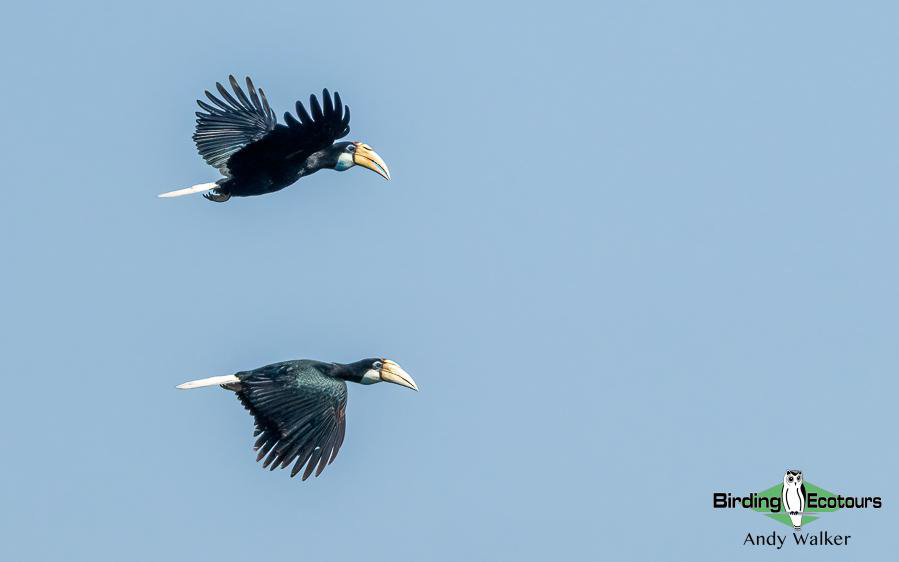
Blyth’s Hornbills gave perfect flyby views from the viewpoint in Varirata National Park.
Once we entered the national park, we made our way to the viewpoint. Here, the clear skies allowed views to stretch far into the distance. We had some great flyby views of Blyth’s Hornbills and Black-capped Lories. A pair of large Stout-billed Cuckooshrikes were in trees nearby and a Rufous-bellied Kookaburra gave the group excellent views. We walked a trail along a river valley and had quick sightings of Yellow-billed Kingfisher, Brown-headed Paradise Kingfisher, Papuan Pitta, and Barred Owlet-nightjar. Three Painted Quail-thrushes were heard, but we were unable to get into a position to see them due to the terrain and some participants in the group got a brief sighting of a shy Hook-billed Kingfisher – one of eight kingfisher species seen during the day.
Fruiting trees, including one in view of our picnic lunch spot, gave us close sightings of Amboyna Cuckoo-Dove, Pink-spotted Fruit Dove, Dwarf Fruit Dove, Orange-bellied Fruit Dove, Green-backed Gerygone, Yellow-bellied Gerygone, Green-backed Honeyeater, Barred Cuckooshrike, Boyer’s Cuckooshrike, Varied Triller, Brown Oriole, Hooded Pitohui, a large flock of Black-fronted White-eyes, and Golden Monarch.
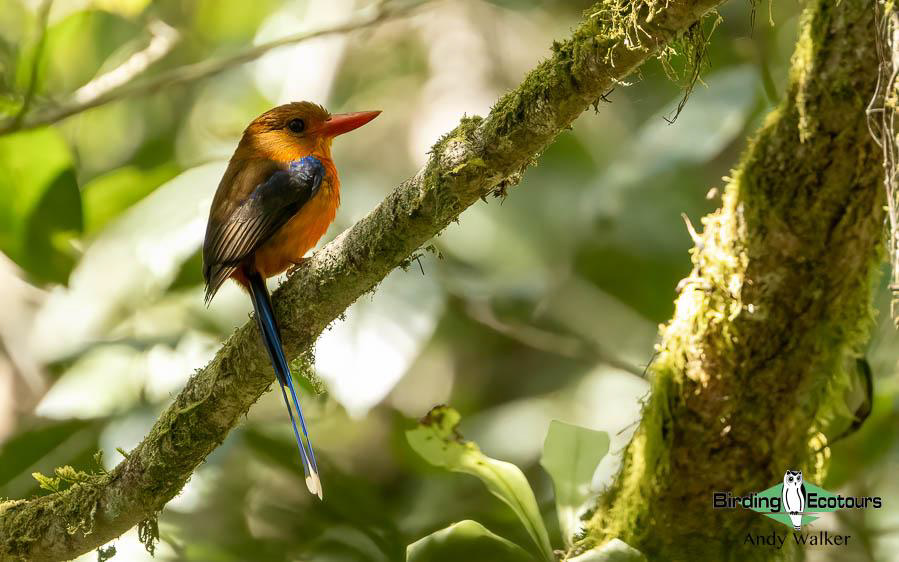
Brown-headed Paradise Kingfisher showed very well on our final day of birding on the tour.
After our lunch, a final walk around the picnic area gave us some additional sightings of the family group of Barking Owls we had so much enjoyed seeing right at the beginning of the trip. A pair of Greater Coucals were foraging around a small lake with another Stout-billed Cuckooshrike seen very nicely too. The final two birds we saw in the park were a Gurney’s Eagle and a Pygmy Eagle, with the latter chasing the former away—quite an impressive sight and a fitting end to the tour.
Day 16, 16th September 2026. Tour ended with departures from Port Moresby
Our Papua New Guinea birding tour ended with departures from Port Moresby. Thank you to everyone for making this such an enjoyable adventure. It was a pleasure traveling with you all, and I hope to see you again in the future.
Bird List – Following AviList v2025b (June 2026)
Birds ‘heard only’ are marked with (H) after the common name; all other species were seen.
| Common name | Scientific name |
| Cassowaries, Emu (Casuariidae) | |
| Dwarf Cassowary (H) | Casuarius bennetti |
| Ducks, Geese, Swans (Anatidae) | |
| Spotted Whistling Duck | Dendrocygna guttata |
| Wandering Whistling Duck | Dendrocygna arcuata |
| Green Pygmy Goose | Nettapus pulchellus |
| Pacific Black Duck | Anas superciliosa |
| Megapodes (Megapodiidae) | |
| Black-billed Brushturkey (H) | Talegalla fuscirostris |
| Pheasants & Allies (Phasianidae) | |
| Brown Quail (H) | Synoicus ypsilophorus |
| Cuckoos (Cuculidae) | |
| Ivory-billed Coucal (H) | Centropus menbeki |
| Pheasant Coucal | Centropus phasianinus |
| Channel-billed Cuckoo | Scythrops novaehollandiae |
| Rufous-throated Bronze Cuckoo | Chalcites ruficollis |
| Shining Bronze Cuckoo | Chalcites lucidus |
| White-eared Bronze Cuckoo | Chalcites meyerii |
| Little Bronze Cuckoo (H) | Chalcites minutillus |
| White-crowned Cuckoo | Caliechthrus leucolophus |
| Chestnut-breasted Cuckoo (H) | Cacomantis castaneiventris |
| Fan-tailed Cuckoo | Cacomantis flabelliformis |
| Sahul Brush Cuckoo | Cacomantis variolosus |
| Pigeons, Doves (Columbidae) | |
| Great Cuckoo-Dove | Reinwardtoena reinwardti |
| Amboyna Cuckoo-Dove | Macropygia amboinensis |
| Bar-tailed Cuckoo-Dove | Macropygia nigrirostris |
| Metallic Pigeon | Columba vitiensis |
| Rock Dove [Feral Pigeon] | Columba livia [dom.] |
| Stephan’s Emerald Dove | Chalcophaps stephani |
| Bronze Ground Dove | Pampusana beccarii |
| Bar-shouldered Dove | Geopelia humeralis |
| Peaceful Dove | Geopelia placida |
| Pheasant Pigeon (H) | Otidiphaps nobilis |
| Papuan Mountain Pigeon | Gymnophaps albertisii |
| Purple-tailed Imperial Pigeon | Ducula rufigaster |
| Pinon’s Imperial Pigeon | Ducula pinon |
| Zoe’s Imperial Pigeon | Ducula zoeae |
| Torresian Imperial Pigeon | Ducula spilorrhoa |
| Wompoo Fruit Dove (H) | Megaloprepia magnifica |
| Pink-spotted Fruit Dove | Ptilinopus perlatus |
| Ornate Fruit Dove | Ptilinopus ornatus |
| Orange-fronted Fruit Dove | Ptilinopus aurantiifrons |
| Superb Fruit Dove (H) | Ptilinopus superbus |
| Coroneted Fruit Dove (H) | Ptilinopus coronulatus |
| White-bibbed Fruit Dove | Ptilinopus rivoli |
| Orange-bellied Fruit Dove | Ptilinopus iozonus |
| Dwarf Fruit Dove | Ptilinopus nainus |
| Flufftails & Forest Rails (Sarothruridae) | |
| Chestnut Forest Rail | Rallicula rubra |
| Forbes’s Forest Rail | Rallicula forbesi |
| Rails, Crakes & Coots (Rallidae) | |
| Buff-banded Rail | Gallirallus philippensis |
| Dusky Moorhen | Gallinula tenebrosa |
| Purple Swamphen | Porphyrio porphyrio |
| Pale-vented Bush-hen | Amaurornis moluccana |
| Plovers (Charadriidae) | |
| Masked Lapwing | Vanellus miles |
| Sandpipers, Snipes (Scolopacidae) | |
| Latham’s Snipe | Gallinago hardwickii |
| Common Sandpiper | Actitis hypoleucos |
| Cormorants, Shags (Phalacrocoracidae) | |
| Little Pied Cormorant | Microcarbo melanoleucos |
| Little Black Cormorant | Phalacrocorax sulcirostris |
| Ibises, Spoonbills (Threskiornithidae) | |
| Australian White Ibis | Threskiornis molucca |
| Herons, Bitterns (Ardeidae) | |
| Pied Heron | Egretta picata |
| Little Egret | Egretta garzetta |
| Nankeen Night Heron | Nycticorax caledonicus |
| Great Egret | Ardea alba |
| Plumed Egret | Ardea plumifera |
| Eastern Cattle Egret | Ardea coromanda |
| Great-billed Heron | Ardea sumatrana |
| Frogmouths (Podargidae) | |
| Marbled Frogmouth | Podargus ocellatus |
| Papuan Frogmouth | Podargus papuensis |
| Owlet-nightjars (Aegothelidae) | |
| Mountain Owlet-nightjar | Aegotheles albertisi |
| Barred Owlet-nightjar | Aegotheles bennettii |
| Swifts (Apodidae) | |
| Glossy Swiftlet | Collocalia esculenta |
| Mountain Swiftlet | Aerodramus hirundinaceus |
| Uniform Swiftlet | Aerodramus vanikorensis |
| Owls (Strigidae) | |
| Barking Owl | Ninox connivens |
| Papuan Boobook | Ninox theomacha |
| Kites, Hawks, Eagles (Accipitridae) | |
| Black-winged Kite | Elanus caeruleus |
| Pacific Baza | Aviceda subcristata |
| Long-tailed Honey Buzzard | Henicopernis longicauda |
| Pygmy Eagle | Hieraaetus weiskei |
| Gurney’s Eagle | Aquila gurneyi |
| Variable Goshawk | Tachyspiza hiogaster |
| Black-mantled Goshawk | Tachyspiza melanochlamys |
| Brown Goshawk | Tachyspiza fasciata |
| Papuan Harrier | Circus spilothorax |
| Brahminy Kite | Haliastur indus |
| Black Kite | Milvus migrans |
| Hornbills (Bucerotidae) | |
| Blyth’s Hornbill | Rhyticeros plicatus |
| Rollers (Coraciidae) | |
| Oriental Dollarbird | Eurystomus orientalis |
| Bee-eaters (Meropidae) | |
| Rainbow Bee-eater | Merops ornatus |
| Kingfishers (Alcedinidae) | |
| Common Kingfisher | Alcedo atthis |
| Azure Kingfisher | Ceyx azureus |
| Papuan Dwarf Kingfisher | Ceyx solitarius |
| Brown-headed Paradise Kingfisher | Tanysiptera danae |
| Hook-billed Kingfisher | Melidora macrorrhina |
| Blue-winged Kookaburra | Dacelo leachii |
| Rufous-bellied Kookaburra | Dacelo gaudichaud |
| Mountain Kingfisher (H) | Syma megarhyncha |
| Yellow-billed Kingfisher | Syma torotoro |
| Forest Kingfisher | Todiramphus macleayii |
| Sacred Kingfisher | Todiramphus sanctus |
| Caracaras, Falcons (Falconidae) | |
| Brown Falcon | Falco berigora |
| Australian Hobby | Falco longipennis |
| Cockatoos (Cacatuidae) | |
| Sulphur-crested Cockatoo | Cacatua galerita |
| Old World Parrots (Psittaculidae) | |
| Buff-faced Pygmy Parrot | Micropsitta pusio |
| Papuan Eclectus | Eclectus polychloros |
| Red-cheeked Parrot | Geoffroyus geoffroyi |
| Brehm’s Tiger Parrot | Psittacella brehmii |
| Modest Tiger Parrot | Psittacella modesta |
| Plum-faced Lorikeet | Oreopsittacus arfaki |
| Fairy Lorikeet | Charmosynopsis pulchella |
| Stella’s Lorikeet | Charmosyna stellae |
| Yellow-billed Lorikeet | Neopsittacus musschenbroekii |
| Orange-billed Lorikeet | Neopsittacus pullicauda |
| Black-capped Lory | Lorius lory |
| Goldie’s Lorikeet | Glossoptilus goldiei |
| Coconut Lorikeet | Trichoglossus haematodus |
| Pittas (Pittidae) | |
| Papuan Pitta | Erythropitta macklotii |
| Eastern Hooded Pitta (H) | Pitta novaeguineae |
| Bowerbirds (Ptilonorhynchidae) | |
| Yellow-breasted Bowerbird | Chlamydera lauterbachi |
| Fawn-breasted Bowerbird | Chlamydera cerviniventris |
| Ochre-breasted Catbird | Ailuroedus stonii |
| Archbold’s Bowerbird | Archboldia papuensis |
| Australasian Wrens (Maluridae) | |
| Orange-crowned Fairywren | Clytomyias insignis |
| White-shouldered Fairywren | Malurus alboscapulatus |
| Australasian Warblers (Acanthizidae) | |
| Yellow-bellied Gerygone | Gerygone chrysogaster |
| Green-backed Gerygone | Gerygone chloronota |
| Fairy Gerygone | Gerygone palpebrosa |
| Brown-breasted Gerygone | Gerygone ruficollis |
| New Guinea Thornbill | Acanthiza murina |
| Mountain Mouse-warbler | Origma robusta |
| Rusty Mouse-warbler (H) | Origma murina |
| Pale-billed Scrubwren | Aethomyias spilodera |
| Buff-faced Scrubwren | Aethomyias perspicillatus |
| Papuan Scrubwren | Aethomyias papuensis |
| Large Scrubwren | Sericornis nouhuysi |
| Honeyeaters (Meliphagidae) | |
| Green-backed Honeyeater | Glycichaera fallax |
| Rufous-backed Honeyeater | Ptiloprora guisei |
| Grey-streaked Honeyeater | Ptiloprora perstriata |
| Rufous-banded Honeyeater | Conopophila albogularis |
| Long-billed Honeyeater | Melilestes megarhynchus |
| Common Smoky Honeyeater | Melipotes fumigatus |
| Plain Honeyeater | Pycnopygius ixoides |
| Marbled Honeyeater | Pycnopygius cinereus |
| Streak-headed Honeyeater | Pycnopygius stictocephalus |
| Red Myzomela | Myzomela cruentata |
| Papuan Black Myzomela | Myzomela nigrita |
| Mountain Myzomela | Myzomela adolphinae |
| Red-collared Myzomela | Myzomela rosenbergii |
| Tawny-breasted Honeyeater | Xanthotis flaviventer |
| Spotted Honeyeater | Xanthotis polygrammus |
| Meyer’s Friarbird | Philemon meyeri |
| Helmeted Friarbird | Philemon buceroides |
| White-throated Honeyeater | Melithreptus albogularis |
| Puff-backed Honeyeater | Meliphaga aruensis |
| Mountain Honeyeater | Microptilotis orientalis |
| Scrub Honeyeater | Microptilotis albonotatus |
| Mimic Honeyeater | Microptilotis analogus |
| Elegant Honeyeater | Microptilotis cinereifrons |
| Black-throated Honeyeater | Caligavis subfrenata |
| Ornate Melidectes | Melidectes torquatus |
| Belford’s Melidectes | Melidectes belfordi |
| Yellow-browed Melidectes | Melidectes rufocrissalis |
| Jewel-babblers, Quail-thrushes (Cinclosomatidae) | |
| Spotted Jewel-babbler (H) | Ptilorrhoa leucosticta |
| Blue Jewel-babbler (H) | Ptilorrhoa caerulescens |
| Painted Quail-thrush (H) | Cinclosoma ajax |
| Cuckooshrikes (Campephagidae) | |
| Stout-billed Cuckooshrike | Coracina caeruleogrisea |
| Hooded Cuckooshrike | Coracina longicauda |
| Barred Cuckooshrike | Coracina lineata |
| Boyer’s Cuckooshrike | Coracina boyeri |
| Black-faced Cuckooshrike | Coracina novaehollandiae |
| White-bellied Cuckooshrike | Coracina papuensis |
| Black-browed Triller | Lalage atrovirens |
| Varied Triller | Lalage leucomela |
| Black-bellied Cuckooshrike | Edolisoma montanum |
| Black Cicadabird | Edolisoma melas |
| Black-shouldered Cicadabird | Edolisoma incertum |
| Sahul Cicadabird | Edolisoma tenuirostre |
| Boatbills (Machaerirhynchidae) | |
| Black-breasted Boatbill | Machaerirhynchus nigripectus |
| Woodswallows, Butcherbirds & Allies (Artamidae) | |
| Great Woodswallow | Artamus maximus |
| White-breasted Woodswallow | Artamus leucorynchus |
| Black Butcherbird | Melloria quoyi |
| Black-backed Butcherbird | Cracticus mentalis |
| Hooded Butcherbird | Cracticus cassicus |
| Mottled Berryhunter (Rhagologidae) | |
| Mottled Berryhunter | Rhagologus leucostigma |
| Sittellas (Neosittidae) | |
| Black Sittella | Daphoenositta miranda |
| Papuan Sittella | Daphoenositta papuensis |
| Ploughbill (Eulacestomatidae) | |
| Wattled Ploughbill | Eulacestoma nigropectus |
| Australo-Papuan Bellbirds (Oreoicidae) | |
| Rufous-naped Bellbird | Aleadryas rufinucha |
| Painted Berrypeckers (Paramythiidae) | |
| Tit Berrypecker | Oreocharis arfaki |
| Eastern Crested Berrypecker | Paramythia montium |
| Figbirds, Old World Orioles, Piopios (Oriolidae) | |
| Hooded Pitohui | Pitohui dichrous |
| Australasian Figbird | Sphecotheres vieilloti |
| Brown Oriole | Oriolus szalayi |
| Whistlers & Allies (Pachycephalidae) | |
| Rusty Pitohui | Pseudorectes ferrugineus |
| Little Shrikethrush | Colluricincla megarhyncha |
| Regent Whistler | Pachycephala schlegelii |
| Sclater’s Whistler | Pachycephala soror |
| Brown-backed Whistler | Pachycephala modesta |
| Grey Whistler | Pachycephala simplex |
| White-bellied Whistler | Pachycephala leucogastra |
| Black-headed Whistler | Pachycephala monacha |
| Fantails (Rhipiduridae) | |
| Black Fantail | Rhipidura atra |
| Northern Fantail | Rhipidura rufiventris |
| Willie Wagtail | Rhipidura leucophrys |
| Dimorphic Fantail | Rhipidura brachyrhyncha |
| Friendly Fantail | Rhipidura albolimbata |
| Chestnut-bellied Fantail | Rhipidura hyperythra |
| Drongos (Dicruridae) | |
| Spangled Drongo | Dicrurus bracteatus |
| Monarchs (Monarchidae) | |
| Frilled Monarch | Arses telescopthalmus |
| Ochre-collared Monarch | Arses insularis |
| Leaden Flycatcher | Myiagra rubecula |
| Black Monarch | Symposiachrus axillaris |
| Hooded Monarch | Symposiachrus manadensis |
| Spot-winged Monarch | Symposiachrus guttula |
| Golden Monarch | Carterornis chrysomela |
| Black-winged Monarch | Monarcha frater |
| Ifrit (Ifritidae) | |
| Blue-capped Ifrit | Ifrita kowaldi |
| Birds-of-paradise (Paradisaeidae) | |
| Crinkle-collared Manucode | Manucodia chalybatus |
| Glossy-mantled Manucode | Manucodia ater |
| King of Saxony Bird-of-paradise | Pteridophora alberti |
| Lawes’s Parotia | Parotia lawesii |
| Greater Lophorina | Lophorina latipennis |
| Growling Riflebird | Ptiloris intercedens |
| Black Sicklebill | Epimachus fastosus |
| Brown Sicklebill | Epimachus meyeri |
| Short-tailed Paradigalla | Paradigalla brevicauda |
| Princess Stephanie’s Astrapia | Astrapia stephaniae |
| Ribbon-tailed Astrapia | Astrapia mayeri |
| Magnificent Bird-of-paradise | Diphyllodes magnificus |
| Blue Bird-of-paradise | Paradisornis rudolphi |
| Lesser Bird-of-paradise | Paradisaea minor |
| Raggiana Bird-of-paradise | Paradisaea raggiana |
| Melampittas (Melampittidae) | |
| Lesser Melampitta | Melampitta lugubris |
| Shrikes (Laniidae) | |
| Long-tailed Shrike | Lanius schach |
| Crows, Jays (Corvidae) | |
| Grey Crow | Corvus tristis |
| Torresian Crow | Corvus orru |
| Satinbirds (Cnemophilidae) | |
| Loria’s Satinbird | Cnemophilus loriae |
| Crested Satinbird | Cnemophilus macgregorii |
| Berrypeckers, Longbills (Melanocharitidae) | |
| Yellow-bellied Longbill | Toxorhamphus novaeguineae |
| Pygmy Longbill | Oedistoma pygmaeum |
| Black Berrypecker | Melanocharis nigra |
| Mid-mountain Berrypecker | Melanocharis longicauda |
| Fan-tailed Berrypecker | Melanocharis versteri |
| Australasian Robins (Petroicidae) | |
| Lesser Ground Robin (H) | Amalocichla incerta |
| Garnet Robin | Eugerygone rubra |
| Canary Flyrobin | Devioeca papuana |
| Olive Flyrobin | Kempiella flavovirescens |
| Torrent Flyrobin | Monachella muelleriana |
| Lemon-bellied Flyrobin | Microeca flavigaster |
| Papuan Scrub Robin (H) | Drymodes beccarii |
| Black-throated Robin | Plesiodryas albonotata |
| Black-sided Robin | Poecilodryas hypoleuca |
| White-faced Robin | Eopsaltria leucops |
| White-winged Robin | Melanodryas sigillata |
| Slaty Robin | Melanodryas cyanus |
| Grassbirds & Allies (Locustellidae) | |
| Papuan Grassbird | Cincloramphus macrurus |
| Swallows, Martins (Hirundinidae) | |
| Pacific Swallow | Hirundo javanica |
| Tree Martin | Petrochelidon nigricans |
| Leaf Warblers (Phylloscopidae) | |
| Island Leaf Warbler | Phylloscopus poliocephalus |
| White-eyes (Zosteropidae) | |
| Black-fronted White-eye | Zosterops chrysolaemus |
| Papuan White-eye | Zosterops novaeguineae |
| Starlings, Rhabdornises (Sturnidae) | |
| Yellow-faced Myna | Mino dumontii |
| Metallic Starling | Aplonis metallica |
| Singing Starling | Aplonis cantoroides |
| Thrushes (Turdidae) | |
| Papuan Island Thrush | Turdus papuensis |
| Chats, Old World Flycatchers (Muscicapidae) | |
| Pied Bush Chat | Saxicola caprata |
| Flowerpeckers (Dicaeidae) | |
| Red-capped Flowerpecker | Dicaeum geelvinkianum |
| Sunbirds (Nectariniidae) | |
| Black Sunbird | Leptocoma aspasia |
| Waxbills, Munias & Allies (Estrildidae) | |
| Grey-headed Mannikin | Lonchura caniceps |
| Hooded Mannikin | Lonchura spectabilis |
| Papuan Parrotfinch | Erythrura papuana |
| Blue-faced Parrotfinch | Erythrura trichroa |
| Old World Sparrows, Snowfinches (Passeridae) | |
| Eurasian Tree Sparrow | Passer montanus |
| Wagtails, Pipits (Motacillidae) | |
| Australian Pipit | Anthus australis |
| Species seen: | 251 |
| Species heard: | 18 |
| Total recorded: | 269 |
Mammal List – Following Mammalwatching.com (September 2024)
The following notation after species names is used to show conservation status following the IUCN Red List: EN = Endangered.
| Common name | Scientific name |
| Dasyures (Dasyuridae) | |
| Speckled Dasyure | Neophascogale lorentzii |
| Kangaroos, Wallabies and Allies (Macropodidae) | |
| Calaby’s Pademelon – EN | Thylogale calabyi |
| Agile Wallaby | Notamacropus agilis |
| Species seen: | 3 |
Reptile List – Following Reptiles of the World (November 2024)
| Common name | Scientific name |
| Colubrid Snakes (Colubridae) | |
| Northern Tree Snake | Dendrelaphis calligaster |
| Typical Geckos (Gekkonidae) | |
| Asian House Gecko | Hemidactylus frenatus |
| Eastern Giant Stump-toed Gecko | Gehyra vorax |
| Species seen: | 3 |
This is a sample trip report. Please email us ([email protected]) for more trip reports from this destination.