- Duration:
- 21 days
- Group Size:
- 2–8 (2027)
- Group Size:
- 6–8 (2028 and 2029)
- Tour Start:
- Ngurah Rai International Airport, Denpasar, Bali, Indonesia
- Tour End:
- Ngurah Rai International Airport, Denpasar, Bali, Indonesia
Birding Tour Indonesia: The Lesser Sunda Islands– Comprehensive Tour
Details
2027
16 June–06 July
Per person sharing
$7,980 USD
£6,334 GBP / €7,365 EUR
Single supplement
$1,195 USD
£948 GBP / €1,103 EUR
based on 6–8 participants
excludes the domestic flights
Per person sharing
$9,230 USD
£7,326 GBP / €8,519 EUR
Single supplement
$1,195 USD
£948 GBP / €1,103 EUR
based on 4–5 participants
excludes the domestic flights
Per person sharing
$11,390 USD
£9,041 GBP / €10,513 EUR
Single supplement
$1,195 USD
£948 GBP / €1,103 EUR
based on 3 participants
excludes the domestic flights
Per person sharing
$14,700 USD
£11,668 GBP / €13,567 EUR
Single supplement
$1,195 USD
£948 GBP / €1,103 EUR
based on 2 participants
includes the domestic flights
2028
16 June–06 July
Per person sharing
$8,380 USD
£6,651 GBP / €7,734 EUR
Single supplement
$1,290 USD
£1,024 GBP / €1,191 EUR
excludes the domestic flights
2029
15 June–05 July
Per person sharing
$8,800 USD
£6,985 GBP / €8,122 EUR
Single supplement
$1,395 USD
£1,107 GBP / €1,287 EUR
excludes the domestic flights
Itinerary
Download ItineraryIndonesia: The Lesser Sunda Islands – Comprehensive Tour
Endemics and Specials of Sumba, West Timor, Alor, Rote, Flores, and Komodo Islands
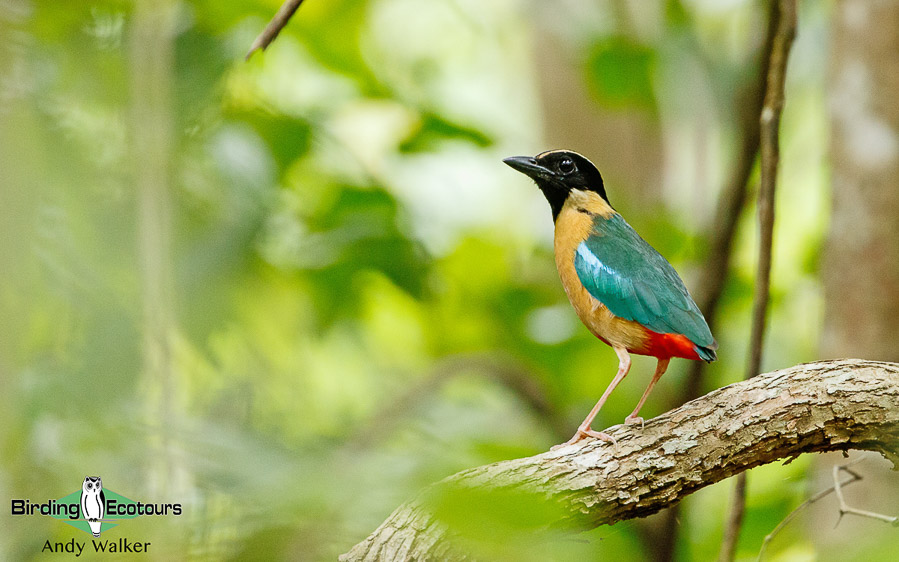 Elegant Pitta, one of many exciting targets on this multi-island tour.
Overview
This small-group birding tour explores six endemic-rich islands in the Lesser Sunda region of Indonesia. Starting and ending in Denpasar, Bali, the tour uses this international gateway as the launch point for a fascinating adventure through Sumba, Rote, West Timor, Alor, Flores, and Komodo, one of Indonesia’s most rewarding and rarely visited island regions.
The tour focuses on finding island endemics, regional endemics, and highly localized specials, including Sumba Hornbill, Sumba Buttonquail, Cinnamon-banded Kingfisher, Little Sumba Boobook, Great Sumba Boobook, Sumba Eclectus, Citron-crested Cockatoo, Elegant Pitta, Red-naped Fruit Dove, Rote Boobook, Rote Myzomela, “Mt Mutis Parrotfinch” (a currently undescribed species), Black-breasted (Timor) Myzomela, Timor Imperial Pigeon, Timor Friarbird, Timor Sparrow, Orange-sided Thrush, Black-banded Flycatcher, Alor Myzomela, Alor Boobook, Flores Hawk-Eagle, Flores Scops Owl, Wallace’s Scops Owl, Chestnut-capped Thrush, Chestnut-backed Thrush, Flores Shortwing, Flores Crow, Flores Monarch, Ornate Pitta, White-rumped Kingfisher, Yellow-crested Cockatoo, and many more. We will also enjoy an exciting range of parrots, fruit doves, sunbirds, and raptors. Away from the birds, Komodo Dragon is likely to provide a memorable non-avian highlight when we step into a Jurassic world on the island with which it shares its name.
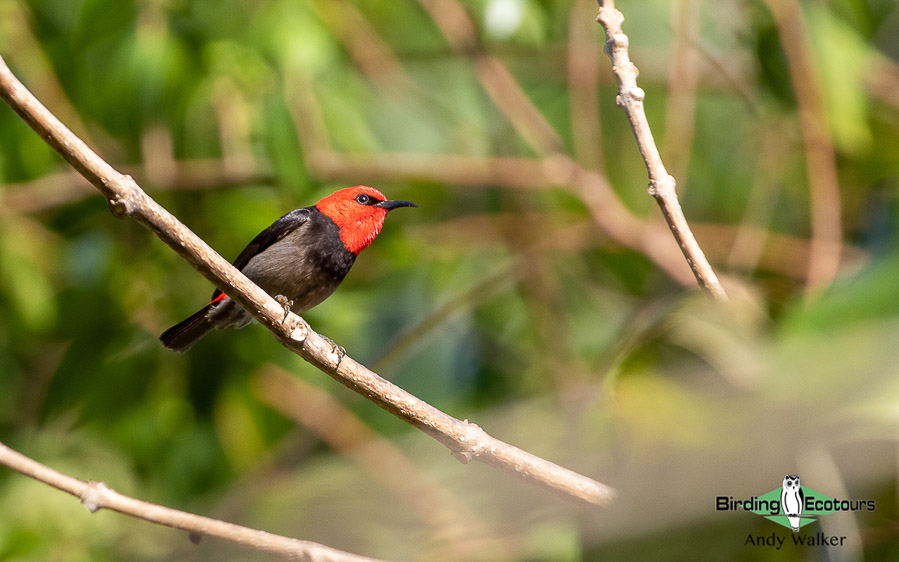 Sumba Myzomela is one of several range-restricted myzomelas (tiny honeyeaters that are reminiscent of sunbirds) that we can enjoy on the tour.
Detailed Itinerary (21 days/20 nights)
Day 1. Arrival in Denpasar (Bali)
This is a non-birding arrival day. You will be met at the airport and transferred to our nearby hotel, with the rest of the day at leisure before a group welcome dinner in the evening.
Overnight: Hilton Garden Hotel, Bali
Day 2. Denpasar (Bali) to Tambolaka (Sumba)
We will depart Denpasar in the morning and fly to Waikabubak Airport in Tambolaka, western Sumba, where we will meet our excellent local guide, who will remain with us throughout our time in the Lesser Sundas. After clearing the airport, we will transfer to our city hotel for a two-night stay. In the afternoon we will bird at Manurara until the evening, looking for Little Cuckoo-Dove, Sumba Green Pigeon, Black-naped Fruit Dove, Tenggara Paradise Flycatcher, Supertramp Fantail, Five-colored Munia, and Great Sumba Boobook.
Overnight: Manandang Hotel, Waikabubak Sumba
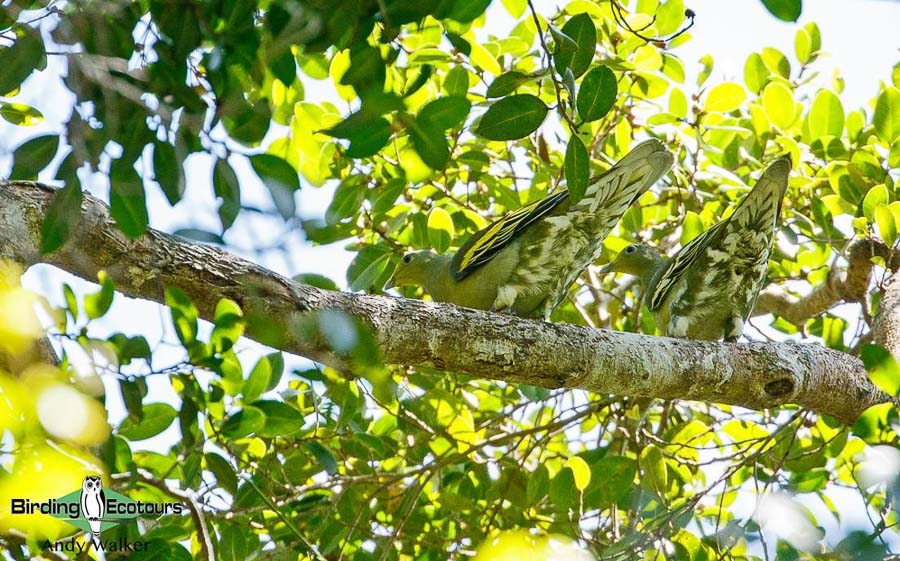 The localized and well-camouflaged Sumba Green Pigeon is a target on the island.
Day 3. Birding Tanadaru (Sumba)
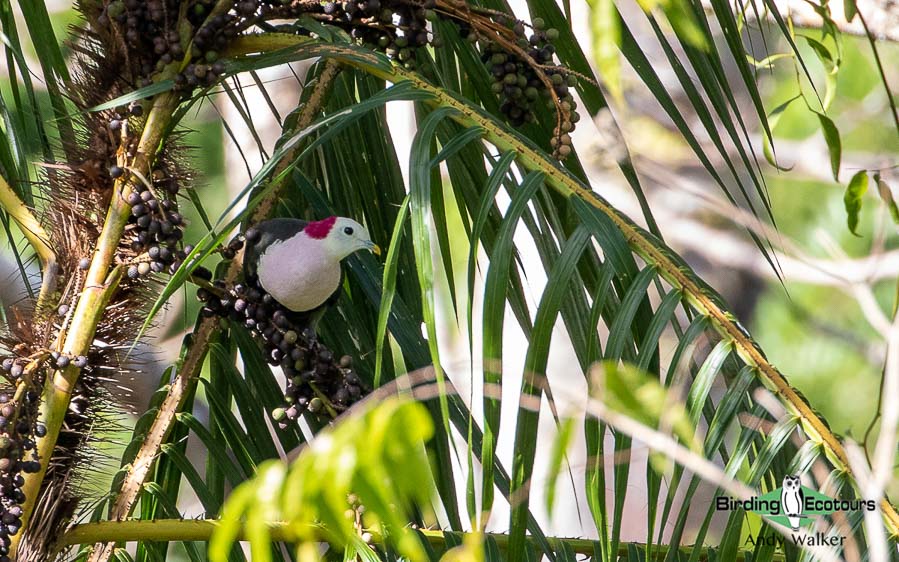
We will leave our accommodation early and drive east to spend the morning birding at Tanadaru. Here we will search for more endemics and specials, including Sumba Myzomela, Tenggara Paradise Flycatcher, Sumba Brown Flycatcher, Tenggara Whistler, Marigold Lorikeet, Sumba Eclectus, Red-naped Fruit Dove, Elegant Pitta, Chestnut-backed Thrush, Sumba Jungle Flycatcher, and Sumba Flowerpecker.
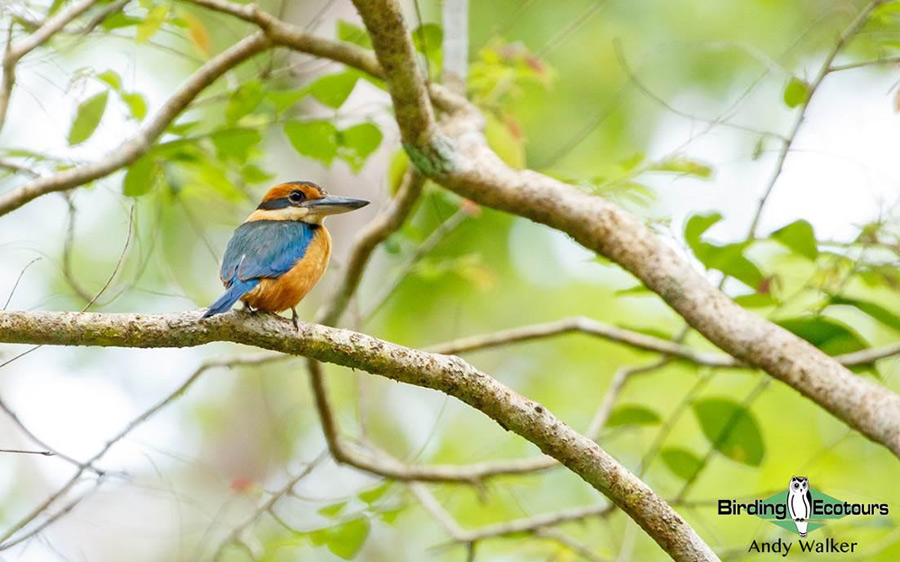 Cinnamon-banded Kingfisher will be a target while we are birding on Sumba.
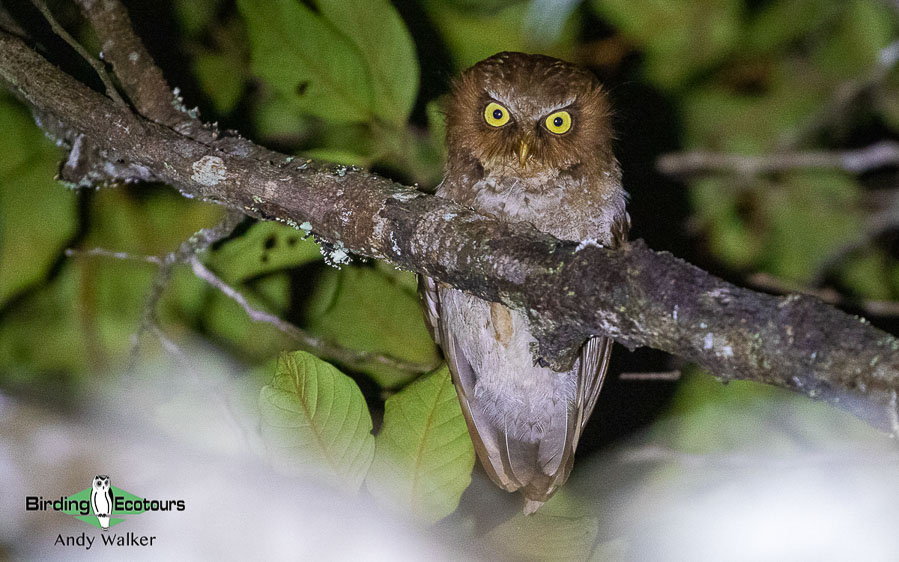
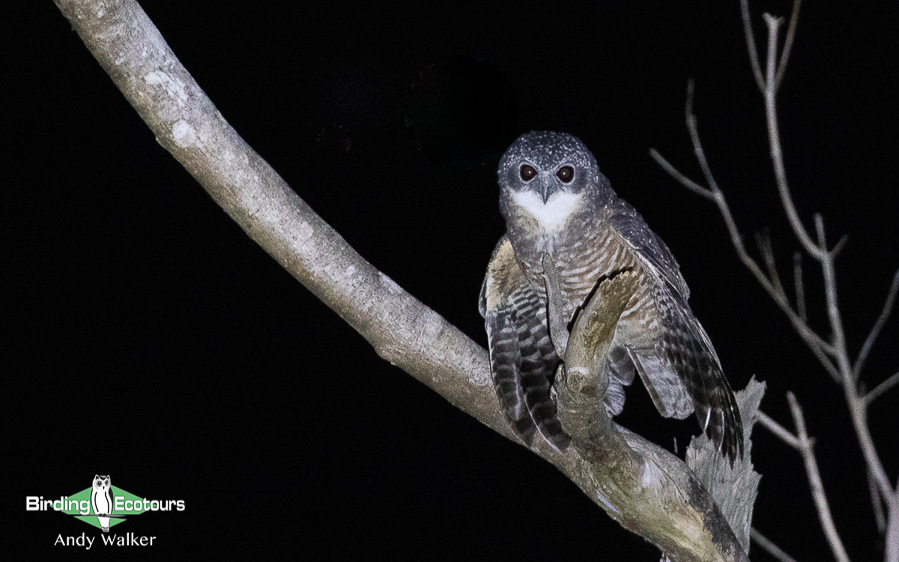 We will look for the endemic Great Sumba Boobook at night while on the island.
After lunch at a local restaurant in Langgaliru, we will continue birding near Tanadaru, where we may find Red-naped Fruit Dove, Elegant Pitta, or Sumba Myzomela. After dark we will head out to search for the endemic owl duo of Little Sumba Boobook and Great Sumba Boobook.
Overnight: Manandang Hotel, Waikabubak Sumba
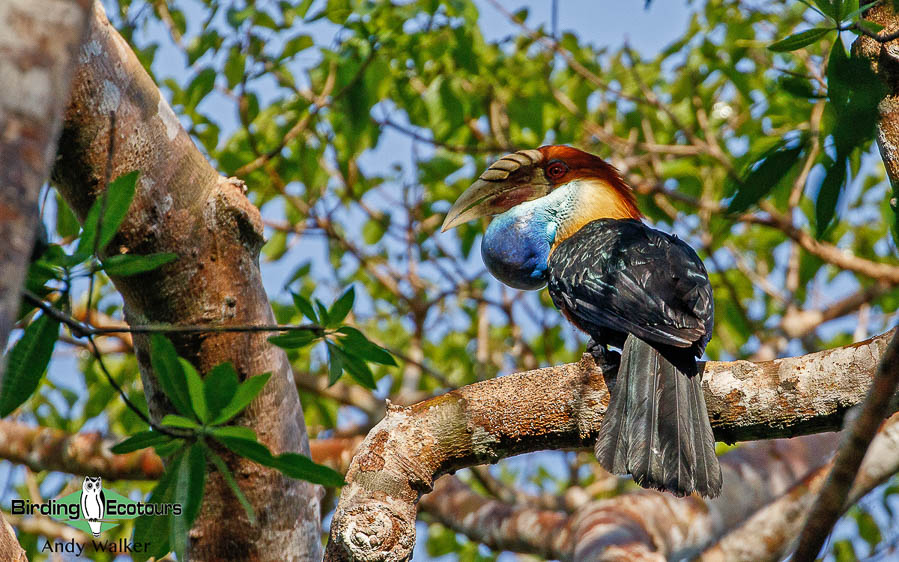 Sumba Hornbill will be a major target during our time in the forests on the island.
Day 4. Waikabubak to Tanadaru and on to Waingapu (Sumba)
We will return to the Tanadaru area for the morning and also bird around Langgaliru and Lewa before driving across the island to Waingapu. During our birding we will look for Apricot-breasted Sunbird, Sumba Flycatcher, Red-naped Fruit Dove, Cinnamon-banded Kingfisher, Citron-crested Cockatoo (recently split from Yellow-crested Cockatoo), Elegant Pitta, Wallacean (Sumba Spangled) Drongo, and plenty more.
Overnight: Padadita Hotel, Sumba
Day 5. Birding at Laipori and Mengitimbi Lake
Today’s main focus will be finding the Sumba Buttonquail. This is one of the rarest and most challenging endemics on the island, so we will need to put in some effort to locate it. Other possibilities in the buttonquail area include Javan Plover, Spotted Kestrel, Brown (Indonesian) Honeyeater, Zitting Cisticola, Eastern Red-rumped (Striated) Swallow, Five-colored Munia, and Pale-headed Munia.
Overnight: Padadita Hotel, Sumba
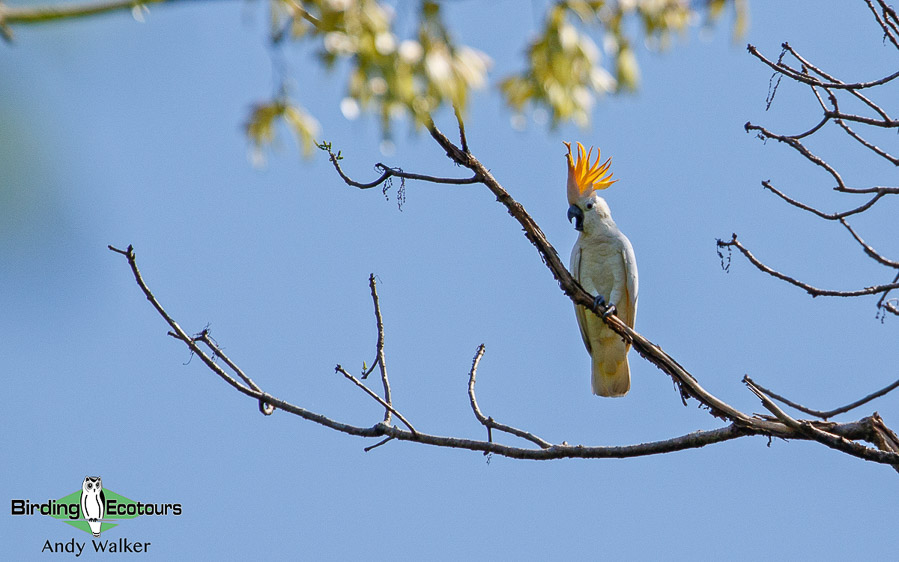 The attractive (and recently split from Yellow-crested Cockatoo) Critically Endangered (BirdLife International) Sumba endemic, Citron-crested Cockatoo will be a target while on the island.
Day 6. Waingapu (Sumba) to Kupang (Timor) to Onotali (Rote)
Today is essentially a travel day, as we take a morning flight from Waingapu, Sumba, to Kupang, Timor, before continuing with a short flight to Bandar Udara D. C. Saudale Airport, Rote. Once we have cleared the airport, we will check into our hotel. Depending on the flight schedules, there may be time for some birding in Kupang, Timor (though we will return here in a few days), or near our accommodation in Sumba or Rote either side of our flights. We should also look out for Australian Pratincoles on the airport runways!
Overnight: Villa De Rose, Rote
Day 7. Rote birding (Rote)
We will spend the full day birding on Rote. The morning will be spent at Baudale and Peto Lake before we return to town for lunch, after which we will drive across to Bolatena for an afternoon and evening birding session. During the day we will look for Rote endemics and specials such as Rote Myzomela, Rote Leaf Warbler, Timor Green Pigeon, Banded (Black-backed) Fruit Dove, Pink-headed Imperial Pigeon, Jonquil Parrot, Northern (Rote) Fantail, Black (Slaty) Cuckoo-Dove, Timor Oriole, Helmeted (Tenggara) Friarbird, Orange-sided Thrush, Timor Blue Flycatcher, White-bellied (Timor) Bush Chat, Flame-breasted Sunbird, and Timor Stubtail. In the evening we will search for the endemic Rote Boobook, along with the recently described Timor Nightjar, which can be found on the island.
Overnight: Villa De Rose, Rote
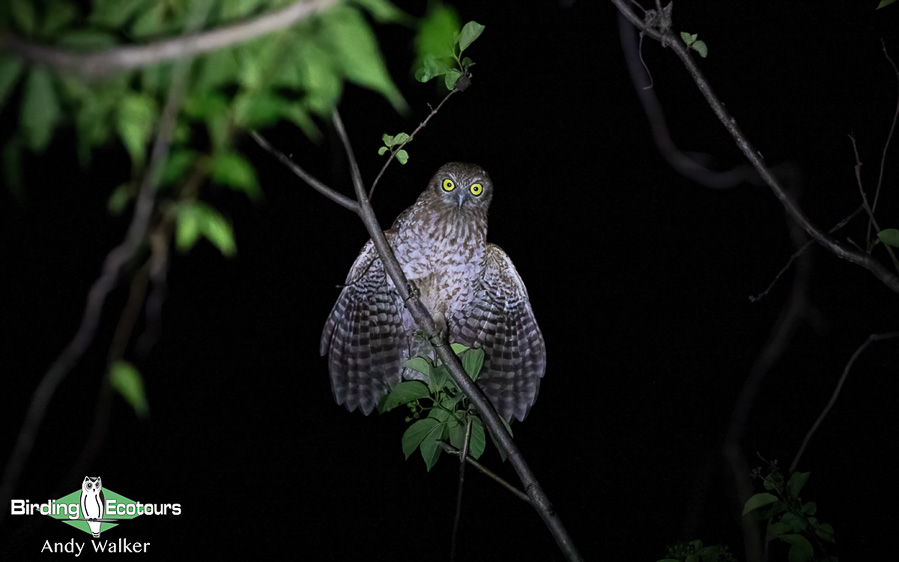 We will look for the island-endemic Rote Boobook while birding the island.
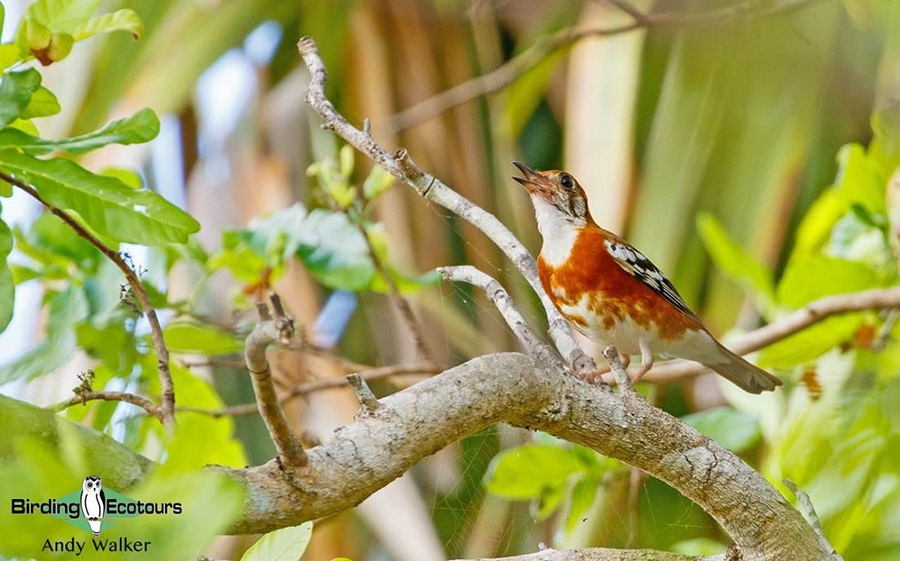 The striking Orange-sided Thrush can be found in Rote and Timor.
Day 8. Rote to Kupang (Timor) to Soé (Timor)
We will take the morning ferry from Rote back to Kupang, then drive on to Soé. Along the way, we plan to stop at Fatuleu to look for Black-banded Flycatcher and Timor Blue Flycatcher. We may also find Timor Friarbird, Rose-crowned Fruit Dove, Cinnamon-banded Kingfisher, and Orange-sided Thrush. In the afternoon we will visit Oehala waterfall, which can sometimes produce Black-breasted (Timor) Myzomela, Fawn-breasted Whistler, and Northern (Timor) Fantail.
Overnight: Hotel Bahagia 2, Soé, Timor
Day 9. Birding Gunung Mutis (Timor) – in search of the undescribed parrotfinch!
We will spend the full day birding Gunung Mutis, home to several little-known and exciting birds, including the currently undescribed parrotfinch known as “Mt Mutis Parrotfinch”, which we will hope to see. Other targets here include Timor Imperial Pigeon, Banded (Black-backed) Fruit Dove, Black-breasted (Timor) Myzomela, Flame-eared Honeyeater, Plain (Timor) Gerygone, Timor Leaf Warbler, Timor Blue Flycatcher, Snowy-browed Flycatcher, Timor Flowerpecker, Sunda Thrush, Chestnut-backed Thrush, Sulawesi Island Thrush, Pygmy Cupwing, Lesser Shortwing, and Yellow-throated Whistler.
Overnight: Hotel Bahagia 2, Soé, Timor
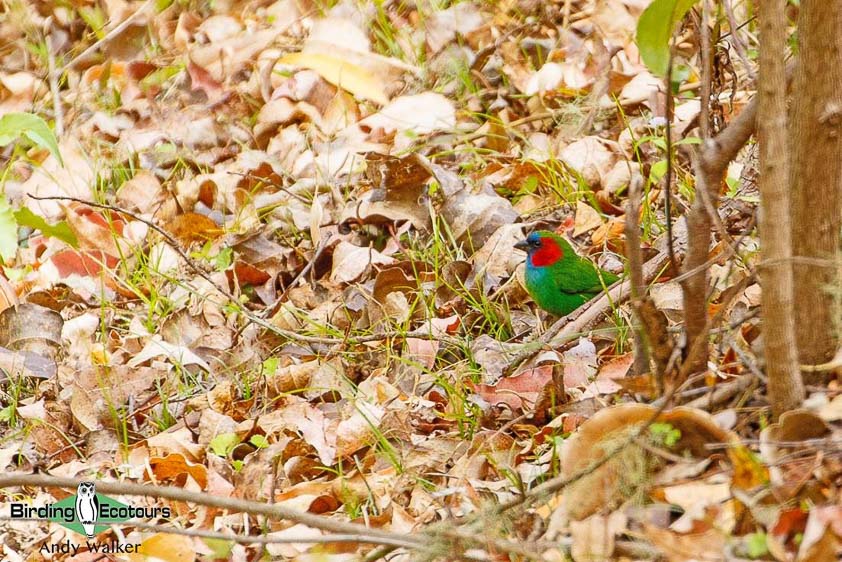 The currently undescribed “Mount Mutis Parrotfinch” is a tough target.
Day 10. Soé to Camplong to Bipolo to Kupang (Timor)
A morning visit to Camplong Nature Reserve should offer some excellent birding. Highlights here could include Timor Friarbird, Orange-sided Thrush, Black-banded Flycatcher, Iris Lorikeet, Timor Blue Flycatcher, Rose-crowned Fruit Dove, Pacific Emerald Dove, Streak-breasted Honeyeater, Brown (Indonesian) Honeyeater, Flame-eared Honeyeater, Scaly-crowned (Sunda) Honeyeater, Supertramp Fantail, Northern (Timor) Fantail, Ashy-bellied White-eye, Red-chested Flowerpecker, Buff-banded Thicketbird, Timor Stubtail, Thick-billed (Sunda) Flowerpecker, Timor Heleia, and Timor Cuckoo-Dove.
In the afternoon we will bird the well-known Bipolo Forest, where we will again seek many of the species mentioned above. Open areas along the forest edge may hold the declining Timor Sparrow among flocks of more widespread munias, as well as shorebirds such as Australian Pratincole. After birding, we will continue to Kupang for the night.
Overnight: Aston Hotel, Kupang, Timor
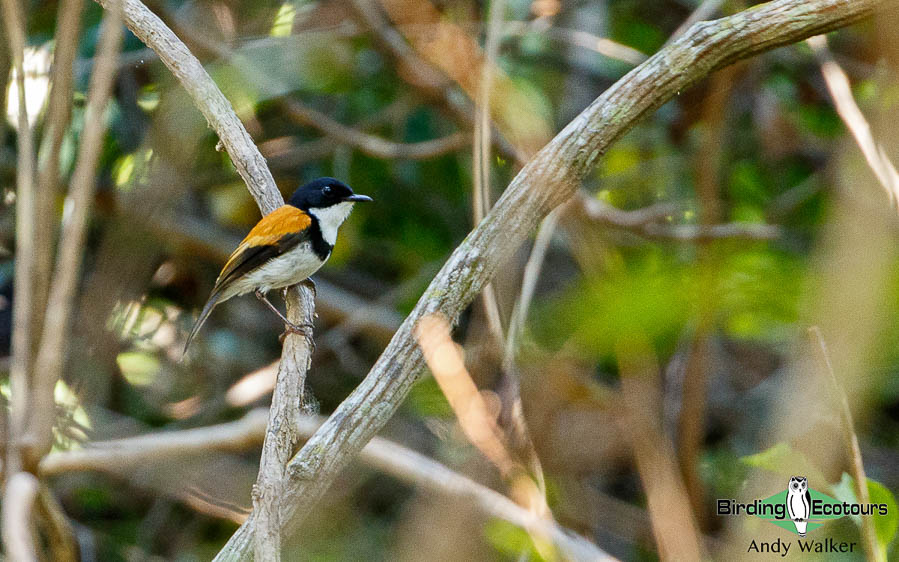 Black-banded Flycatcher, striking even by Ficedula standards and endemic to Timor.
Day 11. Kupang (Timor) to Alor (Alor)
We will take a morning flight to the small island of Alor and spend the day exploring this rarely visited island. We will stop at the Takpala traditional village to enjoy local hospitality and dancing before visiting the Hutan Nostalgia Nature Reserve for some birding. Here we hope to find Olive-headed Lorikeet, Timor Cuckoo-Dove, Little (Eucalypt) Cuckoo-Dove, and Spotted Kestrel. If time permits, we may make our first attempt to find the endemic Alor Boobook in the evening.
Overnight: Hotel Simfoni, Alor
Day 12. Alor birding (Alor)
We will spend the full day birding at a range of sites around Alor, seeking Alor Myzomela, Wallacean (Alor) Cuckooshrike, Flores Green Pigeon, Aberrant (Sunda) Bush Warbler, Javan (Timor) Bush Warbler, Lesser Shortwing, Flores Hawk-Eagle, Short-toed Snake Eagle, Bonelli’s Eagle, Timor Stubtail, Thick-billed (Tenggara) Flowerpecker, Timor Flowerpecker, Tenggara Hill Myna, Chestnut-backed Thrush, and plenty more. In the evening we will search for Alor Boobook, Eastern Barn Owl, and Mees’s Nightjar.
Overnight: Hotel Simfoni, Alor
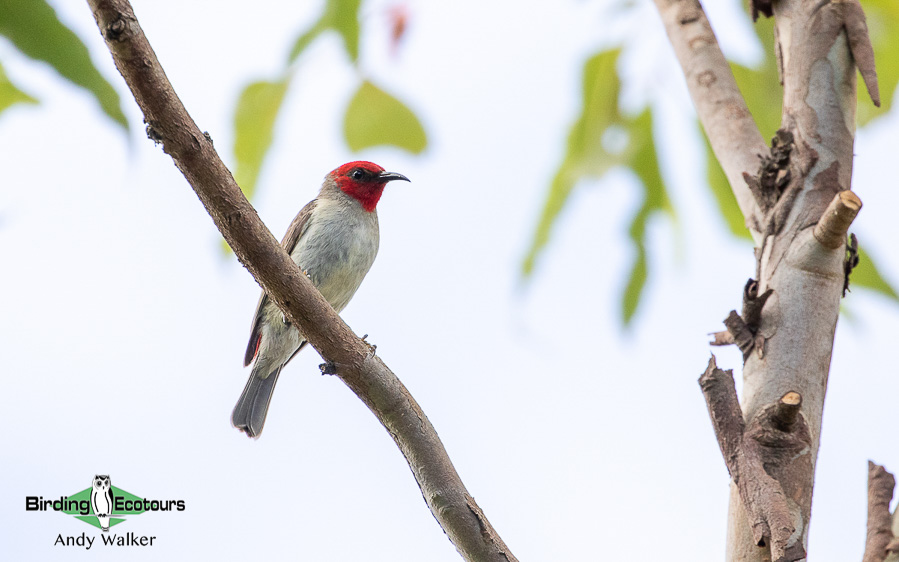
Seen by relatively few world birders, Alor Myzomela will be a target on this trip.
Day 13. Alor to Kupang (Timor)
We will take a morning flight from Alor back to Kupang, Timor, and check into our hotel. Once the heat of the day has passed, we will spend the late afternoon visiting mangroves and farmland near Bipolo Forest, where we will look for Timor Sparrow, (Sunda) Zebra Finch, Timor Friarbird, and Black Kite. We may also find resident, over-summering Palearctic, or over-wintering Australasian shorebirds, or Timor Boobook at dusk.
Overnight: Aston Hotel, Kupang, Timor
Day 14. Kupang (Timor) to Bajawa (Flores)
Leaving Timor for the final time, we will take the short flight to Flores, landing at Bajawa Airport in Soá. If time permits, we will visit the nearby hot springs before lunch in Bajawa. After lunch we will stop at Bena traditional village, followed by birding around Inerie Volcano. Targets here include Flores Green Pigeon, Black-naped (Nusa Tenggara Golden) Oriole, Scaly-crowned Honeyeater, Leaf (Flores) Lorikeet, and Chestnut-backed Thrush.
Overnight: Sanian Hotel, Bajawa, Flores
Day 15. Bajawa to Kisol to Ruteng (Flores)
An early start will take us to the famous site of Poco Ndeki (Kisol). The remnant lowland forest here holds most of the lowland endemics found on Flores. Our main targets will include Flores Green Pigeon and Flores Crow, but many other endemics and specials occur here, including Flores Hawk-Eagle, Wallace’s Scops Owl, White-rumped Kingfisher, Chestnut-capped Thrush, Ornate Pitta, Yellow-spectacled Heleia, Crested Heleia, Thick-billed Heleia, Leaf (Flores) Lorikeet, Great-billed Parrot, and Russet-capped Tesia. In the afternoon we will drive to Ruteng, where we will take an evening night walk in search of the rare Flores Scops Owl, a tough but exciting bird.
Overnight: Ara Garden, Ruteng, Flores
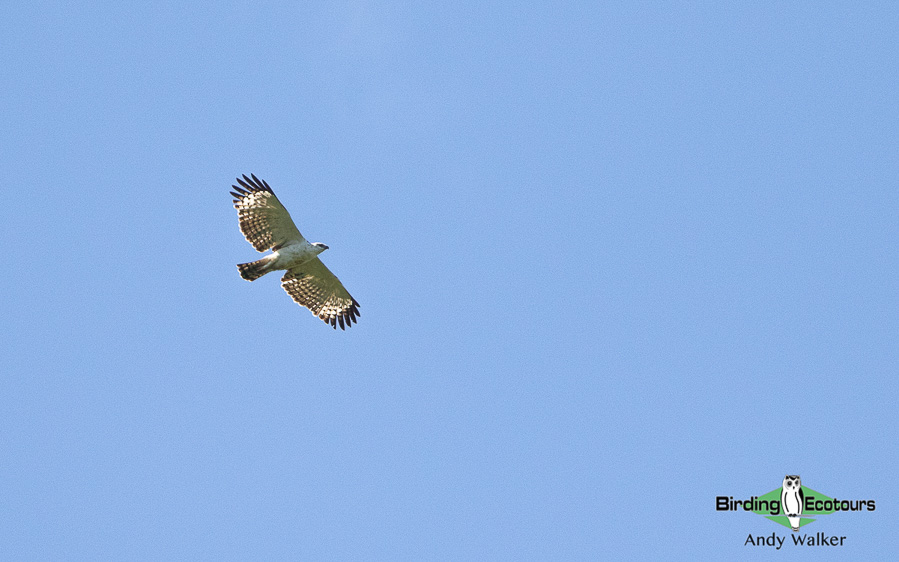 We will be keeping our eyes to the sky for the Critically Endangered (BirdLife International) Flores Hawk-Eagle, an impressive and huge raptor.
Day 16. Birding Ruteng Nature Reserve and Golo Lusang (Flores)
Depending on the previous evening’s owling session, we may make an early start to look again for Flores Scops Owl, if needed. Other targets include the difficult Wallace’s Scops Owl, Bare-throated Whistler (whose song is unforgettable!), Flores Shortwing, Flores Jungle Flycatcher, Crested Heleia, Little (Flores) Minivet, Golden-rumped Flowerpecker, Pale-shouldered Cicadabird, and Chestnut-backed Thrush.
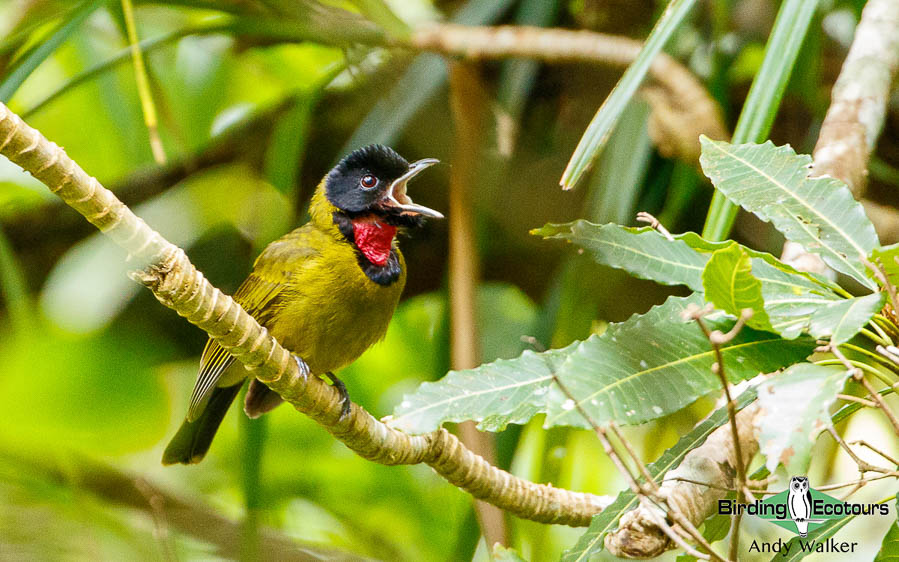 Bare-throated Whistler is one incredible songster.
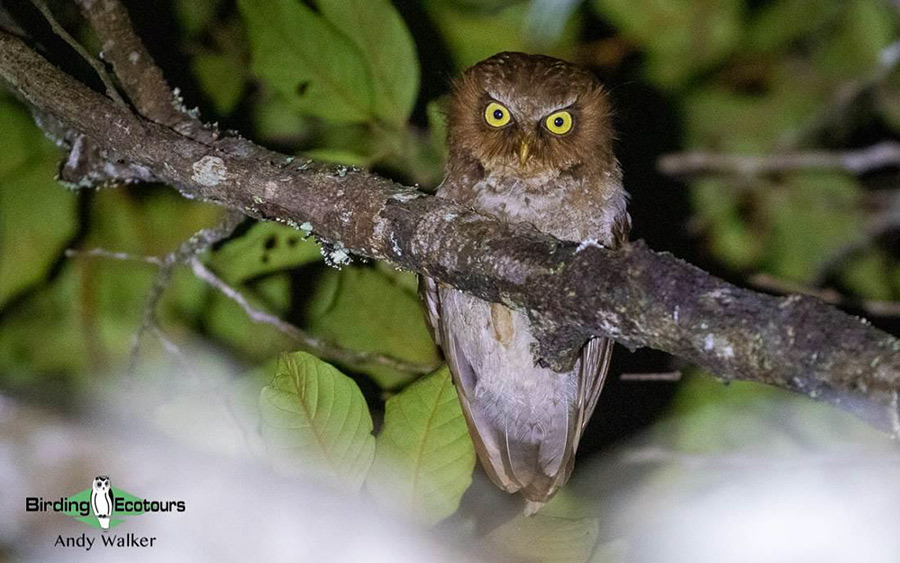 We will hope for great views of the endemic Flores Scops Owl, a rare resident of montane forest.
Day 17. Ruteng to Puarlolo (Flores)
We will leave Ruteng and head west to Puarlolo, where a trail through secondary hill forest offers an excellent opportunity to find the rare, range-restricted endemic Flores Monarch. Plenty of other exciting species occur here too, including the gorgeous Chestnut-capped Thrush, Chestnut-backed Thrush, Flores Crow, Wallace’s Hanging Parrot, Green Junglefowl, Black-naped Fruit Dove, Ornate Pitta, Helmeted (Tenggara) Friarbird, Tenggara Whistler, Tenggara Paradise Flycatcher, Russet-capped Tesia, Rufous-chested Flycatcher, Golden-rumped Flowerpecker, and Thick-billed (Tenggara) Flowerpecker.
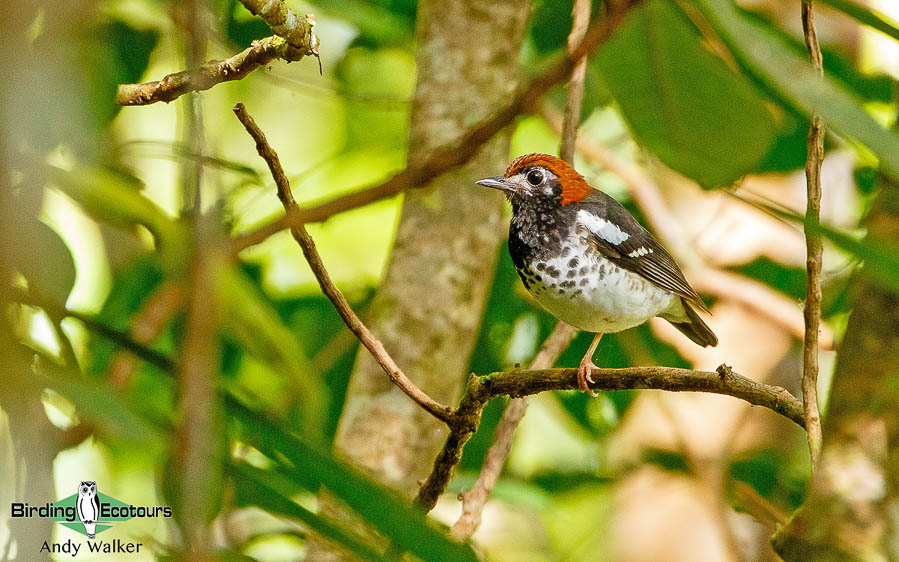 We can find several cryptic Geokichla thrushes on this tour – this is Chestnut-capped Thrush.
We will continue to Ndengo village for lunch and may visit Cunca Rami waterfall in the afternoon, if time allows. We will spend the late afternoon birding around the grounds of our comfortable ecolodge, where we could see Wallacean Drongo, Ruddy (Parzudaki’s) Cuckoo-Dove, Collared Kingfisher, White-rumped Kingfisher, Tenggara Swiftlet, Oriental Dollarbird, Blue-tailed Bee-eater, Sunda Pygmy Woodpecker, Black-naped Monarch, Tenggara Paradise Flycatcher, and Black-fronted Flowerpecker.
Overnight: Mbeliling Ecolodge, Mbeliling, Flores
Day 18. Puarlolo to Labuan Bajo (Flores) to Komodo Island (Komodo)
We will spend the early morning back in the forest at Puarlolo, looking for some of the species mentioned above. After checking out, we will wind our way down the mountain to Labuan Bajo and continue directly to the pier, where we will board our air-conditioned cabin boat for Komodo National Park. We will have lunch on the way and may see Lesser Frigatebird, Bridled Tern, Black-naped Tern, White-bellied Sea Eagle, Beach Stone-curlew, or Great-billed Heron en route. In the afternoon we will stop at Pink Beach for swimming and snorkeling. We will spend the night on the boat near Komodo Island’s pier, ready for the following morning.
Overnight: Air-conditioned cabin boat, Komodo
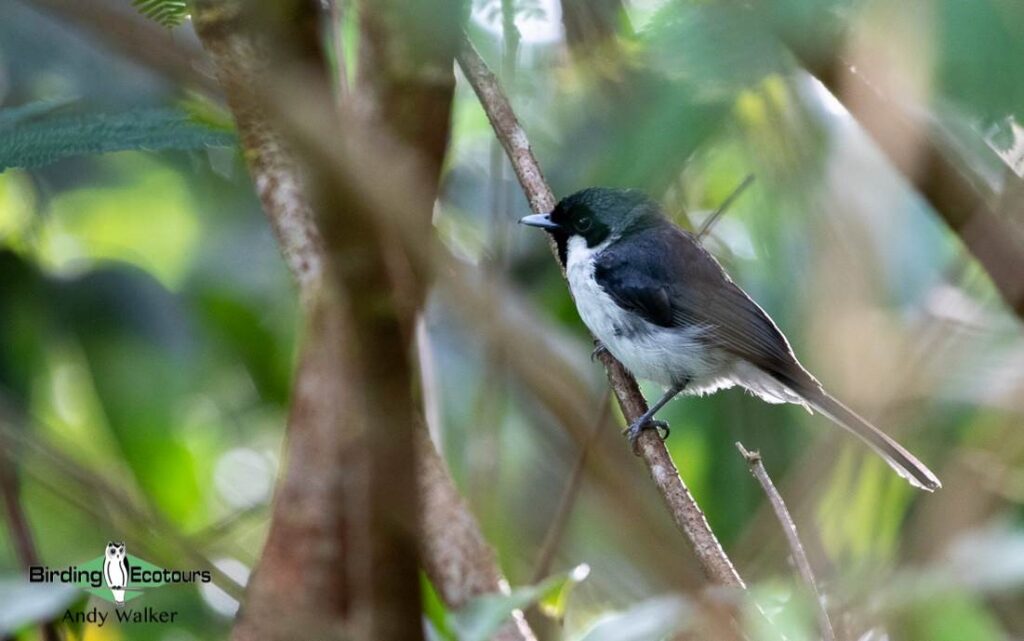 We will look for the extremely localized Flores Monarch at Puarlolo.
Day 19. Birding Komodo Island (Komodo) to Labuan Bajo (Flores)
The morning will be spent birding in Komodo National Park. This protected island is a haven for wildlife and a joy to visit in a country affected by habitat destruction, illegal hunting, and bird-trapping. As we walk around the island, we should see a wide range of birds. Our main avian target will be the rare Yellow-crested Cockatoo; Komodo Island is now the best place in the world to see this Critically Endangered (BirdLife International) species.
Other birds we will look for on Komodo Island include Flores Hawk-Eagle, Orange-footed Scrubfowl, Green Junglefowl, Green Imperial Pigeon, Pied Imperial Pigeon, Sunda Collared Dove, Barred Dove, Black-naped (Nusa Tenggara Golden) Oriole, Wallacean (Flores) Cuckooshrike, Wallacean (Flores Spangled) Drongo, Eastern Red-rumped (Striated) Swallow, Helmeted (Tenggara) Friarbird, and Lemon-bellied White-eye. One of the main reasons for coming to Komodo Island, however, is to look for the impressive Komodo Dragon, a giant monitor lizard that can reach almost 10 feet (3 meters) in length — perhaps the closest you can come to a dinosaur today.
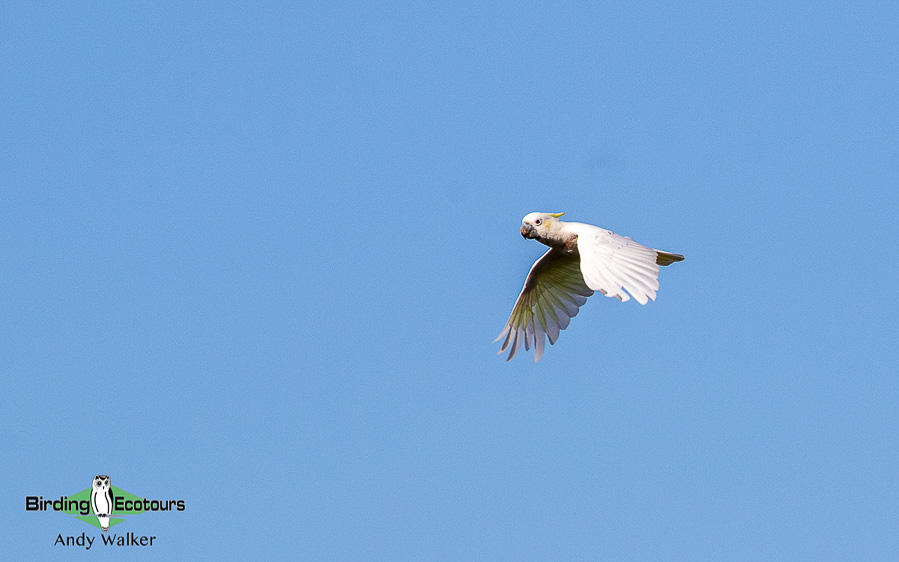 The Critically Endangered (BirdLife International) Yellow-crested Cockatoo will be a big target bird on Komodo Island.
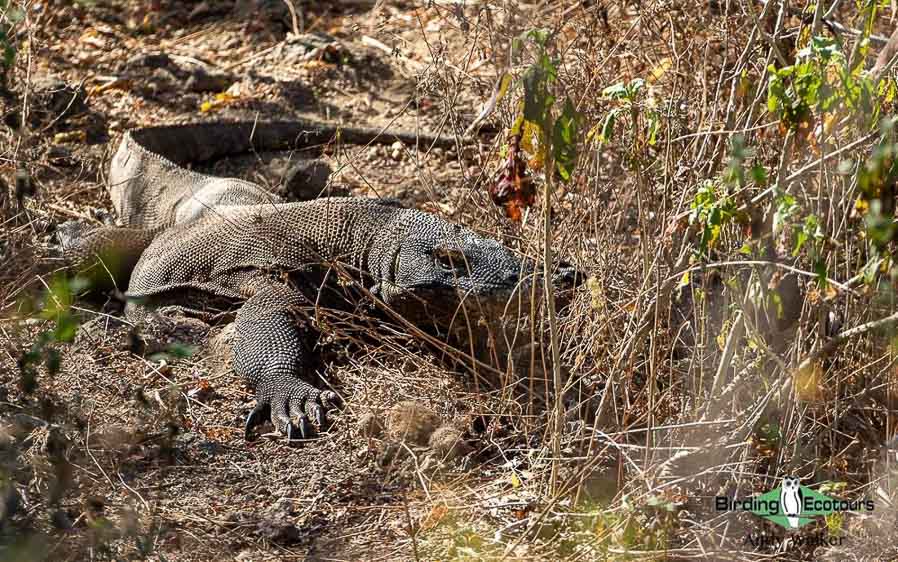 Finding Komodo Dragon is not always as easy as you might expect for something of its size.
We will sail away from Komodo Island and have lunch on the boat. We will then likely stop for more swimming and snorkeling around Pink Beach or another nearby reef site. The reef life in this part of Indonesia is fascinating, and we highly recommend exploring it on this tour. In the late afternoon we will arrive at our comfortable beachside hotel in Labuan Bajo.
Overnight: Purisari Beach Hotel, Labuan Bajo
Day 20. Birding Mamis Forest and Labuan Bajo (Flores)
Our final morning birding session of the tour will take us to forest not far outside Labuan Bajo. Here we will have further opportunities for species such as Flores Monarch, Wallace’s Hanging Parrot, Variable (Nusa Tenggara) Goshawk, Bonelli’s Eagle, White-rumped Kingfisher, Ornate Pitta, Wallacean (Flores) Cuckooshrike, Black-naped Monarch, Tenggara Whistler, and Yellow-spectacled Heleia.
In the afternoon we will visit nearby rice paddies, seasonal wetlands, and shrimp ponds, where we are likely to see a different suite of birds, such as Sunda Teal, Wandering Whistling Duck, Javan Plover, Malaysian Plover, Beach Stone-curlew, Buff-banded Rail, White-browed Crake, Purple (Australasian) Swamphen, White-shouldered Triller, Pied Bush Chat, Flame-breasted Sunbird, Black-fronted Flowerpecker, Black-faced Munia, (Sunda) Zebra Finch, Stork-billed Kingfisher, Collared Kingfisher, Sacred Kingfisher, and Cerulean Kingfisher. We will enjoy a final group dinner together and discuss the “bird of the trip”, which is unlikely to be an easy choice!
Overnight: Purisari Beach Hotel, Labuan Bajo
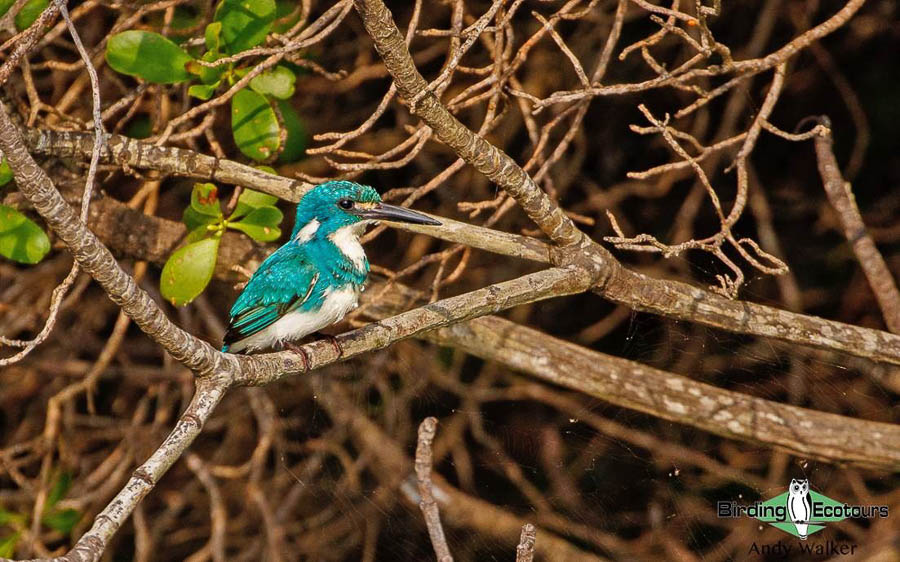 Plenty of beautiful kingfishers can be found on this Lesser Sunda birding tour, and Cerulean Kingfisher is one of those.
Day 21. Labuan Bajo (Flores) to Denpasar (Bali) where the tour concludes
This is a non-birding day. After a leisurely breakfast at our comfortable beachside hotel, we will take a late-morning flight back to Denpasar, Bali, where the tour concludes in time for your international departure. Please do not book your international flight until we have confirmed the time of the domestic flight between Labuan Bajo and Denpasar.
Overnight: Not included
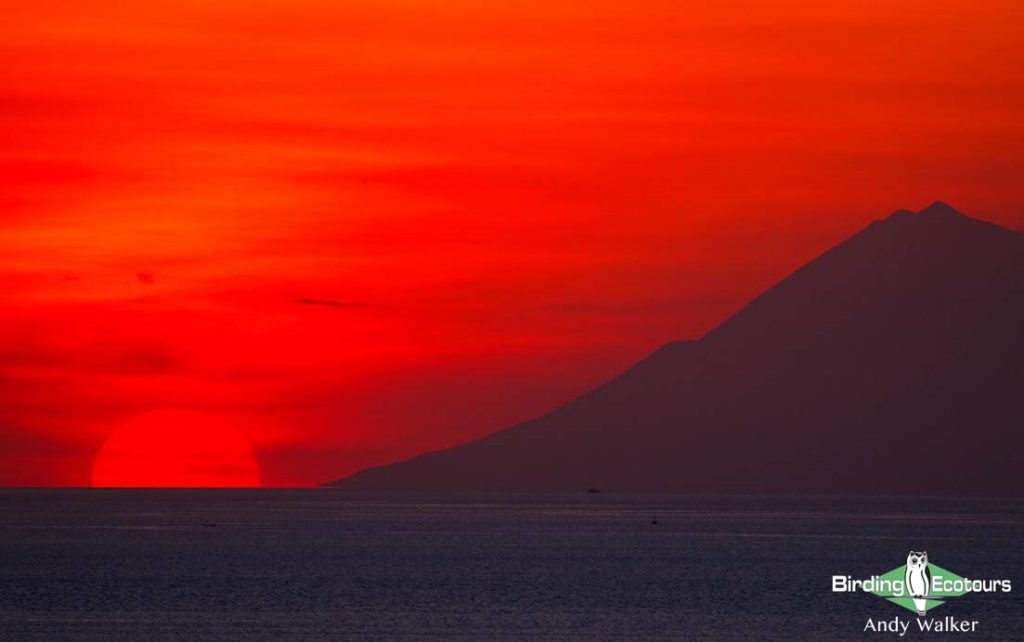 We are likely to enjoy some spectacular sunrises and sunsets on this tour, with the sunsets off Labuan Bajo particularly colorful.
Please note that the itinerary is a guide and cannot be guaranteed. It may change, usually slightly, due to factors such as accommodation availability, updated information on accommodation, roads, or birding sites, guide discretion, and other operational considerations. In addition, we sometimes have to use a different international guide from the one advertised due to tour scheduling.
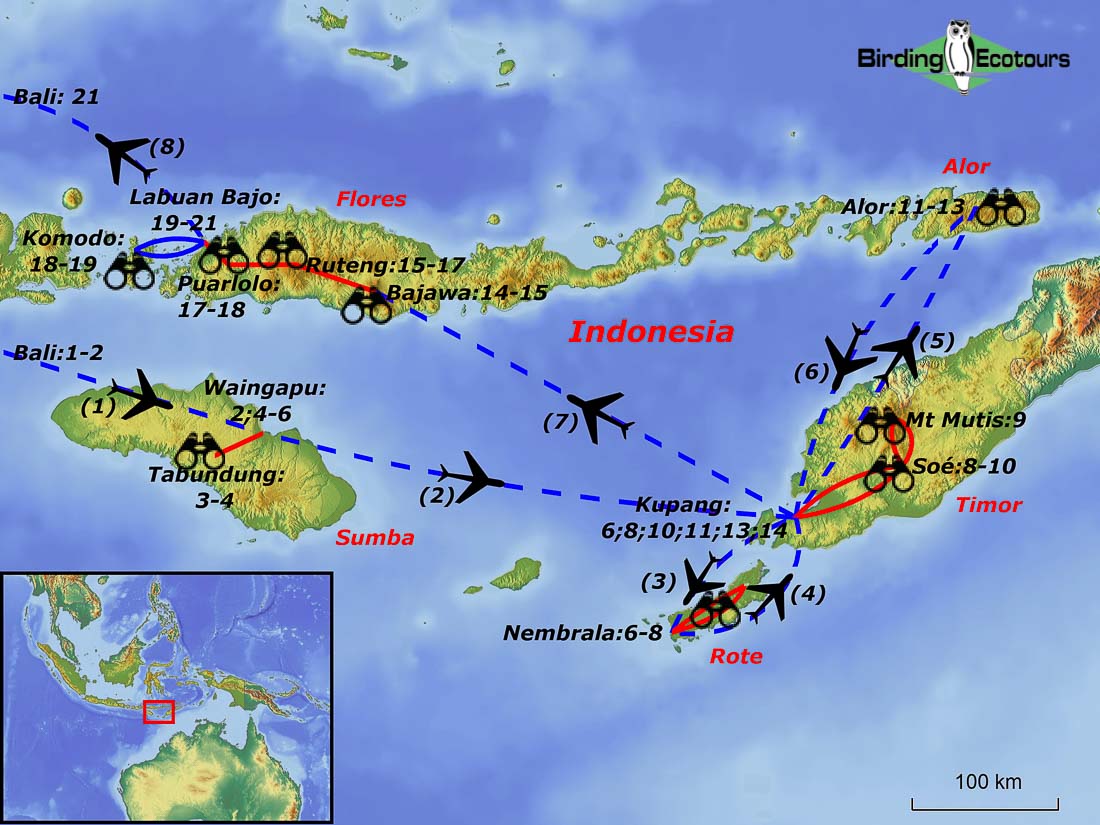
Map
Testimonials
Gallery
General Information
Indonesia: The Lesser Sunda Islands – Comprehensive Tour
Tour-Specific Information
GENERAL INFORMATION ABOUT INDONESIA CAN BE READ HERE
TOUR OUTLINE
This is an amazing opportunity to connect with numerous thrilling regional and island-endemic birds as we cover the Lesser Sunda islands of Sumba, Timor, Rote, Alor, Flores, and Komodo (with a start and end point of Denpasar, Bali “The Islands of the Gods”). This is a comprehensive tour to an area not visited by many birders annually. We will find numerous endemic owls, such as Flores Scops Owl, Little Sumba Boobook, Rote Boobook, and Wallace’s Scops Owl (and more), alongside spectacular species such as Sumba Hornbill, Yellow-crested Cockatoo (of two subspecies), Bare-throated Whistler, Black-banded Flycatcher, Elegant Pitta, Ornate Pitta, and many more delights from a wide assortment of families like honeyeaters, kingfishers, parrots, pigeons, fruit doves, flycatchers, and thrushes. We will also be looking for Komodo Dragon, the world’s largest lizard on this tour. We should get good photo opportunities as we make our way around these little-visited islands.
DAILY ACTIVITIES, PHYSICAL REQUIREMENTS, AND TOUR PACE
This Indonesian birding tour through the Lesser Sunda islands needs reasonable fitness and is run at a moderate pace, covering a lot of remote ground. The tour is likely to be tiring due to the distances covered in remote areas and the heat to be expected, more on that in the “Weather/Climate” details below.
We will be visiting some remote areas on this tour, though will also be passing through towns and cities occasionally on our quest to find as many of the region’s special birds as possible. Remember we will be visiting a developing country and will be staying in remote areas, where there are limited sanitation facilities and services will be very different to what you might expect from home, or even other areas in Indonesia. Notwithstanding the above, we have tried to make this tour as comfortable as possible by staying in accommodation that we know well and is of the highest standard in the local area. Hopefully our time between birding sessions will be as comfortable and relaxing as possible. But some of the accommodation in some locations is rather basic, see more information in the “Accommodation” section below.
This tour entails multiple domestic flights and some boat trips (a mix of fast-ferries, live-aboard boats, and speedboats/outrigger boats). There are several long drives on the tour (e.g. some in the region of five hours), sometimes on poor roads and this can be tiring, particularly when the heat is added into the mix.
We will have long days in the field, though often, when the situation allows, we will rest during the heat of the middle of the day (when bird activity is lower). We will usually have an early breakfast (sometimes this will be a boxed breakfast) before we head out birding. Lunch will usually be back at our accommodation or a restaurant but occasionally might be ‘in the field’ as a boxed picnic lunch, this will very much depend on where we are birding. Dinner will most often be back at our accommodation or a nearby restaurant. There are a lot of nightbirds possible on this tour so there will be several night birding sessions either after dinner, or sometimes before dinner (with a later mealtime being on the cards). Note in some areas there are no facilities at all near birding areas (such as when we are birding on Rote), this is likely to result in a long day as we will have to leave our accommodation very early to get to the birding site for first light and may be out until after dark in the evening (after an endemic owling session), making do with boxed meals/snacks and a late dinner. There will also be no bathroom facilities for most of this day.
Most of our birding on this tour is carried out on flat or gently undulating roads, tracks, and trails, some of these are interspersed with short and steep inclines and declines, but nothing likely to be too problematic for most people in the main, and we will be going at a slow, birding pace. When we are birding in the mountains of central Flores, we will spend most of our time birding along roads. We will likely need to come “off-piste” in our search for some of the more secretive species unlikely to be seen right from the roads and this could include short sharp inclines and declines and sometimes boggy/slippery “trails”. Most of the lowland areas are likely to be very dry and rocky, sometimes we will need to walk through dry, rocky streambeds so care should be taken. Walking sticks or hiking poles are useful by providing additional stability to aid balance and are compulsory for anyone who is not steady on their feet. Most of the walks will be short and close to vehicles, a few walks will be longer but nothing likely to cause anyone any problems if proper hydration is maintained, due to the heat.
TRANSPORTATION AND SEAT ROTATION
We use several types of transport on the tour as we move around the region by land, sea, and air.
On land we will use a range of minibuses of varying sizes, sometimes 4×4 vehicles, such as a Toyota Hilux or similar, and sometimes a group of saloon cars, such as a Toyota Avanza or similar. During our time in vehicles, we will have a seat rotation policy in place, so that everyone on the tour has the same opportunities with seating positions. All participants will be expected to abide by the seat rotation policy. People suffering from motion sickness will not be excused from this policy, so please make sure you have any medication you might need. We will be driving along windy and rough roads in places. We require that you are fit and flexible and can maneuver yourself into and around the vehicles.
We will take multiple domestic flights on this tour (see “Domestic Flights” below, for specifics).
We will potentially use a fast-ferry to move between Timor and Rote (or vice versa) depending on flight schedules, which are subject to changes beyond our control. We will have airplane-style seats and be in an air-conditioned section of the boat and the trip would take up to two hours. We will spend one night on a live-aboard boat for our trip to the Komodo Islands, we will have air-conditioned cabins (see “Boat to Komodo Island” section below).
DOMESTIC FLIGHTS
This bird tour starts and ends in Denpasar, Bali, however there are multiple domestic flights required. Please refer to the tour map tab for a visualization of the tour route. The flights are anticipated to be as follows: Bali-Sumba, Sumba-Timor-Rote, Rote-Timor, Timor-Alor, Alor-Timor, Timor-Flores, and Flores-Bali assuming the flight schedule works for our needs. We may need to substitute in a fast-ferry boat trip between Rote and Timor and we will monitor flight schedules as they can change without warning.
Note that the costs for the domestic flights are included in the tour costs, but the cost for hold luggage is not included in the ticket costs. We estimate this to be in the region of between US$150 – US$200 per person and will need to be paid for at the airport in Indonesian Rupiah (IDR) cash. We will update you two months before the tour as to current estimated prices in case of any unexpected changes. You will need at least between Rp1,500,000 – 2,000,000 per person for hold baggage costs. See “Money” section below.
Most providers have a weight limit of 44 pounds (20 kilograms) and a hand luggage weight limit of 15 pounds (7 kilograms). Any overweight baggage will invite additional costs by the airline used and will be the responsibility of the individual to pay (in cash) while at the airport. Making excess baggage payments at the various airports is likely to take extra time and cause delays to the group, so adhering to the baggage allowance is best for everyone.
BOAT TO KOMODO ISLAND
We will have an overnight trip on a boat to Komodo Island, likely one of the boats here, the exact boat we use will be determined by our final group size and availability. If you would like additional information on the boat closer to the time of the tour, please let us know.
LUGGAGE
Please note the expected maximum weight allowances for the domestic flights and please therefore pack as lightly as possible. A medium, soft-sided, strong duffle bag (not the hard sided cases) is likely to work best for packing in the tour vehicles (noting that this will likely include minibuses, 4×4 vehicles, ferries, live-aboard boats, speedboats, and planes). We recommend a daypack is used to keep items that you wish to use daily when in the vehicle, in the field, and for hand luggage when flying, this should be of the standard size that fits into overhead luggage compartments in planes.
SAFETY
Your safety is our paramount importance on this tour, that’s why we try and provide you with as much thorough general and tour-specific information as possible.
Care should be taken when in cities, airports, and ports where petty theft (e.g. pickpockets etc.) could occur.
Trips and falls when on trails, tracks/roads, rocky, dry riverbeds, and while getting into or out of the vehicles or boats are all possibilities on this tour and care should be taken, especially when conditions are rocky, boggy, or slippery. A walking stick of hiking pole is compulsory if you are at all unsure on your feet. Note we will, at times, venture off marked trails/roads in pursuit of certain target birds and these may include steep inclines or declines.
Natural disasters such as earthquakes, tsunamis, volcanoes, and flooding are frequent across Indonesia. We will keep abreast of the situation ahead of, and during the tour. Be aware that a volcanic eruption far away from the tour location can cause flight delays, for example should a volcano erupt in or near the Indonesian international airports in Bali or Java.
Insect repellent with a high DEET concentration can be useful for keeping Mosquitoes away. The islands we will be visiting have a low Malaria risk, but prevention of bites is recommended, and please consult your doctor or travel health specialist for current information. We would recommend using an insect spray with a high DEET level as it can also keep chiggers and leeches away. Chiggers, possible at a couple of locations, can lead to Scrub (Bush) Typhus and can be seriously irritant as well as lead to medical issues. Leeches, possible in wet areas, like the mountains of Flores, do not spread diseases, but they are annoying and can cause blood loss. Rubber boots can help with reducing issues with chiggers and leeches.
Please follow any safety information from our boat crew on our Komodo Island trip. Care should be taken when swimming and snorkeling. The underwater life is interesting, but it does come with some dangers. We recommend you familiarize yourselves with seriously dangerous creatures such the (Sea Wasp) Australian Box Jellyfish and “Blue-ringed Octopus”.
While on Komodo Island we will be in the realm of the massive Komodo Dragon which is the world’s largest and heaviest lizard, weighing in at a staggering 200 pounds (90 kilograms) and measuring up to a whopping ten feet/three meters! Some have even been recorded with a weight of 330 pounds (150 kilograms)! Komodo Dragons should be treated with total respect, they have venom glands loaded with toxins that lower blood pressure, cause massive bleeding, prevent clotting, and induce shock. They bite down with serrated teeth and pull back with powerful neck muscles, resulting in huge gaping wounds. The venom then quickens the loss of blood and sends the prey into shock. Dragons can calmly follow an escapee for miles as the venom takes effect, using their keen sense of smell to locate the corpse. Read more from National Geographic on these amazing living dinosaurs, here. Our time on Komodo Island will be carefully managed by national park staff and the safety of visitors is one of their main concerns.
WEATHER/CLIMATE
We can expect the weather on the tour to mainly be hot and dry, while when we are birding in forests it may feel more humid. Most of the birding is carried out in the lowlands of Sumba, Rote, Alor, and Komodo where we can expect daytime temperatures of around 85–91 °F (30–33 °C) and nighttime temperatures of around 69–72 °F (20–22 °C). When in the lowlands of Flores and Timor the same can be expected, however on both of these islands we will also spend some time birding at higher elevations, e.g. up to 6,000 feet (1,800 meters) on Timor up to 8,200 feet (2,500 meters) on Flores. Here we can expect lower temperatures, though apart from very early morning it isn’t really that much colder, and our accommodation will be located lower than the birding areas so not quite as cold as the birding sites. While birding at these higher elevations, we can expect temperatures of around 70–75 °F (21–23 °C) during the day and temperatures of around 50–60 °F (10–16 °C) at night. We can sometimes experience winds that might make temperatures feel hotter than they actually are (the opposite to a wind chill!). Rain showers are unlikely, though always possible, particularly when we are in the mountains on Flores.
The sun gets very hot, very quickly in the morning and it is imperative that hydration levels are maintained, and sunscreen applied from early in the day.
ACCOMMODATION
We will stay in a range of accommodation during the tour and the majority of this is comfortable, though one night in Sumba will be in very basic accommodation (this is a necessity to bird the area we want to explore for the best chance of the endemic forest birds of the island). All accommodation will have air conditioning and/or a ceiling or standing fan (with the exception of the one night in remote Sumba). Most accommodation will have Wi-Fi and the majority (with the exception of all on Sumba) will be in areas with phone signal. Some Wi-Fi might be restricted to public areas, such as restaurants. All rooms will have ensuite facilities with western toilet facilities. Some bathrooms (e.g. in Rote) may be of the “wet-room” style commonly found throughout Asia. We will be spending one night on a live-aboard boat as we travel to Komodo Island (see the “Boat to Komodo Island” section above for specific information on that).
We are visiting multiple islands on this tour, some of the accommodation is very close to birding sites and others are a little further away (due to the remote nature of where we are going). On some days we will have to drive one hour from our accommodation to where we want to be birding, and on some days (like while birding on Rote) we might have to drive over two hours from our accommodation – which is the closest option currently based on exploration of the area in October 2021).
COMMUNICATIONS
There is phone signal across much of the tour route though there are some areas where there is no, or very limited signal. The phone signal in Sumba is very poor, even in the towns, where we stay overnight, and where we go birding. Most of the other islands have better connections. The easiest option will be to use your phone on an international roaming package. It will be possible to purchase and use a local SIM, but because we will be visiting multiple islands it will entail quite a lot of faff and is not really recommended, unless totally essential, though we can help guide you if you want to go down this route. It will definitely be easier to rely on Wi-Fi in the various accommodations we stay at. Most airports we visit will have free Wi-Fi.
FOOD AND MEALS
The food during the tour will be of local Indonesian style. In some of the areas we visit (such as when we are in the larger cities and tourist areas) we will be able to get western style food, but this is only on a couple of days, the majority of food will be local. Bringing cereal bars (or energy/protein bars) might be useful for during early mornings or during a long drive, when a snack is required. Some of the places we visit on this tour are remote with limited, or no, convenience stores. It is actually recommended that if you have particular preferences of snacks, you bring them with you from home as we will have limited opportunities for picking up recognizable snacks on the tour, though in some areas we will be able to make use of great bakeries.
Due to the nature of the birding on this tour (outlined in the “Daily Activities, Physical Requirements, and Tour Pace” section above), meals will be at a range of times, sometimes early or late breakfasts and early or late evening meals and will be dictated by the birding or traveling occurring in the day/night. We may get a sit-down breakfast on some occasions and at other times these may be boxed and rather basic (again, we will be going to remote areas and fancy food is not really a feature of most of this tour). On some occasions we will have lunch back at our accommodation or a nearby local warung (local restaurant), though we might also have a picnic-style boxed lunch. Many of the meals will involve an assortment of meat (mainly chicken and fish, occasionally beef and seafood) and vegetable dishes. There will be a hearty supply of rice and noodles with most lunches and evening dinners. A selection of food will usually be placed in the center of the table and shared by the group. Us knowing your dietary preferences ahead of the tour is essential, so please fill us in on anything we should know.
If you must eat food at certain times, for medical reasons for example, please bring a supply of snacks to do so because we cannot guarantee set mealtimes on this birding-focused tour.
MONEY
Important Note: You will need at least between Rp1,500,000 – 2,000,000 per person for hold baggage costs that are not included within the tour costs.
It is recommended that you either bring a supply of Indonesian rupiah with you from home or withdraw some cash from the international airport that you arrive at (such as Bali’s Ngurah Rai International Airport, where the tour starts from). There should be opportunities to withdraw cash, if needed when in Bali (at the airport), Kupang (Timor), Ruteng (Flores), and Labuan Bajo (Flores). It is unlikely that there will be opportunities to withdraw cash while on Rote, Alor, or while in more remote areas of Timor and Flores. There are no facilities on Komodo Island.
It is not uncommon to have difficulties trying to use ATMs in some of the more remote areas and small towns. Not all banks/ATMs accept all foreign cards, most are usually limited to a withdrawal maximum of Rp2,000,000 in one go. Most international bank cards will incur a fee for taking cash from the ATMs.
Most extra purchases/personal expenses are likely to require payment by cash, with the exception of hotels in major cities where cards should be fine to be accepted. Note it is not uncommon for card payment machines, even in major towns and cities, to not work due to problems with the phone line, the internet connection, or other issues.
WHAT TO BRING: CLOTHING AND OTHER ITEMS
The following is a list of useful items to bring on this birding tour around the Lesser Sunda Islands and should be read in conjunction with the general information document for Indonesia.
- A field guide to the region. The following book is best for this tour: Birds of the Indonesian Archipelago: Greater Sundas and Wallacea – James A Eaton et al. (2021), Lynx Edicions. 2nd Edition. The Flexibound version of the 2nd edition of this book is best, rather than the hardback or outdated 1st edition versions that are also available.
- A walking stick or a hiking pole to help on the slippery or rocky tracks and trails. A walking stick is compulsory for anyone who is unsteady walking, as we feel this is a safety issue; we do not want anyone falling over. Uncertain if you need one? Please consult with us.
- Flashlight (torch) and/or a headlamp, and spare batteries/chargers – essential kit for this tour as we will be having multiple owling sessions with endemic owls being found on all main islands we visit. We will have spotlights for observing the birds, but you will need something small so that you can see where you are putting your hands and feet as we walk around, sometimes on roads and trails, sometimes while bushwhacking.
- High concentration DEET insect repellant.
- Leech socks – useful, particularly if it is wet (rubber boots might work) and when owling at night, e.g. on Flores when it’s not as easy to see what’s going on.
- A small personal first aid kit. See the suggested items from the Centers for Disease Control and Prevention (CDC), here. There are pharmacies in all cities we will pass through, but we will only have limited time and access to these.
- Walking/hiking boots are probably best for this tour as they provide good ankle support. Rubber boots can be useful but likely only when birding in the mountains of Flores, so probably not worth bringing for the whole tour, though they can help with keeping leeches or chiggers at bay (but leech socks should be sufficient here).
- Clothes made with a quick-drying fabric are the best for this tour (see the “Weather/Climate” section for further information on likely temperatures during the tour). You are likely to get sweaty and so rinsing out clothes might be needed. Laundry facilities will be very limited on this tour. A fleece can be useful/necessary when birding at the higher elevation sites such as on Flores, and less so on Timor (mainly in the early morning period).
- Rain jacket (and small umbrella) for the time in the mountains when rain could be possible. A dry bag to keep important documents in.
- Swimwear, mask, and snorkel for optional swimming during our Komodo Island boat trip. Note the boat we use has snorkeling equipment to hire (hire costs to be paid in Indonesian rupiah, cash).
- Power bank – useful for keeping cell phones charged up, or if there are any unexpected power cuts while in remote areas.