- Duration:
- 11 days
- Group Size:
- 4 – 8
- Tour Start:
- Seville San Pablo Airport, Seville, Andalusia, Spain
- Tour End:
- Malaga-Costa del Sol Airport, Malaga, Andalusia, Spain
Spain: Birding Andalusia in Fall
Details
2027
19–29 September
Per person sharing
€6,980 EUR
$8,249 USD / £6,232 GBP
Single supplement
€680 EUR
$803 USD / £607 GBP
2028
19–29 September
Per person sharing
€7,290 EUR
$8,615 USD / £6,508 GBP
Single supplement
€700 EUR
$827 USD / £625 GBP
Itinerary
Download ItinerarySpain Birding Tour: Birding Andalusia in Fall
The Strait of Gibraltar is a narrow piece of water connecting the Atlantic Ocean in the west to the Mediterranean Sea in the east, and separating the Iberian Peninsula in the north from North Africa in the south. Andalusia is the huge region in southern Spain that sits adjacent to the straits and is one of the premier locations in Europe to witness the amazing fall (autumn) migration event, as birds nervously cross the sea between the two continents here. The fall migration of birds in the Northern Hemisphere is one of nature’s greatest spectacles, and our Andalusia in Fall tour will bear witness to this.
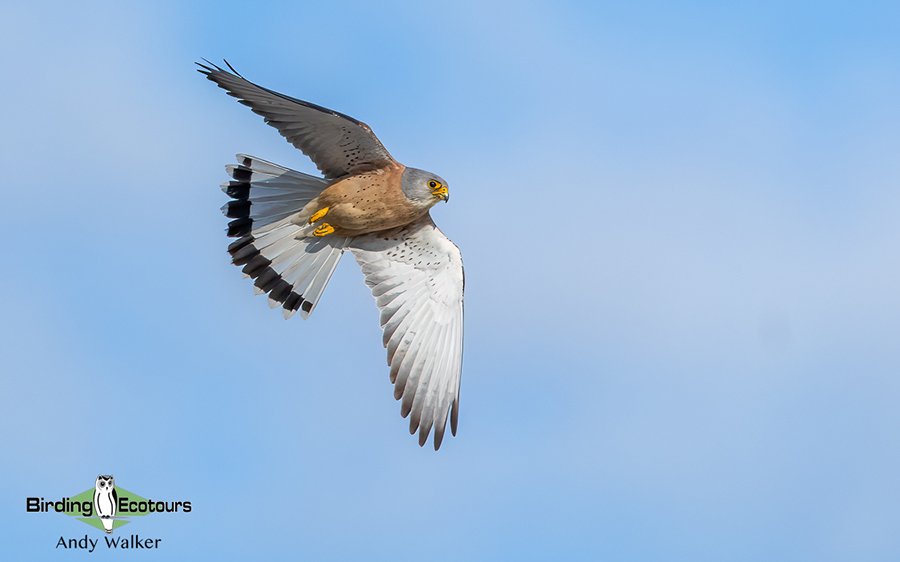
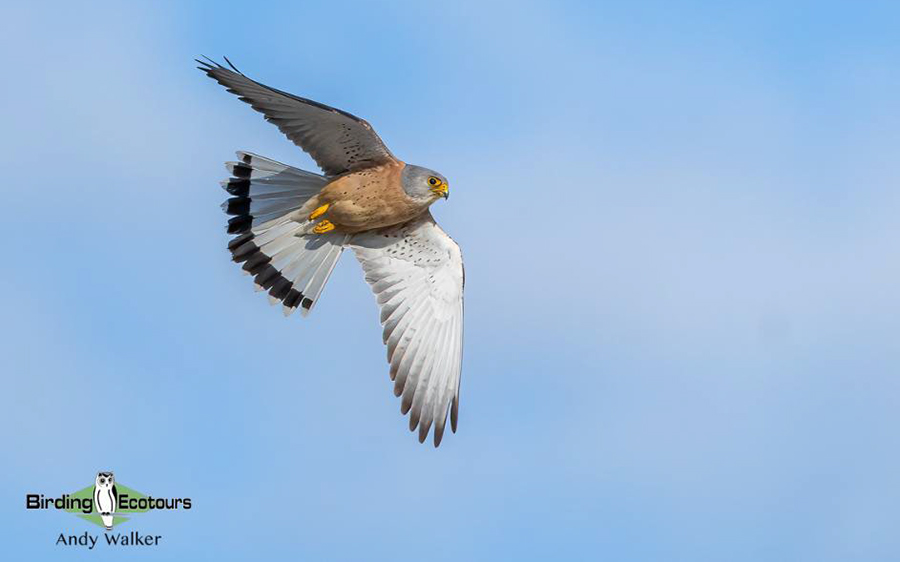 Lesser Kestrel is a species that will be migrating at the time of our Spain fall tour.
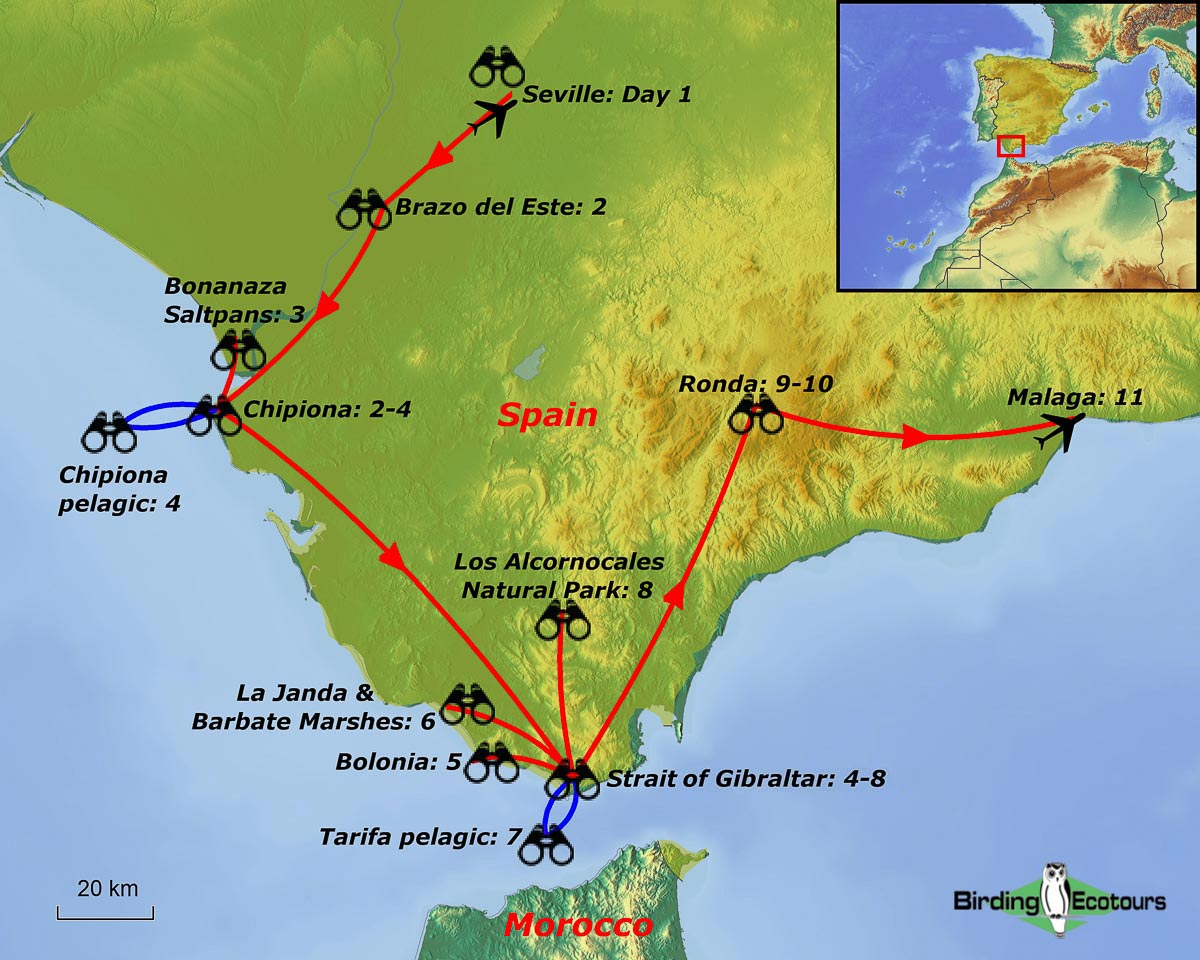
We will visit a range of habitats, from vast coastal grasslands to the high peaks of the region. It is this range of habitats, and its geographical location at the bridge between two continents, which makes Andalusia such a fantastic place for birding. The fall migration, along with the spring migration (when we run our other Spain tour), are the ideal times to visit this bird-rich part of Spain and Europe. Our tour is designed to be flexible to maximize our chances of seeing the best of the bird migration, however we will plan to follow the itinerary below, while keeping the weather conditions in mind.
Spain’s bird list currently stands at 687 species (following International Ornithological Congress (IOC) v14.2 taxonomy as of July 2024), one of the highest single country lists in the Western Palearctic. The region of Andalusia accounts for an impressive 495 of these species. With such a range of birds on offer we will maximize our chances of seeing as many as possible, with a combination of expert guides, a comprehensive itinerary visiting the best places to go birding in Andalusia, and visiting at the best time of year. These all combine to make for a wonderful birdwatching holiday.
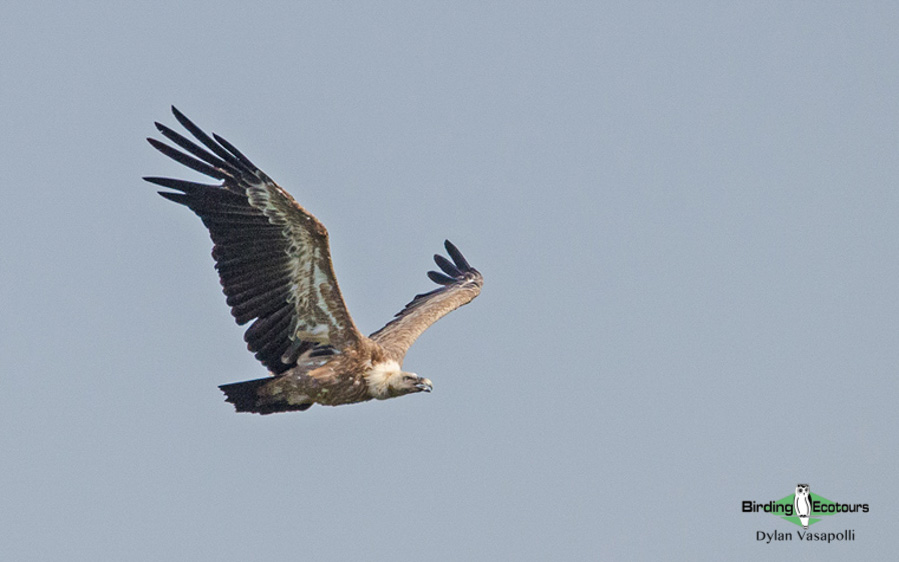 Griffon Vulture can be seen in the mountain areas in Andalusia.
We will begin our tour in the vast wetlands and saltpans on the east bank of the Guadalquivir River. This area is part of the wider Guadalquivir Marshes IBA (an Important Bird Area recognized by BirdLife International) and an enormously productive area. Here we will find a multitude of species, including passerines, egrets, herons, gulls, terns, and around 20 species of shorebirds (waders). While in the area we will look for the colonies of introduced species such as Yellow-crowned Bishop and Black-headed Weaver, and head to Europe’s only breeding colony of Little Swift. After exploring this area we will take a pelagic trip from Chipiona town, where we will explore the productive coastline for migrating seabirds including Wilson’s Storm Petrel, Great Shearwater, and the Critically Endangered (BirdLife International) Balearic Shearwater.
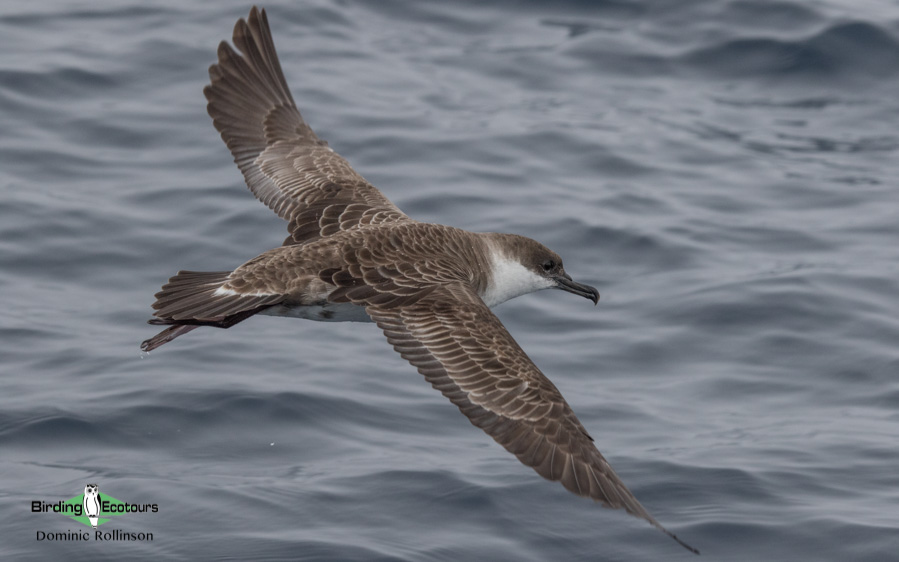 Great Shearwater may be seen on our pelagic trip.
We then head south to the Strait of Gibraltar to enjoy the best of the fall bird migration. We begin in the western straits and nearby Atlantic coast looking for shorebirds on the famous Los Lances beach, part of the wider Estrecho de Gibraltar IBA, where we also have a chance of the rare Audouin’s Gull. The pastures here are excellent for migrant passerines and it is here we can also witness the raptor migration at its best. At any moment, the skies can be full of raptors and storks, and the visible migration is a truly breathtaking experience. We will also visit nearby sites for the rare Mediterranean Chameleon plus the chance of the Critically Endangered (BirdLife International) Rüppell’s Vulture, a rare vagrant from Africa.
Next, we move to the interior lands of the straits. This area is usually full of passerines, shorebirds, waterfowl, and raptors, and always has the chance of throwing up a surprise or two. The area is also a staging area for migrating birds, and the number of birds here can be overwhelming. We will then move northwest along the Atlantic coast, where we will once again search through large flocks of shorebirds. This area is also excellent for migrating passerines. Finally, we will look for the Endangered (BirdLife International) Northern Bald Ibis. This species has bred well since being reintroduced here and is a wonderful conservation success story.
Returning to the main straits for some seawatching, with the Riff Mountains of Northern Africa as backdrop, will offer the chance of observing migrating seabirds, while overhead the raptor migration will continue. Another pelagic trip here will give us the opportunity to search for the many cetaceans that occur in the straits during fall, including the Critically Endangered (International Union for Conservation of Nature and Natural Resources – IUCN) Strait of Gibraltar subpopulation of Killer Whale (Orca).
We then leave the straits behind and head inland to the vast forests and mountains of the interior. Here we will look for some fascinating specials of the area including White-rumped Swift, a rare and recent colonist from Africa. We then head towards the beautiful, picturesque, and very birdy mountain town of Ronda, where we can also find herds of Iberian Wild Goat (Spanish Ibex). We will also enjoy the spectacular scenery of the Sierra Grazalema National Park and spend time here searching the area for its exciting birds.
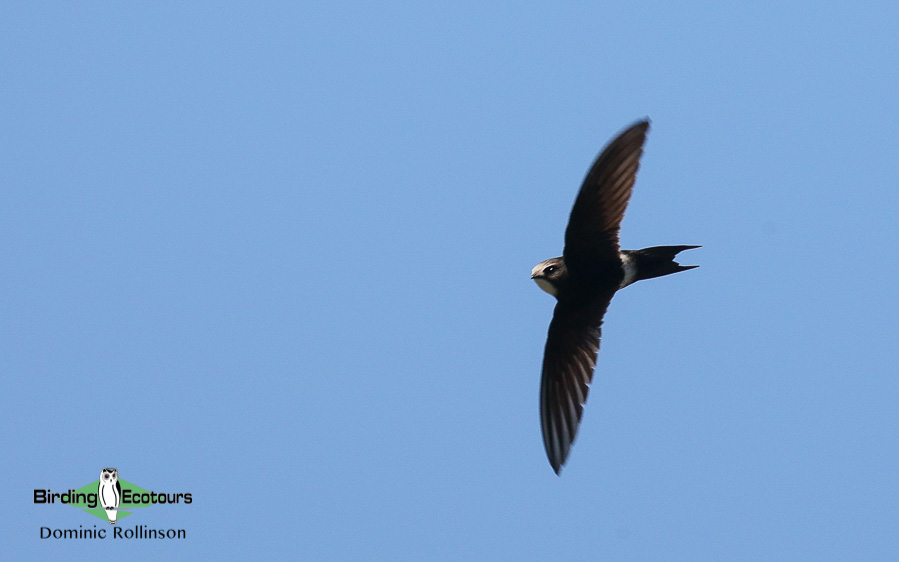 White-rumped Swift is a recent colonist from Africa.
Sadly, we will have to leave the mountains behind and end our trip as we make our way towards the coastal city of Malaga for our flights home as the tour concludes.
If you cannot make the dates of this scheduled tour, please get in touch and we would be happy to help build a custom tour with dates to suit you.
Itinerary (11 days/10 nights)
Day 1. Arrival in Seville
You will be met at Seville San Pablo Airport by your tour leader/bird guide. Once the group has arrived, we will meet at our hotel to discuss the trip itinerary and help facilitate anything the group may need or just relax before the trip starts. We will have a group ‘welcome meal’ in the evening.
Overnight: Hotel in Seville
Day 2. Birding around Brazo del Este and Chipiona
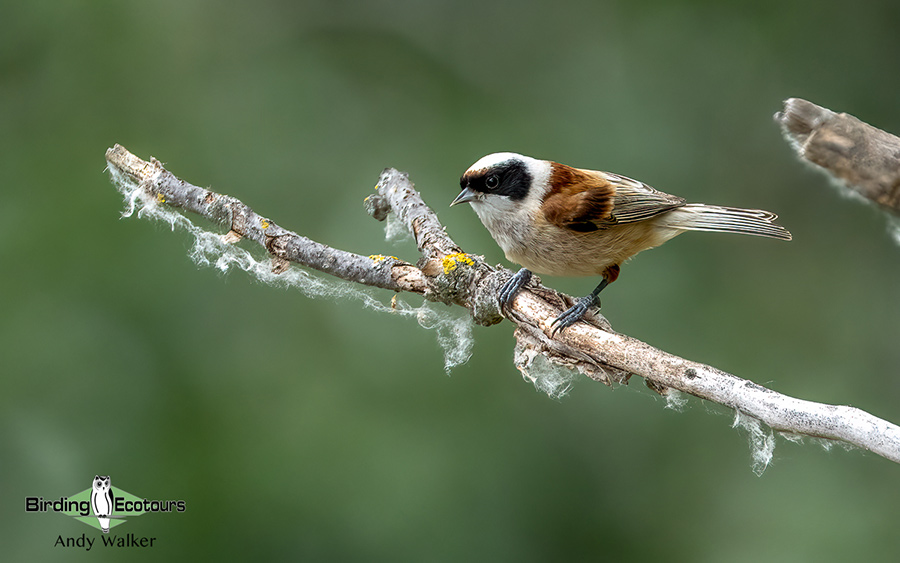
The protected area of Brazo del Este, near the city of Seville, is a superb habitat for shorebirds and waterbirds, with large numbers of Northern Shovelers, Northern Lapwings, and Pied Avocets gathering here in fall. The area is also superb for passerines such as Eurasian Penduline Tit, Savi’s Warbler, and Great Reed Warbler. We also stand a chance of adding some elusive crakes to our list, with Spotted Crake, Little Crake, and Baillon’s Crake all present here.
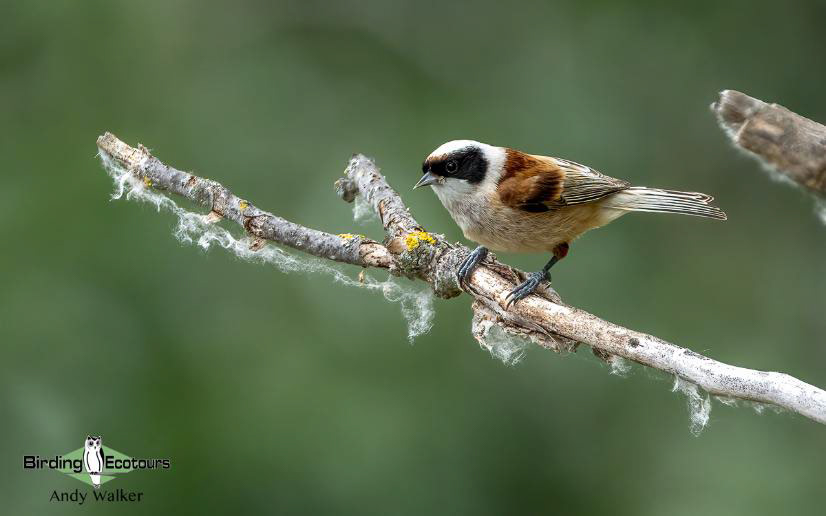 We will check the reedbeds and adjacent vegetation for Eurasian Penduline Tit.
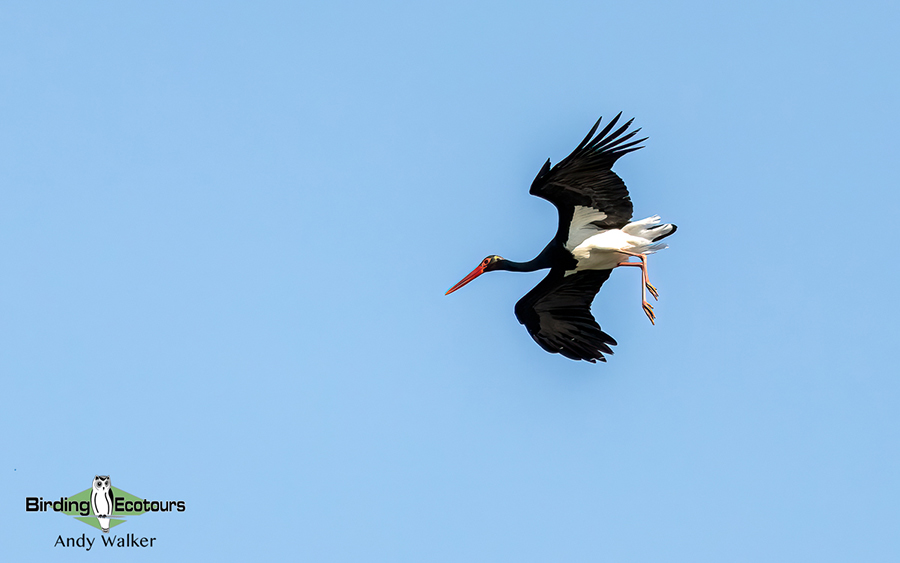
As we proceed through the site, we will come across significant numbers of Western Swamphens, Purple Herons, Squacco Herons, and Whiskered Terns, and many more species typical of this habitat, such as the vast flocks of Glossy Ibis which have now colonized the area and are present year-round. This is a particularly good site for migrants, and White Stork, Black Stork, European Turtle Dove, European Bee-eater, Whinchat, and Northern Wheatear are often found here during this period. We should also see some introduced species from Africa and Asia that have established themselves in the area, such as Black-headed Weaver, Yellow-crowned Bishop, Common Waxbill, and Red Avadavat.
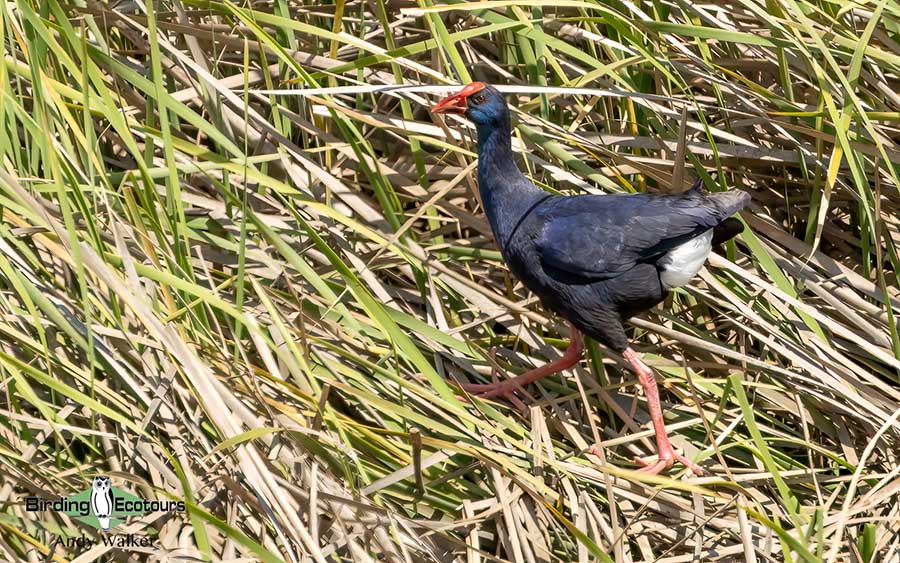
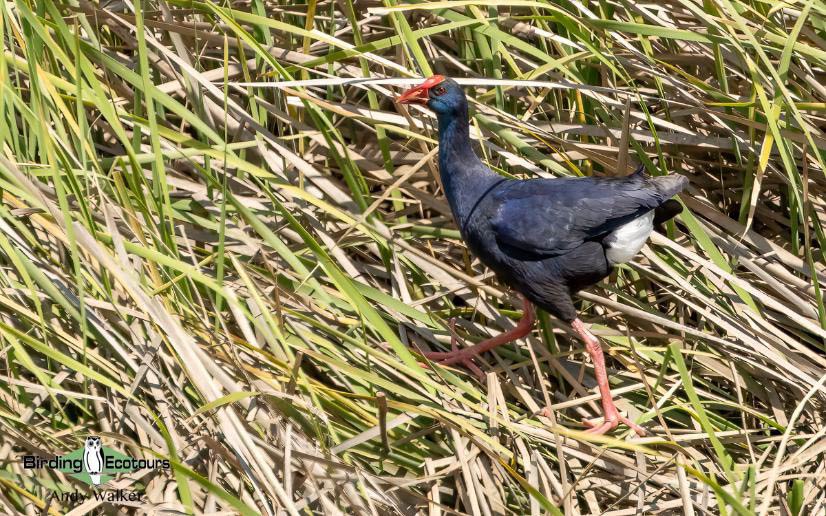 Western Swamphen is a brute of a bird and is found in the marshland here!
While here, we will also visit the Port of Chipiona, home of great seafood. The town also holds the only European colony of Little Swift. While common on the other side of the Mediterranean Sea in Morocco, this species is a real European mega rarity, and we will spend time watching the colony. The beach nearby can be excellent for shorebirds, gulls, and terns including rare species such as Lesser Crested Tern, although this species is typically more common in spring.
Overnight: Chipiona
Day 3. Bonanza, Trebujena, and Montijo
Today we will explore the vast saltpans and habitats near the mouth of the Guadalquivir River. We will start at the Bonanza Saltpans. This expansive saltpan site is superb for shorebirds and we will spend some time here looking for a range of species including Kentish Plover, Little Ringed Plover, Black-winged Stilt, Pied Avocet, Dunlin, Little Stint, Curlew Sandpiper, Sanderling, Ruff, Common Redshank, and Eurasian Whimbrel.
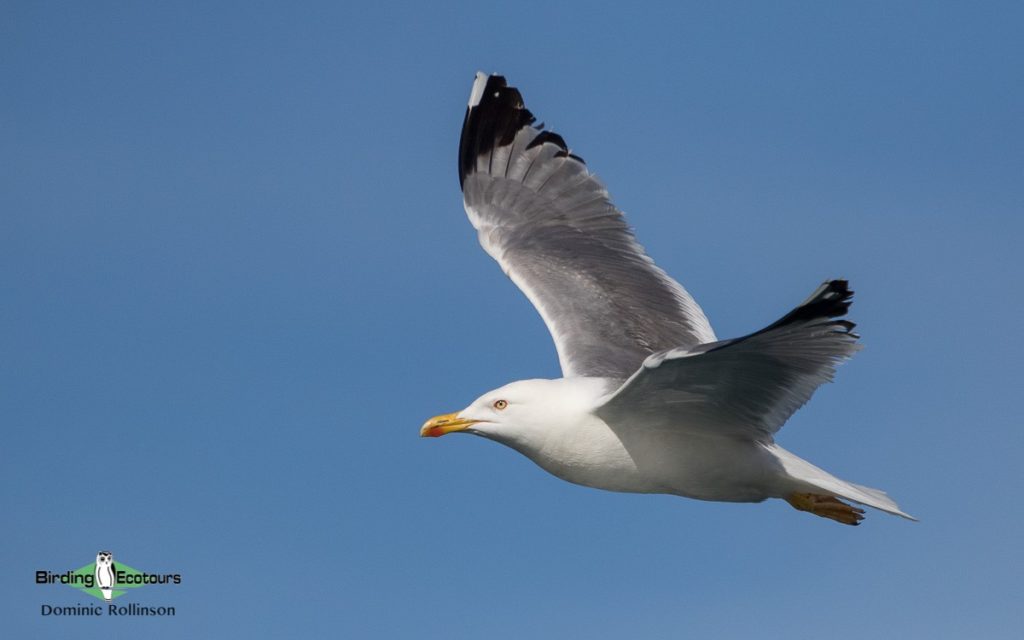 A number of gull and tern species may be seen near the mouth of the Guadalquivir River, such as this Yellow-legged Gull.
The area is also excellent for two rare waterbirds, the Endangered (BirdLife International) White-headed Duck and the Critically Endangered (in Spain) Red-knobbed Coot (BirdLife International). The entire European population of the coot is found in Spain and even here it is incredibly rare. Greater Flamingo is a common species here, as are Yellow-legged Gull, Crested Lark, and Sardinian Warbler.
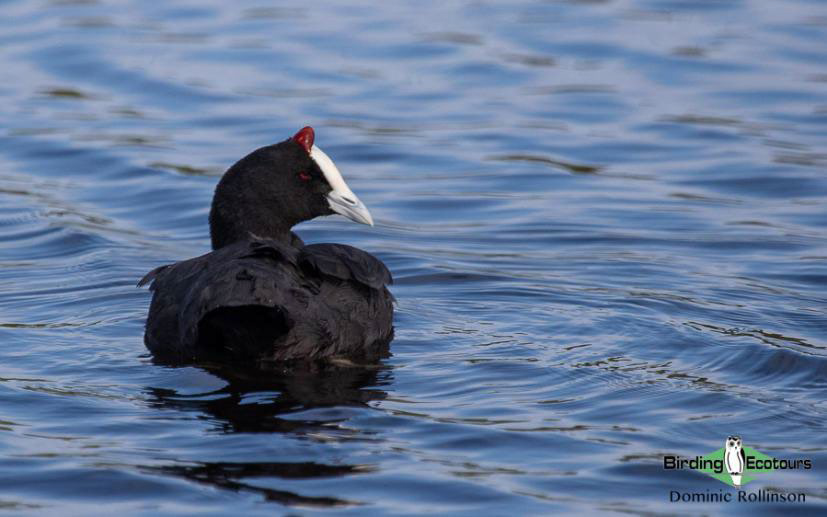 The Guadalquivir area is a stronghold for the Critically Endangered (in Spain), Red-knobbed Coot, this species is tough to find in Europe.
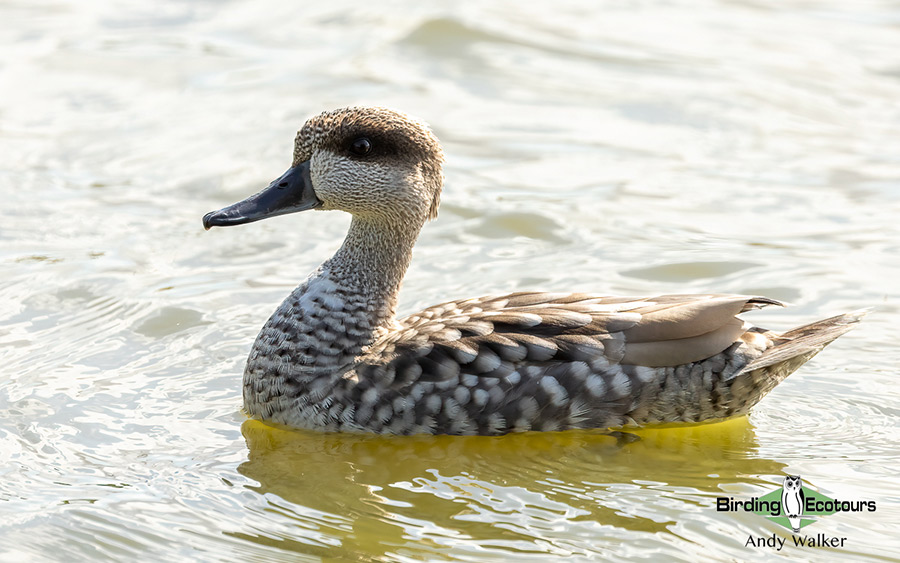
The second site in the area will see us explore the habitats bordering the Guadalquivir River. Along the river we may get passing terns and gulls, with Slender-billed Gull, Little Tern, and Caspian Tern all present here. The wetlands near the river are where we will search for two key species in the form of Marbled Duck (another very localized species in Europe) and the newly described Mediterranean Short-toed Lark (formally Lesser Short-toed Lark), two species that are rare elsewhere in Spain. The area is also home to the striking Rufous-tailed Scrub Robin, which can be present well into September.
Overnight: Chipiona
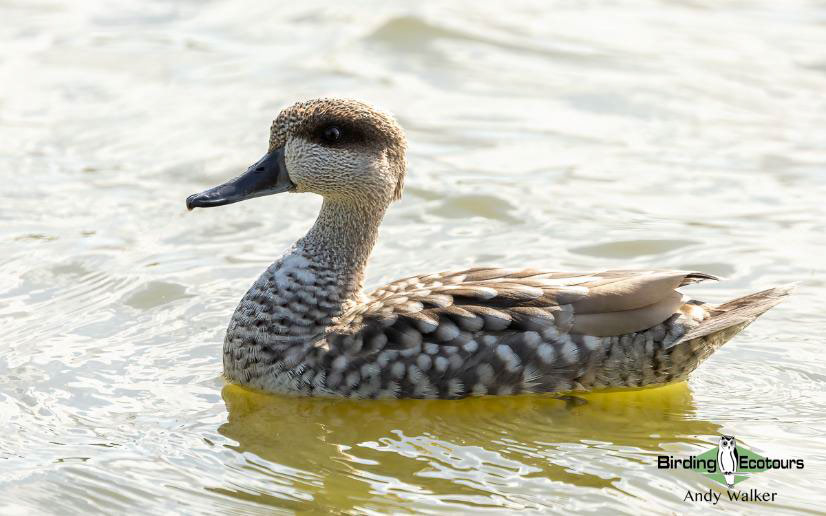 The localized Marbled Duck will be a target during this Spanish birding tour.
Day 4. Pelagic trip from Chipiona and drive to Tarifa
Today we will take an exciting pelagic trip from Chipiona out into the Atlantic Ocean. This trip lasts around six hours and we will head out to around 10 nautical miles (~19 kilometers) offshore. The Gulf of Cadiz is a marine reserve, combined with the Strait of Gibraltar, and it is a species-rich area. On the pelagic we will look for seabirds, with highlights including Balearic Shearwater, Cory’s Shearwater, Great Shearwater, Great Skua, Parasitic Jaeger (Arctic Skua), Northern Gannet and, with luck, European Storm Petrel and Wilson’s Storm Petrel. We will have plenty of time to study these species and, if conditions allow, we will get excellent photographic opportunities.
Once we have finished the pelagic, we will begin the two-hour drive down to the Strait of Gibraltar and our base at Tarifa. If time allows, we will explore the area around the town or take time to relax on the stunning Playa de los Lances’ beach.
Overnight: Tarifa
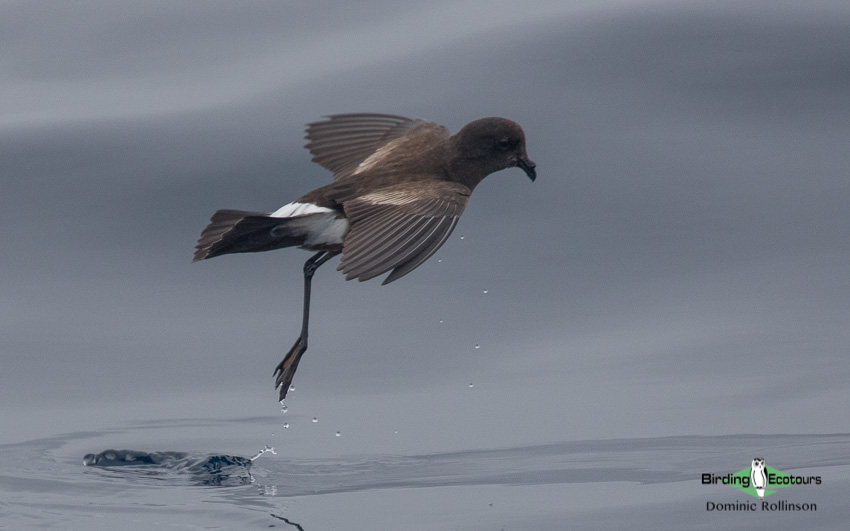
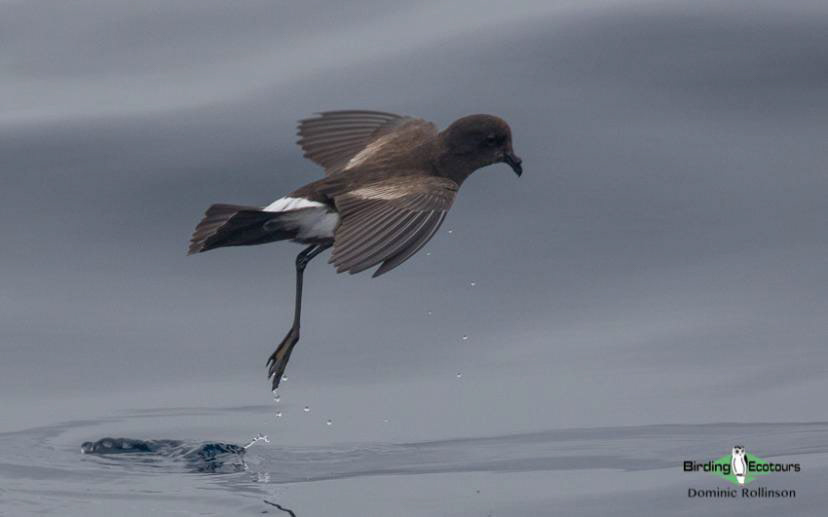 The Bay of Cadiz is an excellent place to look for the rare Wilson’s Storm Petrel.
Day 5. Los Lances, migration watchpoints, and Sierra de la Plata
After breakfast, we will visit the beautiful Los Lances beach near the town. This vast beach is popular with tourists and also an excellent spot to look for shorebirds, gulls, and terns, such as the widespread Kentish Plover, the Vulnerable (BirdLife International) Audouin’s Gull, attractive Mediterranean Gull, and huge Caspian Tern. The pastures around the beach are usually full of migrating passerines and it is often hard to know where to look due to all the activity!
Some of the more numerous species here include Crested Lark, Spotless Starling, Zitting Cisticola, European Stonechat, Tawny Pipit, the Iberian subspecies (iberiae) of Western Yellow Wagtail, and Corn Bunting. Overhead, we may see migrating raptors as they climb on thermals before drifting south and over to Africa, an exciting prelude for what is to come on this tour.
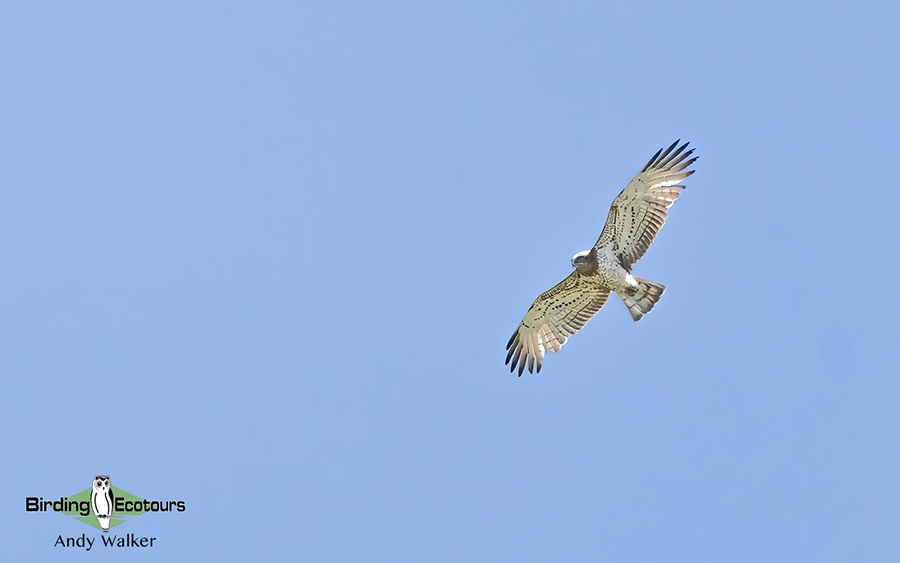
From the beach we will head up into the Strait of Gibraltar proper to witness the spectacle of raptor migration at its best. By keeping a watch on the weather, we will hope to time our visits with the peak movements of raptors as they move through the area. This ploy should allow for excellent views of European Honey Buzzard, Short-toed Snake Eagle, Booted Eagle, Black Kite, Western Marsh Harrier, Montagu’s Harrier, Egyptian Vulture, and Eurasian Sparrowhawk. There is also the chance of bonus species such as Black-winged Kite, Rüppell’s Vulture, Cinereous Vulture, Bonelli’s Eagle, Spanish Imperial Eagle, Lesser Kestrel, Eurasian Hobby, and Eleonora’s Falcon, certainly an impressive range of species.
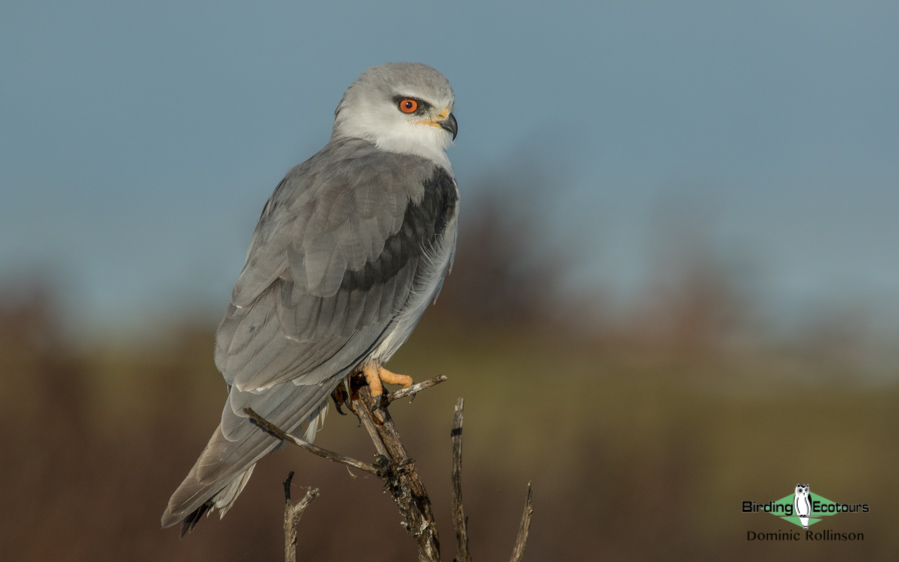 We may see Black-winged Kite while watching migration at the Strait of Gibraltar.
During the afternoon, when the raptor migration tends to slow, we will visit the stunning coastline of Bolonia. This is one of the most stunning parts of the Strait of Gibraltar and gives great views across the sea to Africa. The beach and adjoining pine forest can be good for migrating passerines and shorebirds, but the real star here is the rare Mediterranean Chameleon, an incredible, small reptile.
The mountain behind the village, known as Sierra de la Plata, is home to a Griffon Vulture colony and, with luck, we may also find Egyptian Vulture, and the Critically Endangered (BirdLife International) Rüppell’s Vulture here.
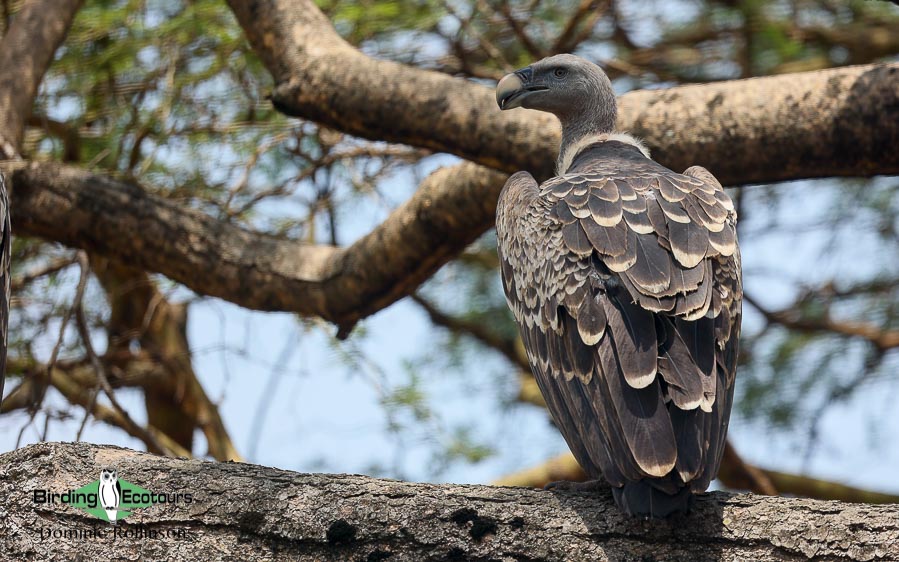 Rüppell’s Vulture is an incredibly rare bird in Europe, and worth searching for on this tour.
While exploring the mountain we will keep a look out for interesting passerines like Thekla’s Lark, Blue Rock Thrush, Rock Bunting, and Cirl Bunting. It is also possible to find migrants here like Western Black-eared Wheatear, Whinchat, and Tree Pipit. Overhead the raptor spectacle may begin to build again as the day moves on, and this is an excellent spot to watch from.
Overnight: Tarifa
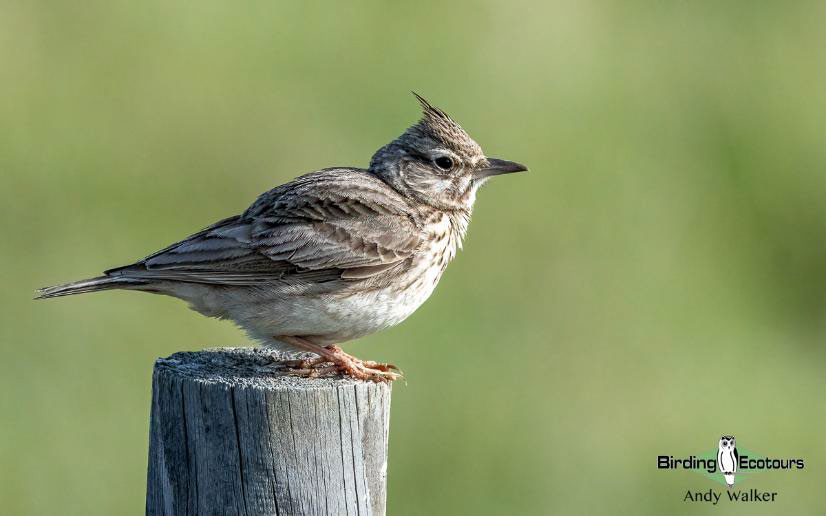 We will look for Thekla’s Lark on this tour.
Day 6. La Janda, searching for Northern Bald Ibis, and Barbate Marshes
Today we will explore the vast former lake of La Janda. This area was once an internationally important lake and wetland, but was drained during Spain’s period under the control of General Franco. Today, while not at the level it was formally, it is still a vitally important breeding and migration staging area for a range of species.
While exploring the area we will come across groups of passerines such as European Goldfinch and Spanish Sparrow, which may contain the rarer Eurasian Tree Sparrow. The agricultural areas can be full of White Storks, Little Egrets, and Grey Herons, and these are often joined by the scarcer Black Stork, Glossy Ibis, and Eurasian Spoonbill. A large reed-lined canal here is home to good numbers of Western Swamphens, and this abundance of life attracts several raptor species, including Black-winged Kite, Montagu’s Harrier, Western Marsh Harrier, Black Kite, Booted Eagle, and Short-toed Snake Eagle. This is also one of the best places in Spain to find Bonelli’s Eagle and the Iberian endemic Spanish Imperial Eagle, a species that numbers only almost 1,100 individuals (based on estimates in 2020), but is slowly increasing.
From La Janda we will head northwest to the Barbate Marshes. This area has been transformed in recent years and is now home to good numbers of shorebirds like Black-winged Stilt, Sanderling, and Curlew Sandpiper. Gulls and terns from the nearby Atlantic Ocean often stop here to roost, and the marshes are a good place to find Audouin’s Gull and Caspian Tern. The former saltpans often hold Eurasian Stone-curlew and Greater Flamingo. This is also an excellent area for migrating passerines, with the tamarisk here providing cover and food for species like Greater Short-toed Lark, Spectacled Warbler, and Tawny Pipit.
Barbate is also the best place to look for the Endangered (BirdLife International) Northern Bald Ibis. This strange-looking species was reintroduced to the area and has been a success in recent years, with 90 birds present in 2017. We will spend time observing the interesting behavior of one of the world’s rarest birds, a real privilege to witness.
Overnight: Tarifa
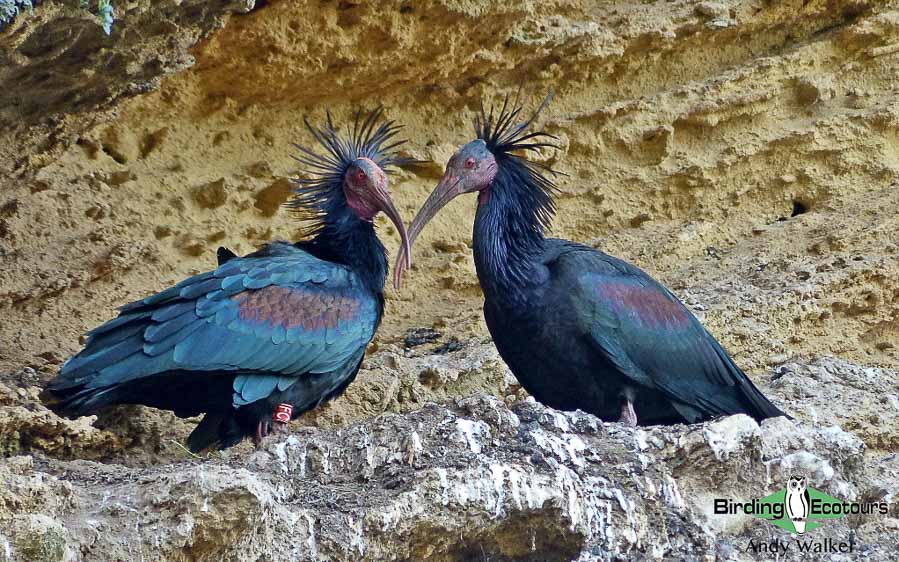 The Northern Bald Ibis is one of the world’s rarest birds, and a real bonus species for visits to Andalusia. In fall they are found away from their breeding cliffs at the Barbate Marshes
Day 7. Island of Tarifa, migration watchpoints, and whale watching
Today we will head to the island of Tarifa. This area is the southernmost tip of mainland Europe and a superb point for looking for passing seabirds. As we look out over the water, we will have the Mediterranean Sea to our left, the Atlantic Ocean to our right, and Africa just eight miles (14 kilometers) in front of us.
Access to the island is highly restricted, making a visit here an exclusive event. The island is home to a spectacular Yellow-legged Gull colony, and seawatching from here will give us the chance of Scopoli’s Shearwater, Balearic Shearwater, Great Skua, Parasitic Jaeger (Arctic Skua), and Northern Gannet. Depending on how the raptor migration is looking, we will remain flexible and may head to the migration watchpoints at any point during the morning.
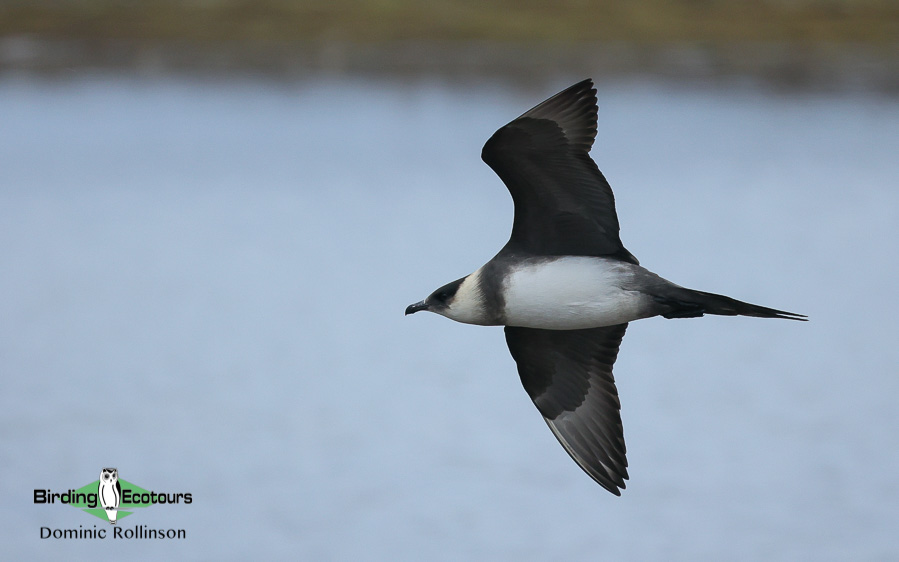 While seawatching we may find the impressive-looking Parasitic Jaeger.
In the afternoon we will take our second pelagic of the tour, out into the Strait of Gibraltar. This two-hour trip will be aimed at finding the resident and migratory cetaceans of the seas here. Resident species include Short-beaked Common Dolphin, Striped Dolphin, Common Bottlenose Dolphin, and Long-finned Pilot Whale. With luck, we might spot migratory species such as the giant Sperm Whale and Fin Whale, plus the Critically Endangered (IUCN) Strait of Gibraltar subpopulation of Killer Whale (Orca). It is sure to be an exciting trip.
Overnight: Tarifa
Day 8. Valle de Ojén, Barbate Reservoir, and migration watchpoints
Today we will visit Los Alcornocales Natural Park, sometimes known as the Mediterranean jungle. This vast cork oak forest is famous for supplying the world with cork for wine bottles, for many hundreds of years, and is also a fabulous spot for birding. The dense forest here holds good populations of resident Short-toed Treecreeper, Eurasian Nuthatch, Common Firecrest, Great Tit, Eurasian Blue Tit, and Eurasian Jay, while the more open areas are good spots for Iberian Grey Shrike, Thekla’s Lark, Woodlark, Dartford Warbler, Sardinian Warbler, Rock Bunting, and Cirl Bunting.
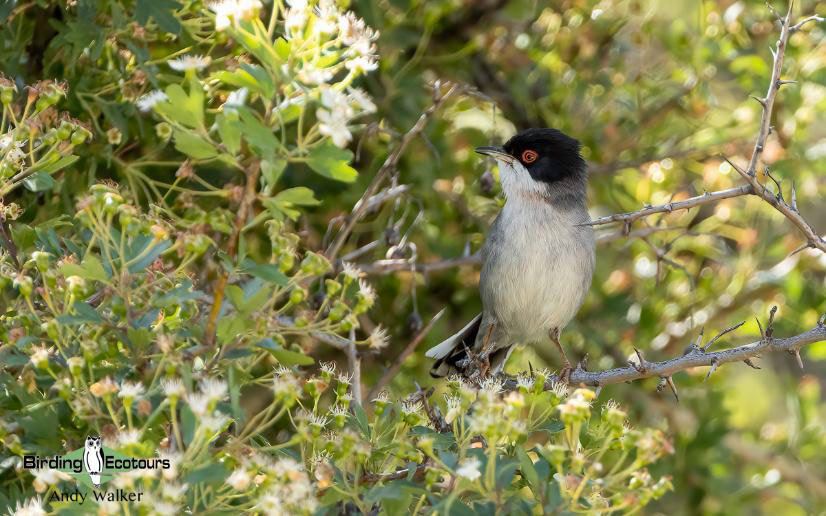 We will keep our eyes peeled for Sardinian Warbler.
The forest is also popular with migrant passerines, and our visit here is well timed to find Woodchat Shrike, Eurasian Blackcap, Spotted Flycatcher, European Pied Flycatcher, Common Redstart, Western Black-eared Wheatear, and Tawny Pipit. We will also visit Barbate Reservoir, a stronghold for White-rumped Swift, a recent colonist in Europe and still scarce. After lunch we will head to the Strait of Gibraltar for one last look at the raptor migration.
Overnight: Tarifa
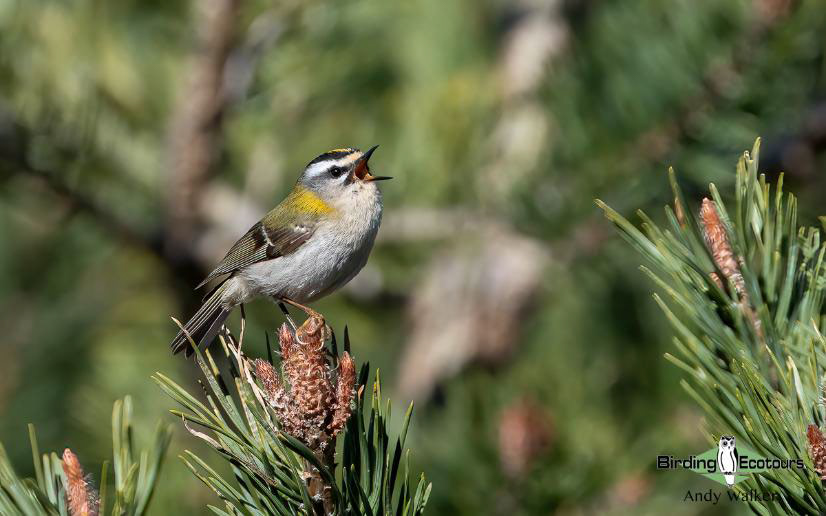 The tiny Common Firecrest might be found in the forest.
Day 9. Casares, Gaucin, and Ronda
Our tour takes a dramatic change in habitat today as we leave the Strait of Gibraltar and head into the mountains that straddle the border between Cádiz and Malaga provinces. The limestone escarpments here are a good place to watch large herds of Iberian Wild Goat (Spanish Ibex), with luck, we may even come across an impressive adult male.
The mountains here are also dotted with “Pueblos Blancos” (classically white-painted villages of the local Spanish style) such as Casares, Gaucin, and Algatocin. These beautiful villages are tucked into mountain valleys and the whole area is as atmospheric as it is productive for wildlife. We will explore the habitats around these villages and enjoy species such as Griffon Vulture, Bonelli’s Eagle, Eurasian Crag Martin, Coal Tit, Sardinian Warbler, Blue Rock Thrush, European Stonechat, Corn Bunting, Rock Bunting, and Cirl Bunting.
In the afternoon we will visit the beautiful town of Ronda, one of Spain’s most historical cities and an important settlement from as long ago as the Roman Empire. Ronda is built on top of a huge rock outcrop and those with a fear of heights may want to avoid getting too close to the barriers on the famous bridge that joins the two sides of the town. However, those that brave the bridge could be rewarded with excellent views of Alpine Swift, Common Kestrel, Peregrine Falcon, Red-billed Chough, Eurasian Crag Martin, Blue Rock Thrush, and Rock Bunting. The parks in town can also be a good spot to find the elusive Hawfinch and Red (Common) Crossbill. At this time of year Black Redstart begin leaving their breeding grounds higher in the mountains to spend the winter at lower levels, such as in Ronda.
Overnight: Ronda
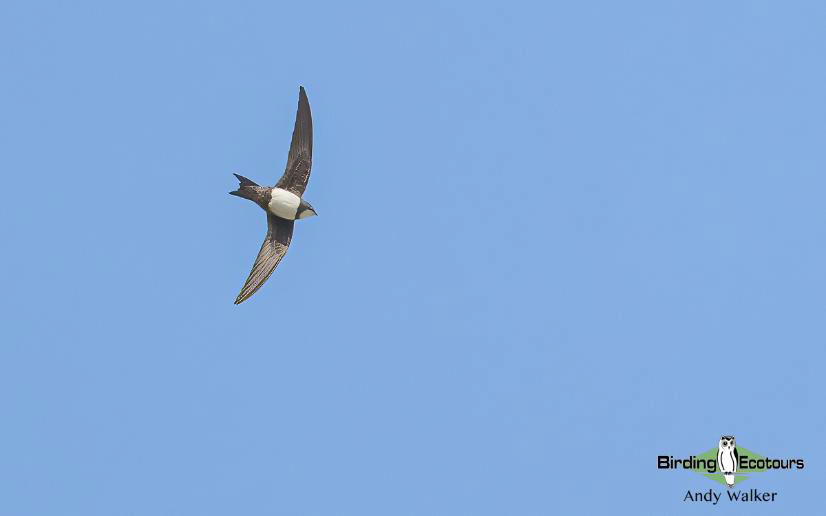 A large and well-marked Alpine Swift cuts a distinctive shape over the skies in Spain.
Day 10. Montejaque and Llanos de Libar
The final full day of the tour will see us visit the most breathtaking landscapes in the region. The Serrania de Ronda and Grazalema Natural Park are part of the stunning region and are full of birds and jaw-dropping scenery. We will visit several sites, making the most of the continued long daylight hours afforded to us in early September.
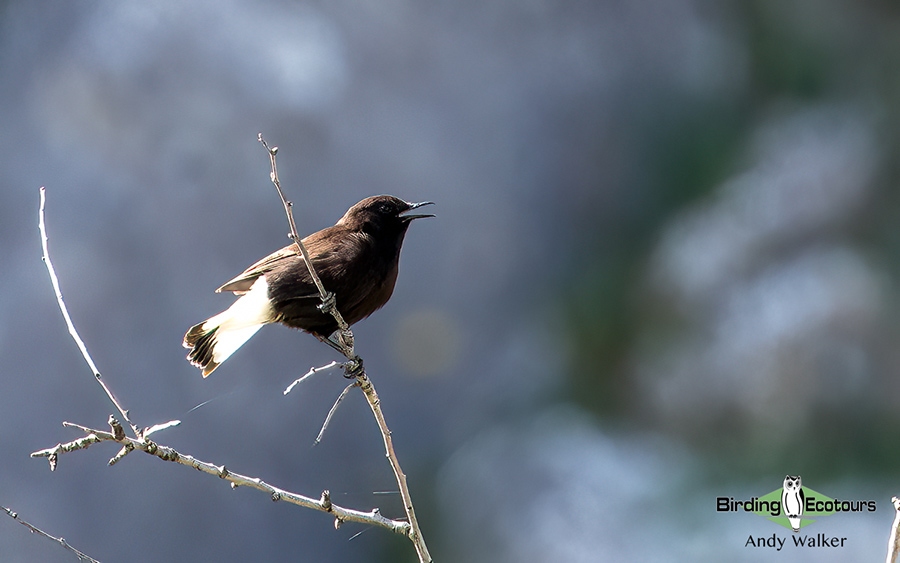
Our first stop is the stunning mountain valley of Llanos de Libar. This valley is excellent all year round, with resident species like Griffon Vulture, Bonelli’s Eagle, Golden Eagle, Little Owl, Iberian Grey Shrike, Red-billed Chough, Black Wheatear, Black Redstart, Rock Sparrow, and Rock Bunting. There will also be signs of migration here, as passerines move through the valley on their way to the coast and raptors like Black Kite, European Honey Buzzard, and Short-toed Snake Eagle migrate overhead.
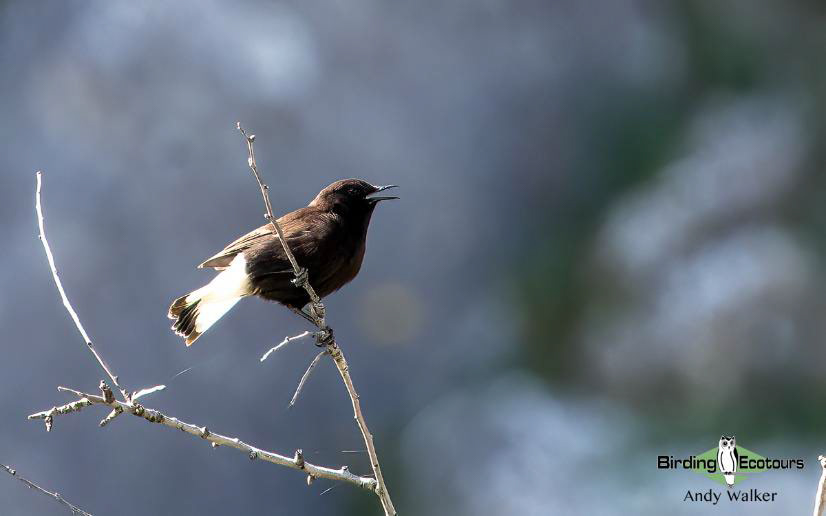 Black Wheatear will be a target as we bird the stunning Llanos de Libar.
A nearby area of agricultural land and woodland in the valley holds Iberian Green Woodpecker, Great Spotted Woodpecker, Woodlark, Great Tit, Coal Tit, Long-tailed Tit, White Wagtail, Meadow Pipit, Hawfinch, Common Chaffinch, Common Linnet, and Cirl Bunting.
We will also explore the area around the Cueva del Gato, which is home to a large colony of Alpine Swift. Other common birds here include Eurasian Crag Martin, Western House Martin, European Robin, Blue Rock Thrush, Common Blackbird, European Stonechat, European Serin, European Greenfinch, and Corn Bunting.
This is also a good area to find Common Kingfisher, Cetti’s Warbler, White-throated Dipper, and Grey Wagtail, since the river rarely dries up, even during the hottest of summers.
Overnight: Ronda
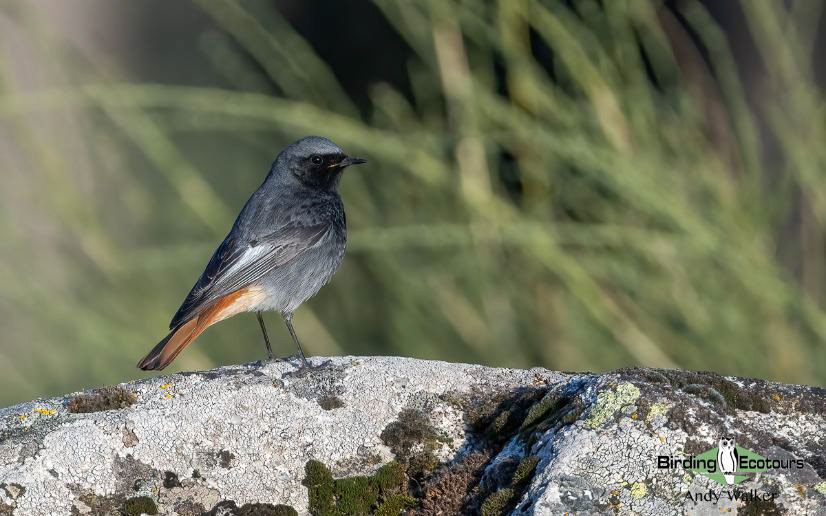 Black Redstart is yet another attractive bird to be found while birding in Spain.
Day 11. Drive to Malaga and departure
Sadly, our tour comes to an end today. Depending on the time of your flight, we may be able to explore Ronda once more to look for any species we may have missed around the town previously. We will then take the scenic mountain drive towards the coastal city of Malaga in time for your flight home in the late afternoon. At some point today we will also have to choose our ‘bird of the trip’ and your expert guides will be on hand to answer any queries about the trip list or species identification.
Overnight: Not included
Please note that the itinerary cannot be guaranteed as it is only a rough guide and can be changed (usually slightly) due to factors such as availability of accommodation, updated information on the state of accommodation, roads, or birding sites, the discretion of the guides, and other factors. In addition, we sometimes have to use a different guide from the one advertised due to tour scheduling or other factors.
Map
Gallery
General Information
Spain: Birding Andalusia in Fall
Tour-specific Information
GENERAL INFORMATION ABOUT SPAIN CAN BE READ HERE
TOUR OUTLINE
This small-group birding tour to Spain in the fall (autumn) season offers a wide range of exciting birds without having to travel too far. The tour starts in Seville and ends in Málaga and takes in a wonderful birding circuit, even including two pelagic trips (off Tarifa and into the Bay of Cadiz). The list of possible bird species on this tour is long, and includes Spanish Imperial Eagle, Rüppell’s Vulture, Audouin’s Gull, Balearic Shearwater, Cory’s Shearwater, Great Shearwater, Wilson’s Storm Petrel, Northern Bald Ibis, Red-knobbed Coot, White-headed Duck, Little Swift, White-rumped Swift, Iberian Magpie, Rufous-tailed Scrub Robin, Black Wheatear, and many more, including the impressive spectacle of visible migration of cranes, raptors, storks, and shorebirds. The detailed itinerary includes full details of what to expect on this wonderful European bird tour.
WEATHER/CLIMATE
Our fall tour will see high temperatures throughout, ranging from 82 – 95 °F (28 – 35 °C) during the daytime. Coastal areas can be cooler but please be aware of these likely high temperatures and remember to pack accordingly. If you struggle with being outside in these temperatures, then please also bare this in mind. Nights are warm with temperatures of 64 – 69 °F (18 – 21 °C), and evening temperatures will still be very warm. The sun will be incredibly strong at this time of year however rain should not be a problem (but as this is Europe it should never be totally ruled out!).
DAILY ACTIVITIES, PHYSICAL REQUIREMENTS, AND TOUR PACE
Our Spain fall birding tour covers a large section of Andalusia and is at a faster pace than some other tours we run. A long list of birds is possible on this birdwatching tour. We break longer journeys up with birding stops and bathroom breaks where needed.
The majority of walking is an easy level of effort and at a gentle pace and should be suitable for most people. For the most part walking will be on easy tracks, roads, and trails. Some longer walks may be required for some bird sites and the exact details of these longer walks will be given to you ahead of time, most walks are optional and should you prefer to sit out a walk we will try to plan something else for you. Relaxing around the hotel grounds could be a good option.
On this tour there will be some early starts and late finishes to our days in the field to maximize our birding time and meal times will remain variable around our birding activities. The main focus of this tour is to find as many Spanish bird specials as possible. Most of the tour is spent at sea-level and low mountain elevations (e.g. around Málaga we will find ourselves birding at around 2,460 feet / 750 meters).
DOMESTIC FLIGHTS
There are no domestic flights required for this Spain tour. Please be aware that the tour starts in Seville at Seville San Pablo Airport and ends in Málaga at Málaga-Costa del Sol Airport.
ACCOMMODATION
During our Spain fall tour we stay in a range of two-star to four-star hotels. Accommodation is of a traditional style and has been selected to offer the best experience in the area, including being close to excellent birdwatching areas.