Written by Anton Schultz and published on 15 January 2026
The Red Lark is a dune-dwelling desert specialist endemic to South Africa’s Northern Cape Province. Classified as Vulnerable in the IUCN Red List, it faces growing threats from climate change and overgrazing. While often admired for its charismatic behavior and perfectly camouflaged plumage, a less frequently told aspect concerns its finely balanced behavioral decisions in extreme desert heat, and how these are likely to be impacted by climate change in the coming years. Ongoing research aims to use artificial shade as a possible conservation intervention to assist Red Larks, although their future survival in a changing world is still uncertain.
Many South African birders have had to make the journey out to a strange, almost Martian landscape of red dunes in the interior of the arid Northern Cape to add a very special bird to their list. While there are several arid-zone specials around this part of the world, perhaps none is more desirable than the dapper, charismatic, and endemic Red Lark (Calendulauda burra), a bird classified as Vulnerable by the IUCN Red List and at risk from both overgrazing of dune grass and climate change.
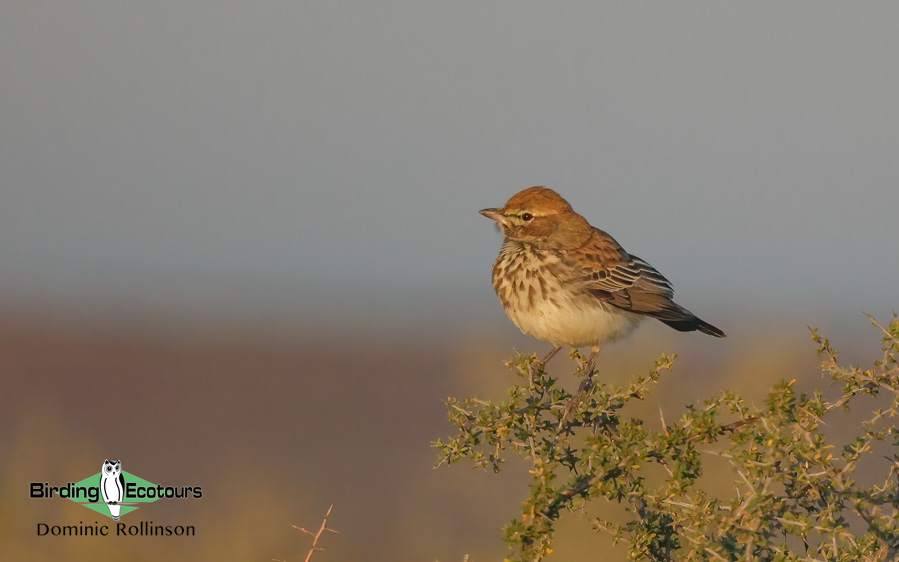
A Red Lark scanning its surroundings from the top of a Trithorn (Rhigozum trichotomum) bush.
Once you become one of the lucky people to have ticked it, it’s quite easy to see why it is so loved. If you see this species in the usual places, you’ll be greeted by a bird with a plain brick-red back and jet-black brush strokes down its white breast, a heavy bill, and a dainty gait. This is likely the C. b. burra or C. b. aridula subspecies of the bird from the northwestern dunes around Aggeneys or Van Wyksvlei, respectively. The streaky-backed, brown C. b. harei inhabits the central alluvial plains of the Red Lark’s range, away from the dunes. However, in truth, the official existence of these subspecies is debatable, given extensive range overlap, interbreeding, and nearly indistinguishable genetic differences. Most birders, myself included, prefer seeing the red-backed form of Red Lark first.
The song of the Red Lark is best heard rather than described (listen here): a repetitive, four- to five-note fluty phrase, often delivered from above as a male undertakes his display flight of up to 160 feet (50 meters) over his small territorial domain. When he lands, often atop a low green shrub, he briefly scans his surroundings before letting out a sharp, trilling call. He then returns to the desert floor to continue foraging for large seeds and small insects in the morning sunlight, leaving delicate footprints behind as he makes his rounds.
Surviving in an extremely hot climate
During midday, the bright red dunes become paler as they’re exposed to the harsh sunlight. Now, temperatures can reach up to 113°F (45°C), and a thermal landscape of smaller shaded and unshaded microsites at different operative temperatures become apparent (with solar radiation, humidity, wind speed, and other climatic variables taken into account). As this happens, the life of the lark changes markedly. It spends much less time in the sun and much more time under vegetation like Trithorn (Rhigozum trichotomum), Karoo Gold (R. obovatum) and the iconic Greenhair Tree (Parkinsonia africana). At this time of the day, I’ve enjoyed many a peaceful vigil watching these birds making decisions about their resource expenditure on a fine scale.
To pant or not to pant? Panting will significantly reduce heat stress, but at the cost of significant water loss, so the lark must choose wisely. Interestingly, Red Larks aren’t known to drink any water, receiving it only from their diet. What moisture they do have is precious to them, and whatever they forage for, better be worth the offset. Resting in the shade is a beneficial way to offload heat, but it comes with missed foraging opportunities. Often a bird will enjoy a long rest under vegetation with one eye open watching the canopy, remaining vigilant, waiting for a caterpillar large enough to justify its effort. And sometimes a bird will forage so slowly and lazily that the line between foraging and resting becomes blurred.
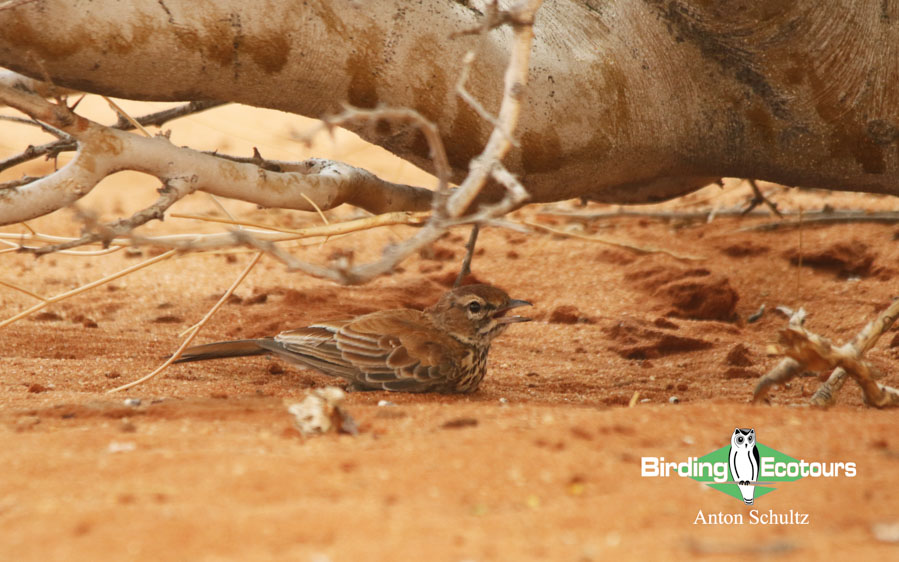
The shade of a Greenhair Tree (Parkinsonia africana) is one of the best places to rest during the hottest hours of the day.
A physiologically able bird, but will it survive further temperature increases?
It’s in these small micro-decisions that the plight of the Red Lark is becoming apparent. As global temperatures continue to rise, the fat caterpillar may become less appealing in the face of reducing body temperatures, and as this happens, larks will incur gradual long-term costs to their physical condition, like body mass reduction when they decide not to go for it. In essence, what a bird gains during the day may no longer offset what it loses overnight. In the case of the Red Lark, males have been shown to experience daily body mass gains equivalent to overnight losses when the maximum daily temperature reached 92°F (34°C), and no diurnal (daytime) body mass gain when the maximum temperature reached 104°F (40°C). A recently published paper modeled habitat suitability for Red Larks and found that one of the species’ largest strongholds — the Black Mountain Mine Conservation Area (BMMCA)— is holding a population of between 232 and 382 individuals, less than 50% of what was predicted in 1989. Given this, it makes it all the more concerning that the current trajectory of climate change predicts many more days over 40.0°C in the region, and with that, the knowledge that this species is unlikely to persist across much of its current range by 2100.
My own work with the Hot Birds Research Project out in the Koa Dunes, near to the BMMCA, is hoping to find a partial solution to this problem in the form of artificial shade. Complete shade, without dappling as you’d find in shrubs – hopefully providing better microclimatic suitability to allow Red Larks to make better decisions. So far, our findings have been limited, but hope remains and much work lies ahead.
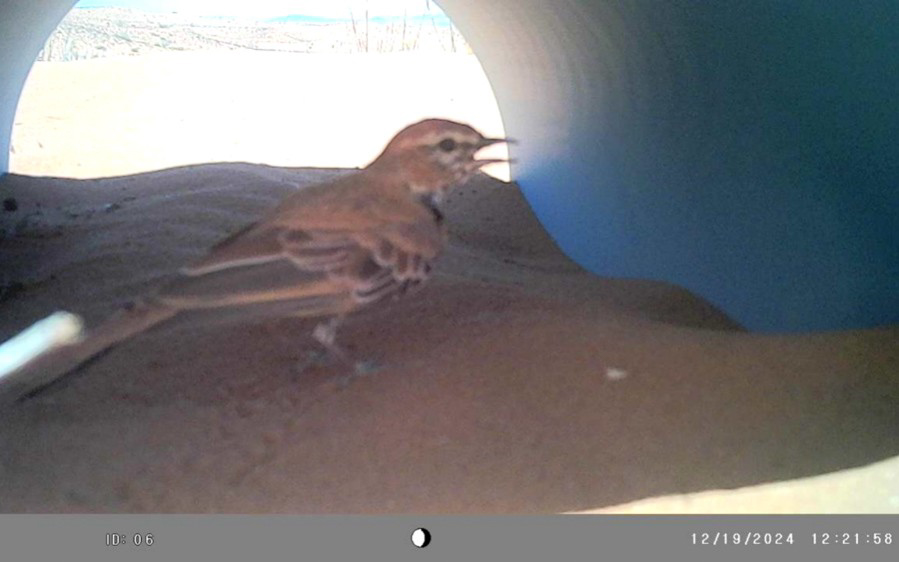
A Red Lark caught on camera trap using provisioned artificial shade during the hottest hours of the day.
So, where’s the best place to see a Red Lark?
Red Larks are extremely localized birds but occur at high densities within their tiny, Northern Cape range. The most recent IUCN estimate in 2021 puts their population at ~6 300 mature individuals, with the best places to find them being around the towns of Brandvlei, Springbok or Aggeneys (this being a small town run by the BMMCA). Join Birding Ecotours on our Western South Africa: Cape Endemics, Namaqualand Wildflowers and the Kalahari tour for a high chance of seeing this bird, or let us know if you would like a private tour that specifically targets the northwestern areas of the Northern Cape (i.e. lark central!). If you’d like to learn more about the Red Lark, read BirdLife International’s factsheet on the species.
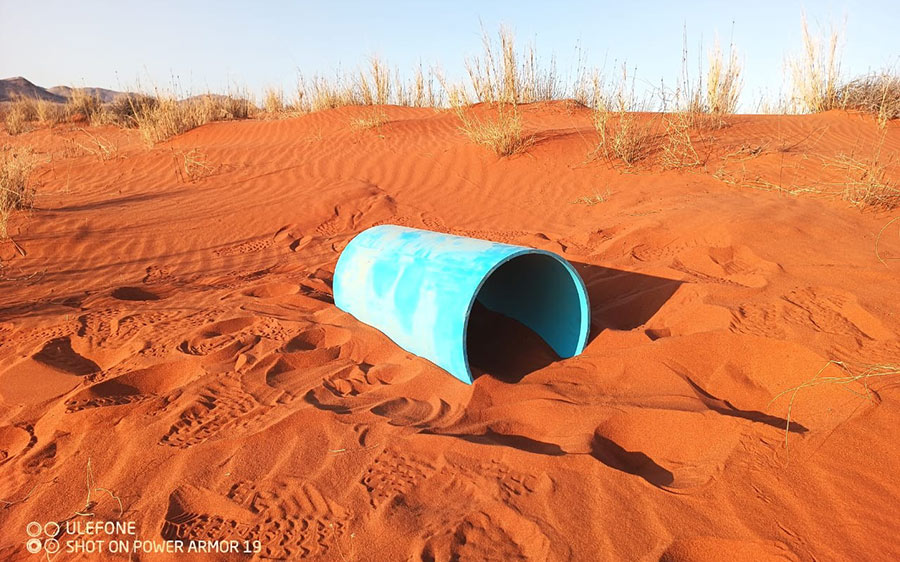
Our first artificial shade installation, planted on a stunning red backdrop with scattered dune grass.
What other birds can you see in these areas?
Once we have seen this bird, there’s plenty else of great interest in the area as well. While Red Larks may not drink water, many other birds do. Cattle drinking troughs offer the best chances for many bird species between the towns of Springbok and Pofadder, including the likes of the highly sought after Sclater’s Lark, Grey-backed Sparrow-Lark, Namaqua Sandgrouse, Black-headed Canary, Lark-like Bunting and amazingly gregarious Sociable Weavers. Open plains in the area offer good possibilities of Ludwig’s Bustard, Karoo Korhaan, Karoo Eremomela, Rufous-eared Warbler and other nomadic and scarce species like Black-eared Sparrow-Lark, Stark’s Lark and Burchell’s Courser. Small outcrops of rocky ridges and hills towards Springbok offer great chances at the vocal Cinnamon-breasted Warbler and less great chances at the extremely secretive Cape Eagle-Owl. This is simply a small taster of what this part of the world can offer; for something more comprehensive, look at a summary of the Western South Africa tour.
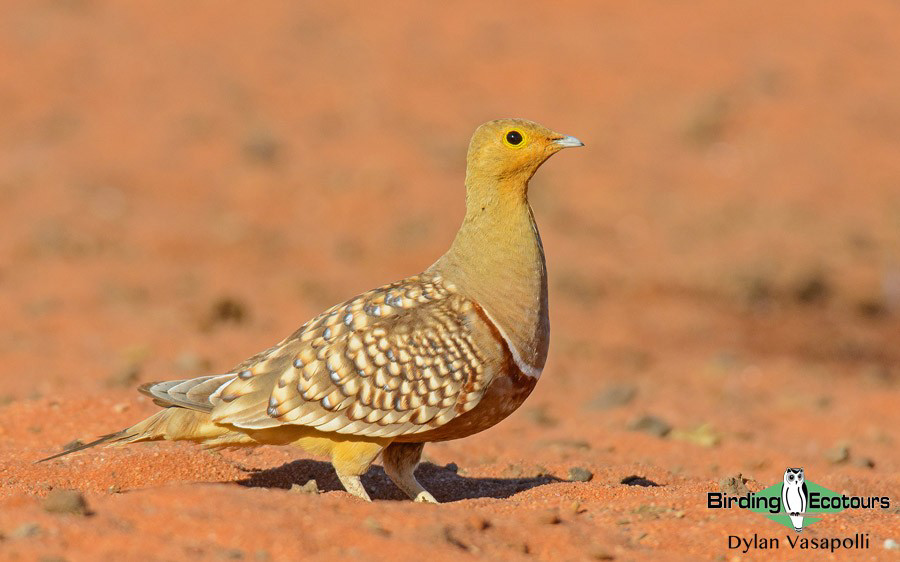
A male Namaqua Sandgrouse, yet another of the Northern Cape’s many desert specialists.