by Adam Cruickshank (written 23 January 2026)
In recent times, one of the most important tools for making birding accessible to most people has been the Merlin Sound ID app. This free app has been downloaded more than 33 million times across 240 countries and territories around the world. Although some may scoff at the use of AI technology to help people identify birds, it plays an important role in avian conservation efforts. Once people become aware of the birds around them, it becomes easier to encourage engagement in conserving those same species. People are more likely to conserve species they are aware of and feel a connection to.
Too Few Recordings: The Challenge of Training AI for African Birds
One of the challenges for the AI technology that Merlin uses is that, for the app to successfully identify a species, at least 150 recordings need to be uploaded to the Macaulay Library. In countries such as the United States, this is not a problem for most species. In other regions, this is far more challenging. In most African countries, less than 30% of bird species have the 150 recordings needed to train AI-powered tools such as the Merlin Sound ID app.
This challenge is not limited to difficult or rarely seen species. It is also a trend among many common birds. Using South African species as an example, the Southern Grey headed Sparrow is widespread across the country, with more than 59,000 eBird observations. However, to date, there are only around 100 sound recordings uploaded. Many South African birders are familiar with the distinctive calls of the Crested Barbet, reflected in its more than 46,000 eBird observations, yet there are only about 110 sound recordings available.
This trend continues with species endemic to South Africa. The Knysna Turaco has more than 6,000 eBird observations, but only around 50 sound recordings. The Red Lark, an endemic species from the drier parts of the country, has fewer observations due to its restricted range, with just over 350 observations and only 15 sound recordings.
What all these species have in common, along with many others across the continent, is that there are not enough recordings to properly train Merlin to identify them. This results in birders being unable to use the Merlin app to identify these species when they encounter them.
Introducing the Big Year of African Sounds
The good news is that for birders who live in Africa, as well as those who visit the continent, there is a way to help change this. The Big Year of African Sounds is an exciting project where the Cornell Lab of Ornithology is partnering with organizations across Africa, including BirdLife South Africa, with two main goals.
- To record over 1,500 bird species across the African continent.
- To record birds in over 50 countries across Africa.
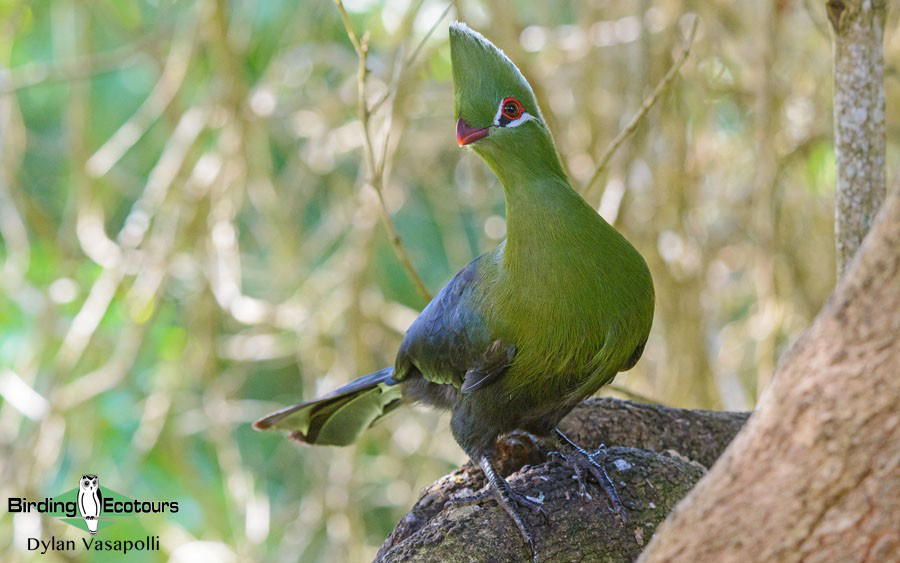
Knysna Turaco is a South African endemic, and sound recordists will enjoy recording its hoarse calls.
At Birding Ecotours, conservation has always been at the heart of what we do. We donate a minimum of 10% of our annual profits to bird conservation. This initiative excites us because it aligns so closely with our values, and we would like to encourage our clients and supporters to get behind this project.
The good news is that you do not need fancy sound recording equipment. All you need is an eBird account and a smartphone. Almost all modern smartphones are capable of recording usable bird sounds, making this accessible to almost anyone. While recordings of rare or sought-after species are valuable, recordings of common birds are just as important. Once you have recorded sounds in the field, you simply upload them to your eBird checklist, and you have contributed to the project.
Sound recording-focused private and small-group tours
Recording sounds on some of our tours may be challenging, as we always need to ensure that every client has a great overall experience. However, for those who book private or smaller group tours, especially with the specific goal of gathering sound recordings, this is something we can cater for.
Some of our guides are already participating in the project, and you would be paired with a guide who understands the needs of sound recordists. We would ensure that the tour is planned around the best places to both see and record your target species. Our expert team, many of whom have formal ornithological training, would be happy to advise on the best time of year, the best locations, and practical tips to help make the trip a success.
What excites us most about hosting these kinds of tours is the direct contribution they make to conservation and the protection of Africa’s birds. This work helps organizations involved in bird conservation, such as BirdLife South Africa, by providing the data needed to support informed conservation decisions.
Whether you book a tour with us or are simply based in Africa, we encourage you to sign up for a free eBird account and start recording what you hear. Every recording makes a difference.
To book a small-group or private tour focused on sound recordings, email [email protected] so that we can help plan a tour that meets your needs.