by Adam Cruickshank (written 23 February 2026)
Every birding tour has a few moments that stand out long after the trip has ended. Sometimes it is a bird seen better than expected. Sometimes it is the setting, the light, or the timing. Often, it is a combination of all three. On our Eastern Australia tours, guests are asked to informally vote for their Bird of the Trip, and over the years, clear favorites have emerged.
The list below is based entirely on those votes. These are not birds chosen for rarity alone, but species that left a strong impression in the field. Some are difficult to find, others are surprisingly confiding, and a few deliver experiences that feel almost unreal when they happen. What they all share is the ability to turn a good day of birding into something that stays with people long after the tour has ended.
Our 18-day Eastern Australia: From the Outback to the Wet Tropics tour has proven to be one of our most popular itineraries. Australia supports around 360 endemic bird species, making it a must visit destination for birders. The tour is split into three main sections, allowing us to cover a wide range of habitats and see many regional specials. We begin in Melbourne, and follow a loop route through Victoria, from the coast and coastal heathlands inland through box-ironbark forest, salt lakes, and semi-arid mallee outback, before crossing open plains and riverine habitats, then returning to Melbourne to conclude the outback section of the tour. From there, we fly to Brisbane starting in Mangrove and coastal wetlands, then visiting the amazing Lamington National Park, including the famous O’Reilly’s Rainforest Retreat, before flying north to Cairns. The final leg begins around Cairns and the tropical coast, before moving south to Mission Beach, climbing onto the Atherton Tablelands to bird both cool upland rainforest and dry country, then descending to the Daintree River for a boat cruise and finishing with a Great Barrier Reef trip, before concluding in Cairns.
There are many bird highlights on the tour, but some of the best include Malleefowl, Australian Owlet-nightjar, Brolga, Gang-gang Cockatoo, Superb Parrot, Australian King Parrot, Noisy Pitta, Albert’s Lyrebird, Superb Lyrebird, Green Catbird, Golden Bowerbird, Satin Bowerbird, Great Bowerbird, White-winged Fairywren, Mallee Emu-wren, Painted Honeyeater, Rufous Bristlebird, Shy Heathwren, Chowchilla, Chestnut Quail-thrush, Eastern Shriketit, Pied Monarch, Victoria’s Riflebird, Rose Robin, Mangrove Robin, and Diamond Firetail.
The five species featured below, as voted for by our guests, reflect not only the quality of birds possible on this tour, but also the way they are experienced. As one guest put it, “If your goal is to see a large number of bird species; this is unquestionably the trip for you. The guides find ’em and insure that everyone sees ’em!” (Ed on Eastern Australia – October 2025)
More than anything, these stories highlight why guiding matters. It is not just about finding birds, but about creating moments in the field that turn sightings into lasting memories.
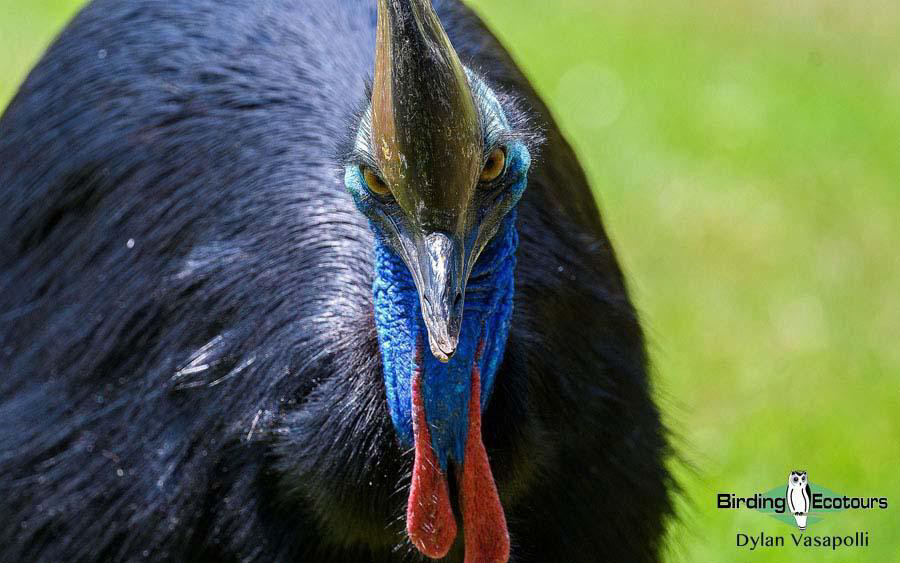
The prehistoric looking Southern Cassowary is one of the most popular species on our Australian birding tours.
Southern Cassowary (Casuarius casuarius)
We are not surprised that the Southern Cassowary is often voted the most popular bird of the tour. Although it is the heaviest bird in Australia, this rainforest dwelling species is shy and retiring, which makes every sighting feel special.
The Southern Cassowary is found in Indonesia, Papua New Guinea, and northeastern Australia. It was once widespread across Queensland, but today it is restricted to isolated populations in the Wet Tropics near Cairns, and the Cape York Peninsula.
On our 2025 Eastern Australia tour, the group was incredibly lucky to see this often-elusive species not once, but five times in a single day. One of the highlights was an individual walking out onto the beach, stopping to drink fresh water, then slowly moving along the shoreline before melting back into the forest.
Seeing a Southern Cassowary feels like stepping back thousands of years in time. With its large horn like casque and brightly colored face, this big flightless bird has a truly prehistoric look. Adults can weigh up to 143 lb (65 kg) and stand around 6 ft (1.8 m) tall, making the experience of seeing one at close range even more impressive.
The Southern Cassowary feeds on the fruit of more than 200 plant species and plays an important role in keeping rainforest ecosystems healthy. It is often called the rainforest gardener, and for good reason. Many plants rely on cassowaries for seed dispersal and successful germination. The bird swallows fruit whole and deposits the seeds far from the parent plant. Once the seeds pass through the digestive system, the dung helps fertilize them and improves their chances of growing.
Breeding behavior is equally fascinating. The female lays three to five eggs and then departs, leaving the male to incubate for about 50 days. After hatching, the male raises the chicks for roughly a year before eventually chasing them away.
The Southern Cassowary has a somewhat undeserved reputation as a dangerous bird. It can jump high, has powerful legs, and sports sharp claws, with the inner claw reaching up to 5 in (12 cm) in length. Yet despite this fearsome image, deadly encounters are extremely rare and only two human deaths have been reported since 1900.
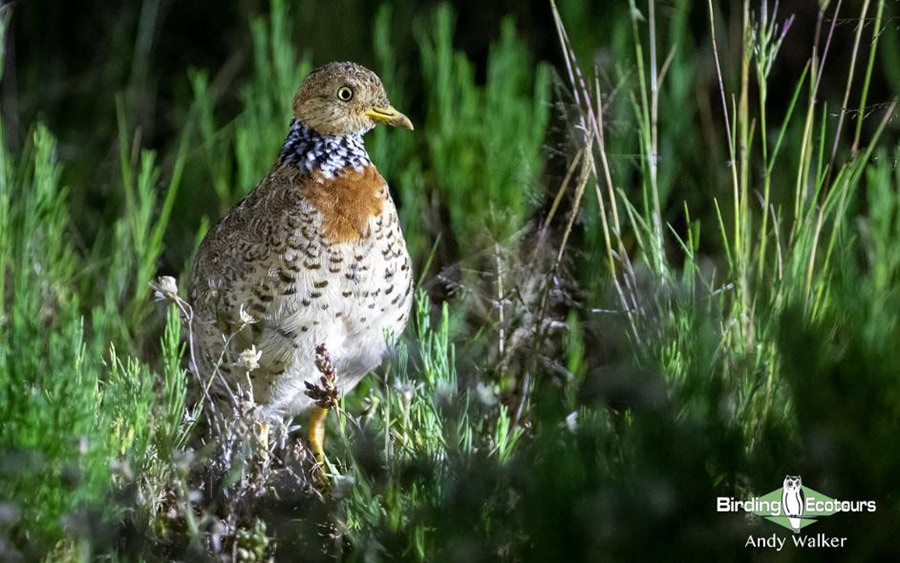
Getting to see four Plains-wanderers under a total lunar eclipse was an extra special sighting on our Eastern Australia tour in 2022.
Plains-wanderer (Pedionomus torquatus)
The well camouflaged Plains-wanderer is one of the most difficult species to find in Australia. The Plains-wanderer belongs to a monotypic family, meaning it is the only species in its family. Although it resembles a quail, it is in fact more closely related to shorebirds than to gamebirds.
The best way to see the species is at night using a spotlight, and most successful sightings rely on local knowledge and experienced guiding.
We have been fortunate over the years to have some great sightings of this highly sought after species. But arguably the best sighting was on the Eastern Australia tour in 2022.
The group arrived on the open plains just as the sun was setting and the moon rising, casting long shadows across the grassland. As darkness settled, the moon slipped into a total lunar eclipse, bathing the landscape in an unusual red glow as the search began. The plains were alive with sound, and before long the group found their main target, a male Plains-wanderer, which showed well despite its subtle plumage. Not far away, a beautifully marked female was located, giving everyone excellent views. On the way back to the vehicles, they encountered another pair, this time with the female calling softly across the flooded landscape. The combination of multiple Plains-wanderer sightings, a rare lunar event, and the dramatic conditions made the experience feel extraordinary.
As the guide,Andy Walker, noted after this special night: “Having seen Plains-wanderer so well was a real highlight of the tour, however, to get to see them in the strange red glow of the total lunar eclipse and a heavily flooded landscape was something else entirely, a unique experience and one that probably won’t be forgotten for a long time.”
Ongoing loss of native grasslands, combined with pesticide use and predation from introduced species, has placed the Plains-wanderer under increasing threat and resulted in its Endangered listing (IUCN/BirdLife International). This makes every sighting in the wild all the more exciting.
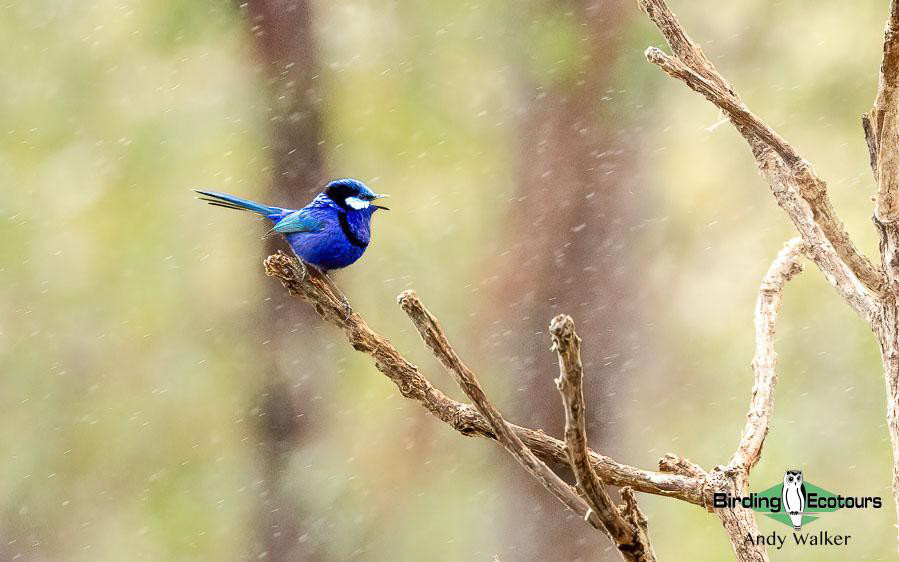
It is not difficult to see why the Splendid Fairywren is one of the most popular birds on our Australia tours!
Splendid Fairywren (Malurus splendens)
The brightly colored Splendid Fairywren is another popular bird on our Australian tours. What makes this species so appealing is its eye-catching, mostly blue coloration, which makes it a favorite subject for photographers. What many people find surprising is that the feathers are not actually blue. Instead, the color comes from the structure of the feathers, which bend and reflect light in a way that makes them appear blue to our eyes. These feathers also reflect ultraviolet light, especially on the cheeks and crown. Birds can see this ultraviolet light, even though we cannot, and it likely plays a role in communication and mate choice. In other words, what looks bright to us is even brighter in the eyes of another fairywren.
The Splendid Fairywren also has fascinating breeding behavior. The species is socially monogamous but sexually promiscuous. A male and female form a bonded pair, yet both may mate with other birds. It is estimated that more than one third of chicks result from extra pair matings. They live in small social groups made up of a breeding pair and up to six helpers that assist with raising the young. Courtship behavior is equally memorable, with males recorded carrying pink or purple flower petals to present to females.
The Splendid Fairywren has a long and sometimes confusing taxonomic history, largely due to variation in plumage across its range. For many years, birds from different parts of Australia were treated as separate species, with names such as Black-backed Wren and Turquoise Wren, before it became clear that these forms were closely related and often intergraded where their ranges met.
Today, these birds are treated as a single species with four recognized subspecies. These are splendens in the west, callainus in the central interior, melanotus in the east, and emmottorum in the arid northeast. Genetic studies support this and show that while some populations differ noticeably in plumage, they remain very closely related, with environmental factors likely driving visible differences faster than genetic divergence.
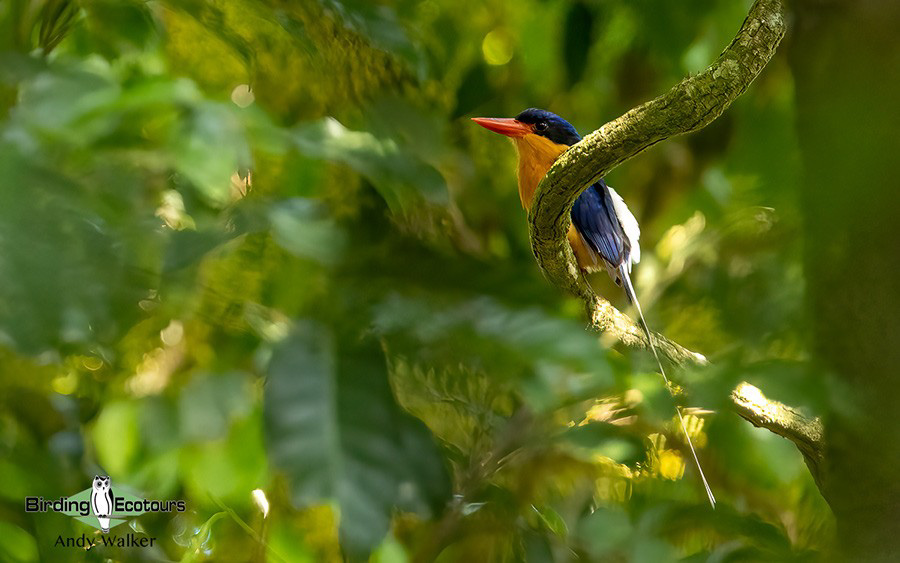
The Buff-breasted Paradise Kingfisher with its long white tail streamer is a special bird to see!
Buff-breasted Paradise Kingfisher (Tanysiptera sylvia)
The Buff-breasted Paradise Kingfisher is another species that has become a favorite on our Eastern Australia tour. Its bold red bill, buff underparts, and deep blue head and wings make it a beautiful bird, but it is the long white tail streamer that makes this species truly unmistakable.
The timing of the tour coincides with their arrival from Papua New Guinea into coastal Queensland for the breeding season. While this always carries a small risk of missing the species if arrival is delayed, it importantly gives us the chance to witness special breeding behavior. Males establish territories by pointing the head and bill skyward, pulling the wings downward, puffing up the feathers on the back and rump, and pumping the tail in time with their calls.
On our 2022 tour, guide Andy Walker recorded a memorable encounter:
“We got one of our main tour targets in a busy patch of rainforest, with a stunning display put on by a couple of Buff-breasted Paradise Kingfishers. We watched a territorial dispute between two birds which had clearly just arrived from Papua New Guinea and were busy setting up breeding territories.
Moments like this, not just seeing birds but sharing memorable experiences, are at the heart of why these tours are so rewarding.
The migratory routes of the Buff-breasted Paradise Kingfisher are also fascinating. Birds breeding in Cape York migrate directly across the Torres Strait, while more southern populations found near Cairns travel over the Great Barrier Reef. This route likely reflects an ancient land bridge that once connected Australia and New Guinea.
Sadly, the Buff-breasted Paradise Kingfisher faces growing threats from habitat loss across its range. Queensland has experienced extensive deforestation over time and similar pressures occur in Papua New Guinea, where forests are being cleared for agriculture, palm oil plantations, and infrastructure development.
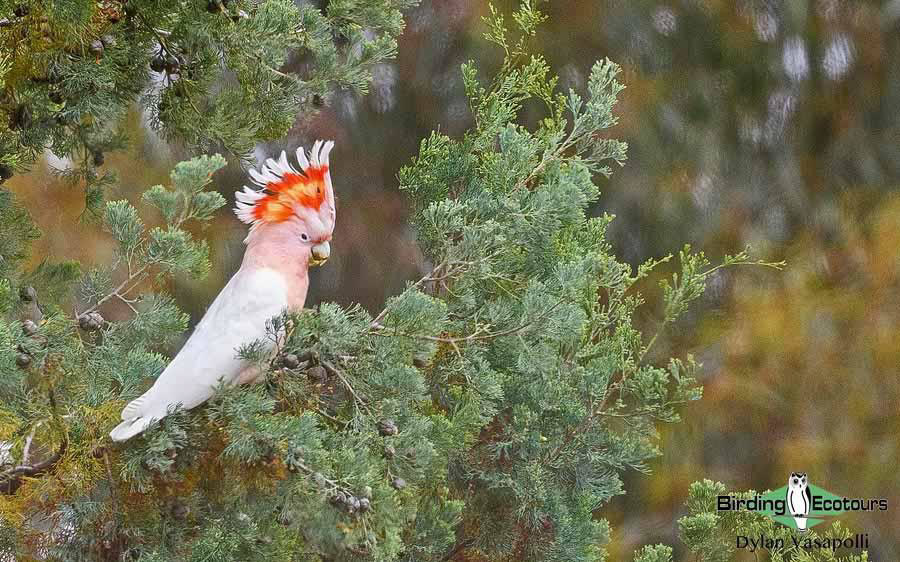
The iconic Pink Cockatoo has provided many great sightings over the years.
Pink Cockatoo (Lophochroa leadbeateri)
The Pink Cockatoo, until recently known as Major Mitchell’s Cockatoo, is one of Australia’s most iconic birds. It is instantly recognizable by its salmon pink head, neck, and underparts. When the crest is lowered it appears mostly white, but when raised it reveals a bold red band with a yellow stripe running through the center. This species is found across arid and semi-arid regions of inland Australia, surviving in some of the continent’s harshest environments.
As with the other species on this list, it is no surprise that the Pink Cockatoo is often voted as a tour favorite when looking back through past trip reports. On the 2023 Eastern Australia tour, the group enjoyed exceptional views when several birds dropped out of a tree to drink from a puddle at the side of the road just a few yards (meters) in front of the group, raising their colorful crests as they did so.
There are two recognized subspecies of Pink Cockatoo. Cacatua leadbeateri mollis occurs in Western Australia, while Cacatua leadbeateri leadbeateri is found in central and east central Australia.
While some Pink Cockatoos may remain in the same area throughout the year, in more arid regions they can be nomadic, moving in response to food and water availability. They readily feed on grain split during harvesting, but their powerful bills allow them to extract seeds from a wide range of native plants.
The species faces ongoing threats, including population declines linked to the loss of hollow bearing trees and pressure from the illegal wildlife trade. The species was officially renamed Pink Cockatoo in 2023, reflecting a wider shift toward culturally inclusive bird names after historical links between Major Mitchell and violence against Aboriginal people were re-examined.
What makes these sightings special is not just the birds themselves, but the experiences that surround them. A Cassowary stepping out onto a beach, fairywrens glowing in perfect light, kingfishers displaying at the height of the breeding season, or Plains-wanderers appearing under a total lunar eclipse. These are the moments that guests remember and talk about long after the tour has ended.
The Eastern Australia tour is carefully timed and guided to give the best possible chance of encounters like these. Local knowledge, experienced leadership, and time spent in the right habitats all play a role, but there is also space for the unexpected. That balance is what keeps each tour feeling fresh, even when returning to familiar places.
If the birds on this list appeal to you, chances are the Eastern Australia tour will too. It is a journey built around great birds, varied landscapes, and shared experiences in the field, the kind that turn a checklist into a story worth telling.
If you would like to experience this journey for yourself, full tour details and upcoming dates are available on our website, or you can email [email protected]