03–15 JULY 2026
By Fraser Bell
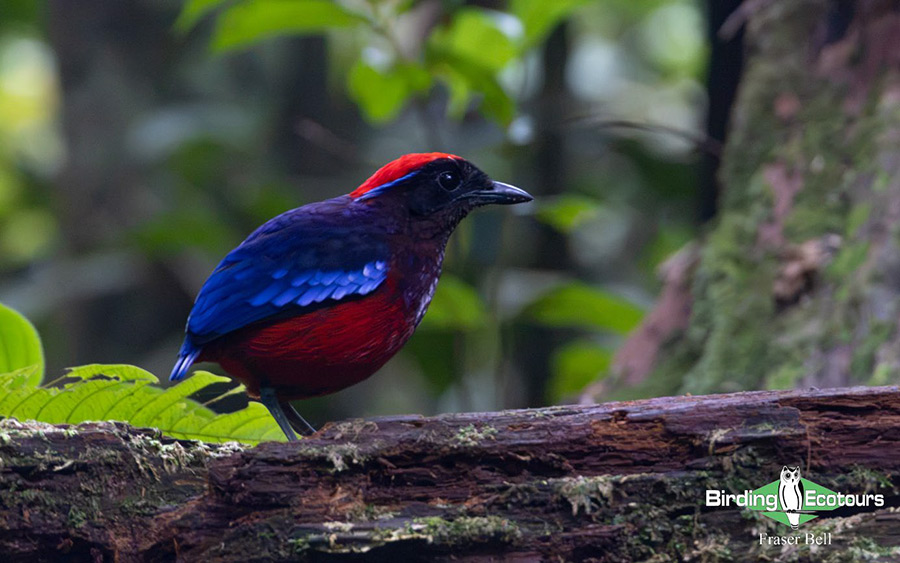
Garnet Pitta gave us exceptional views at a hide in Taman Negara National Park.
Overview
This birding tour of Peninsula Malaysia, which took place between 3rd and 15th July 2026, was a highly successful and enjoyable fortnight of birdwatching, recording a high diversity of species across the peninsula. The tour was particularly productive for gamebirds and pittas, with birds coming into feeding areas allowing us excellent views. Despite a lot of birding in dense forest, which can be slow going at times, we saw a remarkably high diversity of species well, including particularly good numbers of cuckoos, owls, hornbills, barbets, woodpeckers, bulbuls, and babblers. Our night birding was especially successful and great fun, with a memorable evening at Kuala Selangor producing seven species of owls and nightjars, followed by several excellent early-morning sessions in Taman Negara National Park, including close views of Gould’s Frogmouth. We were also fortunate with the weather, experiencing very little rain and mostly comfortable conditions for birding, although some days were hot and humid, particularly in Taman Negara. Everything ran smoothly and we met some lovely people along the way, enjoyed consistently good food and good-quality accommodation (even the motel was not too bad!), and our local guide and driver were a brilliant pair to spend time with. We also had some memorable encounters with mammals, reptiles, and other wildlife along the way.
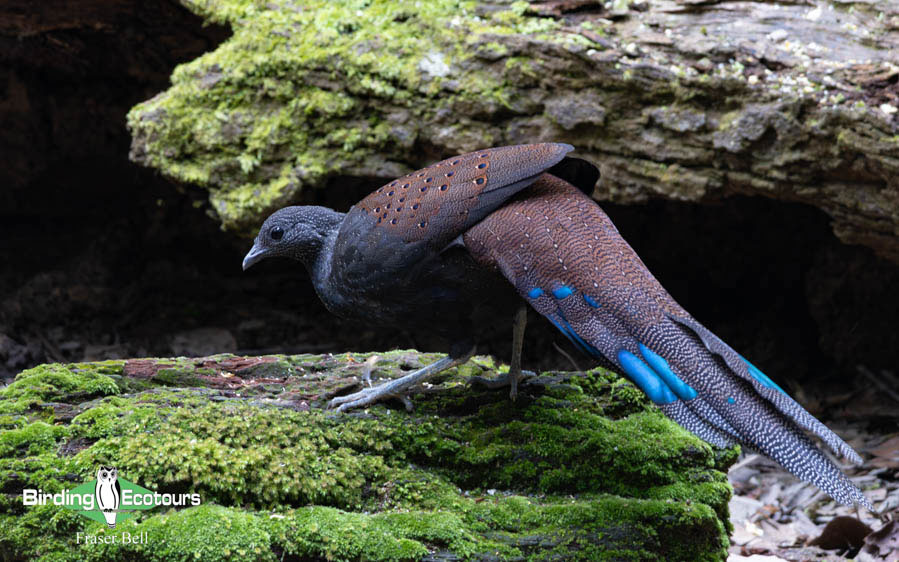
Mountain Peacock-Pheasant has a tiny global range, and we spent our final morning watching one of these beauties, it’s unique ocelli, and luminous blue tail patches dazzling in the light.
The birding highlights from this tour were many. We started by birding the coast just west of Kuala Lumpur, where we found a confiding Mangrove Pitta alongside other mangrove specialists including Copper-throated Sunbird. Moving on to Putrajaya we had a good introduction to some of the more widespread Asian species, including an impressive local heronry packed with breeding storks, herons, and egrets. From here we headed into the hills east of Kuala Lumpur, where we enjoyed a high diversity of lowland forest birds, with highlights including Sooty Barbet and Black-and-red Broadbill, as well as a memorable encounter with Pale-thighed Langur. We then continued north and west to the Kuala Selangor area, where the paddyfields provided good wetland birding before an unforgettable evening of night birding, when we saw seven species of owls and nightjars, including excellent views of Spotted Wood Owl and Malaysian Eared Nightjar. At the nearby Taman Alam Kuala Selangor Reserve, we explored the mangroves and found several specialists including Chestnut-bellied Malkoha, Mangrove Blue Flycatcher, Pied Triller, Smooth-coated Otter and Selangor Silvery Langur.
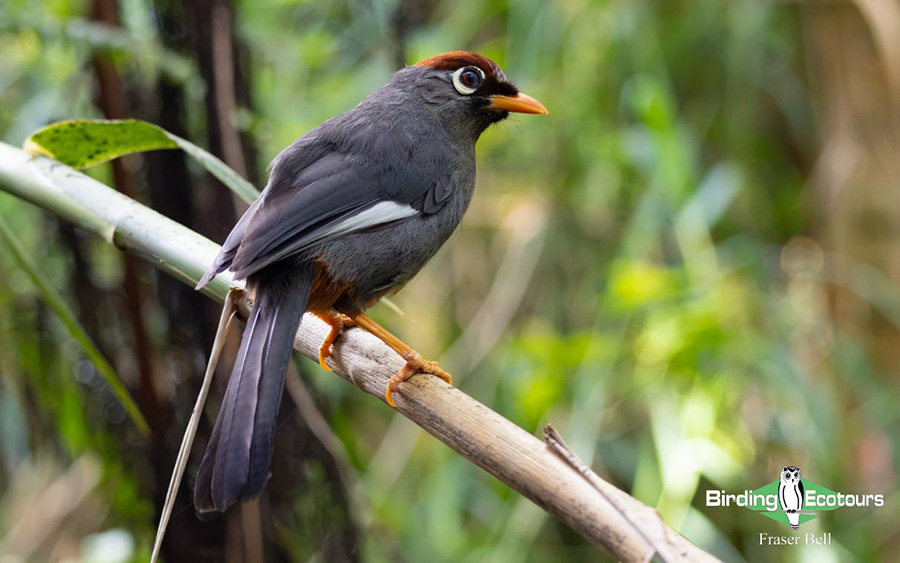
Boisterous flocks of Chestnut-capped Laughingthrushes were common in the highlands of Peninsula Malaysia.
From Kuala Selangor we headed east and up into the highlands of Frasers Hill, where the birding became very different as we entered the cloud and hill forests. We spent a lot of time at feeding areas, enjoying close views of many of the region’s specialists, with several of Peninsula Malaysia’s localized or endemic birds among the highlights, including Malayan Partridge, Chestnut-capped Laughingthrush, Malayan Laughingthrush, Black Laughingthrush, and Malayan Cuckooshrike. Other impressive and colorful species included White-crowned Hornbill, Red-headed Trogon, Red-bearded Bee-eater, Fire-tufted Barbet, Long-tailed Broadbill, Common Green Magpie, Silver-eared Mesia, Blue Nuthatch, and Slaty-backed Forktail, while the forests were also filled with the beautiful but eerie calls of Siamang.
We then continued east to the excellent Taman Negara National Park, finding two secretive woodpeckers, Bamboo Woodpecker and Olive-backed Woodpecker, along the way. Around the Sungai Relau park entrance, we enjoyed close views of the spectacular Malayan Peacock-Pheasant, Great Argus, and Garnet Pitta at feeding areas, alongside a high diversity of forest birds by birding the quiet forest trails, and from the amazing canopy walkway. A few of the highlights included Wreathed Hornbill, Banded Kingfisher, and the monotypic Crested Jayshrike, as well as many more specials. The southern part of Taman Negara was equally rewarding, although the dense forest and mostly boardwalk-based birding made things challenging at times. Top sightings included Malayan Crested Fireback, Scarlet-rumped Trogon, Oriental Bay Owl, Malayan Black Magpie, Malaysian Blue Flycatcher, and White-crowned Forktail. Before finishing the tour, we spent a night at Colmar Tropicale, a unique Malaysian take on a French-style mountain village, before heading into the Bentong Highlands, where we found the localized Mountain Peacock-Pheasant and enjoyed a comical group of Ferruginous Partridges.
We recorded 279 bird species during the tour, with the full bird, mammal, and reptile species lists provided at the end of this report. You can also access our eBird trip report here. Read on for the detailed day-by-day itinerary and a full account of our birding and wildlife highlights.
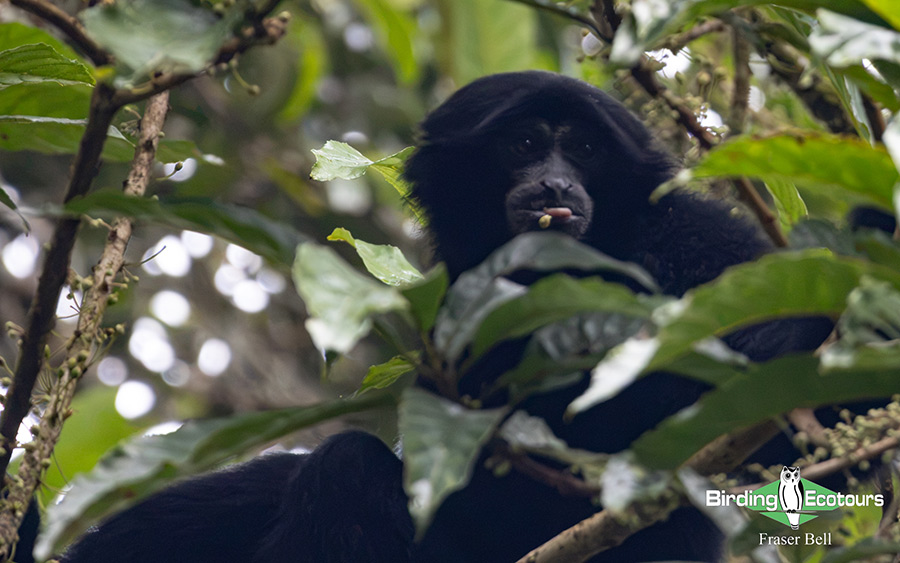
Much of our birding in the highlands of Frasers Hill was accompanied by the beautifully haunting wailing of Endangered (IUCN Red List) Siamang, and we were lucky to have great views of one troop as it fed quietly along the roadside.
Detailed Report
Day 1, 3rd July 2026. Arrival into Kuala Lumpur
Today was an arrival day, with everyone flying into Kuala Lumpur before transferring to Putrajaya, where we would spend the first two nights of the tour. Over dinner, the group reunited and enjoyed meeting new companions while discussing the exciting upcoming fortnight of birding across Peninsula Malaysia.
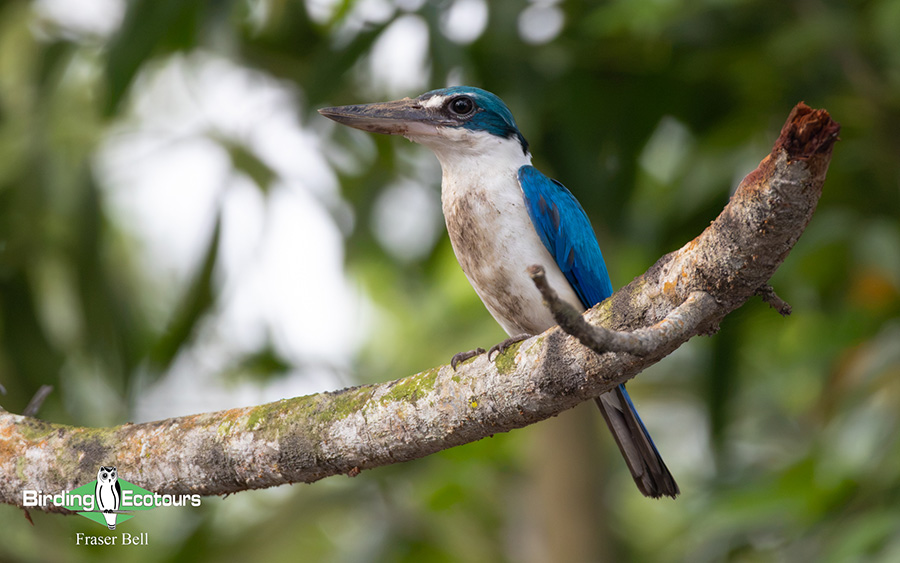
While we enjoyed seeing Collared Kingfisher so well, it did chase away many of the other species in the area, such as the Mangrove pitta!
Day 2, 4th July 2026. Pulau Indah mangroves and Putrajaya
After breakfast, we headed out at first light, bound for the mangroves at Pulau Indah. We stopped at a patch of grassland on the way, enjoying many species that we would become familiar with over the coming fortnight. These included Edible-nest Swiftlet, Spotted Dove, Zebra Dove, White-breasted Waterhen, Changeable Hawk-Eagle, Brahminy Kite, Large-billed Crow, Yellow-bellied Prinia, Pacific Swallow, Yellow-vented Bulbul, Javan Myna, and our grassland targets, Lesser Coucal, a beautiful Long-tailed Shrike, and a busy colony of Baya Weavers.
Moving on to the coast, we tucked ourselves away from the main roads and spent some time birding a back road through the mangroves at Pulau Indah. Almost as soon as we arrived, we struck gold and found a Mangrove Pitta hopping around an open area in the mangroves, showing perfectly for our group to admire. Pittas are always a major target whenever you are in their range, so seeing this mangrove specialist on the first morning of the tour was an excellent start. We then enjoyed a quick-fire birding session, with loads of mangrove birds appearing one after another. A male Laced Woodpecker showed brilliantly, along with Collared Kingfisher, Golden-bellied Gerygone, Ashy Tailorbird, and several small groups of Swinhoe’s White-eye. Over the course of the next hour we also saw Lineated Barbet, Black-naped Oriole, Malaysian Pied Fantail, Asian Glossy Starling, Scarlet-backed Flowerpecker, and an all too brief male Copper-throated Sunbird.
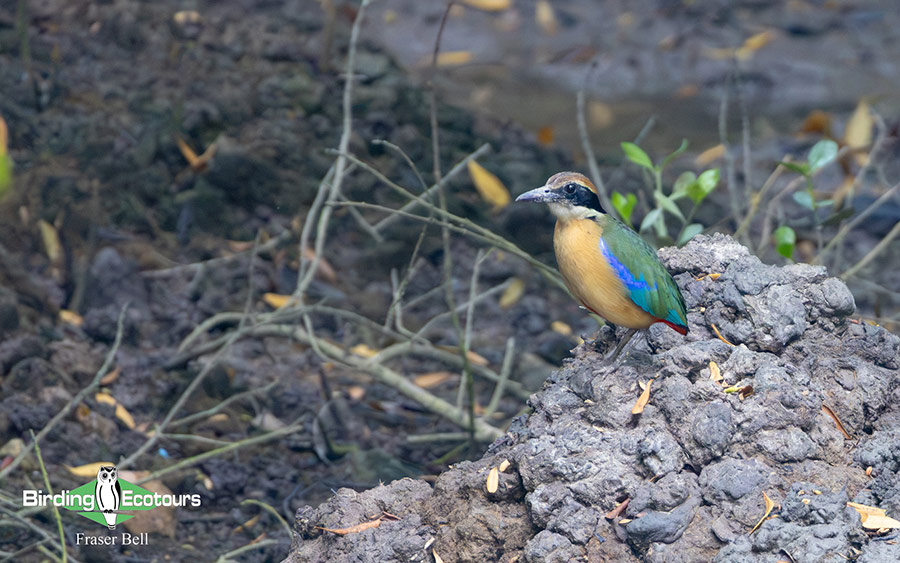
Our tour got off to a great start with this Mangrove Pitta showing well on our first morning.
With the day heating up, we headed back into Kuala Lumpur for lunch, and at a small city park near the restaurant we found a Green-billed Malkoha that provided us with excellent views, along with a vocal Coppersmith Barbet. After some downtime at our hotel in Putrajaya, we took a ride to the local lake and walked back to the hotel while birding. Asian Openbill, Painted Stork, Oriental Darter, Black-crowned Night Heron, Little Egret, Eastern Cattle Egret, Grey Heron, and Purple Heron were all abundant, breeding on the wooded islands. We also saw a gorgeous male Pink-necked Green Pigeon, in addition to the massive White-bellied Sea Eagle, two Oriental Pied Hornbills, a beautiful Blue-throated Bee-eater, Common Iora, and a Common Treeshrew. It made for a great introduction to birding in Malaysia!
Day 3, 5th July 2026. Ulu Langat forest reserve and Kuala Selangor wetlands
First light saw us finishing breakfast, checking out of the hotel, and driving into the eastern hills surrounding Kuala Lumpur, where we enjoyed our first lowland forest birding of the tour at Ulu Langat. This proved to be a very productive session, and the birding was fast-paced at times. We started well with Little Green Pigeon among a large group of Pink-necked Green Pigeons, Raffles’s Malkoha, Golden-whiskered Barbet, and Greater Racket-tailed Drongo. A Blue-eared Kingfisher flew through too quickly, but both Grey-and-buff Woodpecker and Buff-rumped Woodpecker gave prolonged, close views, as did several beautiful Black-and-red Broadbills, which were the highlight of the morning. We also saw Grey-rumped Treeswift, Large Woodshrike, Rufescent Prinia, Dark-necked Tailorbird, Rufous-tailed Tailorbird, Orange-bellied Flowerpecker, and Lesser Green Leafbird.
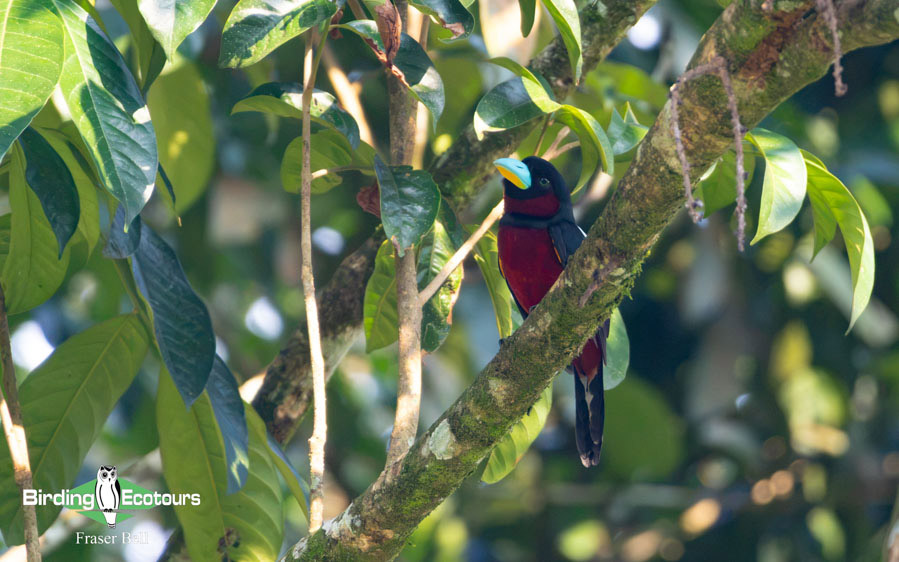
Broadbills such as this Black-and-Red Broadbill are a top target on many Southeast Asian birding tours, and for good reason, being colorful, approachable and bizarre looking!
After moving to a different site, along the entrance road to a busy area with many Malaysians enjoying the forest, we had fun watching a small group of Pale-thighed Langur busily clambering overhead. As is typical of forest birding, the birding was challenging at times, with many species remaining high in the canopy, but we did well by finding Sooty Barbet, Grey-headed Canary-flycatcher, several groups of Pin-striped Tit-Babblers, an Asian Fairy-bluebird,but we could not locate a hidden and calling Blyth’s Frogmouth at its day roost. We also made a good start on the bulbuls and spiderhunters of the region, seeing Buff-vented, Black-headed, Spectacled, and Asian Red-eyed Bulbuls, along with Long-billed, Little, and Grey-breasted Spiderhunters.
After a nice Chinese meal, we headed out of Kuala Lumpur and then north along the coast to Kuala Selangor. After some downtime, we bought our picnic dinner before driving to the Tanjung Karang Paddyfields for wetland and night birding. The paddyfields were not as active nor diverse as we had hoped, as the rice had recently been harvested and the fields were being replanted. Despite this, we did see a Cinnamon Bittern, which flew alongside our vehicle, allowing everyone to appreciate it before it vanished. Aside from the hundreds of storks, herons, egrets, and Edible-nest Swiftlets, we also saw Black-winged Stilt, Black-winged Kite, and Scaly-breasted Munia, all new for the trip.
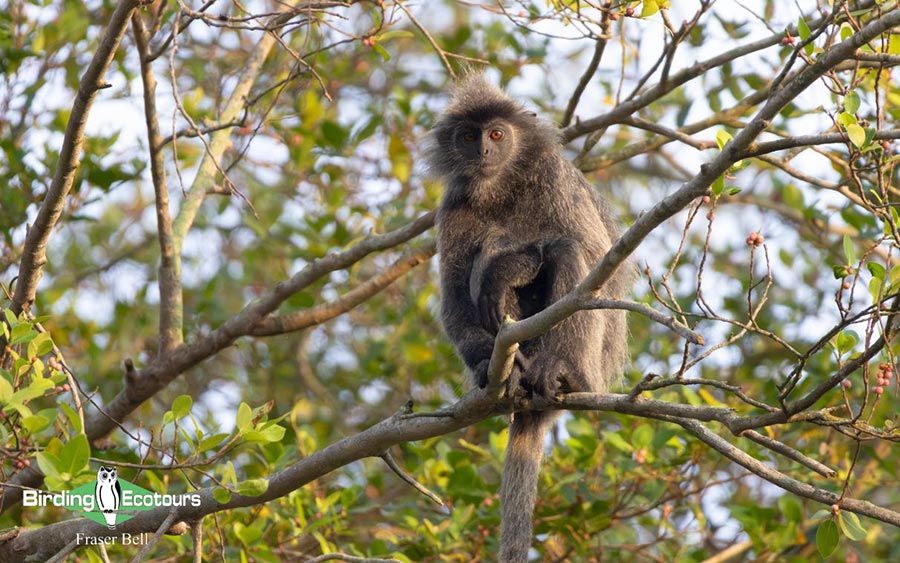
Mischievous Selangor Silvery Langur are localized to a small region of coastal Selangor.
We then positioned ourselves overlooking the canal toward the native trees on the opposite bank. Before long, we saw our main target, the impressive Dusky Eagle-Owl. This massive owl flew into the canopy we were watching and then remained there for the rest of the night, allowing everyone repeated views while it hooted into the dusk. We then ate our picnic dinner and watched the sunset, but before dark we enjoyed scope views of the iconic Rhinoceros Hornbill, along with a vocal Plaintive Cuckoo. It was beautiful watching the sun set with the sky lit up in shades of pink, purple and red, and soon we were joined by many Malaysian Eared Nightjars, Eastern Barn Owl, a pair of Spotted Wood Owls, and a second Dusky Eagle-Owl. On our way back to the hotel, we put in some extra effort and managed to find Large-tailed Nightjar, a Collared Scops Owl, and a distant Buffy Fish Owl. What a night, with two nightjar and five owl species seen!
Day 4, 5th July 2026. The mangroves at Kuala Selangor and transfer to Frasers Hill
Despite our late finish the previous night, we decided to try for Savanna Nightjar, the one species we had missed the previous night, around our hotel before dawn, but unfortunately we did not find any. Instead, we found Large-tailed Nightjar and heard a distant Collared Scops Owl. After breakfast, we enjoyed an excellent morning at Taman Alam Kuala Selangor Reserve, an area dominated by mangroves with pools and canals weaving through them. We picked up our main targets of Little Bronze Cuckoo, Stork-billed Kingfisher, Sunda Pygmy Woodpecker, Greater Flameback, and Pied Triller,but only heard Mangrove Whistler distantly. We also saw a pair of Mangrove Blue Flycatchers, although they were not particularly cooperative! Other species seen included Common Flameback, Ashy Drongo, Cinereous Tit, Olive-winged Bulbul, Ruby-cheeked Sunbird, Ornate Sunbird, and White-headed Munia. After moving to a different site, we enjoyed brilliant views of a Chestnut-bellied Malkoha collecting nest material. During the morning we also enjoyed seeing the localized Selangor Silvery Langur, whose bright orange infants looked very cute alongside the dark adults, as well as Long-tailed Macaques and multiple sightings of Smooth-coated Otters.
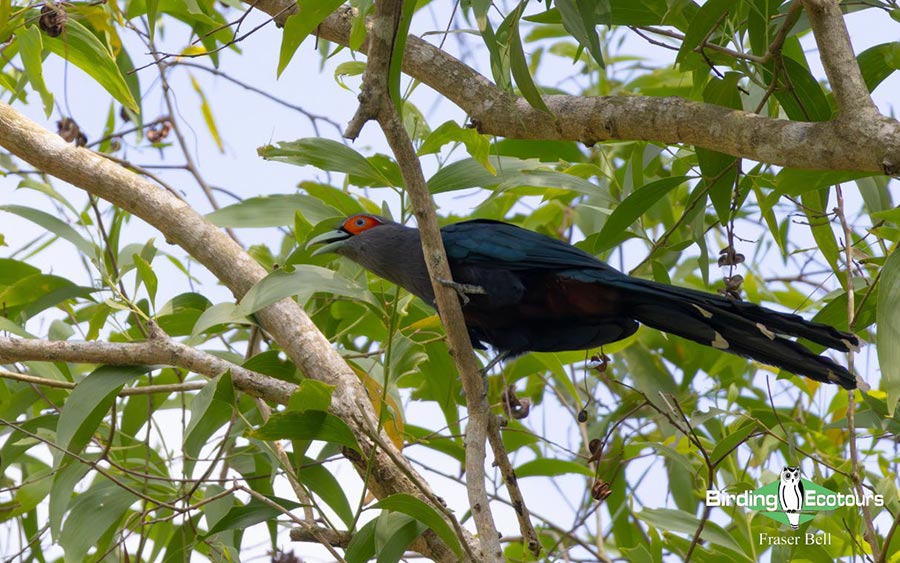
Chestnut-bellied Malkoha is a mangrove specialist in Malaysia, and we did well finding a confiding bird which was collecting nest material, just before we left Selangor.
After lunch, we started our journey east and upward into the heights of Frasers Hill. As we ascended the winding roads through the lush cloud forest clinging to the mountain slopes, we stopped whenever something was spotted, which turned out to be often! The standout species were beautiful Whiskered Treeswift, two groups of Bushy-crested Hornbills, a pair of stunning Silver-breasted Broadbills, and a busy flock of the seed nomad, Pin-tailed Parrotfinch. Other top birds included Rufous-bellied Swallow, Cinereous Bulbul, Scaly-breasted Bulbul, Hume’s White-eye, White-rumped Munia, plus Dusky Langur. On arrival at 1,300 meters (4,250 feet) on Frasers Hill, we tried to check in, but a mixed-species flock delayed us. We quickly saw Black-and-crimson Oriole, Lesser Racket-tailed Drongo, Mountain Fulvetta, Long-tailed Sibia, Chestnut-capped Laughingthrush, the handsome Blue Nuthatch, Streaked Spiderhunter, and a chattering group of acrobatic Sultan Tits. Frasers Hill had given us an exceptional welcome!
Day 5, 7th July 2026. Birding Frasers Hill cloud forest
Unfortunately, during our pre-dawn attempt for the endemic Malayan Whistling Thrush, we only heard a bird, and it stayed far downstream in the dense jungle. However, we then continued on to a feeding station close by and had a brilliant few hours of birding at the roadside. We quickly saw a trio of Malayan Partridges busily rooting around in the undergrowth, then had close views of Grey-throated Babbler, Buff-breasted Babbler, Streaked Wren-Babbler, Chestnut-capped Laughingthrush, Rufous-browed Flycatcher, Lesser Shortwing, White-tailed Robin, and Black-throated Sunbird at the feeding area. A small group of Common Green Magpies were brilliant to see, and excitingly yet frustratingly, a young Rusty-naped Pitta appeared from behind the group (within touching distance!), but quickly flew over our shoulders before disappearing into the dense cover. What an amazing but all too brief encounter! We also saw Southern Gray-bellied Squirrel, Asian Red-cheeked Squirrel, and a Small-toothed Palm Civet.
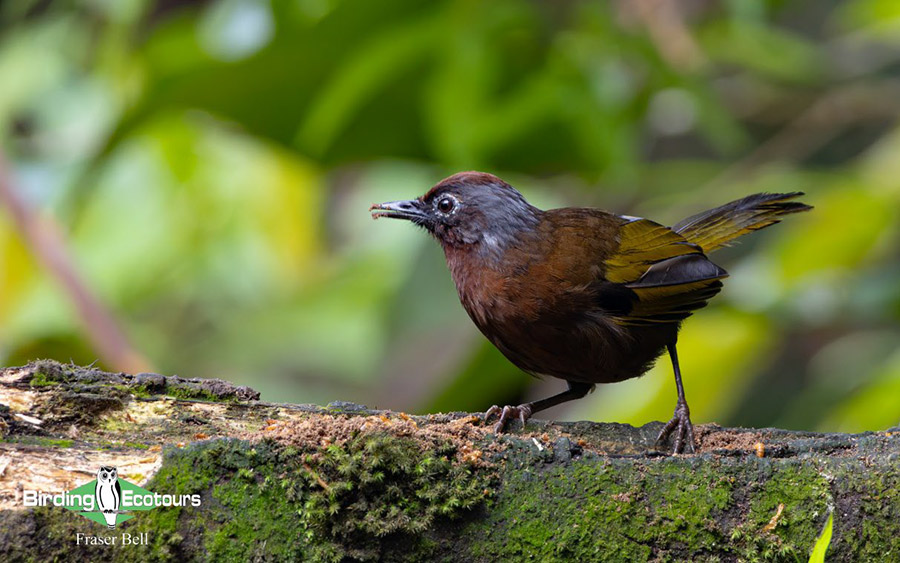
Malayan Laughingthrush is a secretive species which gave us unexpected close views at a bird feeding area on our first full day birding in the highlands.
After a nice breakfast, we visited another feeding station and had close views of the shy endemic Malayan Laughingthrush. Road birding over the following few hours was very productive, both finding species individually and encountering mixed-species feeding flocks. Seeing the enormous Fire-tufted Barbet well was a highlight, as was watching two incredibly beautiful species: a group of five Silver-eared Mesias feeding around us and a male Orange-bellied Leafbird giving excellent scope views from the canopy of a fruiting tree. Other top birds included Blyth’s Hawk-Eagle, Black-browed Barbet, White-throated Fantail, Sunda Crow, Mountain Bulbul, Stripe-throated Bulbul, Golden Babbler, Little Pied Flycatcher, and Fire-breasted Flowerpecker. With activity quieting, we opted to have a rest through the early afternoon.
Later on, we met back up and ventured out again. It was a quieter afternoon, but we still enjoyed some rewarding road birding and added the endemic Malayan Cuckooshrike, Black Eagle, both Greater Yellownape and Lesser Yellownape, a very close Mountain Tailorbird, Pallas’s Squirrel, plus a Black-and-crimson Oriole that had just caught a caterpillar and was knocking off its spines and toxins before eating it. After our evening meal, we tried our luck owling for several hours, and despite standing right next to a very vocal Mountain Scops Owl, we could not see it! Stumbling upon a mass of hundreds of Plume-toed Swiftlets nesting in a garage on the hillside was quite the experience though.
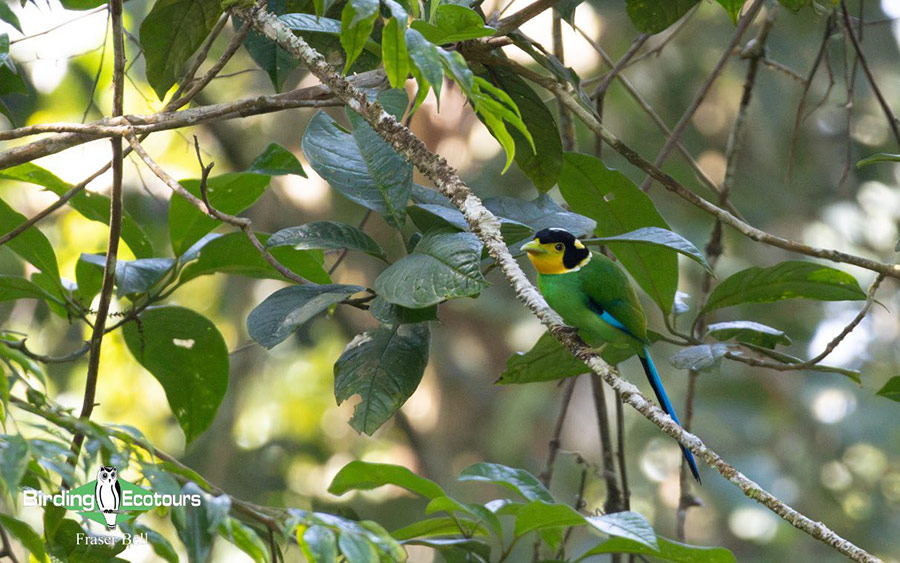
Watching busy flocks of beautiful but truly odd Long-tailed Broadbill was a highlight at Frasers Hill, especially watching them bow to one another while flicking their vibrant blue tails.
Day 6, 8th July 2026. Another full day exploring the excellent Frasers Hill
After our late finish the night before, we opted for a later start. However, this turned out to be an excellent idea, as fog was hanging over the mountains, slowing bird activity in the morning. We walked various quiet roads through the forest over the course of the morning, seeing a steady stream of new birds for the trip. The highlight of the first stop was good views of the interesting yet shy Red-bearded Bee-eater, along with a small family group of Siamang, which were close to the road, allowing great views. At our second stop, we encountered several busy mixed-species flocks, giving us views of the cute Speckled Piculet, White-bellied Erpornis, Bar-winged Flycatcher-shrike, Yellow-bellied Warbler, Golden Babbler, and Crimson-breasted Flowerpecker. The highlight within the flocks was a small group of Long-tailed Broadbills, and being able to watch them at length foraging in the midstory and interacting with one another, flicking their long, skinny blue tails. We also found a nesting Silver-breasted Broadbill, which sat tight and peered down at us from its messy pendular nest, a very sweet sight to behold, in addition to Mountain Imperial Pigeon, Red-throated Barbet, Black-crested Bulbul, White-rumped Shama, Long-billed Spiderhunter, and Blue-winged Leafbird.
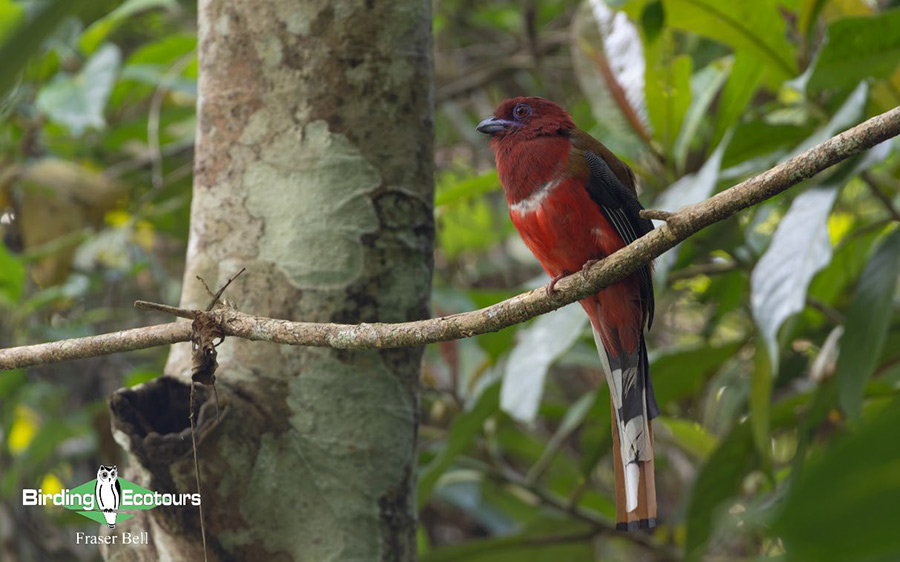
We eventually had repeated views of Red-headed Trogon, including this stunning male.
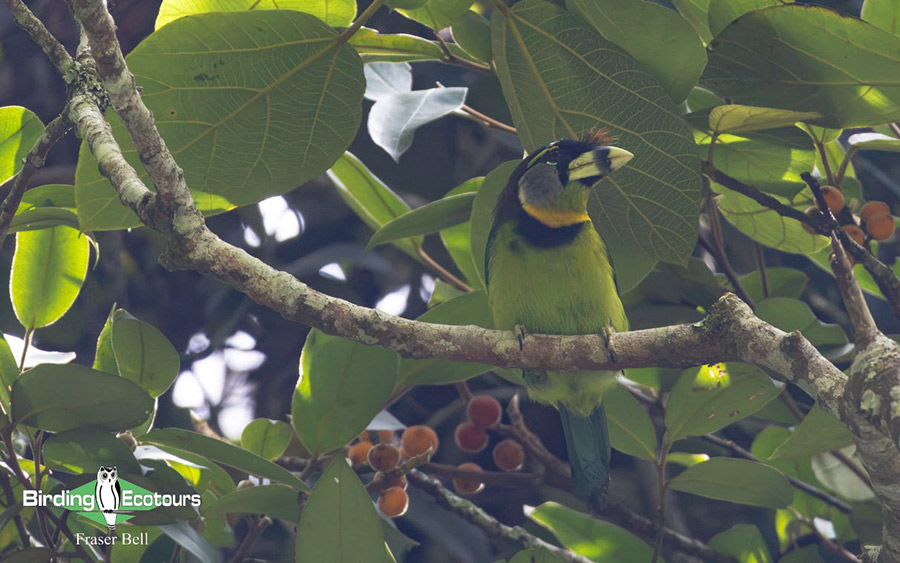
We saw nine species of Asian Barbets on the tour, such as this Fire-tufted Barbet. Their unique cicada like buzzing calls were a constant while birding in the highlands.
Despite it being midday, we decided to make one final quick stop and encountered a mixed-species flock almost straight away. This was a great flock with many of the focal species we were becoming familiar with. Importantly, however, it also contained a Rufous Woodpecker and a female Red-headed Trogon, which came down to head height, allowing us superb views. After lunch, we had a well-earned rest during the middle of the day and then headed out for more road birding, though finding a flock of Grey-chinned Minivets and Blue Nuthatches in the parking lot slowed our departure. The afternoon session was challenging at times, but we improved our views of Red-headed Trogon with a beautiful close-up male, and enjoyed close views of Ochraceous Bulbul, Hill Blue Flycatcher, and, for some, our target bird, Slaty-backed Forktail.
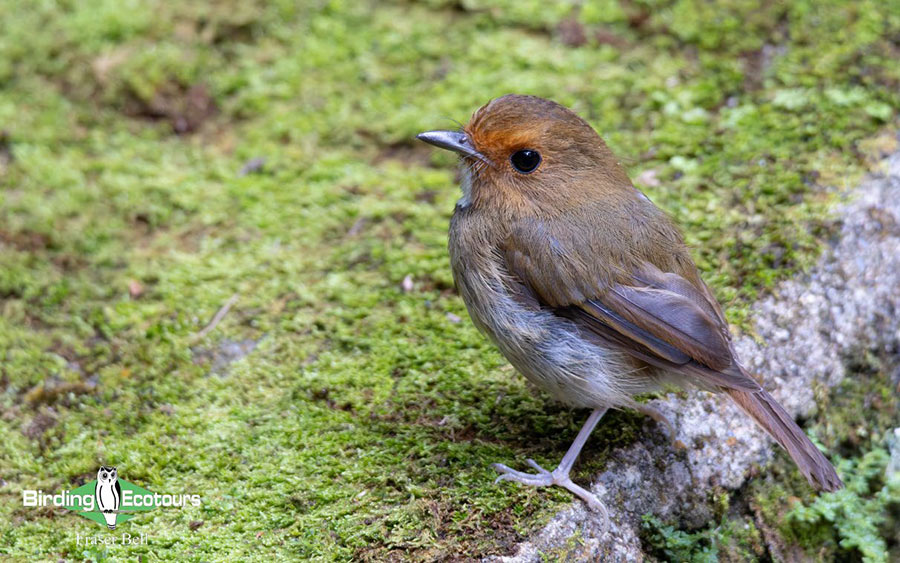
One can never tire of watching the inquisitive and incredibly cute Rufous-browed Flycatcher.
Day 7, 9th July 2026. Birding the forested slopes of Frasers Hill
We opted for a pre-dawn attempt for Mountain Scops Owl and Malayan Whistling Thrush, but unfortunately, we again only heard both species. After breakfast we birded along the forested slopes at a lower elevation than we had over the previous few days, opting to spend time along the main access road into Frasers Hill. The standout targets all came within a short period, right at the end of a good but long morning. We had nice views of a perched female Orange-breasted Trogon, which had been calling to our group for some time before we finally managed to find it hidden in the dense midstory. A pair of White-crowned Hornbills in the distant canopy were appreciated, and even at range their white crests and tails were distinctive. We also scored the localized Black Laughingthrush, which was very satisfying after several days of trying for it at higher elevations. Given we had not spent much time in this habitat at this elevation, we enjoyed a high diversity of interesting new trip birds, including Red-billed Malkoha, a stunning Violet Cuckoo, Buff-necked Woodpecker, Checker-throated Woodpecker, Verditer Flycatcher, and Purple-naped Spiderhunter.
We met up for some late afternoon birding, but unfortunately the weather had other ideas and we were forced to wait out the showers. After the rain had receded, the fog came in thick and impacted our birding. Perhaps this was why the vocal Pygmy Cupwing did not venture out from cover! Despite the conditions, we still managed to see Blue-winged Minla along with good views of Little Cuckoo-Dove, White-throated Fantail, Red-headed Trogon, Grey-chinned Minivet, Sunda Scimitar Babbler, Blue Nuthatch, a lovely male Little Pied Flycatcher, and a Pallas’s Squirrel.
Day 8, 10th July 2026. Arrival at Taman Negara National Park
Today we checked out of Frasers Hill and traveled east over the mountains, then north to the famous Taman Negara National Park. We stopped often along the road down from Frasers Hill and walked several sections, birding as we went. We improved our views of some top tour targets, such as Rhinoceros Hornbill, Red-bearded Bee-eater, and Slaty-backed Forktail, along with Common Emerald Dove, Sultan Tit, Scaly-breasted Bulbul, Rufous-bellied Swallow, Orange-bellied Flowerpecker, and White-rumped Munia. We finally found a Collared Owlet, but intense mobbing by many songbirds forced it away before we managed to see it through the dense cover. However, we did score two woodpeckers – Bamboo Woodpecker and Olive-backed Woodpecker, both of which are difficult to see anywhere within their range, along with a pair of Chestnut-breasted Malkohas.
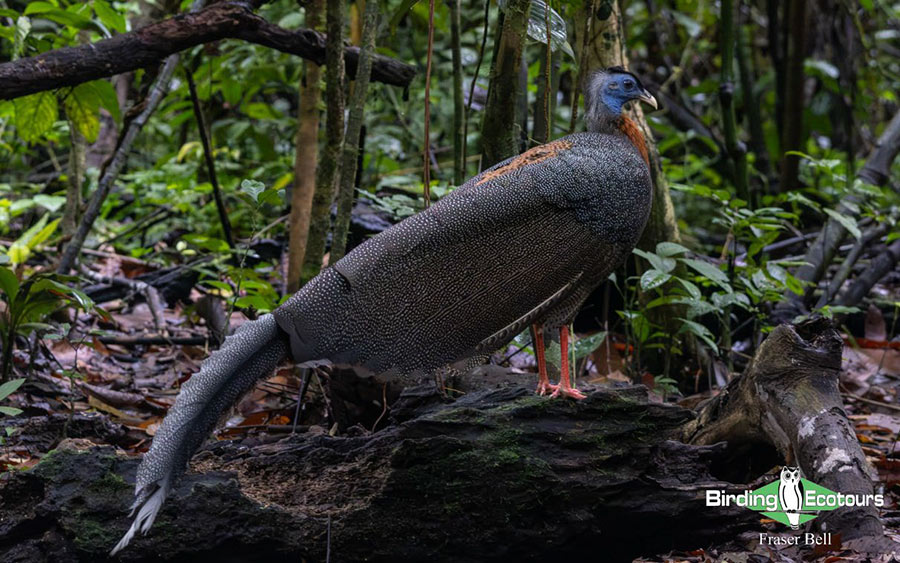
We had an incredible encounter with two iconic pheasants on arrival at Taman Negara Sungai Relau, alongside the Malayan Peacock-Pheasant (the next image), we enjoyed close views of a ridiculously plumaged male Great Argus.
After lunch we had a few hours to drive to the amazing and well preserved Taman Negara National Park. We were heading to the western entrance at Sungai Relau, an excellent place to bird, with several feeding sites for gamebirds and pittas, a well-made canopy walkway, and quiet roads along which bulbuls, babblers, and many other species can be targeted. We decided to focus on our gamebird targets at one of the feeding sites, which paid off well with close views of Great Argus and the shy Malayan Peacock-Pheasant, both magnificent males in exceptional plumage! It goes without saying that we were all ecstatic with such good views of these two top targets. The reserve is a brilliant place to bird, and we also added Banded Woodpecker, Yellow-bellied Bulbul, Finsch’s Bulbul, Buff-vented Bulbul, Malayan Black-capped Babbler, Mourning Babbler, and the colorful Prevost’s Squirrel to our trip lists.
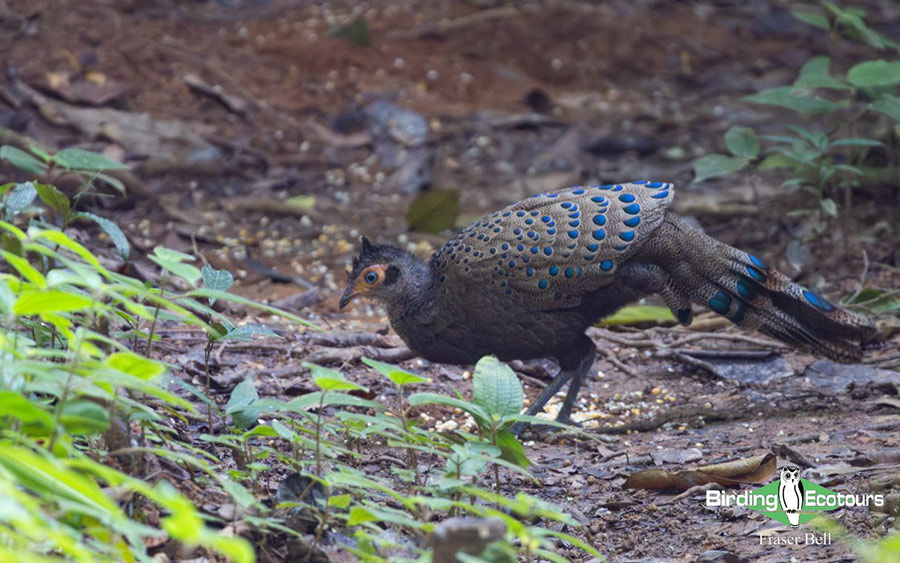
The shy and Endangered (IUCN Red List) Malayan Peacock-Pheasant is one of the top targets on the Peninsula Malaysia tour.
Day 9, 11th July 2026. Birding Sungai Relau, Taman Negara National Park western entrance
An early start had us eating breakfast at a local Chinese coffee shop before heading back to the Sungai Relau entrance of Taman Negara. It was a slow start, with some fog seemingly reducing bird activity, but not long into our walk to the feeding sites we could already hear our pitta target calling. We quickly got set up, and soon afterward we were staring at a gorgeous Garnet Pitta, very close up. After this, we decided to walk the roads looking for babblers, but luck was on our side when a Banded Kingfisher started calling close to us. After a bit of searching, we found the beautiful bird perched in the midstory alongside the road. We did well with our babbler targets, seeing four new species for the trip: Chestnut-winged Babbler, Black-throated Babbler, Chestnut-rumped Babbler, and Sooty-capped Babbler. Other top birds in the forest included a fly over Rhinoceros Hornbill, a female Rufous-winged Philentoma, Green Iora, and Yellow-breasted Flowerpecker. We also heard Square-tailed Drongo-Cuckoo and Striped Wren-Babbler.
After a break in the early afternoon, we returned once again for roadside birding in the Sungai Relau area of Taman Negara. Quite quickly we found one of our major targets, a pair of animated Crested Jayshrikes, which are important as it belongs to a monotypic family. It was fun watching them for some time, as they hopped and swooped through the canopy, and seeing their elongated crown feathers bouncing as they chattered to one another. Later on we found Rufous-crowned Babbler, and soon after Scaly-crowned Babbler, two similar looking species, so it was nice to have good views, compare them, and appreciate the identification features of each. Otherwise we enjoyed seeing species we had already seen before, including several woodpeckers and bulbuls, along with another brief view of the beautiful Garnet Pitta! We had an atmospheric drive back to the hotel as we passed through a very heavy tropical storm, which was impressive, but not so fun for our driver Ricky!
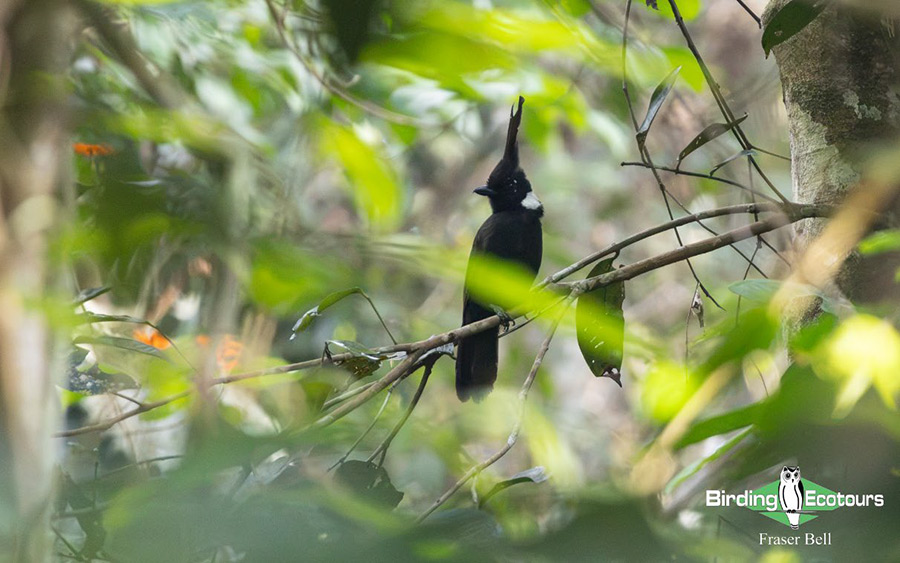
We worked together to improve views of a pair of the monotypic Crested Jayshrike, which were busily working their way through the dense rainforest midstory.
Day 10, 12th July 2026. Canopy walkway and transfer to the Mutiara Taman Negara Resort
We started the day much like the previous one, returning to the Chinese coffee shop before heading back to Sungai Relau. Unlike previous sessions, however, we ventured up into the trees using the recently renovated canopy walkway. This walkway is a well-made rigid structure rather than a series of suspension bridges, making it ideal for birding. However, the heavy rain from the night before resulted in a thick, soup like fog, which restricted our views to the nearest trees for the first hour or more. Still, we persevered and by the end had enjoyed a great morning. We saw a lot of pigeons and hornbills, adding Thick-billed Green Pigeon, Large Green Pigeon, Black Hornbill, had amazing views of perched Wreathed Hornbill and listening to the haunting nasal caws ofHelmeted Hornbills as they flew unseen through the forest. Several Blue-rumped Parrot flybys were appreciated, as they passed close by at head height, and we finally saw Black-eared Barbet, which we had heard often but not seen before now, a real stunner when seen well with its intricate face pattern. Other top birds included five malkoha species, along with close views of perched Black-thighed Falconet, Blue-crowned Hanging Parrot, and Green Iora, alongside many bulbuls and leafbirds. We also saw a Paddyfield Pipit on the drive out of the reserve.
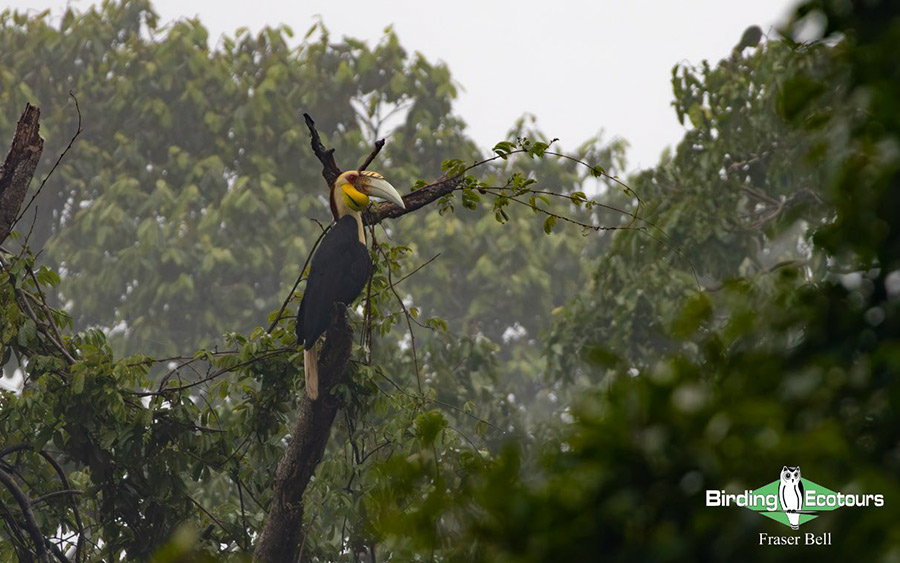
One of the highlights of our time on the canopy walkway was this perched Wreathed Hornbill.
We then headed south and east, skirting around much of the massive Taman Negara National Park, bound for the southern entrance at Kuala Tahan and a two night stay at the fabulous Mutiara Resort. The resort is accessible only by boat and is situated on the southern edge of the park, which is dominated by ancient lowland dipterocarp forest, so this was a wonderful place for us to spend time, and of course, there were many important target species for us here. After checking in, we met for a walk around the famous Swamp Loop, a 0.6 mile (1 kilometer) boardwalk that would be the focus of much of our birding during our stay. Not long into our walk we were watching a beautiful pair of Scarlet-rumped Trogons, perched near one another and allowing great views, until a noisy group of comical Dusky Broadbills rightly distracted us. Other highlights included Scarlet Minivet and Moustached Babbler, but we did not see the calling Garnet Pitta or the Black-and-yellow Broadbill. Meanwhile, a Green Broadbill remained in the dark understory of the forest, so the group only managed the briefest glimpses, and we only heard the localized and very secretive, Large Wren-Babbler. We were joined at our nice buffet dinner by entertaining Double-spotted Gecko and Asian House Gecko.
Day 11, 13th July 2026. A full day birding from the Mutiara Resort
The Mutiara Resort is an excellent destination for birdwatchers. However, being such a popular area for many other ecotourists, the nights get very busy, with a hundred or so people out on night walks! As such, our technique for our nocturnal targets was to instead meet in the early hours before breakfast. We scored big time with a perched Gould’s Frogmouth, which the whole group had time to appreciate before it moved further into the forest. These are such iconic birds of South-east Asia’s forests, so it was great to have such a good sighting. A Reddish Scops Owl was also appreciated by some in the group, but it unfortunately moved off too quickly for everyone to see.
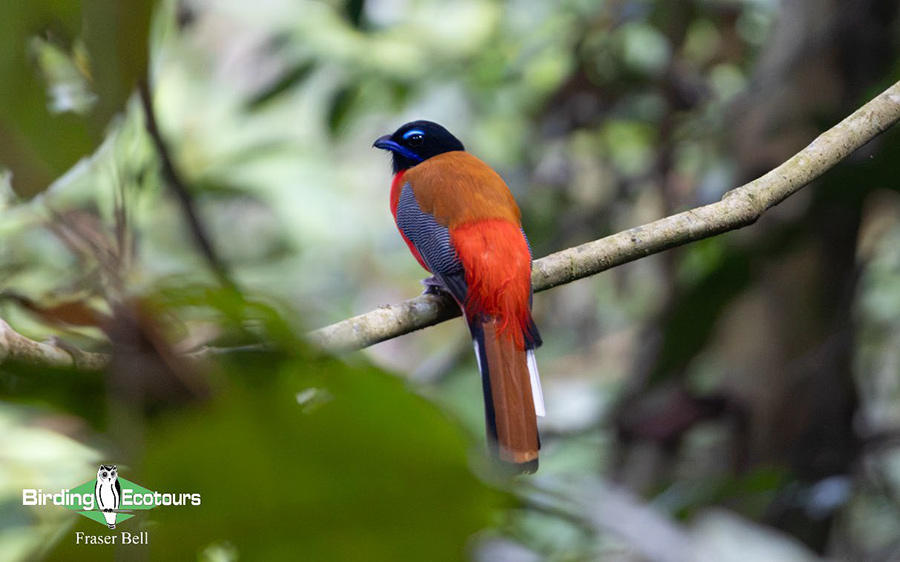
This male Scarlet-rumped Trogon is one of the many colorful and stunning species in Malaysia.
After breakfast we returned to the forest. Soon into the walk we stumbled upon two young male Malayan Crested Firebacks and a group of localized Malayan Black Magpie. The fireback sighting was just awesome. These two colorful, large pheasants walked in front of our group on the boardwalk and along the jungle floor for some time. Given we were birding in dense primary forest, birding was tough and slow at times, but over the long morning we added Hairy-backed Bulbul, a loud group of Fluffy-backed Tit-Babblers, Black-throated Babbler, Abbott’s Babblers, Malaysian Blue Flycatcher, and the striking White-crowned Forktail. The Abbott’s Babblers were particularly fun to watch as the group chattered to one another and foraged acrobatically in an open area not far from us. We also managed to improve our views of Thick-billed Green Pigeon, Rufous-winged Philentoma, and hear a vocal Rufous-collared Kingfisher which remained hidden in the thick midstory. We were delayed getting to lunch as a Indo-Chinese Rat Snake was hunting right outside the restaurant, and we even watched it catch and swallow a frog.
After some time off during the afternoon to recover and rest from the humidity and heat, we went back out onto the boardwalks. The forest was quieter =, but we enjoyed seeing a pair of Orange-backed Woodpeckers, Banded Bay Cuckoo, Dark-throated Oriole, and Blyth’s Paradise Flycatcher. We also finally saw the very vocal and iconic Black-and-yellow Broadbill, which we had been hearing throughout the tour, along with Black-striped Squirrel, and the unusual Shrew-faced Squirrel.
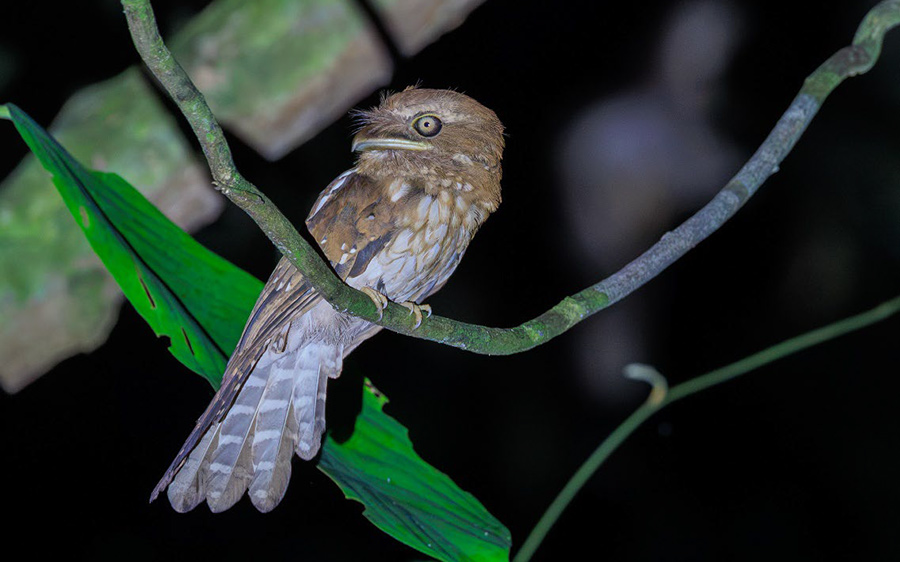
Night birding was very productive during the tour. This Gould’s Frogmouth was rightly a group favorite on our early morning birding in Taman Negara (photo N. Graf).
Day 12, 14th July 2026. Departing Taman Negara and transfer to Bukit Tinggi highlands
Similar to the previous day, we opted for another early start to look for night birds. Again, we had a great session, as we found an Oriental Bay Owl perched on a thick vine over the boardwalk. While this species has a large range in Asia, it is not often encountered here, so it was very much appreciated. We also saw two Southern Palm Civet, and heard Gould’s Frogmouth and Reddish Scops Owl, but given the success of the previous morning, decided not to leave the boardwalk and bushwhack to see them!
Our post breakfast morning session was shorter as we were checking out today. At our favorite boardwalk we found many species we had missed over the previous few days, such as Black-naped Monarch, Grey-cheeked Bulbul, Streaked Bulbul, Ferruginous Babbler, and a brilliant pair of Rufous-chested Flycatchers. That said, the highlight of the walk was seeing two male Malayan Crested Firebacks, one of which was in great light, along with excellent views of Buff-necked Woodpecker and Malayan Black-capped Babbler. While checking out, we were interrupted by a flock of fast moving swifts. Aside from the many swiftlets, this flock contained massive Brown-backed Needletails and Silver-rumped Spinetails, with their odd shaped wings.
Much of the afternoon was taken up by transferring south toward Bukit Tinggi in the Bentong Highlands. En route we stopped at the access road to Tengku Hassanal Wildlife Reserve, a quiet road through patches of primary forest that are unfortunately being encroached upon by agriculture and development. This was, however, a fun session, and we had great views of a pair of the odd-looking but very lovely Banded Broadbill, along with Black-bellied Malkoha, Black Hornbill, Malayan Black Magpie, Fluffy-backed Tit-Babbler, Chestnut-rumped Babbler, and Greater Green Leafbird. However, the highlight of the session was actually a pair of the incredibly shy Lar Gibbons. While at a distance, we watched the black male and orange female swinging through the trees, and excitingly, the female paused to stare at the group, revealing a small, bright orange fluffy infant clinging to her chest. What an amazing sighting! After this short session we continued to the Colmar Tropicale Resort, an odd but fun French themed hotel, complete with a drawbridge and a replica of the streets of Colmar. For our final evening meal of the tour, we headed up to the château overlooking the streets of Colmar and toasted the success and enjoyment of the tour.
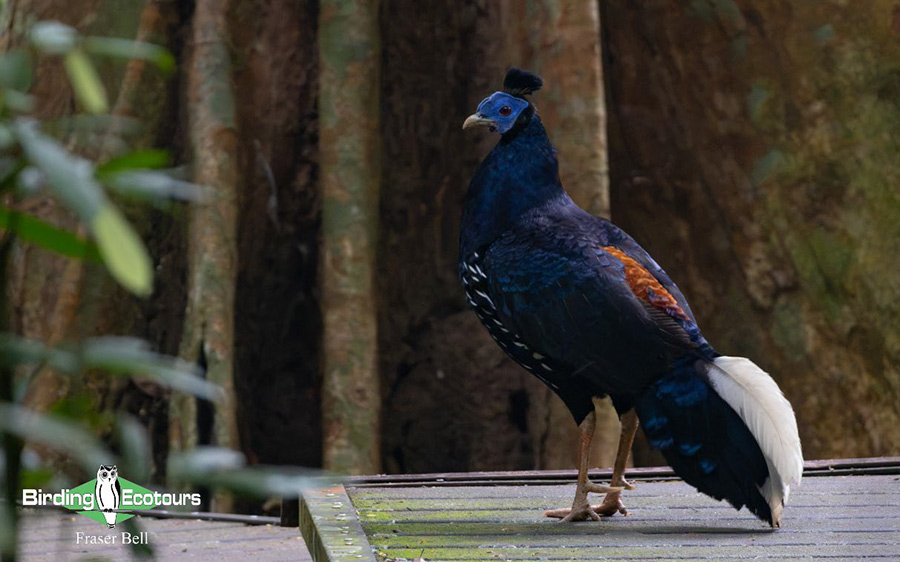
We had good views of all our pheasant targets on the tour, this is the most colorful, the male Malayan Crested Fireback.
Day 13, 15th July 2026. Birding Bukit Tinggi and departure
Our final morning had us eating breakfast at first light in the Malay-French resort before heading out to a stakeout to try for some gamebirds. Once in place we did not have to wait long before a small family group of five bright Ferruginous Partridges came in, with a few even walking incredibly close to our group. A while later, a truly beautiful male Mountain Peacock-Pheasant appeared, and we all enjoyed good close views, watched it foraging, and even heard it calling. This endemic species has a tiny global range, so it was a real treat to watch it for some time. After our early success we had a short time to enjoy some roadside birding before starting our transfer to the airport. We saw the colorful Yellow-crowned Barbet, a species we had heard earlier in the tour, so it was good to finally see it well. We also had good views of Little Cuckoo-Dove, Grey-rumped Treeswift, Rufous-bellied Swallow, Scaly-breasted Bulbul, Blue-winged Leafbird, a Sumatran Flying Dragon, and a brief sighting of a massive Black Giant Squirrel, which is the size of a cat! We also heard Great Hornbill and Maroon Woodpecker in the distance.
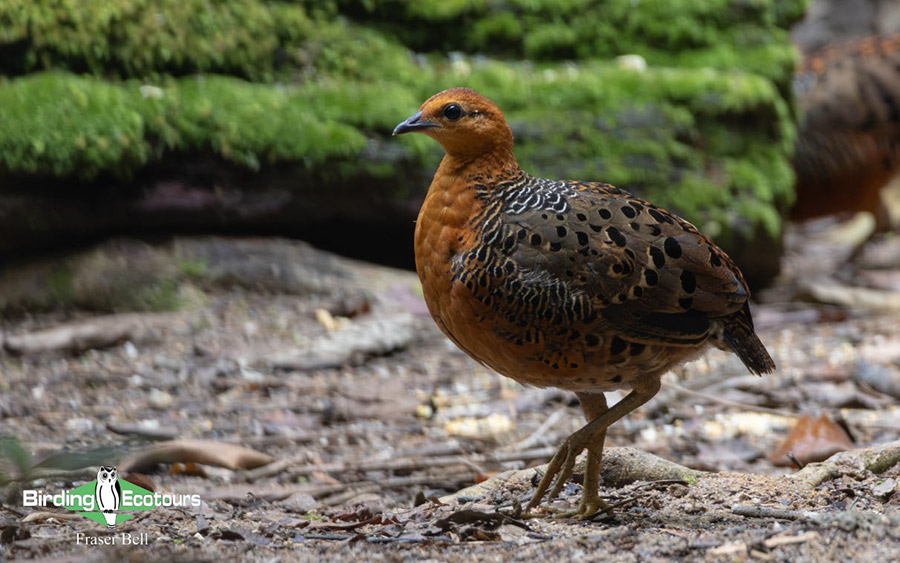
Spending time with a family group of Ferruginous Partridges was a great way to end the tour.
We then continued toward the airport, where this tour of Peninsula Malaysia ended upon our arrival. This had been a thoroughly enjoyable tour with a great group of birders who had a lot of fun together, made even better by the fact that we were all continuing on to our Birding Tour Borneo: Sabah Classic Tour, which started the next day! We had some fantastic wildlife sightings during our tour around the Peninsula, with the birds of the trip being two of five localized gamebirds we enjoyed: the phenomenal Great Argus and Malayan Crested Fireback taking the top prize, followed closely by the beautiful male Garnet Pitta that we spent around 10 minutes with. Meanwhile, the non-avian highlight was the Lar Gibbon we had seen on the penultimate day of the tour. It had been a great adventure!
Bird List – Following IOC 15.2 (April 2026)
Birds ‘heard only’ are marked with (H) after the common name, all other species were seen. The following notation after species names is used to show conservation status following the IUCN Red List: CR = Critically Endangered, EN = Endangered, and VU = Vulnerable.
| Common name | Scientific name |
| Pheasants & Allies (Phasianidae) | |
| Ferruginous Partridge | Caloperdix oculeus |
| Malayan Partridge | Arborophila campbelli |
| Malayan Crested Fireback – VU | Lophura rufa |
| Great Argus – VU | Argusianus argus |
| Malayan Peacock-Pheasant – EN | Polyplectron malacense |
| Mountain Peacock-Pheasant | Polyplectron inopinatum |
| Red Junglefowl (H) | Gallus gallus |
| Nightjars (Caprimulgidae) | |
| Malaysian Eared Nightjar | Lyncornis temminckii |
| Large-tailed Nightjar | Caprimulgus macrurus |
| Frogmouths (Podargidae) | |
| Gould’s Frogmouth | Batrachostomus stellatus |
| Blyth’s Frogmouth (H) | Batrachostomus affinis |
| Treeswifts (Hemiprocnidae) | |
| Grey-rumped Treeswift | Hemiprocne longipennis |
| Whiskered Treeswift | Hemiprocne comata |
| Swifts (Apodidae) | |
| Plume-toed Swiftlet | Collocalia affinis |
| Edible-nest Swiftlet | Aerodramus fuciphagus |
| Silver-rumped Spinetail | Rhaphidura leucopygialis |
| Brown-backed Needletail | Hirundapus giganteus |
| House Swift | Apus nipalensis |
| Cuckoos (Cuculidae) | |
| Greater Coucal | Centropus sinensis |
| Lesser Coucal | Centropus bengalensis |
| Raffles’s Malkoha | Rhinortha chlorophaea |
| Red-billed Malkoha | Zanclostomus javanicus |
| Chestnut-breasted Malkoha | Phaenicophaeus curvirostris |
| Chestnut-bellied Malkoha | Phaenicophaeus sumatranus |
| Black-bellied Malkoha | Phaenicophaeus diardi |
| Green-billed Malkoha | Phaenicophaeus tristis |
| Asian Koel | Eudynamys scolopaceus |
| Violet Cuckoo | Chrysococcyx xanthorhynchus |
| Little Bronze Cuckoo | Chalcites minutillus |
| Banded Bay Cuckoo | Cacomantis sonneratii |
| Plaintive Cuckoo | Cacomantis merulinus |
| Square-tailed Drongo-Cuckoo (H) | Surniculus lugubris |
| Pigeons & Doves (Columbidae) | |
| Rock Dove [Feral Pigeon] (Introduced) | Columba livia [dom.] |
| Spotted Dove | Spilopelia chinensis |
| Little Cuckoo-Dove | Macropygia ruficeps |
| Common Emerald Dove | Chalcophaps indica |
| Zebra Dove | Geopelia striata |
| Little Green Pigeon | Treron olax |
| Pink-necked Green Pigeon | Treron vernans |
| Thick-billed Green Pigeon | Treron curvirostra |
| Large Green Pigeon – VU | Treron capellei |
| Mountain Imperial Pigeon | Ducula badia |
| Rails, Crakes & Coots (Rallidae) | |
| White-breasted Waterhen | Amaurornis phoenicurus |
| Stilts & Avocets (Recurvirostridae) | |
| Black-winged Stilt | Himantopus himantopus |
| Darters (Anhingidae) | |
| Oriental Darter | Anhinga melanogaster |
| Plovers (Charadriidae) | |
| Red-wattled Lapwing | Vanellus indicus |
| Storks (Ciconiidae) | |
| Asian Openbill | Anastomus oscitans |
| Painted Stork | Mycteria leucocephala |
| Herons & Bitterns (Ardeidae) | |
| Cinnamon Bittern | Botaurus cinnamomeus |
| Black-crowned Night Heron | Nycticorax nycticorax |
| Little Egret | Egretta garzetta |
| Little Heron | Butorides atricapilla |
| Medium Egret | Ardea intermedia |
| Eastern Cattle Egret | Ardea coromanda |
| Grey Heron | Ardea cinerea |
| Purple Heron | Ardea purpurea |
| Kites, Hawks & Eagles (Accipitridae) | |
| Black-winged Kite | Elanus caeruleus |
| Crested Serpent Eagle | Spilornis cheela |
| Blyth’s Hawk-Eagle | Nisaetus alboniger |
| Changeable Hawk-Eagle | Nisaetus cirrhatus |
| Black Eagle | Ictinaetus malaiensis |
| Brahminy Kite | Haliastur indus |
| White-bellied Sea Eagle | Icthyophaga leucogaster |
| Barn Owls (Tytonidae) | |
| Eastern Barn Owl | Tyto javanica |
| Oriental Bay Owl | Phodilus badius |
| Owls (Strigidae) | |
| Collared Owlet (H) | Taenioptynx brodiei |
| Reddish Scops Owl | Otus rufescens |
| Mountain Scops Owl (H) | Otus spilocephalus |
| Collared Scops Owl | Otus lettia |
| Buffy Fish Owl | Ketupa ketupu |
| Dusky Eagle-Owl | Ketupa coromanda |
| Spotted Wood Owl | Strix seloputo |
| Trogons (Trogonidae) | |
| Scarlet-rumped Trogon | Harpactes duvaucelii |
| Orange-breasted Trogon | Harpactes oreskios |
| Red-headed Trogon | Harpactes erythrocephalus |
| Hornbills (Bucerotidae) | |
| White-crowned Hornbill – EN | Berenicornis comatus |
| Rhinoceros Hornbill – VU | Buceros rhinoceros |
| Great Hornbill – VU (H) | Buceros bicornis |
| Helmeted Hornbill – CR (H) | Rhinoplax vigil |
| Oriental Pied Hornbill | Anthracoceros albirostris |
| Black Hornbill – VU | Anthracoceros malayanus |
| Bushy-crested Hornbill | Anorrhinus galeritus |
| Wreathed Hornbill – VU | Rhyticeros undulatus |
| Rollers (Coraciidae) | |
| Oriental Dollarbird | Eurystomus orientalis |
| Kingfishers (Alcedinidae) | |
| Rufous-collared Kingfisher (H) | Actenoides concretus |
| Banded Kingfisher | Lacedo pulchella |
| Stork-billed Kingfisher | Pelargopsis capensis |
| White-throated Kingfisher | Halcyon smyrnensis |
| Collared Kingfisher | Todiramphus chloris |
| Blue-eared Kingfisher | Alcedo meninting |
| Bee-eaters (Meropidae) | |
| Red-bearded Bee-eater | Nyctyornis amictus |
| Blue-throated Bee-eater | Merops viridis |
| Asian Barbets (Megalaimidae) | |
| Fire-tufted Barbet | Psilopogon pyrolophus |
| Lineated Barbet | Psilopogon lineatus |
| Golden-whiskered Barbet | Psilopogon chrysopogon |
| Red-throated Barbet | Psilopogon mystacophanos |
| Black-browed Barbet | Psilopogon oorti |
| Yellow-crowned Barbet | Psilopogon henricii |
| Black-eared Barbet | Psilopogon duvaucelii |
| Coppersmith Barbet | Psilopogon haemacephalus |
| Sooty Barbet | Caloramphus hayii |
| Woodpeckers (Picidae) | |
| Speckled Piculet | Picumnus innominatus |
| Grey-and-buff Woodpecker | Hemicircus concretus |
| Sunda Pygmy Woodpecker | Yungipicus moluccensis |
| Banded Woodpecker | Chrysophlegma miniaceum |
| Checker-throated Woodpecker | Chrysophlegma mentale |
| Greater Yellownape | Chrysophlegma flavinucha |
| Lesser Yellownape | Picus chlorolophus |
| Crimson-winged Woodpecker (H) | Picus puniceus |
| Laced Woodpecker | Picus vittatus |
| Common Flameback | Dinopium javanense |
| Orange-backed Woodpecker | Chrysocolaptes validus |
| Greater Flameback | Chrysocolaptes guttacristatus |
| Bamboo Woodpecker | Gecinulus viridis |
| Olive-backed Woodpecker | Gecinulus rafflesii |
| Maroon Woodpecker (H) | Blythipicus rubiginosus |
| Rufous Woodpecker | Micropternus brachyurus |
| Buff-rumped Woodpecker | Meiglyptes grammithorax |
| Buff-necked Woodpecker | Meiglyptes tukki |
| Falcons (Falconidae) | |
| Black-thighed Falconet | Microhierax fringillarius |
| Old World Parrots (Psittaculidae) | |
| Blue-rumped Parrot | Psittinus cyanurus |
| Blue-crowned Hanging Parrot | Loriculus galgulus |
| Typical Broadbills (Eurylaimidae) | |
| Long-tailed Broadbill | Psarisomus dalhousiae |
| Dusky Broadbill | Corydon sumatranus |
| Silver-breasted Broadbill | Serilophus lunatus |
| Black-and-red Broadbill | Cymbirhynchus macrorhynchos |
| Banded Broadbill | Eurylaimus javanicus |
| Black-and-yellow Broadbill | Eurylaimus ochromalus |
| Green Broadbills (Calyptomenidae) | |
| Green Broadbill (H) | Calyptomena viridis |
| Pittas (Pittidae) | |
| Rusty-naped Pitta | Hydrornis oatesi |
| Garnet Pitta | Erythropitta granatina |
| Mangrove Pitta | Pitta megarhyncha |
| Australasian Warblers (Acanthizidae) | |
| Golden-bellied Gerygone | Gerygone sulphurea |
| Vangas & Allies (Vangidae) | |
| Bar-winged Flycatcher-shrike | Hemipus picatus |
| Black-winged Flycatcher-shrike (H) | Hemipus hirundinaceus |
| Large Woodshrike | Tephrodornis virgatus |
| Rufous-winged Philentoma | Philentoma pyrhoptera |
| Woodswallows (Artamidae) | |
| White-breasted Woodswallow | Artamus leucorynchus |
| Ioras (Aegithinidae) | |
| Common Iora | Aegithina tiphia |
| Green Iora | Aegithina viridissima |
| Great Iora (H) | Aegithina lafresnayei |
| Cuckooshrikes (Campephagidae) | |
| Grey-chinned Minivet | Pericrocotus solaris |
| Scarlet Minivet | Pericrocotus speciosus |
| Malayan Cuckooshrike | Coracina larutensis |
| Pied Triller | Lalage nigra |
| Whistlers (Pachycephalidae) | |
| Mangrove Whistler (H) | Pachycephala cinerea |
| Shrike-babblers (Vireonidae) | |
| Black-eared Shrike-babbler (H) | Pteruthius melanotis |
| White-browed Shrike-babbler (H) | Pteruthius aeralatus |
| White-bellied Erpornis | Erpornis zantholeuca |
| Old World Orioles (Oriolidae) | |
| Black-and-crimson Oriole | Oriolus consanguineus |
| Dark-throated Oriole | Oriolus xanthonotus |
| Black-naped Oriole | Oriolus chinensis |
| Drongos (Dicruridae) | |
| Lesser Racket-tailed Drongo | Dicrurus remifer |
| Greater Racket-tailed Drongo | Dicrurus paradiseus |
| Ashy Drongo | Dicrurus leucophaeus |
| Fantails (Rhipiduridae) | |
| White-throated Fantail | Rhipidura albicollis |
| Malaysian Pied Fantail | Rhipidura javanica |
| Monarchs (Monarchidae) | |
| Black-naped Monarch | Hypothymis azurea |
| Blyth’s Paradise Flycatcher | Terpsiphone affinis |
| Jayshrike (Platylophidae) | |
| Crested Jayshrike | Platylophus galericulatus |
| Shrikes (Laniidae) | |
| Long-tailed Shrike | Lanius schach |
| Crows & Jays (Corvidae) | |
| Malayan Black Magpie | Platysmurus leucopterus |
| Common Green Magpie | Cissa chinensis |
| House Crow (Introduced) | Corvus splendens |
| Sunda Crow | Corvus enca |
| Large-billed Crow | Corvus macrorhynchos |
| Fairy Flycatchers (Stenostiridae) | |
| Grey-headed Canary-flycatcher | Culicicapa ceylonensis |
| Tits (Paridae) | |
| Sultan Tit | Melanochlora sultanea |
| Cinereous Tit | Parus cinereus |
| Bulbuls (Pycnonotidae) | |
| Hairy-backed Bulbul | Tricholestes criniger |
| Yellow-bellied Bulbul | Alophoixus phaeocephalus |
| Grey-cheeked Bulbul | Alophoixus tephrogenys |
| Ochraceous Bulbul | Alophoixus ochraceus |
| Finsch’s Bulbul | Iole finschii |
| Buff-vented Bulbul | Iole crypta |
| Cinereous Bulbul | Hemixos cinereus |
| Streaked Bulbul | Ixos malaccensis |
| Mountain Bulbul | Ixos mcclellandii |
| Black-headed Bulbul | Brachypodius melanocephalos |
| Spectacled Bulbul | Ixodia erythropthalmos |
| Scaly-breasted Bulbul | Ixodia squamata |
| Black-crested Bulbul | Rubigula flaviventris |
| Cream-vented Bulbul | Pycnonotus simplex |
| Olive-winged Bulbul | Pycnonotus plumosus |
| Asian Red-eyed Bulbul | Pycnonotus brunneus |
| Stripe-throated Bulbul | Pycnonotus finlaysoni |
| Yellow-vented Bulbul | Pycnonotus goiavier |
| Swallows (Hirundinidae) | |
| Pacific Swallow | Hirundo javanica |
| Rufous-bellied Swallow | Cecropis badia |
| Cupwings (Pnoepygidae) | |
| Pygmy Cupwing (H) | Pnoepyga pusilla |
| Cettia Bush Warblers & Allies (Cettiidae) | |
| Yellow-bellied Warbler | Abroscopus superciliaris |
| Mountain Tailorbird | Phyllergates cucullatus |
| Cisticolas & Allies (Cisticolidae) | |
| Rufescent Prinia | Prinia rufescens |
| Yellow-bellied Prinia | Prinia flaviventris |
| Common Tailorbird | Orthotomus sutorius |
| Dark-necked Tailorbird | Orthotomus atrogularis |
| Rufous-tailed Tailorbird | Orthotomus sericeus |
| Ashy Tailorbird | Orthotomus ruficeps |
| White-eyes (Zosteropidae) | |
| Swinhoe’s White-eye | Zosterops simplex |
| Hume’s White-eye | Zosterops auriventer |
| Tree Babblers & Scimitar Babblers (Timaliidae) | |
| Pin-striped Tit-Babbler | Mixornis gularis |
| Fluffy-backed Tit-Babbler | Macronus ptilosus |
| Golden Babbler | Cyanoderma chrysaeum |
| Chestnut-winged Babbler | Cyanoderma erythropterum |
| Black Laughingthrush | Melanocichla lugubris |
| Sunda Scimitar Babbler | Pomatorhinus bornensis |
| Black-throated Babbler | Stachyris nigricollis |
| Chestnut-rumped Babbler | Stachyris maculata |
| Grey-throated Babbler | Stachyris nigriceps |
| Ground Babblers (Pellorneidae) | |
| Large Wren-Babbler (H) | Turdinus macrodactylus |
| Sooty-capped Babbler | Malacopteron affine |
| Scaly-crowned Babbler | Malacopteron cinereum |
| Rufous-crowned Babbler | Malacopteron magnum |
| Moustached Babbler | Malacopteron magnirostre |
| Malayan Black-capped Babbler | Pellorneum nigrocapitatum |
| Mourning Babbler | Pellorneum malaccense |
| Buff-breasted Babbler | Pellorneum tickelli |
| Malayan Swamp Babbler (H) | Pellorneum rostratum |
| Ferruginous Babbler | Pellorneum bicolor |
| Striped Wren-Babbler (H) | Kenopia striata |
| Abbott’s Babbler | Malacocincla abbotti |
| Streaked Wren-Babbler | Gypsophila brevicaudata |
| Alcippe Fulvettas (Alcippeidae) | |
| Mountain Fulvetta | Alcippe peracensis |
| Laughingthrushes & Allies (Leiothrichidae) | |
| Malayan Laughingthrush | Trochalopteron peninsulae |
| Long-tailed Sibia | Heterophasia picaoides |
| Blue-winged Minla | Actinodura cyanouroptera |
| Silver-eared Mesia – EN | Leiothrix argentauris |
| Chestnut-capped Laughingthrush | Pterorhinus mitratus |
| Fairy-bluebirds (Irenidae) | |
| Asian Fairy-bluebird | Irena puella |
| Nuthatches (Sittidae) | |
| Blue Nuthatch | Sitta azurea |
| Velvet-fronted Nuthatch (H) | Sitta frontalis |
| Starlings (Sturnidae) | |
| Asian Glossy Starling | Aplonis panayensis |
| Great Myna | Acridotheres grandis |
| Javan Myna (Introduced) – VU | Acridotheres javanicus |
| Common Myna | Acridotheres tristis |
| Chats & Old World Flycatchers (Muscicapidae) | |
| Oriental Magpie-Robin | Copsychus saularis |
| White-rumped Shama | Copsychus malabaricus |
| Large Niltava | Niltava grandis |
| Verditer Flycatcher | Eumyias thalassinus |
| Rufous-browed Flycatcher | Anthipes solitaris |
| Malaysian Blue Flycatcher | Cyornis turcosus |
| Indochinese Blue Flycatcher (H) | Cyornis sumatrensis |
| Hill Blue Flycatcher | Cyornis whitei |
| Mangrove Blue Flycatcher | Cyornis rufigastra |
| White-tailed Robin | Myiomela leucura |
| Slaty-backed Forktail | Enicurus schistaceus |
| White-crowned Forktail | Enicurus leschenaulti |
| Malayan Whistling Thrush (Endemic) (H) | Myophonus robinsoni |
| Lesser Shortwing | Brachypteryx leucophris |
| Little Pied Flycatcher | Ficedula westermanni |
| Rufous-chested Flycatcher | Ficedula dumetoria |
| Leafbirds (Chloropseidae) | |
| Greater Green Leafbird – EN | Chloropsis sonnerati |
| Lesser Green Leafbird | Chloropsis cyanopogon |
| Blue-winged Leafbird | Chloropsis moluccensis |
| Orange-bellied Leafbird | Chloropsis hardwickii |
| Flowerpeckers (Dicaeidae) | |
| Yellow-breasted Flowerpecker | Prionochilus maculatus |
| Crimson-breasted Flowerpecker | Prionochilus percussus |
| Orange-bellied Flowerpecker | Dicaeum trigonostigma |
| Fire-breasted Flowerpecker | Dicaeum ignipectus |
| Scarlet-backed Flowerpecker | Dicaeum cruentatum |
| Sunbirds (Nectariniidae) | |
| Ruby-cheeked Sunbird | Chalcoparia singalensis |
| Brown-throated Sunbird | Anthreptes malacensis |
| Copper-throated Sunbird | Leptocoma calcostetha |
| Ornate Sunbird | Cinnyris ornatus |
| Black-throated Sunbird | Aethopyga saturata |
| Purple-naped Spiderhunter | Kurochkinegramma hypogrammicum |
| Little Spiderhunter | Arachnothera longirostra |
| Long-billed Spiderhunter | Arachnothera robusta |
| Spectacled Spiderhunter | Arachnothera flavigaster |
| Grey-breasted Spiderhunter | Arachnothera modesta |
| Streaked Spiderhunter | Arachnothera magna |
| Old World Sparrows (Passeridae) | |
| Eurasian Tree Sparrow | Passer montanus |
| Weavers (Ploceidae) | |
| Baya Weaver | Ploceus philippinus |
| Munias & Allies (Estrildidae) | |
| Scaly-breasted Munia | Lonchura punctulata |
| White-rumped Munia | Lonchura striata |
| White-headed Munia | Lonchura maja |
| Pin-tailed Parrotfinch | Erythrura prasina |
| Wagtails & Pipits (Motacillidae) | |
| Paddyfield Pipit | Anthus rufulus |
| Species seen: | 256 |
| Species heard: | 23 |
| Total recorded: | 279 |
Mammal List – Following IUCN Mammalwatching.com (September 2024)
The following notation after species names is used to show conservation status following the IUCN Red List: EN = Endangered, and VU = Vulnerable.
| Common name | Scientific name |
| Treeshrews (Scandentia) | |
| Common Treeshrew | Tupaia glis |
| Old World Monkeys (Cercopithecidae) | |
| Long-tailed Macaque – EN | Macaca fascicularis |
| Southern Pig-tailed Macaque – EN | Macaca nemestrina |
| Pale-thighed Langur | Presbytis siamensis |
| Dusky Langur – EN | Trachypithecus obscurus |
| Selangor Silvery Langur | Trachypithecus selangorensis |
| Gibbons (Hylobatidae) | |
| Lar Gibbon – EN | Hylobates lar |
| Siamang – EN | Symphalangus syndactylus |
| Squirrels (Sciuridae) | |
| Black Giant Squirrel | Ratufa bicolor |
| Southern Gray-bellied Squirrel | Callosciurus concolor |
| Pallas’s Squirrel | Callosciurus erythraeus |
| Black-striped Squirrel | Callosciurus nigrovittatus |
| Plantain Squirrel | Callosciurus notatus |
| Prevost’s Squirrel | Callosciurus prevostii |
| Asian Red-cheeked Squirrel | Dremomys rufigenis |
| Three-striped Ground Squirrel | Lariscus insignis |
| Shrew-faced Squirrel | Rhinosciurus laticaudatus |
| Slender Squirrel | Sundascirurus tenuis |
| Southeast Asian Striped Squirrel | Tamiops barbei |
| Civets (Viverridae) | |
| Small-toothed Palm Civet | Arctogalidia trivirgata |
| Southern Palm Civet | Paradoxurus hermaphroditus |
| Mustelids (Mustelidae) | |
| Smooth-coated Otter – VU | Lutrogale perspicillata |
| Common name | Scientific name |
| Mouse deer (Tragulus) | |
| Lesser Indo-Malayan Chevrotain | Tragulus kanchil |
| Species seen: | 23 |
Reptile List – Following Reptiles of the World (November 2024)
| Common name | Scientific name |
| Agamas and Dragons (Agamidae) | |
| Changeable Lizard | Calotes versicolor |
| Sumatran Flying Dragon | Draco sumatranus |
| Geckos (Gekkonidae) | |
| Double-spotted Gecko | Gekko monarchus |
| Asian House Gecko | Hemidactylus frenatus |
| Flat-tailed House Gecko | Hemidactylus platyurus |
| Skinks (Scincidae) | |
| Common Sun Skink | Eutropis multifasciata |
| Monitor Lizards (Varanidae) | |
| Clouded Monitor | Varanus nebulosus |
| Common Water Monitor | Varanus salvator |
| Typical Snakes (Colubridae) | |
| Indo-Chinese Rat Snake | Ptyas korros |
| Species seen: | 9 |
This is a sample trip report. Please email us ([email protected]) for more trip reports from this destination.