09–17 SEPTEMBER 2026
By Dylan Vasapolli
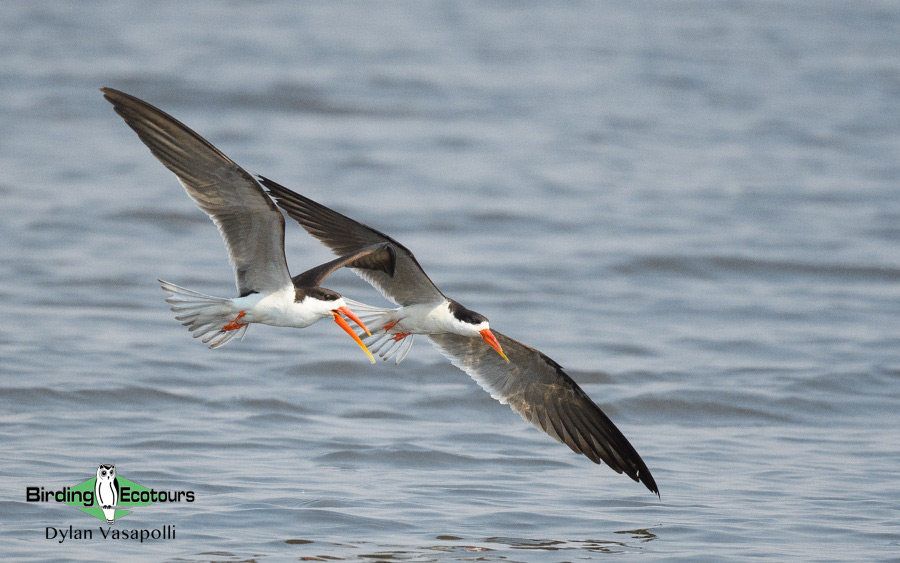
African Skimmers were delightfully abundant along the Chobe River, providing us with excellent sightings throughout our stay.
Overview
This private Botswana tour in September 2026 provided an exciting exploration of the country’s renowned wilderness areas, combining excellent birding with memorable mammal encounters across the Okavango Delta and Chobe National Park. Beginning in Maun, we took a scenic charter flight into the vast Okavango Delta, where we spent our first three nights exploring the diverse habitats of the Moremi Game Reserve. From there, we flew north to Chobe National Park, where four full days of birding and safari activities allowed us to explore the Chobe River and surrounding woodlands through a combination of boat trips and game drives. The tour covered a wonderful variety of habitats, from seasonally flooded wetlands, reedbeds, and open floodplains to riverine forests and dry teak woodlands.
The tour ran smoothly overall, with logistics working well throughout. A late flooding issue at one of the planned lodges necessitated a slight adjustment to our itinerary, resulting in additional time in Chobe, but this did not detract from the experience. Importantly, the weather had no negative impact on our birding, and we enjoyed consistently productive outings in wonderfully warm and sunny conditions. Although conditions in Chobe were particularly dry, concentrating much of the bird and mammal activity around the river, this provided excellent opportunities for wildlife viewing.
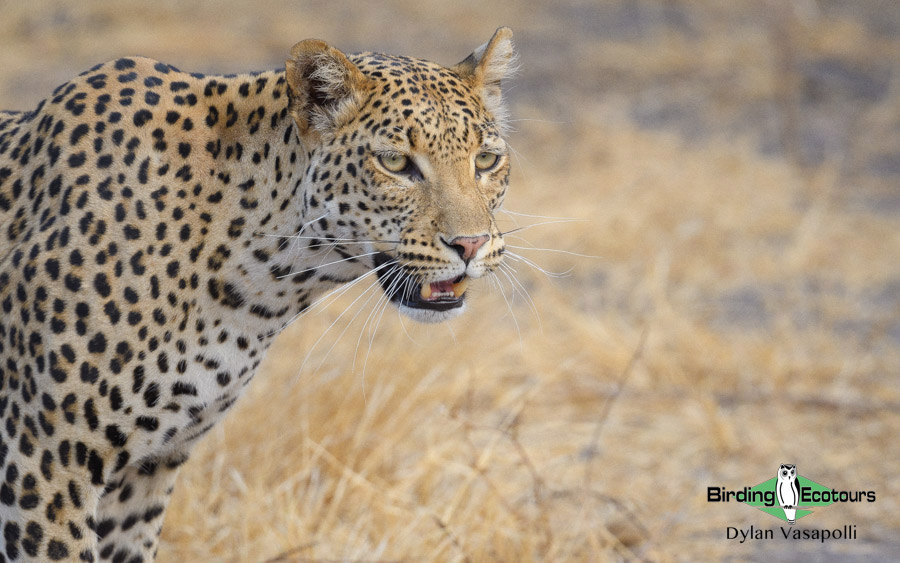
Together with excellent birding, Botswana offers excellent game viewing as well. We had supreme views of Leopard on the tour!
Our time in Botswana produced an excellent selection of birds, including sought-after species such as Pel’s Fishing Owl (heard only), Verreaux’s Eagle-Owl, Arnot’s Chat, Southern Carmine Bee-eater, Bradfield’s Hornbill, Slaty Egret, Rufous-bellied Heron, African Skimmer, and Greater Painted-snipe. The breeding colonies of storks, herons, and egrets were particularly memorable, as were the numerous waterbirds encountered along the Chobe River. Mammals were equally impressive, with outstanding sightings of African Savanna Elephants, Lions, and Leopards, alongside large herds of Southern Lechwe, Impala, and Plains Zebra. A particularly special highlight was encountering a large herd of Roan Antelope, while close-up encounters with a female Leopard and several Lion sightings added further excitement. The combination of exceptional wildlife, beautiful landscapes, and productive birding made for a thoroughly enjoyable Botswana safari.
A detailed daily account can be read below, and the various species lists are located at the end of the report. You can also access our eBird trip report here.
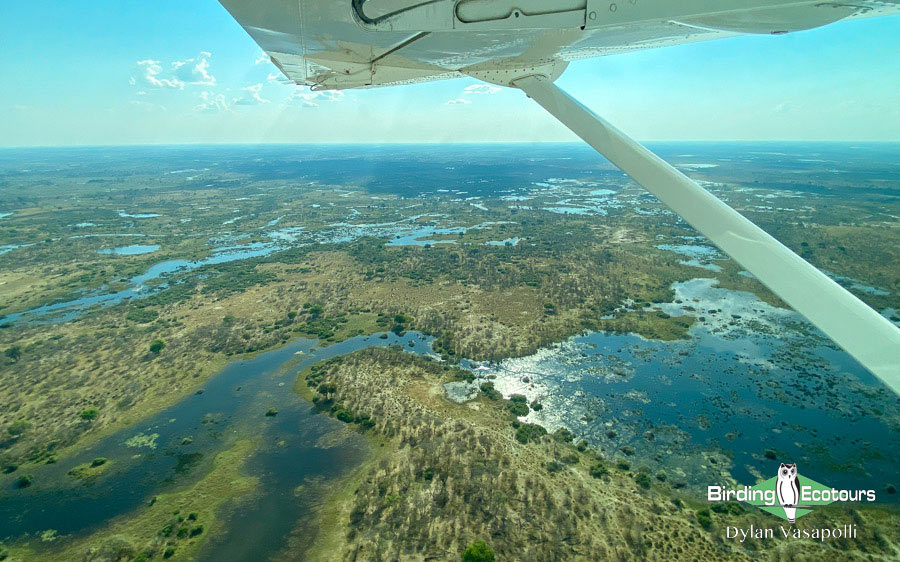
The safari charter flights throughout the Okavango Delta give you spectacular views of this wonderful wilderness area – and how vast it is.
Detailed Report
Day 1, 09th September 2026. Arrival into Maun and flight to Moremi
After arriving in Maun and meeting up, excited for the journey ahead, we had a short wait until it was time for us to board our charter flight. We enjoyed a stunning flight into the vast wilderness of the Okavango Delta, bound for our first destination, the Moremi Game Reserve. After landing, we met our local guide and immediately set off on an afternoon drive to explore the Xakanaxa region of the reserve. Things were a bit quiet to start, with only a lone African Savanna Elephant and our first of many Lilac-breasted Rollers and Burchell’s Starlings keeping us company. Fortunately, things picked up and we enjoyed a fine end to our drive. A Lion resting high in a tree, an unusual sight for this species, was an excellent find, as was an exciting pair of calling Verreaux’s Eagle-Owls. As it turns out, they had a genet prey with them, which was likely why they were so vocal. The likes of Little and Swallow-tailed Bee-eaters were enjoyed, as was a brief Rufous-bellied Heron, and some prolonged views of a male Arnot’s Chat. Before we knew it, the sun was setting, and we arrived at the lovely Camp Moremi, where we checked in and settled down for the evening.
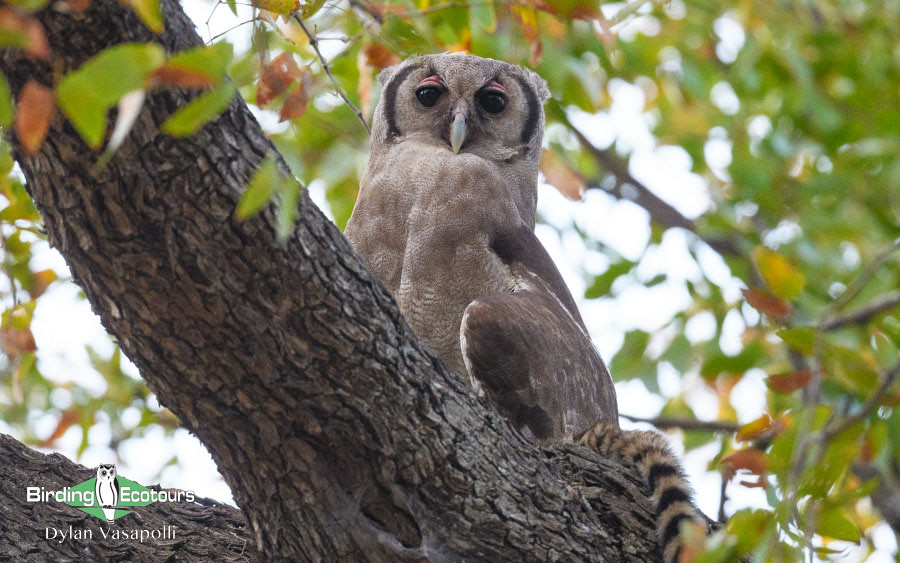
Finding a pair of Verreaux’s Eagle-Owls on our first day in the Delta was excellent. If you look carefully, you’ll see the tail of their genet prey.
Day 2, 10th September 2026. Full day of Moremi birding
After our morning wake-up call, we enjoyed some coffee and an early breakfast before setting off on our morning birding and safari drive. We made our way slowly through the area, enjoying the likes of our first more common birds like Grey Go-away-bird and African Green Pigeon, along with some more special and sought-after birds like Southern Carmine Bee-eater and Bradfield’s Hornbill. A tiny, feisty Pearl-spotted Owlet was a particular highlight. Luck was on our side as we enjoyed a lovely sighting of a Leopard lazing high in a tree. As the morning heat began to increase, the first raptors started moving around and amongst them we picked up Hooded Vulture, Yellow-billed Kite, Brown Snake Eagle and African Hawk-Eagle. We made our way over to the floodplain fringes of this part of the Okavango Delta, where we spent the rest of the morning. The wetlands and open grasslands were a hive of activity, and we quickly picked up many birds. Long-toed Lapwings, Black Crakes and Pied Kingfishers delighted, as sneaky Coppery-tailed Coucals crept about through the grassy fringes. A smaller pan was filled with all manner of shorebirds, with loads of Black-winged Stilts and Collared Pratincoles, along with smaller numbers of recently arrived Palearctic migrants like Ruff, Wood Sandpiper and Little Stint. A family of Southern Ground Hornbills wandered through the area, while a female Saddle-billed Stork was as stately as ever. Of course, these are just a small number of the many bird species seen here. There was also lots of game in the area, and two Side-striped Jackals did not even seem to bother the huge numbers of Southern Lechwe and Impala lazing about. Also present in the area were Tsessebe, Plains Zebra, Steenbok and many herds of African Savanna Elephants. We arrived back into camp at midday, just in time for our lunch and afternoon siesta.
After our afternoon High Tea, we set off on our game drive. We found an excellent Western Banded Snake Eagle before we had even left the camp, and then set off to explore some nearby wetlands. The area was full of birds, and it took us a while to work through the many species present. We were familiar with most of the species by now, but nonetheless enjoyed the more widespread and common species like African Spoonbill, Great Egret and White-faced Whistling Duck. Some careful scanning gave us a few well-hidden White-backed Ducks, along with several Slaty Egrets that were carefully working the grassy edges. A comical Saddle-billed Stork provided some entertainment as it ran around chasing after fish, and we also did well to find a Rufous-bellied Heron. The surrounding woods gave us several new birds as well, with our first Meve’s Starling and White-crested Helmetshrike showing well, alongside others like Wattled Starling, Yellow-throated Bush Sparrow. A Red-crested Korhaan brought us to a stop once more, as did a busy group of Green Wood Hoopoes and a mixed-species feeding flock of Southern Red-billed and Southern Yellow-billed Hornbills. As the sun started to get low on the horizon, we pulled into a scenic wetland enclave, and settled down with gin and tonics in hand, reminiscing about the many (exciting!) sightings during this busy first full day in Botswana. At camp, we were serenaded by calling Pel’s Fishing Owls throughout the evening, but try as we might, we couldn’t catch sight of them.
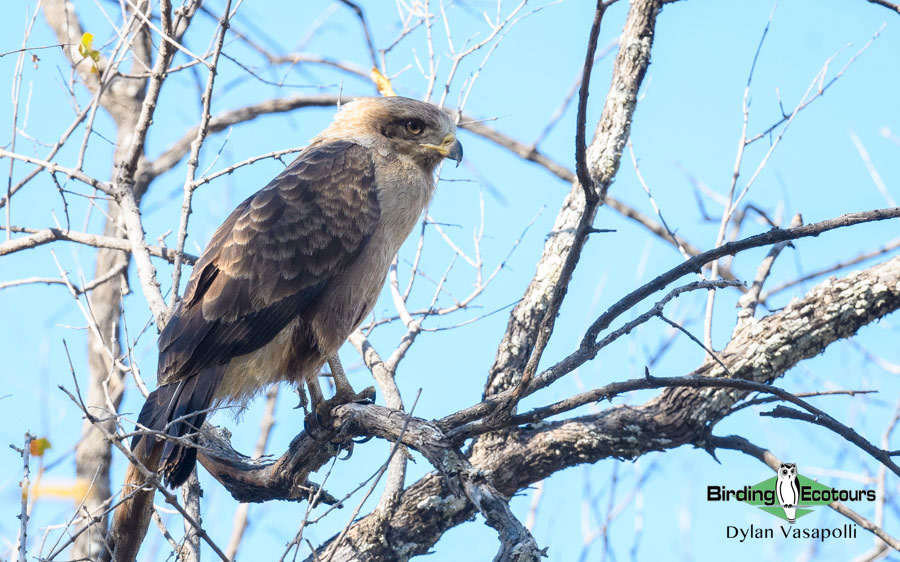
We were lucky with this young Western Banded Snake Eagle perched quietly.
Day 3, 11th September 2026. Wetland birding in the Xakanaxa region
Our second full day in the Moremi Game Reserve started with a morning boat trip, as we explored the vast and seemingly never-ending waterways of the Okavango Delta. We were ultimately bound for a distant island where a rookery was present, but enjoyed some birds like the brilliant Malachite Kingfisher, Little Bittern and others like Fan-tailed Widowbird along the route. We spent a while (and a lovely mid-morning coffee) enjoying the rookery, where noisy Marabou and Yellow-billed Storks made up the bulk of the numbers. Smaller numbers of Grey Heron and both Great and Little Egrets were scatted among the larger storks. The birds were actively breeding, with many occupying nests, some of which already contained young. It was fascinating to watch them. The surrounding reeds also delivered Southern Brown-throated Weavers and the range-restricted Chirping Cisticola, amongst others. Several raptors were also active overhead, and we notched up Hooded and White-backed Vultures, Brown Snake Eagle, Yellow-billed Kite and numerous African Fish Eagles. We then started the journey back to camp, pausing for some birds like Saddle-billed Stork, and an exciting encounter with African Savanna Elephants crossing the deep channel, which we spent some time watching. Back on land, we enjoyed lunch, and found a few birds including Hartlaub’s Babbler, Grey-backed Camaroptera and Terrestrial Brownbul, before heading off for our afternoon siesta.
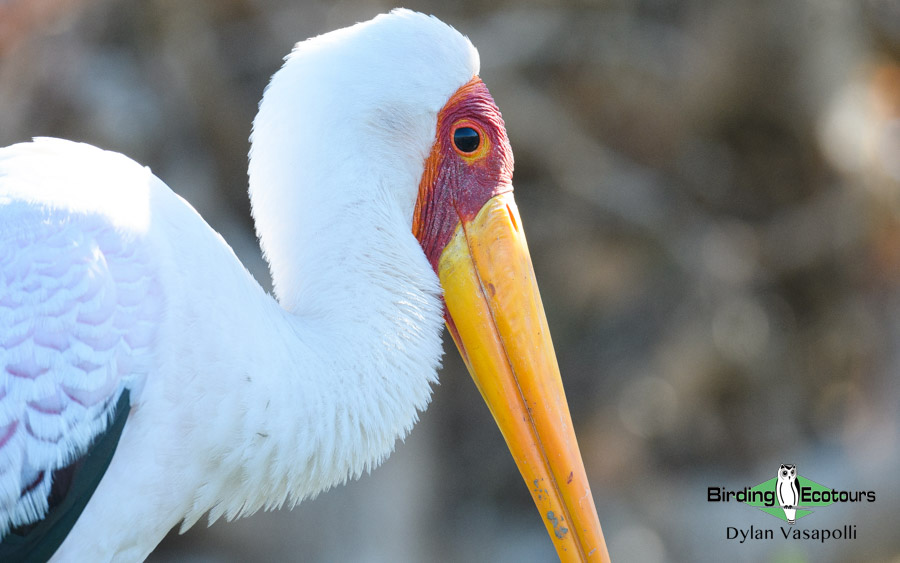
Up close and personal with a Yellow-billed Stork at its rookery. While nesting, their colors are brighter than usual, and their wings display beautiful pink feathers that are only present during the breeding season.
Before we knew it, we were back on the vehicle as we set off for our now customary afternoon game drive. Things were a bit slow, with the sun still sweltering early on, and we managed to eke out some widespread species such as Little Bee-eater, Arrow-marked Babbler and Black-throated Canary. A few scattered water bodies held several waterbirds and we picked up our first Intermediate Egrets and Knob-billed Ducks, amongst others. Favorites like Eurasian Hoopoe, Green Wood Hoopoe, Lilac-breasted Roller kept us entertained. We wound up at an extremely productive seasonally flooded pan, where we would spend the rest of the afternoon birding, and enjoying our sundowners. The birding here was excellent with an exciting nesting rookery of Rufous-bellied Herons piquing our interest. We also did well to add a few new birds like Goliath Heron, Red-billed Teal and Black Heron, whilst enjoying many of the other regulars like African Spoonbill and Yellow-billed Stork, whilst several Slaty Egrets were also about. In the surrounding areas, we far-improved on our views of Meyer’s Parrots, and also enjoyed prolonged views of Buffy Pipit. Mammals were a bit sparse this afternoon, and today generally, though we did add Waterbuck and some delightful Banded Mongoose to our growing list. A lovely African Barred Owlet awaited us when we returned to camp.
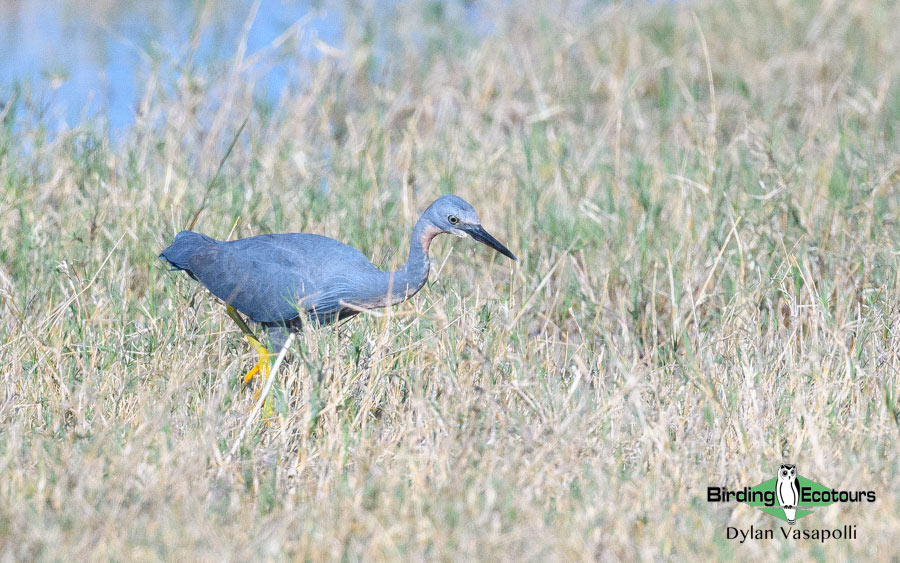
Slaty Egret is a scarce species, and an important target of any trip to the Okavango Delta.
Day 4, 12th September 2026. Transfer to Chobe
We had a slightly more restful day, with us saying goodbye to the wonderful Moremi region of the Delta, and departing up to Chobe National Park, via a charter flight. Following our breakfast, we enjoyed a camp walk, as we picked up some of the resident species we had yet to come across during our travels so far. Typical African species like Red-faced Mousebird and several brightly colored starlings and weavers, were present, and we managed to find a few new birds, including Bennett’s Woodpecker, Yellow-fronted Tinkerbird, Brubru and Purple-banded Sunbird, amongst others. We also enjoyed views of Hartlaub’s Babblers and Swamp Boubous, amongst others, before heading off to catch our plane.
Once onboard, we enjoyed another scenic low-level flight over the vast Delta, stopping to drop off and collect guests at several camps before eventually arriving in Kasane. Here we were quickly met, and taken to our wooded lodge in the Chobe National Park. We opted for an afternoon break, with no safari activity, and enjoyed a restful afternoon at the lodge.
Days 5–8, 13th–16th September 2026. Birding in the Chobe – game drives and boat trips
As our four full days in Chobe National Park covered similar habitats and routes and produced a similar suite of species, they are discussed together below.
We had four full days in the Chobe National Park, in part due to some late flooding at one of the other lodges we were meant to be staying at, which forced a slight re-jig of things. We spent our mornings and afternoons exploring the park through a combination of boat trips on the Chobe River and game drives. Thanks to the extremely dry conditions in the park at the moment, most of the bird and mammal life was situated around the river.
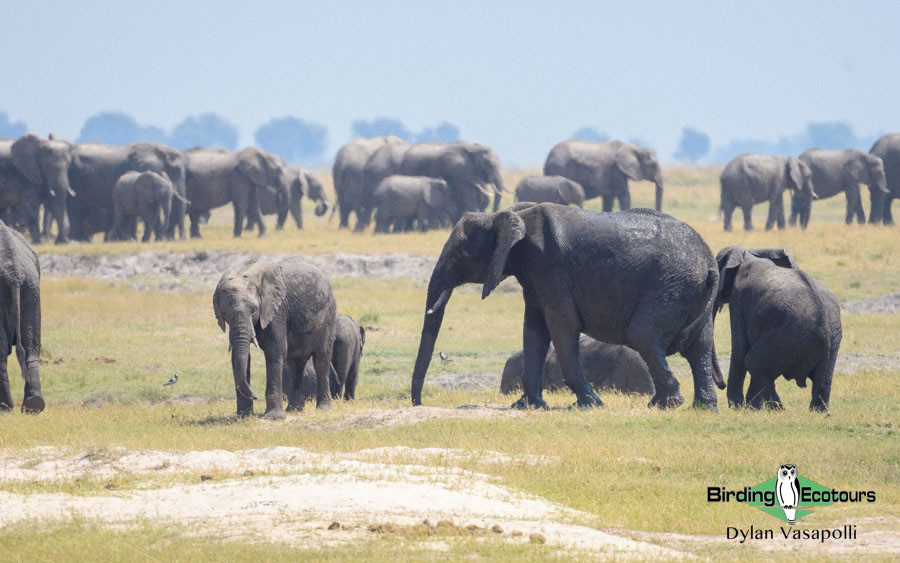
The Chobe River floodplains are inundated with birds and mammals – literally hundreds of African Savanna Elephants come down to get water from the river.
As we explored the river by boat, open sandbars held nesting African Skimmers and bold White-crowned Lapwings. Small marshy areas arguably offered the best birding. These were scattered along the river, and we explored as many as possible. Many species, including African Jacana, Great Egret, African Spoonbill, African Openbill, and Pied Kingfisher were common. Careful scanning invariably revealed some more special birds, including the massive Goliath Heron, small and dainty Squacco, Striated, and Black Herons, and noisy Long-toed Lapwings. Rafts of birds were also constantly moving up and down the river, with flocks of White-faced Whistling Ducks, African Openbills, Reed Cormorants and African Darters never far away. Small numbers of Grey-headed Gull, Whiskered Terns and Collared Pratincoles would pass by every so often as well. Riverine trees produced birds like Giant and Brown-hooded Kingfishers, while a few small colonies of Black-crowned Night Herons occupied the deeper thickets. In the mornings, small numbers of Burchell’s Sandgrouse could be heard and seen flying around over the river, and drinking at usually secluded pools just away from the river. Occasionally, one would land in sight, but our views were mostly limited to flight views. During the hotter times of the day, smaller birds came down to drink, including Blue Waxbills, Golden-breasted Buntings and Emerald-spotted Wood Doves. On the mammal side, the river was always full of African Savanna Elephants, and pods of Common Hippopotamus were commonly seen, as were many Nile Crocodiles and Nile Monitors.
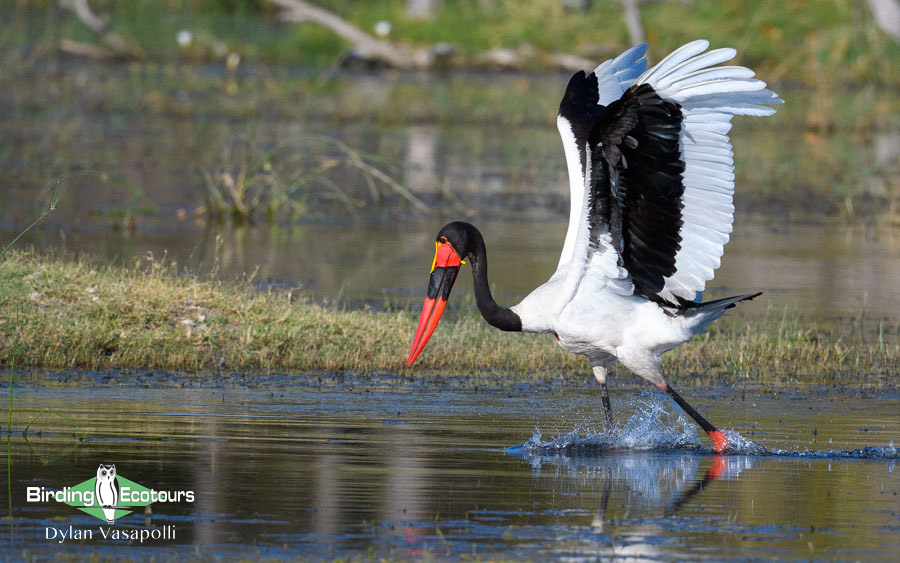
Saddle-billed Storks were seen several times around the rivers and wetlands. Here a male chases after fish.
The game drives saw us exploring some of the fine teak woodlands present in the park, along with some of the more open areas closer to the river floodplains. The park itself was extremely dry, dusty, and barren. The tracts of woodland supported small roving bird parties generally comprised of species like White-crested Helmetshrike, Green Wood Hoopoe, Bradfield’s Hornbill and others. We enjoyed excellent sightings of ground-dwelling birds, including several francolins and spurfowls, as well as large Kori Bustards and smaller Red-crested Korhaans. Bushier areas were alive with smaller seedeaters. At times we encountered large numbers of Blue Waxbills and Scaly-feathered Weavers, alongside smaller numbers of Green-winged Pytilia, Red-billed Firefinch, Violet-eared Waxbill, Golden-breasted Bunting. The larger riverine trees gave up Swamp Boubou, Yellow-breasted Apalis, Little Sparrowhawk, Mourning Collared Dove, White-browed Robin-Chat and others. The grassier floodplains were full of Southern Carmine Bee-eaters hawking insects, while Grey-rumped Swallows were nesting in more isolated areas. The dry flats also held typical species like Crowned Lapwing, Capped Wheatear, African Pipit and Grey-backed Sparrow-Lark. Wetland areas held a similar assemblage of species to those encountered during our boat trips, although smaller, secluded bays produced a fine Greater Painted-snipe, and other birds, including Saddle-billed Stork that we had not seen from the boats. Raptors were fairly common and we enjoyed many species over the course of our drives. Vultures were represented with Hooded, White-backed and the massive Lappet-faced Vultures, while we did well for big eagles too, with Martial and Tawny Eagles, African Hawk-Eagle and Bateleur all seen on occasion. We also had a few sightings of African Marsh Harriers quartering over the grassy floodplains.
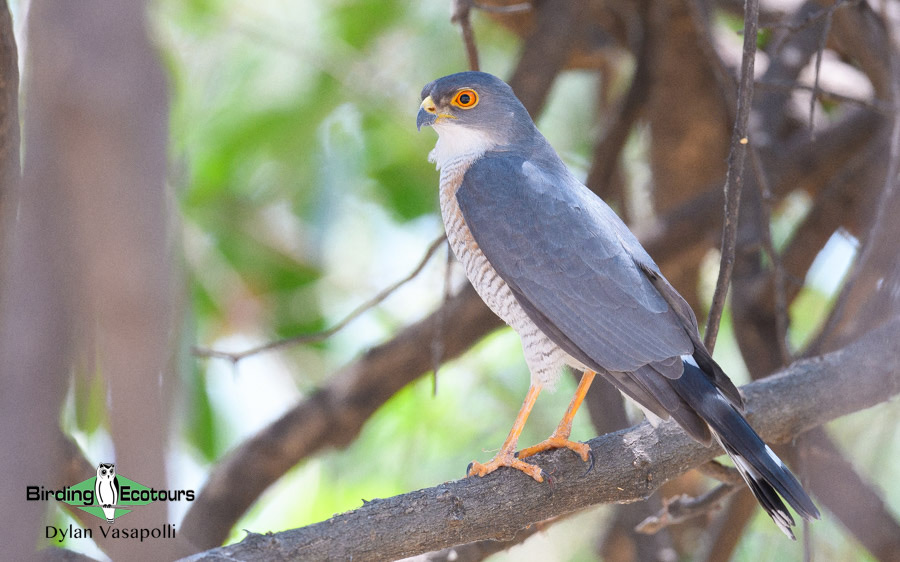
A dashing Little Sparrowhawk pauses for a few moments in the large riverine trees – what a sighting of this small raptor (smaller than most doves).
Mammals were also abundant, with vast numbers of African Savanna Elephants a constant feature around the Chobe River. We spent quite a while enjoying the antics of some of these family herds, enthralled with them as they went about their daily lives. Other game was also abundant, with huge numbers of Impala alongside Greater Kudu, Plains Zebra, Southern Giraffe and Steenbok. A special sighting was a large herd of Roan Antelope feeding in one of the open areas. We also found a few Puku and Tsessebe in other dry floodplain areas. Cape Buffalo were scarce, with limited food availability, and we only found one group resting in the long grass. Common Warthogs fed over the plains, whilst Common Hippopotamus were widespread in the river. We enjoyed a wonderful, close-up encounter with a female Leopard that lasted for an extended period. She was initially stalking some Impala, but they were alert to her presence. She eventually abandoned the hunt and opted to rest in the shade of a dense bush nearby. We had several Lion sightings as well, enjoying the antics of a local pride on several occasions. They were seemingly prolific hunters, and were always well fed.
Day 9, 17th September 2026. Departure
Before we knew it, the tour had come to an end. After a leisurely morning, we transferred to Kasane Airport for our onward flights home.
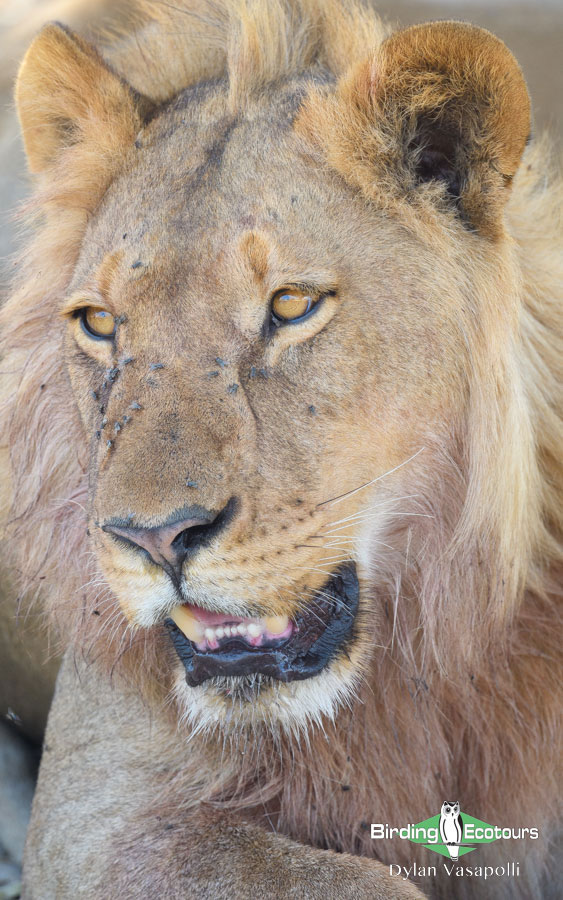
One of the Lions of Chobe National Park rests in the shade after feeding during the night. Spending time with these large cats is always a thrill.
Bird List – Following IOC 15.2 (April 2026)
Birds ‘heard only’ are marked with (H) after the common name, all other species were seen.
The following notation after species names is used to show conservation status following the IUCN Red List: CR = Critically Endangered, EN = Endangered, VU = Vulnerable.
| Common name | Scientific name |
| Ducks, Geese, Swans (Anatidae) | |
| White-faced Whistling Duck | Dendrocygna viduata |
| White-backed Duck | Thalassornis leuconotus |
| Spur-winged Goose | Plectropterus gambensis |
| Knob-billed Duck | Sarkidiornis melanotos |
| Egyptian Goose | Alopochen aegyptiaca |
| Yellow-billed Duck | Anas undulata |
| Red-billed Teal | Anas erythrorhyncha |
| Guineafowl (Numididae) | |
| Helmeted Guineafowl | Numida meleagris |
| Pheasants & Allies (Phasianidae) | |
| Crested Francolin | Ortygornis sephaena |
| Red-billed Spurfowl | Pternistis adspersus |
| Swainson’s Spurfowl | Pternistis swainsonii |
| Swifts (Apodidae) | |
| African Palm Swift | Cypsiurus parvus |
| Little Swift | Apus affinis |
| Turacos (Musophagidae) | |
| Grey Go-away-bird | Crinifer concolor |
| Bustards (Otididae) | |
| Kori Bustard | Ardeotis kori |
| Red-crested Korhaan | Lophotis ruficrista |
| Cuckoos (Cuculidae) | |
| Senegal Coucal | Centropus senegalensis |
| Coppery-tailed Coucal | Centropus cupreicaudus |
| White-browed Coucal | Centropus superciliosus |
| Sandgrouse (Pteroclidae) | |
| Double-banded Sandgrouse | Pterocles bicinctus |
| Burchell’s Sandgrouse | Pterocles burchelli |
| Pigeons, Doves (Columbidae) | |
| Mourning Collared Dove | Streptopelia decipiens |
| Red-eyed Dove | Streptopelia semitorquata |
| Ring-necked Dove | Streptopelia capicola |
| Emerald-spotted Wood Dove | Turtur chalcospilos |
| African Green Pigeon | Treron calvus |
| Rails, Crakes & Coots (Rallidae) | |
| Common Moorhen | Gallinula chloropus |
| Black Crake | Zapornia flavirostra |
| Grebes (Podicipedidae) | |
| Little Grebe | Tachybaptus ruficollis |
| Stone-curlews, Thick-knees (Burhinidae) | |
| Water Thick-knee | Burhinus vermiculatus |
| Stilts, Avocets (Recurvirostridae) | |
| Black-winged Stilt | Himantopus himantopus |
| Plovers (Charadriidae) | |
| Three-banded Plover | Thinornis tricollaris |
| Long-toed Lapwing | Vanellus crassirostris |
| Blacksmith Lapwing | Vanellus armatus |
| White-crowned Lapwing | Vanellus albiceps |
| Crowned Lapwing | Vanellus coronatus |
| Kittlitz’s Plover | Anarhynchus pecuarius |
| Painted-snipes (Rostratulidae) | |
| Greater Painted-snipe | Rostratula benghalensis |
| Jacanas (Jacanidae) | |
| African Jacana | Actophilornis africanus |
| Sandpipers, Snipes (Scolopacidae) | |
| Common Sandpiper | Actitis hypoleucos |
| Marsh Sandpiper | Tringa stagnatilis |
| Wood Sandpiper | Tringa glareola |
| Common Greenshank | Tringa nebularia |
| Ruff | Calidris pugnax |
| Little Stint | Calidris minuta |
| Coursers, Pratincoles (Glareolidae) | |
| Collared Pratincole | Glareola pratincola |
| Gulls, Terns, Skimmers (Laridae) | |
| African Skimmer | Rynchops flavirostris |
| Whiskered Tern | Chlidonias hybrida |
| Grey-headed Gull | Chroicocephalus cirrocephalus |
| Storks (Ciconiidae) | |
| African Openbill | Anastomus lamelligerus |
| Marabou Stork | Leptoptilos crumenifer |
| Yellow-billed Stork | Mycteria ibis |
| Saddle-billed Stork | Ephippiorhynchus senegalensis |
| Anhingas, Darters (Anhingidae) | |
| African Darter | Anhinga rufa |
| Cormorants, Shags (Phalacrocoracidae) | |
| Reed Cormorant | Microcarbo africanus |
| Great Cormorant | Phalacrocorax carbo |
| Ibises, Spoonbills (Threskiornithidae) | |
| African Sacred Ibis | Threskiornis aethiopicus |
| Hadada Ibis | Bostrychia hagedash |
| Glossy Ibis | Plegadis falcinellus |
| African Spoonbill | Platalea alba |
| Herons, Bitterns (Ardeidae) | |
| Little Bittern | Botaurus minutus |
| Black-crowned Night Heron | Nycticorax nycticorax |
| Slaty Egret – VU | Egretta vinaceigula |
| Black Heron | Egretta ardesiaca |
| Little Egret | Egretta garzetta |
| Little Heron | Butorides atricapilla |
| Rufous-bellied Heron | Ardeola rufiventris |
| Squacco Heron | Ardeola ralloides |
| Great Egret | Ardea alba |
| Yellow-billed Egret | Ardea brachyrhyncha |
| Western Cattle Egret | Ardea ibis |
| Grey Heron | Ardea cinerea |
| Purple Heron | Ardea purpurea |
| Goliath Heron | Ardea goliath |
| Hamerkop (Scopidae) | |
| Hamerkop | Scopus umbretta |
| Kites, Hawks, Eagles (Accipitridae) | |
| Black-winged Kite | Elanus caeruleus |
| Lappet-faced Vulture – EN | Torgos tracheliotos |
| Hooded Vulture – CR | Necrosyrtes monachus |
| White-backed Vulture – CR | Gyps africanus |
| Bateleur – EN | Terathopius ecaudatus |
| Western Banded Snake Eagle | Circaetus cinerascens |
| Brown Snake Eagle | Circaetus cinereus |
| Martial Eagle – EN | Polemaetus bellicosus |
| Wahlberg’s Eagle | Hieraaetus wahlbergi |
| Tawny Eagle – VU | Aquila rapax |
| African Hawk-Eagle | Aquila spilogaster |
| Little Sparrowhawk | Tachyspiza minulla |
| African Marsh Harrier | Circus ranivorus |
| Black Kite | Milvus migrans |
| African Fish Eagle | Icthyophaga vocifer |
| Barn Owls (Tytonidae) | |
| Western Barn Owl | Tyto alba |
| Owls (Strigidae) | |
| Pearl-spotted Owlet | Glaucidium perlatum |
| African Barred Owlet | Glaucidium capense |
| African Scops Owl (H) | Otus senegalensis |
| Verreaux’s Eagle-Owl | Ketupa lactea |
| Pel’s Fishing Owl (H) | Scotopelia peli |
| Mousebirds (Coliidae) | |
| Red-faced Mousebird | Urocolius indicus |
| Hoopoes (Upupidae) | |
| Common Hoopoe | Upupa epops |
| Wood Hoopoes (Phoeniculidae) | |
| Green Wood Hoopoe | Phoeniculus purpureus |
| Hornbills (Bucerotidae) | |
| Southern Ground Hornbill – VU | Bucorvus leadbeateri |
| Southern Red-billed Hornbill | Tockus rufirostris |
| Southern Yellow-billed Hornbill | Tockus leucomelas |
| Bradfield’s Hornbill | Lophoceros bradfieldi |
| African Grey Hornbill | Lophoceros nasutus |
| Rollers (Coraciidae) | |
| Purple Roller | Coracias naevius |
| Lilac-breasted Roller | Coracias caudatus |
| Kingfishers (Alcedinidae) | |
| Brown-hooded Kingfisher | Halcyon albiventris |
| Malachite Kingfisher | Corythornis cristatus |
| Giant Kingfisher | Megaceryle maxima |
| Pied Kingfisher | Ceryle rudis |
| Bee-eaters (Meropidae) | |
| Swallow-tailed Bee-eater | Merops hirundineus |
| Little Bee-eater | Merops pusillus |
| White-fronted Bee-eater | Merops bullockoides |
| Southern Carmine Bee-eater | Merops nubicoides |
| African Barbets (Lybiidae) | |
| Crested Barbet | Trachyphonus vaillantii |
| Yellow-fronted Tinkerbird | Pogoniulus chrysoconus |
| Black-collared Barbet | Lybius torquatus |
| Woodpeckers (Picidae) | |
| Bennett’s Woodpecker | Campethera bennettii |
| Bearded Woodpecker | Chloropicus namaquus |
| African & New World Parrots (Psittacidae) | |
| Meyer’s Parrot | Poicephalus meyeri |
| Bushshrikes (Malaconotidae) | |
| Black-crowned Tchagra | Tchagra senegalus |
| Black-backed Puffback | Dryoscopus cubla |
| Swamp Boubou | Laniarius bicolor |
| Brubru | Nilaus afer |
| Vangas & Allies (Vangidae) | |
| White-crested Helmetshrike | Prionops plumatus |
| Drongos (Dicruridae) | |
| Fork-tailed Drongo | Dicrurus adsimilis |
| Shrikes (Laniidae) | |
| Magpie Shrike | Urolestes melanoleucus |
| Crows, Jays (Corvidae) | |
| Pied Crow | Corvus albus |
| Tits, Chickadees (Paridae) | |
| Southern Black Tit | Melaniparus niger |
| Larks (Alaudidae) | |
| Grey-backed Sparrow-Lark | Eremopterix verticalis |
| Bulbuls (Pycnonotidae) | |
| Terrestrial Brownbul | Phyllastrephus terrestris |
| Common Bulbul | Pycnonotus barbatus |
| Swallows, Martins (Hirundinidae) | |
| Grey-rumped Swallow | Pseudhirundo griseopyga |
| Banded Martin | Neophedina cincta |
| Brown-throated Martin | Riparia paludicola |
| Wire-tailed Swallow | Hirundo smithii |
| Lesser Striped Swallow | Cecropis abyssinica |
| Crombecs, African Warblers (Macrosphenidae) | |
| Long-billed Crombec (H) | Sylvietta rufescens |
| Grassbirds & Allies (Locustellidae) | |
| Little Rush Warbler (H) | Bradypterus baboecala |
| Cisticolas & Allies (Cisticolidae) | |
| Rattling Cisticola | Cisticola chiniana |
| Luapula Cisticola (H) | Cisticola luapula |
| Chirping Cisticola | Cisticola pipiens |
| Tawny-flanked Prinia (H) | Prinia subflava |
| Yellow-breasted Apalis (H) | Apalis flavida |
| Grey-backed Camaroptera | Camaroptera brevicaudata |
| White-eyes (Zosteropidae) | |
| Southern Yellow White-eye | Zosterops anderssoni |
| Laughingthrushes & Allies (Leiothrichidae) | |
| Arrow-marked Babbler | Turdoides jardineii |
| Hartlaub’s Babbler | Turdoides hartlaubii |
| Starlings, Rhabdornises (Sturnidae) | |
| Wattled Starling | Creatophora cinerea |
| Greater Blue-eared Starling | Lamprotornis chalybaeus |
| Meves’s Starling | Lamprotornis mevesii |
| Burchell’s Starling | Lamprotornis australis |
| Oxpeckers (Buphagidae) | |
| Yellow-billed Oxpecker | Buphagus africanus |
| Red-billed Oxpecker | Buphagus erythroryncha |
| Thrushes (Turdidae) | |
| Kurrichane Thrush | Turdus libonyana |
| Chats, Old World Flycatchers (Muscicapidae) | |
| Ashy Flycatcher | Fraseria caerulescens |
| Marico Flycatcher | Bradornis mariquensis |
| White-browed Robin-Chat | Cossypha heuglini |
| African Stonechat | Saxicola torquatus |
| Arnot’s Chat | Myrmecocichla arnotti |
| Capped Wheatear | Oenanthe pileata |
| Sunbirds (Nectariniidae) | |
| Amethyst Sunbird | Chalcomitra amethystina |
| Scarlet-chested Sunbird | Chalcomitra senegalensis |
| White-bellied Sunbird | Cinnyris talatala |
| Purple-banded Sunbird | Cinnyris bifasciatus |
| Old World Sparrows, Snowfinches (Passeridae) | |
| Yellow-throated Bush Sparrow | Gymnoris superciliaris |
| Southern Grey-headed Sparrow | Passer diffusus |
| Weavers, Widowbirds (Ploceidae) | |
| Red-billed Buffalo Weaver | Bubalornis niger |
| White-browed Sparrow-Weaver | Plocepasser mahali |
| Scaly-feathered Weaver | Sporopipes squamifrons |
| Holub’s Golden Weaver | Ploceus xanthops |
| Southern Brown-throated Weaver | Ploceus xanthopterus |
| Southern Masked Weaver | Ploceus velatus |
| Southern Red Bishop | Euplectes orix |
| Fan-tailed Widowbird | Euplectes axillaris |
| Waxbills, Munias & Allies (Estrildidae) | |
| Violet-eared Waxbill | Granatina granatina |
| Blue Waxbill | Uraeginthus angolensis |
| Green-winged Pytilia | Pytilia melba |
| Red-billed Firefinch | Lagonosticta senegala |
| Wagtails, Pipits (Motacillidae) | |
| Cape Wagtail | Motacilla capensis |
| African Pied Wagtail | Motacilla aguimp |
| African Pipit | Anthus cinnamomeus |
| Buffy Pipit | Anthus vaalensis |
| Finches, Euphonias (Fringillidae) | |
| Black-throated Canary | Crithagra atrogularis |
| Buntings (Emberizidae) | |
| Golden-breasted Bunting | Emberiza flaviventris |
| Species seen: | 178 |
| Species heard: | 7 |
| Total recorded: | 185 |
Mammal List – Following Mammalwatching.com (October 2025)
The following notation after species names is used to show conservation status following the IUCN Red List: EN = Endangered, VU = Vulnerable, NE = Not Evaluated.
| Common name | Scientific name |
| Elephants (Elephantidae) | |
| African Savanna Elephant – EN | Loxodonta africana |
| Old World Monkeys (Cercopithecidae) | |
| Vervet Monkey | Chlorocebus pygerythrus |
| Chacma Baboon | Papio ursinus |
| Squirrels (Sciuridae) | |
| Smith’s Bush Squirrel | Paraxerus cepapi |
| Old World Fruit Bats (Pteropodidae) | |
| Peters’s Epauletted Fruit Bat | Epomophorus crypturus |
| Canids (Canidae) | |
| Side-striped Jackal | Lupulella adusta |
| Black-backed Jackal | Lupulella mesomelas |
| Felids (Felidae) | |
| Lion – VU | Panthera leo |
| Leopard – VU | Panthera pardus |
| Mongooses (Herpestidae) | |
| Banded Mongoose | Mungos mungo |
| Equines (Equidae) | |
| Plains Zebra | Equus quagga |
| Hippopotamuses (Hippopotamidae) | |
| Common Hippopotamus – VU | Hippopotamus amphibius |
| Bovids (Bovidae) | |
| Impala | Aepyceros melampus |
| Tsessebe | Damaliscus lunatus |
| Steenbok | Raphicerus campestris |
| Roan Antelope | Hippotragus equinus |
| Waterbuck | Kobus ellipsiprymnus |
| Southern Lechwe | Kobus leche |
| Puku | Kobus vardonii |
| Cape Buffalo | Syncerus caffer |
| Greater Kudu | Tragelaphus strepsiceros |
| Southern Bushbuck – NE | Tragelaphus sylvaticus |
| Giraffes and Okapi (Giraffidae) | |
| Southern Giraffe – NE | Giraffa giraffa |
| Suids (Suidae) | |
| Common Warthog | Phacochoerus africanus |
| Species seen: | 24 |
Reptile List – Following Reptiles of the World (November 2025)
| Common name | Scientific name |
| Crocodiles (Crocodylidae) | |
| Nile Crocodile | Crocodylus niloticus |
| Monitor Lizards (Varanidae) | |
| Nile Monitor | Varanus niloticus |
| Species seen: | 2 |
This is a sample trip report. Please email us ([email protected]) for more trip reports from this destination.