16–27 JULY 2026
By Fraser Bell
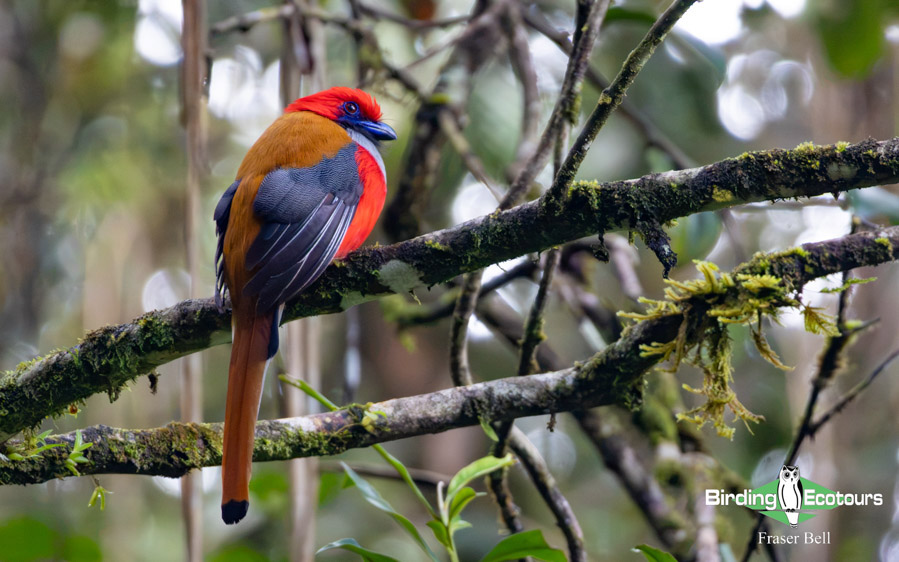
We enjoyed exceptional views of a pair of Whitehead’s Trogon in Mount Kinabalu National Park, including this stunning male.
Overview
This Sabah, Borneo birding tour took place between 16th and 27th July 2026 and followed our preceding Birding Tour Malaysia: Peninsular Malaysia. In Sabah, our tour route covered a range of habitats as we traveled across northern Borneo in search of the island’s many endemic and specialty birds. We began in Kota Kinabalu before climbing into the higher-elevation forests of the Crocker Range and Kinabalu National Park, then descended into the hot and humid lowlands. At Sepilok, we spent time on the famous canopy walkway and explored the winding trails through the lowland rainforest, before continuing east to the Kinabatangan River via a brief stop at the memorable Gomantong Caves. After two days of boat-based birding on the Kinabatangan River, we finished the tour in the ancient dipterocarp forests of Danum Valley, where forest walks, roadside birding, feeding areas, and night drives provided a fun end to the tour. We unfortunately encountered some unseasonably wet weather, and heavy rain curtailed many of the afternoon birding sessions and affected a few mornings, but this had no significant impact on our overall success, and we still connected with almost all of our main targets. Alongside the excellent bird and mammal sightings, we enjoyed comfortable accommodation, good food, and smooth logistics throughout the tour.
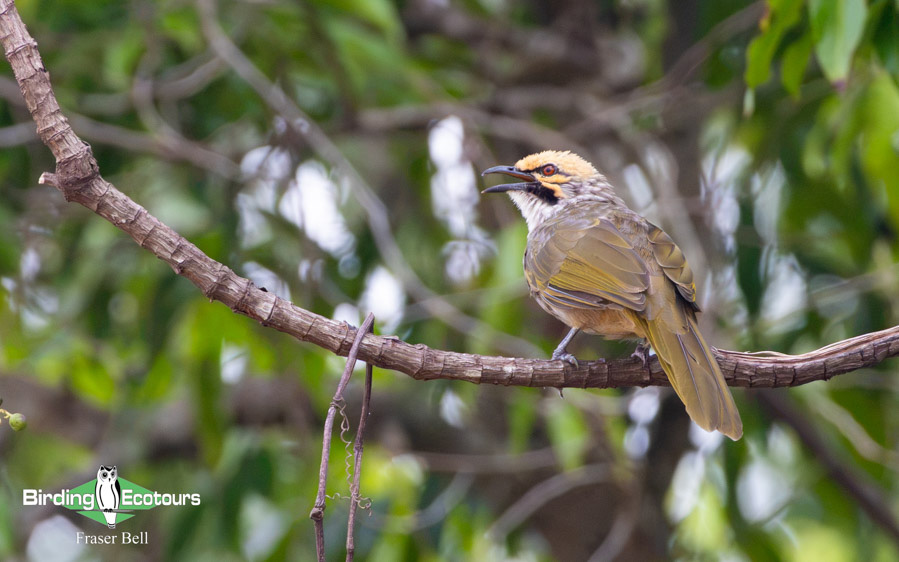
We could not believe our luck when a Critically Endangered (IUCN Red List) Straw-headed Bulbul started singing close to us while birding on the Kinabatangan River.
Our time in Sabah gave us the chance to see an extraordinary diversity of Borneo’s highly sought-after species. In the Crocker Range, we spent time at feeding areas where we had great close views of several Bornean endemics, including Red-breasted Partridge, while roadside birding produced shy Bornean Stubtail, Bornean Shortwing, all four of Sabah’s endemic barbets – Brown Barbet, Bornean Barbet, Mountain Barbet, and Golden-naped Barbet, along with a surprise Whitehead’s Spiderhunter. We then continued to Kinabalu National Park, where birding at a range of altitudes gave us comical groups of Crimson-headed Partridges, as well as Sunda Owlet, Whitehead’s Trogon, and the striking Whitehead’s Broadbill. The wet conditions actually worked in our favor for the usually secretive Everett’s Thrush, while staring up into the canopy at mixed-species flocks produced important targets like the odd Bare-headed Laughingthrush, and we also enjoyed sightings of the tiny and very cute, Tufted Pygmy Squirrel.
As we descended into the lowlands, Poring Hot Springs gave us the chance to see many widespread lowland species before we continued to Sepilok. In the hot and humid rainforest here, we found Sabah Partridge, our first pitta in the form of Black-crowned Pitta, several broadbills including Banded Broadbill and Black-and-yellow Broadbill, and a number of beautiful kingfishers including Rufous-backed Dwarf Kingfisher and Rufous-collared Kingfisher. Among many other canopy species, the canopy walkway gave us very close views of a breeding pair of Wallace’s Hawk-Eagles and some awesome mammal encounters, including Bornean Orangutan and the very shy Eastern Gray Gibbon. At the memorable Gomantong Caves, we saw four species of breeding swiftlet and marveled at the sheer scale of the cave and the terrifying nature of how the workers collect the edible nests, before continuing to the Kinabatangan River.
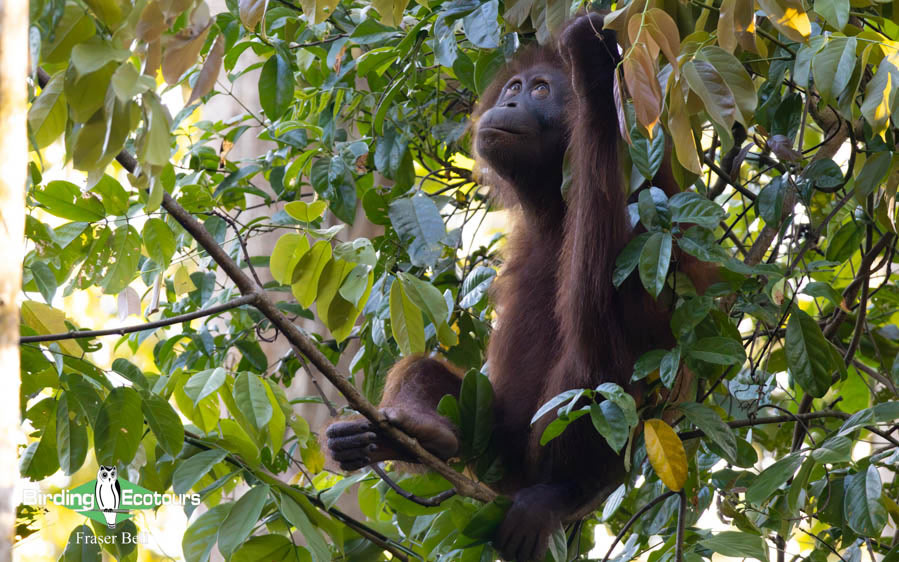
Mammals like this Bornean Orangutan were a major highlight alongside the birding.
From our boats on the Kinabatangan River, we enjoyed some of the tour’s best mammal encounters, including Asian Elephant (Bornean Pygmy Elephant) and Proboscis Monkey, as well as all eight hornbill species found in Sabah, including the Critically Endangered (IUCN Red List) Helmeted Hornbill. Other highlights included other threatened species such as Storm’s Stork and Straw-headed Bulbul, plus Western Hooded Pitta. We then finished the tour in Danum Valley, where a lot of walking through the lush forests paid off, and we enjoyed seeing a high diversity of species. Among the many highlights were Bornean Crested Fireback, Great Argus, Blue-headed Pitta, three species of trogon, and a huge variety of bulbuls and babblers, including the secretive Bornean Wren-Babbler. Our night drives were equally memorable, with Buffy Fish Owl, Blyth’s Frogmouth, Sunda Colugo, Western Tarsier, Malay Civet, and an amazing Sunda Leopard Cat among the highlights. We thought that had provided a fitting end to the tour, but on our final drive out of Danum Valley we connected with a group of one of Borneo’s biggest bird targets, a group of truly unique Bornean Bristleheads, providing a fantastic finale to the trip.
We recorded 261 bird species during the tour, including twelve heard-only species. A detailed daily account can be read below, and the various species lists are located at the end of the report. You can also access our eBird trip report here.
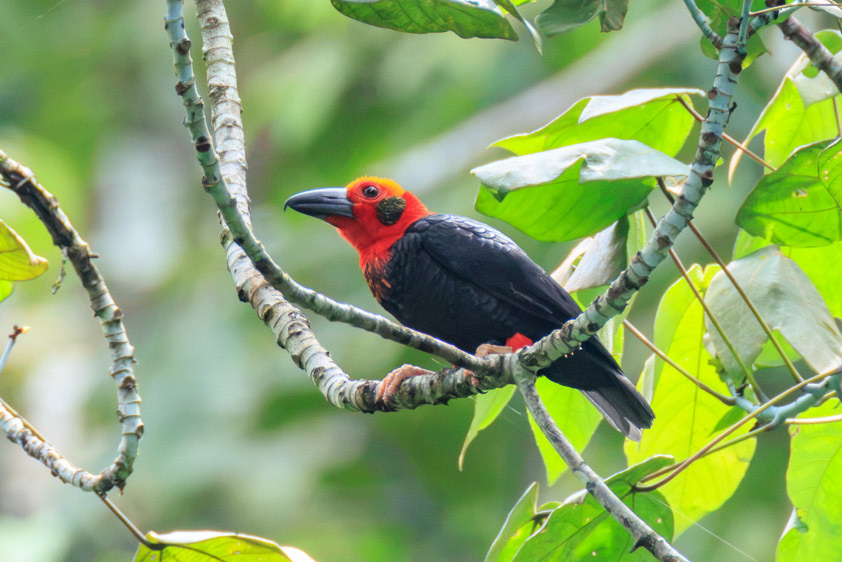
We finished the tour with a bang, seeing the ‘holy grail’ of birding in Borneo as we left Danum Valley on the final morning, when we found a group of the monotypic and striking Bornean Bristleheads (photo N. Graf).
Detailed Report
Day 1, 16th July 2026. Arrival into Kota Kinabalu
Today started with a welcome lunch at our comfortable hotel in Kota Kinabalu, where the group got to meet and discuss the upcoming twelve days of birding in Sabah together. After lunch, we geared up and left for some local birding, but unfortunately the weather had other ideas, with almost constant heavy rain throughout the afternoon. As such, birding was difficult and we missed some of our targets, though we did manage to see Wandering Whistling Duck, Pink-necked Green Pigeon, Green Imperial Pigeon, Pied Imperial Pigeon, herons and egrets including Nankeen Night Heron, Black-winged Kite, Collared Kingfisher, Sunda Pygmy Woodpecker, Yellow-bellied Prinia, and Chestnut Munia. After a nice meal together, it was an early night before our pre-dawn start the following morning!
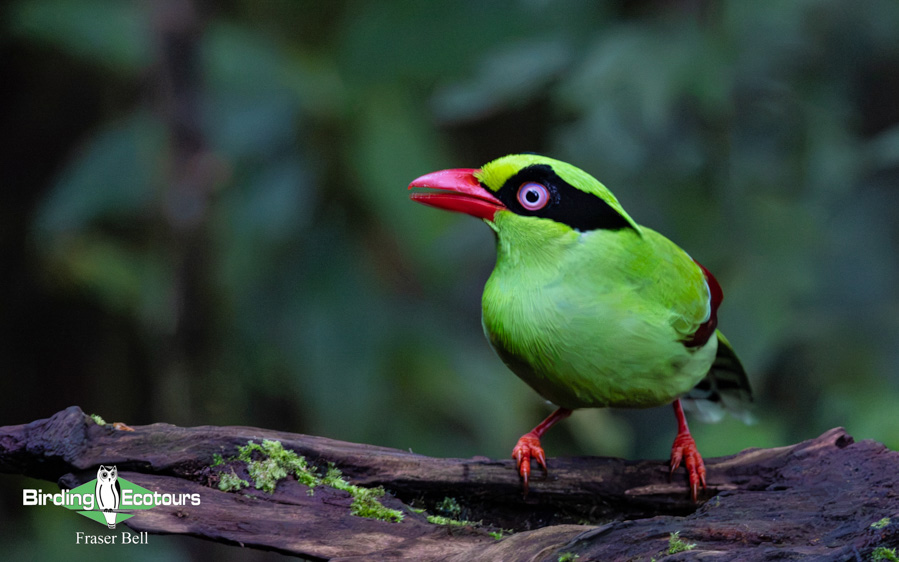
Borneo is full of many striking and colorful endemics, like this Bornean Green Magpie.
Day 2, 17th July 2026. Birding in the Crocker Range National Park and transfer to Kinabalu National Park
We left Kota Kinabalu in the early hours, bound for the mountains of Crocker Range National Park. Our destination was the sensational Gunung Alab birding hide, where we spent the full morning. Here, we had the perfect introduction to birding at elevation in Borneo, enjoying a high diversity of species, including many Bornean endemics that came into the feeding area and gave us brilliant close views. Top birds at the feeding area included Golden-naped Barbet, Bornean Whistler, Bornean Green Magpie, Bornean Treepie, Chestnut-crested Yuhina, Sunda Laughingthrush, and Chestnut-hooded Laughingthrush, all of which are endemic to the island of Borneo. Early on we dropped down to a second feeding area away from the main building, where we would try for partridges. After a bit of a wait, we had good close views of three bright Red-breasted Partridges, which comically bobbed about at the edge of the clearing alongside Temminck’s Babbler and Snowy-browed Flycatcher. We also found a pair of Whitehead’s Trogons just below the feeding site, which some of the group were able to enjoy before they silently vanished back into the forest.
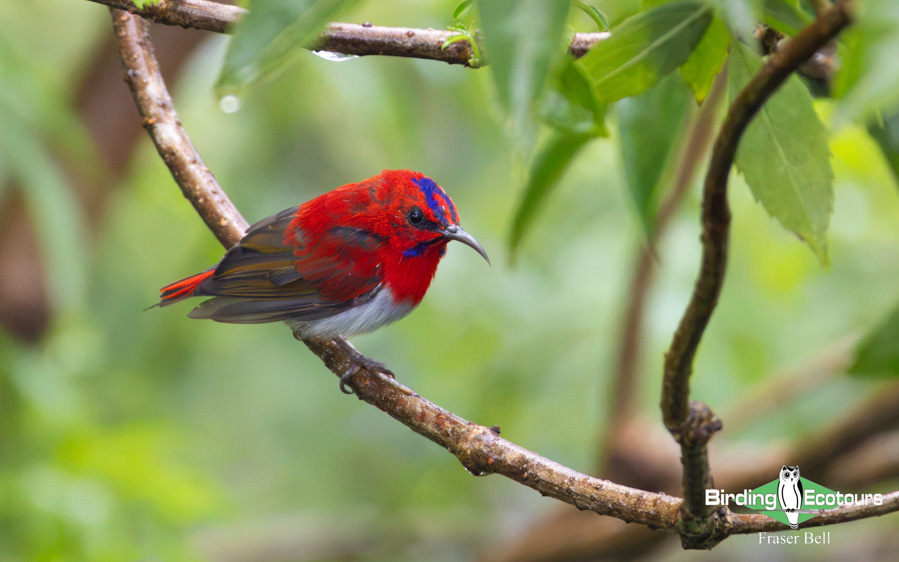
Male Temminck’s Sunbirds are an incredible scarlet and are common in Sabah’s highlands.
Later in the morning, we birded some of the roads near the Gunung Alab birding hide, enjoying close views of three tiny yet characterful birds, Aberrant Bush Warbler, Bornean Stubtail, and Bornean Shortwing, which gave surprisingly good views for such small, secretive species as they belted out their songs and scurried around in the undergrowth around us. Other species we found included Little Cuckoo-Dove, Blyth’s Hawk-Eagle, Black Eagle, Yellow-bellied Prinia, Verditer Flycatcher, Black-sided Flowerpecker, Ornate Sunbird, and the truly beautiful Temminck’s Sunbird. The Crocker Range is an important area to visit on our tour, as several species are restricted to these mid-elevation forests. In search of these we dropped into the Rafflesia Information Center, which proved to be one of the best birding sites of the day, as we quickly found the three endemic barbets we were hoping for: Brown Barbet, Bornean Barbet, and Mountain Barbet. Along with the Golden-naped Barbet we had just enjoyed at the bird feeding area, we had now seen all four of Borneo’s endemic barbets over the course of an hour! Further birding around the Rafflesia Information Center gave us the endemic and uncommon Bornean Bulbul, but the real highlight was an amazing scope view of Whitehead’s Spiderhunter, which came to feed on nectar from a blooming flower for long enough for all to appreciate.
As none of the rafflesia were in bloom, we planned to see some later in the tour. After lunch the weather was unsettled, with bouts of heavy tropical downpours soaking the mountainside. So we opted to spend much of the early afternoon birding from the comfort of the Gunung Alab birding hide, enjoying the local coffee and biscuits while watching several Bornean endemics from our shelter. We encountered a few mixed-species flocks moving through the area, which contained White-throated Fantail, Yellow-breasted Warbler, Mountain Leaf Warbler, Black-capped White-eye, and, surprisingly, a pair of the endemic Mountain Black-eye. The latter were satisfying to see, as this species is typically seen less well while watching flocks moving through the high canopy while birding in Kinabalu National Park. Other top species seen here included Grey-chinned Minivet, White-browed Shrike-babbler, Ashy Drongo (Bornean), Sunda Scimitar Babbler, Grey-throated Babbler, Oriental Magpie-Robin, Indigo Flycatcher, Eyebrowed Jungle Flycatcher, Little Pied Flycatcher, Mountain Treeshrew, Borneo Black-banded Squirrel, and Bornean Mountain Ground Squirrel.
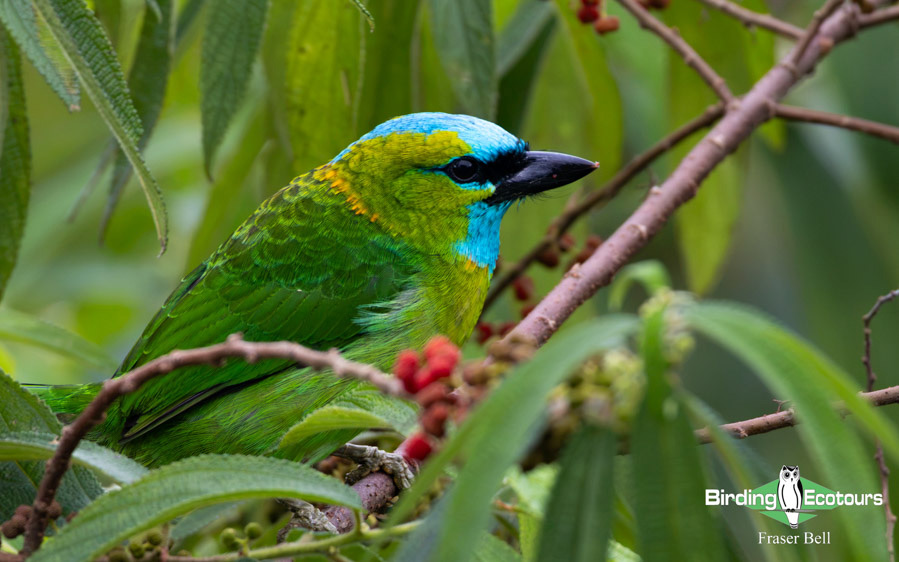
We couldn’t have asked for better views of the Bornean endemic Golden-naped Barbet on our first morning birding in Sabah.
Later we traveled north out of the Crocker Range and into the Kinabalu mountain range through heavy rain showers. Some roadside birding along the way gave us a distant Peregrine Falcon, and better yet, the endemic Dusky Munia, before we checked into our comfortable resort overlooking the dramatic Kinabalu mountains.
Day 3, 18th July 2026. Full day birding at Kinabalu National Park
We had two full days to bird the famous Kinabalu National Park, the haunt of many rare and highly sought-after endemics. Over the morning we walked several sections of the main road, which winds up through the park, spending time at the highest elevation we would reach on the tour at the Timpohon Gate at 1,850 meters (6,100 feet). Birding was slow going at times, and we only heard Mountain Wren-Babbler, but we found some great birds, including a nicely perched Sunda Cuckoo, Pale-faced Bulbul, spritely Pygmy Heleia, which were eventually seen well, and the satisfyingly confiding Bornean Whistling Thrush. The highlight, however, was a busy mixed-species flock of laughingthrushes, Hair-crested Drongos, and Bornean Green Magpies, which importantly contained a group of the bizarre looking Bare-headed Laughingthrushes. Just before lunch a Sunda Owlet started vocalizing close to the road, and after some searching where we were aided by many mobbing songbirds, we were enjoying good scope views of this small, rotund yet very handsome owl. Little Cuckoo-Dove, Mountain Imperial Pigeon, Black-and-crimson Oriole, Mountain Leaf Warbler, Mountain Tailorbird, and Velvet-fronted Nuthatch were also seen through the morning, alongside other species we had seen the day before at the Gunung Alab birding hide. A top mammalian highlight of the tour came when we found the tiny dark Tufted Pygmy Squirrel (also known as Whitehead’s Squirrel), with its bright white ear tufts. We managed some great views despite its erratic scurrying and jumping between the trees.
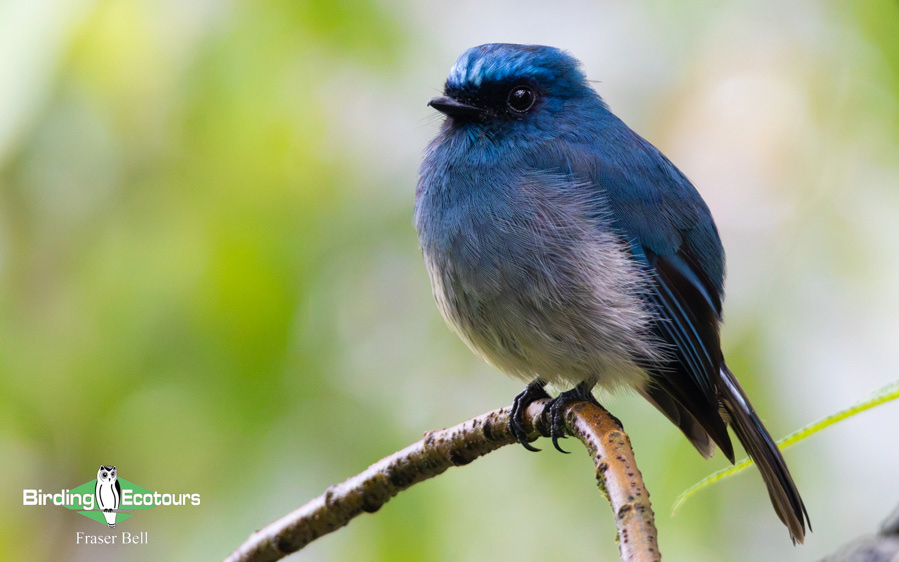
Indigo Flycatchers are lovely things, inquisitive and full of character, with their deep indigo colors really popping in the light.
Unfortunately, the rain curtailed the morning session, so we instead opted for a longer lunch at the very nice restaurant situated near the Kinabalu park entrance, and more time off during the wet afternoon. In the late afternoon those brave enough in the group to try their luck despite the weather had a great session, even despite the heavy showers. We saw our first Jentink’s Squirrel, a mostly brown squirrel but sporting some very classy white eyeliner, but the real highlight was finding the shy and major target, the endemic Everett’s Thrush! This was our main target for the afternoon. Given gloomy, wet conditions, the thrushes are often more active than usual, feeding in the soaked moss and fern clad roadside ditches. We found a pair and had prolonged views as they busily collected worms, presumably for a hungry brood of chicks nearby. We spent some time watching and enjoying them before heading back down the mountain to our sanctuary.
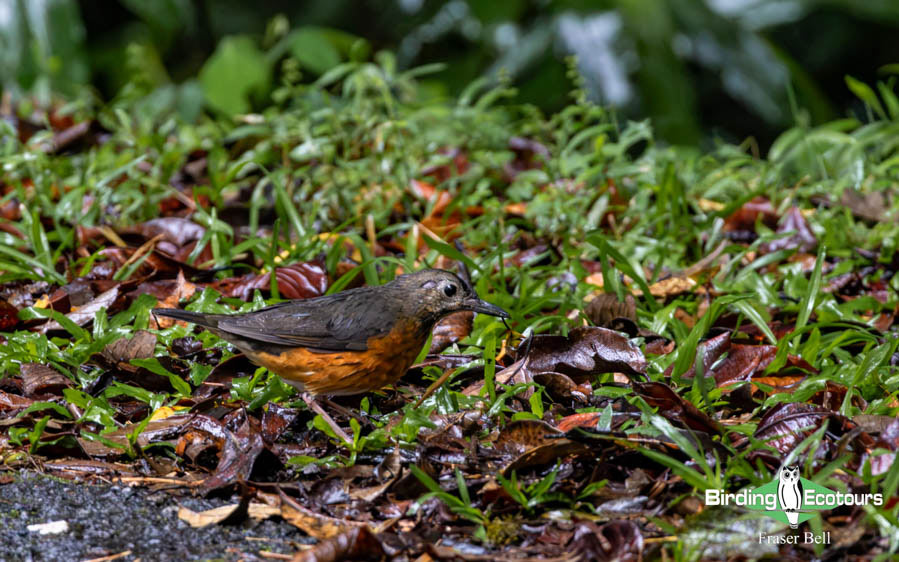
One of the benefits of having wet afternoons while in Kinabalu National Park was that the usually-secretive Everett’s Thrush was more active.
Day 4, 19th July 2026. Second full day birding at Kinabalu National Park
Although yesterday had been a successful day, we still had a number of localized targets to try for on the mountain. We had a great morning, seeing Maroon Woodpecker, Penan Bulbul, and improving our views of several species we had already seen over the last few days, such as Bornean Green Magpie, Bornean Stubtail, and Bornean Whistling Thrush. Early on, a female Crimson-headed Partridge ran across the road in front of the whole group, but the male remained in the dense, dark forest calling but not to be seen. Not long afterward, our main target, the massive Whitehead’s Broadbill, flew into the canopy above us and, after a lot of maneuvering and rearranging, the group managed to see this chunky broadbill, which sports luminous green plumage and stylish black markings. Sometime later, and after a lot of searching, we finally heard the telltale call of Whitehead’s Trogon. A brisk uphill walk and we were watching a stunning pair of these top birds, with the birds perch flycatching and fanning their impressive tails. We heard several of the iconic Fruithunter, but these lived up to their secretive reputation and eluded our group. Mountain Wren-Babbler and Pygmy Flycatcher also remained heard only this time.
To round off an excellent morning, we tried for Bornean Forktail, but it was not present along the river this time. Instead however, we had crippling views of a small family group of Crimson-headed Partridges, including the iconic male with a bright red head, hence the appropriate alternative name, Bloodhead. Similar to yesterday, we enjoyed a long lunch together and then some downtime in the early afternoon. With the rain staying away, we headed back for one last try on the mountain. This proved to be a good idea, as we quickly found a juvenile Bornean Forktail picking through the leaf litter beside the road, the white on the bird glowing in the dull light. Not long after this the rain and mist rolled in, so we headed back down the mountain to prepare for the following days exploring Borneo’s lowlands.
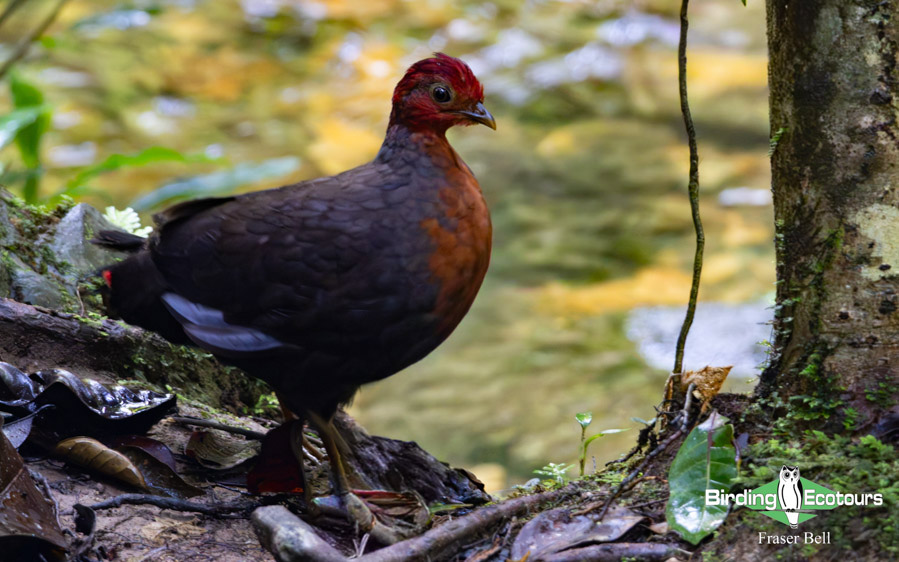
We enjoyed seeing the endemic Crimson-headed Partridge on three different occasions. This is the less vibrant female.
Day 5, 20th July 2026. Birding Poring Hot Springs and transfer to Sepilok
As usual, we had an early pre-dawn breakfast and headed out at first light. This morning, though, we checked out of our resort in the pine forests of Mount Kinabalu and headed down the mountain into the lush lowlands, eventually destined for Sepilok in the southeast of Sabah. First we stopped at Poring Hot Springs, where we had an enjoyable few hours experiencing our first taste of lowland forest birding in Borneo. This was great fun, and most of the birds were new for the trip, with Common Emerald Dove, Asian Palm Swift, Black-eared Barbet, Golden-whiskered Barbet, Buff-rumped Woodpecker, Malaysian Pied Fantail, Black-headed Bulbul, Red-eyed Bulbul, Cream-eyed Bulbul, Orange-bellied Flowerpecker, Plain Sunbird, Brown-throated Sunbird, and a pretty Prevost’s Squirrel all appreciated. The birding was easy going and we walked a short loop around the parking area and the accommodation grounds, where most species were seen well as we birded along the forest edge. We found our main target for the site, Fulvous-chested Jungle Flycatcher, which was keeping to the dark understory near its preferred bamboo habitat. Other highlights included watching a Silver-rumped Spinetail feeding low over the trees with its paddle like wings and bat like flight, plus a trio of beautifully colored species; Violet Cuckoo, Black-and-red Broadbill, and the bright Crimson Sunbird.
Close by, we stopped at a locally owned Rafflesia center, and most of the group went in to see a species from the beautiful yet macabre Rafflesia (or corpse flower) genus, which contains the world’s largest flowers. These parasitic plants produce the smell of rotting flesh to attract the insects that pollinate them. Bonus birding at the center yielded close views of Buff-necked Woodpecker and Yellow-bellied Warbler before continuing on to Sepilok.
After checking in, we explored the grounds of our resort. Recent development, which had cleared an excellent area of habitat, meant we only heard Western Hooded Pitta, but we still had a thoroughly enjoyable session targeting a high diversity of more widespread lowland species. An active and noisy pair of the impressive White-bellied Woodpeckers were present for much of the afternoon, a vibrant Blue-eared Kingfisher was fishing in the small pool we were overlooking, and a shy Chestnut-breasted Malkoha clambered through the canopy giving us brief but repeat views. Several birds of prey, such as Changeable Hawk-Eagle, Rufous-bellied Eagle, and White-bellied Sea Eagle, along with many Long-tailed Parakeets and Blue-crowned Hanging Parrots, flew overhead. Other highlights included good views of Maroon Woodpecker, Rufous-tailed Tailorbird, Charlotte’s Bulbul, and Streaked Bulbul. We celebrated our great day at a nice local restaurant and prepared ourselves for a full day at the Rainforest Discovery Center the following day.
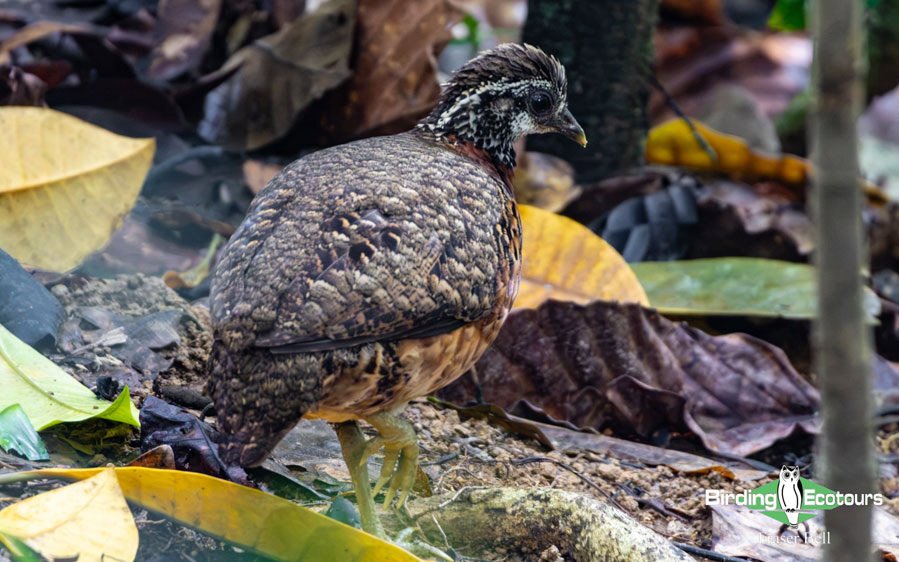
We had a close encounter with the very confiding Sabah Partridge while birding in Sepilok.
Day 6, 21st July 2026. Birding Sepilok’s Rainforest Discovery Center
Today was excellent, a long day filled with many wildlife highlights that made it one of the most memorable of the tour. While the group were assembling, a trio of Smooth-coated Otters greeted us in the car park, apparently they raid the resort’s pond for fish! Birding was very enjoyable at the close-by Rainforest Discovery Center, a large area of protected lowland rainforest which boasts an accessible canopy walkway and many trails through the park. We started with a pre-breakfast walk on the canopy walkway, seeing many bulky Southern Pig-tailed Macaque on the way. Birding from the walkway was a very enjoyable session, with the whole group seeing a breeding pair of Wallace’s Hawk-Eagle nesting very close to one of the platforms, along with great views of White-crowned Hornbill, Black Hornbill, and groups of raucous endemic Bornean Black Magpies. It was such a treat to be in amongst the canopy and having eye-level views of many species that you usually get “warbler neck” looking for! Other highlights included Grey-rumped Treeswift, Crested Goshawk, Fiery Minivet, Green Iora, Sunda Crow, Olive-winged Bulbul, Lesser Green Leafbird, and, for some, a pair of rarely seen Eastern Gray Gibbons! The gibbons were very vocal throughout the morning, which was a joy to hear, but they are very shy animals, so we were lucky to see a pair before they disappeared back into the jungle.
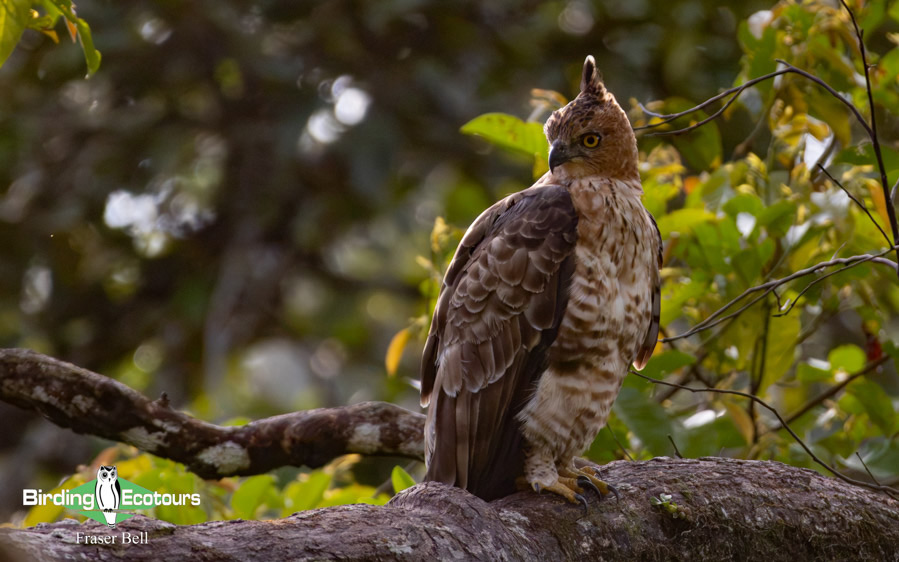
Watching a pair of handsome Wallace’s Hawk-Eagles from the canopy tower, so close to us and interacting with one another, was a tour highlight.
After breakfast, we hit the trails below the canopy walkway for some forest birding. As with all birding in dense forest, this was slow at times, but over the morning we had some incredible sightings. Top of the list was the very showy endemic Sabah Partridge, along with an equally confiding Rufous-backed Dwarf Kingfisher, which fished close to our group over a small stream, and two broadbill species that we saw well while hoping for Black-crowned Pitta: Banded Broadbill and Black-and-yellow Broadbill. Broadbills are such beautiful and quirky birds, and our close views were really appreciated. Other top sightings included Rufous Piculet, Rufous Woodpecker, Black-winged Flycatcher-shrike, Greater Racket-tailed Drongo, Bornean Black-capped Babbler, Large Treeshrew, and Pale Giant Squirrel. A colorful male Diard’s Trogon and the enigmatic Black-crowned Pitta would also have been highlights, save for the fact that few in the group got onto them before they retreated back into the forest!
After some time off during the middle of the day, we headed back to the Rainforest Discovery Center, which was a hard but very rewarding session. We spent a lot of time trying to see the endemic Black-crowned Pitta, and eventually, after carefully repositioning ourselves, and following its call through the forest, most of the group managed to see the gorgeous bird over a couple of minutes as it ran and hopped across the forest floor alongside us. What a star bird and an awesome experience. Afterward we headed down the aptly named Kingfisher Trail and quickly found a beautiful male Rufous-collared Kingfisher, its bright colors vibrant in the forest, but only heard Banded Kingfisher, and also Red-bearded Bee-eater. We then turned to head up to the canopy walkway to enjoy the last of the afternoon light from the towers, when we had an absolutely unforgettable encounter with a wild male Bornean Orangutan. It was simply incredible to see this threatened (IUCN), majestic ape casually climbing through the trees right next to us, giving us mind blowing views as it went about its daily life. It was very special to share the experience with such a fun group of wildlife lovers. After this encounter we were elated and a bit stunned, but on continuing, we found a squadron of gigantic Brown-backed Needletails, a snazzy pair of Ruby-cheeked Sunbirds, and two plump, very fluffy and clearly very sleepy Red Giant Flying Squirrels, which emerged from their nest boxes positioned alongside the canopy walkway, and peered down at us. It had been an excellent but long day, so we enjoyed a good meal at our favorite restaurant and headed off for an early night.
Day 7, 22nd July 2026. The Gomantong Caves and arrival at the Kinabatangan River
We awoke to rain this morning, so cancelled our morning birding session and instead had a longer breakfast, where some in the group watched Stork-billed Kingfisher and Blue-eared Kingfisher feeding in the pools near the resort’s restaurant. We then departed for the Gomantong Caves, a limestone system made famous for the harvesting of the highly valued nests of Edible-nest Swiftlet. On the drive we found Long-tailed Shrike, Oriental Dollarbird, and the unique Bat Hawk, which was perched in a roadside tree. This was a good bonus, as although Bat Hawk is a very active predator of bats and swiftlets at the Gomantong Caves, being crepuscular they are harder to find in the day.
While gearing up for our caving expedition in the parking area, we found a Bornean Orangutan, a much smaller individual than the previous day, and a troop of beautiful Maroon Langurs! The latter were fun to watch as they acrobatically leapt around the treetops, screeching at one another and showing off their tiny, bright red, fuzzy juveniles. On the walk to the cave we found Crested Serpent Eagle, Wreathed Hornbill, Rufous-backed Dwarf Kingfisher, and White-crowned Shama. However, the main event was the circular walk through Gomantong Cave, which was certainly a memorable experience. We witnessed the awe-inspiring sight of many thousands of Wrinkle-lipped Free-tailed Bats and swiftlets swirling around the cave mouths and holes in the roof. We were amazed by the sheer height of the cave and the incredible height at which most Edible-nest Swiftlet were breeding, compared to the tiny wooden structures perched on the mountainous piles of guano that the workers must climb using wooden ladders to harvest the nests. Within the cave we enjoyed comparing the nests and the birds sitting on them, with three swiftlet species present: Mossy-nest Swiftlet, Black-nest Swiftlet, and White-nest Swiftlet.
We then drove to our jetty and made the short boat ride to the Bornean Nature Lodge, a locally run nature retreat nestled on the Kinabatangan River. This would be our home for the next two days, where the whole group would head out together by boat to cruise the river in search of storks, birds of prey, hornbills, and much more. After lunch and some downtime during the hottest part of the day, we had our first cruise on the river. We quickly found the beautiful songster, a very rare Straw-headed Bulbul, which is listed as Critically Endangered (IUCN Red List). This species is still declining rapidly due to its popularity in the cage bird trade, so it was very encouraging to have such a good sighting of this lovely bulbul sitting on a vine overhanging the river’s edge.
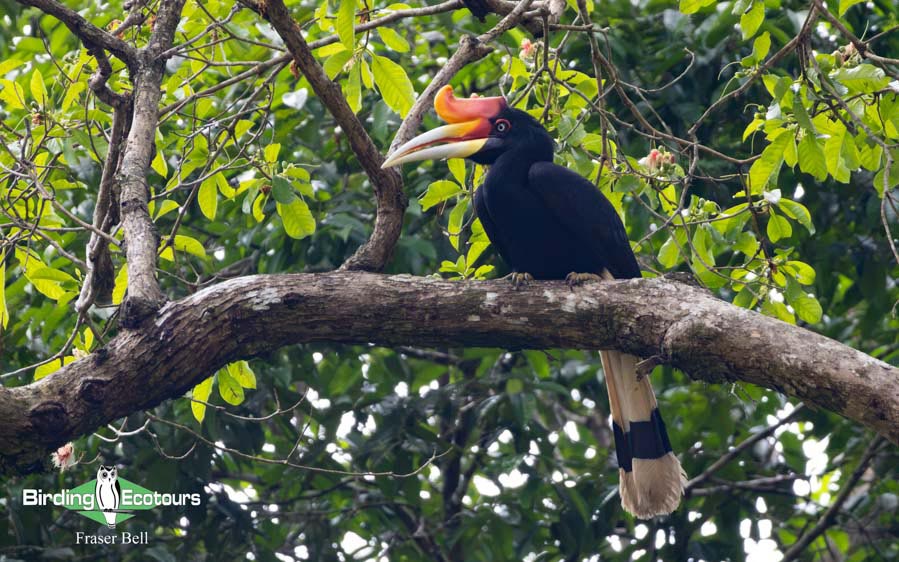
We saw Rhinoceros Hornbills most days while in the lowlands.
We saw our first of many troops of comical Proboscis Monkeys, a near constant sight along the river system, with many bachelor groups and the occasional dominant male with his harem group. Most of the group were able to see a lovely male Western Hooded Pitta, which was chirruping at us and was hopping around on the riverbank. However, being a dark bird, some only picked it up when it flew and the electric blue in its wings lit up against the gloomy forested river sides. We also saw several groups of Bushy-crested Hornbills, Oriental Pied Hornbills, Long-tailed Parakeets, Sunda Crows and heard a vocal Barred Eagle-Owl. However, just as we were getting close to a calling Helmeted Hornbill, the skies turned black, and a heavy tropical downpour sent us racing back to the lodge as quickly as our boatman could get us there! The rain stopped us from doing any night birding, so we instead enjoyed the locally cooked food, had some drinks together and found some Large Flying Foxes.
Day 8, 23rd July 2026. Full day of boat-based birding on the Kinabatangan River
Our day started with pre-dawn coffee before heading back out on a boat trip before breakfast. Seeing an Endangered (IUCN Red List) Storm’s Stork perched high in the riverside trees was the birding highlight, and we also enjoyed seeing White-crowned Hornbill, Bornean Swamp Babbler, Common Hill Myna, and many others during the session. However, we decided to cut our birding short after hearing reports of Asian Elephants (Bornean Pygmy Elephants) in the area, and ten minutes later we were watching two of these majestic creatures at close range, though obscured as they crashed around in the low bushes along the river.
After our nice breakfast back at the resort, we went out again for the rest of the morning by boat. We were able to see another threatened Storm’s Stork in much better light this time, along with many sinister looking Lesser Adjutants, Common Sandpiper, and Crested Goshawk. We had phenomenal views of Rhinoceros Hornbill, Blue-eared Kingfisher, and Malaysian Blue Flycatcher, but best of all was seeing a raucous group of Wrinkled Hornbills, a swamp-forest specialist, and the tiny endemic White-fronted Falconet! It was a great morning, and troops of Long-tailed Macaques and Proboscis Monkeys were very much in attendance. We spent some time listening to the ghostly calls of Bornean Ground Cuckoo, a mysterious inhabitant of the Kinabatangan River system and a major target for us, yet the bird remained on the far side of a channel, out of view.
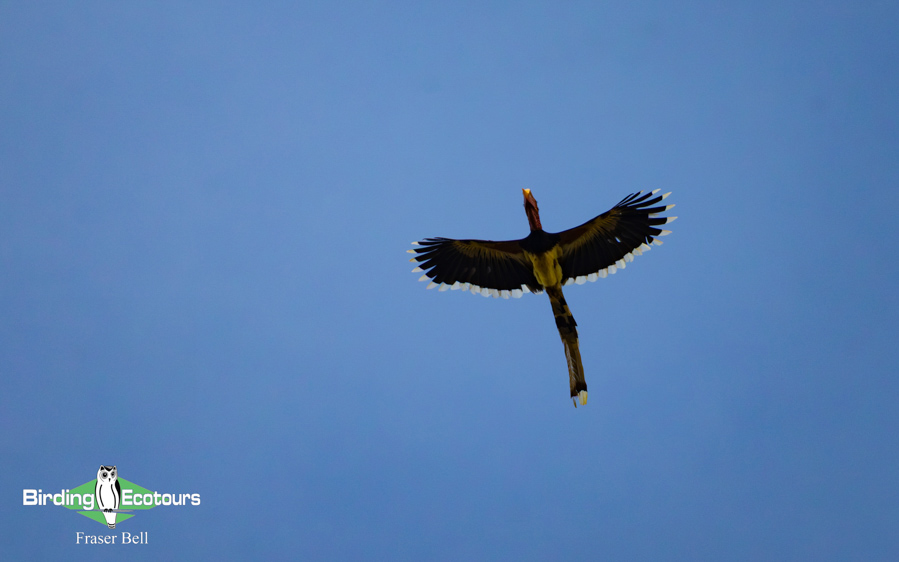
The Critically Endangered (IUCN Red List) Helmeted Hornbill was a major target for us while birding on the Kinabatangan River.
The afternoon’s boat trip started well, with us adding Crimson-winged Woodpecker, a comical group of Dusky Broadbills, and Asian Fairy-bluebird to our trip list, while also spending time with the shy Sunda Silvery Langur, an elegant leaf monkey that is fairly rarely seen here. They were certainly not interested in giving us good views as they leapt and hurried through the treetops, only occasionally stopping to peer down at our group. During the afternoon we had one species firmly in mind, and very satisfyingly we ended the day by seeing the incredible, Critically Endangered (IUCN Red List), Helmeted Hornbill. This was such a great experience for our group – first hearing it calling in the distance, then waiting before it flew across the broad river directly over our group, allowing us all to admire its iconic long tail and impressive casque. To make things even better, we also saw a group of Wreathed Hornbills in the same area, meaning we had seen all eight of Borneo’s hornbill species during a single day on the Kinabatangan River! Traveling back with the sun setting was very peaceful and beautiful. However, the weather did not stay that way for long, and once again our night birding had to be cancelled due to rain. Instead, one of our group was celebrating her 70th birthday, so we enjoyed a lovely dinner party together, complete with wine and cake, to top off a great day of birding in Borneo.
Day 9, 24th July 2026. Travel to Danum Valley
Our day started much the same as the previous day, coffee together then a pre-breakfast boat cruise, our last of the tour. We opted to spend time in an overgrown channel, but because two Bornean Orangutans had clearly just climbed out of their nests and were enjoying the morning sun, this area was very busy with other boats watching them. Despite how popular it was, we had a great trip, seeing Little Green Pigeon, Scarlet-rumped Trogon, Black Hornbill, Red-throated Barbet, Ventriloquial Oriole, Bornean Black Magpie, Greater Green Leafbird, and our best views of both Black-and-red Broadbill and Banded Broadbill. We also found an impressive Saltwater Crocodile, which was about 8 feet (2.5 meters) long, and a Pale Giant Squirrel.
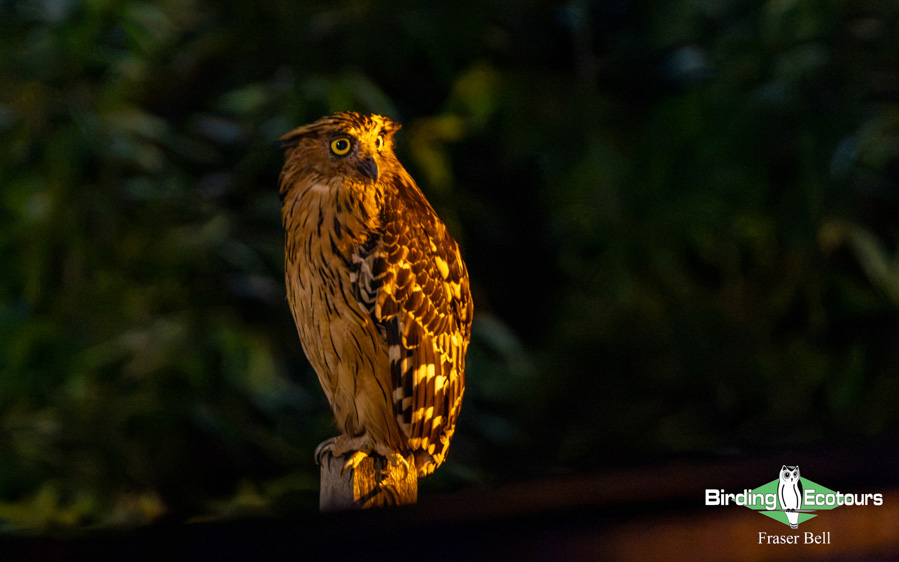
This bold Buffy Fish Owl kept us company every night while we were dining at the excellent Bornean Rainforest Lodge.
We departed our excellent river lodge after breakfast, reunited with our driving team, and headed south through the near continuous expanse of oil palm plantations to the coastal city of Lahad Datu. We were greeted on arrival by the excellent Bornean Rainforest Lodge team, and after lunch we headed west into the famous Danum Valley. This valley boasts a massive diversity of species, being one of the largest contiguous protected areas of ancient lowland dipterocarp forest in Sabah. We all enjoyed being back in such healthy forest and saw some incredible animals on the drive in. The best were a couple of male pheasants, as a Bornean Crested Fireback and a Great Argus ran in front of our convoy, giving most of the group quick but good views of these two elaborately plumaged birds, plus a Critically Endangered (IUCN Red List) and very infrequently seen Asian Forest Tortoise which wandered across the road. Other top birds included a perched Whiskered Treeswift, a beautiful Helmeted Hornbill, though it quickly flew deeper into the jungle, and many White-crowned Forktails foraging along the roadside.
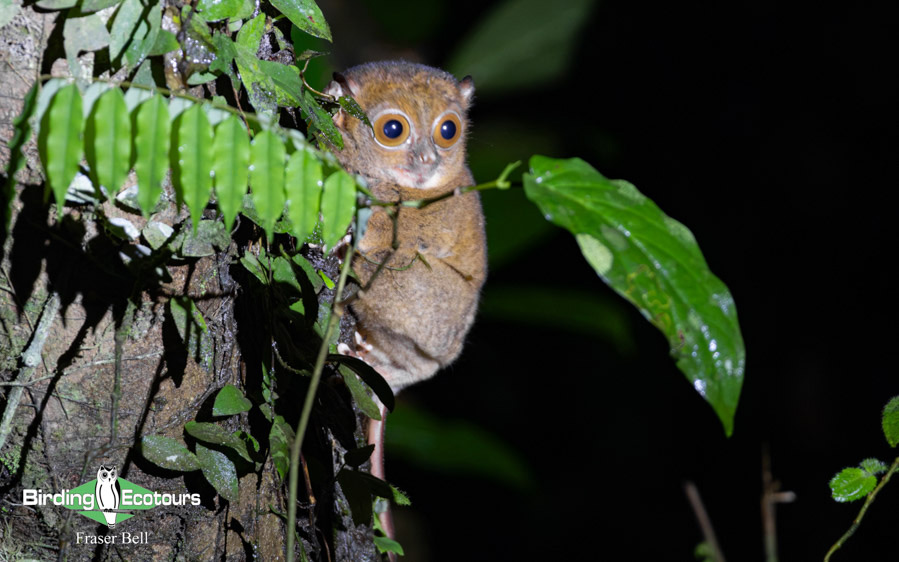
Our night drives in Danum Valley were extremely successful, with a pair of the bizarre carnivorous primate, the Western Tarsier, being the highlight of the first night drive.
The weather turned during our check in, so we cancelled the afternoon plans, instead opting for some downtime before a night drive later that evening. The Bornean Rainforest Lodge is one of Asia’s best ecolodges, and we all thoroughly enjoyed our three night stay here at the end of our excellent tour through Sabah. Our dinner (and in fact all meals here) really was exquisite, but it was rudely interrupted by a bold Buffy Fish Owl foraging right outside the restaurant. This lump of brown feathers with bright yellow eyes and fluffy ear tufts made daily appearances during many of the breakfast and evening meals, always perched just below the pool, presumably waiting for frogs coming off the river.
Our night drive was brilliant. While we only heard Gould’s Frogmouth, we found a perched Blyth’s Frogmouth, and saw many mammals – Malay Civet, Philipine Palm Civet, Sambar, and a Philippine Slow Loris which, despite its name, moved away too fast for most! The highlight however was the two Western Tarsiers which our keen-eyed lodge guide found just next to the road. We had great looks at these two very cute but odd carnivorous primates, which stared inquisitively back at us before they leapt low through the trees into the darkness. What a great welcome to the Danum Valley!
Day 10, 25th July 2026. A full day birding the Danum Valley
Today was a very long but incredibly rewarding day, and we logged over 80 species during the course of the day. We saw many of our target birds well, including a duo of beautiful pittas – Blue-headed Pitta and Black-crowned Pitta, the latter being very satisfying given only some in the group had previously seen them well during our time at Sepilok. We trekked out into the jungle hoping to see Great Argus better than the day before, and even before we arrived we could hear the comical ‘Kow-WOW!’ call of the male, which we then watched for some time. What a treat to be able to enjoy close up, extended views of such an iconic bird of Southeast Asia’s forests, and one with such ridiculous and impressive plumage. We enjoyed seeing a lot of colorful birds across the morning, such as Raffles’s Malkoha, Red-billed Malkoha, Diard’s Trogon, Scarlet-rumped Trogon, Chestnut-naped Forktail, plus a loud group of Great Slaty Woodpeckers. We did hear our major target, the monotypic Bornean Bristlehead, but unfortunately the flock had moved on by the time we were out on the forest trail.
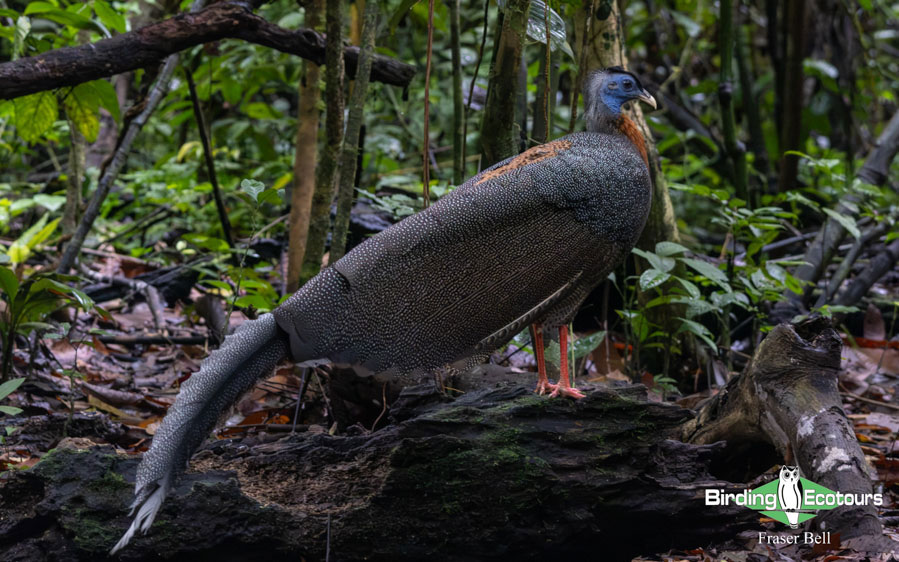
The phenomenal Great Argus is ridiculously plumaged and has to be seen to be believed.
We found some of our endemic targets, with Bicolored Babbler, Black-throated Wren-Babbler, Bornean Blue Flycatcher, Yellow-rumped Flowerpecker, and Bornean Spiderhunter. All of these were seen well, even the shy Black-throated Wren-Babbler, though it did take some work and careful maneuvering to get the whole group good views of this excellent endemic. We also added many other species to our trip list during our very bird filled morning, adding Banded Woodpecker, Maroon-breasted Philentoma, Spotted Fantail, Black-naped Monarch, Grey-headed Canary-flycatcher, Brown Fulvetta, Plain Flowerpecker, Purple-naped Spiderhunter, Long-billed Spiderhunter, seven species of bulbul including Finsch’s Bulbul, and nine babbler species, including the characterful Striped Wren-Babbler.
During another brilliant buffet at the lodge, a Lesser Fish Eagle flew past us and down the river the restaurant looked over. After some downtime, during which some of the group enjoyed the pool, others sat by the river, while others recovered in the plush rooms, we went back out birding. We had a dry afternoon, which was appreciated, but it was slow going, with a handful of new birds added while birding the entrance road. We finally saw Yellow-crowned Barbet, which we had heard multiple times during the tour, plus Fluffy-backed Tit-Babbler and Greater Green Leafbird. Before the evening meal, we tried a night walk, but this was very quiet compared to the previous night, only seeing a Greater Indo-Malayan Chevrotain, and not very well. The Lodge is a great place to be located, as you are right in the action of the highly diverse lowlands, which was evidenced by our group finding the downright bizarre Sunda Colugo and Lesser Indo-Malayan Chevrotain around our rooms in the evening, which made up for the quiet night walk.
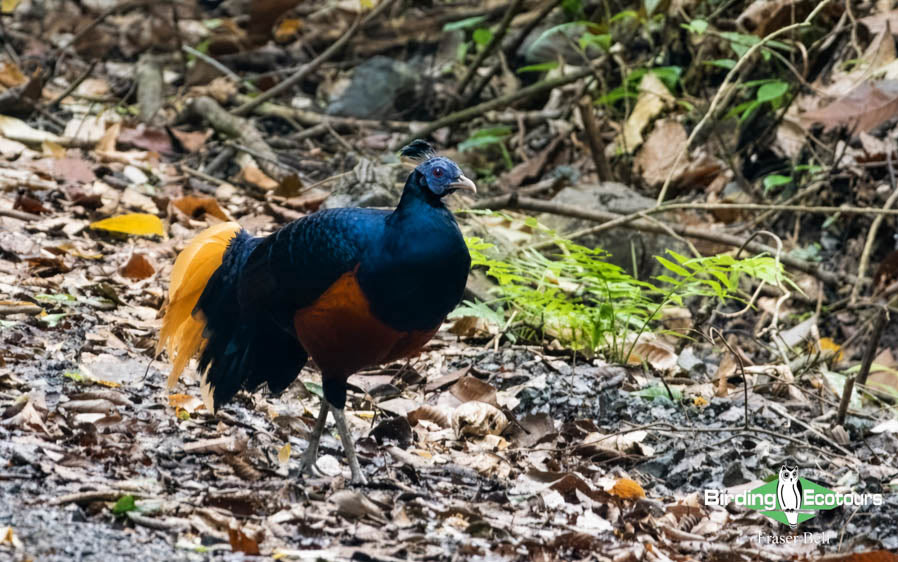
We were glad to improve our views of Bornean Crested Fireback, when two showy males walked out onto the road in front of our group.
Day 11, 26th July 2026. Second full day birding the Danum Valley
We opted to spend first light looking over the river, which proved a good idea as we found Greater Coucal, Bold-striped Tit-Babbler, and White-bellied Munia. The group then headed out along the entrance road once again, but we did not get far before two male Bornean Crested Firebacks came strutting out of the forest! This was very satisfying given we had hoped to see them at a feeding area along with Great Argus the day before, but the Fireback had not come, so finding them so close to our lodge was appreciated. Aside from the pheasants, other highlights included a bright male Red-naped Trogon, our fourth and final trogon species of this tour, plus the major skulker, the Bornean Wren-Babbler. As one might expect, it took us some time to find the Wren-Babbler, and the group had to have an expedition along one of the many forest trails to find the area it was calling from. After a lot of time waiting, listening, and watching, most of us had good views of this top endemic target! Other top birds seen during the morning included Square-tailed Drongo-Cuckoo, Wreathed Hornbill, Green Iora, Puff-backed Bulbul, Grey-bellied Bulbul, Chestnut-rumped Babbler, Sooty-capped Babbler, Rufous-crowned Babbler, and Thick-billed Spiderhunter.
The morning was quieter than the previous day, so we had more time off to enjoy the luxury of the lodge. After lunch, some in the group made a short walk near the restaurant and found a pair of beautiful Blue-headed Pittas, though they did not hang around long enough for the whole group. During the afternoon, the secretive Moustached Hawk-Cuckoo eluded us, remaining heard only, but we saw Banded Bay Cuckoo, Hairy-backed Bulbul, Rufous-fronted Babbler, Leaflitter Babbler, Low’s Squirrel, and a beautiful male Blyth’s Paradise Flycatcher, with its bright white plumage and long tail, spritely flycatching in the understory.
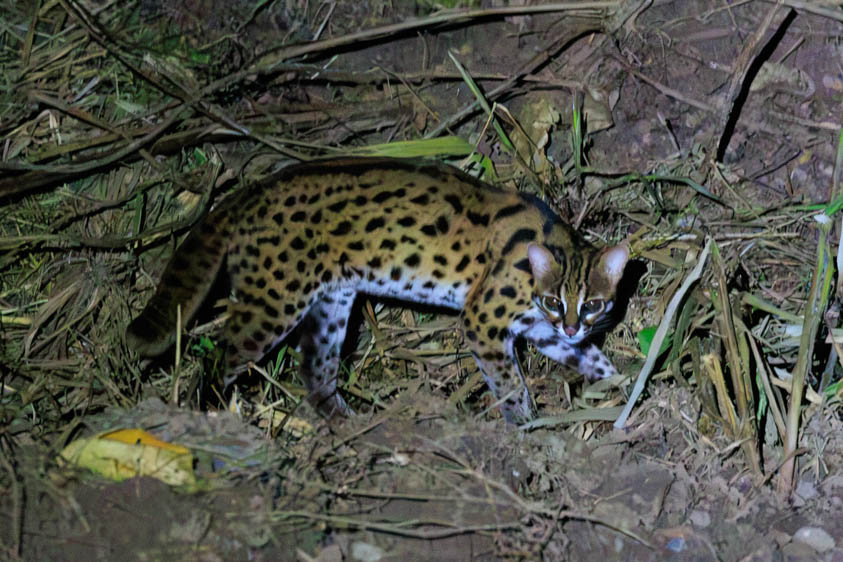
Spending time with a Sunda Leopard Cat on the final night was the perfect finale to our time at Danum Valley (photo N. Graf).
Being our final night we all had a nice time chatting through the many highlights of the tour together, though we went out on another night drive after dinner, one final chance for some nocturnal wildlife. While we only heard Brown Boobook in the distance, we saw a fluffy Brown Wood Owl very well, which was very content watching the group from its lofty perch. The rest of the drive was very quiet, and we were just about to head back when we found a rarely seen Sunda Leopard Cat! At first it was seen only briefly, but after a tense wait, the cat decided to venture back out onto the roadside, so we had repeated views of this very cute little predator for more than ten minutes as it strolled down the road. Finding such a rare nocturnal mammal was the perfect end to our tour, or so we thought, but our final morning also went very well.
Day 12, 27th July 2026. Departure
Our tour was ending in the early afternoon at Lahad Datu Airport, so we had a few hours to bird at the lodge before we prepared ourselves for flight mode and departure. As usual, the morning was fun. We did not see the calling Rufous-winged Philentoma or Crested Jayshrike, but did see Plaintive Cuckoo, Rufous Piculet, Grey-and-buff Woodpecker, Blue-rumped Parrot, Black-and-yellow Broadbill, Large Woodshrike, Bornean Black Magpie, Hairy-backed Bulbul, Bornean Blue Flycatcher, and, surprisingly, a pair of the threatened (IUCN) Straw-headed Bulbuls. It was very encouraging to have two sightings of this chunky bulbul during the tour given how drastically their population is in decline. The mammals continued to amaze, and those in the group out birding the access road together saw a trio of brachiating Eastern Gray Gibbons, with several animals launching themselves through the mid-canopy at impressive speed while we watched in awe. These are shy animals, so although we heard them every day while at Danum, we considered ourselves very lucky to see them. Those in the group who had a quieter morning around the lodge were able to see one final wild Bornean Orangutan.
We then said our goodbyes to the lodge and drove east toward Lahad Datu, but not before making one final try for Bornean Bristlehead at the eleventh hour. Almost as soon as we hopped out of the vehicles, we heard the telltale call of what turned out to be a small group of Bornean Bristleheads, and soon the group was having epic views of this downright odd species, which is often referred to as the grail of birding in Borneo, and for good reason. It is threatened (IUCN Red List), lives at low density, and flocks are wide-ranging, so they are hard to find, but our efforts were very worthwhile to see this truly iconic, monotypic bird. What a way to end a tour!
After some coffee and lunch, we checked in at Lahad Datu airport and waited for our flight to Kota Kinabalu, while adding some common species to our lists, such as Zebra Dove, Paddyfield Pipit, and a number of Buff-banded Rails that were feeding on the grassy sides of the runway. Our group parted ways on arrival at Kota Kinabalu Airport, where this classic Borneo Sabah birding tour ended. What a great tour we had enjoyed! The group were a lot of fun to travel with, and everyone’s positivity, even despite the uncharacteristic dry season rain, made for an excellent tour. We had a lot of laughs and some nice evening parties during the tour, as well as so many wildlife highlights. Bird of the tour was hard fought, but the Bornean Crested Fireback won out after the two males had been so accommodating, allowing us to appreciate their beautiful plumages for some time, but of course, Great Argus and Bornean Bristlehead had honorable mentions. With such incredible mammals seen throughout the tour, it was hardly surprising that the votes were split for the tour mammal. Western Tarsier was really enjoyed, but the overall favorites were the iconic Bornean Orangutan and our surprise find of the Sunda Leopard Cat on the final night.
Bird List – Following IOC 15.2 (April 2026)
Birds ‘heard only’ are marked with (H) after the common name, all other species were seen.
The following notation after species names is used to show conservation status following the IUCN Red List: CR = Critically Endangered, EN = Endangered, VU = Vulnerable.
| Common name | Scientific name |
| Ducks (Anatidae) | Ducks (Anatidae) |
| Wandering Whistling Duck | Dendrocygna arcuata |
| Pheasants & Allies (Phasianidae) | |
| Red-breasted Partridge | Arborophila hyperythra |
| Bornean Crested Fireback – VU | Lophura ignita |
| Great Argus – VU | Argusianus argus |
| Sabah Partridge | Tropicoperdix graydoni |
| Crimson-headed Partridge | Haematortyx sanguiniceps |
| Frogmouths (Podargidae) | |
| Gould’s Frogmouth (H) | Batrachostomus stellatus |
| Blyth’s Frogmouth | Batrachostomus affinis |
| Treeswifts (Hemiprocnidae) | |
| Grey-rumped Treeswift | Hemiprocne longipennis |
| Whiskered Treeswift | Hemiprocne comata |
| Swifts (Apodidae) | |
| Plume-toed Swiftlet | Collocalia affinis |
| Mossy-nest Swiftlet | Aerodramus salangana |
| Black-nest Swiftlet | Aerodramus maximus |
| Edible-nest Swiftlet | Aerodramus fuciphagus |
| Silver-rumped Spinetail | Rhaphidura leucopygialis |
| Brown-backed Needletail | Hirundapus giganteus |
| Asian Palm Swift | Cypsiurus balasiensis |
| House Swift | Apus nipalensis |
| Cuckoos (Cuculidae) | |
| Greater Coucal | Centropus sinensis |
| Bornean Ground Cuckoo – VU (H) | Carpococcyx radiceus |
| Raffles’s Malkoha | Rhinortha chlorophaea |
| English Name | Scientific Name |
| Red-billed Malkoha | Zanclostomus javanicus |
| Chestnut-breasted Malkoha | Phaenicophaeus curvirostris |
| Black-bellied Malkoha (H) | Phaenicophaeus diardi |
| Violet Cuckoo | Chrysococcyx xanthorhynchus |
| Banded Bay Cuckoo | Cacomantis sonneratii |
| Plaintive Cuckoo | Cacomantis merulinus |
| Square-tailed Drongo-Cuckoo | Surniculus lugubris |
| Moustached Hawk-Cuckoo (H) | Hierococcyx vagans |
| Sunda Cuckoo | Cuculus lepidus |
| Pigeons & Doves (Columbidae) | |
| Rock Dove [Feral Pigeon] (Introduced) | Columba livia [dom.] |
| Spotted Dove (Introduced) | Spilopelia chinensis |
| Little Cuckoo-Dove | Macropygia ruficeps |
| Common Emerald Dove | Chalcophaps indica |
| Zebra Dove | Geopelia striata |
| Little Green Pigeon | Treron olax |
| Pink-necked Green Pigeon | Treron vernans |
| Green Imperial Pigeon | Ducula aenea |
| Mountain Imperial Pigeon | Ducula badia |
| Pied Imperial Pigeon | Ducula bicolor |
| Rails & Crakes (Rallidae) | |
| Buff-banded Rail | Gallirallus philippensis |
| Common Moorhen | Gallinula chloropus |
| White-breasted Waterhen | Amaurornis phoenicurus |
| Sandpipers (Scolopacidae) | |
| Common Sandpiper | Actitis hypoleucos |
| Storks (Ciconiidae) | |
| Lesser Adjutant | Leptoptilos javanicus |
| Storm’s Stork – EN | Ciconia stormi |
| Darters (Anhingidae) | |
| Oriental Darter | Anhinga melanogaster |
| Herons & Bitterns (Ardeidae) | |
| Black-Crowned Night-heron | Nycticorax nycticorax |
| Nankeen Night Heron | Nycticorax caledonicus |
| Little Egret | Egretta garzetta |
| Great Egret | Ardea alba |
| Medium Egret | Ardea intermedia |
| Purple Heron | Ardea purpurea |
| Kites, Hawks & Eagles (Accipitridae) | |
| Black-winged Kite | Elanus caeruleus |
| Crested Serpent Eagle | Spilornis cheela |
| Bat Hawk | Macheiramphus alcinus |
| Wallace’s Hawk-Eagle – VU | Nisaetus nanus |
| Blyth’s Hawk-Eagle | Nisaetus alboniger |
| Changeable Hawk-Eagle | Nisaetus cirrhatus |
| Rufous-bellied Eagle | Lophotriorchis kienerii |
| Black Eagle | Ictinaetus malaiensis |
| Crested Goshawk | Lophospiza trivirgata |
| White-bellied Sea Eagle | Icthyophaga leucogaster |
| Lesser Fish Eagle | Icthyophaga humilis |
| Grey-headed Fish Eagle | Icthyophaga ichthyaetus |
| Owls (Strigidae) | |
| Brown Boobook (H) | Ninox scutulata |
| Sunda Owlet | Taenioptynx sylvaticus |
| Buffy Fish Owl | Ketupa ketupu |
| Barred Eagle-Owl (H) | Ketupa sumatrana |
| Brown Wood Owl | Strix leptogrammica |
| Trogons (Trogonidae) | |
| Red-naped Trogon | Harpactes kasumba |
| Diard’s Trogon | Harpactes diardii |
| Whitehead’s Trogon | Harpactes whiteheadi |
| Scarlet-rumped Trogon | Harpactes duvaucelii |
| Hornbills (Bucerotidae) | |
| White-crowned Hornbill – EN | Berenicornis comatus |
| Rhinoceros Hornbill – VU | Buceros rhinoceros |
| English Name | Scientific Name |
| Helmeted Hornbill – CR | Rhinoplax vigil |
| Oriental Pied Hornbill | Anthracoceros albirostris |
| Black Hornbill – VU | Anthracoceros malayanus |
| Bushy-crested Hornbill | Anorrhinus galeritus |
| Wreathed Hornbill – VU | Rhyticeros undulatus |
| Wrinkled Hornbill – EN | Rhabdotorrhinus corrugatus |
| Rollers (Coraciidae) | |
| Oriental Dollarbird | Eurystomus orientalis |
| Kingfishers (Alcedinidae) | |
| Rufous-collared Kingfisher | Actenoides concretus |
| Banded Kingfisher (H) | Lacedo pulchella |
| Stork-billed Kingfisher | Pelargopsis capensis |
| Collared Kingfisher | Todiramphus chloris |
| Blue-eared Kingfisher | Alcedo meninting |
| Rufous-backed Dwarf Kingfisher | Ceyx rufidorsa |
| Bee-eaters (Meropidae) | |
| Red-bearded Bee-eater (H) | Nyctyornis amictus |
| Blue-throated Bee-eater | Merops viridis |
| Asian Barbets (Megalaimidae) | |
| Golden-whiskered Barbet | Psilopogon chrysopogon |
| Red-throated Barbet | Psilopogon mystacophanos |
| Mountain Barbet | Psilopogon monticola |
| Yellow-crowned Barbet | Psilopogon henricii |
| Golden-naped Barbet | Psilopogon pulcherrimus |
| Black-eared Barbet | Psilopogon duvaucelii |
| Bornean Barbet | Psilopogon eximius |
| Brown Barbet | Caloramphus fuliginosus |
| Woodpeckers (Picidae) | |
| Rufous Piculet | Sasia abnormis |
| Grey-and-buff Woodpecker | Hemicircus concretus |
| Sunda Pygmy Woodpecker | Yungipicus moluccensis |
| White-bellied Woodpecker | Dryocopus javensis |
| Banded Woodpecker | Chrysophlegma miniaceum |
| English Name | Scientific Name |
| Crimson-winged Woodpecker | Picus puniceus |
| Maroon Woodpecker | Blythipicus rubiginosus |
| Rufous Woodpecker | Micropternus brachyurus |
| Buff-rumped Woodpecker | Meiglyptes grammithorax |
| Buff-necked Woodpecker | Meiglyptes tukki |
| Great Slaty Woodpecker – VU | Mulleripicus pulverulentus |
| Falcons (Falconidae) | |
| White-fronted Falconet | Microhierax latifrons |
| Peregrine Falcon | Falco peregrinus |
| Old World Parrots (Psittaculidae) | |
| Blue-rumped Parrot | Psittinus cyanurus |
| Long-tailed Parakeet – VU | Psittacula longicauda |
| Blue-crowned Hanging Parrot | Loriculus galgulus |
| Typical Broadbills (Eurylaimidae) | |
| Dusky Broadbill | Corydon sumatranus |
| Black-and-red Broadbill | Cymbirhynchus macrorhynchos |
| Banded Broadbill | Eurylaimus javanicus |
| Black-and-yellow Broadbill | Eurylaimus ochromalus |
| Green Broadbills (Calyptomenidae) | |
| Whitehead’s Broadbill | Calyptomena whiteheadi |
| Pittas (Pittidae) | |
| Blue-headed Pitta – VU | Hydrornis baudii |
| Black-crowned Pitta | Erythropitta ussheri |
| Western Hooded Pitta | Pitta sordida |
| Vangas & Allies (Vangidae) | |
| Black-winged Flycatcher-shrike | Hemipus hirundinaceus |
| Large Woodshrike | Tephrodornis virgatus |
| Rufous-winged Philentoma (H) | Philentoma pyrhoptera |
| Maroon-breasted Philentoma | Philentoma velata |
| Bristlehead (Pityriasidae) | |
| Bornean Bristlehead – VU | Pityriasis gymnocephala |
| Woodswallows (Artamidae) | |
| White-breasted Woodswallow | Artamus leucorynchus |
| Ioras (Aegithinidae) | |
| Common Iora | Aegithina tiphia |
| Green Iora | Aegithina viridissima |
| Cuckooshrikes (Campephagidae) | |
| Fiery Minivet | Pericrocotus igneus |
| Grey-chinned Minivet | Pericrocotus solaris |
| Whistlers (Pachycephalidae) | |
| Bornean Whistler | Pachycephala hypoxantha |
| Shrike-babblers (Vireonidae) | |
| White-browed Shrike-babbler | Pteruthius aeralatus |
| Old World Orioles (Oriolidae) | |
| Black-and-crimson Oriole | Oriolus consanguineus |
| Ventriloquial Oriole | Oriolus consobrinus |
| Drongos (Dicruridae) | |
| Greater Racket-tailed Drongo | Dicrurus paradiseus |
| Hair-crested Drongo | Dicrurus hottentottus |
| Ashy Drongo | Dicrurus leucophaeus |
| Fantails (Rhipiduridae) | |
| White-throated Fantail | Rhipidura albicollis |
| Malaysian Pied Fantail | Rhipidura javanica |
| Spotted Fantail | Rhipidura perlata |
| Monarchs (Monarchidae) | |
| Black-naped Monarch | Hypothymis azurea |
| Blyth’s Paradise Flycatcher | Terpsiphone affinis |
| Jayshrike (Platylophidae) | |
| Crested Jayshrike (H) | Platylophus galericulatus |
| Shrikes (Laniidae) | |
| Long-tailed Shrike | Lanius schach |
| Crows & Jays (Corvidae) | |
| Bornean Black Magpie | Platysmurus aterrimus |
| Bornean Green Magpie | Cissa jefferyi |
| Bornean Treepie | Dendrocitta cinerascens |
| House Crow (Introduced) | Corvus splendens |
| Sunda Crow | Corvus enca |
| Fairy Flycatchers (Stenostiridae) | |
| Grey-headed Canary-flycatcher | Culicicapa ceylonensis |
| Bulbuls (Pycnonotidae) | |
| Hairy-backed Bulbul | Tricholestes criniger |
| Yellow-bellied Bulbul | Alophoixus phaeocephalus |
| Grey-cheeked Bulbul | Alophoixus tephrogenys |
| Penan Bulbul | Alophoixus ruficrissus |
| Finsch’s Bulbul | Iole finschii |
| Charlotte’s Bulbul | Iole charlottae |
| Streaked Bulbul | Ixos malaccensis |
| Puff-backed Bulbul | Euptilotus eutilotus |
| Black-headed Bulbul | Brachypodius melanocephalos |
| Spectacled Bulbul | Ixodia erythropthalmos |
| Grey-bellied Bulbul | Ixodia cyaniventris |
| Bornean Bulbul | Rubigula montis |
| Cream-vented Bulbul | Pycnonotus simplex |
| Olive-winged Bulbul | Pycnonotus plumosus |
| Asian Red-eyed Bulbul | Pycnonotus brunneus |
| Straw-headed Bulbul – CR | Pycnonotus zeylanicus |
| Pale-faced Bulbul | Pycnonotus leucops |
| Yellow-vented Bulbul | Pycnonotus goiavier |
| Swallows (Hirundinidae) | |
| Pacific Swallow | Hirundo javanica |
| Barn Swallow | Hirundo rustica |
| English Name | Scientific Name |
| Cettia Bush Warblers & Allies (Cettiidae) | |
| Yellow-bellied Warbler | Abroscopus superciliaris |
| Mountain Tailorbird | Phyllergates cucullatus |
| Aberrant Bush Warbler | Horornis flavolivaceus |
| Bornean Stubtail | Urosphena whiteheadi |
| Leaf Warblers (Phylloscopidae) | |
| Yellow-breasted Warbler | Phylloscopus montis |
| Mountain Leaf Warbler | Phylloscopus trivirgatus |
| Cisticolas & Allies (Cisticolidae) | |
| Yellow-bellied Prinia | Prinia flaviventris |
| Dark-necked Tailorbird | Orthotomus atrogularis |
| Rufous-tailed Tailorbird | Orthotomus sericeus |
| Ashy Tailorbird | Orthotomus ruficeps |
| White-eyes (Zosteropidae) | |
| Chestnut-crested Yuhina | Staphida everetti |
| Pygmy Heleia | Heleia squamifrons |
| Black-capped White-eye | Zosterops atricapilla |
| Mountain Blackeye | Zosterops emiliae |
| Hume’s White-eye | Zosterops auriventer |
| Tree Babblers & Scimitar Babblers (Timaliidae) | |
| Bold-striped Tit-Babbler | Mixornis bornensis |
| Fluffy-backed Tit-Babbler | Macronus ptilosus |
| Grey-hooded Babbler | Cyanoderma bicolor |
| Rufous-fronted Babbler | Cyanoderma rufifrons |
| Bare-headed Laughingthrush | Melanocichla calva |
| Sunda Scimitar Babbler | Pomatorhinus bornensis |
| Chestnut-rumped Babbler | Stachyris maculata |
| Grey-throated Babbler | Stachyris nigriceps |
| Ground Babblers (Pellorneidae) | |
| Black-throated Wren-Babbler | Turdinus atrigularis |
| Sooty-capped Babbler | Malacopteron affine |
| Scaly-crowned Babbler | Malacopteron cinereum |
| Rufous-crowned Babbler | Malacopteron magnum |
| Bornean Black-capped Babbler | Pellorneum capistratoides |
| Leaflitter Babbler | Pellorneum poliogene |
| Temminck’s Babbler | Pellorneum pyrrogenys |
| Bornean Swamp Babbler | Pellorneum macropterum |
| Ferruginous Babbler | Pellorneum bicolor |
| Striped Wren-Babbler | Kenopia striata |
| Horsfield’s Babbler | Malacocincla sepiaria |
| Mountain Wren-Babbler (H) | Gypsophila crassa |
| Bornean Wren-Babbler – VU | Ptilocichla leucogrammica |
| Alcippe Fulvettas (Alcippeidae) | |
| Brown Fulvetta | Alcippe brunneicauda |
| Laughingthrushes & Allies (Leiothrichidae) | |
| Sunda Laughingthrush | Garrulax palliatus |
| Chestnut-hooded Laughingthrush | Pterorhinus treacheri |
| Fairy-bluebirds (Irenidae) | |
| Asian Fairy-bluebird | Irena puella |
| Nuthatches (Sittidae) | |
| Velvet-fronted Nuthatch | Sitta frontalis |
| Starlings (Sturnidae) | |
| Asian Glossy Starling | Aplonis panayensis |
| Common Hill Myna | Gracula religiosa |
| Javan Myna (Introduced) – VU | Acridotheres javanicus |
| Common Myna (Introduced) | Acridotheres tristis |
| Thrushes (Turdidae) | |
| Fruithunter (H) | Chlamydochaera jefferyi |
| Everett’s Thrush | Zoothera everetti |
| Chats & Old World Flycatchers (Muscicapidae) | |
| Oriental Magpie-Robin | Copsychus saularis |
| White-crowned Shama | Copsychus stricklandii |
| Indigo Flycatcher | Eumyias indigo |
| Verditer Flycatcher | Eumyias thalassinus |
| Bornean Blue Flycatcher | Cyornis superbus |
| Malaysian Blue Flycatcher | Cyornis turcosus |
| Fulvous-chested Jungle Flycatcher | Cyornis olivaceus |
| White-crowned Forktail | Enicurus leschenaulti |
| Bornean Forktail | Enicurus borneensis |
| Chestnut-naped Forktail | Enicurus ruficapillus |
| Bornean Whistling Thrush | Myophonus borneensis |
| Eyebrowed Jungle Flycatcher | Vauriella gularis |
| Bornean Shortwing | Brachypteryx erythrogyna |
| Snowy-browed Flycatcher | Ficedula hyperythra |
| Little Pied Flycatcher | Ficedula westermanni |
| Leafbirds (Chloropseidae) | |
| Greater Green Leafbird – EN | Chloropsis sonnerati |
| Lesser Green Leafbird | Chloropsis cyanopogon |
| Flowerpeckers (Dicaeidae) | |
| Yellow-breasted Flowerpecker | Prionochilus maculatus |
| Yellow-rumped Flowerpecker | Prionochilus xanthopygius |
| Orange-bellied Flowerpecker | Dicaeum trigonostigma |
| Plain Flowerpecker | Dicaeum minullum |
| Black-sided Flowerpecker | Dicaeum monticolum |
| Sunbirds (Nectariniidae) | |
| Ruby-cheeked Sunbird | Chalcoparia singalensis |
| Plain Sunbird | Anthreptes simplex |
| Brown-throated Sunbird | Anthreptes malacensis |
| Red-throated Sunbird | Anthreptes rhodolaemus |
| Ornate Sunbird | Cinnyris ornatus |
| Crimson Sunbird | Aethopyga siparaja |
| Temminck’s Sunbird | Aethopyga temminckii |
| Purple-naped Spiderhunter | Kurochkinegramma hypogrammi-cum |
| Little Spiderhunter | Arachnothera longirostra |
| Thick-billed Spiderhunter | Arachnothera crassirostris |
| Long-billed Spiderhunter | Arachnothera robusta |
| Bornean Spiderhunter | Arachnothera everetti |
| Whitehead’s Spiderhunter | Arachnothera juliae |
| Old World Sparrows (Passeridae) | |
| Eurasian Tree Sparrow | Passer montanus |
| Munias & Allies (Estrildidae) | |
| Scaly-breasted Munia | Lonchura punctulata |
| Dusky Munia | Lonchura fuscans |
| White-bellied Munia | Lonchura leucogastra |
| Chestnut Munia | Lonchura atricapilla |
| Wagtails & Pipits (Motacillidae) | |
| Paddyfield Pipit | Anthus rufulus |
| Species seen: | 249 |
| Species heard: | 12 |
| Total recorded: | 261 |
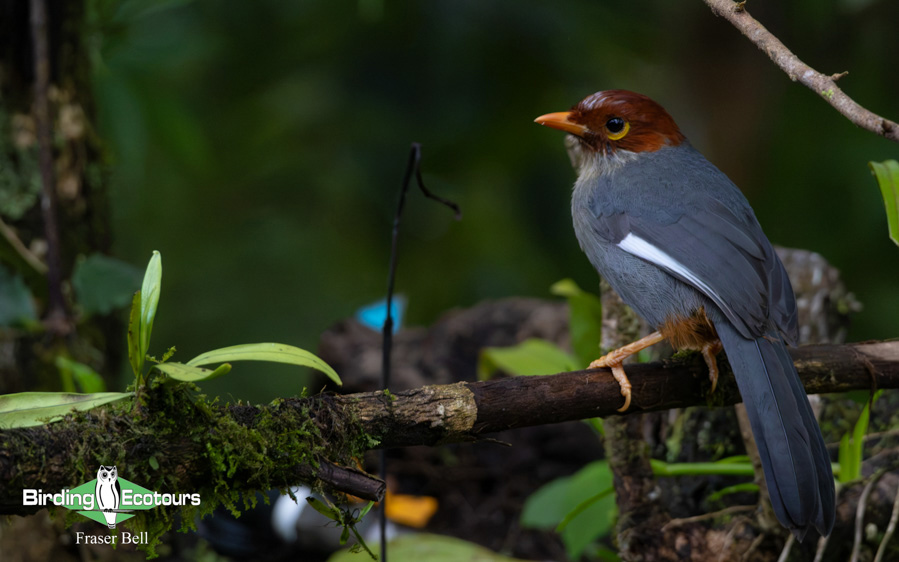
Chestnut-hooded Laughingthrush is a very attractive endemic, we enjoyed seeing lively groups of these multiple times while in the highlands.
Mammal List – Following Mammalwatching (February 2026)
The following notation after species names is used to show conservation status following the IUCN Red List: CR = Critically Endangered, EN = Endangered, VU = Vulnerable.
| Common name | Scientific name |
| Elephants (Elephantidae) | |
| Asian Elephant – EN | Elephas maximus |
| Treeshrews (Scandentia) | |
| Lesser Treeshrew | Tupaia minor |
| Mountain Treeshrew | Tupaia montana |
| Large Treeshrew | Tupaia tana |
| Colugos (Dermoptera) | |
| Sunda Colugo | Galeopterus variegatus |
| Tarsiers (Tarsiidae) | |
| Western Tarsier – VU | Cephalopachus bancanus |
| Lorisids (Lorisidae) | |
| Philippine Slow Loris – VU | Nycticebus menagensis |
| Old World Monkeys (Cercopithecidae) | |
| Long-tailed Macaque – EN | Macaca fascicularis |
| Southern Pig-tailed Macaque – EN | Macaca nemestrina |
| Proboscis Monkey – EN | Nasalis larvatus |
| Maroon Langur – VU | Presbytis rubicunda |
| Sunda Silvery Langur – VU | Trachypithecus cristatus |
| Gibbons (Hylobatidae) | |
| Eastern Gray Gibbon – EN | Hylobates funereus |
| Great Apes (Hominidae) | |
| Bornean Orangutan – CR | Pongo pygmaeus |
| Squirrels (Sciuridae) | |
| Pale Giant Squirrel | Ratufa affinis |
| Red Giant Flying Squirrel | Petaurista petaurista |
| Plantain Squirrel | Callosciurus notatus |
| Borneo Black-banded Squirrel | Callosciurus orestes |
| Prevost’s Squirrel | Callosciurus prevostii |
| Bornean Mountain Ground Squirrel | Dremomys everetti |
| Least Pygmy Squirrel | Exilisciurus exilis |
| Tufted Pygmy Squirrel | Exilisciurus whiteheadi |
| Jentink’s Squirrel | Sundasciurus jentinki |
| Low’s Squirrel | Sundasciurus lowii |
| Old World Fruit Bats (Pteropodidae) | |
| Large Flying Fox – EN | Pteropus vampyrus |
| Free-tailed Bats (Molossidae) | |
| Wrinkle-lipped Free-tailed Bat | Mops plicatus |
| Old World Leaf-npsed bats (Hipposideridae) | |
| Diadem Roundleaf Bat | Hipposideros diadema |
| Civets (Viverridae) | |
| Malay Civet | Viverra tangalunga |
| Philipine Palm Civet | Paradoxurus philippinensis |
| Mustelids (Mustelidae) | |
| Smooth-coated Otter – VU | Lutrogale perspicillata |
| Cats (Felidae) | |
| Sunda Leopard Cat | Prionailurus javanensis |
| Mouse deer (Tragulus) | |
| Lesser Indo-Malayan Chevrotain | Tragulus kanchil |
| Greater Indo-Malayan Chevrotain | Tragulus napu |
| Deer (Cervidae) | |
| Sambar – VU | Rusa unicolor |
| Species seen: | 34 |
Reptile List – Following Reptiles of the World (November 2024)
The following notation after species names is used to show conservation status following the IUCN Red List: CR = Critically Endangered.
| Common name | Scientific name |
| Tortoises and Turtles (Testudines) | |
| Asian Forest Tortoise – CR | Manouria emys |
| Crocodiles (Crocodylidae) | |
| Saltwater Crocodile | Crocodylus porosus |
| Agamas and Dragons (Agamidae) | |
| Oriental Garden Lizard | Calotes versicolor |
| Bartlett’s Flying Dragon | Draco cornutus |
| Green Crested Lizard | Bronchocela cristatella |
| Borneo Forest Dragon | Gonocephalus bornensis |
| Typical Geckos (Gekkonidae) | |
| White-banded Narrow-disked Gecko | Gekko albofasciolatus |
| Asian House Gecko | Hemidactylus frenatus |
| Flat-tailed House Gecko | Hemidactylus platyurus |
| Skinks (Scincidae) | |
| Borneo Skink | Dasia vittata |
| Rough Mabuya | Eutropis rudis |
| Sabah Slender Skink | Sphenomorphus sabanus |
| Beccari’s Keeled Skink | Tropidophorus beccarii |
| Monitor Lizards (Varanidae) | |
| Common Water Monitor | Varanus salvator |
| Species seen: | 14 |
This is a sample trip report. Please email us ([email protected]) for more trip reports from this destination.