13 – 24 MAY 2026
By Andrew Walker
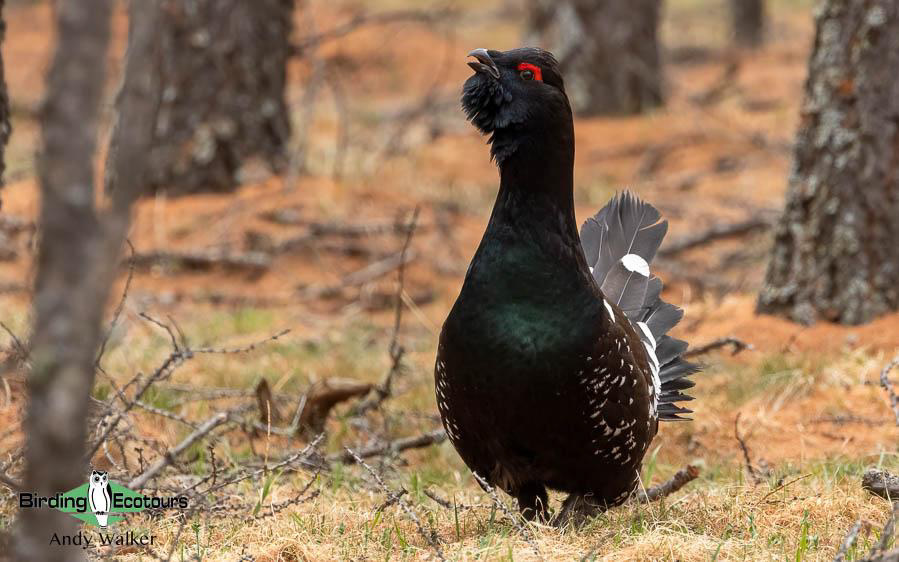
We enjoyed some absolutely sensational views of Black-billed Capercaillie while birding in Mongolia. A definite tour highlight and one of the best birds in Mongolia!
Overview
This Mongolian birding tour started in Ulaanbaatar (also known as Ulan Bator) on the 13th of May 2026 and ended back there on the 24th of May 2026. This Mongolia bird tour visited Siberian taiga forests, vast seamless steppe grasslands, a range of fresh water and brackish lakes, the Gobi Desert, and some impressive mountains and gorges. We stayed in comfortable (and heated) gers throughout. There is no “real” camping on this tour, which was a good thing given the nighttime temperatures were dropping to near freezing and the overnight winds in the desert.
We recorded 185 bird species (three species were heard only), and 19 mammal species on this Mongolian birding tour. Bird and animal lists follow the report and you can also see our eBird trip report, with lots more photos, here.
Highlights from the 2026 Mongolia bird tour were many. We started the tour in Ulaanbaatar with great looks at Swan Goose, Azure Tit, Long-tailed Rosefinch, and Citrine Wagtail. Then, as we moved into the steppe grasslands and waterbodies at Gun-Galuut Nature Reserve, we enjoyed sightings of Stejneger’s Scoter, Falcated Duck, nesting White-naped Crane, Demoiselle Crane, Common Crane, Mongolian Gull, Cinereous Vulture, White-tailed Eagle, Upland Buzzard, Saker Falcon, Mongolian Lark, and Pied Wheatear.
While in the nearby Siberian taiga forests at Gorkhi Terelj National Park, we connected with the highly sought after Black-billed Capercaillie, along with other goodies like Black Stork, Great Grey Owl, Ural Owl, Northern Nutcracker, Asian Short-toed Lark, White-crowned Penduline Tit, Daurian Redstart, Red-flanked Bluetail, Siberian Rubythroat, Olive-backed Pipit, and Pine Bunting.
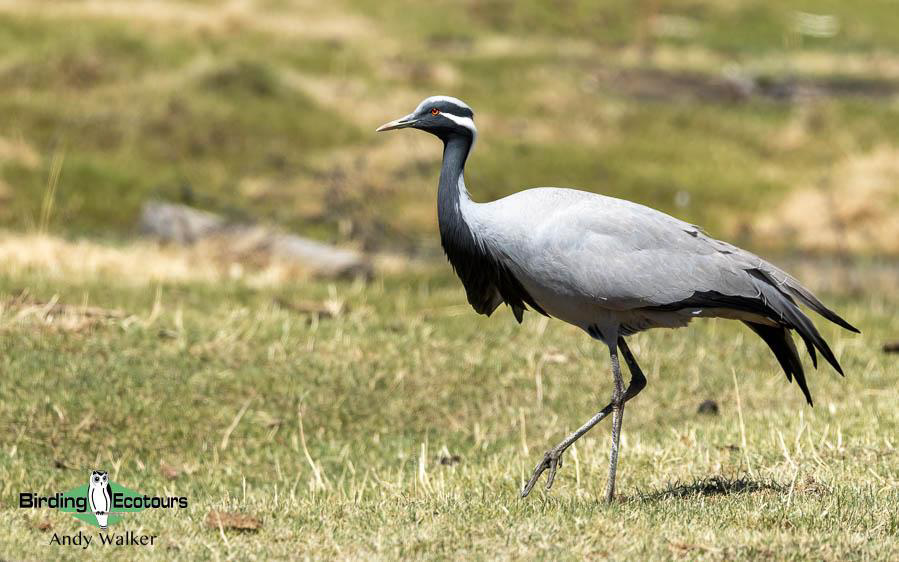
Demoiselle Crane was one of three beautiful species of crane seen very well on the tour.
We arrived in the south of the Gobi Desert after a flight south from Ulaanbaatar. We initially spent some time birding in the high mountains near Dalanzadgad, with many more highlights seen. Some of these included Bearded Vulture, Himalayan Vulture, Golden Eagle, Steppe Eagle, Saker Falcon, Wallcreeper, Isabelline Wheatear, Kozlov’s (Mongolian) Accentor – a near endemic, Brown Accentor, Himalayan Beautiful Rosefinch, and White-winged Snowfinch.
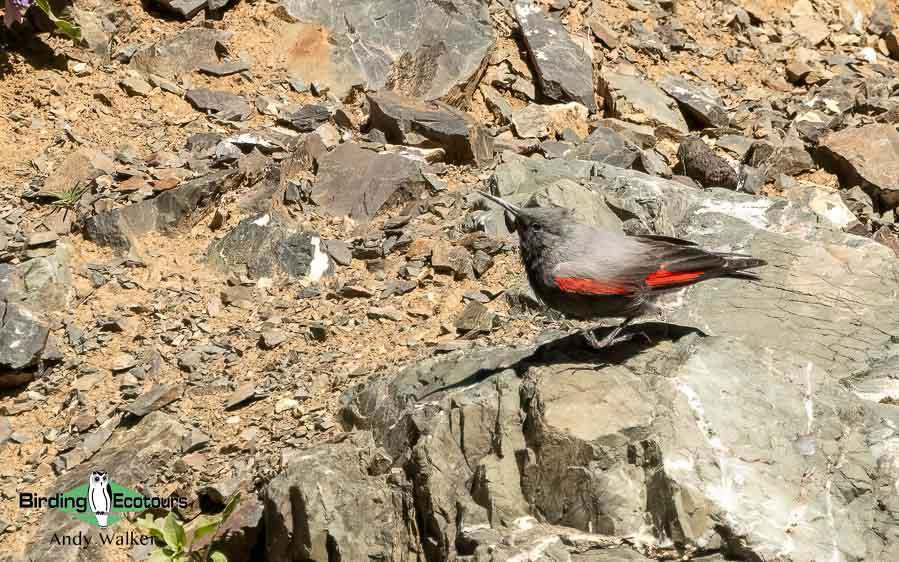
Wallcreeper showed nice and low down on the huge and towering cliffs it calls home.
In the southern Gobi Desert grasslands and expansive (and spectacular) sand dunes we found two stunning breeding plumaged Oriental Plovers and one of our big trip targets, Mongolian Ground Jay. We also added other highlights like Pallas’s Sandgrouse, European Nightjar, Greater Sand Plover, Great (Steppe) Grey Shrike, Isabelline (Daurian) Shrike, Asian Short-toed Lark, Turkestan Short-toed Lark, Desert Wheatear, Isabelline Wheatear, Mongolian Finch, Desert Finch, Pere David’s Snowfinch, and Saxual Sparrow.
Driving north from Dalanzadgad back through to Ulaanbaatar we stopped in the central Gobi Desert, where we enjoyed watching a large breeding colony of Mongolian Gulls, along with sightings of Demoislle Crane, Cinereous Vulture, Bearded Vulture, Golden Eagle, Lesser Kestrel, Mongolian Lark, Pere David’s Snowfinch, Ortolan Bunting, Yellow-breasted Bunting, and a huge flock of Citrine Wagtails.
In addition to the great birds seen during this Mongolian bird tour, we also found numerous great mammals, highlights included Tolai Hare, Pallas’s Pika, Tarbagan Marmot, Mongolian Jird, Argali, Siberian Ibex, Mongolian Gazelle, Goitered Gazelle, Onager, Corsac Fox, and more.
All of the above, along with our great local guides and drivers (and some tasty Mongolian cuisine), resulted in a really enjoyable tour to this massive and bird-rich country, steeped in an amazing history.
Detailed Report
Day 1, 13th May 2026. Arrival and birding in Ulaanbaatar
We met for a welcome lunch in our hotel on the edge of Ulaanbaatar. In the afternoon we took the short drive to a nearby lake complex, where we found many species of waterfowl, with highlights including a small flock of Swan Geese, Whooper Swan, stunning Garganey, and numerous widespread palearctic ducks. The lake edge was hopping with wagtails and we found several Citrine Wagtails amongst the Grey Wagtails and many White Wagtails, with a lone Eastern Yellow Wagtail also present. Shorebirds were evident and we enjoyed sightings of breeding plumaged Black-tailed Godwit, Temminck’s Stint, Long-toed Stint, and Wood Sandpiper. Several Little Ringed Plovers were very sharply plumaged too and showed nicely while a pair of Eurasian Spoonbills dropped in briefly. A roving flock of Red-billed Chough gave some close views too, as did Northern Raven.
We next moved into some more bushy areas, partly to get out of the incessant cold north wind! This was a great move and soon after getting into this different habitat we were enjoying sightings of Common Hoopoe, Azure-winged Magpie, Daurian Jackdaw, Naumann’s Thrush, Dusky Thrush, Taiga Flycatcher, Pallas’s Leaf Warbler, Hawfinch, and Long-tailed Rosefinch, although the real highlight was the pair of Azure Tits that gave excellent prolonged close views – what a stunner! Overhead, we noted Black Kite, Upland Buzzard, and Eurasian Hobby. Despite the bracing weather, it had been a wonderful start to our Mongolia birding tour.
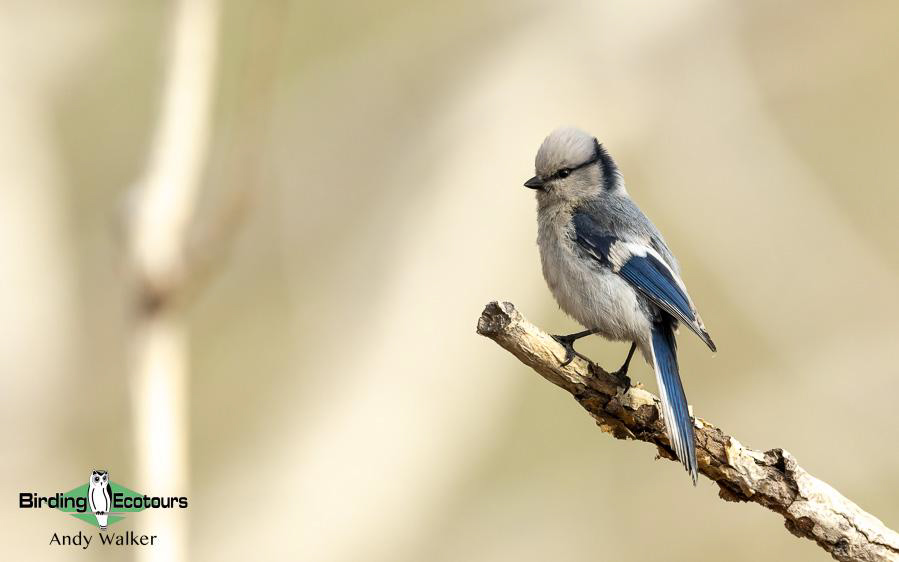
The delightful Azure Tit provided an early tour highlight during our first group birding session in Mongolia!
Day 2, 14th May 2026. Travel between Ulaanbaatar and Gun-Galuut Nature Reserve
We spent most of the morning driving between Ulaanbaatar and Gun-Galuut Nature Reserve, where we were to spend the night is some comfortable gers. We made a stop along the way to take in the humongous Chinggis Khan statue (where we saw a Steppe Eagle overhead) and saw a pet Golden Eagle!
After arriving at our accommodation and having lunch we headed out into the stunning steppe landscape for some enjoyable birding. We soon found ourselves watching Mongolian Lark – with an impressive set of markings, especially when in flight. We then focused our attention on some waterbodies where numerous birds were present. Some of the great birds seen well included Whooper Swan, Stejneger’s Scoter, Falcated Duck, Garganey, Common Swift, Fork-tailed (Pacific) Swift, Northern Lapwing, Eurasian Whimbrel, Eurasian Curlew, Marsh Sandpiper, Mongolian Gull, Cinereous Vulture, White-tailed Eagle, Eastern Marsh Harrier, and Upland Buzzard. However, the three major highlights were probably the views we had of White-naped Crane, Common Crane, and Demoiselle Crane – all such beautiful birds.
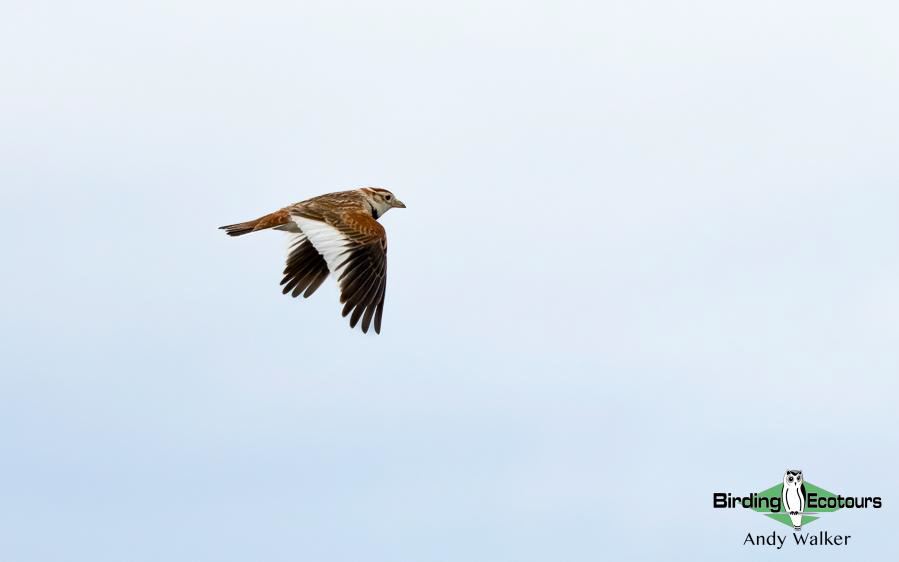
Mongolian Lark has a striking wing pattern, rich colors, and a beautiful song. We saw lots of them while birding in the steppe grasslands at Gun-Galuut Nature Reserve.
Day 3, 15th May 2026. Morning birding at Gun-Galuut Nature Reserve and travel to Gorkhi Terelj National Park for afternoon birding
We started our day nice and early and drove out to a huge area of marsh habitat. A large flock of Swan Geese was present and we got to watch several pairs of elegant White-naped Cranes displaying around their nest sites. A pair of Eastern Marsh Harriers were also patrolling their territory and occasionally flushed a range of wildfowl and shorebirds. Black-tailed Godwits and Common Redshanks were busily displaying and showed nicely. On some cliffs near the marsh we found several roosting Cinereous Vultures which looked quite impressive in the early morning sunlight. Also here, we found some Argali (sheep) along with Meadow Bunting, Northern Wheatear, and Pied Wheatear.
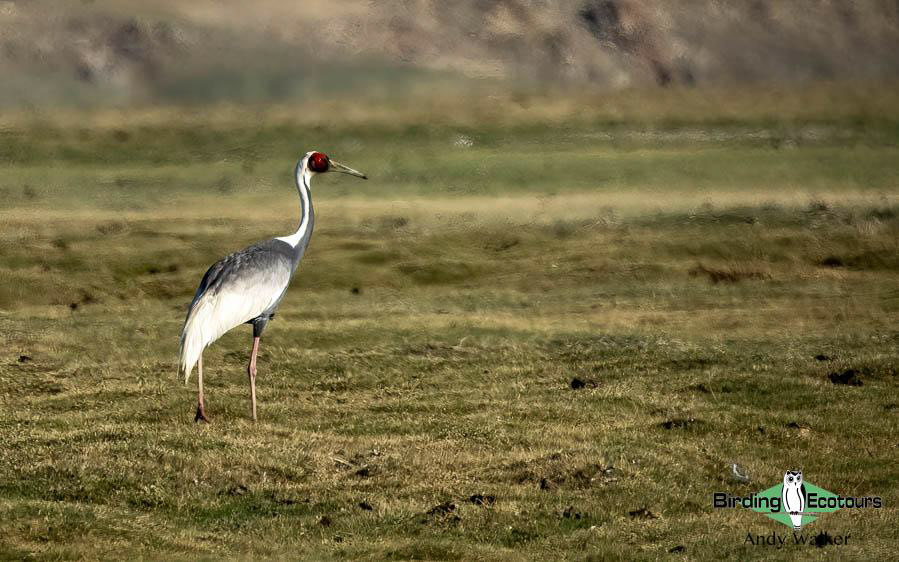
The spectacular White-naped Crane was nesting in the huge marsh.
After breakfast, we departed the accommodation and started our journey to Gorkhi Terelj National Park. We made a stop at a waterbody we’d visited the previous afternoon, where we saw mostly the same species, but also a nice look at a pair of Pied Avocets, and a hunting Saker Falcon shot through distantly. We made another couple of stops along the way, seeing Mongolian Lark, Common Rock Thrush, and Blyth’s Pipit amongst others.
In the afternoon, we checked into our new accommodation for a couple of nights and started exploring Gorkhi Terelj National Park. We took a walk along a pretty river and found plenty to keep us occupied. A pair of Demoiselle Cranes gave exceptional and close views as they foraged totally unconcerned by our presence. During our walk, we found Black Stork, Booted Eagle, Eastern Buzzard, Brown Shrike, White-crowned Penduline Tit, Asian Short-toed Lark, White-cheeked Starling, Daurian Redstart, Siberian Stonechat, Isabelline Wheatear, Water Pipit, Pine Bunting, Little Bunting, and Black-faced Bunting.
After dinner we went out to look for some owls. We had a Eurasian Woodcock fly over at dusk, followed by a brief Great Grey Owl sighting, however the great grey must have strayed into a Long-eared Owl territory and it was quickly chased off, never to be seen again, so we headed back to our comfortable and warm cabins as the outside temperatures plummeted towards freezing (grateful there was no proper camping on this trip)!
Day 4, 16th May 2026. Birding at Gorkhi Terelj National Park
We had an early breakfast (with Common Cuckoo calling nearby) and made the short drive into a forested section of the national park where, not long after arriving, we were watching a distant Black-billed Capercaillie. Unfortunately, even though we were essentially in the middle of nowhere, another birding group was also present at the site, so we decided to try and find another bird to enjoy by ourselves. Not long after, following a short walk through the forest, we heard the distinctive sound of a displaying capercaillie and, suddenly, he was right in front of us in full glory, head and tail cocked and calling away. We stayed with the male for about 30 minutes as he paraded around, a female was also noted checking him out. What a spectacular sight (and sound). After being satisfied with our views we took a short walk around the forest patch, where we found lots of Red-throated Thrushes, along with Chinese Bush Warbler, Willow Tit, Eurasian Nuthatch, Red-flanked Bluetail, Olive-backed Pipit, and lots of Pine Buntings.
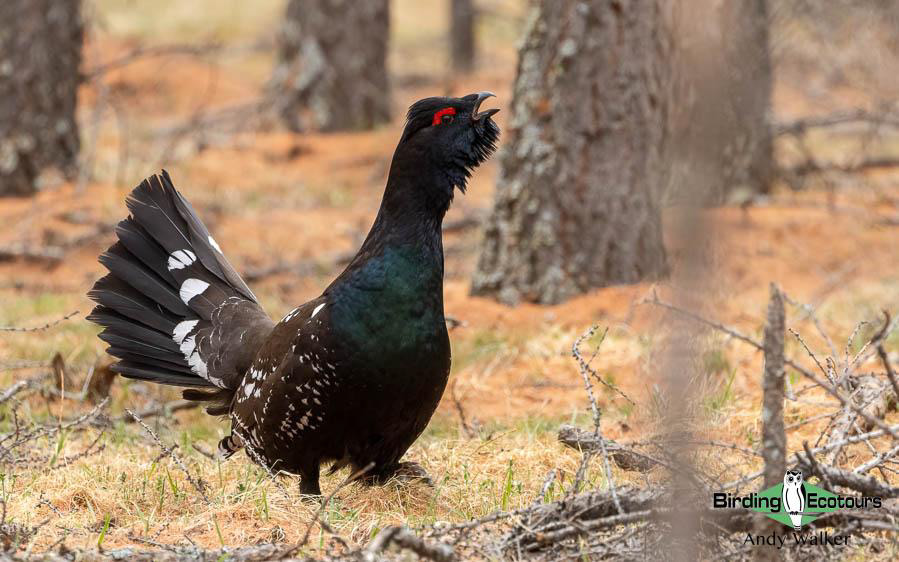
We enjoyed prolonged views of lekking Black-billed Capercaillie.
As we walked back to our vehicles, we again saw the same male capercaillie, and after a while of watching him again we continued and found another male even closer to our vehicles. This male Black-billed Capercaillie also showed very well, allowing for lengthy views. What a bird! Eurasian Jay was also present, but hardly got a look in, due to the huge and strutting gamebird in front of us! Once we eventually got back to our vehicles we enjoyed some warm drinks and watched a flock of Carrion Crows, Eurasian Magpies, Common Ravens, and Black Kites scavenging on some nearby waste. A Crested Honey Buzzard was also noted overhead.
As we made our way back to our accommodation, we made a stop in a small, forested valley where we found a beautiful Ural Owl, a great way to end our morning birding. Back at our accommodation a nearby dead horse was likely responsible for the flock of almost 20 Cinereous Vultures circling around overhead!
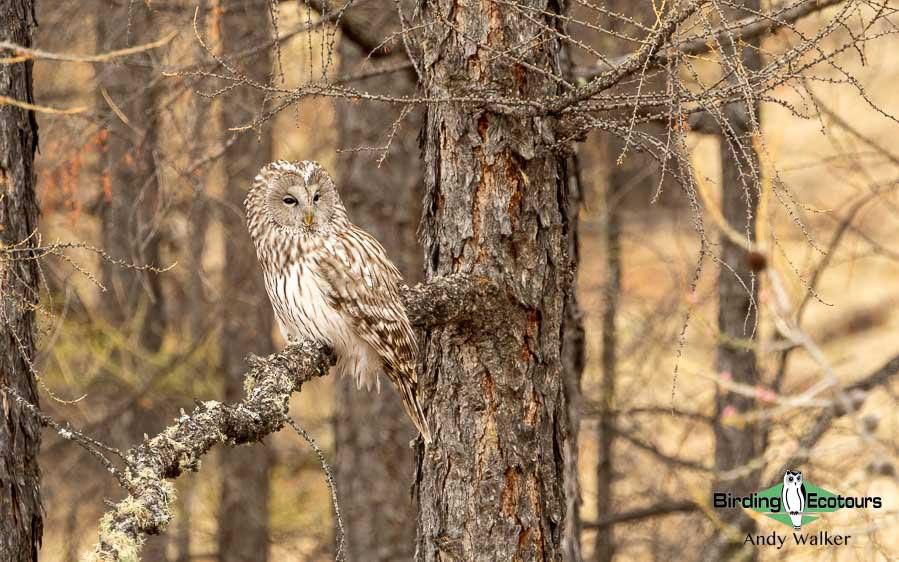
A daytime Ural Owl was a nice surprise in the forest near our accommodation.
After a short break in the middle of the day we again headed out into the national park, where we found our main target, Siberian Rubythroat – a stunning male. Here we also saw Eurasian Wryneck, Daurian Redstart, Olive-backed Pipit, and Pine Bunting.
Day 5, 17th May 2026. Travel between Gorkhi Terelj National Park and Yolyn Am (via flight between Ulaanbaatar and Dalanzadgad)
It was essentially a travel day as we departed our accommodation in Gorkhi Terelj National Park and made our way back to Ulaanbaatar for our flight down to the Gobi Desert. Prior to reaching the airport we made a stop in some mountains, where we saw a few interesting birds, such as Mandarin Duck, Rock Dove (wild ones!), Lesser Spotted Woodpecker, Northern Nutcracker, Eurasian Jay (for everyone this time!), Willow Tit, and several Red-flanked Bluetails, including a stunning adult male. Both Grey-headed Woodpeckers and Eurasian Three-toed Woodpeckers were heard calling and drumming, but we couldn’t get through the forest to reach them.
After some time at the airport and lunch, we made the short flight down to Dalanzadgad, where we then continued our journey to Yolyn Am and our base for the next two nights.
Day 6, 18th May 2026. Birding at Yolyn Am and surrounds
We had a glorious morning walk at the simply spectacular Yolyn Am. We set off for a walk through a gorgeous valley, but before we had even left the car park we found ourselves literally tripping over numerous White-winged Snowfinches – this would be the most abundant bird of the morning, with tame birds seen all along our walk. In the car park we also found Isabelline Wheatear and Eurasian Crag Martin. As we started our walk we quickly found two other targets, the more widespread Brown Accentor and the regional endemic Kozlov’s (Mongolian) Accentor, along with the first of several Black Redstarts for the morning, and a lone Twite giving very close views. At this time we also noted Cinereous Vulture, Himalayan Vulture, Bearded Vulture, and Steppe Eagle overhead, and all showed well multiple times throughout the morning.
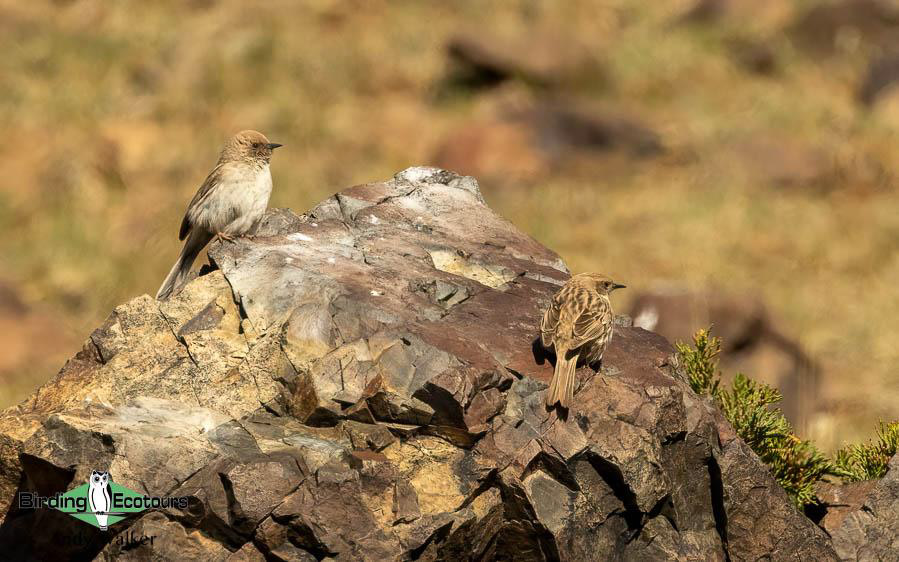
A pair of near-endemic Kozlov’s (Mongolian) Accentors showed nicely in the mountains.
As we continued into a deep gorge we spotted a Saker Falcon, Common Kestrel, and several Himalayan Beautiful Rosefinches, the latter of which showed very well, better than the Pallas’s Leaf Warbler and Lesser Whitethroat that were also present. By the middle of the morning the wind started to pick up, and it was particularly noted as we were walking through the gorge, which seemed to funnel it towards us! We got repeat views of Red-billed Chough, Horned Lark, Isabelline Wheatear, Black Redstart, White-winged Snowfinch (a neverending supply), and Himalayan Beautiful Rosefinch. Eventually, after a lot of scanning of shear rockfaces, we suddenly found another of our main targets, Wallcreeper. A stunning bird appeared right in front of us, allowing for some brief but good views, before it made its way back up to higher areas on the cliffs. We were very happy to find Wallcreeper as this species belongs to a monotypic family. While here we also saw a pair of wild Rock Doves. Walking back to our start point, we noted Golden Eagle, Asian Short-toed Lark, Water Pipit, and Godlewski’s Bunting, as well as more of the birds enjoyed earlier in the day. The area was crawling with mammals and we found Siberian Ibex, Mongolian Jird (Mongolian Gerbil), Pallas’s Pika, and Alashan Ground Squirrel. We headed back to our accommodation for lunch as the wind really picked up.
We spent the afternoon driving around huge expanses of desert grassland that spanned for as far as the eye could see, with one particular bird in mind. Close to the time that we were due to finish our search we got lucky and found two adult male Oriental Plovers, absolutely glorious looking birds.
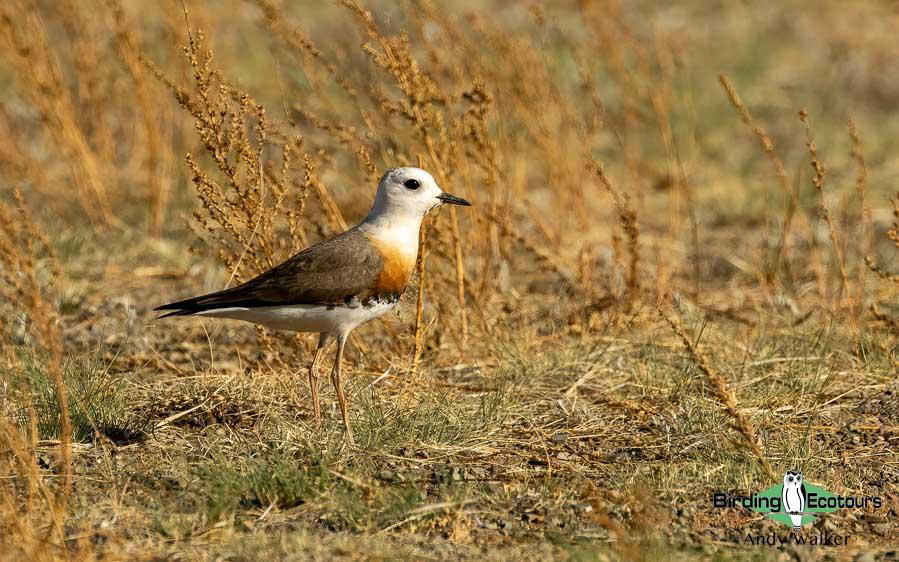
We enjoyed wonderful views of Oriental Plover during the tour.
Day 7, 19th May 2026. Travel between Yolyn Am and Khongoryn Els
We spent most of the day traveling between Yolyn Am and Khongoryn Els. Some birding near our accommodation in the early morning gave us some views of Little Owl, Common Rock Thrush, Citrine Wagtail, and a sizeable flock of Hawfinches. After breakfast we departed our comfortable ger accommodation and made a stop at a patch of trees (the only ones within miles) where we found lots of birds. As soon as we stepped out of the vehicles we saw Common Cuckoo and, overhead, it was clear birds were migrating, with flocks of Citrine Wagtails, Eastern Yellow Wagtails, Common Rosefinches, and Hawfinches flying over. We also saw both Crested Honey Buzzard and Amur Falcon well here. The trees were full of Taiga Flycatchers, but careful scanning resulted in sightings of Pallas’s Leaf Warbler, Arctic Warbler, Willow Warbler, Dusky Warbler, Asian Brown Flycatcher, and Litte Bunting – an enjoyable fall of birds.
As we continued our journey, we called into a wonderful gorge, where we had a nice picnic lunch while enjoying many Mongolian Finches, most coming to drink from the small stream. Here we gained views of several Chukar Partridges, Pied Wheatears, and Godleweski’s Buntings. As we explored the gorge further, we found a Bearded Vulture nest with a nestling barely visible, but a Golden Eagle overhead was unmistakable. Back out on the nearby plains, we soon found a loose group of Mongolian Ground Jays (another major tour highlight), and brief sightings of Isabelline (Daurian) Shrike and Asian Desert Warbler. Continuing our journey to our new accommodation at Khongoryn Els, we noted Goitered Gazelle along the way, with a pair of Desert Wheatears hopping around our new gers on our arrival there.
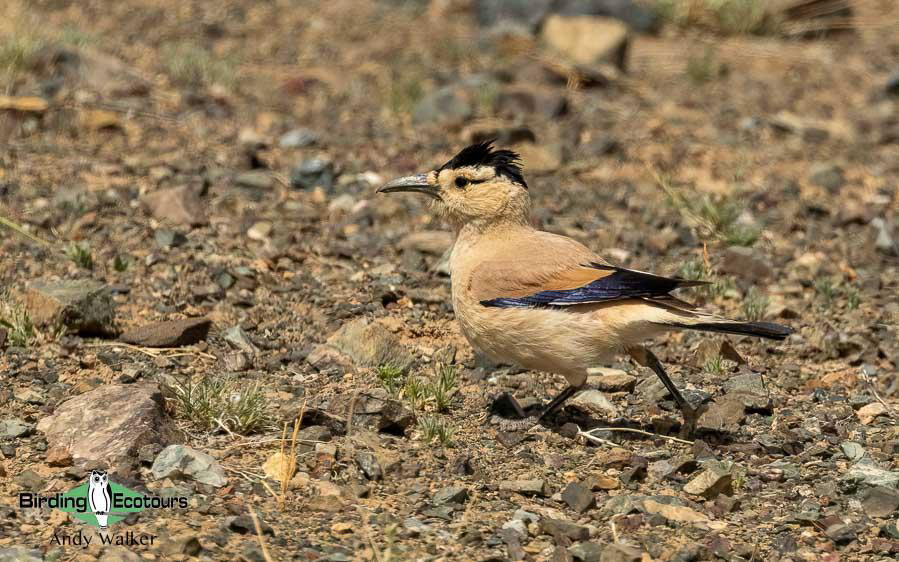
A small flock of Mongolian Ground Jays were actively foraging in some desert scrub.
Day 8, 20th May 2026. Birding at Khongoryn Els
We spent the morning birding around the impressive sand dunes at Khongoryn Els. We quickly found our main targets of Great (Steppe) Grey Shrike and Saxaul Sparrow and we had very nice views of a surprise European Nightjar. The nightjar flushed from under a bush while we were creeping up to get better views of the sparrow and eventually it settled in a shady patch allowing for prolonged views. Desert Wheatears were quite numerous, as were Asian Short-toed Larks, Turkestan Short-toed Larks, and Horned Larks. We had a sad sighting of a deceased Long-legged Buzzard underneath a known nest site.
We explored some waterbodies near the immense sand dunes and found Ruddy Shelduck, Garganey, Pied Avocet, Kentish Plover, Long-toed Stint, Green Sandpiper, Pin-tailed Snipe, Common Snipe, Isabelline (Daurian) Shrike, and Citrine Wagtail. A nearby area also gave us sightings of Demoiselle Cranes, Brown Shrike, and additional Saxaul Sparrows and Desert Wheatears.
We had a more relaxed afternoon and some of the group went and visited a traditional Mongolian nomad family to learn a little bit about their lifestyle.
Day 9, 21st May 2026. Travel between Khongoryn Els and Bayanzag (the “Flaming Cliffs”)
We left our accommodation at Khongoryn Els after breakfast and drove the short distance to a small waterbody at the base of the impressive sand dunes. Here we spent some time watching a good number of Pallas’s Sandgrouse come in to drink. They gave very close flyby views as well as close perched views on the ground. We also had a pair of Pere David’s Snowfinches drop in and briefly drink. Other birds seen around the waterbody included Common Crane, Great Egret, Black-winged Stilt, the ubiquitous Ruddy Shelduck, and an alive Long-legged Buzzard this time! While we were birding, the wind started to pick up and as the day continued the wind got stronger and stronger, to the point where it was difficult to even stand up in it!
As we drove to Bayanzag also known as the “Flaming Cliffs” we saw three very nervous Onagers (Mongolian Wild Ass) as well as a Greater Sand Plover, along with lots more Pallas’s Sandgrouse and Horned Larks. We arrived at our new accommodation in Bayanzag in time for lunch. We were planning to take a walk around the cliffs, but the now persistent gale-force wind put paid to that idea. We enjoyed a brief video presentation about the historical significance of the area (the first dinosaur eggs were found at the site) and then took a drive in our 4x4s to view the famous and rather beautiful cliffs.
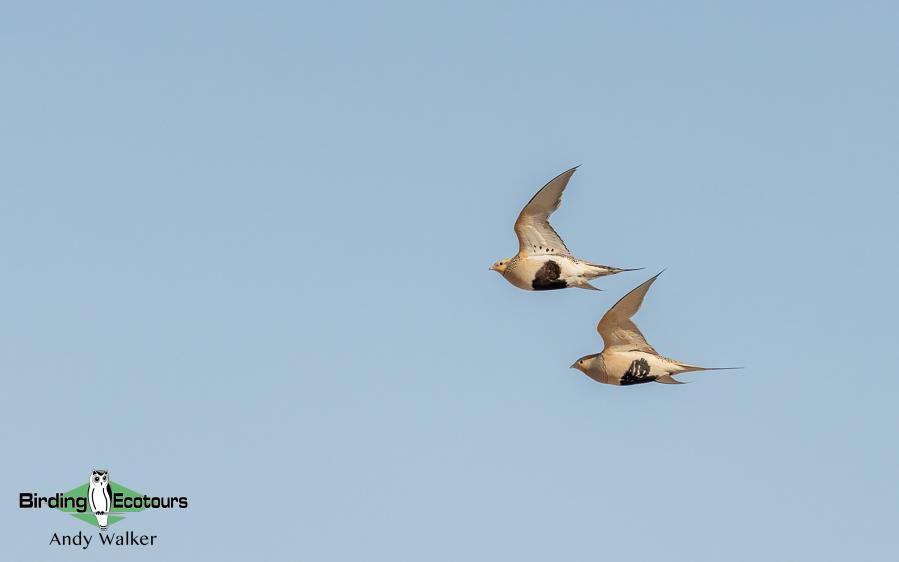
We took great delight in watching (and listening to) Pallas’s Sandgrouse coming in to a waterbody to drink.
Day 10, 22nd May 2026. Travel between Bayanzag and Mandalgovi
We commenced our journey north to Mandalgovi after breakfast. The wind had thankfully dropped a little, though conditions were still not ideal and it had been a very windy night. Near to our accommodation, we called in at an area with some trees and shelter and immediately started finding some small birds. Taiga Flycatchers and Pallas’s Leaf Warblers were the most abundant species, though by working through them carefully we also found Isabelline (Daurian) Shrike, Lesser Whitethroat, Common (Siberian) Chiffchaff, Daurian Redstart, Asian Brown Flycatcher, Common Rosefinches, Hawfinches, and Little Buntings. A lone Barn Swallow was patrolling the sheltered area we were also sticking to and gave repeated close flyby views! Following our stop here, we tried to get some kilometers behind us, though we did make a brief stop for a small group of Mongolian Gazelles, with yet more Pallas’s Sandgrouse and Horned Larks seen flying around the desert plains.
On again reaching the town of Dalanzadgad, we spent a short while checking on a small wetland and river system with a small semi-sheltered area of trees. Here we found Eurasian Sparrowhawk harassing a range of smaller birds, including Desert Finch, Common Rosefinch, and Hawfinch. A large flock of Eurasian Collared Doves were also keeping a wary eye on the sparrowhawk. An attractive breeding plumaged Chinese Pond Heron showed closely and several pairs of Ruddy Shelducks and Little Ringed Plovers were noted along the river, as too were Richard’s Pipit, Grey Wagtail, White Wagtail, and Citrine Wagtail.
After a lunch stop, we continued our journey north, enjoying being on some bitumen roads again. We arrived at our accommodation in a beautiful and remote setting in the late afternoon, spotting Fork-tailed (Pacific) Swift, Mongolian Gull, Cinereous Vulture, Red-billed Chough, and Desert Wheatear along the way.
Day 11, 23rd May 2026. Birding at Baga Gazariin Chuluu Natural Monument and travel to Ulaanbaatar
We spent the morning birding in the impressive rolling mountains of Baga Gazariin Chuluu Natural Monument in the central Gobi Desert region. The rocky outcrops here were visually rather interesting and we found some great birds. Some of the best birds included some excellent close views of some huge birds like Cinereous Vulture, Bearded Vulture, and Golden Eagle as well as some smaller and arguably more attractive ones, such as Common Hoopoe, Mongolian Lark, Common Rock Thrush, Pied Wheatear, Pallas’s Leaf Warbler, and Pere David’s Snowfinch.
We made a long stop at a wetland which was teeming with birds. The dominant species was Mongolian Gull, with a nesting colony of over 100 pairs counted. Ducks were well represented and included a couple of new ones for our tour in Eastern Spot-billed Duck and Red-crested Pochard. We also saw Garganey, Common Pochard, Mallard, Northern Shoveler, Gadwall, and Common and Ruddy Shelducks. Some elegance was provided by a few Demoiselle Cranes, which are always popular, unsurprisingly. An Eastern Marsh Harrier was flying over the marshy edges of the wetland and was constantly getting harassed by a range of species, including Black-winged Stilt, Northern Lapwing, and Red-billed Chough. A couple of pairs of Lesser Kestrels were noted, as was a Little Owl – both species showed well, as did a Temminck’s Stint, which seemed unfazed by all of the possible predators in the area! The Wood Sandpipers and Common Redshanks were a little more sensible, and flighty.
Around the periphery of the wetland we found several Dusky Warblers feeding in the grass out in the open, along with Arctic Warbler, Daurian Redstart, Taiga Flycatcher, Asian Brown Flycatcher, and Black-throated Thrush all doing the same. However, the real highlights were provided by a couple of Critically Endangered (IUCN/BirdLife International) Yellow-breasted Buntings, which showed very nicely and looked stunning in breeding plumage. Careful searching of the nearby grassland here also produced a long Ortolan Bunting and a couple of Common Reed Buntings. One of the other impressive sights was the large flock (200+) of Citrine Wagtails seen, they were also looking rather nice in their breeding plumage.
After a late lunch, we completed our journey to Ulaanbaatar, where we arrived at our final accommodation of the tour in the late afternoon.
We enjoyed a final group dinner together, chatted about the many highlights of the tour and discussed the “bird of the trip”. It was a tight competition, but Black-billed Capercaillie came out on top, with a stellar supporting cast of Oriental Plover, Golden Eagle, Mongolian Ground Jay, and Yellow-breasted Bunting!
A record shot of one of two Critically Endangered (IUCN/BirdLife International) Yellow-breasted Buntings we found on our final morning of birding in Mongolia.
Day 12, 24th May 2026. Tour concluded with departure from Ulaanbaatar
Everyone departed Ulaanbaatar at leisure as this really enjoyable Mongolia birding tour unfortunately came to an end. A huge thank you must go to everyone involved for making this such a successful and fun outing and I look forward to birding with you all again soon.
Bird List – Following AviList v2025
Birds ‘heard only’ are marked with (H) after the common name, all other species were seen. The following notation after species names is used to show conservation status following IUCN/BirdLife International: CR – Critically Endangered, EN – Endangered, VU = Vulnerable.
| Common Name | Scientific Name |
| Ducks, Geese, Swans (Anatidae) | |
| Bar-headed Goose | Anser indicus |
| Swan Goose – EN | Anser cygnoides |
| Whooper Swan | Cygnus cygnus |
| Common Shelduck | Tadorna tadorna |
| Ruddy Shelduck | Tadorna ferruginea |
| Mandarin Duck | Aix galericulata |
| Garganey | Spatula querquedula |
| Northern Shoveler | Spatula clypeata |
| Gadwall | Mareca strepera |
| Falcated Duck | Mareca falcata |
| Eurasian Wigeon | Mareca penelope |
| Eastern Spot-billed Duck | Anas zonorhyncha |
| Mallard | Anas platyrhynchos |
| Northern Pintail | Anas acuta |
| Green-winged Teal | Anas crecca |
| Red-crested Pochard | Netta rufina |
| Common Pochard – VU | Aythya ferina |
| Tufted Duck | Aythya fuligula |
| Stejneger’s Scoter | Melanitta stejnegeri |
| Common Goldeneye | Bucephala clangula |
| Common Merganser | Mergus merganser |
| Pheasants & Allies (Phasianidae) | |
| Black-billed Capercaillie | Tetrao urogalloides |
| Chukar Partridge | Alectoris chukar |
| Nightjars (Caprimulgidae) | |
| European Nightjar | Caprimulgus europaeus |
| Swifts (Apodidae) | |
| Common Swift | Apus apus |
| Fork-tailed Swift | Apus pacificus |
| Cuckoos (Cuculidae) | |
| Common Cuckoo | Cuculus canorus |
| Sandgrouse (Pteroclidae) | |
| Pallas’s Sandgrouse | Syrrhaptes paradoxus |
| Pigeons, Doves (Columbidae) | |
| Rock Dove | Columba livia |
| Rock Dove [Feral Pigeon] | Columba livia [dom.] |
| Eurasian Collared Dove | Streptopelia decaocto |
| Rails, Crakes & Coots (Rallidae) | |
| Eurasian Coot | Fulica atra |
| Cranes (Gruidae) | |
| White-naped Crane – VU | Antigone vipio |
| Demoiselle Crane | Grus virgo |
| Common Crane | Grus grus |
| Grebes (Podicipedidae) | |
| Great Crested Grebe | Podiceps cristatus |
| Black-necked Grebe | Podiceps nigricollis |
| Stilts, Avocets (Recurvirostridae) | |
| Black-winged Stilt | Himantopus himantopus |
| Pied Avocet | Recurvirostra avosetta |
| Plovers (Charadriidae) | |
| Little Ringed Plover | Thinornis dubius |
| Northern Lapwing | Vanellus vanellus |
| Oriental Plover | Anarhynchus veredus |
| Greater Sand Plover | Anarhynchus leschenaultii |
| Kentish Plover | Anarhynchus alexandrinus |
| Sandpipers, Snipes (Scolopacidae) | |
| Eurasian Whimbrel | Numenius phaeopus |
| Eurasian Curlew | Numenius arquata |
| Black-tailed Godwit | Limosa limosa |
| Eurasian Woodcock | Scolopax rusticola |
| Pin-tailed Snipe | Gallinago stenura |
| Common Snipe | Gallinago gallinago |
| Common Sandpiper | Actitis hypoleucos |
| Green Sandpiper | Tringa ochropus |
| Marsh Sandpiper | Tringa stagnatilis |
| Wood Sandpiper | Tringa glareola |
| Common Redshank | Tringa totanus |
| Ruddy Turnstone | Arenaria interpres |
| Temminck’s Stint | Calidris temminckii |
| Long-toed Stint | Calidris subminuta |
| Gulls, Terns, Skimmers (Laridae) | |
| Common Tern | Sterna hirundo |
| Black-headed Gull | Chroicocephalus ridibundus |
| Mongolian Gull | Larus mongolicus |
| Storks (Ciconiidae) | |
| Black Stork | Ciconia nigra |
| Cormorants, Shags (Phalacrocoracidae) | |
| Great Cormorant | Phalacrocorax carbo |
| Ibises, Spoonbills (Threskiornithidae) | |
| Eurasian Spoonbill | Platalea leucorodia |
| Herons, Bitterns (Ardeidae) | |
| Chinese Pond Heron | Ardeola bacchus |
| Great Egret | Ardea alba |
| Grey Heron | Ardea cinerea |
| Kites, Hawks, Eagles (Accipitridae) | |
| Bearded Vulture | Gypaetus barbatus |
| Crested Honey Buzzard | Pernis ptilorhynchus |
| Cinereous Vulture | Aegypius monachus |
| Himalayan Vulture | Gyps himalayensis |
| Booted Eagle | Hieraaetus pennatus |
| Steppe Eagle – EN | Aquila nipalensis |
| Golden Eagle | Aquila chrysaetos |
| Eurasian Sparrowhawk | Accipiter nisus |
| Eastern Marsh Harrier | Circus spilonotus |
| Black Kite | Milvus migrans |
| White-tailed Eagle | Haliaeetus albicilla |
| Long-legged Buzzard | Buteo rufinus |
| Upland Buzzard | Buteo hemilasius |
| Eastern Buzzard | Buteo japonicus |
| Owls (Strigidae) | |
| Little Owl | Athene noctua |
| Long-eared Owl | Asio otus |
| Ural Owl | Strix uralensis |
| Great Grey Owl | Strix nebulosa |
| Hoopoes (Upupidae) | |
| Common Hoopoe | Upupa epops |
| Woodpeckers (Picidae) | |
| Eurasian Wryneck | Jynx torquilla |
| Eurasian Three-toed Woodpecker (H) | Picoides tridactylus |
| Lesser Spotted Woodpecker | Dryobates minor |
| Great Spotted Woodpecker | Dendrocopos major |
| Grey-headed Woodpecker (H) | Picus canus |
| Caracaras, Falcons (Falconidae) | |
| Lesser Kestrel | Falco naumanni |
| Common Kestrel | Falco tinnunculus |
| Amur Falcon | Falco amurensis |
| Eurasian Hobby | Falco subbuteo |
| Saker Falcon – EN | Falco cherrug |
| Shrikes (Laniidae) | |
| Great Grey Shrike | Lanius excubitor |
| Isabelline Shrike | Lanius isabellinus |
| Brown Shrike | Lanius cristatus |
| Crows, Jays (Corvidae) | |
| Eurasian Jay | Garrulus glandarius |
| Azure-winged Magpie | Cyanopica cyanus |
| Eurasian Magpie | Pica pica |
| Mongolian Ground Jay | Podoces hendersoni |
| Northern Nutcracker | Nucifraga caryocatactes |
| Red-billed Chough | Pyrrhocorax pyrrhocorax |
| Daurian Jackdaw | Coloeus dauuricus |
| Rook | Corvus frugilegus |
| Carrion Crow | Corvus corone |
| Northern Raven | Corvus corax |
| Tits, Chickadees (Paridae) | |
| Willow Tit | Poecile montanus |
| Azure Tit | Cyanistes cyanus |
| Great Tit | Parus major |
| Penduline Tits (Remizidae) | |
| White-crowned Penduline Tit | Remiz coronatus |
| Larks (Alaudidae) | |
| Eurasian Skylark | Alauda arvensis |
| Horned Lark | Eremophila alpestris |
| Mongolian Lark | Melanocorypha mongolica |
| Asian Short-toed Lark | Alaudala cheleensis |
| Turkestan Short-toed Lark | Alaudala heinei |
| Swallows, Martins (Hirundinidae) | |
| Sand Martin | Riparia riparia |
| Eurasian Crag Martin | Ptyonoprogne rupestris |
| Barn Swallow | Hirundo rustica |
| Leaf Warblers (Phylloscopidae) | |
| Yellow-browed Warbler | Phylloscopus inornatus |
| Pallas’s Leaf Warbler | Phylloscopus proregulus |
| Dusky Warbler | Phylloscopus fuscatus |
| Willow Warbler | Phylloscopus trochilus |
| Common Chiffchaff | Phylloscopus collybita |
| Greenish Warbler | Phylloscopus trochiloides |
| Arctic Warbler | Phylloscopus borealis |
| Grassbirds & Allies (Locustellidae) | |
| Chinese Bush Warbler (H) | Locustella tacsanowskia |
| Sylviid Babblers (Sylviidae) | |
| Lesser Whitethroat | Curruca curruca |
| Asian Desert Warbler | Curruca nana |
| Wrens (Troglodytidae) | |
| Eurasian Wren | Troglodytes troglodytes |
| Nuthatches (Sittidae) | |
| Eurasian Nuthatch | Sitta europaea |
| Wallcreeper (Tichodromidae) | |
| Wallcreeper | Tichodroma muraria |
| Starlings, Rhabdornises (Sturnidae) | |
| White-cheeked Starling | Spodiopsar cineraceus |
| Thrushes (Turdidae) | |
| White’s Thrush | Zoothera aurea |
| Eyebrowed Thrush | Turdus obscurus |
| Black-throated Thrush | Turdus atrogularis |
| Red-throated Thrush | Turdus ruficollis |
| Dusky Thrush | Turdus eunomus |
| Naumann’s Thrush | Turdus naumanni |
| Chats, Old World Flycatchers (Muscicapidae) | |
| Asian Brown Flycatcher | Muscicapa dauurica |
| Siberian Rubythroat | Calliope calliope |
| Taiga Flycatcher | Ficedula albicilla |
| Red-flanked Bluetail | Tarsiger cyanurus |
| Black Redstart | Phoenicurus ochruros |
| Daurian Redstart | Phoenicurus auroreus |
| Common Rock Thrush | Monticola saxatilis |
| Siberian Stonechat | Saxicola maurus |
| Northern Wheatear | Oenanthe oenanthe |
| Isabelline Wheatear | Oenanthe isabellina |
| Desert Wheatear | Oenanthe deserti |
| Pied Wheatear | Oenanthe pleschanka |
| Old World Sparrows, Snowfinches (Passeridae) | |
| Rock Sparrow | Petronia petronia |
| White-winged Snowfinch | Montifringilla nivalis |
| Pere David’s Snowfinch | Pyrgilauda davidiana |
| Eurasian Tree Sparrow | Passer montanus |
| Saxaul Sparrow | Passer ammodendri |
| House Sparrow | Passer domesticus |
| Accentors (Prunellidae) | |
| Brown Accentor | Prunella fulvescens |
| Kozlov’s Accentor | Prunella koslowi |
| Wagtails, Pipits (Motacillidae) | |
| Eastern Yellow Wagtail | Motacilla tschutschensis |
| Citrine Wagtail | Motacilla citreola |
| Grey Wagtail | Motacilla cinerea |
| White Wagtail | Motacilla alba |
| Richard’s Pipit | Anthus richardi |
| Blyth’s Pipit | Anthus godlewskii |
| Olive-backed Pipit | Anthus hodgsoni |
| Red-throated Pipit | Anthus cervinus |
| Water Pipit | Anthus spinoletta |
| Finches, Euphonias (Fringillidae) | |
| Hawfinch | Coccothraustes coccothraustes |
| Mongolian Finch | Bucanetes mongolicus |
| Common Rosefinch | Carpodacus erythrinus |
| Himalayan Beautiful Rosefinch | Carpodacus pulcherrimus |
| Long-tailed Rosefinch | Carpodacus sibiricus |
| Desert Finch | Rhodospiza obsoleta |
| Twite | Linaria flavirostris |
| Buntings (Emberizidae) | |
| Pine Bunting | Emberiza leucocephalos |
| Godlewski’s Bunting | Emberiza godlewskii |
| Meadow Bunting | Emberiza cioides |
| Ortolan Bunting | Emberiza hortulana |
| Little Bunting | Emberiza pusilla |
| Yellow-breasted Bunting – CR | Emberiza aureola |
| Black-faced Bunting | Emberiza spodocephala |
| Pallas’s Reed Bunting | Emberiza pallasi |
| Common Reed Bunting | Emberiza schoeniclus |
| Total seen | 182 |
| Total heard only | 3 |
| Total recorded | 185 |
Mammal List
| Common Name | Scientific Name |
| Hares and Rabbits (Leporidae) | |
| Tolai Hare | Lepus tolai |
| Pikas (Ochotonidae) | |
| Pallas’s Pika | Ochotona pallasii |
| Squirrels (Sciuridae) | |
| Eurasian Red Squirrel | Sciurus vulgaris |
| Tarbagan Marmot | Marmota sibirica |
| Alashan Ground Squirrel | Spermophilus alaschanicus |
| Pallid Ground Squirrel | Spermophilus pallidicauda |
| Long-tailed Ground Squirrel | Urocitellus undulatus |
| Siberian Chipmunk | Eutamias sibiricus |
| Old World Mice and Rats (Muridae) | |
| Eastern Midday Jird | Meriones psammophilus |
| Mongolian Jird | Meriones unguiculatus |
| Evening Bats (Vespertilionidae) | |
| Alashanian Pipistrelle | Hypsugo alaschanicus |
| Canids (Canidae) | |
| Corsac Fox | Vulpes corsac |
| Red Fox | Vulpes vulpes |
| Equines (Equidae) | |
| Onager | Equus hemionus |
| Bovids (Bovidae) | |
| Goitered Gazelle | Gazella subgutturosa |
| Mongolian Gazelle | Procapra gutturosa |
| Siberian Ibex | Capra sibirica |
| Argali | Ovis ammon |
| Deer (Cervidae) | |
| Eastern Roe Deer | Capreolus pygargus |
| Total seen | 19 |
Reptile List
| Common Name | Scientific Name |
| Dragons (Agamidae) | |
| Tuvan Toad-headed Agama | Phrynocephalus versicolor |
| Wall Lizards (Lacertidae) | |
| Multi-ocellated Racerunner | Eremias multiocellata |
| Total seen | 2 |
This is a sample trip report. Please email us ([email protected]) for more trip reports from this destination.