06 – 15 NOVEMBER 2025
By Andrew Walker
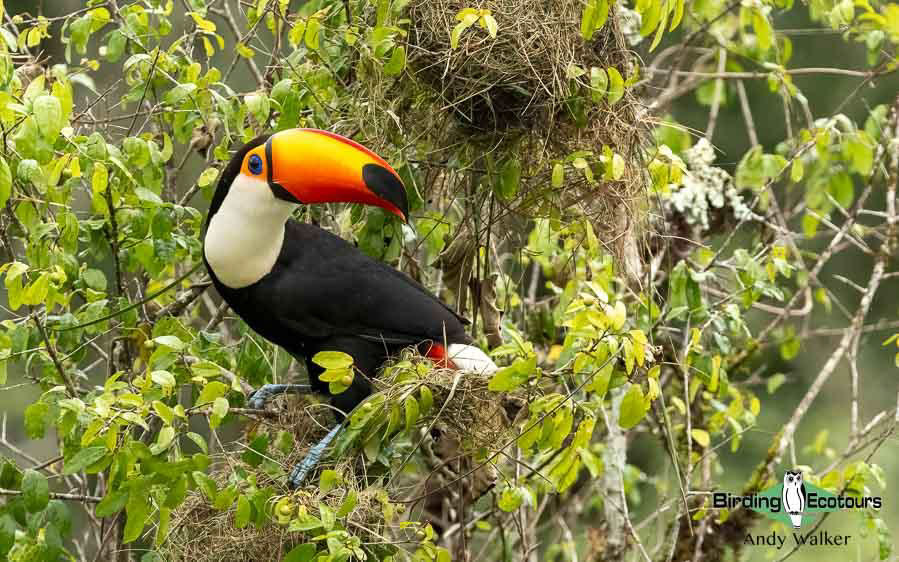
One of the most popular birds on our northeastern Argentina tour was Toco Toucan, this bird raided a Red-rumped Cacique nesting colony and showed very well indeed.
Overview
This birding tour of northeast Argentina started in Buenos Aires on the 6th of November 2025 and ended back there on the 15th of November 2025. We started our northeast Argentina birding tour by birding at the excellent Costanera Sur Ecological Reserve in Buenos Aires. We then flew north to Posadas and traveled to the vast Iberá Marshlands, where we spent time birding across this impressive, huge wetland area, where water levels were much higher than usual for the time of the year. Afterwards, we moved north to the simply spectacular Iguazú Falls (of which no photo can do it justice), where we spent time birding around Iguazú National Park on the best day weather-wise of the whole tour, a real stroke of good luck. Our final birding of the tour took us south of Iguazú to bird at several beautiful forest sites in Misiones province, such as at Urugua-í Provincial Park, Araucaria Provincial Park, and Cruce Caballero Provincial Park, before returning back to Buenos Aires after an early evening flight from Iguazú.
We recorded 313 bird species on this northeast Argentina birdwatching tour (14 of these were heard only) and you can also see our eBird trip report, here. Bird and animal lists for this northeast Argentina birding tour follow the report.
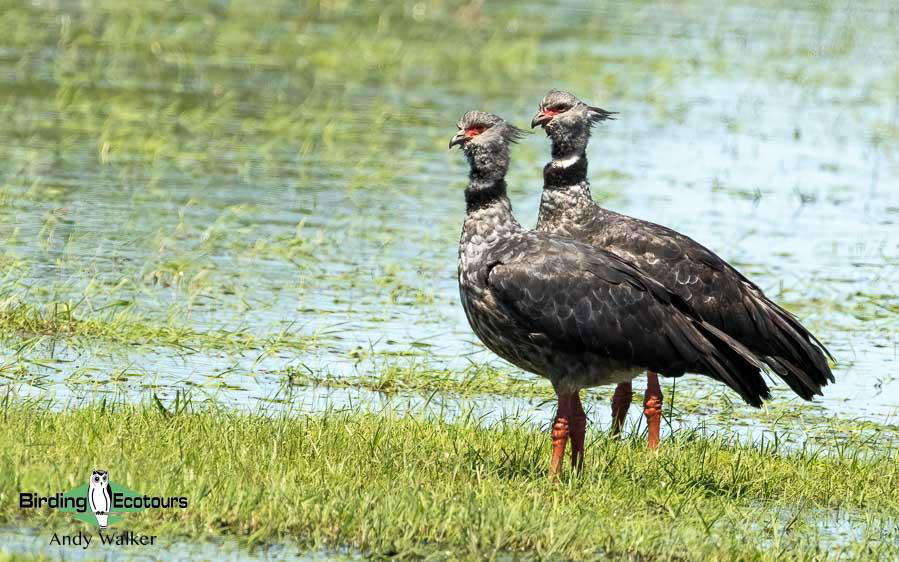
Southern Screamers are humongous birds of wetland areas in Argentina, and we had many sightings of this most interesting of wetland dwellers during the tour.
Highlights were many and included the following top birds around Iberá Marshlands: Greater Rhea, Southern Screamer, Brazilian Teal, Rosy-billed Pochard, Giant Wood Rail, Azure Gallinule, Limpkin, Pantanal Snipe, Jabiru, Maguari Stork, Stripe-backed Bittern, Whistling Heron, Cinereous Harrier, Long-winged Harrier, Campo Flicker, Aplomado Falcon, Red-and-green Macaw, Greater Thornbird, Firewood-gatherer, Chotoy Spinetail, Crested Doradito, Vermilion Flycatcher, Yellow-browed Tyrant, Spectacled Tyrant, White Monjita, Streamer-tailed Tyrant, Black-and-white Monjita, Strange-tailed Tyrant, Black-capped Donacobius, Solitary Cacique, Scarlet-headed Blackbird, Yellow-rumped Marshbird. Pampa Finch, Ibera Seedeater, Long-tailed Reed Finch, and Red-crested Cardinal.
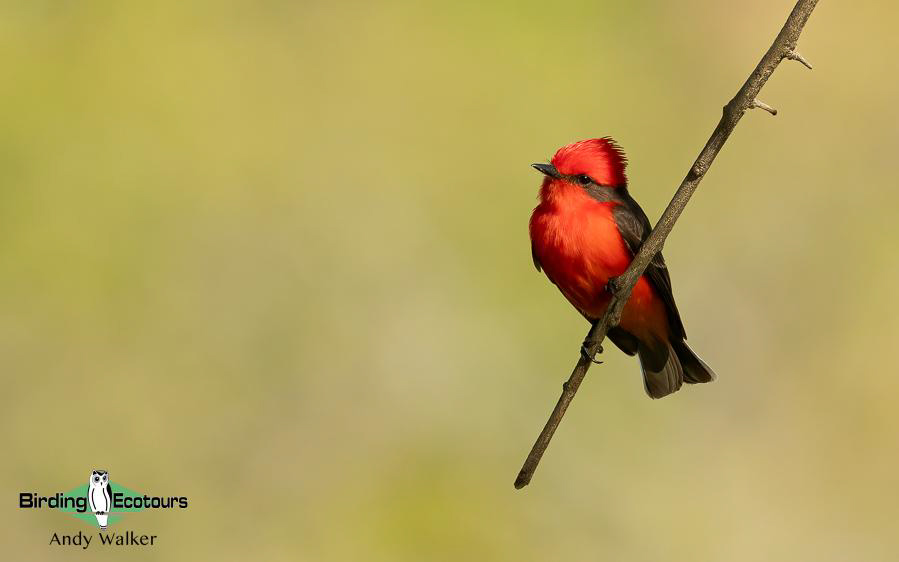
Vermilion Flycatcher (this subspecies formerly known as Scarlet Flycatcher until recently) was hanging around our accommodation in the Iberá Marshlands.
Highlights around Iguazú National Park and the Araucaria-dominated forests of northern Misiones province included a vastly different assemblage of great and sought after birds from those we’d enjoyed around the Iberá Marshlands, such as: Black-fronted Piping Guan, Great Dusky Swift, Pavonine Cuckoo, Surucua Trogon, Atlantic Black-throated Trogon, Rufous-capped Motmot, White-eared Puffbird, Rusty-breasted Nunlet, Toco Toucan, Red-breasted Toucan, Yellow-fronted Woodpecker, Bat Falcon, Vinaceous-breasted Amazon, Lesser Woodcreeper, Atlantic Plain Xenops, Araucaria Tit-Spinetail, Rufous-margined Antwren, Tufted Antshrike, Spot-backed Antshrike, Bertoni’s Antbird, White-shouldered Fire-eye, Rufous Gnateater, Wing-barred Piprites, Southern Antpipit, Three-striped Flycatcher, Sibilant Sirystes, Large-headed Flatbill, Red-ruffed Fruitcrow, Blue Manakin, Greenish Schiffornis, Blue-naped Chlorophonia, Riverbank Warbler, and Swallow Tanager.
We also found several great animals during this northeast Argentina tour, such as Greater Capybara, Black-and Gold Howlers, Pampas Fox, Azara’s Agouti, Argentine Black-and-white Tegu, and a feisty Painted Lancehead.
Detailed Report
Day 1, 6th November 2025. Arrival in Buenos Aires, afternoon birding at Costanera Sur Ecological Reserve
After everyone had arrived into Buenos Aires we had our first birding session of this northeastern Argentina tour at Costanera Sur Ecological Reserve, a stunning reserve located right between the mega city and the River Plate shore. It was a great introductory afternoon birding session with over 65 species seen with minimal effort over a couple of hours. Some of the highlights from our introductory Buenos Aires birding included Coscoroba Swan, Rosy-billed Pochard, Silver Teal, Brazilian Teal (the latter looking incredible in flight), Great Grebe, and White-tufted Grebe on the water. We found Limpkin, Wattled Jacanas, Rufescent Tiger Herons, Cocoi Herons, and Southern Lapwings on marshy water vegetation – along with Fork-tailed Flycatcher, Cattle Tyrant, and Yellow-chinned Spinetail. A Green Kingfisher was perched nicely as it fished in a lake and a Large-billed Tern flew through giving fleeting views. We had a fun sighting when a flock of Nanday Parakeets flew in and landed next to us, this after earlier seeing Monk Parakeets at their nests. Overhead Chimango Caracaras, Crested Caracaras, and Harris’s Hawks flew around and occasionally flushed the birds. Many hirundines were airborne too, and included Grey-breasted Martin, Southern Martin, Brown-chested Martin, and White-rumped Swallow.
The trees and bushes along the wetland edges were busy with birds, and we enjoyed our first looks of the tour of Green-barred Woodpecker, Checkered Woodpecker, and Narrow-billed Woodcreeper foraging, along with Masked Gnatcatchers, Southern House Wren, Rufous-bellied Thrush, Creamy-bellied Thrush, Greyish Baywing, Yellow-billed Cardinal, Red-crested Cardinal, and Sayaca Tanager.
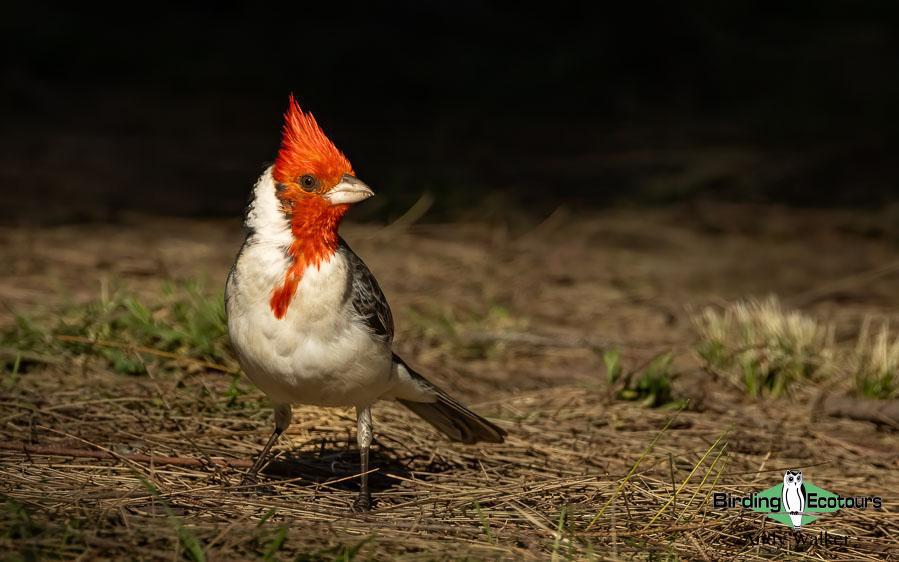
The gorgeous Red-crested Cardinal was a popular sight.
A secretive Sooty-fronted Spinetail was eventually teased out of some dense vegetation to give some good views and a gorgeous Black-and-rufous Warbling Finch was singing his “who dressed you” song, and showing nicely at close range in the same vegetation. Rufous Horneros were almost everywhere, as were Picazuro Pigeons and Eared Doves. Some excitement ensued with a couple of Glittering-bellied Emerald sightings – a gorgeous hummingbird, and a pair of Streaked Flycatchers were spotted nest building too.
After our short but sweet first birding session we enjoyed our tasty welcome dinner in the city before an early night ahead of tomorrow’s flight to the northeast.
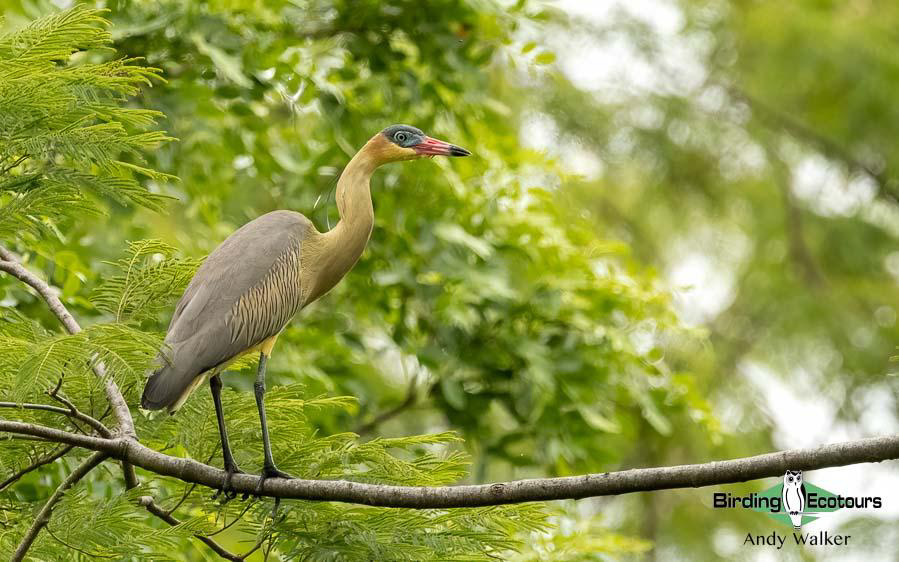
Whistling Heron perched out in the open for a prolonged viewing session, a beautiful bird indeed and a popular species for the group.
Day 2, 7th November 2025. Buenos Aires to Posadas and Iberá Marshlands birding
We departed from Buenos Aires in the early morning bound for Posadas, where we arrived an hour or so later. Just as we landed in Posadas a heavy rainstorm hit and, as we drove to our base in the Iberá Marshlands, we passed through some very intense thunderstorms with a great deal of flooding evident. Some birds were noted along the way but, given the conditions, we focused on getting safely to our accommodation, where we arrived in time for lunch.
After lunch the rain eased, though the temperatures were way below what they should have been for the time of the year and a very cold wind (occasionally gusting quite strongly) was blowing, which made birding conditions harder than desired. Despite the unpleasant conditions, we ventured out into the marsh, where we found a plethora of incredible birds. The first birds to draw our attention were a pair of humongous Southern Screamers and a pair of giant Jabirus and, quickly thereafter, over a hundred Black-crowned Night Herons, Cocoi Heron, Great Egret, Snowy Egret, Western Cattle Egret, Bare-faced Ibis, White-faced Whistling Duck, and even a couple of attractive Whistling Herons. Wattled Jacanas were evident and a flock of three Pantanal Snipes gave repeated fly past views. Snail Kites, Long-winged Harriers, Crested Caracaras, Chimango Caracaras, Lesser Yellow-headed Vulture, Turkey Vulture, Black Vulture, and Aplomado Falcon were all seen and the sky was busy with martins and swallows, including White-rumped Swallow, Brown-chested Martin, and Grey-breasted Martin.
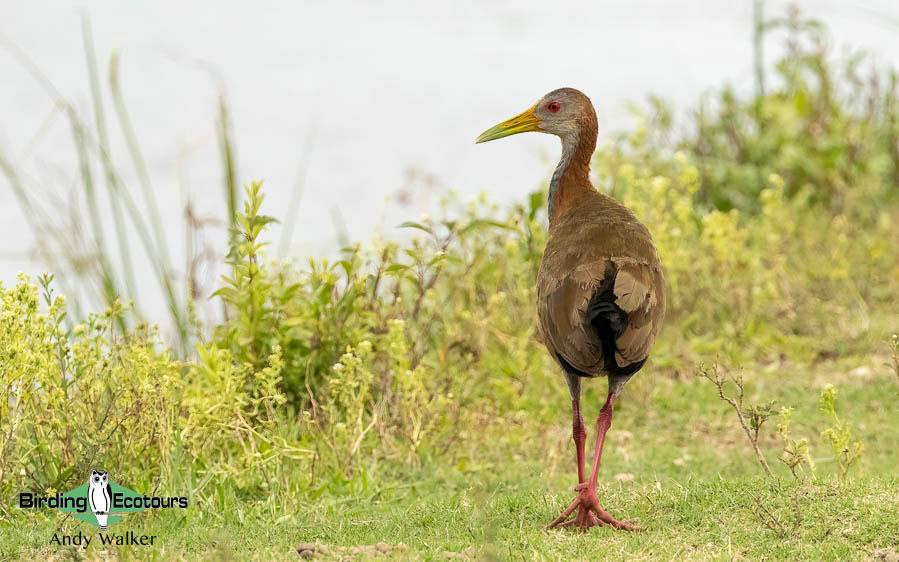
Giant Wood Rail is another large bird found in the Iberá Marshlands and, unlike many other rails, they seemed quite happy walking around out in the open.
Around the marsh, splashes of color were provided by Yellow-rumped Marshbird and Scarlet-headed Blackbird and more subtle hues were offered by Greater Thornbird, Rufous Hornero, and Yellow-chinned Spinetail. Flycatchers were much in evidence, with Fork-tailed Flycatchers and White Monjitas being very common, along with the usual suspects of Great Kiskadee and Tropical Kingbird. Additionally, Variegated Flycatcher, Crowned Slaty Flycatcher, Yellow-browed Tyrant, and Black-and-white Monjita were all seen. A small patch of water held a migrant Solitary Sandpiper which gave some good views and, as we were driving around the marsh, we saw several groups of regal Greater Rheas, with a mix of ages and sexes seen well. It wasn’t ideal conditions for seeing small birds well, however a Double-collared Seedeater perched up well for prolonged views. Another couple of highlights from the afternoon revolved around the good views of many huge Greater Capybaras and a few Marsh Deer and Yacare Caimans.
Day 3, 8th November 2025. Birding Iberá Marshlands
We awoke to a damp morning after a very windy night. A family group of Black-and-gold Howlers was present in the garden and many of the birds seen the previous afternoon were again present, allowing further study. We saw three species of woodpecker in the garden, decreasing in size from Campo Flicker to Green-barred Woodpecker to Little Woodpecker, and all showed very nicely. Several flycatchers were busily feeding, and included Large Elaenia, Yellow-bellied Elaenia, Swainson’s Flycatcher, White Monjita, Crowned Slaty Flycatcher, and more.
We took a long and often damp walk around the property and thankfully the weather improved during the morning, though the chilling wind remained. We found lots of fantastic birds, including a Dark-billed Cuckoo which remained rather furtive but showed occasionally, a pair of very showy Rufous-browed Peppershrikes, and a Solitary Sandpiper on a small flood along with a pair of Brazilian Teals. Amongst all of the abundant kiskadees and kingbirds we enjoyed sightings of many Fork-tailed Flycatchers and a vocal Boat-billed Flycatcher. Other flycatchers seen on our walk included Spectacled Tyrant, Pearly-vented Tody-Tyrant, and Southern Beardless Tyrannulet. Both Bluish-grey and Green-winged Saltators were seen too, the former well, the latter just briefly. Several common furnariids (ovenbirds) were seen, though the highlight was definitely an attractive Chotoy Spinetail which gave prolonged views near a nest site.
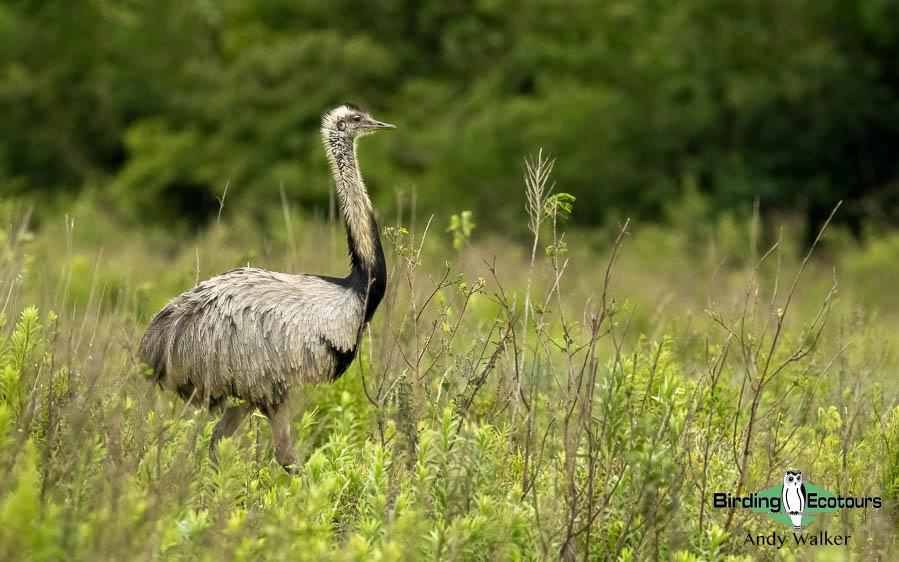
We soaked in some close views of the impressive Greater Rhea.
The marsh was busy with the constant coming and going of birds and we improved our views of Scarlet-headed Blackbird and also saw Brown-and-yellow Marshbirds. We also noted Greater Rheas, Striated Heron, Rufescent Tiger Heron, Jabiru, Wood Stork, Maguari Stork, Roseate Spoonbill, and Limpkin, along with Black-collared Hawk, Long-winged Harrier, White-tailed Hawk, Roadside Hawk, and Yellow-headed Caracara, which were all seen well. Striped Cuckoo and Ash-throated Crake were heard, the cuckoo distantly and the crake in an inaccessible area. Lots of other birds were also seen and enjoyed during the morning among the almost one hundred species recorded, such as better views of Greater Thornbird, Yellow-browed Tyrant, and Whistling Heron, as well as new birds like Crested Becard, Euler’s Flycatcher, and White-rimmed Warbler.
In the afternoon we took a boat ride through a small area of marsh, and it was incredibly busy with birds and wildlife, and was quite pleasant with reduced wind and even a little warmth. Greater Capybaras were everywhere we looked and we saw several Marsh Deer, Yacare Caimans, and Broad-snouted Caimans. As we prepared to get on the boats, we saw a couple of distant Strange-tailed Tyrants, but would have to hope to get closer views another time. Motoring along a water channel we saw multiples of Southern Screamers and Limpkins, along with Jabiru, Wood Stork, and Maguari Stork. A few Greater Rheas were seen and a flock of Guira Cuckoos kept along with us for a while, as did Campo Flickers and a Striated Heron. Rufous Horneros were abundant and many other species were making use of their old nests too. We saw a couple of Greater Thornbirds and the very interestingly named Firewood-gatherer and other passerines seen included Rufous-rumped Seedeater, Pampa Finch, and Fork-tailed Flycatcher. A small flock of Yellow-billed Terns were perched along some fenceposts and within the flock was one much bigger Large-billed Tern. Great and Snowy Egrets were constantly on the move and the occasional flock of Roseate Spoonbills flew over too. A couple of adult Rufescent Tiger Herons gave some good views. Several Pantanal Snipes were displaying overhead and a lone Solitary Sandpiper and a Collared Plover were also seen. A pair of beautiful Long-tailed Reed Finches were found, and while we were watching them an Azure Gallinule broke cover, allowing us all to get a decent view of this often skulking species.
Exploring the property by boat was a great way to see the place and, after dinner, both American Barn Owl and Great Horned Owl were in the garden of our accommodation.
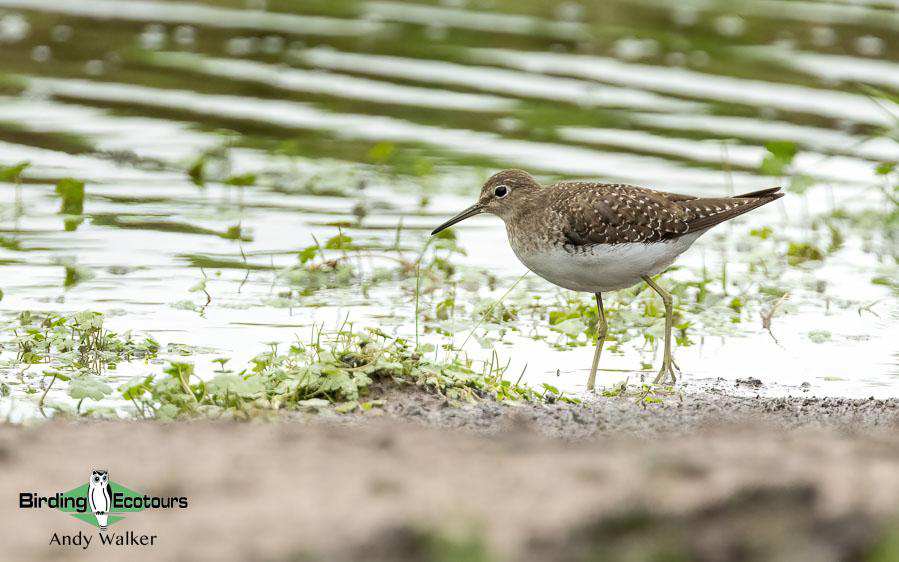
Solitary Sandpiper was a popular migrant shorebird found during the tour.
Day 4, 9th November 2025. Birding Iberá Marshlands
A long but enthralling day was spent exploring a different area of the Iberá Marshlands to where we were based. We saw many species that we had been enjoying over previous days, ranging from Southern Screamer to Roseate Spoonbills to Yellow-rumped Marshbirds. However, we also found plenty of other top birds of the region, with the two main highlights being a pair of Strange-tailed Tyrants (much better views than yesterday) and the localized Ibera Seedeater, which we also got adequate views of. One of the other big targets for the day was Red-and-green Macaw, a species that went extinct in Argentina around 200 years ago and which is the subject of an exciting reintroduction project in the marshlands. A bonus here was the excellent hospitality we received and the great BBQ lunch provided.
Other new birds enjoyed today as we drove and walked around some excellent marshy habitat included Spotted Nothura, Red-winged Tinamou, Scaled Dove, Stripe-backed Bittern, Cinereous Harrier, American Kestrel, Crested Doradito, Sooty Tyrannulet, Grey Monjita, White-headed Marsh Tyrant, Black-backed Water Tyrant, Black-capped Donacobius, Yellowish Pipit, Solitary Cacique, Variable Oriole, Chopi Blackbird, Unicolored Blackbird, and Rusty-collared Seedeater.
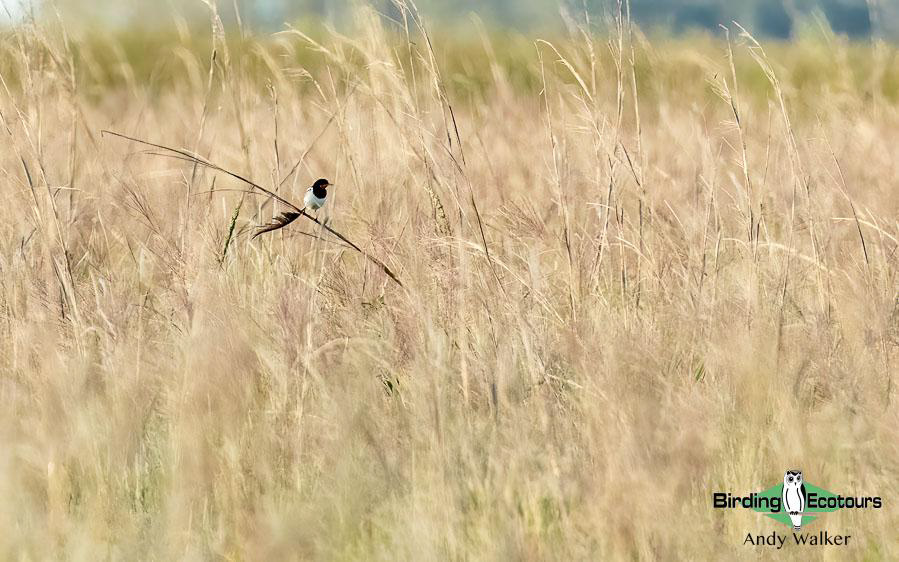
The odd-looking Strange-tailed Tyrant reminded us of a cross between a whydah and a widowbird from Africa and it was fun watching the males displaying!
We did of course also appreciate further sightings of some of the region’s most impressive species, such as Greater Rhea, Giant Wood Rail, Whistling Heron, Jabiru, Wood Stork, Maguari Stork, Long-tailed Harrier, Savanna Hawk, Campo Flicker, Aplomado Falcon, Greater Thornbird, Firewood-gatherer, Vermilion Flycatcher, White Monjita, Long-tailed Reed Finch, and Scarlet-headed Blackbird. In addition to the birds, other wildlife seen included the most impressive Marsh Deer imaginable, with a massive rack of antlers, hundreds of Yacare Caimans and Broad-snouted Caimans, just as many, if not more Greater Capybaras (including some rather cute family groups), several Argentine Black-and-white Tegus, a couple of Six-banded Armadillos, and a Giant Parrot Snake raiding the nests of a White-rumped Swallow colony.
As we left the site at dusk to return to our base for the final time, we picked up a stunning male Scissor-tailed Nightjar, along with a female and also a Pauraque. A Pampas Fox was also seen nearby, and when we reached our accommodation, a young Great Horned Owl was vocalizing.
Day 5, 10th November 2025. Iberá Marshlands to Puerto Iguazú
Essentially a travel day as we moved the long distance between our base in Iberá Marshlands and our next base in Puerto Iguazú, ready to explore the Iguazú National Park area over the next couple of days.
During the drive we spotted several interesting species, such as Southern Screamer, Jabiru, Large-billed Tern, Ringed Kingfisher, White Monjita, and Strange-tailed Tyrant. We broke the journey up with a short birding stop near Posadas, where we had excellent looks at a pair of attractive Streamer-tailed Tyrants. Other birds noted during this stop included Osprey, Guira Cuckoo, and Smooth-billed Ani.
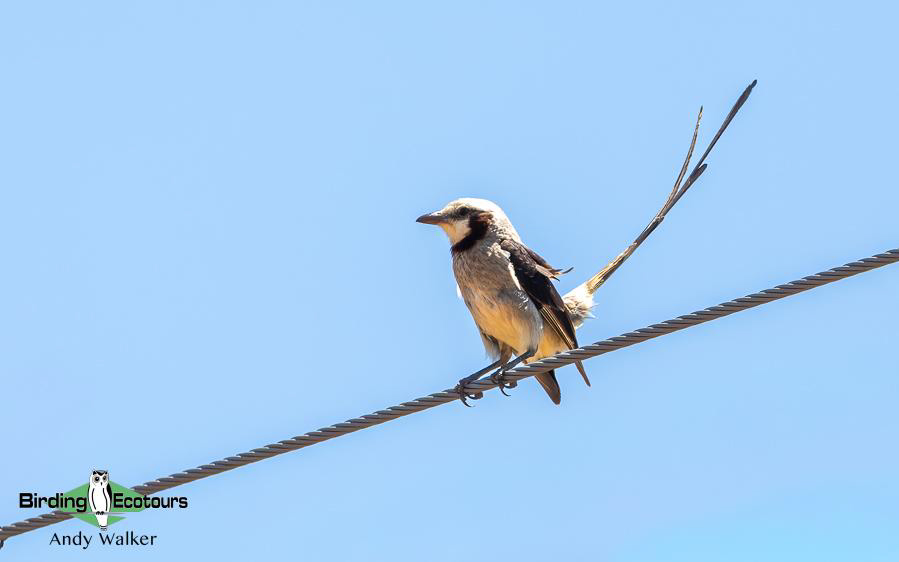
It was interesting to watch the Streamer-tailed Tyrant giving their duet song.
Once we arrived in Puerto Iguazú we called in at Hito Tres Fronteras Puerto Iguazú, where we spent ten minutes soaking in the view of the Paraná and Iguazú Rivers, as well as views of Argentina, Brazil, and Paraguay. We had a fun few minutes spotting some birds in each country, with a couple of species, such as Peregrine Falcon, Fork-tailed Flycatcher, and Eared Dove observed moving between multiple countries!
Day 6, 11th November 2025. Birding Iguazú National Park
We spent the day inside Iguazú National Park around the waterfalls area. It was a fun day, with some birding in the morning and more touristic waterfall-based activities in the afternoon (with a fantastic BBQ buffet lunch in between).
After breakfast we arrived in the rather popular Iguazú National Park. Once the entrance formalities were sorted we started our birding, quickly finding our first (and well-liked) Plush-crested Jays of the tour, it’s hard to not be impressed by this stunning corvid. Further new birds came thick and fast, and included Great Dusky Swift, Plumbeous Kite, Swallow-tailed Kite, Bat Falcon, Social Flycatcher, Swallow Tanager, and Red-rumped Cacique.
As we moved through some different habitats we picked up Smooth-billed Ani and Greater Ani. Green Ibis was heard, but the vegetation was too thick to get near to it. As is typical with forest birding where access is restricted, we heard several species across the day that we weren’t able to reach, such as White-necked Thrush, Wire-tailed Manikin, Southern Antpipit, and Variable Antshrike. We did however see a few Rufous-crowned Motmots, Versicolored Emerald, Ochre-naped Piculet, Olivaceous Woodcreeper, Yellow-chevroned Parakeet, Scaly-headed Parrot, Spot-backed Antshrike, Plain Antvireo, Rufous-crowned Greenlet, Eared Pygmy Tyrant, Grey-hooded Flycatcher, Sepia-capped Flycatcher, Black-goggled Tanager, Chopi Blackbird, and Golden-crowned Warbler. One of the major highlights of the morning though, was when a Pavonine Cuckoo flew in and landed right next to us, allowing prolonged eye-level views of this sought-after species.
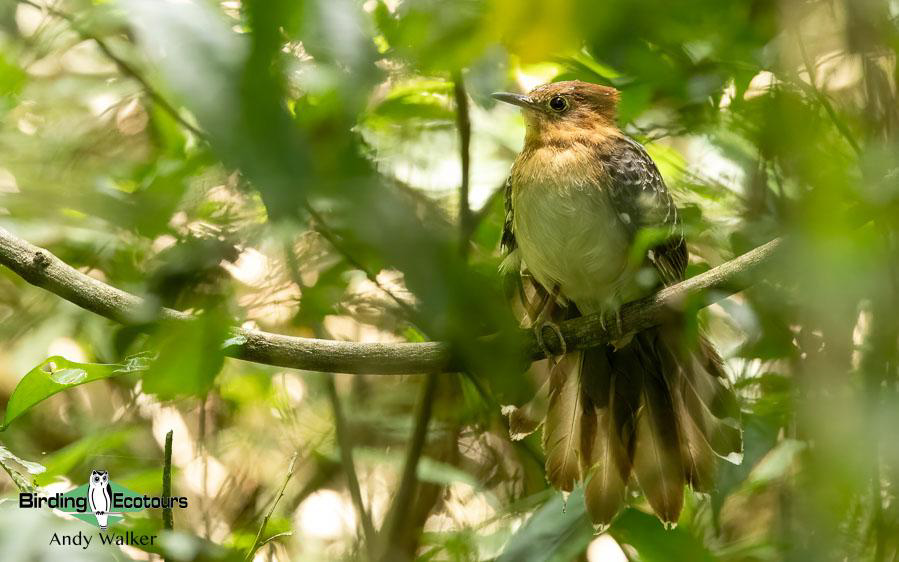
The infrequently seen Pavonine Cuckoo flew in and gave a great showing for us.
After our wonderful BBQ buffet lunch we took several trails covering the bottom and top of the Iguazú waterfalls. The sight of the water bellowing down the various falls was breathtaking, and it is easy to see why the site is considered one of the “New Seven Wonders of Nature”. Given recent rains within the catchment area, the falls were in flood, and the volume of water passing through the site was staggering. As we progressed around the waterfall trail system we found several birds too, including some incredible and close perched Great Dusky Swift views. Other good birds found during the afternoon included Limpkin, Snail Kite, Bat Falcon, Toco Toucan, White-winged Swallow, Barred Antshrike, and Swallow Tanager. A few new reptiles and mammals were also seen, and included the feisty South American Coati.
In the late afternoon we returned to our hotel, another nice evening meal and a rest after a long but fun day on our feet!

Iguazú waterfall was a spectacular sight and we enjoyed a gloriously sunny day for our visit, we were very lucky with the weather on this day given what had come before and would come after.
Day 7, 12th November 2025. Birding Iguazú National Park
Our morning was spent birding in a different section of forest within Iguazú National Park. It was cloudy, cool, and threatening rain from the start and eventually the occasional light showers turned into a more serious storm, which resulted in the curtailment of the birding at lunch time. As we commenced birding we quickly got our eyes on a couple of stunning male Surucua Trogons, the second bird showed very nicely, with a freshly captured praying mantis. A few smaller birds were busily moving through the nearby trees, and included Rufous-fringed Antwren, Spot-backed Antshrike, and Variable Antshrike. Overhead Great Dusky Swifts were flying over, along with a few Grey-rumped Swifts. Continuing through the forest we found Eared Pygmy Tyrant, Three-striped Flycatcher, Sibilant Sirystes, Chestnut-headed Tanager, Ruby-crowned Tanager, Blue Dacnis, and Black-throated Grosbeak.
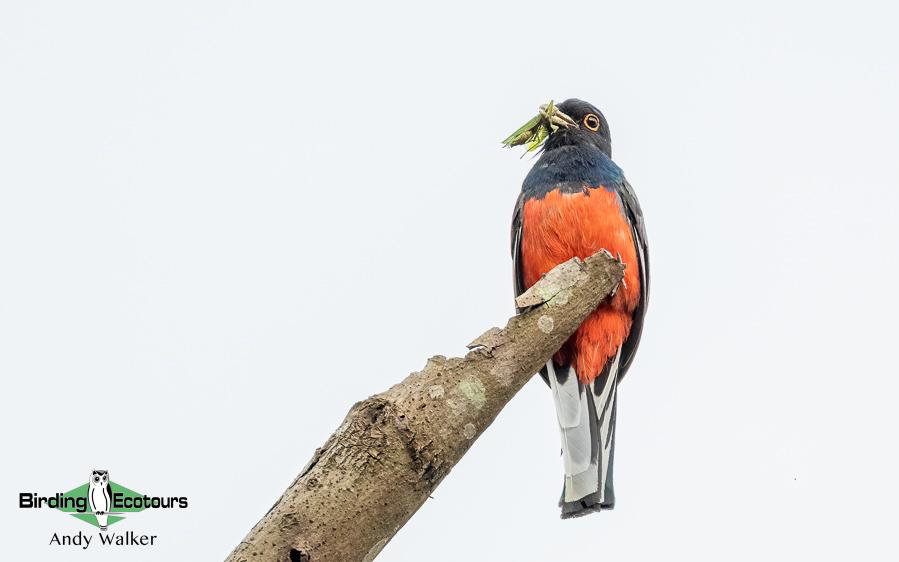
This gorgeous male Surucua Trogon flew in with his breakfast and landed right next to us.
Due to increasingly frequent and persistent rain showers we took shelter in a conveniently located bird blind (bird hide). Not only was the roof welcome, the birds here were rather exciting. A colony of Red-rumped Caciques were nesting near the blind and they were guarding the surrounding area quite well, however a pair of Toco Toucans were able to sneak through their defenses and raid their nests, though seemed unsuccessful in their attempts to predate any eggs or young. Many birds were found at this one spot, with some of the highlights including Blackish Rail, Red-breasted (Green-billed) Toucan, Green-barred Woodpecker, Yellow-fronted Woodpecker, Scaly-headed Parrot, Cobalt-rumped Parrotlet, Black-crowned Tityra, Plush-crested Jay, Violaceous Euphonia, Variable Oriole, and Giant Cowbird.
We enjoyed a brief dry window where we found Ochre-breasted Foliage Gleaner, Yellow Tyrannulet, and Red Pileated Finch but then the storm hit and it was time to abandon the birding. Luckily it was lunchtime, so we headed to a restaurant for a break. Unfortunately the rain just got heavier and heavier all afternoon and well into the night, so no further birding could take place.
Day 8, 13th November 2025. Iguazú to Andresito and birding at Urugua-í Provincial Park and San Sebastian de la Selva
We awoke to a dry morning, thankfully, and we had a good day of birding. We drove out to the Urugua-í Provincial Park, where we undertook a very productive birding session. Not long after our arrival at the site, we found our main target, the attractive Black-fronted Piping Guan. A lone bird was present in some riverine forest and it gave some reasonable views. As we walked along the forest trail we bumped into an assortment of birds, however several species were only heard, partly due to the thick bamboo blocking views and the river itself preventing us getting close to some birds. We did however see Dark-billed Cuckoo, Yellow-fronted Woodpecker, Sharp-tailed Streamcreeper, Buff-browed Foliage-gleaner, Riverside Warbler, Blue Manakin, Tufted Antshrike, Ochre-faced Tody-Flycatcher, Long-tailed Tyrant, White-necked Thrush, Chestnut-headed Tanager, Swallow Tanager, and Ruby-crowned Tanager.
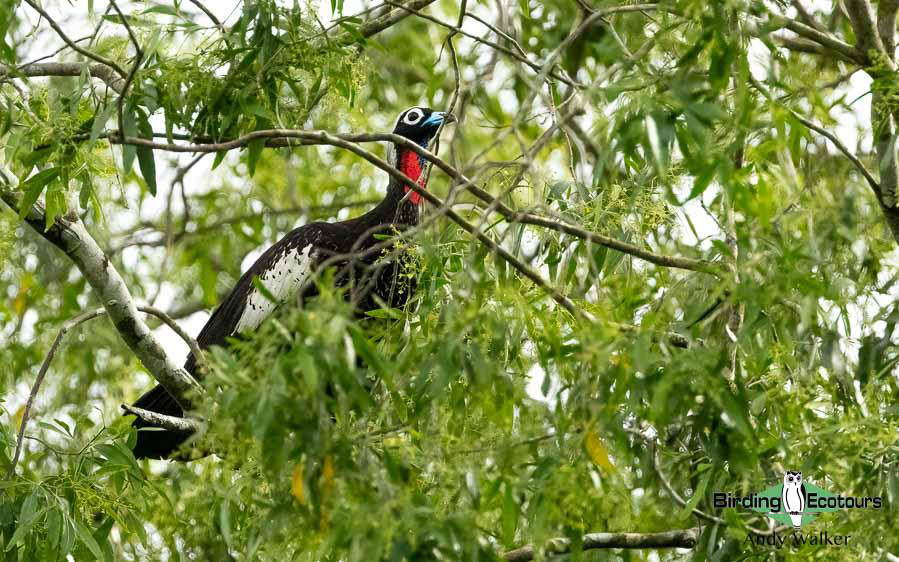
Black-fronted Piping Guan was present in the forest and feeding in a fruiting tree.
We then continued to the Andresito area, where we stopped for lunch and checked into our accommodation at San Sabastian de la Selva. An afternoon walk along the private trails was productive and fun, and we found the impressive Red-ruffed Fruitcrow, along with an excellent supporting cast featuring Sick’s Swift, Amazon Kingfisher, Chestnut-eared Aracari, White-shouldered Fire-eye, Short-tailed Antthrush, Lesser Woodcreeper, Buff-fronted Foliage-gleaner, Rufous-capped Spinetail, Black-tailed Tityra, Drab-breasted Bamboo Tyrant, Southern Antpipit, Fulvous-crowned Scrub Tyrant, and Magpie Tanager. Walking back to our lodge for dinner, we had a close sighting of a young Painted Lancehead, a beautiful but venomous viper. Over dinner and our daily bird list a Pauraque was hawking insects over the lawn and occasionally singing its distinctive song.
Day 9, 14th November 2025. Morning birding at San Sebastian de la Selva, travel to San Pedro, afternoon birding in Araucaria Provincial Park
We again spent the morning birding in the wonderful forest at San Sebastian de la Selva where we recorded a number of new birds and improved views of several species we’d seen the previous day. A pair of Slaty-breasted Wood Rails were on the lawn just before breakfast, along with a small group of friendly Greater Capybaras. We again saw the Red-ruffed Fruitcrow, in a bit better light than the previous evening, which was much appreciated. As we got to the older forest within the private reserve we had amazing repeated views of a Tataupa Tinamou that walked back and forth across the trail a few times. Shortly thereafter, a Wing-barred Piprites, Rusty-fronted Nunbird, and a pair of Rufous Gnateaters all flew in low and close, giving some great views. A bit further along the trail, while we were watching a Common Squirrel Cuckoo that was showing well out in the open, with a freshly caught caterpillar, a gorgeous Bertoni’s Antbird flew in and also sat out in full view, allowing us a really great look at this usually shy species. Southern Antpipit was seen by some, but that one did live up to its shy billing, as did Spotted Bamboowren, which unfortunately remained “heard only”. We got some good views of many other species during the morning, such as Striped Cuckoo, Atlantic Plain Xenops, Grey-bellied Spinetail, Spix’s Spinetail, Variable Antshrike, Green-backed Becard, White-crested Flycatcher, Greenish Elaenia, and lots more!
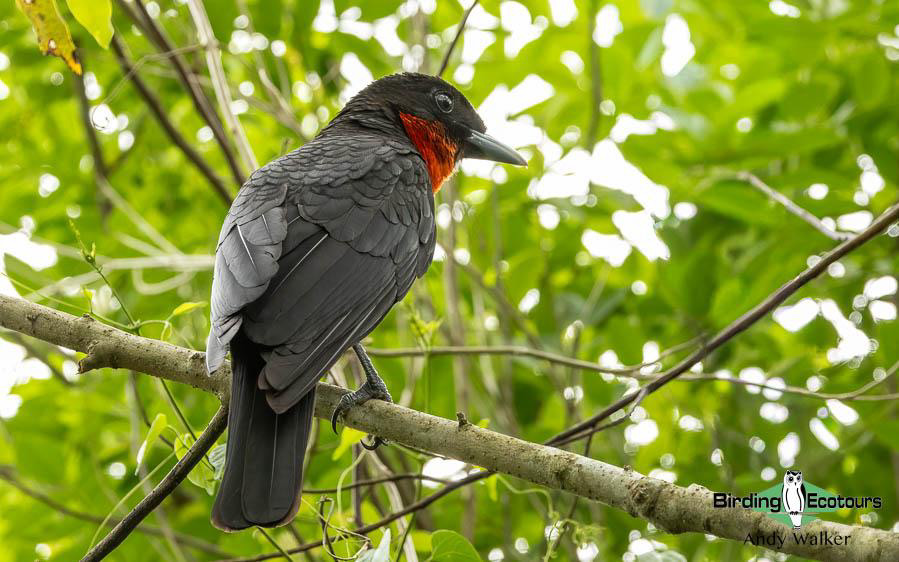
Red-ruffed Fruitcrow was faithful to a small patch of fruiting trees and showed nicely.
In the late morning we checked out of our accommodation at San Sebastian de la Selva and traveled along the Argentina-Brazil border down to the small town of San Pedro, where we had lunch, checked into our accommodation and had a short siesta. The only bird of note seen along the way was a White-eared Puffbird perched up on a phone wire.
After a short break, we went back out for some more birding. Our afternoon was spent at Araucaria Provincial Park, not far from our accommodation and we enjoyed exploring the ancient Araucaria forest, where we found some great birds. As we were entering the forest we saw Atlantic Black-throated Trogon, and several Plumbeous Kites hawking insects. Our first look at the impressive Araucaria trees yielded our hoped-for Araucaria Tit-Spinetail and a White-winged Becard, though that remained elusive, though one seen later in the afternoon performed a little better. While walking through the forest we also picked up Dark-billed Cuckoo, Southern Bristle Tyrant, Sepia-capped Flycatcher, Olivaceous Woodcreeper, Blue Manakin, and Greenish Schiffornis. A pair of Rufous-crowned Motmots remained hidden in the depths of the trees. Our short walk was a nice introduction to the habitat and the region.
Day 10, 15th November 2025. San Pedro to Iguazú, flight to Buenos Aires and tour concluded
We had a final morning birding at Cruce Caballero Provincial Park near San Pedro. The forest was really impressive, with a range of ancient Araucaria trees, pretty tree ferns, lots of native bamboo, and all mixed in with many other interesting plant species. Despite the wonderful looking habitat, birds were fairly thin on the ground compared to some other sites we’d visited, but we still enjoyed our final birding session of the tour.
Almost one of our first birds in the forest was the rare and localized Vinaceous-breasted Amazon, a really attractive large parrot that specializes in the Araucaria trees. A large nesting colony of Red-rumped Caciques were noisy as they came and went to their nests and several species of flycatchers were noted (as were the numerous mosquitos that were following us!). One of the best flycatchers seen was a Large-billed Flatbill that flew in and landed close to us. We also had good views of Buff-fronted Foliage-gleaner and Grey-bellied Spinetail. A splash of color was provided by a pair of gorgeous Blue-naped Chlorophonias feeding on a mossy branch. We also saw numerous other species we had been seeing over previous days, such as Plush-crested Jay, Golden-crowned Warbler, White-rimmed Warbler, and Black-goggled Tanager.
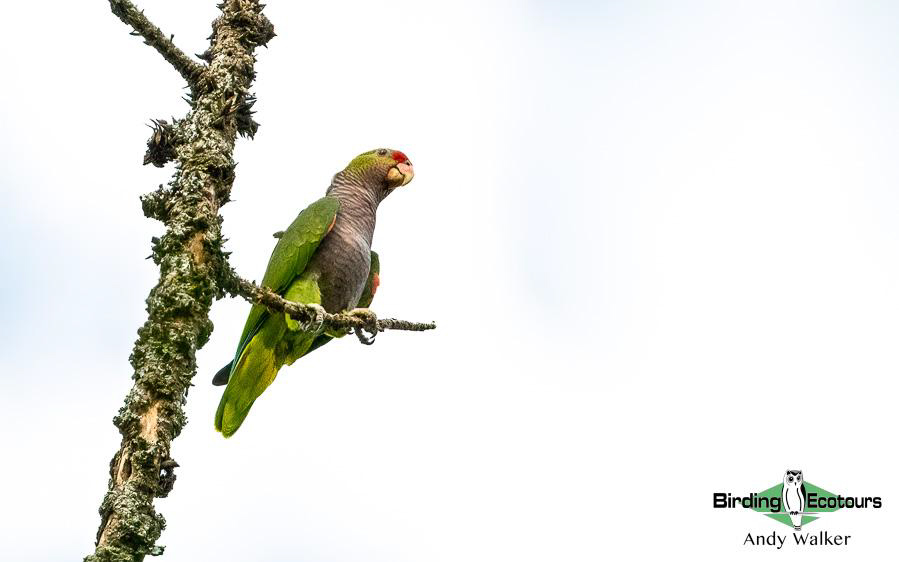
Vinaceous-breasted Amazon was a target during our birding in the Araucaria forest where this uncommon species primarily resides.
After the birding we had lunch in San Pedro, before commencing our journey to Puerto Igauzu for our flight back to Buenos Aires, where this successful northeastern Argentina birding tour concluded. Most folks were continuing with our southern Patagonia tour, so the fun and excellent birding would be continuing…
The “bird of the trip” friendly competition was very competitive with lots of species vying for the top spot, including Toco Toucan, Strange-tailed Tyrant, and Bertoni’s Antbird (with a surprise Solitary Sandpiper making some lists). We’d seen lots of great birds, eaten some good and typical Argentinean food, seen some incredible natural wonders (Iquazu waterfalls was a major highlight), and seen some interesting animals, with Greater Capybaras being a firm favorite!
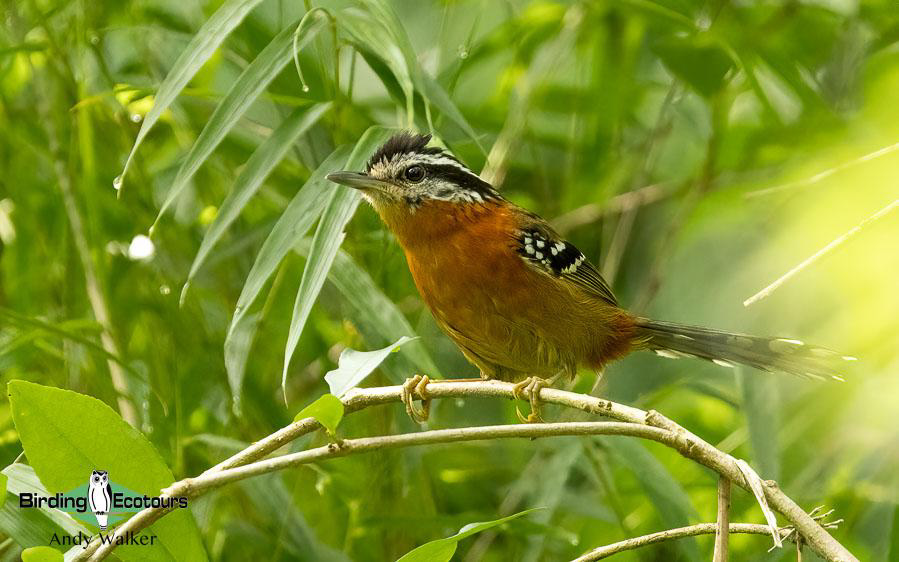
Bertoni’s Antbird showed incredibly well for a species that is usually rather shy, and was one of the most popular birds on the tour.
Bird List – Following IOC (15.1) (March 2025)
Birds ‘heard only’ are marked with (H) after the common name, all other species were seen. Common names with an alternative common name in parenthesis indicate name changes/splits/lumps following the announcement of the new AviList v2025 global bird checklist. The following notation after species names is used to show conservation status following BirdLife International: EN = Endangered, VU = Vulnerable.
| Common Name | Scientific Name |
| Rheas (Rheidae) | |
| Greater Rhea | Rhea americana |
| Tinamous (Tinamidae) | |
| Brown Tinamou (H) | Crypturellus obsoletus |
| Tataupa Tinamou | Crypturellus tataupa |
| Red-winged Tinamou | Rhynchotus rufescens |
| Spotted Nothura | Nothura maculosa |
| Screamers (Anhimidae) | |
| Southern Screamer | Chauna torquata |
| Ducks, Geese, Swans (Anatidae) | |
| White-faced Whistling Duck | Dendrocygna viduata |
| Black-bellied Whistling Duck | Dendrocygna autumnalis |
| Fulvous Whistling Duck | Dendrocygna bicolor |
| Coscoroba Swan | Coscoroba coscoroba |
| Muscovy Duck | Cairina moschata |
| Brazilian Teal | Amazonetta brasiliensis |
| Silver Teal | Spatula versicolor |
| Yellow-billed Teal | Anas flavirostris |
| Rosy-billed Pochard | Netta peposaca |
| Chachalacas, Curassows, Guans (Cracidae) | |
| Rusty-margined Guan | Penelope supercilliaris |
| Black-fronted Piping Guan – EN | Pipile jacutinga |
| Nightjars (Caprimulgidae) | |
| Pauraque | Nyctidromus albicollis |
| Scissor-tailed Nightjar | Hydropsalis torquata |
| Swifts (Apodidae) | |
| Great Dusky Swift | Cypseloides senex |
| White-collared Swift | Streptoprocne zonaris |
| Grey-rumped Swift | Chaetura cinereiventris |
| Sick’s Swift | Chaetura meridionalis |
| Hummingbirds (Trochilidae) | |
| Scale-throated Hermit | Phaethornis eurynome |
| Glittering-bellied Emerald | Chlorostilbon lucidus |
| Purple-crowned Plovercrest | Stephanoxis loddigesii |
| Versicolored Emerald | Chrysuronia versicolor |
| Gilded Sapphire | Hylocharis chrysura |
| Cuckoos (Cuculidae) | |
| Guira Cuckoo | Guira guira |
| Greater Ani | Crotophaga major |
| Smooth-billed Ani | Crotophaga ani |
| Striped Cuckoo | Tapera naevia |
| Pavonine Cuckoo | Dromococcyx pavoninus |
| Squirrel Cuckoo | Piaya cayana |
| Dark-billed Cuckoo | Coccyzus melacoryphus |
| Pigeons, Doves (Columbidae) | |
| Rock Dove [Feral Pigeon] | Columba livia [dom.] |
| Picazuro Pigeon | Patagioenas picazuro |
| Spot-winged Pigeon | Patagioenas maculosa |
| Pale-vented Pigeon | Patagioenas cayennensis |
| Scaled Dove | Columbina squammata |
| Ruddy Ground Dove | Columbina talpacoti |
| Picui Ground Dove | Columbina picui |
| Ruddy Quail-Dove | Geotrygon montana |
| White-tipped Dove | Leptotila verreauxi |
| Grey-fronted Dove | Leptotila rufaxilla |
| Eared Dove | Zenaida auriculata |
| Rails, Crakes & Coots (Rallidae) | |
| Blackish Rail | Pardirallus nigricans |
| Ash-throated Crake (H) | Mustelirallus albicollis |
| Grey-cowled Wood Rail | Aramides cajaneus |
| Giant Wood Rail | Aramides ypecaha |
| Slaty-breasted Wood Rail | Aramides saracura |
| Common Gallinule | Gallinula galeata |
| Azure Gallinule | Porphyrio flavirostris |
| Rufous-sided Crake | Laterallus melanophaius |
| Limpkin (Aramidae) | |
| Limpkin | Aramus guarauna |
| Grebes (Podicipedidae) | |
| White-tufted Grebe | Rollandia rolland |
| Great Grebe | Podiceps major |
| Plovers (Charadriidae) | |
| Southern Lapwing | Vanellus chilensis |
| Collared Plover | Anarhynchus collaris |
| Jacanas (Jacanidae) | |
| Wattled Jacana | Jacana jacana |
| Sandpipers, Snipes (Scolopacidae) | |
| Pantanal Snipe | Gallinago paraguaiae |
| Solitary Sandpiper | Tringa solitaria |
| Greater Yellowlegs | Tringa melanoleuca |
| Gulls, Terns, Skimmers (Laridae) | |
| Yellow-billed Tern | Sternula superciliaris |
| Large-billed Tern | Phaetusa simplex |
| Storks (Ciconiidae) | |
| Wood Stork | Mycteria americana |
| Jabiru | Jabiru mycteria |
| Maguari Stork | Ciconia maguari |
| Anhingas, Darters (Anhingidae) | |
| Anhinga | Anhinga anhinga |
| Cormorants, Shags (Phalacrocoracidae) | |
| Neotropic Cormorant | Nannopterum brasilianum |
| Ibises, Spoonbills (Threskiornithidae) | |
| Green Ibis (H) | Mesembrinibis cayennensis |
| Bare-faced Ibis | Phimosus infuscatus |
| White-faced Ibis | Plegadis chihi |
| Roseate Spoonbill | Platalea ajaja |
| Herons, Bitterns (Ardeidae) | |
| Rufescent Tiger Heron | Tigrisoma lineatum |
| Stripe-backed Bittern | Botaurus involucris |
| Black-crowned Night Heron | Nycticorax nycticorax |
| Whistling Heron | Syrigma sibilatrix |
| Snowy Egret | Egretta thula |
| Striated Heron | Butorides striata |
| Great Egret | Ardea alba |
| Western Cattle Egret | Ardea ibis |
| Cocoi Heron | Ardea cocoi |
| New World Vultures (Cathartidae) | |
| Black Vulture | Coragyps atratus |
| Turkey Vulture | Cathartes aura |
| Lesser Yellow-headed Vulture | Cathartes burrovianus |
| Ospreys (Pandionidae) | |
| Osprey | Pandion haliaetus |
| Kites, Hawks, Eagles (Accipitridae) | |
| White-tailed Kite | Elanus leucurus |
| Swallow-tailed Kite | Elanoides forficatus |
| Cinereous Harrier | Circus cinereus |
| Long-winged Harrier | Circus buffoni |
| Plumbeous Kite | Ictinia plumbea |
| Black-collared Hawk | Busarellus nigricollis |
| Snail Kite | Rostrhamus sociabilis |
| Savanna Hawk | Buteogallus meridionalis |
| Great Black Hawk | Buteogallus urubitinga |
| Roadside Hawk | Rupornis magnirostris |
| Harris’s Hawk | Parabuteo unicinctus |
| White-tailed Hawk | Geranoaetus albicaudatus |
| Barn Owls (Tytonidae) | |
| American Barn Owl | Tyto furcata |
| Owls (Strigidae) | |
| Burrowing Owl | Athene cunicularia |
| Great Horned Owl | Bubo virginianus |
| Trogons (Trogonidae) | |
| Surucua Trogon | Trogon surrucura |
| Atlantic Black-throated Trogon | Trogon chrysochloros |
| Kingfishers (Alcedinidae) | |
| Amazon Kingfisher | Chloroceryle amazona |
| Green Kingfisher | Chloroceryle americana |
| Ringed Kingfisher | Megaceryle torquata |
| Motmots (Momotidae) | |
| Rufous-capped Motmot | Baryphthengus ruficapillus |
| Puffbirds (Bucconidae) | |
| White-eared Puffbird | Nystalus chacuru |
| Rusty-breasted Nunlet | Nonnula rubecula |
| Toucans (Ramphastidae) | |
| Toco Toucan | Ramphastos toco |
| Red-breasted Toucan | Ramphastos dicolorus |
| Chestnut-eared Aracari | Pteroglossus castanotis |
| Woodpeckers (Picidae) | |
| Ochre-collared Piculet | Picumnus temminckii |
| White Woodpecker | Melanerpes candidus |
| Yellow-fronted Woodpecker | Melanerpes flavifrons |
| Little Woodpecker | Veniliornis passerinus |
| Checkered Woodpecker | Veniliornis mixtus |
| Green-barred Woodpecker | Colaptes melanochloros |
| Campo Flicker | Colaptes campestris |
| Blond-crested Woodpecker (H) | Celeus flavescens |
| Caracaras, Falcons (Falconidae) | |
| Crested Caracara | Caracara plancus |
| Yellow-headed Caracara | Milvago chimachima |
| Chimango Caracara | Milvago chimango |
| Collared Forest Falcon (H) | Micrastur semitorquatus |
| American Kestrel | Falco sparverius |
| Aplomado Falcon | Falco femoralis |
| Bat Falcon | Falco rufigularis |
| Peregrine Falcon | Falco peregrinus |
| African & New World Parrots (Psittacidae) | |
| Monk Parakeet | Myiopsitta monachus |
| Yellow-chevroned Parakeet | Brotogeris chiriri |
| Scaly-headed Parrot | Pionus maximiliani |
| Vinaceous-breasted Amazon – EN | Amazona vinacea |
| Turquoise-fronted Amazon | Amazona aestiva |
| Cobalt-rumped Parrotlet | Forpus xanthopterygius |
| Nanday Parakeet | Aratinga nenday |
| Red-and-green Macaw | Ara chloropterus |
| White-eyed Parakeet | Psittacara leucophthalmus |
| Ovenbirds (Furnariidae) | |
| Olivaceous Woodcreeper | Sittasomus griseicapillus |
| Lesser Woodcreeper | Xiphorhynchus fuscus |
| Narrow-billed Woodcreeper | Lepidocolaptes angustirostris |
| Atlantic Plain Xenops | Xenops minutus |
| Rufous Hornero | Furnarius rufus |
| Sharp-tailed Streamcreeper | Lochmias nematura |
| Ochre-breasted Foliage-gleaner | Anabacerthia lichtensteini |
| Buff-browed Foliage-gleaner | Syndactyla rufosuperciliata |
| Buff-fronted Foliage-gleaner | Dendroma rufa |
| White-eyed Foliage-gleaner | Automolus leucophthalmus |
| Araucaria Tit-Spinetail | Leptasthenura setaria |
| Greater Thornbird | Phacellodomus ruber |
| Firewood-gatherer | Anumbius annumbi |
| Yellow-chinned Spinetail | Certhiaxis cinnamomeus |
| Chotoy Spinetail | Schoeniophylax phryganophilus |
| Grey-bellied Spinetail | Synallaxis cinerascens |
| Rufous-capped Spinetail | Synallaxis ruficapilla |
| Spix’s Spinetail | Synallaxis spixi |
| Sooty-fronted Spinetail | Synallaxis frontalis |
| Antbirds (Thamnophilidae) | |
| Rufous-margined Antwren | Herpsilochmus rufimarginatus |
| Plain Antvireo | Dysithamnus mentalis |
| Barred Antshrike | Thamnophilus doliatus |
| Variable Antshrike | Thamnophilus caerulescens |
| Rufous-capped Antshrike (H) | Thamnophilus ruficapillus |
| Tufted Antshrike | Mackenziaena severa |
| Spot-backed Antshrike | Hypoedaleus guttatus |
| Bertoni’s Antbird | Drymophila rubricollis |
| White-shouldered Fire-eye | Pyriglena leucoptera |
| Antthrushes (Formicariidae) | |
| Short-tailed Antthrush (H) | Chamaeza campanisona |
| Gnateaters (Conopophagidae) | |
| Rufous Gnateater | Conopophaga lineata |
| Tapaculos (Rhinocryptidae) | |
| Spotted Bamboowren (H) | Psilorhamphus guttatus |
| Tyrant Flycatchers, Calyptura (Tyrannidae) | |
| Wing-barred Piprites | Piprites chloris |
| Rough-legged Tyrannulet (H) | Acrochordopus burmeisteri |
| Greenish Elaenia | Myiopagis viridicata |
| Yellow-bellied Elaenia | Elaenia flavogaster |
| Large Elaenia | Elaenia spectabilis |
| White-crested Elaenia | Elaenia albiceps |
| Small-billed Elaenia | Elaenia parvirostris |
| Southern Beardless Tyrannulet | Camptostoma obsoletum |
| Sooty Tyrannulet | Serpophaga nigricans |
| White-crested Tyrannulet | Serpophaga subcristata |
| Yellow Tyrannulet | Capsiempis flaveola |
| Crested Doradito | Pseudocolopteryx sclateri |
| Southern Antpipit | Corythopis delalandi |
| Fulvous-crowned Scrub Tyrant | Euscarthmus meloryphus |
| Southern Bristle Tyrant | Pogonotriccus eximius |
| Grey-hooded Flycatcher | Mionectes rufiventris |
| Sepia-capped Flycatcher | Leptopogon amaurocephalus |
| Bran-colored Flycatcher | Myiophobus fasciatus |
| Drab-breasted Bamboo Tyrant | Hemitriccus diops |
| Pearly-vented Tody-Tyrant | Hemitriccus margaritaceiventer |
| Eared Pygmy Tyrant | Myiornis auricularis |
| Ochre-faced Tody-Flycatcher | Poecilotriccus plumbeiceps |
| Yellow-olive Flatbill | Tolmomyias sulphurescens |
| White-throated Spadebill (H) | Platyrinchus mystaceus |
| Euler’s Flycatcher | Lathrotriccus euleri |
| Fuscous Flycatcher | Cnemotriccus fuscatus |
| Scarlet Flycatcher (Vermilion Flycatcher) | Pyrocephalus rubinus |
| Yellow-browed Tyrant | Satrapa icterophrys |
| Spectacled Tyrant | Hymenops perspicillatus |
| White Monjita | Xolmis irupero |
| Grey Monjita | Nengetus cinereus |
| Streamer-tailed Tyrant | Gubernetes yetapa |
| Black-backed Water Tyrant | Fluvicola albiventer |
| White-headed Marsh Tyrant | Arundinicola leucocephala |
| Black-and-white Monjita – VU | Heteroxolmis dominicana |
| Strange-tailed Tyrant – VU | Alectrurus risora |
| Long-tailed Tyrant | Colonia colonus |
| Cattle Tyrant | Machetornis rixosa |
| Piratic Flycatcher | Legatus leucophaius |
| Social Flycatcher | Myiozetetes similis |
| Great Kiskadee | Pitangus sulphuratus |
| Three-striped Flycatcher | Conopias trivirgatus |
| Streaked Flycatcher | Myiodynastes maculatus |
| Boat-billed Flycatcher | Megarynchus pitangua |
| Variegated Flycatcher | Empidonomus varius |
| Crowned Slaty Flycatcher | Griseotyrannus aurantioatrocristatus |
| Tropical Kingbird | Tyrannus melancholicus |
| Fork-tailed Flycatcher | Tyrannus savana |
| Sibilant Sirystes | Sirystes sibilator |
| Swainson’s Flycatcher | Myiarchus swainsoni |
| Short-crested Flycatcher | Myiarchus ferox |
| Brown-crested Flycatcher | Myiarchus tyrannulus |
| Large-headed Flatbill | Ramphotrigon megacephalum |
| Cotingas (Cotingidae) | |
| Red-ruffed Fruitcrow | Pyroderus scutatus |
| Manakins (Pipridae) | |
| Blue Manakin | Chiroxiphia caudata |
| Band-tailed Manakin (H) | Pipra fasciicauda |
| Tityras, Becards & Allies (Tityridae) | |
| Black-crowned Tityra | Tityra inquisitor |
| Black-tailed Tityra | Tityra cayana |
| Greenish Schiffornis | Schiffornis virescens |
| Green-backed Becard | Pachyramphus viridis |
| Chestnut-crowned Becard | Pachyramphus castaneus |
| White-winged Becard | Pachyramphus polychopterus |
| Crested Becard | Pachyramphus validus |
| Vireos, Greenlets, Shrike-babblers (Vireonidae) | |
| Rufous-browed Peppershrike | Cyclarhis gujanensis |
| Rufous-crowned Greenlet | Hylophilus poicilotis |
| Chivi Vireo | Vireo chivi |
| Crows, Jays (Corvidae) | |
| Plush-crested Jay | Cyanocorax chrysops |
| Swallows, Martins (Hirundinidae) | |
| White-rumped Swallow | Tachycineta leucorrhoa |
| White-winged Swallow | Tachycineta albiventer |
| Brown-chested Martin | Progne tapera |
| Southern Martin | Progne elegans |
| Grey-breasted Martin | Progne chalybea |
| Southern Rough-winged Swallow | Stelgidopteryx ruficollis |
| Blue-and-white Swallow | Pygochelidon cyanoleuca |
| Barn Swallow | Hirundo rustica |
| American Cliff Swallow | Petrochelidon pyrrhonota |
| Black-capped Donacobius (Donacobiidae) | |
| Black-capped Donacobius | Donacobius atricapilla |
| Wrens (Troglodytidae) | |
| Thrush-like Wren | Campylorhynchus turdinus |
| Southern House Wren | Troglodytes musculus |
| Gnatcatchers (Polioptilidae) | |
| Masked Gnatcatcher | Polioptila dumicola |
| Mockingbirds, Thrashers (Mimidae) | |
| Chalk-browed Mockingbird | Mimus saturninus |
| Starlings, Rhabdornises (Sturnidae) | |
| Crested Myna | Acridotheres cristatellus |
| Common Starling | Sturnus vulgaris |
| Thrushes (Turdidae) | |
| Creamy-bellied Thrush | Turdus amaurochalinus |
| White-necked Thrush | Turdus albicollis |
| Pale-breasted Thrush | Turdus leucomelas |
| Rufous-bellied Thrush | Turdus rufiventris |
| Old World Sparrows, Snowfinches (Passeridae) | |
| House Sparrow | Passer domesticus |
| Wagtails, Pipits (Motacillidae) | |
| Yellowish Pipit | Anthus chii |
| Finches, Euphonias (Fringillidae) | |
| Hooded Siskin | Spinus magellanicus |
| Blue-naped Chlorophonia | Chlorophonia cyanea |
| Purple-throated Euphonia | Euphonia chlorotica |
| Violaceous Euphonia | Euphonia violacea |
| Chestnut-bellied Euphonia | Euphonia pectoralis |
| New World Sparrows (Passerellidae) | |
| Grassland Sparrow | Ammodramus humeralis |
| Rufous-collared Sparrow | Zonotrichia capensis |
| Oropendolas, New World Orioles, Blackbirds (Icteridae) | |
| Solitary Cacique | Cacicus solitarius |
| Red-rumped Cacique | Cacicus haemorrhous |
| Variable Oriole | Icterus pyrrhopterus |
| Giant Cowbird | Molothrus oryzivorus |
| Shiny Cowbird | Molothrus bonariensis |
| Scarlet-headed Blackbird | Amblyramphus holosericeus |
| Chopi Blackbird | Gnorimopsar chopi |
| Greyish Baywing | Agelaioides badius |
| Yellow-winged Blackbird | Agelasticus thilius |
| Unicolored Blackbird | Agelasticus cyanopus |
| Chestnut-capped Blackbird | Chrysomus ruficapillus |
| Brown-and-yellow Marshbird | Pseudoleistes virescens |
| Yellow-rumped Marshbird | Pseudoleistes guirahuro |
| New World Warblers (Parulidae) | |
| Southern Yellowthroat | Geothlypis velata |
| Tropical Parula | Setophaga pitiayumi |
| White-rimmed Warbler | Myiothlypis leucoblephara |
| Riverbank Warbler | Myiothlypis rivularis |
| Golden-crowned Warbler | Basileuterus culicivorus |
| Cardinals & Allies (Cardinalidae) | |
| Red-crowned Ant Tanager | Habia rubica |
| Blackish-blue Seedeater | Amaurospiza moesta |
| Ultramarine Grosbeak (H) | Cyanoloxia brissonii |
| Tanagers & Allies (Thraupidae) | |
| Pampa Finch | Embernagra platensis |
| Guira Tanager | Hemithraupis guira |
| Swallow Tanager | Tersina viridis |
| Blue Dacnis | Dacnis cayana |
| Green-winged Saltator | Saltator similis |
| Bluish-grey Saltator | Saltator coerulescens |
| Black-throated Grosbeak | Saltator fuliginosus |
| Golden-billed Saltator (H) | Saltator aurantiirostris |
| Bananaquit (H) | Coereba flaveola |
| Black-goggled Tanager | Trichothraupis melanops |
| Red Pileated Finch | Coryphospingus cucullatus |
| White-lined Tanager | Tachyphonus rufus |
| Ruby-crowned Tanager | Tachyphonus coronatus |
| Double-collared Seedeater | Sporophila caerulescens |
| Rusty-collared Seedeater | Sporophila collaris |
| Ibera Seedeater | Sporophila iberaensis |
| Rufous-rumped Seedeater | Sporophila hypochroma |
| Black-and-rufous Warbling Finch | Poospiza nigrorufa |
| Chestnut-headed Tanager | Thlypopsis pyrrhocoma |
| Long-tailed Reed Finch | Donacospiza albifrons |
| Chestnut-vented Conebill | Conirostrum speciosum |
| Saffron Finch | Sicalis flaveola |
| Grassland Yellow Finch | Sicalis luteola |
| Magpie Tanager | Cissopis leverianus |
| Red-crested Cardinal | Paroaria coronata |
| Yellow-billed Cardinal | Paroaria capitata |
| Sayaca Tanager | Thraupis sayaca |
| Total seen | 299 |
| Total heard only | 14 |
| Total recorded | 313 |
Mammal List
| Common Name | Scientific Name |
| Short-nosed Armadillos (Chlamyphoridae) | |
| Six-banded Armadillo | Euphractus sexcinctus |
| Spider, Howler, and Woolly Monkeys (Atelidae) | |
| Black-and-gold Howler | Alouatta caraya |
| Cavies (Caviidae) | |
| Greater Capybara | Hydrochoerus hydrochaeris |
| Agoutis and Acouchis (Dasyproctidae) | |
| Azara’s Agouti | Dasyprocta azarae |
| Spiny Rats and Hutias (Echimyidae) | |
| Coypu | Myocastor coypus |
| Raccoons, Coatis, and Allies (Procyonidae) | |
| South American Coati | Nasua nasua |
| Canids (Canidae) | |
| Pampas Fox | Lycalopex gymnocerca |
| Deer (Cervidae) | |
| Marsh Deer | Blastocerus dichotomus |
| Southeastern Red Brocket | Mazama rufa |
| Total seen | 9 |
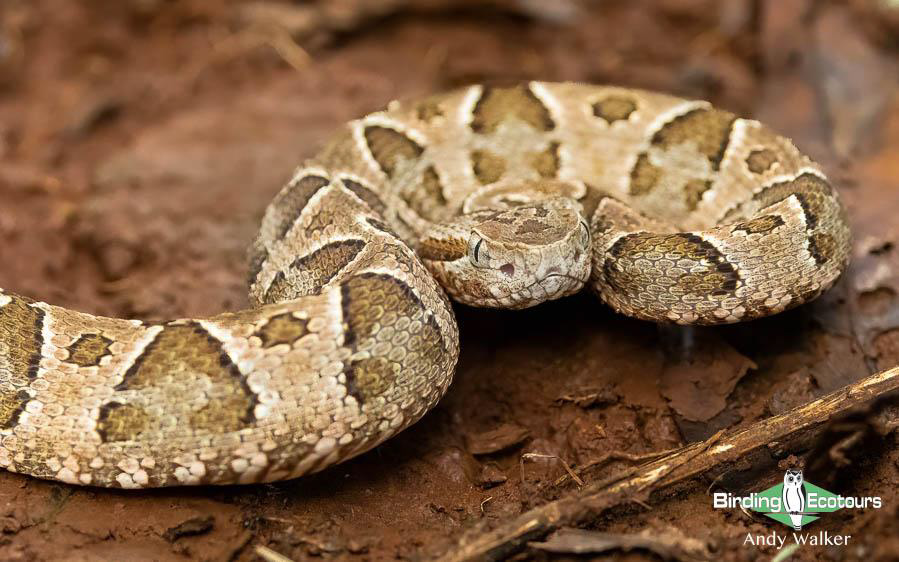
This Painted Lancehead sighting made us pay extra care to where we were putting our feet when walking along forest trails.
Reptile List
| Common Name | Scientific Name |
| Alligators and Caimans (Alligatoridae) | |
| Broad-snouted Caiman | Caiman latirostris |
| Yacare Caiman | Caiman yacare |
| Colubrid Snakes (Colubridae) | |
| Neuwied’s False Fer-de-lance | Xenodon neuwiedii |
| Giant Parrot Snake | Leptophis ahaetulla |
| Vipers (Viperidae) | |
| Painted Lancehead | Bothrops diporus |
| Whiptails and Tegus (Teiidae) | |
| Argentine Black-and-white Tegu | Salvator merianae |
| Neotropical Ground Lizards (Tropiduridae) | |
| Western Collared Spiny Lizard | Tropidurus catalanensis |
| Austro-American Side-necked Turtles (Chelidae) | |
| Williams’ South-American Side-necked Turtle | Phrynops williamsi |
| Hilaire’s Side-necked Turtle | Phrynops hilarii |
| Total seen | 9 |
This is a sample trip report. Please email us ([email protected]) for more trip reports from this destination.