09 FEBRUARY–14 MARCH 2026
By Dominic Rollinson
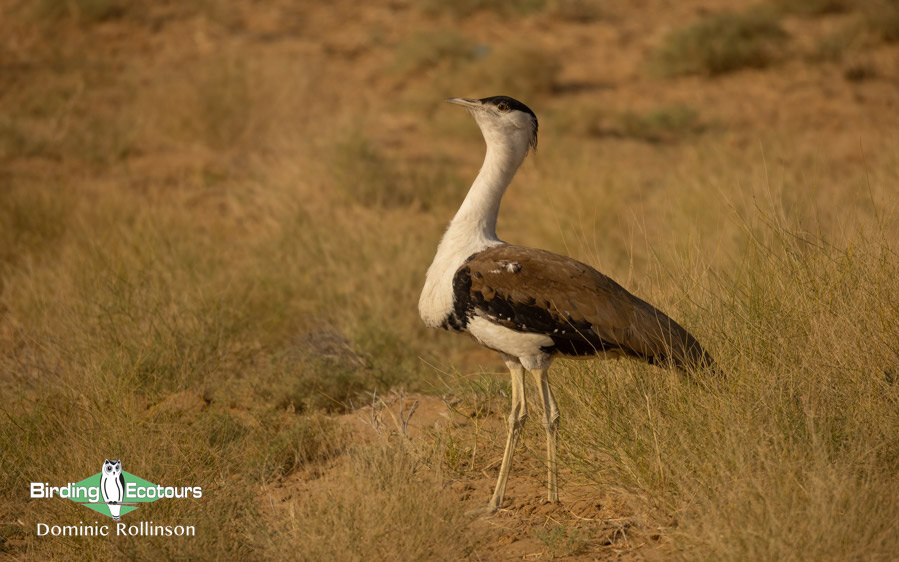
We couldn’t have asked for better views of this male Great Indian Bustard; voted bird of the trip!
Overview
Our 34-day journey across northern India proved to be an incredibly successful and enjoyable tour, covering an extraordinary diversity of habitats ranging from the salt flats and deserts of the west to the Himalayan foothills and lush jungles and grasslands of the northeast. Along the way we explored wetlands, coastal mudflats, arid scrub, river systems, montane forest, subtropical jungle and vast floodplain grasslands, all while enjoying a remarkable selection of birds, mammals and other wildlife. The tour also provided a fascinating insight into India’s rich culture, history and landscapes, with everything from bustling cities and remote villages to the iconic Taj Mahal adding to the overall experience.
We started the tour in Gujarat where the birding got off to a flying start around Nal Sarovar. The surrounding agricultural fields and wetlands held large numbers of cranes, larks and raptors, while one of the major highlights was finding a small group of Critically Endangered Sociable Lapwings feeding in open fields. Other memorable sightings around Nal Sarovar included Demoiselle Crane, Pallid Harrier, Pallid Scops Owl and thousands of wintering waterbirds.
Further west around Jamnagar we enjoyed some outstanding coastal birding. The mudflats and tidal areas at Sachana Beach were especially productive and provided one of the most memorable birding sessions of the trip. Huge numbers of waders gathered on the mudflats as the tide pushed in and we enjoyed wonderful views of the sought-after Crab-plover, with well over 200 birds present. Other highlights included Great Knot, Broad-billed Sandpiper, Terek Sandpiper, Eurasian Oystercatcher and Slender-billed Gull.
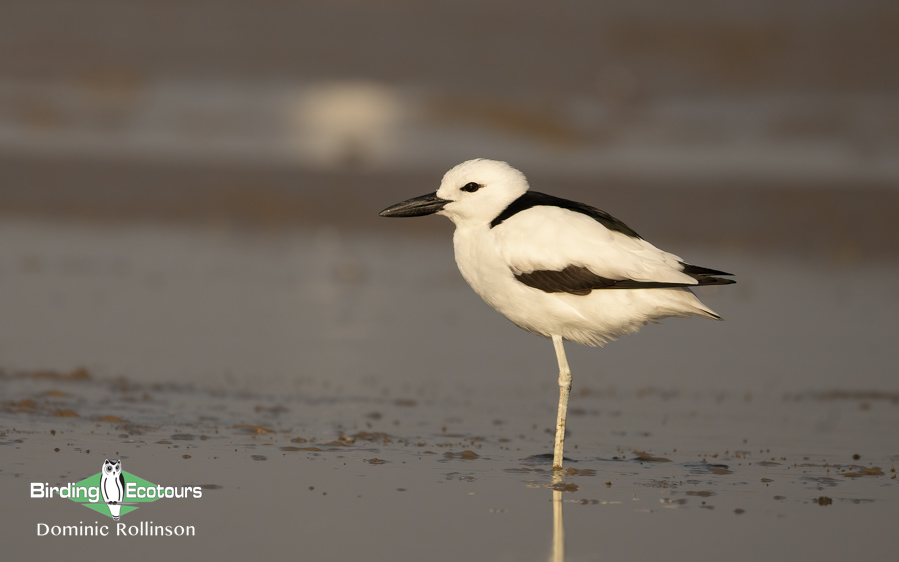
Large numbers of majestic Crab-plovers were seen at Jamnagar.
The Little Rann of Kutch offered a dramatic contrast, with its vast salt flats and harsh semi-desert landscapes. Jeep safaris through the Indian Wild Ass Sanctuary produced excellent looks at the Endangered Asian Wild Ass (Khur) as well as species such as Short-eared Owl, White Stork, Indian Stone-curlew, Chestnut-bellied Sandgrouse and several harrier species. One of the most unforgettable moments here was watching a massive flock of Demoiselle Cranes flying overhead at sunset, silhouetted perfectly against the glowing evening sky.
From Gujarat we flew north to Rajasthan and spent time exploring the fascinating landscapes of Desert National Park near Jaisalmer. The undoubted highlight here, and one of the defining moments of the entire tour, was our phenomenal sighting of Great Indian Bustard. After initially finding a distant group of females within the protected enclosure, we were later treated to sensational close views of a magnificent male that approached to within roughly 20–30 meters. It was an unforgettable encounter with one of the world’s rarest birds and ultimately voted bird of the trip. The desert areas also produced many other exciting species including Cream-colored Courser, Greater Hoopoe-Lark, Asian Desert Warbler, Eastern Imperial Eagle, Laggar Falcon and a remarkable vagrant Cyprus Wheatear, representing the first Indian record of the species. Mammal highlights included numerous Chinkara (Indian Gazelle) as well as an unexpected Indian Long-eared Hedgehog located using the thermal scope after dark.
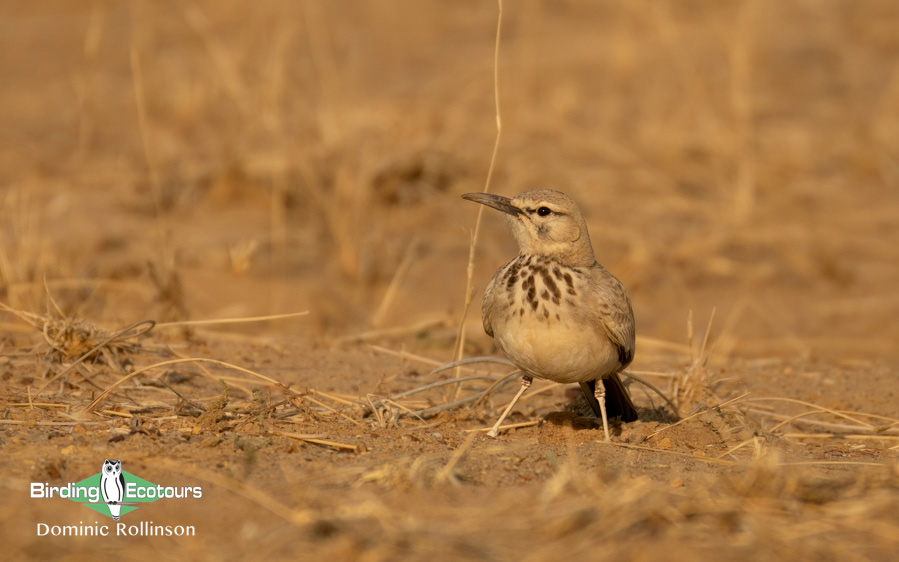
Greater Hoopoe-Lark showed well in Desert National Park.
At Tal Chhapar we enjoyed a productive mix of woodland and grassland birding. The beautifully camouflaged Indian Spotted Creeper showed exceptionally well while large numbers of elegant Blackbuck roaming the grasslands proved to be another major highlight. The area also held good numbers of vultures including Himalayan, Cinereous, Egyptian and Griffon Vultures, while the grasslands themselves produced Black Francolin, Short-eared Owl, Laggar Falcon and Hen, Pallid and Montagu’s Harriers.
The famous Ranthambore National Park provided some unforgettable safari experiences. Over the course of our drives we enjoyed multiple sightings of Tiger, including prolonged close-up views, while repeated encounters with Sloth Bear thrilled the group and eventually tied for mammal of the trip. Other mammals seen well included Sambar, Chital, Rhesus Macaque, Indian Fox and Ruddy Mongoose. Birding during the safaris was also excellent with species such as Painted Spurfowl, Brown Fish Owl, Bonelli’s Eagle, White-naped Woodpecker and Jungle Nightjar among the many highlights.
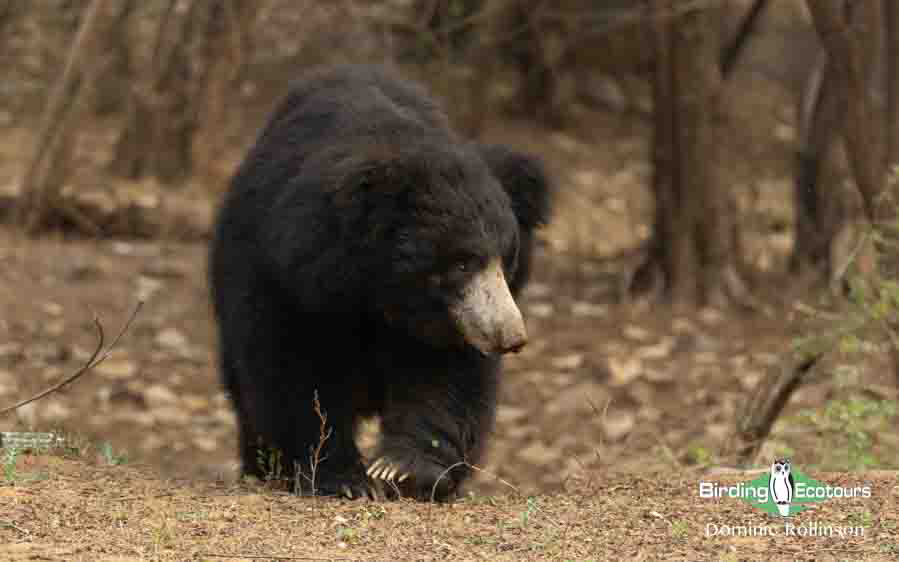
No less than three Sloth Bears were seen in Ranthambore National Park!
Nearby Bharatpur and Keoladeo National Park once again showcased just how spectacular birding in northern India can be. The wetlands teemed with waterbirds and other species, and we recorded an impressive 113 bird species in a single day. Some of the standout birds here included Sarus Crane, Black-necked Stork, Pheasant-tailed and Bronze-winged Jacanas, Dusky Eagle-Owl and Indian Spotted Eagle.
The Chambal River added a completely different dimension to the tour and our relaxed boat cruises proved both enjoyable and highly productive. Our main target here was the Endangered Ganges River Dolphin, and after some patient searching we eventually enjoyed repeated looks at these elusive mammals surfacing briefly in the river. We also had wonderful views of the highly distinctive Gharial, including several impressive adult males, along with multiple Mugger Crocodiles. Bird highlights along the river included Indian Skimmer, Black-bellied Tern, River Lapwing and large numbers of Small Pratincoles.
A visit to the iconic Taj Mahal provided a fascinating cultural break before we headed north into the Himalayan foothills of Uttarakhand. The forests around Sattal and Pangot produced a completely different suite of species and some truly exceptional birding. Time spent at bird hides allowed prolonged and often point-blank views of species such as Rufous-throated Partridge, Red-billed Leiothrix, Greater Yellownape, Blue-winged Minla and several species of laughingthrushes. Forested rivers yielded Brown Dipper, Spotted Forktail and Plumbeous Water Redstart, while higher elevations around Pangot produced specials such as Cheer and Koklass Pheasants, Altai Accentor, Fire-tailed Sunbird and the stunning Himalayan Rubythroat. The beautiful Himalayan scenery only added to the enjoyment of this leg of the tour.
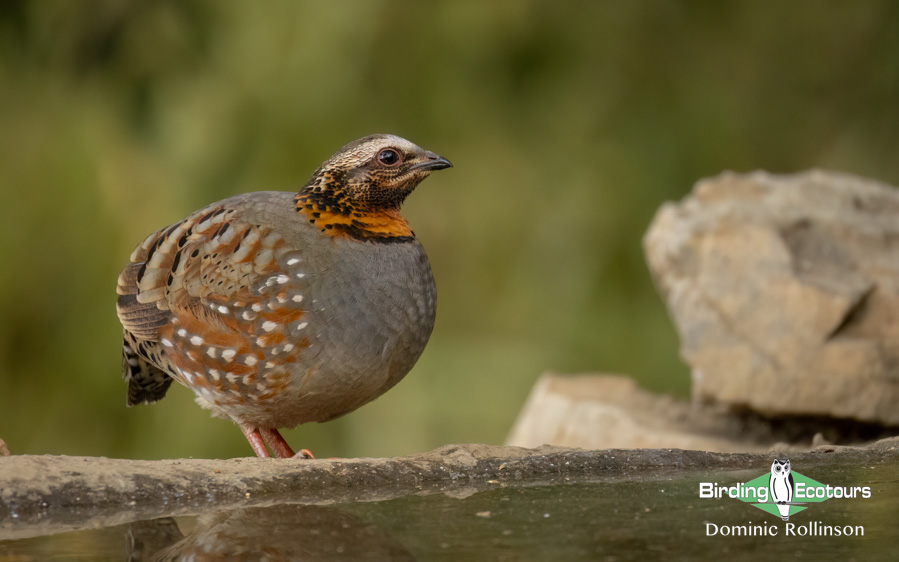
Rufous-throated Partridge from the bird hide at Sattal.
Descending once more into the lowlands, we explored the forests and grasslands of Jim Corbett National Park. The birding here was outstanding and included an excellent selection of woodpeckers, culminating in fantastic looks at the enormous Great Slaty Woodpecker, a major target species for the trip. Other highlights included Great Hornbill, Oriental Pied Hornbill, Common Green Magpie and eventually the much-wanted Wallcreeper along the Koshi River after considerable effort. Mammal sightings again proved excellent with Asian Elephant, Golden Jackal, Tiger and several deer species all seen well.
The final week of the tour took us into the wildlife-rich state of Assam in northeastern India. Near Guwahati we visited the famous landfill site where we enjoyed unbelievable views of numerous Critically Endangered Greater Adjutants, an unforgettable and rather surreal spectacle. We then continued to Manas National Park where lush forests and tall grasslands held an exciting mix of birds and mammals. Bird highlights included Bengal Florican, Collared Falconet, Blue-eared Barbet and Asian Fairy-bluebird, while mammals included Greater One-horned Rhinoceros, Asian Wild Buffalo, Capped Langur and eventually fantastic views of the mighty Gaur, the world’s largest wild cattle species and one of the primary mammal targets of the trip.
Our final destination was Kaziranga National Park, one of Asia’s great wildlife reserves and a fitting finale to the tour. The park held astonishing numbers of large mammals and we enjoyed repeated close encounters with Greater One-horned Rhinoceros, while herds of Asian Elephant, Asian Wild Buffalo and Hog Deer were seen daily. Birding was equally rewarding with highlights including Swamp Francolin, Blue-bearded Bee-eater, Pallas’s and Grey-headed Fish Eagles, Chinese Rubythroat, Greater and Lesser Adjutants and a pair of roadside Wreathed Hornbills on our final day, providing a wonderful ending to the trip.
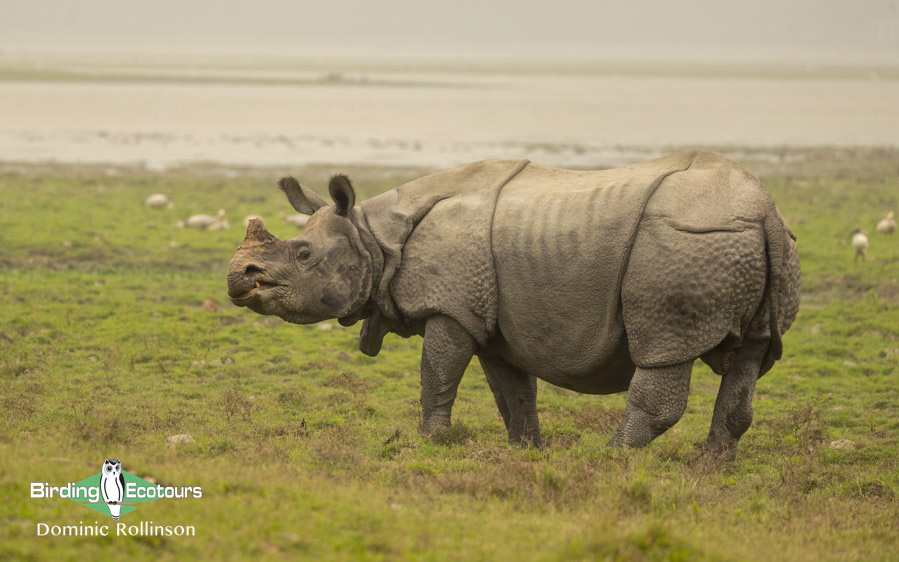
Large numbers of Greater One-horned Rhinoceros were seen in Kaziranga National Park.
By the end of the tour we had experienced an extraordinary cross-section of northern India’s wildlife and landscapes, enjoying countless memorable sightings along the way. From the close-range views of Great Indian Bustard in the deserts of Rajasthan to following Ganges River Dolphins along the Chambal River, watching Sloth Bears in Ranthambore, finding Cheer Pheasants high in the Himalayas, and finally watching massive Gaur in Assam, the trip was packed with unforgettable moments from start to finish. Combined with excellent food, wonderful local hospitality, exciting safari experiences and a fantastic group atmosphere throughout, this tour once again demonstrated why northern India remains one of the world’s premier wildlife and birding destinations.
Over this 34-day trip we saw an impressive 507 species of birds and 39 species of mammals. Dan, Bobby and Diane had created a vision board of the 80 top/most-wanted birds and animals to target on the trip and we ended up seeing 77 of these targets, which we were all very pleased about. The complete eBird trip report can be seen here and here (eBird trip reports are limited to 30 days).
Detailed Report
Day 1, 9th February 2026. Late arrival into Ahmedabad
Today was simply an arrival day with Dan, Bobby and Diane only arriving in the evening. It was great to see Dan and Bobby again after our highly successful South African birding tour back in 2022 and to finally meet Diane. We made the short transfer back to our hotel and excitedly discussed our 34-day trip ahead.
Day 2, 10th February 2026. Nal Sarovar birding and transfer to Jamnagar
We woke early and left Ahmedabad before sunrise and started the roughly two-hour drive to Nal Sarovar where we would spend a few hours birding the area before moving west to Jamnagar. We didn’t actually bird Nal Sarovar Bird Sanctuary but rather concentrated on the surrounding farmlands which were full of birds. Our first stop at a small pond added Baillon’s Crake, Green Sandpiper, Common Crane, Bluethroat and Red-headed and Black-headed Bunting. We then moved around the farmlands and highlights included Demoiselle Crane in amongst the many Common Cranes as well as Short-toed Snake Eagle, Booted Eagle, Pallid Harrier, Pallid Scops Owl, Indian Roller, Ashy-crowned Sparrow-Lark, Tree Pipit and thousands of Greater Short-toed Larks with a few Hume’s Short-toed Larks seen nearby. We also came across a small group of Indian Silverbills which Bobby managed some lovely photos of. Throughout the morning, we also saw several cute Indian Palm Squirrels, a species that would become very familiar with us over the next few weeks.
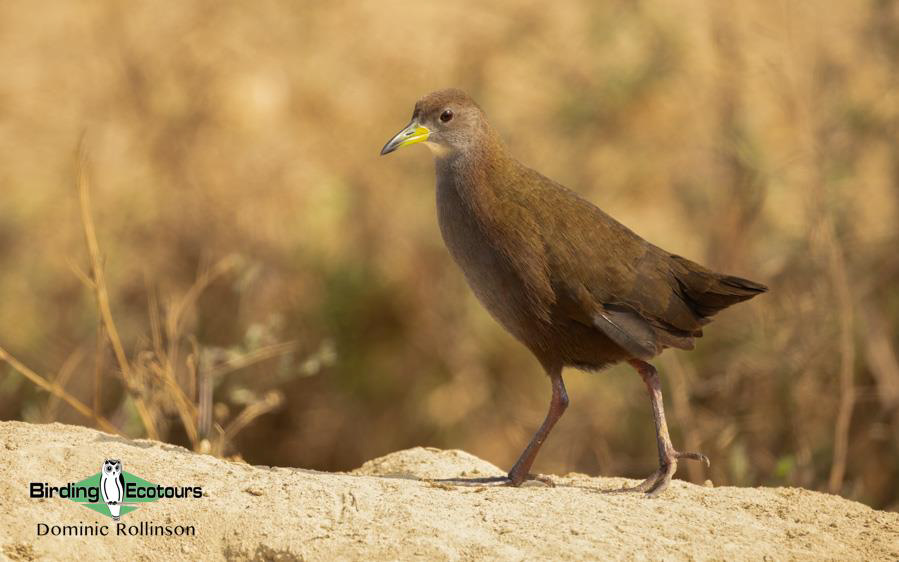
We couldn’t have asked for better views of Brown Crake near Nal Sarovar.
Our primary target around Nal Sarovar was, however, Sociable Lapwing and so later in the morning we moved to some agricultural fields where they had been seen recently and before we knew it, we had found a group of four Sociable Lapwings which showed very well for us. Before hitting the road for Jamnagar we made one final stop for a pair of very showy Brown Crakes. We then left Nal Sarovar, delighted with our morning’s birding success.
The rest of the day was spent on the road as we continued west to the busy town of Jamnagar where we were based for the next two nights; well positioned for some exceptional coastal birding!
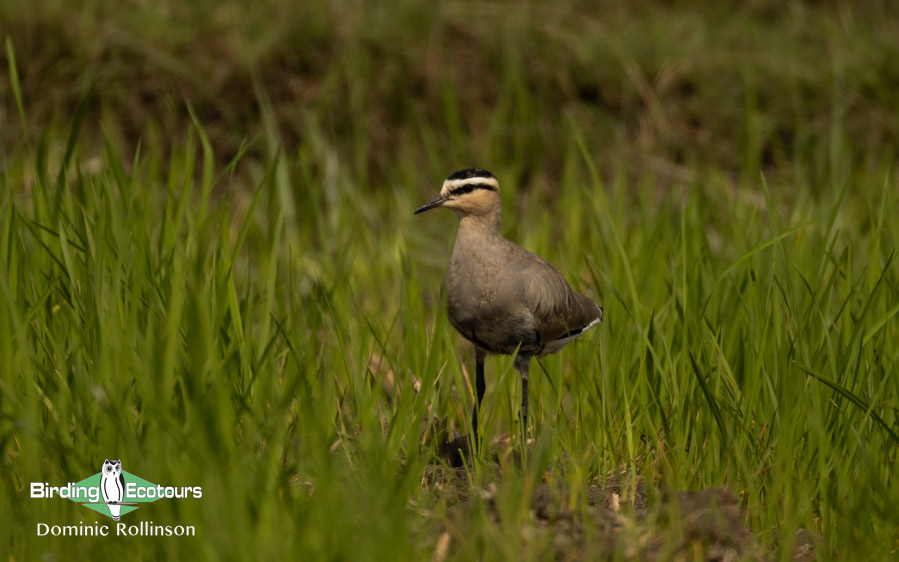
Sociable Lapwings were seen feeding in fields around Nal Sarovar.
Day 3, 11th February 2026. Coastal birding at Jamnagar
We started the day off by heading to Dhinchada Lake on the outskirts of Jamnagar where the new birds started rolling in. Here, there were large numbers of waterfowl and water-associated species including the likes of Knob-billed Duck, Gadwall, Indian Spot-billed Duck, Common Pochard, Common Snipe, Black-tailed Godwit, Marsh Sandpiper, Common Redshank, Black-headed, Brown-hooded and Pallas’s Gulls, Little, Gull-billed, Whiskered, River and Caspian Terns, Eurasian Spoonbill and Western Reef Heron. After a bit of work we eventually had close enough looks at a small group of Indian Skimmers, with a couple of Dalmatian Pelicans around too.
In the surrounding scrub and open areas we found Grey Francolin, Yellow-wattled Lapwing, Asian Koel, Asian Green Bee-eater, Isabelline Shrike, Sykes’s (Tawny) and Sand Larks, Clamorous Reed Warbler, Rosy Starling, Baya Weaver and Paddyfield Pipit.
We then made a short visit to some nearby salt works and mudflats where we found Grey Plover, Common Sandpiper, Common Greenshank, Little Stint and a small group of Lesser Flamingos (way off in the distance).
After our lunch and some downtime back at the hotel we excitedly headed out north of Jamnagar to Sachana Beach, with the number one target being Crab-plover: a monotypic family and very special wader. When we arrived the tide was far out and so we set about walking through the mudflats in the hopes of getting closer to the distant waders. As was expected, the tide, however, soon came in which pushed the masses of waders closer to us and we ended up having wonderful looks at an assortment of waders in the glorious late-afternoon light. We couldn’t have asked for better views of Crab-plover, and we estimated over 250 birds. Other standout species here included Great Stone-curlew, Eurasian Oystercatcher, Tibetan Sand and Greater Sand Plovers, Eurasian Whimbrel, Eurasian Curlew, Bar-tailed Godwit, Terek and Broad-billed Sandpipers, Great Knot, Dunlin, Ruddy Turnstone, Lesser Black-backed Gull and just a single Slender-billed Gull.
Content, we then made our way back to busy Jamnagar where we enjoyed another tasty meal and reminisced on another successful day in Gujarat.
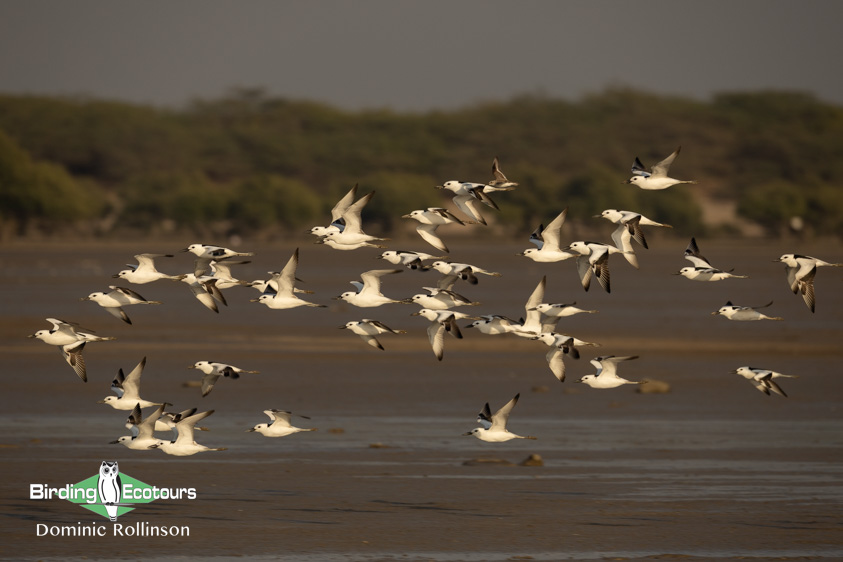
Large flocks of Crab-plovers on the mudflats near Jamnagar.
Day 4, 12th February 2026. Transfer to Little Rann of Kutch and Nava Talav birding
With nearly all the area’s targets seen, we decided to hit the long road northwest to Little Rann of Kutch nice and early to ensure we could enjoy some late afternoon birding later. Along the drive we made a few roadside stops for species such as Brahminy and Black-winged Kites, Chestnut-bellied Sandgrouse (we’re still not sure how Mahesh spotted these!), and our first Nilgai of the trip.
We arrived at the oasis which was to be our camp for the next two nights at around lunchtime and enjoyed a superb meal with excellent and friendly hospitality. Later that afternoon we headed to nearby Nava Talav Lake where we spent the remainder of the afternoon enjoying some fine waterbirds and many other species. Waterbird highlights included Greylag Goose, Ruddy Shelduck, Cotton Pygmy Goose, Garganey, Ferruginous Duck, Common Crane, Little Ringed Plover, Temminck’s Stint, Great Crested Grebe and Eurasian Spoonbill. The nearby open areas and scrubby patches further yielded Sykes’s Nightjar (flushed from its day roost), Eurasian Wryneck, Isabelline Shrike, Rufous-tailed Lark, Sykes’s Warbler, Eastern Orphean Warbler, Lesser Whitethroat, Pied Bush Chat and Yellow-throated Sparrow. The afternoon ended spectacularly as a massive flock of Demoiselle Cranes flew low overhead, silhouetted against the setting sun, a moment none of us will forget.
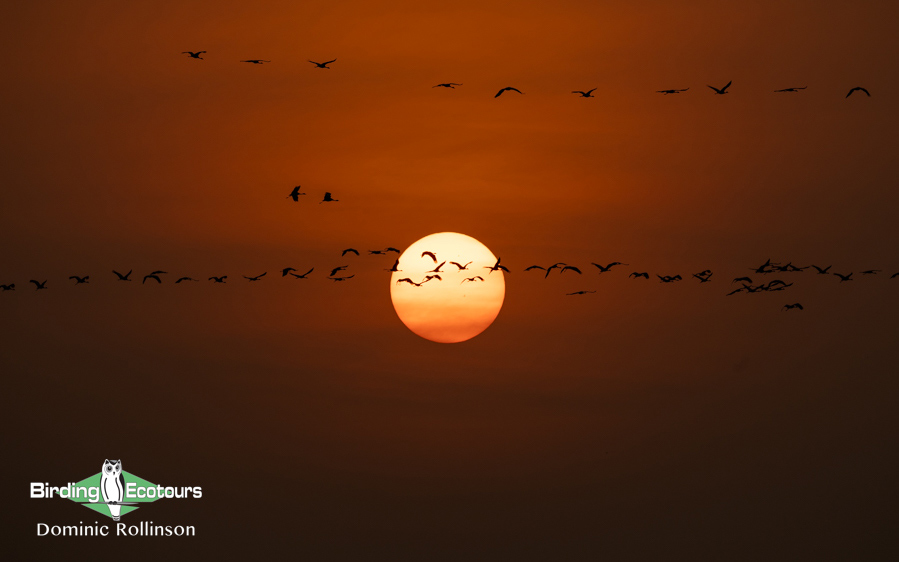
Demoiselle Cranes seen at sunset near Little Rann of Kutch.
Day 5, 13th February 2026. Birding Little Rann of Kutch
The Little Rann of Kutch is the remnant of an ancient shallow sea that was cut off by tectonic uplift and gradually filled with sediment, leaving a flat basin that floods in the monsoon and dries into salt flats each year. This otherworldly, harsh environment is where we spent the morning on our first jeep safari of the tour. We spent time in the Indian Wild Ass Sanctuary which protects a healthy population of the southern subspecies of Asian Wild Ass, also known as Onager or Khur. It did not take long to locate the day’s target mammal species, and we enjoyed fine views of this rare species. We of course had many bird targets here, with Asian Houbara being top of the list. Unfortunately, despite a concerted effort, we could not find any of the area’s few houbaras and had to accept defeat here.
Despite not finding any houbaras we still had an excellent morning out, with highlights including Chestnut-bellied Sandgrouse, Indian Stone-curlew, White-eyed Buzzard, Crested Lark, Common Kestrel, Long-billed Pipit and multiple Montagu’s Harriers. Shortly before our drive came to an end we were relieved to get good looks at a single Short-eared Owl (well spotted, Diane); another of the area’s big targets. We also managed to find a few Red Foxes (of the Desert subspecies) while out on our safari drives.
We then headed back to our lovely lodge where we enjoyed another tasty lunch, with Purple-rumped Sunbird and Common Tailorbird seen on a short walk after our meal.
In the mid-afternoon we headed out for our second jeep safari of the day back into the sanctuary where we birded along the Bajana Creek. The afternoon started off with a bang when we spotted a group of thirteen elegant White Storks. White Storks are Dan’s favorite bird on the planet, and we were thrilled to be able to enjoy this special species for an extended period. We eventually tore ourselves away from the storks and then continued birding along the edge of the lake.
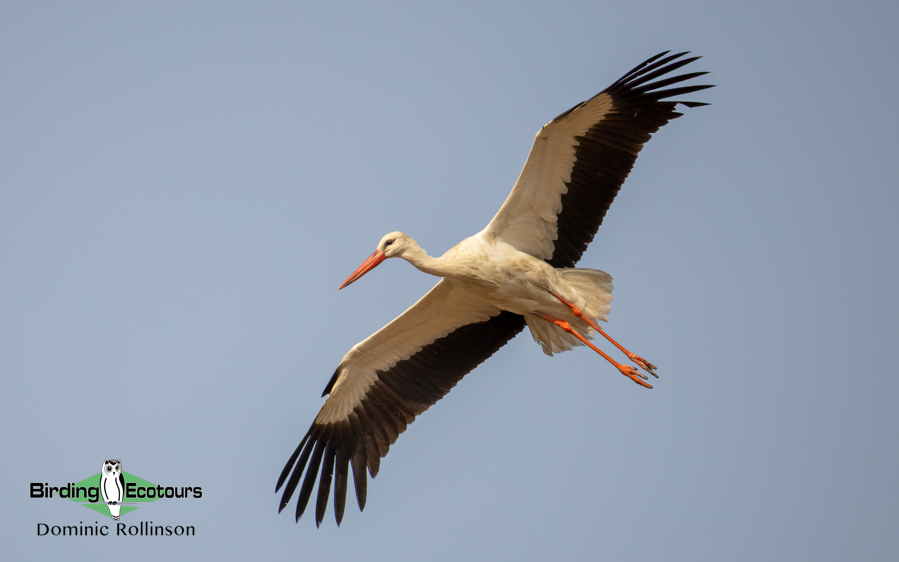
A small group of wintering White Storks was one of our many highlights in Gujarat.
Further birding along the lakeshore we picked through an impressive assortment of waterbirds with Greylag Goose, Ruddy Shelduck, Garganey, Indian Spot-billed Duck, Northern Pintail, Common Pochard, Tufted Duck, Grey-headed Swamphen, Kentish Plover, Black-tailed Godwit, Common Snipe, Spotted Redshank, Temminck’s Stint, another White Stork, and large flocks of Greater and Lesser Flamingos. In the surrounding scrubby areas we found Greater Spotted Eagle, Western Marsh and Montagu’s Harriers, Isabelline Shrike, Rufous-fronted Prinia, Bluethroat and Indian Silverbill.
To finish the day we birded a nearby area where we heard many Indian Nightjars and eventually had good looks of a bird that flew over, with Indian Stone-curlew heard calling nearby too.
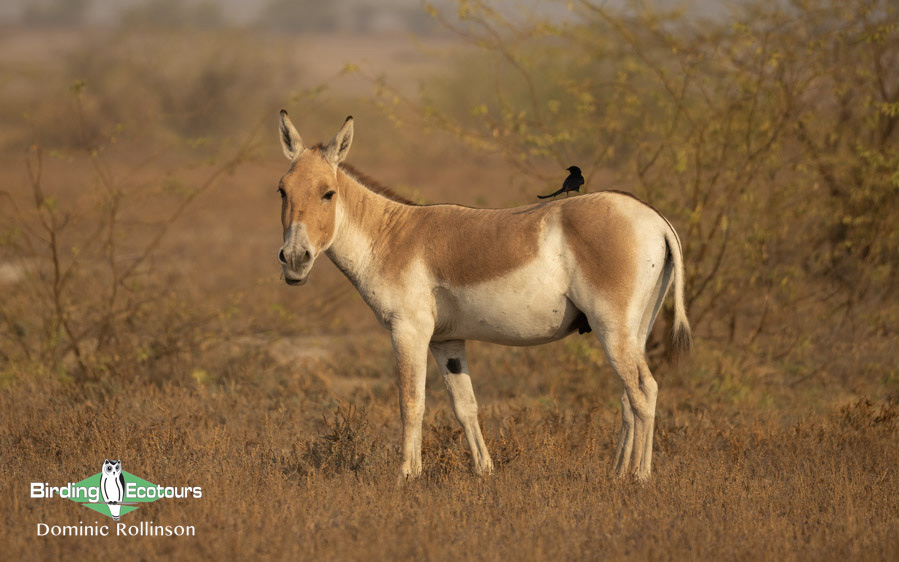
Asian Wild Ass were seen in good numbers around the dry saltpan of Little Rann of Kutch.
Day 6, 14th February 2026. Transfer to Desert National Park
Today was almost exclusively a travel day. We had a very early start as we drove to Ahmedabad to catch an early morning flight to Jodhpur and then undertook the long drive from Jodhpur to our lovely desert camp in Desert National Park, not too far from Jaisalmer. Not far from Jaisalmer we had a couple of interesting birds, which we would see commonly over the next few days, including Steppe and Short-toed Eagles and Variable Wheatear.
This evening we enjoyed dinner under the stars, with Sykes’s Nightjar calling and briefly flying overhead. A lovely finish to a very long and tiring day of travel, we then went to bed excited about our time ahead exploring an entirely new part of northwest India!
Days 7-8, 15-16th February 2026. Exploring and birding Desert National Park and surrounds
Over the next two full days we covered a lot of ground in the greater Desert National Park and the surrounding areas and managed to track down many of our target birds and animals. It was lots of fun exploring an entirely new habitat and ecosystem which meant that many of the species encountered were new for the trip, with many lifers seen.
The most important target for our time in Desert National Park was Great Indian Bustard and so we concentrated on this on our first morning here. It did not take long to locate a group of around ten female Great Indian Bustards within the predator-proof enclosure which unfortunately meant we could not move any closer and had to enjoy scope views from a considerable distance away. We were pleased to see them but for perhaps the most wanted bird of the trip, we had hoped for better views. We needn’t have worried, though, as about 30 minutes later we found a relaxed male which approached down to around 20–30 meters and provided us with the most incredible and lengthy views. Our time in Desert National Park could not have got off to a better start.
Other important birds seen in this area included Chestnut-bellied Sandgrouse, Cream-colored Courser, Egyptian, Cinereous and Griffon Vultures, Eastern Imperial Eagle, Pallid Harrier, Merlin, Laggar Falcon, Great Grey Shrike, Bimaculated Lark, Black-crowned Sparrow-Lark, White-browed Bush Chat, Isabelline, Desert and Variable Wheatears and Tawny Pipit.
We made a special trip out to find a vagrant Cyprus Wheatear (the first Indian record) and easily found the male which showed wonderfully well for us. We also twitched a nearby female Finsch’s Wheatear but, unfortunately, could not find this particular individual, despite some confusion with the very similar Desert Wheatear! We did, however, find a cooperative Asian Desert Warbler (typically foraging alongside Desert Wheatears) and had more good looks at Steppe Eagle and Cinereous Vulture.
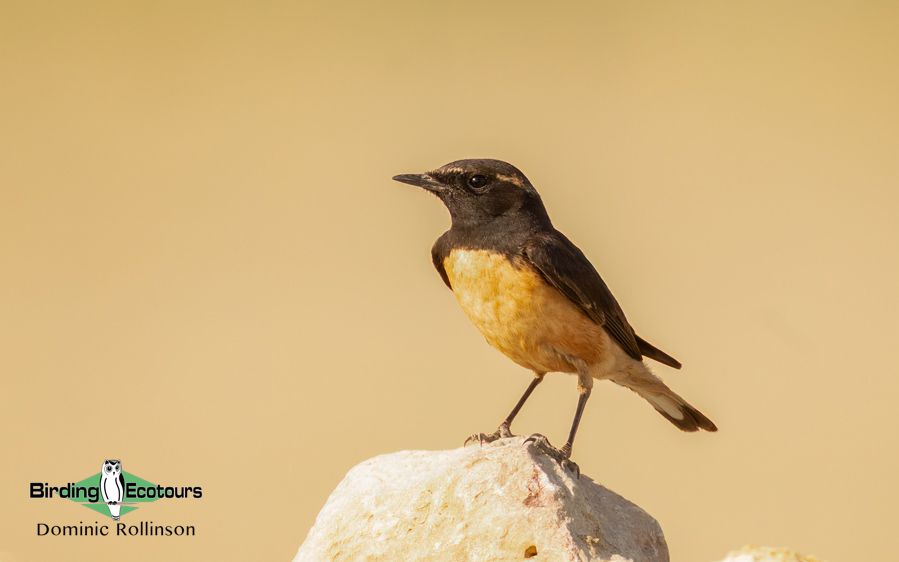
We twitched this vagrant Cyprus Wheatear in Desert National Park; a first for India!
We also visited some barren plains where we found a confiding pair of Greater Hoopoe-Larks as well as Desert Lark, Red-tailed (Persian) Wheatear, Long-legged Buzzard and Trumpeter Finch. A small seasonal pan held a good assemblage of waterbirds including Northern Shoveler, Eurasian Wigeon, Mallard, Ferruginous Duck, Green Sandpiper, Common Greenshank, River Tern and Western Marsh Harrier.
Other species of interest seen around Desert National Park included Tawny Eagle, Grey Francolin, Asian Green Bee-eater, Crested Lark, White-eared Bulbul, White-browed Fantail and Common Kestrel. Chinkara (Indian Gazelle) were fairly abundant throughout the park, but always in low numbers and always seemingly too far away for decent photos.
While driving back to our camp on one of the evenings, we managed to find an Indian Long-eared Hedgehog in the thermal scope which is always a treat to see!
Day 9, 17th February 2026. Transfer to Tal Chhapar
Today was mostly a travel day as we made our way a long way east to Tal Chhapar. We did, however, find time for an early morning stop at Akal Wood Fossil Park where we struck gold with an Indian Eagle-Owl with a couple juveniles around too. Here we also added Striolated Bunting as well as a few more Trumpeter Finches.
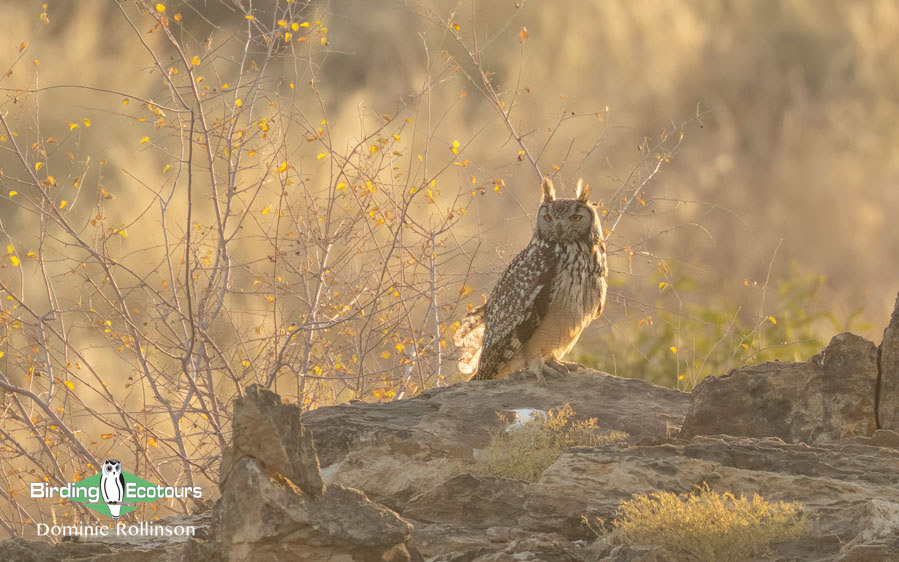
We were delighted with this Indian Eagle-Owl near Desert National Park.
We arrived in Tal Chhapar in the late afternoon and got our first glimpses of the beautiful and highly numerous Blackbuck, as we made our way through woodlands on the outskirts of town; with many more sightings to come tomorrow.
Day 10, 18th February 2026. Birding Tal Chhapar
We had the full day to bird the woodlands and grasslands around Tal Chhapar and started off the day birding woodlands on the edge of town for Indian Spotted Creeper. It did not take long until we heard the distinctive high-pitched song of the creeper, and we were soon enjoying prolonged views of a pair of these delightful birds, as they scurried up and down lichen-clad branches, showing off their incredibly camouflaged plumage! Many other exciting species were seen in the woodlands here including Shikra, Booted Eagle, Eurasian Wryneck, Yellow-crowned Woodpecker, Black-rumped Flameback, Small Minivet, Common Woodshrike, Bay-backed and Great Grey Shrikes, Delicate Prinia, Booted and Eastern Orphean Warblers, Yellow-throated Sparrow and Tree Pipit. The open areas (littered with cattle carcasses) attracted good numbers of vultures including Himalayan, Cinereous, Griffon and Egyptian Vultures, with Red-naped Ibises also picking from the bones and Indian Stone-curlew seen in the heavily grazed grasslands. Another huge highlight of the morning was getting fantastic views of the large numbers of Blackbuck; surely one of the world’s most attractive antelope species, with smaller numbers of Chinkara (Indian Gazelle) seen too.
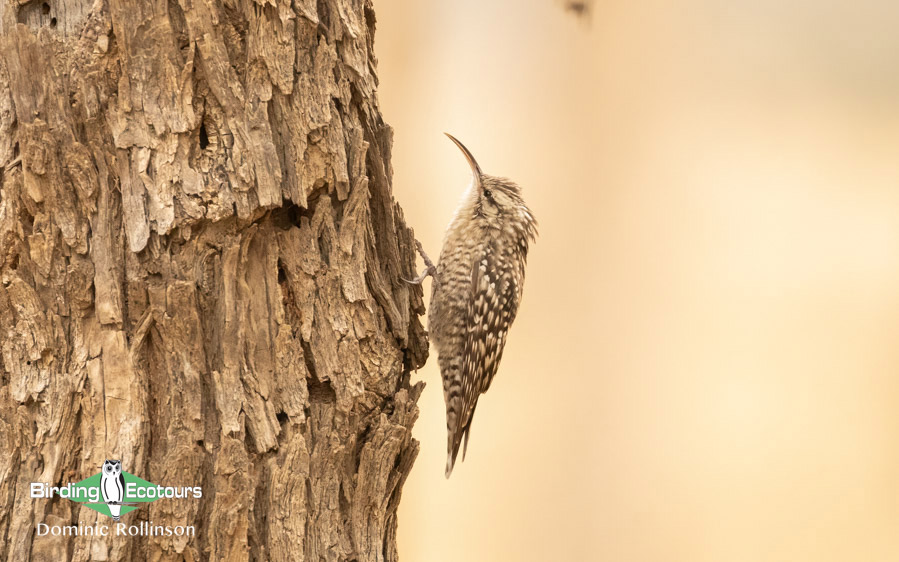
Indian Spotted Creepers were seen in teak woodlands around Tal Chhapar.
We then had some time off before and after lunch and headed back out again in the late afternoon, this time to bird the grasslands of Tal Chhapar Sanctuary. Highlights from the afternoon’s safari drive included Black Francolin, Chestnut-bellied Sandgrouse, Tawny Eagle, Hen, Pallid and Montagu’s Harriers, Indian Scops Owl, Spotted Owlet, Short-eared Owl, Indian Roller, Laggar Falcon, Siberian Stonechat and Long-billed Pipit. We again enjoyed the large numbers of Blackbuck, some of which posed beautifully in the afternoon light.
Day 11, 19th February 2026. Tal Chhapar birding and transfer to Jaipur
We spent most of the morning birding the outskirts of Tal Chhapar, including open fields, salt works and a large dam which yielded a good assortment of species. Some of the highlights of the morning included Gadwall, Ferruginous Duck, Small Pratincole, Pallid Harrier, Long-legged Buzzard, White-tailed Lapwing, Gull-billed Tern, Black Redstart and White-browed Wagtail. We had hoped for views of Red-necked Falcon but, unfortunately, we ran out of luck with this species. As is usually the case around Tal Chhapar, we also saw numbers of Blackbuck scattered around the woodlands.
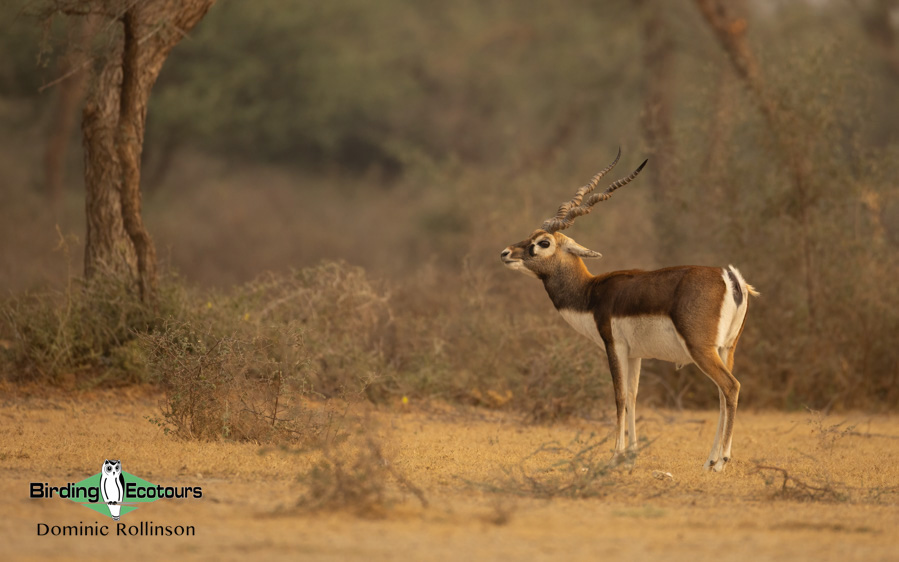
Blackbuck were seen in large numbers around Tal Chhapar; surely one of the world’s most attractive antelope species.
We then started the long drive southeast to Jaipur, which would act as stopover point between here and Ranthambore National Park. We did break the long drive with a birding stop in some woodland near Sikar which yielded White-tailed Iora, Bay-backed Shrike and a brief flock of Alpine Swifts overhead. The remainder of the afternoon was spent traveling to Jaipur, only arriving after dark at our palatial accommodation.
Day 12, 20th February 2026. Transfer to Ranthambore and our first safari drive
Most of the morning was spent traveling south to the famous Ranthambore National Park, to enjoy our first safari drive that afternoon. We had a few interesting bird species en route including Indian Grey Hornbill, Indian Cuckooshrike, Eastern Red-rumped Swallow and Indian Pied Myna. A roadside pan and some open fields added Red-crested Pochard, Yellow-wattled Lapwing, Spotted Redshank, Streak-throated Swallow, Red Avadavat (much to Bobby’s delight) and Citrine Wagtail. Unfortunately, we could not find any Indian Coursers (for now).
After our lunch we loaded into our safari jeep for our first of four Ranthambore safari drives. That afternoon we were assigned Zone 2. This drive was one to remember and it started off really well with many new bird species including the likes of Painted Spurfowl, Black Stork, Crested Serpent Eagle, Bonelli’s Eagle, Brown Fish Owl, White-naped Woodpecker, Plum-headed Parakeet, Common Iora, Large-billed Crow, Grey-headed Canary-flycatcher, Cinereous Tit, Tickell’s Blue Flycatcher, Taiga Flycatcher and Grey Wagtail. It was, however, the mammals that stole the show today: Chital (Spotted Deer), Sambar deer and Eurasian Wild Pig were common throughout this zone, as were Rhesus Macaque and Bengal Sacred Langur. We also got lucky with a couple brief views of Ruddy Mongoose, and the afternoon ended with a bang when we had sensational, prolonged views of a confiding Tiger, and even better when Mahesh somehow spotted a Sloth Bear, although our views were a little distant and brief.
That evening we enjoyed another tasty Indian meal and toasted to our success of finding both Tiger and Sloth Bear on our first safari drive! We even had brief views of flyby Savanna Nightjar nearby to our hotel.
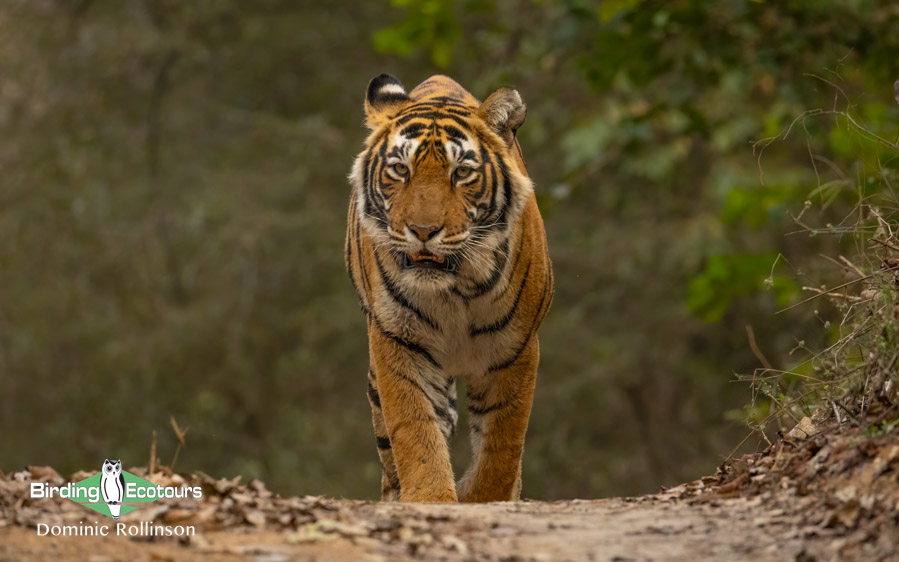
Our first safari drive in Ranthambore produced exceptional views of Tiger.
Day 13, 21st February 2026. Ranthambore National Park
This morning we had another safari drive and this time in Zone 10, which was a bit of a drive from our hotel. Soon into our drive we again got very lucky with amazing views of a Sloth Bear as it went about feeding. As is often the case at sightings of charismatic mammals in India, it was a bit chaotic, with many jeeps jockeying for position, however, we waited it out, and eventually we were left to enjoy the animal all on our own, with views down to a couple meters! We were elated as the previous day’s sighting had not quite been what we had hoped for.
The rest of the drive proved full of birds and we saw the likes of Spotted Dove, Yellow-footed Green Pigeon, White-breasted Waterhen, Greater Painted-snipe, Asian Woolly-necked Stork, Coppersmith Barbet, Brown-capped Pygmy Woodpecker, White-bellied Drongo, Grey-breasted Prinia, Brahminy Starling, Red-breasted Flycatcher and White-capped Bunting.
Back at our accommodation we enjoyed a late breakfast, which was delicious. Afterwards we went for a walk around in the scrub surrounding our hotel, which proved very productive with a few new species seen. Highlights of this walk included Painted Sandgrouse, Greater Painted-snipe, Black-tailed Godwit, Crested Honey Buzzard, Common Hoopoe, Ashy Prinia, and Yellow-eyed Babbler. Mahesh did really well to spot an Indian Fox, and we enjoyed our best views of the trip of this timid species. By this point it had warmed up and we decided to go cool down and take it easy for a while before our afternoon safari drive.
It was Zone 3 for our afternoon safari drive and we enjoyed driving through this picturesque zone, with Ranthambore Fort as a backdrop to the many tranquil lakes and forest patches. This is a very reliable zone for Tiger sightings, and this afternoon was no different as we found a young female relaxing in the shade and then had glimpses of a male nearby. The birding was, of course, great too, and we enjoyed sightings of Lesser Whistling Duck, Painted Spurfowl, Great Stone-curlew, River Tern, Asian Openbill, White-naped Woodpecker, Indian Cuckooshrike, Common Iora, Siberian Stonechat and White-browed Wagtail. As we were leaving the park, we stumbled upon a long line of jeeps all trying to leave. As we made our way through the queue we realized what the commotion was about when we saw yet another Sloth Bear, this animal enjoying a good scratch up against a tree! This evening we enjoyed a lovely meal out under the stars and again celebrated another day of unbelievable wildlife sightings.
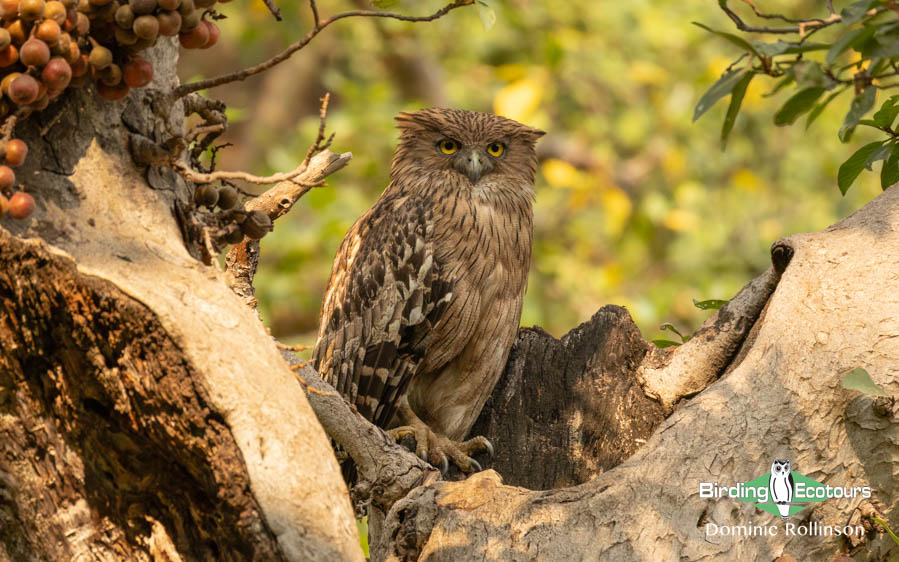
Ranthambore is an excellent park for views of Brown Fish Owl.
Day 14, 22nd February 2026. Ranthambore safari and transfer to Bharatpur
This morning was our final Ranthambore safari drive and as we had a longish drive ahead of us (with a few birding stops en route), we decided to make this safari a shortened one. Despite the truncated drive we still managed to find a few interesting birds such as Black Stork, Crested Serpent Eagle, Spotted Owlet, Stork-billed Kingfisher and a roosting Jungle Nightjar that Mahesh somehow managed to spot!
We then came back to the hotel for breakfast, packed our bags and boarded the bus, and started the drive northeast to Bharatpur. We again stopped at the same fields as a couple days prior, and this time got lucky with lovely views of a small group of Indian Courser. Next up was Bayana, where we found small numbers of roosting Indian Vultures, a species we had surprisingly missed in Ranthambore.
After a long busy day, we made it into our grand hotel where we would be based for the next three nights and enjoyed another tasty Indian dinner.
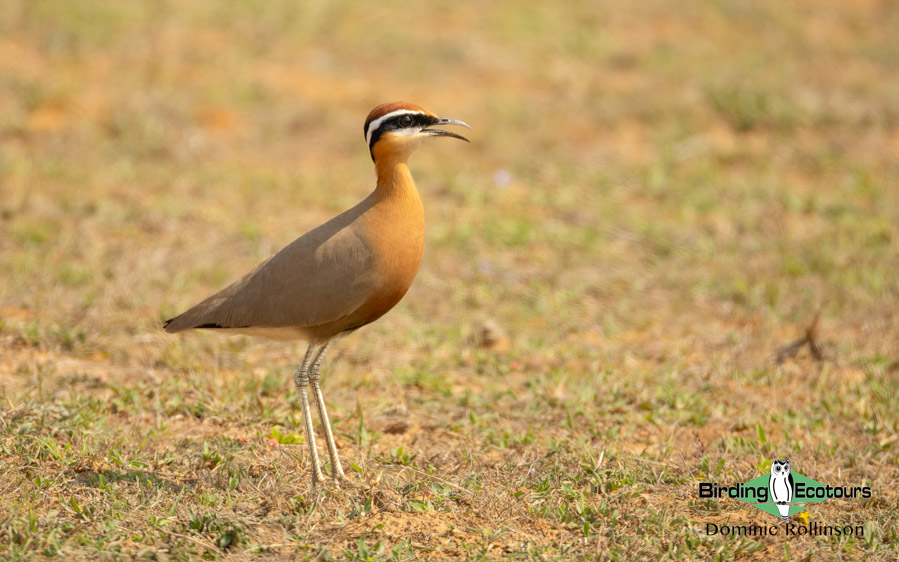
Indian Coursers were seen in agricultural fields near Ranthambore.
Day 15, 23rd February 2026. Full day in Keoladeo National Park
Today was yet another early start and we then made our way to the entrance of Keoladeo National Park, where we boarded our motorized rickshaw and headed into the park. Keoladeo was, as always, bustling with waterbird activity, however, as we hoped for a chance of finding Striped Hyena we made our way quickly through the park to a point where Mahesh had seen them before. We ate our breakfast here and waited a while but, unfortunately, we did not see the hyena., although we did have lovely views of Chital in the early morning mist!
The rest of the day was spent moving around the park, birding the various ponds and wetlands, with a tasty lunch break taken while avoiding cheeky birds. We recorded 113 species of birds today, with some of the major highlights including Cotton Pygmy Goose, Red-crested Pochard, Sarus Crane, Grey-headed and White-tailed Lapwings, Pheasant-tailed and Bronze-winged Jacanas, Black-necked Stork, Black Bittern, Osprey, Indian Spotted Eagle, Dusky Eagle-Owl, Indian Golden and Black-hooded Orioles, Blyth’s Reed and Clamorous Reed Warblers, Greenish Warbler and Western Yellow Wagtail.
After a long but incredibly bird-filled day, we headed back to our hotel for our dinner and well-deserved night’s rest.
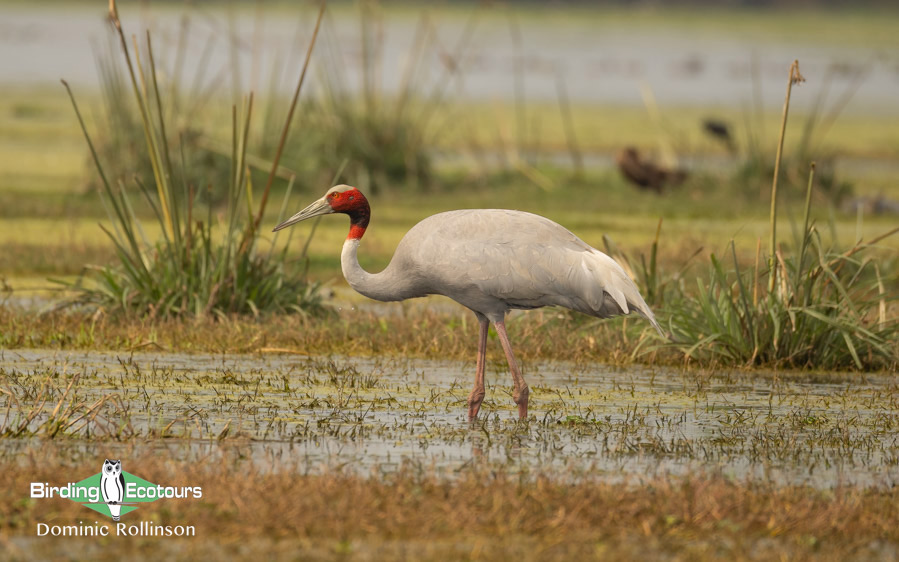
Sarus Cranes are usually a sure bet at Keoladeo National Park.
Day 16, 24th February 2026. Chambal River cruise and afternoon of rest
We excitedly left our hotel early and headed south to the Chambal River at Dhaulpur. Just before boarding our private boat we had our first brief looks at Blue Rock Thrush and then we quickly munched down our breakfast and headed out onto the river. Our primary target this morning was Ganges River Dolphin. Once widespread across northern India’s river systems, their numbers have declined drastically due to pollution, dam construction, accidental entanglement in fishing nets, reduced river flow, sand mining, and heavy boat traffic. It did not take long until our river guide spotted a few ripples at the surface and, after a game of hide-and-seek, we all eventually managed to see enough of the animals. It was hard work getting views as they would seemingly surface at random and without any warning, and if you happened to be looking in another direction you would miss it!
Once we had our fill of the dolphins, we concentrated on Gharial crocodiles, which proved to be rather numerous along the banks of the Chambal River. The fish-eating Gharial is one of the most distinctive and elegant crocodilians in the world, instantly recognizable by its remarkably long, slender snout, lined with an impressive array of interlocking teeth. We also saw a number of mature males, which develop a curious bulbous growth at the tip of the snout, known as a “ghara”, which gives the species both its name and much of its character. We also saw several large Mugger Crocodiles on this boat cruise.
With the morning’s top two animal targets seen, we found an assortment of bird species including Ruddy Shelduck, Bonelli’s Eagle, Great Stone-curlew, River Lapwing, Temminck’s Stint, Black-bellied Tern, Jungle Prinia, Brown Rock Chat and Citrine Wagtail. After an enjoyable couple of hours out on the water we headed back to shore and drove back to Bharatpur. We grabbed lunch and then enjoyed a planned afternoon off – with this being a 34-day trip, we had purposely scheduled in a couple days or afternoons to rest and recharge the batteries.
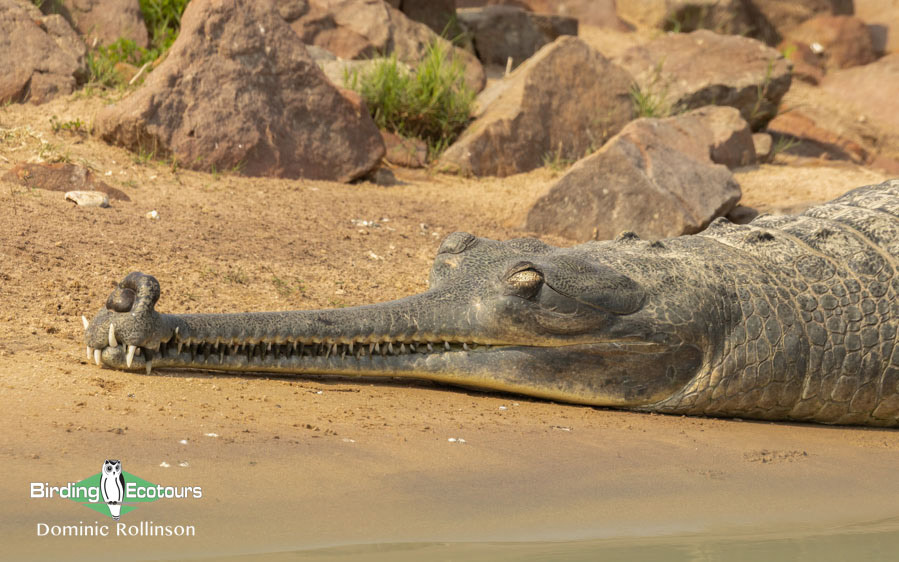
Gharials were common along the Chambal River.
Day 17, 25th February 2026. Transfer to Chambal Safari Lodge and afternoon river cruise
A more relaxed start was decided on this morning (very much a rarity), and we had a walk around the hotel garden, with Brown-headed Barbet being the only noteworthy addition. We then loaded the bus and made our way to Chambal Safari Lodge. Upon arrival we enjoyed a quick walk around the lush lodge grounds. On this walk we found Indian Scops Owl, Coppersmith Barbet, Red-whiskered Bulbul, Greenish Warbler, Orange-headed Thrush and a small colony of noisy Indian Flying Foxes. After our walk we enjoyed a delicious lunch and some time off.
Later that afternoon we made our way back to the Chambal River, this time at the National Chambal Sanctuary at Jaitpur for our second Chambal River boat cruise. We made a stop for some birding in some scrub before the river and, despite our best efforts, we could only hear Jungle Bush Quail, and they would not show for us. This boat cruise proved to be incredibly fun and relaxing, and we again managed an impressive assortment of birds and other wildlife. We also again managed brief looks at Ganges River Dolphins, and Bobby even managed a pic of one breaking the surface! Highlights from the afternoon included Great Stone-curlew, River Lapwing, Pallas’s Gull, Black-bellied Tern, large numbers of feeding Small Pratincoles and amazing point-blank looks at large numbers of Indian Skimmers. We ended the cruise with an impressive sunset and the unusual buzzing noise of male Gharial crocodiles, made by the bulbous snouts!
This evening we took a night walk around the lodge grounds and very easily found Northern Palm Civet, as well as a few Indian Hares feeding on the lawn.
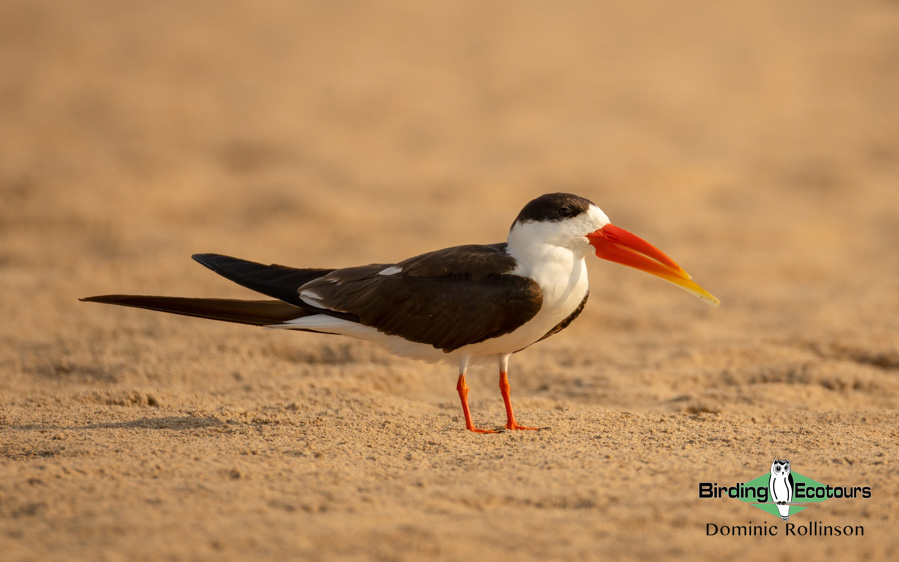
Indian Skimmers showed beautifully in the afternoon light along the Chambal River.
Day 18, 26th February 2026. Taj Mahal and transfer to Noida
We left our lodge before dawn this morning to ensure we would be at the Taj Mahal around sunrise (when the gates open) to enjoy this UNESCO World Heritage Site. Despite our early arrival in Agra, the Taj Mahal was already teeming with visitors and it took a while to get into the monument grounds. We then spent a thoroughly enjoyable couple of hours enjoying the Taj Mahal from many different angles in the glorious early morning light. Our site guide informed us of the fascinating story of the mausoleum, and we spent some time getting photos (the Princess Di bench proving particularly popular).
When we had had our fill of the Taj Mahal we hit the road north to Noida and then enjoyed the rest of the afternoon at our leisure, which was most welcome after the hustle and bustle of Agra.
Day 19, 27th February 2026. Transfer to Sattal, and afternoon birding
This morning we headed north to the Himalayan foothills, which meant the entire morning was spent traveling. We eventually arrived at our charming hotel set in amongst tall forest on the edge of the village of Sattal. After checking in we had lunch and then headed out birding for the late afternoon.
We headed to the Chaffi River area where we found a Tawny Fish Owl roosting in a large tree alongside the river. In the area we also found Asian Barred Owlet, Common and Crested Kingfishers, Great Barbet, Himalayan Black-lored Tit, Black and Himalayan Bulbuls, Grey-hooded Warbler, Streaked Laughingthrush, Blue Whistling Thrush, Spotted Forktail, Plumbeous Water and White-capped Redstarts and Common Rosefinch. We also spent an enjoyable 20 minutes or so, watching and photographing a pair of Brown Dipper that were coming back and forth to a nest under an overhanging rock.
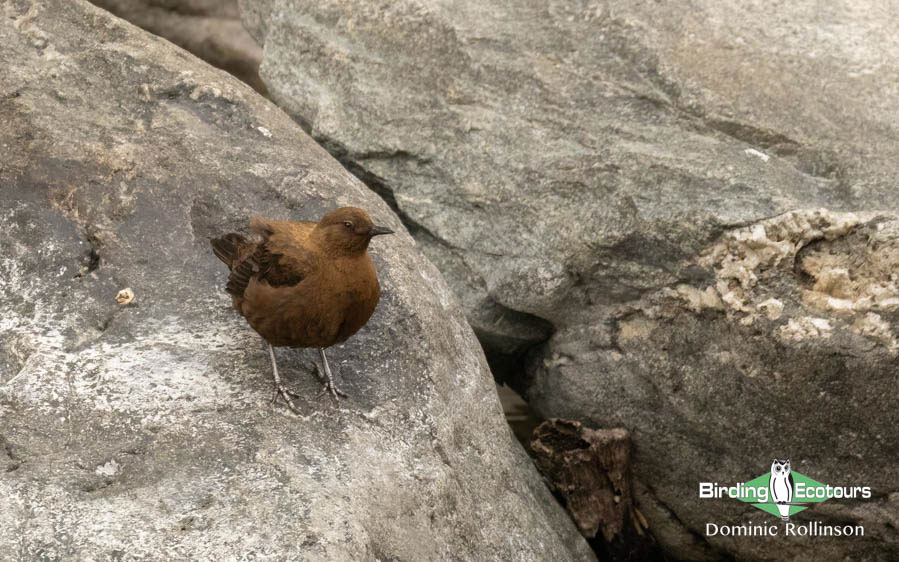
Brown Dippers were nesting along the Chaffi River near Sattal.
After a great start to our first afternoon in the Himalayan foothills we headed back for dinner and spent some time trying to see the Large-tailed Nightjars and Mountain Scops Owls calling in the trees around our hotel, but despite our best efforts we could not get any visuals tonight.
Day 20, 28th February 2026. Sattal birding
It was with great anticipation that we headed out, armed with our breakfast packs, to a nearby bird hide. The bird hide did not disappoint, and we spent a thoroughly enjoyable two hours in the bird hide, watching the non-stop flow of new and exciting birds coming in to eat and drink. The highlights from our time at the hide were many, but some of the best birds included Rufous-throated Partridge, Kalij Pheasant, Common Emerald Dove, Great Barbet, Brown-fronted and Grey-headed Woodpeckers, Greater Yellownape, Slaty-headed Parakeet, Black-headed Jay, Red-billed Blue Magpie, Grey Treepie, Green-backed Tit, Rusty-cheeked Scimitar Babbler, Striated, White-crested and Rufous-chinned Laughingthrushes, Red-billed Leiothrix, Chestnut-bellied Nuthatch, Rufous-bellied Niltava and Common Rosefinch. Many of these species were seen incredibly well and provided sublime photographic opportunities.
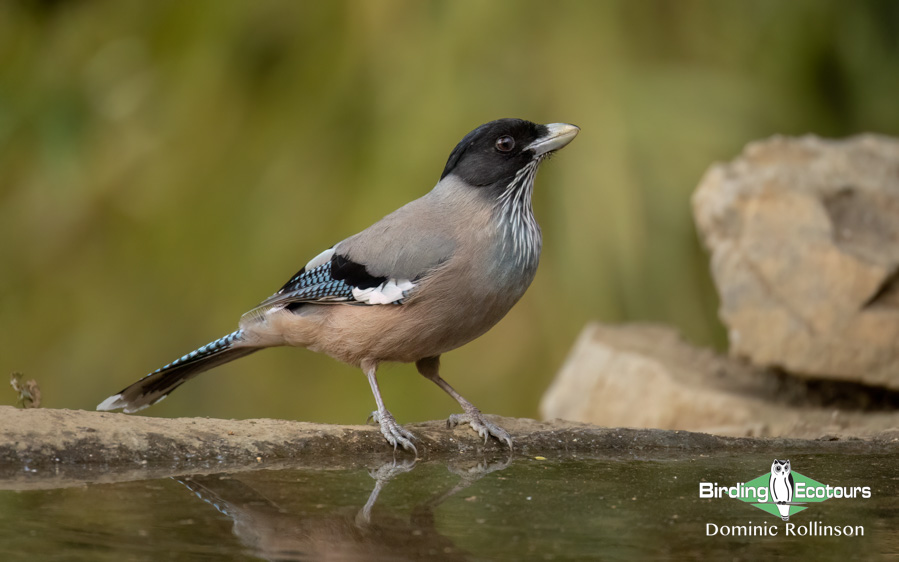
The strikingly patterned and localized Black-headed Jay performed exceptionally well from the bird hide in Sattal.
After our wonderful time at the bird hide, we then walked down a nearby road and had our breakfast at a lovely viewpoint. In this area we further added Long-tailed Minivet, Yellow-bellied Fantail, Blue-winged Minla, Velvet-fronted Nuthatch, Grey-winged Blackbird, White-browed Shrike-babbler and Fire-breasted Flowerpecker.
Next, we moved back around to the Chaffi River area where we birded for the remainder of the morning. Here, we found Speckled Piculet, Lemon-rumped, Whistler’s and Chestnut-crowned Warblers, Black-chinned Babbler and Spotted Forktail.
We then headed back to our accommodation for lunch and had some time off in the early afternoon. In the late afternoon we headed out again, this time to a mountainous road on the other side of Sattal and had a very enjoyable afternoon of birding. The raptors were probably the highlight of the afternoon, with Steppe and Bonelli’s Eagles, Himalayan Vulture and Himalayan Buzzard seen well, a brief sighting of Crested Goshawk (an uncommon bird in the area) and a displaying pair of Mountain Hawk-Eagles entertaining us for a while. Other birds seen along this road included Speckled Piculet, Grey-capped Pygmy and Fulvous-breasted Woodpeckers, Lesser Yellownape, Bar-winged Flycatcher-shrike, Red-billed Blue Magpie, Himalayan Black-lored Tit, Buff-barred Warbler, Black-throated Thrush, Blue-fronted and Blue-capped Redstarts, Grey Bush Chat, Crimson Sunbird and Yellow-breasted Greenfinch.
This evening, as it was getting dark, we had good looks at a Large-tailed Nightjar as it flew around the lodge grounds calling nonstop but, unfortunately, the calling Mountain Scops Owls were even further away tonight and we still could not see any.
Day 21, 1st March 2026. Sattal birding and transfer to Pangot
This morning we birded a road en route to Pangot which proved to be incredibly productive. The main highlight of this road was a small group of Grey-crowned Goldfinches which had been drawing some attention with local birders for a while. We had good looks at the goldfinches and then continued to bird along the road. Other highlights of this walk included Kalij Pheasant, Rufous Turtle Dove, Himalayan Woodpecker, Red-billed Blue Magpie, Eastern Red-rumped Swallow, Bar-tailed Treecreeper, Grey-winged Blackbird, Golden Bush Robin, Scaly-breasted Cupwing and Russet Sparrow.
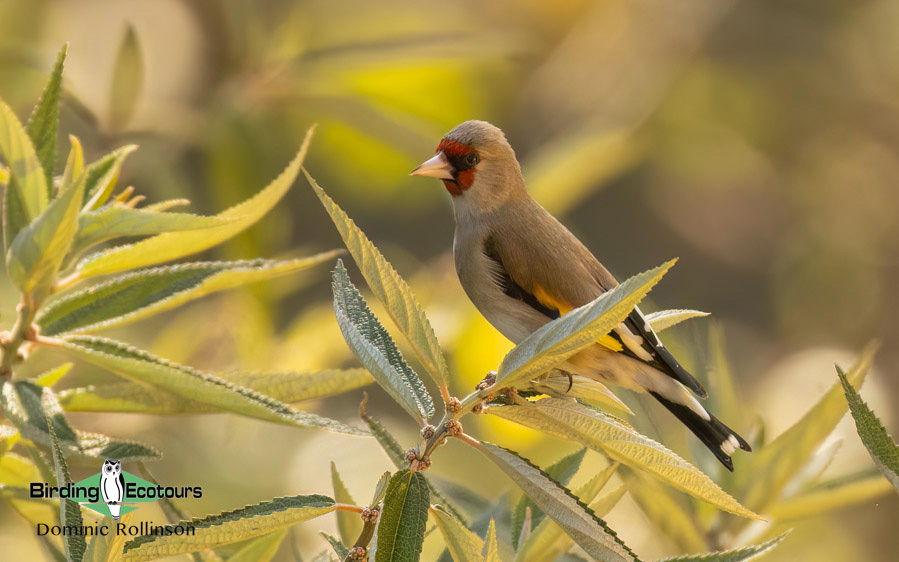
The scarce Grey-crowned Goldfinch was seen near Sattal.
We then carried on along the long, winding road to Pangot. En route we made a few roadside stops for Hair-crested Drongo, Black Eagle and Slaty-backed Forktail. We arrived at Pangot for a late lunch and then took it easy for a little while.
Later in the afternoon we took a relaxed walk around our lodge grounds and the surrounds where we saw Grey-backed Shrike, Eurasian and Black-headed Jays, Black-faced Warbler, Himalayan Bulbul and Yellow-breasted Greenfinch. We then waited at the bird hide and had excellent looks at Eurasian Jay and Red-billed Blue Magpie but unfortunately the Kalij Pheasants were a no-show today!
Day 22, 2nd March 2026. Pangot birding
It was a very early start this morning as we wanted to be in the higher altitude forests around dawn for Koklass Pheasant, which can prove tricky at times. Today it was dead easy as, at one of our first stops, we had good looks at a pair as they slowly walked along the forest floor, occasionally calling as they went. With some of the pressure off, we continued higher up and ticked off the likes of Common Wood Pigeon, Chestnut-bellied Rock Thrush and Alpine Thrush. The thermal scope proved highly successful at picking up small heat signatures in the cold environment, and we also found Sambar and Northern Red Muntjac using this method.
Getting to our highest elevation of the morning, the trees mostly gave way to open grasslands on the sheer slopes and here we found Himalayan Vulture, Eurasian Crag Martin, Coal Tit, Whiskered Yuhina, White-tailed Nuthatch, Grey-winged Blackbird, Fire-tailed and Green-tailed Sunbirds, Altai and Black-throated Accentors, Rock Bunting and Upland Pipit. Our main target bird here, though, was Cheer Pheasant, which Mahesh somehow spotted slowly walking through the grass. We still have no idea how Mahesh spotted these birds, as they were at considerable distance with their camouflaged plumage blending in perfectly! While up here we also saw a few Himalayan Goral (a type of mountain goat) as well as decent numbers of Nepal Sacred Langurs. With it being a beautiful day, we enjoyed distant views of the peaks of the Uttarakhandan Himalayas with Nanda Devi standing tallest at 25,656 feet (7,817 meters), India’s second-highest peak!
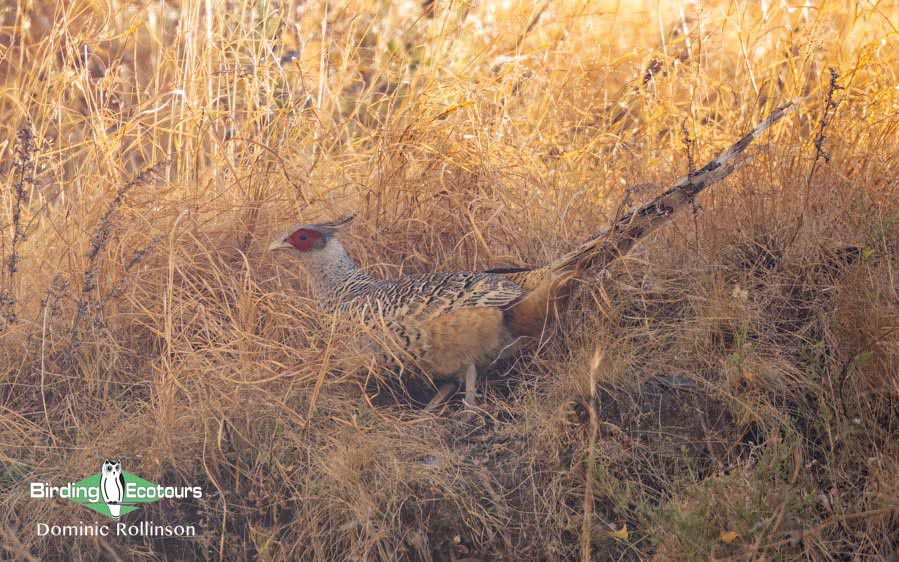
Cheer Pheasant showed well on the steep grassed slopes above Pangot.
Later this afternoon we birded at a lower elevation and managed a good haul of species, with a male Himalayan Rubythroat being the best of the lot. Other birds of interest seen this afternoon included Black Francolin, Red-billed Blue Magpie, Blue-throated Barbet, Long-tailed Shrike, Himalayan Prinia, Grey-headed Canary-flycatcher, Striated and Streaked Laughingthrushes, Chestnut-headed Tesia (which we really had to work for), Himalayan Black-lored Tit, Verditer and Slaty-blue Flycatchers and Purple Sunbird.
Day 23, 3rd March 2026. Rest day at Pangot
When we planned this tour, we included a couple days without any birding plans so that everybody could recharge the batteries and enjoy the day at leisure. Today was one of these and we enjoyed a relaxed day around our lovely lodge.
We did do a very short walk around the lodge grounds in the late morning where we had brief looks at Maroon Oriole and saw a single Mountain Bulbul.
In the late afternoon, Mahesh let us know that a pair of Brown Wood Owls were showing nearby and so we made a quick mission out to enjoy these large owls. To finish the day, we sat at the hide hoping that the Kalij Pheasants would come in, but sadly they were again not around today!
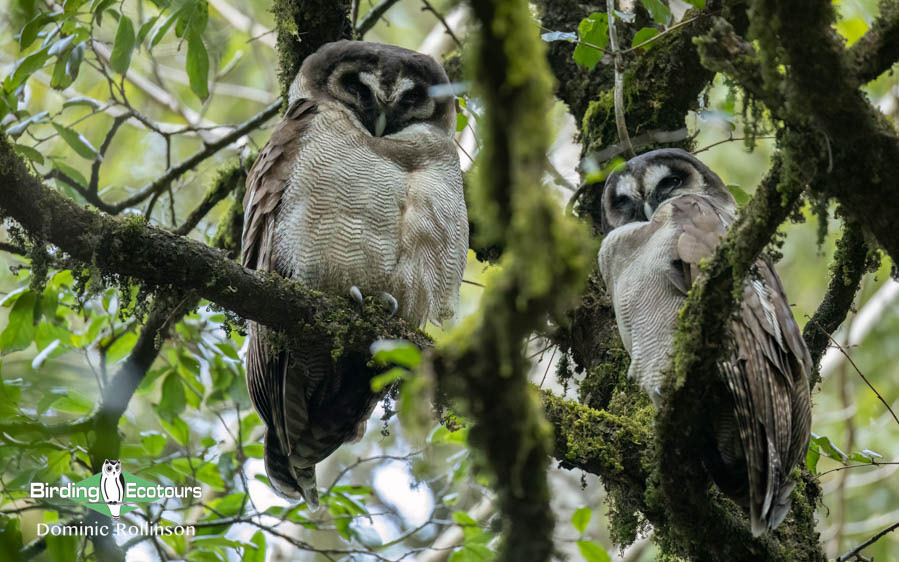
This pair of Brown Wood Owls was seen in a wooded ravine near Pangot.
Day 24, 4th March 2026. Pangot birding and transfer to Jim Corbett National Park area
Today was Holi, the Hindu festival of color, love and spring. As such, we made sure we were out birding early before the festivities began and enjoyed a couple of hours of highly productive birding. Some of the highlights included Hill Partridge, Speckled Wood Pigeon, Booted Eagle, Peregrine Falcon, Chestnut-crowned Laughingthrush, White-tailed Nuthatch, Himalayan Bluetail, Rufous-breasted Accentor, Pink-browed and Vinaceous Rosefinches and Rock Bunting. We ended our birding session watching a pair of Coal Tits, delicately plucking hair from a pile of dung (which Mahesh suspected of being from a Leopard), presumably to line the nest of these tiny birds! On our way back for breakfast, we made a couple of forest stops where we added Yellow-browed Tit in a feeding flock which also included Buff-barred Warbler and Bar-tailed Treecreeper.
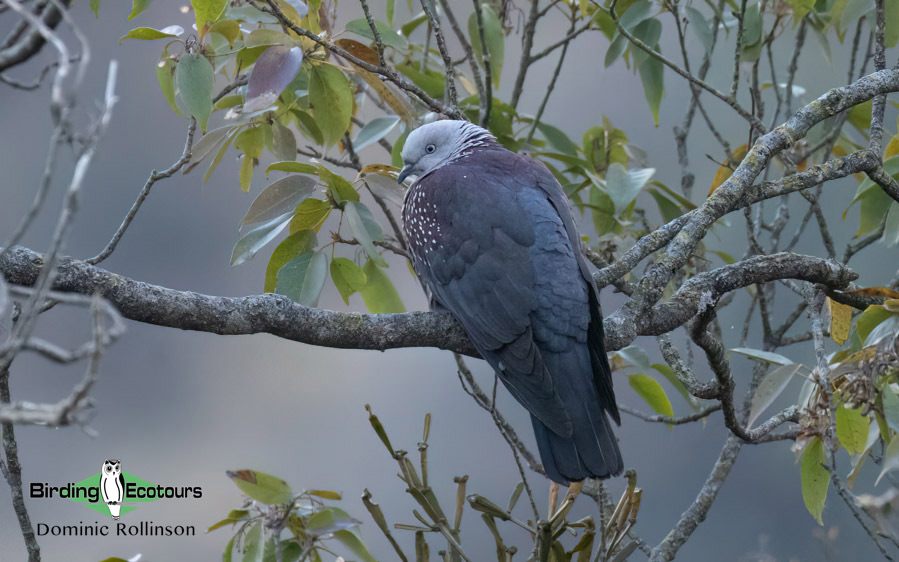
Small numbers of Speckled Wood Pigeons were seen in wooded areas near Pangot.
We then enjoyed some breakfast and Holi festivities back at our lodge and decided to do some relaxed birding from the lodge grounds for the remainder of the morning. Some of the better birds seen here included Common Wood Pigeon, Eurasian Sparrowhawk, Black-headed Jay, Verditer Flycatcher, Russet Sparrow and Yellow-breasted Greenfinch.
We had lunch at the lodge and then made our way down through the hills to Garjiya, on the edge of Jim Corbett National Park. The roads were even more chaotic today than usual, as everybody was out to celebrate this important festival on the Hindu calendar.
In the late afternoon we headed out to bird the Koshi River in the hopes of finding Ibisbill and Wallcreeper. The news with regards to Ibisbill was not good though, as the birds had not been seen for the last few days, despite a few birding groups having looked for them, and it appeared they had moved further upstream towards their breeding grounds. We searched the river and its tributaries but eventually had to give up on Ibisbill, and it was worrying that Wallcreeper had not shown either. Despite this, we still had some good birding along the river and saw Lesser Fish Eagle, River Lapwing, Crested Kingfisher, Plumbeous Water and White-capped Redstarts and White-browed Wagtail.
Day 25, 5th March 2026. Safari drives in Jim Corbett National Park
This morning was our first of four Jim Corbett National Park safari drives, and this morning’s drive would take place in the Garjiya zone. As we had already seen Tiger, we could let our safari guide know to concentrate on birds and not worry about speeding around, looking for large groups of jeeps (tell-tale signs of a Tiger sighting). As this was our first morning birding in the park we had a good number of new trip birds, including the likes of Red Junglefowl, White-rumped Spinetail, Crested Treeswift, Lineated Barbet, Scarlet Minivet, Lesser Racket-tailed Drongo, Black-crested Bulbul, Western Crowned Warbler and Golden-fronted Leafbird. This zone has an exceptionally impressive diversity of woodpeckers and this morning we saw Grey-capped Pygmy, Rufous, Grey-headed and Streak-throated Woodpeckers, Himalayan and Black-rumped Flamebacks, with the cherry-on-top being the massive Great Slaty Woodpecker, a big trip target! In addition to the great birding we also saw Terai Sacred Langur, Golden Jackal, Sambar, Chital and Northern Red Muntjac.
In the afternoon we headed out on safari again and this time entered the Jhirna zone. This afternoon also proved highly successful with standout species including Common Hawk-Cuckoo, White-rumped Vulture (flying high overhead), Hair-crested Drongo, and bird-of-the-day went to Great Hornbill, which we enjoyed watching as a pair fed in a fruiting tree – Bobby’s most wanted bird for the trip! We also came across some outstanding mammals on this safari, with a very brief sighting of a Tiger and a small group of Asian Elephants which showed wonderfully well for us!
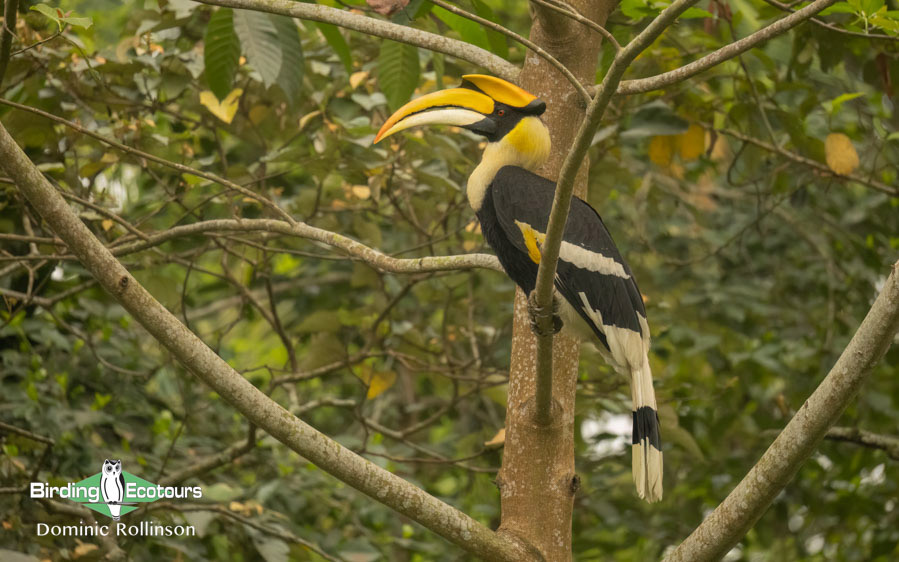
We had excellent views of Great Hornbill in Jim Corbett National Park.
Later this evening, as we were meeting for dinner, we heard the characteristic ‘boo-book’ call of Brown Boobook. We easily found the bird calling in the top of a tree in the lodge grounds and had good looks. A great way to finish another successful day.
Day 26, 6th March 2026. Safari drives in Jim Corbett National Park
We had another day of safari drives in Jim Corbett National Park and for the morning drive we were again assigned the Jhirna zone. We had a similar assemblage of species as the previous afternoon, with a few notable additions including Red-headed Vulture, Oriental Pied Hornbill, Chestnut-headed Bee-eater, Greater Yellownape, Puff-throated Babbler, Chestnut-tailed Starling, White-rumped Shama and Thick-billed Flowerpecker. Another interesting sighting for the morning was a couple of Small Indian Mongooses.
During lunchtime at the lodge, Bobby suddenly shouted, ‘Green Magpie” and right there in the trees behind the restaurant was a feeding Common Green Magpie. I had started to become worried about this species, as it was a vision board species, and so it was a big relief to finally see this beautiful species. While looking at the magpie we also managed to find a Jungle Owlet which was being mobbed by all sorts of other small birds.
After the excitement of our lunchtime birding, we hopped in the jeeps for our final Jim Corbett safari drive, which was in the Dhela zone. This zone comprises of dense jungle, but also large open grassland and we enjoyed moving between these two habitats. In the dense jungle we had amazing sightings of Asian Elephant (including a close-up massive bull) and managed a glimpse of a Tiger taking a bath in a waterhole, while the grasslands produced a Golden Jackal which was not too perturbed by our presence. There were, of course, plenty of birds around, with some of the standout species being Indian Stone-curlew, Yellow-wattled Lapwing, Barred Buttonquail, Great Hornbill, Red-breasted Parakeet, Maroon Oriole (just a quick flyover), Bengal Bush Lark, Red Avadavat and a fine male Kalij Pheasant which finally posed for photos!
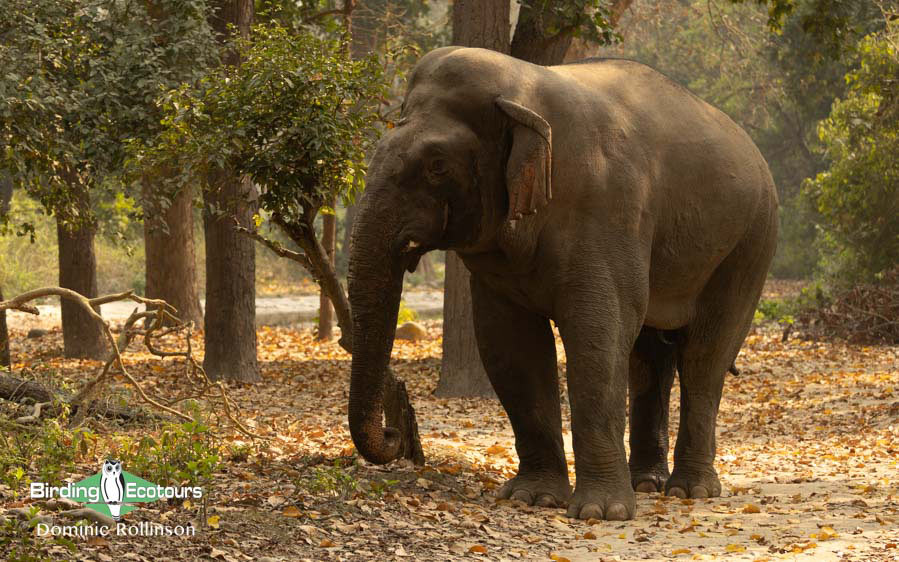
This large Asian Elephant bull put on a show for us in Jim Corbett National Park.
Day 27, 7th March 2026. Koshi River birding and transfer to Delhi
For our final morning in the Jim Corbett area we birded along the Koshi River and surrounding areas where we hoped for a final shot at Wallcreeper. We stopped at the usual spot near the temple, but it was crazy busy, with dozens of buses and hundreds of people, so we decided to rather bird from the nearby suspension bridge. This proved to be a good decision, for as soon as we got down to the river Mahesh shouted Wallcreeper, and we watched a single bird slowly flying upstream (towards the temple). We were overjoyed because there were very few still around and, with the busy scene near the temple, we thought we had missed this species. Other birds seen during our pre-breakfast birding included Changeable Hawk-Eagle, River Lapwing, Great Hornbill, Scarlet Minivet, Rufous-gorgeted Flycatcher, Bar-winged Flycatcher-shrike, Crimson Sunbird and Velvet-fronted Nuthatch.
We then headed back to our lodge, loaded the bus and spent most of the remainder of the day in the bus returning to Delhi. We arrived at our Delhi hotel in the late afternoon and enjoyed some time off before an early dinner.
Day 28, 8th March 2026. Flights to Guwahati and transfer to Mana National Park
We caught an early morning flight from Delhi to Guwahati and said our goodbyes to Mahesh and Davindra. Both had done fine jobs over the last few weeks: Mahesh with his perfect logistics and incredible birding skills and Davindra with his careful and safe driving.
We landed in Guwahati in the late morning and met our guide, Nekib, who would be showing us around northeastern India for the next week, as well as our drivers Bobby and Bul. After a quick bite to eat, we immediately made our way to the Guwahati landfill where we had unbelievable looks at Greater Adjutant. Many birders who have passed through Guwahati have probably visited the landfill site to look for these rare storks. Here an otherworldly scene awaited us, with dozens of scavenging Greater Adjutants working their way through the mountains of trash!
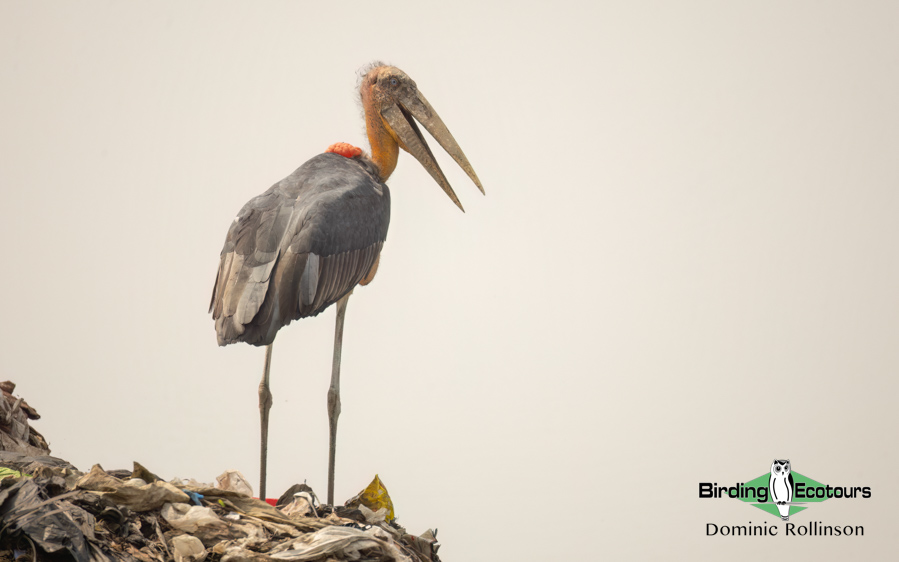
Greater Adjutant scavenging at the Guwahati landfill.
We then crossed the Brahmaputra River and headed north out of Guwahati towards Manas National Park, where we were based for the next two nights. En route we made a roadside stop for nesting Lesser Adjutant, where we also added Asian Palm Swift and Ashy Woodswallow overhead. In the mid-afternoon we arrived at our accommodation right along the edge of Manas National Park, and even got our first distant views of Greater One-horned Rhinoceros; another vision board species and one we had all wanted to see for a very long time!
Later that afternoon we took a casual stroll along the park fence line, and found a few new species such as Indochinese Roller, Oriental Cuckooshrike, Jungle and Great Mynas and Eurasian Tree Sparrow. This afternoon we also got our first looks at Irrawaddy Squirrel, which would prove to be rather common and conspicuous over the next week.
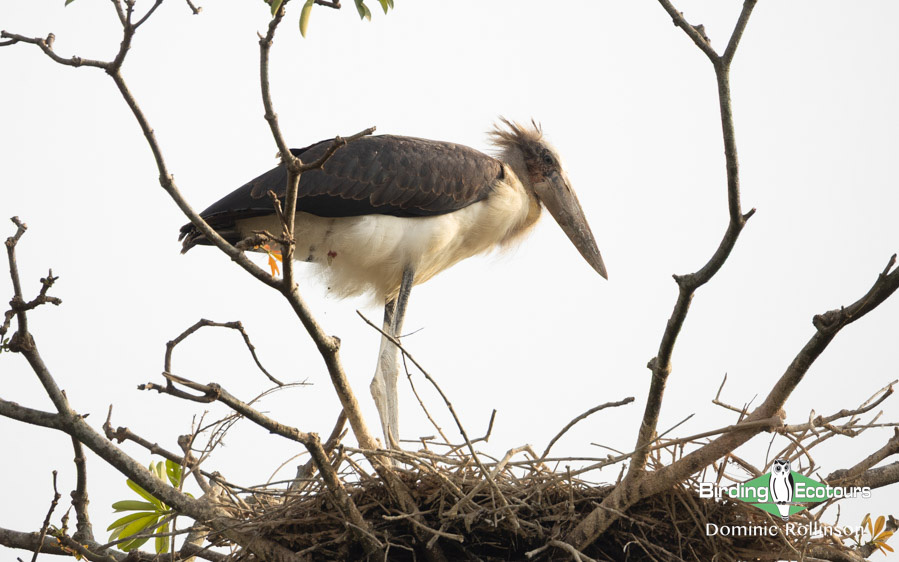
This juvenile Lesser Adjutant was our second adjutant species of the day!
Day 29, 9th March 2026. Birds and wildlife in Manas National Park
Today we had morning and afternoon safari drives within the park to target as many birds and animals as possible. We let our driver know that primary reason for adding Manas to the itinerary was to search for the gigantic Gaur. The Gaur is the world’s largest wild cattle species; a massive, muscular animal with a dark chocolate-brown body, high shoulder ridge, stockinged white legs, and impressive curved horns. It was once widespread across Asia’s forests but has sadly become increasingly scarce in many areas due to habitat loss, hunting, and disease from domestic livestock. While in Manas there was, of course, a plethora of important bird species to see too!
Both of today’s safari drives were in the Banasbari (Central) Range and we spent the morning driving through large patches of jungle and tall grassland areas. Despite our best efforts we could not find Gaur this morning, however we did find many new bird species and an assortment of charismatic megafauna such as Capped Langur, Hog Deer, Asian Wild Buffalo and had much better looks at Greater One-horned Rhinoceros. On the birding front, we found Barred Cuckoo-Dove, Common Emerald Dove, Wedge-tailed Green Pigeon, Green and Mountain Imperial Pigeons, Brown Crake, Lesser Adjutant, Spot-billed Pelican, Oriental Pied Hornbill, Blue-eared Barbet, Rosy Minivet, Bronzed Drongo, Black-naped Monarch, Sultan Tit, Bengal Bush Lark, Blyth’s Leaf Warbler, Pin-striped Tit-Babbler, Abbott’s Babbler, Small Niltava, Scarlet-backed Flowerpecker, Asian Fairy-bluebird, Olive-backed Pipit and brief looks at a displaying Bengal Florican! It had been a highly successful and enjoyable morning, although we had hoped to get the most-wanted mammal (Gaur), so we could relax for the afternoon.
It was an all-out Gaur search for the afternoon safari and after a couple hours of searching without success, things were starting to look precarious and then Nekib shouted ‘bison’ and there, on the road ahead of us, was a single Gaur. We of course watched for a while and, over the next 30 minutes or so, we watched a large herd of around 25 animals including several massive bulls. It was a huge relief, and we could see the tension melt from Nekib’s face after he spotted them! As so often happens, after we spotted our first herd, we found another herd on our way back out too!
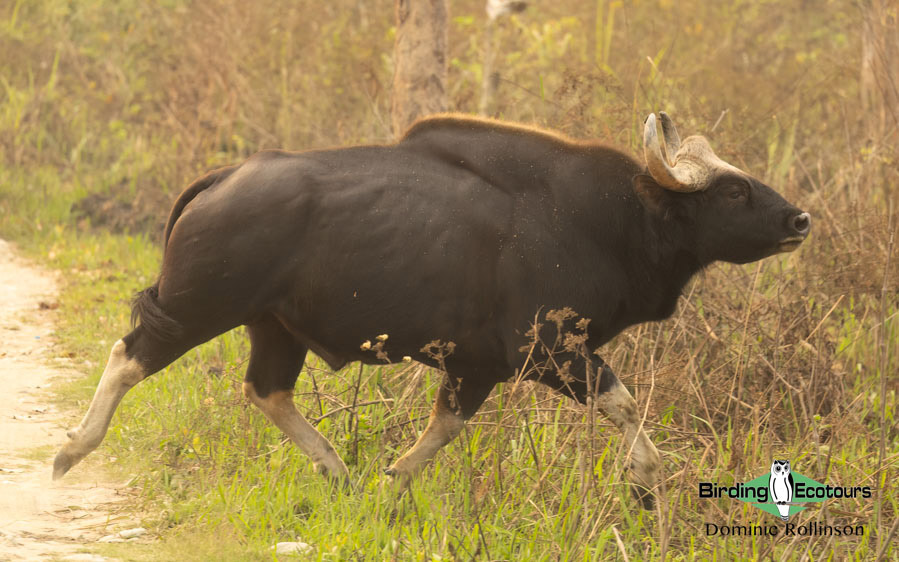
After a long search, we had great looks at a couple herds of Gaur in Manas National Park.
Despite Gaur being the primary target this afternoon we also found a good selection of birds, including Plaintive Cuckoo, Black Eagle, Blue-eared Barbet, Rufous Woodpecker, Small Minivet, Chestnut-bellied Rock Thrush and Crimson Sunbird. On our way back to our lodge we struck gold with decent looks at a tiny Collared Falconet, yet another vision board species. Another highlight of the afternoon was watching the huge Black Giant Squirrel scurrying up a tree, looking more like a mongoose than a squirrel!
This evening we toasted to our successful day on safari and looked forward to our final Manas National Park safari drive the following morning!
Day 30, 10th March 2026. Manas National Park and transfer to Kaziranga National Park
For our final safari drive in Manas National Park we visited the grasslands of the Bhuyanpara Range where we were hoping to improve our looks of Bengal Florican and find a few other grassland targets. En route to the range, a few roadside stops added Lesser Coucal, Black-winged Cuckooshrike and Striated Grassbird.
We then spent the remainder of the safari drive working the large open grasslands and managed to find at least four Bengal Floricans which gave us good flyby views, as well as more distant views of them slowly walking through the grasslands. Other standout species for the morning included Northern Lapwing, Black Stork, Hen Harrier, Rufous Woodpecker, Alexandrine Parakeet, Oriental Cuckooshrike, Golden-headed Cisticola, Dusky Warbler, Indian Grassbird, Bluethroat and Rosy Pipit.
We then returned to our lodge, packed up and hit the long road to Kaziranga National Park. We only arrived at our lodge near Kaziranga after dark and grabbed a quick dinner before getting some much-needed rest.
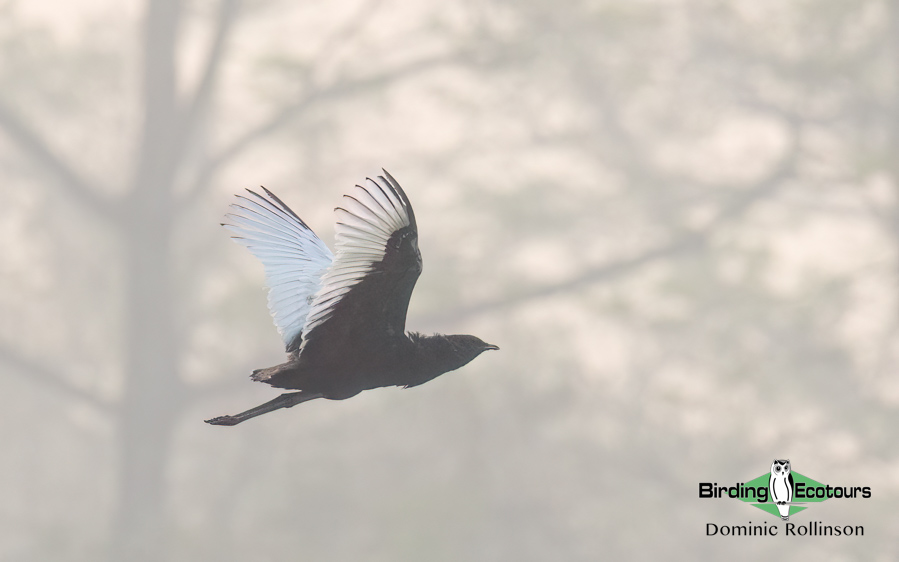
The rare Bengal Florican was seen in the grasslands of Manas National Park.
Days 31-32, 11-12th March 2026. Exploring Kaziranga National Park
Over the next two days we undertook two morning and two afternoon safari drives and covered a large portion of the park, mostly concentrating on the Central Range (closer to where we were based) but also visiting the Western and Eastern Ranges too.
Kaziranga National Park is well known for its large numbers of mammal species, and our visits were no different. Greater One-horned Rhinoceros were amazingly abundant, this was encouraging to see as this species’ continued existence had been on the brink not so long ago. Asian Elephants were also a common sight in the park and were always fun to watch. The plains were littered with Asian Wild Buffalo, Hog Deer, and Eurasian Wild Pig, while Barasingha (Swamp Deer) was a welcome addition. Less common sightings included Smooth-coated Otters fishing in the park’s many lakes.
Our Kaziranga bird sightings started with a bang on the first morning, before we had even left our lodge, when Nekib pointed out a trio of Blue-bearded Bee-eaters hawking insects from the top of a nearby tree. We had heard this species repeatedly over the past couple of weeks but the birds were never nearby and so it was a relief to finally lay eyes on this large bee-eater species!
Bird highlights over these two safari-packed days included Lesser Whistling Duck, Swamp Francolin, Green-billed Malkoha, Great Stone-curlew, Grey-headed Lapwing, Greater and Lesser Adjutants, Black-necked Stork, Spot-billed Pelican, Red-headed, Himalayan and Slender-billed Vultures, Pallas’s and Grey-headed Fish Eagles, White-tailed Eagle (somewhat of a rarity here), Hen Harrier, Dusky Eagle-Owl, Dollarbird, Blossom-headed Parakeet, Greater Racket-tailed Drongo, Yellow-browed Warbler, Striated Babbler, Chestnut-capped Babbler, Chinese Rubythroat, White-tailed Robin, Common Hill Myna, Spot-winged Starling, Baya Weaver and Richard’s Pipit.
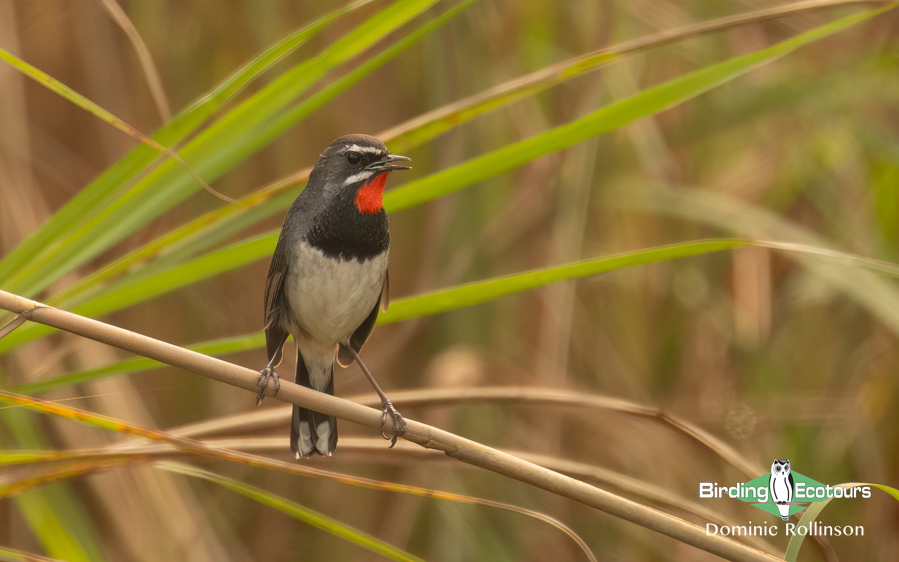
Chinese Rubythroat was one of the many delights of Kaziranga.
Day 33, 13th March 2026. Birding Kaziranga surrounds and transfer to Guwahati
For our final morning around Kaziranga we birded some of the forest patches on the outskirts of the park, targeting a few final species before we made the long transfer west back to Guwahati. This morning proved to be a productive one and we added the likes of Daurian Redstart, Blyth’s Paradise Flycatcher, Lesser Necklaced Laughingthrush and Yellow-vented and Plain Flowerpeckers. We heard a distant group of Western Hoolock Gibbons but, despite our best efforts, we could not lay eyes on them.
We then packed our bags and loaded into our cars and started the drive back to Guwahati. Our Kaziranga sightings were not yet done though, as Bobby (one of our drivers) twice spotted a couple of Wreathed Hornbills. This was another most-wanted vision board species, and it would prove to be our final addition to the trip list.
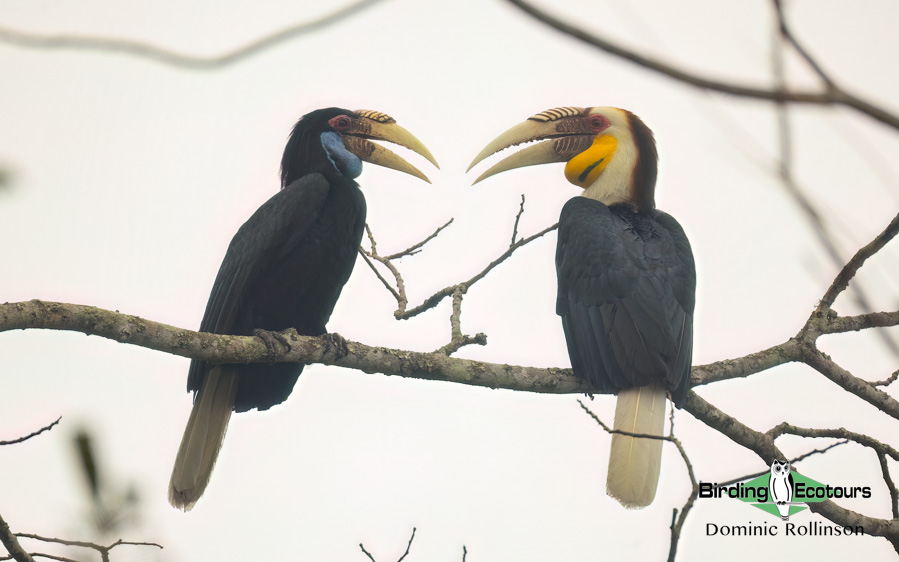
This pair of Wreathed Hornbills was our final addition to the trip list.
We made it into our lovely Guwahati hotel in the late afternoon and enjoyed a final group dinner together which was lots of fun. We reminisced about what a successful and fun-filled trip it had been and voted on bird and mammal of the trip. Bird of the trip turned out to be a tie between Great Indian Bustard and Great Hornbill with other honorable mentions to White Stork, Common Green Magpie and Greater Adjutant. Mammal of the trip was also a tie between Sloth Bear and Greater One-horned Rhino, with Ganges River Dolphin being the runner-up.
Day 34, 14th March 2026. Departure from Guwahati
This morning we enjoyed a relaxed sit-down breakfast before packing our bags and heading to Guwahati Airport, where we said our goodbyes. Thanks to Nekib for showing us around northeastern India and to our drivers Bobby and Bul for their expert and safe driving.
Thanks to Dan, Bobby and Diane for making this a highly enjoyable trip, your enthusiasm and love for all things nature made it easy to spend five weeks moving across northern India and I look forward to traveling together again soon.
Bird List – Following IOC 15.1 (March 2025)
Birds ‘heard only’ are marked with (H) after the common name, all other species were seen.
The following notation after species names is used to show conservation status following the IUCN Red List: CR = Critically Endangered, EN = Endangered, VU = Vulnerable.
| Common name | Scientific name |
| Ducks, Geese, Swans (Anatidae) | |
| Lesser Whistling Duck | Dendrocygna javanica |
| Bar-headed Goose | Anser indicus |
| Greylag Goose | Anser anser |
| Knob-billed Duck | Sarkidiornis melanotos |
| Ruddy Shelduck | Tadorna ferruginea |
| Cotton Pygmy Goose | Nettapus coromandelianus |
| Garganey | Spatula querquedula |
| Northern Shoveler | Spatula clypeata |
| Gadwall | Mareca strepera |
| Eurasian Wigeon | Mareca penelope |
| Indian Spot-billed Duck | Anas poecilorhyncha |
| Mallard | Anas platyrhynchos |
| Northern Pintail | Anas acuta |
| Eurasian Teal | Anas crecca |
| Red-crested Pochard | Netta rufina |
| Common Pochard – VU | Aythya ferina |
| Ferruginous Duck | Aythya nyroca |
| Tufted Duck | Aythya fuligula |
| Pheasants & Allies (Phasianidae) | |
| Hill Partridge | Arborophila torqueola |
| Rufous-throated Partridge | Arborophila rufogularis |
| Koklass Pheasant | Pucrasia macrolopha |
| Cheer Pheasant – VU | Catreus wallichii |
| Kalij Pheasant | Lophura leucomelanos |
| Indian Peafowl | Pavo cristatus |
| Painted Spurfowl | Galloperdix lunulata |
| Red Junglefowl | Gallus gallus |
| Grey Francolin | Ortygornis pondicerianus |
| Swamp Francolin | Ortygornis gularis |
| Black Francolin | Francolinus francolinus |
| Jungle Bush Quail (H) | Perdicula asiatica |
| Nightjars (Caprimulgidae) | |
| Jungle Nightjar | Caprimulgus indicus |
| Grey Nightjar (H) | Caprimulgus jotaka |
| Sykes’s Nightjar | Caprimulgus mahrattensis |
| Large-tailed Nightjar | Caprimulgus macrurus |
| Indian Nightjar | Caprimulgus asiaticus |
| Savanna Nightjar | Caprimulgus affinis |
| Treeswifts (Hemiprocnidae) | |
| Crested Treeswift | Hemiprocne coronata |
| Swifts (Apodidae) | |
| White-rumped Spinetail | Zoonavena sylvatica |
| Asian Palm Swift | Cypsiurus balasiensis |
| Alpine Swift | Tachymarptis melba |
| Little Swift | Apus affinis |
| Bustards (Otididae) | |
| Great Indian Bustard – CR | Ardeotis nigriceps |
| Bengal Florican – CR | Houbaropsis bengalensis |
| Cuckoos (Cuculidae) | |
| Greater Coucal | Centropus sinensis |
| Lesser Coucal | Centropus bengalensis |
| Green-billed Malkoha | Phaenicophaeus tristis |
| Asian Koel | Eudynamys scolopaceus |
| Plaintive Cuckoo | Cacomantis merulinus |
| Common Hawk-Cuckoo | Hierococcyx varius |
| Sandgrouse (Pteroclidae) | |
| Chestnut-bellied Sandgrouse | Pterocles exustus |
| Painted Sandgrouse | Pterocles indicus |
| Pigeons, Doves (Columbidae) | |
| Rock Dove | Columba livia |
| Common Wood Pigeon | Columba palumbus |
| Speckled Wood Pigeon | Columba hodgsonii |
| Oriental Turtle Dove | Streptopelia orientalis |
| Eurasian Collared Dove | Streptopelia decaocto |
| Red Collared Dove | Streptopelia tranquebarica |
| Spotted Dove | Spilopelia chinensis |
| Laughing Dove | Spilopelia senegalensis |
| Barred Cuckoo-Dove | Macropygia unchall |
| Common Emerald Dove | Chalcophaps indica |
| Yellow-footed Green Pigeon | Treron phoenicopterus |
| Wedge-tailed Green Pigeon | Treron sphenurus |
| Green Imperial Pigeon | Ducula aenea |
| Mountain Imperial Pigeon | Ducula badia |
| Rails, Crakes & Coots (Rallidae) | |
| Common Moorhen | Gallinula chloropus |
| Eurasian Coot | Fulica atra |
| Grey-headed Swamphen | Porphyrio poliocephalus |
| Brown Crake | Zapornia akool |
| Baillon’s Crake | Zapornia pusilla |
| White-breasted Waterhen | Amaurornis phoenicurus |
| Cranes (Gruidae) | |
| Sarus Crane – VU | Antigone antigone |
| Demoiselle Crane | Grus virgo |
| Common Crane | Grus grus |
| Grebes (Podicipedidae) | |
| Little Grebe | Tachybaptus ruficollis |
| Great-crested Grebe | Podiceps cristatus |
| Flamingos (Phoenicopteridae) | |
| Greater Flamingo | Phoenicopterus roseus |
| Lesser Flamingo | Phoeniconaias minor |
| Buttonquail (Turnicidae) | |
| Barred Buttonquail | Turnix suscitator |
| Stone-curlews, Thick-knees (Burhinidae) | |
| Great Stone-curlew | Esacus recurvirostris |
| Indian Stone-curlew | Burhinus indicus |
| Oystercatchers (Haematopodidae) | |
| Eurasian Oystercatcher | Haematopus ostralegus |
| Stilts, Avocets (Recurvirostridae) | |
| Black-winged Stilt | Himantopus himantopus |
| Pied Avocet | Recurvirostra avosetta |
| Plovers (Charadriidae) | |
| Grey Plover – VU | Pluvialis squatarola |
| Little Ringed Plover | Charadrius dubius |
| Northern Lapwing | Vanellus vanellus |
| River Lapwing | Vanellus duvaucelii |
| Yellow-wattled Lapwing | Vanellus malabaricus |
| Grey-headed Lapwing | Vanellus cinereus |
| Red-wattled Lapwing | Vanellus indicus |
| Sociable Lapwing – CR | Vanellus gregarius |
| White-tailed Lapwing | Vanellus leucurus |
| Tibetan Sand Plover | Anarhynchus atrifrons |
| Greater Sand Plover | Anarhynchus leschenaultii |
| Kentish Plover | Anarhynchus alexandrinus |
| Painted-snipes (Rostratulidae) | |
| Greater Painted-snipe | Rostratula benghalensis |
| Jacanas (Jacanidae) | |
| Pheasant-tailed Jacana | Hydrophasianus chirurgus |
| Bronze-winged Jacana | Metopidius indicus |
| Sandpipers, Snipes (Scolopacidae) | |
| Eurasian Whimbrel | Numenius phaeopus |
| Eurasian Curlew | Numenius arquata |
| Bar-tailed Godwit | Limosa lapponica |
| Black-tailed Godwit | Limosa limosa |
| Common Snipe | Gallinago gallinago |
| Terek Sandpiper | Xenus cinereus |
| Common Sandpiper | Actitis hypoleucos |
| Green Sandpiper | Tringa ochropus |
| Marsh Sandpiper | Tringa stagnatilis |
| Wood Sandpiper | Tringa glareola |
| Common Redshank | Tringa totanus |
| Spotted Redshank | Tringa erythropus |
| Common Greenshank | Tringa nebularia |
| Ruddy Turnstone | Arenaria interpres |
| Great Knot – EN | Calidris tenuirostris |
| Ruff | Calidris pugnax |
| Broad-billed Sandpiper – VU | Calidris falcinellus |
| Curlew Sandpiper – VU | Calidris ferruginea |
| Temminck’s Stint | Calidris temminckii |
| Dunlin | Calidris alpina |
| Little Stint | Calidris minuta |
| Crab-plover (Dromadidae) | |
| Crab-plover | Dromas ardeola |
| Coursers, Pratincoles (Glareolidae) | |
| Indian Courser | Cursorius coromandelicus |
| Cream-colored Courser | Cursorius cursor |
| Small Pratincole | Glareola lactea |
| Gulls, Terns, Skimmers (Laridae) | |
| Indian Skimmer | Rynchops albicollis |
| Little Tern | Sternula albifrons |
| Gull-billed Tern | Gelochelidon nilotica |
| Caspian Tern | Hydroprogne caspia |
| Whiskered Tern | Chlidonias hybrida |
| River Tern – VU | Sterna aurantia |
| Black-bellied Tern – EN | Sterna acuticauda |
| Slender-billed Gull | Chroicocephalus genei |
| Black-headed Gull | Chroicocephalus ridibundus |
| Brown-headed Gull | Chroicocephalus brunnicephalus |
| Pallas’s Gull | Ichthyaetus ichthyaetus |
| Lesser Black-backed Gull | Larus fuscus |
| Storks (Ciconiidae) | |
| Asian Openbill | Anastomus oscitans |
| Lesser Adjutant | Leptoptilos javanicus |
| Greater Adjutant | Leptoptilos dubius |
| Painted Stork | Mycteria leucocephala |
| Black-necked Stork | Ephippiorhynchus asiaticus |
| Asian Woolly-necked Stork | Ciconia episcopus |
| Black Stork | Ciconia nigra |
| White Stork | Ciconia ciconia |
| Anhingas, Darters (Anhingidae) | |
| Oriental Darter | Anhinga melanogaster |
| Cormorants, Shags (Phalacrocoracidae) | |
| Little Cormorant | Microcarbo niger |
| Indian Cormorant | Phalacrocorax fuscicollis |
| Great Cormorant | Phalacrocorax carbo |
| Ibises, Spoonbills (Threskiornithidae) | |
| Black-headed Ibis | Threskiornis melanocephalus |
| Red-naped Ibis | Pseudibis papillosa |
| Glossy Ibis | Plegadis falcinellus |
| Eurasian Spoonbill | Platalea leucorodia |
| Herons, Bitterns (Ardeidae) | |
| Black Bittern | Botaurus flavicollis |
| Black-crowned Night Heron | Nycticorax nycticorax |
| Little Egret | Egretta garzetta |
| Western Reef Heron | Egretta gularis |
| Little Heron | Butorides atricapilla |
| Indian Pond Heron | Ardeola grayii |
| Great Egret | Ardea alba |
| Medium Egret | Ardea intermedia |
| Eastern Cattle Egret | Ardea coromanda |
| Grey Heron | Ardea cinerea |
| Purple Heron | Ardea purpurea |
| Pelicans (Pelecanidae) | |
| Great White Pelican | Pelecanus onocrotalus |
| Spot-billed Pelican | Pelecanus philippensis |
| Dalmatian Pelican | Pelecanus crispus |
| Ospreys (Pandionidae) | |
| Osprey | Pandion haliaetus |
| Kites, Hawks, Eagles (Accipitridae) | |
| Black-winged Kite | Elanus caeruleus |
| Egyptian Vulture – EN | Neophron percnopterus |
| Crested Honey Buzzard | Pernis ptilorhynchus |
| Red-headed Vulture – CR | Sarcogyps calvus |
| Cinereous Vulture | Aegypius monachus |
| Himalayan Vulture | Gyps himalayensis |
| White-rumped Vulture – CR | Gyps bengalensis |
| Indian Vulture – CR | Gyps indicus |
| Slender-billed Vulture – CR | Gyps tenuirostris |
| Griffon Vulture | Gyps fulvus |
| Crested Serpent Eagle | Spilornis cheela |
| Short-toed Snake Eagle | Circaetus gallicus |
| Mountain Hawk-Eagle | Nisaetus nipalensis |
| Changeable Hawk-Eagle | Nisaetus cirrhatus |
| Black Eagle | Ictinaetus malaiensis |
| Indian Spotted Eagle – VU | Clanga hastata |
| Greater Spotted Eagle – VU | Clanga clanga |
| Booted Eagle | Hieraaetus pennatus |
| Steppe Eagle – EN | Aquila nipalensis |
| Tawny Eagle – VU | Aquila rapax |
| Eastern Imperial Eagle – VU | Aquila heliaca |
| Bonelli’s Eagle | Aquila fasciata |
| Crested Goshawk | Lophospiza trivirgata |
| Shikra | Tachyspiza badia |
| Eurasian Sparrowhawk | Accipiter nisus |
| Pallid Harrier | Circus macrourus |
| Hen Harrier | Circus cyaneus |
| Montagu’s Harrier | Circus pygargus |
| Western Marsh Harrier | Circus aeruginosus |
| Black Kite | Milvus migrans |
| Brahminy Kite | Haliastur indus |
| Pallas’s Fish Eagle – EN | Haliaeetus leucoryphus |
| White-tailed Eagle | Haliaeetus albicilla |
| Lesser Fish Eagle | Icthyophaga humilis |
| Grey-headed Fish Eagle | Icthyophaga ichthyaetus |
| White-eyed Buzzard | Butastur teesa |
| Long-legged Buzzard | Buteo rufinus |
| Himalayan Buzzard | Buteo refectus |
| Owls (Strigidae) | |
| Brown Boobook | Ninox scutulata |
| Spotted Owlet | Athene brama |
| Asian Barred Owlet | Glaucidium cuculoides |
| Jungle Owlet | Glaucidium radiatum |
| Mountain Scops Owl (H) | Otus spilocephalus |
| Pallid Scops Owl | Otus brucei |
| Indian Scops Owl | Otus bakkamoena |
| Short-eared Owl | Asio flammeus |
| Indian Eagle-Owl | Bubo bengalensis |
| Brown Fish Owl | Ketupa zeylonensis |
| Tawny Fish Owl | Ketupa flavipes |
| Dusky Eagle-Owl | Ketupa coromanda |
| Brown Wood Owl | Strix leptogrammica |
| Hoopoes (Upupidae) | |
| Eurasian Hoopoe | Upupa epops |
| Hornbills (Bucerotidae) | |
| Great Hornbill – VU | Buceros bicornis |
| Oriental Pied Hornbill | Anthracoceros albirostris |
| Indian Grey Hornbill | Ocyceros birostris |
| Wreathed Hornbill – VU | Rhyticeros undulatus |
| Rollers (Coraciidae) | |
| Indian Roller | Coracias benghalensis |
| Indochinese Roller | Coracias affinis |
| Oriental Dollarbird | Eurystomus orientalis |
| Kingfishers (Alcedinidae) | |
| Stork-billed Kingfisher | Pelargopsis capensis |
| White-throated Kingfisher | Halcyon smyrnensis |
| Common Kingfisher | Alcedo atthis |
| Crested Kingfisher | Megaceryle lugubris |
| Pied Kingfisher | Ceryle rudis |
| Bee-eaters (Meropidae) | |
| Blue-bearded Bee-eater | Nyctyornis athertoni |
| Asian Green Bee-eater | Merops orientalis |
| Blue-tailed Bee-eater | Merops philippinus |
| Chestnut-headed Bee-eater | Merops leschenaulti |
| Asian Barbets (Megalaimidae) | |
| Great Barbet | Psilopogon virens |
| Brown-headed Barbet | Psilopogon zeylanicus |
| Lineated Barbet | Psilopogon lineatus |
| Blue-throated Barbet | Psilopogon asiaticus |
| Blue-eared Barbet | Psilopogon cyanotis |
| Coppersmith Barbet | Psilopogon haemacephalus |
| Woodpeckers (Picidae) | |
| Eurasian Wryneck | Jynx torquilla |
| Speckled Piculet | Picumnus innominatus |
| Brown-capped Pygmy Woodpecker | Yungipicus nanus |
| Grey-capped Pygmy Woodpecker | Yungipicus canicapillus |
| Brown-fronted Woodpecker | Dendrocoptes auriceps |
| Yellow-crowned Woodpecker | Leiopicus mahrattensis |
| Rufous-bellied Woodpecker | Dendrocopos hyperythrus |
| Fulvous-breasted Woodpecker | Dendrocopos macei |
| Himalayan Woodpecker | Dendrocopos himalayensis |
| Greater Yellownape | Chrysophlegma flavinucha |
| Lesser Yellownape | Picus chlorolophus |
| Streak-throated Woodpecker | Picus xanthopygaeus |
| Grey-headed Woodpecker | Picus canus |
| Himalayan Flameback | Dinopium shorii |
| Black-rumped Flameback | Dinopium benghalense |
| Greater Flameback | Chrysocolaptes guttacristatus |
| White-naped Woodpecker | Chrysocolaptes festivus |
| Rufous Woodpecker | Micropternus brachyurus |
| Great Slaty Woodpecker – VU | Mulleripicus pulverulentus |
| Caracaras, Falcons (Falconidae) | |
| Collared Falconet | Microhierax caerulescens |
| Common Kestrel | Falco tinnunculus |
| Merlin | Falco columbarius |
| Laggar Falcon | Falco jugger |
| Peregrine Falcon | Falco peregrinus |
| Old World Parrots (Psittaculidae) | |
| Slaty-headed Parakeet | Psittacula himalayana |
| Blossom-headed Parakeet | Psittacula roseata |
| Plum-headed Parakeet | Psittacula cyanocephala |
| Red-breasted Parakeet | Psittacula alexandri |
| Alexandrine Parakeet | Psittacula eupatria |
| Rose-ringed Parakeet | Psittacula krameri |
| Vangas & Allies (Vangidae) | |
| Bar-winged Flycatcher-shrike | Hemipus picatus |
| Common Woodshrike | Tephrodornis pondicerianus |
| Woodswallows, Butcherbirds & Allies (Artamidae) | |
| Ashy Woodswallow | Artamus fuscus |
| Ioras (Aegithinidae) | |
| Common Iora | Aegithina tiphia |
| Marshall’s Iora | Aegithina nigrolutea |
| Cuckooshrikes (Campephagidae) | |
| Small Minivet | Pericrocotus cinnamomeus |
| Long-tailed Minivet | Pericrocotus ethologus |
| Scarlet Minivet | Pericrocotus speciosus |
| Rosy Minivet | Pericrocotus roseus |
| Indian Cuckooshrike | Coracina macei |
| Oriental Cuckooshrike | Coracina javensis |
| Black-winged Cuckooshrike | Lalage melaschistos |
| Vireos, Greenlets, Shrike-babblers (Vireonidae) | |
| White-browed Shrike-babbler | Pteruthius aeralatus |
| Figbirds, Old World Orioles, Piopios (Oriolidae) | |
| Maroon Oriole | Oriolus traillii |
| Black-hooded Oriole | Oriolus xanthornus |
| Indian Golden Oriole | Oriolus kundoo |
| Drongos (Dicruridae) | |
| Bronzed Drongo | Dicrurus aeneus |
| Lesser Racket-tailed Drongo | Dicrurus remifer |
| Greater Racket-tailed Drongo | Dicrurus paradiseus |
| Hair-crested Drongo | Dicrurus hottentottus |
| Ashy Drongo | Dicrurus leucophaeus |
| White-bellied Drongo | Dicrurus caerulescens |
| Black Drongo | Dicrurus macrocercus |
| Fantails (Rhipiduridae) | |
| White-throated Fantail | Rhipidura albicollis |
| White-browed Fantail | Rhipidura aureola |
| Monarchs (Monarchidae) | |
| Black-naped Monarch | Hypothymis azurea |
| Blyth’s Paradise Flycatcher | Terpsiphone affinis |
| Shrikes (Laniidae) | |
| Great Grey Shrike | Lanius excubitor |
| Bay-backed Shrike | Lanius vittatus |
| Isabelline Shrike | Lanius isabellinus |
| Long-tailed Shrike | Lanius schach |
| Grey-backed Shrike | Lanius tephronotus |
| Crows, Jays (Corvidae) | |
| Eurasian Jay | Garrulus glandarius |
| Black-headed Jay | Garrulus lanceolatus |
| Red-billed Blue Magpie | Urocissa erythroryncha |
| Common Green Magpie | Cissa chinensis |
| Rufous Treepie | Dendrocitta vagabunda |
| Grey Treepie | Dendrocitta formosae |
| House Crow | Corvus splendens |
| Large-billed Crow | Corvus macrorhynchos |
| Fairy Flycatchers (Stenostiridae) | |
| Yellow-bellied Fantail | Chelidorhynx hypoxanthus |
| Grey-headed Canary-flycatcher | Culicicapa ceylonensis |
| Tits, Chickadees (Paridae) | |
| Yellow-browed Tit | Sylviparus modestus |
| Sultan Tit | Melanochlora sultanea |
| Coal Tit | Periparus ater |
| Cinereous Tit | Parus cinereus |
| Green-backed Tit | Parus monticolus |
| Himalayan Black-lored Tit | Machlolophus xanthogenys |
| Larks (Alaudidae) | |
| Greater Hoopoe-Lark | Alaemon alaudipes |
| Desert Lark | Ammomanes deserti |
| Rufous-tailed Lark | Ammomanes phoenicura |
| Black-crowned Sparrow-Lark | Eremopterix nigriceps |
| Ashy-crowned Sparrow-Lark | Eremopterix griseus |
| Bengal Bush Lark | Plocealauda assamica |
| Oriental Skylark | Alauda gulgula |
| Sykes’s Lark | Galerida deva |
| Crested Lark | Galerida cristata |
| Hume’s Short-toed Lark | Calandrella acutirostris |
| Greater Short-toed Lark | Calandrella brachydactyla |
| Bimaculated Lark | Melanocorypha bimaculata |
| Sand Lark | Alaudala raytal |
| Bulbuls (Pycnonotidae) | |
| White-throated Bulbul | Alophoixus flaveolus |
| Ashy Bulbul | Hemixos flavala |
| Mountain Bulbul | Ixos mcclellandii |
| Black Bulbul | Hypsipetes leucocephalus |
| Black-crested Bulbul | Rubigula flaviventris |
| Red-whiskered Bulbul | Pycnonotus jocosus |
| Red-vented Bulbul | Pycnonotus cafer |
| White-eared Bulbul | Pycnonotus leucotis |
| Himalayan Bulbul | Pycnonotus leucogenys |
| Swallows, Martins (Hirundinidae) | |
| Grey-throated Martin | Riparia chinensis |
| Eurasian Crag Martin | Ptyonoprogne rupestris |
| Dusky Crag Martin | Ptyonoprogne concolor |
| Barn Swallow | Hirundo rustica |
| Wire-tailed Swallow | Hirundo smithii |
| Eastern Red-rumped Swallow | Cecropis daurica |
| Streak-throated Swallow | Petrochelidon fluvicola |
| Cupwings (Pnoepygidae) | |
| Scaly-breasted Cupwing | Pnoepyga albiventer |
| Cettia Bush Warblers & Allies (Cettiidae) | |
| Black-faced Warbler | Abroscopus schisticeps |
| Aberrant Bush Warbler (H) | Horornis flavolivaceus |
| Chestnut-headed Tesia | Cettia castaneocoronata |
| Bushtits (Aegithalidae) | |
| Black-throated Bushtit | Aegithalos concinnus |
| Leaf Warblers (Phylloscopidae) | |
| Buff-barred Warbler | Phylloscopus pulcher |
| Hume’s Leaf Warbler | Phylloscopus humei |
| Yellow-browed Warbler | Phylloscopus inornatus |
| Lemon-rumped Warbler | Phylloscopus chloronotus |
| Dusky Warbler | Phylloscopus fuscatus |
| Common Chiffchaff | Phylloscopus collybita |
| Greenish Warbler | Phylloscopus trochiloides |
| Chestnut-crowned Warbler | Phylloscopus castaniceps |
| Western Crowned Warbler | Phylloscopus occipitalis |
| Blyth’s Leaf Warbler | Phylloscopus reguloides |
| Grey-hooded Warbler | Phylloscopus xanthoschistos |
| Reed Warblers & Allies (Acrocephalidae) | |
| Clamorous Reed Warbler | Acrocephalus stentoreus |
| Blyth’s Reed Warbler | Acrocephalus dumetorum |
| Booted Warbler | Iduna caligata |
| Sykes’s Warbler | Iduna rama |
| Grassbirds & Allies (Locustellidae) | |
| Pallas’s Grasshopper Warbler | Helopsaltes certhiola |
| Striated Grassbird | Megalurus palustris |
| Cisticolas & Allies (Cisticolidae) | |
| Zitting Cisticola | Cisticola juncidis |
| Golden-headed Cisticola | Cisticola exilis |
| Himalayan Prinia | Prinia crinigera |
| Rufous-fronted Prinia | Prinia buchanani |
| Grey-breasted Prinia | Prinia hodgsonii |
| Delicate Prinia | Prinia lepida |
| Jungle Prinia | Prinia sylvatica |
| Ashy Prinia | Prinia socialis |
| Plain Prinia | Prinia inornata |
| Common Tailorbird | Orthotomus sutorius |
| Sylviid Babblers (Sylviidae) | |
| Lesser Whitethroat | Curruca curruca |
| Eastern Orphean Warbler | Curruca crassirostris |
| Asian Desert Warbler | Curruca nana |
| Parrotbills & Allies (Paradoxornithidae) | |
| Yellow-eyed Babbler | Chrysomma sinense |
| White-eyes (Zosteropidae) | |
| Whiskered Yuhina | Yuhina flavicollis |
| Indian White-eye | Zosterops palpebrosus |
| Babblers, Scimitar Babblers (Timaliidae) | |
| Chestnut-capped Babbler | Timalia pileata |
| Pin-striped Tit-Babbler | Mixornis gularis |
| Black-chinned Babbler | Cyanoderma pyrrhops |
| Rusty-cheeked Scimitar Babbler | Erythrogenys erythrogenys |
| Ground Babblers (Pellorneidae) | |
| Indian Grassbird | Graminicola bengalensis |
| Puff-throated Babbler | Pellorneum ruficeps |
| Abbott’s Babbler | Malacocincla abbotti |
| Laughingthrushes & Allies (Leiothrichidae) | |
| Striated Laughingthrush | Grammatoptila striata |
| Streaked Laughingthrush | Trochalopteron lineatum |
| Chestnut-crowned Laughingthrush | Trochalopteron erythrocephalum |
| Rufous Sibia | Heterophasia capistrata |
| Blue-winged Minla | Actinodura cyanouroptera |
| Red-billed Leiothrix | Leiothrix lutea |
| Large Grey Babbler | Argya malcolmi |
| Jungle Babbler | Argya striata |
| Common Babbler | Argya caudata |
| Striated Babbler | Argya earlei |
| Lesser Necklaced Laughingthrush | Garrulax monileger |
| White-crested Laughingthrush | Garrulax leucolophus |
| Rufous-chinned Laughingthrush | Ianthocincla rufogularis |
| White-throated Laughingthrush | Pterorhinus albogularis |
| Fairy-bluebirds (Irenidae) | |
| Asian Fairy-bluebird | Irena puella |
| Nuthatches (Sittidae) | |
| Velvet-fronted Nuthatch | Sitta frontalis |
| White-tailed Nuthatch | Sitta himalayensis |
| Chestnut-bellied Nuthatch | Sitta cinnamoventris |
| Wallcreeper (Tichodromidae) | |
| Wallcreeper | Tichodroma muraria |
| Treecreepers (Certhiidae) | |
| Bar-tailed Treecreeper | Certhia himalayana |
| Spotted Creepers (Salpornithidae) | |
| Indian Spotted Creeper | Salpornis spilonota |
| Starlings, Rhabdornises (Sturnidae) | |
| Spot-winged Starling | Saroglossa spilopterus |
| Common Hill Myna | Gracula religiosa |
| Great Myna | Acridotheres grandis |
| Jungle Myna | Acridotheres fuscus |
| Bank Myna | Acridotheres ginginianus |
| Common Myna | Acridotheres tristis |
| Indian Pied Myna | Gracupica contra |
| Chestnut-tailed Starling | Sturnia malabarica |
| Brahminy Starling | Sturnia pagodarum |
| Rosy Starling | Pastor roseus |
| Thrushes (Turdidae) | |
| Alpine Thrush | Zoothera mollissima |
| Orange-headed Thrush | Geokichla citrina |
| Grey-winged Blackbird | Turdus boulboul |
| Black-throated Thrush | Turdus atrogularis |
| Chats, Old World Flycatchers (Muscicapidae) | |
| Oriental Magpie-Robin | Copsychus saularis |
| Indian Robin | Copsychus fulicatus |
| White-rumped Shama | Copsychus malabaricus |
| Rufous-bellied Niltava | Niltava sundara |
| Small Niltava | Niltava macgrigoriae |
| Verditer Flycatcher | Eumyias thalassinus |
| Tickell’s Blue Flycatcher | Cyornis tickelliae |
| Bluethroat | Luscinia svecica |
| White-tailed Robin | Myiomela leucura |
| Himalayan Rubythroat | Calliope pectoralis |
| Chinese Rubythroat | Calliope tschebaiewi |
| Slaty-backed Forktail | Enicurus schistaceus |
| Spotted Forktail | Enicurus maculatus |
| Blue Whistling Thrush | Myophonus caeruleus |
| Slaty-blue Flycatcher | Ficedula tricolor |
| Rufous-gorgeted Flycatcher | Ficedula strophiata |
| Red-breasted Flycatcher | Ficedula parva |
| Taiga Flycatcher | Ficedula albicilla |
| Golden Bush Robin | Tarsiger chrysaeus |
| Himalayan Bluetail | Tarsiger rufilatus |
| Blue-fronted Redstart | Phoenicurus frontalis |
| Blue-capped Redstart | Phoenicurus coeruleocephala |
| Plumbeous Water Redstart | Phoenicurus fuliginosus |
| White-capped Redstart | Phoenicurus leucocephalus |
| Black Redstart | Phoenicurus ochruros |
| Daurian Redstart | Phoenicurus auroreus |
| Chestnut-bellied Rock Thrush | Monticola rufiventris |
| Blue Rock Thrush | Monticola solitarius |
| Grey Bush Chat | Saxicola ferreus |
| White-browed Bush Chat – VU | Saxicola macrorhynchus |
| Pied Bush Chat | Saxicola caprata |
| Siberian Stonechat | Saxicola maurus |
| Isabelline Wheatear | Oenanthe isabellina |
| Desert Wheatear | Oenanthe deserti |
| Cyprus Wheatear | Oenanthe cypriaca |
| Brown Rock Chat | Oenanthe fusca |
| Variable Wheatear | Oenanthe picata |
| Red-tailed Wheatear | Oenanthe chrysopygia |
| Dippers (Cinclidae) | |
| Brown Dipper | Cinclus pallasii |
| Leafbirds (Chloropseidae) | |
| Golden-fronted Leafbird | Chloropsis aurifrons |
| Flowerpeckers (Dicaeidae) | |
| Yellow-vented Flowerpecker | Pachyglossa chrysorrhea |
| Thick-billed Flowerpecker | Pachyglossa agilis |
| Plain Flowerpecker | Dicaeum minullum |
| Fire-breasted Flowerpecker | Dicaeum ignipectus |
| Scarlet-backed Flowerpecker | Dicaeum cruentatum |
| Sunbirds (Nectariniidae) | |
| Purple-rumped Sunbird | Leptocoma zeylonica |
| Purple Sunbird | Cinnyris asiaticus |
| Green-tailed Sunbird | Aethopyga nipalensis |
| Crimson Sunbird | Aethopyga siparaja |
| Fire-tailed Sunbird | Aethopyga ignicauda |
| Old World Sparrows, Snowfinches (Passeridae) | |
| Yellow-throated Sparrow | Gymnoris xanthocollis |
| Russet Sparrow | Passer cinnamomeus |
| Eurasian Tree Sparrow | Passer montanus |
| House Sparrow | Passer domesticus |
| Weavers, Widowbirds (Ploceidae) | |
| Baya Weaver | Ploceus philippinus |
| Waxbills, Munias & Allies (Estrildidae) | |
| Indian Silverbill | Euodice malabarica |
| Red Avadavat | Amandava amandava |
| Accentors (Prunellidae) | |
| Altai Accentor | Prunella himalayana |
| Rufous-breasted Accentor | Prunella strophiata |
| Black-throated Accentor | Prunella atrogularis |
| Wagtails, Pipits (Motacillidae) | |
| Western Yellow Wagtail | Motacilla flava |
| Eastern Yellow Wagtail | Motacilla tschutschensis |
| Citrine Wagtail | Motacilla citreola |
| Grey Wagtail | Motacilla cinerea |
| White Wagtail | Motacilla alba |
| White-browed Wagtail | Motacilla maderaspatensis |
| Richard’s Pipit | Anthus richardi |
| Paddyfield Pipit | Anthus rufulus |
| Tawny Pipit | Anthus campestris |
| Long-billed Pipit | Anthus similis |
| Tree Pipit | Anthus trivialis |
| Olive-backed Pipit | Anthus hodgsoni |
| Rosy Pipit | Anthus roseatus |
| Red-throated Pipit | Anthus cervinus |
| Upland Pipit | Anthus sylvanus |
| Finches, Euphonias (Fringillidae) | |
| Trumpeter Finch | Bucanetes githagineus |
| Common Rosefinch | Carpodacus erythrinus |
| Pink-browed Rosefinch | Carpodacus rodochroa |
| Vinaceous Rosefinch | Carpodacus vinaceus |
| Grey-crowned Goldfinch | Carduelis caniceps |
| Yellow-breasted Greenfinch | Chloris spinoides |
| Buntings (Emberizidae) | |
| Rock Bunting | Emberiza cia |
| White-capped Bunting | Emberiza stewarti |
| Striolated Bunting | Emberiza striolata |
| Black-headed Bunting | Emberiza melanocephala |
| Red-headed Bunting | Emberiza bruniceps |
| Species seen: | 510 |
| Species heard: | 4 |
| Total recorded: | 514 |
Mammal List – Following Mammalwatching.com (October 2025)
The following notation after species names is used to show conservation status following the IUCN Red List: EN = Endangered, VU = Vulnerable.
| Common name | Scientific name |
| Elephants (Elephantidae) | |
| Asian Elephant – EN | Elephas maximus |
| Old World Monkeys (Cercopithecidae) | |
| Rhesus Macaque | Macaca mulatta |
| Bengal Sacred Langur | Semnopithecus entellus |
| Terai Sacred Langur | Semnopithecus hector |
| Nepal Sacred Langur | Semnopithecus schistaceus |
| Capped Langur – VU | Trachypithecus pileatus |
| Gibbons (Hylobatidae) | |
| Western Hoolock Gibbon – EN (H) | Hoolock hoolock |
| Hares and Rabbits (Leporidae) | |
| Indian Hare | Lepus nigricollis |
| Squirrels (Sciuridae) | |
| Irrawaddy Squirrel | Callosciurus pygerythrus |
| Indian Palm Squirrel | Funambulus palmarum |
| Black Giant Squirrel | Ratufa bicolor |
| Old World Mice and Rats (Muridae) | |
| Indian Desert Jird | Meriones hurrianae |
| Hedgehogs and Gymnures (Erinaceidae) | |
| Indian Long-eared Hedgehog | Hemiechinus collaris |
| Old World Fruit Bats (Pteropodidae) | |
| Indian Flying Fox | Pteropus medius |
| Mustelids (Mustelidae) | |
| Smooth-coated Otter – VU | Lutra perspicillata |
| Bears (Ursidae) | |
| Sloth Bear – VU | Melursus ursinus |
| Canids (Canidae) | |
| Golden Jackal | Canis aureus |
| Indian Fox | Vulpes bengalensis |
| Red Fox | Vulpes vulpes |
| Felids (Felidae) | |
| Tiger – EN | Panthera tigris |
| Mongooses (Herpestidae) | |
| Small Indian Mongoose | Urva auropunctata |
| Indian Gray Mongoose | Urva edwardsii |
| Ruddy Mongoose | Urva smithii |
| Civets, Genets, and Oyans (Viverridae) | |
| Northern Palm Civet | Paradoxurus hermaphroditus |
| Rhinoceroses (Rhinocerotidae) | |
| Greater One-horned Rhinoceros – VU | Rhinoceros unicornis |
| Equines (Equidae) | |
| Asiatic Wild Ass (Onager) | Equus hemionus |
| Bovids (Bovidae) | |
| Blackbuck | Antilope cervicapra |
| Chinkara | Gazella bennettii |
| Himalayan Goral | Naemorhedus goral |
| Nilgai | Boselaphus tragocamelus |
| Gaur – VU | Bos gaurus |
| Asian Wild Buffalo – EN | Bubalus arnee |
| Deer (Cervidae) | |
| Chital | Axis axis |
| Hog Deer – EN | Axis porcinus |
| Barasingha – VU | Rucervus duvaucelii |
| Sambar – VU | Rusa unicolor |
| Northern Red Muntjac | Muntiacus vaginalis |
| Suids (Suidae) | |
| Eurasian Wild Pig | Sus scrofa |
| South Asian River Dolphins (Platanistidae) | |
| Ganges River Dolphin – EN | Platanista gangetica |
| Species seen: | 38 |
| Species heard: | 1 |
| Total recorded: | 39 |
Reptile List – Following Reptiles of the World (November 2025)
The following notation after species names is used to show conservation status following the IUCN Red List: CR = Critically Endangered, EN = Endangered, VU = Vulnerable.
| Common name | Scientific name |
| Crocodiles (Crocodylidae) | |
| Mugger Crocodile – VU | Crocodylus palustris |
| Gharials (Gavialidae) | |
| Gharial – CR | Gavialis gangeticus |
| Colubrid Snakes (Colubridae) | |
| Chequered Keelback | Fowlea piscator |
| Dragons (Agamidae) | |
| Himalayan Agama | Paralaudakia himalayana |
| Typical Geckos (Gekkonidae) | |
| Tropical House Gecko | Hemidactylus mabouia |
| Wall Lizards (Lacertidae) | |
| Spiny-tailed Lizard | Darevskia rudis |
| Monitor Lizards (Varanidae) | |
| Bengal Monitor | Varanus bengalensis |
| Common Water Monitor | Varanus salvator |
| Pythons (Pythonidae) | |
| Indian Python | Python molurus |
| Softshell and Flapshell Turtles (Trionychidae) | |
| Indian Narrow-headed Softshell Turtle – EN | Chitra indica |
| Eurasian Pond, River, and Neotropical Wood Turtles (Geoemydidae) | |
| Assam Roofed Turtle – CR | Pangshura sylhetensis |
| Indian Roofed Turtle – VU | Pangshura tecta |
| Black Pond Turtle – EN | Geoclemys hamiltonii |
| Species seen: | 13 |
Amphibian List – Following Amphibians of the World (August 2023)
| Common name | Scientific name |
| Fork-tongued Frogs (Dicroglossidae) | |
| Common Skittering frog | Euphlyctis cyanophlyctis |
| Indus Valley Bullfrog | Hoplobatrachus tigerinus |
| Species seen: | 2 |
This is a sample trip report. Please email us ([email protected]) for more trip reports from this destination.