14 – 31 October 2025
By Anton Schultz
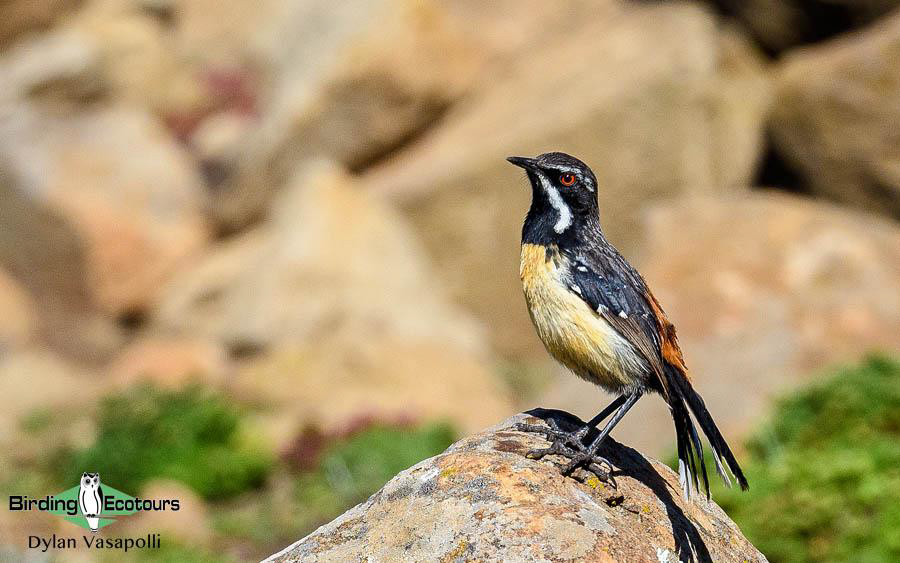
Drakensberg Rockjumper is one of the region’s most sought-after birds and families. Our day trip into the high Drakensberg Mountains produced exceptional views.
Overview
Across a wide range of impressive biomes and ecosystems, South Africa has a dense variety and abundance of plant and animal species that is hard to match. Better still, its well-supported tourism routes make South Africa easy to navigate and explore. The bird diversity in South Africa is particularly noteworthy, with over 850 species on offer across nine biomes.
On this 18-day tour, we spent time traversing four biomes in Eastern South Africa across a wide range of subtropical forest and savannah ecosystems with brief forays into cooler altitudinal grasslands and mountainous regions. We managed to amass a list of 417 bird species, with notable highlights including: African Emerald Cuckoo, Wattled Crane, Indian Yellow-nosed Albatross, Saddle-billed Stork, Palm-nut Vulture, Southern Banded Snake Eagle, African Wood Owl, Southern Ground Hornbill, African Pygmy Kingfisher, Green Barbet, Gorgeous Bushshrike, Drakensberg Rockjumper, Crimson-breasted Shrike, Bush Blackcap, Orange Ground Thrush and Yellow-breasted Pipit among many others.
This tour usually offers amazing mammal sightings as well, and this trip was no different. From Humpback Whales to Meerkats to the Magnificent seven (African Savanna Elephant, White Rhinoceros, Cape Buffalo, Lion, Leopard, African Wild Dog and Cheetah). Not to mention some other amazing wildlife including an unforgettable sighting of a Boomslang being mobbed by a bird party in the heart of the Kwazulu-Natal province (Check out Day 9)!
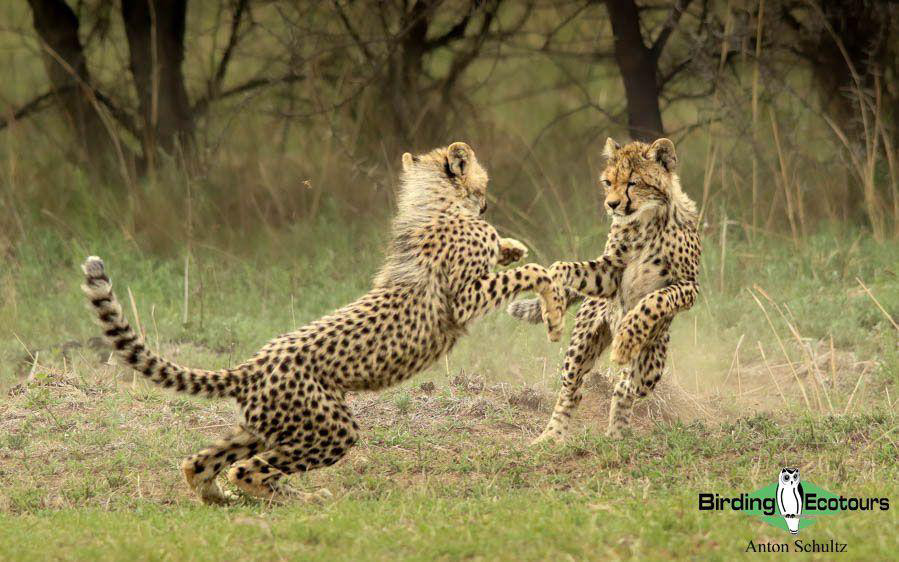
A highlight of this year’s tour: two Cheetah cubs play-fighting in Dinokeng Game Reserve.
Detailed Report
Day 1, 14thOctober 2025. Arrival in Durban, local birding and transfer to Pennington
Our morning was spent coordinating logistics and gathering the group. However, even in Durban central the birding had already begun, with a pair of the widespread and iconic Peregrine Falcon soaring over the city skyline and the first few African Woolly-necked Storks and Black Kites dropping in on its suburban outskirts. When we finally met at the historical Botha House, the anticipation was tangible. After some brief introductions, we headed out for a quick lunch at the local golf club restaurant overlooking the Indian Ocean. Harsh winds may be the bane of a birder’s existence elsewhere, but here proved to be quite the exception as we broke out the scope and watched the occasional Indian Yellow-nosed Albatross fly past—and the occasional Humpback Whale swim by—from the comfort of our table.
Later in the afternoon we travelled deeper into the lush forest of Umdoni Park for our first real taste of the journey ahead – and what a sweet taste it was. Despite the very same howling wind, our brief afternoon walk yielded the first forest species we would be seeing a lot more of on the trip, including an unforgettable sighting of Narina Trogon perched in front of us for minutes on end. Among the regular forest bird party denizens like Square-tailed Drongo, Olive Woodpecker and Dark-backed Weaver, we also managed a brief but fantastic view of a Little Sparrowhawk perched in the canopy and a secretive view of a Blue Duiker in the undergrowth. With our trip rolling and our excitement palpable, we headed back to our accommodation, fit for a president, and discussed what was to come on our trip ahead.
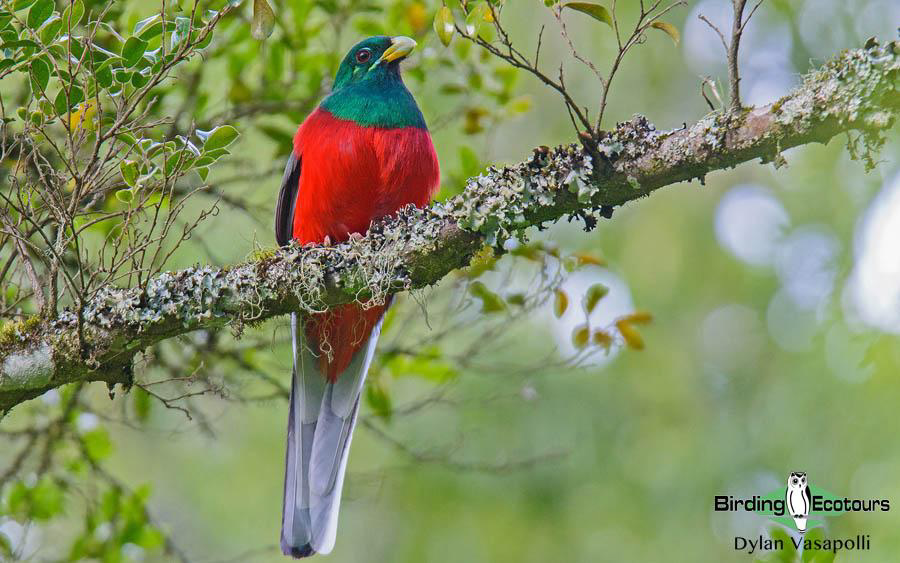
Trogons are known worldwide as stunning birds—this Narina Trogon is no exception.
Day 2, 15thOctober 2025. Birding Umdoni Park, and transfer to Underberg, via Harding
Before breakfast (but after coffee), we went out for an early morning walk back through the forests of Umdoni Park to revisit the same area as yesterday. Being much less windy than yesterday, the birding was much more productive. Some of the local forest species seen this morning included Tambourine Dove, Olive Sunbird, Yellow-rumped Tinkerbird and Red-capped Robin-Chat, with other more widespread species like Crested Barbet, Southern Black Tit and Hamerkop putting in appearances on the forest edges. The stars of the morning, however, had to be the group of five Knysna Turacos squawking wildly and courtship feeding on an exposed tree. A quick breakfast later and we were on our way to the Drakensberg mountains.
On our way we tried for the critically endangered Blue Swallow which, unfortunately, didn’t grace us with its presence. Instead, we saw Plain-backed Pipit, Lanner Falcon, Cape Grassbird, Buff-streaked Chat and Wing-snapping Cisticola on the rolling grasslands. We pushed on through to Ngeli forest lodge for lunch and a nearby plantation where we found the much sought-after Bush Blackcap and the very difficult-to-see Barratt’s Warbler calling loudly in a field of blackberries. Seeing that we were running the clock down, we sprinted out of the forest, only stopping for an African Yellow Warbler on the way out, and only returning to fetch the speaker I may or may not have accidentally left on the minibus roof after leaving said warbler. Running even lower on time now, we only stopped for a fantastic Spotted Eagle-Owl on the way into our accommodation, at the base of the legendary Sani Pass, for the evening.
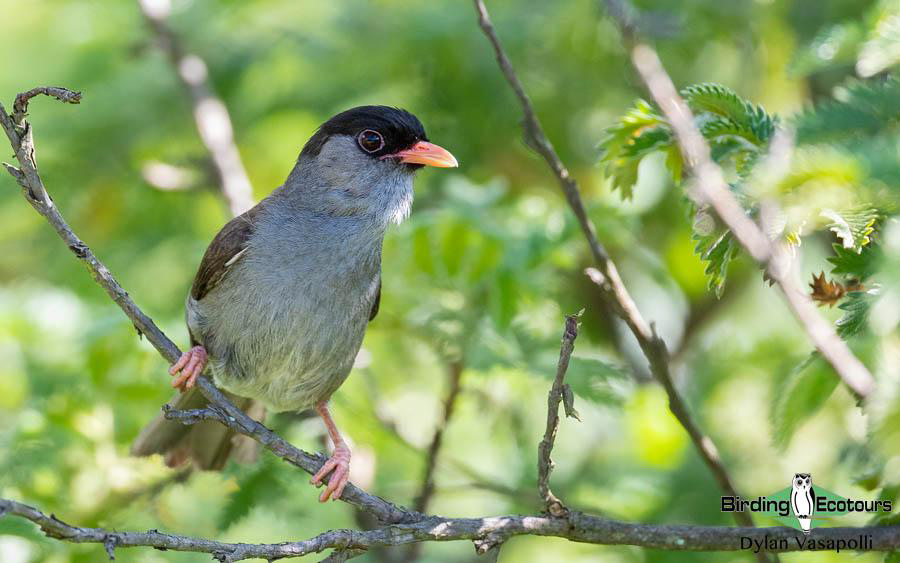
The localized Bush Blackcap is one of many endemics sought on this tour.
Day 3, 16thOctober 2025. Endemic birding on Sani Pass, and into Lesotho
Up at the crack of dawn, we were lucky enough to be treated, from our verandah, to a foraging Spotted-necked Otter, as we waited for our local guides, father-son duo Stuart and Glen Mclean, to come pick us up. Today was a fantastic day of birding along the spectacular Sani Pass: a 15-kilometer-long mountain pass that ascends the dramatic Maluti-Drakensberg Mountains and crosses the border into Lesotho at the top. At the base of the pass, we observed some fantastic species over lawn grass, Red-throated Wryneck, Cardinal Woodpecker, Fiscal Flycatcher, Olive Thrush and our first fleeting views of Red-chested Cuckoo. Looking over a small farm dam, we enjoyed watching a group of Cape Weavers going about their busy lives, as a Giant Kingfisher went diving for its breakfast behind them.
As we steadily climbed the pass, always making sure to stay ahead of the mist belt cloud chasing us from below – the grassy, boulder-strewn slopes and valleys along the pass started to give up some proper Drakensberg and Afromontane specials. These included the endemic Gurney’s Sugarbird, Wailing Cisticola, Drakensberg Prinia, Malachite and Greater Double-collared Sunbird. Scanning a group of swallows and swifts yielded the tricky House Martin, along with African Black and Alpine Swift. Rising further still, we crossed between both the South African and Lesotho border to the pristine rocky altitudinal grassland at 9,800 ft (3,000 m) above sea level. It was here that we were treated to the dapper and highly charismatic endemic Drakensberg Rockjumper, the diminutive endemic Drakensberg Siskin and the mysterious endemic Mountain Pipit, whose exact wintering grounds are still unknown. Other special birds seen up here included Southern Bald Ibis, Large-billed Lark, Sickle-winged Chat, Karoo Prinia and Sentinel Rock Thrush.
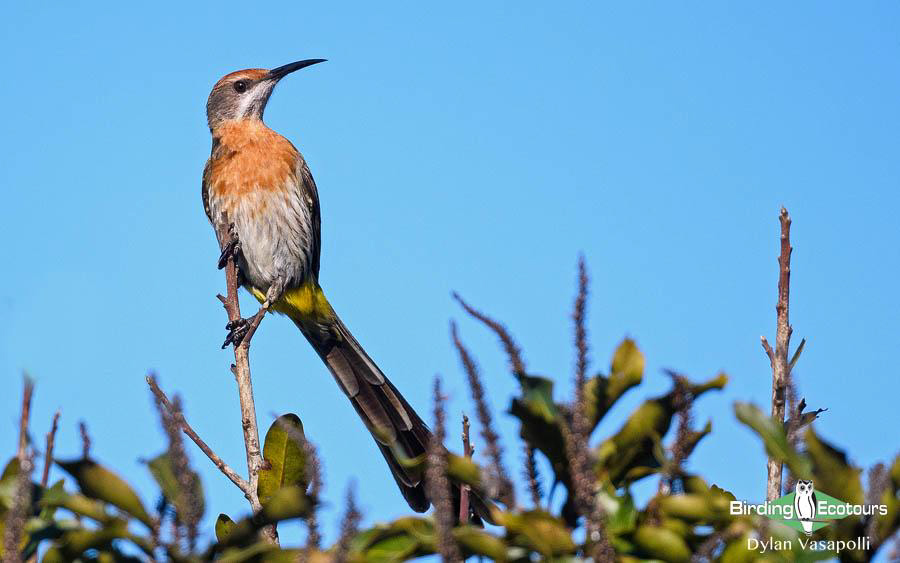
Gurney’s Sugarbird was one of our early highlights on Sani Pass—a very special bird.
As we continued to climb uphill – waving at the passengers of an upturned car having a worse day than us on the way – the ratio of grass to Karroid scrubs shifted into habitat resembling the dry west of South Africa. Here too the species complex became quite interesting for this part of the country, with species like Black-headed Canary, Karoo Scrub Robin, Layard’s Warbler, Fairy Flycatcher and African Rock Pipit all seen within only a few kilometers of each other. It was in this rocky-scrubby habitat that we stopped for a quick lunch; peacefully observing the local goat herders going about their unique livelihoods to make some money for the summer months. It was here that we were treated to a pair of Verreaux’s Eagles at a considerable distance away from us, along with some White-necked Ravens and Cape Vultures.
Towards sunset we headed back down the pass, finding a few missing targets on the way down, the stars being Grey-winged Francolins on the mountainside, sitting beautifully in the scope. Other species on the way back down included Ground Woodpecker, Jackal Buzzard, Cape Bunting and Bokmakierie and some interesting mammals like Rhebok, Slogget’s Vlei Rat and Rock Hyrax. After a fantastic day in one of the most unique parts of Africa, we were greeted by another Spotted Eagle-Owl with two fledglings at our accommodation. What a day!
Day 4, 17thOctober 2025. Sani, Underberg and Benvie Gardens, transfer to Eshowe
We decided to take a quick morning drive around our accommodation this morning. Despite the drizzle, we saw a few nice species around the dam and small lakes around our lodge, including Long-tailed Widowbird, Yellow Bishop, Yellow-billed Egret, Black-headed Heron,Pied Kingfisher and the flashy Diederik Cuckoo. After leaving Sani Valley we journeyed east, away from the mountains and into the farmlands nearby Underberg. Here we found all three locally occurring crane species in South Africa: the very scarce Wattled Crane, the beautifully adorned Grey Crowned Crane, and the National bird of South Africa, Blue Crane. Along with the stars of the show were some other grassland species like Ant-eating Chat, African Pipit, Zitting Cisticola and Fan-tailed Widowbird. Driving northwards, we stopped at a local biker’s bar, a traffic control officer and a banana salesperson as we made our way to Eshowe.
Along the way, we made a painfully brief stop at the tranquil Benvie Gardens in the Karkloof Conservancy. This area is definitely worth spending longer in, with tall exotic conifers adorning a picturesque garden complete with Azaleas. Such an alien landscape creates quite alien sightings; in fact, this is probably the premier spot in South Africa to observe the usually shy and secretive Orange Ground Thrush. Quite strangely, we had five of these incredible birds foraging around us, unbothered by our presence. Here we also saw Chorister Robin-Chat, Lemon Dove and Long-crested Eagle. We were unfortunately in a rush and arrived in Eshowe a little later that evening than ideal, perhaps we should have skipped the biker’s bar or the banana salesperson!
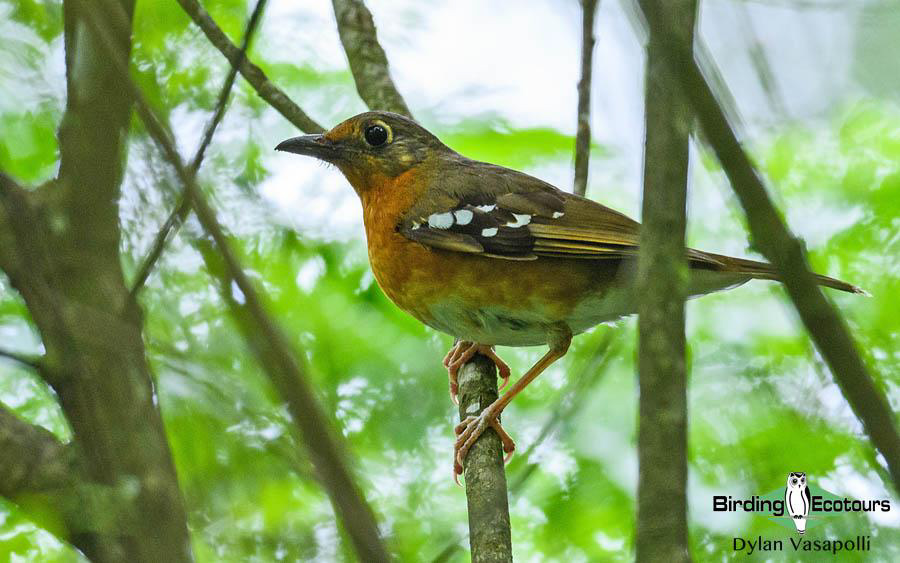
We had some unforgettable moments with Orange Ground Thrush at Benvie Gardens.
Day 5, 18thOctober 2025. Birding Ongoye and Mtunzini
We made our way down to Mtunzini at sunrise to fetch our local guide, Junior Gabela. Our first stop of the day was the impressive Ongoye Forest. This large patch of Afromontane Forest is well-known in birding circles for hosting southern Africa’s only population of Green Barbet. The subspecies here, woodwardii, is also endemic to this forest, and differs from those further north in having bright yellow ear coverts. Unfortunately, this morning was extremely windy, so finding one should have been difficult to impossible. Luckily for us, however, Junior knew of a site which gave us beautiful views of a bird sticking its head (and only its head) out of a nesting hole. The remainder of the time spent in this forest yielded some other forest species, including the difficult Yellow-streaked Greenbul, Green-backed Camaroptera and African Paradise Flycatcher.
The howling wind became so incessant that we decided to backtrack down from whence we came. The roadside birding kept us plenty entertained on the way back down, with more widespread species like Black-collared Barbet, Black-crowned Tchagra, Familiar Chat, Wire-tailed and Lesser Striped Swallow and the stunning Scarlet-chested Sunbird keeping us entertained as we drove through the village-dotted countryside towards Mtunzini. Further along we stopped at a productive tropical wetland site to see what we could find. The ponds here were incredibly productive, with African Pygmy Goose, White-backed Duck, Goliath Heron, African Jacana and the blue jewel Malachite Kingfisher making an appearance. Behind the ponds grew a large Raffia palm tree, towering over the landscape, and we were delighted with incredible views of a pair of the vegetarian Palm-nut Vulture making a nest.
Back in Mtunzini we birded the town center, seeing some great widespread species like Brown-hooded Kingfisher, Black-bellied Starling, Speckled Mousebird, Bronze Mannikin,Eastern Golden and Spectacled Weaver in a local park. We then birded on the Siyaya trail, south of town, and saw fantastic species like Black-throated Wattle-eye, Grey Sunbird and a group of the bizarre Green Malkoha in a calling cacophony. Heading into the mangrove swamp area of the Umlalazi Nature Reserve, we ended the birding day looking at waders like Common Ringed Plover, Common Greenshank, Little Stint and Wood Sandpiper. We finished off early and enjoyed a much-appreciated afternoon break at our accommodation. There was one more pleasant surprise at our accommodation that evening when we saw a fantastic male African Wood Owl in the drizzle, what a way to finish off the day in style!
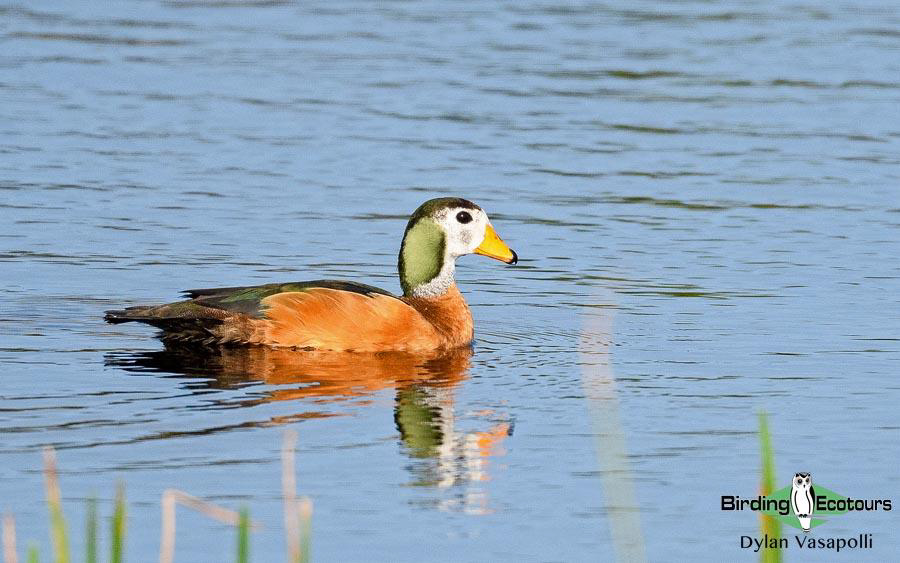
The tiny African Pygmy Goose is a scarce bird in South Africa.
Day 6, 19thOctober 2025. Dlinza Forest, transfer to St Lucia
With gloomy weather looming over Eshowe this morning, we made an early start and birded the well-known Dlinza Forest on the outskirts of town. Starting with the viewing platform, we waited patiently for an Eastern-Bronze-naped Pigeon that never came, and we had to settle for a few African Olive Pigeons instead. We left the deck and headed deeper into the forest with a specific bird in mind, and we were struggling! Just as things were seeming unlucky a security guard, with the aura of a shaman monk, calmly told us that he knew what we were looking for. He pointed us in the direction of a gorgeous and well-camouflaged Spotted Ground Thrush, another extremely localized bird, looking out through leaf litter on the forest floor. On our way back out of the forest we spotted a Scaly-throated Honeyguide calling from its sentinel. We also managed views of a few other species we’d seen previously on the trip, like Narina Trogon, Chorister Robin-Chat and Olive Woodpecker. What a morning! After a quick breakfast at our lodge we got back on the road again, this transfer was much shorter than the days prior.
Soon we were on the Siyabonga Jetty outside St Lucia, looking at Brown-throated and Eastern Golden Weavers building nests from scratch. Driving into town, we were greeted by a very friendly Common Warthog, which was contemplating whether or not to charge a tourist hovering their cellphone camera inches from its face! Luckily, it chose the option of a quick and simple mock charge and thereafter continued its otherwise pleasant life. We were greeted by the local Southern Crested Guineafowls, wearing their Tina Turner wigs, and then by an Eastern Green Snake, on our way into our accommodation. We dropped our bags off and had lunch in town, then ended the day on the St Lucia Estuary, scanning for waders like Eurasian Whimbrel, White-fronted Plover, Ruddy Turnstone, Curlew Sandpiper, Common Ringed Plover, Collared Pratincole and the regional rarity, Greater Sand Plover, and watched the first few Greater Crested and Little Terns come in to roost, before the rain dispelled us. We enjoyed a special treat after dinner when the famous St Lucia Common Hippopotamuses made their rounds on the streets, escorted by a security car.
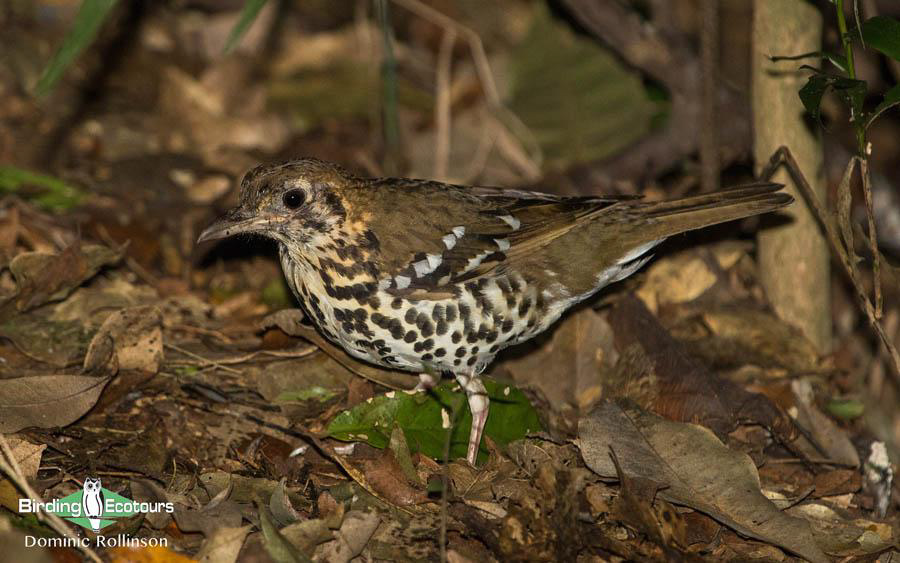
Elation as we finally found our Spotted Ground Thrush (with thanks to the security guard!).
Day 7, 20th October 2025. Birding the Eastern Shores of the Isimangaliso Wetland Park
We arrived at the entrance gate bright and early to be first into the park. Our first stop was the Amazibu bird hide, where we had a specific bird in mind, and after a welcome cup of coffee it showed! A nice Rufous-bellied Heron strolling into view, not an easy bird anywhere else in South Africa. The wetlands here and nearby continued to impress, with great views of African Pygmy Geese, White-backed and White-faced Whistling Ducks, Yellow-billed and Great Egrets, Squacco Heron and another Malachite Kingfisher. We continued through the park and on some loops, getting great species on the moist grassland and above, including Croaking Cisticola, Red-breasted Swallow, and our first Broad-billed Roller. The stars of the show had to be a pair of Burchell’s Coucals, one with a dragonfly in its beak! (I have probably seen a higher diversity of Animalia in this bird’s grasp than any other, from lizards to mice to baby birds to crabs, and spiders and insects of all shapes and sizes). Speaking of animal diversity, this was our first big game park of the trip and we saw some new mammals for the trip, like Cape Buffalo, Plains Zebra, Greater Kudu, Waterbuck, Southern Reedbuck and Bushbuck.
A quick stop at the Mission Rocks picnic site gave us some special birds like Woodwards Batis, Rudd’s Apalis and Grey Waxbill, along with more common species like Collared Sunbird. Unfortunately, the entire day had been a race against the steadily advancing rainclouds. We kept an eye out for the rare Southern Banded Snake-Eagle as we made our way deeper into the park. Out on the Cape Vidal beachfront we got to see a few species that we’d picked up beforehand like Grey-headed Gull, Greater Crested Tern, White-fronted Plover and Humpback Whale. All this birdwatching was making us quite hungry though, so we decided to have a peaceful lunch at a nearby picnic site. We were watched intently by some localised Blue Monkeys and the more widespread Vervet Monkeys, and my Australian clients guarded their only bottle of Vegemite with their lives. As we passed through the coastal forest coming out of Cape Vidal we managed fantastic views of a pair of Blue-mantled Crested Flycatcher (not a bird for the slow-paced) and another fantastic view of the tricky Brown Scrub Robin.
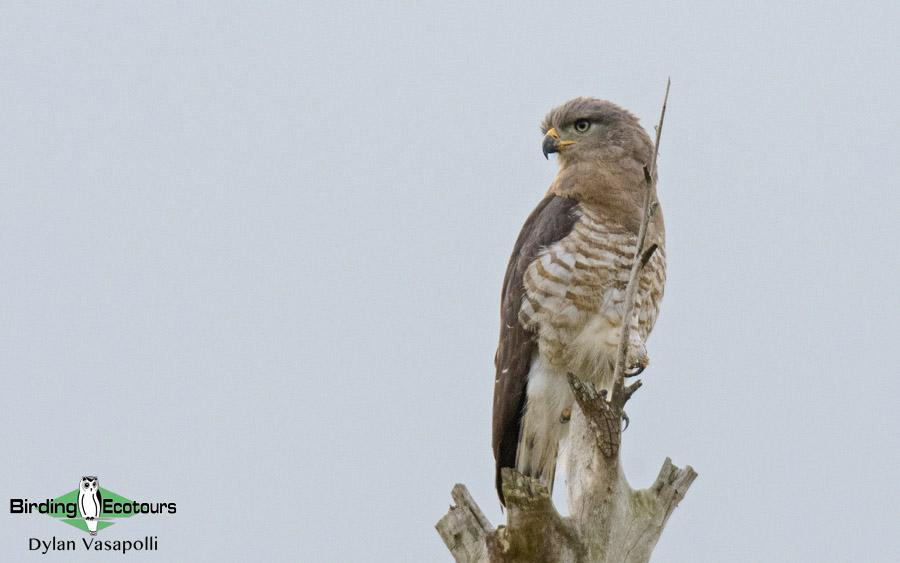
Our last-minute Southern Banded Snake Eagle sighting took a great deal of pressure off.
Around early afternoon we started making our way back towards the entrance gate, only stopping at a few wetland and estuarine views on our way back. Even so we still managed to keep ticking species for the day, like European Bee-eater, Common Buzzard and White-breasted Cormorant. Alas, as we exited the gate of the wetland park, we knew we had missed our opportunity for Southern Banded Snake Eagle – or so I thought! Just as I’d resigned to our fate, we were finally treated to some magnificent views of this scarce bird on a telephone pole, out in the open.
Day 8, 21st October 2025. Birding St Lucia, transfer to Hluhluwe
Our morning began with exploring the excellent iGwalagwala Trail, running through the coastal forest around the town. The birding here felt difficult, with a lot more being heard than seen. Secretive Buff-spotted Flufftails serenaded us temptingly throughout the forest, as a frustratingly distant African Emerald Cuckoo called at the top of its lungs, and a pair of Olive Bushshrikes remained out of reach on the forest fringes. All the while, the only bird we saw often was the ubiquitous Red-capped Robin-Chat, its beautiful whistle ironically imitating our missing targets. Even so, we still saw some great species including Livingstone’s Turaco, Trumpeter Hornbill, Orange-breasted Bushshrike and Yellow-breasted Apalis, as well as a beautiful Eastern Hinged-Back Tortoise on the forest edge.
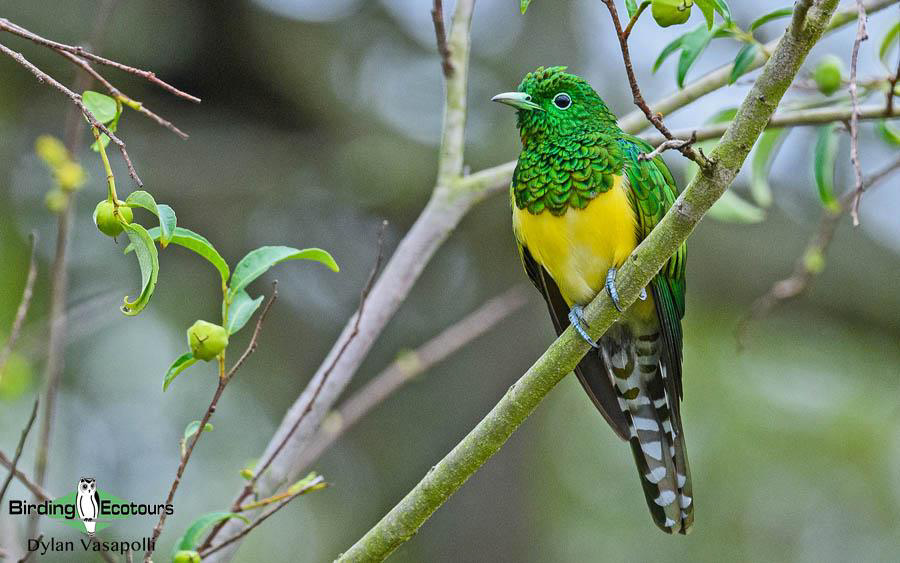
A sighting of a bright male African Emerald Cuckoo is hard to beat.
A nice breakfast and probably the best coffee of the trip later, we headed out for our transfer to Hluhluwe, adventurously following Google Maps through some strange forest roads as we did so. Somewhere along a dirt road, in some of the most unassuming habitat alongside a village, our minibus came to an abrupt stop and our doors flung open, for an African Emerald Cuckoo calling in an alien plantation directly alongside us. After much searching we eventually managed to locate this yellow and green gem, always a tough species, in the canopy. Entering into our accommodation at Mazuri Cottages, we managed fantastic views of Striped Kingfisher, Little Bee-eater, Pin-tailed Whydah and the scarce African Cuckoo Hawk!
After settling into our rooms we made our way to the legendary Nibela Floodplains in the late afternoon – an area where our bird list was almost guaranteed to explode. And it certainly did. The sheer abundance of birdlife on this stretch of Lake St. Lucia was breathtaking. Greater Flamingos stole the show, with Pink-backed Pelicans scattered across the vista. Overhead, White-winged, Whiskered, and Caspian Terns drifted past, while a Blue-billed Teal foraged quietly in the shallows nearby. But the real stars of the afternoon were four Black Herons performing their iconic “nighttime-daytime” hunting routine – an absolute highlight. Not far from the pan we were treated to our first African Pygmy Kingfisher of the trip, a tiny flash of color that had everyone delighted. It was one of those golden afternoons you never want to leave. The guests practically had to drag me away as the sun dipped toward the horizon. Still, dinner was waiting and tomorrow promised an even bigger treat.
Day 9, 22nd October 2025. Birding Mpepe, Muzi Pan and Mkhuze Game Reserve
We set off from Kuleni at first light, but barely made it out of the reserve before being stopped in our tracks by a once-in-a-lifetime spectacle. A full-blown bird party was in chaos beside the road, and at the center of all the commotion was a snake, and not just any snake, but a female Boomslang, the legendary rear-fanged snake known for its hemotoxic venom. Leading the charge was a particularly fierce Black-backed Puffback, absolutely relentless in its assault. It darted back and forth, taking sharp little pot-shots at the Boomslang, which was rapidly shifting from hunter to hunted as it tried to retreat into a tangled pile of sticks and leaves. We didn’t stay long enough to see how the drama ended, although, if we had to put money on it, our bets were firmly on the puffback.
Our show continued to Mpepe Pan, where we were welcomed by an incredible number of Black-winged Lapwings. Overhead we had a group of aerialists, including the fairly scarce Grey-rumped Swallow, among other more common species like Barn Swallow, Black Saw-wing and White-rumped Swift. On the pan itself we had our first and only sighting of a lone female Knob-billed Duck for the trip, along with other species we had seen before, like Rufous-winged Cisticola, Black Crake, Purple Heron and Caspian Tern. We then turned our attention to the surrounding Lala Palms – ‘Lala’ meaning sleep in Zulu, named for the wine traditionally made from them – hoping to track down the localized and elusive Lemon-breasted Canary, which breeds within the palms’ freshly unfurled leaves. But, true to the unpredictability of birding, we ended up finding a small group of these canaries not in pristine palm habitat, but feeding happily in a farmer’s invasive-choked crop field, where the seed supply was clearly too good to resist.
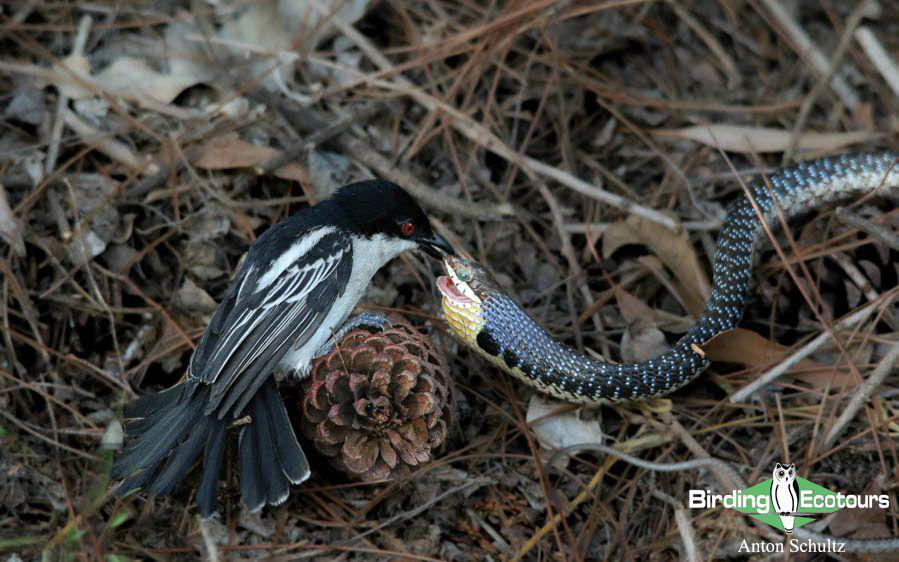
A possibly once-in-a-lifetime experience: a Black-backed Puffback with a Boomslang in its grasp!
Moving along swiftly we made our way to Muzi Pan, where we had another special encounter for the day. This time with a White-faced Whistling Duck which had been snagged by a rudimentary snare on the edge of the pan. After releasing the bird and deactivating the snare we continued to bird along the pan, where we found a few other nice birds like Three-banded Plover, Spur-winged Goose, Purple Swamphen and Black-crowned Night Heron. It should be noted that the locals here are often too poor to afford any other form of high-quality protein in their diet without resorting to harvesting off the land. While we can’t sit idly by and allow a duck to starve without its flock, we do understand that the situation is nuanced.
We arrived in Mkuze Game Reserve around midday and had to kill time in the blistering heat. Nevertheless, we found some of our first bushveld species of the trip, like Lilac-breasted Roller, Southern Red-fronted Tinkerbird, White-throated Robin-Chat, a notable sighting of a male Red-crested Korhaan, Common Scimitarbill and White-crested Helmetshrike. As the day started to cool down towards golden hour, we stopped at Kumasinga bird hide to watch birds coming in to drink at the waterhole. A variety of interesting species popped up, including Greater Honeyguide, Yellow-throated Bush Sparrow, Thick-billed Weaver, Kurrichane Thrush, Emerald-spotted Wood Dove, and Blue and Grey Waxbill. When we weren’t being entertained by birds, we enjoyed the Cape Terrapins eagerly begging for food below us, the local Southern Foam-nest Tree Frog sheltering in the hide, and the Southern Giraffes coming to the edge of the waterhole for a drink.
With it getting close to closing time, we unfortunately had to leave our bubble of paradise. On the way out of the hide we passed a tame flock of Crested Francolin, as well as an African Honeybee colony in the middle of a dispersal. Our peaceful bubble turned into a brisk pace as we made our way out of Mkuze and back to camp. All in all, a fantastic and unique day of birdwatching.
Day 10, 23rdOctober 2025. Birding Kuleni and transfer to Wakkerstroom
We started the morning off bright and early with a long walk around the unique sand forests of Kuleni. The birding here is simply extraordinary, with this spot being one of the best to find secretive species like Gorgeous Bushshrike and Eastern Nicator – both of which still gave us a run for our money. We continued our walk a bit further towards the Guineafowl Trail, where we added other great species like Green Twinspot, Terrestrial Brownbul and Grey Tit-Flycatcher to our trip list. The highlight of the entire walk, however, was an extremely close encounter with a Southern Giraffe that didn’t back down off the trailhead upon seeing us. We decided to play it safe and move into denser vegetation to allow the big male to pass us by. Not your typical sighting of this usually-peaceful herbivore.
The rest of the day was spent making the decently long journey to the small, picturesque town of Wakkerstroom, where we’d be birding the next day. Deciding to try our luck for a special, we took an unusual route to get there. It was made even stranger by the men in bright vests who stopped us while they blasted at a nearby mine. One “KABOOM!” later, and with our bones rattled, we made our way through to the real target we were looking for. Before long, we got it: a spectacular view of a family of White-bellied Bustards (endemic subspecies barrowi) on a hillside vista, and a nearby Temminck’s Courser to make it sweeter. We made our way to our accommodation for the evening, enjoying an awe-inspiring sunset as we did so, and enjoyed a traditional South African “braai” (barbeque) prepared by our hosts.
Day 11, 24th October 2025. Endemic birding around Wakkerstroom
We headed out early this morning to pick up our local guide, David Nkosi, for the day. Starting early, we had a target in mind that’s no longer as easy around these parts as it used to be, the endemic Rudd’s Lark. This lark is now found in only a handful of spots in the area and very difficult to see before the first rains, unfortunately we didn’t get to see this species today despite searching hard. Neither did we get to look for the other huge special in this area, Botha’s Lark, which is now the most Critically Endangered bird in South Africa and under intense protection. Even so, we had plenty of other birds to look for in the highlands, starting with a bucket of other lark species like Eastern Long-billed, Red-capped and a Spike-heeled Lark with chicks! Likely the biggest highlight for the morning was a beautiful pair of Yellow-breasted Pipits, which are tough to see in altitudinal grasslands despite their bright and beautiful breeding plumage. Leaving this area, we headed back towards the grassland near town, passing both Grey Crowned and Blue Cranes along the way. In this area we managed to get distant views of a pair of Denham’s Bustard on a hillside, not an easy species either.
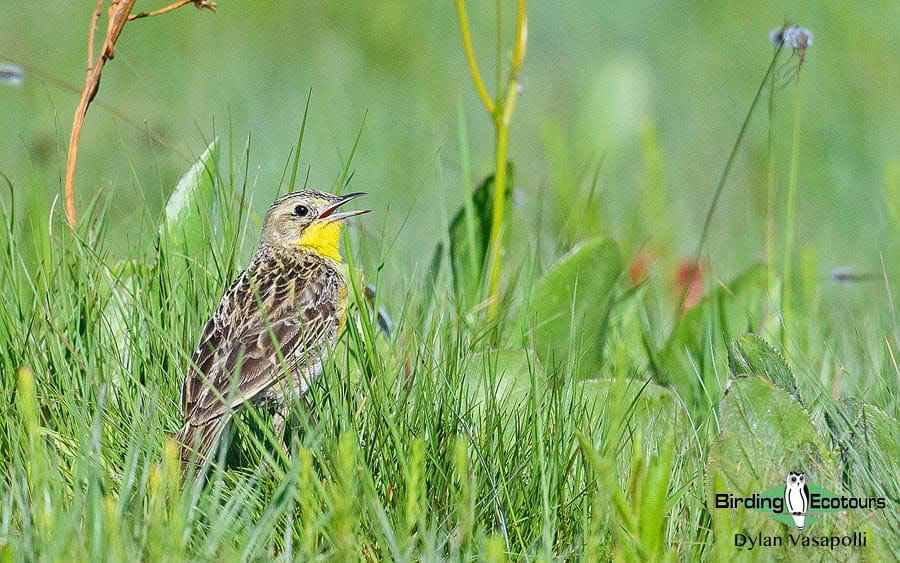
Yellow-breasted Pipit is a highly localized and very special bird of the high-altitude grasslands of central South Africa (and Lesotho).
Heading back into town we grabbed a cup of coffee and made our way through to the other half of Wakkerstroom to find a pair of Blue Korhaans. We saw these just in time before the day got too hot and they went immobile. Other birds we saw nearby during our breakfast were Pale-crowned Cisticola, Southern Red and Yellow-crowned Bishop, South African Cliff Swallow and Southern Masked Weavers weaving nests on the barbed wires of the farm fences. While those weavers may sound hardcore, they don’t really compare to the Cape Crows in the area which make their whole nest out of barbed wire, that’s pretty metal if you ask me! – Pardon the pun. Also in this area was a family of Meerkats, one going sentinel to keep an eye on us. These charismatic mongooses are always a highlight to see on our highveld grasslands, where they can actually be quite shy, despite what you may have seen on BBC documentaries about the Kalahari, where they’re a lot tamer. After a quick lunch we moved onwards to an incredibly productive saline wetland, where our list for the day exploded! Maccoa Duck, African Spoonbill, South African Shelduck, Cape Shoveler, Southern Pochard, Red-knobbed Coot, Glossy Ibis, White-breasted Cormorant, Great Crested, Black-necked and Little Grebe and more and more, on a single pan. Returning to our accommodation we passed an enormous controlled fire ravaging the landscape, with some familiar aerialists feeding above, an interesting morning indeed.
We decided to take the midday off and meet our guide again later in the afternoon. Even sitting on our stoep back at our accommodation was great birdwatching though, with a White-throated Swallow coming in to feed its chicks on our left and a Greater Striped Swallow building a mud nest on our right.
That afternoon we met David again and headed out to try find a Nicholson’s Pipit which had been eluding us all morning. Eventually we found the bugger, only having to go into the town’s nearby quarry to do so. We ended the day looking over the Wakkerstroom wetland (‘Wakkerstroom’ means ‘awake stream’ in Afrikaans, named because of this perennial wetland). Despite trying, we didn’t find much on account of the heavy wind in the area (probably not the best day for that controlled fire), with an African Marsh Harrier marking the end of an otherwise great day of birding!
Day 12, 25th October 2025. Transfer to Kruger National Park
This was probably the least thrilling day of the trip but, that being said, as the adage goes “A bad day of birding is still better than a good day…well, anywhere else really”. Like yesterday afternoon, this morning was windy, very windy! We got to see a fantastic Bokmakierie on our front lawn as we left, as well as an Amethyst Sunbird feeding on a flower, and the local Wahlberg’s Eagle coming in for a flyby. Once the car was packed, we were off, passing right by the Wakkerstroom Wetland again on our way out. The trip up to Kruger didn’t yield much aside from a few Black-winged Kites, Long-crested Eagles and the ubiquitous and much-loved Long-tailed Widowbird. All that being said, our music was on fire, so we didn’t mind too much.
We reached the Phabeni Gate of the famous Kruger National Park with about two hours of daylight left. Just beyond the gate a leaking pipe offered some unexpected entertainment, as a stream of beautiful seed eaters came in to drink: Blue Waxbill, Southern Grey-headed Sparrow, Bronze Mannikin, and a particularly striking Golden-breasted Bunting. A little further along the road we got lucky again, picking up Dark Chanting Goshawk, African Hawk-Eagle, and our first Natal Spurfowl of the trip. Probably the highlight of this drive, though, had to be a Spotted Hyena den with pups! By late afternoon we rolled into Skukuza Camp, where we’d be spending the next three nights, already excited for what the coming days might bring.
Day 13, 26th October 2025. Kruger: Skukuza, Tshokwane and Orpen Dam
Today we’d be birding the Kruger in style, in an open-topped vehicle. Our driver, Sammy, may not have been a birdwatcher but his knowledge of the bigger animals of the Kruger was astounding. We decided to start our Kruger birding by heading north towards the Tshokwane picnic site. Along the way a lot of the more widespread bushveld birds we’d been neglecting for Zululand specials began trickling in. Grey Go-away-bird was an instant favourite, a good thing too considering we’d be seeing it every day of the trip from now onwards. Other birds seen included a stunning Klaas’s Cuckoo, Red-headed Weaver, White-headed Vulture, Martial Eagle, Red-faced Cisticola, African Grey, Southern Yellow-billed and Southern Red-billed Hornbills…STOP! An enormous mega-herd of hundreds of Cape Buffalo crossing the road, their hooves sounding like crackling fire as they crossed (something you’ll just have to experience yourself to know what I’m talking about). On the buffalos’ backs were Red-billed Oxpeckers galore, with the occasional, rarer, Yellow-billed Oxpecker sprinkled in.
Beyond the herd we saw Violet-backed Starlings glistening in the sunlight, Purple Roller, and a stunning Bearded Woodpecker female. We also saw the mammals that make this a legendary reserve: African Savanna Elephant, Impala, Southern Giraffe, Waterbuck, Plains Zebra, and smaller numbers of Nyala, Southern Bushbuck, Greater Kudu, Steenbok, Common Warthog, and a small colony of Common Dwarf Mongoose. We also got unsatisfactory views of a White Rhinoceros in deep vegetation but, needless to say, the sighting wasn’t quite the epitome of stellar. By mid-morning we’d made our way to the picnic site, where we had a South African classic for lunch, Roosterbroodjies! Essentially a toasted cheese sandwich grilled over an open flame, and absolutely delectable. After a brilliant lunch, being watched by a gang of thuggish Greater Blue-eared and Cape Starlings, we took a small walk around camp for the strangely localized Mourning Collared Dove which seems to like this site, and this site only, in the southern Kruger National Park.
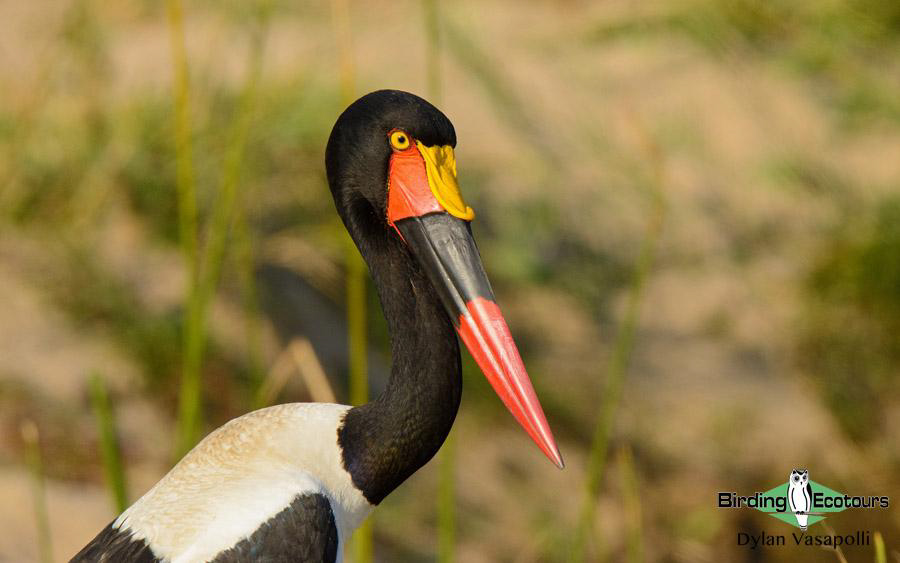
Saddle-billed Stork is an elegant and glorious species that towers above most other waterbirds.
Leaving the picnic site, we were shocked to see an enormous African Savanna Elephant bull feeding in the shade of a tree right next to the bathrooms of the picnic site, that’s Kruger for you! We made our way to Orpen Dam, getting brilliant views of a pride of sleepy African Lion along the way. At the dam itself we got to see some great species like Saddle-billed Stork, Black Crake, Giant Kingfisher, and Striated, Squacco, Grey and Purple Heron. Around midday we decided that the day was simply too hot to be birding in, so we headed back to camp. We stopped for a few great mammals and gamebirds, like the stunning and strange Southern Ground Hornbill, on our way back. Later in the afternoon we briefly birded around the Skukuza tent camping section, with some great species like White-browed Robin-Chat and Southern Boubou. We finished the day at sunset looking over the nearby Lake Panic, which was more of a puddle than a lake. Almost a tradition, we were treated to a pack of African Wild Dogs on our way back to camp, just before closing time. This evening we had another braai and a tasting session of the South African creamy alcoholic drink “Amarula”. We were also visited by our first Solifuge of the trip, not an animal for the faint of heart.
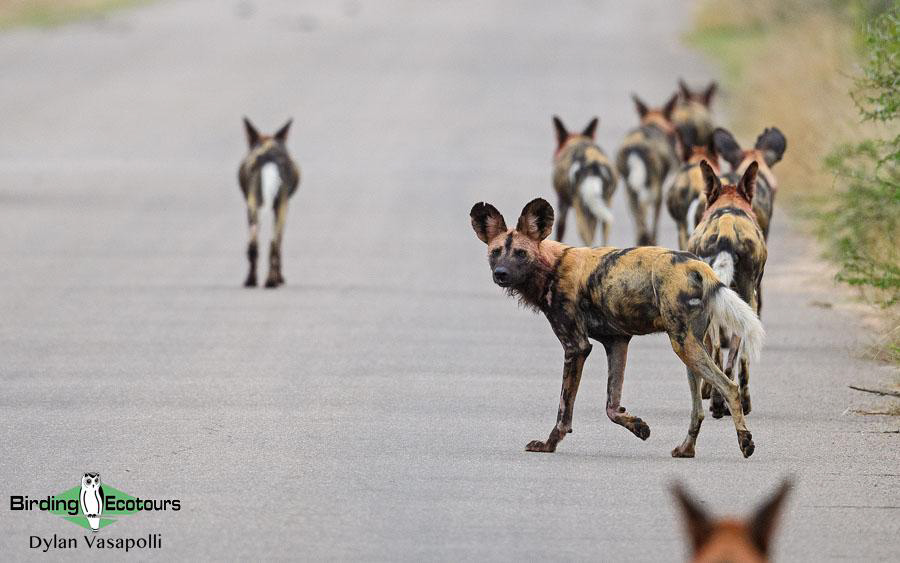
A pack of African Wild Dogs—this scarce mammal is a rare sight, and we were thrilled.
Day 14, 27th October 2025. Kruger: Rhenosterkop Road, Lower Sabie and Mlondozi
We got off to a really lucky start today, with the same pack of African Wild Dogs as we’d seen the day before, hopefully a sign of good things to come. Well, one thing was for sure, the birds were absolutely popping off this morning! Sometimes you drive past an area and you just feel like it’s the right place to sit: this morning I had one of those feelings, and it paid off with a laundry list of species including Green-winged Pytilia, Black-crowned Tchagra, Chinspot Batis, Kurrichane Thrush, Southern Black Tit, Rattling Cisticola, White-bellied Sunbird, Southern Black Flycatcher and the star of the show, Bennett’s Woodpecker! As we made our way further down this gravel road we were treated to free bush massages, courtesy of the corrugations! We saw some impressive species like Retz’s Helmetshrike and Black Cuckooshrike. Eventually, however, we were halted by something even more amazing, Side-striped Jackals! These animals are quite rare, especially in southern Kruger. While we watched the pair of jackals, a Sabota Lark forcibly stole the show and sat calling its heart out on an exposed trunk, making for quite a special view overall.
Feeling rather satisfied with ourselves, we made our way to Sunset Dam where we saw some great birds like Water Thick-knee, Black-winged Stilt, Common Greenshank, Common Sandpiper, African Pied Wagtail and an even better view of Green-winged Pytilia, amongst the bigger gamebirds like African Spoonbill, Marabou and Yellow-billed Storks and the even larger Nile Crocodile. After a nice lunch overlooking the Sabie River, we headed back out to Mlondozi Dam, passing by some nice species like Magpie Shrike, Tawny Eagle and African Harrier-Hawk on the way. At Mlondozi itself we broke out the scope and intensely scanned the dry dam, finding some great species like Pied Avocet (quite rare for Kruger), Collared Pratincole, African Openbill, Saddle-billed and African Woolly-necked Stork. Around the woodland by our viewpoint we also saw some great species like Jameson’s Firefinch, Mocking Cliff Chat, Wattled Starling, Marico Sunbird and, finally, a good sighting of African Paradise Flycatcher, which had been torturing us all trip!
We’d had enough free massaging for one day so we decided to go back to Skukuza via the main road, a great choice indeed! We were treated to two Lionesses stalking Southern Bushbucks along the Sabie River. Then, further down the road, after a stunning Pearl-spotted Owlet and a few White-backed and Hooded Vulture nests, we were treated to the main course of the day, a gorgeous male Leopard lying in a dry riverbed! Nothing really compares to seeing those spots, which have a way of melting into the landscape. Other great species on this drive included Jacobin Cuckoo, White-crowned Lapwing, African Fish Eagle, Bateleur, Goliath Heron, Brubru and Ashy Flycatcher.
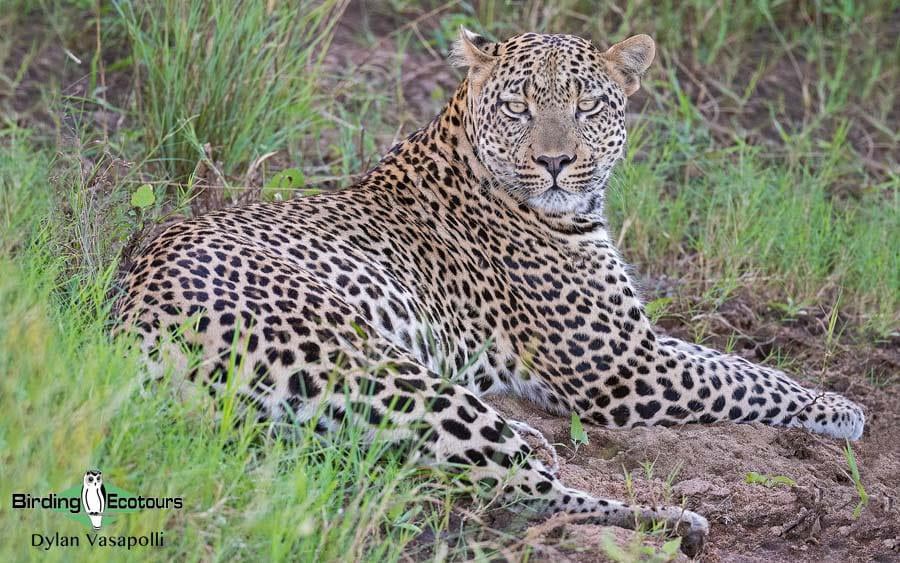
A fabulous male Leopard at home in a dry riverbed—aren’t spotted cats the best?!
Overall, we saw more species on this day than any prior, Kruger really treated us. This evening we had supper at the nearby golf club and we found some nocturnal animals like Scrub Hare and a Common Hippopotamus outside of its usual water-refuge, between the camp and restaurant. All in all, a good first taste of classic Africa!
Day 15, 28th October 2025. Birding Skukuza and transfer to Mount Sheba
We had a more leisurely morning today, taking time for a bit more sleep and a nice breakfast near our camp. From the viewing deck, looking over the Sabie River we saw a nice pair of African Black Ducks, while some African Green Pigeons crawled gently through the branches of a Sycamore Fig tree above us, looking for their own breakfast. We managed to see a few tricky species on our way out of Phabeni, including Levaillant’s Cuckoo, Long-tailed Paradise Whydah, Red-billed Buffalo Weaver, Brown Snake Eagle, Southern Ground Hornbill, White-fronted Bee-Eater, Willow Warbler and Groundscraper Thrush, ironically this list only scrapes the surface.
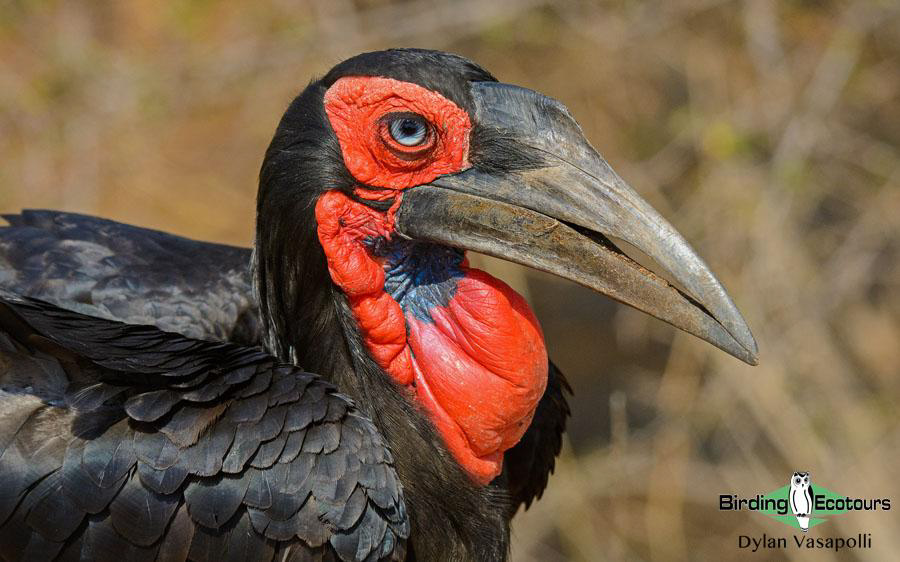
Southern Ground Hornbill is one of Kruger’s many special birds.
The rest of the day was spent getting to our accommodation atop Mount Sheba as soon as possible. With gloomy weather there wasn’t much to be seen on the way there. Probably the only exception was a flock of Southern Bald Ibis grazing somewhere along the way. As we rose in altitude towards our accommodation we were surrounded by a thick layer of fog and a sense of ghostly stillness. The vegetation at the top of this mountain was quite strange and somewhat resembled the Fynbos biome which occurs much further south. Even so, with the odds stacked against us, we tried for one special bird up here, and got it, Red-necked Spurfowl, not an easy bird at all! With not much to see, we decided to use the time to rest and prepare ourselves for the following day.
Day 16, 29th October 2025. Birding Mount Sheba, and transfer to Dinokeng
We awoke to see the beautiful mountain vista that had been hidden by mist the day before. This morning we essentially played catchup for some of the forest species we had missed elsewhere on our trip. Some very difficult species graced us with quick views, including White-starred Robin, Yellow-throated Woodland Warbler and Grey Cuckooshrike. Coming out of the forest itself, we birded the lawns around the lodge grounds and had stunning views of Olive Bushshrike, which had been taunting us all trip, and a nice Bar-throated Apalis calling on the forest fringes. After a nice buffet breakfast we hit the road, seeing a few Swee Waxbills picking through seeds on the lawn grass as we left.
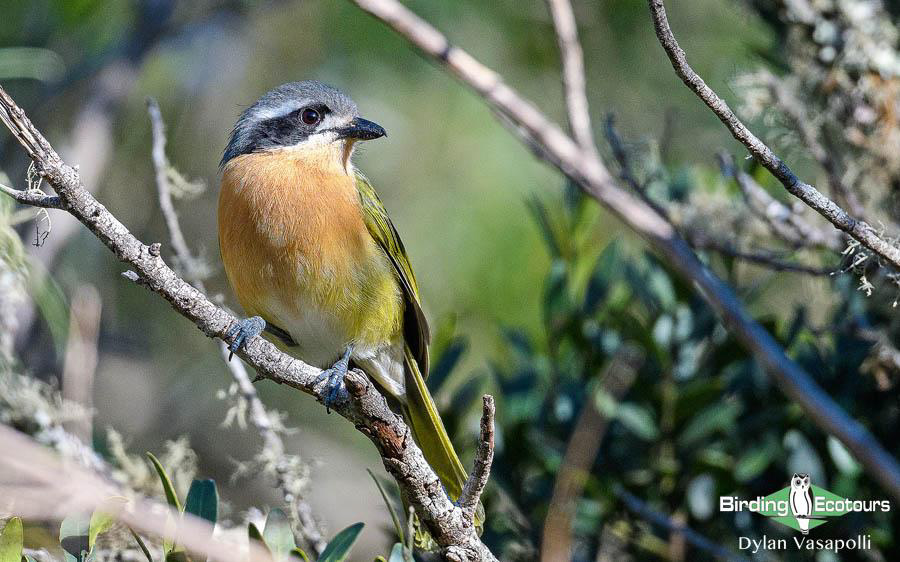
Mount Sheba offers excellent forest birding—this is an Olive Bushshrike.
On the way to our accommodation we stopped at Mabusa Nature Reserve, where we enjoyed our homemade lunches, as we had many times before on the trip. Here we got to see a few nice broad-leaved woodland specials, some species seen here around midday included Yellow-fronted Tinkerbird, Rock-loving Cisticola and Cinnamon-breasted Bunting. We were sadly running late and had to leave, also spotting a few Red-collared and White-winged Widowbirds as we made our way out of the reserve. Along the way to our destination we had one more awesome sighting in store for us, a colony of White-fronted Bee-eaters nesting in a river’s mudbank in the afternoon light. We arrived at our accommodation in Dinokeng Game Reserve at sunset, seeing only a Spotted Thick-knee as we entered. This was our final accommodation of the trip and what a fine place it was, looking out over the woodland, almost reminiscent of Kruger.
Day 17, 30th October 2025. Birding the Zaagkuilsdrift Road and Kgomo-Kgomo
Our day began with a handsome pair of Black-backed Jackals in Dinokeng. These are usually much more common in South Africa than the Side-striped Jackals we were fortunate enough to encounter earlier in the trip. Today’s plan was to bird the legendary Zaagkuilsdrift Road, located about one and a half hours north of Johannesburg. This unassuming 15-mile (24-kilometer) stretch of dirt road is famous within the South African birding community for producing an astonishing diversity of species in a very small area. Its secret lies in the rich mixture of habitats it passes through and the sheer productivity of Kalahari woodland.
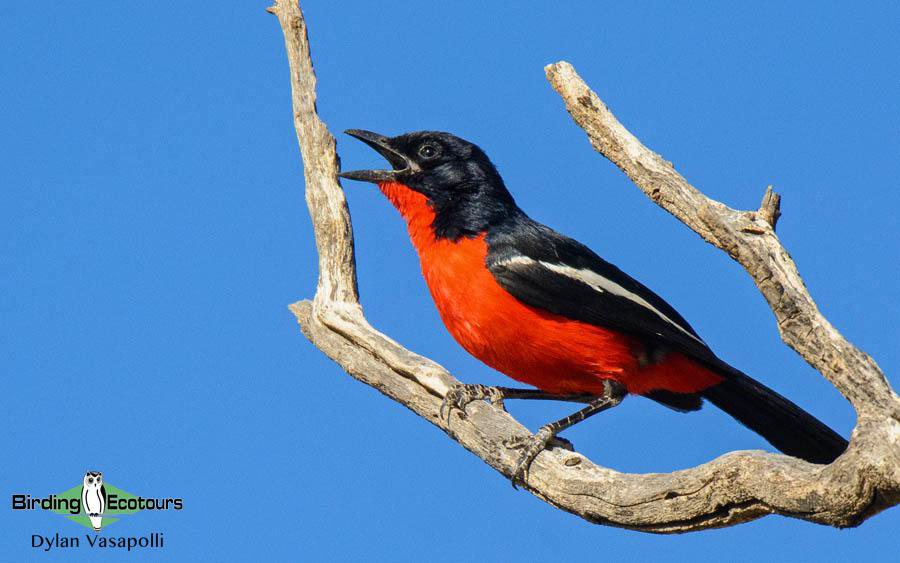
Crimson-breasted Shrike is one of the Kalahari specialties we target in the area.
It did not take long before the action started. Within minutes we were picking up an impressive list of specialties such as Black-chested Prinia, Pearl-breasted Swallow, White-browed Sparrow-Weaver, Chestnut-vented Warbler, Great Sparrow, Burnt-necked Eremomela, Marico Flycatcher and Cape Penduline Tit. A firm favourite, Pearl-spotted Owlet, gave us exceptional views that were every bit as thrilling as our first sighting earlier in the trip. We were also delighted to find an African Pygmy Kingfisher, which is quite rare for this region.
As the day grew warmer, we continued towards the small town of Kgomo-Kgomo. Here we were treated to the brilliant Crimson-breasted Shrike, a species that never fails to impress. In the same area we also added Scaly-feathered Weaver and a very energetic Kalahari Scrub Robin. The Kgomo-Kgomo floodplain, which is known for its incredible diversity of tropical wetland species, was completely dry since the seasonal rains had not yet arrived. It was clear that today would not be the day for the famous aquatic species that the area is known for, but this unpredictability is part of the excitement of birding. Beyond the floodplain, in the surrounding rural villages, we were very lucky to see two Great Spotted Cuckoos moving between houses at close range. This was an excellent sighting and a highlight of the morning. We made our way back along Zaagkuilsdrift Road at midday and stopped for lunch at the inviting Zaagkuilsdrift Bird Sanctuary. The heat of the day brought many species into the shade around the lodge. Among them were Black-faced Waxbill, Southern Pied Babbler and Acacia Pied Barbet, giving us a complete sweep of all the possible barbet species for the trip. At the small wetland in front of the lodge we were treated to a flock of delicate and very difficult Orange-breasted Waxbills that came down to drink. From the nearby sunken bird hide we also enjoyed excellent views of Striated Heron.
Feeling thoroughly satisfied with the productivity of the day, we began our journey back to Dinokeng in the early afternoon so that the tour participants could relax and pack for their flights the following day. Even the drive back added to the experience. We saw a lone Greater Kestrel and a lively family of Banded Mongoose before reaching the reserve.
As we entered Dinokeng, we encountered a sighting that immediately became a contender for the highlight of the entire trip: a Cheetah mother and her two cubs, which were engaged in energetic play, tumbling and wrestling in the open. It was an unforgettable moment and the perfect ending to an outstanding day. We spent the evening reminiscing about a truly remarkable trip that gave us many special memories and experiences that will stay with us for a long time.
Day 18, 31st October 2025. Birding Rietvlei, and departure from Johannesburg
For our final day of the trip, I thought it would be best to target a bird we had quite ridiculously missed on our trip, none other than Common Ostrich, which is plentiful in Rietvlei Nature Reserve. This nature reserve holds some fantastic birdwatching potential and is only 20 minutes’ drive from OR Tambo International Airport, making it really convenient. At a small wetland hide here we managed good views of Lesser Swamp and Common Reed Warbler, which we had previously only heard on this trip. Along the grassland loops we found some fantastic species like Capped Wheatear, Plain-backed Pipit, Cape Longclaw and, most significantly, White Rhinoceros, which we had only had a terrible sighting of earlier on the trip. We ate our final lunch of the trip and made our way out of the reserve, stopping only for a brief but stunning Little Bittern sighting on our way out. With time running short we headed to the airport, seeing a single Northern Black Korhaan on the way back, the last new species for the trip. And of course, a Hadeda Ibis, the only bird we had seen on every single day of the trip.
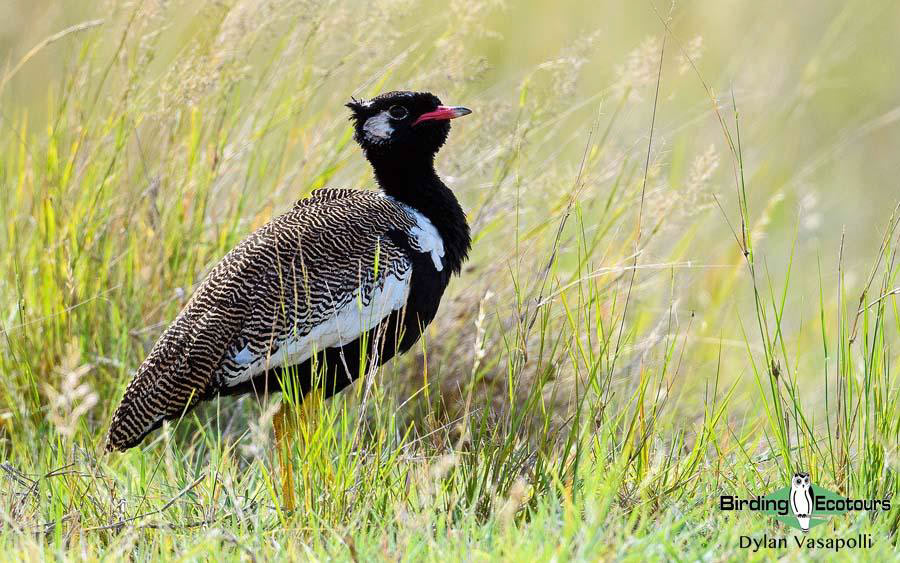
Northern Black Korhaan at home in the grasslands of central South Africa—our final new species of the 2025 tour.
Thank you to everyone for bringing your own flair and unique perspectives on this trip and for making it memorable. I learned so much and am appreciative of the graciousness of the lovely guests who helped me grow into this role. This was a successful trip with some great and extraordinary sightings!
Bird List – Following IOC 15.1 (March 2025)
Birds ‘heard only’ are marked with (H) after the common name, all other species were seen.
The following notation after species names is used to show conservation status following the IUCN Red List:
CR = Critically Endangered, EN = Endangered, VU = Vulnerable.
| Common name | Scientific name |
| Ostriches (Struthionidae) | |
| Common Ostrich | Struthio camelus |
| Ducks, Geese, Swans (Anatidae) | |
| White-faced Whistling Duck | Dendrocygna viduata |
| White-backed Duck | Thalassornis leuconotus |
| Spur-winged Goose | Plectropterus gambensis |
| Knob-billed Duck | Sarkidiornis melanotos |
| Egyptian Goose | Alopochen aegyptiaca |
| South African Shelduck | Tadorna cana |
| African Pygmy Goose | Nettapus auritus |
| Blue-billed Teal | Spatula hottentota |
| Cape Shoveler | Spatula smithii |
| African Black Duck | Anas sparsa |
| Yellow-billed Duck | Anas undulata |
| Red-billed Teal | Anas erythrorhyncha |
| Southern Pochard | Netta erythrophthalma |
| Maccoa Duck – EN | Oxyura maccoa |
| Guineafowl (Numididae) | |
| Helmeted Guineafowl | Numida meleagris |
| Southern Crested Guineafowl | Guttera edouardi |
| Pheasants & Allies (Phasianidae) | |
| Crested Francolin | Ortygornis sephaena |
| Grey-winged Francolin | Scleroptila afra |
| Natal Spurfowl | Pternistis natalensis |
| Swainson’s Spurfowl | Pternistis swainsonii |
| Red-necked Spurfowl | Pternistis afer |
| Swifts (Apodidae) | |
| African Palm Swift | Cypsiurus parvus |
| Alpine Swift | Tachymarptis melba |
| African Black Swift | Apus barbatus |
| Little Swift | Apus affinis |
| White-rumped Swift | Apus caffer |
| Turacos (Musophagidae) | |
| Grey Go-away-bird | Crinifer concolor |
| Purple-crested Turaco | Gallirex porphyreolophus |
| Livingstone’s Turaco | Tauraco livingstonii |
| Knysna Turaco | Tauraco corythaix |
| Bustards (Otididae) | |
| Denham’s Bustard | Neotis denhami |
| White-bellied Bustard | Eupodotis senegalensis |
| Blue Korhaan | Eupodotis caerulescens |
| Red-crested Korhaan | Lophotis ruficrista |
| Northern Black Korhaan | Afrotis afraoides |
| Cuckoos (Cuculidae) | |
| Burchell’s Coucal | Centropus burchellii |
| Green Malkoha | Ceuthmochares australis |
| Great Spotted Cuckoo | Clamator glandarius |
| Levaillant’s Cuckoo | Clamator levaillantii |
| Jacobin Cuckoo | Clamator jacobinus |
| Diederik Cuckoo | Chrysococcyx caprius |
| Klaas’s Cuckoo | Chrysococcyx klaas |
| African Emerald Cuckoo | Chrysococcyx cupreus |
| Red-chested Cuckoo | Cuculus solitarius |
| Pigeons, Doves (Columbidae) | |
| Rock Dove | Columba livia |
| Speckled Pigeon | Columba guinea |
| African Olive Pigeon | Columba arquatrix |
| Lemon Dove | Columba larvata |
| Mourning Collared Dove | Streptopelia decipiens |
| Red-eyed Dove | Streptopelia semitorquata |
| Ring-necked Dove | Streptopelia capicola |
| Laughing Dove | Spilopelia senegalensis |
| Emerald-spotted Wood Dove | Turtur chalcospilos |
| Tambourine Dove | Turtur tympanistria |
| Namaqua Dove | Oena capensis |
| African Green Pigeon | Treron calvus |
| Flufftails & Forest Rails (Sarothruridae) | |
| Buff-spotted Flufftail (H) | Sarothrura elegans |
| Rails, Crakes & Coots (Rallidae) | |
| African Rail (H) | Rallus caerulescens |
| Common Moorhen | Gallinula chloropus |
| Red-knobbed Coot | Fulica cristata |
| African Swamphen | Porphyrio madagascariensis |
| Black Crake | Zapornia flavirostra |
| Cranes (Gruidae) | |
| Grey Crowned Crane – EN | Balearica regulorum |
| Wattled Crane – VU | Grus carunculata |
| Blue Crane – VU | Grus paradisea |
| Grebes (Podicipedidae) | |
| Little Grebe | Tachybaptus ruficollis |
| Great Crested Grebe | Podiceps cristatus |
| Black-necked Grebe | Podiceps nigricollis |
| Flamingos (Phoenicopteridae) | |
| Greater Flamingo | Phoenicopterus roseus |
| Stone-curlews, Thick-knees (Burhinidae) | |
| Spotted Thick-knee | Burhinus capensis |
| Water Thick-knee | Burhinus vermiculatus |
| Stilts, Avocets (Recurvirostridae) | |
| Black-winged Stilt | Himantopus himantopus |
| Pied Avocet | Recurvirostra avosetta |
| Plovers (Charadriidae) | |
| Common Ringed Plover | Charadrius hiaticula |
| Three-banded Plover | Charadrius tricollaris |
| Blacksmith Lapwing | Vanellus armatus |
| White-crowned Lapwing | Vanellus albiceps |
| Black-winged Lapwing | Vanellus melanopterus |
| Crowned Lapwing | Vanellus coronatus |
| African Wattled Lapwing | Vanellus senegallus |
| Greater Sand Plover | Anarhynchus leschenaultii |
| Kittlitz’s Plover | Anarhynchus pecuarius |
| White-fronted Plover | Anarhynchus marginatus |
| Jacanas (Jacanidae) | |
| African Jacana | Actophilornis africanus |
| Sandpipers, Snipes (Scolopacidae) | |
| Eurasian Whimbrel | Numenius phaeopus |
| Common Sandpiper | Actitis hypoleucos |
| Wood Sandpiper | Tringa glareola |
| Common Greenshank | Tringa nebularia |
| Ruddy Turnstone | Arenaria interpres |
| Curlew Sandpiper – VU | Calidris ferruginea |
| Sanderling | Calidris alba |
| Little Stint | Calidris minuta |
| Coursers, Pratincoles (Glareolidae) | |
| Temminck’s Courser | Cursorius temminckii |
| Collared Pratincole | Glareola pratincola |
| Gulls, Terns, Skimmers (Laridae) | |
| Little Tern | Sternula albifrons |
| Caspian Tern | Hydroprogne caspia |
| Whiskered Tern | Chlidonias hybrida |
| White-winged Tern | Chlidonias leucopterus |
| Greater Crested Tern | Thalasseus bergii |
| Grey-headed Gull | Chroicocephalus cirrocephalus |
| Albatrosses (Diomedeidae) | |
| Indian Yellow-nosed Albatross – EN | Thalassarche carteri |
| Storks (Ciconiidae) | |
| African Openbill | Anastomus lamelligerus |
| Marabou Stork | Leptoptilos crumenifer |
| Yellow-billed Stork | Mycteria ibis |
| Saddle-billed Stork | Ephippiorhynchus senegalensis |
| African Woolly-necked Stork | Ciconia microscelis |
| Anhingas, Darters (Anhingidae) | |
| African Darter | Anhinga rufa |
| Cormorants, Shags (Phalacrocoracidae) | |
| Reed Cormorant | Microcarbo africanus |
| Great Cormorant | Phalacrocorax carbo |
| Ibises, Spoonbills (Threskiornithidae) | |
| African Sacred Ibis | Threskiornis aethiopicus |
| Southern Bald Ibis | Geronticus calvus |
| Hadada Ibis | Bostrychia hagedash |
| Glossy Ibis | Plegadis falcinellus |
| African Spoonbill | Platalea alba |
| Herons, Bitterns (Ardeidae) | |
| Little Bittern | Botaurus minutus |
| Black-crowned Night Heron | Nycticorax nycticorax |
| Black Heron | Egretta ardesiaca |
| Little Egret | Egretta garzetta |
| Little Heron | Butorides atricapilla |
| Rufous-bellied Heron | Ardeola rufiventris |
| Squacco Heron | Ardeola ralloides |
| Great Egret | Ardea alba |
| Yellow-billed Egret | Ardea brachyrhyncha |
| Western Cattle Egret | Ardea ibis |
| Grey Heron | Ardea cinerea |
| Purple Heron | Ardea purpurea |
| Black-headed Heron | Ardea melanocephala |
| Goliath Heron | Ardea goliath |
| Hamerkop (Scopidae) | |
| Hamerkop | Scopus umbretta |
| Pelicans (Pelecanidae) | |
| Pink-backed Pelican | Pelecanus rufescens |
| Kites, Hawks, Eagles (Accipitridae) | |
| Black-winged Kite | Elanus caeruleus |
| African Harrier-Hawk | Polyboroides typus |
| Palm-nut Vulture | Gypohierax angolensis |
| African Cuckoo-Hawk | Aviceda cuculoides |
| White-headed Vulture – CR | Trigonoceps occipitalis |
| Hooded Vulture – CR | Necrosyrtes monachus |
| White-backed Vulture – CR | Gyps africanus |
| Cape Vulture – VU | Gyps coprotheres |
| Bateleur – EN | Terathopius ecaudatus |
| Southern Banded Snake Eagle | Circaetus fasciolatus |
| Black-chested Snake Eagle | Circaetus pectoralis |
| Brown Snake Eagle | Circaetus cinereus |
| Crowned Eagle (H) | Stephanoaetus coronatus |
| Martial Eagle – EN | Polemaetus bellicosus |
| Long-crested Eagle | Lophaetus occipitalis |
| Wahlberg’s Eagle | Hieraaetus wahlbergi |
| Verreaux’s Eagle | Aquila verreauxii |
| Dark Chanting Goshawk | Melierax metabates |
| Little Sparrowhawk | Tachyspiza minulla |
| African Marsh Harrier | Circus ranivorus |
| Yellow-billed Kite | Milvus aegyptius |
| African Fish Eagle | Icthyophaga vocifer |
| Jackal Buzzard | Buteo rufofuscus |
| Common Buzzard | Buteo buteo |
| Owls (Strigidae) | |
| Pearl-spotted Owlet | Glaucidium perlatum |
| Spotted Eagle-Owl | Bubo africanus |
| African Wood Owl | Strix woodfordii |
| Mousebirds (Coliidae) | |
| Speckled Mousebird | Colius striatus |
| Red-faced Mousebird | Urocolius indicus |
| Trogons (Trogonidae) | |
| Narina Trogon | Apaloderma narina |
| Hoopoes (Upupidae) | |
| Eurasian Hoopoe | Upupa epops |
| Wood Hoopoes (Phoeniculidae) | |
| Green Wood Hoopoe | Phoeniculus purpureus |
| Common Scimitarbill | Rhinopomastus cyanomelas |
| Ground Hornbills (Bucorvidae) | |
| Southern Ground Hornbill – VU | Bucorvus leadbeateri |
| Hornbills (Bucerotidae) | |
| Southern Red-billed Hornbill | Tockus rufirostris |
| Southern Yellow-billed Hornbill | Tockus leucomelas |
| African Grey Hornbill | Lophoceros nasutus |
| Trumpeter Hornbill | Bycanistes bucinator |
| Rollers (Coraciidae) | |
| Purple Roller | Coracias naevius |
| Lilac-breasted Roller | Coracias caudatus |
| Broad-billed Roller | Eurystomus glaucurus |
| Kingfishers (Alcedinidae) | |
| Brown-hooded Kingfisher | Halcyon albiventris |
| Striped Kingfisher | Halcyon chelicuti |
| African Pygmy Kingfisher | Ispidina picta |
| Malachite Kingfisher | Corythornis cristatus |
| Giant Kingfisher | Megaceryle maxima |
| Pied Kingfisher | Ceryle rudis |
| Bee-eaters (Meropidae) | |
| Little Bee-eater | Merops pusillus |
| White-fronted Bee-eater | Merops bullockoides |
| European Bee-eater | Merops apiaster |
| African Barbets (Lybiidae) | |
| Crested Barbet | Trachyphonus vaillantii |
| Green Barbet | Cryptolybia olivacea |
| White-eared Barbet | Stactolaema leucotis |
| Yellow-rumped Tinkerbird | Pogoniulus bilineatus |
| Southern Red-fronted Tinkerbird | Pogoniulus pusillus |
| Yellow-fronted Tinkerbird | Pogoniulus chrysoconus |
| Acacia Pied Barbet | Tricholaema leucomelas |
| Black-collared Barbet | Lybius torquatus |
| Honeyguides (Indicatoridae) | |
| Lesser Honeyguide (H) | Indicator minor |
| Scaly-throated Honeyguide | Indicator variegatus |
| Greater Honeyguide | Indicator indicator |
| Woodpeckers (Picidae) | |
| Red-throated Wryneck | Jynx ruficollis |
| Ground Woodpecker | Geocolaptes olivaceus |
| Bennett’s Woodpecker | Campethera bennettii |
| Golden-tailed Woodpecker | Campethera abingoni |
| Bearded Woodpecker | Chloropicus namaquus |
| Cardinal Woodpecker | Dendropicos fuscescens |
| Olive Woodpecker | Dendropicos griseocephalus |
| Caracaras, Falcons (Falconidae) | |
| Greater Kestrel | Falco rupicoloides |
| Lanner Falcon | Falco biarmicus |
| Peregrine Falcon | Falco peregrinus |
| African & New World Parrots (Psittacidae) | |
| Brown-headed Parrot (H) | Poicephalus cryptoxanthus |
| Wattle-eyes, Batises (Platysteiridae) | |
| Cape Batis | Batis capensis |
| Woodwards’ Batis | Batis fratrum |
| Chinspot Batis | Batis molitor |
| Black-throated Wattle-eye | Platysteira peltata |
| Bushshrikes (Malaconotidae) | |
| Grey-headed Bushshrike | Malaconotus blanchoti |
| Olive Bushshrike | Chlorophoneus olivaceus |
| Orange-breasted Bushshrike | Chlorophoneus sulfureopectus |
| Gorgeous Bushshrike | Telophorus viridis |
| Bokmakierie | Telophorus zeylonus |
| Brown-crowned Tchagra | Tchagra australis |
| Black-crowned Tchagra | Tchagra senegalus |
| Black-backed Puffback | Dryoscopus cubla |
| Southern Boubou | Laniarius ferrugineus |
| Crimson-breasted Shrike | Laniarius atrococcineus |
| Brubru | Nilaus afer |
| Vangas & Allies (Vangidae) | |
| White-crested Helmetshrike | Prionops plumatus |
| Retz’s Helmetshrike | Prionops retzii |
| Cuckooshrikes (Campephagidae) | |
| Grey Cuckooshrike | Ceblepyris caesius |
| Black Cuckooshrike | Campephaga flava |
| Figbirds, Old World Orioles, Piopios (Oriolidae) | |
| Black-headed Oriole | Oriolus larvatus |
| Drongos (Dicruridae) | |
| Fork-tailed Drongo | Dicrurus adsimilis |
| Square-tailed Drongo | Dicrurus ludwigii |
| Monarchs (Monarchidae) | |
| Blue-mantled Crested Flycatcher | Trochocercus cyanomelas |
| African Paradise Flycatcher | Terpsiphone viridis |
| Shrikes (Laniidae) | |
| Southern White-crowned Shrike | Eurocephalus anguitimens |
| Magpie Shrike | Lanius melanoleucus |
| Southern Fiscal | Lanius collaris |
| Crows, Jays (Corvidae) | |
| House Crow | Corvus splendens |
| Cape Crow | Corvus capensis |
| Pied Crow | Corvus albus |
| White-necked Raven | Corvus albicollis |
| Rockjumpers (Chaetopidae) | |
| Drakensberg Rockjumper | Chaetops aurantius |
| Fairy Flycatchers (Stenostiridae) | |
| Fairy Flycatcher | Stenostira scita |
| Tits, Chickadees (Paridae) | |
| Southern Black Tit | Melaniparus niger |
| Grey Tit | Melaniparus afer |
| Penduline Tits (Remizidae) | |
| Cape Penduline Tit | Anthoscopus minutus |
| Nicators (Nicatoridae) | |
| Eastern Nicator | Nicator gularis |
| Larks (Alaudidae) | |
| Spike-heeled Lark | Chersomanes albofasciata |
| Eastern Long-billed Lark | Certhilauda semitorquata |
| Sabota Lark | Calendulauda sabota |
| Rufous-naped Lark | Corypha africana |
| Large-billed Lark | Galerida magnirostris |
| Red-capped Lark | Calandrella cinerea |
| Bulbuls (Pycnonotidae) | |
| Sombre Greenbul | Andropadus importunus |
| Yellow-bellied Greenbul | Chlorocichla flaviventris |
| Terrestrial Brownbul | Phyllastrephus terrestris |
| Yellow-streaked Greenbul | Phyllastrephus flavostriatus |
| Common Bulbul | Pycnonotus barbatus |
| Swallows, Martins (Hirundinidae) | |
| Black Saw-wing | Psalidoprocne pristoptera |
| Grey-rumped Swallow | Pseudhirundo griseopyga |
| Banded Martin | Neophedina cincta |
| Brown-throated Martin | Riparia paludicola |
| Large Rock Martin | Ptyonoprogne fuligula |
| Pearl-breasted Swallow | Hirundo dimidiata |
| Barn Swallow | Hirundo rustica |
| White-throated Swallow | Hirundo albigularis |
| Wire-tailed Swallow | Hirundo smithii |
| Western House Martin | Delichon urbicum |
| Greater Striped Swallow | Cecropis cucullata |
| Lesser Striped Swallow | Cecropis abyssinica |
| Red-breasted Swallow | Cecropis semirufa |
| South African Cliff Swallow | Petrochelidon spilodera |
| Crombecs, African Warblers (Macrosphenidae) | |
| Cape Grassbird | Sphenoeacus afer |
| Long-billed Crombec | Sylvietta rufescens |
| Leaf Warblers (Phylloscopidae) | |
| Yellow-throated Woodland Warbler | Phylloscopus ruficapilla |
| Reed Warblers & Allies (Acrocephalidae) | |
| Lesser Swamp Warbler | Acrocephalus gracilirostris |
| Common Reed Warbler | Acrocephalus scirpaceus |
| African Yellow Warbler | Iduna natalensis |
| Grassbirds & Allies (Locustellidae) | |
| Barratt’s Warbler | Bradypterus barratti |
| Cisticolas & Allies (Cisticolidae) | |
| Red-faced Cisticola | Cisticola erythrops |
| Rock-loving Cisticola | Cisticola aberrans |
| Rattling Cisticola | Cisticola chiniana |
| Wailing Cisticola | Cisticola lais |
| Rufous-winged Cisticola | Cisticola galactotes |
| Levaillant’s Cisticola | Cisticola tinniens |
| Croaking Cisticola | Cisticola natalensis |
| Neddicky | Cisticola fulvicapilla |
| Zitting Cisticola | Cisticola juncidis |
| Desert Cisticola | Cisticola aridulus |
| Pale-crowned Cisticola | Cisticola cinnamomeus |
| Wing-snapping Cisticola | Cisticola ayresii |
| Tawny-flanked Prinia | Prinia subflava |
| Black-chested Prinia | Prinia flavicans |
| Karoo Prinia | Prinia maculosa |
| Drakensberg Prinia | Prinia hypoxantha |
| Bar-throated Apalis | Apalis thoracica |
| Rudd’s Apalis | Apalis ruddi |
| Yellow-breasted Apalis | Apalis flavida |
| Grey-backed Camaroptera | Camaroptera brevicaudata |
| Stierling’s Wren-Warbler | Calamonastes stierlingi |
| Barred Wren-Warbler (H) | Calamonastes fasciolatus |
| Burnt-necked Eremomela | Eremomela usticollis |
| Sylviid Babblers (Sylviidae) | |
| Bush Blackcap – VU | Sylvia nigricapillus |
| Layard’s Warbler | Curruca layardi |
| Chestnut-vented Warbler | Curruca subcoerulea |
| White-eyes (Zosteropidae) | |
| Cape White-eye | Zosterops virens |
| Southern Yellow White-eye | Zosterops anderssoni |
| Laughingthrushes & Allies (Leiothrichidae) | |
| Arrow-marked Babbler | Turdoides jardineii |
| Southern Pied Babbler | Turdoides bicolor |
| Sugarbirds (Promeropidae) | |
| Gurney’s Sugarbird | Promerops gurneyi |
| Starlings, Rhabdornises (Sturnidae) | |
| Common Myna | Acridotheres tristis |
| Common Starling | Sturnus vulgaris |
| Wattled Starling | Creatophora cinerea |
| Black-bellied Starling | Notopholia corusca |
| Cape Starling | Lamprotornis nitens |
| Greater Blue-eared Starling | Lamprotornis chalybaeus |
| Burchell’s Starling | Lamprotornis australis |
| Pied Starling | Lamprotornis bicolor |
| Violet-backed Starling | Cinnyricinclus leucogaster |
| Red-winged Starling | Onychognathus morio |
| Oxpeckers (Buphagidae) | |
| Yellow-billed Oxpecker | Buphagus africanus |
| Red-billed Oxpecker | Buphagus erythrorynchus |
| Thrushes (Turdidae) | |
| Spotted Ground Thrush – VU | Geokichla guttata |
| Orange Ground Thrush | Geokichla gurneyi |
| Groundscraper Thrush | Turdus litsitsirupa |
| Olive Thrush | Turdus olivaceus |
| Kurrichane Thrush | Turdus libonyana |
| Karoo Thrush | Turdus smithi |
| Chats, Old World Flycatchers (Muscicapidae) | |
| Karoo Scrub Robin | Tychaedon coryphoeus |
| Brown Scrub Robin | Tychaedon signata |
| Kalahari Scrub Robin | Cercotrichas paena |
| White-browed Scrub Robin | Cercotrichas leucophrys |
| Pale Flycatcher | Agricola pallidus |
| Grey Tit-Flycatcher | Fraseria plumbea |
| Ashy Flycatcher | Fraseria caerulescens |
| Southern Black Flycatcher | Melaenornis pammelaina |
| Fiscal Flycatcher | Sigelus silens |
| Marico Flycatcher | Bradornis mariquensis |
| African Dusky Flycatcher | Muscicapa adusta |
| White-starred Robin | Pogonocichla stellata |
| White-browed Robin-Chat | Cossypha heuglini |
| Chorister Robin-Chat | Cossypha dichroa |
| Red-capped Robin-Chat | Cossypha natalensis |
| White-throated Robin-Chat | Dessonornis humeralis |
| Cape Robin-Chat | Dessonornis caffer |
| Sentinel Rock Thrush | Monticola explorator |
| Cape Rock Thrush | Monticola rupestris |
| African Stonechat | Saxicola torquatus |
| Buff-streaked Chat | Campicoloides bifasciatus |
| Sickle-winged Chat | Emarginata sinuata |
| Mocking Cliff Chat | Thamnolaea cinnamomeiventris |
| Ant-eating Chat | Myrmecocichla formicivora |
| Mountain Chat | Myrmecocichla monticola |
| Capped Wheatear | Oenanthe pileata |
| Familiar Chat | Oenanthe familiaris |
| Sunbirds (Nectariniidae) | |
| Collared Sunbird | Hedydipna collaris |
| Olive Sunbird | Cyanomitra olivacea |
| Grey Sunbird | Cyanomitra veroxii |
| Amethyst Sunbird | Chalcomitra amethystina |
| Scarlet-chested Sunbird | Chalcomitra senegalensis |
| Malachite Sunbird | Nectarinia famosa |
| Greater Double-collared Sunbird | Cinnyris afer |
| Marico Sunbird | Cinnyris mariquensis |
| Purple-banded Sunbird | Cinnyris bifasciatus |
| White-bellied Sunbird | Cinnyris talatala |
| Old World Sparrows, Snowfinches (Passeridae) | |
| Yellow-throated Bush Sparrow | Gymnoris superciliaris |
| Cape Sparrow | Passer melanurus |
| Great Sparrow | Passer motitensis |
| Southern Grey-headed Sparrow | Passer diffusus |
| House Sparrow | Passer domesticus |
| Weavers, Widowbirds (Ploceidae) | |
| Red-billed Buffalo Weaver | Bubalornis niger |
| White-browed Sparrow-Weaver | Plocepasser mahali |
| Scaly-feathered Weaver | Sporopipes squamifrons |
| Thick-billed Weaver | Amblyospiza albifrons |
| Spectacled Weaver | Ploceus ocularis |
| Cape Weaver | Ploceus capensis |
| Eastern Golden Weaver | Ploceus subaureus |
| Southern Brown-throated Weaver | Ploceus xanthopterus |
| Lesser Masked Weaver | Ploceus intermedius |
| Southern Masked Weaver | Ploceus velatus |
| Village Weaver | Ploceus cucullatus |
| Dark-backed Weaver | Ploceus bicolor |
| Red-headed Weaver | Anaplectes rubriceps |
| Red-billed Quelea | Quelea quelea |
| Yellow-crowned Bishop | Euplectes afer |
| Southern Red Bishop | Euplectes orix |
| Yellow Bishop | Euplectes capensis |
| Fan-tailed Widowbird | Euplectes axillaris |
| White-winged Widowbird | Euplectes albonotatus |
| Red-collared Widowbird | Euplectes ardens |
| Long-tailed Widowbird | Euplectes progne |
| Waxbills, Munias & Allies (Estrildidae) | |
| Bronze Mannikin | Spermestes cucullata |
| Black-and-white Mannikin | Spermestes bicolor |
| Swee Waxbill | Coccopygia melanotis |
| Green Twinspot | Mandingoa nitidula |
| Black-faced Waxbill | Brunhilda erythronotos |
| Grey Waxbill | Glaucestrilda perreini |
| Common Waxbill | Estrilda astrild |
| Orange-breasted Waxbill | Amandava subflava |
| Blue Waxbill | Uraeginthus angolensis |
| Green-winged Pytilia | Pytilia melba |
| Pink-throated Twinspot (H) | Hypargos margaritatus |
| Red-billed Firefinch | Lagonosticta senegala |
| African Firefinch | Lagonosticta rubricata |
| Jameson’s Firefinch | Lagonosticta rhodopareia |
| Indigobirds, Whydahs (Viduidae) | |
| Pin-tailed Whydah | Vidua macroura |
| Long-tailed Paradise Whydah | Vidua paradisaea |
| Wagtails, Pipits (Motacillidae) | |
| Cape Wagtail | Motacilla capensis |
| African Pied Wagtail | Motacilla aguimp |
| Cape Longclaw | Macronyx capensis |
| Yellow-throated Longclaw | Macronyx croceus |
| African Pipit | Anthus cinnamomeus |
| Mountain Pipit | Anthus hoeschi |
| Nicholson’s Pipit | Anthus nicholsoni |
| Plain-backed Pipit | Anthus leucophrys |
| African Rock Pipit | Anthus crenatus |
| Yellow-breasted Pipit – VU | Anthus chloris |
| Finches, Euphonias (Fringillidae) | |
| Black-throated Canary | Crithagra atrogularis |
| Lemon-breasted Canary | Crithagra citrinipectus |
| Yellow-fronted Canary | Crithagra mozambica |
| Drakensberg Siskin | Crithagra symonsi |
| Yellow Canary | Crithagra flaviventris |
| Brimstone Canary | Crithagra sulphurata |
| Streaky-headed Seedeater | Crithagra gularis |
| Cape Canary | Serinus canicollis |
| Black-headed Canary | Serinus alario |
| Buntings (Emberizidae) | |
| Cinnamon-breasted Bunting | Emberiza tahapisi |
| Cape Bunting | Emberiza capensis |
| Golden-breasted Bunting | Emberiza flaviventris |
| Species seen: | 417 |
| Species heard: | 7 |
| Total species recorded: | 424 |
Mammal List – Following Mammalwatching.com (Jan. 2024)
Mammals ‘heard only’ are marked with (H) after the common name, all other species were seen.
The following notation after species names is used to show conservation status following the IUCN Red List:
EN = Endangered, VU = Vulnerable.
Reptile List
The following notation after species names is used to show conservation status following the IUCN Red List:
| Common name | Scientific name |
| Colubrid Snakes (Colubridae) | |
| Spotted Bush Snake | Philothamnus semivariegatus |
| Eastern Green Snake | Philothamnus natalensis |
| Boomslang | Dispholidus typus |
| Dragons (Agamidae) | |
| Southern Tree Agama | Acanthocercus atricollis |
| Girdle-tail Lizards (Cordylidae) | |
| Drakensberg Crag Lizard | Pseudocordylus subviridis |
| Skinks (Scincidae) | |
| Rainbow Skink | Trachylepis margaritifer |
| Monitor Lizards (Varanidae) | |
| Nile Monitor | Varanus niloticus |
| Tortoises (Testudinidae) | |
| Eastern Hinged-Back Tortoise | Kinixys zombensis |
| Leopard Tortoise | Stigmochelys pardalis |
| African Mud Turtles (Pelomedusidae) | |
| Cape Terrapin | Pelomedusa galeata |
| Species seen: | 10 |
This is a sample trip report. Please email us ([email protected]) for more trip reports from this destination.