14–26 JUNE 2026
By Jacob Roalef
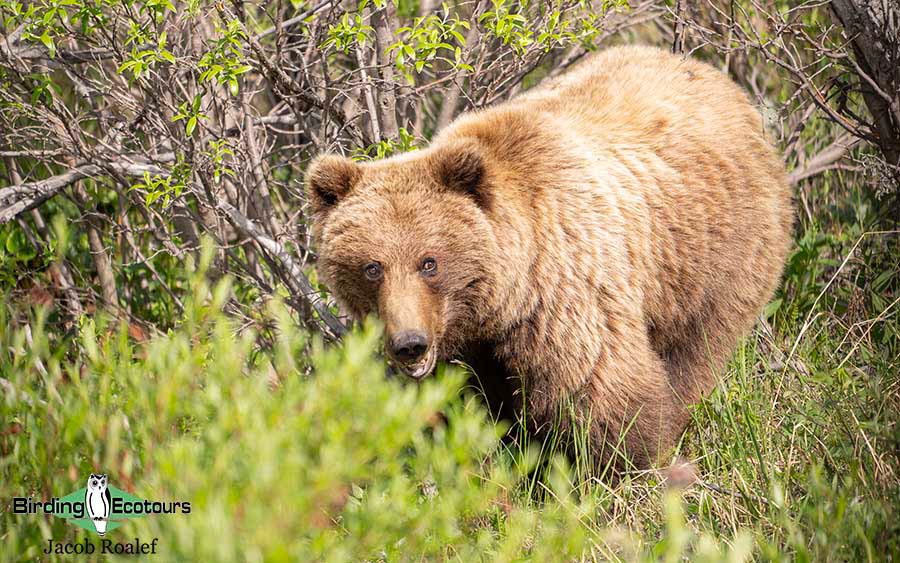
Our group were treated with incredibly close views of Brown (Grizzly) Bear along the road!
Overview
Our Alaska set-departure tour began in Anchorage on 14 June 2026 and returned there on 26 June after an exciting circuit through some of the state’s most memorable landscapes. From our Anchorage base, we explored the dramatic Kenai Peninsula, the sweeping Denali region, and the storied gold-rush town of Nome. Along the way, we birded an impressive variety of standout sites, including Resurrection Bay, Kincaid Park, Lowell Point, Westchester Lagoon, Potter Marsh, Hatcher Pass, Denali National Park, the Denali Highway, and numerous productive birding locations around Nome.
The tour delivered a superb mix of Alaskan specialties and far-traveling global migrants, giving us memorable chances to study each species in the field. By exploring a rich variety of Arctic habitats, we built an impressive list in just 13 days. Avian highlights included Horned and Tufted Puffin, Spruce Grouse, Parakeet Auklet, Kittlitz’s and Ancient Murrelets, Rock, White-tailed and Willow Ptarmigan, Arctic and Aleutian Terns, Long-tailed Jaeger, Arctic Warbler, Eastern Yellow and White Wagtails, Boreal Chickadee, Northern Hawk Owl, Gyrfalcon, Yellow-billed Loon, Bluethroat, Northern Wheatear, Snow Bunting, and many more.
A total of 148 bird species were seen, with three additional heard only species, bringing the total recorded to 151. In addition to the birds, this year’s tour recorded our highest mammal total to date, with some amazing highlights including Canada Lynx, Brown (Grizzly) Bear, Moose, Humpback Whale, Fin Whale, Sea Otter, Steller Sea Lion, Muskox, Hoary Marmot, Collared Pika, and Mountain Goat. Full bird and mammal checklists can be found at the end of the report and be sure to check out our eBird trip report for more specifics.
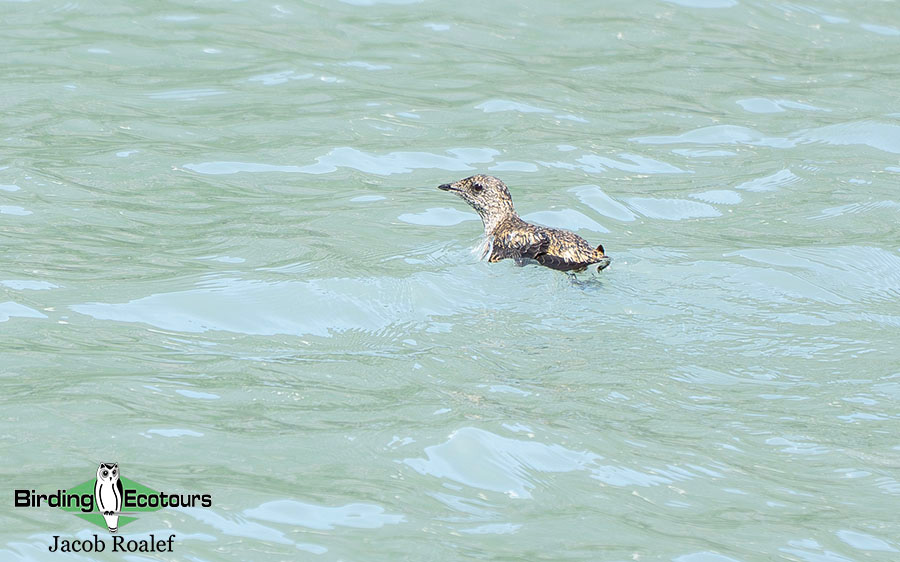
Kittlitz’s Murrelet is one of the most sought-after species of our pelagic trip.
Detailed Report
Day 1, 14th June 2026. Arrival and Anchorage birding
Today was arrival day in Anchorage as we had some participants arrive early and others in the afternoon. Alaska is not always close, so once everyone had arrived, we had some time to adjust, get to the rooms, and relax after traveling. We met up at the hotel restaurant for our first official dinner and to get to know each other better. Some of us who arrived early did some birding at the nearby Lake Spenard and noted our first Alaskan species like Black-billed Magpie, Red-necked Grebe, and Arctic Tern.
Day 2, 15th June 2026. South to Seward and the Kenai Peninsula
Time to really begin our Alaska adventure! Those who arrived in the late afternoon yesterday needed to get caught up, so we started off with a little pre-breakfast check of Lake Spenard just outside the hotel. We ticked our first few species as a group, like Common and Pacific Loons, Lesser and Greater Scaups, Bonaparte’s Gull, Red-necked Grebe, and Osprey. Time to head back inside for breakfast and to pack up and head out to the nearby Kincaid Park. We hiked around the lovely trails here and picked up our first few species for Alaska, like Sooty Fox Sparrow, Swainson’s Thrush, Dark-eyed Junco, and Two-barred Crossbill. Eventually, the mosquitoes had become too much and the trail was flooded, so we headed back to the van to begin our journey south to Seward. We made a brief stop at Beluga Point and found a group of Dall’s Sheep up on the mountainside along with a few Violet-green Swallows buzzing around. From there we enjoyed the scenic drive into the Kenai Peninsula, until we eventually reached Seward for lunch.
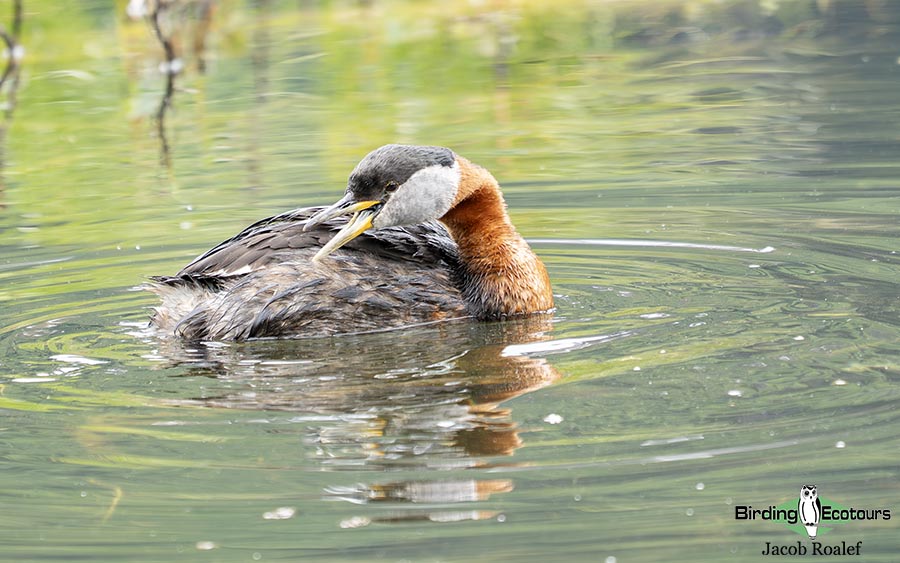
This stunning Red-necked Grebe preened in front of us for nearly ten minutes.
After our tasty lunch at the quaint café, we did a bit of birding along the edges of Resurrection Bay as we headed towards our next destination. Our efforts yielded many fantastic species like Harlequin Duck, Marbled Murrelet, Wandering Tattler, Sea Otter, Barrow’s Goldeneye, Song Sparrow, and more.
For the remainder of the afternoon we switched our focus from the sea over to the target birds of the temperate rainforest habitat. Lowell Point State Recreation Site is an eerie forest full of old growth trees, perfect for finding some of our top species like Varied Thrush, Brown Creeper, and Townsend’s Warbler. While we managed to find these, the forest here was a bit quiet this afternoon despite our best efforts. From here we headed over to Two Lakes Park in town with similar habitat and enjoyed the impressive waterfall on offer here. An American Dipper worked up and down the stream to the falls, always a treat. Just before we left, we found a few Steller’s Jays foraging around the roadside, so we hopped out and quickly got onto a load of other good species like Chestnut-backed Chickadee, Pine Siskin, Violet-green Swallow, and Rufous Hummingbird. After a great effort to nail these temperate rainforest species, we headed off to the hotel for a short break to get settled in and then walked across the street to enjoy a tasty dinner. Time for some rest before a big day on the water tomorrow.
Day 3, 16th June 2026. Resurrection Bay pelagic to Northwestern Fjord
Excitement was high this morning as we set off for a full day of pelagic birding from Resurrection Bay. After fueling up with coffee and breakfast at a local Starbucks, we made our way to the docks, checked in, and boarded our vessel. Even in the harbor, birds were already on show, with familiar species such as Black-legged Kittiwake, Arctic Tern, Double-crested Cormorant, Common Murre, and Marbled Murrelet. As we pushed toward open water, the day quickly gained momentum when several Horned Puffins swept past the boat. We continued through the Harding Gateway and into the Chiswell Island area, where the birding truly came alive with highlights including Horned and Tufted Puffins, Ancient Murrelet, Parakeet Auklet, Surf Scoter, and Black Oystercatcher.
We enjoyed a picnic-style lunch on board while the spectacular scenery unfolded around us on the way to Northwestern Fjord and its glacier. As we approached, chunks of glacial ice drifted past the boat, some large enough to hold resting Harbor Seals. After taking in the glacier and watching sections calve into the water, we turned our focus to one of the day’s key targets. Happily, the fjord delivered, with up to a dozen range-restricted Kittlitz’s Murrelets feeding actively in the cold waters. On the return to the docks, a brief stop at Beehive Island added Pigeon Guillemot and Rhinoceros Auklet to our list. The scenery from the water was just incredible all day long, but few spots rivaled that of Cataract Cove. We spotted a few Mountain Goats near these impressive waterfalls. We couldn’t have asked for a better day to be out on the water and surrounded by the beauty of Alaska. Finally, we returned to land after a long, rewarding day on the water, packed with lifers. One final burst of excitement occurred in the parking lot as an American Ermine scurried between the vehicles and tires. We wrapped up the day with a tasty waterfront dinner before heading back to the hotel for a well-earned rest.
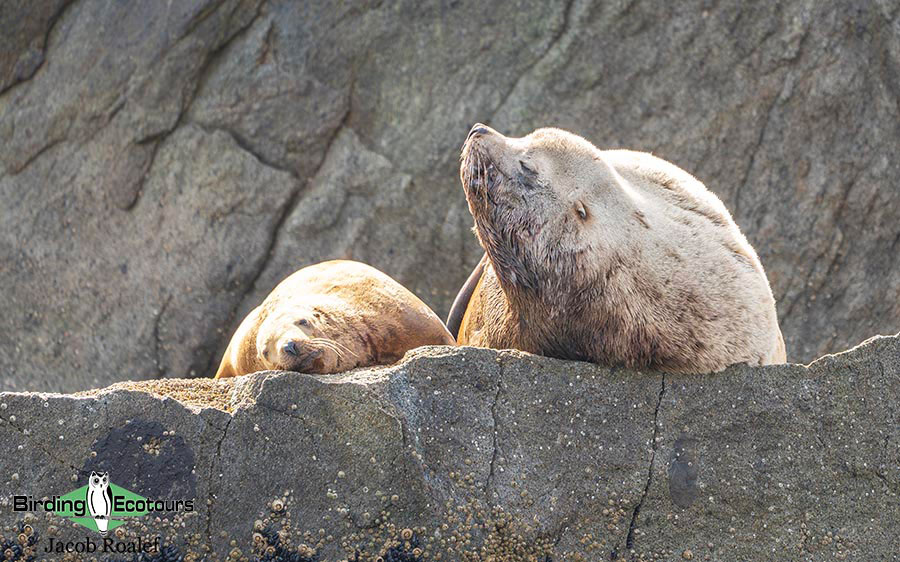
These sleepy Steller Sea Lions lounged in the afternoon sun.
Day 4, 17th June 2026. Seward and Anchorage birding
We were out early this morning, eager to squeeze in some birding before breakfast. Hoping for a few last encounters with the temperate rainforest birds before leaving this habitat behind, we returned to Lowell Point at the southern end of Seward. Our efforts paid off with Steller’s Jay, Varied and Hermit Thrush, Rufous Hummingbird, and Townsend’s Warbler, along with a few others. After breakfast at a local café, we packed the vehicle and began the scenic drive back toward Anchorage. En route, we made a quick birding stop at Bear Creek Weir, where a delightful family of American Dippers flew in and out while feeding fledglings just above the salmon weigh station. We also enjoyed much improved views of Golden-crowned Kinglet, while a singing Pine Grosbeak teased us with calls but refused to offer a clear look. Aside from a wonderfully cooperative, preening, Red-necked Grebe, the return drive to Anchorage was quiet but beautifully scenic. A quick check of Potter Marsh netted us a few new trip species like Red-necked Phalarope, Rusty Blackbird, Sandhill Crane, and Alder Flycatcher.
As we entered Anchorage, we got a report of a rarity at Westchester Lagoon from another friendly birding group we had met on our pelagic the previous day. This was already in our plans for the day, so we rerouted ever so slightly and headed off to the lagoons. We beelined straight to the area and, luckily, managed to see the rare Black-headed Gull, but unfortunately it was way out on the mudflats which meant views weren’t the most satisfying. We birded the lagoons back to the vehicle and noted Trumpeter Swan, Gadwall, Northern Shoveler, and American Wigeon. We still had some time left in the day to revisit Kincaid Park and this time we took the slight detour around the flooded portion of the trail, and we prepared for the war with the mosquitoes a bit better this time. Off we went and it didn’t take long to find the pole with the nestling American Three-toed Woodpecker in it. We watched as both parents eventually came in to feed their young. Our birding friends also showed up, and thanks to their efforts and loads of eyes in the area, we managed to get onto a lovely female Spruce Grouse with a few chicks in tow. An excellent few species to cap the day off, so we made the hour drive to Wasilla for dinner and sleep.
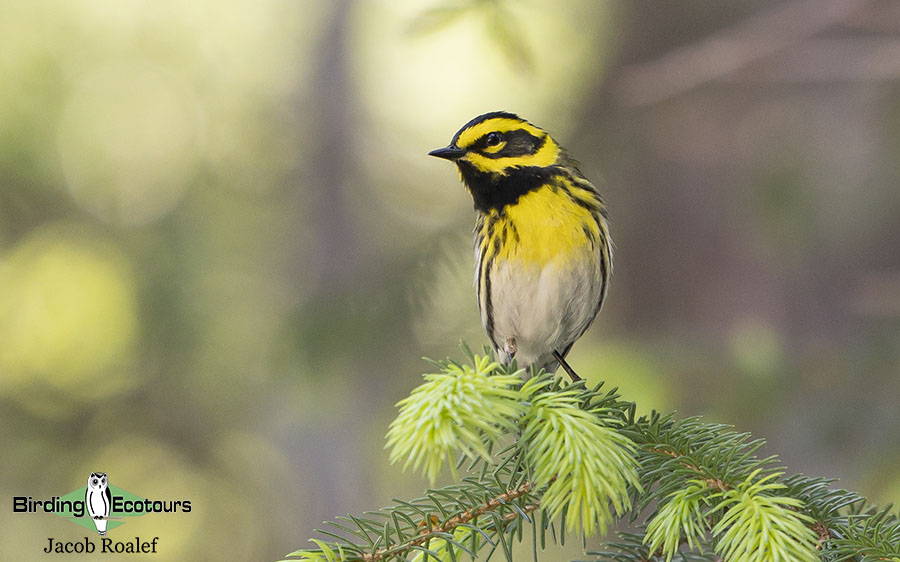
The colorful Townsend’s Warbler was great to see in the temperate rainforest.
Day 5, 18th June 2026. Hatcher Pass to Healy
We began the day with a hearty breakfast and coffee at a nearby café before setting out for Palmer Hay Flats. Unfortunately, the boardwalk was closed, and the mosquitoes were relentless, so after quick views of Northern Waterthrush and Hairy Woodpecker, we beat a retreat and continued toward Hatcher Pass. By late morning we had reached Independence Mine, where we stretched our legs and took advantage of the facilities. Even this brief stop produced several lovely birds, including Golden-crowned, Savannah, and White-crowned Sparrows, along with Wilson’s Warbler. We spent some time scanning the surrounding slopes with little success at first, until a Golden Eagle finally appeared on the horizon. With the pass itself still closed for the season, we walked our way up the roadside instead, hoping the extra effort might reveal something special. The uphill walk was demanding, but it rewarded us with excellent views of a perched Golden Eagle, as well as Arctic Ground Squirrel and Hoary Marmot for the mammal list. Near a rocky outcrop toward the top of the road, we found a calling Collared Pika tucked among the rocks. Acting on a hunch, we scrambled higher up the slope—no easy task, though everyone handled it brilliantly. The climb proved well worth it when we located an exceptionally cooperative White-tailed Ptarmigan among the rocks, one of the trickiest and most range-restricted birds of the trip. Since the road closure kept us from driving over the pass as planned, we made our way back down to the vehicle, the descent feeling much easier after such a satisfying success. From there, we adjusted course, backtracked to an alternate route, and stopped in Wasilla for lunch.
After lunch we still had quite a distance to travel before reaching Healy, so we got back on the road and began to cover ground. We enjoyed the scenic views of the boreal forest and surrounding mountains as we cruised Highway 3. We eventually made it to Denali viewpoint south, a great spot to take a break and look at the Alaska Range, which contains the famous Mount McKinley otherwise known as Denali, the tallest peak in North America. Typically, this impressive mountain creates its own weather and is covered in clouds, but luck was on our side today as we had a perfectly sunny, clear view of Denali and the whole Alaska range. It was back in the vehicle for another few hours to get to Healy. After about an hour and a half or so, I was asked how I was doing as it was a long day of driving in the van. I said I was fine, just scanning for a Northern Hawk Owl and not even 30 seconds later, BOOM! Northern Hawk Owl teed up perfectly with a safe pull-off for us to use and get out along the road. It was like destiny; you couldn’t write it up better than that. Sadly, our luck took a slight turn for the worse as the tire pressure light clicked on as we rolled into town Denali Park Village with a flat tire. After some setbacks with changing the tire, a little luck and a good Samaritan went in our favor and we got the spare on and were on our way to the hotel and dinner after a long, eventful day.
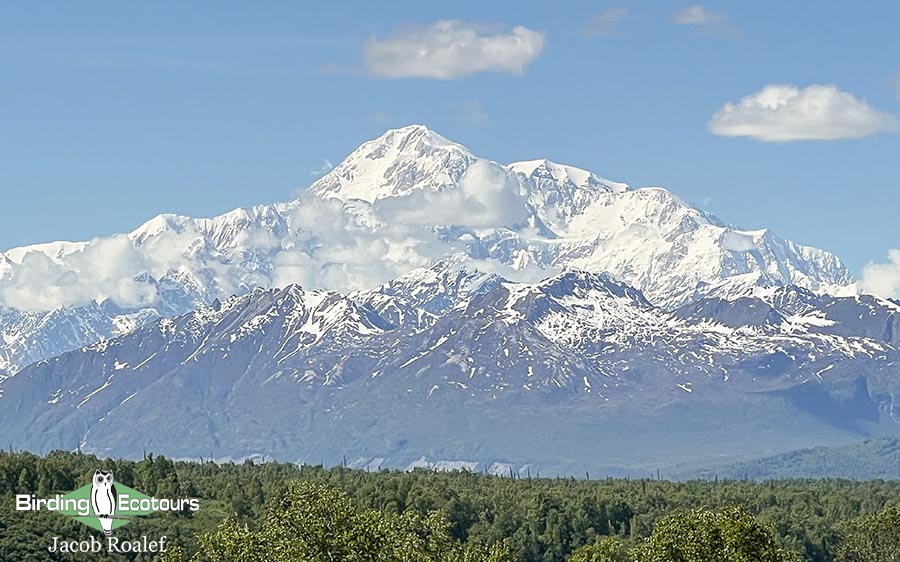
Our group had tremendous luck this year with epic views of Denali.
Day 6, 19th June 2026. Denali National Park
We were up early this morning and made our way to the bus depot, where we lined up, grabbed coffee, enjoyed breakfast, and waited for our tour into Denali National Park. The Tundra Wilderness Tour gave us an excellent introduction to the park’s landscapes and natural history, carrying us as far as mile marker 43, where a major washout is still under repair. Beyond the Savage River checkpoint, access is limited to authorized vehicles, making the bus journey the best way to experience this remarkable stretch of wilderness. Along the way, we passed through varied habitats, learned more about Denali’s ecology, and soaked in the sweeping scenery of this vast national park. Our group hung out at the back of the bus and ended up spotting most of the notable wildlife like a sleeping Brown (Grizzly) Bear, many Caribou, Golden Eagle, Willow Ptarmigan, and more. It was a great day, but the real highlight came on our way back as the sleeping Brown (Grizzly) Bear had woken up and moved down to forage right along the edge of the road! We all enjoyed some incredible views of this massive animal from the safety of the bus. What a great time along the park road!
After our bus tour had concluded, we ventured over to the Denali National Park Visitor’s Center and spent some time here to check out all the neat exhibits, grab some more food, and do a little souvenir shopping. We spent the remainder of the afternoon on a lovely hike around Horseshoe Lake inside the park. It was a perfect afternoon, and we found loads of enjoyable species like American Three-toed Woodpecker, Spotted Sandpiper, Canada Jay, Boreal Chickadee, and more. Time to head back to the hotel and dinner. We made one final quick birding stop at Otto Lake, across from the restaurant where we spotted a Semipalmated Plover just as the rain came in. We hurried over to dinner and called it a day.
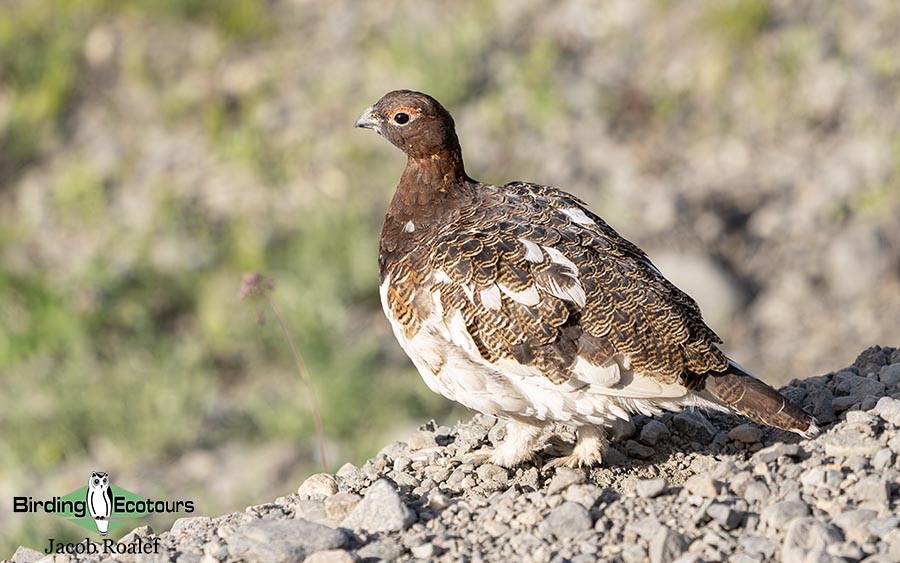
This Willow Ptarmigan had a cozy spot along the road until we drove by.
Day 7, 20th June 2026. Denali Highway
We loaded the van early, set off into the morning and drove about half an hour before reaching a charming local café for coffee and a light breakfast. Once refreshed by baked goods and caffeine, we continued onto the scenic Denali Highway for the long, beautiful drive ahead. Our first stop came at a quiet roadside lake, where Ring-necked Duck, Lesser Scaup, and Lesser Yellowlegs were joined by welcome new trip birds, including Blackpoll Warbler and Red Fox Sparrow. We continued and stopped whenever we saw some nice habitat or heard something good singing from the window. Arctic Warblers seemed to be all over the place this year, so we enjoyed these great species at several stops along with Grey-cheeked Thrush, Northern Waterthrush, Wilson’s Warbler, Lesser Yellowlegs, Least Sandpiper, Redpoll, and more.
By afternoon, the weather began to turn, with rain moving in and dark clouds gathering on the horizon, so we pushed on until we broke through the showers and reached a series of attractive lakes and ponds along the road. We spent some time here to stop and scan at various points whenever we saw a group of birds and these efforts yielded Long-tailed Duck, Northern Pintail, Common and Red-breasted Mergansers, Trumpeter Swan, and Barrow’s Goldeneye. Finally, we arrived at our lodge on the Maclaren River and were greeted by a swarm of nesting American Cliff Swallows all around the lodge and a cute Redhead on the lake behind the cabins. We had some time to relax here before dinner and a few of us even saw a Moose family swim across the lake! It was another gorgeous day in Alaska where the scenic views are never on short supply.
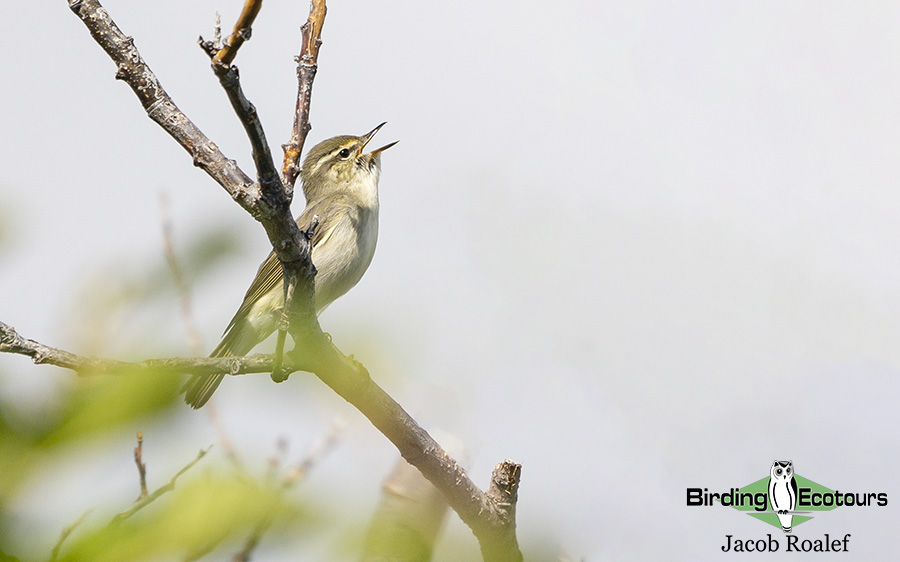
Arctic Warbler was prevalent all along the Denali Highway this year.
Day 8, 21st June 2026. Denali Highway and back to Anchorage
With a long journey back to Anchorage ahead of us, we enjoyed a satisfying breakfast at the lodge, packed up our belongings, and set out to complete the final stretch of the Denali Highway. First up was a quick check along the river and an opportunity to cheer on the runners of the Denali-135 ultra marathon race that began this morning. These runners would be attempting to run the length of the Denali Highway, all 135 miles (217 kilometers) of it. What a memorable experience and timing to be able to catch a little bit of this. We moved along and made a quick stop to check out a Sand Martin colony in a nice bank where we also saw a Merlin jet past us. We continued until we reached some of the higher points near the Maclaren Summit. Here we hopped out and scanned along the road for a bit before some of us decided to venture up the mountainside into the tundra to have a better, more expansive view and search. While we weren’t planning to be here too long, the few of us who wandered up managed to find an accommodating Rock Ptarmigan! This is not an easy species to find, so we scrambled and found everyone along the road, and we all managed to conquer the tundra wilderness and get great views of this awesome species.
It was already late morning, and most of the remainder of the day consisted of driving back to Anchorage. We broke up the drive a bit with several stops along the way, the first of which was for lunch. After this we pushed forward to the Gulkana Airport for a brief birding stop. Here we managed to find a few nice species like Bufflehead, Common Goldeneye, and Rusty Blackbird. More driving until we eventually stopped for a scenic view of the Matanuska Glacier, a great place to stretch our legs and use the restrooms. During our last stretch of driving, amazingly a Ruffed Grouse was in the middle of the road and just made it off in time before oncoming traffic came through. This netted us an impressive five species for the Phasianidae family, not an easy feat on this Alaska tour! Finally, we made it to our hotel in Anchorage for dinner and some much-needed rest and time out of the vehicle.
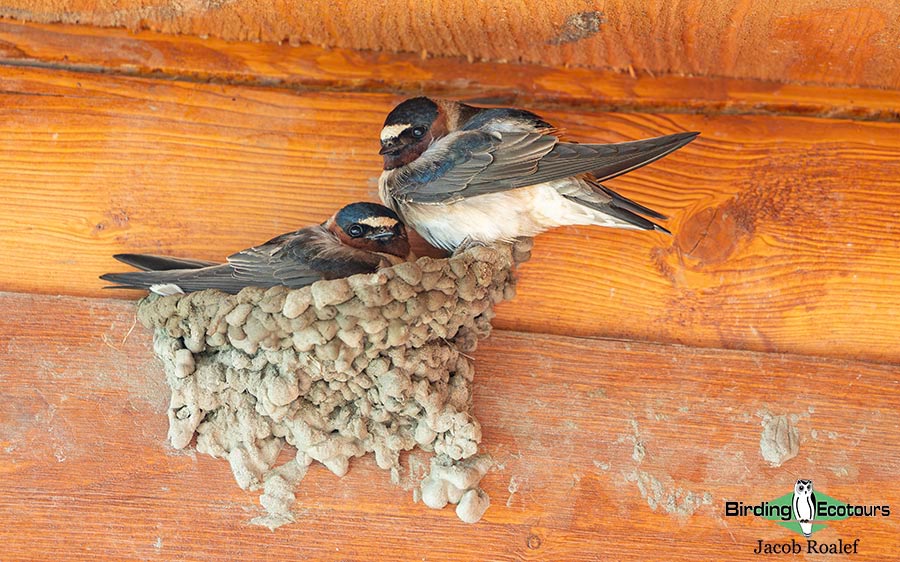
American Cliff Swallows were nesting just outside our door.
Day 9, 22nd June 2026. Flight to Nome, first tastes of Nome birding along Council Road
It was a cloudy, drizzly morning, perfect to sleep in a bit and have a casual start to the day, especially after such a long day yesterday. A few of us decided to head out and bird for a bit but between the rain and the mosquitoes, we didn’t last very long, but we did manage a few species like Black-billed Magpie and Bonaparte’s Gull. We had some extra time at the hotel to do laundry, pack, and prep for the final leg of our journey, Nome. After checking out, we took care of some logistics like fetching new binoculars and returning the vehicle, before heading off to the airport for lunch and our afternoon flight.
After touching down in Nome, Jacob headed off to collect the new vehicle and handle the hotel arrangements, while the rest of the group lingered at the airport and wasted no time getting their first taste of Nome birding with a Long-tailed Jaeger sweeping past. Once everyone was settled at the hotel, we headed out for dinner, but the lure of birding under Nome’s endless summer light proved too strong to resist. With the evening still bright and everyone eager for more, we made our way to the Nome River mouth for a quick scan. Several Aleutian Terns were waiting for us on the beach as we hiked out to scan the flats around the river. Here we began to rack up new and excellent trip birds like Bar-tailed Godwit, Western Sandpiper, Glaucous Gull, Dunlin, Pacific Golden Plover, and more. Everyone was still keen on birding more, so we pressed forward along the council road to scan for any water birds we could find. We made it nearly to the bridge this evening and stayed out birding past 11pm, but turned up some nice birds like Eurasian Wigeon, Tundra Swan, Brant Goose, Common Eider, and Red-throated Loon. It is always a little disorienting birding so late into the night without it really even being all that dark, but we had a long day planned for tomorrow, so it was back to the hotel for some sleep.
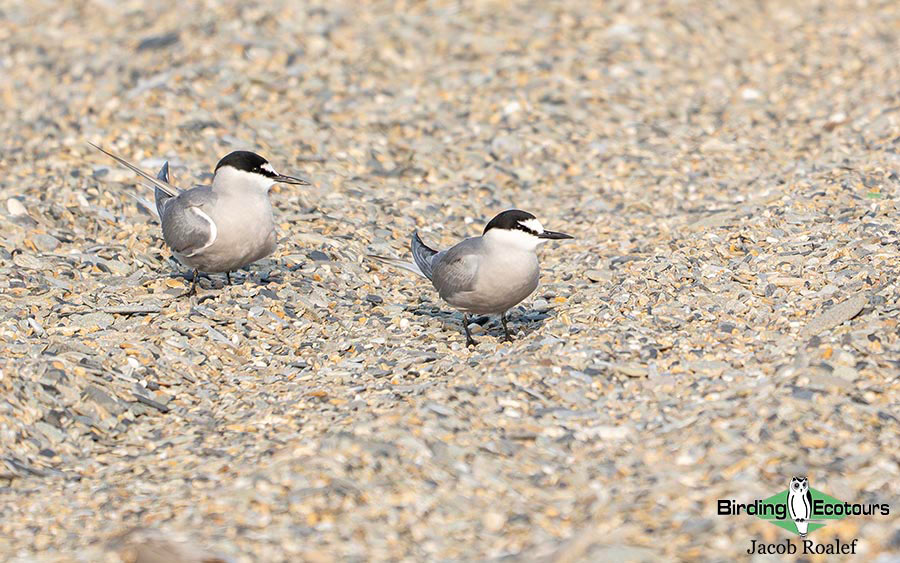
These Aleutian Terns were waiting for us down by the Nome River mouth.
Day 10, 23rd June 2026. Nome – Teller Road
Our goal for the day was to follow Teller Road as far as time would allow. We began with coffee and breakfast in the hotel lobby, then loaded up and set out to search town for our first target. Thanks to some useful local intel, it was not long before we were admiring a striking White Wagtail near its nest in a weathered old building—an excellent start and a superb ABA-area bird to connect with. Soon after leaving Nome, we paused for our first Muskoxen herd of the tour. As we worked our way along Teller Road, more good birds appeared, including American Yellow Warbler, Tundra Swan, Cackling Goose, Willow Ptarmigan, Short-eared Owl, and others. By mid-morning we reached the mile-34 ridgeline, where we stepped out to search for one of the group’s most-wanted birds: Bluethroat. Despite the wind, its distinctive song and call carried across the tundra, and with patience we were all rewarded with excellent views of this dazzling species. It was the perfect success to celebrate over a sunny picnic lunch.
After eating we went for a hike in the tundra wilderness to see what we might turn up. The tundra was dry and relatively flat today which made for a lovely stroll with flowers blooming and all kinds of interesting plant life. It is a true wonder to be surrounded by this habitat. Of course, birds were our main focus, and we did well for this open tundra landscape as we found Rock Ptarmigan, Snow Bunting, Northern Wheatear, Horned Lark, and Red Knot this afternoon. Time to head back to town for a short rest before dinner after a long day yesterday. While some of us rested, a few of us opted to head down to the Nome River mouth for another check. Just the usual suspects here this evening, however, we ran into a slight hiccup on the sandy beach. Thanks to some local help, it wasn’t long before we were out of there with dinner plans only slightly altered. Time for bed after a few long days birding in Nome.
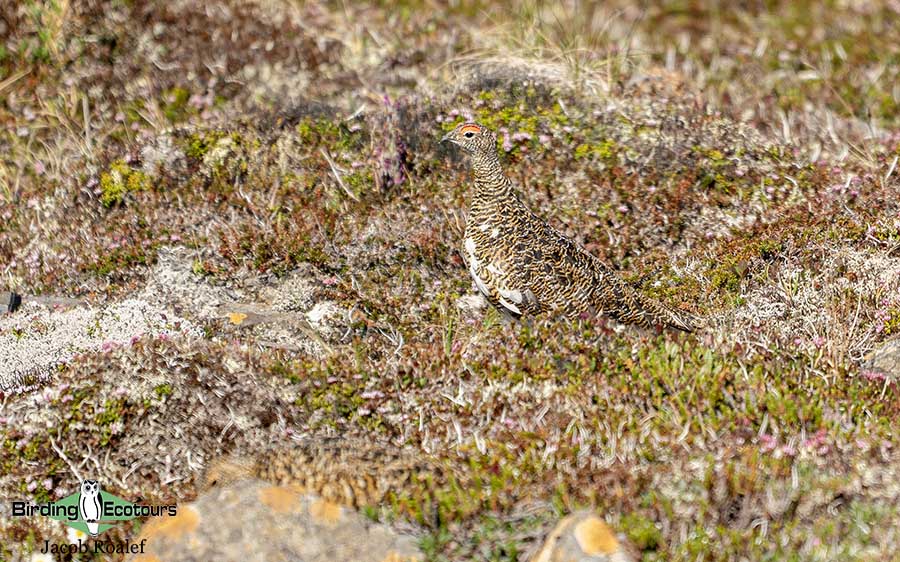
The camouflage of this Rock Ptarmigan against the tundra floor is remarkable.
Day 11 24th June 2026. Nome – Kougarok Road
Today’s objective was Kougarok Road and the hike up Coffee Dome. We made an extra-early start, knowing we had a long drive ahead and wanted to reach the trailhead during the best morning birding window, especially since reports suggested this year’s birds were proving difficult and most success had come in the first hours of the day. We didn’t have any planned stops but noted a lot of Snowshoe Hares along the road this morning which felt like a good omen. Sure enough, a larger mammal was spotted crossing the road far up the road. What was that? We had a hunch, but the view was quick. We crept along slowly and waited and, sure enough, the amazing Canada Lynx backtracked to the road, and we all watched in awe from the vehicle as it walked ahead of us and then disappeared into the willows. What a way to start the day! As we neared the starting point for our hike, we did spot a few nice new species that we made a quick stop for; Black Scoter and Greater White-fronted Goose. Always nice to add a few new trip birds.
We arrived at Coffee Dome, laced up our boots, prepped our gear, and headed up the slope which, surprisingly, wasn’t too muddy or difficult compared to past years. Unfortunately, it was a windy morning which made it very difficult to listen or hear any calls. We searched and searched for hours and only managed to turn up Willow Ptarmigan, Say’s Phoebe, Bluethroat, and several Hudsonian Whimbrels. After our much longer than anticipated hike and search of the vast tundra wilderness, we all made it back to the vehicle and began our drive back towards Nome. Of course, we had a few final stops planned along the way. First up was Salmon Lake, although the sun on the lake caused some viewing issues. After a bit of analysis, we sorted out a plan to view from a different angle and managed some fantastic views of Yellow-billed Loon, a stellar bird! We made one final stop much closer to town and managed to find the accommodating pair of nesting Northern Shrikes without too much difficulty. By now it had been an incredibly long day on the Kougarok Road, we made it back to Nome just in time for dinner and a drink.
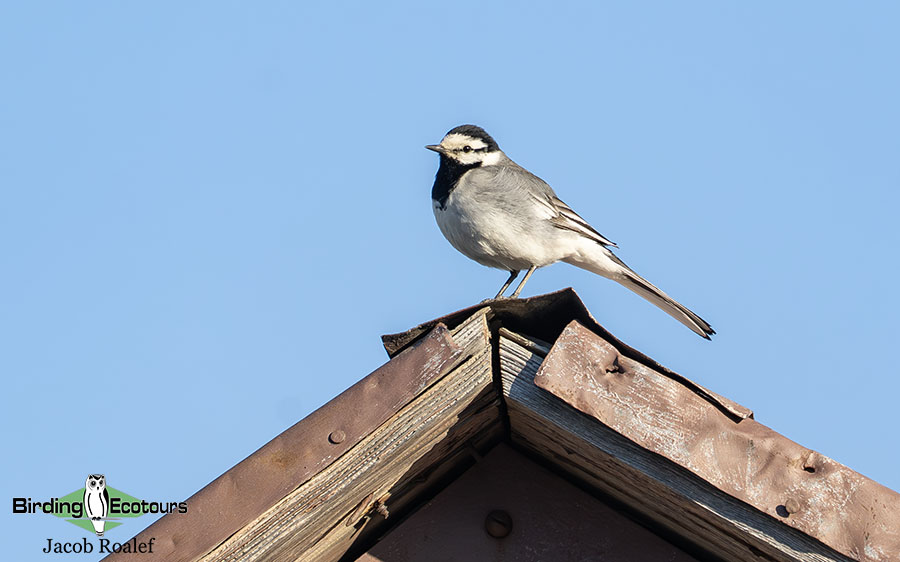
The group enjoyed great views of this rare White Wagtail in the morning light!
Day 12, 25th June 2026. Nome – Council Road and back to Anchorage
For our final day in Nome, we had one last road to explore: the Nome-Council Road. We set off eagerly, soon enjoying close views of several Long-tailed Jaegers hunting over the tundra, along with a Parasitic Jaeger chasing Black-legged Kittiwakes out over the sea. With Safety Sound on one side and the Bering Sea on the other, the road offered mile after mile of superb coastal birding. We made repeated stops to scan the water, hoping for new species while simply soaking up the fine weather and abundance of birds. The effort paid off with new trip birds such as Black Turnstone, Sabine’s Gull, and White-winged Scoter, alongside great views of Short-eared Owl, Lapland Longspur, Eurasian Wigeon, Red-throated Loon, and more. It was a wonderful morning, and eventually the road curved inland, leading us away from the coast toward Solomon for a picnic lunch. We had barely settled in before our target appeared: Eastern Yellow Wagtail. Two birds sang and displayed nearby, giving us excellent time with this rare species. We could not linger too long, however, as more ground lay ahead and another target bird was waiting farther along the road.
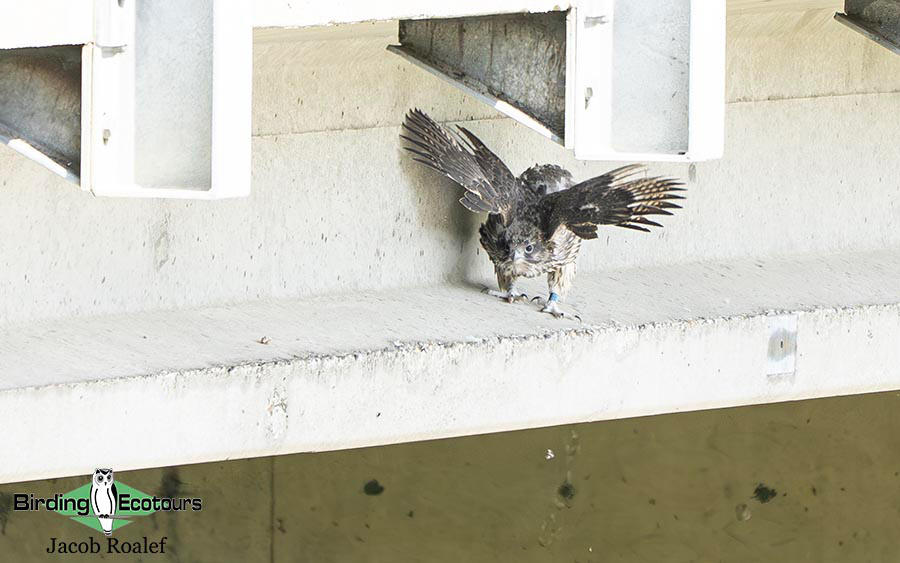
This young Gyrfalcon was ready to take flight and fledge any day.
We pulled up to the bridge where we would search for our final target species, and we ran into a few other birding friends we had made during our time in Nome. It didn’t take too long to spot the nest of a Gyrfalcon with three nearly fledged birds, just waiting to take their first flight. Mom or dad was also spotted soaring nearby to give some nice views of an adult Gyrfalcon as well. It was amazing to watch these incredible birds for a while, but we also enjoyed a Northern Wheatear nest nearby and several singing Arctic Warblers while we were here. Time to load up and head back to Nome to get ready for our flight home. We planned this to have just a little time for birding and scanning on the way back in hopes of a few more last-minute birds. Down by the Safety Sound bridge we spotted a large group of gulls, so we had to pull over and search through them quickly. Finally, a Vega Gull was in the group of Glaucous Gulls along with a first year Slaty-backed Gull! A couple of excellent additions to our list. We pressed on and just as we were about to leave the sound area, a few rafts of geese were spotted in the water. More Brant Geese, only this time, the second group of four were Emperor Geese! Sadly, all the birds decided to take flight just as we got on them, but we did manage a view of the difficult Emperor Goose. This made for three last minute additions to our list to beat the buzzer and give David in our group his 700th ABA continental species, a goal which seemed like it may have been out of reach just 30-minutes prior. Congratulations to David! Finally, we reached the hotel in Nome, packed and organized our luggage, and caught our flight back to Anchorage. We enjoyed our final meal together with lots of laughs and memories to share and then transferred to the hotel in town for the night.
Day 13, 26th June 2026. Tour conclusion
Our epic Alaskan adventure came to a close this morning. Some of the group headed off early, while those with later flights enjoyed breakfast at the hotel, with the shuttle service smoothly accommodating everyone’s departure times. As we said our goodbyes, we looked back on an unforgettable journey packed with standout moments, from Canada Lynx and Brown (Grizzly) Bear to Kittlitz’s Murrelet, Northern Hawk Owl, American Three-toed Woodpecker, and Gyrfalcon. With that, another fantastic Alaska tour was officially in the books.
Bird List – Following IOC 15.2 (April 2026)
Birds ‘heard only’ are marked with (H) after the common name, all other species were seen.
The following notation after species names is used to show conservation status following the IUCN Red List: EN = Endangered, VU = Vulnerable.
| Common Name | Scientific Name |
| Ducks, Geese, Swans (Anatidae) | |
| Brant Goose | Branta bernicla |
| Canada Goose | Branta canadensis |
| Cackling Goose | Branta hutchinsii |
| Emperor Goose | Anser canagicus |
| Greater White-fronted Goose | Anser albifrons |
| Trumpeter Swan | Cygnus buccinator |
| Tundra Swan | Cygnus columbianus |
| Northern Shoveler | Spatula clypeata |
| Gadwall | Mareca strepera |
| Eurasian Wigeon | Mareca penelope |
| American Wigeon | Mareca americana |
| Mallard | Anas platyrhynchos |
| Northern Pintail | Anas acuta |
| Green-winged Teal | Anas carolinensis |
| Redhead | Aythya americana |
| Ring-necked Duck | Aythya collaris |
| Greater Scaup | Aythya marila |
| Lesser Scaup | Aythya affinis |
| Common Eider | Somateria mollissima |
| Harlequin Duck | Histrionicus histrionicus |
| Surf Scoter | Melanitta perspicillata |
| White-winged Scoter | Melanitta deglandi |
| Black Scoter | Melanitta americana |
| Long-tailed Duck – VU | Clangula hyemalis |
| Bufflehead | Bucephala albeola |
| Common Goldeneye | Bucephala clangula |
| Barrow’s Goldeneye | Bucephala islandica |
| Common Merganser | Mergus merganser |
| Red-breasted Merganser | Mergus serrator |
| Pheasants & Allies (Phasianidae) | |
| Willow Ptarmigan | Lagopus lagopus |
| Rock Ptarmigan | Lagopus muta |
| White-tailed Ptarmigan | Lagopus leucura |
| Spruce Grouse | Canachites canadensis |
| Ruffed Grouse | Bonasa umbellus |
| Grebes (Podicipedidae) | |
| Red-necked Grebe | Podiceps grisegena |
| Pigeons, Doves (Columbidae) | |
| Rock Dove (Introduced) | Columba livia |
| Cranes (Gruidae) | |
| Sandhill Crane | Antigone canadensis |
| Hummingbirds (Trochilidae) | |
| Rufous Hummingbird | Selasphorus rufus |
| Oystercatchers (Haematopodidae) | |
| Black Oystercatcher | Haematopus bachmani |
| Plovers (Charadriidae) | |
| Pacific Golden Plover | Pluvialis fulva |
| American Golden Plover | Pluvialis dominica |
| Semipalmated Plover | Charadrius semipalmatus |
| Sandpipers, Snipes (Scolopacidae) | |
| Hudsonian Whimbrel | Numenius hudsonicus |
| Bar-tailed Godwit | Limosa lapponica |
| Black Turnstone | Arenaria melanocephala |
| Red Knot | Calidris canutus |
| Dunlin | Calidris alpina |
| Least Sandpiper | Calidris minutilla |
| Semipalmated Sandpiper | Calidris pusilla |
| Western Sandpiper | Calidris mauri |
| Wilson’s Snipe | Gallinago delicata |
| Red-necked Phalarope | Phalaropus lobatus |
| Spotted Sandpiper | Actitis macularius |
| Wandering Tattler | Tringa incana |
| Lesser Yellowlegs | Tringa flavipes |
| Gulls, Terns, Skimmers (Laridae) | |
| Black-legged Kittiwake – VU | Rissa tridactyla |
| Sabine’s Gull | Xema sabini |
| Bonaparte’s Gull | Chroicocephalus philadelphia |
| Black-headed Gull | Chroicocephalus ridibundus |
| Short-billed (Mew) Gull | Larus brachyrhynchus |
| Glaucous-winged Gull | Larus glaucescens |
| Glaucous Gull | Larus hyperboreus |
| American Herring Gull | Larus smithsonianus |
| Vega Gull | Larus vegae |
| Slaty-backed Gull | Larus schistisagus |
| Aleutian Tern – VU | Onychoprion aleuticus |
| Arctic Tern | Sterna paradisaea |
| Skuas (Stercorariidae) | |
| Long-tailed Jaeger | Stercorarius longicaudus |
| Parasitic Jaeger | Stercorarius parasiticus |
| Auks (Alcidae) | |
| Rhinoceros Auklet | Cerorhinca monocerata |
| Tufted Puffin | Fratercula cirrhata |
| Horned Puffin | Fratercula corniculata |
| Parakeet Auklet | Aethia psittacula |
| Kittlitz’s Murrelet | Brachyramphus brevirostris |
| Marbled Murrelet – EN | Brachyramphus marmoratus |
| Pigeon Guillemot | Cepphus columba |
| Thick-billed Murre | Uria lomvia |
| Common Murre | Uria aalge |
| Ancient Murrelet | Synthliboramphus antiquus |
| Loons (Gaviidae) | |
| Red-throated Loon | Gavia stellata |
| Pacific Loon | Gavia pacifica |
| Common Loon | Gavia immer |
| Yellow-billed Loon | Gavia adamsii |
| Cormorants and Shags (Phalacrocoracidae) | |
| Pelagic Cormorant | Urile pelagicus |
| Double-crested Cormorant | Nannopterum auritum |
| Ospreys (Pandionidae) | |
| Osprey | Pandion haliaetus |
| Kites, Hawks, Eagles (Accipitridae) | |
| Golden Eagle | Aquila chrysaetos |
| Northern Harrier | Circus hudsonius |
| Bald Eagle | Haliaeetus leucocephalus |
| Rough-legged Buzzard | Buteo lagopus |
| Owls (Strigidae) | |
| Northern Hawk-Owl | Surnia ulula |
| Short-eared Owl | Asio flammeus |
| Kingfishers (Alcedinidae) | |
| Belted Kingfisher | Megaceryle alcyon |
| Woodpeckers (Picidae) | |
| American Three-toed Woodpecker | Picoides dorsalis |
| Downy Woodpecker (H) | Dryobates pubescens |
| Hairy Woodpecker | Leuconotopicus villosus |
| Caracaras, Falcons (Falconidae) | |
| Merlin | Falco columbarius |
| Gyrfalcon | Falco rusticolus |
| Tyrant Flycatchers (Tyrannidae) | |
| Say’s Phoebe | Sayornis saya |
| Alder Flycatcher | Empidonax alnorum |
| Shrikes (Laniidae) | |
| Northern Shrike | Lanius borealis |
| Crows, Jays, and Magpies (Corvidae) | |
| Canada Jay | Perisoreus canadensis |
| Steller’s Jay | Cyanocitta stelleri |
| Black-billed Magpie | Pica hudsonia |
| American Crow | Corvus brachyrhynchos |
| Northern Raven | Corvus corax |
| Tits, Chickadees, and Titmice (Paridae) | |
| Chestnut-backed Chickadee | Poecile rufescens |
| Boreal Chickadee | Poecile hudsonicus |
| Black-capped Chickadee (H) | Poecile atricapillus |
| Swallows (Hirundinidae) | |
| Sand Martin | Riparia riparia |
| Tree Swallow | Tachycineta bicolor |
| Violet-green Swallow | Tachycineta thalassina |
| American Cliff Swallow | Petrochelidon pyrrhonota |
| Larks (Alaudidae) | |
| Horned Lark | Eremophila alpestris |
| Leaf Warblers & Allies (Phylloscopidae) | |
| Arctic Warbler | Phylloscopus borealis |
| Kinglets (Regulidae) | |
| Ruby-crowned Kinglet | Corthylio calendula |
| Golden-crowned Kinglet | Regulus satrapa |
| Treecreepers (Certhiidae) | |
| Brown Creeper | Certhia americana |
| Starlings (Sturnidae) | |
| Common Starling | Sturnus vulgaris |
| Thrushes and Allies (Turdidae) | |
| Varied Thrush | Ixoreus naevius |
| Swainson’s Thrush | Catharus ustulatus |
| Hermit Thrush | Catharus guttatus |
| Grey-cheeked Thrush | Catharus minimus |
| American Robin | Turdus migratorius |
| Chats, Old World Flycatchers (Muscicapidae) | |
| Bluethroat | Luscinia svecica |
| Northern Wheatear | Oenanthe oenanthe |
| Dippers (Cinclidae) | |
| American Dipper | Cinclus mexicanus |
| Wagtails and Pipits (Motacillidae) | |
| Eastern Yellow Wagtail | Motacilla tschutschensis |
| White Wagtail | Motacilla alba |
| Finches, Euphonias, and Allies (Fringillidae) | |
| Pine Grosbeak (H) | Pinicola enucleator |
| Redpoll | Acanthis flammea |
| Pine Siskin | Spinus pinus |
| Two-barred Crossbill | Loxia leucoptera |
| Longspurs and Snow Buntings (Calcariidae) | |
| Lapland Longspur | Calcarius lapponicus |
| Snow Bunting | Plectrophenax nivalis |
| New World Sparrows (Passerellidae) | |
| Sooty Fox Sparrow | Passerella unalaschcensis |
| Red Fox Sparrow | Passerella iliaca |
| American Tree Sparrow | Spizelloides arborea |
| Dark-eyed Junco | Junco hyemalis |
| White-crowned Sparrow | Zonotrichia leucophrys |
| Golden-crowned Sparrow | Zonotrichia atricapilla |
| Savannah Sparrow | Passerculus sandwichensis |
| Song Sparrow | Melospiza melodia |
| Oropendolas, Orioles, Blackbirds (Icteridae) | |
| Rusty Blackbird – VU | Euphagus carolinus |
| New World Warblers (Parulidae) | |
| Northern Waterthrush | Parkesia noveboracensis |
| Orange-crowned Warbler | Leiothlypis celata |
| American Yellow Warbler | Setophaga aestiva |
| Blackpoll Warbler | Setophaga striata |
| Myrtle Warbler | Setophaga coronata |
| Townsend’s Warbler | Setophaga townsendi |
| Wilson’s Warbler | Cardellina pusilla |
| Species seen: | 148 |
| Species heard: | 3 |
| Total recorded: | 151 |
Mammal List – Following Mammalwatching.com (November 2025)
The following notation after species names is used to show conservation status following the IUCN Red List: EN = Endangered, VU = Vulnerable.
| Common Name | Scientific Name |
| Rabbits and Hares (Leporidae) | |
| Snowshoe Hare | Lepus americanus |
| Pikas (Ochotonidae) | |
| Collared Pika | Ochotona collaris |
| Beavers (Castoridae) | |
| American Beaver | Castor canadensis |
| Porcupines and Allies (Erethizontidae) | |
| North American Porcupine | Erethizon dorsatum |
| Squirrels and Allies (Sciuridae) | |
| North American Red Squirrel | Tamiasciurus hudsonicus |
| Arctic Ground Squirrel | Urocitellus parryii |
| Hoary Marmot | Marmota caligata |
| Rodents (Cricetidae) | |
| Muskrat | Ondatra zibethicus |
| Cats (Felidae) | |
| Canada Lynx | Lynx canadensis |
| Dogs (Canidae) | |
| Red Fox | Vulpes vulpes |
| Bears (Ursidae) | |
| Brown (Grizzly) Bear | Ursus arctos |
| Eared Seals (Otariidae) | |
| Steller Sea Lion | Eumetopias jubatus |
| Earless Seals (Phocidae) | |
| Harbour Seal | Phoca vitulina |
| Weasels, Badgers and Allies (Mustelidae) | |
| Sea Otter – EN | Enhydra lutris |
| American Ermine | Mustela richardsonii |
| True Deer (Cervidae) | |
| Moose | Alces alces |
| Caribou – VU | Rangifer tarandus |
| Cloven-hoofed Mammals (Bovidae) | |
| Mountain Goat | Oreamnos americanus |
| Dall’s Sheep | Ovis dalli |
| Muskox | Ovibos moschatus |
| Rorquals (Balaenopteridae) | |
| Fin Whale | Balaenoptera physalus |
| Humpback Whale | Megaptera novaeangliae |
| Porpoises (Phocoenidae) | |
| Harbour Porpoise | Phocoena phocoena |
| Dall’s Porpoise | Phocoenoides dalli |
| Total seen: | 24 |
This is a sample trip report. Please email us ([email protected]) for more trip reports from this destination.