24 MARCH–04 APRIL 2026
By Jacob Roalef
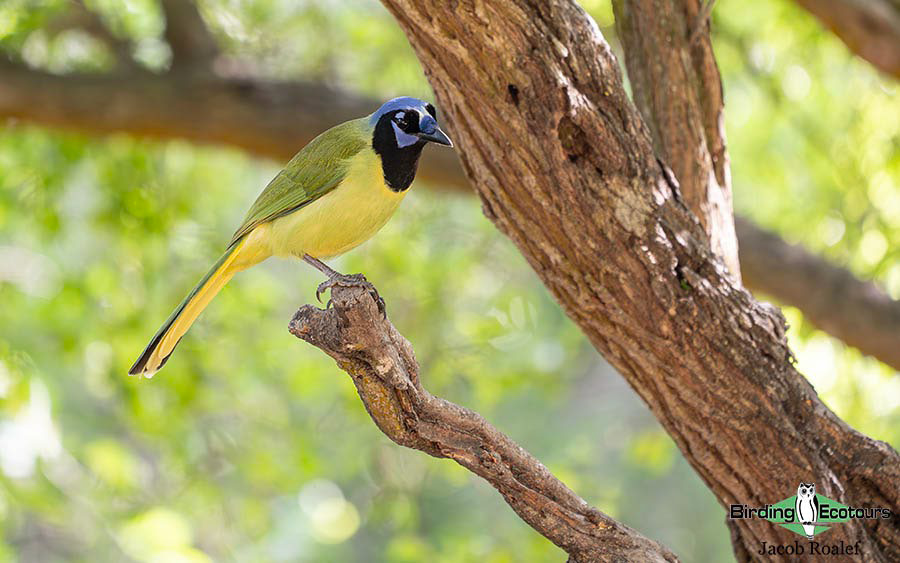
The iconic Green Jay became our signature bird of this year’s trip.
Overview
Our spring birding adventure through south Texas set out from Corpus Christi on 24 March and returned there on 4 April, completing a sweeping loop across one of the most varied and bird-rich regions of the United States. Along the way, we explored an excellent mix of famous birding sites, including Aransas National Wildlife Refuge, King Ranch, Leonabelle Turnbull Birding Center, Resaca de la Palma State Park, Estero Llano Grande State Park, National Butterfly Center, South Padre Island, Santa Margarita Ranch, Frio Bat Cave, Lost Maples State Park, and many other productive stops. The route carried us through an impressive cross-section of Texas habitats, from coastal marshes and rich riparian woodlands to dry desert scrub and the oak-maple forests of the Hill Country, each adding its own distinctive birds and character to the tour.
The tour delivered in style, producing the full suite of Lower Rio Grande Valley specialties alongside an exciting assortment of spring migrants. By the end of our twelve days in Texas, the trip list was packed with standout birds. Highlights included Mangrove Yellow and Golden-cheeked Warblers, Green Jay, Whooping Crane, Altamira and Audubon’s Orioles, Gull-billed Tern, Least Grebe, White-tailed Hawk, Green and Ringed Kingfishers, Aplomado Falcon, and many more. As if that were not enough, Texas added an extra dose of rarity excitement with sightings of Brown Jay, Mottled Owl, Rose-throated Becard, Crimson-collared Grosbeak, Red-footed Booby, and Cattle Tyrant.
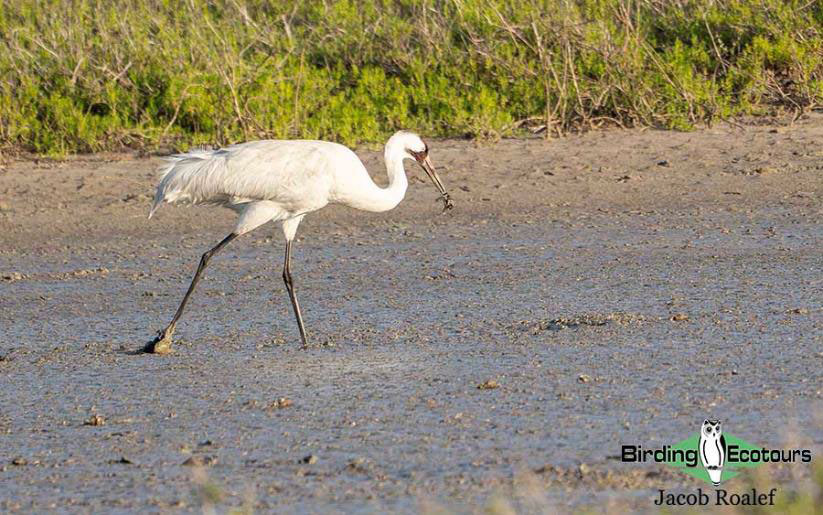
From the boat we watched this Whooping Crane feast on Blue Crabs.
By the end of our Texas adventure, we had recorded an outstanding 247 bird species seen, with six additional species heard only, bringing our final trip total to an impressive 253 species. This was a superb tally and a fitting reflection of the remarkable variety of habitats and birds encountered along the way. The wildlife was not limited to birds, either: we also enjoyed memorable mammal sightings, including millions of Mexican Free-tailed Bats streaming from their cave, close encounters with Collared Peccary (Javelina), Common Bottlenose Dolphin, and more. Full mammal and bird lists are included at the end of this report, and further details on daily checklists and birding locations can be found in our eBird Trip Report.
Detailed Report
Day 1, 24th March 2026. Arrival and rarity hunting
Everyone arrived in Corpus Christi by the late afternoon and were keen to squeeze in our first taste of Texas birding. There had been some lingering rarities for the USA in and around the Corpus area, so we loaded up to give them a shot. First up was the famous blue dumpster by the oyster bar, the long-standing home of a lost flycatcher. We made a few walks through the neighborhood before finally spotting the Cattle Tyrant on a nearby building. Eventually, it flew right into the dumpster area, snagged a few flies, and quickly disappeared after giving us a great show. Next, we headed over to the water’s edge and the end of the pier which wasn’t more than ten minutes away. We noted our first of many waterbird species like Laughing Gull, Double-crested Cormorant, Brown Pelican, and Royal Tern. As we searched through the birds along the wall, our target casually drifted over our heads, Red-footed Booby! This is a very rare species for the continental US. Combined with the first record of Cattle Tyrant, it was safe to say our trip was off to a stellar start! It had gotten late now, so we headed off to dinner nearby to celebrate our rarities, have more proper introductions, and discuss the exciting trip ahead of us.
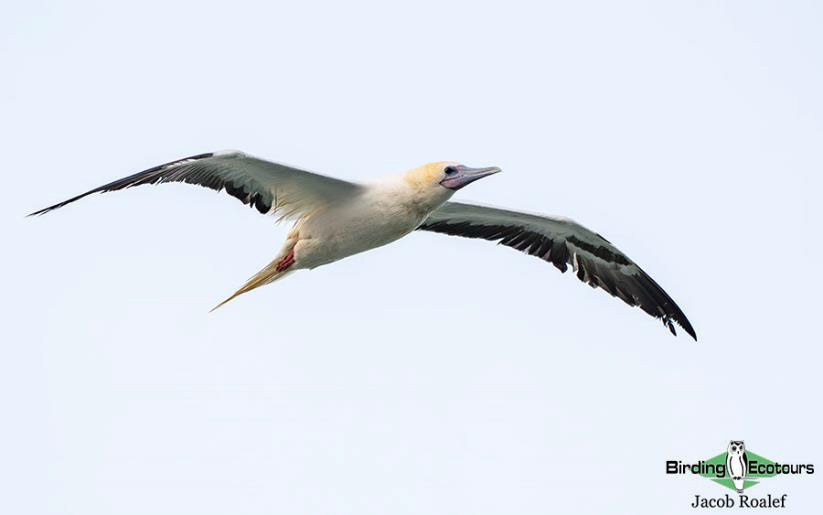
The rare Red-footed Booby gave us some close flybys to start our trip!
Day 2, 25th March 2026. Aransas National Wildlife Refuge boat, transfer to Kingsville
Excitement was high this morning, with a private boat trip on Aransas Bay set to fill the early hours. After breakfast, we made our way to the docks in Rockport and met the captain shortly after sunrise, ready to spend the morning exploring the bay. It was a beautiful morning to be out on the water, and we decided to head right out to the tidal marshes to arrive by first light. It didn’t take long before we were on the top target and the reason for our boat trip, Whooping Crane. We managed to park the boat and watch a few of these impressive, endangered birds feed on blue crab and wade through the marshes. While we were anchored, we also spotted other great species in and around the tidal pools like Seaside Sparrow, Reddish Egret, Lesser Black-backed Gull, Willet, Long-billed Curlew, and Tricolored Heron. Once we had our fill of Whooping Crane, we set off to see what else we could find. Out near the end of a rock jetty, a large group of birds had gathered. We sorted through these and found Gull-billed Tern, American Oystercatcher, Neotropic Cormorant, Ruddy Turnstone, and more. We had ventured far and it was time to bird our way back. The water level had changed slightly from this morning, which exposed a few more sandspits in the causeway. Here we spotted Wilson’s Plover, Dunlin, and Least Sandpiper. We arrived back at the docks after a fantastic morning on the water where we tallied up 45 species. Now it was time for some lunch.
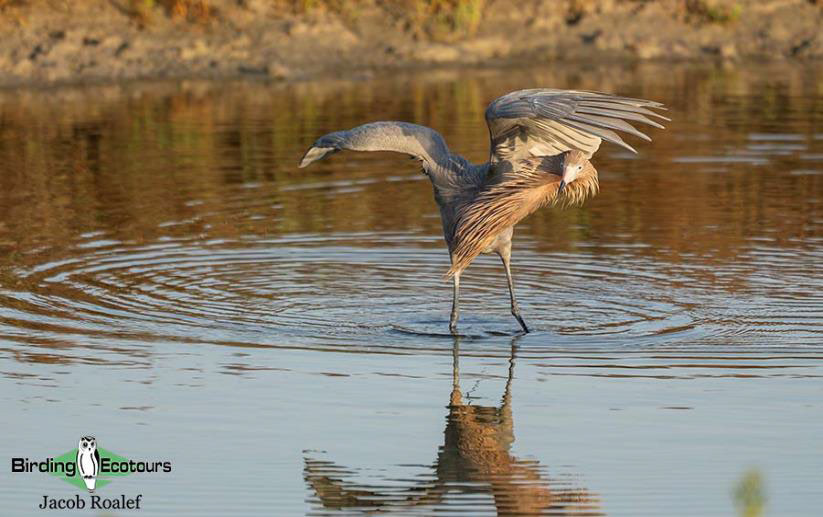
Few birds are as charismatic as the Reddish Egret.
There was still a lot of birding to pack into the rest of the day, so after lunch, we headed north to the Guadalupe Delta Wildlife Management Area. We made a quick pit stop first in the small town of Tivoli to snag the grackle sweep for our trip: Great-tailed, Boat-tailed, and Common Grackles. It is one of the few places to see all three species together. At Guadalupe Delta, we quickly scanned through the birds here and found Northern Shoveler, Ruddy Duck, Black-necked Stilt, White-faced Ibis, Anhinga, Little Blue Heron, and more. From here, we headed back to Rockport, across the bay on the ferry and over to Leonabelle Turnbull Birding Center. This little sanctuary boardwalk trail plays host to a huge number of birds, with many being right up close and personal. Here we enjoyed Pectoral Sandpiper, Lesser Yellowlegs, Blue-winged and Green-winged Teal, American Avocet, American White Pelican, Lincoln’s Sparrow, and Northern Harrier. The day was starting to escape, and we still had some ground to cover, so we loaded up and began our journey south towards Kingsville via Mustang Island. We made a few quick birding stops to help break up the drive. First was at a nesting platform for Aplomado Falcon where we enjoyed some great views of this gorgeous species. Next was a quick stop at Bishop City Park where we added a lovely Cinnamon Teal to our trip list. Eventually, we rolled into Kingsville, got checked in, and went for a delicious dinner.
Day 3, 26th March 2026. King Ranch and transfer south
It was still dark when we finished a quick breakfast at the hotel and set off for one of the most anticipated days of the trip. We reached the meeting point at King Ranch headquarters about half an hour before sunrise, checked in, and prepared for a full day exploring the famous Norias Division. While we waited for the rest of the group, the ranch was already beginning to stir: a few Pauraques called from the dimness and then appeared briefly as they made the most of their final minutes of activity before roosting. Once everyone was ready, we loaded up for the 45-minute transfer to Norias. The birding began almost immediately, with an excellent welcome party that included Vermillion Flycatcher, Green Jay, Golden-fronted Woodpecker, Northern Beardless-Tyrannulet, Blue-headed Vireo, and Couch’s Kingbird. Near the restrooms, a Greater Roadrunner and Northern Bobwhite showed along the roadside, while a pair of Hooded Orioles were busy nestbuilding in their usual palm tree. From there we continued toward a beautiful stand of old-growth oak woodland, adding birds all along the way, including Scissor-tailed Flycatcher, Harris’s Hawk, Crested Caracara, and American Kestrel. Once in the oaks, we searched carefully for our target owl until, at last, a series of soft toots drifted from deep in the woods. With patience, the superb Ferruginous Pygmy-Owl eventually popped into view and put on a wonderful show. This is a very difficult species to find in the United States and one of the true headline birds of King Ranch. With the owl secured, we turned our attention to another major prize, Tropical Parula. Luck stayed with us and, before long, we heard one and then managed to see this colorful little warbler near the vehicle. After such a productive morning, it was time for a well-earned and delicious lunch on the ranch beside a lovely pond.
Lunch on the ranch came with its own entertainment, as a bold Great Kiskadee and several curious Green Jays gathered nearby, clearly hoping we might leave a few crumbs behind. Just as we were packing up, a low-flying raptor slipped overhead, and after a careful look we realized we had picked up a superb Zone-tailed Hawk, another excellent addition to our King Ranch list. With our main targets already secured, we spent the afternoon roaming the property and steadily adding more quality birds, including Pyrrhuloxia, Baird’s Sandpiper, Summer Tanager, Bronzed Cowbird, Lark Sparrow, Black-crested Titmouse, and Loggerhead Shrike. By the time we wrapped up at the Norias Division, we had built an impressive list of 64 species. From here, we left the ranch behind and continued south to Harlingen in the Lower Rio Grande Valley. After checking into the hotel and taking a short break, we headed out for dinner. One final bird still remained on the agenda, and our excellent restaurant choice—thanks, Sam—put us in exactly the right place. Almost as soon as we stepped outside, a flock of Green Parakeets swept over our heads. We lingered a while as more birds arrived at their evening roost, then called time on a superb day and headed off to bed.
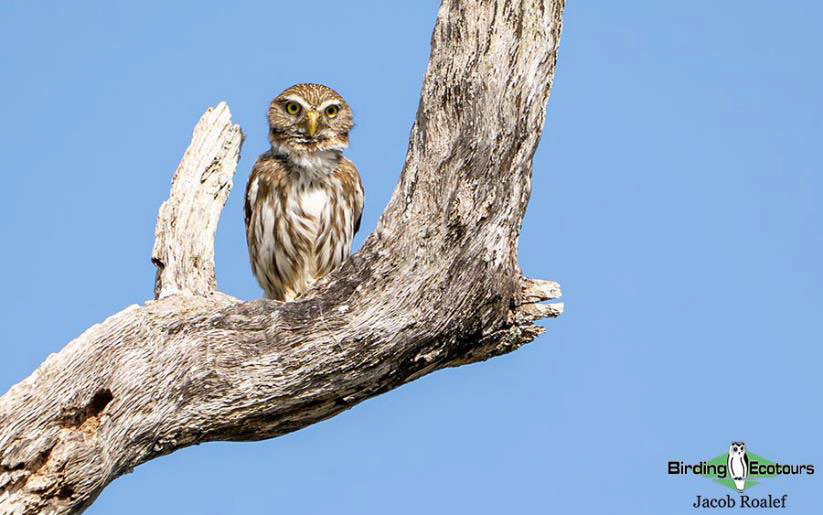
Ferruginous Pygmy-Owl is a top species for King Ranch.
Day 4, 27th March 2026. Lower Rio Grande Valley birding
Our plan for the day was to bird the eastern parks and sites of the Lower Rio Grande Valley, so after breakfast we began at Hanka Sod Farms. Creeping along the dirt road, we scanned the fields and found several excellent species, including Upland Sandpiper, American Golden-Plover, Cave Swallow, Merlin, and Horned Lark. From here, we continued to Resaca de la Palma State Park for our first real taste of Valley birding, quickly adding specialties such as Altamira Oriole, White-tipped Dove, Long-billed Thrasher, Plain Chachalaca, and Olive Sparrow. As late morning approached, we pressed on toward South Padre Island, making a brief stop at a boat ramp where we picked up Yellow-crowned Night-Heron, Black Skimmer, and Caspian Tern before crossing the bridge. With a little time before lunch, we scanned the mangrove estuary and, after some patient searching, secured quick views of Mangrove Yellow Warbler, another excellent ABA-area bird. By then, it was time for lunch and a welcome break from the sun and heat.
In the afternoon we made a quick detour to check for another potential rarity. After setting the scope on a distant buoy, we soon confirmed a pair of Brown Boobies, another excellent addition to the trip list. We then continued to the South Padre Island Birding Center. Although the afternoon was hot, the birding remained enjoyable, with plenty of waterbirds to hold our attention. Highlights included close views of Tricolored, Little Blue, and Green Herons, Reddish and Snowy Egrets, Black-bellied Whistling-Duck, and Roseate Spoonbill. Afterward we crossed back to the mainland, returned to the hotel for a short break, and then headed out for dinner. Our first stop after supper was in the neighborhood of McAllen, where we listened for the loud calls of Red-crowned Amazon and watched birds flying into their roosts. With that species secured, we hurried to Bentsen State Park, arriving just before sunset. We walked the short trail, joined a group of birders, and fixed our attention on a tiny hole in a telephone pole. Right on cue, the resident Elf Owl peered out several times before flying off to hunt, providing a memorable end to the day, and our signal to return to the hotel for some rest.
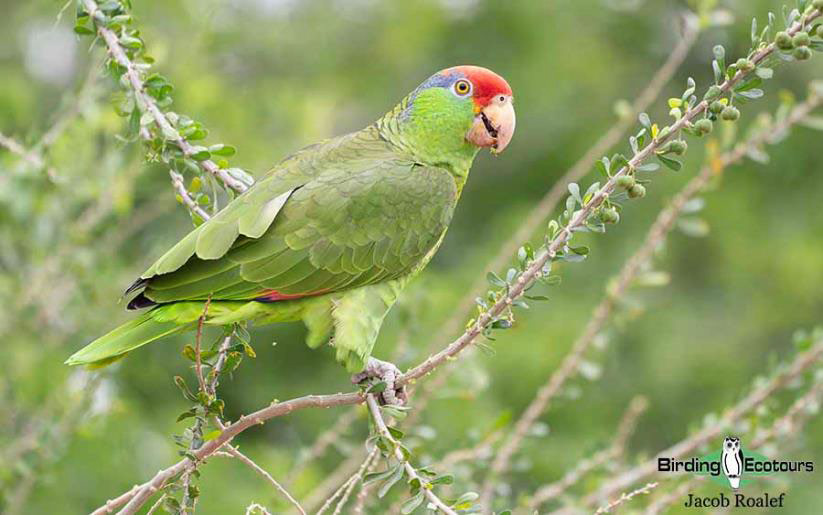
We enjoyed the colorful Red-crowned Amazon several times this year.
Day 5, 28th March 2026. More Lower Rio Grande Valley birding
We eased into the morning with coffee and breakfast at the hotel, before setting out to explore the western parks of the Lower Rio Grande Valley. Our first stop was Estero Llano Grande State Park, where the day began in style: a Red-crowned Amazon was feeding in the parking-lot trees and gave us excellent views almost immediately. From here, we worked the ponds and feeders near the visitor center, adding Buff-bellied Hummingbird, Plain Chachalaca, Long-billed Thrasher, Ladder-backed Woodpecker, Great Kiskadee, and more. A relaxed walk through the park then produced more excellent birds, including Pectoral Sandpiper, Fulvous Whistling-Duck, Yellow-crowned Night-Heron, Clay-colored Thrush, Grey Hawk, and a sleeping Pauraque. Before leaving we paused at the water drip in the tropical zone, where Orange-crowned Warbler, White-eyed Vireo, and Green Jay all came in for a drink and bath.
After lunch we made a brief foray into desert scrub, where both Bewick’s Wren and Cactus Wren quickly joined the day’s list. We then headed to the National Butterfly Center for another hour or so of birding under the Texas sun. A short walk through the grounds and time at the feeders produced a strong mix of birds, including Yellow-bellied Sapsucker, Eastern Screech-Owl, Audubon’s and Altamira Orioles, Inca Dove, Green Jay, and plenty more. With ambitious evening plans ahead, we returned to the hotel to settle in and rest before dinner. After a tasty meal we drove west to Santa Margarita Ranch, where we met our local guide and several other birders for a much-anticipated night-birding session on this private property. As we walked the trail in the last light of day we still managed to pick up Grey Hawk, Red-billed Pigeon, Brown Jay, and Lesser Nighthawks passing overhead. Once darkness settled in the owling began in earnest and, before long, we heard the bird we had come for: Mottled Owl. We moved carefully toward the sound and were rewarded with superb views as this mega rarity perched in the open for everyone to enjoy and photograph. On the walk back out we added excellent views of Eastern Screech-Owl and heard several other nocturnal species, including Common Poorwill, Great Horned Owl, and American Barn Owl. It was a thrilling evening of birding and eventually we made the drive back to the hotel for some much-needed sleep.
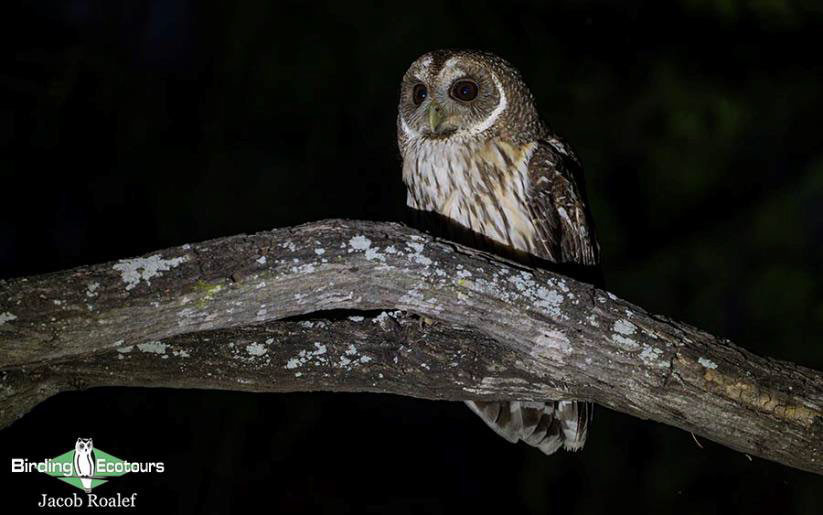
The long-standing Mottled Owl was very cooperative for our group.
Day 6, 29th March 2026. Final valley birding and over to Falcon Lake State Park
After our late-night adventure we all decided it was a good idea to sleep in a bit and have a more relaxed morning today. We had already done very well with our valley target species so we headed off mid-morning to hopefully find our final few. First, we headed off to a busy parking lot outside a large shopping center. This was certainly an odd location, but it was a great place to find Brewer’s Blackbird, a species we were still missing. Thankfully, our mission was quick and successful, as a few pairs were strutting through the lot. Next up, the Hildago Pump Station. Here we enjoyed a pleasant bit of birding and found Purple Martin, Monk Parakeet, Broad-winged Hawk, and Bronzed Cowbird. As we were heading out of the area we finally heard the distinctive call of a Tropical Kingbird. It didn’t take long to locate it and bag our final Lower Rio Grande Valley specialty species. Time for a short break and some lunch.
We still had some unfinished business because of yesterday’s issues with Edinburgh Scenic Wetlands being closed, so we headed off to try our luck today. Thankfully, they were open and we were able to search for the rare species here. We found some other species first like Least Grebe, Buff-bellied Hummingbird, Plain Chachalaca, Wilson’s Warbler, Ladder-backed Woodpecker, Long-billed Thrasher, and more. However, it took some serious effort and teamwork before we finally managed to spot the celebrity female, Crimson-collared Grosbeak! After a bit of running around we were all able to get on the bird and everyone left happy. We had a long drive towards Zapata and, after a few hours on the road, we stopped at Falcon Dam State Park for a short break and a little extra birding. The heat kept our visit brief but we still found several worthwhile species, including Greater Roadrunner, Verdin, and Pyrrhuloxia. We then continued to Zapata, checked into our hotel, and headed to dinner and a rest in anticipation of a long day of birding tomorrow.
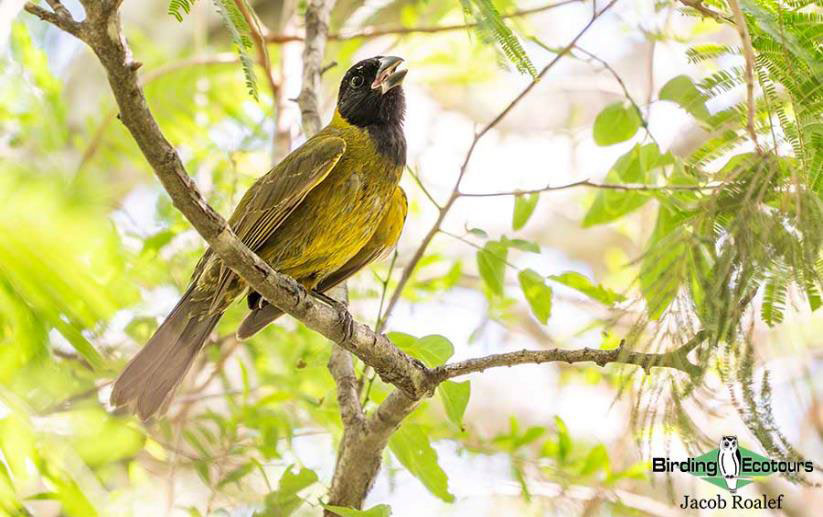
This female Crimson-collared Grosbeak proved to be one of the standout birds of the trip.
Day 7, 30th March 2026. Santa Margarita Ranch
Today felt like a real privilege, with special access arranged for us to bird Santa Margarita Ranch, a private stretch of superb habitat along the Rio Grande. The ranch held plenty of promise, including several possible U.S. rarities, so we grabbed a quick early breakfast and set off in time to arrive just before sunrise. There we met our local guide for the day, who entered the security code and led us through the huge border wall, bringing us closer to the river. We spent the first hours of the morning scanning from the bluffs, and the effort quickly paid off with an excellent mix of birds, including Red-billed Pigeon, Black-throated Sparrow, Muscovy Duck, Canvasback, Ringed Kingfisher, Audubon’s Oriole, Grey Hawk, and Lesser Scaup. Raptor migration was also in full swing, with many Swainson’s Hawks passing overhead and Zone-tailed, Sharp-shinned, and Cooper’s Hawks mixed in. By mid-morning, it was time to move down into the riparian zone. On the way, we paused at the edge of the desert scrub to put out some feed, which quickly drew in a covey of Scaled Quail, along with nearby Verdin and Curve-billed Thrasher.
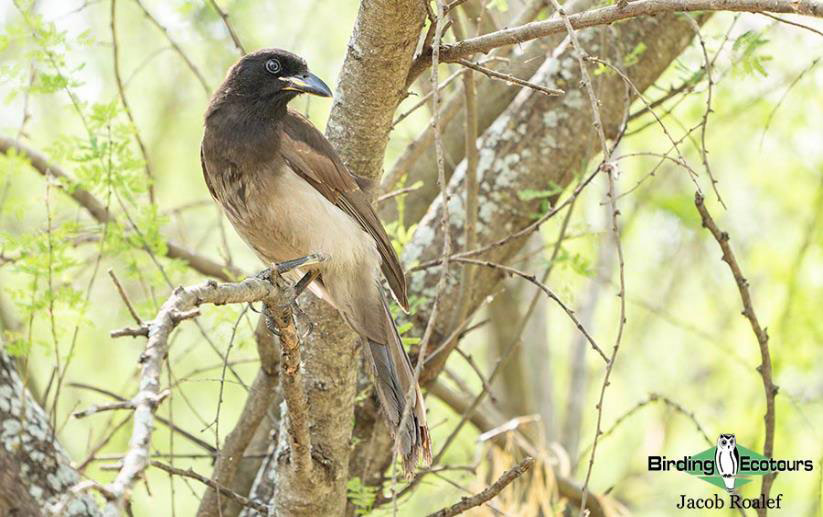
This Brown Jay was waiting for some marshmallows.
Once down in the riparian zone we were greeted by the now-famous family of Brown Jays, which seemed especially interested in whether we had arrived with lunch for them. We set up the feeders, settled in with our own food, and enjoyed a memorable meal surrounded by birds. Brown and Green Jays, Altamira Oriole, Golden-fronted Woodpecker, and Olive Sparrow all dropped in around the feeding area. After everyone had refueled, we pushed deeper into the riverine habitat and soon connected with another special bird nesting in the area, Rose-throated Becard. Both male and female appeared briefly, giving us solid views despite staying high in the tangled canopy. On our way back out more excellent birds kept the momentum going, including Brown-crested Flycatcher, Morelet’s Seedeater, Green Kingfisher, and Ladder-backed Woodpecker. With a little time still available we turned our attention to the drier desert scrub away from the river, where we added several new trip birds, including Black-tailed Gnatcatcher, Ash-throated Flycatcher, and Cassin’s Sparrow. We then said goodbye to Ryan and thanked him for an excellent day exploring Santa Margarita Ranch. The birding was not quite finished, however, as a pair of Chihuahuan Ravens appeared along the roadside on our drive back. After that final bonus sighting, we returned to the hotel for a welcome break from the heat and then dinner.
Day 8, 31st March 2026. Laredo to Uvalde and the Rio Frio bat colony
After the previous day’s marathon of birding a slower start was very welcome, and we eased into the morning with breakfast at the hotel. Today’s route would take us out of the Valley and into the Texas Hill Country, with a few worthwhile birding stops along the way. Once the luggage was packed, we set off for a local park in Laredo along the U.S.–Mexico border, where a busy Cliff Swallow colony filled the underside of the international bridge. We moved to another section of the park and added a fine mix of birds, including Clay-colored Sparrow, Grey Hawk, Mexican Duck, Scissor-tailed Flycatcher, Black Phoebe, Ringed and Green Kingfishers, and Hermit Thrush. We then continued to another park on the north side of Laredo, where time was short but fortune was kind: before long, we had found our main target, Bell’s Vireo, another new species for the trip. After lunch and a few more hours on the road, we reached Uvalde, where a check of the local water tower produced a perched Peregrine Falcon.
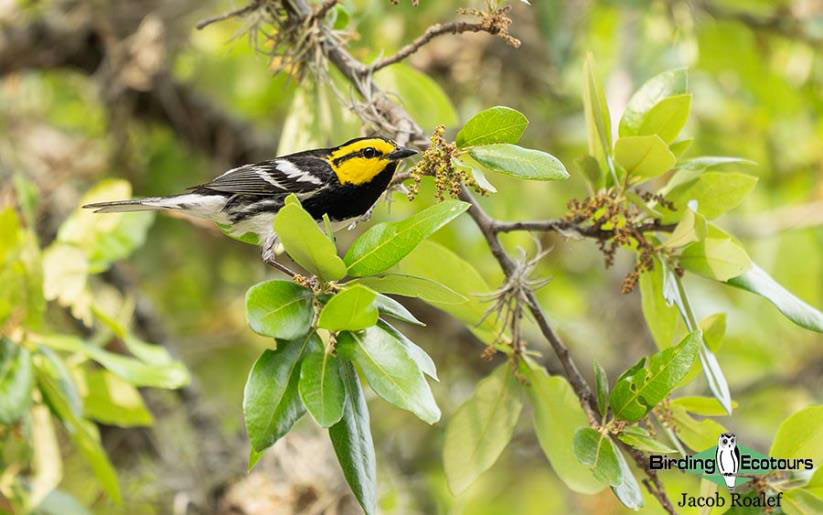
Golden-cheeked Warbler was a welcome Hill Country highlight.
In the evening, before the bat spectacle, we fitted in a little more birding. We stopped at a roadside site and found several good species, including Chipping Sparrow, Black-and-white and Yellow-throated Warblers, and Hutton’s Vireo. We then continued to nearby Garner State Park, where a quick drive through the large park led us to a promising patch of maple habitat. A short search produced a Golden-cheeked Warbler, which we enjoyed again while having dinner at the nearby picnic tables. We then headed to the Concan Frio bat cave for the main event. As we waited near the entrance a noisy Canyon Wren kept us entertained. Around sunset, millions of Mexican Free-tailed Bats began streaming from the cave, forming the second-largest mammal congregation in the world. Raptors, including Merlin and Red-tailed Hawk, circled nearby, ready to take advantage of their nightly buffet.
Day 9, 1st April 2026. Lost Maples and more Hill Country
Today was devoted to the Texas Hill Country, a fresh landscape for the trip and one holding several enticing new targets. We set off for Lost Maples State Park, but a large flock of Cedar Waxwings at the Utopia Library Garden tempted us into a quick stop. The detour proved worthwhile, with Carolina Chickadee and our best views yet of Cave Swallow, as birds dropped to a puddle to collect mud. At Lost Maples, we gathered a little information at the visitor center, checked the feeding station hide, and headed toward the trails.. There we picked up Lesser Goldfinch, Woodhouse’s Scrub-Jay, Black-chinned Hummingbird, and more. Soon after starting down the trail, we heard the unmistakable song of our main Hill Country prize, Black-capped Vireo. After some patient searching, everyone enjoyed good views of this often-skulking specialty. With our top target secured so early we could relax and see what else the hills had in store. The trail soon produced more Golden-cheeked Warblers, along with a Tropical Parula keeping company with a female Northern Parula. Before leaving, we made one final stop at the feeders and added Eastern Phoebe and another excellent bird, Rufous-crowned Sparrow.
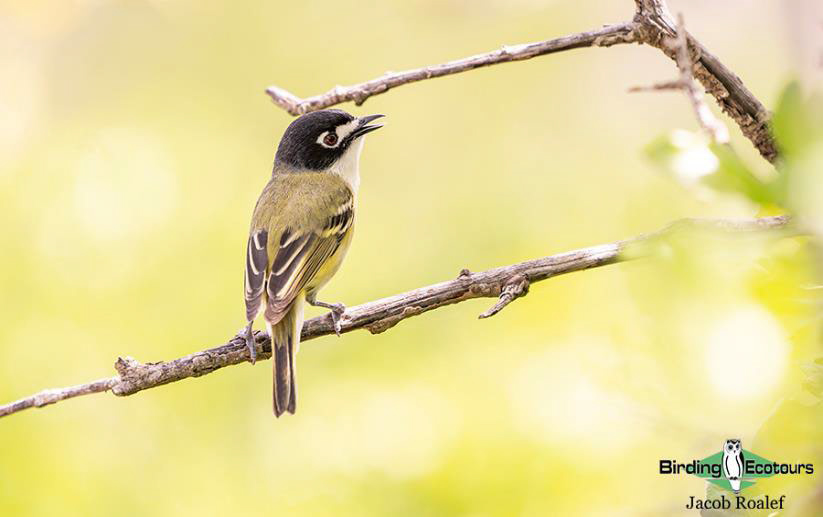
Black-capped Vireo showed off its bold head pattern and striking contrast.
After an excellent morning in the hills and a tasty lunch, we spent the afternoon exploring South Llano River State Park. By then the heat had settled in and bird activity had quieted, so we focused our efforts on the park’s feeder stations. Even in the slower hours the stops proved worthwhile, producing new trip birds such as Field Sparrow and Spotted Towhee, along with Lincoln’s Sparrow, Black-crested Titmouse, Bewick’s Wren, and Purple Martin. With the afternoon birding complete, we continued to Kerrville for dinner and our overnight stay.
Day 10, 2nd April 2026. Birding back to Corpus Christi
By this stage of the tour new trip birds were becoming hard to find, as we had already covered the coast, the Valley, and the Hill Country well. After reviewing the remaining possibilities we set out for Boerne City Lake Park, despite a dreary forecast. Scanning the lake we found distant ducks, including Northern Shoveler, Gadwall, Cinnamon Teal, and Ruddy Duck, with a welcome Franklin’s Gull mixed in among them as a new trip species. We then birded the lakeside trees and open fields, building a solid drizzly-morning list that included Eastern Bluebird, Vermilion Flycatcher, Cedar Waxwing, Nashville Warbler, and Field Sparrow. We continued to nearby River Road Park in search of a few more targets. Luck was with us again, and we found a long-staying Snow Goose, along with Egyptian Goose and Blue Jay. After lunch we started the long drive back across the state to Corpus Christi.
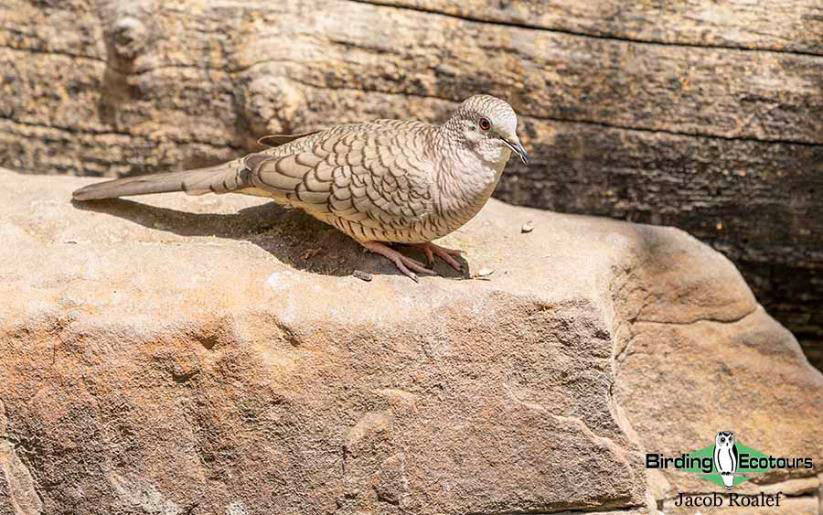
Inca Dove has some great camouflage in the dry, rocky environments.
After a few hours we arrived back in the gulf area and still had plenty of time to squeeze in a bit more birding, so off we went to Hazel Bazemore Park to hopefully turn up a few more species. While we escaped the rain for the day, the wind certainly picked up as we got closer to the gulf, and this made birding challenging. We turned our attention to shorebirds for now and managed to find Stilt Sandpiper, Western, Least and Semipalmated Sandpipers, plus a few gorgeous Wilson’s Phalaropes. This was a productive stop for sure, but it was time to move on to our final birding destination of the day, Blucher Park. The wind was still an issue; however, the cover of the trees here did help some with this. Birding was quiet, but we all found some excitement when we flushed up a Chuck-will’s-widow from the understory. We attempted to track this bird down but only ended up catching glimpses of it as it flew through the park. Time for some tasty Texas BBQ after a long and successful day.
Day 11, 3rd April 2026. Corpus Christi area birding
We had now come full circle, with a full day to revisit the Rockport and Corpus Christi area where the tour had begun ten days earlier. A few targets still remained, so we made the most of the morning with a return to Leonabelle Turnbull Birding Center. The weather was gorgeous, and the boardwalk was alive with close birds to enjoy and photograph, including Black-necked Stilt, Sora, Willet, Roseate Spoonbill, Tricolored Heron, and Marsh Wren. We also added several strong birds to the list, including Clapper Rail and Magnificent Frigatebird. We visited the neighboring wetland park and picked up Piping Plover, then continued to the Port Aransas Jetty, where we searched through hundreds of beachside terns and found Least, Cabot’s, Royal, and Caspian Terns. It was an excellent, bird-filled morning, followed by a local lunch.
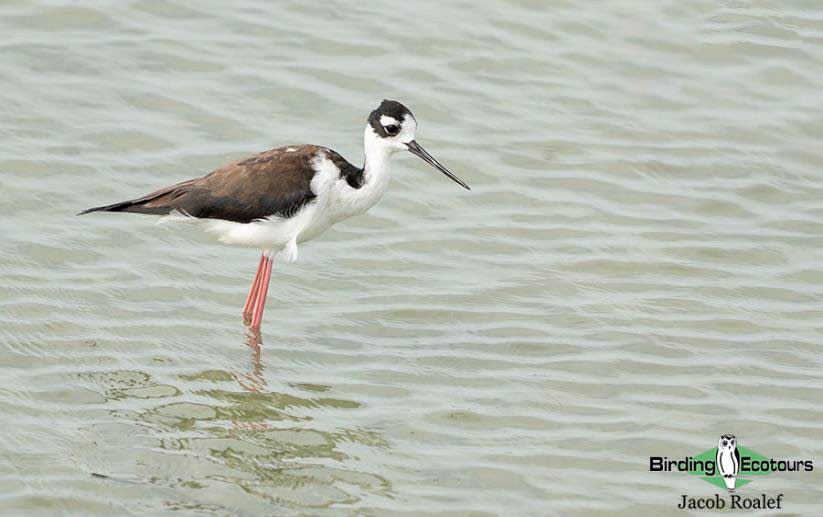
The striking contrast of a Black-necked Stilt always grabs attention.
This afternoon we birded south along Mustang Island in hopes of adding a few final species. Scanning the tidal pools and marshes produced an excellent mix of birds, including a new Marbled Godwit, along with Black Skimmer, Gull-billed Tern, and Sanderling. After the coastal stops, we turned inland to explore nearby agricultural fields, covering several miles and finding Upland Sandpiper, American Kestrel, Scissor-tailed Flycatcher, Crested Caracara, and another new trip bird, Eastern Kingbird. Storm clouds were beginning to build, but we still had time for one last stop at Sunset Lake before returning to town for dinner. There we added a Red-breasted Merganser, also new for the trip, plus Wilson’s and Piping Plovers, Dunlin, Least Sandpiper, Reddish Egret, and more. It was a rewarding, habitat-rich day and a fitting lead-in to our final group dinner.
Day 12, 4th April 2025. Final birding and transfer to airport
On our final morning later flights gave some of us one last chance to bird before departure. With an unsettled forecast, we timed our outing between showers and, after such a successful tour, set out to see what few new species might still be found. After a relaxed start, we visited nearby Rockport Memorial Park, a pleasant spot with ponds and woodland patches. The mosquitoes were less than welcoming, but the birding quickly made up for it. We added three final new species to the trip list: Redhead, Great Crested Flycatcher, and Grey Catbird, pushing us comfortably beyond the 250-species mark. One last stop at Blucher Park in Corpus Christi produced the perfect finale: a small mixed flock with a new Black-throated Green Warbler, plus Blue-headed Vireo, Black-and-white Warbler, and Northern Parula. It was a fitting end to an excellent South Texas birding tour before we headed to the airport and said our goodbyes.
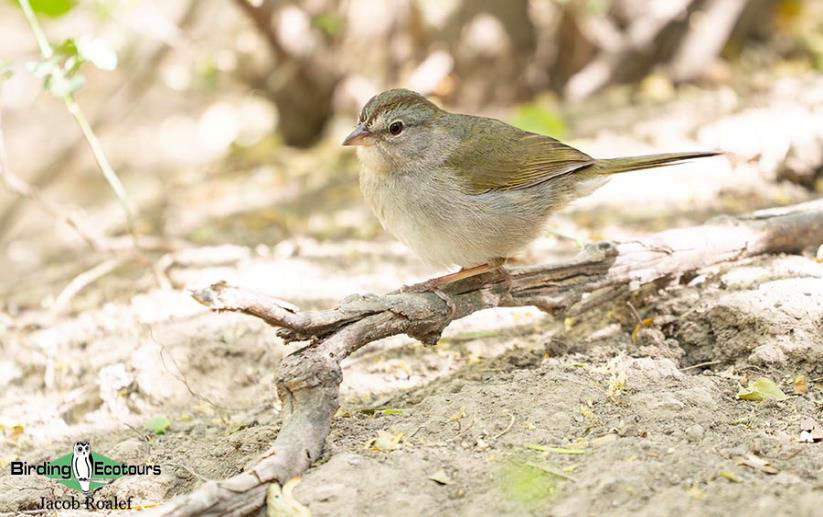
We enjoyed close-up views of Olive Sparrow several times on this trip.
Bird List – Following IOC 15.2 (April 2026)
Birds ‘heard only’ are marked with (H) after the common name, all other species were seen.
The following notation after species names is used to show conservation status following the IUCN Red List: EN = Endangered, VU = Vulnerable.
| Common Name | Scientific Name |
| Ducks, Geese, Swans (Anatidae) | |
| Black-bellied Whistling Duck | Dendrocygna autumnalis |
| Fulvous Whistling Duck | Dendrocygna bicolor |
| Snow Goose | Anser caerulescens |
| Canada Goose | Branta canadensis |
| Egyptian Goose | Alopochen aegyptiaca |
| Muscovy Duck | Cairina moschata |
| Wood Duck | Aix sponsa |
| Cinnamon Teal | Spatula cyanoptera |
| Blue-winged Teal | Spatula discors |
| Northern Shoveler | Spatula clypeata |
| Gadwall | Mareca strepera |
| American Wigeon | Mareca americana |
| Mallard | Anas platyrhynchos |
| Mottled Duck | Anas fulvigula |
| Mexican Duck | Anas diazi |
| Green-winged Teal | Anas carolinensis |
| Canvasback | Aythya valisineria |
| Redhead | Aythya americana |
| Lesser Scaup | Aythya affinis |
| Red-breasted Merganser | Mergus serrator |
| Ruddy Duck | Oxyura jamaicensis |
| Chachalacas, Curassows, Guans (Cracidae) | |
| Plain Chachalaca | Ortalis vetula |
| New World Quail (Odontophoridae) | |
| Scaled Quail | Callipepla squamata |
| Northern Bobwhite | Colinus virginianus |
| Pheasants & Allies (Phasianidae) | |
| Wild Turkey | Meleagris gallopavo |
| Nightjars (Caprimulgidae) | |
| Lesser Nighthawk | Chordeiles acutipennis |
| Pauraque | Nyctidromus albicollis |
| Common Poorwill (H) | Phalaenoptilus nuttallii |
| Chuck-will’s-widow | Antrostomus carolinensis |
| Eastern Whip-poor-will (H) | Antrostomus vociferus |
| Swifts (Apodidae) | |
| Chimney Swift – VU | Chaetura pelagica |
| Hummingbirds (Trochilidae) | |
| Black-chinned Hummingbird | Archilochus alexandri |
| Ruby-throated Hummingbird | Archilochus colubris |
| Buff-bellied Hummingbird | Amazilia yucatanensis |
| Cuckoos (Cuculidae) | |
| Greater Roadrunner | Geococcyx californianus |
| Pigeons, Doves (Columbidae) | |
| Rock Dove | Columba livia |
| Red-billed Pigeon | Patagioenas flavirostris |
| Eurasian Collared Dove | Streptopelia decaocto |
| Inca Dove | Columbina inca |
| Common Ground Dove | Columbina passerina |
| White-tipped Dove | Leptotila verreauxi |
| Mourning Dove | Zenaida macroura |
| White-winged Dove | Zenaida asiatica |
| Rails, Crakes & Coots (Rallidae) | |
| Clapper Rail | Rallus crepitans |
| Sora | Porzana carolina |
| Common Gallinule | Gallinula galeata |
| American Coot | Fulica americana |
| Cranes (Gruidae) | |
| Whooping Crane – EN | Grus americana |
| Grebes (Podicipedidae) | |
| Least Grebe | Tachybaptus dominicus |
| Pied-billed Grebe | Podilymbus podiceps |
| Oystercatchers (Haematopodidae) | |
| American Oystercatcher | Haematopus palliatus |
| Stilts and Avocets (Recurvirostridae) | |
| Black-necked Stilt | Himantopus mexicanus |
| American Avocet | Recurvirostra americana |
| Plovers (Charadriidae) | |
| Grey Plover – VU | Pluvialis squatarola |
| American Golden Plover | Pluvialis dominica |
| Killdeer | Charadrius vociferus |
| Semipalmated Plover | Charadrius semipalmatus |
| Piping Plover | Charadrius melodus |
| Wilson’s Plover | Anarhynchus wilsonia |
| Sandpipers, Snipes (Scolopacidae) | |
| Upland Sandpiper | Bartramia longicauda |
| Hudsonian Whimbrel | Numenius hudsonicus |
| Long-billed Curlew | Numenius americanus |
| Marbled Godwit – VU | Limosa fedoa |
| Long-billed Dowitcher | Limnodromus scolopaceus |
| Short-billed Dowitcher – VU | Limnodromus griseus |
| Wilson’s Snipe | Gallinago delicata |
| Wilson’s Phalarope | Phalaropus tricolor |
| Spotted Sandpiper | Actitis macularius |
| Lesser Yellowlegs – VU | Tringa flavipes |
| Willet | Tringa semipalmata |
| Greater Yellowlegs | Tringa melanoleuca |
| Ruddy Turnstone | Arenaria interpres |
| Stilt Sandpiper | Calidris himantopus |
| Sanderling | Calidris alba |
| Dunlin | Calidris alpina |
| Baird’s Sandpiper | Calidris bairdii |
| Least Sandpiper | Calidris minutilla |
| Pectoral Sandpiper | Calidris melanotos |
| Western Sandpiper | Calidris mauri |
| Semipalmated Sandpiper | Calidris pusilla |
| Gulls, Terns, Skimmers (Laridae) | |
| Black Skimmer | Rynchops niger |
| Least Tern | Sternula antillarum |
| Gull-billed Tern | Gelochelidon nilotica |
| Caspian Tern | Hydroprogne caspia |
| Forster’s Tern | Sterna forsteri |
| Cabot’s Tern | Thalasseus acuflavidus |
| Royal Tern | Thalasseus maximus |
| Laughing Gull | Leucophaeus atricilla |
| Franklin’s Gull | Leucophaeus pipixcan |
| Ring-billed Gull | Larus delawarensis |
| Lesser Black-backed Gull | Larus fuscus |
| American Herring Gull | Larus smithsonianus |
| Loons (Gaviidae) | |
| Common Loon | Gavia immer |
| Frigatebirds (Fregatidae) | |
| Magnificent Frigatebird | Fregata magnificens |
| Gannets, Boobies (Sulidae) | |
| Red-footed Booby | Sula sula |
| Brown Booby | Sula leucogaster |
| Anhingas, Darters (Anhingidae) | |
| Anhinga | Anhinga anhinga |
| Cormorants, Shags (Phalacrocoracidae) | |
| Neotropic Cormorant | Nannopterum brasilianum |
| Double-crested Cormorant | Nannopterum auritum |
| Ibises, Spoonbills (Threskiornithidae) | |
| American White Ibis | Eudocimus albus |
| White-faced Ibis | Plegadis chihi |
| Roseate Spoonbill | Platalea ajaja |
| Herons, Bitterns (Ardeidae) | |
| Yellow-crowned Night Heron | Nyctanassa violacea |
| Black-crowned Night Heron | Nycticorax nycticorax |
| Little Blue Heron | Egretta caerulea |
| Tricolored Heron | Egretta tricolor |
| Reddish Egret | Egretta rufescens |
| Snowy Egret | Egretta thula |
| Green Heron | Butorides virescens |
| Great Egret | Ardea alba |
| Western Cattle Egret | Ardea ibis |
| Great Blue Heron | Ardea herodias |
| Pelicans (Pelecanidae) | |
| American White Pelican | Pelecanus erythrorhynchos |
| Brown Pelican | Pelecanus occidentalis |
| New World Vultures (Cathartidae) | |
| Black Vulture | Coragyps atratus |
| Turkey Vulture | Cathartes aura |
| Ospreys (Pandionidae) | |
| Osprey | Pandion haliaetus |
| Kites, Hawks, Eagles (Accipitridae) | |
| White-tailed Kite | Elanus leucurus |
| Sharp-shinned Hawk | Accipiter striatus |
| Cooper’s Hawk | Astur cooperii |
| Northern Harrier | Circus hudsonius |
| Harris’s Hawk | Parabuteo unicinctus |
| White-tailed Hawk | Geranoaetus albicaudatus |
| Grey Hawk | Buteo plagiatus |
| Red-shouldered Hawk | Buteo lineatus |
| Broad-winged Hawk | Buteo platypterus |
| Swainson’s Hawk | Buteo swainsoni |
| Zone-tailed Hawk | Buteo albonotatus |
| Red-tailed Hawk | Buteo jamaicensis |
| Kingfishers (Alcedinidae) | |
| Green Kingfisher | Chloroceryle americana |
| Ringed Kingfisher | Megaceryle torquata |
| Belted Kingfisher | Megaceryle alcyon |
| Barn Owls (Tytonidae) | |
| American Barn Owl (H) | Tyto furcata |
| Owls (Strigidae) | |
| Elf Owl | Micrathene whitneyi |
| Ferruginous Pygmy Owl | Glaucidium brasilianum |
| Great Horned Owl (H) | Bubo virginianus |
| Eastern Screech Owl | Megascops asio |
| Mottled Owl | Strix virgata |
| Woodpeckers (Picidae) | |
| Golden-fronted Woodpecker | Melanerpes aurifrons |
| Yellow-bellied Sapsucker | Sphyrapicus varius |
| Ladder-backed Woodpecker | Dryobates scalaris |
| Caracaras, Falcons (Falconidae) | |
| Crested Caracara | Caracara plancus |
| American Kestrel | Falco sparverius |
| Aplomado Falcon | Falco femoralis |
| Merlin | Falco columbarius |
| Peregrine Falcon | Falco peregrinus |
| African & New World Parrots (Psittacidae) | |
| Monk Parakeet | Myiopsitta monachus |
| Red-crowned Amazon – EN | Amazona viridigenalis |
| Green Parakeet | Psittacara holochlorus |
| Tyrant Flycatchers, Calyptura (Tyrannidae) | |
| Northern Beardless Tyrannulet | Camptostoma imberbe |
| Eastern Phoebe | Sayornis phoebe |
| Black Phoebe | Sayornis nigricans |
| Vermilion Flycatcher | Pyrocephalus obscurus |
| Cattle Tyrant | Machetornis rixosa |
| Great Kiskadee | Pitangus sulphuratus |
| Tropical Kingbird | Tyrannus melancholicus |
| Couch’s Kingbird | Tyrannus couchii |
| Scissor-tailed Flycatcher | Tyrannus forficatus |
| Eastern Kingbird | Tyrannus tyrannus |
| Ash-throated Flycatcher | Myiarchus cinerascens |
| Great Crested Flycatcher | Myiarchus crinitus |
| Brown-crested Flycatcher | Myiarchus tyrannulus |
| Tityras, Becards, Sharpbill (Tityridae) | |
| Rose-throated Becard | Pachyramphus aglaiae |
| Vireos, Greenlets, Shrike-babblers (Vireonidae) | |
| Hutton’s Vireo | Vireo huttoni |
| Yellow-throated Vireo | Vireo flavifrons |
| Blue-headed Vireo | Vireo solitarius |
| White-eyed Vireo | Vireo griseus |
| Bell’s Vireo | Vireo bellii |
| Black-capped Vireo | Vireo atricapilla |
| Shrikes (Laniidae) | |
| Loggerhead Shrike | Lanius ludovicianus |
| Crows, Jays (Corvidae) | |
| Brown Jay | Cyanocorax morio |
| Green Jay | Cyanocorax luxuosus |
| Blue Jay | Cyanocitta cristata |
| Woodhouse’s Scrub Jay | Aphelocoma woodhouseii |
| Northern Raven | Corvus corax |
| Chihuahuan Raven | Corvus cryptoleucus |
| Waxwings (Bombycillidae) | |
| Cedar Waxwing | Bombycilla cedrorum |
| Tits, Chickadees (Paridae) | |
| Black-crested Titmouse | Baeolophus atricristatus |
| Carolina Chickadee | Poecile carolinensis |
| Penduline Tits (Remizidae) | |
| Verdin | Auriparus flaviceps |
| Larks (Alaudidae) | |
| Horned Lark | Eremophila alpestris |
| Swallows, Martins (Hirundinidae) | |
| Sand Martin | Riparia riparia |
| Tree Swallow | Tachycineta bicolor |
| Purple Martin | Progne subis |
| Northern Rough-winged Swallow | Stelgidopteryx serripennis |
| Barn Swallow | Hirundo rustica |
| American Cliff Swallow | Petrochelidon pyrrhonota |
| Cave Swallow | Petrochelidon fulva |
| Wrens (Troglodytidae) | |
| Cactus Wren | Campylorhynchus brunneicapillus |
| Canyon Wren | Catherpes mexicanus |
| Sedge Wren (H) | Cistothorus stellaris |
| Marsh Wren | Cistothorus palustris |
| Bewick’s Wren | Thryomanes bewickii |
| Carolina Wren | Thryothorus ludovicianus |
| Northern House Wren | Troglodytes aedon |
| Gnatcatchers (Polioptilidae) | |
| Blue-grey Gnatcatcher | Polioptila caerulea |
| Black-tailed Gnatcatcher | Polioptila melanura |
| Mockingbirds, Thrashers (Mimidae) | |
| Grey Catbird | Dumetella carolinensis |
| Northern Mockingbird | Mimus polyglottos |
| Long-billed Thrasher | Toxostoma longirostre |
| Curve-billed Thrasher | Toxostoma curvirostre |
| Starlings, Rhabdornises (Sturnidae) | |
| Common Starling | Sturnus vulgaris |
| Thrushes (Turdidae) | |
| Eastern Bluebird | Sialia sialis |
| Hermit Thrush | Catharus guttatus |
| Clay-colored Thrush | Turdus grayi |
| Old World Sparrows, Snowfinches (Passeridae) | |
| House Sparrow | Passer domesticus |
| Finches, Euphonias (Fringillidae) | |
| House Finch | Haemorhous mexicanus |
| American Goldfinch (H) | Spinus tristis |
| Lesser Goldfinch | Spinus psaltria |
| New World Sparrows (Passerellidae) | |
| Cassin’s Sparrow | Peucaea cassinii |
| Olive Sparrow | Arremonops rufivirgatus |
| Black-throated Sparrow | Amphispiza bilineata |
| Lark Sparrow | Chondestes grammacus |
| Chipping Sparrow | Spizella passerina |
| Clay-colored Sparrow | Spizella pallida |
| Field Sparrow | Spizella pusilla |
| White-crowned Sparrow | Zonotrichia leucophrys |
| Seaside Sparrow | Ammospiza maritima |
| Savannah Sparrow | Passerculus sandwichensis |
| Song Sparrow | Melospiza melodia |
| Lincoln’s Sparrow | Melospiza lincolnii |
| Rufous-crowned Sparrow | Aimophila ruficeps |
| Spotted Towhee | Pipilo maculatus |
| Oropendolas, New World Orioles, Blackbirds (Icteridae) | |
| Eastern Meadowlark | Sturnella magna |
| Audubon’s Oriole | Icterus graduacauda |
| Altamira Oriole | Icterus gularis |
| Hooded Oriole | Icterus cucullatus |
| Red-winged Blackbird | Agelaius phoeniceus |
| Bronzed Cowbird | Molothrus aeneus |
| Brown-headed Cowbird | Molothrus ater |
| Brewer’s Blackbird | Euphagus cyanocephalus |
| Common Grackle | Quiscalus quiscula |
| Boat-tailed Grackle | Quiscalus major |
| Great-tailed Grackle | Quiscalus mexicanus |
| New World Warblers (Parulidae) | |
| Black-and-white Warbler | Mniotilta varia |
| Orange-crowned Warbler | Leiothlypis celata |
| Nashville Warbler | Leiothlypis ruficapilla |
| Common Yellowthroat | Geothlypis trichas |
| Hooded Warbler | Setophaga citrina |
| Northern Parula | Setophaga americana |
| Tropical Parula | Setophaga pitiayumi |
| Northern Yellow Warbler | Setophaga aestiva |
| Mangrove Yellow Warbler | Setophaga petechia |
| Myrtle Warbler | Setophaga coronata |
| Yellow-throated Warbler | Setophaga dominica |
| Golden-cheeked Warbler – EN | Setophaga chrysoparia |
| Black-throated Green Warbler | Setophaga virens |
| Wilson’s Warbler | Cardellina pusilla |
| Cardinals & Allies (Cardinalidae) | |
| Summer Tanager | Piranga rubra |
| Crimson-collared Grosbeak | Periporphyrus celaeno |
| Northern Cardinal | Cardinalis cardinalis |
| Pyrrhuloxia | Cardinalis sinuatus |
| Tanagers & Allies (Thraupidae) | |
| Morelet’s Seedeater | Sporophila morelleti |
| Species seen: | 247 |
| Species heard: | 6 |
| Total recorded: | 253 |
Mammal List – Following Mammalwatching.com (November 2025)
| Common Name | Scientific Name |
| Squirrels and Relatives (Sciuridae) | |
| Eastern Grey Squirrel | Sciurus carolinensis |
| Eastern Fox Squirrel | Sciurus niger |
| Rabbits and Hares (Leporidae) | |
| Black-tailed Jackrabbit | Lepus californicus |
| Eastern Cottontail | Sylvilagus floridanus |
| Free-tailed Bats (Molossidae) | |
| Mexican Free-tailed Bat | Tadarida brasiliensis |
| Evening Bats (Vespertilionidae) | |
| North American Evening Bat | Nycticeius humeralis |
| Armadillos and allies (Daypodidae) | |
| Nine-banded Armadillo | Dasypus novemcinctus |
| Oceanic Dolphins (Delphinidae) | |
| Common Bottlenose Dolphin | Tursiops truncatus |
| Peccary (Tayassuidae) | |
| Collared Peccary | Dicotyles tajacu |
| Deer, Elk, Mooses (Cervidae) | |
| White-tailed Deer | Odocoileus virginianus |
| Species seen: | 10 |
This is a sample trip report. Please email us ([email protected]) for more trip reports from this destination.