29 OCTOBER – 15 NOVEMBER 2025
By Dylan Vasapolli
Overview
This is our premier Australian set departure birding tour that covers the diverse (and truly excellent) eastern parts of the country, starting in Melbourne and eventually ending up in Cairns some 18 days later. Our short tour to Tasmania, which runs just prior to this, is easily linked with this tour, and it was indeed the case that all the participants on this eastern Australia tour all joined our Tasmania tour just before. This allowed us added flexibility, as there is some overlap in special birds to be found between these two tours (such as Hooded Plover and Pink Robin). Thus, rather than trying for some birds we had all seen in Tasmania, such as the examples above, we put more time into the more challenging and difficult species that aren’t usually seen on the east coast tour, like the mega rare Critically Endangered (IUCN) Orange-bellied Parrot, and skulkers like Lewin’s Rail.
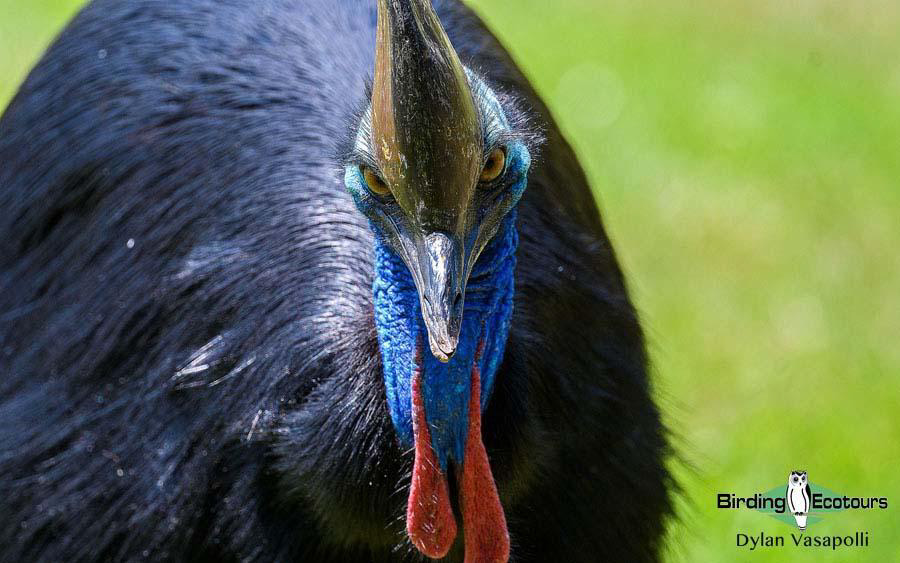
Staring into the eyes of a Southern Cassowary was a thrilling experience for us all. This prehistoric bird is a major tour target, and we had multiple great looks during this year’s tour.
This tour is essentially divided into three distinct segments; firstly a nine-day loop through the state of Victoria (and briefly into New South Wales) in and out of Melbourne; secondly with a flight to Brisbane in Queensland allowing us a few nights at the wonderful O’Reilly’s Rainforest Retreat in Lamington National Park; and thirdly, with a flight to Cairns (still in Queensland) and a short seven-day loop in and out of Cairns as we explore the wet and dry tropics of the Atherton Tablelands and surrounds. There are many big targets on the tour, and the tour itself usually generates more than 350 species of birds, but special effort is put into highly sought-after birds like Malleefowl, the monotypic Plains-wanderer and Southern Cassowary in particular, though of course there are many, many others that are sought as well.
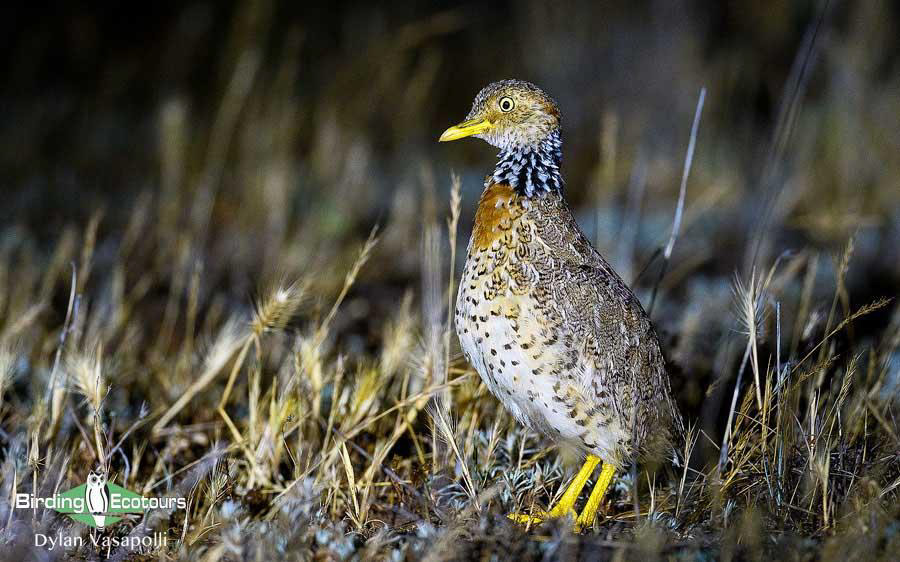
Plains-wanderer is a strange monotypic shorebird occurring in the dry country of south-central Australia. Little is known about this rare bird due to its highly secretive nature. Virtually the only way to see this mega bird is a night-time excursion – which aside from the bird itself is always another major tour highlight.
As a whole the tour went smoothly, with virtually no issues to speak of regarding the logistics which had multiple domestic flights to contend with. Our weather did leave a bit to be desired, as especially the southern Australian coastline area seemed to be beset with regular big storm systems coming in with strange and unusual weather stemming from the Antarctic. Our Victoria/Melbourne loop at the start of the tour did see us contend with this trying weather, and we experienced everything ranging from intense heat, extreme winds and dust storms, to freezing cold conditions and quite a bit of rain. Once we got up into Queensland, things were more settled.
We did very well on the birding side of things, finding almost all the main targets, and enjoying pretty good looks at most everything. There are too many highlights to list them all in this summary, but the tour started off with a bang as we found some Orange-bellied Parrots – which were excellent, given that this species was missed on the preceding Tasmania Tour due to bad weather forcing the cancellation of our dedicated flight to see this species. Our five (!) separate sightings of seven different Southern Cassowaries (several had chicks) was scarcely believable, as was seeing a host of Malleefowl during a productive afternoon. We were likewise thrilled with our excellent sighting of the tough Striated Grasswren, as was seeing both the possible ‘Birds-of-Paradise’ (BoPs); Paradise and Victoria’s Riflebirds. Some eight cockatoos and 18 parrots kept us busy for a while, as did well over 40 honeyeaters and all the seven possible fairywrens. The mammals are also not to be forgotten, and we reveled in countless views of many different macropods (kangaroo family), including the three big ones – Red, Eastern Grey and Western Grey Kangaroos. We also did well to find the rare Lumholtz’s Tree Kangaroo and some of Australia’s other iconic mammals like Koala, Platypus and Common Wombat.
A detailed daily account can be read below, and the various species lists are located at the end of the report.
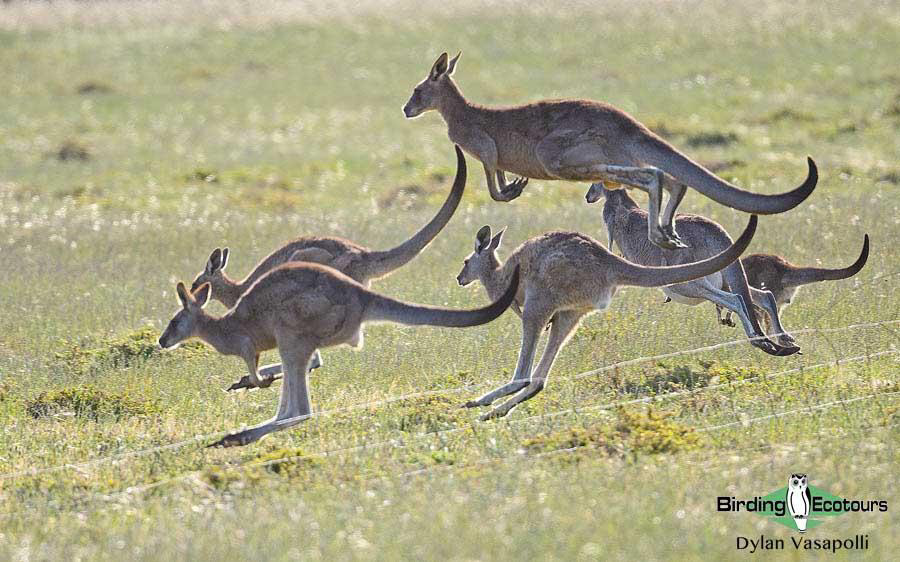
A mob of Eastern Grey Kangaroos sprang over the fields (and fences) with ease. This iconic Australian mammal (and family) is one of many reasons that make this country so exciting!
Detailed Report
Day 1, 29th October 2025. Arrival into Melbourne
The group arrived together into Melbourne this afternoon from the recently completed Tasmania tour. After checking into our airport hotel, and a short rest, we headed out for a leisurely stroll around the surrounds. Though there was not much natural habitat left, we enjoyed finding our first common urban birds, with the likes of Red Wattlebird, Little Raven, White-plumed Honeyeater, Rainbow Lorikeet, Noisy Miner and some ultra confiding Magpie-larks all showing well. A snazzy Crested Pigeon popped in briefly, and just like that, it was time for dinner. We settled in for the evening over a wonderful meal, excited for the tour ahead.
Day 2, 30th October 2025. Birding the Western Treatment Plants “Werribee” to Geelong
With an incredible day lined up ahead we met up with Simon, our local guide who’d be taking us around our Victoria circuit in the morning, before loading up and heading out. Our first point of call was the lovely Serendip Sanctuary, just outside Lara. As we arrived, we picked up a few of the always sought-after Emus – these globally known birds being high on most folks’ wish lists. A few of the hulking Cape Barren Goose were strolling about the plain with them. We then set about finding our main target here, Tawny Frogmouth, and were soon looking at a pair with a large chick (well spotted, Sue!). After gawking at these great birds, we set off into the reserve, quickly picking up loads of widespread species like Galah, Common Bronzewing, Grey Fantail, Willie-wagtail, Weebill, Spotted Pardalote amongst the hordes of Red Wattlebirds about. Sadly, the wattlebirds were chasing off anything that moved, and both Black-chinned and Brown-headed Honeyeaters didn’t hang around long, and only showed poorly to some, before being chased off. More open areas gave us our first Magpie Goose, along with small numbers of White-winged Choughs, while a large flock of the nomadic White-winged Trillers were feeding about the plain. We enjoyed our first Red-rumped Parrot, along with Red-browed Finch, Rufous Whistler and more Emus, while the small dam held a few waterbirds, notably our first Pied Stilt, Australasian Grebe and Dusky Moorhen. We began noticing the first of numerous Black and Whistling Kites overhead, before finding a different Tawny Frogmouth – another bird on a nest. We had to pull ourselves away, and picked up some food for a picnic lunch, before venturing off to Werribee – the world-famous “Western Treatment Plant” (WTP).
We spent the rest of the day birding this vast network of ponds, farmlands, lagoons and mudflats, racking up an impressive list. There were too many to list and detail all, but our first segment before lunch was a good introduction, as we got our views of the more common and widespread species here, such as Australian Pelican, Black Swan, Chestnut and Grey Teals, Whiskered Tern and Hardhead. Some of the more special sightings went to a very close Spotted Harrier, lovely flocks of Red-necked Avocets, a few stately Brolgas, elegant Royal and Yellow-billed Spoonbills, and our first bounding Eastern Grey Kangaroo. The likes of Little Grassbird and White-browed Scrubwren played hardball, while heaps of White-fronted Chats zoomed about.
We transferred to a different section of WTP, where we broke for lunch at an excellent point. While enjoying some food and drink, precisely positioned over a small wetland area, we picked up our hoped-for Black-tailed Nativehen, while numerous small Australian Crakes dashed about close to us in the open – incredible! A Tiger Snake that came out into the open soon disappeared safely. Large flocks of ducks became a feature from here on out, with us picking up large numbers of the snazzy Pink-eared Duck, along with smaller numbers of Musk and Blue-billed Ducks, along with the wonderful Australian Shelducks. A flushed Latham’s Snipe showed well after landing, and we did well to stakeout a Baillon’s Crake which came out and walked around in the open for a short while. A patch of mudflats held vast numbers of Sharp-tailed Sandpipers, along with Red-necked Stint, and both Curlew and Marsh Sandpipers. As the tide receded, we explored various areas in the bay, which yielded some more ocean-going species like Pied Oystercatcher, along with several terns, including both of the similar Little and Fairy Terns. A White-bellied Sea Eagle flew overhead, and flushed everything up, and that was that for the coastal segment. The best was still to come, however.
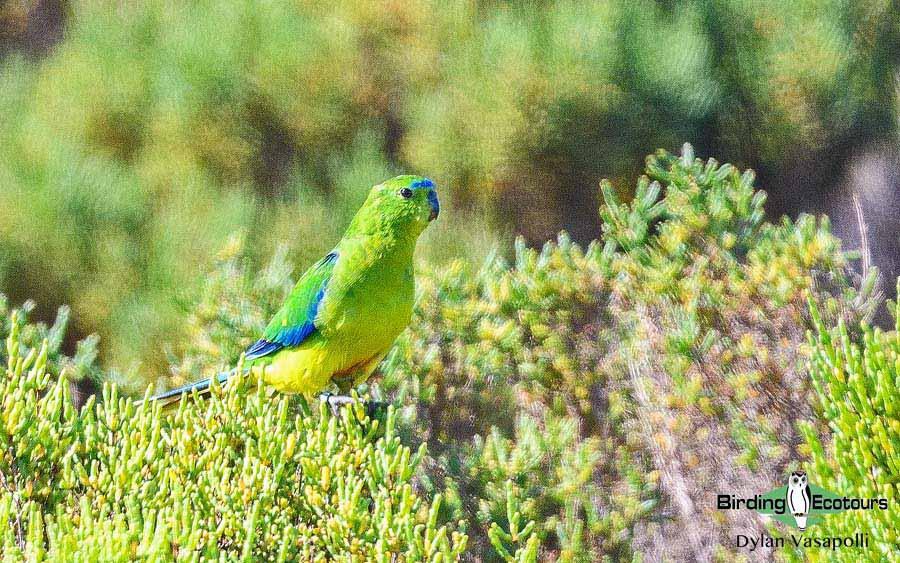
We were in for a major surprise when we found the rare and highly sought-after Orange-bellied Parrot at Werribee during our first full day of birding.
With the group party all having done the preceding Tasmania Tour, where the flight to Melaleuca for Orange-bellied Parrot (one of the major drawcards for that tour) was cancelled due to poor weather, and meant this special, rare and Critically Endangered (IUCN) bird had been missed. The other side of the coin is that some of these special birds, up to 20 of the presumed under 100 individuals left in the wild, winter in the greater Werribee area, and Simon had seen three late-staying birds recently, and knew where to look for them. As if right on cue, we arrived in the area, and almost immediately found an Orange-bellied Parrot, sitting up in the open. We could hardly believe our luck! We pulled off and spent a while watching this special bird, and as we waited and watched, two other individuals crept up from the undergrowth and showed well – bringing our total up to three of these mega birds. After a while, the parrots disappeared, and we pressed on outside the WTP, as the day drew to a close. Our final stop also produced a fine Striated Fieldwren (after lots of effort during the day), while a large mob of Eastern Grey Kangaroos were a closing highlight for us all. We settled in for our dinner following our exciting and excellent day that produced over 110 species.
Day 3, 31st October 2025. Birding the Surf Coast, and through to central Victoria
With a long day in store, we started things off heading down “The Great Ocean Road” where we called in at Point Addis. Our main target, Rufous Bristlebird, didn’t take too long to show – and ended up sticking around for almost the whole duration of our stop here, as it foraged in the open atop the low shrubs. Several others were seen briefly and heard around the area. A quick sea watch produced a close-in Shy Albatross which we all loved seeing, along with others like Australasian Gannet, Caspian Tern and an Afro-Australian Fur Seal loafing in the water. Several other species that are possible in the surrounds had been seen very well by the whole group in the preceding Tasmania Tour (like Hooded Plover, Black-faced Cormorant and the like), so we opted to focus on new birds for the group and thus didn’t try for these species.
We then headed over to the Anglesea area, where our first woodland stop was excellent. As we got out the van we quickly picked up new birds like White-eared and White-naped Honeyeaters. They were a bit fidgety at first but settled down and showed well. A short distance further along we could hardly believe our luck when two Gang-Gang Cockatoos came flying in and landed right in front of us. We got great looks at the birds, though they were not yet fully colored birds – likely young males. The good birds didn’t stop, as we picked up yet more good stuff like Eastern Yellow Robin, Sacred Kingfisher, White-browed Treecreeper, Striated Thornbill and Eastern Spinebill, amongst others. A quick walk through the area also delivered a whole host of exciting flowering orchids, ranging from Tall Sun Orchid through to Eastern White Spider Orchid and Eastern Mantis Orchid. We pushed onto the upper reaches of the heath vegetation, where our main target was the tiny (and difficult) Southern Emu-wren. We got a pair of birds at our first stakeout, but they did not show too well. We explored a few other sites and eventually found a cooperative pair that put on an excellent show for us. A Striated Fieldwren perched up nicely, though Chestnut-rumped Heathwren sadly didn’t oblige for us.
We forced in a break for lunch at a café in town, before a quick visit to a nearby wetland produced several Lewin’s Rails, including an adult with three fluffy chicks in tow. These are extremely shy rallids, and brief views are very much the order of the day with this species and, after a few scuttles by, we were content and left the birds in peace. We began the long drive up to our eventual endpoint at Inglewood, with rain falling along most of the drive. We had a quick break in Castlemaine for our hoped-for Powerful Owl, which duly obliged and gave us all excellent views. Bright Crimson Rosellas were also a major hit here. A final birding stop shortly before town gave us a few shy Australian Reed Warblers, along with a showy Little Friarbird. After an excellent dinner, we headed on an owling session through the nearby woods (though, as always, these nocturnal sessions can often produce mixed results). We started off at our Spotted Nightjar stakeout, which produced a few birds very quickly – we had good flyby views of them. Some road-cruising and walking eventually gave up a Common Brush-tailed Possum scuttling up a tree, before we heard two Australian Owlet-Nightjars calling. Try as we might we just couldn’t locate them, with the birds being close to us but always one step ahead in the denser mallee habitat. We eventually called it a night and settled in for the evening.
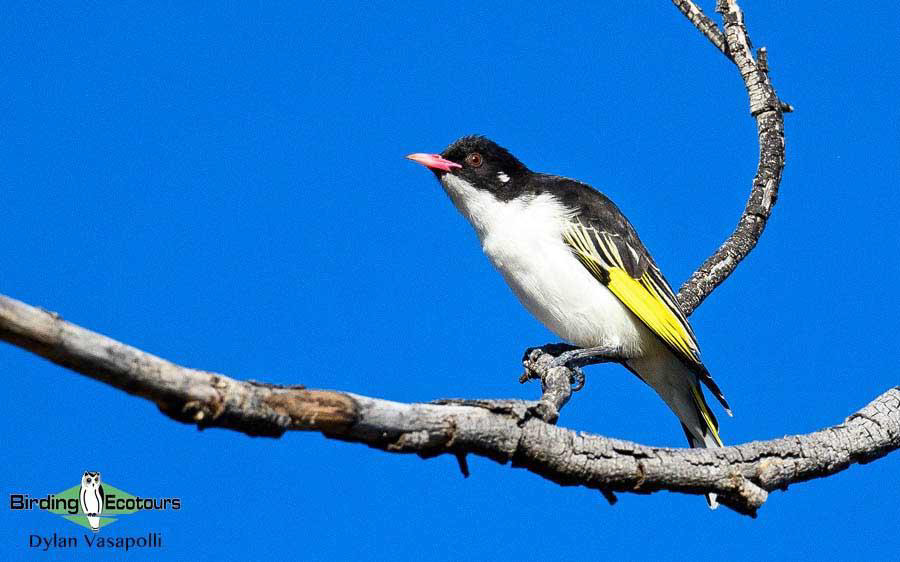
We began to make some serious inroads to the honeyeaters – this a fine Painted Honeyeater.
Day 4, 1st November 2025. Birding from Inglewood to Mildura
As is the norm on this tour, we had another fabulous (though long) day out in the field. We began things off with a visit to the nearby Inglewood Nature Conservation Reserve, where we spent a while exploring a few trails. Honeyeaters were a dime a dozen, and aside from the regular New Holland Honeyeater, we notched up the scarce White-fronted and Tawny-crowned Honeyeaters, while also enjoying views of Yellow-tufted, Brown-headed and the snazzy White-eared Honeyeaters. We did well to find a stunning Gilbert’s Whistler, while White-backed Swallows flew overhead and Inland Thornbills flitted about. Our first Rainbow Bee-eaters were a big highlight, as were our first White-browed Babblers. Shy Heathwren also eventually gave us all some views, albeit briefly, while Southern Scrub Robin showed only to some, while calling virtually constantly. Eventually, we had to call it, and moved onwards to Mount Korong, where we spent the rest of our morning birding. The wooded areas produced Brown Treecreeper without much hassle, and a stunning Painted Honeyeater in some more open habitat – which showed well to all. We carried on exploring, finding the scarce Red-backed Kingfisher in the process, while enjoying more honeyeaters – with the likes of Singing, White-plumed and the massive Spiny-cheeked Honeyeaters all numerous. A Rufous Songlark played hide and seek with us, not showing in the end, before we again had to pull ourselves out of the excellent birding.
We then settled in for a bit of a drive through Sea Lake and lunch to Lake Tyrell, where we spent a bit of time. Sadly, the sun was beaming down on us, and the birds were sparse, but we did well to eke out a number of the localized Rufous Fieldwrens, though White-winged Fairywrens remained hidden. A lovely Black-faced Woodswallow brough our stop here to a close.
We then pressed on through Ouyen to the dry Hattah-Kulkayne National Park, where we spent the rest of the afternoon and evening. Our initial foray through the areas was extremely quiet, with little moving, though we did eventually get Southern Whiteface and our first Eastern Bluebonnets. We then prepared ourselves for our main target this evening, the highly sought-after Malleefowl – and right on cue, we picked up a bird crossing the road (well spotted, Sue!) and were absolutely thrilled. We headed to another area and could barely believe it when we found another Malleefowl (incredible eyes, Sue), while further along we had yet more birds – just incredible! The likes of Regent Parrot, Australian Ringneck and loads of Little Corellas were also about. We checked into our accommodation in the evening and settled in for the night after dinner.
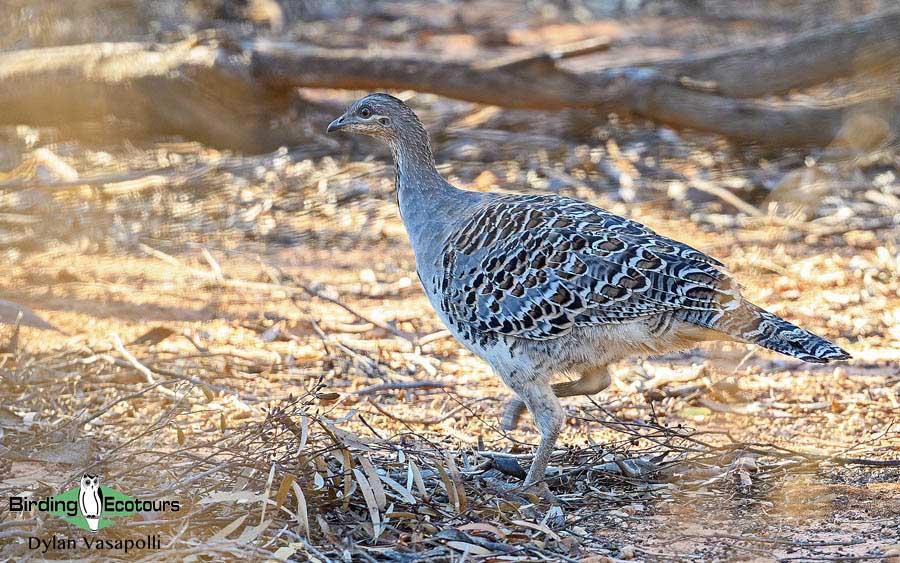
Malleefowl is easily one of the top tour targets – being rare, localized and notoriously shy. We were extremely fortunate to have several excellent sightings during this year’s tour.
Day 5, 2nd November 2025. Birding the mallee of Hattah-Kulkyne National Park
With lots of exciting birds on the cards for the day, we departed for the vast mallee woodlands of Hattah-Kulkyne National Park, where we would spend the bulk of the day. The forecast was for very high temperatures, just under 40oC, and so we tried to maximize the cool of the morning as much as possible. A fine Wedge-tailed Eagle was seen along the road, and we soon arrived and loaded out the van for our first walk through the mallee, this site covered with spinifex grass, and home to some of our most sought-after birds. The area was heaving with high numbers of both Masked and White-browed Woodswallows – both very snazzy-looking birds, but not too much else aside from the conspicuous Yellow-plumed Honeyeaters.
We visited an active Malleefowl mound, and though the birds were not at the mound, it was special to see and learn about this strange breeding process – where the temperatures in the mound are carefully regulated to incubate the eggs these birds lay. The wind started picking up as the mercury rose, and we carried on exploring the area. Chestnut Quail-thrush frustrated us by calling, out of sight, and remained as a heard only, with still little else moving about. After a while, we finally latched onto some movement, and a short while later saw a speedy Striated Grasswren running around. We had to be a bit patient but were rewarded with excellent views as the bird perched up several times, completely in the open. Smiles and high-fives went around with all of us getting excellent views of this secretive bird. The highly localized Mallee Emu-wren was still eluding us, but we finally called it and headed to a nearby café for a late breakfast.
All feeling a bit better after a break (with food, and out of the heat), we added Striped Honeyeater to our list in the garden, before heading to a different part of the park. The conditions weren’t great, with very high temps and now fairly heavy wind, but we persisted and several stops added the likes of a fiery male Red-capped Robin, along with dazzling Purple-backed and Splendid Fairywrens all bounding around. We had good looks at the yellow form of Crimson Rosella, along with several Emus in a grassy plain. After a quick picnic lunch break, we opted to take the scenic route back to our hotel for a break in the worst of the heat, via the Murray River. A few opportunistic stops along the river banks added our first Australian Zebra Finches, along with other more common species.
Feeling refreshed after our afternoon break, we headed out for some local birding in the late afternoon. We were hoping to try for some rare birds like Inland Dotterel, which were hanging around in the dry conditions, but our hearts sank as we could clearly see we were headed right towards an intense dust storm – a sight straight out of an apocalyptic movie scene. Although we thought we probably wouldn’t see too much, we gave it a shot and, surprisingly, did remarkably well with some strategic stops. A close-perched Australian Ringneck finally showed well, before calling in at our dotterel stakeout. Two Banded Lapwings were suffering in the sand and wind, before we latched onto our main target – the incredible Inland Dotterel. This nomadic and rare bird was a major surprise on the route, and we were thrilled to get it. We spent a while watching it, as the wind and dust died off a tiny bit, making it more bearable to be outside – but this was a species well worth the coating of sand we received everywhere, including inside the van. On a high, we headed off in search of other birds through the surrounding scrublands, though little perched out in the open, as expected, given the conditions. An opportunistic stop for Black-faced and White-browed Woodswallows clinging onto the fence produced a flurry of birds, with first a Nankeen Kestrel showing well, before a party of Chestnut-crowned Babblers flew in and gave us great looks. A short distance further away, we lucked onto a stunning male Crimson Chat. We tried hard for Orange Chat but couldn’t pull this out the hat – all in all, a great end to the day.
Day 6, 3rd November 2025. Birding to Deniliquin, and searching for Plains-wanderer
Another mega day was on the cards, as we set off ultimately bound for Deniliquin, where we would undertake an evening excursion to look for the decidedly rare, localized and monotypic Plains-wanderer. However, we had almost the full morning available for birding along the way there.
We started off nice and early in the mallee at Hattah-Kulkyne National Park once more, though with the storm system that came through last night, we were greeted with extremely cold and gloomy conditions – a stark contrast from the heat of yesterday. It was a tough start, as barely a bird was moving (or calling), and we were unable to dig out our missed quail thrush and emu-wren from yesterday, despite a concerted effort, but a brief Striated Grasswren was a consolation prize. We took a few backroads heading through the park, making our way down towards Ouyen and, with the first bits of sun coming out, the birds burst into life. We ground to a halt when we spotted some Mulga Parrots and hopped out and enjoyed great views. Loads of Regent Parrots were moving overhead, and we also got our first good views of Red Kangaroos here. Eastern Bluebonnets were a dime a dozen and showed well, and we also enjoyed some smaller birds like Weebill, Chestnut-rumped Thornbill and Spotted Pardalote, while calling Crested Bellbirds remained unseen. We then found ourselves in Ouyen for a late breakfast, following which we cruised around town looking for our highly wanted Pink (formerly Major Mitchell’s) Cockatoo. Time was running out, and we were beginning to make second rounds on their usual haunts, when we finally picked up a distant white bird perched in a pine tree – a Pink Cockatoo (well spotted, Donna!). The bird was on private property, but we were able to get fairly close on the outside of the property and had fabulous views of this most-wanted species.
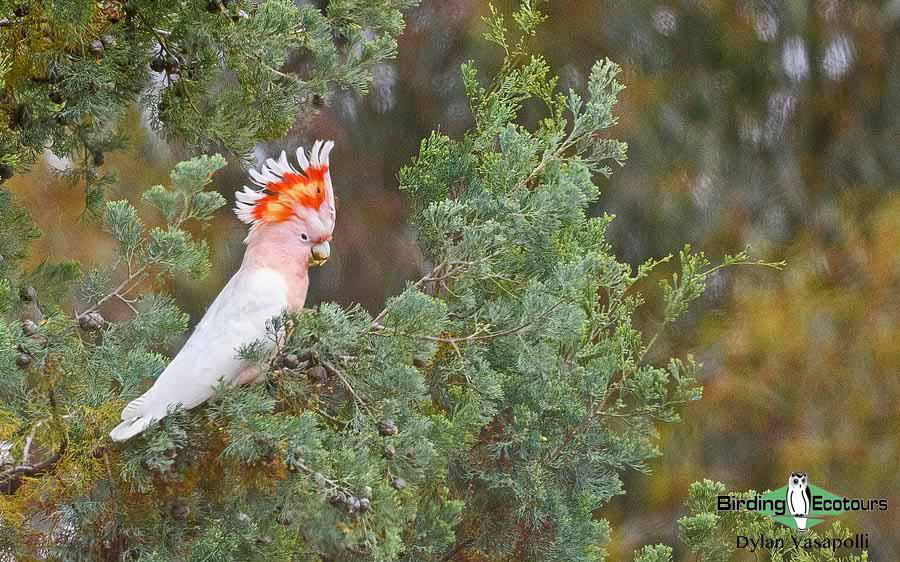
We had to put in lots of hard work for Pink Cockatoo, and we were well rewarded at the eleventh-hour, finding a group of birds feeding.
We began the journey towards Deniliquin and called in at the Goschen Busland Reserve for a short walk around. The reserve was bustling with birds, and masses of Masked and White-browed Woodswallows were present, while Singing and Spiny-cheeked Honeyeaters moved about. Several pairs of White-winged Trillers were also about, and we had to check them carefully as similar-looking Hooded Robins were also present. Strange White-winged Choughs showed well, but our hoped-for Cockatiels and Budgerigars were nowhere to be seen. We checked into our comfortable hotel in Deniliquin in the afternoon and had a short rest.
Local birding guru, Phil Maher, met us and we headed out. We called in at a few woodland patches along the way to the private Plains-wanderer (PW) farm and enjoyed some fine late afternoon birding. A curious Australian Owlet-nightjar, another highly desirable target, was first up and showed well from the entrance to its hollow. A pair of feisty White-winged Fairywren was our next target and didn’t put up much of a fight. We then tried for the tiny Black Honeyeater, which we eventually found. As we approached the PW farm, several Emus were running around, and a fine Wedge-tailed Eagle sat up, as did a Brown Falcon. Loads of kangaroos were about, and we had all three locally occurring species, with Eastern Grey, Western Grey and Red Kangaroos. We seemed to be dealing with rather unfortunate weather, as the impressive cloud system we had seen building up in the distance was now upon us. We had our picnic dinner under shelter as the rain came down, with a spectacular light show and regular lightning strikes keeping us entertained. We were slightly unsure how the rest of the evening would pan out and were almost dreading walking around the plains for our hoped-for Plains-wanderer in this weather.
When we finished dinner, and with it now properly dark, we loaded up into the vehicles and headed out. As if by some good fortune, the storm system passed and, before we knew it, we were looking up at a starry night sky. The recent rain meant the gravel tracks were extremely slippery and treacherous to drive, and it was almost better off the road. Stops were made when we found Banded Lapwing and several Brown Songlarks, then we pulled up at the designated paddock where we would be on foot looking for the Plains-wanderer. We had just gotten going when we found our first male Plains-wanderer. Fantastic! These birds sit tight up against a grass tuft, usually showing well. We then spent quite a while walking around looking for a female wanderer (larger and more brightly colored than the males). We split up into different groups to cover more ground and enjoyed another male Plains-wanderer – this bird looking like it was on a nest!
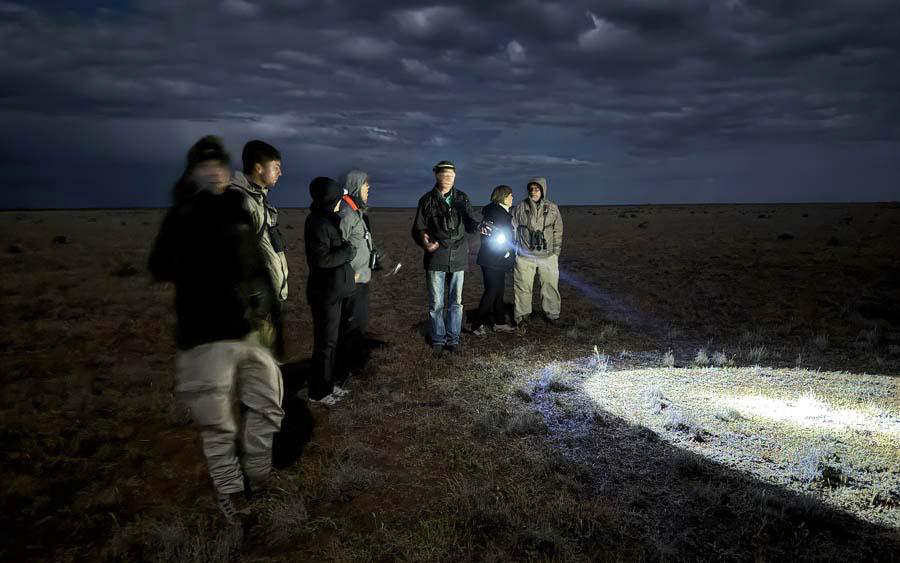
A great in-situ photo taken late at night, whilst we’re out and about on the plains looking at our hoped-for Plains-wanderer (in the torch beam). Photo © Sue Lewis (tour participant).
We then got a call for an Inland Dotterel and headed over the fields and enjoyed incredible close-up views of this scarce shorebird (slightly better than our previous sighting yesterday in the dust storm). With seemingly no female wanderers to be found, and with the clock about to hit midnight, we opted to call it a night and head back. As so often happens in true birding fashion, at the vehicles and having given up, we latched onto a female Plains-wanderer! It was a bit fidgety at first but soon settled down and gave us great views – see the photograph on the second page (under “Overview”). A Tawny Frogmouth saw us off and we got back into Deniliquin in the early hours of the morning, following a highly enjoyable evening wandering the plains.
Day 7, 4th November 2025. Birding from Deniliquin to the Warby-Ovens National Park
We had a leisurely (and late) start to the day, considering the hour we got back, and kicked off our birding with a walk through the excellent Island Sanctuary in town. The woods here are always alive with parrots and cockatoos and today was no different. We had to wade through numbers of very showy Eastern Rosellas, Rainbow Lorikeets, Red-rumped Parrots, Galahs, yellow Crimson Rosellas and Long-billed Corellas to eventually find our main target, Superb Parrot. Many other confiding birds, like Brown Treecreeper, Superb Fairywren, Noisy Miner, White-browed Scrubwren, Dusky Woodswallow and our first Noisy Friarbirds, all showed well. We visited a nearby site to look for a nesting Square-tailed Kite – and had to dodge a rain shower that passed through. It took a little while to track down the nest, eventually we found it, and one of the adults on the nest, but the view did leave us wanting more. A bird party here gave us a pair of Western Gerygones and Buff-rumped Thronbills, while several Red-browed Finches showed well, feeding on the grasses.
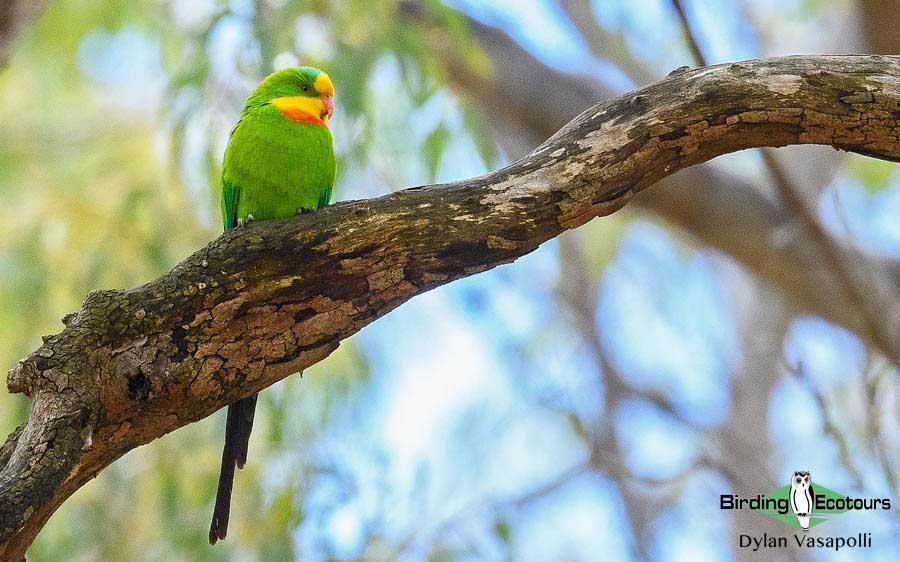
A fine parrot day started off with this localized Superb Parrot in Deniliquin.
We then began the drive back into Victoria (Deniliquin is across the state line in New South Wales), and onto the Warby-Ovens National Park, where we spent the rest of our afternoon. We found a quiet track and set about on foot. Birds were everywhere and thus we didn’t progress very far along the track. A vocal Restless Flycatcher showed well just outside the van, while numerous Dusky Woodswallows milled about. A few soft calls gave away an Eastern Shrike-tit, and we focused on this species, and enjoyed great looks at a pair of these sought-after birds! A Turquoise Parrot was next, and it took us a little while (with some patience needed) before we all got onto this spectacular bird. In the end, we were rewarded with great views as we watched, at length, a bright male feeding in the open grass. We had barely gone two steps further when we ground to a halt with a Diamond Firetail. Again, the bird was a bit fidgety but soon settled and showed wonderfully for all. A vocal Olive-backed Oriole came right in, before the weather turned and we had to beat a hasty retreat. We opted to drive some backroads, which rewarded us with a Jacky-winter, before checking into our comfortable hotel in Wangaratta, and enjoying a bit of downtime while it rained. Following dinner, the weather was holding, so we headed out for a night walk around a park in town. Several Common Brush-tailed Possums and Eastern Ring-tailed Possums were about, and we had the most magnificent encounter with a pair of Barking Owls – aptly ‘barking’ right above our heads! Further explorations gave us a few Squirrel Gliders and our first Grey-headed Flying Fox.
Day 8, 5th November 2025. Birding Chiltern-Mt Pilot to the wet forests of Healesville
We had a quick visit to a nearby park before breakfast, which was full of birds. Many of the more common and widespread species were evident, like Superb Fairywren, but we enjoyed getting our first views of Australian King Parrot and Yellow-faced Honeyeater. Just as we found our Azure Kingfisher, it was immediately chased off by a Sacred Kingfisher before everyone could get onto it. A fabulous (and musical) White-throated Gerygone was also picked up. After something to eat, we drove to Chiltern-Mt Pilot National Park, where we spent the rest of the morning birding. Roving bird parties were the order of the morning, and our first stop was bustling with the likes of Brown-headed Honeyeater, Striated Pardalote, White-throated Gerygone, Olive-backed Oriole and a fine Speckled Warbler, amongst others. Another area with some blossoming trees was absolutely heaving with Fuscous Honeyeaters. Some careful checking also gave us Yellow-tufted and Black-chinned Honeyeaters, though we had to be quick to get good looks at them before the pesky (and ultra-aggressive) Fuscous Honeyeaters drove them off.
A Little Lorikeet zooming overhead left us wanting more, but we enjoyed prolonged views of Swamp Wallaby. As we headed to another area, we sadly spotted a Squirrel Glider impaled on a roadside barbed wire fence, and we set about trying to help the strained animal. A few of us pitched in and set about trying to secure and stabilize the animal, along with contact for help (which unfortunately was a long process, phoning number after number to try and get to a helpline that would assist). Fortunately, one of the participants was a doctor and it seemed the animal wasn’t too badly impaled and likely possible for us to free it. A little bit of fiddling with the wire, and the Squirrel Glider was soon free, and bolting to the top of the nearest tree (thanks, Mike!). Birding resumed when we finally located a calling Rufous Songlark nearby, before we lucked into a Tawny Frogmouth perched low down. A large lake had several waterbirds, including multiple White-necked Herons and Yellow-billed Spoonbills. We then settled in for the long drive down south to Healesville – in the mountains just east of Melbourne.
We stopped at Yea for a short birding walk which was lively once more. Bell Miners were vocal and showed well right in the parking lot. The surrounding woods held many species we’d become familiar with, along with others we were still becoming acquainted with, like Leaden Flycatcher and Yellow-faced Honeyeater. We made our way up into the high Toolangi State Forest, where we had a bit of time to wander along some trails. It was a fairly quiet walk, with not much calling and active. A few bright Crescent Honeyeaters showed well, while Rose Robins kept high up and left us wanting a bit more. A high-pitched whistle led us to an Olive Whistler, which showed remarkably well just above our heads, and we had further views of Australian King Parrots. The leeches that ruled the pathway were not much of an issue, though Ed can perhaps beg to differ, needing to pluck off several that had found openings. We called it, with the day winding down, and checked into our comfortable rooms and enjoyed a hearty dinner in town.
As it got dark, we headed out for an evening walk, hoping for a few birds and mammals. Sadly, we went bird-less, and couldn’t turn up any of our hoped-for owls, but had a glorious evening with mammals. Loads of Southern Greater Gliders were seen, with small numbers of Common Brush-tailed and Eastern Ring-tailed Possums, and a few Krefft’s Gliders. An open section had a Common Wombat wandering around, but it was extremely shy and elusive, and only a few folks got brief looks at it. We eventually pulled ourselves away, and crawled into bed for the night.
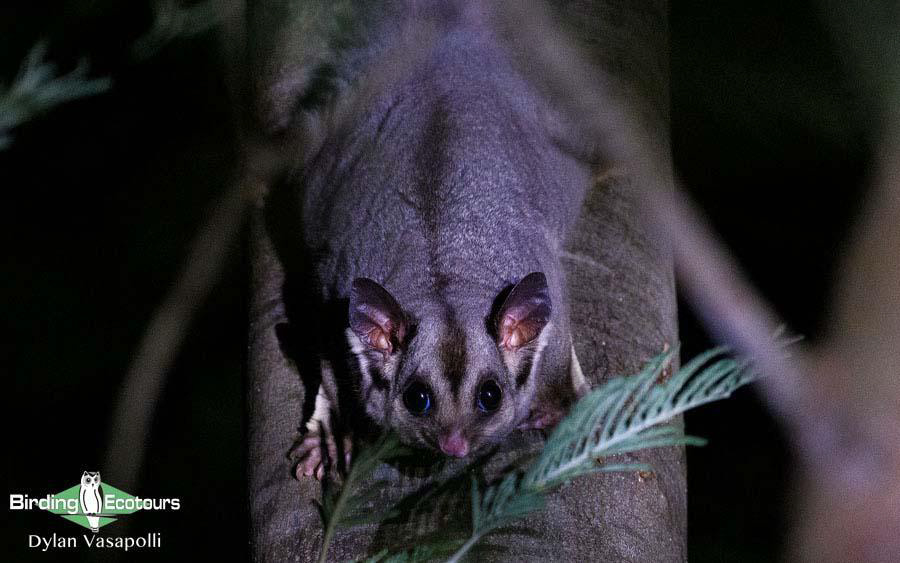
We had several great evening sessions on the tour – our night around Healesville was loaded with all manner of different mammals – including this small Krefft’s Glider.
Day 9, 6th November 2025. Birding in the Yarra Ranges, and transfer to Melbourne
This was the final day of our first segment of the east coast tour, and we ultimately wound up back in Melbourne this evening. First though, we had a few more birds to find and started off after breakfast by heading high up into the Yarra Ranges mountains. A few Flame Robins were seen on the roadside, before we hopped out the van and set off on a steep, slick trail. Despite the howling wind (and ice-cold temperatures), we easily heard a vocal Superb Lyrebird, though it kept well hidden in the thickets for now. A Pilotbird was more friendly, and we had great looks at this special and elusive species. We carried on through the mountains and eventually saw our first Superb Lyrebird crossing the road in front of the van. As we went along, we had many more encounters with lyrebirds crossing in front of us, and by the end, everyone had seen this species. A surprise pair of Bassian Thrushes were seen feeding in an open field. We then began working our way down the mountains, and wound up in Warburton, where it was much warmer.
We explored the riverine woodlands here, on a short walk which was oddly rather quiet. We had some species we were now used to, like Yellow-faced and White-naped Honeyeaters, along with dainty Eastern Yellow Robins. A Gang-gang Cockatoo flew by, which was about the most interesting bird, before we headed onwards. After lunch, our last port of call for the day was exploring the Sherbrooke Forest in the Dandenong Ranges National Park. Though the time of day was not quite ideal, we eked out a few more new species, like Large-billed Scrubwren and Australian Rufous Fantail. Bright Crimson Rosellas were all over, but our Superb Lyrebirds were keeping well hidden in the scrub and could only be heard at various points. We picked up a relaxed Swamp Wallaby as we returned to the van. We then wound our way through busy Melbourne, getting caught up in some afternoon traffic. Eventually we checked into our airport hotel for some much-needed downtime, in preparation for the Queensland leg coming up. We bid farewell and thanked Simon, our trusty local guide for this Victoria leg, and looked forward to an exciting loop through southern Australia.
Day 10, 7th November 2025. Flight to Brisbane, and birding to O’Reilly’s
Our day began with a morning flight from Melbourne up to Brisbane, in Queensland, where Steve, our new local guide, was waiting. We immediately headed off to Nudgee Beach, where we quickly got onto our hoped-for targets, Mangrove Gerygone and Mangrove Honeyeater. Many other common wetland birds were around, and we also added several new common species like Torresian Crow as we were in an entirely new part of the country. We then navigated our way through Brisbane to Mount Gravatt, stopping for a nesting Square-tailed Kite along the way. We enjoyed seeing the now large youngster on the nest, virtually ready to fledge. We scoured hard for Koala along the road as well, and then broke for lunch at the café. Our first friendly Australian Brushturkey was seen wandering around the parking lot, before we had another Koala search – sadly not finding any animals today.
We then set about getting through most of the drive to O’Reilly’s Rainforest Retreat – we were to spend two nights at this famous and excellent lodge, located in Lamington National Park. Roadworks held us up for awhile, and we also stretched our legs in Canugra while simultaneously marveling at the sight of an enormous Grey-headed Flying Fox roost – well into the tens of thousands. We eventually managed to find some Black Flying Foxes in between, and also enjoyed the antics of the widespread Rainbow Lorikeets, Noisy Friarbirds and Blue-faced Honeyeaters. We then started the windy ascent up to Lamington National Park, stopping whenever we found something of interest. Small groupings of the scarce Pale-headed Rosella were an early highlight, as were numbers of Whip-tailed Wallaby, before we bumped into a feeding frenzy of lorikeets, finding our first Scaly-breasted Lorikeets amongst the hordes of brightly colored Rainbow Lorikeets. We arrived at O’Reilly’s in the late afternoon and received an excellent welcoming party when both Crimson Rosellas and Australian King Parrots flew in and landed on our heads! As we were marveling at these birds, several male, ridiculously bright, Regent Bowerbirds stole our attention and, try as we might, we couldn’t quite ignore a Wonga Pigeon that came walking through. We enjoyed dinner and settled down for the evening, excited for the days that lay ahead as we birded through Queensland.
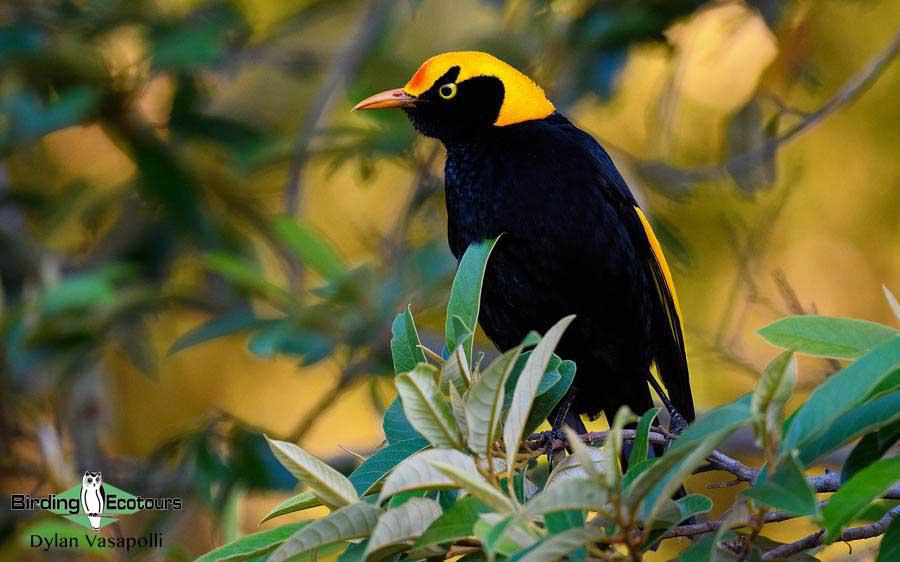
This colorful male Regent Bowerbird is one of O’Reilly’s famous residents.
Day 11, 8th November 2025. Full day of birding Lamington National Park at O’Reilly’s
We were up and at it bright and early just after sunrise, as we set about slowly exploring the trails stemming out into the forests surrounding O’Reilly’s. Things were a bit slow going at first, though some scratching in the leaflitter gave us our first Australian Logrunner – exciting! We then paused at a Satin Bowerbird’s bower, and as we were awed by it, as if right on cue, the male Satin Bowerbird appeared and gave us our first of many good looks. Things still seemed to be waking up, and finally got going, when we found a confiding Australian Rufous Fantail bouncing around. Soon we were surrounded by tame and extremely confiding birds of all sorts. We had to be careful where we walked so as not to step on the many (tiny) White-browed and Yellow-throated Scrubwrens running between our feet, while several Eastern Whipbirds nearly blew our eardrums out as we watched them call, from within touching distance. We finally got onto some Green Catbirds, which we had heard calling throughout the morning. We quickly broke for breakfast, before resuming our morning walk. Bird activity had begun to die down now, and we began to focus on some of the birds we had yet to find. First up was a calling Noisy Pitta, which we managed to locate and enjoy our first views of, as several Brown Gerygones fiddled in the canopy. We improved on our views of Australian Logrunner, before we finally heard a Paradise Riflebird call. This is a member of the famous ‘Birds-of-Paradise’ family and is, naturally, a major target. We tried for a while, without luck and, just as we were about to head off, a female Paradise Riflebird flew in. We were ecstatic and watched the female go about gleaning the tree trunks for insects with its long, decurved beak. Eventually the bird melted away and we immediately picked up on a male Rose Robin foraging low down. This species usually frequents the canopies, not always allowing for the best views. We finally managed to latch onto some fidgety Black-faced Monarchs, and also got acquainted with the other common species occurring here, like the bold Lewin’s Honeyeaters.
Before we knew it, it was time for lunch, which was interrupted by several flyby groups of Topknot Pigeons and a fine Grey Goshawk. Following a short rest over the midday period we resumed in the mid-afternoon for another bash at the trails, hoping for our one big missing target – Albert’s Lyrebird. We got off to a good start, improving our views of Noisy Pittas as we enjoyed some close views as a pair of these spectacular birds bounded around. We also enjoyed a few Russet-tailed Thrushes foraging around, then picked up on the tell-tale call of lyrebird. Notably, the male that resides close to the lodge is known for imitating a dog bark, and we all grinned when the bird began ‘barking’. It was a way off, down the slope, and so the waiting game began. Fortunately, we didn’t wait for too long before the bird moved up towards us and, soon enough, an Albert’s Lyrebird walked into view, followed by a second bird, a female. We stayed still and watched as these birds walked by and settled into foraging, using their massive legs and feet to scratch around in the leaf litter. We were blown away as the birds basically walked between us. Content, we called it a day and rested briefly before dinner. Sadly, our evening owling (and ‘mammaling’) plans after dinner had to be abandoned as rain settled in for the evening.
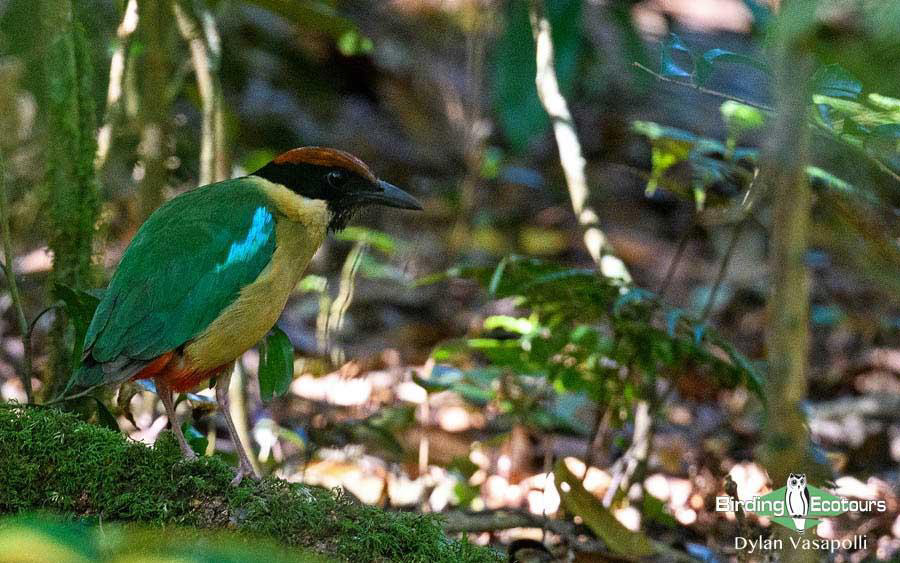
This Noisy Pitta was a big target of ours at O’Reilly’s. We successfully managed to find several birds and enjoyed good views on a few occasions.
Day 12, 9th November 2025. Birding back to Brisbane, and flight to Cairns
With all our major targets seen, the pressure was off for the morning and we met up for a short spell of birding around O’Reilly’s before breakfast. We enjoyed our last views of some of the incredible birds that abound here, like Satin and Regent Bowerbirds, while the final groupings of Crimson Rosellas and Australian King Parrots landed on us again. A male Paradise Riflebird showed briefly to some but, try as we might, we just couldn’t bring it back out. We finally found a small group of White-headed Pigeons, and more groups of Topknot Pigeons flew overhead. Many of the other common species were around as well. Following a hearty breakfast, we loaded up and hit the road bound for Brisbane again – where we would catch an early afternoon flight up to Cairns.
Timing was tight, with a few birding stops planned on the way, and we had to keep to our schedule. We were unable to find any of the rare Glossy Black Cockatoos at their preferred sites, though we ground to an immediate halt when we found a Koala near the road (well spotted, Judy!). We had thought we had missed this highly-prized mammal on the tour and were now over the moon. We had great views of the animal doing what Koalas do best – sit. Sadly, it looked as though the animal was a bit sickly, and possibly injured, and we were able to get in touch with the necessary groups who could take a look at the animal (though this took many phone calls and several hours to eventually get in touch with the right folks). We received an update several days later that the animal was indeed captured, taken to a ‘Koala hospital’, inspected and put on a treatment course – with ‘Margarita’ (as she was dubbed) responding well.
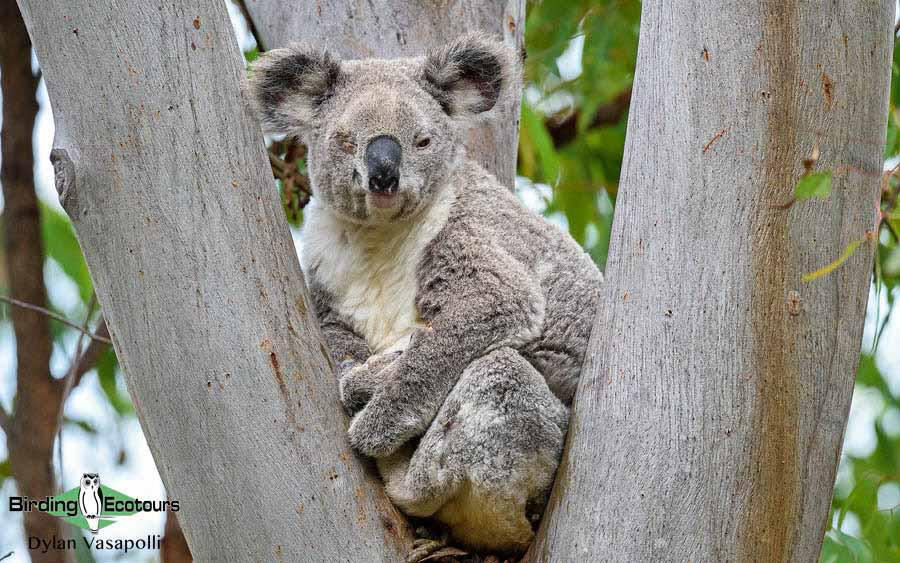
Seeing a Koala is a major highlight of any tour to Australia. It was sad to see the animal unwell, fortunately we were able to get in the necessary help and the animal has been responding well.
After our Koala excitement we pressed on towards Brisbane, where we had a quick hour available to bird the Sandy Camp wetlands. Lots of waterbirds were around but we focused on the grassy and reedy edges which quickly gave us a fine Red-backed Fairywren, alongside the many, common Superb Fairywrens. A few Spotless Crakes called from the dense cover but we were unable to lure any of them out into the open for a view. A Tawny Grassbird that sat in the open for a short while was much appreciated, as were a small group of brightly colored Chestnut-breasted Mannikins. With time running out we finally got onto our last major target here, Variegated Fairywren, with several males and females bounding around and giving us great looks. Then it was off to the airport, arriving well in time for our flight up to Cairns.
We landed in the late afternoon and headed out to the car rental depot to sort out the formalities. This proved great and we could hardly believe our eyes when the first bird we saw at the car rental depot was the scarce and highly sought-after Beach Stone-curlew (thick-knee) – perched in a field opposite the entrance. We soaked in our views of this massive bird, also finding the similar Bush Stone-curlew close by, giving us great comparative views. The excitement didn’t stop there, as a small party of Red-tailed Black Cockatoos perched on overhead lights next to the roadside, and we got acquainted with the mega common Torresian Imperial Pigeon (which are just everywhere) and others like Helmeted Friarbird and Australasian Figbird. We checked into our beachfront hotel and enjoyed a great dinner on the esplanade, excited for the next few days of northern Queensland birding.
Day 13, 10th November 2025. Cairns birding and cassowaries down to Mission Beach
A brilliant day lay ahead as we started off nice and early with a visit to the nearby Centenary Lakes in town. We were in for a treat as a Rufous Owl pair had successfully nested this season and were still hanging around. We made a bee line for the area, and soon had a glorious adult perched in full view – excellent! A Torresian Kingfisher grabbed our attention for a few moments, before we resumed watching the owl for a bit longer. We soon left the bird in peace, finding a few of the strange Orange-footed Scrubfowls rummaging around in the leaf litter. We located one of the calling Black Butcherbirds, and also enjoyed our first views of Sahul Sunbirds and our first of many Metallic Starlings. We then made our way back to the esplanade, where we started off exploring the mangroves on the northern end. We were almost overrun with birds, as a Rose-crowned Fruit Dove came flying in, landing nearby, and afforded us wonderful views. Green Orioles and Varied Trillers vied for attention as well, before we located a dainty Mangrove Robin hopping about – all with the many other more common species across the country present en-masse.
We enjoyed a fine breakfast before focusing on the shorebirds out on the mudflats – with the tide now starting to come in. The birds were a bit distant at first but, as the morning wore on, came in closer and closer and, by the end, we had enjoyed good views of the many birds present. The bulk of the numbers were dominated by large Great Knots and smaller Sharp-tailed Sandpipers, while numerous Bar-tailed Godwits rapidly foraged around. We also got used to separating Far Eastern Curlews from the smaller Eurasian Whimbrels, while careful scanning got us most of the regular species like Greater Sand Plover, Black-tailed Godwit, Terek Sandpiper, Grey-tailed Tattler, Common Greenshank, Curlew Sandpiper and Red-necked Stint. Many Australian Terns were also present, hunting over the mudflats and showed well, as did other iconic waterbirds like Royal Spoonbill and Australian Pelican.
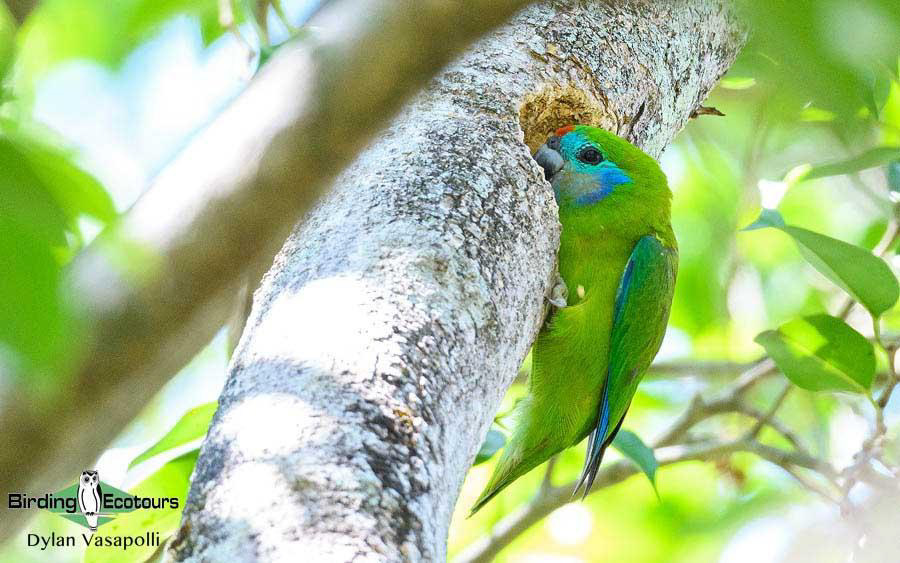
We enjoyed sublime views of the tiny Double-eyed Fig Parrots as they excavated a nesting hole on the Cairns Esplanade.
Away from the shorebirds and mudflats, we ignored the hordes of Torresian Imperial Pigeons that seemed to be nesting in every tree and found others like Varied Honeyeater, day-roosting Nankeen Night Herons and some wonderful Double-eyed Fig Parrots after a lengthy search. Our long search for these tiny fig parrots was worth it, as we spent some time watching the birds go about business, and even saw them busily excavating a nesting hole.
With most of the morning spent, we loaded up our things and began the journey to Mission Beach where we would spend the night. The main goal of venturing down to this small coastal hamlet was to look for the prehistoric-looking Southern Cassowary – this perhaps being the most reliable site to find them. A few stops on the way gave us a large flock of Pacific Golden Plovers and Plumed Whistling Ducks, while bright Crimson Finches were a surprise when they hopped out of the long grass. After lunch we began our cassowary search by first heading towards Etty Bay beach.
We couldn’t believe our luck when, at our first possible opportunity, we spotted a huge Southern Cassowary. We ground to a halt, loaded out the van, being careful on the roadside edge, and watched in awe as this massive, strange bird wandered about. Not even the setting of being present around private houses could detract from the sighting. We carried on enjoying the view as the bird started walking back towards the forest, before it turned and made a bee-line for us, clearly curious (see the tour report cover image for a close-up photo). We stood together and still, and soaked in a wonderful moment as the cassowary walked right up to us, then around us, and melted into the forest. Lots of high fives and smiles all round followed, then we headed over to the beach to enjoy our (now slightly late) picnic lunch. We found another adult Southern Cassowary, with a baby chick, en-route. With the pressure off after this most incredible encounter with this bird, we had a leisurely lunch and got our feet wet in the warm ocean. As we were wrapping up, another of the famed residents of Etty Bay appeared, as yet another, different, Southern Cassowary wandered out onto the beach. It drank from some fresh water, walked all along the beach, between all of us once more, and then headed back into the forest. We eventually made our way out of Etty Bay, pausing to admire the many Metallic Starlings nesting in the area, and also finding our first Pacific Baza, before checking into our accommodations at Mission Beach. We had a break, then headed out for a late afternoon birding session around the village. Things were a bit quiet, but we did enjoy some low-flying Australian Swiftlets, and eventually our first Yellow-spotted Honeyeaters and Fairy Gerygones, amongst others. Masses of Agile Wallabies were seen around some open fields. With the day just about done, what better way to round things off than with yet another Southern Cassowary – this time an immature bird walking about and crossing a road, before disappearing into the forest. A great day, filled with five (!) Southern Cassowaries.
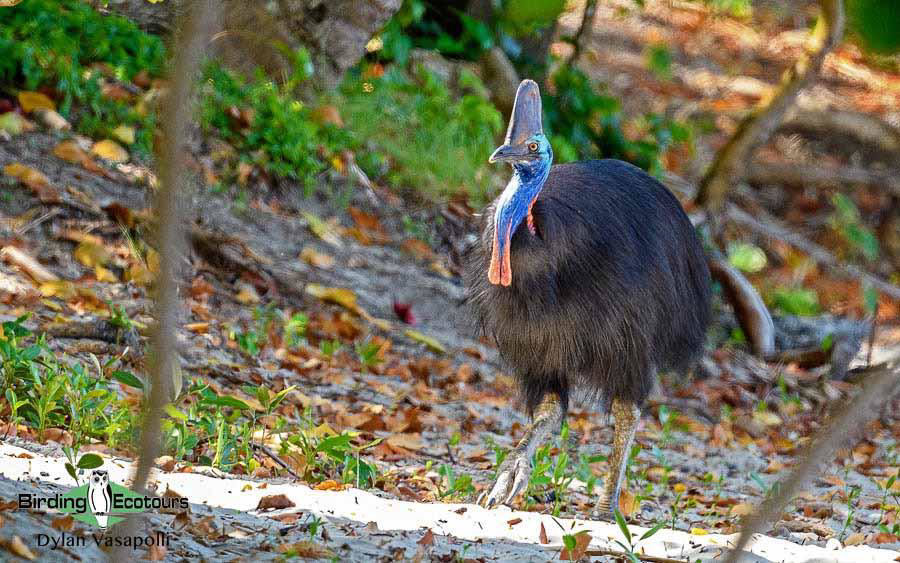
Our fantastic afternoon with Southern Cassowaries continued right through – this was our third sighting of these special birds today, as one strolled down onto the beach and wandered about.
Day 14, 11th November 2025. Full day of birding on the Atherton Tablelands
Our morning kicked off as we checked out of Mission Beach and headed up onto the Atherton Tablelands, with a few stops along the way up. Things started off in a flurry as we enjoyed both similar-looking Black-faced and Spectacled Monarchs in the same view, before a pair of snazzy White-eared Monarchs stole the show. A calling Wompoo Fruit Dove was eventually located and gave us some good views, while we were unable to find a calling Victoria’s Riflebird, despite our best efforts. Lake Eachem in the beautiful Crater Lakes National Park was a fine venue for our picnic lunch, where we were interrupted by the likes of a spectacular Barred Cuckooshrike, along with Forest Kingfisher and the many tame Australian Brushturkeys. A short walk around gave us our big target here, Tooth-billed Bowerbird – which showed right on cue, calling endlessly near its bower. We also got our first looks at several dainty Pale-yellow Robins, with calling Victoria’s Riflebirds frustrating us once again. We carried on our birding nearby and, despite the sun blazing down, enjoyed another remarkably birdy spell. A skittish Pied Monarch was first up, but didn’t hang around for too long, before we focused on a calling Yellow-breasted Boatbill, which showed well. We enjoyed our first of many Rufous Shrikethrushes and Macleay’s Honeyeaters, while it took a while to lure out a shy Grey-headed Robin – but we eventually got some good looks. By this stage we had still barely progressed at all along the track, when a stunning male Victoria’s Riflebird came in, and began to feed on some nearby berries. Elated, we soaked in great views of this amazing bird as it went about feeding, before eventually melting back into the forest. The wind unfortunately started to pick up as we headed out towards the massive Cathedral Fig Tree.
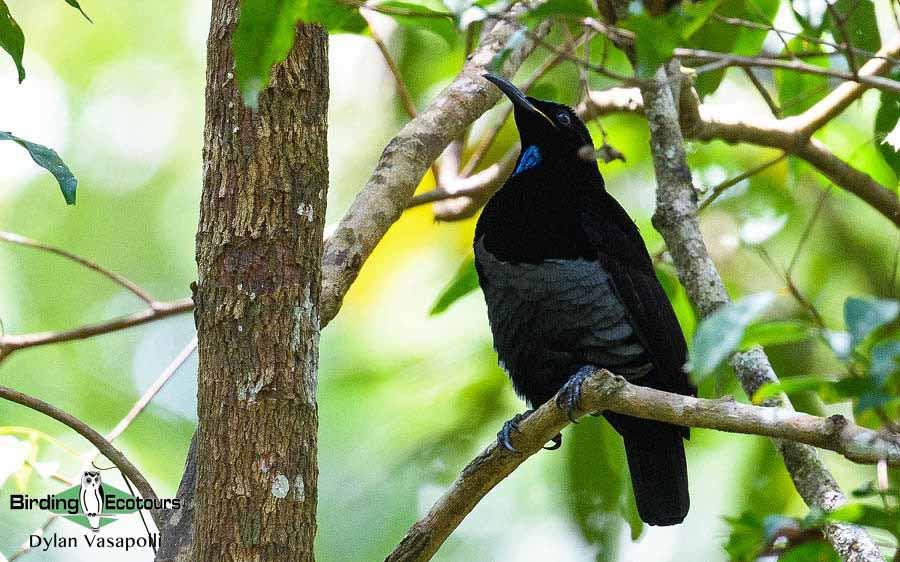
Elation as we finally got our eyes on the stunning Victoria’s Riflebird, a member of the famed Birds-of-Paradise. This was our second “BoP” on the tour, following the Paradise Riflebird we found earlier at O’Reilly’s.
It was hard birding, with little moving around, but we did get our first Spotted Catbird, and several calling Superb Fruit Doves frustrated us by calling out of sight.The day was winding down and it was time for us to head over towards Yungaburra, where we would spend the rest of the day trying for a few more special mammal targets – Lumholtz’s Tree Kangaroo and Platypus.
Rain showers kept us company during the early stages and then the weather settled down. We did well to find one of the scarce Lumholtz’s Tree Kangaroos early on and had great views, with a tiny Green Ring-tailed Possum curled up nearby, before resuming our Platypus vigil. Several birds were out and about, keeping us company, but nothing of interest. Time was running out and, on speaking with some of the other locals around, the animals had become increasingly difficult to see in recent weeks. As we began the reluctant walk back out of the area, a line of bubbles coming up near the river’s edge brought us to a halt and, after some patience, the animal revealed itself and it was indeed a Platypus – though the views were brief and left us wanting more. Sadly, that was all we were able to muster, with the animal keeping to a particularly dense area. As the light disappeared we made our way out and headed to dinner in town. An owling session after dinner was great, giving us a fine Eastern Barn Owl and a lovely Barking Owl that called away in the open. Lesser Sooty Owl was less cooperative and remained as a heard only.
Day 15, 12th November 2025. Birding the ‘Wet and Dry Tropics’ to Mareeba
A busy day was in store for us as we made an early start towards Mount Hypipamee National Park. A large gathering of Sarus Cranes was an opportunistic find along the way, before we got going into the forests. Easily our main target here was the magnificent Golden Bowerbird and, after a short walk into the depths of the forest, we found ourselves at a bower of this species, and set ourselves up for a wait. We heard the distinct calls of this species in the distance when a blur of motion caught our eye, and just like that we were face to face with a stunning male Golden Bowerbird in hot pursuit of a female. The female seemed to lose interest and the male settled down, allowing us prolonged looks. Still soaking up our views of the bowerbird, further movement caught our eyes and a massive Southern Cassowary strolled into view, accompanied by a large chick. The cassowaries walked towards us and then carried on their way deep into the forest. We couldn’t believe our luck – what an exceptionally great start to the morning!
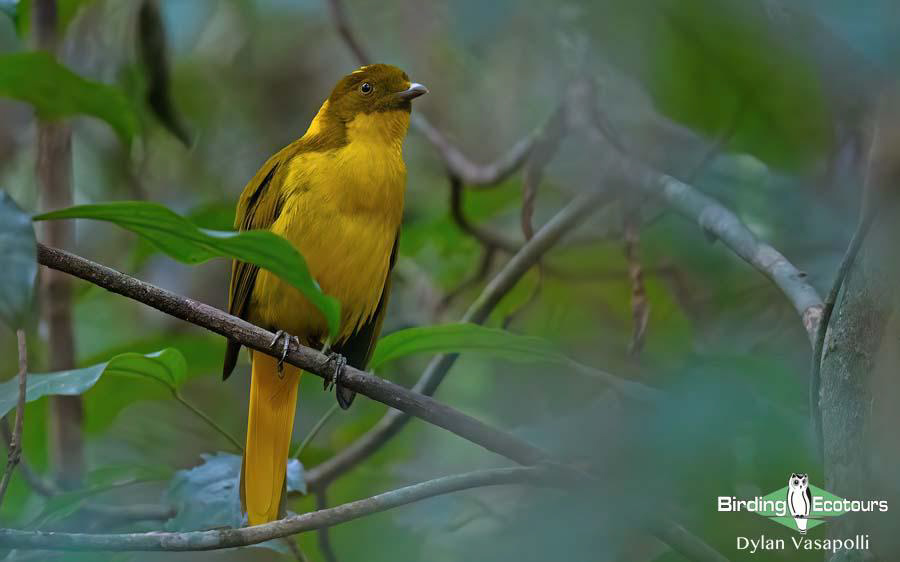
We were blown away with this excellent Golden Bowerbird sighting – not even being rudely interrupted by a Southern Cassowary could deter us from admiring this bird.
We then focused our efforts on the more open areas of forest, which were also alive with activity. We worked hard to find the scarce Bower’s Shrikethrush, and were handsomely rewarded in the end, while the highly localized duo of Atherton Scrubwren and Mountain Thornbill showed well, without much hassle. Calling Chowchillas frustrated us as they remained out of sight, while some of the many large trees were full of species like Spotted Catbird, Tooth-billed Bowerbird and a few more of the special Victoria’s Riflebird. Grey-headed Robins jumped about in the open, improving on our views from yesterday and we also got our first Bridled Honeyeaters. We pulled ourselves out of the forest and headed over for a hearty breakfast back in town.
We then called in at Hasties Swamp, which was full of birds, though mostly distant and our scopes came in handy. The grassy edges gave us our first Pheasant Coucals, along with some lively Red-backed Fairywrens. The open water was loaded with ducks, geese, herons and the like, with hordes of Magpie Geese and our first Wandering Whistling Ducks being the most interesting. We also enjoyed watching gangs of Royal Spoonbills and Australian Pelicans hunting in the shallows togethers, while we did well to pick out a Buff-banded Rail on the water’s edge, though it took a while and some careful planning for us all to get views. Tiny Comb-crested Jacanas were also running about.
We then started making our way off the Atherton Tablelands and into the ‘Dry Tropics’ – just as its name implies, this markedly different area now very dry, with Eucalyptus trees and a savannah feel dominating. A stop at the Rocky Creek War Memorial Park was historically fascinating, and also gave us some exciting birds, as new honeyeaters came down in spades, with our first few minutes out the van giving us numerous Yellow and White-throated Honeyeaters, along with bright Scarlet Myzomelas. Several Dollarbirds didn’t take too kindly to a Laughing Kookaburra, constantly mobbing it, before we eventually located a few Lemon-bellied Flyrobins perched high up. We enjoyed our picnic lunch at Granite Gorge Nature Park, where a short walk also gave us some of the habituated (and highly localized) Mareeba Rock Wallaby, a showy Sahul Brush Cuckoo and a family of Grey-crowned Babblers. We marveled at a Great Bowerbird bower, showing its builder’s fascination with green, red and white things. The bird was not home, with recent construction work taking place in the area likely having disturbed it. Little else was about, and we headed to our hotel in Mareeba for a short break.
When we resumed a bit later in the afternoon, a park in town gave us our first Cryptic Honeyeater, with our hoped-for White-browed Robin nowhere to be found. We pressed on to Pickford Road, where our main target was Australian Bustard, and we soon picked up a bird walking through a field. We spent a little while watching this large bird, albeit quite distantly, before moving on. We then focused our efforts on some of the surrounding dry woodlands and enjoyed a superb afternoon finding almost all of our targets. We stopped to view a gathering of Pale-headed Rosellas, which also produced large numbers of Rainbow and Scaly-breasted Lorikeets, before we struck gold finding a few Red-winged Parrots.
We also enjoyed finally connecting with a Great Bowerbird, after having missed it earlier at Granite Gorge, as two of the massive Channel-billed Cuckoos gave us a few flyby views overhead. We also found our first Pacific Koel, and eventually our hoped-for Blue-winged Kookaburra – which gave us great looks. The surrounds were also busy with species we were now acquainted with, like Blue-faced, Yellow and Brown Honeyeaters, Australian Figbirds, Forest Kingfishers and Dollarbirds, though we pulled out a few Brown-backed Honeyeaters feeding in between things. A small stream held a pair of shy Azure Kingfishers as a few wild Emus wandered about nearby. After a superb spell of afternoon birding, we slowly made our way back to town, finding presumably the same Australian Bustard as we saw earlier – this time much closer. We also had some final raptors with Black-shouldered Kite, Collared Sparrowhawk, White-bellied Sea Eagle and Nankeen Kestrels all about, along with the continuous stream of Black and Whistling Kites.
Day 16, 13th November 2025. Final birding to Julatten and the Daintree River
Who could believe it – our last full birding day was here, and it was another busy (and excellent) day. We started off early on with a visit to the vast Lake Mitchell. The water level was quite low, which meant the birds were distant. Vast numbers of waterbirds were again present here, and amongst all the many more regular species were our first Radjah Shelduck, and large numbers of Green Pygmy Goose. A pair of stately Black-necked Storks were hard to miss as they towered above everything else, whilst Brolgas strolled through the surrounds, and masses of Comb-crested Jacanas roamed about the edges. We then visited a nearby woodland site where some blossoming Eucalyptus were pulling in numbers of birds. We spent a while watching the comings and goings, with seven honeyeater species seen. We finally got our wanted Banded Honeyeater here, and improved on our views of Brown-backed Honeyeater. We also lucked into a fine group of beautiful Black-throated Finches feeding in the area.
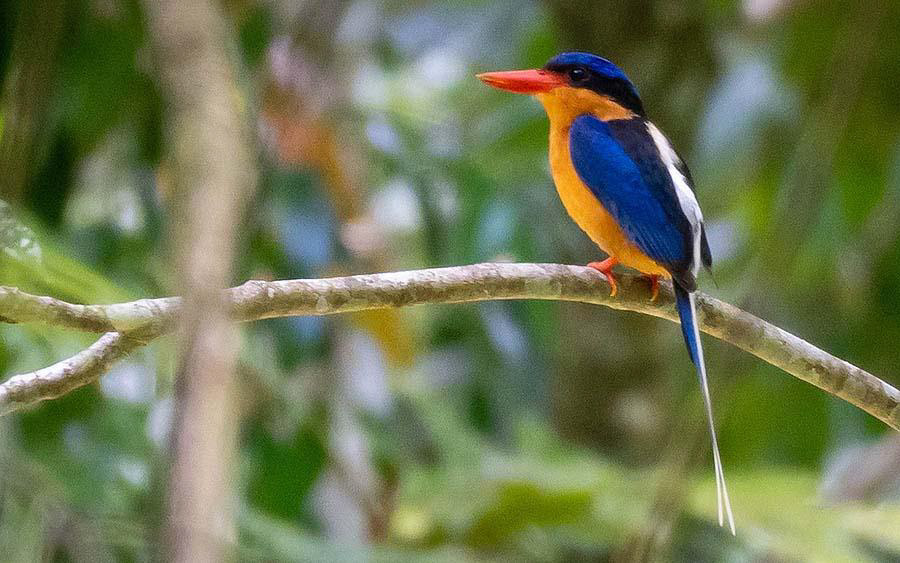
A glorious Buff-breasted Paradise Kingfisher. We had an incredible run with many seen throughout the day – we started calling them “chooks”. Photo © Ed Lewis (tour participant).
We pressed on with a short stop at Abattoir Swamp giving us our final fairywren, Lovely Fairywren. We had good views, though the birds kept their distance from us, and soon melted back into the brush. We then transited back into the ‘wet tropics’ around Julatten (as the habitat changed once again back to the cool, wet forests), and we sought out another of the big targets on the tour – Buff-breasted Paradise Kingfisher. We arrived at our first stakeout and set about trying to find one. We were distracted by loads of other high-quality birds like Wompoo and Superb Fruit Doves, Australian King Parrots and Macleay’s Honeyeaters, before we found our target perched motionless in the upper canopy. We all got onto the bird and enjoyed some great views of the paradise kingfisher in the scope, before it disappeared. We spent a little while longer trying to relocate it, which we did, and enjoyed more views of this very special bird. Content, we headed off to a wetland where we managed to find a White-browed Crake walking about, while Spotless Crakes remained as heard-only once more.
After our lunch break, we carried on birding in the rough Julatten area, where we enjoyed some more excellent birding. Much to our delight, virtually at every stop we found a Buff-breasted Paradise Kingfisher (or two) – soon we were all calling them “chooks” (as in chickens, due to how commonly we were seeing them). Once we got over these wonderful birds, we enjoyed other specials like Bridled Honeyeater, Northern Fantail, Yellow-breasted Boatbill, Grey Whistler, and a nesting Spectacled Monarch that sat tight on its nest as we bypassed it, giving us some close views. Just as we were about to call it, a fine adult Superb Fruit Dove flew in, giving us all excellent views (our views earlier in the day were of a young bird). It was then time for us to head over to the Daintree River, where we had a late afternoon boat ride in store for us.
As always, boat trips are excellent, and this one was no different as we got off to a good start with a Saltwater Crocodile loafing on the surface. We explored a nearby channel which gave us our first of several Black Bitterns, along with our hoped-for Papuan Frogmouth – a nesting bird expertly camouflaged in an overhanging tree. We enjoyed getting close looks at waterbirds like Australian Darter and Radjah Shelduck, along with those in the surrounding vegetation like Large-billed Gerygones, beautiful Shining Flycatchers and numerous Green Orioles. What a glorious end to the day. We enjoyed a great dinner in town, before returning to Cairns later in the evening.
Day 17, 14thNovember 2025. Birding and snorkeling on the Great Barrier Reef
The penultimate day of the tour was here, and this was a far more relaxed day, with limited birding on the cards as we undertook a boat cruise out to the Great Barrier Reef for a day on the water. We were up and at it early, as we walked down the Cairns Esplanade down to the docks. The tide was in, and a quick check of the high tide roost had some of the regulars like Bar-tailed Godwit, Great Knot, Red-necked Stint and Grey-tailed Tattler, amongst others. Once at the docks, we were ushered onto our boat, from where we headed out towards the Great Barrier Reef, and the area around Michaelmas Cay. This tiny islet is home to vast numbers of nesting seabirds, though of only a few species. Sooty Terns and Brown Noddies make up the bulk of the birds on the cay. Brown Booby are also present and breed in small numbers – and are easily seen as they dwarf the other smaller terns. We had to carefully sift through the Sooty Terns and Brown Noddies for the others and we managed to pick out a few of the scarce Black-naped and Bridled Terns, while Lesser Crested and Greater Crested Terns were easy to see.
After having seen all there was on the island on the bird side, we turned our attention to the ocean, where we spent the rest of the day snorkeling around the cay, and at the nearby Hastings Reef. We completely immersed ourselves in the vibrant underwater life all around us and also found a Green Sea Turtle.
Once back on land, we had a relaxed afternoon, and had a final group dinner, reminiscing about the exciting trip and all the many excellent birds (and mammals) we had come across during the last few weeks.
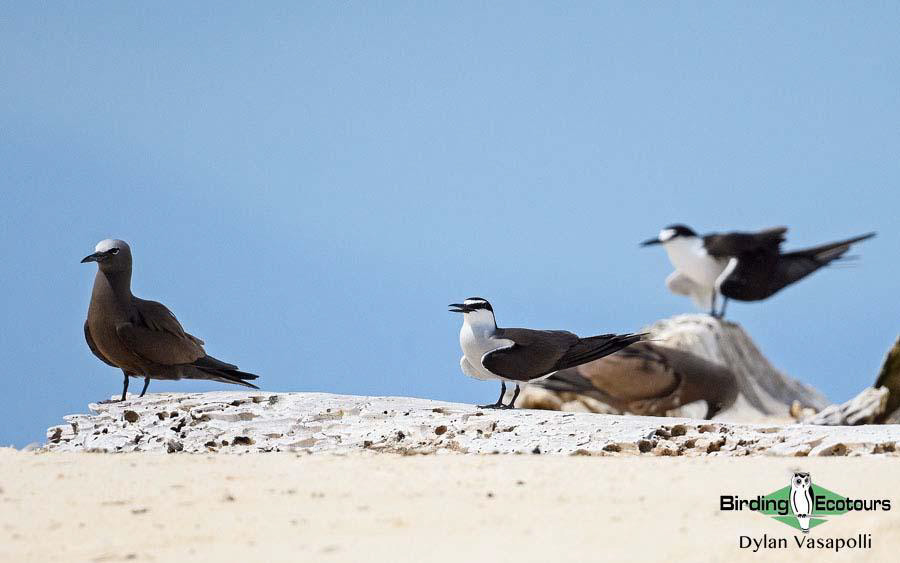
Michaelmas Cay, on the Great Barrier Reef, is home to many nesting Sooty Terns (back right) and Common Noddies (left front). One of the scarcer specials is Bridled Tern (center).
Day 18, 15th November 2025. Departure from Cairns
The tour came to a close in the morning, as everyone made their way to the airport for their respective onward departures. We also all thanked Steve for his excellent guiding on our two Queensland legs of the tour.
Without further ado, here are the tour favorites, as voted for by the group (a few other honorable mentions aren’t included):
1. Buff-breasted Paradise Kingfisher
2. Plains-wanderer
3. Koala
4. Orange-bellied Parrot
5. Golden Bowerbird
6. Southern Cassowary
7. Pink Cockatoo
8. Regent Bowerbird
9. Albert’s Lyrebird
10. Victoria’s Riflebird
I would like to thank the group for making this trip as enjoyable as it was, and keeping going through the many long and intense days (and nights) we had. This was another highly successful set departure tour, with almost all of our bird and mammal targets seen (and usually seen well), and countless memories we’ll all cherish for years to come.
Bird List – Following IOC 15.1 (March 2025)
Birds ‘heard only’ are marked with (H) after the common name, all other species were seen.
The following notation after species names is used to show conservation status following the IUCN Red List:
CR = Critically Endangered, EN = Endangered, VU = Vulnerable.
| Common name | Scientific name |
| Cassowaries, Emu (Casuariidae) | |
| Southern Cassowary | Casuarius casuarius |
| Emu | Dromaius novaehollandiae |
| Magpie Goose (Anseranatidae) | |
| Magpie Goose | Anseranas semipalmata |
| Ducks, Geese, Swans (Anatidae) | |
| Plumed Whistling Duck | Dendrocygna eytoni |
| Wandering Whistling Duck | Dendrocygna arcuate |
| Cape Barren Goose | Cereopsis novaehollandiae |
| Black Swan | Cygnus atratus |
| Radjah Shelduck | Radjah radjah |
| Australian Shelduck | Tadorna tadornoides |
| Pink-eared Duck | Malacorhynchus membranaceus |
| Maned Duck | Chenonetta jubata |
| Green Pygmy Goose | Nettapus pulchellus |
| Australasian Shoveler | Spatula rhynchotis |
| Pacific Black Duck | Anas superciliosa |
| Grey Teal | Anas gracilis |
| Chestnut Teal | Anas castanea |
| Hardhead | Aythya australis |
| Blue-billed Duck | Oxyura australis |
| Musk Duck | Biziura lobata |
| Megapodes (Megapodiidae) | |
| Australian Brushturkey | Alectura lathami |
| Malleefowl – VU | Leipoa ocellata |
| Orange-footed Scrubfowl | Megapodius reinwardt |
| Guineafowl (Numididae) | |
| Helmeted Guineafowl | Numida meleagris |
| Pheasants & Allies (Phasianidae) | |
| Brown Quail (H) | Synoicus ypsilophorus |
| Nightjars (Caprimulgidae) | |
| Spotted Nightjar | Eurostopodus argus |
| Frogmouths (Podargidae) | |
| Papuan Frogmouth | Podargus papuensis |
| Tawny Frogmouth | Podargus strigoides |
| Owlet-nightjars (Aegothelidae) | |
| Australian Owlet-nightjar | Aegotheles cristatus |
| Swifts (Apodidae) | |
| Australian Swiftlet | Aerodramus terraereginae |
| White-throated Needletail | Hirundapus caudacutus |
| Bustards (Otididae) | |
| Australian Bustard | Ardeotis australis |
| Cuckoos (Cuculidae) | |
| Pheasant Coucal | Centropus phasianinus |
| Pacific Koel | Eudynamys orientalis |
| Channel-billed Cuckoo | Scythrops novaehollandiae |
| Horsfield’s Bronze Cuckoo | Chalcites basalis |
| Shining Bronze Cuckoo (H) | Chalcites lucidus |
| Fan-tailed Cuckoo (H) | Cacomantis flabelliformis |
| Sahul Brush Cuckoo | Cacomantis variolosus |
| Pigeons, Doves (Columbidae) | |
| Rock Dove | Columba livia |
| White-headed Pigeon | Columba leucomela |
| Spotted Dove | Spilopelia chinensis |
| Brown Cuckoo-Dove | Macropygia phasianella |
| Pacific Emerald Dove | Chalcophaps longirostris |
| Common Bronzewing | Phaps chalcoptera |
| Brush Bronzewing (H) | Phaps elegans |
| Crested Pigeon | Ocyphaps lophotes |
| Wonga Pigeon | Leucosarcia melanoleuca |
| Peaceful Dove | Geopelia placida |
| Bar-shouldered Dove | Geopelia humeralis |
| Wompoo Fruit Dove | Ptilinopus magnificus |
| Superb Fruit Dove | Ptilinopus superbus |
| Rose-crowned Fruit Dove | Ptilinopus regina |
| Torresian Imperial Pigeon | Ducula spilorrhoa |
| Topknot Pigeon | Lopholaimus antarcticus |
| Rails, Crakes & Coots (Rallidae) | |
| Lewin’s Rail | Lewinia pectoralis |
| Buff-banded Rail | Hypotaenidia philippensis |
| Australian Crake | Porzana fluminea |
| Black-tailed Nativehen | Tribonyx ventralis |
| Dusky Moorhen | Gallinula tenebrosa |
| Eurasian Coot | Fulica atra |
| Australasian Swamphen | Porphyrio melanotus |
| Baillon’s Crake | Zapornia pusilla |
| Spotless Crake (H) | Zapornia tabuensis |
| White-browed Crake | Poliolimnas cinereus |
| Cranes (Gruidae) | |
| Sarus Crane – VU | Antigone antigone |
| Brolga | Antigone rubicunda |
| Grebes (Podicipedidae) | |
| Australasian Grebe | Tachybaptus novaehollandiae |
| Hoary-headed Grebe | Poliocephalus poliocephalus |
| Great Crested Grebe | Podiceps cristatus |
| Stone-curlews, Thick-knees (Burhinidae) | |
| Beach Stone-curlew | Esacus magnirostris |
| Bush Stone-curlew | Burhinus grallarius |
| Oystercatchers (Haematopodidae) | |
| Pied Oystercatcher | Haematopus longirostris |
| Stilts, Avocets (Recurvirostridae) | |
| Pied Stilt | Himantopus leucocephalus |
| Red-necked Avocet | Recurvirostra novaehollandiae |
| Plovers (Charadriidae) | |
| Pacific Golden Plover | Pluvialis fulva |
| Black-fronted Dotterel | Charadrius melanops |
| Banded Lapwing | Vanellus tricolor |
| Masked Lapwing | Vanellus miles |
| Inland Dotterel | Peltohyas australis |
| Greater Sand Plover | Anarhynchus leschenaultii |
| Jacanas (Jacanidae) | |
| Comb-crested Jacana | Irediparra gallinacea |
| Plains-wanderer (Pedionomidae) | |
| Plains-wanderer – EN | Pedionomus torquatus |
| Sandpipers, Snipes (Scolopacidae) | |
| Eurasian Whimbrel | Numenius phaeopus |
| Far Eastern Curlew – EN | Numenius madagascariensis |
| Bar-tailed Godwit | Limosa lapponica |
| Black-tailed Godwit | Limosa limosa |
| Latham’s Snipe | Gallinago hardwickii |
| Terek Sandpiper | Xenus cinereus |
| Grey-tailed Tattler | Tringa brevipes |
| Marsh Sandpiper | Tringa stagnatilis |
| Common Greenshank | Tringa nebularia |
| Ruddy Turnstone | Arenaria interpres |
| Great Knot – EN | Calidris tenuirostris |
| Sharp-tailed Sandpiper – VU | Calidris acuminata |
| Curlew Sandpiper – VU | Calidris ferruginea |
| Red-necked Stint | Calidris ruficollis |
| Gulls, Terns, Skimmers (Laridae) | |
| Brown Noddy | Anous stolidus |
| Sooty Tern | Onychoprion fuscatus |
| Bridled Tern | Onychoprion anaethetus |
| Little Tern | Sternula albifrons |
| Fairy Tern – VU | Sternula nereis |
| Australian Tern | Gelochelidon macrotarsa |
| Caspian Tern | Hydroprogne caspia |
| Whiskered Tern | Chlidonias hybrida |
| Common Tern | Sterna hirundo |
| Black-naped Tern | Sterna sumatrana |
| Lesser Crested Tern | Thalasseus bengalensis |
| Greater Crested Tern | Thalasseus bergii |
| Silver Gull | Chroicocephalus novaehollandiae |
| Pacific Gull | Larus pacificus |
| Albatrosses (Diomedeidae) | |
| Shy Albatross | Thalassarche cauta |
| Storks (Ciconiidae) | |
| Black-necked Stork | Ephippiorhynchus asiaticus |
| Gannets, Boobies (Sulidae) | |
| Australasian Gannet | Morus serrator |
| Brown Booby | Sula leucogaster |
| Anhingas, Darters (Anhingidae) | |
| Australasian Darter | Anhinga novaehollandiae |
| Cormorants, Shags (Phalacrocoracidae) | |
| Little Pied Cormorant | Microcarbo melanoleucos |
| Australian Pied Cormorant | Phalacrocorax varius |
| Little Black Cormorant | Phalacrocorax sulcirostris |
| Great Cormorant | Phalacrocorax carbo |
| Ibises, Spoonbills (Threskiornithidae) | |
| Australian White Ibis | Threskiornis molucca |
| Straw-necked Ibis | Threskiornis spinicollis |
| Glossy Ibis | Plegadis falcinellus |
| Royal Spoonbill | Platalea regia |
| Yellow-billed Spoonbill | Platalea flavipes |
| Herons, Bitterns (Ardeidae) | |
| Black Bittern | Botaurus flavicollis |
| Nankeen Night Heron | Nycticorax caledonicus |
| Pacific Reef Heron | Egretta sacra |
| Little Egret | Egretta garzetta |
| White-faced Heron | Egretta novaehollandiae |
| Little Heron | Butorides atricapilla |
| White-necked Heron | Ardea pacifica |
| Great Egret | Ardea alba |
| Plumed Egret | Ardea plumifera |
| Eastern Cattle Egret | Ardea coromanda |
| Pelicans (Pelecanidae) | |
| Australian Pelican | Pelecanus conspicillatus |
| Kites, Hawks, Eagles (Accipitridae) | |
| Black-shouldered Kite | Elanus axillaris |
| Pacific Baza | Aviceda subcristata |
| Square-tailed Kite | Lophoictinia isura |
| Little Eagle | Hieraaetus morphnoides |
| Wedge-tailed Eagle | Aquila audax |
| Collared Sparrowhawk | Tachyspiza cirrocephala |
| Grey Goshawk | Tachyspiza novaehollandiae |
| Spotted Harrier | Circus assimilis |
| Swamp Harrier | Circus approximans |
| Black Kite | Milvus migrans |
| Brahminy Kite | Haliastur indus |
| Whistling Kite | Haliastur sphenurus |
| White-bellied Sea Eagle | Icthyophaga leucogaster |
| Barn Owls (Tytonidae) | |
| Lesser Sooty Owl (H) | Tyto multipunctata |
| Eastern Barn Owl | Tyto javanica |
| Owls (Strigidae) | |
| Rufous Owl | Ninox rufa |
| Powerful Owl | Ninox strenua |
| Barking Owl | Ninox connivens |
| Rollers (Coraciidae) | |
| Oriental Dollarbird | Eurystomus orientalis |
| Kingfishers (Alcedinidae) | |
| Buff-breasted Paradise Kingfisher | Tanysiptera sylvia |
| Laughing Kookaburra | Dacelo novaeguineae |
| Blue-winged Kookaburra | Dacelo leachii |
| Forest Kingfisher | Todiramphus macleayii |
| Torresian Kingfisher | Todiramphus sordidus |
| Sacred Kingfisher | Todiramphus sanctus |
| Red-backed Kingfisher | Todiramphus pyrrhopygius |
| Azure Kingfisher | Ceyx azureus |
| Bee-eaters (Meropidae) | |
| Rainbow Bee-eater | Merops ornatus |
| Caracaras, Falcons (Falconidae) | |
| Nankeen Kestrel | Falco cenchroides |
| Brown Falcon | Falco berigora |
| Cockatoos (Cacatuidae) | |
| Yellow-tailed Black Cockatoo | Zanda funerea |
| Red-tailed Black Cockatoo | Calyptorhynchus banksii |
| Gang-gang Cockatoo – VU | Callocephalon fimbriatum |
| Galah | Eolophus roseicapilla |
| Pink Cockatoo | Cacatua leadbeateri |
| Little Corella | Cacatua sanguinea |
| Long-billed Corella | Cacatua tenuirostris |
| Sulphur-crested Cockatoo | Cacatua galerita |
| Old World Parrots (Psittaculidae) | |
| Superb Parrot | Polytelis swainsonii |
| Regent Parrot | Polytelis anthopeplus |
| Australian King Parrot | Alisterus scapularis |
| Red-winged Parrot | Aprosmictus erythropterus |
| Red-rumped Parrot | Psephotus haematonotus |
| Eastern Bluebonnet | Northiella haematogaster |
| Mulga Parrot | Psephotellus varius |
| Crimson Rosella | Platycercus elegans |
| Pale-headed Rosella | Platycercus adscitus |
| Eastern Rosella | Platycercus eximius |
| Australian Ringneck | Barnardius zonarius |
| Orange-bellied Parrot – CR | Neophema chrysogaster |
| Turquoise Parrot | Neophema pulchella |
| Little Lorikeet | Parvipsitta pusilla |
| Musk Lorikeet | Glossopsitta concinna |
| Scaly-breasted Lorikeet | Trichoglossus chlorolepidotus |
| Rainbow Lorikeet | Trichoglossus moluccanus |
| Double-eyed Fig Parrot | Cyclopsitta diophthalma |
| Pittas (Pittidae) | |
| Noisy Pitta | Pitta versicolor |
| Lyrebirds (Menuridae) | |
| Albert’s Lyrebird | Menura alberti |
| Superb Lyrebird | Menura novaehollandiae |
| Bowerbirds (Ptilonorhynchidae) | |
| Green Catbird | Ailuroedus crassirostris |
| Spotted Catbird | Ailuroedus maculosus |
| Tooth-billed Bowerbird | Scenopoeetes dentirostris |
| Golden Bowerbird | Prionodura newtoniana |
| Regent Bowerbird | Sericulus chrysocephalus |
| Satin Bowerbird | Ptilonorhynchus violaceus |
| Great Bowerbird | Chlamydera nuchalis |
| Australasian Treecreepers (Climacteridae) | |
| White-throated Treecreeper | Cormobates leucophaea |
| Brown Treecreeper | Climacteris picumnus |
| Australasian Wrens (Maluridae) | |
| Lovely Fairywren | Malurus amabilis |
| Purple-backed Fairywren | Malurus assimilis |
| Variegated Fairywren | Malurus lamberti |
| Superb Fairywren | Malurus cyaneus |
| Splendid Fairywren | Malurus splendens |
| Red-backed Fairywren | Malurus melanocephalus |
| White-winged Fairywren | Malurus leucopterus |
| Southern Emu-wren | Stipiturus malachurus |
| Striated Grasswren | Amytornis striatus |
| Honeyeaters (Meliphagidae) | |
| Eastern Spinebill | Acanthorhynchus tenuirostris |
| Crimson Chat | Epthianura tricolor |
| White-fronted Chat | Epthianura albifrons |
| Brown-backed Honeyeater | Ramsayornis modestus |
| Tawny-crowned Honeyeater | Gliciphila melanops |
| Black Honeyeater | Sugomel nigrum |
| Dusky Myzomela | Myzomela obscura |
| Scarlet Myzomela | Myzomela sanguinolenta |
| Little Friarbird | Philemon citreogularis |
| Helmeted Friarbird | Philemon buceroides |
| Noisy Friarbird | Philemon corniculatus |
| Macleay’s Honeyeater | Xanthotis macleayanus |
| Striped Honeyeater | Plectorhyncha lanceolata |
| Painted Honeyeater | Grantiella picta |
| Crescent Honeyeater | Phylidonyris pyrrhopterus |
| New Holland Honeyeater | Phylidonyris novaehollandiae |
| Brown Honeyeater | Lichmera indistincta |
| Banded Honeyeater | Cissomela pectoralis |
| White-eared Honeyeater | Nesoptilotis leucotis |
| Blue-faced Honeyeater | Entomyzon cyanotis |
| Black-chinned Honeyeater | Melithreptus gularis |
| Brown-headed Honeyeater | Melithreptus brevirostris |
| White-throated Honeyeater | Melithreptus albogularis |
| White-naped Honeyeater | Melithreptus lunatus |
| Yellow Honeyeater | Stomiopera flava |
| Yellow-spotted Honeyeater | Meliphaga notata |
| Lewin’s Honeyeater | Meliphaga lewinii |
| White-fronted Honeyeater | Purnella albifrons |
| Yellow-tufted Honeyeater | Lichenostomus melanops |
| Cryptic Honeyeater | Microptilotis imitatrix |
| Varied Honeyeater | Gavicalis versicolor |
| Mangrove Honeyeater | Gavicalis fasciogularis |
| Singing Honeyeater | Gavicalis virescens |
| Fuscous Honeyeater | Ptilotula fusca |
| Yellow-plumed Honeyeater | Ptilotula ornata |
| White-plumed Honeyeater | Ptilotula penicillata |
| Yellow-faced Honeyeater | Caligavis chrysops |
| Red Wattlebird | Anthochaera carunculata |
| Spiny-cheeked Honeyeater | Acanthagenys rufogularis |
| Bridled Honeyeater | Bolemoreus frenatus |
| Bell Miner | Manorina melanophrys |
| Noisy Miner | Manorina melanocephala |
| Yellow-throated Miner | Manorina flavigula |
| Bristlebirds (Dasyornithidae) | |
| Rufous Bristlebird | Dasyornis broadbenti |
| Pardalotes (Pardalotidae) | |
| Spotted Pardalote | Pardalotus punctatus |
| Red-browed Pardalote (H) | Pardalotus rubricatus |
| Striated Pardalote | Pardalotus striatus |
| Australasian Warblers (Acanthizidae) | |
| Pilotbird – VU | Pycnoptilus floccosus |
| Speckled Warbler | Pyrrholaemus sagittatus |
| Shy Heathwren | Hylacola cauta |
| Striated Fieldwren | Calamanthus fuliginosus |
| Rufous Fieldwren | Calamanthus campestris |
| Weebill | Smicrornis brevirostris |
| Yellow-throated Scrubwren | Neosericornis citreogularis |
| White-browed Scrubwren | Sericornis frontalis |
| Atherton Scrubwren – VU | Sericornis keri |
| Large-billed Scrubwren | Sericornis magnirostra |
| Southern Whiteface – VU | Aphelocephala leucopsis |
| Yellow-rumped Thornbill | Acanthiza chrysorrhoa |
| Yellow Thornbill | Acanthiza nana |
| Striated Thornbill | Acanthiza lineata |
| Inland Thornbill | Acanthiza apicalis |
| Mountain Thornbill – VU | Acanthiza katherina |
| Brown Thornbill | Acanthiza pusilla |
| Chestnut-rumped Thornbill | Acanthiza uropygialis |
| Buff-rumped Thornbill | Acanthiza reguloides |
| Brown Gerygone | Gerygone mouki |
| Fairy Gerygone | Gerygone palpebrosa |
| Large-billed Gerygone | Gerygone magnirostris |
| White-throated Gerygone | Gerygone olivacea |
| Mangrove Gerygone | Gerygone levigaster |
| Western Gerygone | Gerygone fusca |
| Australasian Babblers (Pomatostomidae) | |
| Grey-crowned Babbler | Pomatostomus temporalis |
| White-browed Babbler | Pomatostomus superciliosus |
| Chestnut-crowned Babbler | Pomatostomus ruficeps |
| Logrunners (Orthonychidae) | |
| Australian Logrunner | Orthonyx temminckii |
| Chowchilla (H) | Orthonyx spaldingii |
| Whipbirds (Psophodidae) | |
| Eastern Whipbird | Psophodes olivaceus |
| Jewel-babblers, Quail-thrushes (Cinclosomatidae) | |
| Chestnut Quail-thrush (H) | Cinclosoma castanotum |
| Boatbills (Machaerirhynchidae) | |
| Yellow-breasted Boatbill | Machaerirhynchus flaviventer |
| Woodswallows, Butcherbirds & Allies (Artamidae) | |
| White-breasted Woodswallow | Artamus leucorynchus |
| Masked Woodswallow | Artamus personatus |
| White-browed Woodswallow | Artamus superciliosus |
| Black-faced Woodswallow | Artamus cinereus |
| Dusky Woodswallow | Artamus cyanopterus |
| Black Butcherbird | Melloria quoyi |
| Australian Magpie | Gymnorhina tibicen |
| Grey Butcherbird | Cracticus torquatus |
| Pied Butcherbird | Cracticus nigrogularis |
| Pied Currawong | Strepera graculina |
| Grey Currawong | Strepera versicolor |
| Cuckooshrikes (Campephagidae) | |
| Barred Cuckooshrike | Coracina lineata |
| Black-faced Cuckooshrike | Coracina novaehollandiae |
| White-bellied Cuckooshrike | Coracina papuensis |
| White-winged Triller | Lalage tricolor |
| Varied Triller | Lalage leucomela |
| Australo-Papuan Bellbirds (Oreoicidae) | |
| Crested Bellbird (H) | Oreoica gutturalis |
| Shriketits (Falcunculidae) | |
| Eastern Shriketit | Falcunculus frontatus |
| Whistlers & Allies (Pachycephalidae) | |
| Olive Whistler | Pachycephala olivacea |
| Gilbert’s Whistler | Pachycephala inornata |
| Grey Whistler | Pachycephala simplex |
| Australian Golden Whistler | Pachycephala pectoralis |
| Western Whistler | Pachycephala fuliginosa |
| Rufous Whistler | Pachycephala rufiventris |
| Bower’s Shrikethrush – VU | Colluricincla boweri |
| Rufous Shrikethrush | Colluricincla rufogaster |
| Grey Shrikethrush | Colluricincla harmonica |
| Figbirds, Old World Orioles, Piopios (Oriolidae) | |
| Australasian Figbird | Sphecotheres vieilloti |
| Olive-backed Oriole | Oriolus sagittatus |
| Green Oriole | Oriolus flavocinctus |
| Drongos (Dicruridae) | |
| Spangled Drongo | Dicrurus bracteatus |
| Fantails (Rhipiduridae) | |
| Willie Wagtail | Rhipidura leucophrys |
| Northern Fantail | Rhipidura rufiventris |
| Grey Fantail | Rhipidura albiscapa |
| Australian Rufous Fantail | Rhipidura rufifrons |
| Monarchs (Monarchidae) | |
| Spectacled Monarch | Symposiachrus trivirgatus |
| Black-faced Monarch | Monarcha melanopsis |
| White-eared Monarch | Carterornis leucotis |
| Pied Monarch | Arses kaupi |
| Magpie-lark | Grallina cyanoleuca |
| Leaden Flycatcher | Myiagra rubecula |
| Shining Flycatcher | Myiagra alecto |
| Restless Flycatcher | Myiagra inquieta |
| Crows, Jays (Corvidae) | |
| Torresian Crow | Corvus orru |
| Little Raven | Corvus mellori |
| Australian Raven | Corvus coronoides |
| Australian Mudnesters (Corcoracidae) | |
| White-winged Chough | Corcorax melanorhamphos |
| Birds-of-paradise (Paradisaeidae) | |
| Paradise Riflebird | Ptiloris paradiseus |
| Victoria’s Riflebird – VU | Ptiloris victoriae |
| Australasian Robins (Petroicidae) | |
| Red-capped Robin | Petroica goodenovii |
| Rose Robin | Petroica rosea |
| Flame Robin | Petroica phoenicea |
| Lemon-bellied Flyrobin | Microeca flavigaster |
| Jacky Winter | Microeca fascinans |
| Southern Scrub Robin | Drymodes brunneopygia |
| Grey-headed Robin | Heteromyias cinereifrons |
| Hooded Robin | Melanodryas cucullata |
| Mangrove Robin | Peneothello pulverulenta |
| Eastern Yellow Robin | Eopsaltria australis |
| Pale-yellow Robin | Tregellasia capito |
| Larks (Alaudidae) | |
| Eurasian Skylark | Alauda arvensis |
| Swallows, Martins (Hirundinidae) | |
| White-backed Swallow | Cheramoeca leucosterna |
| Welcome Swallow | Hirundo neoxena |
| Fairy Martin | Petrochelidon ariel |
| Tree Martin | Petrochelidon nigricans |
| Reed Warblers & Allies (Acrocephalidae) | |
| Australian Reed Warbler | Acrocephalus australis |
| Grassbirds & Allies (Locustellidae) | |
| Little Grassbird | Poodytes gramineus |
| Brown Songlark | Cincloramphus cruralis |
| Rufous Songlark | Cincloramphus mathewsi |
| Tawny Grassbird | Cincloramphus timoriensis |
| Cisticolas & Allies (Cisticolidae) | |
| Golden-headed Cisticola | Cisticola exilis |
| White-eyes (Zosteropidae) | |
| Silvereye | Zosterops lateralis |
| Starlings, Rhabdornises (Sturnidae) | |
| Metallic Starling | Aplonis metallica |
| Common Myna | Acridotheres tristis |
| Common Starling | Sturnus vulgaris |
| Thrushes (Turdidae) | |
| Russet-tailed Thrush | Zoothera heinei |
| Bassian Thrush | Zoothera lunulata |
| Common Blackbird | Turdus merula |
| Flowerpeckers (Dicaeidae) | |
| Mistletoebird | Dicaeum hirundinaceum |
| Sunbirds (Nectariniidae) | |
| Sahul Sunbird | Cinnyris frenatus |
| Old World Sparrows, Snowfinches (Passeridae) | |
| House Sparrow | Passer domesticus |
| Waxbills, Munias & Allies (Estrildidae) | |
| Diamond Firetail – VU | Stagonopleura guttata |
| Crimson Finch | Neochmia phaeton |
| Red-browed Finch | Neochmia temporalis |
| Double-barred Finch | Stizoptera bichenovii |
| Australian Zebra Finch | Taeniopygia castanotis |
| Black-throated Finch | Poephila cincta |
| Scaly-breasted Munia | Lonchura punctulata |
| Chestnut-breasted Mannikin | Lonchura castaneothorax |
| Wagtails, Pipits (Motacillidae) | |
| Australian Pipit | Anthus australis |
| Finches, Euphonias (Fringillidae) | |
| European Goldfinch | Carduelis carduelis |
| Species seen: | 373 |
| Species heard: | 10 |
| Total recorded: | 383 |
Mammal List – Following Mammalwatching.com (Jan. 2024)
Mammals ‘heard only’ are marked with (H) after the common name, all other species were seen.
The following notation after species names is used to show conservation status following the IUCN Red List:
EN = Endangered, VU = Vulnerable.
| Common name | Scientific name |
| Platypuses (Ornithorhynchidae) | |
| Platypus | Ornithorhynchus anatinus |
| Dasyures (Dasyuridae) | |
| Fat-tailed Dunnart | Sminthopsis crassicaudata |
| Kangaroos, Wallabies and Allies (Macropodidae) | |
| Lumholtz’s Tree Kangaroo | Dendrolagus lumholtzi |
| Mareeba Rock Wallaby | Petrogale mareeba |
| Red-legged Pademelon | Thylogale stigmatica |
| Red-necked Pademelon | Thylogale thetis |
| Western Gray Kangaroo | Macropus fuliginosus |
| Eastern Gray Kangaroo | Macropus giganteus |
| Agile Wallaby | Notamacropus agilis |
| Whip-tailed Wallaby | Notamacropus parryi |
| Red-necked Wallaby | Notamacropus rufogriseus |
| Red Kangaroo | Osphranter rufus |
| Swamp Wallaby | Wallabia bicolor |
| Gliders, Trioks, and Allies (Petauridae) | |
| Yellow-bellied Glider (H) | Petaurus australis |
| Squirrel Glider | Petaurus norfolcensis |
| Krefft’s Glider | Petaurus notatus |
| Ringtail Possums (Pseudocheiridae) | |
| Southern Greater Glider – VU | Petauroides volans |
| Eastern Ring-tailed Possum | Pseudocheirus peregrinus |
| Green Ring-tailed Possum | Pseudochirops archeri |
| Cuscuses and Brushtail Possums (Phalangeridae) | |
| Common Brush-tailed Possum | Trichosurus vulpecula |
| Koalas (Phascolarctidae) | |
| Koala – VU | Phascolarctos cinereus |
| Wombats (Vombatidae) | |
| Common Wombat | Vombatus ursinus |
| Hares and Rabbits (Leporidae) | |
| European Rabbit – EN | Oryctolagus cuniculus |
| Old World Mice and Rats (Muridae) | |
| White-tailed Giant Rat | Uromys caudimaculatus |
| Australian Swamp Rat | Rattus lutreola |
| Old World Fruit Bats (Pteropodidae) | |
| Black Flying Fox | Pteropus alecto |
| Spectacled Flying Fox – EN | Pteropus conspicillatus |
| Gray-headed Flying Fox – VU | Pteropus poliocephalus |
| Eared Seals (Otariidae) | |
| Afro-Australian Fur Seal | Arctocephalus pusillus |
| Canids (Canidae) | |
| Red Fox | Vulpes vulpes |
| Deer (Cervidae) | |
| Sambar – VU | Rusa unicolor |
| Species seen: | 30 |
| Species heard: | 1 |
| Total recorded: | 31 |
Reptile List
The following notation after species names is used to show conservation status following the IUCN Red List:
EN = Endangered.
| Common name | Scientific name |
| Crocodiles (Crocodylidae) | |
| Saltwater Crocodile | Crocodylus porosus |
| Colubrid Snakes (Colubridae) | |
| Common Tree Snake | Dendrelaphis punctulatus |
| Elapid Snakes (Elapidae) | |
| Little Whip Snake | Suta flagellum |
| Tiger Snake | Notechis scutatus |
| Dragons (Agamidae) | |
| Nobbi | Diporiphora nobbi |
| Southern Mallee Dragon | Ctenophorus tuniluki |
| Australian Water Dragon | Intellagama lesueurii |
| Skinks (Scincidae) | |
| Shingleback Lizard | Tiliqua rugosa |
| Land Mullet | Bellatorias major |
| Monitor Lizards (Varanidae) | |
| Lace Monitor | Varanus varius |
| Austro-American Side-necked Turtles (Chelidae) | |
| Common Snake-necked Turtle | Chelodina longicollis |
| Macquarie Turtle | Emydura macquarii |
| Eastern Saw-shelled Turtle | Myuchelys latisternum |
| Typical Sea Turtles (Cheloniidae) | |
| Green Sea Turtle – EN | Chelonia mydas |
| Species seen: | 14 |
This is a sample trip report. Please email us ([email protected]) for more trip reports from this destination.