26 JANUARY – 04 FEBRUARY 2026
By Andy Walker
Overview
This short and birdy central Thailand birdwatching tour started in Bangkok on the 26th of January 2026. We first visited Kaeng Krachan National Park, followed by birding at the shorebird capital of the country – Pak Thale and Laem Pak Bia on the coast, and then finally visited Khao Yai National Park, before the tour concluded back in Bangkok on the 4th of January 2026. Most of the group then continued on to our Northern Thailand tour, which followed this tour.
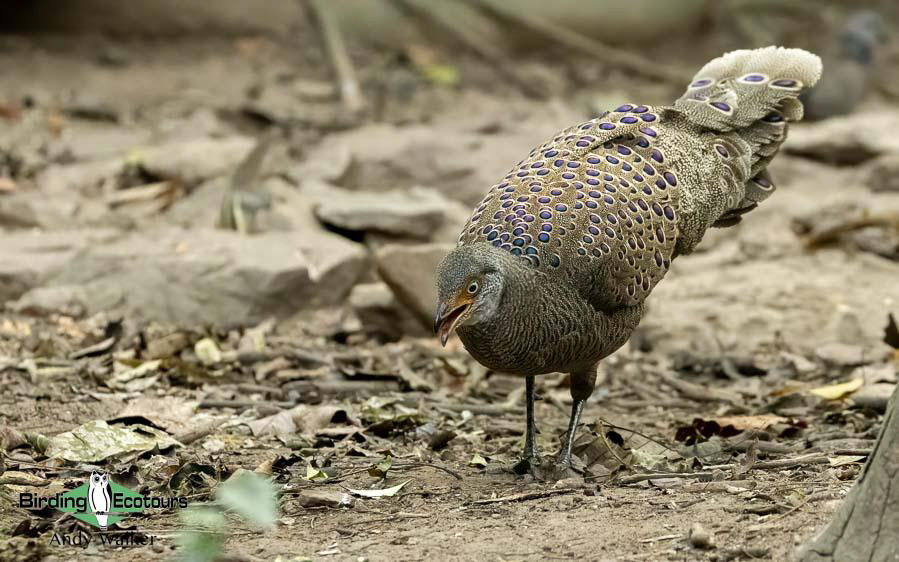
We enjoyed great views of a pair of gorgeous Grey Peacock-Pheasants during the tour, at close range. This is the male of this usually secretive species.
We recorded 286 bird species on this Thailand birdwatching tour (ten were heard only) and you can also see our eBird trip report, here, with a few more photos than are shown in this report. Bird and animal lists for this Thai birding tour also follow the detailed daily account below.
Some of the non-passerine highlights from our time in Kaeng Krachan and Khao Yai included Grey Peacock-Pheasant, Silver Pheasant, Kalij Pheasant, Bar-backed Partridge, Grey Nightjar, White-fronted Scops Owl, Spot-bellied Eagle-Owl, Tickell’s Brown Hornbill, Wreathed Hornbill, Great Hornbill, Indochinese Roller, Red-bearded Bee-eater, Blue-bearded Bee-eater, Asian Green Bee-eater, Great Slaty Woodpecker, Buff-rumped Woodpecker, Heart-spotted Woodpecker, Vernal Hanging Parrot, and Red-breasted Parakeet.
From our time birding at the coast, the following were non-passerine highlights: Chinese Egret, Grey-headed Lapwing, White-faced Plover, Malaysian Plover, Nordmann’s Greenshank, Asian Dowitcher, Spoon-billed Sandpiper, Terek Sandpiper, Broad-billed Sandpiper, Great Knot, Long-toed Stint, Little Stint, Painted Stork, Spot-billed Pelican, Black-headed Ibis, Slender-billed Gull, Collared Kingfisher, and Black-capped Kingfisher.
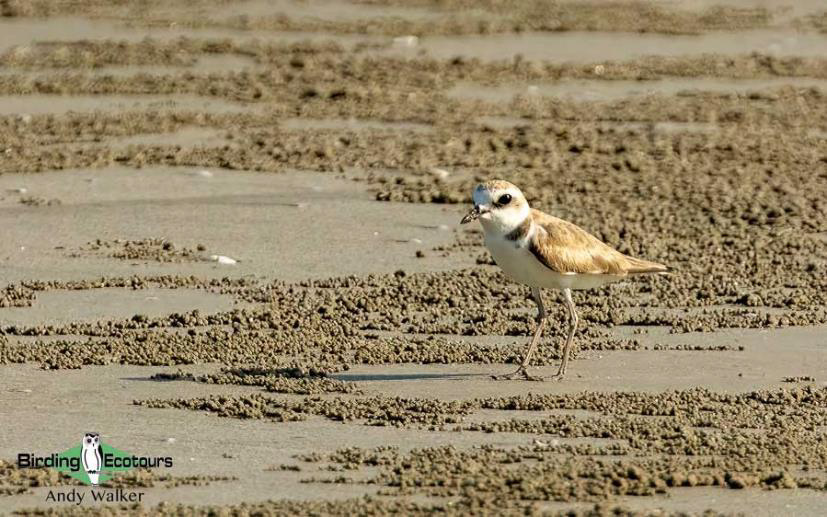
White-faced Plover gave some very good views during the tour and coastal Thailand remains one of the best places to see this bird (recently elevated to full species status) in the world.
Passerine highlights were many across the tour and involved sightings of Blue Pitta, Golden-bellied Gerygone, Silver Oriole, Asian Fairy-bluebird, Common Green Magpie, Sultan Tit, White-crested Laughingthrush, Greater Necklaced Laughingthrush, Lesser Necklaced Laughingthrush, Black-throated Laughingthrush, Collared Babbler, Eyebrowed Thrush, Grey-sided Thrush, Orange-headed Thrush, Hainan Blue Flycatcher, Chinese Blue Flycatcher, Siberian Blue Robin, Cambodian Flowerpecker, Crimson Sunbird, Asian Golden Weaver, White-rumped Munia, and Pin-tailed Parrotfinch.
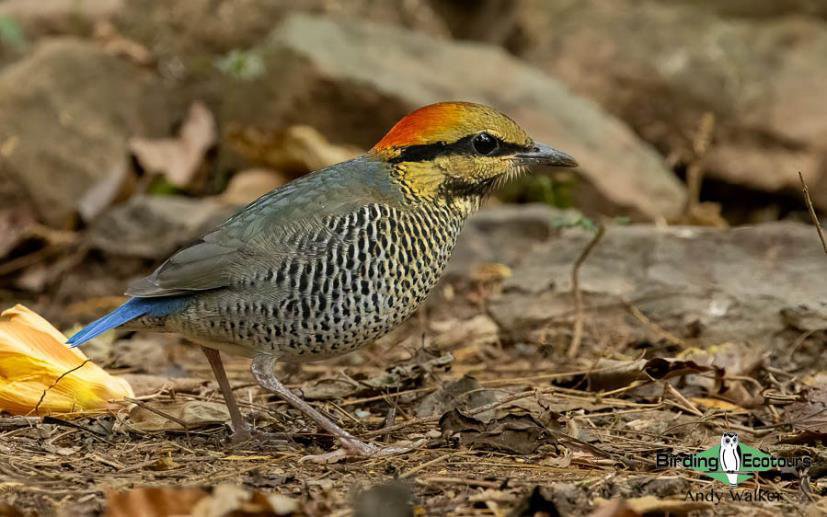
Pittas are rightly very popular birds and we had some excellent views of this female Blue Pitta during our Thai bird tour, when we spent some time birding in the forest from a bird blind.
We also found some really interesting mammals and reptiles on this Thailand birding tour, with the absolute highlight being a close view of a Sun Bear as it foraged at close range, totally unconcerned by our presence, while in Kaeng Krachan National Park. Some of the other interesting species seen included Asian Elephant (a bathing bull elephant in a lake and also a great sight), very noisy Lar Gibbons and Pileated Gibbons, attractive Robinson’s Banded Langurs and Dusky Langurs, the spectacular Malayan Porcupine, and huge Giant Black Squirrel. Special mentions should also go to the several giant Common Water Monitors we found and a rather cute Asian Forest Tortoise that put in a rather slow performance, allowing all to get a good view! See some pictures of the non-bird highlights at the end of the report.
Detailed Report
Day 1, 26thJanuary 2026. Arrival in Bangkok
The group arrived in our comfortable hotel near the main airport in Bangkok and we met for a welcome dinner and discussed the plans for the next few days of Thai birding.
Day 2, 27thJanuary 2026. Travel to Kaeng Krachan National Park area via Nong Pla Lai
We left our hotel in Bangkok behind and after a couple of hours we arrived at Nong Pla Lai rice paddies, where we had our first birding session of the tour. We made occasional short walks in areas that looked busy with birds, seeing a lot of species with little effort, which is always nice! Yellow Bittern, Javan Pond Heron, and Bronze-winged Jacanas were some of the first birds seen at our first stop, and quickly after we were also watching Red Collared Dove, Zebra Dove, Indochinese Roller, Black Drongo, Brown Shrike, Oriental Magpie-Robin, Siamese Pied Myna, Amur Stonechat, and Eastern Yellow Wagtail. After a quick change of location we were watching gorgeous and colorful Blue-tailed Bee-eaters and White-throated Kingfishers at close range, followed by more subtly plumaged Zitting Cisticola, Plain Prinia, Richard’s Pipit, and Paddyfield Pipit.
Whiskered Terns were busily foraging across the area, with several Wood Sandpipers and Black-necked Stilts also seen. Asian Openbills were one of the most numerous species, though there were many egrets and herons present too, including Little Egret, Medium Egret, Great Egret, Eastern Cattle Egret, and Purple Heron. A female Pied Harrier showed at close range while Brahminy Kite and Black Kite were frequently seen, with Edible-nest Swiftlet, Asian Palm Swift, and Barn Swallows also flying about. A lone Black-headed Ibis was also seen, along with Greater Coucal, Great Myna, and Ashy Woodswallow. So, plenty to get our heads around!
After our rice paddies introductory birding session we continued on to the wonderful Baan Maka Nature Lodge near Kaeng Krachan, our base for three nights, and had a welcome Thai lunch.
In the afternoon we visited a nearby bird blind (bird hide). It was an excellent birding experience (as well as being great for other wildlife too!). We had very good, close-up, and prolonged views of some great and secretive birds, including a pair of Grey Peacock-Pheasants (see photo on trip report cover), a flock of six Kalij Pheasants (made up of four males and two females), and pairs of both Bar-backed Partridges and Green-legged Partridges, and one gloriously glowing male Red Junglefowl (and a less snazzy female!). Although the game birds were stealing the show, the laughingthrushes and woodpeckers were putting up some stiff competition. Both Greater Yellownape and Common Flameback showed at eye-level for prolonged and repeated periods, and a raucous group of White-crested Laughingthrushes, Greater Necklaced Laughingthrushes, and Lesser Necklaced Laughingthrushes all grabbed our attention time and time again – stunners!
Lots of other birds visited the blind, with other interesting birds including Black-naped Monarch, Greater Racket-tailed Drongo, Racket-tailed Treepie, Chinese Blue Flycatcher, Indochinese Blue Flycatcher, Taiga Flycatcher, Siberian Blue Robin, White-rumped Shama, Abbott’s Babbler, Black-crested Bulbul, Blue-winged Leafbird, and lots more! It was also hard to ignore the mammals at the blind, with Grey-bellied Squirrel, Indochinese Ground Squirrel, Himalayan Striped Squirrel, Northern Treeshrew, Lesser Indo-Malayan Chevrotain, and Yellow-throated Marten all seen (with the latter flushing everything at the blind!). However, one of the most interesting non-avian highlights was the Asian Forest Tortoise that came in to drink at the pond! It had certainly been a great day to start the birding on the tour and, as we returned to our accommodation, we picked up Large-tailed Nightjar, Asian Barred Owlet, and Indian Stone-curlew. A Collared Scops Owl was also calling overnight and heard by some.
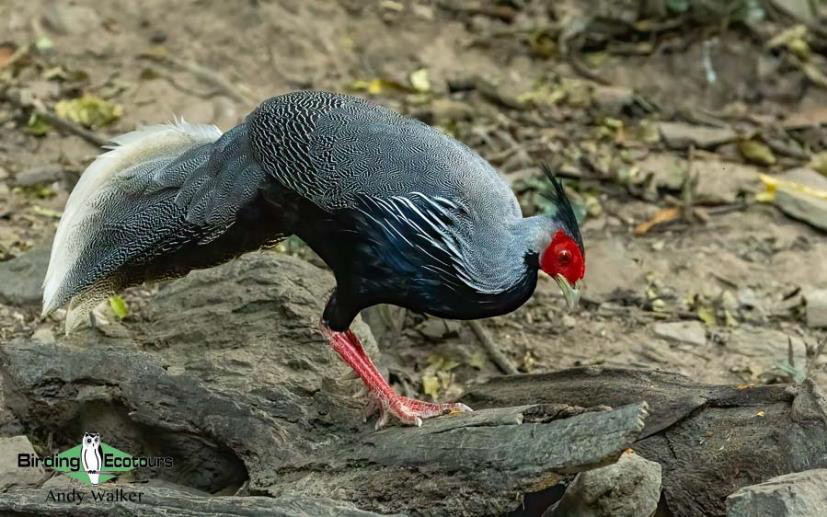
Kalij Pheasant was one of several early tour highlights from our first visit to a bird blind.
Day 3, 28thJanuary 2026. Birding Kaeng Krachan National Park
An enjoyable morning was spent birding in the lower elevations of the vast Kaeng Krachan National Park and just outside it, where a quick stop in a busy bird blind provided us with excellent sightings of a gorgeous Blue Pitta, as well as several other species, including Grey-headed (Black-naped) Woodpecker and other species seen the previous day – though a flock of Black-crested Bulbuls coming down and drinking from the pond was an impressive sight. Radde’s Warbler was perhaps not as fancy as some of the other birds, but it did show quite well, if briefly.
Driving along the park entrance road we had a brief sighting of a regal Great Hornbill, which unfortunately flew off just as the scope was getting focused, though lots of Oriental Pied Hornbills were seen. Bronzed Drongo and Ashy Drongo both gave more prolonged views and we also saw Asian Barred Owlet, Indochinese Roller, Ruby-cheeked Sunbird, Ornate Sunbird, Blue-winged Leafbird, and a nesting pair of Blue-eared Barbets (with Coppersmith Barbets also perched nearby). Both Dusky Warbler and Thick-billed Warbler were seen in some scrubby roadside vegetation too. Driving further into the park we spotted a stunning Orange-breasted Trogon which gave fantastic views, and then one of the best birds of the morning (and an early tour highlight), the rare White-fronted Scops Owl, which was found roosting below eye-level right next to the road! During the morning birding session in the park we saw plenty of mammals and a few reptiles too, with highlights including Lar (White-handed) Gibbons, Dusky Langurs, Stump-tailed Macaques, Black Giant Squirrel, Common Water Monitor, and Oriental Whipsnake. After this great birding session in the national park we returned to the lodge for lunch (which included a Blue Whistling Thrush sighting for some) and a siesta.
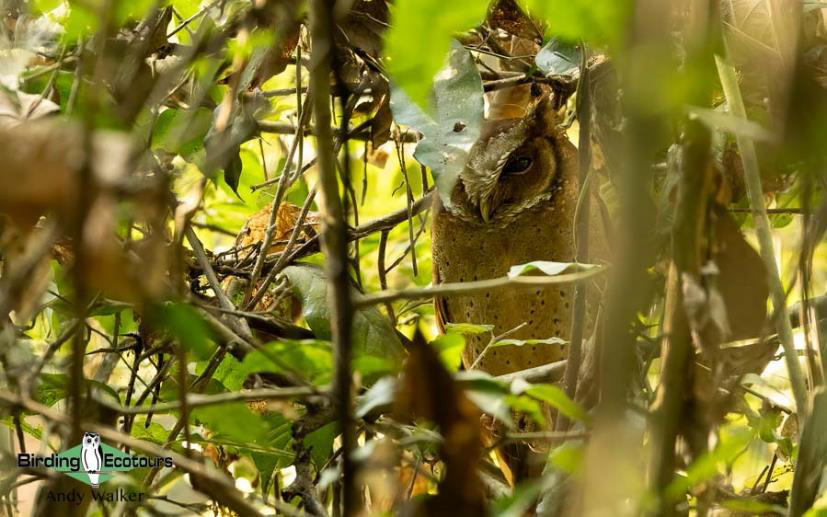
White-fronted Scops Owl is a very tough species to connect with anywhere in its small global range, so we were thrilled to find this bird roosting deep in the forest.
In the afternoon we took a walk around our lodge grounds where we found a few new birds and improved looks at others we’d already seen, such as Crested Treeswift, Indochinese Roller, Asian Green Bee-eater, Chestnut-headed Bee-eater, Lineated Barbet, Hair-crested Drongo, Black-naped Oriole, Two-barred Warbler, Black-browed Reed Warbler, Chestnut-tailed Starling, Sooty-headed Bulbul, Black-headed Bulbul, Thick-billed Flowerpecker, and Ornate Sunbird. We drove around to another area nearby where we had a great look at an Eyebrowed Thrush feeding out in the open, and we also gained further sightings of both Greater and Lesser Necklaced Laughingthrushes. We had a couple of sightings of hunting Peregrine Falcons, their presence given away by alarm-calling Edible-nest Swiftlets.
Day 4, 29th January 2026. Birding Kaeng Krachan National Park
We spent the day birding at Kaeng Krachan National Park, where we focused on the higher elevations. It was slow going at times, but overall we found some good birds and wildlife. As we gained in elevation, some flowering bamboo and some fruiting trees provided us with a range of species, including Great Hornbill, Blue-eared Barbet, Blue-throated Barbet, Swinhoe’s Minivet, Ashy Minivet, Dark-sided Flycatcher, and numerous bulbuls.
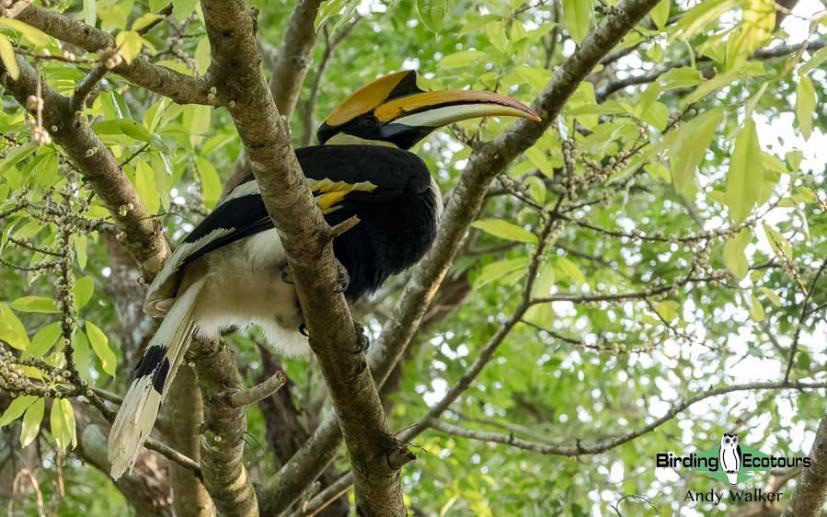
Great Hornbill is a spectacular species and we had amazing views of feeding birds paying zero attention to us as we watched in admiration.
Exploring the upper campsite area and surrounds, we found Mountain Imperial Pigeon, Rufous-bellied Eagle, Crested Honey Buzzard, Asian Palm Swift, Grey-rumped Treeswift, Orange-breasted Trogon, Vernal Hanging Parrots (perched finally!), Yellow-bellied Warbler, Alstrom’s Warbler, Collared Babbler, White-browed Scimitar Babbler, White-browed Shrike-Babbler, Striated Yuhina, Flavescent Bulbul, Olive Bulbul, Eyebrowed Thrush, Grey-sided Thrush, Black-throated Sunbird, Grey-breasted Spiderhunter, and Streaked Spiderhunter. A little bit of excitement involved the sighting of a roosting Grey Nightjar, giving an unusually good and perched daytime view.
One other highlight of the day involved the sighting of a global rarity, a Silver Oriole, however the views were brief for most and not everyone was lucky to see this very tough bird – a species that breeds in remote China and overwinters sporadically in South East Asia, with very few records from anywhere. Aside from the birds, the clear mammalian highlight was the unexpected sighting we had of a Sun Bear. We were staking out the Eyebrowed Thrushes hoping to see the Grey-sided Thrush, when out walked the Sun Bear. It walked right past us and proceeded to eat out of the food waste from the nearby café (we also saw the target thrush!).
Driving down and off the mountain we stopped several times, finding Large Hawk-Cuckoo, Oriental Dollarbird, Red-bearded Bee-eater, Tickell’s Brown Hornbill, and a Crested Goshawk chasing a Bay Woodpecker, of all things. Unfortunately, a couple of calling Red-throated Barbets were not interested in coming closer to allow for views so, after a long day in the field, we returned to our lodge for dinner and some rest, where both Collared Scops Owl and Asian Barred Owlet were vocalizing.
Day 5, 30thJanuary 2026. Morning birding Kaeng Krachan area, afternoon transfer to and birding at Laem Pak Bia
We had a final birding session in Kaeng Krachan National Park, where we concentrated our efforts on some of the lowland areas. It was an enjoyable morning with some great sightings of many species, including hunting Shikra and displaying Crested Goshawk, along with flyover and foraging Tickell’s Brown Hornbills, Wreathed Hornbills, Great Hornbills, and Oriental Pied Hornbills. A range of woodpeckers were seen, from the huge Great Slaty Woodpecker, to the smaller Heart-spotted Woodpecker and Buff-rumped Woodpecker, to the tiny White-browed Piculet. Several attractive Thick-billed Green Pigeons were perched up and gave good views, as did stunning Black-naped Oriole. Lots of smaller birds were seen too, such as Sultan Tit, Great Iora, Thick-billed Warbler, Hainan Blue Flycatcher, Common Hill Myna, Golden-crested Myna, White-bellied Erpornis, Blue-winged Leafbird, Ruby-cheeked Sunbird, Crimson Sunbird, Ornate Sunbird, White-rumped Munia, and Pin-tailed Parrotfinch.
After our birding session we returned to Baan Maka Nature Lodge for the final time for some lunch. Afterwards, we took the short drive to our base for the next two nights on the coast, ready to explore a totally different set of habitats and birds.
We arrived at Mr. Daeng’s house in Laem Pak Bia and quicky set off on a boat trip through the mangroves, where we saw several gorgeous Black-capped Kingfishers and Collared Kingfishers, and a Pacific Reef Heron. We arrived at the famed Laem Pak Bia sandspit, where we quickly found our two main targets, White-faced Plover and Malaysian Plover. Both species showed very nicely. Here we also enjoyed sightings of Kentish Plover, Tibetan Sand Plover, Terek Sandpiper, Sanderling, Caspian Tern, and Brown-headed Gull. During our return boat trip we had great views of a foraging Chinese Egret, which rounded off a successful boat trip.
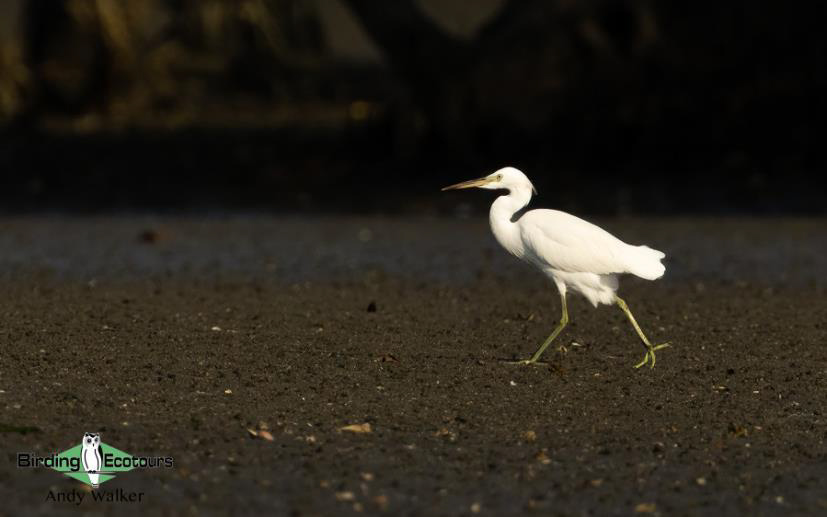
Chinese Egret is one of the tougher egrets to connect with from a global birding point of view.
In the late afternoon, we took the opportunity for some final birding in the last 30 minutes of light and found another of our main shorebird targets – Asian Dowitcher. We managed some good views of eleven birds that were intermingled in a large flock of Black-tailed Godwits. Other species found in our quick exploration included Painted Stork, Grey-headed Lapwing (looking amazing in the last rays of the day), Ruff, Spotted Redshank, Marsh Sandpiper, and more. It was just a little taster for what we hoped would be a bird-filled day of shorebirds tomorrow.
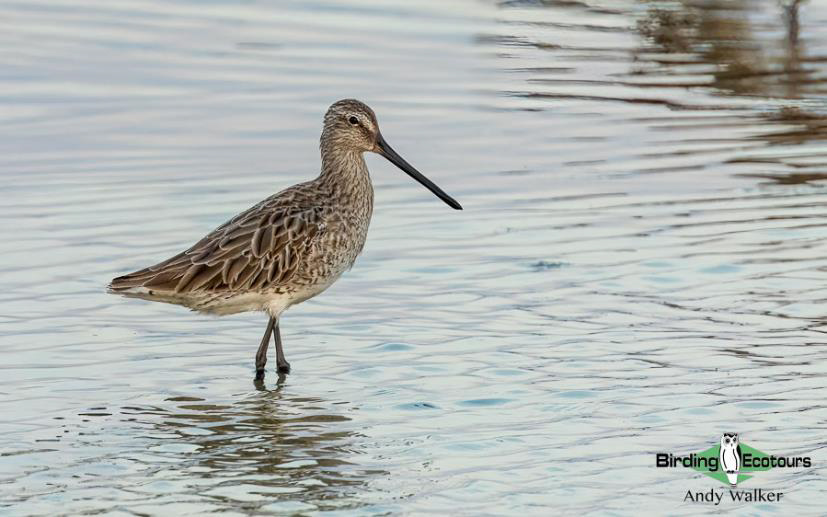
Great close views of Asian Dowitchers were a highlight from our afternoon birding.
Day 6, 31stJanuary 2026. Birding Pak Thale and Laem Pak Bia
We had a morning birding session in the Pak Thale and Laem Pak Bia saltpans. The highlight was observing a group of three Nordmann’s Greenshanks in a flock of several thousand Great Knots.
We started our day in the north of the area, where we found a large flock of Black-tailed Godwits and Great Knots and picked out a few new birds in low numbers here, such as Grey Plovers, Pacific Golden Plovers, Curlew Sandpipers, and Red Knots. We then moved locations and found a large flock of Tibetan Sand Plovers and Red-necked Stints. Among these we picked out a good number of Kentish Plovers, Broad-billed Sandpipers, Long-toed Stints, and a lone Little Stint. A pair of Peregrine Falcons was noted and no doubt why the shorebirds were flighty at times! Overhead we saw Great Cormorant, Oriental Darters, and Painted Storks.
In the southernmost part of the area we were covering, where we found the aforementioned Nordmann’s Greenshanks and massive Great Knot flock, we also saw many of the abovementioned species, along with Greater Sand Plover, Ruff, Marsh Sandpiper, Spotted Redshank, Common Greenshank, and a sizeable flock of Asian Dowitchers. A flock of Brown-headed Gulls were loafing in a saltpan, whereas a lone Slender-billed Gull was foraging nearby. Whiskered Terns, Caspian Terns, and Little Terns were all seen during the morning too.
In the afternoon we went back to a saltpan we had visited in the morning as it looked quite promising for one of our remaining key targets. After getting into position to scan a flock of mixed shorebird species, it didn’t take long to find our objective – Spoon-billed Sandpiper. Annoyingly the flock flew off before everyone had seen the bird in the scopes but, thankfully, half the flock returned to the same spot, including our prized sandpiper. The bird (an un-ringed individual) then stayed put for about 30 minutes, allowing everyone to soak in views of this highly sought after and Critically Endangered (IUCN/BirdLife International) species.
We spent some time looking over a few other saltpans, gaining further looks at several of the species we had seen previously, but in different light, which always provides a different experience. Some of the birds we focused on included Red-necked Stints, Broad-billed Sandpipers, Curlew Sandpipers, and Great Knots.
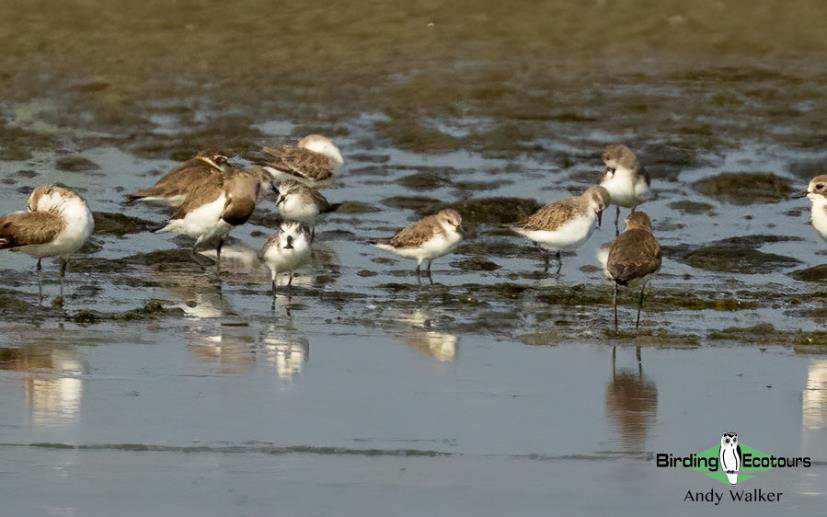
Spoon-billed Sandpiper is a big target on this Thailand bird tour and so it was with much excitement we found a lone bird on a saltpan mixed in with numerous other shorebird species.
Day 7, 1stFebruary 2026. Morning birding Pak Thale and Laem Pak Bia area and travel to Khao Yai area
We visited some saltpans near our accommodation after breakfast for a quick look before departing the area. We found another large flock of Asian Dowitchers, along with a wide range of shorebirds we had now become very familiar with, and included our best views to date of Long-toed Stints. A small patch of scrub nearby gave us views of Eurasian Hoopoe, Golden-bellied Gerygone, Oriental Reed Warbler, Dusky Warbler, and Common Tailorbird.
We checked out of our comfortable accommodation at the coast to make the long drive to our next base to explore Khao Yai National Park. Along the way we called in at a large lake near the coast, where we found several new trip birds, including Garganey, Northern Pintail, Spot-billed Pelican, Little Ringed Plover, Osprey, and Common Tern. We also had improved views of several other species, including Oriental Darter, Indian Cormorant, Black-headed Ibis, Painted Stork, Wood Sandpiper, Brown-headed Gull, and Caspian Tern.
We spent the afternoon driving to the Khao Yai National Park area, where we checked into our resort for the next three nights in the late afternoon.
Day 8, 2ndFebruary 2026. Birding Khao Yai National Park
We spent the day birding in Khao Yai National Park. We birded at several spots within the park at a range of elevations and habitats. One of the highlights early in the day was some good views (eventually) of the range-restricted Cambodian Flowerpecker, another recent split. We found a really nice fruiting tree early on, which kept us busy for quite a while as we watched Moustached Barbets, Green-eared Barbets, and Blue-eared Barbets, along with Puff-throated Bulbuls, Red-whiskered Bulbuls, Black-crested Bulbuls, and Grey-eyed Bulbuls all foraging in the tree. The standout species here was a stunning Orange-headed Thrush which flew in and showed nicely for a while. Another nearby tree was similarly busy with a different suite of species all showing well, such as Black-winged Cuckooshrike, Swinhoe’s Minivet, Verditer Flycatcher, Square-tailed Drongo-Cuckoo, and a stunning Asian Emerald Cuckoo.
Moving further into the park we found a secluded waterbody where a Black Bittern was residing, however it skulked away all too quickly! The other highlight in this area was a Claudia’s Leaf Warbler, a change from Yellow-browed Warblers we had been seeing everywhere on the trip.
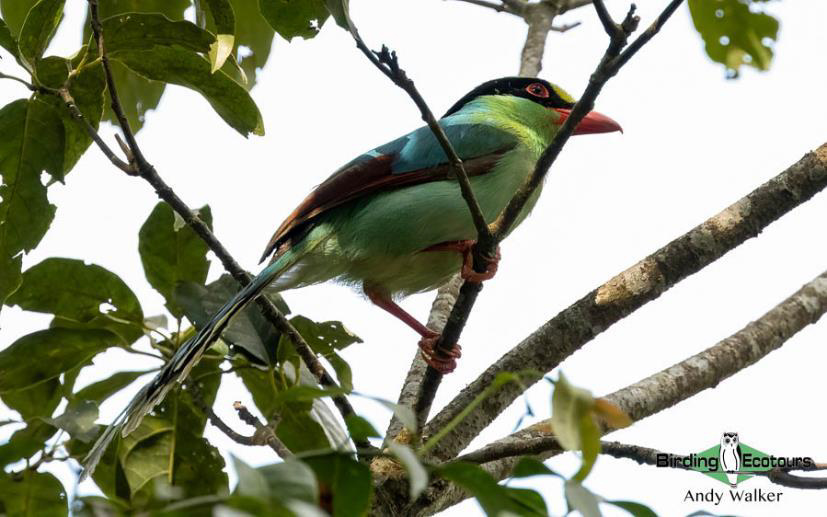
Common Green Magpie put in an appearance for us and was rather popular.
After lunch (during which we had some fantastic views of Common Kingfisher), we gained more elevation and found a nice viewpoint, where we enjoyed some sightings of the strikingly plumaged Common Green Magpie and secretive Black-throated Laughingthrush. Here we also had fun watching a family group of Bar-winged Flycatcher-shrikes at very close range, along with several species we had seen earlier in the day. Both Rufous-bellied Eagle and Black Eagle were also seen during the afternoon.
We ended the day with some perched views of a gorgeous Blue-bearded Bee-eater and followed that by watching a spectacular flyby from a group of Brown-backed Needletails as they came to a lake to drink. Here we also saw a small flock of Asian House Martins, to add to the Barn Swallows and Eastern Red-rumped Swallows we had seen earlier in the day.
Plenty of interesting mammals were seen during the day, the highlight was probably a family group of Malayan Porcupines (very cool looking animals!), Northern Red Muntjac, Sambar, Variable Squirrel, Pallas’s Squirrel, and Northern Pig-tailed Macaques. Pileated Gibbons were heard whooping in the distance too but remained out of sight for now.
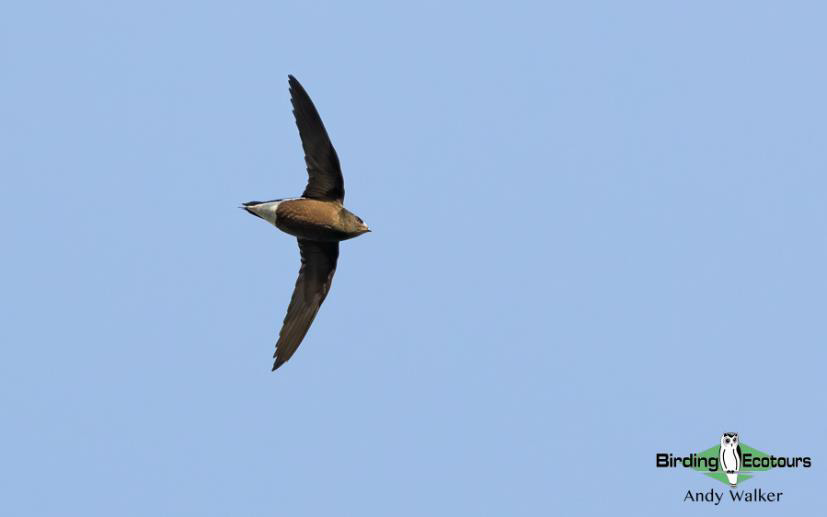
The huge Brown-backed Needletail put on quite the show for us.
Day 9, 3rdFebruary 2026. Birding Khao Yai National Park
We again spent the full day birding at Khao Yai National Park, covering some areas we had visited the previous day, but also several new spots. We headed straight to some higher elevation forest, were we again saw the rather pretty Black-throated Laughingthrush. We also noted Large Hawk-Cuckoo and Barred Cuckoo-Dove, and gained repeated views of Black-winged Cuckooshrikes, Mountain Imperial Pigeons and others. A change of locations got us our first proper looks at Hill Blue Flycatcher and a flock of Chestnut-flanked White-eyes, with Ashy Bulbuls, Puff-throated Bulbuls, Black-crested Bulbuls, and Blue-winged Leafbirds all present and vocal.
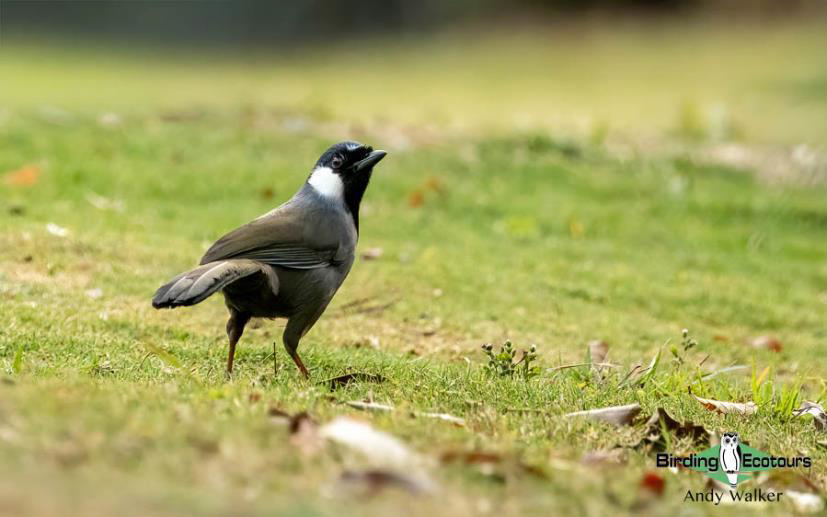
Black-throated Laughingthrush gave some good views during the tour, one of several attractive laughingthrush species to do so over the course of the trip.
Another change of location was fairly quiet, but we got some brief views of Blue Whistling Thrush, and at our final spot before lunch we had Rufous-bellied Eagle, Crested Goshawk, Collared Owlet, and a magnificent vocal display from a family group of Pileated Gibbons, which then showed wonderfully as they foraged and ran through the trees. As we drove to our lunch spot some folks got lucky with a Rufous-winged Buzzard sighting.
After lunch, we had some time relaxing around the park headquarters, where many of the species seen the previous day were still present. In the afternoon we focused our birding along a waterfall trail which had Pale-legged Leaf Warbler near the entrance and an interesting flock of sunbirds of several species, which included Crimson Sunbird, Purple Sunbird, Van Hasselt’s Sunbird, and Ruby-cheeked Sunbird all chasing each other around a flowering tree! There was also a Little Spiderhunter nearby. Here, the river was pulling in birds and we had a good showing from Oriental Dollarbird and Chestnut-headed Bee-eater, with Crested Honey Buzzard overhead.
As we drove out of the park we found a big gathering of people near one of the lakes, only to find a bull Asian Elephant practically totally submerged and bathing in the lake, though it was hard to not be distracted by the stunning Paddyfield Pipit at our feet! We spent some time watching this fun sight before we continued on our way once the elephant had finished his wash.
After eventually leaving the national park, and when we were back at the edge of town, we called into a well-known area, where we had a flock of Red-breasted Parakeets gathering ahead of going to roost. Here we also saw a Spot-bellied Eagle-Owl (well, its massive head and eyebrows poking out of its hole!). A few groups of Chestnut-tailed Starlings flew overhead, as did a pair of Yellow-breasted Buntings, to end another great day of Thai birding.
Day 10, 4thFebruary 2026. Birding Khao Yai area and transfer to Bangkok for tour conclusion
We had a final morning birding in Khao Yai National Park and it was rather successful, with two sightings of our main target, Silver Pheasant. First we found a group of six birds, including four males, and later we found another bird, a lone male, in a different area. In addition to the spectacular pheasants, we found a great mixed flock of leaf warblers. The flock contained Martens’s Warbler, Claudia’s Leaf Warbler, Davison’s Leaf Warbler, Sulphur-breasted Warbler, Radde’s Warbler, and the ubiquitous Yellow-browed Warbler of course.
Birding around the nearby forest gave us repeated views of birds we had learnt well by now, such as Moustached Barbet, Black-crested Bulbul, and Black-throated Laughingthrush. A final highlight of the tour was a small family group of Crab-eating Mongoose running across a road in the park.
We grabbed brunch back at our accommodation before driving back to Bangkok, where the tour concluded. We had a discussion on the important “bird of the trip” over our final dinner together, with, unsurprisingly, Spoon-billed Sandpiper taking the top honors. There was an eclectic mix of other species getting honorable mentions, including Silver Pheasant, Asian Dowitcher, Nordmann’s Greenshank, White-faced Scops Owl, Red-bearded Bee-eater, Silver Oriole, Asian Fairy-bluebird, and White-crested Laughingthrush.
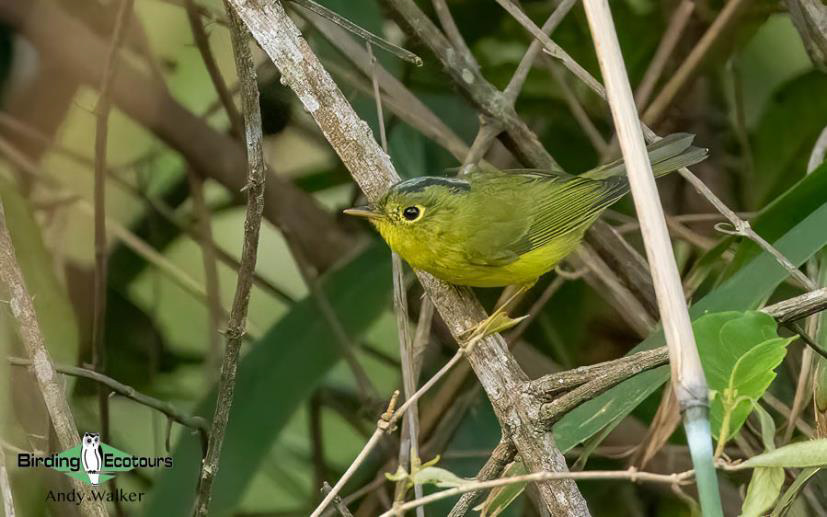
Many phylloscopus (leaf warblers) are generally considered quite drab (subtly plumaged), however Martens’s Warbler bucks that trend!
Bird List – Following IOC (15.1) (March 2025)
Birds ‘heard only’ are marked with (H) after the common name, all other species were seen. The following notation after species names is used to show conservation status following IUCN/BirdLife International: CR = Critically Endangered, EN – Endangered, VU = Vulnerable, NT = Near-threatened.
| Common Name | Scientific Name |
| Ducks, Geese, Swans (Anatidae) | |
| Lesser Whistling Duck | Dendrocygna javanica |
| Garganey | Spatula querquedula |
| Northern Pintail | Anas acuta |
| Pheasants & Allies (Phasianidae) | |
| Bar-backed Partridge | Arborophila brunneopectus |
| Kalij Pheasant | Lophura leucomelanos |
| Silver Pheasant | Lophura nycthemera |
| Green-legged Partridge | Tropicoperdix chloropus |
| Grey Peacock-Pheasant | Polyplectron bicalcaratum |
| Red Junglefowl | Gallus gallus |
| Nightjars (Caprimulgidae) | |
| Grey Nightjar | Caprimulgus jotaka |
| Large-tailed Nightjar | Caprimulgus macrurus |
| Treeswifts (Hemiprocnidae) | |
| Crested Treeswift | Hemiprocne coronata |
| Grey-rumped Treeswift | Hemiprocne longipennis |
| Swifts (Apodidae) | |
| Himalayan Swiftlet | Aerodramus brevirostris |
| Edible-nest Swiftlet | Aerodramus fuciphagus |
| Brown-backed Needletail | Hirundapus giganteus |
| Asian Palm Swift | Cypsiurus balasiensis |
| House Swift | Apus nipalensis |
| Cuckoos (Cuculidae) | |
| Greater Coucal | Centropus sinensis |
| Green-billed Malkoha | Phaenicophaeus tristis |
| Asian Koel | Eudynamys scolopaceus |
| Asian Emerald Cuckoo | Chrysococcyx maculatus |
| Violet Cuckoo | Chrysococcyx xanthorhynchus |
| Banded Bay Cuckoo (H) | Cacomantis sonneratii |
| Plaintive Cuckoo (H) | Cacomantis merulinus |
| Square-tailed Drongo-Cuckoo | Surniculus lugubris |
| Large Hawk-Cuckoo | Hierococcyx sparverioides |
| Pigeons, Doves (Columbidae) | |
| Rock Dove | Columba livia |
| Red Collared Dove | Streptopelia tranquebarica |
| Spotted Dove | Spilopelia chinensis |
| Barred Cuckoo-Dove | Macropygia unchall |
| Common Emerald Dove | Chalcophaps indica |
| Zebra Dove | Geopelia striata |
| Pink-necked Green Pigeon | Treron vernans |
| Thick-billed Green Pigeon | Treron curvirostra |
| Mountain Imperial Pigeon | Ducula badia |
| Rails, Crakes & Coots (Rallidae) | |
| Common Moorhen | Gallinula chloropus |
| Ruddy-breasted Crake (H) | Zapornia fusca |
| White-breasted Waterhen | Amaurornis phoenicurus |
| Grebes (Podicipedidae) | |
| Little Grebe | Tachybaptus ruficollis |
| Stone-curlews, Thick-knees (Burhinidae) | |
| Indian Stone-curlew | Burhinus indicus |
| Stilts, Avocets (Recurvirostridae) | |
| Black-winged Stilt | Himantopus himantopus |
| Plovers (Charadriidae) | |
| Grey Plover – VU | Pluvialis squatarola |
| Pacific Golden Plover | Pluvialis fulva |
| Little Ringed Plover | Charadrius dubius |
| Grey-headed Lapwing | Vanellus cinereus |
| Red-wattled Lapwing | Vanellus indicus |
| Tibetan Sand Plover | Anarhynchus atrifrons |
| Greater Sand Plover | Anarhynchus leschenaultii |
| Malaysian Plover | Anarhynchus peronii |
| Kentish Plover | Anarhynchus alexandrinus |
| White-faced Plover | Anarhynchus dealbatus |
| Jacanas (Jacanidae) | |
| Bronze-winged Jacana | Metopidius indicus |
| Sandpipers, Snipes (Scolopacidae) | |
| Eurasian Whimbrel | Numenius phaeopus |
| Eurasian Curlew – NT | Numenius arquata |
| Bar-tailed Godwit – NT | Limosa lapponica |
| Black-tailed Godwit – NT | Limosa limosa |
| Asian Dowitcher – NT | Limnodromus semipalmatus |
| Terek Sandpiper | Xenus cinereus |
| Common Sandpiper | Actitis hypoleucos |
| Green Sandpiper | Tringa ochropus |
| Marsh Sandpiper | Tringa stagnatilis |
| Wood Sandpiper | Tringa glareola |
| Common Redshank | Tringa totanus |
| Nordmann’s Greenshank – EN | Tringa guttifer |
| Spotted Redshank | Tringa erythropus |
| Common Greenshank | Tringa nebularia |
| Great Knot – EN | Calidris tenuirostris |
| Red Knot – NT | Calidris canutus |
| Ruff | Calidris pugnax |
| Broad-billed Sandpiper – VU | Calidris falcinellus |
| Curlew Sandpiper – VU | Calidris ferruginea |
| Long-toed Stint | Calidris subminuta |
| Red-necked Stint – NT | Calidris ruficollis |
| Spoon-billed Sandpiper – CR | Calidris pygmaea |
| Sanderling | Calidris alba |
| Little Stint | Calidris minuta |
| Gulls, Terns, Skimmers (Laridae) | |
| Little Tern | Sternula albifrons |
| Caspian Tern | Hydroprogne caspia |
| Whiskered Tern | Chlidonias hybrida |
| Common Tern | Sterna hirundo |
| Slender-billed Gull | Chroicocephalus genei |
| Brown-headed Gull | Chroicocephalus brunnicephalus |
| Storks (Ciconiidae) | |
| Asian Openbill | Anastomus oscitans |
| Painted Stork – NT | Mycteria leucocephala |
| Anhingas, Darters (Anhingidae) | |
| Oriental Darter -NT | Anhinga melanogaster |
| Cormorants, Shags (Phalacrocoracidae) | |
| Little Cormorant | Microcarbo niger |
| Indian Cormorant | Phalacrocorax fuscicollis |
| Great Cormorant | Phalacrocorax carbo |
| Ibises, Spoonbills (Threskiornithidae) | |
| Black-headed Ibis – NT | Threskiornis melanocephalus |
| Herons, Bitterns (Ardeidae) | |
| Black Bittern | Botaurus flavicollis |
| Yellow Bittern | Botaurus sinensis |
| Pacific Reef Heron | Egretta sacra |
| Chinese Egret – VU | Egretta eulophotes |
| Little Egret | Egretta garzetta |
| Little Heron | Butorides atricapilla |
| Chinese Pond Heron | Ardeola bacchus |
| Javan Pond Heron | Ardeola speciosa |
| Great Egret | Ardea alba |
| Medium Egret | Ardea intermedia |
| Eastern Cattle Egret | Ardea coromanda |
| Grey Heron | Ardea cinerea |
| Purple Heron | Ardea purpurea |
| Pelicans (Pelecanidae) | |
| Spot-billed Pelican – NT | Pelecanus philippensis |
| Ospreys (Pandionidae) | |
| Osprey | Pandion haliaetus |
| Kites, Hawks, Eagles (Accipitridae) | |
| Crested Honey Buzzard | Pernis ptilorhynchus |
| Crested Serpent Eagle | Spilornis cheela |
| Mountain Hawk-Eagle | Nisaetus nipalensis |
| Rufous-bellied Eagle | Lophotriorchis kienerii |
| Black Eagle | Ictinaetus malaiensis |
| Crested Goshawk | Lophospiza trivirgata |
| Shikra | Tachyspiza badia |
| Pied Harrier | Circus melanoleucos |
| Black Kite | Milvus migrans |
| Brahminy Kite | Haliastur indus |
| Rufous-winged Buzzard | Butastur liventer |
| Owls (Strigidae) | |
| Collared Owlet (H) | Taenioptynx brodiei |
| Asian Barred Owlet | Glaucidium cuculoides |
| White-fronted Scops Owl – VU | Otus sagittatus |
| Collared Scops Owl (H) | Otus lettia |
| Spot-bellied Eagle-Owl | Ketupa nipalensis |
| Trogons (Trogonidae) | |
| Orange-breasted Trogon | Harpactes oreskios |
| Hoopoes (Upupidae) | |
| Eurasian Hoopoe | Upupa epops |
| Hornbills (Bucerotidae) | |
| Great Hornbill – VU | Buceros bicornis |
| Oriental Pied Hornbill | Anthracoceros albirostris |
| Tickell’s Brown Hornbill – NT | Anorrhinus tickelli |
| Wreathed Hornbill – VU | Rhyticeros undulatus |
| Rollers (Coraciidae) | |
| Indochinese Roller | Coracias affinis |
| Oriental Dollarbird | Eurystomus orientalis |
| Kingfishers (Alcedinidae) | |
| White-throated Kingfisher | Halcyon smyrnensis |
| Black-capped Kingfisher – VU | Halcyon pileata |
| Collared Kingfisher | Todiramphus chloris |
| Common Kingfisher | Alcedo atthis |
| Bee-eaters (Meropidae) | |
| Red-bearded Bee-eater | Nyctyornis amictus |
| Blue-bearded Bee-eater | Nyctyornis athertoni |
| Asian Green Bee-eater | Merops orientalis |
| Blue-tailed Bee-eater | Merops philippinus |
| Chestnut-headed Bee-eater | Merops leschenaulti |
| Asian Barbets (Megalaimidae) | |
| Lineated Barbet | Psilopogon lineatus |
| Green-eared Barbet | Psilopogon faiostrictus |
| Red-throated Barbet (H) | Psilopogon mystacophanos |
| Blue-throated Barbet | Psilopogon asiaticus |
| Moustached Barbet | Psilopogon incognitus |
| Blue-eared Barbet | Psilopogon cyanotis |
| Coppersmith Barbet | Psilopogon haemacephalus |
| Woodpeckers (Picidae) | |
| White-browed Piculet | Sasia ochracea |
| Heart-spotted Woodpecker | Hemicircus canente |
| Greater Yellownape | Chrysophlegma flavinucha |
| Laced Woodpecker (H) | Picus vittatus |
| Grey-headed Woodpecker | Picus canus |
| Common Flameback | Dinopium javanense |
| Bay Woodpecker | Blythipicus pyrrhotis |
| Buff-rumped Woodpecker | Meiglyptes grammithorax |
| Great Slaty Woodpecker – VU | Mulleripicus pulverulentus |
| Caracaras, Falcons (Falconidae) | |
| Peregrine Falcon | Falco peregrinus |
| Old World Parrots (Psittaculidae) | |
| Red-breasted Parakeet – NT | Psittacula alexandri |
| Vernal Hanging Parrot | Loriculus vernalis |
| Typical Broadbills (Eurylaimidae) | |
| Long-tailed Broadbill (H) | Psarisomus dalhousiae |
| Banded Broadbill (H) | Eurylaimus javanicus |
| Pittas (Pittidae) | |
| Blue Pitta | Hydrornis cyaneus |
| Australasian Warblers (Acanthizidae) | |
| Golden-bellied Gerygone | Gerygone sulphurea |
| Vangas & Allies (Vangidae) | |
| Bar-winged Flycatcher-shrike | Hemipus picatus |
| Woodswallows, Butcherbirds & Allies (Artamidae) | |
| Ashy Woodswallow | Artamus fuscus |
| Ioras (Aegithinidae) | |
| Common Iora | Aegithina tiphia |
| Great Iora | Aegithina lafresnayei |
| Cuckooshrikes (Campephagidae) | |
| Scarlet Minivet | Pericrocotus speciosus |
| Ashy Minivet | Pericrocotus divaricatus |
| Swinhoe’s Minivet | Pericrocotus cantonensis |
| Black-winged Cuckooshrike | Lalage melaschistos |
| Vireos, Greenlets, Shrike-babblers (Vireonidae) | |
| White-browed Shrike-babbler | Pteruthius aeralatus |
| White-bellied Erpornis | Erpornis zantholeuca |
| Figbirds, Old World Orioles, Piopios (Oriolidae) | |
| Silver Oriole – EN | Oriolus mellianus |
| Black-naped Oriole | Oriolus chinensis |
| Drongos (Dicruridae) | |
| Bronzed Drongo | Dicrurus aeneus |
| Greater Racket-tailed Drongo | Dicrurus paradiseus |
| Hair-crested Drongo | Dicrurus hottentottus |
| Ashy Drongo | Dicrurus leucophaeus |
| Black Drongo | Dicrurus macrocercus |
| Fantails (Rhipiduridae) | |
| Malaysian Pied Fantail | Rhipidura javanica |
| Monarchs (Monarchidae) | |
| Black-naped Monarch | Hypothymis azurea |
| Blyth’s Paradise Flycatcher | Terpsiphone affinis |
| Shrikes (Laniidae) | |
| Brown Shrike | Lanius cristatus |
| Crows, Jays (Corvidae) | |
| Common Green Magpie | Cissa chinensis |
| Racket-tailed Treepie | Crypsirina temia |
| Eastern Jungle Crow | Corvus levaillantii |
| Fairy Flycatchers (Stenostiridae) | |
| Grey-headed Canary-flycatcher | Culicicapa ceylonensis |
| Tits, Chickadees (Paridae) | |
| Sultan Tit | Melanochlora sultanea |
| Bulbuls (Pycnonotidae) | |
| Ochraceous Bulbul | Alophoixus ochraceus |
| Puff-throated Bulbul | Alophoixus pallidus |
| Olive Bulbul | Iole viridescens |
| Grey-eyed Bulbul | Iole propinqua |
| Ashy Bulbul | Hemixos flavala |
| Mountain Bulbul | Ixos mcclellandii |
| Black-headed Bulbul | Brachypodius melanocephalos |
| Black-crested Bulbul | Rubigula flaviventris |
| Streak-eared Bulbul | Pycnonotus conradi |
| Stripe-throated Bulbul | Pycnonotus finlaysoni |
| Flavescent Bulbul | Pycnonotus flavescens |
| Red-whiskered Bulbul | Pycnonotus jocosus |
| Sooty-headed Bulbul | Pycnonotus aurigaster |
| Swallows, Martins (Hirundinidae) | |
| Barn Swallow | Hirundo rustica |
| Asian House Martin | Delichon dasypus |
| Eastern Red-rumped Swallow | Cecropis daurica |
| Cettia Bush Warblers & Allies (Cettiidae) | |
| Yellow-bellied Warbler | Abroscopus superciliaris |
| Leaf Warblers (Phylloscopidae) | |
| Yellow-browed Warbler | Phylloscopus inornatus |
| Radde’s Warbler | Phylloscopus schwarzi |
| Dusky Warbler | Phylloscopus fuscatus |
| Alström’s Warbler | Phylloscopus soror |
| Martens’s Warbler | Phylloscopus omeiensis |
| Two-barred Warbler | Phylloscopus plumbeitarsus |
| Pale-legged Leaf Warbler | Phylloscopus tenellipes |
| Sulphur-breasted Warbler | Phylloscopus ricketti |
| Claudia’s Leaf Warbler | Phylloscopus claudiae |
| Davison’s Leaf Warbler | Phylloscopus intensior |
| Reed Warblers & Allies (Acrocephalidae) | |
| Oriental Reed Warbler | Acrocephalus orientalis |
| Black-browed Reed Warbler | Acrocephalus bistrigiceps |
| Thick-billed Warbler | Arundinax aedon |
| Cisticolas & Allies (Cisticolidae) | |
| Zitting Cisticola | Cisticola juncidis |
| Plain Prinia | Prinia inornata |
| Common Tailorbird | Orthotomus sutorius |
| Dark-necked Tailorbird | Orthotomus atrogularis |
| White-eyes (Zosteropidae) | |
| Striated Yuhina | Staphida castaniceps |
| Chestnut-flanked White-eye | Zosterops erythropleurus |
| Swinhoe’s White-eye | Zosterops simplex |
| Babblers, Scimitar Babblers (Timaliidae) | |
| Chestnut-capped Babbler (H) | Timalia pileata |
| Pin-striped Tit-Babbler | Mixornis gularis |
| White-browed Scimitar Babbler | Pomatorhinus schisticeps |
| Ground Babblers (Pellorneidae) | |
| Collared Babbler | Gampsorhynchus torquatus |
| Puff-throated Babbler | Pellorneum ruficeps |
| Abbott’s Babbler | Malacocincla abbotti |
| Alcippe Fulvettas (Alcippeidae) | |
| Brown-cheeked Fulvetta | Alcippe poioicephala |
| Laughingthrushes & Allies (Leiothrichidae) | |
| Lesser Necklaced Laughingthrush | Garrulax monileger |
| White-crested Laughingthrush | Garrulax leucolophus |
| Black-throated Laughingthrush | Pterorhinus chinensis |
| Greater Necklaced Laughingthrush | Pterorhinus pectoralis |
| Fairy-bluebirds (Irenidae) | |
| Asian Fairy-bluebird | Irena puella |
| Starlings, Rhabdornises (Sturnidae) | |
| Golden-crested Myna | Ampeliceps coronatus |
| Common Hill Myna | Gracula religiosa |
| Great Myna | Acridotheres grandis |
| Common Myna | Acridotheres tristis |
| Siamese Pied Myna | Gracupica floweri |
| Chestnut-tailed Starling | Sturnia malabarica |
| Thrushes (Turdidae) | |
| Orange-headed Thrush | Geokichla citrina |
| Eyebrowed Thrush | Turdus obscurus |
| Grey-sided Thrush – VU | Turdus feae |
| Chats, Old World Flycatchers (Muscicapidae) | |
| Oriental Magpie-Robin | Copsychus saularis |
| White-rumped Shama | Copsychus malabaricus |
| Dark-sided Flycatcher | Muscicapa sibirica |
| Asian Brown Flycatcher | Muscicapa dauurica |
| Verditer Flycatcher | Eumyias thalassinus |
| Chinese Blue Flycatcher | Cyornis glaucicomans |
| Hainan Blue Flycatcher | Cyornis hainanus |
| Indochinese Blue Flycatcher | Cyornis sumatrensis |
| Hill Blue Flycatcher | Cyornis whitei |
| Blue Whistling Thrush | Myophonus caeruleus |
| Siberian Blue Robin | Larvivora cyane |
| Taiga Flycatcher | Ficedula albicilla |
| Amur Stonechat | Saxicola stejnegeri |
| Leafbirds (Chloropseidae) | |
| Blue-winged Leafbird | Chloropsis moluccensis |
| Flowerpeckers (Dicaeidae) | |
| Thick-billed Flowerpecker | Pachyglossa agilis |
| Plain Flowerpecker | Dicaeum minullum |
| Cambodian Flowerpecker | Dicaeum cambodianum |
| Scarlet-backed Flowerpecker | Dicaeum cruentatum |
| Sunbirds (Nectariniidae) | |
| Ruby-cheeked Sunbird | Chalcoparia singalensis |
| Brown-throated Sunbird | Anthreptes malacensis |
| Van Hasselt’s Sunbird | Leptocoma brasiliana |
| Purple Sunbird | Cinnyris asiaticus |
| Ornate Sunbird | Cinnyris ornatus |
| Black-throated Sunbird | Aethopyga saturata |
| Crimson Sunbird | Aethopyga siparaja |
| Little Spiderhunter | Arachnothera longirostra |
| Grey-breasted Spiderhunter | Arachnothera modesta |
| Streaked Spiderhunter | Arachnothera magna |
| Old World Sparrows, Snowfinches (Passeridae) | |
| Eurasian Tree Sparrow | Passer montanus |
| Plain-backed Sparrow | Passer flaveolus |
| House Sparrow | Passer domesticus |
| Weavers, Widowbirds (Ploceidae) | |
| Asian Golden Weaver – NT | Ploceus hypoxanthus |
| Baya Weaver | Ploceus philippinus |
| Waxbills, Munias & Allies (Estrildidae) | |
| Scaly-breasted Munia | Lonchura punctulata |
| White-rumped Munia | Lonchura striata |
| Chestnut Munia | Lonchura atricapilla |
| Pin-tailed Parrotfinch | Erythrura prasina |
| Wagtails, Pipits (Motacillidae) | |
| Eastern Yellow Wagtail | Motacilla tschutschensis |
| Richard’s Pipit | Anthus richardi |
| Paddyfield Pipit | Anthus rufulus |
| Buntings (Emberizidae) | |
| Yellow-breasted Bunting – CR | Emberiza aureola |
| Total seen | 276 |
| Total heard only | 10 |
| Total recorded | 286 |
Mammal List
| Common Name | Scientific Name |
| Elephants (Elephantidae) | |
| Asian Elephant | Elephas maximus |
| Treeshrews (Tupaiidae) | |
| Northern Treeshrew | Tupaia belangeri |
| Old World Monkeys (Cercopithecidae) | |
| Stump-tailed Macaque | Macaca arctoides |
| Northern Pig-tailed Macaque | Macaca leonina |
| Robinson’s Banded Langur | Presbytis robinsoni |
| Dusky Langur | Trachypithecus obscurus |
| Gibbons (Hylobatidae) | |
| Lar Gibbon | Hylobates lar |
| Pileated Gibbon | Hylobates pileatus |
| Old World Porcupines (Hystricidae) | |
| Malayan Porcupine | Hystrix brachyura |
| Squirrels (Sciuridae) | |
| Gray-bellied Squirrel | Callosciurus caniceps |
| Pallas’s Squirrel | Callosciurus erythraeus |
| Indochinese Ground Squirrel | Menetes berdmorei |
| Himalayan Striped Squirrel | Tamiops mcclellandii |
| Black Giant Squirrel | Ratufa bicolor |
| Variegated Squirrel | Sciurus variegatoides |
| Hedgehogs and Gymnures (Erinaceidae) | |
| Northern Short-tailed Gymnure | Hylomys peguensis |
| Mustelids (Mustelidae) | |
| Yellow-throated Marten | Martes flavigula |
| Bears (Ursidae) | |
| Sun Bear | Helarctos malayanus |
| Mongooses (Herpestidae) | |
| Crab-eating Mongoose | Urva urva |
| Deer (Cervidae) | |
| Sambar | Rusa unicolor |
| Northern Red Muntjac | Muntiacus vaginalis |
| Chevrotains (Tragulidae) | |
| Lesser Indo-Malayan Chevrotain | Tragulus kanchil |
| Suids (Suidae) | |
| Eurasian Wild Pig | Sus scrofa |
| Total seen | 23 |
Reptile List
| Common Name | Scientific Name |
| Colubrid Snakes (Colubridae) | |
| Oriental Whipsnake | Ahaetulla prasina |
| Dragons (Agamidae) | |
| Reeves’ Butterfly Lizard | Leiolepis reevesii |
| Typical Geckos (Gekkonidae) | |
| Asian House Gecko | Hemidactylus frenatus |
| Tokay Gecko | Gekko gecko |
| Skinks (Scincidae) | |
| Spotted Forest Skink | Sphenomorphus maculatus |
| Bronze Mabuya | Eutropis macularia |
| Short-tailed Striped Skink | Lipinia microcerca |
| Monitor Lizards (Varanidae) | |
| Clouded Monitor | Varanus nebulosus |
| Common Water Monitor | Varanus salvator |
| Eurasian Pond, River, and Neotropical Wood Turtles (Geoemydidae) | |
| Oldham’s Leaf Turtle | Cyclemys oldhamii |
| Tortoises (Testudinidae) | |
| Asian Forest Tortoise | Manouria emys |
| Total seen | 11 |
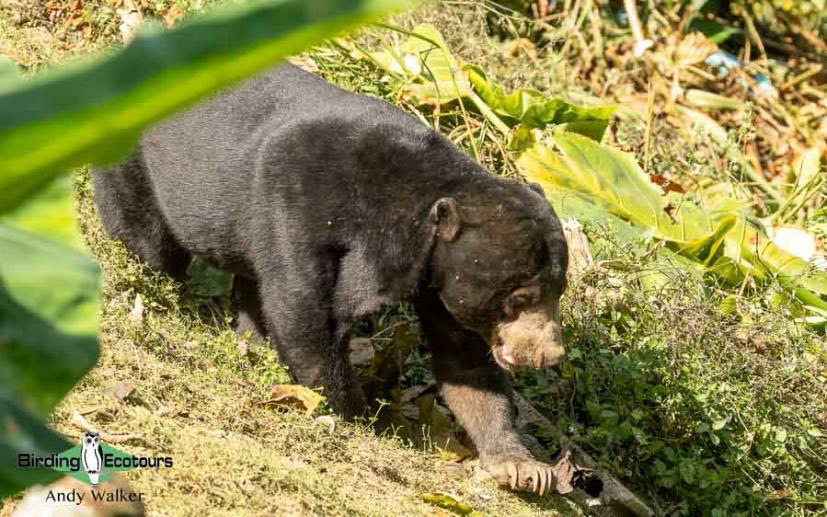
This Sun Bear gave us some incredible and close views in Kaeng Krachan National Park.
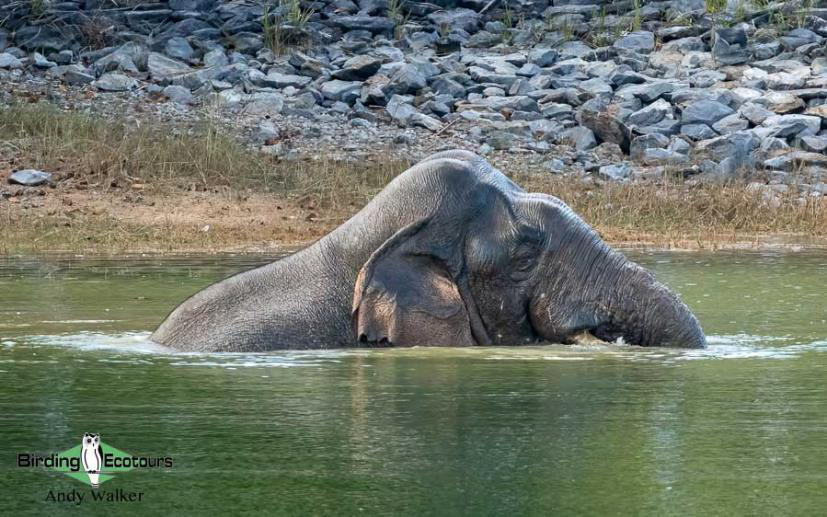
This bathing Asian Elephant was seen in Khao Yai National Park.
This is a sample trip report. Please email us ([email protected]) for more trip reports from this destination.