08–24 FEBRUARY 2026
By Giancarlo Ventolini
This birding expedition was designed as a comprehensive transect across some of Colombia’s most representative ecological gradients, linking the southwestern Andes with the Amazonian foothills and the vast savannas of the Orinoquía. By covering a broad range of altitudes and climates, the tour allowed us to experience a remarkable variety of bird communities and provided a comparative perspective on distinct biogeographic assemblages within a single itinerary.
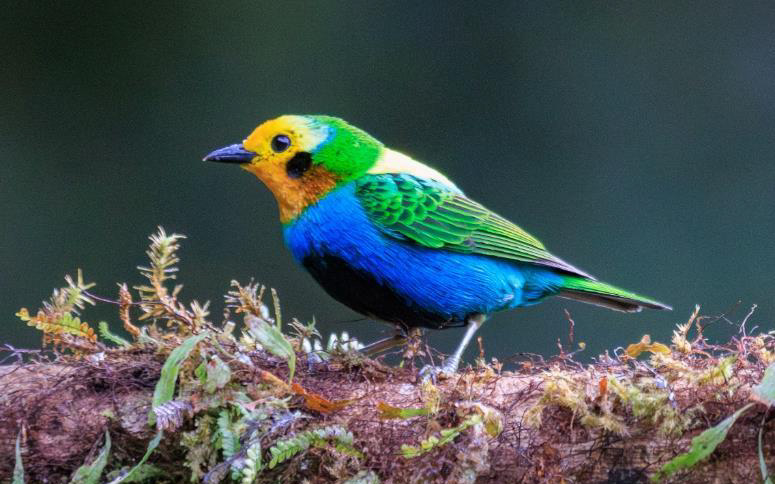
The Colombian endemic Multicolored Tanager (photo Norman Graf).
We began in the montane forests of Km 18, in the mountains above Cali. This area is internationally recognized for its endemism and its concentration of species restricted to the western Andean slope. The combination of cloud forest interior, forest edges, and feeding stations provided excellent opportunities to observe a diverse community of hummingbirds and mixed-species tanager flocks, reflecting the structural complexity of this habitat.
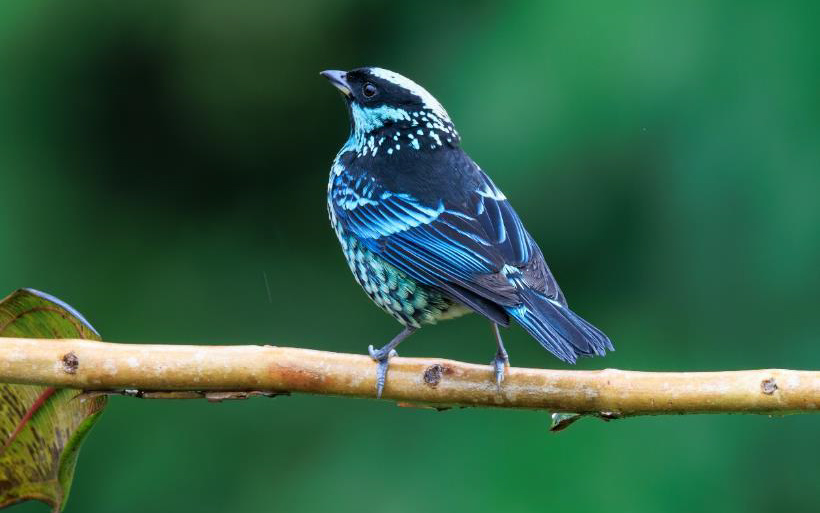
Beryl-spangled Tanager with its brilliant plumage shimmering in the forest (photo Norman Graf).
We then traveled to Puracé National Natural Park in the Colombian Massif, where high Andean forests and páramo ecosystems marked a dramatic shift in both landscape and avifaunal composition. Higher elevations, cooler temperatures, and specialized vegetation favored species adapted to open shrublands and elfin forest conditions characteristic of these montane systems.
Our journey continued south to Laguna de la Cocha, an important high Andean lake complex of significant ecological value. Here we explored both aquatic habitats and surrounding temperate forests, recording species associated with high-elevation wetlands as well as southern Andean forest specialists. The descent along the iconic ‘Biodiversity Trampolín’ represented one of the tour’s most dynamic ecological transitions. As elevation gradually decreased, vegetation became taller and more stratified, and the avifauna increasingly reflected Amazonian influence, highlighting the importance of this corridor as a zone of biogeographic interchange. In Mocoa and surrounding areas, we explored humid pre-montane foothill forests characterized by high rainfall and complex forest structure. This Andean-Amazonian interface allowed us to document a unique overlap of Andean and Amazonian species. Further east, in Puerto Asís, the focus shifted to lowland tropical rainforest.
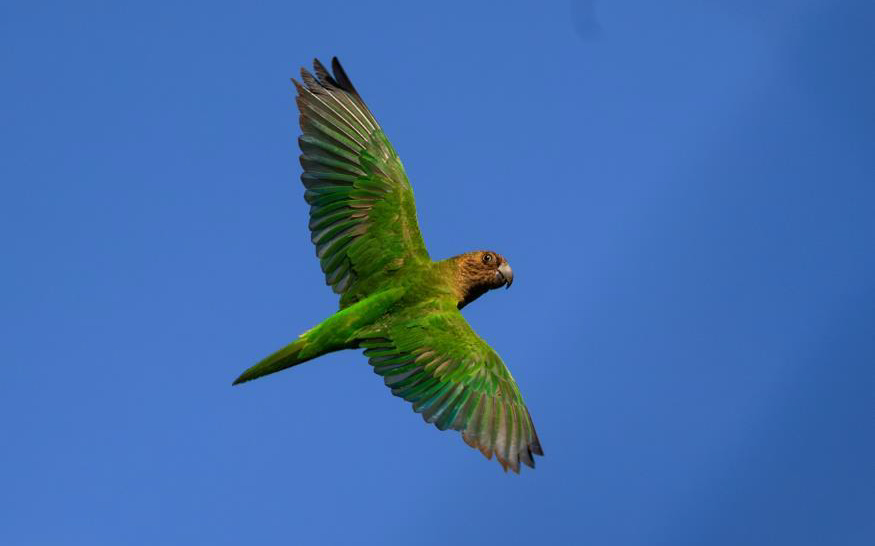
Brown-throated Parakeet in flight over the Llanos (photo Norman Graf).
We flew to Bogotá and visited Parque La Florida, a highland wetland on the Bogotá plateau. This stop added a distinct ecological component to the trip, allowing us to record waterfowl and endemic species characteristic of the Bogotá savanna. The final stage of the tour took place in the Llanos Orientales, based in Yopal, with fieldwork at the renowned Hato La Aurora and accommodation at Hotel Juan Solito. In this landscape of seasonally flooded savannas, palm swamps, and gallery forests, bird communities were dominated by species adapted to open habitats and wetlands, reflecting the hydrological dynamics typical of the Orinoquía region. Overall, the tour documented a high level of species richness and a clear succession of bird communities associated with altitudinal change and biogeographic transition. This report summarizes the principal sites visited, the habitats explored, and the most significant diversity patterns and notable records observed throughout the journey.
During this fantastic 17-day Colombian birding tour, we recorded 460 bird species, including more than 40 species of hummingbirds and more than 33 tanager species.
Detailed Report
Day 1, 8th February 2026. Arrival in Cali
Our tour began in the city of Cali. The group arrived at Alfonso Bonilla Aragón International Airport and then transferred to the hotel. In the evening, we had dinner at the hotel and got to know each other and excitedly discussed the tour ahead.
Day 2, 9th February 2026. Birding Km 18 forest and transfer to Popayán
We left the city of Cali early to visit some of the many nearby birding hotspots at Km 18 and La Florida Reserve. We spent time at the excellent bird feeders on the property, where we observed some of the most eagerly awaited species, including Multicolored Tanager and Chestnut Wood Quail. Other species seen at the feeders included Red-headed Barbet, Crimson-rumped Toucanet, Green Honeycreeper, Saffron-crowned, Golden-naped, Summer, Flame-rumped, Black-capped, and Golden Tanagers.
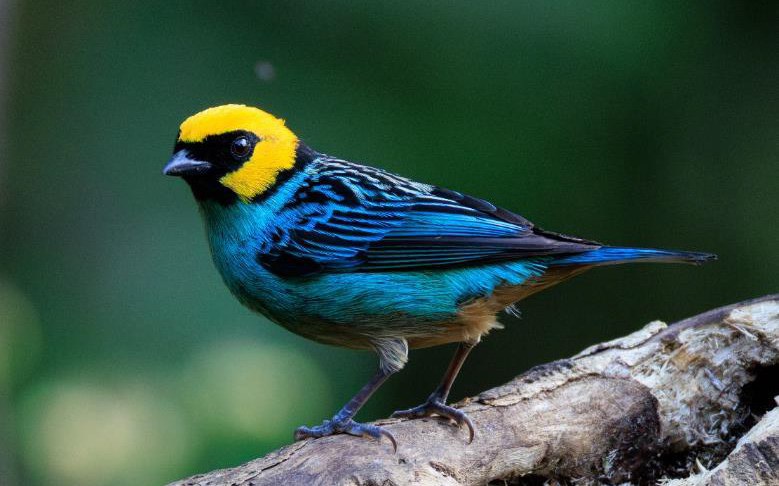
The beautiful Saffron-crowned Tanager at Km 18 (photo Norman Graf).
Afterwards, we visited the hummingbird feeders where we were able to observe species such as Long-tailed Sylph, White-booted Racket-tail (a recent split from Booted Racket-tail) and Bronzy Inca. Other species recorded here included Colombian Chachalaca (endemic), Black-winged Saltator, Acorn Woodpecker, Gray-breasted Wood-Wren, and Chestnut-capped Brushfinch. Other hummingbird species were Greenish Puffleg, White-necked Jacobin, Fawn-breasted Brilliant, Steely-vented Hummingbird, Andean Emerald, and Speckled Hummingbird.
We then enjoyed lunch at the reserve before transferring to Popayán.
Day 3, 10th February 2026. Birding Puracé National Natural Park
We departed early from Popayán, ascending into the high Andes toward Puracé National Natural Park. As elevation increased, montane forest gradually transitioned into elfin forest and open páramo habitats. Along the way, we stopped to watch birds and observed species like Streak-throated Bush Tyrant, Chestnut-bellied Chat-Tyrant, White-naped Brushfinch, and White-sided Flowerpiercer. We had breakfast and visited hummingbird feeders, where we saw Green-tailed Trainbearer, Buff-winged Starfrontlet, White-bellied Woodstar, Shining Sunbeam, and Tyrian Metaltail. In the surrounding area, we were able to see several additional species moving through the forest and along the edges, including Gray-breasted Mountain Toucan, Purple-backed Thornbill, White-throated Tyrannulet, and Rufous-breasted Chat-Tyrant.
We arrived at the condor feeding site, a windswept páramo slope with wide open views of the Andes. The air was cold and crisp as we waited quietly near the overlook. An impressive Andean Condor appeared, soaring effortlessly on the thermals, before descending toward the rocky outcrop. Watching its massive wings spread against the mountain backdrop was truly unforgettable, an intimate and powerful encounter with one of the Andes’ most iconic birds.
Other species observed throughout the day were Carunculated and Crested Caracara, White-capped Tanager, Golden-crowned Tanager, and Golden-fronted Redstart.
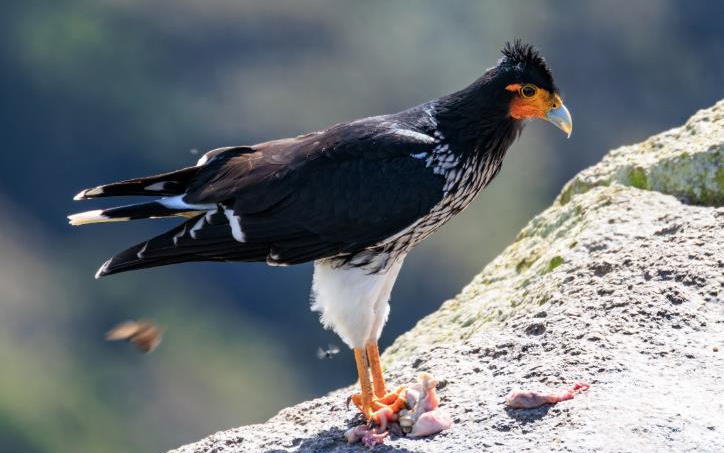
Carunculated Caracara at the feeding site(photo Norman Graf).
Day 4, 11th February 2026. Birding around the hotel and transfer to Pasto
The morning began with rain. After breakfast, we headed toward La Cocha Lake, one of the most important high Andean wetlands in the region, located about 25 km from the city of Pasto in southern Colombia. Surrounded by Andean forest and páramo vegetation, this large lake offers excellent opportunities for waterbirds and other species associated with high-elevation wetlands.
Along the way, we stopped for a restroom break and found species like Spectacled Parrotlet, Fork-tailed Flycatcher, Yellow-headed Caracara, and Scrub Tanager. Around La Cocha we saw Barred Fruiteater, Lacrimose Mountain Tanager, Sharpe’s Wren, Yellow-billed Pintail, Ecuadorian Rail, Sierran Elaenia, and Grassland Yellow Finch.
We arrived at our hotel at La Cocha Lake, ate dinner, reviewed our bird list for the day and prepared for the next morning’s activities.
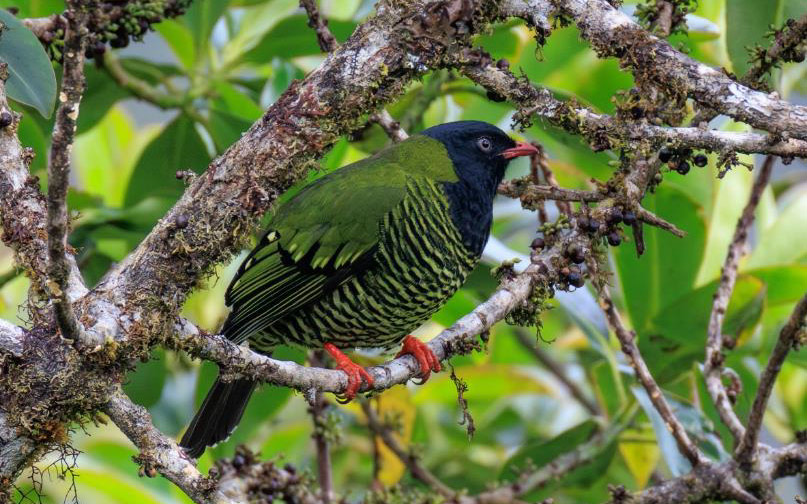
We found Barred Fruiteater in the surroundings of the lake (photo Norman Graf).
Day 5, 12th February 2026. Birding the Páramo de Bordoncillo
We left the hotel early, with our packed breakfasts, and headed to the Bordoncillo Páramo, located along the road connecting Pasto and Mocoa in southern Colombia. This marks the transition between the Andes and the Amazon basin. This high-elevation ecosystem is characterized by extensive stands of frailejones, grasslands, and scattered patches of high Andean forest, providing excellent habitat for a variety of specialized páramo birds. Some of the species we saw included Rainbow-bearded Thornbill, Glowing Puffleg, Agile Tit-Tyrant, Blue-backed Conebill, Black-capped Tyrannulet, and Andean Guan.
In the afternoon we headed to the area around La Cocha Lagoon. Flowering plants attracted several species of hummingbirds, including Tourmaline Sunangel, Tyrian Metaltail, Collared Inca, and Sword-billed Hummingbird.
We continued walking through the vegetation closest to the lagoon and saw the incredible Subtropical Doradito, as well as Grass Wren, Andean Gull and Slate-colored Coot.
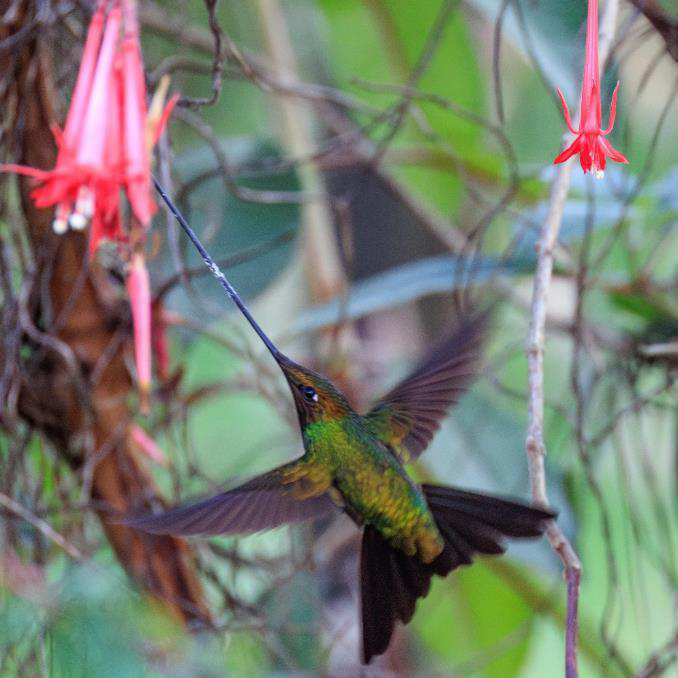
Sword-billed Hummingbird showed its remarkable bill (photo Norman Graf).
Day 6, 13th February 2026. Birding Trampolín Road (upper section)
Today we left La Cocha Lagoon and headed toward the city of Mocoa. Trampolín Road winds dramatically down the Andes toward the Amazonian foothills, passing through beautiful cloud forest landscapes. Despite its reputation, the area also offers excellent opportunities for birding, with many species typical of Andean montane forests and foothill habitats. During the journey, we made several birding stops along the road, and we were able to see Pearled Treerunner, Scaly-naped Amazon, Sickle-winged Guan, Black-billed Mountain-Toucan and Crimson-mantled Woodpecker.
At one of our stops we were incredibly fortunate to observe the majestic Black-and-chestnut Eagle at close range, one of the most impressive raptors of the Andean cloud forests. This large forest eagle is distinguished by its dark head and back, contrasting with rich chestnut underparts, as well as its prominent crest. It inhabits humid montane forests of the Andes, where it hunts medium-sized birds and mammals within the forest canopy. Due to habitat loss and its naturally low population density, the species is considered Endangered, making every sighting particularly special for birders exploring the Andean forests.
Other species seen included Yellow-bellied Chat-Tyrant, Dusky Piha, White-capped Dipper, Gorgeted Woodstar, White-rimmed Brushfinch, and Grass-green Tanager.
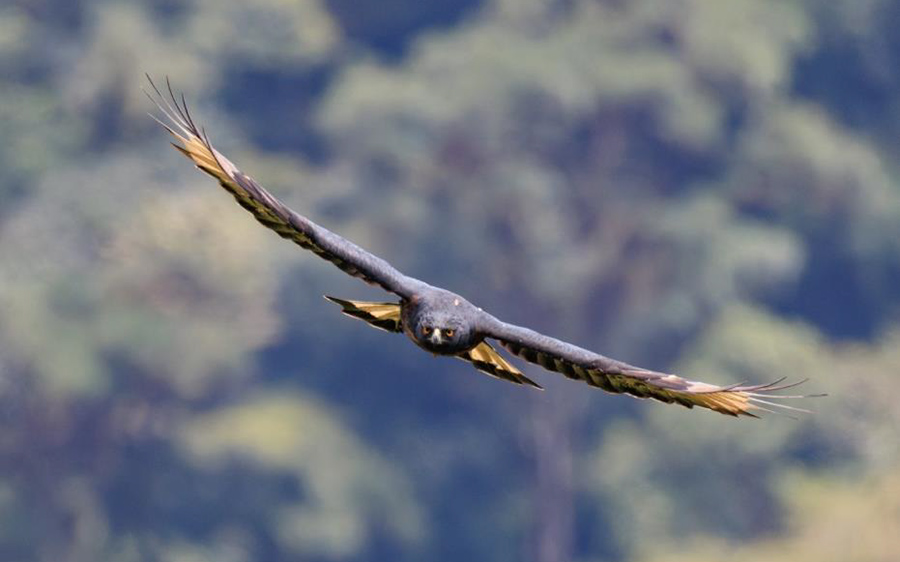
The majestic Black-and-chestnut Eagle flying over the Amazonian foothills (photo Norman Graf).
Day 7, 14th February 2026. Birding Trampolín Road (lower section)
We started the day early along the lower section of Trampolín Road, where the Andes begin to descend toward the Amazon basin. The morning was accompanied by light mist and the constant sound of birds coming from the surrounding humid forest. We walked slowly along the road and nearby trails, scanning fruiting and flowering trees which attracted a wide variety of species.
During the first hours of the morning we recorded several species, such as Speckled Chachalaca, Violaceous Jay, Russet-backed Oropendola, Golden-collared Honeycreeper, and Swallow Tanager.
In small forest openings we found Violet-fronted Brilliant, Green-backed Hillstar, Peruvian Racket-tail, Long-tailed Sylph, and Green-fronted Lancebill visiting flowers. Mixed flocks moved along the forest edges and we saw Andean Cock-of-the-rock, Bronze-green Euphonia, Orange-eared Tanager, and Golden-eared Tanager. The transition between lower montane forest and Amazonian foothill vegetation made this area especially rich in bird diversity.
As the day progressed, bird activity remained steady. New species such as Short-billed Chlorospingus, Red-bellied Grackle, Flame-faced Tanager, Deep-blue Flowerpiercer, Red-ruffed Fruitcrow, Emerald-bellied Puffleg, Beryl-spangled Tanager, and Maroon-tailed Parakeet appeared at different forest levels, from the understory to the canopy. After several productive hours in the field, and with a long species list, we finished the day. We finished the day satisfied after exploring one of the most biodiverse corridors connecting the Andes and the Amazon.
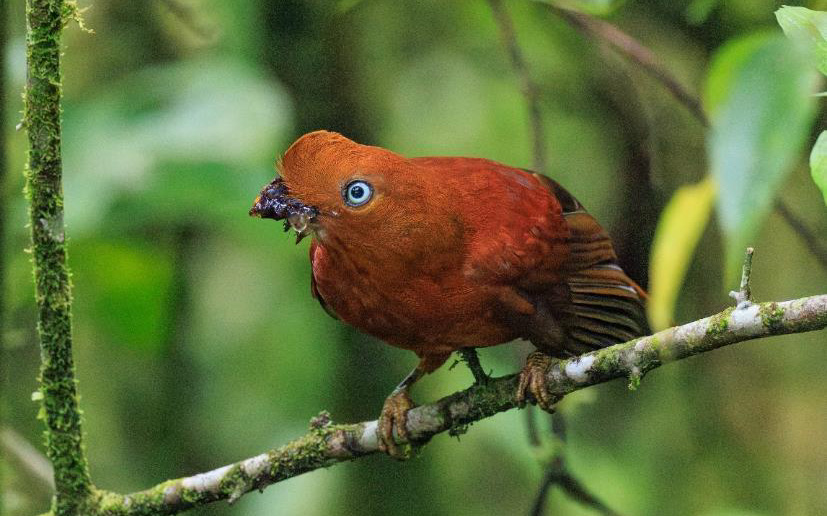
Andean Cock-of-the-rock (female) collecting nesting material on the Trampolín (photo Norman Graf).
Day 8, 15th February 2026. Birding the Finca Discosura
Today we visited the Finca Discosura, located near Mocoa in the Andean-Amazon foothills. The area combines humid forest and open gardens, creating diverse habitats for birdwatching. Species seen in the gardens included Blue-tailed Emerald, Wire-crested Thorntail, Violet-headed Hummingbird, Golden-tailed Sapphire, and Glittering-throated Emerald.
During the day we walked the trails and gardens of the property, recording several species like Blue-crowned Trogon, Coppery-chested Jacamar, Gilded and Lemon-throated Barbets, Scaled Piculet, Paradise Tanager, Green-and-gold Tanager, Blue-gray Tanager, Lemon-browed Flycatcher, Ecuadorian Tyrannulet, Rufous-tailed Foliage-gleaner, and Little Woodpecker attracted to fruiting trees and the surrounding vegetation. This proved to be a very productive birding site.
As the afternoon came to an end, we headed to another location in search of Band-bellied Owl, and we fortunately found a pair. Other species seen in the area included Ferruginous Pygmy Owl, Summer Tanager, and Black-billed Thrush.
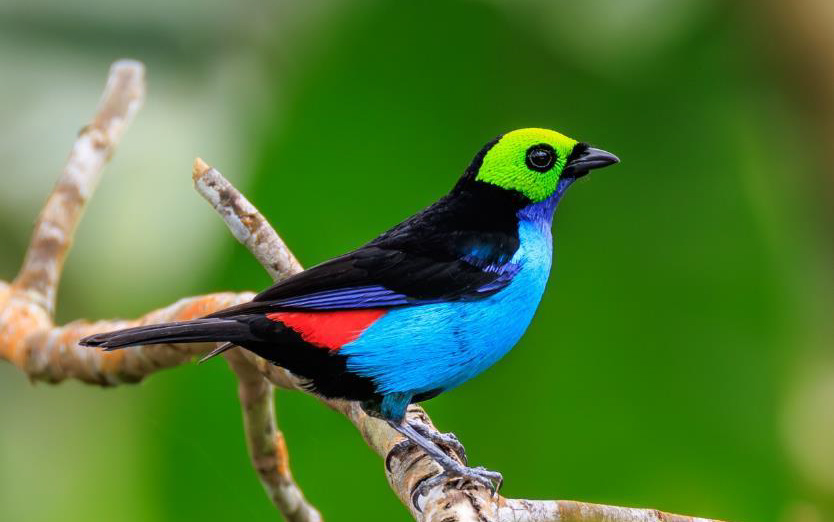
The Paradise Tanager, a strikingly colorful tanager, showed its bright green head, blue underparts, and red rump as it moved through the canopy (photo Norman Graf).
Day 9, 16th February 2026. Birding El Escondite and transfer to Puerto Asís
We departed early from Mocoa and headed toward El Escondite Natural Reserve, located in Villagarzón, Putumayo. We spent the morning exploring the trails of this private reserve, surrounded by humid forest and well-known as an excellent birdwatching site. Bird activity was constant as we walked along the trails and around fruiting trees. We observed several species typical of the region, including Swallow-winged Puffbird, Orange-winged Amazon, Masked Crimson Tanager, Masked Tanager, Yellow-bellied Dacnis, Orange-backed Troupial, Golden-bellied Euphonia, Orange-fronted Plushcrown, Plum-throated Cotinga, and Bare-necked Fruitcrow.
After lunch we explored other areas of the reserve and saw Lafresnaye’s Piculet, Chestnut Woodpecker, White-chinned Jacamar, Green-backed Trogon, White-bearded Hermit, Black-banded Woodcreeper, Magpie Tanager, Lettered Aracari, Dusky-headed and White-eyed Parakeets.
After a productive day at El Escondite, we continued our journey toward Puerto Asís. On the way we passed forested landscapes and the rural areas of Putumayo. We arrived in the late afternoon, rested and prepared for the next day’s activities.
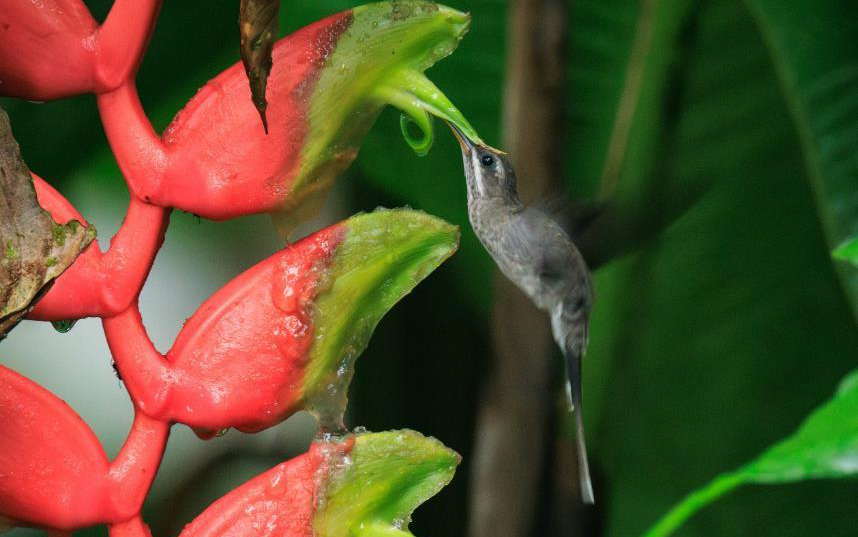
White-bearded Hermit feeding on a Heliconia flower at El Escondite (photo Norman Graf).
Day 10, 17th February 2026. Birding Sendero Ecológico Playa Rica
We left Puerto Asís early in the morning and headed to the river, where we boarded a small boat that took us to the community of Playa Rica. The short ride along the river provided a pleasant introduction to the Amazonian landscape, with lush forest lining the riverbanks and the first bird calls already echoing from the surrounding vegetation.
Upon arrival, we began birding along the Playa Rica Ecological Trail, a well-preserved forest that offers excellent opportunities for seeing birds of the Amazonian foothills. Throughout the morning we encountered several mixed flocks moving actively through the canopy, and we recorded Great Potoo, Green Ibis, Many-banded Aracari, Yellow-tufted Woodpecker, Cream-colored Woodpecker, White-shouldered Antbird, Long-billed Woodcreeper, Black-capped Donacobius, Thrush-like Wren, Dusky-headed Parakeet, and Red-bellied Macaw.
During our walk, our local guide showed us a group of Amazonian Night Monkeys resting inside a hollow dry tree trunk. The monkeys were sleeping quietly, tucked together inside the cavity, using the trunk as a daytime refuge while they waited for nightfall to become active. It was a great opportunity to observe these normally nocturnal primates at close range without disturbing them. It was a very productive day. On our way back to the hotel, we found a small wetland where we saw Scarlet Ibis, Cocoi Heron, and Horned Screamer.
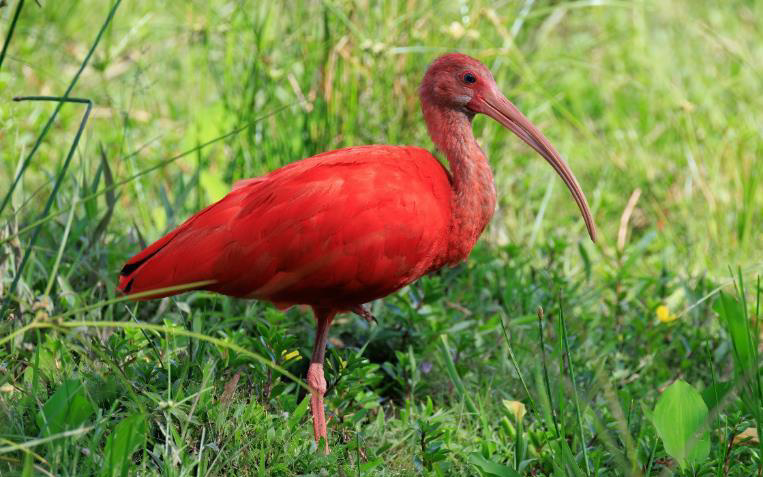
Scarlet Ibis glowing bright red along the shores of the Putumayo River (photo Norman Graf).
Day 11, 18th February 2026. Birding Hojarasca Center and Flight to Bogotá
The day started early at Hojarasca Center, a small birding reserve located near Puerto Asís in the Putumayo region, within the transition zone between the Andean foothills and the Amazon basin. The mix of secondary forest, forest edges, and well-maintained gardens with native plants created excellent habitat for a wide diversity of birds.
From first light, the trails around the reserve were full of activity. Walking slowly through the forest we encountered a variety of species along the trails, including Black-tailed Tityra, Southern Beardless-Tyrannulet, Dusky-capped Flycatcher, Yellow-rumped Cacique, and Black-fronted Nunbird.
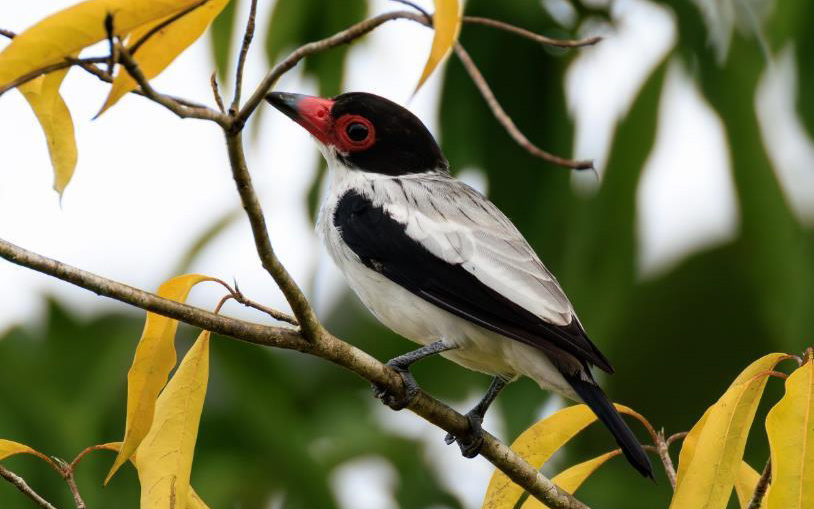
Black-tailed Tityra perched quietly along the forest edge at Hojarasca Center (photo Norman Graf).
One of the most productive areas was around the feeders and flowering plants, where the Butterfly Coquette visited constantly, offering great photo opportunities. Nearby fruiting trees also attracted Golden-bellied Euphonia, Turquoise Tanager, Scarlet-crowned Barbet, as well as Chestnut-eared Aracari which came in to feed on ripe fruit. Other species recorded in the area included Blue-black Grassquit, Lesson’s Seedeater, Chestnut-bellied Seed Finch, Wing-barred Seedeater and Silver-beaked Tanager. After a wonderful morning of birding, we headed to Puerto Asís Airport to catch our flight to Bogotá, for the night.
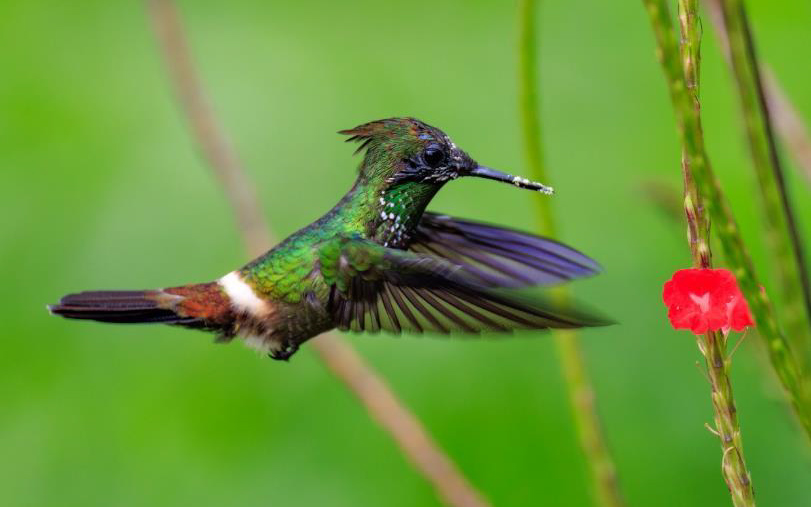
The stunning Butterfly Coquette flitting among the flowers at Hojarasca (photo Norman Graf).
Day 12, 19th February 2026. Birding Parque La Florida and Flight to Yopal
Our day began with an early visit to Parque La Florida, an important wetland reserve located on the outskirts of Bogotá. This site protects a mosaic of wetlands, marshes, and open grasslands on the Bogotá savanna and offers excellent opportunities to observe a variety of waterbirds and wetland species. Walking along the trails and dikes around the lagoons we quickly began adding several species to our list, including Spot-flanked Gallinule, Andean Duck, Pied-billed Grebe, Neotropic Cormorant, Striated Heron, and the Colombian endemic Bogota Rail. Other species recorded in the park included Yellow-hooded Blackbird, Torrent Tyrannulet, White-bellied Woodstar, Black-bellied Whistling Duck, and another endemic species, Rufous-browed Conebill. After an enjoyable morning of birding and exploring the reserve, we returned to the airport in Bogotá to catch our flight eastward to Yopal, the gateway to the vast savannas of the Colombian Llanos, where the next stage of our birding adventure would take place.
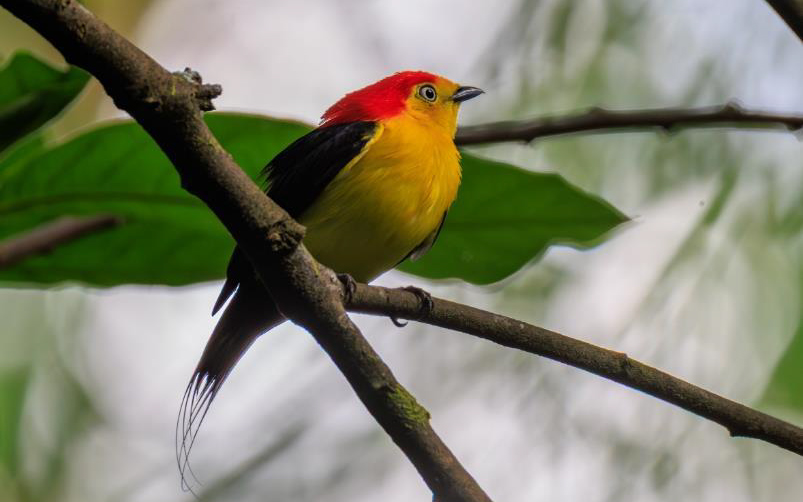
A beautiful Wire-tailed Manakin in the gallery forest at Puro Llano (photo Norman Graf).
In the afternoon we headed to Puro Llano, a productive birding site located near Yopal in the Casanare department, within the vast savannas of the Colombian Llanos. This area is characterized by a mosaic of open grasslands, scattered trees, gallery forest, and small wetlands, creating excellent habitat for a wide variety of Llanos bird species including Smooth-billed Ani, Southern Lapwing, Buff-necked Ibis, Plain Thornbird, Chestnut-fronted Macaw, Wire-tailed Manakin, Pied Water-Tyrant, Boat-billed Flycatcher, Tropical Gnatcatcher and, at a small lagoon near Puro Llano, a Giant Otter.
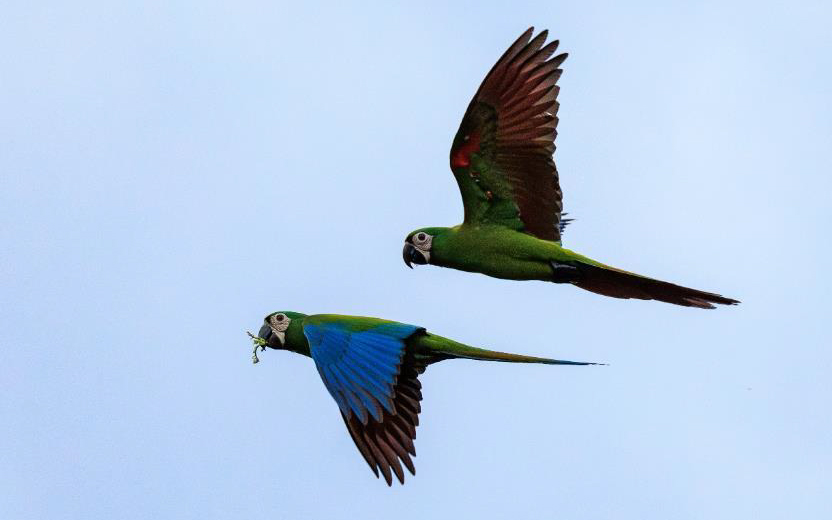
Chestnut-fronted Macaws flying over the Llanos savanna (photo Norman Graf).
Day 13, 20th February 2026. Yopal to Hato La Aurora and Juan Solito Lodge
After an early breakfast in Yopal we began our journey toward Hato La Aurora, traveling deep into the vast savannas of the Casanare Llanos. The drive itself offered excellent birding opportunities, and we made several stops along the road whenever we spotted interesting activity. The open savannas, scattered palms, and seasonal wetlands along the route held a great variety of typical Llanos species. Roadside fences, isolated trees, and open pastures proved particularly productive. Some species found along the roadside included White, Scarlet and Sharp-tailed Ibises, Jabiru, White-faced Whistling Duck, Roseate Spoonbill, Whistling Heron, Little Blue Heron, American Kestrel, Vermilion Flycatcher, Fork-tailed Flycatcher, and Oriole Blackbird.
After lunch at Hato La Aurora, we spent some time birding around the lodge and found species such as Horned Screamer, Sunbittern, Orinoco Goose, Rufous-vented Chachalaca, Pale-headed Jacamar, Yellow-headed Caracara, Crested Oropendola, Pale-eyed Pygmy Tyrant, Hooded Tanager and Giant Cowbird. Incredibly, one of the participants returned early to the main house and encountered a Giant Anteater. He immediately called the group, and we all headed back to enjoy this magnificent animal for a few unforgettable moments.
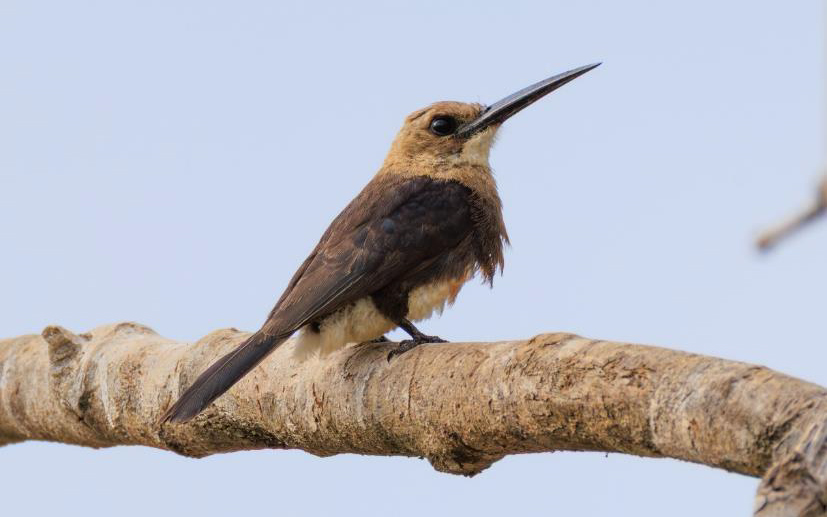
The Pale-headed Jacamar, one of the birding highlights of the Llanos (photo Norman Graf).
As dusk approached, we returned to the lodge to enjoy dinner and review the day’s impressive bird list. It had been a fantastic introduction to the rich birdlife of the Casanare Llanos, with many memorable sightings throughout the journey from Yopal to Hato La Aurora.
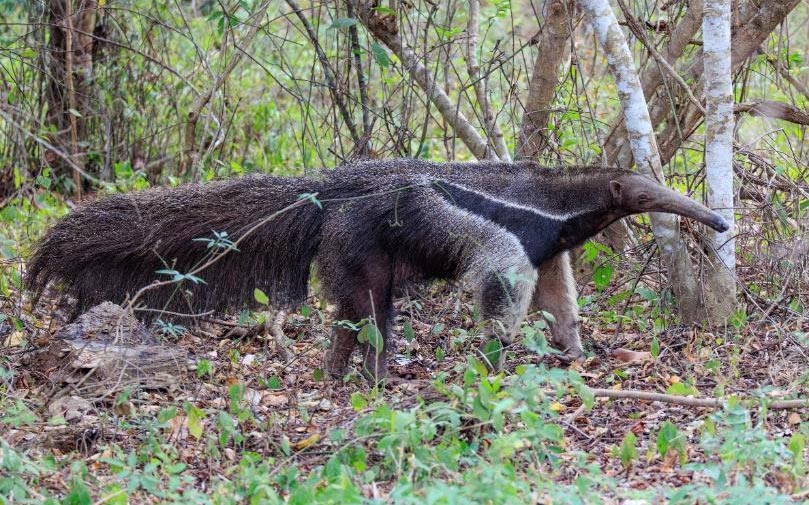
A close encounter with Giant Anteater in the Colombian Llanos (photo Norman Graf).
Day 14, 21st February 2026. Birding Juan Solito, Hato La Aurora
We started the day early exploring the surroundings of the lodge and the vast savanna landscapes typical of the Colombian Llanos. During the morning we enjoyed a combination of birdwatching and a Llanos safari. Driving along the ranch roads, some of the first birds we encountered were Scaled and White-tipped Doves, Double-striped Thick-knee, Pied and Collared Plovers, Pantanal Snipe, Nacunda Nighthawk, Black Skimmer, Large-billed Tern, Wood Stork, Roseate Spoonbill, Black-crowned Night Heron, and Rufescent Tiger Heron.
Along the way we encountered other wildlife characteristic of the region. While visiting several seasonal wetlands we found Horned Screamer, Orinoco Goose, Blue-winged and Brazilian Teals, White-faced and Black-bellied Whistling-Ducks, and Little Blue Heron.
Around midday we headed to another house on the property, where we enjoyed a traditional Llanos-style lunch and a short break, before continuing to explore the area. Around the feeders and surrounding areas of the house we found Venezuelan Troupial, Yellow Oriole, Shiny Cowbird, Carib Grackle, Masked Cardinal, Silver-beaked Tanager, Orange-fronted Yellow-Finch, Yellow-rumped Cacique, and Two-banded Puffbird. In the afternoon we birded around different areas of the ranch, visiting lagoons and open savannas in search of additional species, taking advantage of the increased bird activity toward the end of the day. We saw Burrowing Owl, Black-necked Stilt, Great Black Hawk, Yellow-chinned Spinetail, White-headed Marsh Tyrant, Yellowish Pipit, Yellow-browed Sparrow, and Red-breasted Meadowlark.
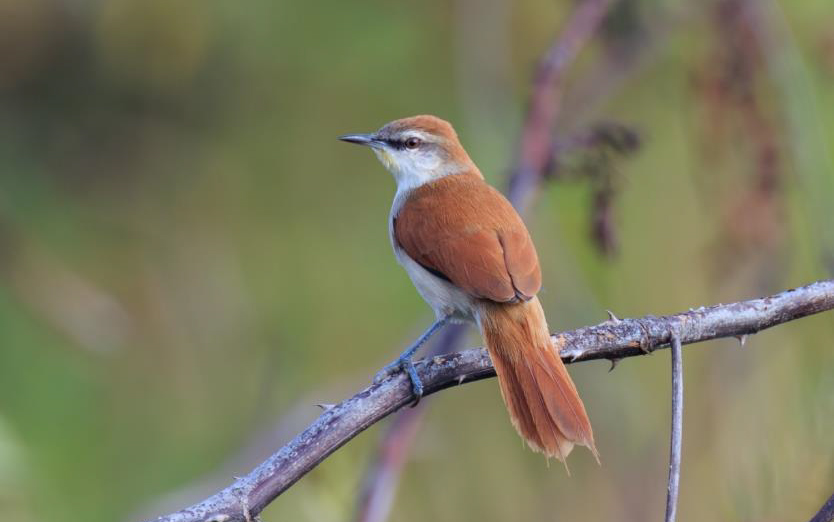
Yellow-chinned Spinetail emerged briefly from the thick brush of the Llanos (photo Norman Graf).
We saw a great variety of wildlife typical of the Llanos, including White-tailed Deer, Collared Peccary, Orinoco Crocodile, Green Iguana, Greater Capybara, Crab-eating Fox and freshwater turtles. It was a very productive day, combining birdwatching and a true Llanos wildlife safari in one of the most iconic landscapes of the Colombian Orinoquía.
We returned to Juan Solito Lodge to enjoy a wonderful dinner and work on our species list, while the lodge staff treated us to a live demonstration of traditional Llanero music, bringing a perfect end to the day.
Day 15, 22nd February 2026. Birding Juan Solito, Hato La Aurora
The morning began with us exploring the surrounds ofJuan Solito, walking along the trails and savannas near the camp. We took advantage of the higher bird activity during the early hours of the day on the forest edges, palm groves, and open areas. Some of the notable species seen included White-bearded Flycatcher, Lesser Kiskadee, Red-crowned Woodpecker, Chestnut-eared Aracari, Sharp-tailed Ibis, Rufous-vented Chachalaca, and Rufescent Tiger Heron.
Later we headed to the Ariporo River and had a boat ride near the riverbanks. From the water we saw a variety of species associated with the river, sandbars, and riparian vegetation, with excellent photo opportunities. Some of the species seen included Scarlet Macaw, Orinoco Goose, Crestless Curassow, Pied Plover, Hoatzin, Sunbittern, Boat-billed Heron, White-winged Swallow, and Purple-throated Euphonia.
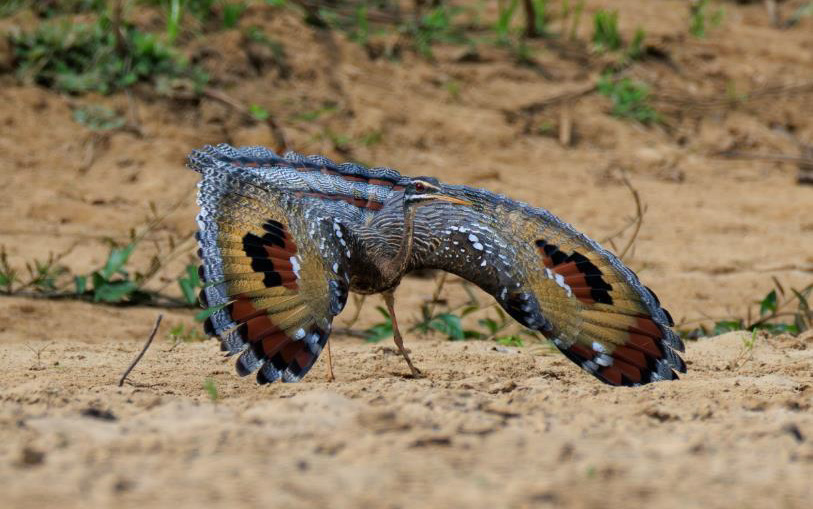
Along the river, a Sunbittern opened its wings, revealing a spectacular display (photo Norman Graf).
In the afternoon we drove in a 4×4 vehicle to one of the flooded areas of the reserve, a very productive habitat that added many species to our day list. Some of the species included Crested Bobwhite, Short-tailed Swift, Black Skimmer, Black-collared Hawk, Savanna Hawk, Aplomado Falcon, Crested Caracara, Yellow-crowned Amazon, and Band-tailed Nighthawk. We enjoyed a beautiful sunset over the Llanos savannas, bringing a very rewarding day of birdwatching to a close.
Day 16, 23rd February 2026. Juan Solito and transfer back to Yopal
We started early in the morning, exploring the surroundings of the lodge, walking the nearby trails and open areas in search of bird species. We recorded a good variety of birds, including Rufous-tailed Jacamar, White-winged Becard, Straight-billed Woodcreeper, Southern White-fringed Antwren, Black-crested Antshrike, Yellow Tyrannulet, Violaceous Jay, Bicolored and Buff-breasted Wrens, Spectacled Thrush, Cobalt-winged Parakeet, Crane Hawk, and Gray-headed Kite.
After lunch we began our journey back to Yopal City. Along the way we made a few strategic stops to continue birdwatching, finding species such as Horned Screamer, Gray-cowled Wood-Rail, Southern Lapwing, Wattled Jacana, Solitary Sandpiper, Jabiru, and Brown-throated Parakeet.
By late afternoon we arrived at our hotel, bringing to a close a very productive day of birdwatching.
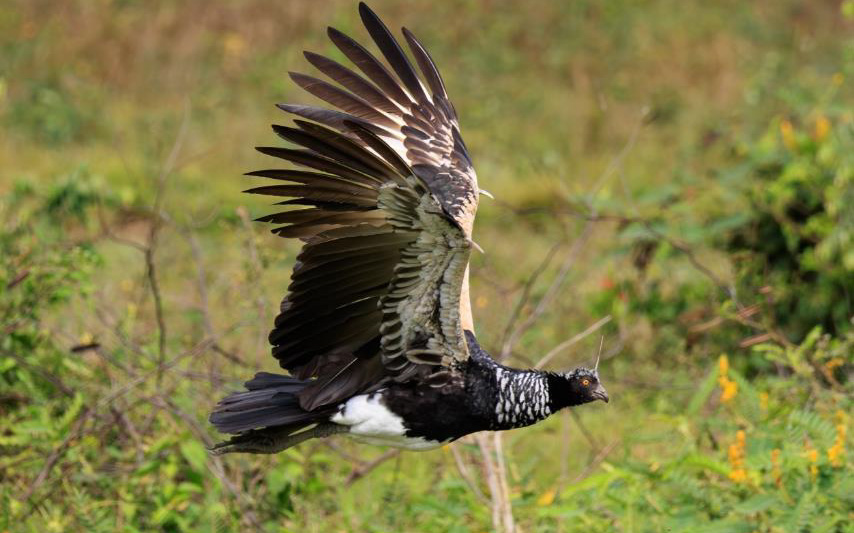
The emblematic Horned Screamer flew over the savanna (photo Norman Graf).
Day 17, 24th February 2026. Domestic flight to Bogotá and flight out
We ate breakfast at the hotel before heading to Yopal Airport for our flight to Bogotá, where each participant connected with onward flights to their final destinations. With this, we concluded a wonderful tour filled with many bird sightings and unforgettable experiences across the amazing landscapes of Colombia. We would like to extend our sincere thanks to all the participants for being part of this memorable adventure. Your enthusiasm, patience, and shared passion for birds made every early morning, long drive, and exciting sighting truly special. It was a pleasure exploring the incredible landscapes of Colombia together, from Andean forests and Amazonian rivers to the vast Llanos savannas, enjoying remarkable birds and unforgettable moments along the way. We hope the memories, photographs, and species recorded during this tour will stay with you for many years to come.
Special thanks to Norman Graf for allowing the use of his incredible photographs in this report.
Thank you once again for your great company, and we hope to share another birding adventure with you all in future.
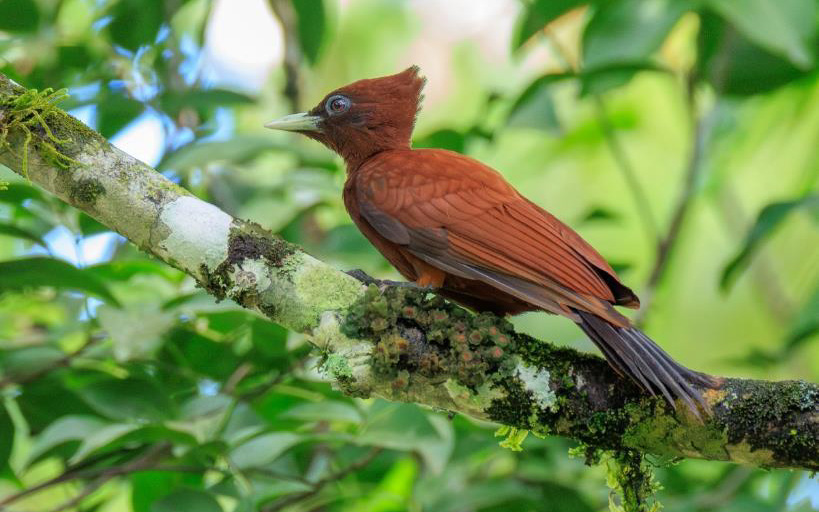
Chestnut Woodpecker foraging on a tree trunk in the forests of El Escondite Natural Reserve(photo Norman Graf).
Bird List – Following IOC (15.1) (March 2025)
| Common Name | Scientific Name |
| Tinamous (Tinamidae) | |
| Black Tinamou (H) | Tinamus osgoodi |
| Cinereous Tinamou (H) | Crypturellus cinereus |
| Undulated Tinamou (H) | Crypturellus undulatus |
| Screamers (Anhimidae) | |
| Horned Screamer | Anhima cornuta |
| Ducks, Geese, Swans (Anatidae) | |
| Black-bellied Whistling Duck | Dendrocygna autumnalis |
| White-faced Whistling Duck | Dendrocygna viduata |
| Orinoco Goose | Oressochen jubatus |
| Muscovy Duck | Cairina moschata |
| Brazilian Teal | Amazonetta brasiliensis |
| Blue-winged Teal | Spatula discors |
| Yellow-billed Pintail | Anas georgica |
| Andean Duck | Oxyura ferruginea |
| Chachalacas, Curassows, Guans (Cracidae) | |
| Sickle-winged Guan | Chamaepetes goudotii |
| Andean Guan | Penelope montagnii |
| Wattled Guan (H) | Aburria aburri |
| Colombian Chachalaca | Ortalis columbiana |
| Speckled Chachalaca | Ortalis guttata |
| Rufous-vented Chachalaca | Ortalis ruficauda |
| Crestless Curassow | Mitu tomentosum |
| New World Quail (Odontophoridae) | |
| Chestnut Wood Quail | Odontophorus hyperythrus |
| Crested Bobwhite | Colinus cristatus |
| Nightjars (Caprimulgidae) | |
| Common Pauraque (H) | Nyctidromus albicollis |
| Band-tailed Nighthawk | Nyctiprogne leucopyga |
| Nacunda Nighthawk | Chordeiles nacunda |
| Potoos (Nyctibiidae) | |
| Great Potoo | Nyctibius grandis |
| Swifts (Apodidae) | |
| White-collared Swift | Streptoprocne zonaris |
| Short-tailed Swift | Chaetura brachyura |
| Fork-tailed Palm Swift | Tachornis squamata |
| Hummingbirds (Trochilidae) | |
| White-necked Jacobin | Florisuga mellivora |
| White-bearded Hermit | Phaethornis hispidus |
| Green Hermit | Phaethornis guy |
| Tawny-bellied Hermit | Phaethornis syrmatophorus |
| Green-fronted Lancebill | Doryfera ludovicae |
| Sparkling Violetear | Colibri coruscans |
| Brown Violetear | Colibri delphinae |
| Wire-crested Thorntail | Discosura popelairii |
| Butterfly Coquette | Lophornis verreauxii |
| Black-throated Mango | Anthracothorax nigricollis |
| Tourmaline Sunangel | Heliangelus exortis |
| Green-tailed Trainbearer | Lesbia nuna |
| Speckled Hummingbird | Adelomyia melanogenys |
| Long-tailed Sylph | Aglaiocercus kingii |
| Purple-backed Thornbill | Ramphomicron microrhynchum |
| Rainbow-bearded Thornbill | Chalcostigma herrani |
| Glowing Puffleg | Eriocnemis vestita |
| Tyrian Metaltail | Metallura tyrianthina |
| Greenish Puffleg | Haplophaedia aureliae |
| Emerald-bellied Puffleg | Eriocnemis aline |
| Peruvian Racket-tail | Ocreatus peruanus |
| Shining Sunbeam | Aglaeactis cupripennis |
| Bronzy Inca | Coeligena coeligena |
| Green-backed Hillstar | Urochroa leucura |
| Collared Inca | Coeligena torquata |
| Buff-winged Starfrontlet | Coeligena lutetiae |
| Violet-fronted Brilliant | Heliodoxa leadbeateri |
| Sword-billed Hummingbird | Ensifera ensifera |
| White-bellied Woodstar | Chaetocercus mulsant |
| Gorgeted Woodstar | Chaetocercus heliodor |
| White-booted Racket-tail | Ocreatus underwoodii |
| Rufous-gaped Hillstar | Urochroa bougueri |
| Andean Emerald | Uranomitra franciae |
| Fawn-breasted Brilliant | Heliodoxa rubinoides |
| Purple-throated Woodstar | Philodice mitchellii |
| Blue-tailed Emerald | Chlorostilbon mellisugus |
| Violet-headed Hummingbird | Klais guimeti |
| Fork-tailed Woodnymph | Thalurania furcata |
| Crowned Woodnymph | Thalurania colombica |
| Steely-vented Hummingbird | Saucerottia saucerottei |
| Golden-tailed Sapphire | Chrysuronia oenone |
| Glittering-throated Emerald | Chionomesa fimbriata |
| Cuckoos (Cuculidae) | |
| Greater Ani | Crotophaga major |
| Smooth-billed Ani | Crotophaga ani |
| Striped Cuckoo (H) | Tapera naevia |
| Squirrel Cuckoo | Piaya cayana |
| Pigeons, Doves (Columbidae) | |
| Rock Dove [Feral Pigeon] | Columba livia |
| Pale-vented Pigeon | Patagioenas cayennensis |
| Band-tailed Pigeon | Patagioenas fasciata |
| Plumbeous Pigeon | Patagioenas plumbea |
| Ruddy Pigeon | Patagioenas subvinacea |
| Ruddy Ground Dove | Columbina talpacoti |
| Scaled Dove | Columbina squammata |
| Blue Ground Dove | Claravis pretiosa |
| White-tipped Dove | Leptotila verreauxi |
| Gray-fronted Dove (H) | Leptotila rufaxilla |
| Eared Dove | Zenaida auriculata |
| Rails, Crakes & Coots (Rallidae) | |
| Ecuadorian Rail | Rallus aequatorialis |
| Bogota Rail | Rallus semiplumbeus |
| Grey-cowled Wood Rail | Aramides cajaneus |
| Purple Gallinule | Porphyrio martinica |
| Spot-flanked Gallinule | Porphyriops melanops |
| American Coot | Fulica americana |
| Slate-colored Coot | Fulica ardesiaca |
| Common Gallinule | Gallinula galeata |
| Rufous-sided Crake (H) | Laterallus melanophaius |
| Grebes (Podicipedidae) | |
| Pied-billed Grebe | Podilymbus podiceps |
| Stone-curlews, Thick-knees (Burhinidae) | |
| Double-striped Thick-knee | Hesperoburhinus bistriatus |
| Stilts, Avocets (Recurvirostridae) | |
| Black-necked Stilt | Himantopus mexicanus |
| Plovers (Charadriidae) | |
| Southern Lapwing | Vanellus chilensis |
| Pied Plover | Hoploxypterus cayanus |
| Collared Plover | Anarhynchus collaris |
| Jacanas (Jacanidae) | |
| Wattled Jacana | Jacana jacana |
| Sandpipers, Snipes (Scolopacidae) | |
| Pantanal Snipe | Gallinago paraguaiae |
| Spotted Sandpiper | Actitis macularius |
| Solitary Sandpiper | Tringa solitaria |
| Lesser Yellowlegs | Tringa flavipes |
| Least Sandpiper | Calidris minutilla |
| Gulls, Terns, Skimmers (Laridae) | |
| Andean Gull | Chroicocephalus serranus |
| Black Skimmer | Rynchops niger |
| Large-billed Tern | Phaetusa simplex |
| Sunbittern (Eurypygidae) | |
| Sunbittern | Eurypyga helias |
| Storks (Ciconiidae) | |
| Jabiru | Jabiru mycteria |
| Wood Stork | Mycteria americana |
| Anhingas, Darters (Anhingidae) | |
| Anhinga | Anhinga anhinga |
| Cormorants, Shags (Phalacrocoracidae) | |
| Neotropic Cormorant | Nannopterum brasilianum |
| Ibises, Spoonbills (Threskiornithidae) | |
| Green Ibis | Mesembrinibis cayennensis |
| Bare-faced Ibis | Phimosus infuscatus |
| Glossy Ibis | Plegadis falcinellus |
| Buff-necked Ibis | Theristicus caudatus |
| White Ibis | Eudocimus albus |
| Scarlet Ibis | Eudocimus ruber |
| Sharp-tailed Ibis | Cercibis oxycerca |
| Roseate Spoonbill | Platalea ajaja |
| Herons, Bitterns (Ardeidae) | |
| Little Blue Heron | Egretta caerulea |
| Striated Heron | Butorides striata |
| Western Cattle Egret | Ardea ibis |
| Great Egret | Ardea alba |
| Cocoi Heron | Ardea cocoi |
| Rufescent Tiger Heron | Tigrisoma lineatum |
| Boat-billed Heron | Cochlearius cochlearius |
| Black-crowned Night Heron | Nycticorax nycticorax |
| Capped Heron | Pilherodius pileatus |
| Whistling Heron | Syrigma sibilatrix |
| Hoatzin (Opisthocomidae) | |
| Hoatzin | Opisthocomus hoazin |
| New World Vultures (Cathartidae) | |
| Andean Condor | Vultur gryphus |
| Black Vulture | Coragyps atratus |
| Turkey Vulture | Cathartes aura |
| Lesser Yellow-headed Vulture | Cathartes burrovianus |
| Greater Yellow-headed Vulture | Cathartes melambrotus |
| Ospreys (Pandionidae) | |
| Osprey | Pandion haliaetus |
| Kites, Hawks, Eagles (Accipitridae) | |
| Hook-billed Kite | Chondrohierax uncinatus |
| Gray-headed Kite | Leptodon cayanensis |
| Swallow-tailed Kite | Elanoides forficatus |
| Black-and-white Hawk-Eagle | Spizaetus melanoleucus |
| Black-and-chestnut Eagle | Spizaetus isidori |
| Plumbeous Kite | Ictinia plumbea |
| Crane Hawk | Geranospiza caerulescens |
| Black-collared Hawk | Busarellus nigricollis |
| Savanna Hawk | Buteogallus meridionalis |
| Great Black Hawk | Buteogallus urubitinga |
| Roadside Hawk | Rupornis magnirostris |
| White-tailed Hawk | Geranoaetus albicaudatus |
| Broad-winged Hawk | Buteo platypterus |
| Owls (Strigidae) | |
| Band-bellied Owl | Pulsatrix melanota |
| Ferruginous Pygmy Owl | Glaucidium brasilianum |
| Burrowing Owl | Athene cunicularia |
| Trogons (Trogonidae) | |
| Green-backed Trogon | Trogon viridis |
| Blue-crowned Trogon | Trogon curucui |
| Kingfishers (Alcedinidae) | |
| Amazon Kingfisher | Chloroceryle amazona |
| Ringed Kingfisher | Megaceryle torquata |
| Green Kingfisher | Chloroceryle americana |
| Motmots (Momotidae) | |
| Andean Motmot | Momotus aequatorialis |
| Jacamars (Galbulidae) | |
| Rufous-tailed Jacamar | Galbula ruficauda |
| White-eared Jacamar | Galbalcyrhynchus leucotis |
| Pale-headed Jacamar | Brachygalba goeringi |
| White-chinned Jacamar | Galbula tombacea |
| Coppery-chested Jacamar | Galbula pastazae |
| Puffbirds (Bucconidae) | |
| Two-banded Puffbird | Hypnelus bicinctus |
| Black-fronted Nunbird | Monasa nigrifrons |
| Swallow-winged Puffbird | Chelidoptera tenebrosa |
| New World Barbets (Capitonidae) | |
| Red-headed Barbet | Eubucco bourcierii |
| Scarlet-crowned Barbet | Capito aurovirens |
| Gilded Barbet | Capito auratus |
| Lemon-throated Barbet | Eubucco richardsoni |
| Toucans (Ramphastidae) | |
| Southern Emerald-Toucanet | Aulacorhynchus albivitta |
| Crimson-rumped Toucanet | Aulacorhynchus haematopygus |
| Gray-breasted Mountain-Toucan | Andigena hypoglauca |
| Black-billed Mountain-Toucan | Andigena nigrirostris |
| Lettered Aracari | Pteroglossus inscriptus |
| Chestnut-eared Aracari | Pteroglossus castanotis |
| Many-banded Aracari | Pteroglossus pluricinctus |
| Yellow-throated Toucan (H) | Ramphastos ambiguus |
| Woodpeckers (Picidae) | |
| Lafresnaye’s Piculet | Picumnus lafresnayi |
| Scaled Piculet | Picumnus squamulatus |
| Acorn Woodpecker | Melanerpes formicivorus |
| Yellow-tufted Woodpecker | Melanerpes cruentatus |
| Red-crowned Woodpecker | Melanerpes rubricapillus |
| Little Woodpecker | Veniliornis passerinus |
| Crimson-crested Woodpecker | Campephilus melanoleucos |
| Lineated Woodpecker | Dryocopus lineatus |
| Cream-colored Woodpecker | Celeus flavus |
| Chestnut Woodpecker | Celeus elegans |
| Golden-olive Woodpecker | Colaptes rubiginosus |
| Crimson-mantled Woodpecker | Colaptes rivolii |
| Spot-breasted Woodpecker | Colaptes punctigula |
| Caracaras, Falcons (Falconidae) | |
| Crested Caracara | Caracara plancus |
| Yellow-headed Caracara | Milvago chimachima |
| Laughing Falcon (H) | Herpetotheres cachinnans |
| Black Caracara (H) | Daptrius ater |
| Carunculated Caracara | Daptrius carunculatus |
| American Kestrel | Falco sparverius |
| Aplomado Falcon | Falco femoralis |
| Bat Falcon | Falco rufigularis |
| Peregrine Falcon | Falco peregrinus |
| African & New World Parrots (Psittacidae) | |
| Cobalt-winged Parakeet | Brotogeris cyanoptera |
| Blue-headed Parrot | Pionus menstruus |
| Bronze-winged Parrot | Pionus chalcopterus |
| Yellow-crowned Amazon | Amazona ochrocephala |
| Orange-winged Amazon | Amazona amazonica |
| Scaly-naped Amazon | Amazona mercenarius |
| Riparian Parrotlet | Forpus crassirostris |
| Spectacled Parrotlet | Forpus conspicillatus |
| Maroon-tailed Parakeet | Pyrrhura melanura |
| Brown-throated Parakeet | Eupsittula pertinax |
| Dusky-headed Parakeet | Aratinga weddellii |
| Red-bellied Macaw | Orthopsittaca manilatus |
| Chestnut-fronted Macaw | Ara severus |
| Scarlet Macaw | Ara macao |
| Scarlet-fronted Parakeet | Psittacara wagleri |
| White-eyed Parakeet | Psittacara leucophthalmus |
| Ovenbirds (Furnariidae) | |
| Long-billed Woodcreeper | Nasica longirostris |
| Black-banded Woodcreeper | Dendrocolaptes picumnus |
| Straight-billed Woodcreeper | Dendroplex picus |
| Montane Woodcreeper | Lepidocolaptes lacrymiger |
| Streaked Xenops | Xenops rutilans |
| Rufous-tailed Foliage-gleaner | Anabacerthia ruficaudata |
| Lineated Foliage-gleaner | Syndactyla subalaris |
| Flammulated Treehunter | Thripadectes flammulatus |
| Pearled Treerunner | Margarornis squamiger |
| Plain Thornbird | Phacellodomus inornatus |
| Orange-fronted Plushcrown | Metopothrix aurantiaca |
| Red-faced Spinetail | Cranioleuca erythrops |
| Yellow-chinned Spinetail | Certhiaxis cinnamomeus |
| Dusky Spinetail (H) | Synallaxis moesta |
| Antbirds (Thamnophilidae) | |
| Great Antshrike | Taraba major |
| Black-crested Antshrike | Sakesphorus canadensis |
| Uniform Antshrike | Thamnophilus unicolor |
| Plain Antvireo | Dysithamnus mentalis |
| Slaty Antwren | Myrmotherula schisticolor |
| Yellow-breasted Antwren | Herpsilochmus axillaris |
| Southern White-fringed Antwren | Formicivora grisea |
| Black-faced Antbird (H) | Myrmoborus myotherinus |
| Plumbeous Antbird | Myrmelastes hyperythrus |
| White-shouldered Antbird | Akletos melanoceps |
| Antpittas (Grallariidae) | |
| Scaled Antpitta (H) | Grallaria guatimalensis |
| Chestnut-crowned Antpitta (H) | Grallaria ruficapilla |
| Chestnut-naped Antpitta (H) | Grallaria nuchalis |
| White-bellied Antpitta (H) | Grallaria hypoleuca |
| Equatorial Antpitta | Grallaria saturata |
| Tawny Antpitta (H) | Grallaria quitensis |
| Tapaculos (Rhinocryptidae) | |
| White-crowned Tapaculo (H) | Scytalopus atratus |
| Long-tailed Tapaculo (H) | Scytalopus micropterus |
| Blackish Tapaculo (H) | Scytalopus latrans |
| Nariño Tapaculo (H) | Scytalopus vicinior |
| Spillmann’s Tapaculo (H) | Scytalopus spillmanni |
| Tyrant Flycatchers, Calyptura (Tyrannidae) | |
| Streak-necked Flycatcher | Mionectes striaticollis |
| Slaty-capped Flycatcher | Leptopogon superciliaris |
| Ecuadorian Tyrannulet | Phylloscartes gualaquizae |
| Rufous-headed Pygmy Tyrant | Pseudotriccus ruficeps |
| Pale-eyed Pygmy Tyrant | Atalotriccus pilaris |
| Rusty-fronted Tody-Flycatcher | Poecilotriccus latirostris |
| Common Tody-Flycatcher | Todirostrum cinereum |
| Gray-crowned Flatbill | Tolmomyias poliocephalus |
| Olive-faced Flatbill | Tolmomyias viridiceps |
| Cinnamon Flycatcher | Pyrrhomyias cinnamomeus |
| Ornate Flycatcher | Myiotriccus ornatus |
| Southern Beardless-Tyrannulet | Camptostoma obsoletum |
| White-throated Tyrannulet | Mecocerculus leucophrys |
| Agile Tit-Tyrant | Uromyias agilis |
| Yellow Tyrannulet | Capsiempis flaveola |
| Subtropical Doradito | Pseudocolopteryx acutipennis |
| Yellow-crowned Tyrannulet | Tyrannulus elatus |
| Sierran Elaenia | Elaenia pallatangae |
| Torrent Tyrannulet | Serpophaga cinerea |
| Black-capped Tyrannulet | Tyranniscus nigrocapillus |
| Golden-faced Tyrannulet | Zimmerius chrysops |
| Flavescent Flycatcher | Myiophobus flavicans |
| Black Phoebe | Sayornis nigricans |
| Vermilion Flycatcher | Pyrocephalus rubinus |
| Streak-throated Bush-Tyrant | Myiotheretes striaticollis |
| White-headed Marsh Tyrant | Arundinicola leucocephala |
| Pied Water-Tyrant | Fluvicola pica |
| Crowned Chat-Tyrant | Silvicultrix frontalis |
| Yellow-bellied Chat-Tyrant | Silvicultrix diadema |
| Chestnut-bellied Chat-Tyrant | Ochthoeca cinnamomeiventris |
| Rufous-breasted Chat-Tyrant | Ochthoeca rufipectoralis |
| Cinnamon Attila | Attila cinnamomeus |
| Bright-rumped Attila | Attila spadiceus |
| Dusky-capped Flycatcher | Myiarchus tuberculifer |
| Short-crested Flycatcher | Myiarchus ferox |
| Great Crested Flycatcher | Myiarchus crinitus |
| Cattle Tyrant | Machetornis rixosa |
| Lesser Kiskadee | Philohydor lictor |
| Great Kiskadee | Pitangus sulphuratus |
| Boat-billed Flycatcher | Megarynchus pitangua |
| Rusty-margined Flycatcher | Myiozetetes cayanensis |
| Social Flycatcher | Myiozetetes similis |
| Gray-capped Flycatcher | Myiozetetes granadensis |
| White-bearded Flycatcher | Phelpsia inornata |
| Lemon-browed Flycatcher | Conopias cinchoneti |
| Golden-bellied Flycatcher | Myiodynastes hemichrysus |
| Streaked Flycatcher | Myiodynastes maculatus |
| Sulphur-bellied Flycatcher | Myiodynastes luteiventris |
| Piratic Flycatcher | Legatus leucophaius |
| Tropical Kingbird | Tyrannus melancholicus |
| Fork-tailed Flycatcher | Tyrannus savana |
| Cotingas (Cotingidae) | |
| Green-and-black Fruiteater | Pipreola riefferii |
| Barred Fruiteater | Pipreola arcuata |
| Red-ruffed Fruitcrow | Pyroderus scutatus |
| Dusky Piha | Lipaugus fuscocinereus |
| Andean Cock-of-the-rock | Rupicola peruvianus |
| Plum-throated Cotinga | Cotinga maynana |
| Bare-necked Fruitcrow | Gymnoderus foetidus |
| Manakins (Pipridae) | |
| Golden-winged Manakin | Masius chrysopterus |
| Wire-tailed Manakin | Pipra filicauda |
| Tityras, Becards & Allies (Tityridae) | |
| Black-tailed Tityra | Tityra cayana |
| Black-crowned Tityra | Tityra inquisitor |
| White-winged Becard | Pachyramphus polychopterus |
| Vireos, Greenlets, Shrike-babblers (Vireonidae) | |
| Black-billed Peppershrike | Cyclarhis nigrirostris |
| Rufous-naped Greenlet | Pachysylvia semibrunnea |
| Yellow-green Vireo | Vireo flavoviridis |
| Crows, Jays (Corvidae) | |
| Violaceous Jay | Cyanocorax violaceus |
| Swallows, Martins (Hirundinidae) | |
| Bank Swallow | Riparia riparia |
| White-winged Swallow | Tachycineta albiventer |
| Gray-breasted Martin | Progne chalybea |
| Southern Rough-winged Swallow | Stelgidopteryx ruficollis |
| White-thighed Swallow | Atticora tibialis |
| Blue-and-white Swallow | Pygochelidon cyanoleuca |
| Brown-bellied Swallow | Orochelidon murina |
| Barn Swallow | Hirundo rustica |
| Black-capped Donacobius (Donacobiidae) | |
| Black-capped Donacobius | Donacobius atricapilla |
| Wrens (Troglodytidae) | |
| Southern House Wren | Troglodytes musculus |
| Grass Wren | Cistothorus platensis |
| Bicolored Wren | Campylorhynchus griseus |
| Thrush-like Wren | Campylorhynchus turdinus |
| Coraya Wren (H) | Pheugopedius coraya |
| Buff-breasted Wren | Cantorchilus leucotis |
| Sharpe’s Wren | Cinnycerthia olivascens |
| Gray-breasted Wood-Wren | Henicorhina leucophrys |
| Northern Chestnut-breasted Wren (H) | Cyphorhinus dichrous |
| Gnatcatchers (Polioptilidae) | |
| Tropical Gnatcatcher | Polioptila plumbea |
| Mockingbirds, Thrashers (Mimidae) | |
| Tropical Mockingbird | Mimus gilvus |
| Thrushes (Turdidae) | |
| Andean Solitaire | Myadestes ralloides |
| Glossy-black Thrush | Turdus serranus |
| Great Thrush | Turdus fuscater |
| Black-billed Thrush | Turdus ignobilis |
| Pale-breasted Thrush | Turdus leucomelas |
| Spectacled Thrush | Turdus nudigenis |
| Dippers (Cinclidae) | |
| White-capped Dipper | Cinclus leucocephalus |
| Wagtails, Pipits (Motacillidae) | |
| Yellowish Pipit | Anthus chii |
| Finches, Euphonias (Fringillidae) | |
| Blue-naped Chlorophonia | Chlorophonia cyanea |
| Purple-throated Euphonia | Euphonia chlorotica |
| Golden-bellied Euphonia | Euphonia chrysopasta |
| Thick-billed Euphonia | Euphonia laniirostris |
| Orange-bellied Euphonia | Euphonia xanthogaster |
| Bronze-green Euphonia | Euphonia mesochrysa |
| New World Sparrows (Passerellidae) | |
| Yellow-throated Chlorospingus | Chlorospingus flavigularis |
| Short-billed Chlorospingus | Chlorospingus parvirostris |
| Ashy-throated Chlorospingus | Chlorospingus canigularis |
| Yellow-browed Sparrow | Ammodramus aurifrons |
| Orange-billed Sparrow | Arremon aurantiirostris |
| Rufous-collared Sparrow | Zonotrichia capensis |
| White-naped Brushfinch | Atlapetes albinucha |
| White-rimmed Brushfinch | Atlapetes leucopis |
| Northern Slaty Brushfinch | Atlapetes schistaceus |
| Pale-naped Brushfinch | Atlapetes pallidinucha |
| Oropendolas, New World Orioles, Blackbirds (Icteridae) | |
| Eastern Meadowlark | Sturnella magna |
| Red-breasted Meadowlark | Leistes militaris |
| Russet-backed Oropendola | Psarocolius angustifrons |
| Crested Oropendola | Psarocolius decumanus |
| Scarlet-rumped Cacique | Cacicus uropygialis |
| Yellow-rumped Cacique | Cacicus cela |
| Mountain Cacique | Cacicus chrysonotus |
| Yellow-backed Oriole | Icterus chrysater |
| Venezuelan Troupial | Icterus icterus |
| Orange-backed Troupial | Icterus croconotus |
| Yellow Oriole | Icterus nigrogularis |
| Shiny Cowbird | Molothrus bonariensis |
| Giant Cowbird | Molothrus oryzivorus |
| Carib Grackle | Quiscalus lugubris |
| Red-bellied Grackle | Hypopyrrhus pyrohypogaster |
| Oriole Blackbird | Gymnomystax mexicanus |
| Yellow-hooded Blackbird | Chrysomus icterocephalus |
| New World Warblers (Parulidae) | |
| Northern Waterthrush | Parkesia noveboracensis |
| Black-and-white Warbler | Mniotilta varia |
| Cerulean Warbler | Setophaga cerulea |
| Tropical Parula | Setophaga pitiayumi |
| Blackburnian Warbler | Setophaga fusca |
| Northern Yellow Warbler | Setophaga aestiva |
| Blackpoll Warbler | Setophaga striata |
| Three-striped Warbler | Basileuterus tristriatus |
| Black-crested Warbler | Myiothlypis nigrocristata |
| Russet-crowned Warbler | Myiothlypis coronata |
| Canada Warbler | Cardellina canadensis |
| Slate-throated Redstart | Myioborus miniatus |
| Golden-fronted Redstart | Myioborus ornatus |
| Cardinals & Allies (Cardinalidae) | |
| Summer Tanager | Piranga rubra |
| Tanagers & Allies (Thraupidae) | |
| Masked Cardinal | Paroaria nigrogenis |
| Red-capped Cardinal | Paroaria gularis |
| Magpie Tanager | Cissopis leverianus |
| White-capped Tanager | Sericossypha albocristata |
| Hooded Tanager | Nemosia pileata |
| Oleaginous Hemispingus | Sphenopsis frontalis |
| Flame-rumped Tanager | Ramphocelus flammigerus |
| Silver-beaked Tanager | Ramphocelus carbo |
| Masked Crimson Tanager | Ramphocelus nigrogularis |
| Hooded Mountain Tanager | Buthraupis montana |
| Grass-green Tanager | Chlorornis riefferii |
| Lacrimose Mountain Tanager | Anisognathus lacrymosus |
| Blue-winged Mountain Tanager | Anisognathus somptuosus |
| Golden-crowned Tanager | Iridosornis rufivertex |
| Orange-eared Tanager | Chlorochrysa calliparaea |
| Multicolored Tanager | Chlorochrysa nitidissima |
| Blue-gray Tanager | Thraupis episcopus |
| Palm Tanager | Thraupis palmarum |
| Golden-naped Tanager | Chalcothraupis ruficervix |
| Black-capped Tanager | Stilpnia heinei |
| Scrub Tanager | Stilpnia vitriolina |
| Masked Tanager | Stilpnia nigrocincta |
| Blue-necked Tanager | Stilpnia cyanicollis |
| Blue-and-black Tanager | Tangara vassorii |
| Beryl-spangled Tanager | Tangara nigroviridis |
| Metallic-green Tanager | Tangara labradorides |
| Blue-browed Tanager | Tangara cyanotis |
| Turquoise Tanager | Tangara mexicana |
| Paradise Tanager | Tangara chilensis |
| Golden-eared Tanager | Tangara chrysotis |
| Saffron-crowned Tanager | Tangara xanthocephala |
| Flame-faced Tanager | Tangara parzudakii |
| Green-and-gold Tanager | Tangara schrankii |
| Golden Tanager | Tangara arthus |
| Swallow Tanager | Tersina viridis |
| Yellow-bellied Dacnis | Dacnis flaviventer |
| Blue Dacnis | Dacnis cayana |
| Purple Honeycreeper | Cyanerpes caeruleus |
| Green Honeycreeper | Chlorophanes spiza |
| Golden-collared Honeycreeper | Iridophanes pulcherrimus |
| Chestnut-vented Conebill | Conirostrum speciosum |
| Blue-backed Conebill | Conirostrum sitticolor |
| Capped Conebill | Conirostrum albifrons |
| Rufous-browed Conebill | Conirostrum rufum |
| Black Flowerpiercer | Diglossa humeralis |
| White-sided Flowerpiercer | Diglossa albilatera |
| Deep-blue Flowerpiercer | Diglossa glauca |
| Bluish Flowerpiercer | Diglossa caerulescens |
| Masked Flowerpiercer | Diglossa cyanea |
| Slaty Finch | Haplospiza rustica |
| Orange-fronted Yellow-Finch | Sicalis columbiana |
| Saffron Finch | Sicalis flaveola |
| Grassland Yellow-Finch | Sicalis luteola |
| Blue-black Grassquit | Volatinia jacarina |
| Lesson’s Seedeater | Sporophila bouvronides |
| Chestnut-bellied Seed-Finch | Sporophila angolensis |
| Gray Seedeater | Sporophila intermedia |
| Wing-barred Seedeater | Sporophila americana |
| Yellow-bellied Seedeater | Sporophila nigricollis |
| Bananaquit | Coereba flaveola |
| Buff-throated Saltator | Saltator maximus |
| Black-winged Saltator | Saltator atripennis |
| Bluish-gray Saltator | Saltator coerulescens |
| Total seen | 435 |
| Total heard only | 25 |
| Total recorded | 460 |
Mammal List – Following Mammalwatching.com (October 2025)
The following notation after species names is used to show conservation status following the IUCN Red List: VU = Vulnerable.
| Common Name | Scientific Name |
| Night Monkeys (Aotidae) | |
| Spix’s Night Monkey | Aotus vociferans |
| Opossums (Didelphidae) | |
| Northern Black-eared Opossum | Didelphis marsupialis |
| Anteaters (Myrmecophagidae) | |
| Giant Anteater – VU | Myrmecophaga tridactyla |
| Marmosets and Tamarins (Callitrichidae) | |
| Northern Pygmy Marmoset – VU | Cebuella pygmaea |
| Lesson’s Saddle-back Tamarin | Leontocebus fuscus |
| Cebid Monkeys (Cebidae) | |
| Guianan Brown Capuchin | Sapajus apella |
| Sakis, Titis, and Uakaris (Pitheciidae) | |
| Red-crowned Titi | Plecturocebus discolor |
| Hares and Rabbits (Leporidae) | |
| Greater Capybara | Hydrochoerus hydrochaeris |
| Brazilian Guinea Pig | Cavia aperea |
| Agoutis and Acouchis (Dasyproctidae) | |
| Black Agouti | Dasyprocta fuliginosa |
| Canids (Canidae) | |
| Crab-eating Fox | Cerdocyon thous |
| Felids (Felidae) | |
| Puma | Puma concolor |
| Otters, Weasels, Mink (Mustelidae) | |
| Giant Otter | Pteronura brasiliensis |
| Deer (Cervidae) | |
| White-tailed Deer | Odocoileus virginianus |
| Peccaries (Tayassuidae) | |
| Collared Peccary | Dicotyles tajacu |
| Total seen | 15 |
Reptile List – Following Reptiles of the World (November 2025)
The following notation after species names is used to show conservation status following the IUCN Red List: CR = Critically Endangered.
| Common Name | Scientific Name |
| Alligators and Crocodiles (Alligatoridae) | |
| Orinoco Crocodile – CR | Crocodylus intermedius |
| Spectacled Caiman | Caiman crocodilus |
| Whiptails and Tegus (Teiidae) | |
| Golden Tegu | Salvator teguixin |
| Total seen | 3 |
This is a sample trip report. Please email us ([email protected]) for more trip reports from this destination.