01 – 19 AUGUST 2026
By Daniel Engelbrecht
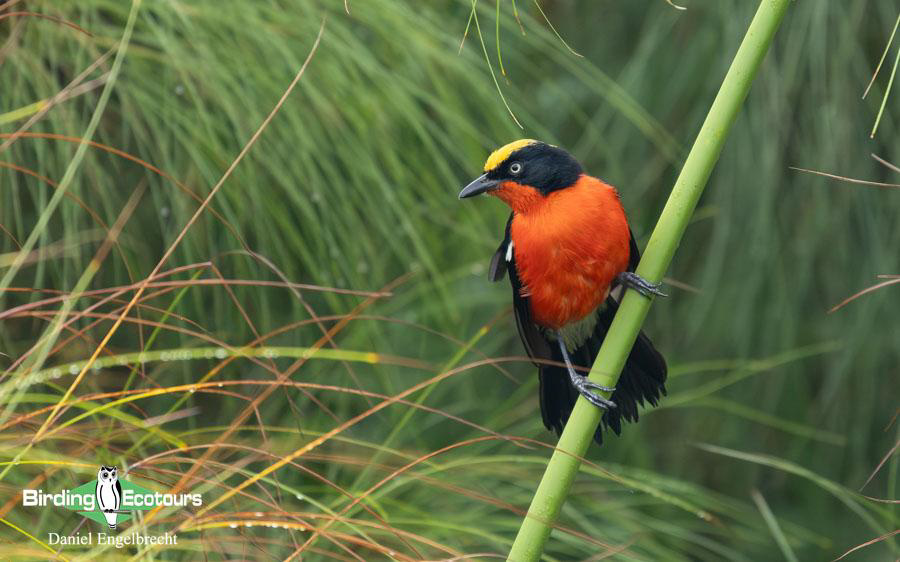
The striking Papyrus Gonolek was seen well in the papyrus swamps of Lake Mburo National Park.
Overview
This 19-day Uganda birding tour visited many of the country’s most famous birding sites in search of an array of localized and iconic species. Combining three savanna parks, Lake Mburo, Queen Elizabeth, and Murchison Falls National Parks, each with subtly different avian assemblages, with a number of exceptionally biodiverse forests, from the cool montane forests of Mgahinga Gorilla National Park to the towering lowland forests of Budongo, allowed us to record a sizeable total of over 500 species.
Early highlights from Entebbe and the famous Mabamba Swamp included the bizarre and highly sought-after Shoebill (we saw no fewer than five individuals over the course of the tour), along with other scarce species such as Blue Swallow and Weyns’s Weaver. Next up was Lake Mburo National Park, which delivered many of our hoped-for targets, including the nomadic Brown-chested Lapwing, African Finfoot, and Papyrus Gonolek, among a variety of other localized species in Uganda, such as Long-tailed Cisticola. We then moved on to the montane forests of Mgahinga Gorilla National Park and Bwindi Impenetrable Forest, which together yielded some of the best birds of the trip, including Handsome Spurfowl, Rwenzori Turaco, Grauer’s Broadbill, Grauer’s Swamp Warbler, Yellow-eyed Black Flycatcher, Regal Sunbird, Red-throated Alethe, and White-collared Oliveback, among many other Albertine Rift endemics. Naturally, there was more papyrus birding to be done in this area too, and we found Papyrus Yellow Warbler and Papyrus Canary.
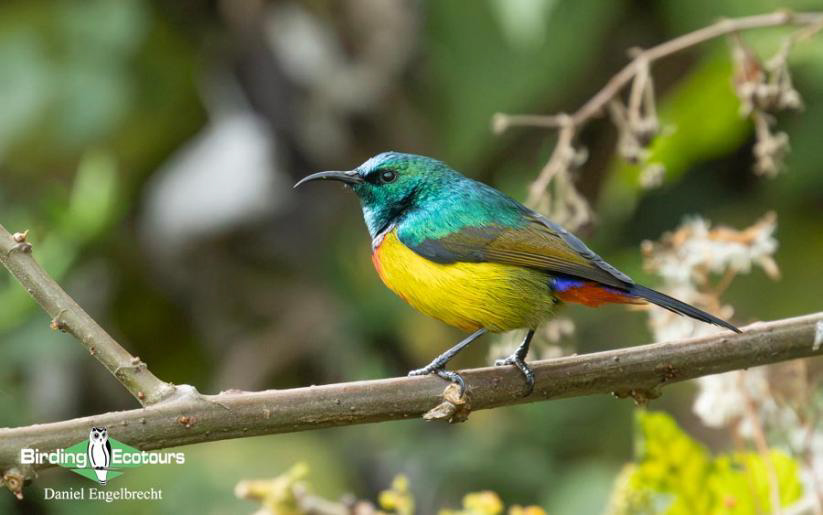
The gorgeous Regal Sunbird was one of several Albertine Rift endemics seen on this tour.
We then moved on to Queen Elizabeth National Park, where noteworthy additions to our list included African Skimmer, White-tailed Lark, Temminck’s Courser, and other typical savanna species such as Lappet-faced Vulture and Saddle-billed Stork. Kibale National Park delivered the hoped-for Green-breasted Pitta, along with Narina Trogon, Jameson’s Wattle-eye, and Speckle-breasted Woodpecker, while the Masindi area produced the tricky Bronze-tailed Starling, Marsh Widowbird, and White-winged Swamp Warbler. The birding at Budongo Forest had us craning our necks for views of Chocolate-backed Kingfisher, Lemon-bellied Crombec, Fraser’s Forest Flycatcher, Rufous-crowned Eremomela, and more, while we had to crouch down in the undergrowth to see the elusive Nahan’s Partridge and African Dwarf Kingfisher.
Our final destination was the scenic Murchison Falls National Park, where we caught up with many great birds, including Abyssinian Ground Hornbill, Denham’s Bustard, Red-winged Grey Warbler, and Purple Starling, and found a Tibetan Sand Plover, which, if accepted, would represent Uganda’s first eBird record and first documented record of the species. Mammals were also well represented on this tour, especially primates, including an unforgettable encounter with Eastern Gorillas at Bwindi, as well as three separate Chimpanzee sightings. The savanna parks gave us the opportunity to see iconic megafauna like African Savanna Elephant, Northern Giraffe, and even a Leopard.
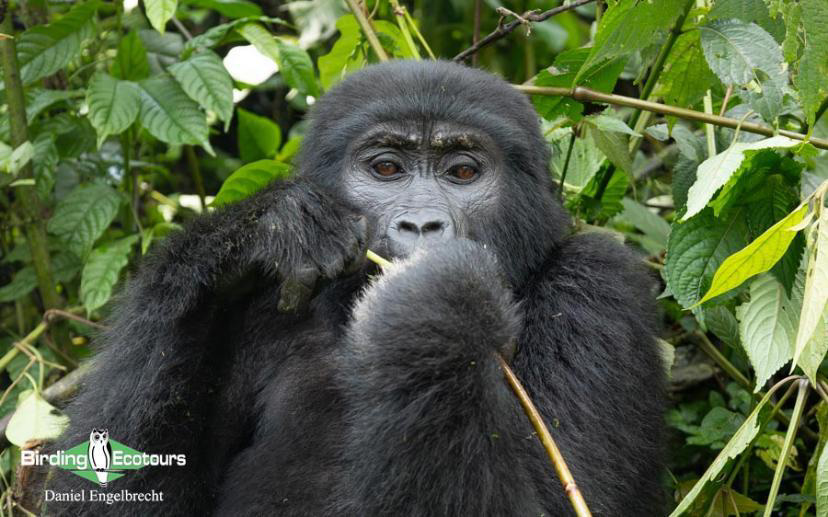
Spending time with Eastern Gorillas in Bwindi Impenetrable National Park was an unforgettable experience!
A detailed daily account follows below, with the bird and mammal species lists located at the end of the report. You can also access our eBird trip report here, which contains a few more photos than this report.
Detailed Report
Day 1, 1st August 2026. Arrival in Entebbe
Our Ugandan adventure started today on the shores of mighty Lake Victoria in the leafy town of Entebbe. Although today was scheduled as the arrival day, David and I had arrived before the start of the tour, and, seeing as we had no plans for the morning, we decided to take a short birding walk at the Entebbe Golf Course, opposite our hotel. Over a little more than two hours, we familiarized ourselves with some of the more widespread species, including Lizard Buzzard, African Green Pigeon, White-browed Coucal, Palm-nut Vulture, Brown-throated Wattle-eye, Green Crombec, Pale-throated Greenbul, Green Hylia, African Thrush, Bronze and Black-and-white Mannikins, Red-cheeked Cordon-bleu, and Grey-headed Nigrita, among others. The highlights, however, came in the form of a pair of African Cuckoo-Hawks and a perched African Goshawk, which offered excellent scope views at close range.
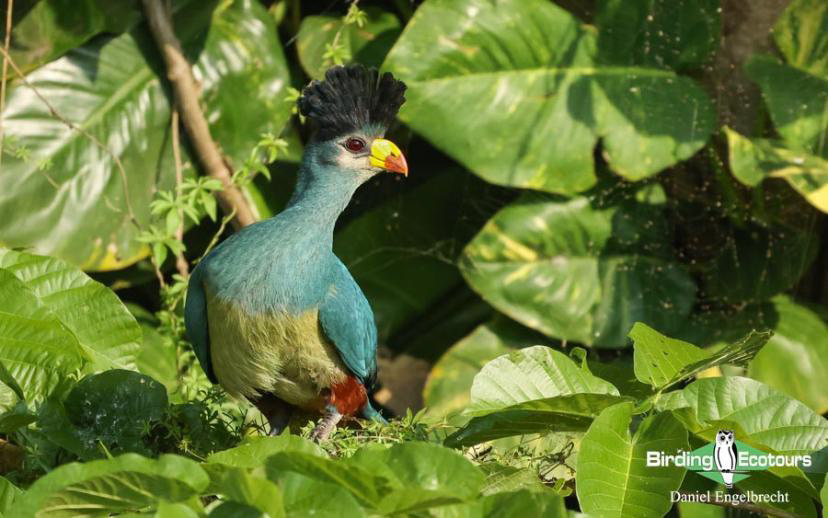
Great Blue Turacos are delightfully common in Uganda.
At noon, we met up with Sue, who had arrived earlier in the morning, and discussed our plans for the trip over lunch. In the afternoon, we made our way to the Entebbe Botanical Gardens, which, unfortunately, were very busy on a Saturday, and we had to dodge loud crowds and blaring music to find our targets. Despite the noise, we managed to see several good birds, including three turaco species: the spectacular duo of Great Blue and Ross’s Turacos, along with the noisy and slightly less attractive Eastern Plantain-eater. The large and raucous Black-and-white-casqued Hornbills were seen in good numbers, along with a single Crowned Hornbill, which called from the top of a dead tree. Other species seen here included several flyover Pink-backed Pelicans, Black Kite, a perched African Hobby, dozens of White-throated Bee-eaters, Woodland and Pied Kingfishers, Grey Parrot, Red-bellied and African Paradise Flycatchers, Grey-backed Camaroptera, and Rüppell’s Starling, to mention a few.
We worked our way through a tree that was teeming with weavers and managed to pick out our main target, the scarce Orange Weaver, among large numbers of Village Weavers. A lone Slender-billed Weaver also put in a brief appearance. Flowering plants attracted a few Olive-bellied Sunbirds, which were much enjoyed, as was a single male Red-chested Sunbird.
After a successful first birding session as a group, we made our way back to the hotel, where we enjoyed dinner together and went to sleep with the prospect of seeing one of Uganda’s most iconic birds tomorrow!
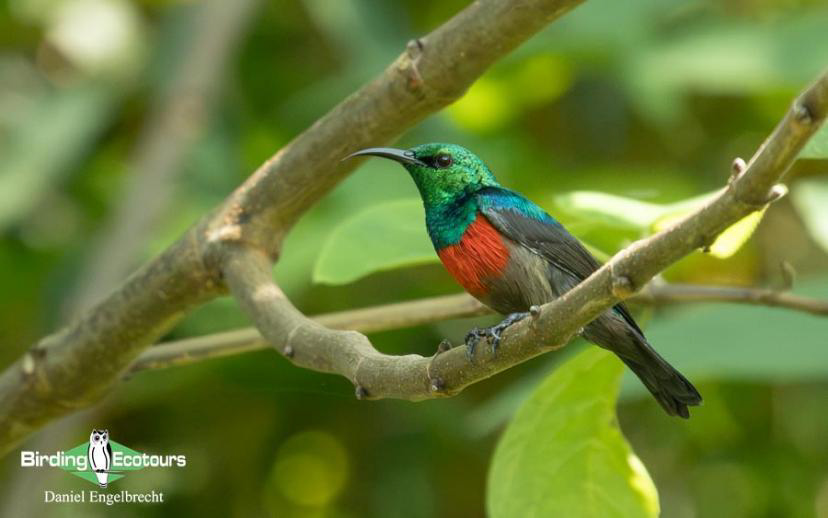
Olive-bellied Sunbird was the first of many sunbird species seen on this tour.
Day 2, 2nd August 2026. Mabamba Swamp and transfer to Lake Mburo National Park
After an early breakfast at our hotel in Entebbe, we made our way to the boat launch on the outskirts of town, where we departed for the legendary Mabamba Swamp. The boat ride across Lake Victoria was uneventful; however, we did add a few new species on our way to the swamp, including Spur-winged Lapwing, Wood and Common Sandpipers, African Openbill, Yellow-billed Stork, and Grey-headed Gull. Eventually, our boat could go no farther along the increasingly narrow channels through the vast papyrus beds, so we transferred to a smaller wooden boat and slowly made our way through the swamp. Almost immediately, we connected with a small flock of Weyns’s Weavers, a localized, unpredictable, and scarce species that we were thrilled to see. We were off to a good start.
The swamp was teeming with birds, and early additions to our list included White-faced Whistling Duck, African Jacana, Black Crake, Long-toed Lapwing, Rufous-bellied, Squacco, Goliath, and Purple Herons, Yellow-billed Egret, African Marsh Harrier, Winding Cisticola, Malachite Kingfisher, Lesser Swamp Warbler, Northern Brown-throated Weaver, and Fan-tailed Widowbird. It didn’t take long for us to spot a tall, gray figure standing among the reeds – a Shoebill! This prehistoric-looking bird, with its outrageously bulky bill, is one of Uganda’s most sought-after birds, and we enjoyed phenomenal close-up views of a single bird standing motionless as it waited for its prey. With our main target in the bag, we continued birding up a storm in the swamp, finding the sought-after Lesser Jacana, along with several Blue-breasted Bee-eaters and a pair of Fulvous Whistling Ducks (a rarity in Uganda).
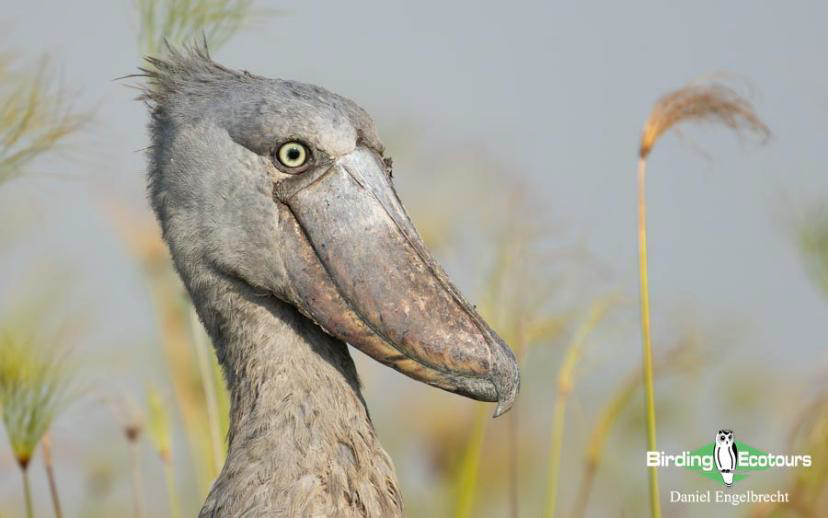
The iconic Shoebill was the star of the show at Mabamba Swamp.
After scanning through flocks of swallows, most of which were Barn Swallows, we struck gold with the rare Blue Swallow, a globally Endangered (BirdLife International) species that is exceptionally difficult to see here on its nonbreeding grounds. In fact, our bird was the first record of the season in Uganda! We docked at Mabamba, where our local guide, Alex, was waiting for us with the car. A quick scan around the Mabamba docks produced Greater Swamp Warbler and Mosque Swallow, both new species for the trip. Our journey then took us toward Lake Mburo National Park, with a quick stop at a wetland near Lyantonde along the way. This produced yet another Shoebill, along with our first Grey-crowned Cranes and a few other widespread species.
We arrived at Lake Mburo National Park in the late afternoon, but made sure we had enough time to scan the arid savannas just before reaching the park. Our primary target here was the scarce Brown-chested Lapwing, and we had walk-away views of no fewer than six birds. On our way to the lodge, we picked up African Wattled Lapwing, Bare-faced Go-away-bird, Meyer’s Parrot, Black-headed Gonolek, Grey-backed Fiscal, and Red-billed Firefinch, among several new trip birds. Lake Mburo also delivered a few mammals before sunset, including Plains Zebra, Impala, Waterbuck, Olive Baboon, and Common Warthog, along with a family group of adorable Common Dwarf Mongooses.
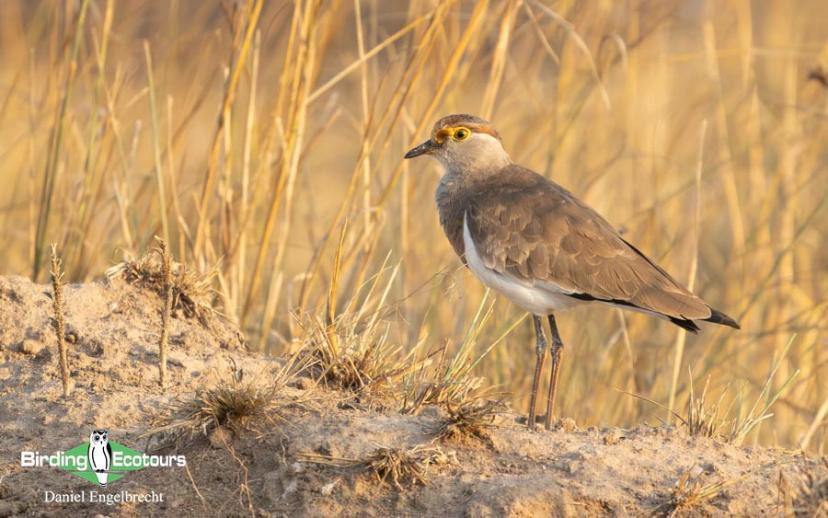
The scarce Brown-chested Lapwing was an early highlight at Lake Mburo National Park.
Day 3, 3rd August 2026. Full day birding in Lake Mburo National Park
After an early breakfast at our lodge, we set off to explore the wooded savannas of Lake Mburo National Park just after dawn. As expected, we had a near-constant stream of activity as we drove around the eastern and central parts of the park, regularly encountering mixed-species flocks along the way, and we recorded around 90 species before lunch. As this was our first exposure to savanna birding in Uganda, most of the species seen were new for the trip. Some noteworthy additions included Red-necked Spurfowl, Black-bellied Bustard, Striped Kingfisher, Nubian and Cardinal Woodpeckers, Spot-flanked and Crested Barbets, Lesser Honeyguide, Orange-breasted Bushshrike, Sooty Chat, White-winged Black Tit, Long-tailed Cisticola, Buff-bellied Warbler, Yellow-breasted Apalis, Grey Penduline Tit, Yellow-throated Longclaw, Greater Blue-eared Starling, Green-winged Pytilia, Little, Lesser Masked, and Red-headed Weavers, and Red-cheeked Cordon-Bleu. Large sections of the park had burned recently, creating plenty of suitable habitat for Senegal Lapwings, and we saw several individuals, some with chicks.
Before lunch, we decided to bird the papyrus beds surrounding the lake, which yielded no fewer than three Shoebills (totally unexpected!), along with our first Swamp Flycatcher and, after a bit of work, the sought-after and localized Papyrus Gonolek. The thickets surrounding the lake also yielded a few new species, including African Pygmy Kingfisher, Green Wood Hoopoe, Klaas’s Cuckoo, and several flyover White-headed Saw-wings.
After lunch, we embarked on a boat trip on Lake Mburo, which offered opportunities to improve our views of a few widespread waterbird species and, of course, produced the shy African Finfoot. Lake Mburo must be one of the best places in the world to see this otherwise tricky species, and we saw four individuals during our boat trip. Before dinner, a mixed-species flock in the lodge grounds gave us Ashy and Grey Tit-Flycatchers, along with several species we had seen earlier.
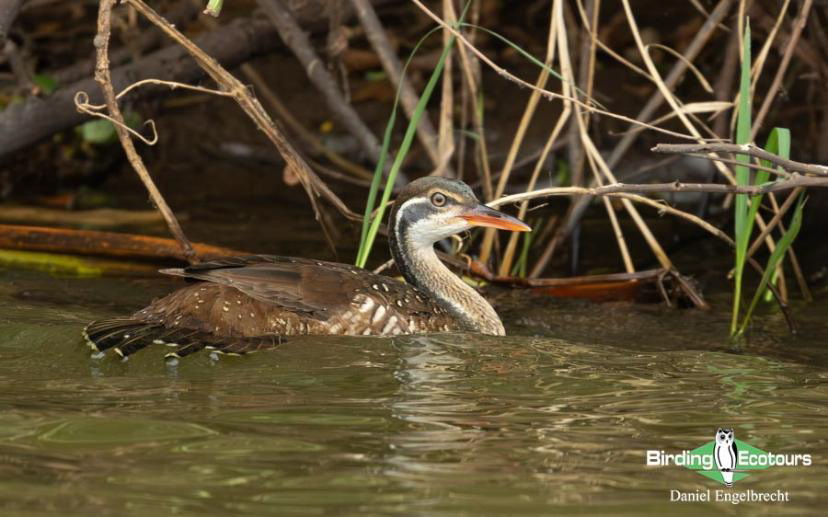
We had excellent views of this female African Finfoot during our boat trip on Lake Mburo.
After dinner, we did a night drive in the park, which unfortunately failed to deliver much of interest. We did, however, see many Common Hippopotamuses and a Thick-tailed Greater Galago. After a long but exceptionally rewarding day, we headed to bed in preparation for a long drive to the forests of the Albertine Rift tomorrow.
Day 4, 4th August 2026. Transfer to Kisoro
Today was primarily a travel day, with limited birding as we made our way from Lake Mburo National Park to the far southwestern corner of Uganda. As we traveled west toward our lunch stop in the town of Kabale, we added a few new species to the trip list, including Angola and African Red-rumped Swallows and White-necked Raven.
Before lunch, we attempted to twitch a vagrant African Pitta that had taken up residence on Bushara Island in Lake Bunyonyi. Unfortunately, despite the bird being present that morning, we had no luck finding it. The boat ride to the island did, however, produce a surprise Spotted-necked Otter, and we added a few new species, including White-eyed Slaty Flycatcher, Green White-eye, Brown-throated Wattle-eye, Cape Wagtail, and Bronze Sunbird.
In the late afternoon, we passed through Echuya Forest on the way to our lodge, where we had our first forest birding session of the trip. Here, we soon added our first Albertine Rift endemics, including Rwenzori Batis, Red-faced Woodland Warbler, Regal Sunbird, and Albertine Sooty Boubou, along with a Blue Monkey. We also saw our first Chubb’s Cisticolas and Streaky Seedeaters, both of which would be abundant over the next few days. Just before reaching our accommodation, we enjoyed our first views of a perched Augur Buzzard, before spending the final hour of the day relaxing at the lodge.
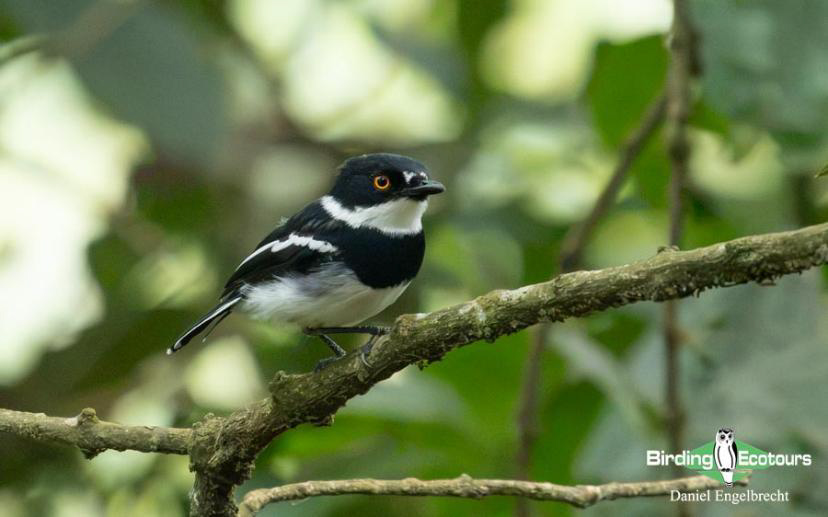
Rwenzori Batis was one of our first Albertine Rift endemics!
Day 5, 5th August 2026. Birding at Mgahinga National Park
After a pre-dawn breakfast, we made our way to the entrance of Mgahinga National Park. This scenic park is bordered by Rwanda to the south and the Democratic Republic of the Congo to the east and lies in the foothills of three towering dormant volcanoes. We set off on foot and birded along the main trail, which winds its way through montane forest, bamboo, and patchy grassland. Over the course of six hours, we found ourselves adding a near-constant stream of new birds. Early additions on the lower sections of the trail included African Olive Pigeon, Western and Yellow-rumped Tinkerbirds, Black Cuckooshrike, White-tailed Crested Flycatcher, Mountain Masked Apalis, Kikuyu Mountain Greenbul, Rwenzori Hill Babbler, Abyssinian Thrush, and Strange Weaver. A small flock of seed-eating birds yielded our first Dusky Crimsonwings, along with several Kandt’s Waxbills.
It didn’t take long for us to get our first views of the main target, the stunning Rwenzori Turaco; however, we only had brief flyby views as a flock of four birds darted across the trail. We would have to do better. While following the call of a turaco off-trail, we flushed a male Pennant-winged Nightjar. This sought-after bird is scarce at the best of times and was completely unexpected in the montane forests of Mgahinga! The turaco refused to show (for now); however, we did see the range-restricted Blue-headed Sunbird, and we had brief views of a vocal Doherty’s Bushshrike. We pushed on farther up the trail and into the bamboo zone, where we had good views of a skulking Cinnamon Bracken Warbler.
We reached our turnaround point and started making our way back down when we heard another Rwenzori Turaco calling nearby. It took us a little while to find the bird, but we were rewarded with exceptional views of this coveted Albertine Rift endemic. Our perseverance had paid off. On the way back down, we added a few new species, including the shy Archer’s Ground Robin, Rwenzori Apalis, and Rwenzori Double-collared Sunbird.
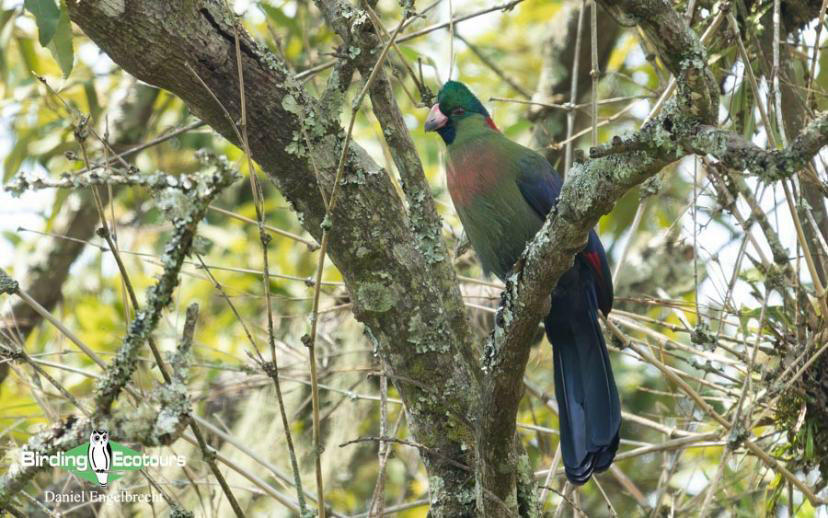
After a lengthy search, we were rewarded with exceptional views of Rwenzori Turaco.
Before heading back to our accommodation, we took a stroll around the gardens at the entrance to the park and found a Cape Robin-Chat, a localized species in Uganda. The drive back to the lodge yielded several Baglafecht Weavers, African Stonechat, and Cinnamon-chested Bee-eater.
We enjoyed a bit of downtime in the afternoon before spending an hour birding around the lodge grounds. The lodge was remarkably birdy, and we saw our first African Spoonbill, White-tailed Blue Flycatcher, Grey-capped Warbler, and Black-crowned Waxbill, among others. Just as the sun was setting, we found a pair of scarce White-collared Olivebacks and enjoyed good views of this tricky species.
Day 6, 6th August 2026. Transfer to Ruhija, Bwindi Impenetrable National Park
The plan for today was to travel north to Ruhija, a small town on the outskirts of the famous Bwindi Impenetrable National Park. Although the drive itself would only take around two hours, we had several birding stops planned along the way and intended to arrive in Ruhija in the afternoon. After leaving our comfortable lodge north of Kisoro, we stopped at a large wetland near the town of Kanaba, where new additions included Blue-billed Teal, Red-knobbed Coot, Little Grebe, and Thick-billed Weaver.
Next up was Echuya Forest, where we spent two hours birding from the main road that runs through this pristine patch of montane forest. Almost as soon as we got out of the car, we added the brightly colored Mountain Oriole and White-starred Robin, both of which were new for the trip. We then spent a few minutes tracking down a vocal Barred Long-tailed Cuckoo, which rewarded us with great views when David spotted it calling below the canopy. Other noteworthy species here included Mountain Buzzard, Tambourine Dove, Mountain Yellow Warbler, and Rwenzori Apalis, among many species seen the previous day at Mgahinga. We also heard the elusive Grauer’s Swamp Warbler calling from a marshy drainage line; however, we would have to wait for views of this species.
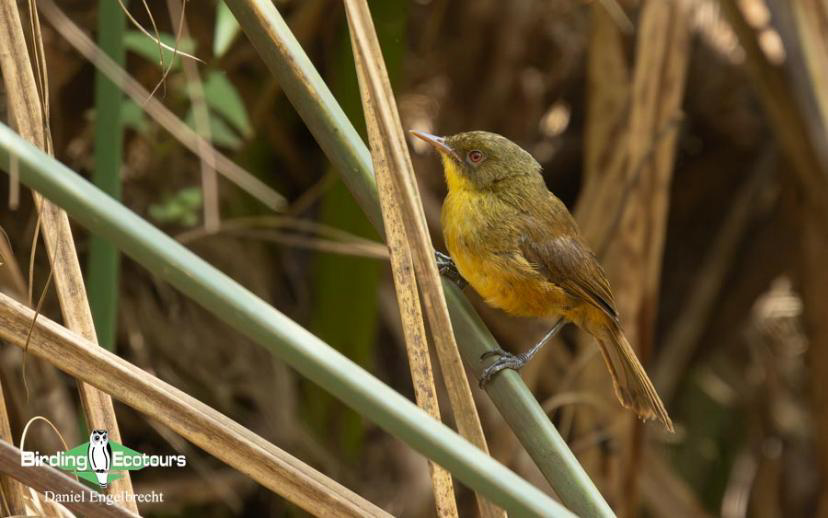
We were thrilled with the views we had of Papyrus Yellow Warbler.
After a productive session at Echuya, we visited a papyrus swamp near the town of Rubanda, where we quickly found Highland Rush Warbler, Carruther’s Cisticola, and Papyrus Canary. We explored the surrounding farmlands, papyrus, and reedbeds and added a few other species, including African Woolly-necked Stork, Black-headed Heron, Blue-headed Coucal, Northern Fiscal, and Common Waxbill. Despite hearing several Papyrus Yellow Warblers, the birds were not cooperating, and we resigned ourselves to adding this species as heard-only. However, while having our packed lunches at the swamp, I decided to investigate another section of the swamp close to our car, and sure enough, I found a responsive Papyrus Yellow Warbler, which we all managed to see exceptionally well.
We entered the Ruhija sector of Bwindi Impenetrable National Park in the afternoon, but not before finding a small flock of Yellow-bellied Waxbills in a sorghum field near the entrance. We slowly birded along the main road through the forest and added Eastern Yellow-billed and Grey-headed Barbets, Slender-billed Greenbul, and Sharpe’s Starling before connecting with the sought-after Purple-breasted Sunbird. We also had our first views of the smart-looking L’Hoest’s Monkey while driving to our lodge.
Activity was low overall, so we decided to continue through to our lodge on the other side of the forest in the town of Ruhija. We enjoyed a delicious dinner at our lodge before turning in early, as we had a busy day ahead of us tomorrow.
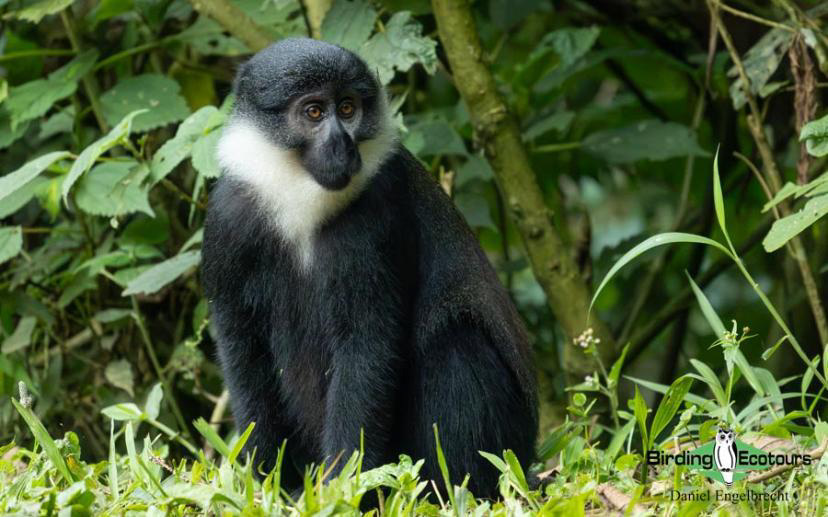
L’Hoest’s Monkeys were regularly encountered at Bwindi Impenetrable National Park.
Day 7, 7th August 2026. Full day birding in the Ruhija Sector of Bwindi Impenetrable National Park
We decided to split up for the morning. David and I would undertake the long and steep walk down to Mubwindi Swamp, while Sue opted to bird from the main road with Alex. Our walk down to the swamp took us through pristine montane forests, and we added a good number of new species. The upper reaches of the trail, where we started, yielded our first Chestnut-throated Apalises, whose trilling calls are a constant feature while birding at Ruhija.
We took the better part of four hours to reach the swamp, with plenty of distractions along the way, including White-headed Wood Hoopoe, Mackinnon’s Shrike, White-bellied Crested Flycatcher, Stripe-breasted Tit, White-chinned Prinia, Black-throated Apalis, Banded Prinia, Black-faced Rufous Warbler, Equatorial Akalat, Yellow-streaked Greenbul, Northern Double-collared Sunbird, Waller’s Starling, Brown-capped Weaver, and a lone Oriole Finch, along with many of the Albertine Rift endemics we had seen earlier in the trip, including Blue-headed Sunbird and Rwenzori Apalis. Our first Kivu Duiker put in a brief appearance; however, we would have better views of the species over the next few days.
As we had hoped, once we reached the lower reaches of the trail, we found a small group of Yellow-eyed Black Flycatchers, a tricky Albertine Rift endemic. We then picked up the easily undetected, high-pitched call of our main target and, after several minutes scanning the canopy of a towering tree, were rewarded with views of a pair of Grauer’s Broadbills. Success!
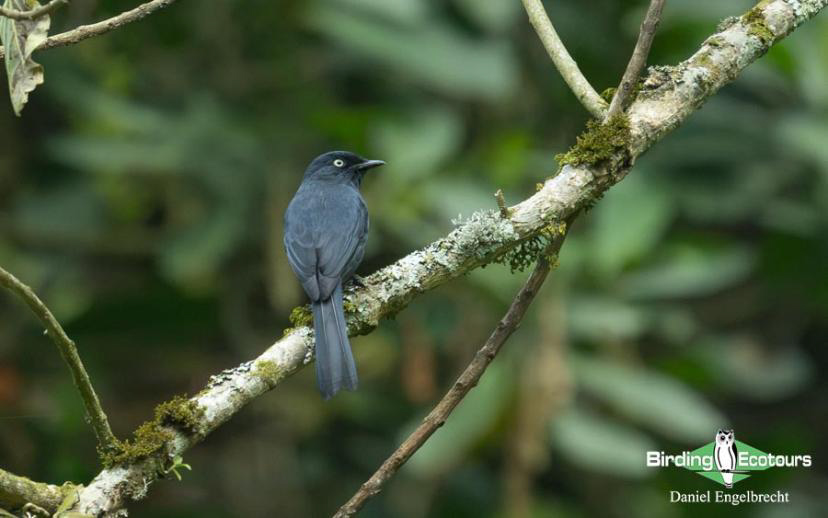
The localized Yellow-eyed Black Flycatcher was one of our main targets on the Mubwindi Swamp walk.
We then pushed on to the end of the trail, reaching the scenic Mubwindi Swamp and seeing another Grauer’s Broadbill a little farther down. We had our packed lunch overlooking the swamp, where, after a few minutes, we managed to see another of our big targets, Grauer’s Swamp Warbler.
After lunch, we began the steep hike back up to the main road. Alex and Sue also had a rewarding morning birding along the main road, with some of their notable sightings including the Albertine Rift endemic Handsome Spurfowl, along with a flyover Cassin’s Hawk-Eagle, Elliot’s Woodpecker, and Thick-billed Seedeater. Before dinner, we decided to try a spot for Montane Nightjar at dusk, and we had walk-away views of a single individual.
Day 8, 8th August 2026. Transfer to the Buhoma Sector of Bwindi Impenetrable National Park
After an early breakfast at the lodge, we spent some time birding along the main road through the forest at Ruhija. An early highlight was a flock of Oriole Finches feeding in a fruiting tree, and we enjoyed great views of this tricky species. Other noteworthy species included brief views of a Handsome Spurfowl darting across the road, Albertine Sooty Boubou, Sharpe’s Starling, a calling Grauer’s Warbler, and Strange Weaver. A troop of elegant Guerezas was another welcome distraction. The birding was exceptionally slow, possibly due to a very cool breeze, so we decided to start the drive to Buhoma, the lower-lying eastern sector of Bwindi.
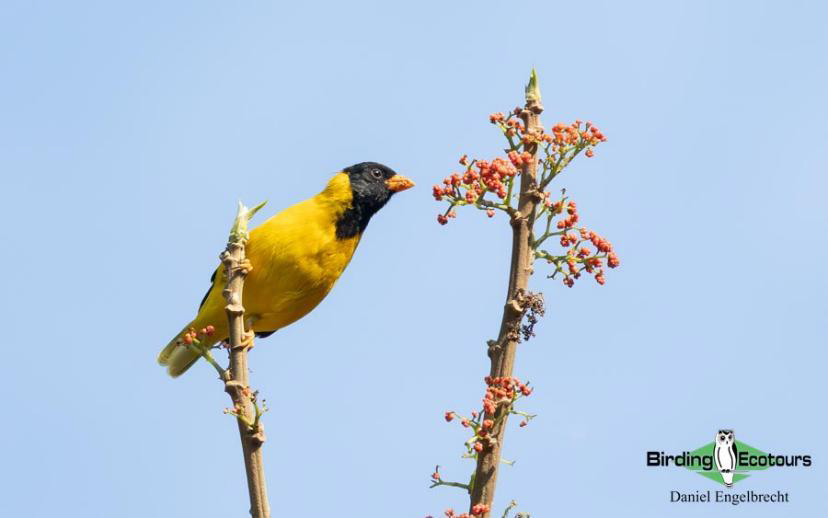
Oriole Finch was an unexpected sighting at Ruhija.
On the way, we made a quick stop at a village, where we soon found a male Arnot’s Chat of the collaris subspecies, which is sometimes regarded as a separate species, the Ruaha Chat. Next up was “The Neck,” a small section of Bwindi Impenetrable National Park bisected by the main road between Ruhija and Buhoma. We spent some time birding along the road, which yielded our first Dusky Long-tailed Cuckoo, and we had excellent views of this vocal but elusive bird. A soaring Ayres’s Hawk-Eagle provided some entertainment, and we had good scope views of a Black Bee-eater as it hawked insects.
We spent some time scanning a fast-flowing stream for Cassin’s Flycatcher, which would remain elusive for now; however, we did see our only Shining-blue Kingfisher as it darted across the bridge. Other notable additions included a flock of Narrow-tailed Starlings inspecting a nesting cavity, Speckled Tinkerbird, Grey-chinned and Blue-throated Brown Sunbirds, and a striking Red-headed Malimbe.
We checked into our accommodation in Buhoma and, after waiting for a torrential downpour to subside, headed out for our first birding session along the entrance road to the forest. Soon after arriving, we heard a White-spotted Flufftail calling from some dense tangles along a stream, and we managed to tape the bird into view. The post-rain activity was high, and we rapidly added a stack of new birds, including African Goshawk, Petit’s Cuckooshrike, Black-and-white Shrike-flycatcher, Pink-footed Puffback, Buff-throated and Grey Apalises, Plain Greenbul, and Dusky-blue Flycatcher.
The highlight of the afternoon was a gorgeous Many-colored Bushshrike, which showed uncharacteristically well. After a productive introductory birding session at Buhoma, we headed back to our accommodation, very much looking forward to our gorilla trekking expedition tomorrow.
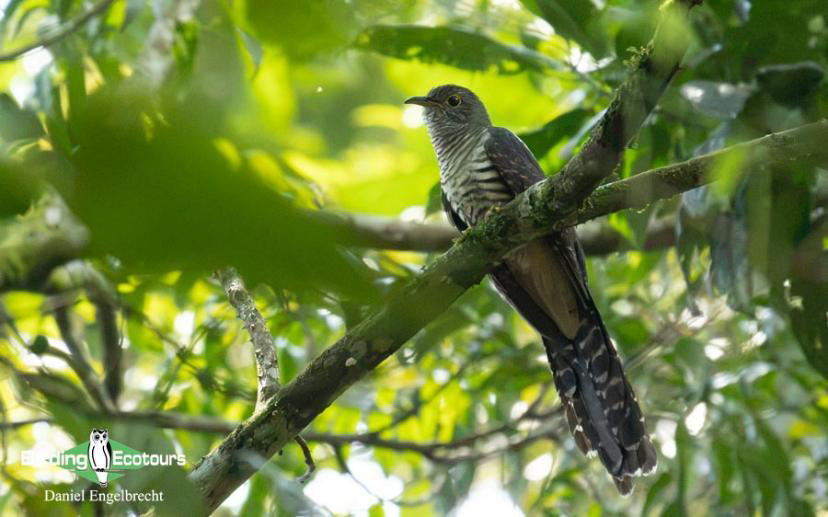
We managed to see all three members of the genus Cercococcyx on this tour – this is Dusky Long-tailed Cuckoo.
Day 9, 9th August 2026. Eastern Gorilla trekking at Buhoma
Today was set aside entirely for the unforgettable Eastern Gorilla trekking experience at Buhoma. We spent most of the day walking to and from the gorillas, navigating steep forest trails, leaving next to no time for birding. We tracked the Muyambi group and had the privilege of spending an hour watching them go about their business, seemingly unfazed by our presence. The only new birds for the trip list were a few Variable Sunbirds feeding on flowers at the start of the trail and a single Mountain Wagtail, which we saw at a stream crossing.
Day 10, 10th August 2026. Full day birding at Buhoma
We had the full day to bird the Buhoma Track, and after an early breakfast, we set off on our walk through the forest. Conditions were superb, and the forest was alive with activity. Afep Pigeons called from the canopy but remained frustratingly out of view; however, we did at last manage to get views of a stunning Black-billed Turaco, a species we had been hearing regularly over the past few days. An attractive Blue Malkoha showed well early on, and we were thrilled to get views of an Olive Long-tailed Cuckoo, giving us a clean sweep of all three members of the genus Cercococcyx!
A large fruiting tree produced several striking Yellow-spotted Barbets, and we also managed brief glimpses of a Bar-tailed Trogon. The understory held several skulking birds, and over the course of the day, we added Red-throated Alethe, Green Hylia, Cabanis’s, Red-tailed, and Shelley’s Greenbuls, Mountain and Scaly-breasted Illadopsises, White-bellied and Grey-winged Robin-Chats, and Black-billed Weaver, among many others. Small, drab flycatchers were well represented, and we saw African Dusky, Sooty, Dusky-blue, and the scarce Chapin’s Flycatcher. We also added Red-tailed Monkey to our rapidly growing primate list.
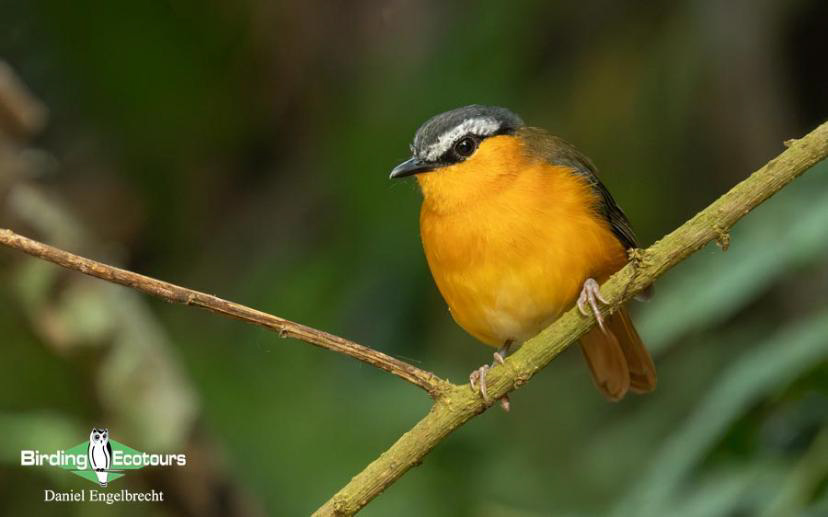
Grey-winged Robin-Chat showed well for us at Buhoma.
Near our turnaround point, we heard the distinctive, loud call of a Neumann’s Warbler; however, the bird called only once, and we were unable to obtain views of this secretive species. On our way back, a mixed-species flock produced Fine-banded, Elliot’s, and Buff-spotted Woodpeckers. After an action-packed day, we headed back to the lodge in the late afternoon.
Day 11, 11th August 2026. Transfer to Queen Elizabeth National Park
We decided to spend half an hour birding along the entrance road at Buhoma this morning before starting the drive north to Queen Elizabeth National Park. We saw many of the species we had encountered over the past few days but greatly improved our views of Grey-winged Robin-Chat, and we added Lühder’s Bushshrike, Olive-green Camaroptera, and Toro Olive Greenbul to the trip list.
The drive to Queen Elizabeth National Park passed without event, and upon entering the park just north of the town of Kihihi, we started adding new species to our list, including Pearl-spotted Owlet, Red-headed Lovebird, and Croaking Cisticola. A perched African Hobby (our second of the trip) was a welcome sighting, and there were large flocks of White-throated and Olive Bee-eaters along the roadside as we traveled through the park. A planned stop in an area of rank grass produced a Stout Cisticola (our only one of the trip), and we had no problem connecting with the hoped-for Lowland Sooty Boubou as we passed through one of the park’s forested sections.
We arrived at the Mweya section of the park in time for our afternoon boat trip along the Kazinga Channel, a 20-mile (32-kilometer) waterway connecting Lake George and Lake Edward. As expected, we added several new waterbirds and waders to our list, including Great White Pelican, Great Egret, Black-winged Stilt, Ruff, Common Greenshank, Common Sandpiper, and Little Stint. The undisputed highlight was seeing a large flock of African Skimmers, always a crowd-pleaser! We also saw good numbers of African Savanna Elephants, Cape Buffalos, and Common Hippopotamuses. In the evening, we took a short walk around the lodge grounds, where we saw our first Brimstone Canary and even had a flyover Gull-billed Tern. We enjoyed another tasty dinner with a spectacular view over Lake Edward before turning in early.
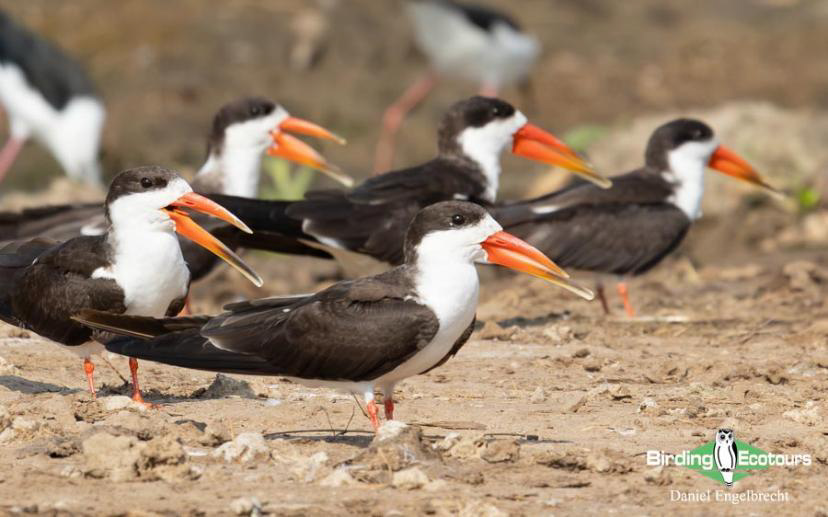
We saw good numbers of African Skimmers on the Kazinga Channel.
Day 12, 12th August 2026. Birding at Queen Elizabeth National Park and transfer to Kibale National Park
Our plan today was to spend the morning birding the plains of Queen Elizabeth National Park before traveling to Kibale National Park after lunch. We first birded the scrubbier Euphorbia thickets around Mweya, where we saw Grey-headed Kingfisher, Brown-crowned Tchagra, Arrow-marked Babbler, Purple-banded Sunbird, and Crimson-rumped Waxbill, among others. We then turned our attention to the rank grasslands, which yielded a few good birds, including Marsh Tchagra, Flappet Lark, Moustached Grass Warbler, Fan-tailed Grassbird, Holub’s Golden Weaver, and Fawn-breasted Waxbill. A saline crater lake produced a distant flock of Lesser Flamingos, and upon entering the Kasenyi section of the park, we connected with our main target – White-tailed Lark.
Over the course of a few hours, we found many new birds in the Kasenyi section, including Saddle-billed Stork, Lappet-faced Vulture, Grey Kestrel, Mourning Collared Dove, African Crake, Common Buttonquail, Temminck’s Courser, Rufous-naped Lark, Zitting Cisticola, Copper Sunbird, Quailfinch, and Cinnamon-breasted Bunting, to name a few. We were also fortunate to spend some time with a Leopard, which appeared to be eyeing a large herd of Kob.
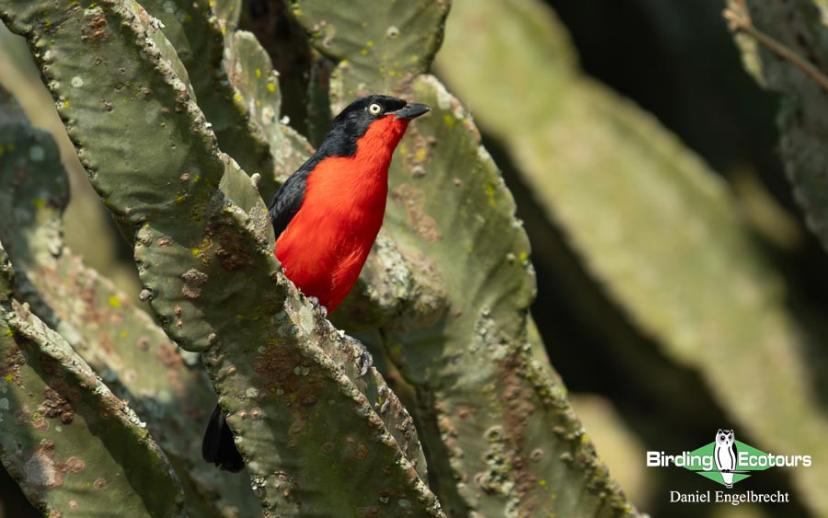
Colorful Black-headed Gonoleks were common in the savanna parks on this tour.
After having our packed lunches in the park, we started the drive to Kibale, passing the towering Rwenzori Mountains, their peaks shrouded in clouds. As we approached our accommodation on the edge of Kibale, we picked up a surprise Blue-throated Roller perched atop a dead tree, our only one of the trip, along with a breeding colony of Vieillot’s Black Weavers. In the afternoon, we took a walk around the lodge grounds, which produced our first Sabine’s Spinetail in a large flock of aerial feeders, as well as Brown-backed Scrub Robin and Little Green and Green-throated Sunbirds.
Day 13, 13th August 2026. Full day birding at Kibale National Park
We were up early this morning for a pre-dawn breakfast before heading to the start of the Njojo Trail in Kibale National Park. Our main target was one of Uganda’s most sought-after species, the rare Green-breasted Pitta. The local guide took us to a site where he had seen it the day before; however, we were met with silence. While waiting in vain for the pitta to start displaying, we distracted ourselves with other birds, including Afep Pigeon, which only gave us a brief flyby view, Yellow-crested Woodpecker, Yellow-throated Tinkerbird, White-throated Greenbul, Splendid Starling, and Fraser’s Rufous Thrush, among others. A vocal Narina Trogon caught our attention, and, after following its hooting call through the forest for a while, we eventually saw it perched in the canopy.
As we were watching the trogon, a Green-breasted Pitta started displaying nearby, and after a frantic scramble through the undergrowth, we had exceptional views of this most-wanted bird. What a relief! We then decided to go and see the astonishingly loud Chimpanzees we had been hearing all morning, and after a short walk, we managed to spot several individuals gorging themselves on figs. We spent a while watching them and also picked up a showy Blue-shouldered Robin-Chat and a troop of Ugandan Crested Mangabeys in the process.
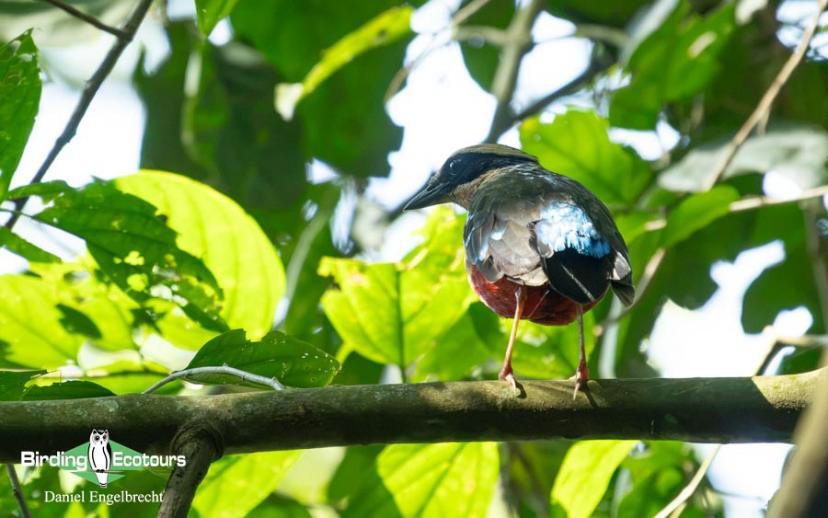
We were lucky to have prolonged views of this displaying Green-breasted Pitta.
After a delicious lunch at the lodge, we set out along the main road through Kibale National Park for an afternoon birding session. First, we explored some of the thickets on the forest edge, where we quickly found our targets: Jameson’s Wattle-eye and Lowland Masked Apalis. We then focused our attention on the primary forest, where we saw African Emerald Cuckoo, Hairy-breasted Barbet, Velvet-mantled Drongo, Dusky Tit, Purple-headed Starling, and Superb Sunbird, among many of the species that we had already seen, before returning to the lodge in time for dinner.
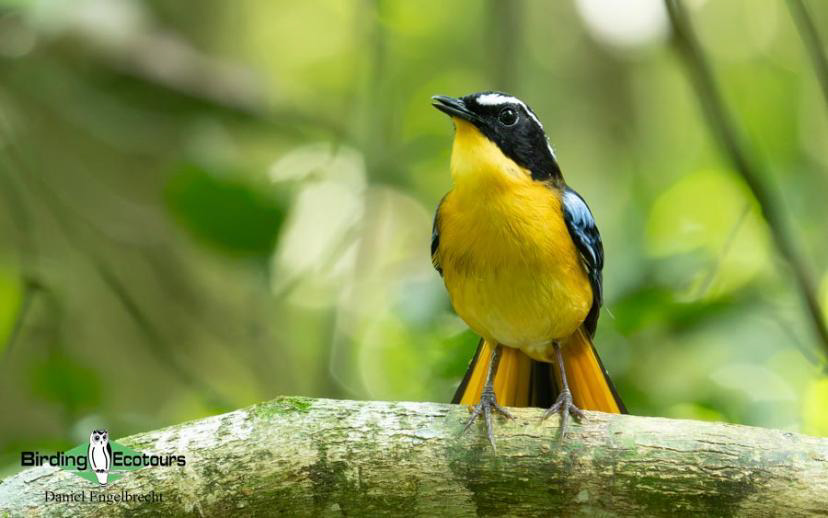
This stunning Blue-shouldered Robin-Chat was uncharacteristically showy.
Day 14, 14th August 2026. Morning birding at Kibale and transfer to Masindi
Our plan for the day was to spend some time birding the farmlands and thickets around the town of Bigodi before starting the long drive to Masindi. Our first stops yielded a few new birds, including the striking Double-toothed Barbet, as well as a perched Red-chested Cuckoo, a foraging African Blue Flycatcher, and a nest-building Compact Weaver. The highlight of the morning was a female Speckle-breasted Woodpecker (a notoriously tricky species to see), which we watched for a few minutes as she perched atop a dead tree. We then traveled north through Kibale National Park, making a few strategic stops along the way to add Joyful Greenbul and Cassin’s Flycatcher to our list.
After stopping for lunch, we investigated a roadside papyrus swamp near Hoima, which produced the hoped-for White-winged Swamp Warbler. Most of the afternoon was spent on the road; however, we did squeeze in an exceptional stop at a wetland near Masindi, where we saw Red-headed Lovebird, Banded Martin, Brown Twinspot, African Firefinch, and three widowbird species: Red-collared, Yellow-mantled, and our main target, Marsh Widowbird.
David’s sharp eyes picked up an intricately patterned male Greater Painted Snipe hiding among the rushes, and perhaps the most unexpected find was a flock of Bronze-tailed Starlings, a scarce and easily overlooked species in this part of Uganda. After a long day on the road, we were eager to get an early dinner and some good rest in preparation for an exciting morning at Budongo Forest.
Day 15, 15th August 2026. Morning birding at Budongo Forest and transfer to Murchison Falls National Park
We had an early breakfast this morning before meeting our local guide, Raymond, in a sorghum field just after sunrise. We easily found our main targets, Grey-headed Oliveback and Orange-breasted Waxbill, before heading to the entrance of Budongo Forest and the famous Royal Mile—a dirt road that cuts through Budongo Forest.
Initially, activity was frustratingly low; however, about half an hour into our walk down the Royal Mile, we heard a covey of Nahan’s Partridges calling. After positioning ourselves at a clearing in the forest, we were able to tape them into view. This is an immensely difficult bird to see, and we were thrilled to have connected with this rare species.
Raucous flocks of White-thighed Hornbills bounced around in the canopy, joined by the more widespread Black-and-white-casqued Hornbills. Gradually, we caught up with a few mixed-species flocks, which yielded Black Cuckoo, Western Oriole, African Shrike-flycatcher, Lemon-bellied Crombec, Grey Longbill, Rufous-crowned Eremomela, Honeyguide, Spotted and Little Grey Greenbuls, Chestnut-capped Flycatcher, Fraser’s Forest Flycatcher, Grey-throated Tit-Flycatcher, and Red-headed Bluebill.
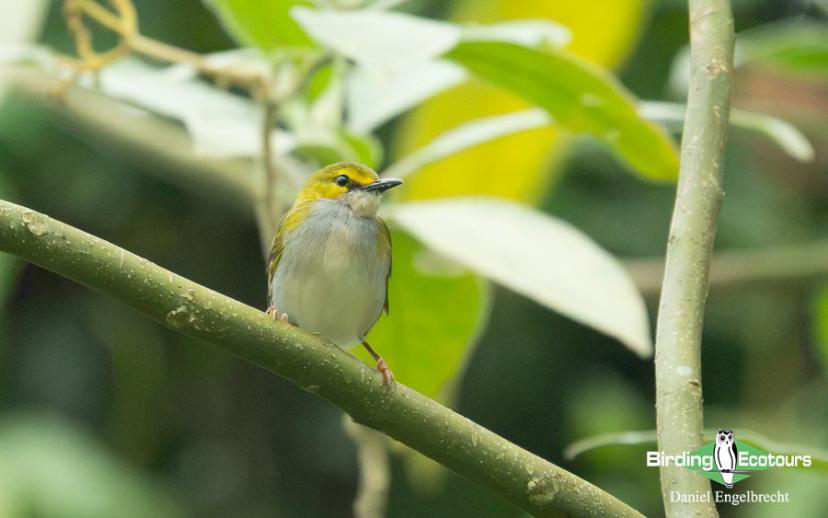
Yellow-browed Camaroptera was one of many new species seen at Budongo Forest.
As always, kingfishers were well represented, and we managed to see several of the widespread African Pygmy Kingfishers, along with two scarcer forest kingfishers: the gorgeous Chocolate-backed Kingfisher and the unobtrusive African Dwarf Kingfisher. A Uganda Woodland Warbler called once from the canopy but remained unseen, and, unfortunately, Ituri Batis, which seems to have become unreliable at this site, was not found.
After a rewarding session at the Royal Mile, we began the drive north to Murchison Falls National Park, stopping briefly to see Yellow-browed Camaroptera in the Busingiro section of Budongo Forest. We then birded the open woodlands of the Butiaba Escarpment, where we saw Dark Chanting Goshawk, Foxy Cisticola, Beautiful Sunbird, Vitelline Masked Weaver, and Black-winged Red Bishop, among others.
After reaching the low-lying plains around Lake Albert, we visited a local market near the town of Bulisa, where we quickly saw our target, White-rumped Seedeater, as well as our first Vinaceous Dove, Piapiac, and Silverbird. It was nearing sunset by the time we reached our lodge in Murchison Falls National Park, and a single Abyssinian Ground Hornbill on the roadside provided some last-minute excitement. Tomorrow, we would have the full day to explore this wonderful park.
Day 16, 16th August 2026. Full day birding at Murchison Falls National Park
Today we focused our attention on the northern plains of Murchison Falls National Park. Our first stop saw us birding the lush riverine vegetation along the Victoria Nile, where we had our first sightings of Blue-breasted Kingfisher and the localized Red-winged Grey Warbler. As we left the riverine woodlands behind, the vegetation transitioned to vast plains dotted with tall Borassus palms. We encountered a near-constant stream of new birds, with early additions including Black Scimitarbill, Rattling and Short-winged Cisticolas, Speckle-fronted Weaver, Chestnut-crowned Sparrow-Weaver, Northern Red Bishop, and Bar-breasted Firefinch.
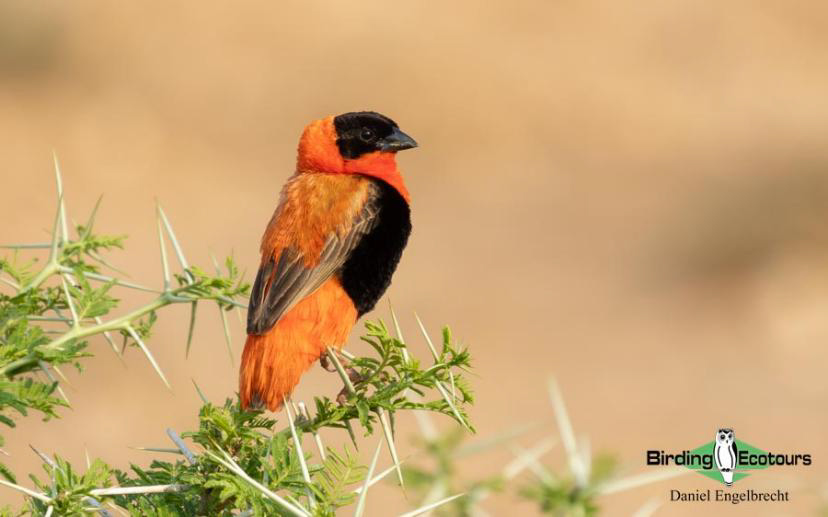
We enjoyed the many colorful Northern Red Bishops at Murchison Falls National Park.
Large numbers of vultures were feeding on an unidentifiable carcass, and we saw Palm-nut, White-headed, Hooded, White-backed, and Rüppell’s Vultures squabbling over scraps. A heavily grazed section of the park yielded a pair of Denham’s Bustards, which showed very well, alongside a few neat-looking Black-headed Lapwings. As expected, we had many excellent mammal encounters today, including close-up views of Northern Giraffe, African Savanna Elephant, Cape Buffalo, Hartebeest, Waterbuck, and hundreds of Oribi and Kob.
Closer to the Lake Albert shoreline, the plains gave way to Umbrella thorn woodlands, which held several new species, including Black-billed Wood Dove, Swallow-tailed Bee-eater, Black-billed Barbet, Black-crowned Tchagra, Spotted Palm Thrush, and Black-rumped Waxbill. We had our packed lunches on the Lake Albert shoreline, where we enjoyed good flyover looks at Collared Pratincoles and watched several Gull-billed Terns flying past. A single Namaqua Dove was another welcome addition and our only sighting of this species on the trip.
As we left our lunch spot, we stopped to scan a small, muddy pond with a few waders around it. Immediately, we picked up an odd-looking plover among the Common and Wood Sandpipers. After getting a few record shots, there was no doubt that we had just found a Tibetan Sand Plover, the first record of the species for Uganda on eBird! There is one previous claim of the species from Queen Elizabeth National Park in 1969; however, our record would appear to be the first supported by photographic evidence.
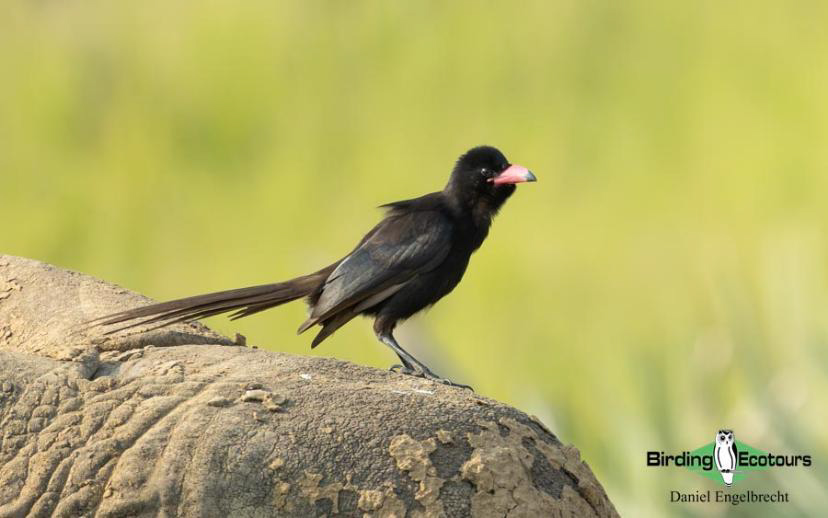
Piapiacs were abundant at Murchison Falls National Park.
After the excitement of the rarity, we slowly headed to the boat launch on the Victoria Nile for our afternoon boat cruise to Murchison Falls, picking up a few Northern Carmine Bee-eaters and a Wahlberg’s Eagle along the way.
The boat cruise yielded many of the same waterbirds that we had seen earlier in the trip, along with our first Senegal Thick-knee, White-winged Tern, and Osprey. We also had several vibrant Red-throated Bee-eaters, some of which offered decent photo opportunities. Another highlight of the boat trip was seeing the mighty Murchison Falls, one of the world’s most iconic and powerful waterfalls, where the Victoria Nile is forced through a narrow 23-foot (7-meter) gap. After the boat trip, we slowly headed back to the lodge, finding a raucous flock of Brown Babblers along the way.
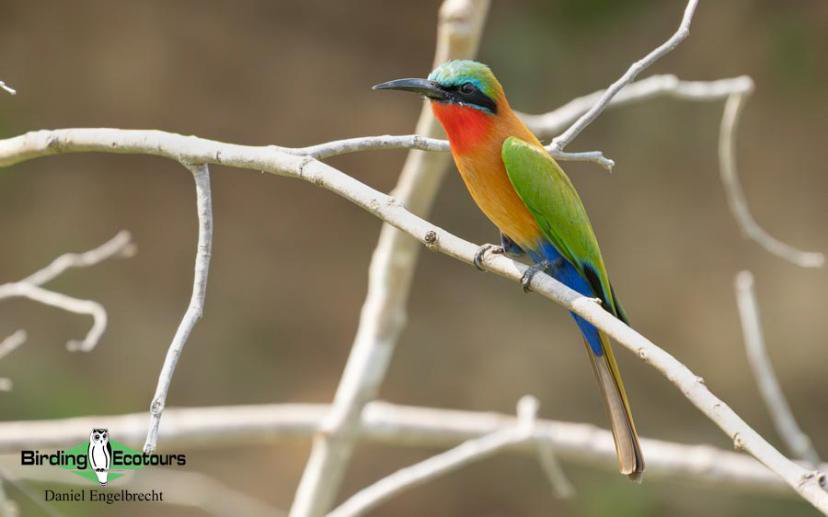
We saw many Red-throated Bee-eaters on our boat trip to Murchison Falls.
Day 17, 17th August 2026. Full day birding at Murchison Falls National Park
We had another full day to explore Murchison Falls National Park, and we decided to spend the day in the more densely vegetated southern section of the park. Shortly after leaving the lodge, we found a calling Red-winged Prinia, an uncommon species in Uganda, followed by an African Cuckoo-Hawk. A small patch of riverine forest yielded a vocal White-crested Turaco, while mixed-species flocks gave us a few new species, including African Golden Oriole, Greater Honeyguide, Green-backed Eremomela, Red-faced Cisticola, and Pale Flycatcher.
The highlight of the morning was a flock of starlings consisting of Lesser Blue-eared and Purple Starlings, both of which were new for the trip. We spent some time searching the riverine thickets along the Victoria Nile for Dusky Babbler, but to no avail; however, we enjoyed close-up views of a feeding Grey Kestrel, as well as Snowy-crowed Robin-Chat and African Grey Woodpecker.
Before lunch, we paid a quick visit to Murchison Falls, this time experiencing the raw power of this incredible natural wonder from the top viewpoint. While soaking up views of the falls (literally!), we enjoyed some good looks at Rock Pratincoles sitting on rocks in the rapids. We returned to the lodge for lunch, adding a perched Western Banded Snake Eagle along the way, and decided to spend the afternoon birding around the lodge grounds.
Unfortunately, the weather was building, and we only had a short session before the rain set in for the afternoon. Still, we managed to find three new birds for the trip: White-shouldered Black Tit, Cassin’s Honeybird, and a large flock of storm-chasing Common Swifts.
Day 18, 18th August 2026. Transfer to Entebbe
Today, we made our way back to Entebbe, where our unforgettable Uganda birding adventure had begun. Although it would mostly be a travel day, we planned to include a few birding stops along the way, the first of which was Kaniyo Pabidi Forest, the eastern section of Budongo Forest. We spent around two hours birding in the forest, where we enjoyed many species we had seen previously, including African Shrike-Flycatcher, Blue Malkoha, Western Oriole, and Yellow-crested Woodpecker, among others. The only new species we added were a flyover Little Sparrowhawk and a Whistling Cisticola at the gate.
The drive to Entebbe was largely uneventful; however, a brief roadside stop delivered White-headed Barbet, Red-faced Crombec, and White-browed Sparrow-Weaver, while a Heuglin’s Spurfowl crossing the road provided us with brief views.
After an enjoyable and rewarding 18 days on the road, visiting many of Uganda’s most spectacular reserves and national parks and targeting some of Africa’s most iconic birds and mammals, our unforgettable adventure had come to an end. We enjoyed a final dinner together at our hotel in Entebbe and reflected on the many highlights of the trip.
Day 19, 19th August 2026. Departure
After breakfast, we said our goodbyes and took our various flights home.
Bird List – Following IOC 15.2 (April 2026)
Birds ‘heard only’ are marked with (H) after the common name, all other species were seen.
The following notation after species names is used to show conservation status following the IUCN Red List: CR = Critically Endangered, EN = Endangered, VU = Vulnerable.
| Common name | Scientific name |
| Ducks, Geese, Swans (Anatidae) | |
| White-faced Whistling Duck | Dendrocygna viduata |
| Fulvous Whistling Duck | Dendrocygna bicolor |
| Spur-winged Goose | Plectropterus gambensis |
| Egyptian Goose | Alopochen aegyptiaca |
| Blue-billed Teal | Spatula hottentota |
| Yellow-billed Duck | Anas undulata |
| Guineafowl (Numididae) | |
| Helmeted Guineafowl | Numida meleagris |
| New World Quail (Odontophoridae) | |
| Nahan’s Partridge – VU | Ptilopachus nahani |
| Pheasants & Allies (Phasianidae) | |
| Coqui Francolin (H) | Peliperdix coqui |
| Crested Francolin | Dendroperdix sephaena |
| Handsome Spurfowl | Pternistis nobilis |
| Scaly Spurfowl (H) | Pternistis squamatus |
| Heuglin’s Spurfowl | Pternistis icterorhynchus |
| Red-necked Spurfowl | Pternistis afer |
| Nightjars (Caprimulgidae) | |
| Fiery-necked Nightjar (H) | Caprimulgus nigriscapularis |
| Montane Nightjar | Caprimulgus poliocephalus |
| Pennant-winged Nightjar | Caprimulgus vexillarius |
| Swifts (Apodidae) | |
| Sabine’s Spinetail | Rhaphidura sabini |
| African Palm Swift | Cypsiurus parvus |
| Alpine Swift | Tachymarptis melba |
| Little Swift | Apus affinis |
| Common Swift | Apus apus |
| White-rumped Swift | Apus caffer |
| Turacos (Musophagidae) | |
| Great Blue Turaco | Corythaeola cristata |
| Bare-faced Go-away-bird | Crinifer personatus |
| Eastern Plantain-eater | Crinifer zonurus |
| Rwenzori Turaco | Gallirex johnstoni |
| Ross’s Turaco | Tauraco rossae |
| White-crested Turaco | Tauraco leucolophus |
| Black-billed Turaco | Tauraco schuettii |
| Bustards (Otididae) | |
| Denham’s Bustard | Neotis denhami |
| Black-bellied Bustard | Lissotis melanogaster |
| Cuckoos (Cuculidae) | |
| Blue-headed Coucal | Centropus monachus |
| White-browed Coucal | Centropus superciliosus |
| Blue Malkoha | Ceuthmochares aereus |
| Diederik Cuckoo | Chrysococcyx caprius |
| Klaas’s Cuckoo | Chrysococcyx klaas |
| African Emerald Cuckoo | Chrysococcyx cupreus |
| Dusky Long-tailed Cuckoo | Cercococcyx mechowi |
| Olive Long-tailed Cuckoo | Cercococcyx olivinus |
| Barred Long-tailed Cuckoo | Cercococcyx montanus |
| Black Cuckoo | Cuculus clamosus |
| Red-chested Cuckoo | Cuculus solitarius |
| Pigeons, Doves (Columbidae) | |
| Rock Dove | Columba livia |
| Speckled Pigeon | Columba guinea |
| Afep Pigeon | Columba unicincta |
| African Olive Pigeon | Columba arquatrix |
| Mourning Collared Dove | Streptopelia decipiens |
| Red-eyed Dove | Streptopelia semitorquata |
| Ring-necked Dove | Streptopelia capicola |
| Vinaceous Dove | Streptopelia vinacea |
| Laughing Dove | Spilopelia senegalensis |
| Emerald-spotted Wood Dove | Turtur chalcospilos |
| Black-billed Wood Dove | Turtur abyssinicus |
| Blue-spotted Wood Dove | Turtur afer |
| Tambourine Dove | Turtur tympanistria |
| Namaqua Dove | Oena capensis |
| African Green Pigeon | Treron calvus |
| Finfoots (Heliornithidae) | |
| African Finfoot | Podica senegalensis |
| Flufftails (Sarothruridae) | |
| White-spotted Flufftail | Sarothrura pulchra |
| Red-chested Flufftail (H) | Sarothrura rufa |
| Rails, Crakes & Coots (Rallidae) | |
| African Crake | Crecopsis egregia |
| Common Moorhen | Gallinula chloropus |
| Red-knobbed Coot | Fulica cristata |
| African Swamphen | Porphyrio madagascariensis |
| Black Crake | Zapornia flavirostra |
| Cranes (Gruidae) | |
| Grey Crowned Crane – EN | Balearica regulorum |
| Grebes (Podicipedidae) | |
| Little Grebe | Tachybaptus ruficollis |
| Flamingos (Phoenicopteridae) | |
| Lesser Flamingo | Phoeniconaias minor |
| Buttonquail (Turnicidae) | |
| Common Buttonquail | Turnix sylvaticus |
| Stone-curlews, Thick-knees (Burhinidae) | |
| Senegal Thick-knee | Burhinus senegalensis |
| Water Thick-knee | Burhinus vermiculatus |
| Stilts, Avocets (Recurvirostridae) | |
| Black-winged Stilt | Himantopus himantopus |
| Plovers (Charadriidae) | |
| Long-toed Lapwing | Vanellus crassirostris |
| Spur-winged Lapwing | Vanellus spinosus |
| Black-headed Lapwing | Vanellus tectus |
| Senegal Lapwing | Vanellus lugubris |
| Crowned Lapwing | Vanellus coronatus |
| African Wattled Lapwing | Vanellus senegallus |
| Brown-chested Lapwing | Vanellus superciliosus |
| Tibetan Sand Plover | Anarhynchus atrifrons |
| Kittlitz’s Plover | Charadrius pecuarius |
| Three-banded Plover | Charadrius tricollaris |
| Painted-snipes (Rostratulidae) | |
| Greater Painted-snipe | Rostratula benghalensis |
| Jacanas (Jacanidae) | |
| Lesser Jacana | Microparra capensis |
| African Jacana | Actophilornis africanus |
| Sandpipers, Snipes (Scolopacidae) | |
| Ruff | Calidris pugnax |
| Little Stint | Calidris minuta |
| Common Sandpiper | Actitis hypoleucos |
| Wood Sandpiper | Tringa glareola |
| Common Greenshank | Tringa nebularia |
| Coursers, Pratincoles (Glareolidae) | |
| Temminck’s Courser | Cursorius temminckii |
| Collared Pratincole | Glareola pratincola |
| Rock Pratincole | Glareola nuchalis |
| Gulls, Terns, Skimmers (Laridae) | |
| African Skimmer | Rynchops flavirostris |
| Grey-headed Gull | Chroicocephalus cirrocephalus |
| Gull-billed Tern | Gelochelidon nilotica |
| White-winged Tern | Chlidonias leucopterus |
| Storks (Ciconiidae) | |
| Yellow-billed Stork | Mycteria ibis |
| African Openbill | Anastomus lamelligerus |
| African Woolly-necked Stork | Ciconia microscelis |
| Saddle-billed Stork | Ephippiorhynchus senegalensis |
| Marabou Stork | Leptoptilos crumenifer |
| Anhingas, Darters (Anhingidae) | |
| African Darter | Anhinga rufa |
| Cormorants, Shags (Phalacrocoracidae) | |
| Reed Cormorant | Microcarbo africanus |
| Great Cormorant | Phalacrocorax lucidus |
| Ibises, Spoonbills (Threskiornithidae) | |
| African Sacred Ibis | Threskiornis aethiopicus |
| Hadada Ibis | Bostrychia hagedash |
| Glossy Ibis | Plegadis falcinellus |
| African Spoonbill | Platalea alba |
| Herons, Bitterns (Ardeidae) | |
| Little Heron | Butorides atricapilla |
| Squacco Heron | Ardeola ralloides |
| Rufous-bellied Heron | Ardeola rufiventris |
| Western Cattle Egret | Bubulcus ibis |
| Grey Heron | Ardea cinerea |
| Black-headed Heron | Ardea melanocephala |
| Goliath Heron | Ardea goliath |
| Purple Heron | Ardea purpurea |
| Great Egret | Ardea alba |
| Yellow-billed Egret | Ardea brachyrhyncha |
| Little Egret | Egretta garzetta |
| Hamerkop (Scopidae) | |
| Hamerkop | Scopus umbretta |
| Shoebill (Balaenicipitidae) | |
| Shoebill – VU | Balaeniceps rex |
| Pelicans (Pelecanidae) | |
| Great White Pelican | Pelecanus onocrotalus |
| Pink-backed Pelican | Pelecanus rufescens |
| Ospreys (Pandionidae) | |
| Osprey | Pandion haliaetus |
| Kites, Hawks, Eagles (Accipitridae) | |
| Black-winged Kite | Elanus caeruleus |
| Palm-nut Vulture | Gypohierax angolensis |
| African Cuckoo-Hawk | Aviceda cuculoides |
| Hooded Vulture – CR | Necrosyrtes monachus |
| White-backed Vulture – CR | Gyps africanus |
| Rüppell’s Vulture – CR | Gyps rueppelli |
| White-headed Vulture – CR | Trigonoceps occipitalis |
| Lappet-faced Vulture – EN | Torgos tracheliotos |
| Black-chested Snake Eagle | Circaetus pectoralis |
| Brown Snake Eagle | Circaetus cinereus |
| Western Banded Snake Eagle | Circaetus cinerascens |
| Bateleur – EN | Terathopius ecaudatus |
| Crowned Eagle | Stephanoaetus coronatus |
| Long-crested Eagle | Lophaetus occipitalis |
| Wahlberg’s Eagle | Hieraaetus wahlbergi |
| Ayres’s Hawk-Eagle | Hieraaetus ayresii |
| Cassin’s Hawk-Eagle | Aquila africana |
| Lizard Buzzard | Kaupifalco monogrammicus |
| Dark Chanting Goshawk | Melierax metabates |
| African Goshawk | Accipiter tachiro |
| Little Sparrowhawk | Accipiter minullus |
| Black Sparrowhawk | Accipiter melanoleucus |
| African Marsh Harrier | Circus ranivorus |
| Yellow-billed Kite | Milvus aegyptius |
| African Fish Eagle | Haliaeetus vocifer |
| Mountain Buzzard | Buteo oreophilus |
| Augur Buzzard | Buteo augur |
| Owls (Strigidae) | |
| Pearl-spotted Owlet | Glaucidium perlatum |
| Red-chested Owlet (H) | Glaucidium tephronotum |
| African Scops Owl (H) | Otus senegalensis |
| African Wood Owl (H) | Strix woodfordii |
| Mousebirds (Coliidae) | |
| Speckled Mousebird | Colius striatus |
| Blue-naped Mousebird | Urocolius macrourus |
| Trogons (Trogonidae) | |
| Narina Trogon | Apaloderma narina |
| Bar-tailed Trogon | Apaloderma vittatum |
| Hoopoes (Upupidae) | |
| Eurasian Hoopoe | Upupa epops |
| Wood Hoopoes (Phoeniculidae) | |
| White-headed Wood Hoopoe | Phoeniculus bollei |
| Green Wood Hoopoe | Phoeniculus purpureus |
| Black Scimitarbill | Rhinopomastus aterrimus |
| Common Scimitarbill | Rhinopomastus cyanomelas |
| Ground Hornbills (Bucorvidae) | |
| Abyssinian Ground Hornbill – VU | Bucorvus abyssinicus |
| Hornbills (Bucerotidae) | |
| Crowned Hornbill | Lophoceros alboterminatus |
| African Grey Hornbill | Lophoceros nasutus |
| White-thighed Hornbill | Bycanistes albotibialis |
| Black-and-white-casqued Hornbill | Bycanistes subcylindricus |
| Rollers (Coraciidae) | |
| Lilac-breasted Roller | Coracias caudatus |
| Blue-throated Roller | Eurystomus gularis |
| Broad-billed Roller | Eurystomus glaucurus |
| Kingfishers (Alcedinidae) | |
| Chocolate-backed Kingfisher | Halcyon badia |
| Grey-headed Kingfisher | Halcyon leucocephala |
| Striped Kingfisher | Halcyon chelicuti |
| Blue-breasted Kingfisher | Halcyon malimbica |
| Woodland Kingfisher | Halcyon senegalensis |
| African Dwarf Kingfisher | Ispidina lecontei |
| African Pygmy Kingfisher | Ispidina picta |
| Malachite Kingfisher | Corythornis cristatus |
| Shining-blue Kingfisher | Alcedo quadribrachys |
| Pied Kingfisher | Ceryle rudis |
| Bee-eaters (Meropidae) | |
| Black Bee-eater | Merops gularis |
| Swallow-tailed Bee-eater | Merops hirundineus |
| Little Bee-eater | Merops pusillus |
| Blue-breasted Bee-eater | Merops variegatus |
| Cinnamon-chested Bee-eater | Merops oreobates |
| Red-throated Bee-eater | Merops bulocki |
| White-throated Bee-eater | Merops albicollis |
| Northern Carmine Bee-eater | Merops nubicus |
| Olive Bee-eater | Merops superciliosus |
| African Barbets (Lybiidae) | |
| Grey-throated Barbet | Gymnobucco bonapartei |
| Speckled Tinkerbird | Pogoniulus scolopaceus |
| Western Tinkerbird | Pogoniulus coryphaea |
| Yellow-throated Tinkerbird | Pogoniulus subsulphureus |
| Yellow-rumped Tinkerbird | Pogoniulus bilineatus |
| Yellow-fronted Tinkerbird | Pogoniulus chrysoconus |
| Yellow-spotted Barbet | Buccanodon duchaillui |
| Hairy-breasted Barbet | Tricholaema hirsuta |
| Spot-flanked Barbet | Tricholaema lacrymosa |
| White-headed Barbet | Lybius leucocephalus |
| Black-billed Barbet | Lybius guifsobalito |
| Double-toothed Barbet | Lybius bidentatus |
| Eastern Yellow-billed Barbet | Trachyphonus purpuratus |
| Crested Barbet | Trachyphonus vaillantii |
| Honeyguides (Indicatoridae) | |
| Cassin’s Honeybird | Prodotiscus insignis |
| Lesser Honeyguide | Indicator minor |
| Greater Honeyguide | Indicator indicator |
| Woodpeckers (Picidae) | |
| Buff-spotted Woodpecker | Pardipicus nivosus |
| Nubian Woodpecker | Campethera nubica |
| Fine-banded Woodpecker | Campethera taeniolaema |
| Yellow-crested Woodpecker | Chloropicus xantholophus |
| Speckle-breasted Woodpecker | Dendropicos poecilolaemus |
| Cardinal Woodpecker | Dendropicos fuscescens |
| Elliot’s Woodpecker | Dendropicos elliotii |
| African Grey Woodpecker | Dendropicos goertae |
| Caracaras, Falcons (Falconidae) | |
| Grey Kestrel | Falco ardosiaceus |
| African Hobby | Falco cuvierii |
| African & New World Parrots (Psittacidae) | |
| Grey Parrot – EN | Psittacus erithacus |
| Meyer’s Parrot | Poicephalus meyeri |
| Old World Parrots (Psittaculidae) | |
| Red-headed Lovebird | Agapornis pullarius |
| Typical Broadbills (Eurylaimidae) | |
| Grauer’s Broadbill – VU | Pseudocalyptomena graueri |
| African & Green Broadbills (Calyptomenidae) | |
| African Broadbill (H) | Smithornis capensis |
| Pittas (Pittidae) | |
| Green-breasted Pitta | Pitta reichenowi |
| Wattle-eyes, Batises (Platysteiridae) | |
| Rwenzori Batis | Batis diops |
| Chinspot Batis | Batis molitor |
| Chestnut Wattle-eye | Platysteira castanea |
| Brown-throated Wattle-eye | Platysteira cyanea |
| Jameson’s Wattle-eye | Platysteira jamesoni |
| Bushshrikes (Malaconotidae) | |
| Grey-headed Bushshrike (H) | Malaconotus blanchoti |
| Many-colored Bushshrike | Chlorophoneus multicolor |
| Bocage’s Bushshrike (H) | Chlorophoneus bocagei |
| Orange-breasted Bushshrike | Chlorophoneus sulfureopectus |
| Doherty’s Bushshrike | Telophorus dohertyi |
| Marsh Tchagra | Bocagia minuta |
| Brown-crowned Tchagra | Tchagra australis |
| Black-crowned Tchagra | Tchagra senegalus |
| Pink-footed Puffback | Dryoscopus angolensis |
| Northern Puffback | Dryoscopus gambensis |
| Lowland Sooty Boubou | Laniarius leucorhynchus |
| Albertine Sooty Boubou | Laniarius holomelas |
| Lühder’s Bushshrike | Laniarius luehderi |
| Tropical Boubou | Laniarius major |
| Papyrus Gonolek | Laniarius mufumbiri |
| Black-headed Gonolek | Laniarius erythrogaster |
| Brubru | Nilaus afer |
| Vangas & Allies (Vangidae) | |
| African Shrike-flycatcher | Megabyas flammulatus |
| Black-and-white Shrike-flycatcher | Bias musicus |
| Cuckooshrikes (Campephagidae) | |
| Black Cuckooshrike | Campephaga flava |
| Petit’s Cuckooshrike | Campephaga petiti |
| Shrikes (Laniidae) | |
| Mackinnon’s Shrike | Lanius mackinnoni |
| Grey-backed Fiscal | Lanius excubitoroides |
| Northern Fiscal | Lanius humeralis |
| Figbirds, Old World Orioles, Piopios (Oriolidae) | |
| Western Oriole | Oriolus brachyrynchus |
| Black-headed Oriole | Oriolus larvatus |
| Mountain Oriole | Oriolus percivali |
| African Golden Oriole | Oriolus auratus |
| Drongos (Dicruridae) | |
| Velvet-mantled Drongo | Dicrurus modestus |
| Fork-tailed Drongo | Dicrurus adsimilis |
| Monarchs (Monarchidae) | |
| Red-bellied Paradise Flycatcher | Terpsiphone rufiventer |
| African Paradise Flycatcher | Terpsiphone viridis |
| Crows, Jays (Corvidae) | |
| Piapiac | Ptilostomus afer |
| Pied Crow | Corvus albus |
| White-necked Raven | Corvus albicollis |
| Fairy Flycatchers (Stenostiridae) | |
| African Blue Flycatcher | Elminia longicauda |
| White-tailed Blue Flycatcher | Elminia albicauda |
| White-bellied Crested Flycatcher | Elminia albiventris |
| White-tailed Crested Flycatcher | Elminia albonotata |
| Tits, Chickadees (Paridae) | |
| White-shouldered Black Tit | Melaniparus guineensis |
| White-winged Black Tit | Melaniparus leucomelas |
| Dusky Tit | Melaniparus funereus |
| Stripe-breasted Tit | Melaniparus fasciiventer |
| Penduline Tits (Remizidae) | |
| Grey Penduline Tit | Anthoscopus caroli |
| Larks (Alaudidae) | |
| Rufous-naped Lark | Mirafra africana |
| Flappet Lark | Mirafra rufocinnamomea |
| White-tailed Lark | Mirafra albicauda |
| Bulbuls (Pycnonotidae) | |
| Slender-billed Greenbul | Stelgidillas gracilirostris |
| Red-tailed Bristlebill (H) | Bleda syndactylus |
| Pale-throated Greenbul | Atimastillas flavicollis |
| Spotted Greenbul | Ixonotus guttatus |
| Joyful Greenbul | Chlorocichla laetissima |
| Honeyguide Greenbul | Baeopogon indicator |
| Kakamega Greenbul | Arizelocichla kakamegae |
| Kikuyu Mountain Greenbul | Arizelocichla kikuyuensis |
| Red-tailed Greenbul | Criniger calurus |
| Little Greenbul | Eurillas virens |
| Yellow-whiskered Greenbul | Eurillas latirostris |
| Plain Greenbul | Eurillas curvirostris |
| Little Grey Greenbul | Eurillas gracilis |
| White-throated Greenbul | Phyllastrephus albigularis |
| Cabanis’s Greenbul | Phyllastrephus cabanisi |
| Yellow-streaked Greenbul | Phyllastrephus flavostriatus |
| Toro Olive Greenbul | Phyllastrephus hypochloris |
| Common Bulbul | Pycnonotus barbatus |
| Swallows, Martins (Hirundinidae) | |
| White-headed Saw-wing | Psalidoprocne albiceps |
| Black Saw-wing | Psalidoprocne pristoptera |
| Banded Martin | Riparia cincta |
| Barn Swallow | Hirundo rustica |
| Angola Swallow | Hirundo angolensis |
| Wire-tailed Swallow | Hirundo smithii |
| Blue Swallow – EN | Hirundo atrocaerulea |
| Red-throated Rock Martin | Ptyonoprogne fuligula |
| Lesser Striped Swallow | Cecropis abyssinica |
| Mosque Swallow | Cecropis senegalensis |
| African Red-rumped Swallow | Cecropis melanocrissus |
| Crombecs, African Warblers (Macrosphenidae) | |
| Moustached Grass Warbler | Melocichla mentalis |
| Yellow Longbill (H) | Macrosphenus flavicans |
| Grey Longbill | Macrosphenus concolor |
| Red-faced Crombec | Sylvietta whytii |
| Green Crombec | Sylvietta virens |
| Lemon-bellied Crombec | Sylvietta denti |
| White-browed Crombec | Sylvietta leucophrys |
| Cettia Bush Warblers & Allies (Cettiidae) | |
| Neumann’s Warbler (H) | Urosphena neumanni |
| Yellow Flycatchers (Erythrocercidae) | |
| Chestnut-capped Flycatcher | Erythrocercus mccallii |
| Hylias (Hyliidae) | |
| Green Hylia | Hylia prasina |
| Leaf Warblers (Phylloscopidae) | |
| Red-faced Woodland Warbler | Phylloscopus laetus |
| Uganda Woodland Warbler (H) | Phylloscopus budongoensis |
| Reed Warblers & Allies (Acrocephalidae) | |
| Grauer’s Warbler (H) | Graueria vittata |
| Greater Swamp Warbler | Acrocephalus rufescens |
| Lesser Swamp Warbler | Acrocephalus gracilirostris |
| African Yellow Warbler (H) | Iduna natalensis |
| Mountain Yellow Warbler | Iduna similis |
| Papyrus Yellow Warbler – VU | Calamonastides gracilirostris |
| Grassbirds & Allies (Locustellidae) | |
| Fan-tailed Grassbird | Catriscus brevirostris |
| Cinnamon Bracken Warbler | Bradypterus cinnamomeus |
| White-winged Swamp Warbler | Bradypterus carpalis |
| Grauer’s Swamp Warbler – VU | Bradypterus graueri |
| Highland Rush Warbler | Bradypterus centralis |
| Cisticolas & Allies (Cisticolidae) | |
| Red-faced Cisticola | Cisticola erythrops |
| Singing Cisticola | Cisticola cantans |
| Whistling Cisticola | Cisticola lateralis |
| Trilling Cisticola | Cisticola woosnami |
| Chubb’s Cisticola | Cisticola chubbi |
| Rattling Cisticola | Cisticola chiniana |
| Winding Cisticola | Cisticola marginatus |
| Carruthers’s Cisticola | Cisticola carruthersi |
| Stout Cisticola | Cisticola robustus |
| Croaking Cisticola | Cisticola natalensis |
| Short-winged Cisticola | Cisticola brachypterus |
| Foxy Cisticola | Cisticola troglodytes |
| Long-tailed Cisticola | Cisticola angusticauda |
| Zitting Cisticola | Cisticola juncidis |
| Tawny-flanked Prinia | Prinia subflava |
| Banded Prinia | Prinia melanops |
| Red-winged Warbler | Prinia erythroptera |
| White-chinned Prinia | Schistolais leucopogon |
| Rwenzori Apalis | Oreolais ruwenzorii |
| Red-winged Grey Warbler | Drymocichla incana |
| Buff-bellied Warbler | Phyllolais pulchella |
| Yellow-breasted Apalis | Apalis flavida |
| Lowland Masked Apalis | Apalis binotata |
| Mountain Masked Apalis | Apalis personata |
| Black-throated Apalis | Apalis jacksoni |
| Chestnut-throated Apalis | Apalis porphyrolaema |
| Buff-throated Apalis | Apalis rufogularis |
| Grey Apalis | Apalis cinerea |
| Grey-capped Warbler | Eminia lepida |
| Grey-backed Camaroptera | Camaroptera brevicaudata |
| Yellow-browed Camaroptera | Camaroptera superciliaris |
| Olive-green Camaroptera | Camaroptera chloronota |
| Black-faced Rufous Warbler | Bathmocercus rufus |
| Green-backed Eremomela | Eremomela canescens |
| Rufous-crowned Eremomela | Eremomela badiceps |
| Sylviid Babblers (Sylviidae) | |
| Rwenzori Hill Babbler | Sylvia atriceps |
| White-eyes (Zosteropidae) | |
| Green White-eye | Zosterops stuhlmanni |
| Northern Yellow White-eye | Zosterops senegalensis |
| Ground Babblers (Pellorneidae) | |
| Mountain Illadopsis | Illadopsis pyrrhoptera |
| Scaly-breasted Illadopsis | Illadopsis albipectus |
| Laughingthrushes & Allies (Leiothrichidae) | |
| Brown Babbler | Turdoides plebejus |
| Arrow-marked Babbler | Turdoides jardineii |
| Black-lored Babbler | Turdoides sharpei |
| Starlings, Rhabdornises (Sturnidae) | |
| Wattled Starling | Creatophora cinerea |
| Purple-headed Starling | Hylopsar purpureiceps |
| Greater Blue-eared Starling | Lamprotornis chalybaeus |
| Lesser Blue-eared Starling | Lamprotornis chloropterus |
| Bronze-tailed Starling | Lamprotornis chalcurus |
| Splendid Starling | Lamprotornis splendidus |
| Purple Starling | Lamprotornis purpureus |
| Rüppell’s Starling | Lamprotornis purpuroptera |
| Violet-backed Starling | Cinnyricinclus leucogaster |
| Waller’s Starling | Onychognathus walleri |
| Narrow-tailed Starling | Poeoptera lugubris |
| Sharpe’s Starling | Poeoptera sharpii |
| Oxpeckers (Buphagidae) | |
| Yellow-billed Oxpecker | Buphagus africanus |
| Thrushes (Turdidae) | |
| Red-tailed Ant Thrush (H) | Neocossyphus rufus |
| Fraser’s Rufous Thrush | Stizorhina fraseri |
| African Thrush | Turdus pelios |
| Abyssinian Thrush | Turdus abyssinicus |
| Chats, Old World Flycatchers (Muscicapidae) | |
| Brown-backed Scrub Robin | Cercotrichas hartlaubi |
| White-browed Scrub Robin | Cercotrichas leucophrys |
| Fraser’s Forest Flycatcher | Fraseria ocreata |
| Grey-throated Tit-Flycatcher | Myioparus griseigularis |
| Grey Tit-Flycatcher | Myioparus plumbeus |
| White-eyed Slaty Flycatcher | Melaenornis fischeri |
| Yellow-eyed Black Flycatcher | Melaenornis ardesiacus |
| Northern Black Flycatcher | Melaenornis edolioides |
| Pale Flycatcher | Melaenornis pallidus |
| Silverbird | Empidornis semipartitus |
| Ashy Flycatcher | Muscicapa caerulescens |
| Swamp Flycatcher | Muscicapa aquatica |
| Cassin’s Flycatcher | Muscicapa cassini |
| Chapin’s Flycatcher – VU | Muscicapa lendu |
| African Dusky Flycatcher | Muscicapa adusta |
| Dusky-blue Flycatcher | Muscicapa comitata |
| Sooty Flycatcher | Muscicapa infuscata |
| Red-throated Alethe | Chamaetylas poliophrys |
| White-bellied Robin-Chat | Cossyphicula roberti |
| Archer’s Ground Robin | Cossypha archeri |
| Cape Robin-Chat | Cossypha caffra |
| Grey-winged Robin-Chat | Cossypha polioptera |
| Blue-shouldered Robin-Chat | Cossypha cyanocampter |
| White-browed Robin-Chat | Cossypha heuglini |
| Red-capped Robin-Chat | Cossypha natalensis |
| Snowy-crowned Robin-Chat | Cossypha niveicapilla |
| White-starred Robin | Pogonocichla stellata |
| Forest Robin (H) | Stiphrornis erythrothorax |
| Equatorial Akalat | Sheppardia aequatorialis |
| Spotted Palm Thrush | Cichladusa guttata |
| African Stonechat | Saxicola torquatus |
| Sooty Chat | Myrmecocichla nigra |
| Arnot’s Chat | Myrmecocichla arnotti |
| Sunbirds (Nectariniidae) | |
| Little Green Sunbird | Anthreptes seimundi |
| Grey-chinned Sunbird | Anthreptes rectirostris |
| Collared Sunbird | Hedydipna collaris |
| Green-headed Sunbird | Cyanomitra verticalis |
| Blue-throated Brown Sunbird | Cyanomitra cyanolaema |
| Blue-headed Sunbird | Cyanomitra alinae |
| Olive Sunbird | Cyanomitra olivacea |
| Green-throated Sunbird | Chalcomitra rubescens |
| Scarlet-chested Sunbird | Chalcomitra senegalensis |
| Purple-breasted Sunbird | Nectarinia purpureiventris |
| Bronze Sunbird | Nectarinia kilimensis |
| Olive-bellied Sunbird | Cinnyris chloropygius |
| Rwenzori Double-collared Sunbird | Cinnyris stuhlmanni |
| Northern Double-collared Sunbird | Cinnyris reichenowi |
| Regal Sunbird | Cinnyris regius |
| Beautiful Sunbird | Cinnyris pulchellus |
| Red-chested Sunbird | Cinnyris erythrocercus |
| Purple-banded Sunbird | Cinnyris bifasciatus |
| Superb Sunbird | Cinnyris superbus |
| Variable Sunbird | Cinnyris venustus |
| Copper Sunbird | Cinnyris cupreus |
| Old World Sparrows, Snowfinches (Passeridae) | |
| Shelley’s Sparrow | Passer shelleyi |
| Northern Grey-headed Sparrow | Passer griseus |
| Weavers, Widowbirds (Ploceidae) | |
| White-browed Sparrow-Weaver | Plocepasser mahali |
| Chestnut-crowned Sparrow-Weaver | Plocepasser superciliosus |
| Speckle-fronted Weaver | Sporopipes frontalis |
| Thick-billed Weaver | Amblyospiza albifrons |
| Baglafecht Weaver | Ploceus baglafecht |
| Slender-billed Weaver | Ploceus pelzelni |
| Little Weaver | Ploceus luteolus |
| Black-necked Weaver | Ploceus nigricollis |
| Strange Weaver | Ploceus alienus |
| Black-billed Weaver | Ploceus melanogaster |
| Holub’s Golden Weaver | Ploceus xanthops |
| Orange Weaver | Ploceus aurantius |
| Northern Brown-throated Weaver | Ploceus castanops |
| Lesser Masked Weaver | Ploceus intermedius |
| Vitelline Masked Weaver | Ploceus vitellinus |
| Village Weaver | Ploceus cucullatus |
| Vieillot’s Black Weaver | Ploceus nigerrimus |
| Weyns’s Weaver | Ploceus weynsi |
| Black-headed Weaver | Ploceus melanocephalus |
| Compact Weaver | Ploceus superciliosus |
| Brown-capped Weaver | Ploceus insignis |
| Red-headed Malimbe | Malimbus rubricollis |
| Red-headed Weaver | Anaplectes rubriceps |
| Red-headed Quelea | Quelea erythrops |
| Red-billed Quelea | Quelea quelea |
| Black Bishop | Euplectes gierowii |
| Black-winged Red Bishop | Euplectes hordeaceus |
| Southern Red Bishop | Euplectes orix |
| Northern Red Bishop | Euplectes franciscanus |
| Fan-tailed Widowbird | Euplectes axillaris |
| Yellow-mantled Widowbird | Euplectes macroura |
| Marsh Widowbird | Euplectes hartlaubi |
| Red-collared Widowbird | Euplectes ardens |
| Waxbills, Munias & Allies (Estrildidae) | |
| Bronze Mannikin | Spermestes cucullata |
| Black-and-white Mannikin | Spermestes bicolor |
| White-collared Oliveback | Nesocharis ansorgei |
| Yellow-bellied Waxbill | Coccopygia quartinia |
| Dusky Crimsonwing | Cryptospiza jacksoni |
| Red-faced Crimsonwing | Cryptospiza reichenovii |
| White-breasted Nigrita | Nigrita fusconotus |
| Grey-headed Nigrita | Nigrita canicapillus |
| Grey-headed Oliveback | Delacourella capistrata |
| Black-crowned Waxbill | Estrilda nonnula |
| Kandt’s Waxbill | Estrilda kandti |
| Fawn-breasted Waxbill | Estrilda paludicola |
| Common Waxbill | Estrilda astrild |
| Black-rumped Waxbill | Estrilda troglodytes |
| Crimson-rumped Waxbill | Estrilda rhodopyga |
| Quailfinch | Ortygospiza atricollis |
| Orange-breasted Waxbill | Amandava subflava |
| Red-cheeked Cordon-bleu | Uraeginthus bengalus |
| Red-headed Bluebill | Spermophaga ruficapilla |
| Green-winged Pytilia | Pytilia melba |
| Brown Twinspot | Clytospiza monteiri |
| Red-billed Firefinch | Lagonosticta senegala |
| African Firefinch | Lagonosticta rubricata |
| Bar-breasted Firefinch | Lagonosticta rufopicta |
| Indigobirds, Whydahs (Viduidae) | |
| Village Indigobird | Vidua chalybeata |
| Pin-tailed Whydah | Vidua macroura |
| Wagtails, Pipits (Motacillidae) | |
| Cape Wagtail | Motacilla capensis |
| Mountain Wagtail | Motacilla clara |
| African Pied Wagtail | Motacilla aguimp |
| Yellow-throated Longclaw | Macronyx croceus |
| African Pipit | Anthus cinnamomeus |
| Finches, Euphonias (Fringillidae) | |
| Oriole Finch | Linurgus olivaceus |
| Western Citril | Crithagra frontalis |
| Papyrus Canary | Crithagra koliensis |
| Yellow-fronted Canary | Crithagra mozambica |
| Brimstone Canary | Crithagra sulphurata |
| Thick-billed Seedeater | Crithagra burtoni |
| Streaky Seedeater | Crithagra striolata |
| White-rumped Seedeater | Crithagra leucopygia |
| Buntings (Emberizidae) | |
| Cinnamon-breasted Bunting | Emberiza tahapisi |
| Golden-breasted Bunting | Emberiza flaviventris |
| Species seen: | 502 |
| Species heard: | 18 |
| Total recorded: | 520 |
Mammal List – Following Mammalwatching.com (October 2025)
The following notation after species names is used to show conservation status following the IUCN Red List: EN = Endangered, VU = Vulnerable.
| Common name | Scientific name |
| Elephants (Elephantidae) | |
| African Savanna Elephant – EN | Loxodonta africana |
| Old World Monkeys (Cercopithecidae) | |
| L’Hoest’s Monkey – VU | Allochrocebus lhoesti |
| Red-tailed Monkey | Cercopithecus ascanius |
| Blue Monkey | Cercopithecus mitis |
| Tantalus Monkey | Chlorocebus tantalus |
| Ugandan Crested Mangabey – NE | Lophocebus ugandae |
| Olive Baboon | Papio anubis |
| Guereza | Colobus guereza |
| Great Apes (Hominidae) | |
| Eastern Gorilla – CR | Gorilla beringei |
| Chimpanzee – EN | Pan troglodytes |
| Galagos (Galagidae) | |
| Thick-tailed Greater Galago | Otolemur crassicaudatus |
| Hares and Rabbits (Leporidae) | |
| Bunyoro Rabbit | Poelagus marjorita |
| Squirrels (Sciuridae) | |
| Carruther’s Mountain Squirrel | Funisciurus carruthersi |
| Gambian Sun Squirrel | Heliosciurus gambianus |
| Ruwenzori Sun Squirrel | Heliosciurus ruwenzorii |
| Boehm’s Bush Squirrel | Paraxerus boehmi |
| Mustelids (Mustelidae) | |
| Spotted-necked Otter | Hydrictis maculicollis |
| Felids (Felidae) | |
| Leopard – VU | Panthera pardus |
| Mongooses (Herpestidae) | |
| Common Dwarf Mongoose | Helogale parvula |
| Equines (Equidae) | |
| Plains Zebra | Equus quagga |
| Hippopotamuses (Hippopotamidae) | |
| Common Hippopotamus – VU | Hippopotamus amphibius |
| Bovids (Bovidae) | |
| Impala | Aepyceros melampus |
| Hartebeest | Alcelaphus buselaphus |
| Tsessebe | Damaliscus lunatus |
| Oribi | Ourebia ourebi |
| Kivu Duiker – NE | Cephalophorus kivuensis |
| Waterbuck | Kobus ellipsiprymnus |
| Kob | Kobus kob |
| Cape Buffalo | Syncerus caffer |
| Giraffes and Okapi (Giraffidae) | |
| Northern Giraffe – VU | Giraffa camelopardalis |
| Suids (Suidae) | |
| Common Warthog | Phacochoerus africanus |
| Species seen: | 31 |
This is a sample trip report. Please email us ([email protected]) for more trip reports from this destination.