- Duration:
- 14 days
- Group Size:
- 4–6
- Tour Start:
- Entebbe, Uganda
- Tour End:
- Entebbe, Uganda
Best of Uganda Birding Tour – Shoebill, Albertine Rift Endemics and Great Apes
Details
2027
01–14 August
Per person sharing
$7,940 USD
£6,298 GBP / €7,440 EUR
Single supplement
$520 USD
£413 GBP / €487 EUR
2028
01–14 August
Per person sharing
$8,600 USD
£6,821 GBP / €8,059 EUR
Single supplement
$650 USD
£516 GBP / €609 EUR
Itinerary
Download ItineraryBest of Uganda Birding Tour – Shoebill, Albertine Rift Endemics and Great Apes
This Uganda birding and mammal extravaganza allows you to find the most important birds and primates that Uganda has to offer. Shoebill is almost guaranteed. Over 20 Albertine (Western) Rift endemics are also sought, including one of Africa’s most fabulous turacos, Rwenzori Turaco, and of course the “must-see” Grauer’s (African Green) Broadbill. We have not yet missed Green-breasted Pitta on any of our trips – Uganda has become the classic country for finding this otherwise very difficult bird.
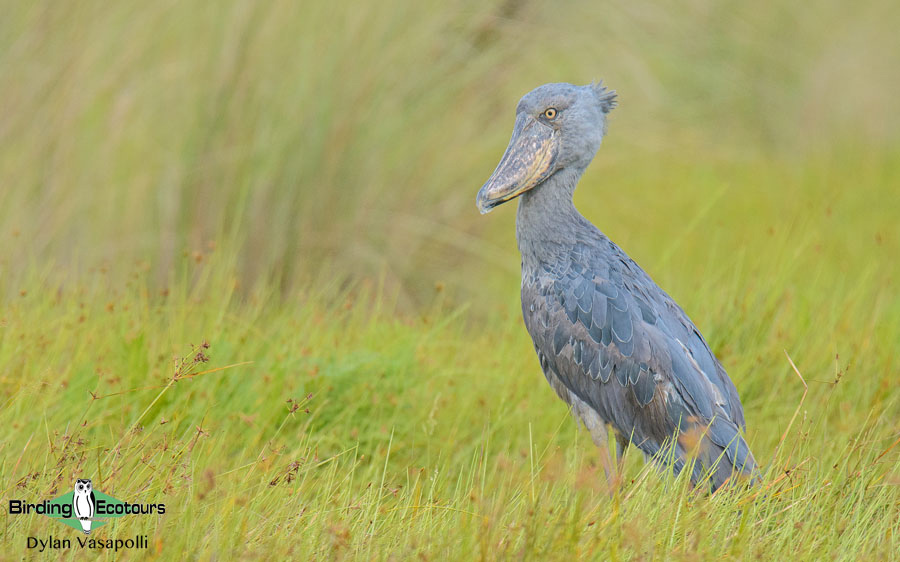
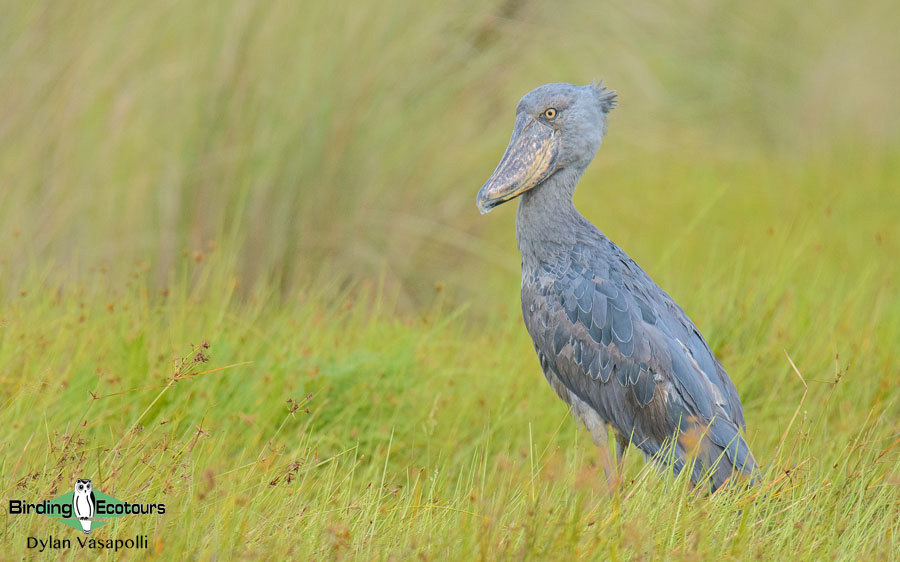 Shoebill is one of the most sought-after birds in the world and is one of our special targets on this tour!
We also look for other range-restricted birds, such as Red-faced Barbet, which is also found in a remote part of Tanzania, excluded from most birding tours to that country. Ross’s Turaco, Great Blue Turaco (almost twice the size of other turacos), and various other birds are virtually garden birds here in Uganda, “the Pearl of Africa”. Other highlights of our Uganda birding tour are a great many primates, such as Ashy Red Colobus, Guereza, Eastern (Mountain) Gorilla, and Chimpanzee, not to mention the spectacular scenery, including such famous places as Lake Victoria (the continent’s largest lake), Bwindi Impenetrable Forest National Park, and last but not least the Virunga Mountains.
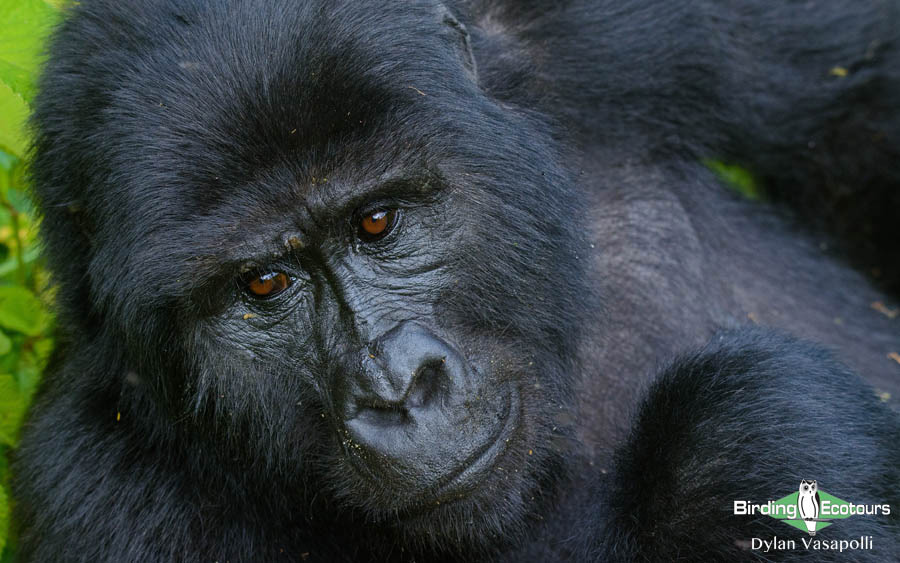
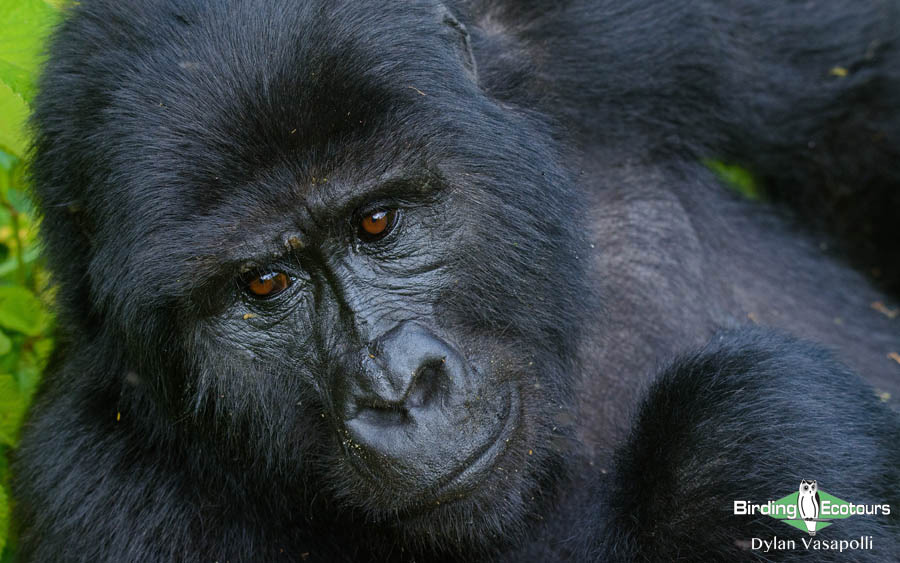 We have the option to spend some time with Eastern (Mountain) Gorillas on this tour.
This tour runs immediately before our Eastern Uganda Birding Tour – Fox’s Weaver & Localized Specialties, allowing for a seamless combination into one comprehensive Uganda birding adventure.
PLEASE NOTE: This trip is moderate in terms of fitness required, except for some days that are considered quite strenuous, such as the day of gorilla trekking and the day hike into Mubwindi Swamp and back. Chimpanzee trekking and looking for Green-breasted Pitta can also involve quite a lot of walking. You are welcome to opt out of any activities if you don’t feel you’ll manage them. There are also many days of forest birding; please wear appropriate clothing items (dark/neutral clothing and caps instead of very wide-brimmed hats) and be ready to spend good amounts of time on foot with a good chance of soaking rain, so protection for camera gear is advised.
Itinerary (14 days/13 nights)
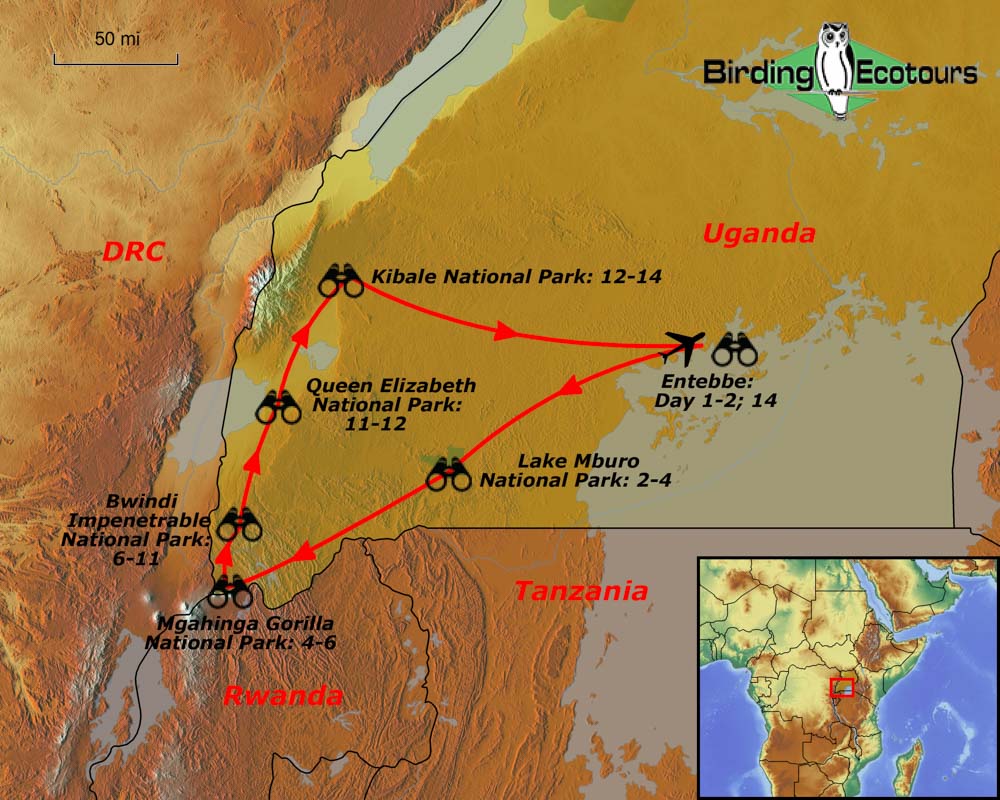
Day 1. Arrival at Entebbe International Airport and birding the shore of Lake Victoria
We’ll fetch you from Entebbe International Airport and check in at our guest house before starting birding. The dazzling Black-headed Gonolek, as well as the striking Double-toothed Barbet are both common around Entebbe. Bat Hawk and African Hobby are sometimes seen around town. Broad-billed Roller, Palm-nut Vulture, numerous weavers, and perhaps our first Great Blue Turaco might be seen as we bird the Entebbe Botanical Garden on the edge of Africa’s largest lake.
Overnight: Entebbe
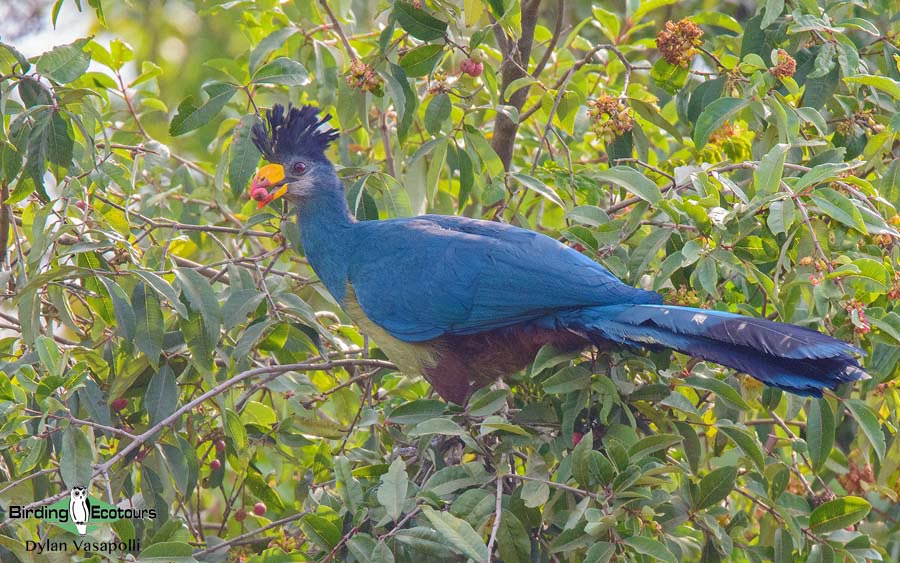
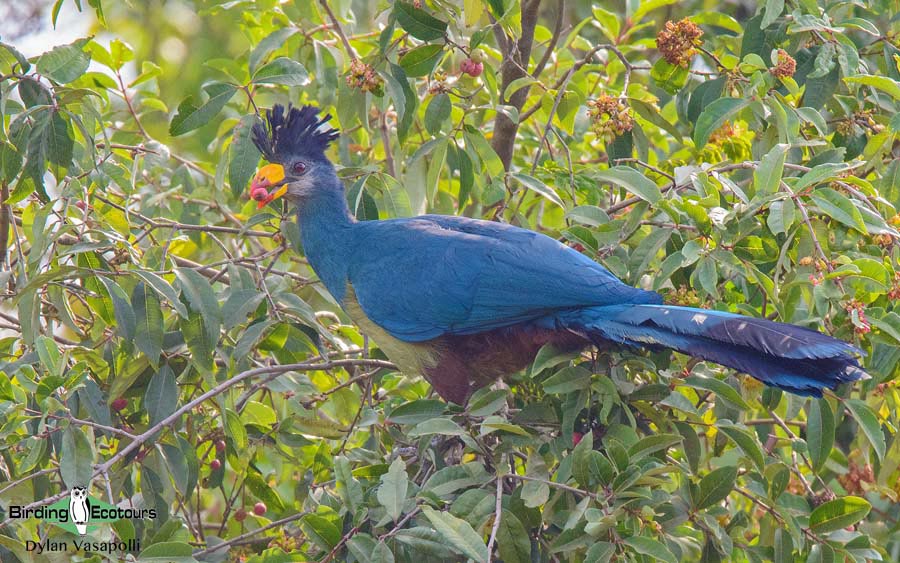 The Great Blue Turaco is magnificent!
Days 2 – 3. Shoebill and transfer to Lake Mburo National Park
Bypassing the bustling city of Kampala (adjacent to the more pleasant small town of Entebbe), we head for Mabamba Swamp, one of Africa’s most accessible sites for the monstrous Shoebill. The papyrus-swamp-loving Red-chested Sunbird, numerous weaver species that build their impressively neat nests in the wetlands, coucals, and many tropical waterbirds such as Lesser Jacana abound as we do a dugout canoe trip into the huge swamp. Swamp Flycatcher is also common here. After seeing Shoebill, we continue to our site for Orange Weaver, often seeing Eastern Plantain-eater, Ross’s Turaco, large flocks of the noisy Great Blue Turaco (the far-carrying calls of which are one of the characteristic sounds of Uganda), Grey Kestrel, and a very big, beautiful barbet, Double-toothed Barbet. We will also keep an eye open for the localized and scarce Weyns’s Weaver this morning.
We eventually arrive at Lake Mburo National Park (where we’ll spend two nights), which breaks the journey between Entebbe and the southwestern border region of Uganda, where we will look for over 20 Albertine Rift endemics (this region, also known as the Western Rift, is a branch of the Great Rift Valley).
The following morning, we take a boat trip on the lake, and this is one of the easiest places to find African Finfoot. We should see the colorful Papyrus Gonolek in addition to an array of kingfishers, including the likes of Malachite Kingfisher, Giant Kingfisher, Pied Kingfisher, and the rare Shining-blue Kingfisher. In general, this park gives us an excellent opportunity to see a lot of arid-country birds, which can include Blue-naped Mousebird, Bare-faced Go-away-bird, Golden-breasted Bunting, and the incredibly localized, rather “thin-on-the-ground” Red-faced Barbet, along with a more widespread East African species, Spot-flanked Barbet. Nubian Woodpecker is often heard before it is seen. As in most arid-habitat parks in East Africa, a large bird list can be accumulated very fast, and the above species are just a few of the many goodies we expect to find. This is the only place where we’re likely to see Plains Zebra during our Uganda birding tour, and there are a lot of other mammals as well, such as Common Hippopotamus, Cape Buffalo, Waterbuck, Bohor Reedbuck, Tsessebe (Topi), Common Eland, and many more.
Overnight: Lake Mburo National Park
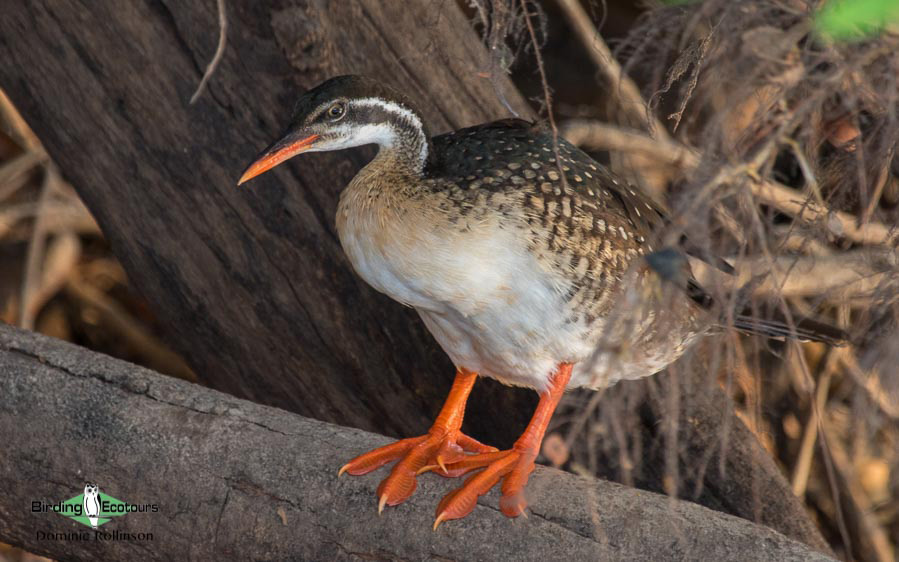
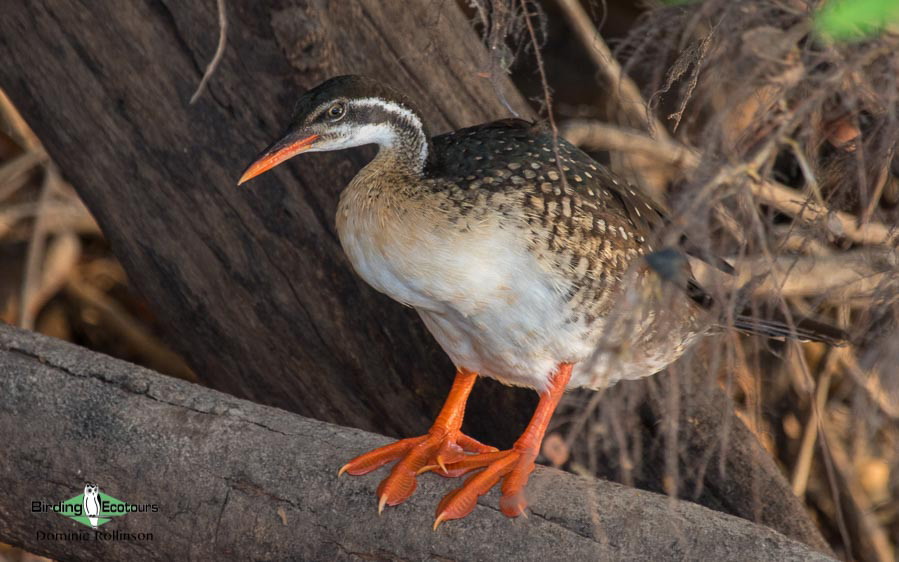 Sometimes we see up to five African Finfoots at Lake Mburo.
Days 4 – 5. Birding the Virunga Mountains region: Mgahinga Gorilla National Park
The Eastern (Mountain) Gorillas here freely roam into neighboring Rwanda and the DRC, but with extreme luck we might stumble across them (usually we have to wait until we get to Bwindi Impenetrable Forest National Park, though). One of the main reasons we include this park on our Uganda birding tour is to look for the gorgeous Rwenzori Turaco. This park has a lot of bamboo forest, in which we search for Abyssinian Ground Thrush. The very rare Shelley’s Crimsonwing is always possible – this Endangered (IUCN) species seems to be declining and, for once, not because of humans. We may get a head start with some other Albertine Rift endemics, but most of these will have to wait for Bwindi.
Overnight: Kisoro
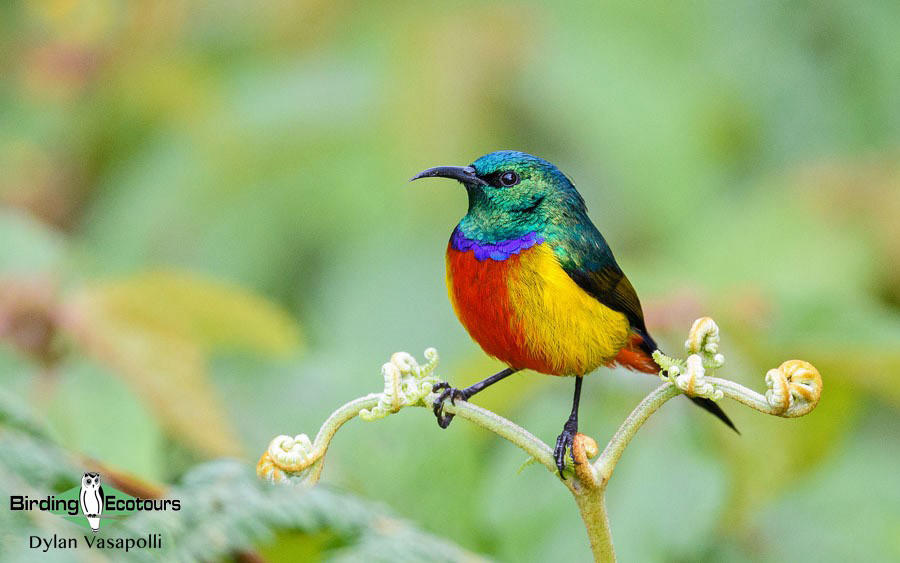
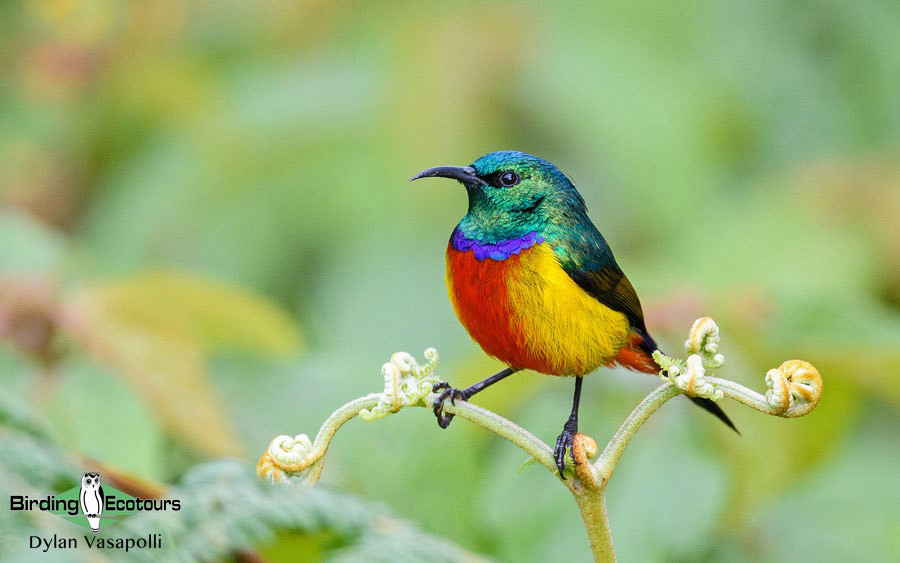 The beautiful Regal Sunbird is an Albertine Rift endemic.
Days 6 – 7. Ruhija, Bwindi Impenetrable Forest National Park
We travel to one of Africa’s richest forests for primates and birds, Bwindi Impenetrable Forest National Park, and start in its high-altitude Ruhija part. We’ll start birding the forest-covered hills as soon as we arrive, looking for the beautiful Black Bee-eater and also trying to find Grauer’s Swamp Warbler at a roadside site, so that we can reduce the length of the long walk on Day 6, as this warbler occurs right in the lower reaches of Mubwindi Swamp. Mountain Yellow Warbler might also be seen, nice to compare with Papyrus Yellow Warbler, for which we try another day. A walk most of the way down to this swamp can’t be avoided, though, as Grauer’s (African Green) Broadbill, one of Africa’s most desirable birds, also occurs there.
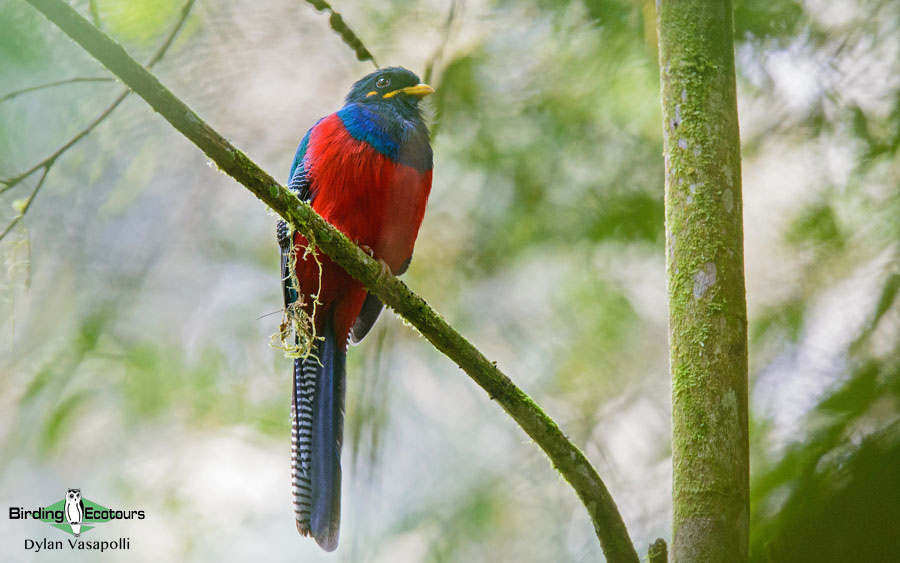
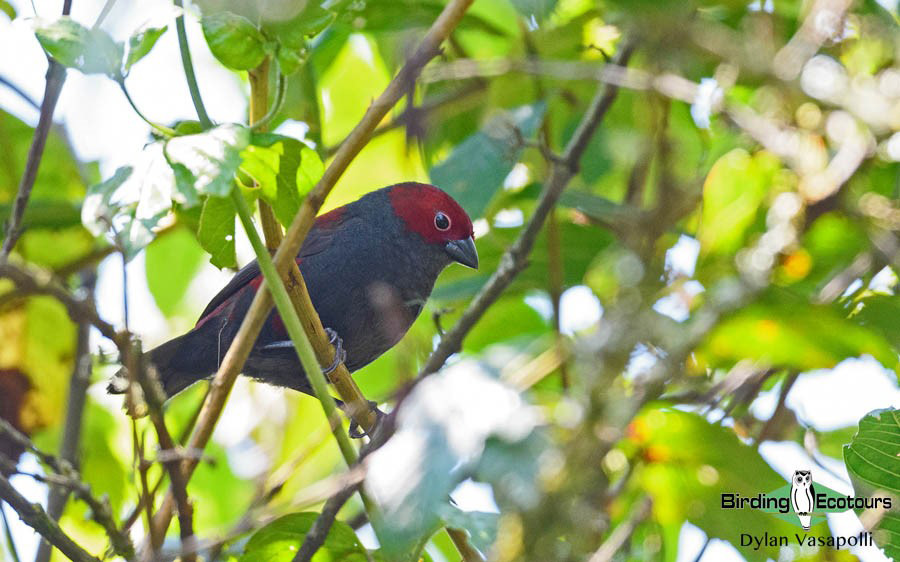
The good-looking, highly localized Yellow-eyed Black Flycatcher also lurks pretty close to the bottom reaches. The walk down to the site for this broadbill (and back) takes a large part of the day, but this is one of the best birding days of the entire tour. Trip participants usually end up getting a constant stream of life-birds throughout the day, mainly Albertine Rift endemics. Banded Prinia, Mountain Masked Apalis, Rwenzori Apalis, Chestnut-throated Apalis, the strange-looking (and dull for a barbet) Grey-throated Barbet, Red-faced Woodland Warbler, and up to four species of quiet, brightly colored forest finches known as crimsonwings (all of them very difficult, though!) are often encountered. There are far too many high-quality species to list here! We will also spend plenty of time working through several greenbul species, often rather subtle in appearance, as Uganda is exceptionally rich in them, making identification both challenging and rewarding. We do need to mention a couple of the other range-restricted species as well, though, – the very long-tailed Blue-headed Sunbird, the dazzling Regal Sunbird, Stripe-breasted Tit, Rwenzori Batis, and also slightly more widespread species like the fabulous Bar-tailed Trogon and Rwenzori Hill Babbler.
Overnight: Ruhija
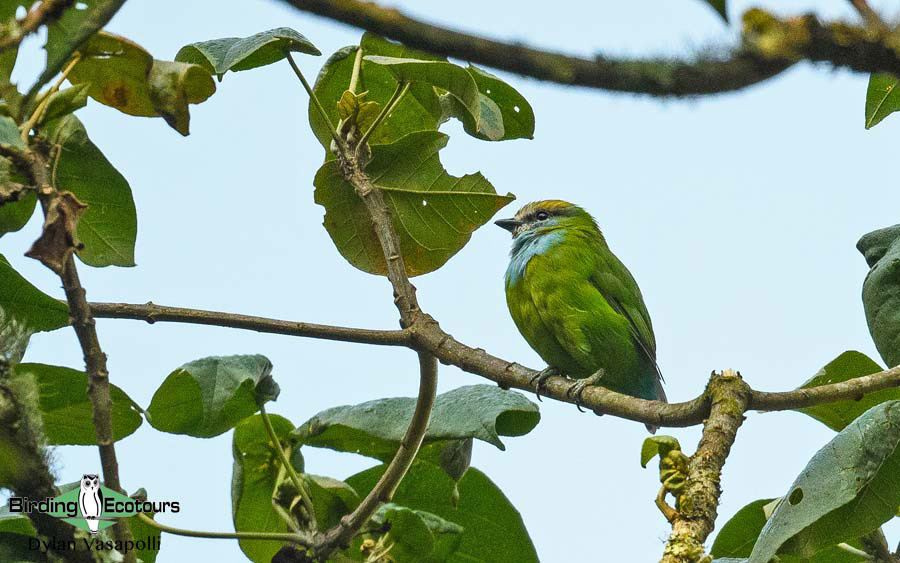 The highly prized Grauer’s (African Green) Broadbill is another major target.
Days 8 – 10. Buhoma, Bwindi Impenetrable Forest National Park: birds and optional gorilla trekking
En route between the higher-altitude Ruhija and the lower-elevation Buhoma sections of the park, we stop to bird “The Neck”, which allows us to see quite a number of species we won’t find elsewhere. Black Bee-eater and Cinnamon-chested Bee-eater are both quite easy to see here. Chubb’s Cisticola duets from the thickets. Black-and-white Shrike-flycatcher (also known as Vanga Flycatcher) might be seen – this charismatic bird usually moves around a lot (it’s an extremely lively species) and makes lots of noise as it flies around from one perch to the next. It has a fabulous crest, and the species exhibits obvious sexual dimorphism. The female is chestnut and white, whereas the male is black-and-white with striking yellow eyes. We might also see Brown-throated Wattle-eye, Mackinnon’s Shrike, Bronzy Sunbird and several other sunbirds, African Grey Woodpecker, Augur Buzzard, etc.
Deep-forest birds we’ll seek include many more localized endemics that barely get into neighboring countries – Grauer’s Warbler (not to be confused with Grauer’s Swamp Warbler, which we should have already seen), Bar-tailed Trogon, Petit’s Cuckooshrike, Lühder’s Bushshrike, Brown-capped Weaver and other weavers of the forest canopy, Red-throated Alethe, and lots of others. We’ll be sure to spend time looking for slightly more widespread birds as well, including the skulking White-spotted Flufftail, Red-shouldered Cuckooshrike, Olive-bellied Sunbird, some beautiful forest barbets such as the large Yellow-billed Barbet, the dazzlingly bright and shiny, green-and-yellow African Emerald Cuckoo, and, last but not least, Black-billed Turaco.
Forest-edge birding can be equally rewarding (and often easier for photography!) with such specials as Dusky Long-tailed Cuckoo, Great Blue and Ross’s Turaco, Grey-winged Robin-Chat, Black-necked Weaver, Red-headed Malimbe, Northern Double-collared Sunbird, Grey-headed Nigrita and many others. Over our two full days here, we will spend plenty of time birding the forest trails, forest edge, and adjacent agricultural areas.
At Buhoma, there is the option to spend a day trekking for Eastern (Mountain) Gorillas (this is a strenuous activity; if you decide not to join, you’ll be taken birding instead, or you can relax or look at and photograph birds around the lodge).
Overnight: Buhoma
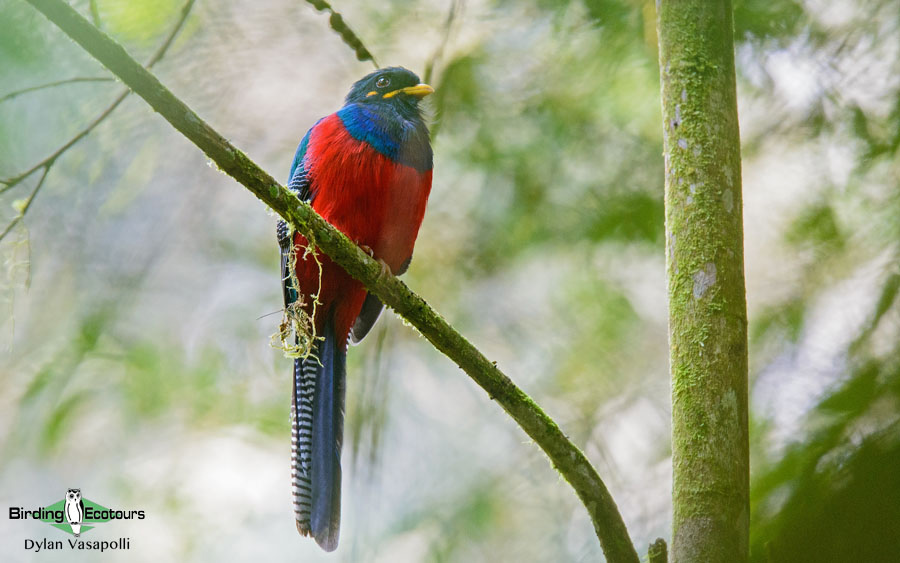 Bar-tailed Trogon occurs in the Bwindi Impenetrable Forest.
Day 11. Birds and mammals of Queen Elizabeth National Park
We stop over in Queen Elizabeth National Park (often staying on the Mweya peninsula itself, along the Kazinga Channel) en route to Kibale Forest. England’s queen officially opened this national park (well-known for its tree-climbing lions and boasting 100 mammal species and 600 bird species!) in 1954. One of the highlights of our stay here is getting out on the Kazinga Channel by boat and seeing Nile Crocodile, Common Hippopotamus, and a great many waterbirds. Naturally, we also see Common Warthog, Cape Buffalo, Kob, and a plethora of other mammals. Giant Forest Hog usually steals the show, however.
Overnight: Queen Elizabeth National Park
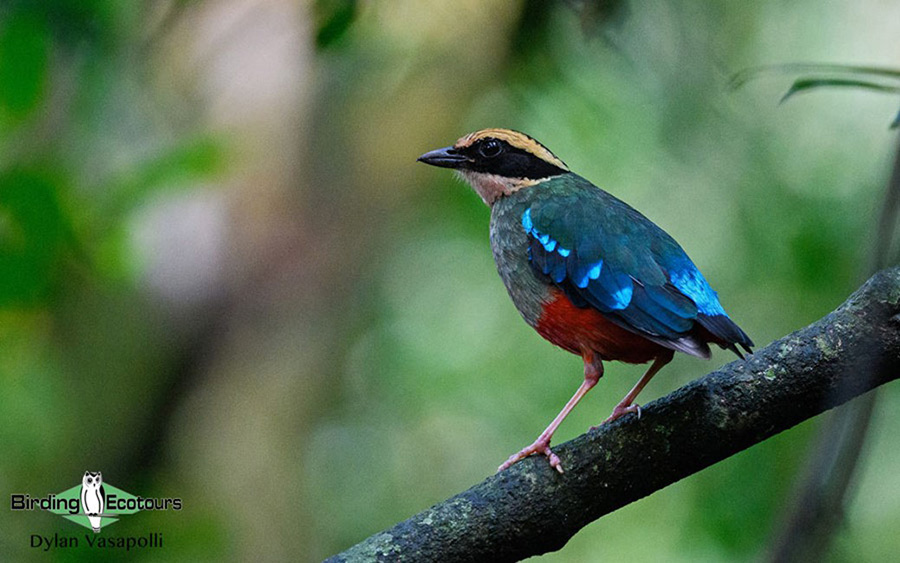
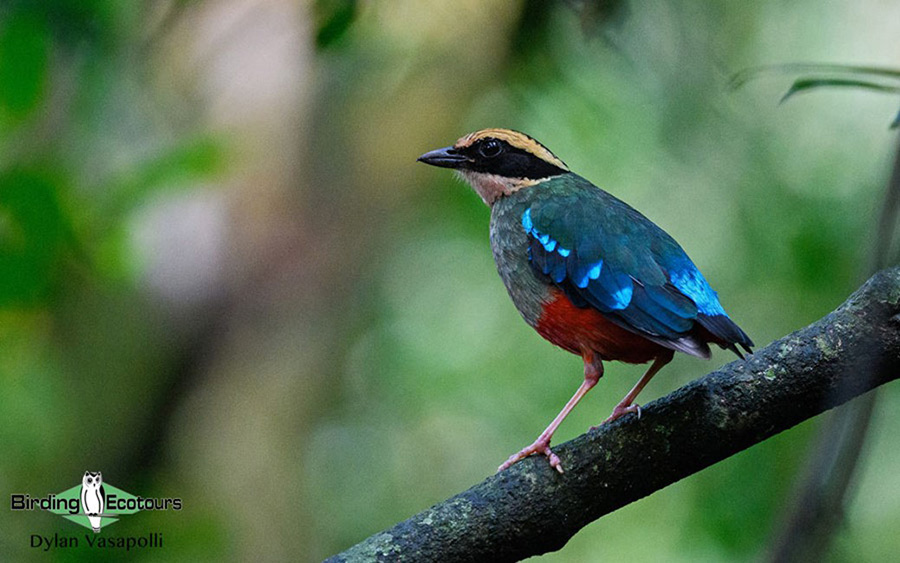 Green-breasted Pitta is another of Africa’s most sought-after species we’ll be targeting.
Days 12 – 13. Kibale National Park – the Chimpanzee/Green-breasted Pitta combo
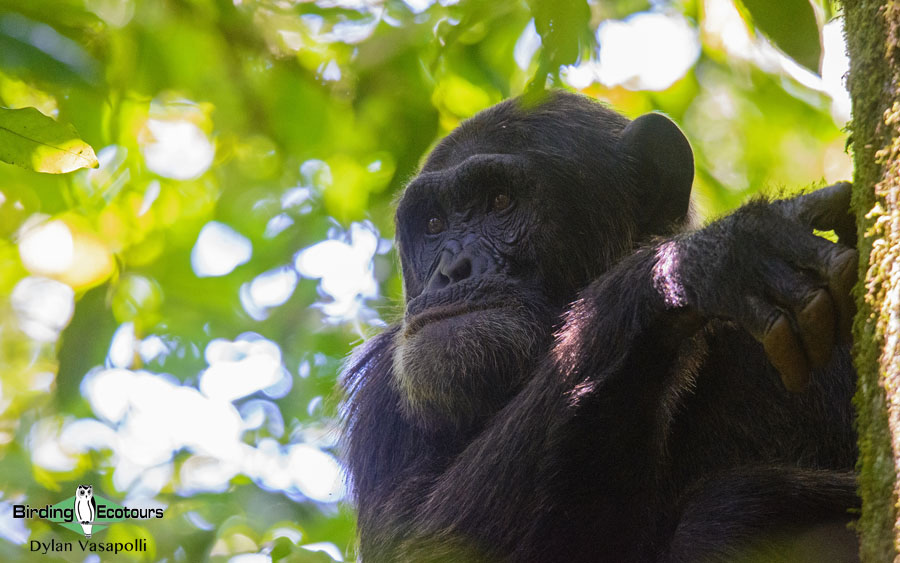
The drive from Queen Elizabeth to another fantastic national park, Kibale, is amazing: We traverse the foothills of the “Mountains of the Moon” (the Ruwenzori Range) and cross the equator, eventually arriving at the richest forest for primates on the African continent. Our main avian target is Green-breasted Pitta, which is best found at dawn, when its display call allows us to narrow down its whereabouts (otherwise, despite the jewel-like colors of this bird, it’s like looking for a needle in a haystack on the forest floor). While we search for this bird, the atmospheric, quite scary noises of large troops of Chimpanzees resonate through the forest. There is also the opportunity to optionally trek for Chimpanzees. We should also find some other primates, such as L’Hoest’s Monkey, Ashy Red Colobus, one of the most striking of all African primates, Guereza (Eastern Black-and-white Colobus), Red-tailed Monkey, Ugandan Crested Mangabey, and other monkeys (not to mention the well-built Olive Baboon, which wanders around in massive troops, usually on the ground). We also have a lot of good birds to see, which might include White-headed Wood Hoopoe, Narrow-tailed Starling, Black-billed Turaco, and Chestnut Wattle-eye.
Overnight: Bigodi
Day 14. Transfer to Entebbe and departure
After some final birding around Kibale, we return to Entebbe to conclude what promises to be an unforgettable journey. You may depart at any time after 3:00 p.m. For those continuing on our Eastern Uganda Birding Tour, we will overnight in Entebbe before setting off for Pian Upe National Park the following day.
Please note that the itinerary cannot be guaranteed as it is only a rough guide and can be changed (usually slightly) due to factors such as availability of accommodation, updated information on the state of accommodation, roads, or birding sites, the discretion of the guides, and other factors. In addition, we sometimes have to use a different guide from the one advertised due to tour scheduling or other factors.
Map
Testimonials
Gallery
General Information
Best of Uganda Birding Tour – Shoebill, Albertine Rift Endemics and Great Apes
GENERAL INFORMATION
Uganda, “the Pearl of Africa”, is about the same size as the state of Oregon yet boasts over 1,000 bird species and Africa’s greatest concentration of primate species! This spectacular faunal diversity is partly explained by the dramatic variety of habitats that change constantly (and sometimes rapidly) as one drives across the country. On this Ugandan birding tour, we target the most important birds and primates that Uganda has to offer. The huge and bizarre Shoebill is searched for in Mabamba Swamp and is near-guaranteed. Enough time is spent in the highlands of the country where we search for the 20 Albertine (Western) Rift endemics which includes one of Africa’s most fabulous turacos, Rwenzori Turaco, and of course the “must-see” Grauer’s Broadbill. We also then spend time in lowland forest (looking for Green-breasted Pitta) and savanna as well as time on boats on rivers and lakes which results in an impressive trip list (both birds and mammals).
DAILY ACTIVITIES, PHYSICAL REQUIREMENTS, AND TOUR PACE
Most of the trip is not very strenuous. However, there are a couple of relatively difficult, but optional, walks that take at least half a day, sometimes the whole day. Those folks who are unfit (or who prefer just to have more of a vacation) can certainly feel free to opt out of any strenuous activities. The lodges are pleasant places to spend the occasional day relaxing, and we have found that photographers sometimes get quite good bird pictures by staying behind at the accommodations while the others embark on these long walks. Some folks also opt out of pre-breakfast birding or night owling if they want a less tiring trip. From our experience, a mix of hardcore birders and relaxed birding spouses have thoroughly enjoyed this trip to Uganda since it is, on most days (except when driving between sites), easy to opt out of activities and to enjoy “off” time around the hotels.
There are a few long, slow drives during the tour that can take half a day or more between sites. Road work has been ongoing for several years in Uganda, so do be prepared to travel along the unpaved side of the road for many miles at times – this gets dusty.
Most of the birding on this tour involves birding in forests (at Mgahinga, Bwindi, and Kibale), although we do also spend quality time in savanna, wetland and river systems, and other open-country habitats. Forest birding is typically difficult and often involves looking for birds high up in the tree canopy or searching for cryptic and skulking species in the dense undergrowth. This means at times forest birding can be frustrating as often somebody in the group may miss species however it can also be incredibly rewarding if you are patient and determined and can result in some highly prized Albertine Rift endemics added to your life list.
BIRDING AND GREAT APE HIKES
We undertake several birding hikes and walks on this trip, most of which take us through climax highland as well as lowland forest. The birding hike down to Mubwindi Swamp is one of the most exciting birding walks of the entire trip, as one often sees a constant stream of Albertine Rift endemics, the top one being Grauer’s Broadbill, which is unfortunately right at the bottom around the swamp. It is also the most strenuous walk of the trip as it involves hiking at altitude (roughly 6,400 feet /2,000 meters above sea), covers roughly 10 miles (16 kilometers), round trip, and may include some walking off cleared paths. One spends the whole morning slowly walking down (dropping roughly 1,500 feet/500 meters), enjoy our picnic lunch at the swamp and then some people struggle, as the entire afternoon is spent walking back up a long hill for several hours! Mgahinga Gorilla National Park (near the start of the trip) is also strenuous but usually involves walking uphill first, then downhill later. Other birding walks are far less strenuous and are over much easier terrain, such as at the Buhoma section of Bwindi Impenetrable Forest and Kibale. If you decide you’d prefer to skip any of our planned birding hikes, we will try our best to make other plans for more relaxed birding, probably along forest roads. To get the most out of this Uganda birding tour however a moderate level of fitness is ideal.
Gorilla trekking can take 2-14 hours, depending on where the gorilla family is on the day you do the trekking (it’s all about luck, or lack thereof!). The gorilla trekking is in a mountainous area, so expect to walk up and down a lot. Most of the time one has to leave the trail completely to get to where the gorillas are. This can involve some serious “bush-bashing” through the undergrowth; proper hiking boots with good grip are essential. So be prepared, with proper clothing. Snakes and forest elephants lurk in the area; this is wild Africa. For those folks who have problems walking, if you’re willing to pay at the very least double the price of the gorilla trekking, you can be carried on a stretcher to see these great apes! So, if money is less of an issue, even this day does not have to be strenuous as the porters will prepare a stretcher for you on the spot. Strictly one hour is spent with the gorillas after meeting up with them – this is to keep disturbance to a minimum.
Chimpanzee trekking in Kibale Forest is usually quite a lot easier, as it is over flatter terrain. Of course, it still can involve quite a walk through a hot and humid forest.
Those opting out of the gorilla and chimp trekking can catch up on rest and “regroup” at the lodge or will be taken birding if preferred.
BOAT TRIPS
There are a few boat trips on this tour. The trip to look for Shoebill at the Mabamba Swamp is in small dugout canoes (mokoros). Due to limited space in each canoe, the group splits up into different canoes, which, however, stick close together as they travel out onto the water to seek Shoebill. Other wildlife-viewing boat trips such as on Lake Mburo are on larger boats where the whole group can be accommodated together.
PASSPORT AND VISA
Most visitors require a tourist visa to visit Uganda, and these must be applied for online (here) prior to your visit at a cost of around $50. We can provide you with a letter from a local sponsor, which may be required for your application process. We usually recommend starting the visa application process a couple of months before the start of the tour.
Please make sure that you bring a photocopy of your passport with you on the tour, to be kept in a different location to your original passport, in case of loss or damage. This can be kept with other important documents such as vaccine certificate, emergency contact details, and insurance documents. It may also be worthwhile to leave a copy with your tour leader. Your passport should be valid for a minimum period of six months from the time you enter Uganda.
If you are further unsure of entry requirements from your home country, we suggest checking your own governments’ advice and contact their nearest embassies/consulates for up-to-date regulations and requirements.
TRAVEL INSURANCE
As per our standard Terms and Conditions, we strongly suggest (and essentially insist, as tour deposits and balance payments are unfortunately non-refundable if you cancel as we spend the money in advance to secure services) that you buy trip cancellation insurance to protect yourself against accidents, medical issues, illness, repatriation, loss of valuables or luggage, and travel interruptions or delays of any kind.
HEALTH AND SAFETY
Please read the Centers for Disease Control website’s section on Uganda very carefully, noting that anti-malarial drugs are required and that a yellow fever vaccination certificate is needed to enter the country. Insect repellent and quick-drying long-sleeved shirts are a good idea, not only to help prevent mosquito bites but also to protect against other (simply pesky) insects such as biting flies.
Avoid travelers’ diarrhea by never drinking tap water or eating unpeeled fruit or salads. Unlimited bottled water is provided free of charge throughout the tour in the vehicles (we purchase this inexpensively at grocery stores; bottled water bought at restaurants is not covered and is for your account but you are welcome to take water from the vehicles to the rooms when needed although many hotels provide free bottled water too).
In Uganda, large animals such as elephants, hippos, lions, leopards, gorillas, chimpanzees, crocodiles and others pose a risk and need to be treated with extreme respect. Small animals such as spiders, snakes, etc. can also, of course, pose a safety risk.
You’ll find the people of Uganda to be extremely friendly and helpful, but (like in most parts of the world) crime is possible (especially in the big cities). Always watch your valuables (although we certainly have never had any problems on any of our tours to Uganda).
Steep trails (see for example the part on gorilla trekking above) can also be a hazard.
CURRENCY
The Ugandan Shilling (see here for exchange rate, etc.) is the currency. You can draw this local currency using major credit cards (especially Visa and Mastercard) at ATMs (which can be found at the airport and in towns along the way – please do ask the guides a couple of days in advance when you need another ATM stop to replenish cash!). Major credit cards can be used for some purchases and to buy drinks and get laundry done at some hotels – but a supply of local cash is also essential, as some of the accommodations are remote and do not take cards (and neither do folks selling gifts and souvenirs along the route). If you prefer not to draw money from an ATM, then US dollar (or other major currency to a lesser extent) cash is easily exchanged for local currency in Entebbe and we recommend doing this before the start of the tour as it may be difficult in smaller towns. Traveler’s checks are no longer used much, are extremely difficult to cash, and are not advised.
WEATHER/CLIMATE
The country of Uganda is full of water and has vast papyrus swamps, shares a large part of Africa’s largest lake (Victoria) with its neighbors, and has some verdant forest, thanks to the good amount of rain it receives. This also means that one must be prepared for the possibility of rain, drizzle, and mist, although often this does not pose a major problem as we run our set departure Uganda tours in the dry season, which covers the months from June to August. This is also when birds are in breeding plumage and singing and the intra-African migrants are present.
Uganda is well-known for its diversity of terrain and habitats, which in turn means that birders visiting Uganda need to be prepared for all kinds of different temperatures and weather patterns. At arrival in the hot and humid Entebbe airport one does not necessarily realize that a couple of days later one will likely be wearing fleeces high in the volcanic mountains straddling the border with Rwanda and the Democratic Republic of Congo; despite being equatorial, it can get cold in both Bwindi Impenetrable National Park and Mgahinga Gorilla National Park (not usually quite as low as freezing point, though). It’s best to bring many layers; while quite often conditions will be unpleasantly hot and humid, at other times people get surprised how cold it is. Bwindi Impenetrable National Park (especially its higher-altitude Ruhija section) and Mgahinga Gorilla National Park often leave people feeling markedly chilly. Accommodations are not always heated, so you may rely on layers while sleeping, and the provided blankets.
The “take-home” message is to bring layers, including waterproofs (which hopefully you won’t actually need, but which you certainly should carry, while gorilla trekking or on long birding walks). A relatively nominal fee can be paid to porters for carrying gear during the longer birding walks and gorilla/chimp trekking. A waterproof day backpack is advised (whether you carry it or the porter does, during the birding and primate walks) – for waterproof layers, your water bottle, etc. Waterproof bags for placing cameras, cell phones, etc. into, in case that it does rain, are recommended.
ELECTRICITY
Electricity in Uganda is 220 V and with UK-type plug sockets – full details are shown here. Please bring adapters, and in some cases a currency converter in order not to damage cameras or other equipment, noting that voltage is twice that in North America.
COMMUNICATIONS
Cell (mobile) phone signal is likely to be available at most locations we visit on the tour. Roaming charges might apply depending on your phone contract, it’s thus best to check with your supplier that your phone will work in Uganda. A considerably less expensive alternative to using an international SIM card would be to purchase a local SIM card on your arrival at the airport or phone shop (options are available in Entebbe, prior to the start of the tour). Wi-Fi is usually widely available at most of our accommodation establishments however it is not always available in your rooms and is rather only available in common areas such as reception or the dining area.
TRANSPORTATION AND SEAT ROTATION
Travel in Uganda is typically very slow (with many speed bumps and potholes) which means even though we might not have far to travel between destinations, it may take a very long time. However, we use modern, comfortable vehicles during our Uganda birding tours, such as a Toyota Landcruiser, or a minibus, for larger groups, which ensures the drives are as comfortable as possible.
We have a seat rotation policy for our set departure tours, this ensures ensure everybody has equal opportunities within the vehicle throughout the tour. As we need to keep things fair for all our paying clients, motion sickness will unfortunately not excuse you from our seat rotation policy and if you are prone to motion sickness you should ensure you bring the necessary medication. It is necessary that you are fit and flexible enough to maneuver yourself to the back of the vehicle when it is your turn to sit in that position. Tour participants should be mindful of the extra equipment they bring into the general seating area of the vehicle (rather than the luggage section) and should ensure they do not clog up general thoroughfare or extra seats with camera equipment, tripods, etc. from both a comfort and a health and safety perspective.
LUGGAGE
Due to restricted space in the vehicles, please try to pack on the lighter side for this tour. We find a medium-sized, soft-sided duffle bag (not the hard-sided cases) usually works best for packing in the vehicles. A small daypack should be used to keep items that you wish to use daily when in the vehicle or in the field.
ACCOMMODATION
Accommodation is by no means luxurious but is clean, reasonably comfortable and well situated, often with large gardens or grounds which offer good birding opportunities right on the doorstep. Most accommodation establishments have air-conditioning and/or a fan while all have private bathrooms. “Load-shedding” is common – this is when the electricity supply is interrupted because of Uganda’s limited capacity for power generation. At other times, electricity at some hotels will be from generators that are switched off at certain times (e.g. between 10 p.m. and 6 a.m.). The guides will advise on the exact details/generator times during the tour. Rooms are not always heated and can actually get slightly chilly at night up in the mountains. At other times heat and humidity will of course be more of a problem however most establishments we use have air-conditioning and/or a fan.
WHAT TO BRING: CLOTHING
We recommend packing loose, lightweight field clothing with green and brown colors as these colors work best for our birding activities and help blend into the forest environments that we will spend most of our time birding in. Bright colors are to be avoided for birding attire, please (e.g. no pale colors, white, red, orange etc.). Due to the potential insect issues (and fierce tropical sun) mentioned above, we recommend long pants/trousers and long-sleeved shirts (these can be rolled up should you get too hot). Shorts can be great for when you are relaxing around the accommodation but always be aware of biting insects and sun exposure.
As we will be birding in the mountains for some sections of this tour, you will also need to bring some warmer clothing, certainly a minimum of a warm fleece/jacket for early morning/evening when temperatures can be low. It is also advisable to pack something warm to sleep in for the nights when at higher elevation. Rain is always a possibility in Uganda, so (light-weight) rain gear is always useful to have on hand.
Casual and informal dress is fine in the hotels/accommodation (and for dinners). Swimwear can be useful as there may be opportunities to swim at some of the accommodations during the rest periods in the middle of the day. Sunglasses, sunhat, and sunscreen (rated SPF 30 or higher) are useful.
We undertake a number of birding/wildlife hikes on this Uganda birding tour and thus we recommend lightweight walking boots for when out on foot to give extra ankle support and added protection against animal stings/bites. A change of shoes is always good in case your boots get soaked from rain or walking through damp areas – a pair of lighter walking shoes is good to have along on the trip as a backup and for shorter walks. Sandals/trainers (tennis shoes) are useful for in the vehicles and for walking between your room and restaurant in the hotels and lodges.
WHAT TO BRING: OTHER ITEMS
Do not forget: binoculars, East African/Ugandan field guides (see “Books” section below), flashlight (torch), prescription drugs (please bring the generic names for these drugs with you), toiletries, prescription glasses (and a spare pair), insect repellent, sunscreen, sunglasses, camera, batteries (for electronic equipment and chargers for the re-chargeable batteries, if required), converter plugs and plug adaptors if needed, money pouch, suggested medical kit, and daypacks.
Our tour leader or local guide will have a telescope for use during the tour. Most of the birding will be carried out in forest environments and therefore we are unlikely to rely heavily on a scope during this tour, therefore it is probably not worth bringing your own scope, unless you like to “digiscope/phone-scope”. The communal scope will be for everyone to look at the birds but not for taking photos through.
Other important items to remember to bring include: key travel documents, cash (or ATM/credit cards to draw money), passport, proof of vaccinations (yellow fever vaccination is mandatory) and your travel or health insurance cards – photocopies of all can be carried by the tour leader in case of emergency, US Dollars (US$) or British Pound Sterling (GBP/£) can be changed to Ugandan Shillings if you prefer not to simply draw from ATM’s, cash for anything of a personal nature that is not included within the tour cost.
To help with the evening checklist session, we recommend bringing two different colored pens and a 12-inch (30-centimeter) plastic ruler. Using different colors on alternate days makes the listing activity much easier!
If you would like some advice on what to pack for a birding tour, you can read more in this blog post here.
BOOKS
In terms of books, “The Birds of East Africa” field guide and the associated app (detailed in our blog here) are highly recommended for Uganda. Another good option is the Merlin bird app (with the Uganda country package downloaded) which gives you access to a large range of photos and calls of almost all of Uganda’s bird species.