14–31 OCTOBER 2026
By Daniel Engelbrecht
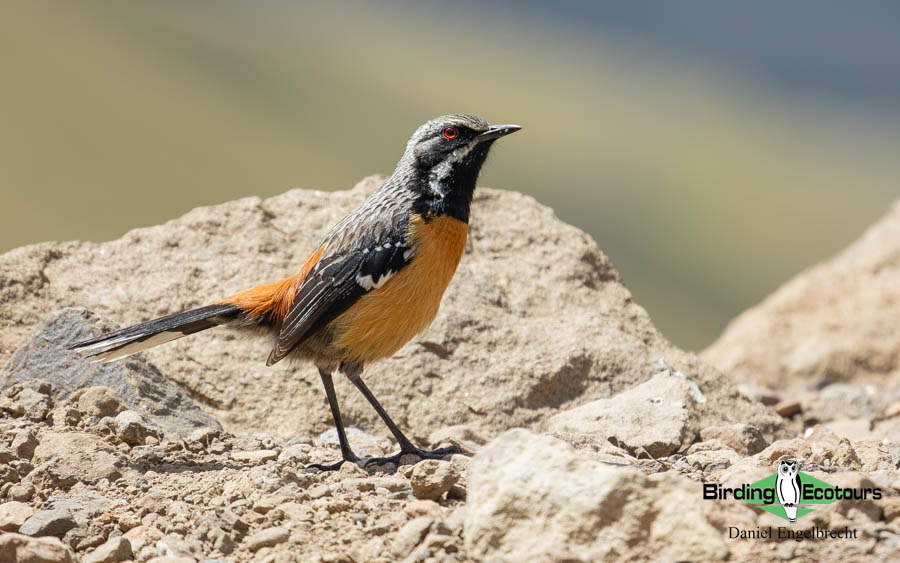
The two rockjumpers are among the most sought-after birds on any South African birding trip, representing a near-endemic bird family. We were fortunate to enjoy excellent views of Drakensberg Rockjumper.
Overview
South Africa is arguably the continent’s premier birding destination, and for good reason. Excellent infrastructure, easy access to an extensive network of nature reserves and national parks, a large and active birding community, and an impressive variety of endemic and localized species make the country an outstanding destination for birders from around the world.
This 18-day tour covered a large part of the eastern half of the country, taking in a wide range of habitats, from coastal dune forest to escarpment grasslands, Afromontane forest, high-altitude heathlands, sand forest, Highveld grasslands, mixed woodlands, and Kalahari bushveld, to name a few. In total, we recorded 455 bird species, of which more than 50 are considered endemic to southern Africa. We began along the KwaZulu-Natal south coast and escarpment, where Black-throated Wattle-eye, Magpie Mannikin, Brown Scrub Robin, Knysna Turaco, and a pair of Endangered (BirdLife International) Blue Swallows were early successes, along with Narina Trogon, Chorister Robin-Chat, Bush Blackcap, Forest Canary, and Barratt’s Warbler at Ingeli Forest. A day trip up Sani Pass into Lesotho was a major highlight, delivering Drakensberg Rockjumper, Drakensberg Siskin, Gurney’s Sugarbird, Mountain Pipit, Buff-streaked Chat, and a Bearded Vulture performing its bone-dropping routine. Other standout species on this leg of the trip included Southern Bald Ibis and Wattled Crane.
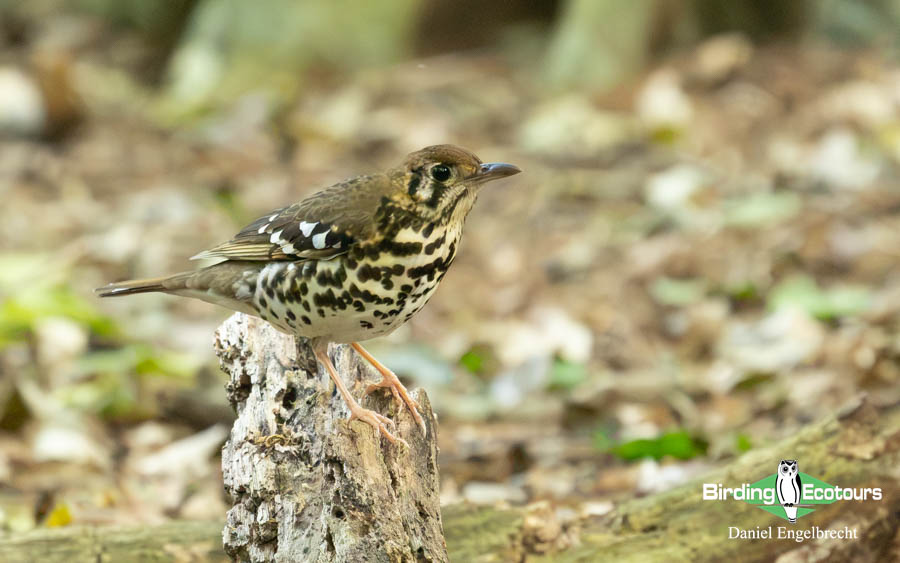
We could not have asked for better views of the rare Spotted Ground Thrush at Dlinza Forest.
Zululand and the Maputaland coast produced a string of specialties, including Spotted Ground Thrush, Eastern Bronze-naped Pigeon, Green Barbet, Swamp Nightjar, Green Malkoha, Southern Banded Snake Eagle, Rudd’s Apalis, Woodwards’ Batis, Livingstone’s Turaco, and Buff-spotted Flufftail. The sand forests and wetlands around Hluhluwe and Mkhuze added Neergaard’s Sunbird, Pink-throated Twinspot, Southern Red-fronted Tinkerbird, and Lemon-breasted Canary. We then climbed back onto the Highveld at Wakkerstroom, where White-bellied Bustard, Blue Korhaan, Eastern Long-billed Lark, Yellow-breasted Pipit, and a very cooperative Black-rumped Buttonquail were among the many stars. Three nights in Kruger National Park brought African Skimmer, White-headed Vulture, Thick-billed Cuckoo, Southern Ground Hornbill, Kori Bustard, and Brown-headed Parrot, before Melodious Lark, Crimson-breasted Shrike, Southern White-faced Owl, and an unexpected African Finfoot rounded off the birding around Rust de Winter.
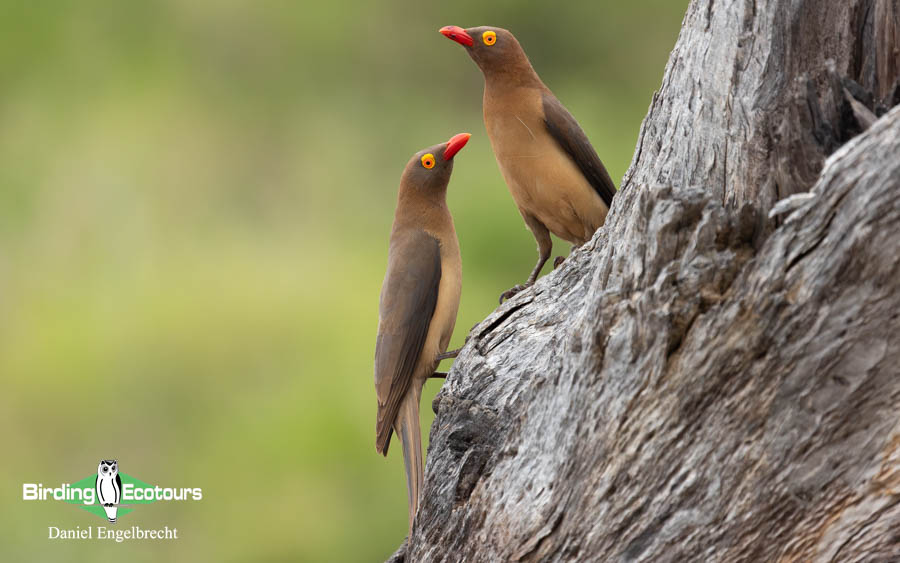
This tour serves as a perfect introduction to birding in Africa and we enjoyed representatives from many classic African families, like these Red-billed Oxpeckers.
Mammals were also well represented. We saw all of Africa’s iconic “Big Five” on this tour, with sightings of African Savanna Elephant, White Rhinoceros, Cape Buffalo, Leopard, and Lion. Additionally, a remarkable eight mongoose species were recorded, including the elusive White-tailed Mongoose, while the tiny Suni, Blue Duiker, and Natal Red Duiker were further highlights.
A detailed daily account can be read below, with the full bird and mammal lists located at the end of the report. You can also access our eBird trip report here.
Detailed Report
Day 1, 14th October 2026. Arrival in Durban and transfer to Pennington
Our Subtropical South Africa birding tour started today at King Shaka International Airport on the outskirts of Durban. After collecting five of the six tour participants from the airport, we headed to a nearby park, where we enjoyed a quick picnic lunch before the birding began. We kicked off the trip list with a few widespread species that we would encounter again during the tour, such as Little Swift, White-throated and Lesser Striped Swallows, three soaring African Woolly-necked Storks, Common Bulbul, Eastern Golden and Thick-billed Weavers, and Southern Red Bishop. The main reason for visiting this site, however, was to see a pair of Black-throated Wattle-eyes, a species that can be hit or miss along our route. Thankfully, the birds cooperated.
After a successful lunch stop, we continued south, stopping to bird another park along the way, where we had brief fly-by views of the rare Magpie Mannikin. We did not have much time to explore this patch of coastal forest, but still added several new species, including the gorgeous Purple-crested Turaco, Tambourine Dove, White-eared Barbet, Cardinal and Olive Woodpeckers, Red-winged and Black-bellied Starlings, Southern Black Flycatcher, and Olive Sunbird, among others. Many small birds were feeding on the seeding grasses, and we picked out Black-and-white and Bronze Mannikins, Yellow-fronted Canary, and the shy Grey Waxbill.
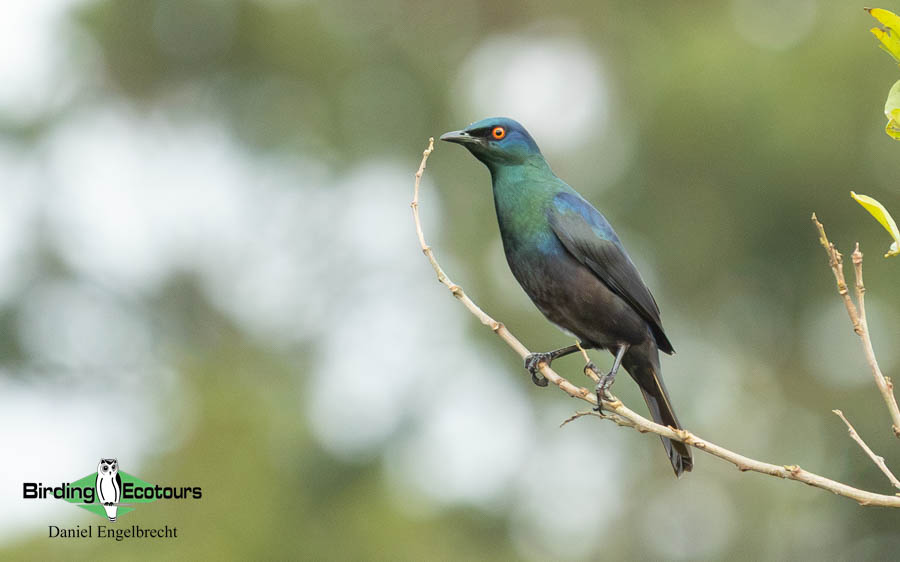
Black-bellied Starlings were common on the KwaZulu-Natal leg of our tour.
We continued to our well-appointed guesthouse in the charming coastal town of Pennington, where we met the final member of our group, David Holberton-Jones, who had arrived a day early. Although dusk was fast approaching, we enjoyed sweeping views of the Indian Ocean from our manor in the scenic Umdoni Park. Over dinner, we discussed our plans for the tour and looked forward to the exciting day ahead.
Day 2, 15th October 2026. Transfer to Underberg, birding en route
We met for coffee on the veranda of our guesthouse and watched the sun rise over the ocean. We planned to bird the coastal dune forest on the property before breakfast, which, as expected, proved quite productive. An early non-bird highlight came in the form of a tiny Blue Duiker walking across the road, our only good sighting of this secretive antelope. We explored the area on foot, securing views of African Green Pigeon, Knysna Turaco, Crowned Hornbill, Cape Batis, Square-tailed Drongo, African Paradise Flycatcher, Green-backed Camaroptera, Yellow-bellied Greenbul, Red-capped Robin-Chat, Collared Sunbird, and the musical Dark-backed Weaver. Our main target here was Brown Scrub Robin, a species that can be tricky on our route, and we had good views of it foraging in the undergrowth. Better views of Tambourine Dove and Purple-crested Turaco this morning were also much appreciated by all, and we saw our first of eight mongoose species, Banded Mongoose, on our way back to the manor.
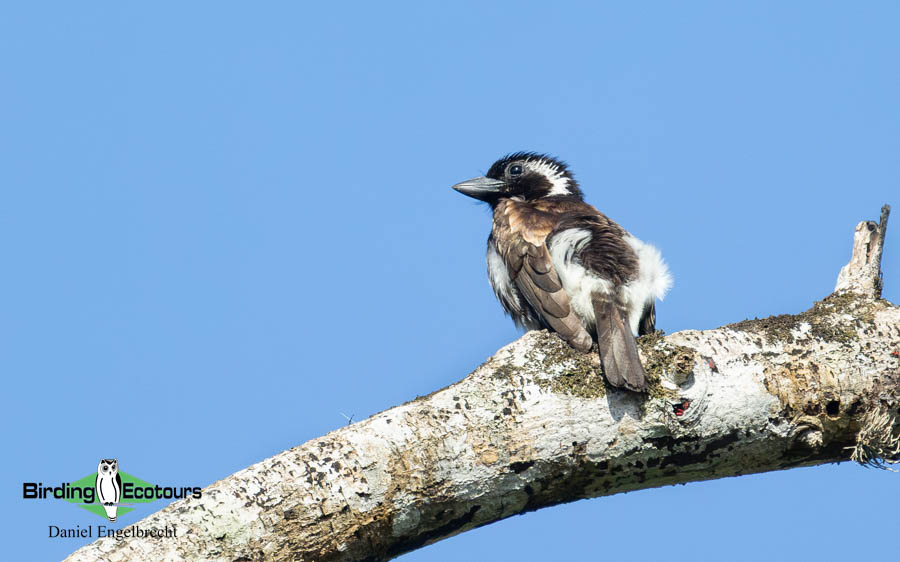
We had many White-eared Barbet sightings in the coastal dune forests on this tour.
After a wonderful breakfast at the manor, we packed our bags, enjoyed our first views of Black-collared Barbet and African Pied Wagtail in the lodge grounds, and set off for the escarpment. As we gained elevation, the habitat rapidly transitioned from lush coastal thickets to pristine montane grasslands, pine and eucalyptus plantations, and Afromontane forest. We arrived at an area of hilly grassland before lunch to try for the rare Blue Swallow, and, after a short search, we found a pair of these Endangered (BirdLife International) birds and watched them as they elegantly flew around their territory. These splendid intra-African migrants are threatened by the degradation of montane grassland habitats across their range, and as few as 80 individuals remain in Eswatini and South Africa. Other species seen at the swallow site included the elusive Red-winged Francolin, Wing-snapping and Wailing Cisticolas, Red-throated Wryneck, and Red-collared and Fan-tailed Widowbirds.
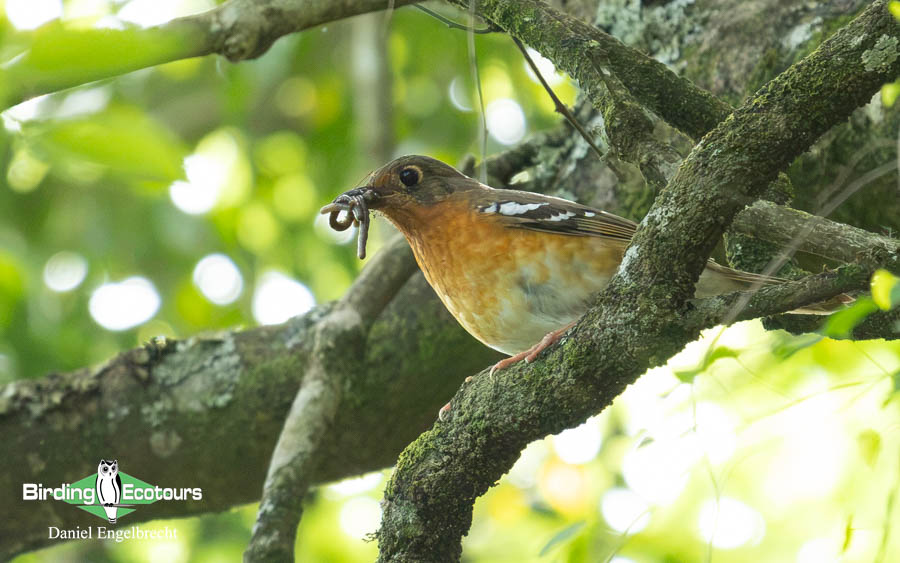
This Orange Ground Thrush showed well for us at Ingeli Forest.
We had lunch, then visited Ingeli Forest, where we made good progress on our Afromontane forest targets. The shorter thickets on the forest edge gave us views of a skulking but vocal Barratt’s Warbler, along with Drakensberg Prinia, Cape White-eye, Southern Double-collared Sunbird, and the sought-after Bush Blackcap. We birded a dirt road running through the forest on foot, which yielded exceptional close-up views of Narina Trogon, as well as Olive Bushshrike, Bar-throated Apalis, African Dusky Flycatcher, Orange Ground Thrush, Chorister Robin-Chat, and Forest Canary. David Secomb spotted a large raptor soaring above the forest, which turned out to be a Verreaux’s Eagle, one of those birds you can never tire of seeing! It was time to get going again, so we made our way back to the main road, but not before adding Long-crested Eagle and African Firefinch on the way out.
Much of the afternoon was spent driving through some truly breathtaking scenery as we made our way higher into the foothills of the Drakensberg Mountains. There were a few birding distractions along the roadside, the most notable of which was a lone Secretarybird. We also started seeing many Long-tailed Widowbirds, the males all adorned with their stupendous tails. After a long but rewarding day, we arrived at our picturesque accommodation overlooking a large lake and the towering mountains of the Drakensberg. Dinner was, as it always is on this trip, divine, and we all had an early night in preparation for our day trip up Sani Pass tomorrow.
Day 3, 16th October 2026. Day trip up Sani Pass and into Lesotho
We had our obligatory early morning coffee and biscuits just after sunrise before meeting our local guides, Stewart and Glen McLean, for our much-anticipated day trip up Sani Pass. Sani Pass is a dramatic mountain pass connecting South Africa with the mountain kingdom of Lesotho. The pass climbs over 4,500 feet (1,370 meters) along some rather rugged roads, and our plan was to spend most of the day birding at various elevations along the pass before crossing into neighboring Lesotho and birding our way up to a final elevation of 10,630 feet (3,240 meters).
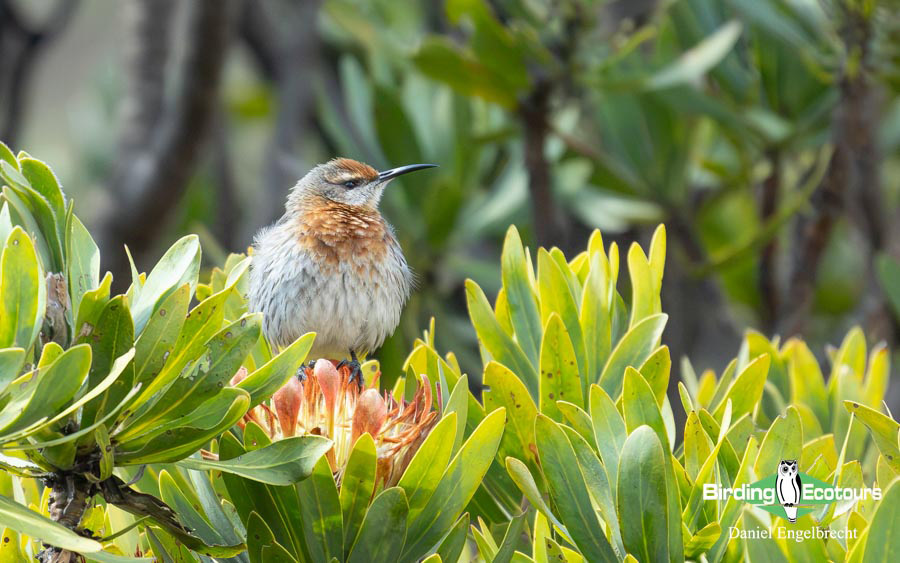
Gurney’s Sugarbird was one of the highlights of our day trip up Sani Pass.
We split between the two 4×4 vehicles and set off, seeing our first Giant and Pied Kingfishers, Yellow-billed Duck, Bokmakierie, Levaillant’s Cisticola, Cape Robin-Chat, Yellow Bishop, Common Waxbill, and Cape Longclaw, all before leaving the property. We then made a series of stops along the lower sections of the pass, where we saw African Olive Pigeon, African Black Swift, Southern Bald Ibis, Cape Vulture, Brown-backed Honeybird, White-necked Raven, Cape Rock Thrush, Neddicky, another Bush Blackcap, African Yellow Warbler, Swee Waxbill, Streaky-headed Seedeater, Cape Canary, and Nicholson’s Pipit. Our breakfast stop further added good views of Black Cuckoo, Black-headed Oriole, Yellow-throated Woodland Warbler, Olive Thrush, Fiscal Flycatcher, Cape Weaver, and Southern Grey-headed Sparrow. We then scanned a small dam, where we saw the uncommon Half-collared Kingfisher, a good bird to get out of the way this early in the trip.
As we gained elevation, the scrubbier vegetation of the lower slopes gave way to grassland and boulder-strewn hillsides dotted with Protea trees. Here, we saw a flock of Horus Swifts flying overhead, as well as our first Jackal Buzzards, Buff-streaked Chats, Ground Woodpeckers, and Cape Grassbirds. We also managed to flush the rare Short-tailed Pipit and saw our only Fan-tailed Grassbird and Rock Kestrel. When we eventually found a flowering Protea, we were delighted to see a single Gurney’s Sugarbird probing the flowers for nectar, along with Greater Double-collared and Malachite Sunbird.
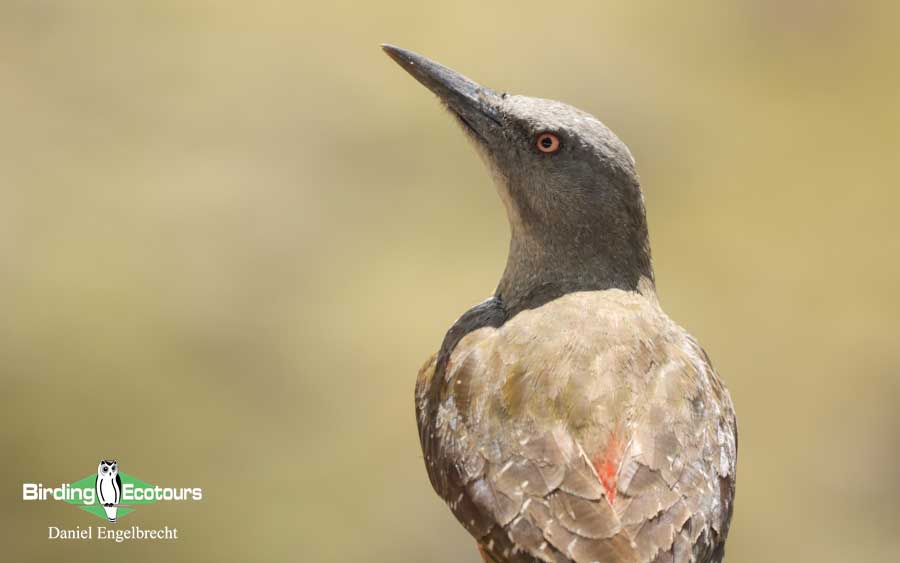
We saw several Ground Woodpeckers at Sani Pass.
The highest reaches of the pass yielded our first Drakensberg Rockjumper: a very confident male, clearly accustomed to looking for scraps from visiting tourists. Overhead, we saw Alpine Swifts and a pair of Verreaux’s Eagles, our second sighting of this majestic species. We stopped at the top of the pass to take in the views, but soon found ourselves distracted by another Drakensberg Rockjumper, along with a pair of Drakensberg Siskins and a Cape Bunting.
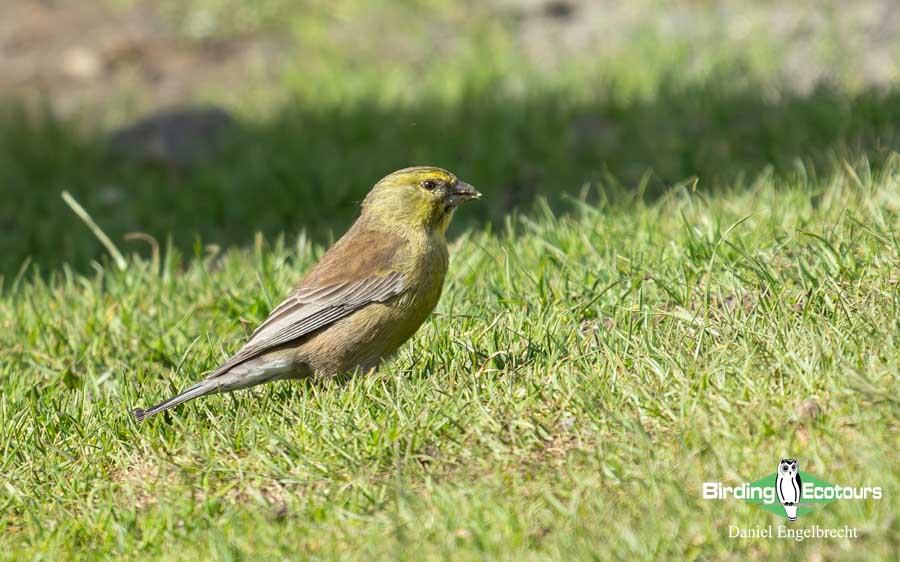
We saw several flocks of localized Drakensberg Siskins in Lesotho.
Notable highlights during our time in Lesotho included a flock of no fewer than 80 Southern Bald Ibis, Sentinel Rock Thrush, and Sickle-winged and Mountain Chats. We also encountered several Karoo species typically targeted on our tours to western South Africa, such as Grey Tit, Karoo Prinia, Layard’s Warbler, Karoo Scrub Robin, Large-billed Lark, Fairy Flycatcher, and Yellow Canary. Before lunch, we saw our two main targets in Lesotho: the poorly known Mountain Pipit and the iconic Bearded Vulture (Lammergeier), the latter of which has become much rarer in recent years. We had lunch in the Black Mountains, where we enjoyed scope views of a Bearded Vulture performing its famous “bone-dropping” behavior, a definite tour highlight for me. Our attempts to enjoy lunch were interrupted by an African Rock Pipit, and although birds were our main focus, we also made an effort to see the localized Sloggett’s Vlei Rat.
On the way back down the pass, we came across a herd of Rhebok before eventually arriving back at our guesthouse an hour before sunset. A few of us decided to head out again shortly before dusk to look for Cape Eagle-Owl, which, unfortunately, we only managed to hear. Our efforts were still rewarded with sightings of a Grey-crowned Crane, followed by the rare Wattled Crane. On our way back to the guesthouse, we saw a Spotted Eagle-Owl at close range before enjoying another outstanding dinner.
Day 4, 17th October 2026. Transfer to Eshowe
Today’s morning coffee birding session delivered good views of a Diederik Cuckoo and a Common Starling nesting in the roof rafters. While packing the car, we once again saw the Wattled Cranes. We bid farewell to the Drakensberg and set off on the long drive to Eshowe, stopping at Marutswa Forest along the way to enjoy our packed breakfasts. The main target at this site was the endemic Cape Parrot, which requires an exceptionally early start to give us a good chance of seeing it. We had decided the previous evening that we would rather set off a little later, knowing that this would significantly reduce our chances. As expected, we only managed to hear the parrots calling from deep in the valley. Nevertheless, we added a few new birds, including Grey Cuckooshrike, Lanner Falcon, and Violet-backed Starling. We also enjoyed much-improved views of Swee Waxbill.
Much of the remainder of the day was spent driving to Eshowe, although we did stop for lunch and made an unsuccessful attempt to find Southern Tchagra. Our lunch stop did, however, produce our first Lesser Honeyguide and Grey Sunbird. We arrived at our guesthouse in Eshowe with some time to relax before heading out to Dlinza Forest in the late afternoon. We explored the forest on foot, and it didn’t take long to find our main target, the scarce Spotted Ground Thrush, flicking through the leaf litter. The walk also gave us repeat views of a few forest species we had seen on Day 2, including Red-capped and Chorister Robin-Chats, and we saw our first Trumpeter Hornbill and Natal Red Duiker. We had dinner back at our guesthouse and discussed our plans for what promised to be an exciting day birding in the heart of Zululand tomorrow.
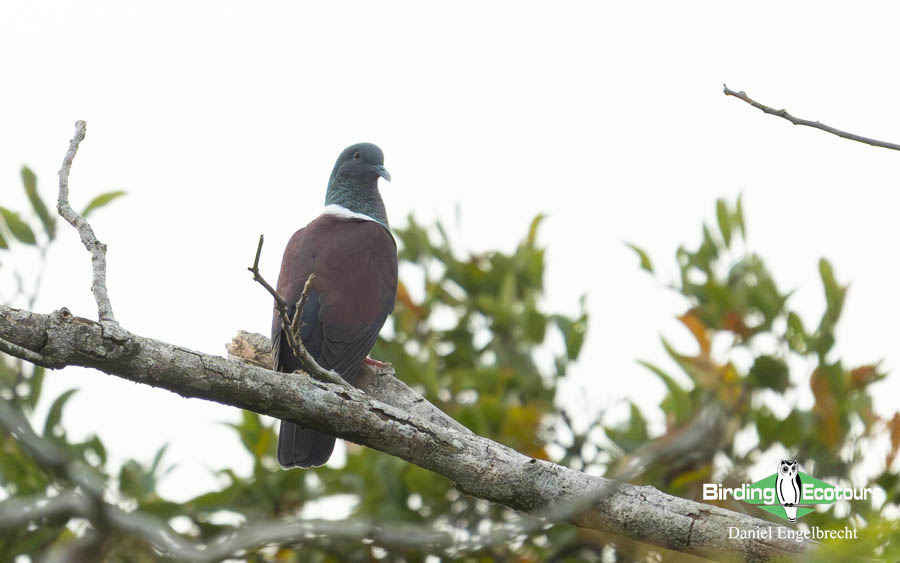
We had phenomenal views of Eastern Bronze-naped Pigeon at Dlinza Forest.
Day 5, 18th October 2026. Full day birding in Zululand: Eshowe, Ngoye Forest, and Mtunzini
Today, we met up with our local guide, Junior Gabela, at Dlinza Forest. Our first port of call was the canopy tower, which offers superb views over the forest. Upon arrival, we spotted a pair of Eastern Bronze-naped Pigeons, which we watched through the scope. With our only remaining target at Dlinza out of the way, we spent some time at the tower, picking out a few other species, including our second Grey Cuckooshrike, a nest-building White-eared Barbet, and a Sombre Greenbul, to name a few. We couldn’t believe our luck when a male Eastern Bronze-naped Pigeon flew in and landed just a few feet from us, offering exceptional eye-level views! Even Junior, who visits the canopy tower weekly, was shocked.
Next, we visited a rather unassuming patch of forest surrounded by sugarcane plantations, where we easily found a Southern Tchagra, along with a Rock-loving Cisticola, Striped Pipit, and Spectacled Weaver, all new for the trip. We kept the momentum going at Ngoye Forest, where Junior had found a nest of our primary target, the range-restricted Green Barbet. We waited a few minutes for the barbet to arrive, and it eventually showed up at the nest, giving us outstanding views of the morphologically distinctive woodwardi subspecies, with its yellowish ear-coverts clearly visible. After leaving Ngoye Forest, we headed to the coast, stopping along the way to add two brilliant birds, Swamp Nightjar and Green Malkoha, to our rapidly growing trip list.
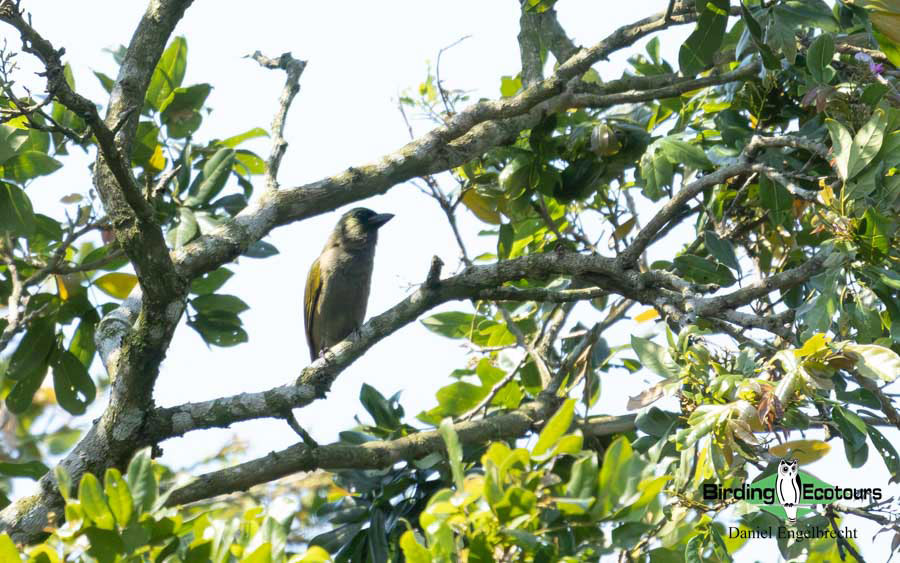
Green Barbet was the main target at Ngoye Forest.
In the coastal town of Mtunzini, we visited Junior’s stakeout for Scaly-throated Honeyguide, which performed like clockwork. While scanning the large Raphia palms, we also spotted our only Palm-nut Vulture, always a special bird. Unfortunately, the Mangrove Kingfishers had already left a few weeks earlier, but we managed to find our first of many Purple-banded Sunbirds in the Umlalazi mangroves, along with a single Goliath Heron, a Little Egret, and a Common Sandpiper. Having done so well with our targets, we decided to head back to Eshowe after a hearty pizza lunch, allowing us some much-needed time off at our guesthouse. As we said goodbye to Junior, a large storm rolled in, which confirmed that our afternoon break was well timed.
Day 6, 19th October 2026. Birding at Mtunzini and transfer to St Lucia
After an early coffee and biscuits, we packed our bags and headed to Umlalazi Nature Reserve in Mtunzini for breakfast and some final birding. Our main target was African Finfoot, but unfortunately, we had no luck and would have to wait until later in the trip to see this species. We certainly didn’t leave empty-handed, though, with the mudflats producing Common Ringed and Three-banded Plovers, Eurasian Whimbrel, and Common Greenshank, alongside a Caspian Tern over the estuary. The highlight was undoubtedly the kingfishers, with views of five species: Half-collared, Malachite, and African Pygmy Kingfishers in the smaller channels, and Giant and Pied Kingfishers along the main estuary. We also saw a Marsh Mongoose and, with some careful fieldcraft, managed to show everyone a vocal male Red-chested Flufftail in the reedy marsh. A territorial Lesser Swamp Warbler and our first good views of Vervet Monkey rounded off the morning.
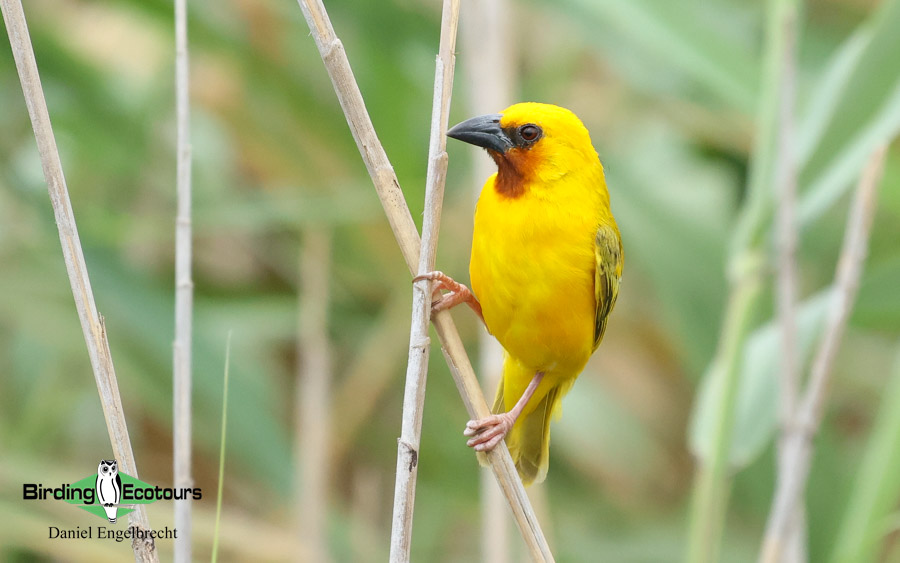
We saw our only Southern Brown-throated Weavers of the trip at St Lucia.
The drive north to St Lucia passed without event, and a brief stop to scan the reedbeds overlooking the Hluhluwe River yielded great views of the hoped-for Southern Brown-throated Weaver, along with a soaring African Harrier-Hawk. We then made a quick visit to the famous iGwalagwala Trail to get started on some of our targets. Within half an hour, we had secured views of Woodwards’ Batis, Rudd’s Apalis, and Green Twinspot, along with a few easier, more widespread species, including Ashy Flycatcher, Terrestrial Brownbul, Yellow-rumped Tinkerbird, and Black-backed Puffback. After lunch at an agreeable Greek restaurant in town, we checked in at our guesthouse and had some time to relax, thanks to another afternoon thunderstorm. The storm continued into the evening and only began to dissipate after dinner. On our return to the guesthouse, we were treated to brief views of a pair of African Wood Owls.
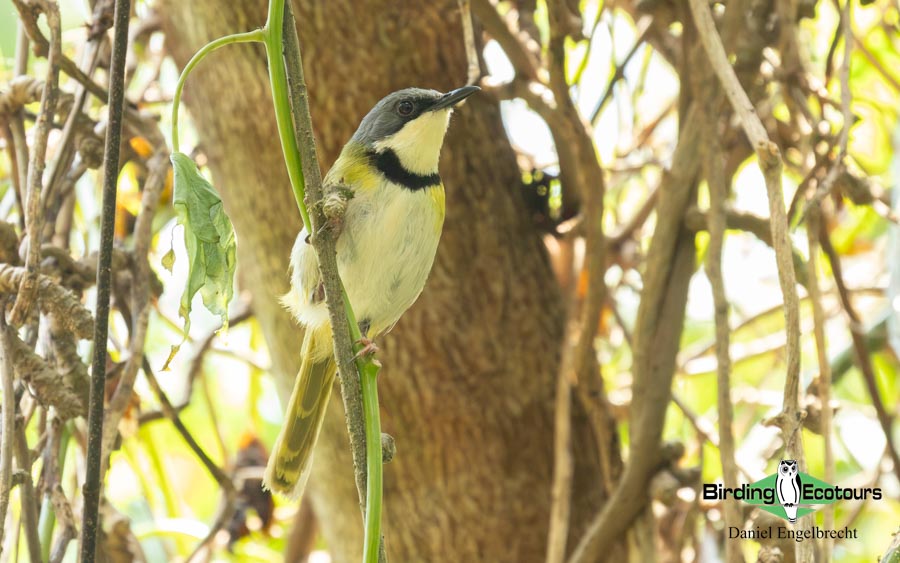
We had several encounters with the localized Rudd’s Apalis.
Day 7, 20th October 2026. Full day birding at iSimangaliso Wetland Park and St Lucia
We arrived at the entrance to iSimangaliso Wetland Park just as the gates opened. Our plan was to spend most of the day exploring the coastal dune forests, subtropical wetlands, and grasslands of this UNESCO World Heritage Site. We got off to a good start, finding three Rufous-bellied Herons, a rarity in South Africa, shortly after arriving. The wetlands also held African Jacana, Black Crake, and Great and Yellow-billed Egrets. Other highlights over the course of the morning included the funky-looking Southern Crested Guineafowl, Burchell’s Coucal, African Fish Eagle, Little and European Bee-eaters, Brown-hooded Kingfisher, Gorgeous and Orange-breasted Bushshrikes, Rufous-naped Lark, Yellow-breasted Apalis, White-throated Robin-Chat, Red-breasted Swallow, Red-billed Oxpecker, Yellow-throated Longclaw, and Brimstone Canary. Cisticolas were well represented, and we added three species to our list: Rufous-winged, Croaking, and Pale-crowned Cisticolas, all of which we saw well. The undisputed highlight, however, was seeing the rare Southern Banded Snake Eagle, our main target here. As expected, our time in the park also produced several new mammals, including Blue Monkey, Common Hippopotamus, Impala, Waterbuck, Southern Reedbuck, Cape Buffalo, Greater Kudu, Southern Bushbuck, Common Warthog, and, best of all, a Leopard, which we saw walking down the main road!
We had our packed lunches at the scenic Cape Vidal picnic site before slowly making our way back to St Lucia. While driving through town, we heard the distinctive call of an African Emerald Cuckoo right by the roadside. To our delight, we found it perched out in the open and enjoyed unobstructed views of this gem of a bird. Next, we birded the Hluhluwe Estuary, where we added several new species, most of which we didn’t see again, including African Oystercatcher, White-fronted Plover, Bar-tailed Godwit, Ruddy Turnstone, Curlew Sandpiper, Sanderling, and Grey-headed and Kelp Gulls. A sizeable tern roost yielded large numbers of Greater Crested Terns, a few Sandwich and Caspian Terns, and a lone Little Tern. Perhaps the most unexpected sighting was a Cape Gannet, which flew right past us. Well spotted, Corinne!
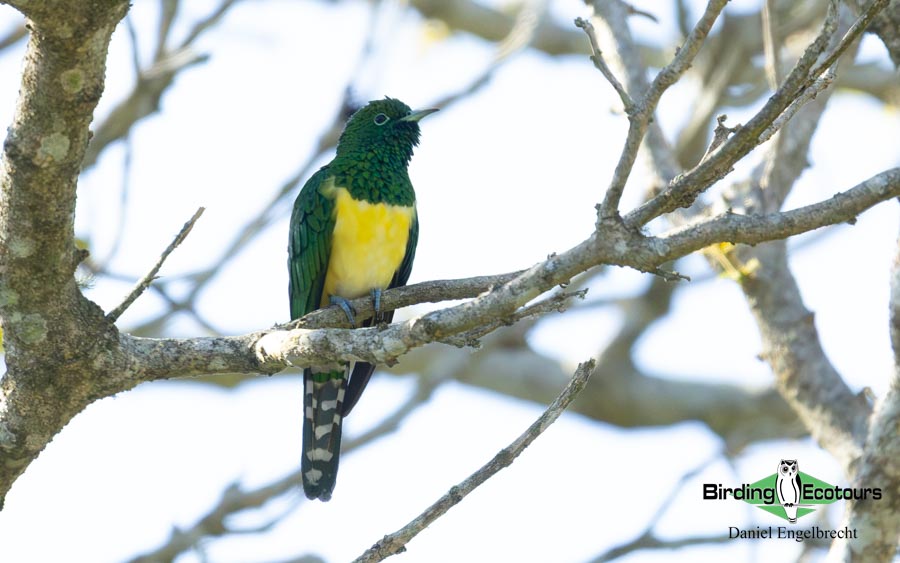
This African Emerald Cuckoo showed exceptionally well for us at St Lucia.
A quick late-afternoon session along the iGwalagwala Trail produced a roosting African Wood Owl and an Eastern Nicator, which we saw unexpectedly well as it called from the canopy. We had dinner in town again after another long but rewarding day.
Day 8, 21st October 2026. Transfer to Hluhluwe
For our pre-breakfast birding session today, we spent a little over an hour exploring the coastal dune forests along the iGwalagwala Trail. We had only three targets remaining, and we did well to find them all. First was an agitated Blue-mantled Crested Flycatcher, which put on a good performance for us. Next up was a much more challenging bird, the skulking Buff-spotted Flufftail. It took us a while to find a vocal and responsive bird; however, once we did, it didn’t take us too long to lay eyes on the male as it walked past us through the dark undergrowth. The last of our targets was supposed to be the easiest of the three, but despite hearing several individuals, we still had to work hard to get good views of the elegant Livingstone’s Turaco. With our targets acquired, we had breakfast back at our guesthouse before driving north to Hluhluwe.
We arrived in Hluhluwe too early to check in to our lodge, so we visited the Nibela Floodplains to kill some time. The expansive wetland here was teeming with birds, and we added Fulvous Whistling Duck, Blue-billed and Red-billed Teals, Cape Shoveler, Ruff, Little Stint, Collared Pratincole, Whiskered Tern, Greater Flamingo, Yellow-billed Stork, Glossy Ibis, Black, Purple, and Squacco Herons, Great White and Pink-backed Pelicans, and Black-winged Stilt. Overhead, we saw our first Wahlberg’s Eagle, while the dense thickets around the wetland edge yielded good views of Gorgeous Bushshrike and Great Spotted Cuckoo. After a productive session at Nibela, we checked in at our comfortable lodge, surrounded by dense sand forest, where we saw our first Nyala and had some time off during the heat of the day.
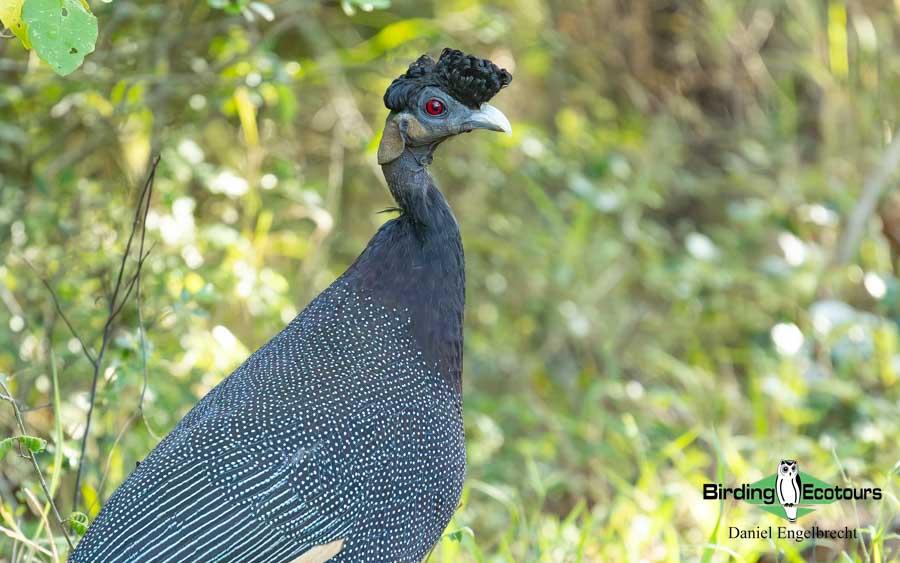
We had a few close encounters with Southern Crested Guineafowl.
Later in the afternoon, we took a stroll around the lodge grounds, exploring the sand forest in search of a few species closely associated with this habitat. We added a few new birds, including Black Sparrowhawk, Southern Yellow White-eye, Scarlet-chested Sunbird, Bearded Scrub Robin, and Red-billed Firefinch. Our walk delivered repeat views of other special birds, like Southern Crested Guineafowl and Rudd’s Apalis; however, most of our sand forest targets would have to wait until tomorrow. On our way to dinner that evening, we saw a White-tailed Mongoose on the road, a scarce and elusive species and a welcome addition to the mammal list.
Day 9, 22nd October 2026. Day trip to Mkhuze Game Reserve and sand forest birding
We took along packed breakfasts this morning and started the day birding along a dirt road that traverses a productive patch of sand forest. Our main target here was the localized Neergaard’s Sunbird, and, after a bit of work, we found a cooperative male. We also had several Purple-banded Sunbirds here, allowing for comparison views of these superficially similar species. Other notable species included Levaillant’s Cuckoo, our only Southern Red-fronted Tinkerbird, Long-billed Crombec, and our first views of the exquisite Pink-throated Twinspot. Despite hearing a displaying African Broadbill, the dense sand forest prevented us from getting anywhere near the bird.
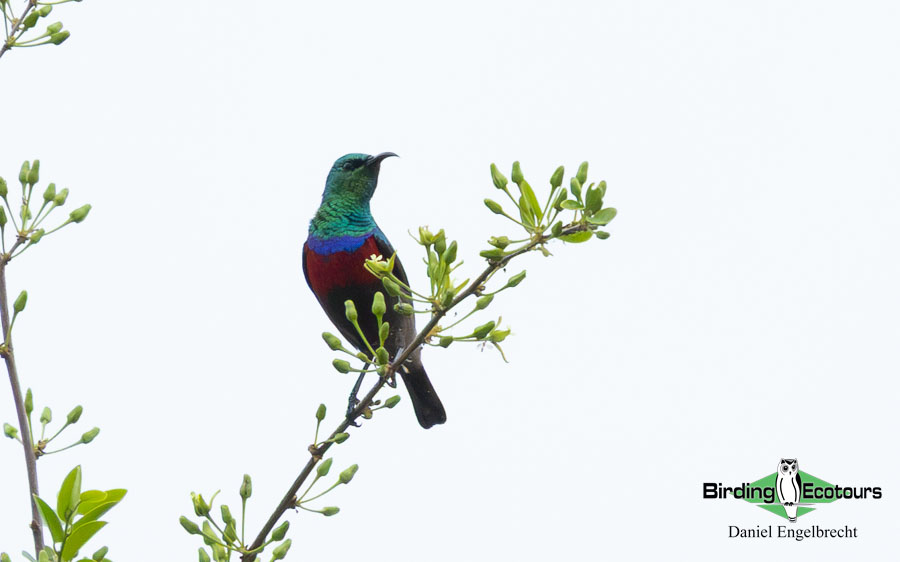
Neergaard’s Sunbird was one of our main targets around Hluhluwe.
Next, we visited Mpempe Pan, which was somewhat disappointing. The pan was relatively dry, with very few waterbirds; however, we did see a Black Heron performing its iconic “umbrella” hunting technique. We also saw a soaring Black-chested Snake Eagle, along with Marico and White-bellied Sunbirds, and Zitting Cisticola, all new for the trip. The main reason for visiting the pan was to search for the range-restricted Lemon-breasted Canary, a species closely associated with Ilala Palms. It didn’t take us long to find one perched atop a palm; however, only some of us managed to see it before it flew off. We then spent some time walking among the palms before finding a more confiding pair, which everyone managed to see well. With the canary secured, we made our way north to Mkhuze Game Reserve, stopping briefly at Muzi Pan along the way, where we saw four African Pygmy Geese and an African Swamphen, among others.
Mkhuze was superb, and our five hours exploring the park flew by. As this was our first proper savanna birding of the trip, we added several new birds, including a close Black-bellied Bustard, Emerald-spotted Wood Dove, White-backed Vulture, Bateleur, Brown Snake Eagle, Golden-tailed Woodpecker, White-crested Helmetshrike, Wire-tailed Swallow, Cape Starling, White-browed Robin-Chat, Blue Waxbill, and Yellow-throated Bush Sparrow, to name a few. We also managed to get our first views of Red-chested Cuckoo, a species that we had thus far only heard. Large mammals were well represented, and we saw African Savanna Elephant, Southern Giraffe, and the rare White Rhinoceros, the latter from a hide as they waited their turn to drink from a waterhole. Other new mammals included Plains Zebra, Blue Wildebeest, Common Slender Mongoose, and Bush Duiker, along with the scarce Suni, one of the world’s smallest ungulates, of which we saw several individuals.
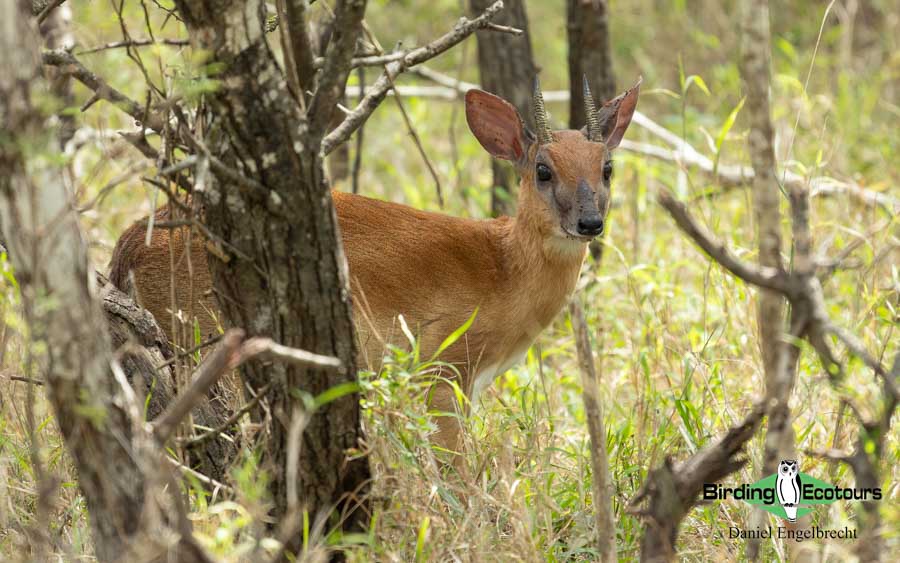
The scarce Suni was seen at Mkhuze Game Reserve.
After a fun time at Mkhuze, we headed back to our lodge near Hluhluwe, adding a flock of Wattled Starlings along the way. We relaxed for the remainder of the afternoon before having dinner at a nearby restaurant.
Day 10, 23rd October 2026. Transfer to Wakkerstroom
We started the morning with coffee and biscuits before taking a short walk around the lodge in an attempt to improve our views of Pink-throated Twinspot, as not everyone had managed satisfactory views of the birds yesterday. Thankfully, the twinspots cooperated much better this morning, and we all enjoyed good views of a pair.
We packed the car, had breakfast, and set off on the fairly long drive to the highland grasslands of Wakkerstroom. Roadworks and some potholed sections slowed us down a bit as we made our way up the escarpment again, and it was already well into the afternoon when we stopped in the highveld grasslands around Dirkiesdorp to look for one of our target species. I was scanning the grasslands with the scope when I spotted a bustard. There it was! No, there it wasn’t! It was a Black-bellied Bustard, a species typically associated with low-lying savanna habitats, so what it was doing up here was a bit of a mystery.
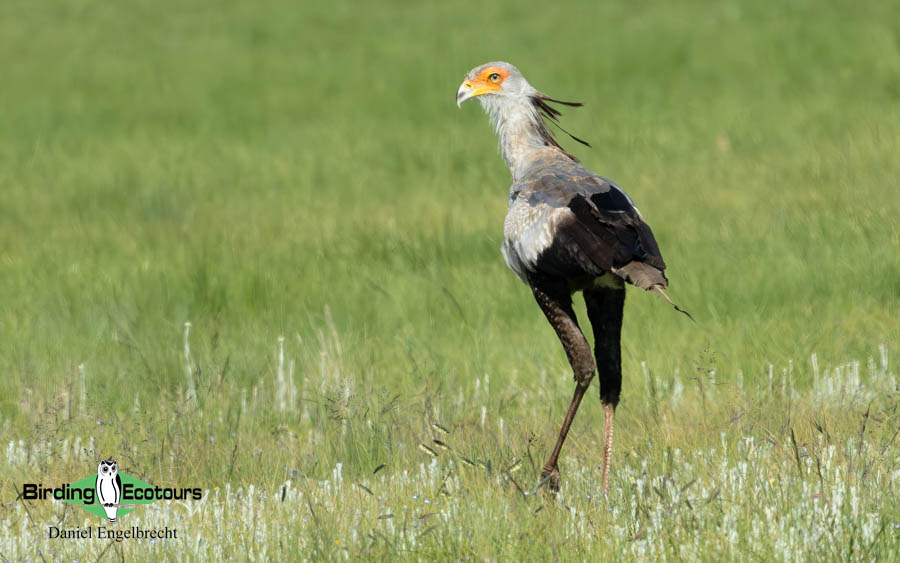
The iconic Secretarybird was seen a few times in the Wakkerstroom area.
The search continued. We added a few new birds while looking for our target, including Cape Crow, South African Cliff Swallow, and Ant-eating Chat. We tried another spot, where we quickly found our target, the uncommon White-bellied Bustard – on a nest! We also saw Speckled Pigeon, White-fronted Bee-eater, and Pied Starling here, along with a very obliging pair of Southern Bald Ibises. The remainder of the short drive to Wakkerstroom yielded a pair of Blue Cranes, the last of South Africa’s three crane species and the country’s national bird, as well as our second Secretarybird.
We arrived at our wonderful guesthouse in the scenic Wakkerstroom farmlands, where we were treated to a superb home-cooked dinner before turning in for an early night.
Day 11, 24th October 2026. Full day birding the Wakkerstroom surrounds
Today, we met up with David Nkosi, a local bird guide, on the outskirts of Wakkerstroom for what promised to be a rewarding day of grassland birding. Unfortunately, two of Wakkerstroom’s former major targets, Botha’s and Rudd’s Larks, have become increasingly difficult to find in recent years. This has been compounded by difficulties accessing their remaining habitat, much of which is on private land. At the time of our visit, the whereabouts of both species was unknown, meaning that neither could be targeted.
First, we drove up into the mountains south of Wakkerstroom, where we found a Denham’s Bustard, as well as the scarce and endemic Yellow-breasted Pipit. We then turned our attention to the grasslands north of town, where we spent most of the morning birding along the quiet farm roads. Notable sightings included Blue Korhaan, White-bellied Bustard, Grey-winged Francolin, Black-winged Lapwing, Secretarybird, Spike-heeled Lark, and Cloud Cisticola.
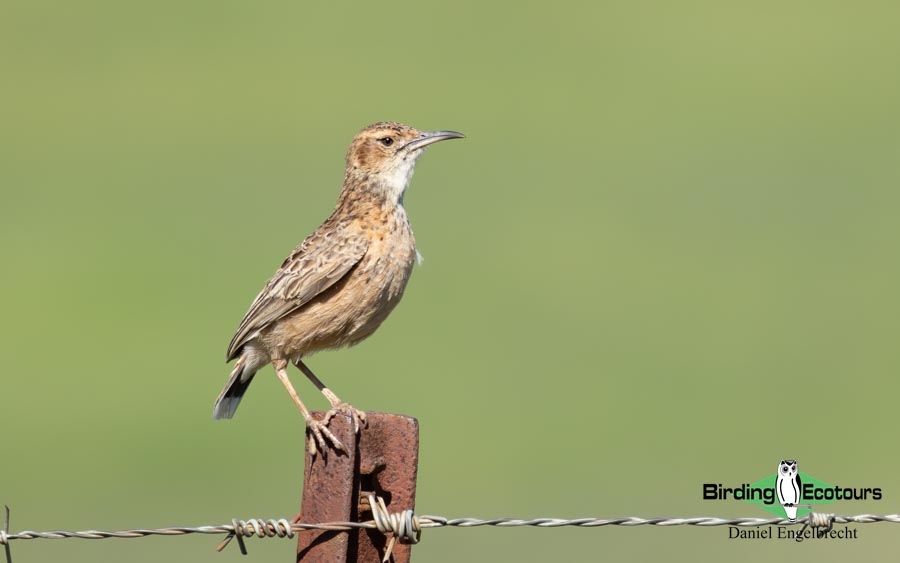
Spike-heeled Larks were a frequent sight in Wakkerstroom.
A dense ouhout thicket delivered our third Bush Blackcap of the trip, and we saw many Capped Wheatears in the more overgrazed areas. Yellow Mongooses were common throughout the morning, while Meerkats were much scarcer.
We stopped at an overgrazed patch of grassland near a small town where, to our surprise, we heard the deep, hooting call of a Black-rumped Buttonquail. This rare and seldom-seen bird is most often seen when flushed; however, careful scanning revealed it sitting on the ground, giving us an opportunity to study its features at close range. Elated by our views, we started the drive back to Wakkerstroom for lunch, stopping along the way to add Eastern Long-billed and Eastern Clapper Larks to our list. We had a lovely lunch at a lively restaurant in town before parting ways with David Nkosi and heading out for our afternoon birding session. The afternoon session yielded two new bird species for us, Swainson’s Spurfowl and Orange-breasted Waxbill, as well as two new mammals, Egyptian Mongoose and South African Ground Squirrel.
After dinner, we attempted a night drive, which unfortunately yielded little of interest apart from a winnowing African Snipe heard over the wetland on the outskirts of town.
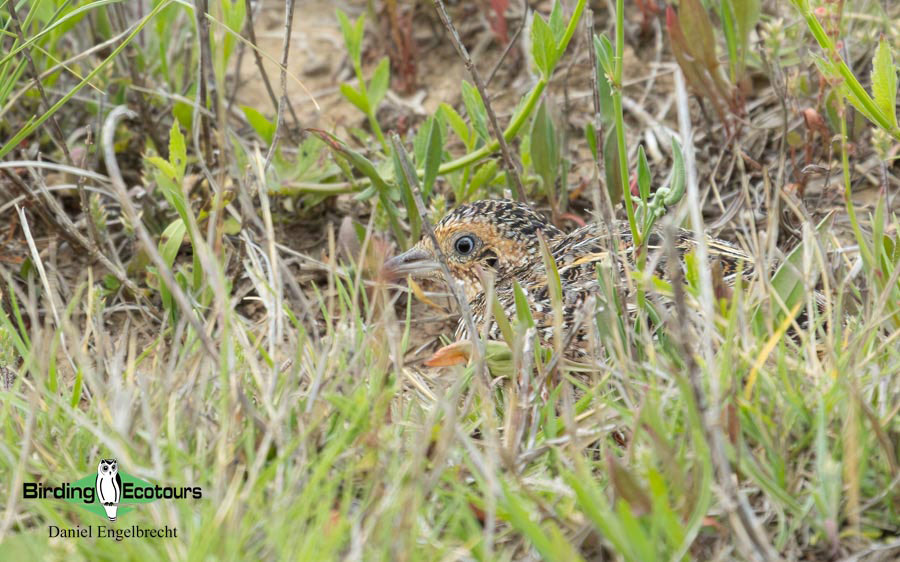
We were fortunate to see this Black-rumped Buttonquail on the ground.
Day 12, 25th October 2026. Transfer to Skukuza, Kruger National Park
Today was primarily a travel day, with limited birding as we undertook the longest drive of the trip, from Wakkerstroom to the famous Kruger National Park. We started the morning with pre-breakfast birding at Wakkerstroom Wetland Nature Reserve, where we birded from the main road and saw our first African Snipe, Southern Pochard, African Marsh Harrier, and Little Rush Warbler. I decided to play the call of African Rail, which immediately prompted a response from nearby. After carefully positioning ourselves, we all managed to see the bird as it crossed a gap in the reeds and paused in the sun for a while! Thrilled with our views of the rail, we returned to the guesthouse for breakfast, packed our bags, and hit the road.
The drive north to Kruger took us through dozens of small highveld towns before we descended the escarpment again and entered Kruger late in the afternoon. We had only a short drive to Skukuza Rest Camp, our base for the next three nights, but still managed to see several new birds along the way, including Red-crested Korhaan, Grey Go-away-bird, Southern Yellow-billed Hornbill, Lilac-breasted Roller, Magpie Shrike, Arrow-marked Babbler, Burchell’s Starling, Green-winged Pytilia, and an out-of-range Violet-eared Waxbill, a species we had only expected to see toward the end of the tour. The highlight of the afternoon was a flock of three Brown-headed Parrots feeding in a small tree on the roadside.
We checked into our comfortable chalets in Skukuza and took some time off before dinner after a long day on the road. The following day, we would meet up with our guide for the first of two days exploring Kruger National Park in an open safari vehicle.
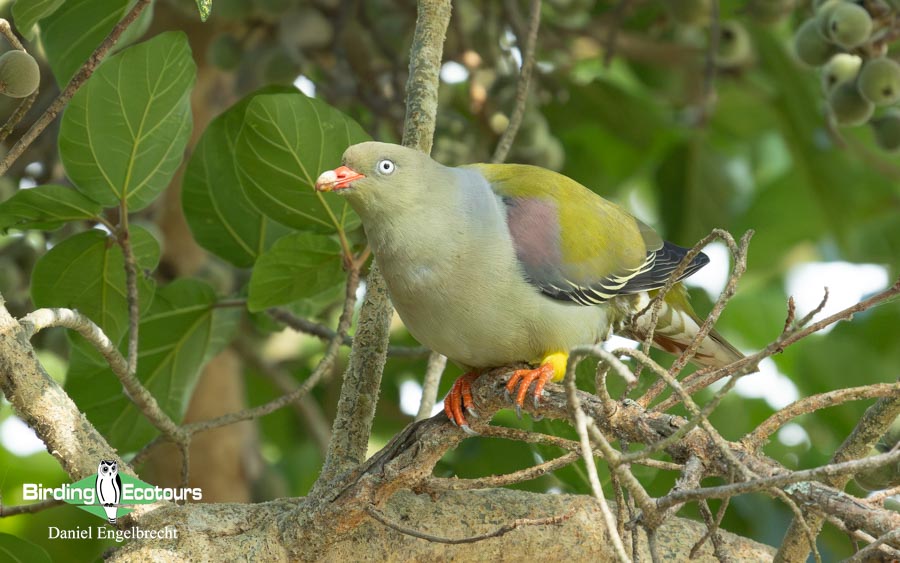
We enjoyed many colorful African Green Pigeons around our chalets at Skukuza.
Day 13, 26th October 2026. Full day exploring Kruger National Park
We met our driver and safari guide, Jason van der Merwe, early this morning and left camp as soon as the gates opened. The plan was to bird our way north to Tshokwane Picnic Site, where we would have a late breakfast. Shortly after leaving camp, we found a small family group of Spotted Hyenas that had taken up residence in a culvert beneath the road. Another early mammalian highlight was a small group of Common Dwarf Mongooses, our eighth mongoose species of the trip! Our bird list grew quickly over the course of the morning, with many new species, including White-crowned and Senegal Lapwings, Tawny Eagle, Green Wood Hoopoe, Common Scimitarbill, Southern Red-billed Hornbill, Crested Barbet, Black Cuckooshrike, Brubru, Black-crowned Tchagra, Southern White-crowned Shrike, White-browed Scrub Robin, and Red-billed Buffalo Weaver. A herd of Southern Giraffes was visited by both Red-billed and Yellow-billed Oxpeckers, and we had close-up views of the hulking Southern Ground Hornbill.
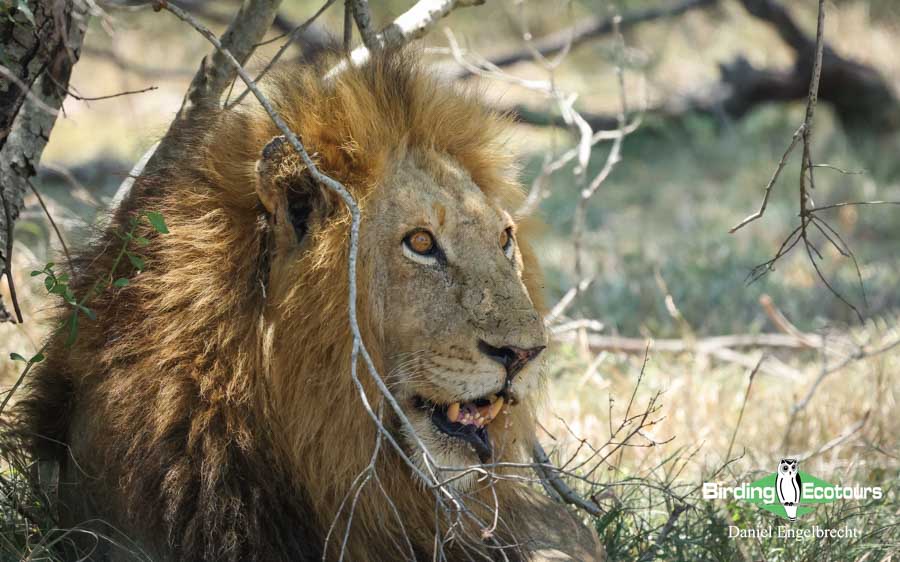
We saw two male Lions in the Kruger National Park.
We had breakfast at Tshokwane, where flocks of Greater Blue-eared and Cape Starlings entertained us as they foraged for scraps around the picnic site. After breakfast, we slowly made our way back to Skukuza for lunch. The drive back was quite productive and yielded the last member of the “Big Five” for us: Lion. We had great views of two males lying in the shade of a small bush, occasionally lifting their heads before dozing off again. A Kori Bustard, among the heaviest flying birds in the world, was a welcome sight, as were good numbers of vultures bathing in the Sabie River, including White-backed, Hooded, Lappet-faced, and White-headed Vultures. We had lunch back at Skukuza and, after a break from the heat of the day, headed out again later in the afternoon.
For the afternoon drive, we focused our attention on the open woodlands and granite outcrops south of Skukuza. Activity was lower than in the morning, and although we saw many species again from the morning drive, a pair of Crested Francolins were the only new birds for the trip. We saw several Steenbok that afternoon, along with large herds of African Savanna Elephants. We also stopped at Lake Panic Bird Hide, where we enjoyed good photographic opportunities in the evening light. In addition to many widespread waterbirds, we had fun watching Nile Crocodiles and Common Hippopotamuses as they went about their business. In the evening, we had a lovely dinner at Skukuza after an excellent day exploring the park.
Day 14, 27th October 2026. Full day exploring Kruger National Park
For our morning drive today, we took the road east to Lower Sabie Rest Camp, a route that closely follows the Sabie River and its lush riverine woodlands. We recorded around 100 species before breakfast, with notable highlights including Natal Spurfowl, Jacobin Cuckoo, Kittlitz’s Plover, African Hawk-Eagle, Lizard Buzzard, Broad-billed Roller, Chinspot Batis, Brown-crowned Tchagra, our first quality views of Southern Boubou, large numbers of Mosque Swallows, and Purple-banded Sunbird. So far, we had little luck with storks on this trip; however, that changed this morning, with good looks at African Openbill and Saddle-billed, Yellow-billed, and Marabou Storks.
We had breakfast at Lower Sabie Rest Camp and then stopped to scan the sandbars on the Sabie River, where we soon found our target, African Skimmer. To our surprise, we also saw a lone Greater Flamingo here, a rarity in Kruger National Park. On the way back to Skukuza for lunch, we had eye-level views of a Martial Eagle feeding on an unidentifiable mammal and a Grey-headed Kingfisher, a scarce and tricky species in South Africa.
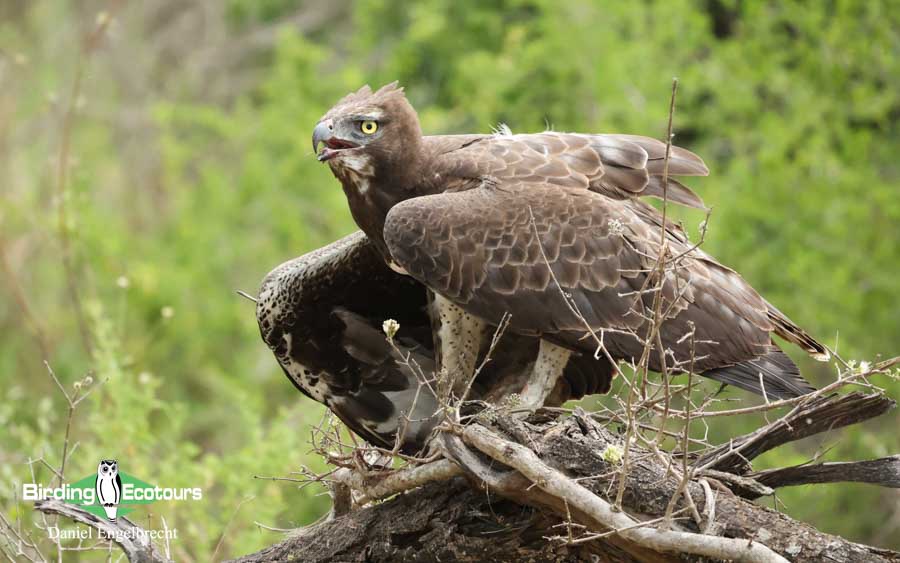
This Martial Eagle was one of the highlights of our time in Kruger National Park.
The highlight of today’s afternoon drive was an adorable Pearl-spotted Owlet, which David Secomb brilliantly spotted perched in a tree, closely followed by a showy Stierling’s Wren-Warbler. Again, we spent some time at a waterhole in the late afternoon, where we watched African Savanna Elephants come down to drink. On the way back to Skukuza, we were treated to a phenomenal African sunset, the best of the trip. While getting ready for dinner, we heard a vocal pair of African Wood Owls at our chalets.
Day 15, 28th October 2026. Morning birding in Kruger National Park and transfer to Mount Sheba
We started the morning with coffee and biscuits before taking a walk around the campgrounds. The camp was very birdy, allowing us to improve our views of Natal Spurfowl, Red-chested Cuckoo, Long-billed Crombec, Sombre Greenbul, Purple-banded Sunbird, and White-throated Robin-Chat. Our only new bird was Red-faced Cisticola, which we had heard frequently over the previous few days but hadn’t seen until now. Breakfast overlooking the Sabie River was accompanied by dozens of African Green Pigeons feeding in a large fig tree above our table.
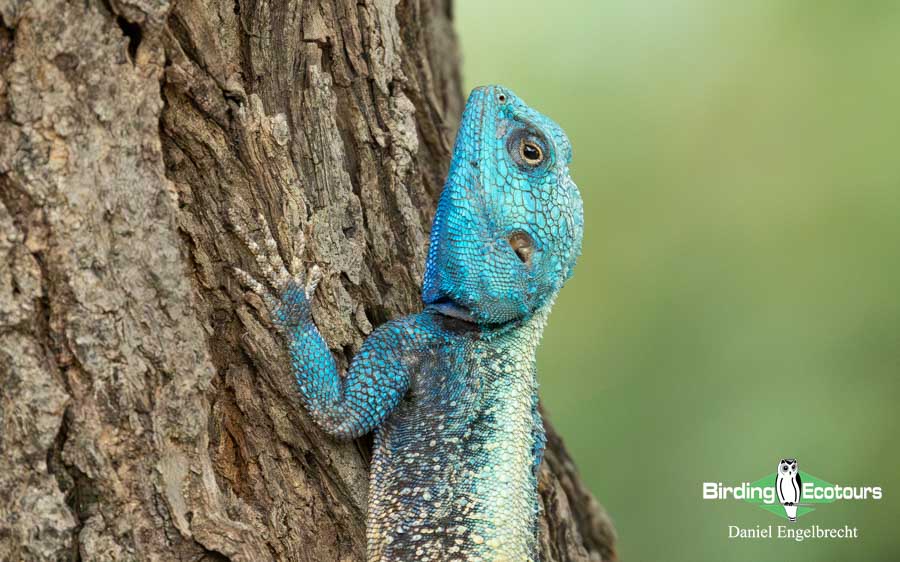
This colorful Southern Tree Agama was seen on our camp walk at Skukuza.
After breakfast, we packed up and took the longer route through Kruger National Park to Numbi Gate, hoping to find the rare Thick-billed Cuckoo, recently reported near Pretoriuskop. We soon located a vocal bird, a real bonus given how challenging this species can be to see. Other highlights along the way included our first wild Common Ostrich, a Striped Kingfisher, and a Mocking Cliff Chat atop a granite outcrop. A bird party near Numbi Gate held Retz’s Helmetshrike, Green-capped Eremomela, Grey Penduline Tit, Brubru, and Black Cuckooshrike, among others. Even our bathroom stop at the gate proved productive, with Red-headed Weavers building their nests and an African Cuckoo giving us great views as it foraged close by.
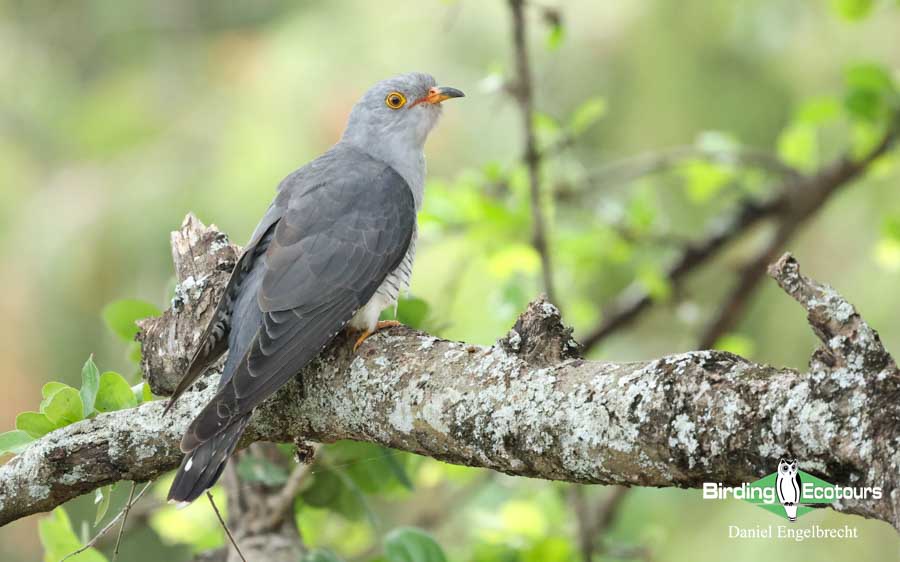
This African Cuckoo was a welcome surprise on our last day in the Kruger National Park.
After a memorable three-night stay in Kruger, we headed back up the escarpment, stopping for lunch in Graskop. We then continued to Mount Sheba, surrounded by montane grasslands and cool Afromontane forests. An afternoon walk produced a vocal Yellow-streaked Greenbul, feeding alongside Knysna Turaco, Olive Woodpecker, Olive Thrush, and Chorister Robin-Chat, followed by a White-starred Robin foraging on the forest floor.
We drove up to the grasslands in search of Red-necked Spurfowl, a species that had so far eluded us. After some exploratory playback, we heard a bird respond and eventually saw it when a truck flushed it from the roadside. As the light faded, we also found our final Afromontane forest target, Lemon Dove, foraging on the road. Dinner was superb, and we all turned in early.
Day 16, 29th October 2026. Transfer to Rust de Winter
We attempted a pre-breakfast birding session at Mount Sheba this morning; however, cold conditions and dense mist meant we didn’t see much of interest. Instead, we returned to the lodge, enjoyed a hearty breakfast, and packed our bags. Our destination today was Rust de Winter, about an hour north of Pretoria, so we spent most of the day on the road. The drive passed largely without incident, although, as usual, we made a few planned birding stops along the way, particularly in the Mabusa area. Here, we added the tricky Melodious Lark, Black-chested Prinia, Desert Cisticola, Quailfinch, White-winged Widowbird, Black-throated Canary, and Buffy Pipit to our trip list.
When we arrived at our lodge on the banks of the Mologa River, we spotted both Kurrichane and Groundscraper Thrushes on the lawns, as well as a Golden-tailed Woodpecker probing a hole in a tree. We had some much-needed downtime in the evening before meeting for dinner. While going through the daily checklist, we heard an African Scops Owl calling, which we managed to see very well.
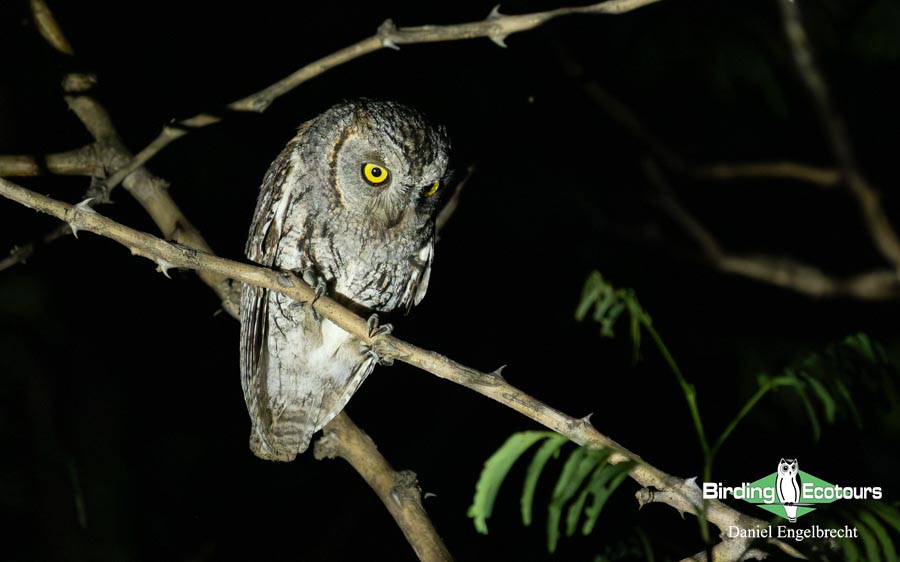
We had great views of this African Scops Owl at Mologa River Lodge.
Day 17, 30th October 2026. Full day birding the Zaagkuilsdrift Road
As usual, we started early today to reach the Zaagkuilsdrift Road shortly after sunrise. This seemingly unremarkable road offers excellent Vachellia thornveld birding alongside seasonal floodplains, making it one of the country’s premier birding destinations. Because we were here before the main rains, the area was still very dry, so we missed some of the nomadic waterbirds that are best targeted here during peak season. Still, the birding was incredible, and since this was our first exposure to this habitat, we quickly added several new birds, including the striking Crimson-breasted Shrike, Ashy Tit, Cape Penduline Tit, Sabota Lark, Burnt-necked Eremomela, Barred Wren-Warbler, Chestnut-vented Warbler, Southern Pied Babbler, Marico Flycatcher, Kalahari Scrub Robin, Scaly-feathered Weaver, and White-browed Sparrow-Weaver.
Another highlight was adding two small raptors to our list in the form of Gabar Goshawk and Little Sparrowhawk. Large numbers of swallows were perched on the power lines along the road, and we picked out our first Pearl-breasted Swallows among the more numerous Barn Swallows. Migrant numbers had been low throughout the trip, and that continued today, although we did find a lone Spotted Flycatcher. We had our packed breakfasts at the Kgomo-Kgomo floodplain, which, despite being largely dry, still held a few waterbirds. Some of the species here that we had already seen included Yellow-billed Stork, African Spoonbill, Yellow-billed Duck, Red-billed Teal, Glossy Ibis, African Snipe, and Great Egret, to name a few. Scanning the floodplain with the scope yielded our first Marsh Sandpipers, along with large numbers of Ruffs, Wood Sandpipers, and Common Greenshanks. Three Collared Pratincoles were a surprise find, as they are uncommon in this part of the country.
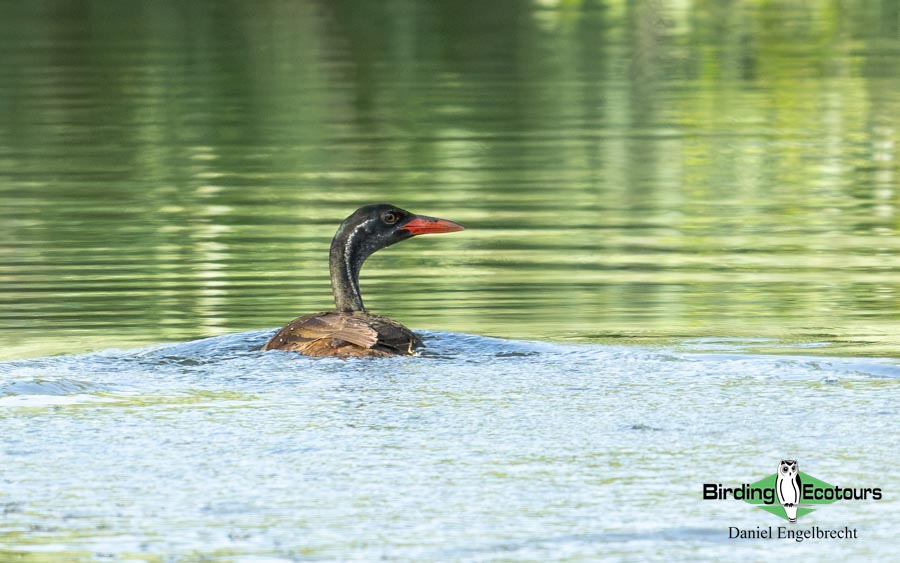
One of the biggest surprises of the trip was this African Finfoot on the Mologa River.
We had lunch at a nearby lodge before slowly birding our way back to our accommodation. It was quite warm on the way back, and we only added African Grey Hornbill and Jameson’s Firefinch. Later in the afternoon, we drove the rural farm roads near our lodge. While we waited for everyone to reach the car, a few of us spotted a male African Finfoot on the Mologa River, and everyone eventually saw it. After missing this sought-after species earlier in the trip at Mtunzini, it was a relief to find it here, where we certainly weren’t expecting it. The afternoon drive yielded our best views of Levaillant’s Cuckoo and Pearl-spotted Owlet, along with many species we had already seen.
We were once again serenaded by the African Scops Owl before dinner, and we managed to see it again this evening. After dinner, a few of us took a night drive to one of our sites for Southern White-faced Owl. It took us a while to find one, but after a bit of work, we had a good look at this attractive owl.
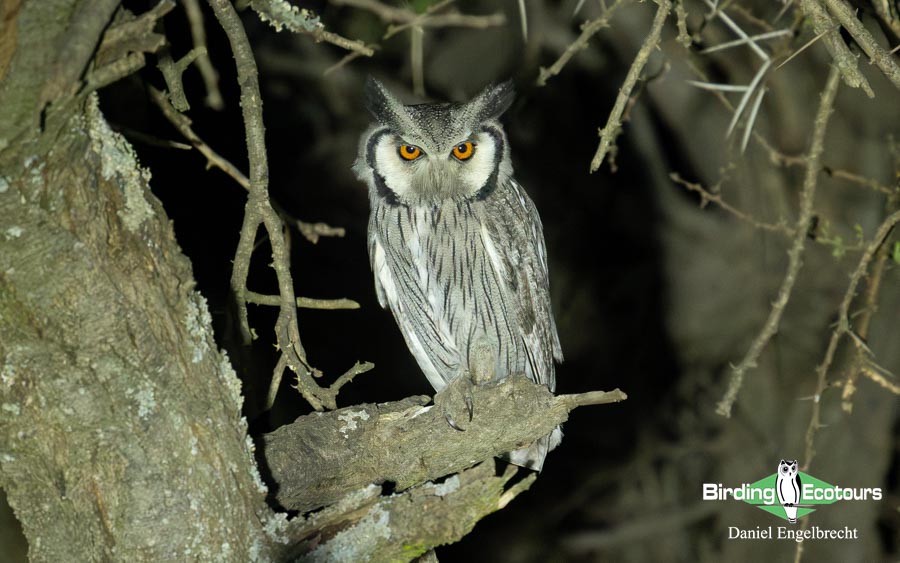
This Southern White-faced Owl was a fitting way to end the last night of the tour.
Day 18, 31st October 2026. Transfer to Johannesburg for departure
Although today was our dedicated departure day, we all had late flights, so we managed to squeeze in a fair amount of birding. First, we did a pre-breakfast session along the Rust de Winter farm roads, which produced four Northern Black Korhaans and a pair of Bearded Woodpeckers, as well as our best views of Southern White-crowned Shrike and Violet-eared Waxbill. An added bonus was a nesting Gabar Goshawk.
Back at our lodge, we enjoyed a relaxed breakfast, packed our bags, and started the drive to Johannesburg. As we arrived in Pretoria with more than an hour to spare before lunch, we made a stop at Rietvlei Nature Reserve for our last birding of the trip. Although we added no new birds, it was fun to catch up with some Highveld birds again, including Long-tailed Widowbird and Pied Starling. Rietvlei also produced a few mammals, highlighted by the endemic Black Wildebeest and our second White Rhinoceros sighting of the trip. We enjoyed one last meal together over lunch in the leafy suburb of Irene before heading to the airport to catch our various flights home.
I want to thank all the tour participants for a thoroughly enjoyable and highly successful tour.
Bird List – Following IOC 15.2 (April 2026)
Birds ‘heard only’ are marked with (H) after the common name, all other species were seen.
The following notation after species names is used to show conservation status following the IUCN Red List: CR = Critically Endangered, EN = Endangered, VU = Vulnerable.
| Common name | Scientific name |
| Ostriches (Struthionidae) | |
| Common Ostrich | Struthio camelus |
| Ducks, Geese, Swans (Anatidae) | |
| White-faced Whistling Duck | Dendrocygna viduata |
| Fulvous Whistling Duck | Dendrocygna bicolor |
| Spur-winged Goose | Plectropterus gambensis |
| Egyptian Goose | Alopochen aegyptiaca |
| South African Shelduck | Tadorna cana |
| African Pygmy Goose | Nettapus auritus |
| Blue-billed Teal | Spatula hottentota |
| Cape Shoveler | Spatula smithii |
| Yellow-billed Duck | Anas undulata |
| Red-billed Teal | Anas erythrorhyncha |
| Southern Pochard | Netta erythrophthalma |
| Guineafowl (Numididae) | |
| Helmeted Guineafowl | Numida meleagris |
| Southern Crested Guineafowl | Guttera edouardi |
| Pheasants & Allies (Phasianidae) | |
| Crested Francolin | Ortygornis sephaena |
| Red-winged Francolin | Scleroptila levaillantii |
| Grey-winged Francolin | Scleroptila afra |
| Common Quail (H) | Coturnix coturnix |
| Natal Spurfowl | Pternistis natalensis |
| Swainson’s Spurfowl | Pternistis swainsonii |
| Red-necked Spurfowl | Pternistis afer |
| Nightjars (Caprimulgidae) | |
| Fiery-necked Nightjar (H) | Caprimulgus pectoralis |
| Swamp Nightjar | Caprimulgus natalensis |
| Swifts (Apodidae) | |
| African Palm Swift | Cypsiurus parvus |
| Alpine Swift | Tachymarptis melba |
| African Black Swift | Apus barbatus |
| Little Swift | Apus affinis |
| Horus Swift | Apus horus |
| White-rumped Swift | Apus caffer |
| Turacos (Musophagidae) | |
| Grey Go-away-bird | Crinifer concolor |
| Purple-crested Turaco | Gallirex porphyreolophus |
| Livingstone’s Turaco | Tauraco livingstonii |
| Knysna Turaco | Tauraco corythaix |
| Bustards (Otididae) | |
| Kori Bustard | Ardeotis kori |
| Denham’s Bustard | Neotis denhami |
| White-bellied Bustard | Eupodotis senegalensis |
| Blue Korhaan | Eupodotis caerulescens |
| Red-crested Korhaan | Lophotis ruficrista |
| Northern Black Korhaan | Afrotis afraoides |
| Black-bellied Bustard | Lissotis melanogaster |
| Cuckoos (Cuculidae) | |
| Burchell’s Coucal | Centropus burchellii |
| Green Malkoha | Ceuthmochares australis |
| Great Spotted Cuckoo | Clamator glandarius |
| Levaillant’s Cuckoo | Clamator levaillantii |
| Jacobin Cuckoo | Clamator jacobinus |
| Thick-billed Cuckoo | Pachycoccyx audeberti |
| Diederik Cuckoo | Chrysococcyx caprius |
| Klaas’s Cuckoo | Chrysococcyx klaas |
| African Emerald Cuckoo | Chrysococcyx cupreus |
| Black Cuckoo | Cuculus clamosus |
| Red-chested Cuckoo | Cuculus solitarius |
| African Cuckoo | Cuculus gularis |
| Pigeons, Doves (Columbidae) | |
| Rock Dove | Columba livia |
| Speckled Pigeon | Columba guinea |
| African Olive Pigeon | Columba arquatrix |
| Eastern Bronze-naped Pigeon | Columba delegorguei |
| Lemon Dove | Columba larvata |
| Red-eyed Dove | Streptopelia semitorquata |
| Ring-necked Dove | Streptopelia capicola |
| Laughing Dove | Spilopelia senegalensis |
| Emerald-spotted Wood Dove | Turtur chalcospilos |
| Tambourine Dove | Turtur tympanistria |
| Namaqua Dove | Oena capensis |
| African Green Pigeon | Treron calvus |
| Finfoots (Heliornithidae) | |
| African Finfoot | Podica senegalensis |
| Flufftails & Forest Rails (Sarothruridae) | |
| Buff-spotted Flufftail | Sarothrura elegans |
| Red-chested Flufftail | Sarothrura rufa |
| Rails, Crakes & Coots (Rallidae) | |
| African Rail | Rallus caerulescens |
| Common Moorhen | Gallinula chloropus |
| Red-knobbed Coot | Fulica cristata |
| African Swamphen | Porphyrio madagascariensis |
| Black Crake | Zapornia flavirostra |
| Cranes (Gruidae) | |
| Grey Crowned Crane – EN | Balearica regulorum |
| Wattled Crane – VU | Grus carunculata |
| Blue Crane – VU | Grus paradisea |
| Grebes (Podicipedidae) | |
| Little Grebe | Tachybaptus ruficollis |
| Flamingos (Phoenicopteridae) | |
| Greater Flamingo | Phoenicopterus roseus |
| Buttonquail (Turnicidae) | |
| Black-rumped Buttonquail | Turnix nanus |
| Stone-curlews, Thick-knees (Burhinidae) | |
| Water Thick-knee | Burhinus vermiculatus |
| Oystercatchers (Haematopodidae) | |
| African Oystercatcher | Haematopus moquini |
| Stilts, Avocets (Recurvirostridae) | |
| Black-winged Stilt | Himantopus himantopus |
| Plovers (Charadriidae) | |
| Common Ringed Plover | Charadrius hiaticula |
| Three-banded Plover | Charadrius tricollaris |
| Blacksmith Lapwing | Vanellus armatus |
| White-crowned Lapwing | Vanellus albiceps |
| Senegal Lapwing | Vanellus lugubris |
| Black-winged Lapwing | Vanellus melanopterus |
| Crowned Lapwing | Vanellus coronatus |
| African Wattled Lapwing | Vanellus senegallus |
| Kittlitz’s Plover | Anarhynchus pecuarius |
| White-fronted Plover | Anarhynchus marginatus |
| Jacanas (Jacanidae) | |
| African Jacana | Actophilornis africanus |
| Sandpipers, Snipes (Scolopacidae) | |
| Eurasian Whimbrel | Numenius phaeopus |
| Bar-tailed Godwit | Limosa lapponica |
| African Snipe | Gallinago nigripennis |
| Common Sandpiper | Actitis hypoleucos |
| Marsh Sandpiper | Tringa stagnatilis |
| Wood Sandpiper | Tringa glareola |
| Common Greenshank | Tringa nebularia |
| Ruddy Turnstone | Arenaria interpres |
| Ruff | Calidris pugnax |
| Curlew Sandpiper – VU | Calidris ferruginea |
| Sanderling | Calidris alba |
| Little Stint | Calidris minuta |
| Coursers, Pratincoles (Glareolidae) | |
| Collared Pratincole | Glareola pratincola |
| Gulls, Terns, Skimmers (Laridae) | |
| African Skimmer | Rynchops flavirostris |
| Little Tern | Sternula albifrons |
| Caspian Tern | Hydroprogne caspia |
| Whiskered Tern | Chlidonias hybrida |
| Sandwich Tern | Thalasseus sandvicensis |
| Greater Crested Tern | Thalasseus bergii |
| Grey-headed Gull | Chroicocephalus cirrocephalus |
| Kelp Gull | Larus dominicanus |
| Storks (Ciconiidae) | |
| African Openbill | Anastomus lamelligerus |
| Marabou Stork | Leptoptilos crumenifer |
| Yellow-billed Stork | Mycteria ibis |
| Saddle-billed Stork | Ephippiorhynchus senegalensis |
| African Woolly-necked Stork | Ciconia microscelis |
| Gannets, Boobies (Sulidae) | |
| Cape Gannet – EN | Morus capensis |
| Anhingas, Darters (Anhingidae) | |
| African Darter | Anhinga rufa |
| Cormorants, Shags (Phalacrocoracidae) | |
| Reed Cormorant | Microcarbo africanus |
| Great Cormorant | Phalacrocorax carbo |
| Ibises, Spoonbills (Threskiornithidae) | |
| African Sacred Ibis | Threskiornis aethiopicus |
| Southern Bald Ibis | Geronticus calvus |
| Hadada Ibis | Bostrychia hagedash |
| Glossy Ibis | Plegadis falcinellus |
| African Spoonbill | Platalea alba |
| Herons, Bitterns (Ardeidae) | |
| Black-crowned Night Heron | Nycticorax nycticorax |
| Black Heron | Egretta ardesiaca |
| Little Egret | Egretta garzetta |
| Little Heron | Butorides atricapilla |
| Rufous-bellied Heron | Ardeola rufiventris |
| Squacco Heron | Ardeola ralloides |
| Great Egret | Ardea alba |
| Yellow-billed Egret | Ardea brachyrhyncha |
| Western Cattle Egret | Ardea ibis |
| Grey Heron | Ardea cinerea |
| Purple Heron | Ardea purpurea |
| Black-headed Heron | Ardea melanocephala |
| Goliath Heron | Ardea goliath |
| Hamerkop (Scopidae) | |
| Hamerkop | Scopus umbretta |
| Pelicans (Pelecanidae) | |
| Great White Pelican | Pelecanus onocrotalus |
| Pink-backed Pelican | Pelecanus rufescens |
| Secretarybird (Sagittariidae) | |
| Secretarybird – EN | Sagittarius serpentarius |
| Kites, Hawks, Eagles (Accipitridae) | |
| Black-winged Kite | Elanus caeruleus |
| African Harrier-Hawk | Polyboroides typus |
| Palm-nut Vulture | Gypohierax angolensis |
| Bearded Vulture | Gypaetus barbatus |
| White-headed Vulture – CR | Trigonoceps occipitalis |
| Lappet-faced Vulture – EN | Torgos tracheliotos |
| Hooded Vulture – CR | Necrosyrtes monachus |
| White-backed Vulture – CR | Gyps africanus |
| Cape Vulture – VU | Gyps coprotheres |
| Bateleur – EN | Terathopius ecaudatus |
| Southern Banded Snake Eagle | Circaetus fasciolatus |
| Black-chested Snake Eagle | Circaetus pectoralis |
| Brown Snake Eagle | Circaetus cinereus |
| Martial Eagle – EN | Polemaetus bellicosus |
| Long-crested Eagle | Lophaetus occipitalis |
| Wahlberg’s Eagle | Hieraaetus wahlbergi |
| Tawny Eagle – VU | Aquila rapax |
| African Hawk-Eagle | Aquila spilogaster |
| Verreaux’s Eagle | Aquila verreauxii |
| Gabar Goshawk | Micronisus gabar |
| Lizard Buzzard | Kaupifalco monogrammicus |
| African Goshawk | Aerospiza tachiro |
| Little Sparrowhawk | Tachyspiza minulla |
| Black Sparrowhawk | Astur melanoleucus |
| African Marsh Harrier | Circus ranivorus |
| Black Kite | Milvus migrans |
| African Fish Eagle | Icthyophaga vocifer |
| Jackal Buzzard | Buteo rufofuscus |
| Common Buzzard | Buteo buteo |
| Owls (Strigidae) | |
| Pearl-spotted Owlet | Glaucidium perlatum |
| African Scops Owl | Otus senegalensis |
| Southern White-faced Owl | Ptilopsis granti |
| Cape Eagle-Owl (H) | Bubo capensis |
| Spotted Eagle-Owl | Bubo africanus |
| African Wood Owl | Strix woodfordii |
| Mousebirds (Coliidae) | |
| Speckled Mousebird | Colius striatus |
| Red-faced Mousebird | Urocolius indicus |
| Trogons (Trogonidae) | |
| Narina Trogon | Apaloderma narina |
| Hoopoes (Upupidae) | |
| Eurasian Hoopoe | Upupa epops |
| Wood Hoopoes (Phoeniculidae) | |
| Green Wood Hoopoe | Phoeniculus purpureus |
| Common Scimitarbill | Rhinopomastus cyanomelas |
| Ground Hornbills (Bucorvidae) | |
| Southern Ground Hornbill – VU | Bucorvus leadbeateri |
| Hornbills (Bucerotidae) | |
| Southern Red-billed Hornbill | Tockus rufirostris |
| Southern Yellow-billed Hornbill | Tockus leucomelas |
| Crowned Hornbill | Lophoceros alboterminatus |
| African Grey Hornbill | Lophoceros nasutus |
| Trumpeter Hornbill | Bycanistes bucinator |
| Rollers (Coraciidae) | |
| Lilac-breasted Roller | Coracias caudatus |
| Broad-billed Roller | Eurystomus glaucurus |
| Kingfishers (Alcedinidae) | |
| Grey-headed Kingfisher | Halcyon leucocephala |
| Brown-hooded Kingfisher | Halcyon albiventris |
| Striped Kingfisher | Halcyon chelicuti |
| African Pygmy Kingfisher | Ispidina picta |
| Malachite Kingfisher | Corythornis cristatus |
| Half-collared Kingfisher | Alcedo semitorquata |
| Giant Kingfisher | Megaceryle maxima |
| Pied Kingfisher | Ceryle rudis |
| Bee-eaters (Meropidae) | |
| Little Bee-eater | Merops pusillus |
| White-fronted Bee-eater | Merops bullockoides |
| European Bee-eater | Merops apiaster |
| African Barbets (Lybiidae) | |
| Crested Barbet | Trachyphonus vaillantii |
| Green Barbet | Cryptolybia olivacea |
| White-eared Barbet | Stactolaema leucotis |
| Yellow-rumped Tinkerbird | Pogoniulus bilineatus |
| Southern Red-fronted Tinkerbird | Pogoniulus pusillus |
| Black-collared Barbet | Lybius torquatus |
| Honeyguides (Indicatoridae) | |
| Brown-backed Honeybird | Prodotiscus regulus |
| Lesser Honeyguide | Indicator minor |
| Scaly-throated Honeyguide | Indicator variegatus |
| Woodpeckers (Picidae) | |
| Red-throated Wryneck | Jynx ruficollis |
| Ground Woodpecker | Geocolaptes olivaceus |
| Golden-tailed Woodpecker | Campethera abingoni |
| Bearded Woodpecker | Chloropicus namaquus |
| Cardinal Woodpecker | Dendropicos fuscescens |
| Olive Woodpecker | Dendropicos griseocephalus |
| Caracaras, Falcons (Falconidae) | |
| Rock Kestrel | Falco rupicolus |
| Lanner Falcon | Falco biarmicus |
| African & New World Parrots (Psittacidae) | |
| Cape Parrot (H) – VU | Poicephalus robustus |
| Brown-headed Parrot | Poicephalus cryptoxanthus |
| African & Green Broadbills (Calyptomenidae) | |
| African Broadbill (H) | Smithornis capensis |
| Wattle-eyes, Batises (Platysteiridae) | |
| Cape Batis | Batis capensis |
| Woodwards’ Batis | Batis fratrum |
| Chinspot Batis | Batis molitor |
| Black-throated Wattle-eye | Platysteira peltata |
| Bushshrikes (Malaconotidae) | |
| Grey-headed Bushshrike (H) | Malaconotus blanchoti |
| Olive Bushshrike | Chlorophoneus olivaceus |
| Orange-breasted Bushshrike | Chlorophoneus sulfureopectus |
| Gorgeous Bushshrike | Telophorus viridis |
| Bokmakierie | Telophorus zeylonus |
| Brown-crowned Tchagra | Tchagra australis |
| Southern Tchagra | Tchagra tchagra |
| Black-crowned Tchagra | Tchagra senegalus |
| Black-backed Puffback | Dryoscopus cubla |
| Southern Boubou | Laniarius ferrugineus |
| Crimson-breasted Shrike | Laniarius atrococcineus |
| Brubru | Nilaus afer |
| Vangas & Allies (Vangidae) | |
| White-crested Helmetshrike | Prionops plumatus |
| Retz’s Helmetshrike | Prionops retzii |
| Cuckooshrikes (Campephagidae) | |
| Grey Cuckooshrike | Ceblepyris caesius |
| Black Cuckooshrike | Campephaga flava |
| Figbirds, Old World Orioles, Piopios (Oriolidae) | |
| Black-headed Oriole | Oriolus larvatus |
| Drongos (Dicruridae) | |
| Fork-tailed Drongo | Dicrurus adsimilis |
| Square-tailed Drongo | Dicrurus ludwigii |
| Monarchs (Monarchidae) | |
| Blue-mantled Crested Flycatcher | Trochocercus cyanomelas |
| African Paradise Flycatcher | Terpsiphone viridis |
| Shrikes (Laniidae) | |
| Southern White-crowned Shrike | Eurocephalus anguitimens |
| Magpie Shrike | Lanius melanoleucus |
| Southern Fiscal | Lanius collaris |
| Crows, Jays (Corvidae) | |
| Cape Crow | Corvus capensis |
| Pied Crow | Corvus albus |
| White-necked Raven | Corvus albicollis |
| Rockjumpers (Chaetopidae) | |
| Drakensberg Rockjumper | Chaetops aurantius |
| Fairy Flycatchers (Stenostiridae) | |
| Fairy Flycatcher | Stenostira scita |
| Tits, Chickadees (Paridae) | |
| Southern Black Tit | Melaniparus niger |
| Ashy Tit | Melaniparus cinerascens |
| Grey Tit | Melaniparus afer |
| Penduline Tits (Remizidae) | |
| Grey Penduline Tit | Anthoscopus caroli |
| Cape Penduline Tit | Anthoscopus minutus |
| Nicators (Nicatoridae) | |
| Eastern Nicator | Nicator gularis |
| Larks (Alaudidae) | |
| Spike-heeled Lark | Chersomanes albofasciata |
| Eastern Long-billed Lark | Certhilauda semitorquata |
| Sabota Lark | Calendulauda sabota |
| Melodious Lark | Mirafra cheniana |
| Eastern Clapper Lark | Corypha fasciolata |
| Rufous-naped Lark | Corypha africana |
| Large-billed Lark | Galerida magnirostris |
| Red-capped Lark | Calandrella cinerea |
| Bulbuls (Pycnonotidae) | |
| Sombre Greenbul | Andropadus importunus |
| Yellow-bellied Greenbul | Chlorocichla flaviventris |
| Terrestrial Brownbul | Phyllastrephus terrestris |
| Yellow-streaked Greenbul | Phyllastrephus flavostriatus |
| Common Bulbul | Pycnonotus barbatus |
| Swallows, Martins (Hirundinidae) | |
| Black Saw-wing | Psalidoprocne pristoptera |
| Banded Martin | Neophedina cincta |
| Brown-throated Martin | Riparia paludicola |
| Large Rock Martin | Ptyonoprogne fuligula |
| Blue Swallow – EN | Hirundo atrocaerulea |
| Pearl-breasted Swallow | Hirundo dimidiata |
| Barn Swallow | Hirundo rustica |
| White-throated Swallow | Hirundo albigularis |
| Wire-tailed Swallow | Hirundo smithii |
| Greater Striped Swallow | Cecropis cucullata |
| Lesser Striped Swallow | Cecropis abyssinica |
| Red-breasted Swallow | Cecropis semirufa |
| Mosque Swallow | Cecropis senegalensis |
| South African Cliff Swallow | Petrochelidon spilodera |
| Crombecs, African Warblers (Macrosphenidae) | |
| Cape Grassbird | Sphenoeacus afer |
| Long-billed Crombec | Sylvietta rufescens |
| Leaf Warblers (Phylloscopidae) | |
| Yellow-throated Woodland Warbler | Phylloscopus ruficapilla |
| Reed Warblers & Allies (Acrocephalidae) | |
| Lesser Swamp Warbler | Acrocephalus gracilirostris |
| Common Reed Warbler | Acrocephalus scirpaceus |
| African Yellow Warbler | Iduna natalensis |
| Grassbirds & Allies (Locustellidae) | |
| Fan-tailed Grassbird | Catriscus brevirostris |
| Barratt’s Warbler | Bradypterus barratti |
| Little Rush Warbler | Bradypterus baboecala |
| Cisticolas & Allies (Cisticolidae) | |
| Red-faced Cisticola | Cisticola erythrops |
| Rock-loving Cisticola | Cisticola aberrans |
| Rattling Cisticola | Cisticola chiniana |
| Wailing Cisticola | Cisticola lais |
| Rufous-winged Cisticola | Cisticola galactotes |
| Levaillant’s Cisticola | Cisticola tinniens |
| Croaking Cisticola | Cisticola natalensis |
| Neddicky | Cisticola fulvicapilla |
| Zitting Cisticola | Cisticola juncidis |
| Desert Cisticola | Cisticola aridulus |
| Cloud Cisticola | Cisticola textrix |
| Pale-crowned Cisticola | Cisticola cinnamomeus |
| Wing-snapping Cisticola | Cisticola ayresii |
| Tawny-flanked Prinia | Prinia subflava |
| Black-chested Prinia | Prinia flavicans |
| Karoo Prinia | Prinia maculosa |
| Drakensberg Prinia | Prinia hypoxantha |
| Bar-throated Apalis | Apalis thoracica |
| Rudd’s Apalis | Apalis ruddi |
| Yellow-breasted Apalis | Apalis flavida |
| Green-backed Camaroptera | Camaroptera brachyura |
| Stierling’s Wren-Warbler | Calamonastes stierlingi |
| Barred Wren-Warbler | Calamonastes fasciolatus |
| Green-capped Eremomela | Eremomela scotops |
| Burnt-necked Eremomela | Eremomela usticollis |
| Sylviid Babblers (Sylviidae) | |
| Bush Blackcap – VU | Sylvia nigricapillus |
| Layard’s Warbler | Curruca layardi |
| Chestnut-vented Warbler | Curruca subcoerulea |
| White-eyes (Zosteropidae) | |
| Cape White-eye | Zosterops virens |
| Southern Yellow White-eye | Zosterops anderssoni |
| Laughingthrushes & Allies (Leiothrichidae) | |
| Arrow-marked Babbler | Turdoides jardineii |
| Southern Pied Babbler | Turdoides bicolor |
| Sugarbirds (Promeropidae) | |
| Gurney’s Sugarbird | Promerops gurneyi |
| Starlings, Rhabdornises (Sturnidae) | |
| Common Myna | Acridotheres tristis |
| Common Starling | Sturnus vulgaris |
| Wattled Starling | Creatophora cinerea |
| Black-bellied Starling | Notopholia corusca |
| Cape Starling | Lamprotornis nitens |
| Greater Blue-eared Starling | Lamprotornis chalybaeus |
| Burchell’s Starling | Lamprotornis australis |
| Pied Starling | Lamprotornis bicolor |
| Violet-backed Starling | Cinnyricinclus leucogaster |
| Red-winged Starling | Onychognathus morio |
| Oxpeckers (Buphagidae) | |
| Yellow-billed Oxpecker | Buphagus africanus |
| Red-billed Oxpecker | Buphagus erythrorynchus |
| Thrushes (Turdidae) | |
| Spotted Ground Thrush – VU | Geokichla guttata |
| Orange Ground Thrush | Geokichla gurneyi |
| Groundscraper Thrush | Turdus litsitsirupa |
| Olive Thrush | Turdus olivaceus |
| Kurrichane Thrush | Turdus libonyana |
| Chats, Old World Flycatchers (Muscicapidae) | |
| Karoo Scrub Robin | Tychaedon coryphoeus |
| Brown Scrub Robin | Tychaedon signata |
| Bearded Scrub Robin | Tychaedon quadrivirgata |
| Kalahari Scrub Robin | Cercotrichas paena |
| White-browed Scrub Robin | Cercotrichas leucophrys |
| Grey Tit-Flycatcher (H) | Fraseria plumbea |
| Ashy Flycatcher | Fraseria caerulescens |
| Southern Black Flycatcher | Melaenornis pammelaina |
| Fiscal Flycatcher | Sigelus silens |
| Marico Flycatcher | Bradornis mariquensis |
| African Dusky Flycatcher | Muscicapa adusta |
| Spotted Flycatcher | Muscicapa striata |
| White-starred Robin | Pogonocichla stellata |
| White-browed Robin-Chat | Cossypha heuglini |
| Chorister Robin-Chat | Cossypha dichroa |
| Red-capped Robin-Chat | Cossypha natalensis |
| White-throated Robin-Chat | Dessonornis humeralis |
| Cape Robin-Chat | Dessonornis caffer |
| Sentinel Rock Thrush | Monticola explorator |
| Cape Rock Thrush | Monticola rupestris |
| African Stonechat | Saxicola torquatus |
| Buff-streaked Chat | Campicoloides bifasciatus |
| Sickle-winged Chat | Emarginata sinuata |
| Mocking Cliff Chat | Thamnolaea cinnamomeiventris |
| Ant-eating Chat | Myrmecocichla formicivora |
| Mountain Chat | Myrmecocichla monticola |
| Capped Wheatear | Oenanthe pileata |
| Familiar Chat | Oenanthe familiaris |
| Sunbirds (Nectariniidae) | |
| Collared Sunbird | Hedydipna collaris |
| Olive Sunbird | Cyanomitra olivacea |
| Grey Sunbird | Cyanomitra veroxii |
| Amethyst Sunbird | Chalcomitra amethystina |
| Scarlet-chested Sunbird | Chalcomitra senegalensis |
| Malachite Sunbird | Nectarinia famosa |
| Southern Double-collared Sunbird | Cinnyris chalybeus |
| Neergaard’s Sunbird | Cinnyris neergaardi |
| Greater Double-collared Sunbird | Cinnyris afer |
| Marico Sunbird | Cinnyris mariquensis |
| Purple-banded Sunbird | Cinnyris bifasciatus |
| White-bellied Sunbird | Cinnyris talatala |
| Old World Sparrows, Snowfinches (Passeridae) | |
| Yellow-throated Bush Sparrow | Gymnoris superciliaris |
| Cape Sparrow | Passer melanurus |
| Southern Grey-headed Sparrow | Passer diffusus |
| House Sparrow | Passer domesticus |
| Weavers, Widowbirds (Ploceidae) | |
| Red-billed Buffalo Weaver | Bubalornis niger |
| White-browed Sparrow-Weaver | Plocepasser mahali |
| Scaly-feathered Weaver | Sporopipes squamifrons |
| Thick-billed Weaver | Amblyospiza albifrons |
| Spectacled Weaver | Ploceus ocularis |
| Cape Weaver | Ploceus capensis |
| Eastern Golden Weaver | Ploceus subaureus |
| Southern Brown-throated Weaver | Ploceus xanthopterus |
| Lesser Masked Weaver | Ploceus intermedius |
| Southern Masked Weaver | Ploceus velatus |
| Village Weaver | Ploceus cucullatus |
| Dark-backed Weaver | Ploceus bicolor |
| Red-headed Weaver | Anaplectes rubriceps |
| Red-billed Quelea | Quelea quelea |
| Southern Red Bishop | Euplectes orix |
| Yellow Bishop | Euplectes capensis |
| Fan-tailed Widowbird | Euplectes axillaris |
| White-winged Widowbird | Euplectes albonotatus |
| Red-collared Widowbird | Euplectes ardens |
| Long-tailed Widowbird | Euplectes progne |
| Waxbills, Munias & Allies (Estrildidae) | |
| Bronze Mannikin | Spermestes cucullata |
| Magpie Mannikin | Spermestes fringilloides |
| Black-and-white Mannikin | Spermestes bicolor |
| Swee Waxbill | Coccopygia melanotis |
| Green Twinspot | Mandingoa nitidula |
| Grey Waxbill | Glaucestrilda perreini |
| Common Waxbill | Estrilda astrild |
| Quailfinch | Ortygospiza atricollis |
| Orange-breasted Waxbill | Amandava subflava |
| Violet-eared Waxbill | Granatina granatina |
| Blue Waxbill | Uraeginthus angolensis |
| Green-winged Pytilia | Pytilia melba |
| Pink-throated Twinspot | Hypargos margaritatus |
| Red-billed Firefinch | Lagonosticta senegala |
| African Firefinch | Lagonosticta rubricata |
| Jameson’s Firefinch | Lagonosticta rhodopareia |
| Indigobirds, Whydahs (Viduidae) | |
| Pin-tailed Whydah | Vidua macroura |
| Wagtails, Pipits (Motacillidae) | |
| Cape Wagtail | Motacilla capensis |
| African Pied Wagtail | Motacilla aguimp |
| Cape Longclaw | Macronyx capensis |
| Yellow-throated Longclaw | Macronyx croceus |
| African Pipit | Anthus cinnamomeus |
| Mountain Pipit | Anthus hoeschi |
| Nicholson’s Pipit | Anthus nicholsoni |
| Buffy Pipit | Anthus vaalensis |
| Striped Pipit | Anthus lineiventris |
| African Rock Pipit | Anthus crenatus |
| Short-tailed Pipit | Anthus brachyurus |
| Yellow-breasted Pipit – VU | Anthus chloris |
| Finches, Euphonias (Fringillidae) | |
| Forest Canary | Crithagra scotops |
| Black-throated Canary | Crithagra atrogularis |
| Lemon-breasted Canary | Crithagra citrinipectus |
| Yellow-fronted Canary | Crithagra mozambica |
| Drakensberg Siskin | Crithagra symonsi |
| Yellow Canary | Crithagra flaviventris |
| Brimstone Canary | Crithagra sulphurata |
| Streaky-headed Seedeater | Crithagra gularis |
| Cape Canary | Serinus canicollis |
| Buntings (Emberizidae) | |
| Cinnamon-breasted Bunting | Emberiza tahapisi |
| Cape Bunting | Emberiza capensis |
| Golden-breasted Bunting | Emberiza flaviventris |
| Species seen: | 448 |
| Species heard: | 7 |
| Total recorded: | 455 |
Mammal List – Following Mammalwatching.com (October 2025)
The following notation after species names is used to show conservation status following the IUCN Red List: EN = Endangered, VU = Vulnerable.
| Common name | Scientific name |
| Elephants (Elephantidae) | |
| African Savanna Elephant – EN | Loxodonta africana |
| Hyraxes (Procaviidae) | |
| Bush Hyrax | Heterohyrax brucei |
| Old World Monkeys (Cercopithecidae) | |
| Vervet Monkey | Chlorocebus pygerythrus |
| Chacma Baboon | Papio ursinus |
| Blue Monkey | Cercopithecus mitis |
| Galagos (Galagidae) | |
| Thick-tailed Greater Galago | Otolemur crassicaudatus |
| Squirrels (Sciuridae) | |
| Smith’s Bush Squirrel | Paraxerus cepapi |
| Red Bush Squirrel | Paraxerus palliatus |
| South African Ground Squirrel | Geosciurus inauris |
| Old World Mice and Rats (Muridae) | |
| Sloggett’s Vlei Rat | Otomys sloggetti |
| Mustelids (Mustelidae) | |
| African Clawless Otter | Lutra capensis |
| Canids (Canidae) | |
| Black-backed Jackal | Lupulella mesomelas |
| Felids (Felidae) | |
| Lion – VU | Panthera leo |
| Leopard – VU | Panthera pardus |
| Mongooses (Herpestidae) | |
| Marsh Mongoose | Atilax paludinosus |
| Yellow Mongoose | Cynictis penicillata |
| Egyptian Mongoose | Herpestes ichneumon |
| Common Slender Mongoose | Herpestes sanguineus |
| White-tailed Mongoose | Ichneumia albicauda |
| Common Dwarf Mongoose | Helogale parvula |
| Banded Mongoose | Mungos mungo |
| Meerkat | Suricata suricatta |
| Hyaenas (Hyaenidae) | |
| Spotted Hyena | Crocuta crocuta |
| Rhinoceroses (Rhinocerotidae) | |
| White Rhinoceros | Ceratotherium simum |
| Equines (Equidae) | |
| Plains Zebra | Equus quagga |
| Hippopotamuses (Hippopotamidae) | |
| Common Hippopotamus – VU | Hippopotamus amphibius |
| Bovids (Bovidae) | |
| Impala | Aepyceros melampus |
| Black Wildebeest | Connochaetes gnou |
| Blue Wildebeest | Connochaetes taurinus |
| Oribi | Ourebia ourebi |
| Steenbok | Raphicerus campestris |
| Natal Red Duiker | Cephalophorus natalensis |
| Blue Duiker | Philantomba monticola |
| Bush Duiker | Sylvicapra grimmia |
| Suni | Nesotragus moschatus |
| Klipspringer | Oreotragus oreotragus |
| Waterbuck | Kobus ellipsiprymnus |
| Rhebok | Pelea capreolus |
| Southern Reedbuck | Redunca arundinum |
| Cape Buffalo | Syncerus caffer |
| Nyala | Tragelaphus angasii |
| Greater Kudu | Tragelaphus strepsiceros |
| Southern Bushbuck | Tragelaphus sylvaticus |
| Giraffes and Okapi (Giraffidae) | |
| Southern Giraffe | Giraffa giraffa |
| Suids (Suidae) | |
| Common Warthog | Phacochoerus africanus |
| Species seen: | 45 |
This is a sample trip report. Please email us ([email protected]) for more trip reports from this destination.