Sri Lanka Birding Tours
Summary of our Sri Lanka birding tours
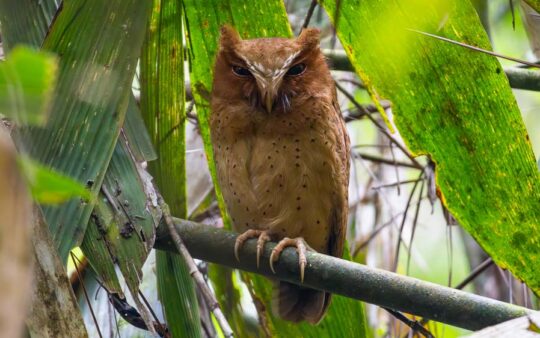
Birding Ecotours offers exciting Sri Lanka birding tours that explore the island’s top birding sites while targeting all the country’s endemic birds. Our Sri Lanka: Island Endemics and Wintering Jewels tour visits a variety of habitats, including rainforests, montane cloud forests, wetlands, and coastal lagoons, in search of more than 30 endemic species such as Serendib Scops Owl, Sri Lanka Spurfowl, Sri Lanka Blue Magpie, and Layard’s Parakeet. Timed for the northern winter, the tour also targets sought-after migrants such as Indian Pitta, Kashmir Flycatcher, and Pied Thrush. In addition to superb birding, participants may encounter impressive wildlife, including Asian Elephant, Leopard, and Sloth Bear. The tour typically runs for just under two weeks and, as always, is operated as a small-group experience. With exceptional bird diversity, spectacular scenery, and comfortable accommodation throughout, Sri Lanka offers one of the most rewarding birding and wildlife experiences in Asia.
Read More About Sri Lanka
Introduction to Sri Lanka
The Democratic Socialist Republic of Sri Lanka (simply “Sri Lanka” hereafter) is a picturesque island country in the Indian Ocean located just off the southeast tip of the Indian peninsula and is separated from India (see our Indian birding tours here) by the Gulf of Mannar and the Palk Strait (this is also the area with the shortest at-sea distance between the two countries at 34 miles (55 kilometers) – legend has it that this strait was passable on foot up until around 1480 AD). The Bay of Bengal is to the northeast and the Arabian Sea (and Laccadive Sea) is to the west. The legislative capital is Sri Jayawardenepura Kotte (often called ‘Kotte’). It is a satellite city of Colombo, the country’s largest city and commercial hub. Our Sri Lanka birding tours start to the north of Colombo near the city of Negombo, which is located near to the international airport, and all take place in the southern third of the country.
Evidence of prehistoric human settlement in Sri Lanka dates back at least 125,000 years, unsurprisingly Sri Lanka is rich in cultural heritage with over 3,000 years of history documented, during which time the island has been known by many different names. Given the island’s location and deep harbors, Sri Lanka proved a vital point in international trade routes with first the Portuguese, then Dutch, then British all taking possession. During the British rule (1815-1948) and thereafter Sri Lanka was known as Ceylon, a name that is still widely known and referenced in various bird names to this day, with the name Sri Lanka adopted in 1972. With all of the varied influence from around the world for hundreds of years the human tapestry of the island is remarkable, one area where this can be seen well is within the incredible architecture, the other is the delicious food!
Sri Lanka is a continental island consisting mostly of flat to rolling coastal plains, with mountains rising only in the south-central part of the country e.g. the hill station of Nuwara Eliya. Pidurutalagala (Mount Pedro) is the highest peak (8,281 feet / 2,524 meters). As referenced above Sri Lanka has been connected to India for much of its geological past through episodes of lower sea level. Despite these land-bridge connections, faunal exchange between the rainforests found in southern India and Sri Lanka has been minimal. This lack of exchange of species is probably due to the inability of rainforest organisms to disperse through the interceding areas of dry zones in the lowlands. These dry lowlands are still dry today and receive only one major rainy season, whereas Sri Lanka’s “wet zone” experiences two annual monsoons. This long insularity of Sri Lankan biota in a moist tropical environment has led to the emergence of a bewildering variety of endemic biodiversity (there is a huge number of endemic plants for example). This is why southwestern Sri Lanka and the Western Ghats of southern India are jointly regarded as one of the globe’s 34 biodiversity hotspots and are considered an Endemic Bird Area (EBA) by BirdLife International. Furthermore, Sri Lanka is the westernmost representative of Indo-Malayan flora, and its abundant birdlife also shows many such affinities which makes it unique in the Indian Subcontinent. Over 70 Important Bird Areas (IBAs) are recognized by BirdLife International, several of these will feature on our Sri Lanka birding tours.
Sri Lanka birding highlights
Sri Lanka is well known among birdwatchers for the quality of exciting birding and photographic opportunities available (the thrill of the bird-wave here is incredible) and the exciting number of endemic birds that occur on the island. The Sri Lankan bird list, according to the International Ornithological Congress (IOC) currently stands at 510 bird species, 34 of these are endemic birds and include Serendib Scops Owl (only relatively recently discovered), Sri Lanka Spurfowl, Layard’s Parakeet, and Sri Lanka Junglefowl (see our itinerary for more delightful endemics). We usually see all of the endemic birds on our Sri Lanka birding tour. The position and climate of the island also makes it an important over-wintering area for some highly sought-after species such as Pied Thrush, Kashmir Flycatcher, and Indian Pitta which all breed much further north on the Indian Subcontinent.
Sri Lanka wildlife highlights
Although birds are obviously the main feature of our birding tours in Sri Lanka, there are some great mammals present too, none more impressive than large herds of Asian Elephants plus stealthy Leopards (occurring in higher densities at Yala National Park than anywhere else in the world), as well as the chance of Sloth Bear!