- Duration:
- 13 days
- Group Size:
- 6–8
- Tour Start:
- Bandaranaike International Airport, Katunayake
- Tour End:
- Bandaranaike International Airport, Katunayake
Birding Tour Sri Lanka: Island Endemics and Wintering Jewels
Details
2028
26 January–07 February
Per person sharing
$6,300 USD
£4,971 GBP / €5,943 EUR
Single supplement
$800 USD
£631 GBP / €755 EUR
2029
26 January–07 February
Per person sharing
$6,830 USD
£5,390 GBP / €6,443 EUR
Single supplement
$860 USD
£678 GBP / €812 EUR
Itinerary
Sri Lanka birding tour: Island Endemics and Wintering Jewels
This exclusive small-group birdwatching tour of Sri Lanka explores the picturesque continental island situated at the southern tip of the Indian subcontinent where we go in search of the country’s mouthwatering endemic birds and wintering specialties.
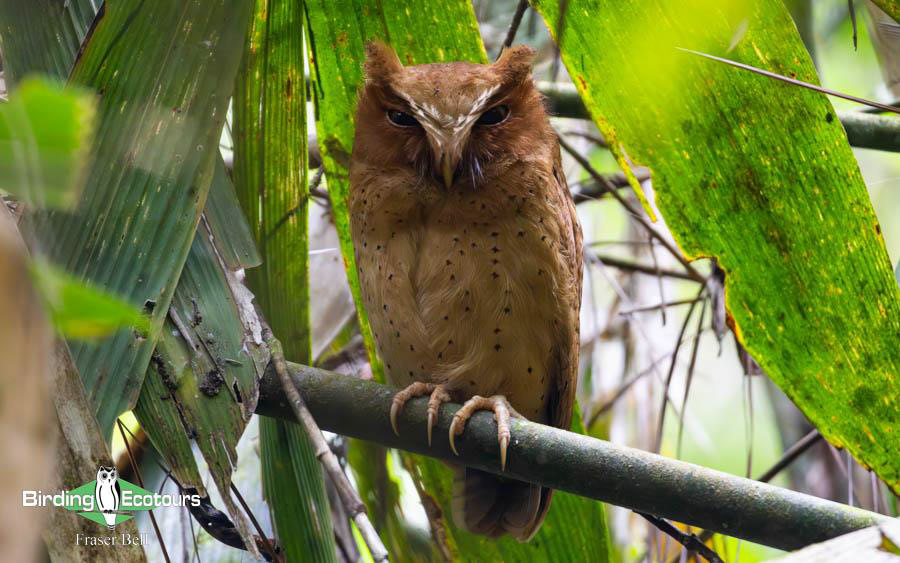 Serendib Scops Owl was discovered only in 2001 and is one of over 30 endemic target birds on this tour.
Sri Lanka is home to 35 currently recognized IOC endemic bird species, with some of the most impressive ones including the rare Sri Lanka Spurfowl, the gaudy Sri Lanka Junglefowl, Sri Lanka Hanging Parrot, Layard’s Parakeet, the shy, thicket-dwelling Red-faced Malkoha, the tiny Chestnut-backed Owlet, the common Sri Lanka Grey Hornbill, Yellow-fronted Barbet, Crimson-fronted Barbet, and Yellow-eared Bulbul, the spectacular Sri Lanka Blue Magpie, the cute Sri Lanka White-eye, and the tricky, but worth-the-effort trio of Sri Lanka Whistling Thrush, Sri Lanka Thrush, and Spot-winged Thrush. We will also look for the relatively recently discovered (2001), Endangered (IUCN), range-restricted, and endemic Serendib Scops Owl, which we will hopefully find on its day roost, as we hope to do with the shy and secretive Sri Lanka Bay Owl too.
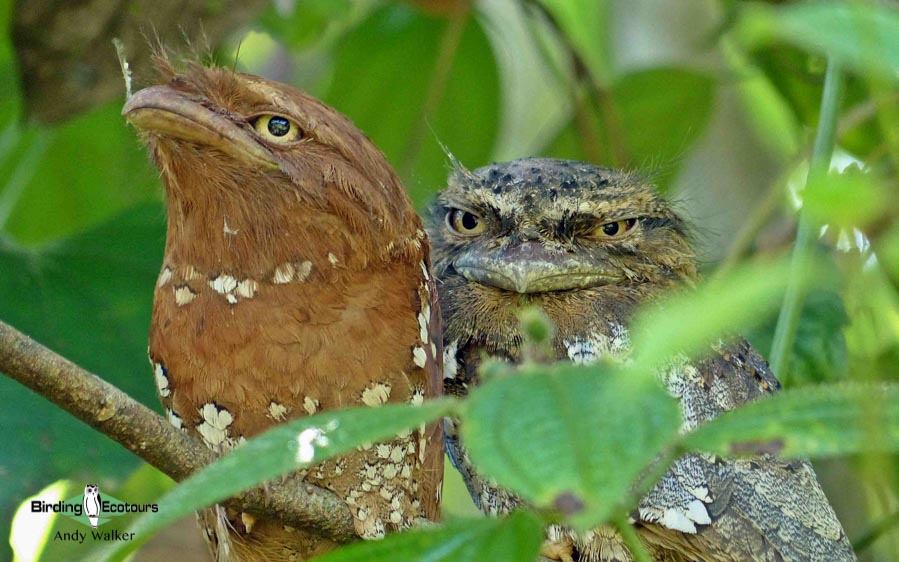 Sri Lanka Frogmouth can often be found during the daytime.
This tour is also timed to coincide with the presence of several overwintering species in the country that are difficult to find at their breeding grounds; these include the boldly patterned and highly skulking Pied Thrush, the pretty Kashmir Flycatcher, and the simply stunning Indian Pitta. There are also plenty of other exciting species possible, such as Lesser Adjutant, Indian Blue Robin, Indian Peafowl, Legge’s Hawk-Eagle, Orange Minivet, Indian Paradise Flycatcher, Forest Wagtail, Malabar Trogon, and Sri Lanka Frogmouth (surprisingly not a Sri Lankan endemic, given its English name; it also occurs in southern India in the Western Ghats, as do a couple of the other birds listed above, such as the trogon). Furthermore, Sri Lanka is the westernmost representative of Indo-Malayan flora, and its abundant birdlife also shows many such affinities.
This tour also offers plenty of wildlife-viewing opportunities with Asian Elephant, the Sri Lankan endemic subspecies of Leopard (Panthera pardus kotiya), and Sloth Bear all being possible, along with a range of monkeys, squirrels, and deer. This itinerary covers a variety of habitat types, including lowland, monsoon and cloud forests, grasslands, lagoons, coastal mudflats, fresh and brackish waterbodies, imposing riverine woodland, and forest, and uses comfortable accommodation throughout the tour.
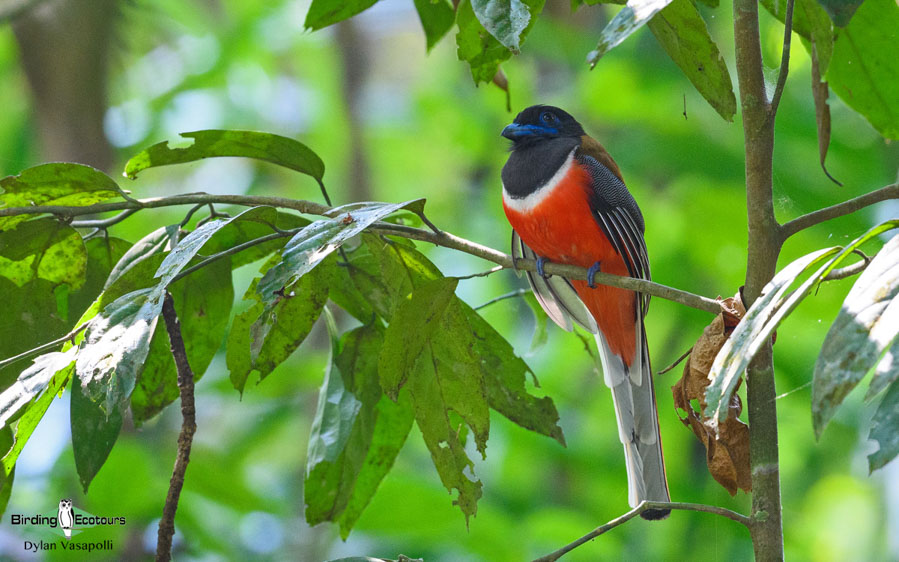 Found only in Sri Lanka and the Western Ghats (in India), Malabar Trogon is sure to delight.
You could combine this tour with our exciting Birding Tour India: Andaman Islands Endemics, designed specially to follow this Sri Lanka tour. This extension will look for numerous endemic birds, including Andaman Serpent Eagle, Andaman Masked Owl, Hume’s Boobook, Andaman Boobook, Andaman Woodpecker, and many more!
We have many other Indian tours following after this tour, details of which can be found here.
Itinerary (13 days/12 nights)
Day 1. Arrival in Katunayake and transfer to your hotel near the airport
Today you will arrive in Sri Lanka at the Bandaranaike International Airport in Katunayake and transfer to your nearby hotel, with the remainder of the day at leisure. Any early arrivals can start to enjoy the surprisingly productive birding from the wooded grounds of the hotel. Here the endemic Crimson-fronted Barbet and Red-backed Flameback are commonly seen, alongside other specials such as Forest Wagtail and Loten’s Sunbird. We will have a group dinner together in the evening, our first of many wonderful local meals; the food in Sri Lanka is great!
Overnight: Katunayake
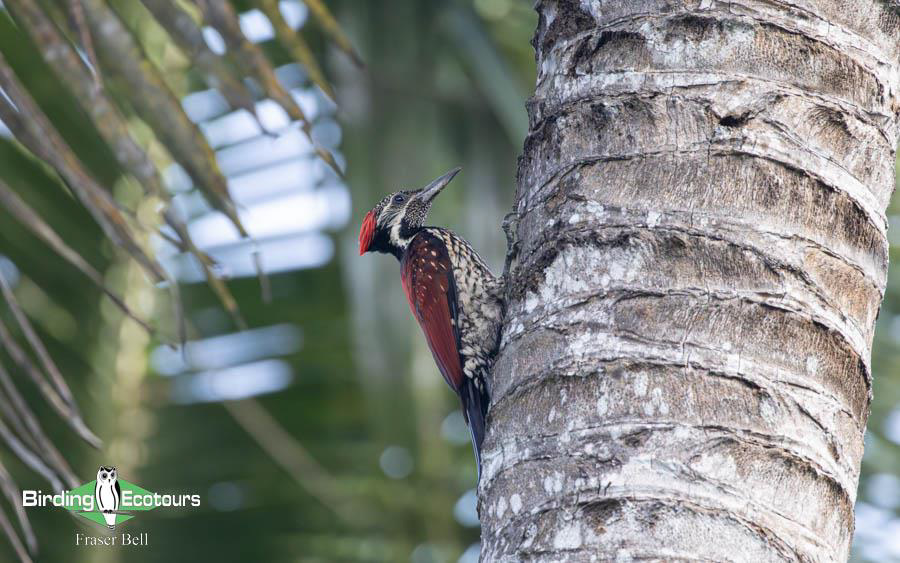 The endemic Red-backed Flameback is the most common woodpecker throughout much of Sri Lanka.
Day 2. Drive to the endemic hotspot of Sinharaja Forest Reserve
We will leave the hotel after breakfast, heading southwest to our first birding base, the lush lowlands of Sinharaja Forest Reserve. Roadside birding in Sri Lanka is refreshingly good. Blue-tailed Bee-eater, White-throated Kingfisher, White-bellied Drongo, Indian Roller, Sri Lanka Swallow, Scaly-breasted Munia, Brown Shrike, Indian Jungle Crow, Yellow-billed Babbler, Oriental Magpie-Robin, and Ashy Woodswallow are often seen perched on wires. Though we will no doubt see them again and again, these roadside temptations will be hard to resist. The odd Crested Serpent Eagle and Changeable (Crested) Hawk-Eagle, sentinels on posts, will almost certainly bring our vehicle to a halt. The more common waterbirds such as Red-wattled Lapwing, Indian Pond Heron, Eastern Cattle Egret, Intermediate Egret, Black-winged Stilt, and Asian Openbill will certainly not be ignored either.
Sinharaja Forest Reserve is a UNESCO World Heritage Site, which represents the largest expanse of lowland rainforest in Sri Lanka and is the premier site for Sri Lanka’s avian endemics, with 28 of the 35 endemics possible here. On arrival we will check in to our beautiful eco lodge nestled within the heart of Sinharaja for a four-night stay. After enjoying our first of many rice-and-curry lunches we will commence our quest for the island’s endemics in the surrounding forests.
The resonant call of Yellow-fronted Barbet is likely to demand our attention first, a common element in the soundscape of the wet Sri Lankan hinterland. The gregarious Orange-billed Babbler, with its constant chattering will be easier to locate. Sri Lanka Green Pigeon and the newly raised-to-endemic Sri Lanka Swallow are common overhead, though it may take more time to find one perched. A gem of a bird, Sri Lanka Hanging Parrot, whose scientific name beryllinus refers to beryl, a semi-precious stone found in Sri Lanka, may require scope views to fully appreciate its scarlet forehead and rump against its green body. Other interesting birds in this lively area include Green Imperial Pigeon, Crested Treeswift, Lesser Yellownape, Black-hooded Oriole, Common Iora, and Oriental White-eye, to name a few.
Overnight: Sinharaja
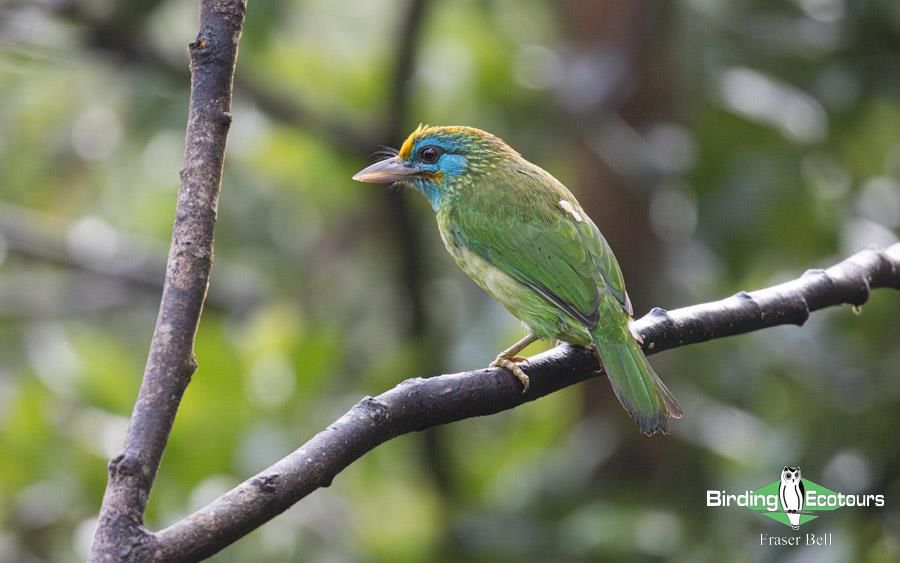 The Yellow-fronted Barbet is a striking endemic and a familiar sight and sound in Sri Lanka’s wet lowlands.
Days 3 – 5. Three days birding Sinharaja for lowland endemics and mixed-species flocks
We will have three full days in this birding hotspot, and we are sure to see many great birds. We will use a range of birding techniques to maximize our species list, using stakeouts for secretive targets, walking dense forest trails to find mixed flocks and the rarer endemics, and birding along roads and in home-gardens to enjoy excellent viewing of a high diversity of species along the forest edge.
Our first morning birding this diverse area should add a huge boost to our trip list. Spot-winged Thrush may greet the day with its rhythmic dawn chorus and could come hopping in at first light, in search of an easy meal. The “pretty-dear” call from the undergrowth may betray a flock of Brown-capped Babblers moving low through the vegetation. As the light improves, the dawn chorus may build with additional songs from Green Warbler, Tickell’s Blue Flycatcher, and Black-hooded Oriole. The well-wooded, home-garden-type birding here, which combines a mix of habitats, should deliver a mouthwatering list of species including endemics such as Sri Lanka Junglefowl, Sri Lanka Grey Hornbill, Sri Lanka Hill Myna, Black-capped Bulbul, Legge’s Flowerpecker, and perhaps Layard’s Parakeet, named after E. L. Layard, a 19th century British civil servant, who added 136 species to Sri Lanka’s avian inventory. More widespread species we expect to see include Square-tailed, White-browed, and Yellow-browed Bulbuls, Golden-fronted Leafbird, Black-headed Cuckooshrike, Indian Paradise Flycatcher, Black-naped Monarch, Purple-rumped Sunbird, Bar-winged Flycatcher-shrike, Forest Wagtail, Orange Minivet, and Brown-breasted and Asian Brown Flycatchers.
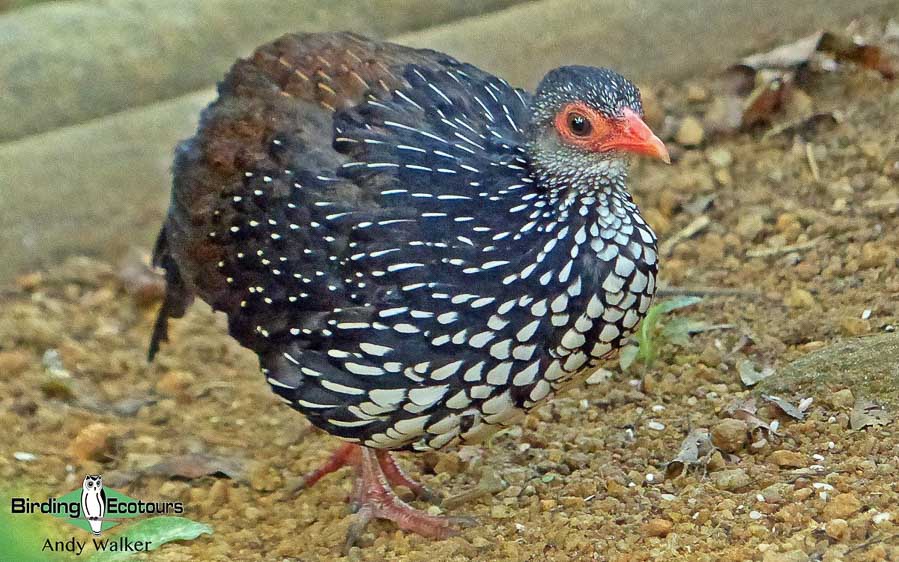 We will hope to get great views of the rare and secretive Sri Lanka Spurfowl.
During our time at Sinharaja we will spend a morning at a stakeout for the ultra-secretive Sri Lanka Spurfowl, which is highly wary of people, along with other elusive species such as Ashy-headed Laughingthrush, Indian Blue Robin, and Slaty-legged Crake. Another shy species is the Sri Lanka Thrush, which we will search for during a jeep trip up into the mountains, checking ditches and ravines along forest trails. This habitat is also ideal for the sweet Black-backed Dwarf Kingfisher. The iconic Sri Lanka Blue Magpie is much easier, as there are usually several pairs breeding in the area. Crimson-backed Flameback is also found in this forest and is a large, striking woodpecker, and we will be on constant alert for Green-billed Coucal, which is surprisingly stealthy for such a large bird. Our night bird list is likely to begin with the adorable Chestnut-backed Owlet at a stakeout, and we expect to find several Sri Lanka Frogmouth roosting during the day. This South India and Sri Lanka endemic is satisfyingly common here. Our main nocturnal target, however, is the Serendib Scops Owl, discovered in 2001 and with an estimated population of only 200 to 250 birds in the wild. We will look for it at a daytime roost, and Sinharaja is the best place in the world to see it.
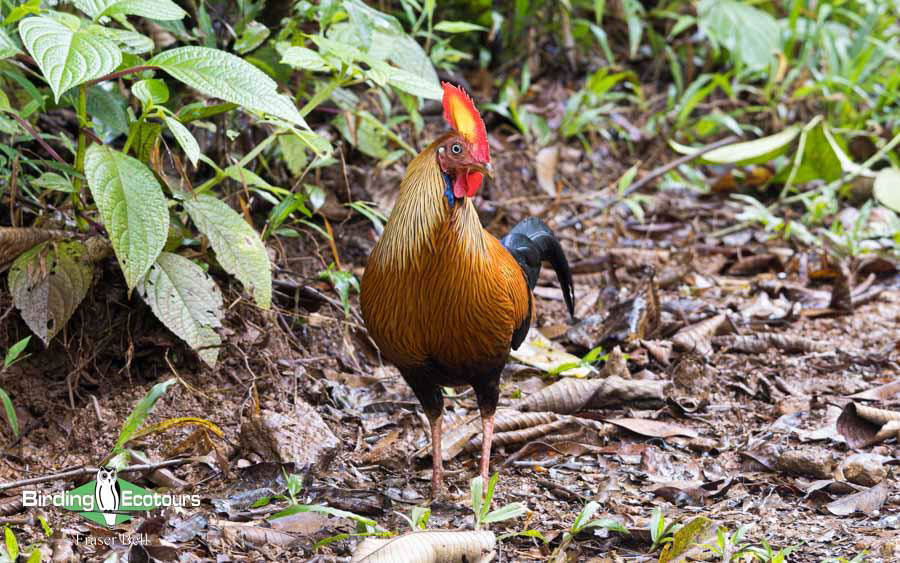 No ordinary chicken! A regal Sri Lanka Junglefowl looking at our group.
A highlight of birding in Sinharaja is seeing mixed-species bird flocks, which is a strategy adopted by birds in the tropics to maximize feeding efficiency and to reduce the risk of predation; these flocks are likely to be led by Orange-billed Babbler and Sri Lanka Drongo. The star of this coterie of flock-associated specials is the enigmatic Red-faced Malkoha – a canopy-dwelling endemic, found typically at heights of 80-120 feet (25-35 meters), with a remarkable ability to melt away into dense thickets. White-faced Starling too keeps to the canopy. Ashy-headed Laughingthrush, in comparison, is found in the lower levels of the flock, often scratching at the forest floor for insect prey. Malabar Trogon hawks insects in the subcanopy and remains largely silent, but boisterous pairs of Sri Lanka Scimitar Babbler will often help us locate the flock. We will try to experience the magic of mixed-species bird flocks on several occasions.
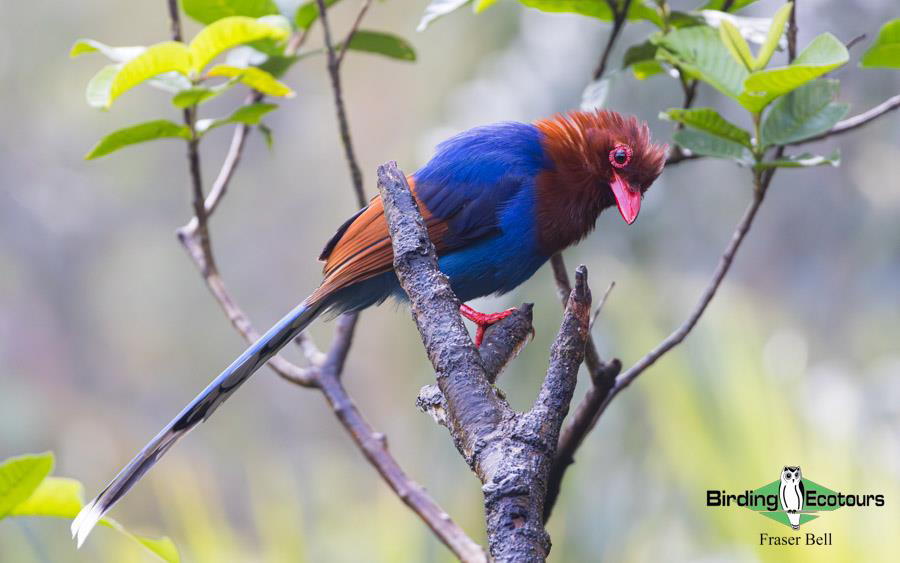 Sri Lanka Blue Magpie is gorgeous and can at times be quiet as it moves through dense vegetation, giving occasional great and close views.
Finding an Indian Paradise Flycatcher sporting its white ribbon-like tail streamers that are nearly a foot in length may be a possibility, if we encounter a good flock. Chestnut-winged Cuckoo, another migrant that joins flocks, may, however, present a tougher challenge, as it is not as regular. We will also try for forest raptors like Besra and Crested Goshawk, which lurk behind flocks to catch birds. During the day we may perhaps hear the blood-curdling screams of Sri Lanka (Grizzled) Giant Squirrel, which would betray the presence of more formidable forest raptors such as Legge’s Hawk-Eagle and Black Eagle, soaring high above the canopy.
Overnight: Sinharaja
Day 6. Sinharaja and travel to Tissamaharama
After a final morning birding in Sinharaja we will move east to the town of Tissamaharama, our base for three nights as we explore this excellent area for a wide range of birds. On arrival we will head out for our first wetland birding, focusing on the large Tissa lakes, which are fringed with dense vegetation. These are brilliant for a wide variety of waterbirds such as Lesser Whistling Duck, Cotton Pygmy Goose, Grey-headed Swamphen, Pheasant-tailed Jacana, Oriental Darter, Indian and Little Cormorants, Black-headed Ibis, Yellow Bittern, Spot-billed Pelican, and Stork-billed Kingfisher, among others. The mix of wooded home gardens, vegetated lakes, and flooded fields supports high diversity, and we are likely to add a large number of species to our trip list, with the likes of Coppersmith Barbet, White-naped Woodpecker, Rose-ringed Parakeet, Small Minivet, Brown Shrike, Plain Prinia, and Jerdon’s Leafbird all abundant here.
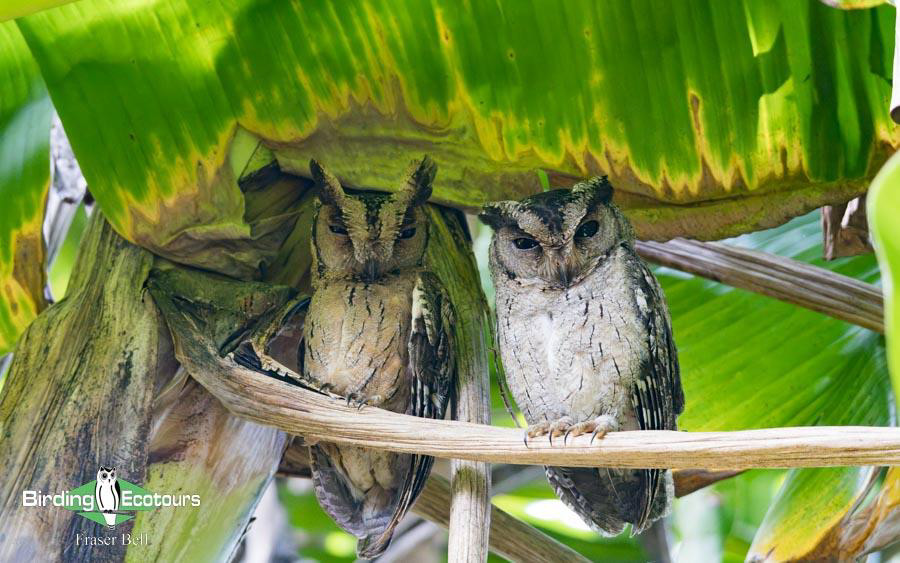 Indian Scops Owl are one of four species of owl we will look for at day roosts around the Tissamaharama lakes.
This area is also brilliant for owling, and we will look for Brown Boobook, Jungle Owlet, Indian Scops Owl, and Brown Fish Owl at day roosts, as well as Eastern Barn Owl at dusk. A noisy colony of Indian Flying Foxes will be hard to ignore, and we could see them in their thousands in several large trees next to the lakes, with constant fights over landing rights.
Overnight: Tissamaharama
Day 7. Full day in Bundala National Park
We will spend the full day birding the fascinating habitats of Bundala National Park, Sri Lanka’s first Ramsar site. This is the premier site for waterbirds, and you can often get close to the birds in the vehicles to get very good photographic opportunities. We will explore the extensive pools, flooded grasslands, dry thorny scrubland, sand dunes, brackish water lagoons, and salt pans for a large range of species. We will get there as early as possible to maximize our time in this wonderful set of habitats. Some of the species possible here are Black, Yellow, and Cinnamon Bitterns, Watercock, Great and Indian Stone-curlews, Eurasian Curlew, Marsh Sandpiper, Tibetan and Greater Sand Plovers, Kentish Plover, Red-necked Phalarope, Small Pratincole, Black-headed and Glossy Ibises, Eurasian Spoonbill, Black-necked Stork, Little and Indian Cormorants, Oriental Darter, Spot-billed Pelican, Yellow-wattled Lapwing, Black-tailed Godwit, Garganey, Greater Flamingo, Caspian, White-winged, Whiskered, Common, Greater Crested, Lesser Crested, and Little Terns. Other species possible in the area include Clamorous (Indian) Reed Warbler, Eurasian Hoopoe, Ashy-crowned Sparrow-Lark, Brown Fish Owl, Yellow-crowned Woodpecker, and Ashy Drongo.
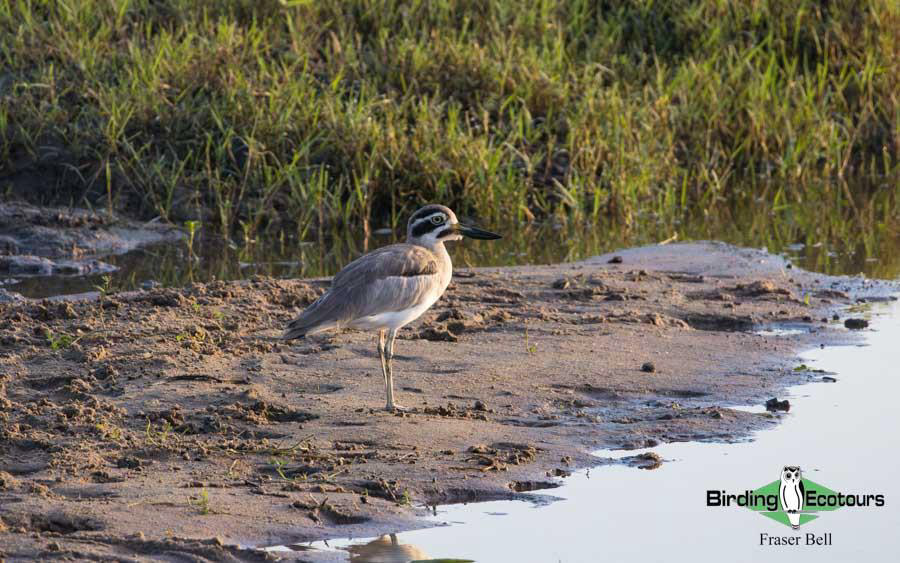 Great Stone-curlews can be seen at Bundala National Park.
This is a truly amazing site to spend a full day at. The sheer abundance and diversity of birds is incredibly impressive and makes for very enjoyable birding from the comfort of the vehicles, which are elevated and offer excellent viewing. Further species we will look for include Barred Buttonquail, Painted Stork, White-bellied Sea Eagle, Grey-headed Fish Eagle, Greater Painted-snipe, Terek Sandpiper, Blue-faced Malkoha, Sirkeer Malkoha, Chestnut-headed Bee-eater, Indian Pitta, Forest Wagtail, Oriental Skylark, Yellow-eyed Babbler, Rosy Starling, Indian Silverbill, and Streaked and Baya Weavers. There really is a huge list of potential species here, and we are bound to have a great time.
Overnight: Tissamaharama
Day 8. Full day of game drives in Yala National Park
We have an amazing opportunity to do a full day of game drives in the famous Yala National Park. This park covers a vast area of monsoon forest, dry grassland, and lush wetlands, all bordering the Indian Ocean. We have one major avian target in the park, the endemic Sri Lanka Shama, a surprisingly shy bird of the dry forests here. Once we have this species in the bag, we will turn our attention to the large mammals that give the park its fame. Our big targets will be the Sri Lankan endemic subspecies of Leopard and Sloth Bear, which, despite their rarity, we have seen both on previous tours. Yala is thought to hold the greatest density of Leopard in the world but if we see one we will consider ourselves lucky! Other mammalian targets include Golden Jackal, Tufted Grey Langur, Wild Boar, Wild Water Buffalo, Sri Lankan Giant Squirrel, Sambar Deer, and Chital (Spotted Deer), and there is also a good chance of finding Asian Elephant, which is always a treat.
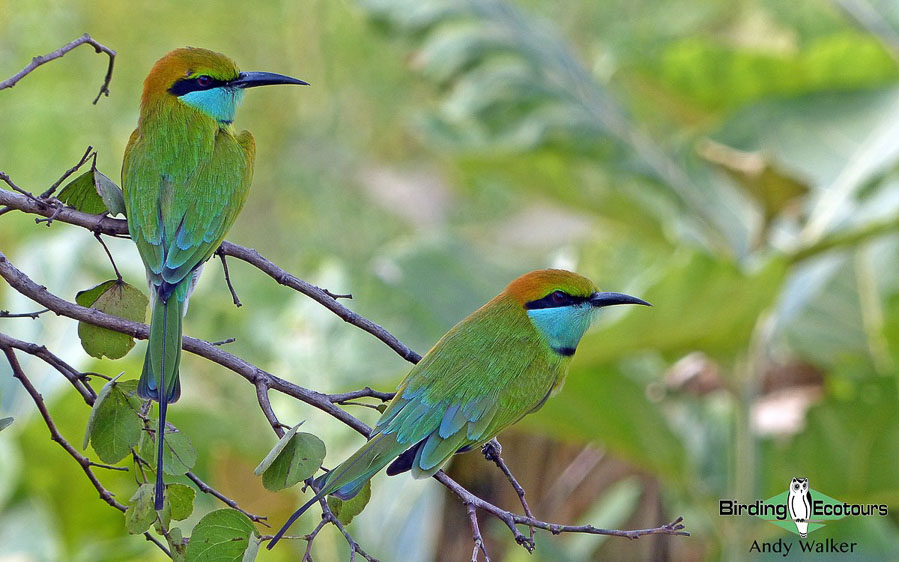 Asian Green Bee-eater is one of the species we hope to encounter in Yala National Park.
Aside from the mammals, Yala is particularly good for Indian Peafowl, Knob-billed Duck, Grey-bellied Cuckoo, Fork-tailed Drongo-Cuckoo, Orange-breasted Green Pigeon, Barred Buttonquail, Painted, Asian Woolly-necked and Black-necked Storks, Malabar Pied Hornbill, Brown-capped Pygmy and Yellow-crowned Woodpeckers, Indian Pitta, Ashy Drongo, Jerdon’s Bushlark, Indian Robin, and Purple Sunbird. We will likely be escorted by many beautiful Asian Green Bee-eaters, gliding effortlessly around our vehicles catching the insects we disturb as we roll past. Aside from these major targets, we will come across many of the birds found in Bundala (listed above) and at Udawalawe (listed below).
Overnight: Tissamaharama
Day 9. Drive to Udawalawe National Park for dry-zone specialties
In the morning we drive to the dry lowlands of Udawalawe National Park. After checking in at the accommodation we will explore this fantastic park in search of dry-zone birds, which abound here. Our most important targets are the endemic Sri Lanka Woodshrike, and the near-endemic Blue-faced Malkoha and Marshall’s Iora, both of which are patchily distributed in parts of India and Sri Lanka. Other birds on offer here include Indian Peafowl, Sri Lanka Junglefowl, Little Swift, Jacobin and Grey-bellied Cuckoos, Indian Stone-curlew, Yellow-wattled Lapwing, Painted and Asian Woolly-necked Storks, Asian Green Bee-eater, Coppersmith Barbet, Ashy-crowned Sparrow-Lark, Jerdon’s Bush Lark, Yellow-eyed Babbler, Rosy and Brahminy Starlings, Indian Robin, and Paddyfield, and Blyth’s Pipits. Migrant species like Eastern Red-rumped Swallow, and Western Yellow, White, and Citrine Wagtails may show up too.
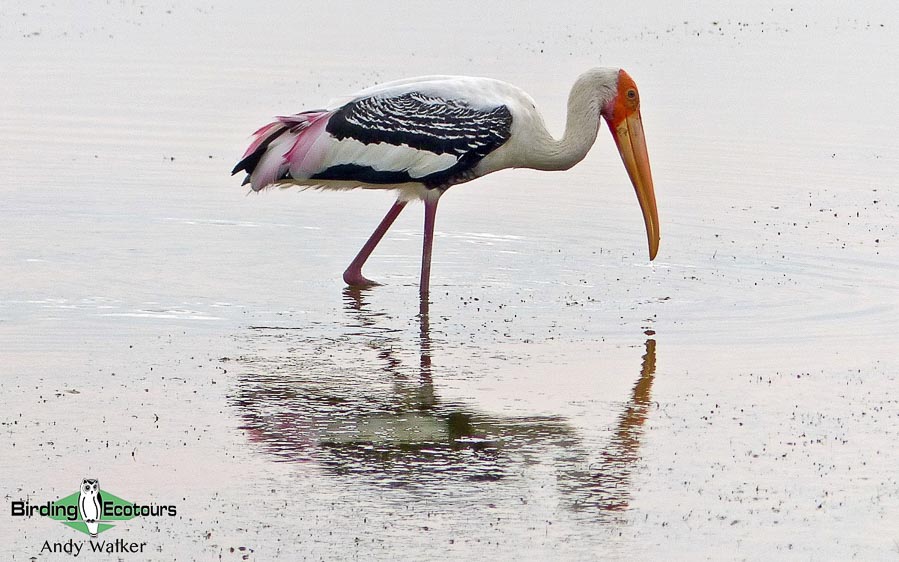 Painted Stork can be seen in Udawalawe National Park.
Other dry-zone specials we will be on the lookout for at Udawalawe National Park include Sirkeer Malkoha, Barred Buttonquail, Lesser Adjutant, Malabar Pied Hornbill, Indian Silverbill, and, if we’re lucky, Brown Fish Owl. With its vast open expanses, the park also harbors a rich diversity of exciting raptors, such as Black-winged Kite, Crested Honey Buzzard, Crested Serpent Eagle, Changeable (Crested) Hawk-Eagle, Booted Eagle, Shikra, White-bellied Sea Eagle, Grey-headed Fish Eagle, Common Kestrel, and the local resident subspecies of Shaheen Peregrine Falcon (Falco peregrinus peregrinator). We may also encounter rare raptors in Sri Lanka, such as Osprey, Pallid Harrier, or Montagu’s Harrier. In addition to excellent birds, a visit to Udawalawe also offers a good opportunity to observe Asian Elephant and Wild Water Buffalo, both of which are found in good numbers in the park.
As dusk approaches we will look for Indian Nightjar and Jerdon’s Nightjar in the scrub near our accommodation, likely serenaded by a chorus of Indian Pittas as the sun sets.
Overnight: Udawalawe
Day 10. Transfer to Nuwara Eliya and high-elevation birding
After some more early-morning birding in the Udawalawe area, we will begin our ascent to reach the cooler interiors of Nuwara Eliya at 6,200 feet (1,890 meters). We will stop for any good birds along the way, and near Nuwara Eliya we will make a brief stop to look for Brown Wood Owl at a known nesting area. Birding in this area should produce our first high-elevation species, such as Cinerous Tit and Grey-headed Canary-flycatcher. As we continue, we will keep an eye on the skies, as these forested mountain roads offer a great chance of spotting raptors, with Rufous-bellied Eagle, Legge’s Hawk-Eagle and Peregrine Falcon high on our target list.
Nuwara Eliya is the most famous hill station in Sri Lanka, named by some “Little England”, as it still bears evidence of its colonial past with its English-style holiday homes, an urban park, a few pubs, flower gardens, and a fine 18-hole golf course. As we ascend, vast stretches of tea gardens dominate the landscape, a cash crop introduced by the British, which is currently the country’s third-highest revenue earner. A serious drop in temperature of around 50-59 degrees Fahrenheit (10-15 degrees Celsius) at Nuwara Eliya will necessitate sweaters!
Once we reach the town we will explore Victoria Park. Established in 1897 to commemorate the 60th coronation jubilee of Queen Victoria, this urban park is the prime location for Western Himalayan migrants, including Kashmir Flycatcher and Pied Thrush, which winter almost exclusively in Sri Lanka. Indian Pitta, Indian Blue Robin, Forest Wagtail, Sri Lanka Scimitar Babbler, Indian Blackbird, and Sykes’s Warbler are some of the other good birds to be found in this park. At the end of the day we will reach our cozy highland lodge, where we will stay for two nights.
Overnight: Nuwara Eliya
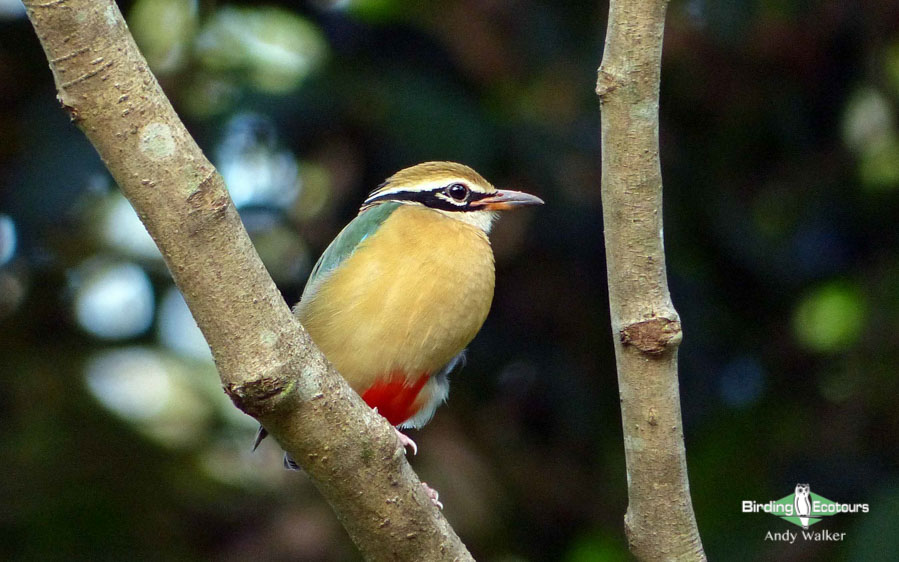 The stunning Indian Pitta spends its non-breeding season in Sri Lanka.
Day 11. Nuwara Eliya, looking for montane endemics and other specials
We will have an early start with a picnic breakfast to get to the high-elevation Horton Plains National Park, where we will spend time in the forest looking for high-value montane targets including the final five Sri Lankan endemics. These include the secretive duo of Sri Lanka Whistling Thrush, and Sri Lanka Bush Warbler, alongside more abundant Yellow-eared Bulbul, Dull-blue Flycatcher, and Sri Lanka Wood Pigeon. Indian Blackbird and Legge’s Hawk-Eagle are other major targets in Horton Plains, both of which are near endemics, being restricted to the Indian subcontinent. Mixed-species bird flocks are to be found in this forest, comprised of Sri Lanka White-eye, Orange Minivet, Velvet-fronted Nuthatch, Grey-headed Canary-flycatcher, Cinerous Tit, Bar-winged Flycatcher-shrike and Large-billed Leaf Warbler.
In the afternoon we will descend back to near Nuwara Eliya, where we will reach a patch of habitat close to our accommodation in time to anticipate the arrival of the ultra-secretive, montane, endemic Sri Lanka Whistling Thrush, which is one of two Endangered (IUCN) Sri Lankan endemics.
Overnight: Nuwara Eliya
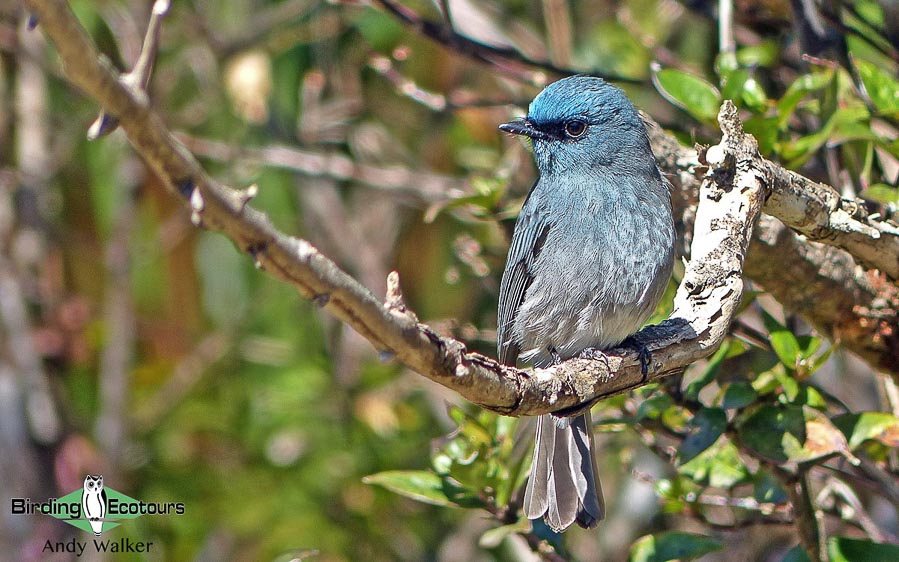 The endemic Dull-blue Flycatcher is found in the mountains of Sri Lanka.
Day 12. Nuwara Eliya birding, transfer to Katunayake
In the morning we will be birding for any missing montane specials around Nuwara Eliya. Most of the day will be a transfer day, as we travel back to Katunayake. En route we will pause at a tea factory to see the recently split Hill Swallow, which nests inside the factory. After a cuppa we will reach our accommodation and check in for the final night of the tour.
Overnight: Katunayake
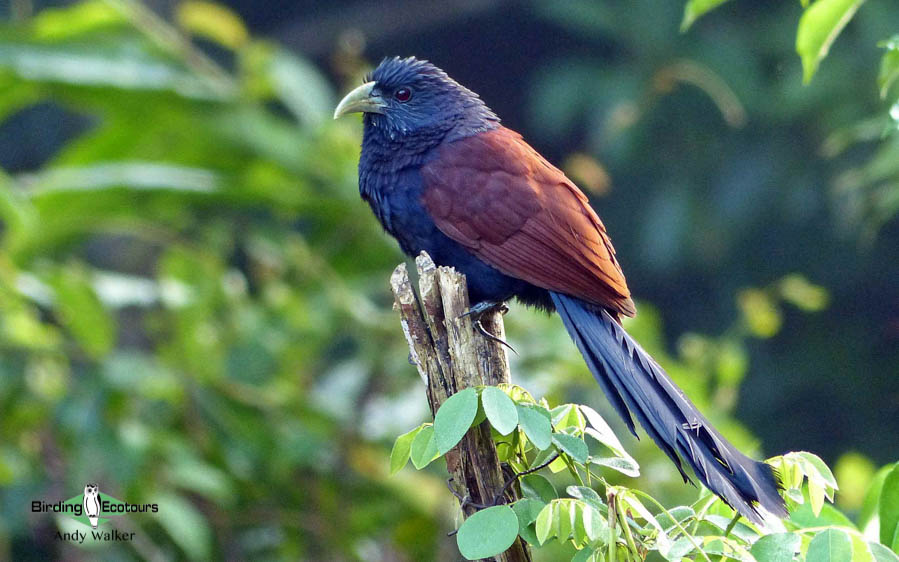 Green-billed Coucal is a secretive endemic and we will be constantly looking for one.
Day 13. Departure
We will finish the tour with some optional pre-breakfast birding around the wonderful gardens of the peaceful Katunayake hotel. After one final breakfast together the tour comes to an end with your international departure.
If you would like to add some further island endemic birds to your travels you might like to consider our Birding Tour India: Andaman Islands Endemics which runs straight after this tour, during which we will look for Andaman Woodpecker, Andaman Serpent Eagle, Andaman Masked Owl, Andaman Scops Owl, Hume’s Boobook, and Andaman Boobook, among many others. Alternatively you may like to consider our Southern India birding tour where we visit the Western Ghats and Nilgiri which takes place immediately prior to this Sri Lanka birding tour. On this tour of southern India we hope to find an assortment of Western Ghats and Nilgiri endemics including such stunners as Malabar Whistling Thrush, Nilgiri Laughingthrush, Nilgiri Blue Robin, Black-and-orange Flycatcher, amongst many others.
Overnight: Not included
Please note that the itinerary cannot be guaranteed as it is only a rough guide and can be changed (usually slightly) due to factors such as availability of accommodation, updated information on the state of accommodation, roads, or birding sites, the discretion of the guides, and other factors. In addition, we sometimes have to use a different guide from the one advertised due to tour scheduling or other factors.
Map
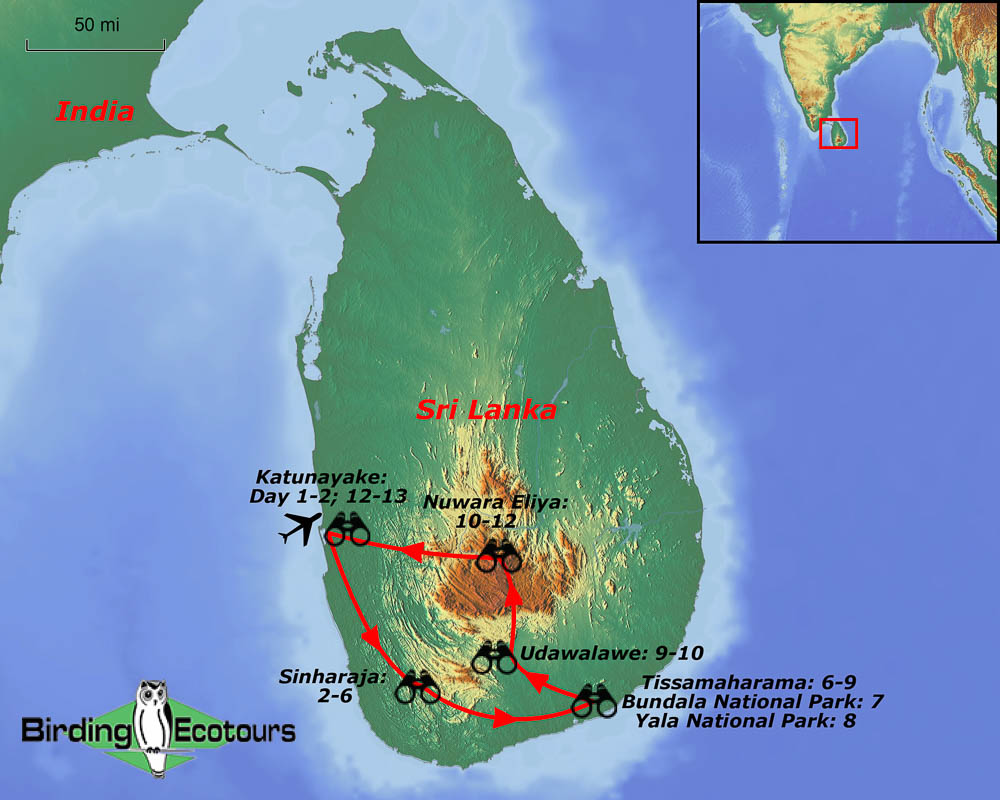
Trip Report
Testimonials
Gallery
General Information
Sri Lanka birding tour: Island Endemics and Wintering Jewels
OUR SRI LANKA BIRDING TOUR
This small-group Sri Lanka birding tour focuses on the 35 currently recognized IOC (15.1) endemic birds, several near-endemic regional specials that only also occur in a relatively small area of southern India, and several overwintering specials. Some of the main targets on this birdwatching tour of Sri Lanka include Serendib Scops Owl, Sri Lanka Bay Owl, Chestnut-backed Owlet, Sri Lanka Frogmouth, Sri Lanka Spurfowl, Sri Lanka Junglefowl, Sri Lanka Hornbill, Indian Pitta, Malabar Trogon, Red-faced Malkoha, Sri Lanka Blue Magpie, Sri Lanka Thrush, Sri Lanka Thrush, Pied Thrush, Indian Blue Robin, Kashmir Flycatcher, and many more.
Our tour will take us around the south of the picturesque island nation, soaking in a wide range of habitats along the way. In addition to the high-quality birds, we will keep our eyes peeled for Asian Elephant, (Sri Lankan) Leopard, and Sloth Bear. This Sri Lanka birding tour starts and ends at Bandaranaike International Airport in Katunayake, near the Sri Lankan capital, Colombo.
ITINERARY AND SPECIES RECORDING (BIRD LISTS AND ANIMAL LISTS)
Ahead of our Sri Lanka birdwatching tour we will send you a detailed daily itinerary (along with arrival instructions). We will then provide you with a printed copy of the itinerary on the first day of the tour.
The printed copy of the itinerary will include a bird list and list of other animals possible on the tour and we will go through this each night (but it is totally optional whether you join or not – though it is considered extremely useful). We always use the latest version of the International Ornithological Congress (IOC) taxonomy for our bird list and for all other wildlife, we use the International Union for Conservation of Nature (IUCN) taxonomy. While birding during the tour we will create eBird checklists and these will be shared with any participants who wish to have a copy. Just provide us with your eBird user details at the beginning of the tour for us to do this.
Each evening, we will go through the itinerary to give you any specific information to be aware of for the following day (like what clothes and equipment will be needed, when we will be having breakfast, departure time from the hotel, and any important birds we will be looking for, etc.). This is a good time for you to ask us any questions you may have for the day ahead.
After the completion of the tour, we will email you a PDF copy of an illustrated trip report. This will include a complete IOC and IUCN checklist of all wildlife recorded during the tour. Any interesting bird, animal, or landscape photographs will be included in the trip report and will also be added to our tour-specific Flickr pages as a reminder, and you are able to download these for free and share with your friends and family.
DAILY ACTIVITIES, PHYSICAL REQUIREMENTS, AND TOUR PACE
This Sri Lanka birdwatching tour is not considered to be too physically demanding, though heat and humidity throughout the tour can increase tiredness and care should be taken to remain hydrated at all times.
There are a couple of long hikes during the trip, but we always take these slowly and go at birdwatching pace. If you do want to sit out a birding session, there are opportunities to hang back at our accommodation for some more relaxed birding or photography at several locations. We will spend the majority of our time birding on easy to moderate trails and roadsides, at a range of elevations, and will experience warm/hot and humid conditions throughout.
This is a birding-focused tour that does offer some good incidental photo opportunities, though these are secondary to the actual birding element of the tour. Finding and seeing well the many endemic and near-endemic species and subspecies of Sri Lanka, as well as overwintering specials, will be considered the priority. That said, some good photo opportunities are available at many of the sites we will be visiting, though conditions can be tough in the forested, more enclosed, areas we will visit.
Most of the drives between different sites are two to three hours, but there are also a couple that are around the four-hour mark. Please note that on longer journeys our driver may need to take a short break for safety. This will generally be done at a place where there is some birding for us, or where we will have lunch. Everyone’s safety is our concern on this and all our tours. There are a couple of long, rough, and potentially dusty jeep rides on this tour. Please see the “Transportation” section below for more details.
At a couple of locations, we will be birding from within open-topped jeeps/vans due to site regulations, often for our own safety (e.g. in areas where there are elephants or leopards).
PASSPORT, VISA, LOCAL LAWS, AND CUSTOMS
In order to visit Sri Lanka, most visitors will require a visa which can usually be obtained on arrival in the country. The online visa (eVisa) application system can be accessed here, and is working (as of May 2025). To enter the country your passport must have an expiry date at least six months after the day you arrive.
You are required to complete an online arrival form up to three days before you arrive in Sri Lanka. This is a free service (don’t fall for online scams claiming you need to pay) and this can save time on arrival. Please refer to the department of Immigration and Emigration website for further up-to-date information, and also check the advice provided by your government. There are strict rules about goods you can take into or out of Sri Lanka, with details here.
On arrival in Sri Lanka, you will likely have to show evidence of your ticket to leave the country after your bird holiday. Please make sure that you have all the required documents, and please contact us if you have any questions.
You must always carry your passport as an official form of identification. A copy is usually acceptable, but in some situations, you may have to produce the original at a police station, within a specified time limit.
Do not fly drones near, use binoculars or telescopes, or take photographs of military bases, government buildings, or vehicles used by VIPs. Drones require a permit in Sri Lanka.
Disrespecting Buddhist images and artefacts, or making offensive remarks about religion, is a serious offence and can lead to arrest. If you have visible tattoos of Buddha, you can be refused entry to Sri Lanka or face deportation. Do not pose for photographs standing in front of a statue of Buddha (don’t pose for photos with your back to Buddha). Avoid touching sacred objects or relics. Always seek permission before photographing people, particularly monks or worshippers. Public displays of affection are frowned upon in Sri Lanka. It is best to avoid overt displays to respect local customs and traditions.
Please make sure that you bring a photocopy of your passport with you on the tour, this can be kept with other important documents like vaccination certificates, emergency contact details, and insurance documents.
Collecting animals or parts of animals (e.g. bones, feathers, eggs, insects including but not limited to moths and butterflies, dead or alive) and plants to remove them from where you found them is a serious offence. It can result in prison time, heavy fines, and bans from returning to the country. You are likely to be kept in custody until the fine is paid, and fines can be substantial.
Here is an example of what can happen if you are caught. Please do not take the risk. If you do, you will be entirely responsible for the consequences.
TRAVEL INSURANCE
As detailed in our standard Terms and Conditions, we strongly encourage you to have comprehensive trip cancellation insurance to protect against unexpected events that might cause delays and interruptions to travel. It is important that the insurance covers illness, medical issues, accidents, repatriation, loss of luggage or any valuable items that you might be bringing (e.g. optical and camera equipment) etc.
HEALTH AND PESTS
We recommend you consult your doctor or local travel clinic, regarding vaccine requirements, approximately two months prior to your bird tour to Sri Lanka, so that any required vaccine courses can be completed in time for your departure.
There is no risk of Yellow Fever in Sri Lanka, however there is a certificate requirement for travelers arriving from countries with a risk of Yellow Fever transmission (or who have transited for more than 12 hours through one). The certificate for Yellow Fever is now valid for life, rather than 10 years, as is considered to apply to pre-2016 vaccinations. Please refer to the World Health Organization’s list of countries where Yellow Fever transmission is possible, here.
Everyone visiting Sri Lanka should be up to date with standard vaccinations and boosters, like Diphtheria-Tetanus-Pertussis, Chickenpox (Varicella), Flu, Covid-19, Polio, Shingles, and Measles-Mumps-Rubella (MMR). Other vaccinations that might be required (depending on your personal situation, and to be confirmed by your travel clinic/doctor), include Hepatitis A, Hepatitis B, Japanese Encephalitis, Cholera, Typhoid, and Rabies. Airborne and droplet transmitted diseases such as Tuberculosis (TB), Avian/Bird Flu, Seasonal Flu, and Hantavirus are present.
There is a risk of insect or tick-borne diseases in some areas of South Asia, including in Sri Lanka. This includes diseases such as Chikungunya, Crimean-Congo Hemorrhagic Fever, Leishmaniasis, Scrub Typhus (from Chiggers) and West Nile Virus. There is no risk of Malaria in Sri Lanka, however there is Zika Virus (from diurnal mosquitos). To prevent mosquito bites we recommend wearing long-sleeved shirts and long pants, treat clothes with repellents like permethrin or use permethrin-treated clothing (such as Buzz Off), and use an EPA-registered mosquito repellent containing DEET.
Please refer to the CDC (Centers for Disease Control and Prevention) website here, for further information on vaccines and how to stay healthy on the tour. Another great source of data is the “Travel Health Pro” website, and information on Sri Lanka can be seen here. All three linked webpages, and any others from your home government, are worth studying ahead of joining our tour.
Poor air quality is a significant public health problem in many parts of the world, and we can experience areas of poor air quality, usually when in (but not limited to) cities. Exposure to high levels of air pollution over short time periods (e.g. minutes/hours/days) is linked to many different acute and chronic health problems. These effects are mainly on the respiratory (lungs and airways) and cardiovascular (heart function and blood circulation) systems.
Tap water is not potable in Sri Lanka and you should not drink water from taps, as you can get ill (e.g. traveler’s diarrhea) and this will likely ruin a portion of your bird tour. We will be providing two bottles of mineral water per day per person from our tour vehicle supply, please bring a refillable water bottle to maintain your own supply. Water taken from the hotel (excluding any free water provided) will be at your own cost (e.g. water from the restaurant, water from a mini bar etc.).
If you pick up any scratches from plants (see the “Dangerous Animals and Plants” section below) or receive any bites from insects, they should be cleaned, treated with antiseptic cream/wipes, and covered quickly to reduce the chance of any infection.
Sunscreen (rated SPF 30+) should be used frequently, and a sunhat should be worn to protect from the sun’s powerful rays, with sunglasses used to help prevent glare. A plentiful intake of water is essential to maintain hydration.
There is a risk of altitude sickness when traveling to elevations of 8,200 feet (2,500 meters), however we won’t be going above this elevation on our tour. The highest point we are likely to be birding at on our Sri Lanka bird tour is at Horton Plains (approximately 5,900 feet / 1,800 meters). The highest overnight elevation is approximately 5,250 feet (1,600 meters).
MEDICAL CONDITIONS
It is very important that you are suitably covered with comprehensive medical insurance in the instance of any emergency situation while on our Sri Lanka bird tour. Medical facilities in Sri Lanka are likely to be of a lower quality than you are used to at home. Emergency medical treatment outside main cities is not readily available, and you may have to be brought to Colombo for treatment. Treatment in private hospitals can be expensive and the options for repatriation to your home or a neighboring country in an emergency are limited and very expensive. If you don’t have insurance, the cost for medical care is likely to be very high.
As detailed in our standard Terms and Conditions, we require you to tell us when signing up for our Sri Lanka birdwatching tour of any medical conditions that we should be aware of. Please tell us if you have any walking/mobility (including stability) issues, diabetes, epilepsy, food and medicinal allergies, heart conditions, and long-term illnesses etc. This will make things easier for us, and you, in case an unexpected situation arises.
CRIME AND SAFETY
Sri Lanka is generally considered to be a relatively safe country to visit, with many friendly people, but you should take at least the same precautions you would at home. Place valuables in a secure place, such as a hotel safe, when you can, and keep belongings in sight when traveling. Remain vigilant of your surroundings at all times.
Terrorist attacks in Sri Lanka cannot be ruled out, avoid crowded public places, large gatherings, and demonstrations. Possible targets could also include hotels, tourist sites, and places of worship. Protests and demonstrations linked to political and economic situations can happen anywhere across the island at short notice, and can become violent, so are to be avoided.
Violent crime against foreigners is rare, but there has been an increase in low-level opportunistic crime incidents, e.g. bag snatches off motorbikes. Wear a body belt for safe keeping of documents.
Bank card fraud is common. Fraudsters can steal your card details without you noticing. Use ATMs inside banks or hotels where possible, and check ATMs on the street for signs of tampering. Keep cards in sight when paying in shops and restaurants.
Many beaches in Sri Lanka have dangerous surf or rip tides at certain times of the year. Get advice from your hotel or lifeguards before going into the sea.
DANGEROUS ANIMALS AND PLANTS
Some Sri Lankan animals can be dangerous. If in doubt, follow advice from our local guides or the Birding Ecotours Sri Lanka tour leader. Wild Asian Elephants and Mugger (Crocodiles) will attack humans on occasion and (Sri Lankan) Leopards are present, though we will likely be in vehicles if we are lucky enough to find one of these shy apex predators. Venomous insects and snakes are found in many parts of the country and we are likely to come into contact with some of these. Feral dogs are common and sometimes carry Rabies.
Special mention should be made of leeches, which occur throughout Sri Lanka, where they are particularly abundant. Even though we will be visiting Sri Lanka in what should be the drier months, it is best to expect them to be present, and to be pleasantly surprised if we don’t encounter many of them! They are an annoyance rather than being a real health issue, though we know no one likes them! Insect repellent (particularly citronella) sprayed on shoes and ankles can help to keep them at bay, as well as being great for reducing issues with other annoying creatures, such as ticks, mosquitoes, and chiggers. Saltwater spray can also deter leeches. We aim to provide you with a pair of “Leech socks” at the beginning of the tour, but it is a good idea to bring your own and also have some salt sachets as well. Salt can be an effective way to remove a leech if it attaches to your skin.
There are numerous poisonous and irritant plants in Sri Lanka, and some plants may be protected by fierce-looking spikes, so we recommend being careful about where you put your hands if moving through vegetation (this is also a good way to reduce insect bites).
FOOD, DRINKS, AND MEALS
A variety of typical Sri Lankan food is the main type of food to be expected on this tour, with some western menu options likely in some places. Vegetarian food is commonly available, but please let us know of any dietary requirements ahead of the tour. Most meals are based around chicken or fish with rice, breads, and vegetables. Fresh fruit will be available. Due to the lack of refrigeration, dairy products are not common.
Sri Lankan food can be quite spicy, so if you don’t like spicy food, please let us know so we can inform our hosts in advance. We will have breakfasts at our hotels (possibly after an early morning birding session in some cases), lunches will either be taken in our hotel, restaurants as we travel, or occasionally as boxed/packed lunches in the field while birding. Evening meals will be taken at our hotels. We suggest you bring your favorite snacks or protein bars to supplement your diet. Street food is not recommended for travelers due to risk of getting sick.
Tap water is not potable in Sri Lanka, and you should not drink water from taps, since you can get sick. Tea and coffee are widely available, but if you have strong preferences about your tea/coffee you’d be advised to bring your own, though Sri Lanka is famous for its tea production. Alcoholic drinks are available in most places, though the sale of alcoholic drinks is banned (or at least not usually available) on religious holidays. Drinking alcoholic drinks in certain public areas is illegal.
CURRENCY, MONEY, AND TIPPING
The Sri Lankan Rupee (LKR) is the currency of Sri Lanka. It is subdivided into 100 cents (but these are rarely seen in circulation due to their low value). Banknotes can be found in the following denominations: LKR 20, 50, 100, 500, 1,000, and 5,000. The Sri Lankan Rupee is a closed currency, which means it is not available to buy or sell outside of Sri Lanka. It will likely be best to buy Sri Lankan Rupees at the airport or use an ATM at the airport. Some of the larger towns/cities we are likely to pass through/visit should have ATMs for withdrawing cash, though there is always a chance these are broken or won’t except your international card. Cash is useful for incidental purchases in rural areas, where cards may not be accepted. Some small denominations of US$ can come in useful for tipping (e.g. US$1, US$5, US$10 bills), or emergency cash if your bank card doesn’t work. It is useful to get small Sri Lankan Rupee banknotes when possible. It is best to exchange currency at authorized dealers, banks, or hotels to avoid counterfeit notes. Always ask for a receipt after exchanging money.
Tipping is not mandatory in Sri Lanka but is customary and greatly appreciated. It is a good way to show gratitude for good service and to acknowledge those working in the service industry, such as waitstaff, hotel housekeepers, drivers etc. We will cover tips to hotel staff, restaurant staff, and safari jeep drivers. You will be responsible for tipping tour vehicle drivers and local guides. We would suggest LKR500-1,000 (or US$5) per person per day for drivers, and for local guides, a tip of LKR2,000 (or US$10) per person per day. However, as stated, the above tipping is at your discretion.
ACCOMMODATION
The accommodation on this tour is generally of a good standard, with electricity throughout. All accommodation has air conditioning (those in the mountains don’t really need it).
Located approximately ten minutes from Bandaranaike International Airport in Katunayake, we stay at a luxury resort at the beginning of the tour, set in twelve acres of stunning, lush gardens. An ideal place to start our Sri Lankan birding tour, and a good location if you’d like to arrive ahead of the tour and relax a little and start your endemic bird quest early.
While we are on our birding circuit around Sri Lanka we will utilize a range of accommodations, from colonial style hotels, rustic bungalows and nature lodges set in pristine habitat and important bird areas, and boutique hotels. Some of this accommodation is more basic than others, but we try and use the best accommodation available in the chosen area, near the key birding sites and it is generally of a high standard. Some of the areas we will be staying in may be hilly, and so walking between bedrooms and hotel common areas (e.g. the dining room) may involve some steps. If you have difficulty walking on steps, please let us know in advance and we will endeavor to get a room that will best suit your ability.
ELECTRICITY
In Sri Lanka the power plugs and sockets (outlets) are of Type D, Type M, and Type G. The standard voltage is 230 volts (V), and the standard frequency is 50 hertz (Hz). Further details and photos of these plugs and sockets, and information on the electricity supply in Sri Lanka can be found here. This link also allows you to type in your home country and will tell you if you will need to bring a travel adaptor and / or a voltage converter, as well as tell you if you need to consider frequency differences. All places we stay on our tour should have electricity 24 hours a day, unless there is an unexpected power outage, such as the result of a storm or other unforeseen circumstance.
COMMUNICATIONS
The phone signal in Sri Lanka is reasonably good. Dialog is the largest and best performing local network across the country. It is possible to purchase a local SIM card on arrival in Sri Lanka, and most likely simply done at the airport. Most places we stay will have Wi-Fi, but the Wi-Fi infrastructure across the country is not great.
TRANSPORTATION
We will use an air-conditioned minibus/van on this tour for moving between our overnight destinations and some of our birding sites. We will also use open-top jeeps at some birding sites. The jeep drives can sometimes be rough and dusty.
DOMESTIC FLIGHTS
There are no domestic flights on this tour.
WEATHER/CLIMATE
January and February are considered the cooler months in Sri Lanka. The average daytime temperatures in the coastal lowlands of Sri Lanka at this time of year range from 73°F to 88°F (23°C to 31°C). Meanwhile, the average daytime temperatures in the central highlands of Sri Lanka at this time of year range from 50°F to 79°F (10°C to 26°C). Note that in the early mornings it can be cool (cold for some), and we might be in open-top jeeps at this time of day, so suitable clothing will be required. See the “What to Bring: Clothes” section, below.
This is the least humid and driest time in Sri Lanka. There is a low chance of rain during the tour, although, given the possible effects of events like El Nino and La Nina, which may bring unseasonable rainfall, it is always worth being prepared for rainfall.
The sun is strong at this time of year, and care should be taken to remain hydrated, and use sun protection.
NATURAL DISASTERS
Tropical cyclones and monsoon rains can cause flooding in many places in Sri Lanka. Our tours are timed to run outside the tropical cyclone and monsoon seasons, to hopefully avoid these huge storm events which can cause widespread flooding and landslides.
LUGGAGE
Please pack as lightly as possible for this tour. A medium, soft-sided, and robust duffle bag is likely to work best for packing in the tour vehicles. We recommend a daypack be used to keep items that you wish to use daily when in the vehicle, or when birding in the field.
WHAT TO BRING: CLOTHING AND RELATED ITEMS
We recommend that you bring a selection of loose and lightweight field clothing with green, brown, or dark colors, as these work best for forest birding (which we will be doing for the majority of our tours in the region). Please avoid bright/pale colors, for example no white, red, orange etc. outer clothing layers during birding time. Casual and informal dress is appropriate for the hotels/accommodation we use.
We highly recommend trousers/long pants and long-sleeved shirts (these can be rolled up should you get too hot) for all birding activities, given the potential leech and insect issues (and the strong tropical sun). A selection of clothes is useful, as you are likely to get hot and sweaty in some locations. You should also bring some warmer clothes, as we will spend some time birding at higher elevations, where nighttime temperatures could drop, and still be cool when we are birding or driving in open-top jeeps.
Although we will be birding during the dry season, rain is always a possibility, so light rain gear (including a small umbrella) is always worth having in your daypack. Leeches also enjoy damp conditions, so we advise bringing leech socks with you.
There are some opportunities for swimming on the tour, so swimwear might be useful, should you wish to enjoy a swimming pool break. Sunglasses, sunhat, and sunscreen (rated SPF 30 or higher) are, however, considered essential.
Lightweight walking boots are recommended for the tour, as they give extra ankle support while walking (necessary given some of the trails we will be birding on) and added protection against animal stings/bites. A pair of sandals (flipflops) or sneakers/trainers (tennis shoes) can be useful for when in vehicles and when walking between your room and restaurant in the hotels.
Sri Lanka is a culturally diverse country, with a predominantly Buddhist population. It is respectful to dress modestly, especially when visiting temples or religious sites. Cover your shoulders and knees and remove your shoes and hats before entering religious places.
WHAT TO BRING: OTHER ITEMS
Do not forget: Binoculars, camera, field guide (see “Books” section below), flashlight (torch), spare batteries, power bank, converter plugs, plug adaptors, chargers, prescription drugs (please bring the generic names for these drugs with you, and take note of the information on what is and isn’t allowed to be brought into Sri Lanka), toiletries, prescription glasses (and a spare pair), insect repellent, sunscreen, sunglasses, alarm clock, money pouch, hiking poles/walking sticks, suggested medical kit (see here), water bottle, and daypack.
Our tour leader/local guide will have a communal telescope for use during the tour. A scope can be moderately useful on some parts of our Sri Lanka birding tour (we spend more time in forest than open areas). If you do have a scope it would be helpful to bring it along. The communal scope will allow everyone opportunities to look at birds briefly on a rotation basis. If you like to “digi-scope/phone-scope”, or you would like to take prolonged scope views of the birds, please bring your own scope for that, the communal scope will be for everyone to look at the birds, but not for photography.
Some additional items to remember include important travel documents, passport, cash (or ATM/credit cards to withdraw money), proof of vaccinations, and your travel or health insurance cards – photocopies of all can be carried by the tour leader in case of emergency.
We recommend bringing a couple of different colored pens, together with a 12-inch/30-centimeter plastic ruler, these can make the checklist session easier to follow.
Face masks or face coverings are useful for when in open-topped vehicles, to keep dust out of your ears, nose, and mouth.
A hiking pole or walking stick is helpful on the tracks and trails. A walking stick is compulsory for anyone who is unsteady walking, we feel this is a safety issue; we don’t want anyone slipping on the trails or anywhere else.
A dry bag will be useful for optics and important documentation in case of rain, and can help keep dust off items when in open-top jeeps.
LANGUAGE
Sri Lanka has two official languages, Sinhala and Tamil – with English as a link language. Most people have some knowledge of English.
BOOKS
Helm Field Guides: Birds of Sri Lanka – Deepal Warakadagoda, Carol Inskipp, Tim Inskipp, and Richard Grimmett (2012), Helm. We recommend this paperback for your Sri Lanka bird tour.
Please take a look at our recommended field guide blog for additional information on this region. Some of the other bird books relevant to Sri Lanka include:
Helm Wildlife Guides: Birds of Sri Lanka – Deepal Warakagoda, Uditha Hettige, and Himesha Warakagoda (2022). Helm.
Birds of Sri Lanka: An Illustrated Guide – Sarath Kotagama and Gamini Ratnavira (2017). Field Ornithology Group Sri Lanka.
A Naturalist’s Guide to the Birds of Sri Lanka – Gehan de Silva Wijeyeratne (2020). John Beaufoy Publishing.
A Photographic Field Guide to the Birds of Sri Lanka – Gehan de Silva Wijeyeratne (2019). John Beaufoy Publishing.
A Field Guide to the Birds of Sri Lanka [2nd Edition] – John Harrison and Tim Worfolk (2011). Oxford University Press.
A Naturalist’s Guide to the Birds of India: Bangladesh, Bhutan, Nepal, Pakistan, and Sri Lanka – Bikram Grewal and Garima Bhatia (2022). John Beaufoy Publishing.
Other specific-interest books, such as those covering reptiles, mammals, and other aspects of natural history, etc.:
A Photographic Guide to the Wildlife of Sri Lanka – Gehan de Silva Wijeyeratne (2024). John Beaufoy Publishing.
Bradt Wildlife Guide: Sri Lankan Wildlife – Gehan de Silva Wijeyeratne (2022). Bradt Travel Guides.
A Naturalist’s Guide to the Mammals of Sri Lanka – Gehan de Silva Wijeyeratne (2020). John Beaufoy Publishing.
A Naturalist’s Guide to the Mammals of India: Bangladesh, Bhutan, Nepal, Pakistan, and Sri Lanka – Bikram Grewal and Rohit Chakravarty (2022). John Beaufoy Publishing.
A Naturalist’s Guide to the Reptiles of Sri Lanka – Anslem de Silva and Kanishka Ukuwela (2020). John Beaufoy Publishing.
A Naturalist’s Guide to the Reptiles of India: Bangladesh, Bhutan, Nepal, Pakistan, and Sri Lanka – Indraneil Das and Abhijit Das (2017). John Beaufoy Publishing.
Lizards of Sri Lanka: A Color Guide with Field Keys – N Somaweera and R Somaweera (2009). Edition Chimaira.
The Poisonous Terrestrial Snakes of Our British Indian Dominions (including Ceylon) and How to Recognize them: With Symptoms of Snake Poisoning Treatment – F Wall (1928). Bishen Singh Mahendra Pal Singh.
Field Guide to the Butterflies of Sri Lanka – George Michael van der Poorten and Nancy E van der Poorten (2018). Lepodon Books.
A Naturalist’s Guide to the Butterflies and Dragonflies of Sri Lanka – Gehan de Silva Wijeyeratne (2018). John Beaufoy Publishing.
A Field Guide to the Dragonflies and Damselflies of Sri Lanka – Amila Prasanna Sumanapala (2017). Dilmah Conservation.
Indian Ocean Reef Guide: Maldives, Sri Lanka, Thailand, South Africa, Mauritius, Madagascar, East Africa, Seychelles – Helmut Debelius (2013). ConchBooks.
A Naturalist’s Guide to the Trees of Sri Lanka – Gehan de Silva Wijeyeratne (2019). John Beaufoy Publishing.
A Naturalist’s Guide to the Flowers of Sri Lanka – Darshani Singhalage, Nadeera Weerasinghe, and Gehan de Silva Wijeyeratne (2018). John Beaufoy Publishing.
Fascinating Lichens of Sri Lanka – Gothamie Weerakoon (2015). Dilmah Conservation.
SOUND RECORDINGS
You can listen to and download a range of bird calls and songs from Sri Lanka on the excellent xeno-canto bird sound library. Additional recordings may be found on eBird species accounts and some of the apps referenced below.
USEFUL WEBSITE RESOURCES AND APPS
Aves Vox – this app allows you to download a good selection of bird songs from the xeno-canto website onto your smartphone.
eBird/Merlin – loads of information that is easy to gather on your smartphone or other devices such as tablets and computers. Sound, photo, and video galleries exist for almost every species in Sri Lanka, via the Cornell Lab of Ornithology’s Macaulay Library.
IOC World Bird List – the website gives all the latest information on world bird taxonomy according to the scientific body that we use at Birding Ecotours. You can learn about species that have been newly described, any recent and past splits (creation of a new species) and lumps (deletion of a species) of existing species, and plenty of additional useful information on distribution and taxonomy.
Lonely Planet – contains lots of general travel information on Sri Lanka, though some of the places we will be going to are not likely to be mentioned. If you are interested in extending your stay in Sri Lanka before or after the tour, this will help you find some must-see places.