Written by Dominic Rollinson and published on 05 December 2025
The Western Cape is generally regarded as the rarity capital of South Africa. Over the years, an assortment of mouth-watering vagrants have made their way onto the southern African subregion’s list, courtesy of this remarkable province. In recent years, however, the Eastern Cape and KwaZulu-Natal have given the Western Cape a run for its money, each producing its share of exciting rarities. The summer months are generally regarded as the best time of the year to find rare vagrants across South Africa, with the summer of 2025/2026 having gotten off to a bumper start!
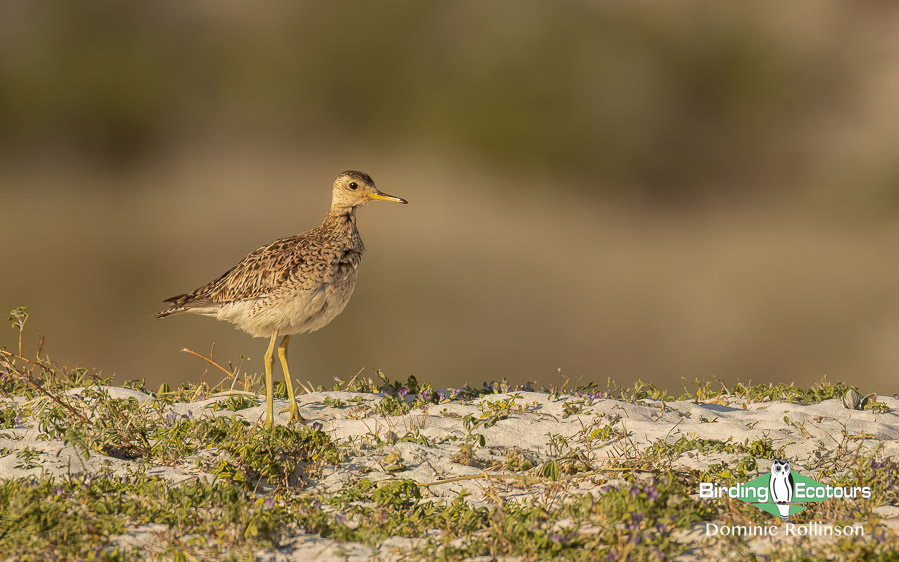
Upland Sandpiper at Cape Point stole the southern African birding headlines for 2025!
One of our guides, Dom, based in Cape Town, has had a busy month twitching many of the Cape’s rarities—mostly with his wife, Jaime. First up was a Caspian Plover at a salt works along the West Coast, near to the small town of Velddrif. This Palearctic wader is not considered a South African national rarity (although it certainly is rare in the Western Cape), as it is regularly recorded further north in the country. Unfortunately, the plover always kept its distance from us, however, we did get some good scope views, as it showed its dull cream-yellow legs, crisp supercilium and broad chest band.
After our early success with the plover, we headed back south and shifted our focus on a certain Gull-billed Tern (another South African national rarity) at the Bot River Estuary. After a grueling walk straight into the almost-gale-force southeaster, we eventually made it to the estuary mouth and started scanning through the tern roost and feeding terns. It took a while, but we eventually spotted the Gull-billed Tern flying in the distance and moved closer. After another walk along the edge of the estuary, we managed to find the tern in the big roost and got good looks at it. Comparing it to other terns nearby, such as Common and Sandwich Terns, it showed a heavy bill, dark eye patch (behind the eye) and very long, almost gull-like in length, legs.
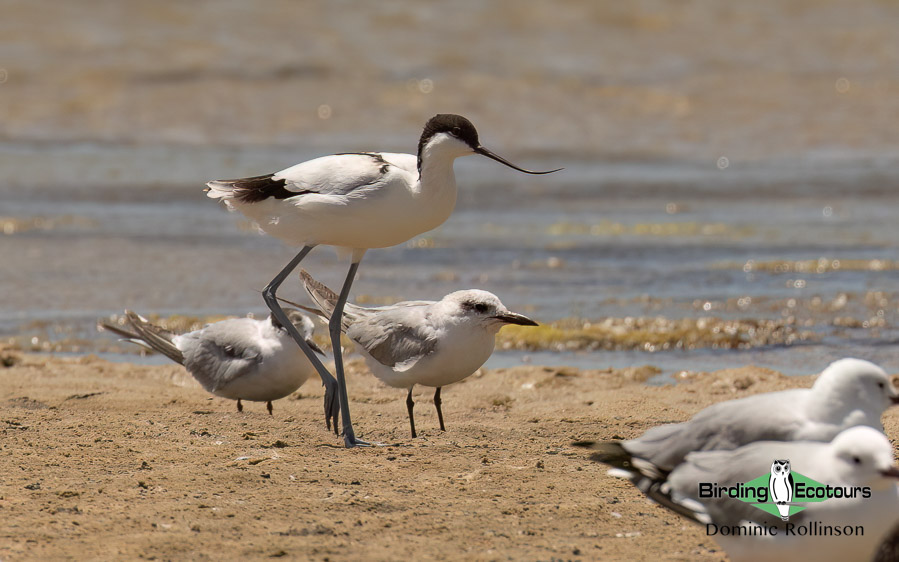
The heavy-billed and long-legged Gull-billed Tern at Bot River.
The following day, I planned to have a relaxed Sunday after a busy Saturday of twitching around the Cape. However, a Black-headed Gull in full breeding plumage was found just around the corner at Strandfontein Sewage Works which meant my lazy Sunday afternoon turned into a busy one. Upon arrival, the gull had moved off but was thankfully re-found and showed beautifully in the afternoon light. Black-headed Gulls are considered very rare in the southern African subregion with the previous record from Mossel Bay, Western Cape, (also in full breeding plumage) almost a year earlier, with very few other records over the past decade or so.
That next week, after a few days in the office, I was out twitching again, this time with some clients (Johnny and Caleb), and we managed good looks at the vagrant Baird’s Sandpiper which turned out to be Caleb’s 800th southern African species, making him the youngest southern African birder to reach this milestone! Baird’s Sandpiper breeds in the high latitudes of North America with its non-breeding range being in South America. It’s a rare, but regular, rarity this side of the Atlantic Ocean. We then twitched the Gull-billed Tern at Bot River which again showed nicely for us, but took some work to find!
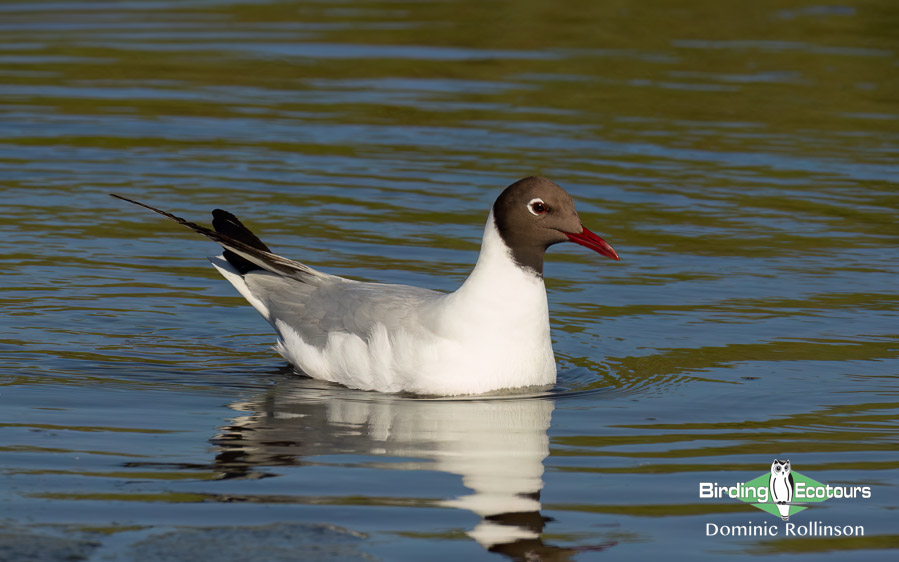
Strandfontein Sewage Works’ Black-headed Gull was in fine breeding plumage, unusual for this time of the year, perhaps because this individual has been lingering somewhere in the southern hemisphere?
That best was saved for the final day of the month when Cliff Dorse sent out the news that he’d found southern Africa’s first and mainland Africa’s third record of Upland Sandpiper. This bird has been on southern African birders’ radars for a long time and it was a well-deserved find for Cliff, who works the Cape of Good Hope Nature Reserve tirelessly in search of lost vagrant birds.
Jaime and I immediately shot down to the reserve and soon found the gathered crowd who got us onto the bird and we managed good, yet distant, scope views. The bird kept disappearing from view, and so eventually the large group of twitchers moved to the coast, where we improved our looks of this odd-looking wader. Interestingly, it did not feed along the shoreline but rather stuck to coastal grassland patches, behaving almost bustard-like as it fed on insects in the grass.
Not at all satisfied with my record shots, I headed back in the late afternoon and was thrilled to watch and photograph the bird in glorious late-afternoon light as it fed seemingly unperturbed by, but fully aware of, the small group of twitchers watching it. The local birdlife, however, did not take kindly to its presence, as it was routinely dive-bombed by Kittlitz’s and White-fronted Plovers, likely protecting nearby nests or chicks.
Upland Sandpiper has a similar distribution to Baird’s Sandpiper, with most of its population breeding in the Great Plains of North America, east of the Rocky Mountains, spending its non-breeding months in central South America. This species is a very rare, yet regular, vagrant to western Europe, e.g. to Iceland and Ireland, however, African records are few and far between, with the only two previous records coming from Mauritania and Morocco!
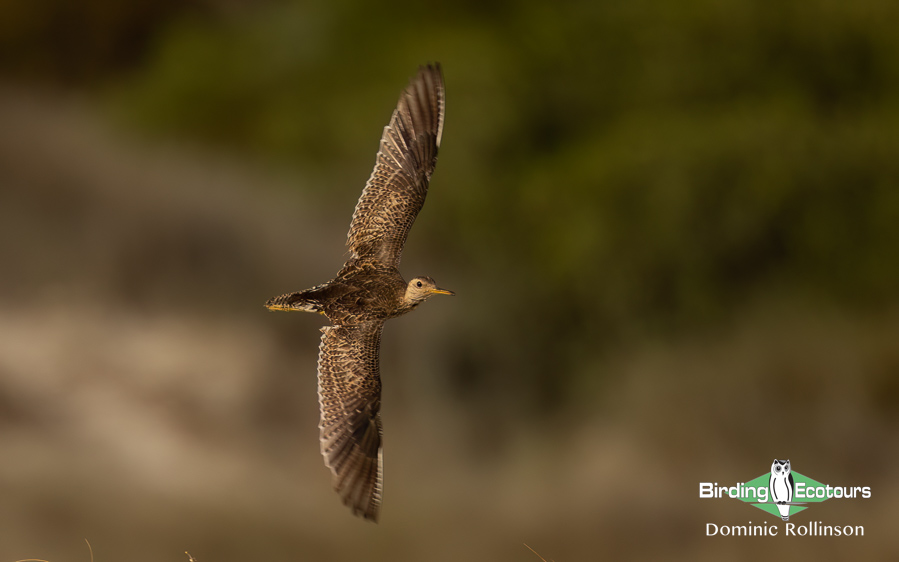
The strange-looking, small-headed, long-tailed Upland Sandpiper.
Over the next four days many of South Africa’s twitchers managed to connect with the bird, topping off a crazy month of Cape rarities – what will December have in store for us?!