- Duration:
- 5 days
- Group Size:
- 4–6
- Tour Start:
- Cape Town, South Africa
- Tour End:
- Cape Town, South Africa
Budget South Africa Birding Tour: Cape Town’s Fynbos Endemics
Details
2027
06–10 May
Per person sharing
R33,976 ZAR
$2,144 USD / £1,612 GBP / €1,927 EUR
Single supplement
R6,216 ZAR
$393 USD / £295 GBP / €353 EUR
2028
06–10 May
Per person sharing
R37,720 ZAR
$2,380 USD / £1,789 GBP / €2,139 EUR
Single supplement
R6,900 ZAR
$436 USD / £328 GBP / €392 EUR
Itinerary
Budget South Africa Birding Tour: Cape Town’s Fynbos Endemics
South Africa’s southwestern Cape is an endemic-rich, scenically spectacular region of this incredibly diverse country. Excellent infrastructure and accommodation, friendly people, abundant access to reserves and parks, and great value for money make South Africa an obvious destination for travelers. Couple this with exceptionally high levels of endemism, particularly in the Cape, and a large active birding community, and it becomes a must-visit destination for world listers and causal birders wishing to explore this unique corner of Africa.
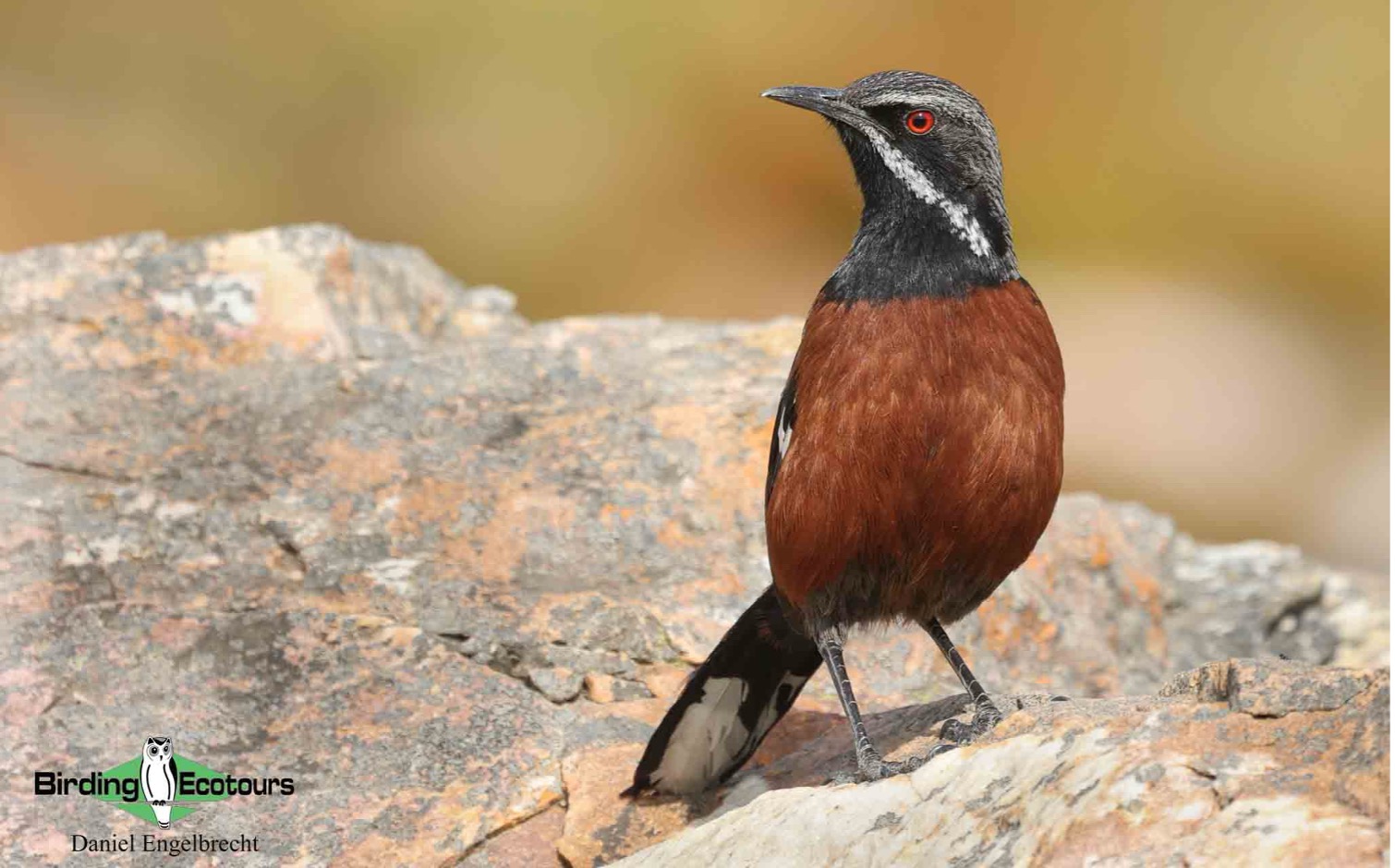
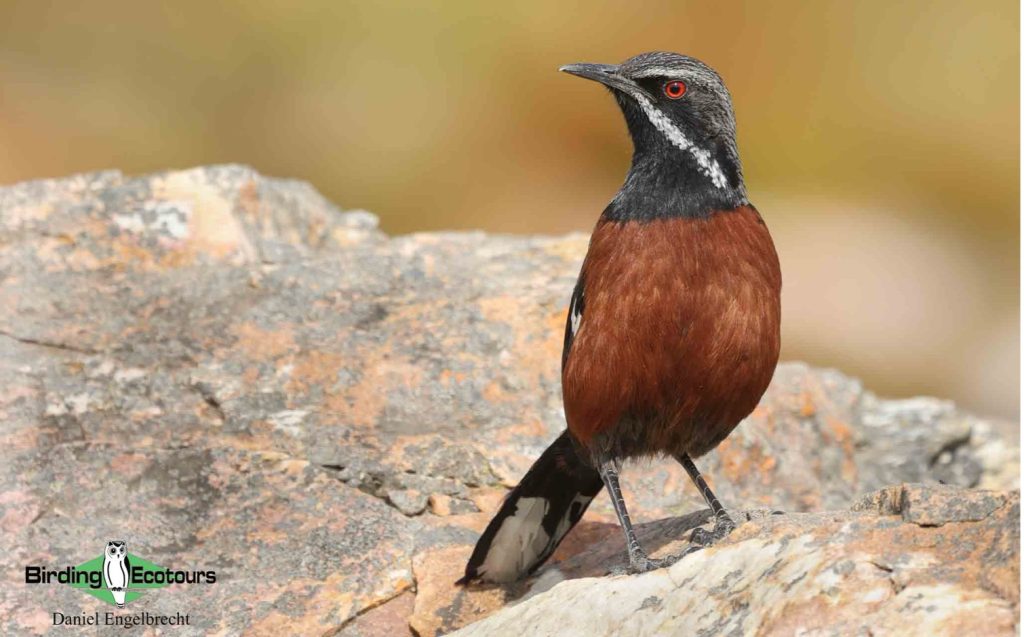 Cape Rockjumper is one of our primary targets on this tour.
This budget tour focuses on the endemic and near-endemic species of the greater Cape Town area. In the interest of keeping costs down on this tour, we stay in a comfortable and reasonably priced hotel on the outskirts of Cape Town – frequently rated among the best cities in the world. We will explore the botanically diverse fynbos habitats in search of iconic birds, including Cape Rockjumper, Cape Sugarbird, Victorin’s Warbler, Protea Canary, Ground Woodpecker, and Orange-breasted Sunbird. The rich waters of the Atlantic Ocean provide food for several range-restricted coastal species, like the Critically Endangered (BirdLife International) African Penguin and Endangered (BirdLife International) Bank Cormorant, both of which we target at their breeding colonies.
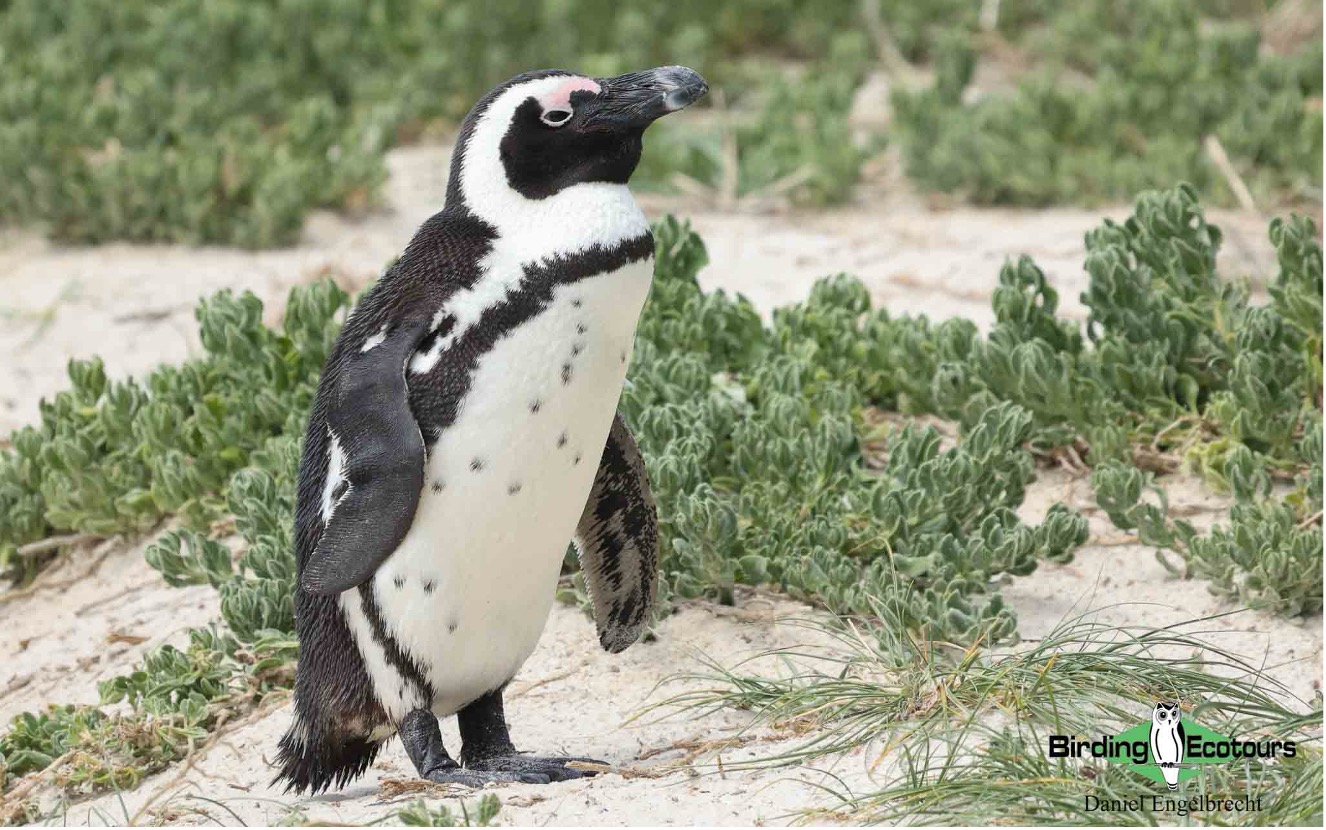
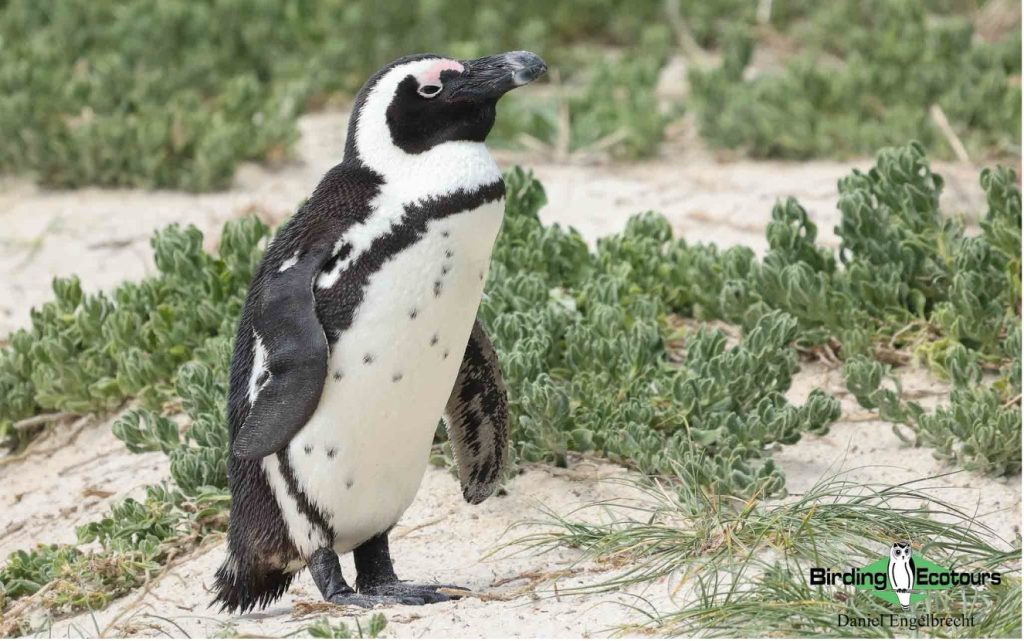 We will see the Critically Endangered African Penguins at one of the few mainland breeding colonies at Stony Point.
We also visit South Africa’s West Coast and its strandveld (translated to “beach scrub”) habitats, where we target special birds like Black Harrier, Grey-winged Francolin, Cape Clapper, Cape Long-billed and Karoo Larks, and Southern Black Korhaan, among others. The birding along the forested slopes of the famous Table Mountain can produce jewels like the endemic Forest Canary and secretive Lemon Dove, and we look forward to our time birding the fantastic Kirstenbosch Botanical Gardens.
This tour serves as an excellent introduction to South African birding around famous Cape Town and Table Mountain, at a cost-conscious rate, and forms part of our “Budget South African Birding Tour” offerings. It can easily be combined with our preceding Budget South African Birding Tour: Northern Cape’s Desert Endemics, while our Budget South African Birding Tour: Zululand and Budget South African Birding Tour: The North follow directly afterward.
Detailed Itinerary (5 days/4 nights)
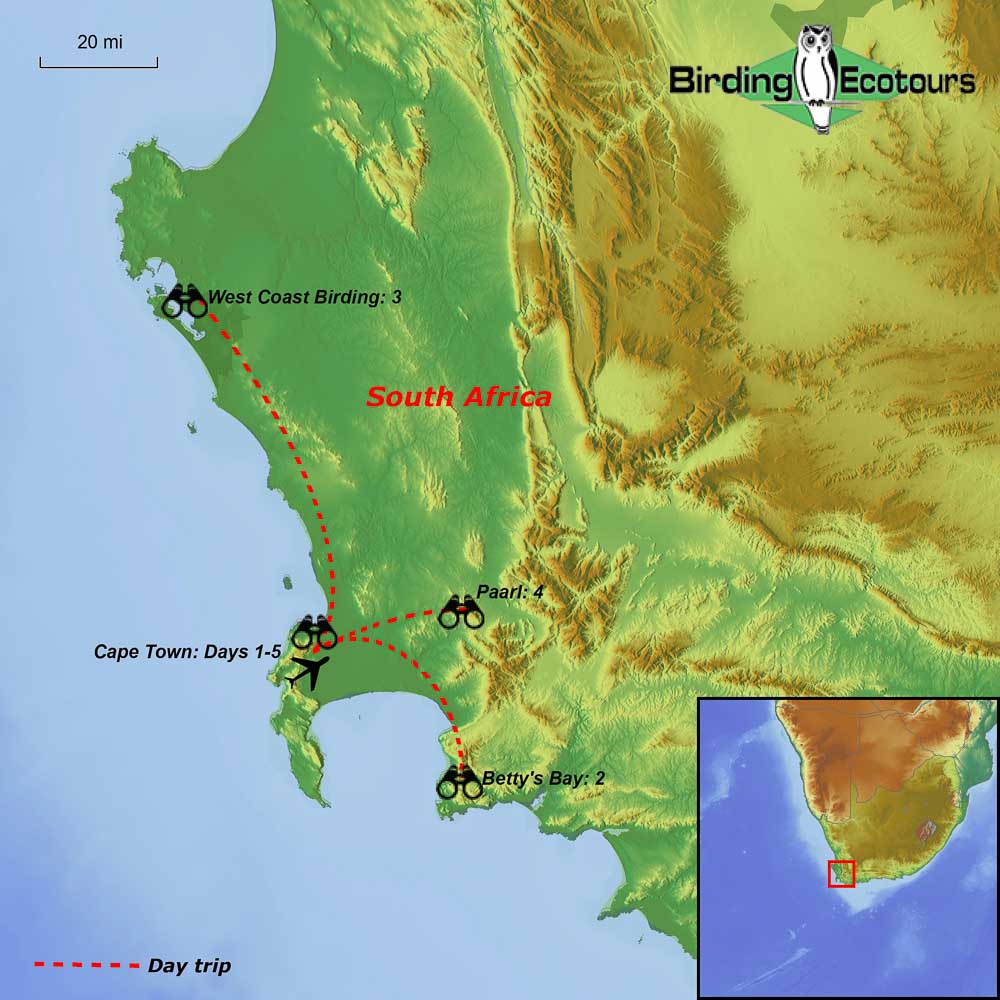
Day 1. Arrival in Cape Town
You are free to arrive at any time today, with hotel check-in from 2 p.m. Upon arrival in Cape Town, you will be met at Cape Town International Airport and transferred to your comfortable hotel on the outskirts of this beautiful city. Should you be arriving from our preceding Budget South African Birding Tour: Northern Cape’s Desert Endemics, kindly note that tour ends the previous day (yesterday), to allow for a smoother (less rushed) arrival into Cape Town for this tour.
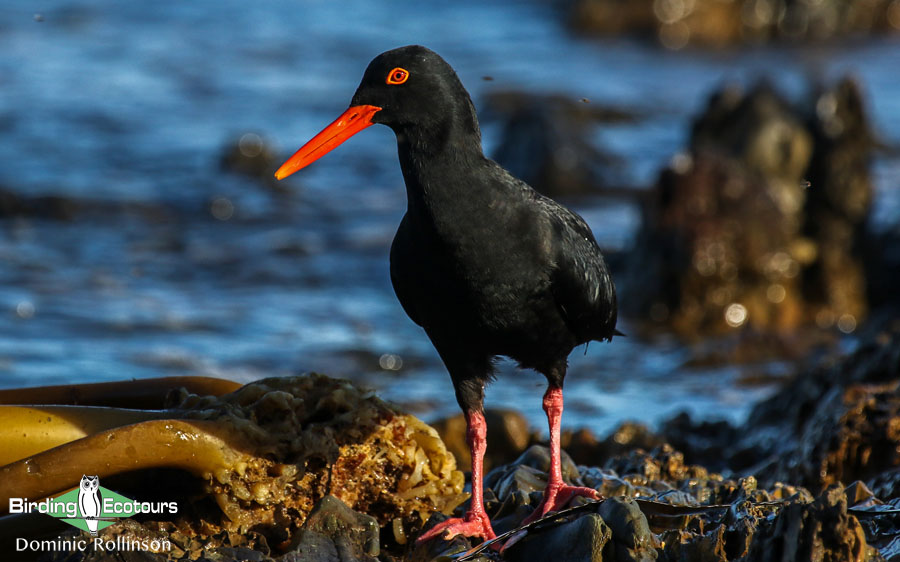
Time permitting, we may start birding this afternoon and will either begin on the forested slopes of Table Mountain or at one of the wetland reserves in the area. We should kick off our lists with species typical of the southwestern Cape, including Cape White-eye, Cape Spurfowl, Cape Robin-Chat, Southern Double-collared Sunbird, Southern Boubou, Cape Canary, Cape Bulbul, Karoo Prinia, and many more. Wetlands in the area may yield Greater and Lesser Flamingos, Great White Pelican, Cape Shoveler, Cape Teal, Southern Pochard, Maccoa Duck, and African Marsh Harrier. Hartlaub’s Gull and African Oystercatcher are a regular feature of the coastal habitats here, and we could have our first encounters with both species today.
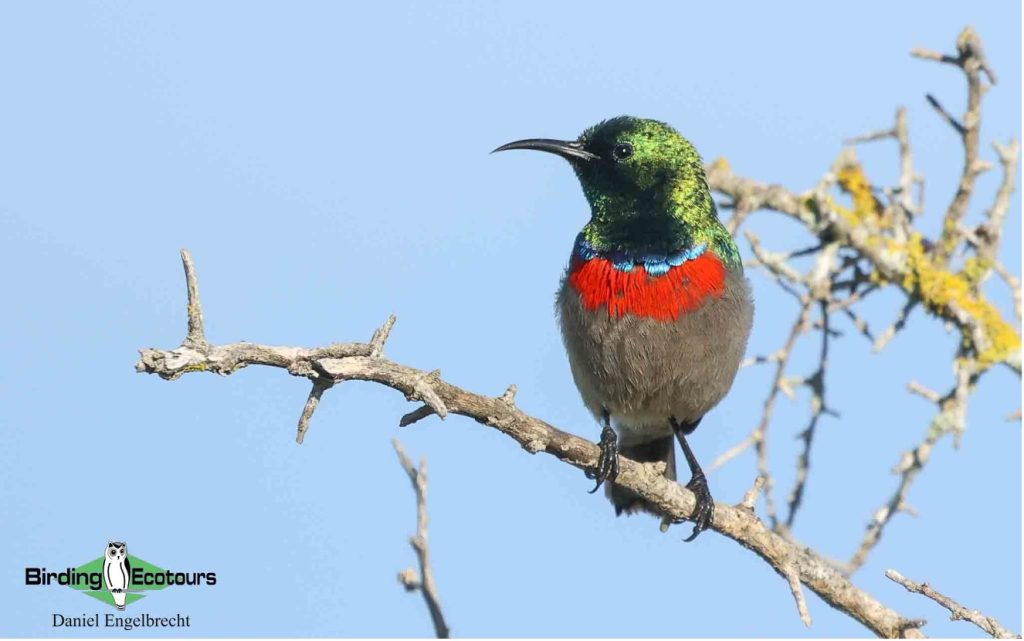 The attractive Southern Double-collared Sunbird is widespread on this tour!
In the evening, we will return to our hotel, enjoy our first dinner together, and prepare for an exciting day chasing several fynbos endemic species tomorrow.
Overnight: Cape Town
Day 2. Birding Rooi-Els and Betty’s Bay
We will have an early start today, making our way towards the Hottentots Holland Mountains along the eastern side of False Bay. The drive to our first birding spot takes us along a spectacular ocean drive, where towering sandstone mountains clad in scrubby fynbos vegetation meet the Atlantic Ocean.
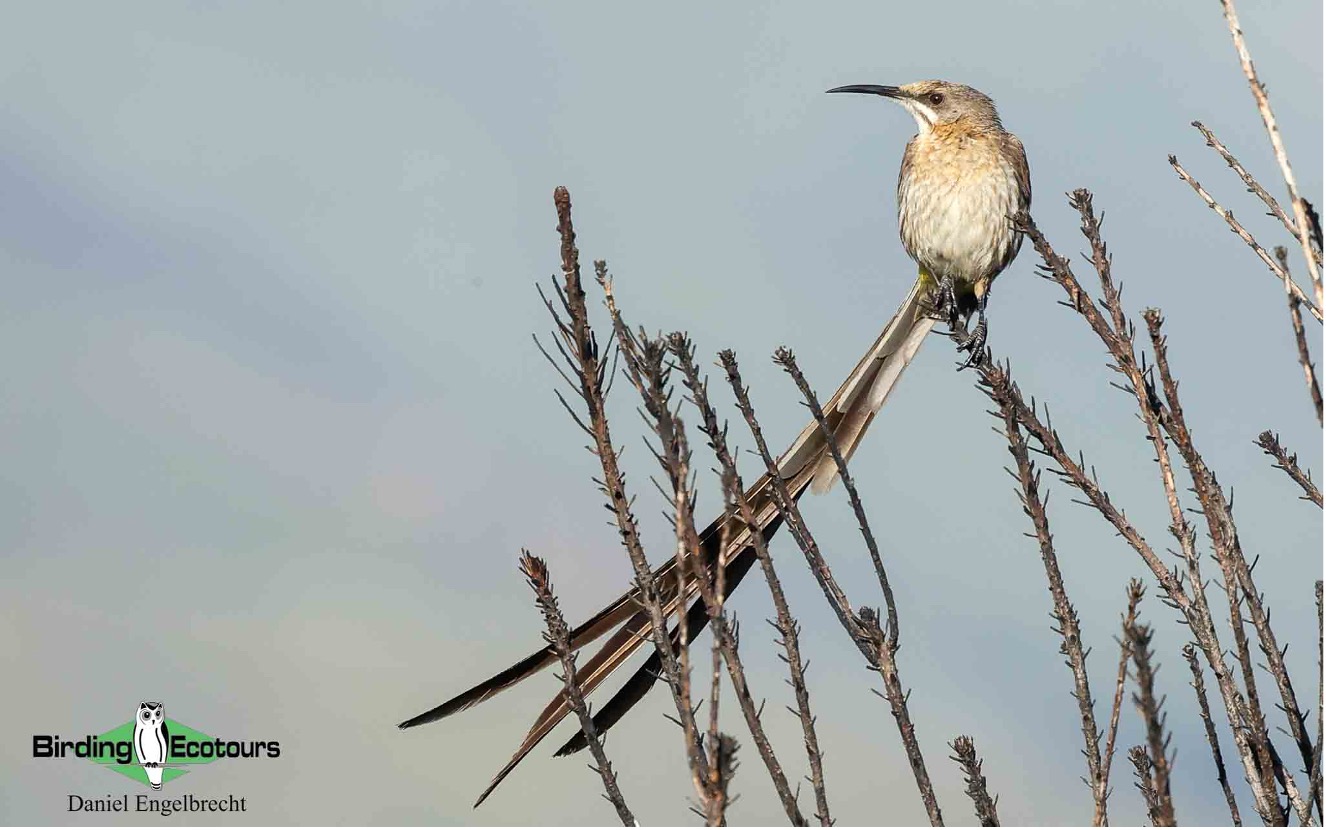
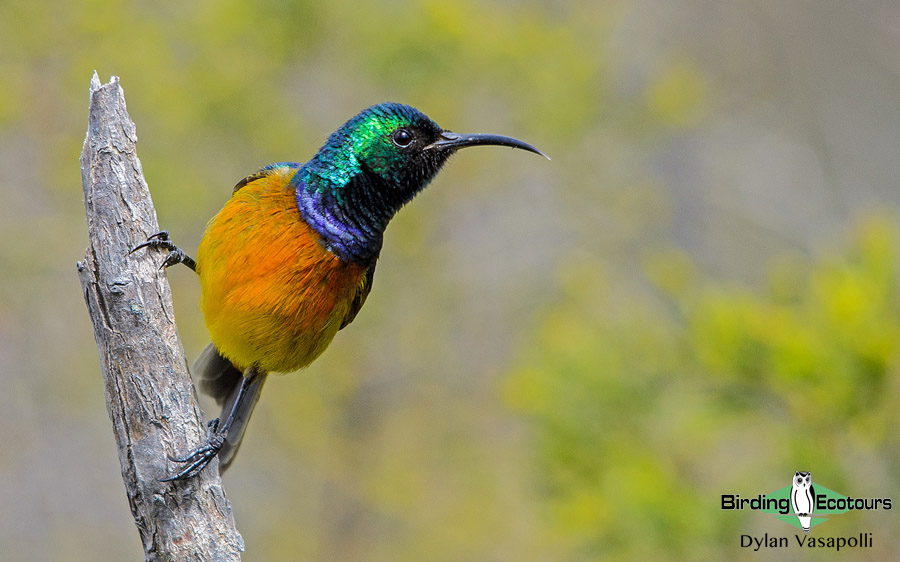
We will bird along a dirt track on the outskirts of the picturesque coastal town of Rooi-Els, where we should connect with our first fynbos endemics, such as the gorgeous Orange-breasted Sunbird, Cape Siskin, Cape Sugarbird, and our primary target, the characterful Cape Rockjumper. Both the rockjumper and sugarbird are members of families endemic to Southern Africa. Their respective eastern counterparts, Drakensberg Rockjumper and Gurney’s Sugarbird, are best seen on our Subtropical South Africa Birding Tour: Comprehensive Eastern South Africa. Other birds worth looking out for here include Cape Rock Thrush, Cape Grassbird, Grey-backed Cisticola, Cape Bunting, and the large Ground Woodpecker. We may also hear the repetitive song of Victorin’s Warbler coming from the higher slopes, but it is tricky to see here, and we will try for views at our next stop.
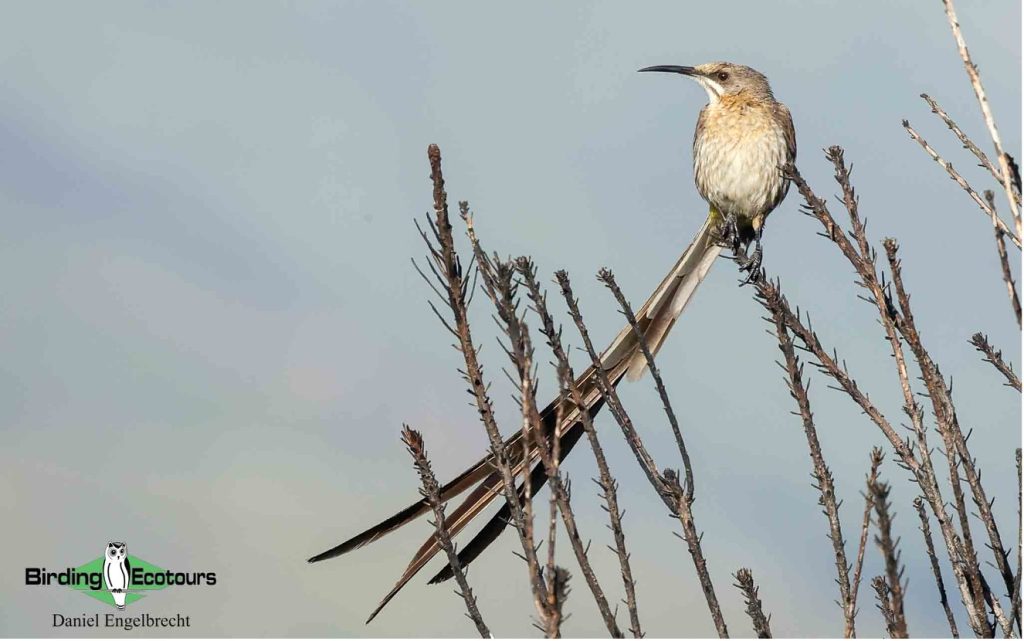 We should see Cape Sugarbird on most days of this trip!
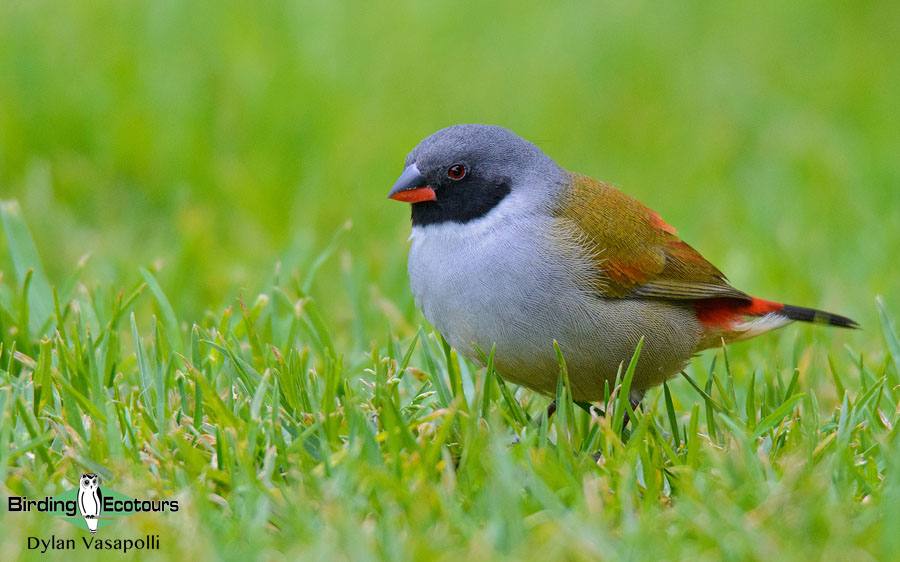
From Rooi-Els, we will head to the small town of Betty’s Bay. First, we will visit Harold Porter Botanical Gardens, where we may see the attractive Swee Waxbill, African Paradise, African Dusky and Blue-mantled Crested Flycatchers, Brimstone Canary, Black Saw-wing, and Victorin’s Warbler, in addition to many other species characteristic of the southwestern Cape. We will pop in at Stony Point Nature Reserve, famous for its African Penguin colony. These Critically Endangered birds (BirdLife International) have experienced a 97% decline in population size; however, recent conservation efforts are a hopeful step in the right direction for this iconic species. The reserve also has large numbers of breeding cormorants, and we should see Great, Crowned, Cape, and Endangered (BirdLife International) Bank Cormorants with their bizarre bi-colored eyes.
On our way back to Cape Town, we will stop for an afternoon birding session at Paardevlei or Strandfontein Bird Sanctuary, the latter one of the most popular birding sites in the city and a rarity hotspot. We will spend some time driving around the pans and reedbeds here, hoping to connect with a variety of waterfowl, including Cape Teal, Southern Pochard, Fulvous Whistling Duck, Cape Shoveler, and Maccoa Duck, among several other species. The reedbeds here hold skulkers like Lesser Swamp and Little Rush Warblers, as well as the colorful Malachite Kingfisher. Depending on the water levels in the pans, we may be in for some exciting wader-watching or tern roost scanning.
After a busy first full day, we will return to our hotel with the prospect of West Coast specials tomorrow.
Overnight: Cape Town
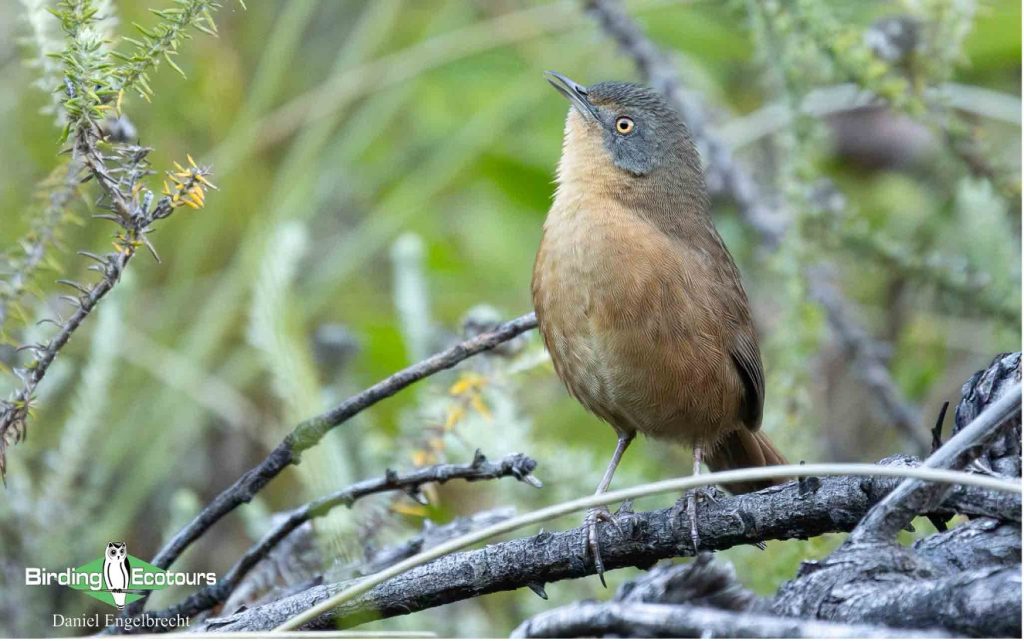 Victorin’s Warbler is a super-skulker that requires patience to see well.
Day 3. Birding West Coast National Park and surrounds
Today, we will make our way north of Cape Town, along the West Coast. The habitat here superficially resembles the scrubby fynbos vegetation from yesterday; however, the strandveld (translated as “beach scrub”) is botanically very distinct and grows on white-dune sands. The avifaunal complex is different too, and at our first stop, we hope to connect with Grey-winged Francolin, Cape Clapper Lark, Karoo Scrub Robin, Chestnut-vented and Layard’s Warblers, Bokmakierie, Grey Tit, White-backed Mousebird, Long-billed Crombec, Cape Penduline Tit, White-throated Canary, and more.
As we continue our drive north toward West Coast National Park, we will keep a constant lookout for the most-wanted Black Harrier, which is fairly common in this area and could show up anywhere today. Upon arrival in the park, we will explore the strandveld habitat further, which is likely to yield many of the same species seen at our first stop, as well as the Southern Black Korhaan. This impressive park includes a large area of the Langebaan Lagoon, and its azure blue waters and mudflats attract remarkable numbers of shorebirds every summer. Though the bulk of these birds would have begun their migration to their Northern Hemisphere breeding ground by now, there are usually still some birds around. We will need to pay careful attention to the tides to maximise our chances. Scanning from the park’s hides could produce the likes of Curlew Sandpiper, Ruddy Turnstone, Bar-tailed Godwit, Sanderling, Little Stint, Eurasian Whimbrel, Grey, Common Ringed, White-fronted, Three-banded and Kittlitz’s Plovers, and Common Greenshank. Other slightly less frequent visitors that we will keep an eye out for include Terek Sandpiper. The reedbeds around the edges of the lagoon hold African Rail, and we often see African Marsh Harrier, Osprey, and African Fish Eagle flying overhead. The eucalyptus trees near Geelbek hide are usually quite birdy, and we may see Cardinal Woodpecker and Common Hoopoe.
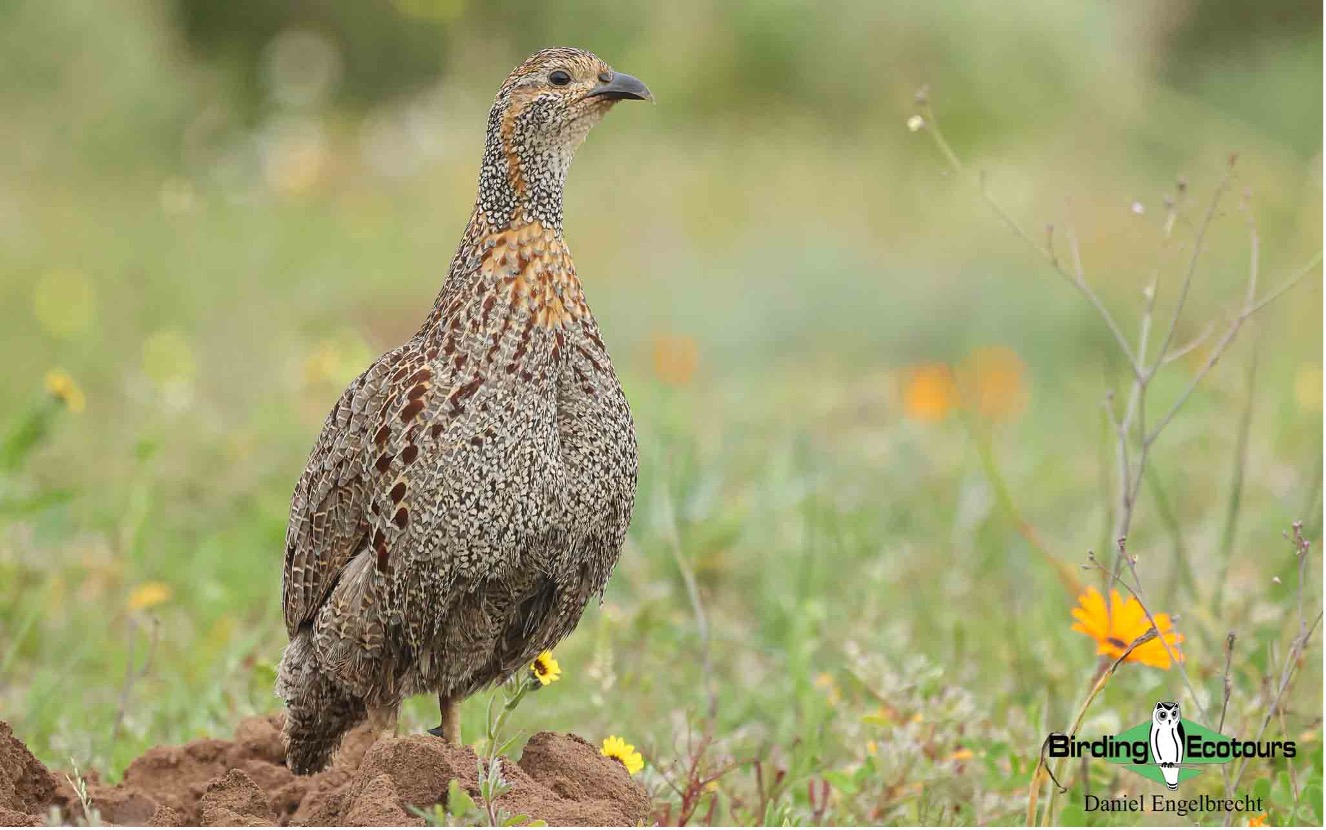
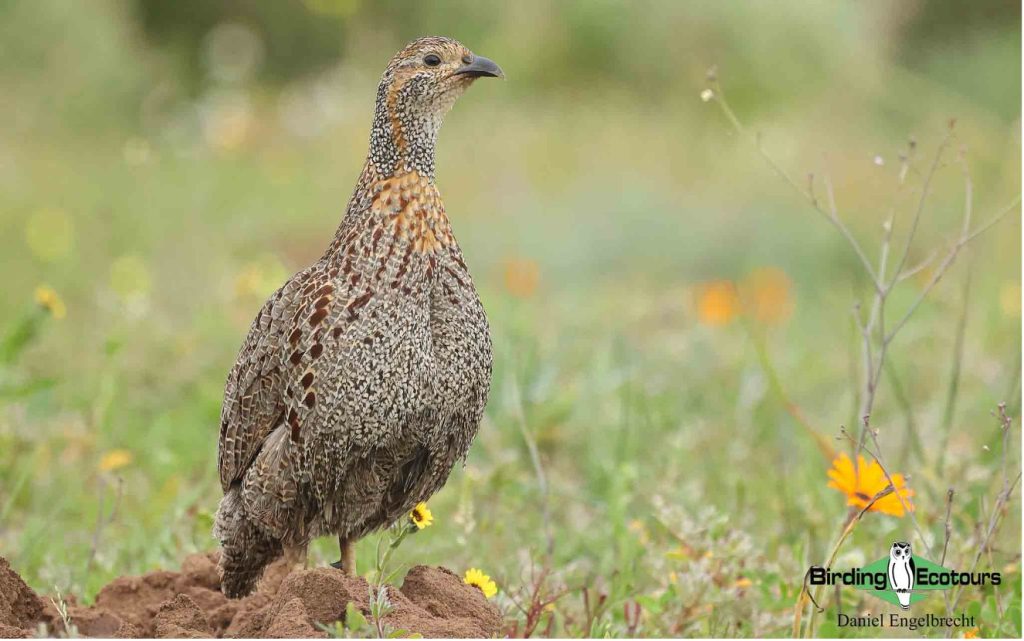 The intricately patterned Grey-winged Francolin is one of our targets on the West Coast.
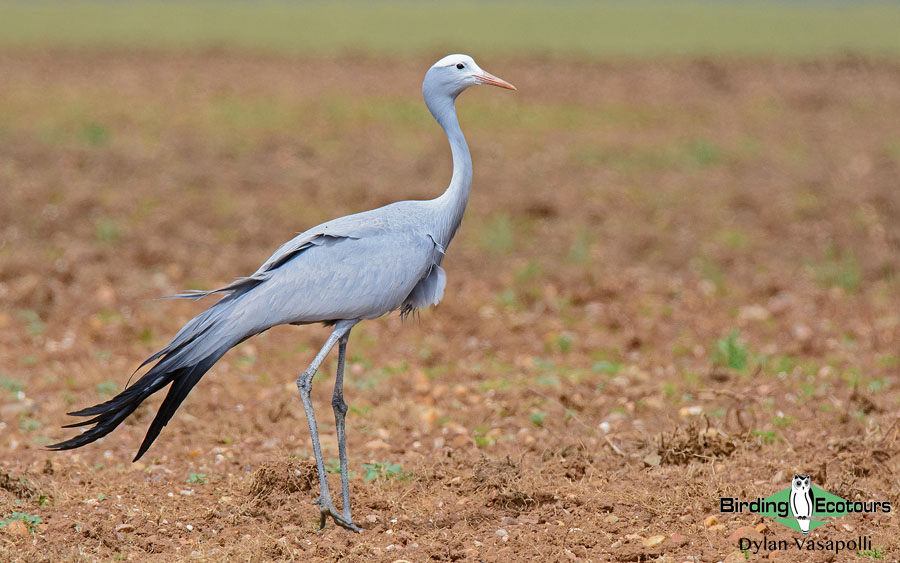
We will leave West Coast National Park and visit a quarry in the town of Langebaan, where a pair of the impressive Verreaux’s Eagles breed. The farmlands north of Langebaan are next on the agenda, and we hope to connect with Blue Crane, Cape Long-billed, Large-billed and Karoo Larks, Sickle-winged Chat, Cape Longclaw, Pied Starling, the Cape subspecies of Cloud Cisticola, and the abundant Capped Wheatear.
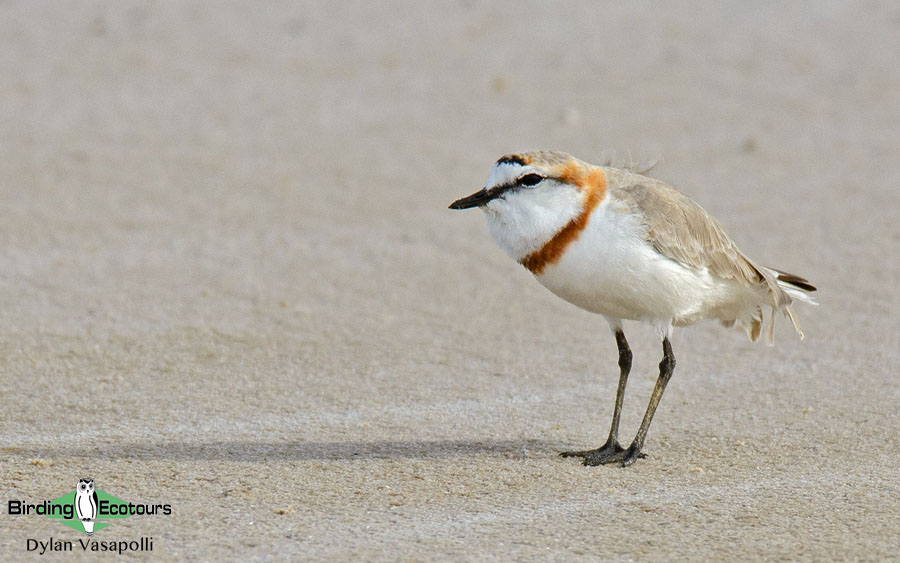
After lunch, we will visit the salt works near the town of Velddrif. Lesser and Greater Flamingos are abundant here, as are the saltpan specialist Chestnut-banded Plovers. Kilphoek Salt Works is also the only reliable site in southern Africa for Red-necked Phalarope, and there is almost always at least one bird here.
We will then slowly make our way back to our hotel in Cape Town after an action-packed day out.
Overnight: Cape Town
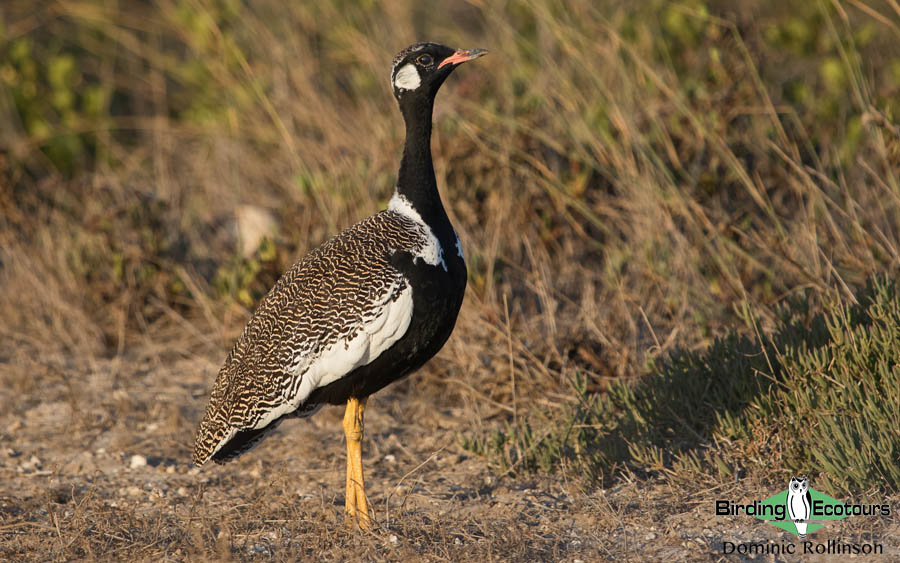
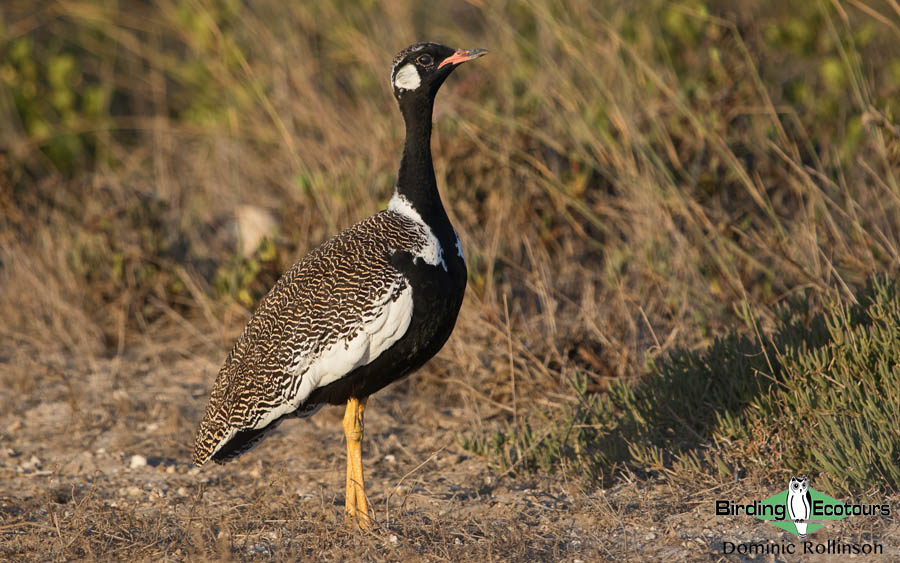 We will look for Southern Black Korhaan on the West Coast.
Day 4. Paarl and Table Mountain birding
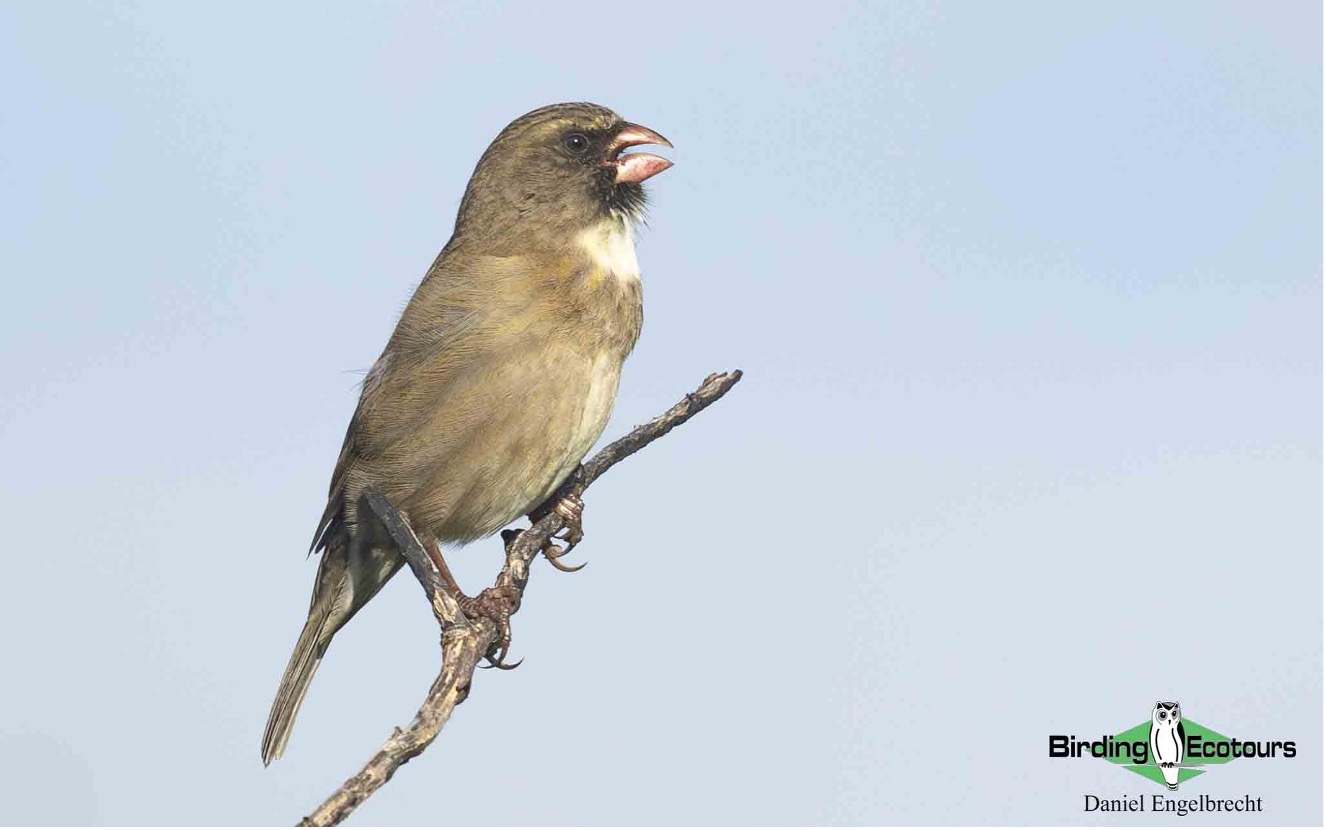
Our plan today is to target one of the trickier fynbos endemic species near the town of Paarl, located in the Cape’s famous and picturesque winelands. The target species in question is Protea Canary, and we will search for it on Paarl Mountain and the surrounding Hottentots Holland range. The Protea flowers here are likely to produce more views of Cape Sugarbird and sunbirds like Southern Double-collared, Malachite, and Orange-breasted Sunbird. This is also a good area for the inconspicuous Brown-backed Honeybird and other more common species like African Olive Pigeon, African Goshawk, Cape Batis, Olive Thrush, Streaky-headed Seedeater, Fiscal Flycatcher, and Bar-throated Apalis.
After our time in Paarl, we will make our way in the direction of Cape Town, stopping at the spectacular Kirstenbosch Botanical Gardens on the slopes of Table Mountain. We will spend some time strolling around these wonderful gardens, where we will try to see Forest Canary, Olive Woodpecker, Lemon Dove, Swee Waxbill, Southern Boubou, and several of the species mentioned earlier in the itinerary.
Overnight: Cape Town
Day 5. Departure
The tour comes to an end after breakfast, and no birding plans are included for the day. You are free to depart at any time today.
This tour links up with our Budget South African Birding Tour: Zululand, which follows directly afterwards and starts today. For participants joining this tour, the group will fly up to Durban in the morning to begin this tour (kindly note that we will advise and assist with booking the domestic flight connecting these tours).
Overnight: Not included
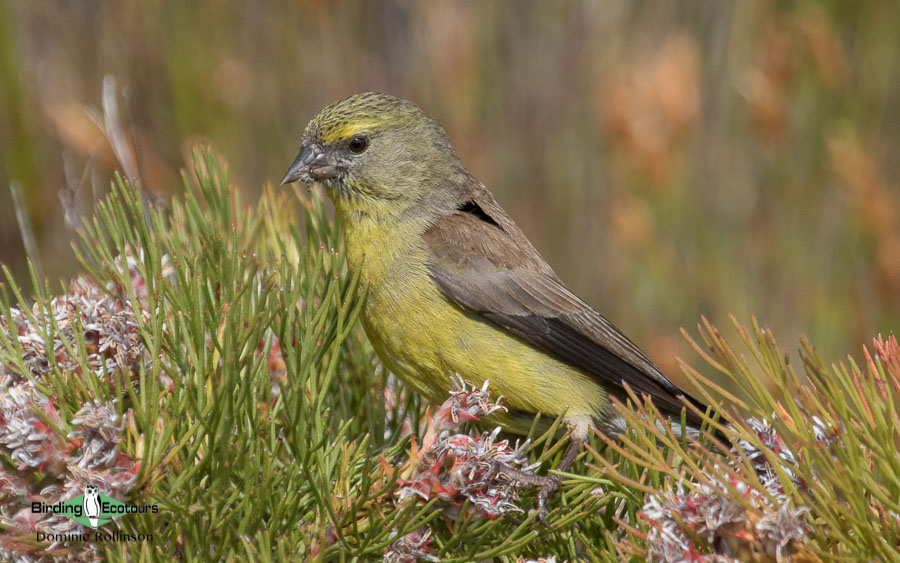
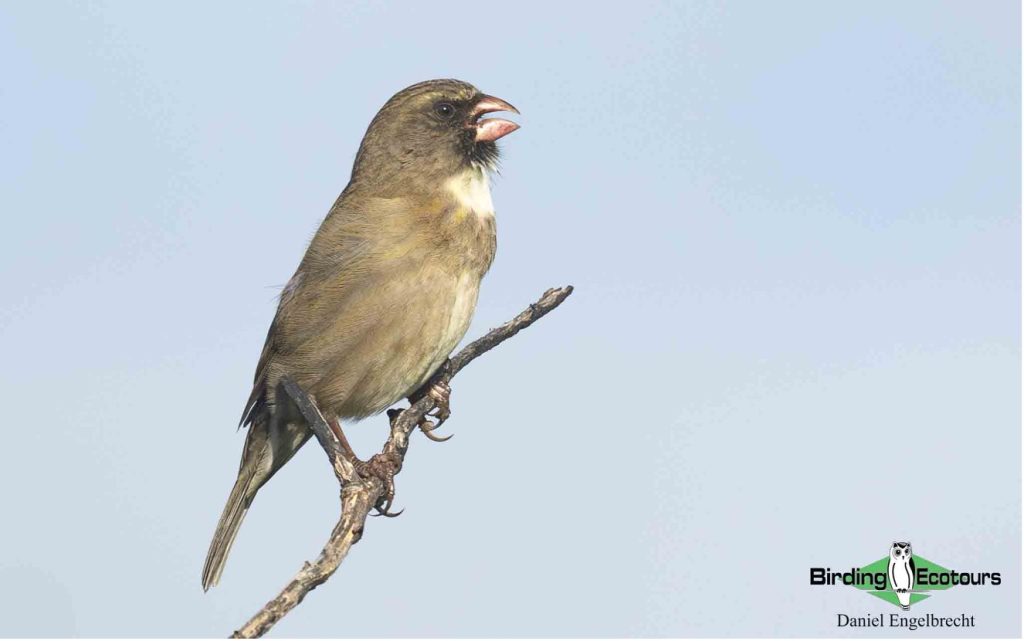 Protea Canary is one of the trickier fynbos endemics.
Please note that the itinerary cannot be guaranteed as it is only a rough guide and can be changed (usually slightly) due to factors such as availability of accommodation, updated information on the state of accommodation, roads, or birding sites, the discretion of the guides, and other factors. In addition, we sometimes have to use a different guide from the one advertised due to tour scheduling or other factors.
Map
Trip Report
Testimonials
Gallery
General Information
BUDGET SOUTH AFRICA: CAPE TOWN’S FYNBOS ENDEMICS
TOUR-SPECIFIC INFORMATION
GENERAL INFORMATION ABOUT SOUTH AFRICA CAN BE READ HERE
TOUR OUTLINE
This short Cape birding tour is designed to provide an excellent introduction to the Cape while giving you a good chance of seeing several of the region’s endemic bird species.
The tour is based in Cape Town, and we will stay in the same hotel for all four nights of the tour, with three full-day trips to be undertaken from Cape Town. This tour is one of four linked itineraries that together form a 26-day mega South African budget tour. The tour preceding this one is the Budget South Africa Birding Tour: Northern Cape, followed after this Cape tour by the Budget South Africa Birding Tour: Zululand Specials, and finally the Budget South Africa Birding Tour: The North. Each tour stands alone, but combined they offer an unrivalled budget birding journey across the full breadth of South Africa.
PACE OF TOUR
Although this is a short tour, we pack a great deal into the itinerary, which can result in some fairly long fast-paced days in the field. On most of the days we will leave our accommodation early and only return late in the afternoon, although on one of the days we may ensure some down-time. Overall, this is a fast-paced tour.
To take advantage of the early morning peak in bird activity, we will often leave the accommodation with simple (but adequate) breakfast packs. Similarly, lunches will often involve lunch packs, or simpler sandwiches/wraps, which we eat while out birding (usually enjoying a picnic lunch) so as not to waste large amounts of time during the day. However, we can enjoy a sit-down meal where time allows. Although these meals may be simpler, we will always ensure you are well fed so that you do not go hungry. Dinners will, of course, be sit-down meals and are generally of a very good standard in the Cape, where we eat out at restaurants or the hotel’s restaurant-style kitchen.
It is possible to opt out of some activities; however, we generally head out for the entire day each morning, therefore, opting out would mean missing the day’s birding altogether.
The guide discusses the daily plan with the group in detail each evening. Note that we do retain a sense of flexibility, within reason, to allow for us to maximize your birding experience.
WALKING AND STYLE OF BIRDING
The tour is generally considered ‘easy’ in terms of physical exertion. It does not involve a great deal of walking, and any walks that we do are generally less than a mile (1.6 kilometers), and under two hours.
- The walks are never very strenuous, although we might have to walk on uneven terrain when looking for Cape Rockjumpers near Betty’s Bay.
- While birding in West Coast National Park we generally bird from the vehicle, although we can get out of the vehicle for short walks when opportunities arise.
- In the Cape the vegetation is often very spiky and so long trousers are recommended to protect your legs from cuts and scrapes.
LENGTH OF DRIVES
We stay in the same accommodation for all four nights. This means we drive out to different areas outside the city of Cape Town. We normally aim to leave early to beat the Cape Town traffic.
The drives are generally all under 2.5 hours. The longest drive is the return journey from Velddrif after a day of birding on the West Coast which is normally just over two hours.
SAFETY
Although this tour is spent in the greater Cape Town area (where safety is an issue in certain areas), we stay in safe suburbs where you do not generally need to worry about your personal safety. While out birding, we may visit some areas which are less safe than others, however, we will be mostly vehicle-based in these areas, and you should not need to worry about your personal safety. We recommend not leaving personal items of value in the vehicle while it is unattended, if you’re ever in doubt, please check with the tour leader.
HEALTH, PESTS AND DANGEROUS ANIMALS
There is no risk of malaria on this tour, as it is absent from this part of the country, however, there may still be mosquitoes around which are more of an annoyance than a health concern. In some areas that we may walk, there could be ticks around, and so it is mostly recommended to wear long trousers and check yourself for ticks after a day out in the field. There is no risk of Lyme Disease in South Africa, however, African tick-bite fever is possible, though it is generally much less severe than other tick-borne diseases.
*Note that dangerous and venomous snakes and scorpions are possible, and this point is discussed in greater detail under the “South Africa General Information” document.
TRANSPORTATION
Depending on the final group size, we will likely use a 14-seater minibus on this Cape birding tour, ensuring everyone has a window seat throughout the tour. Air-conditioning is available in our tour vehicles. We will follow a seat-rotation policy every day to ensure fair viewing opportunities to everyone throughout the tour (your guide will explain further at the start of the tour).
We will provide airport transfers to participants on the first and final days of the tour, which are included in the tour cost. Should you arrive in South Africa earlier than that or prolong your stay in South Africa after the tour, those transfers would be at your own expense. We will, however, help arrange transfers wherever they may be needed.
DOMESTIC FLIGHTS
There are no domestic flights on this Cape birding tour, although you would need to catch a domestic flight, should you be joining another linked South African budget tour which immediately follows this tour. These flights are not included in the tour cost. It is also advised to be in touch with your tour leader before you book this flight.
ACCOMMODATION
The accommodation on this tour (as with all our South African tours) is of a good standard. It is worth noting that buildings in South Africa are often not heated like they are in North America, Europe, etc., and so for colder evenings it may be worth packing warmer sleeping clothes.
It is possible to get laundry washed at the hotel used on this tour, provided they have a minimum of one-day lead time.
ELECTRICITY
There should not be any issues with electricity at the lodge in Cape Town. However, being a South African city, power outages may occasionally occur. Many establishments do have generators for these situations.
It is good practice to bring international adapters, as many establishments are changing their plug outlets to better align with international clients, and this is an aspect we do not have direct control over.
WEATHER
Many people are surprised how cold the Cape can be. It is possible that a cold front could pass through during our tour which might mean a few days of cold (and wet) weather. For this reason, it is recommended that you bring along a rain jacket and something to cover your gear. The wind can also be very strong at times which can make things unpleasant. We therefore recommend bringing adequate cold-weather clothing for this Cape birding tour. Conversely, the weather can also be wonderful at this time of year, although most conditions normally require long pants and a light jersey, as opposed to shorts and t-shirts.
Accommodations are often not heated like they are in North America, Europe, etc., and so warm sleeping clothes are advisable. Kindly be prepared for all kinds of weather, from cold to hot. It is also advisable to pack a buff/neck scarf to help protect you from dust while exploring certain areas on the West Coast.
Despite the generally cooler temperatures on this tour, the sun in the Cape can be intense and so we recommend the frequent application of sunscreen, particularly when out on the West Coast.
WHAT TO BRING
Please see our blog on ‘What to bring on a birding tour’ which will help you pack for this Cape birding tour.
Download Cape Town’s Fynbos Endemics Tour-Specific Information