- Duration:
- 9 days
- Group Size:
- 4–6
- Tour Start:
- Johannesburg, South Africa
- Tour End:
- Johannesburg, South Africa
Budget South Africa Birding Tour: The North
Details
2027
17–25 May
Per person sharing
R59,400 ZAR
$3,752 USD / £2,817 GBP / €3,368 EUR
Single supplement
R13,800 ZAR
$872 USD / £654 GBP / €782 EUR
2028
17–25 May
Per person sharing
R65,870 ZAR
$4,160 USD / £3,124 GBP / €3,735 EUR
Single supplement
R15,310 ZAR
$967 USD / £727 GBP / €868 EUR
Itinerary
Budget South Africa Birding Tour: The North
South Africa is one of the premier birding destinations on the African continent. The ease of travel, excellent infrastructure, welcoming people, wealth of birding-related information, affordability, and abundant access to reserves and national parks make South Africa a must-visit destination for any global birder. Over 850 species have been recorded in South Africa, and no fewer than 38 are endemic to the country (some are shared with South Africa’s two smallest neighbors, Swaziland and Lesotho). The highest levels of endemism are found in the fynbos and Karoo habitats of the Cape provinces, as well as in the country’s high-altitude grasslands on its central plateau. In contrast, the subtropical northern provinces are the most species-diverse regions of the country.
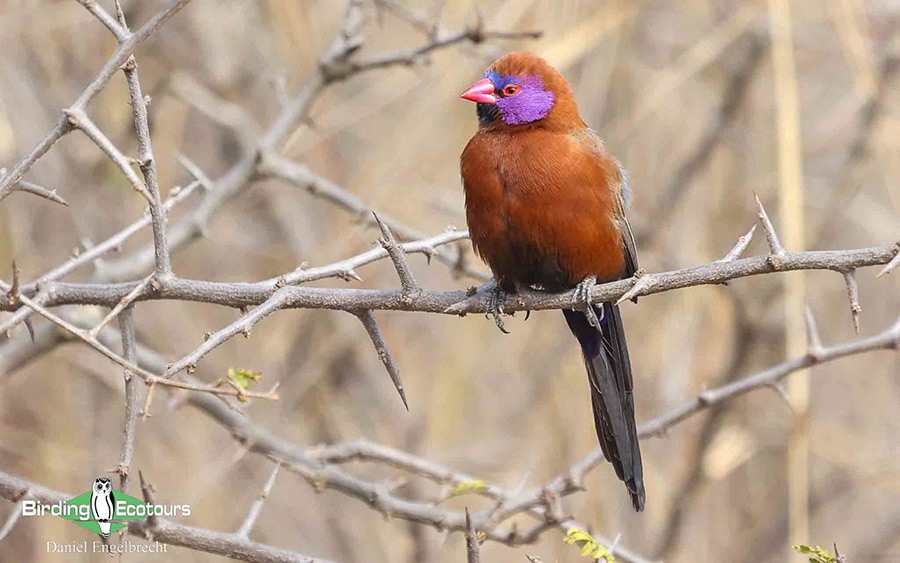
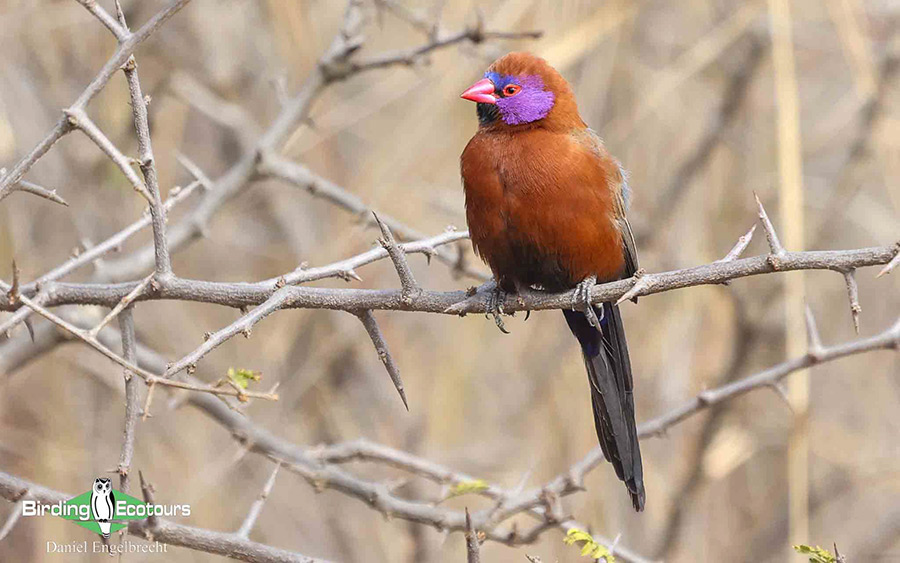 The stunning Violet-eared Waxbill should be seen on the first few days of this tour.
This is the final tour of our budget tour series, which also includes other critical parts of the country; the Northern Cape, Cape Town, and Zululand. This budget South African birding tour focuses on the avian-rich Limpopo and Mpumalanga Provinces, located in the northeast of the country. To keep costs down on this tour, we do not stay in the high-end accommodation typical of our other South African birding tours. Instead, we stay in comfortable, cost-conscious accommodation throughout the tour.
A variety of diverse habitats, including Polokwane Plateau bushveld, montane grassland, Afrotemperate forest, subtropical thicket, Mopani and riverine woodlands, and several types of mixed woodlands, each with their respective avian assemblages, contribute to the impressive array of species on offer on this tour. Over the course of this nine-day tour, we may see close to 400 species with highlights including Short-clawed Lark, Crimson-breasted Shrike, Gurney’s Sugarbird, Buff-streaked Chat, Cape Parrot, Black-fronted Bushshrike, Magpie Mannikin, Bat Hawk, Gorgeous Bushshrike, Blue Crane, Southern Bald Ibis, and so much more!
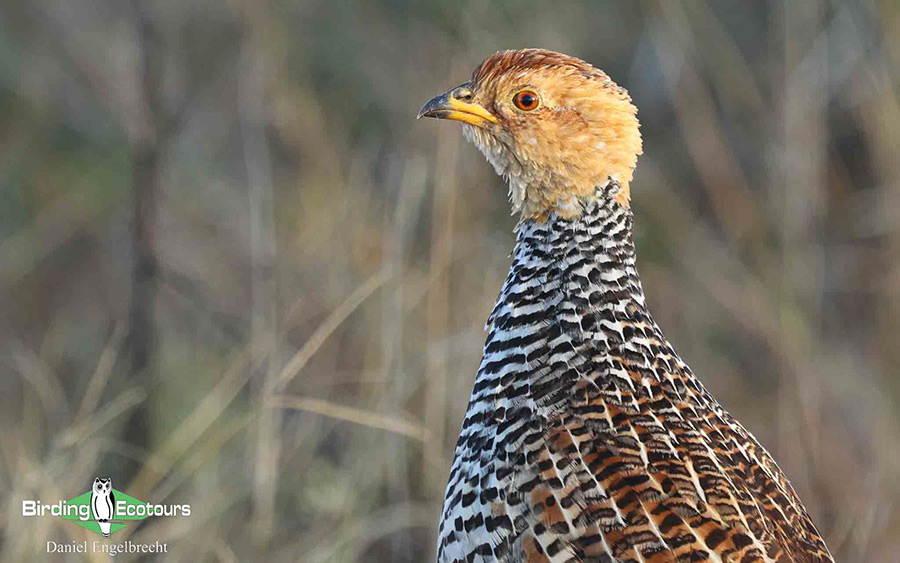
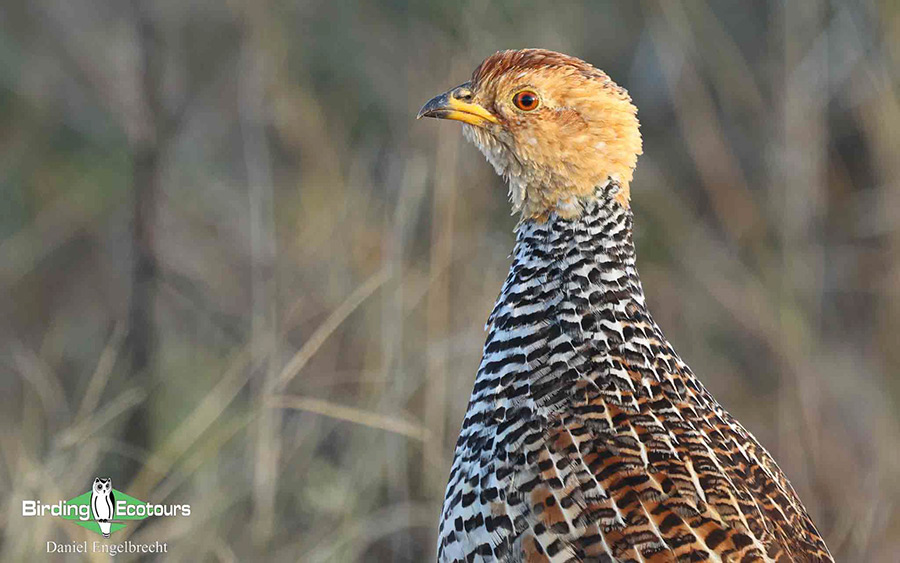 Coqui Francolin will be searched for around Polokwane.
Although this tour is not as mammal focused as some of our other tours in northern South Africa, we should see a few of the more widespread African mammals, such as Southern Giraffe, Greater Kudu, Sable Antelope, Plains Zebra, Impala, Waterbuck, Bontebok, Vervet and Blue Monkeys, and Rhebok, among others.
Detailed Itinerary (9 days/8 nights)
Day 1. Arrival in Johannesburg and transfer to Dinokeng Game Reserve
This northern South Africa budget birding tour begins in Johannesburg, the largest city in South Africa and the country’s main point of entry. We ask that you arrive before 2:00 p.m. today, as we have a two-hour drive to our accommodation tonight.
For those of you joining this tour after our Budget South Africa Birding Tour: Zululand, you will fly in from Durban the previous day or this morning (we will advise and assist with the interconnecting arrangements). Upon arrival in Johannesburg, you will be met at the airport, and we will make our way north to Dinokeng Game Reserve.
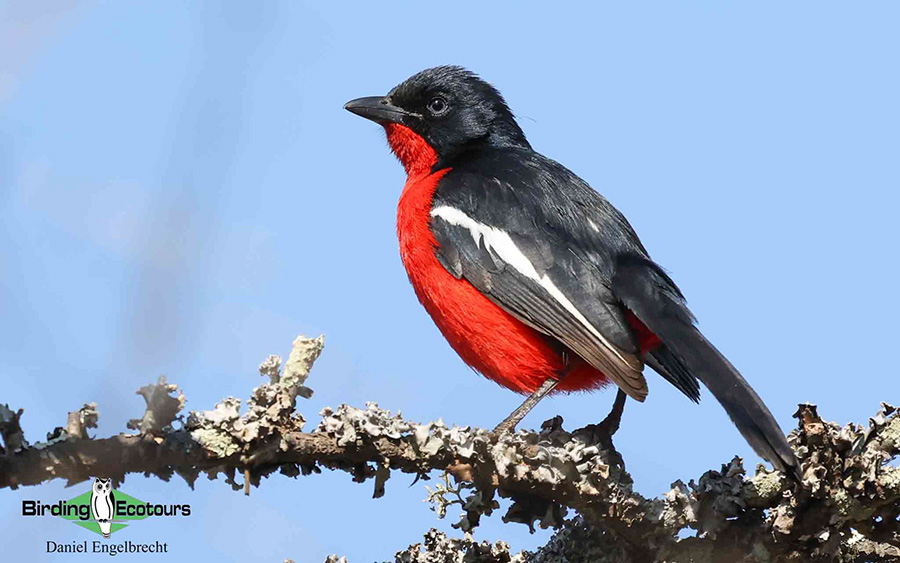
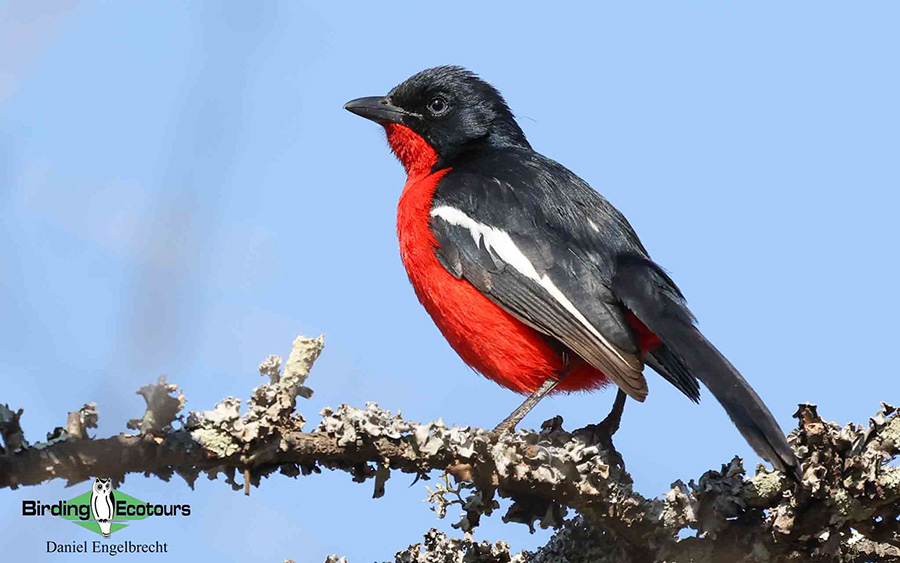 We should see the marvelous Crimson-breasted Shrike at several sites on this trip.
Dinokeng Game Reserve is the only “Big 5” reserve in Gauteng Province, meaning that (White/Black) Rhinoceros, Leopard, Lion, Cape Buffalo, and African Savanna Elephant can be seen in the reserve. Additionally, other mammals like Greater Kudu, Common Eland, Southern Giraffe, Plains Zebra, Blue Wildebeest, Hartebeest, and several other species occur here. We may spot mammals in Dinokeng, but our time in the reserve is brief—it mainly serves as an overnight stop, with arrival in the late afternoon and departure early the next morning. We will also get our trip list off to a good start and should have our first exposure to common species like Swainson’s and Natal Spurfowls, Crested Francolin, Red-crested Korhaan, Green Wood Hoopoe, Southern Yellow-billed, Southern Red-billed and African Grey Hornbills, Lilac-breasted Roller, Crested Barbet, Magpie and Crimson-breasted Shrikes, Rattling Cisticola, Southern Pied and Arrow-marked Babblers, and Burchell’s Starling, among many others.
Overnight: Dinokeng Game Reserve
Day 2. Dinokeng Game Reserve to Polokwane
Today, we will start with an early morning birding session in Dinokeng before setting off for Polokwane, the capital of the northernmost Limpopo Province. En route, we will stop to bird along the Zaagkuilsdrift Road. This dirt road passes through Kalahari-type Vachellia thornveld, where we hope to connect with birds like Northern Black Korhaan, Southern Pied Babbler, Kalahari Scrub Robin, White-throated Robin-Chat, Chestnut-vented Warbler, Cut-throat Finch, Scaly-feathered Weaver, White-browed Sparrow-Weaver, Shaft-tailed Whydah, and Yellow Canary.
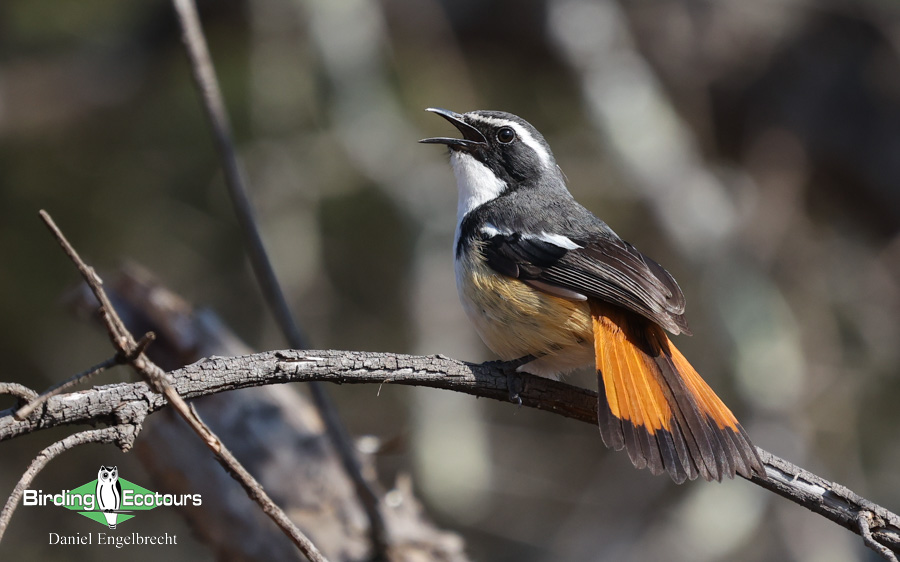 The attractive and relatively localized White-throated Robin-Chat is common along the Zaagkuilsdrift Road.
After a two-and-a-half hour drive, we should arrive in Polokwane and head out for an afternoon session in the Vachellia thornveld, where we hope to see species like the gorgeous Crimson-breasted Shrike, Kalahari Scrub Robin, Barred Wren-Warbler, Marico Flycatcher, Burnt-necked Eremomela, Ashy Tit, Cape Penduline Tit, Great Sparrow, and Violet-eared and Black-faced Waxbills. We should also have our first chance at the range-restricted Short-clawed Lark, the uncommon Bushveld Pipit, and Shelley’s and Coqui Francolins.
Overnight: Polokwane
Day 3. Polokwane and Chebeng Grasslands birding
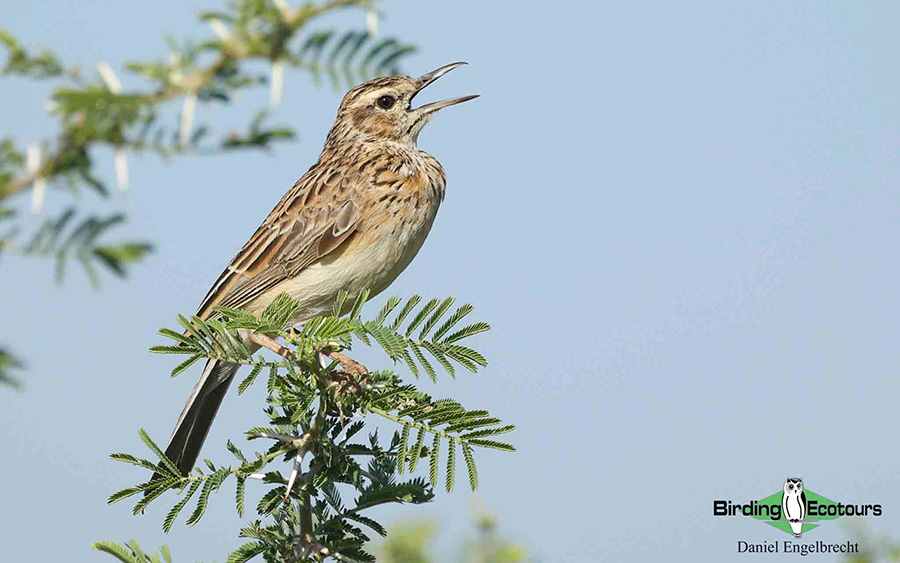
We will have an early start this morning and make our way west of Polokwane to the Chebeng Grasslands. These seemingly overgrazed grasslands between the villages are home to several localized and scarce species. Our main target is Short-clawed Lark, and we should connect with this species after listening out for its distinctive whistling call. Remarkably, no fewer than ten lark species have been recorded from this area, and we will likely see a number of species, including Spike-heeled (an isolated population occurs here), Pink-billed, Sabota, Rufous-naped, Red-capped, and Grey-backed Sparrow-Larks. Melodious Lark is rare here, but we do occasionally connect with this special species. Other birds to look out for in these short grasslands include White-bellied Bustard, Northern Black Korhaan, Greater Kestrel, Temminck’s Courser, Capped Wheatear, Ant-eating Chat, Cloud Cisticola, Cape Longclaw, and the stunning Long-tailed Widowbird.
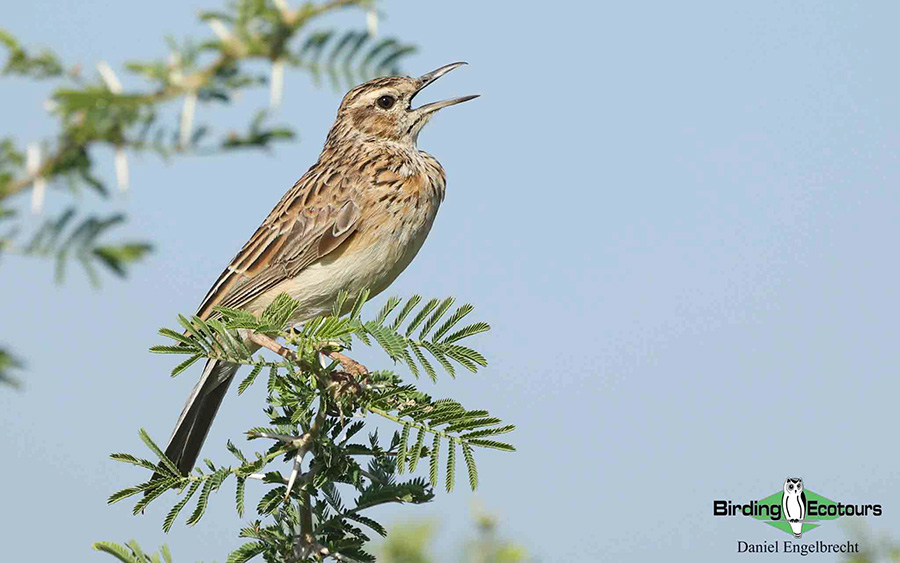 The range-restricted Short-clawed Lark is one of our primary targets at Chebeng.
The scarce Tinkling Cisticola and unobtrusive Yellow-bellied Eremomela favor areas with slightly more shrubby vegetation. A nearby granite outcrop supports a small Cape Vulture colony, and we often see a few birds cruising overhead, along with the Critically Endangered (BirdLife International) White-backed Vulture.
After a busy morning, we will return to Polokwane for lunch and head out for another birding session in the Vachellia thornveld, where we will likely connect with many of the species mentioned under Day 1. The Polokwane Game Reserve also supports good numbers of mammals like Plains Zebra, Sable Antelope, Southern Giraffe, Tsessebe, Impala, Common Eland, and more!
Overnight: Polokwane
Day 4. Polokwane to Magoebaskloof (via Wolkberg)
We will leave Polokwane early today and make our way east towards the northern reaches of the Great Escarpment. En route, we will stop to scan a few sports fields where Southern Bald Ibis is seen from time to time (although this species is by no means guaranteed here). We will then head up into the Wolkberg Mountains, rapidly gaining altitude and leaving behind the Polokwane Plateau bushveld. On our way up, we will stop in the mixed bushveld habitats of the lower slopes to look for Mocking Cliff Chat, Black Cuckooshrike, Yellow-fronted Tinkerbird, Short-toed Rock Thrush, Striped Pipit, and Rock-loving Cisticola.
Once we reach the higher reaches of the Wolkberg Mountains, we will bird the montane grasslands and Protea stands for species like the endemic Gurney’s Sugarbird (Cape Sugarbird, the only other member of this southern African endemic family, can be seen on our Budget South Africa Birding Tour: Cape Town’s Fynbos Endemics), Malachite and Greater Double-collared Sunbirds, Wailing Cisticola, the endemic Buff-streaked Chat, Cape Bunting, and Nicholson’s Pipit. We will also keep an eye skywards for Verreaux’s Eagle, which breeds on the cliffs in the area.
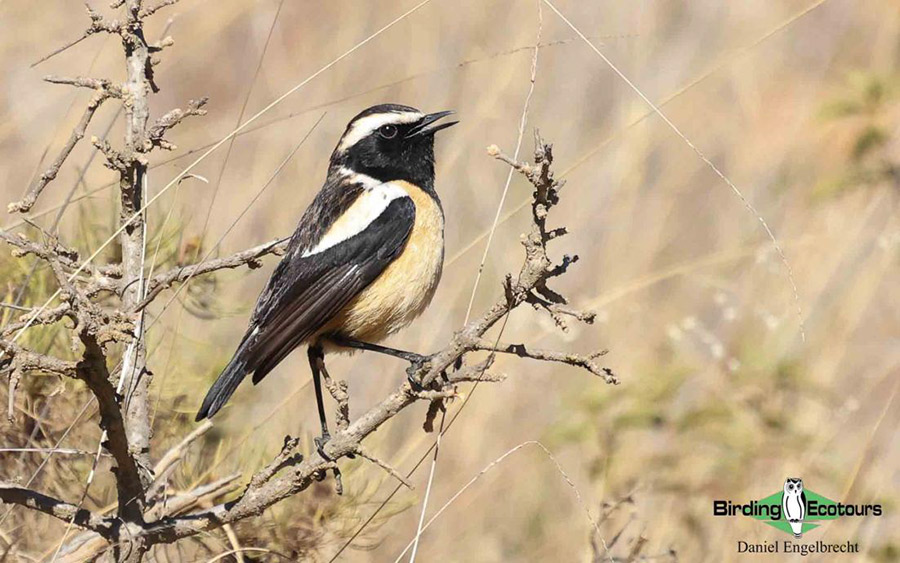 The characterful Buff-streaked Chat is an attractive endemic of South Africa’s highlands.
We will then proceed to the quaint town of Haenertsburg, nestled in the Wolkberg Mountains. The grasslands surrounding the town are productive and may yield African Yellow Warbler, Red-collared Widowbird, Drakensberg Prinia, Yellow Bishop, Levaillant’s Cisticola, Cape Grassbird, and, with some luck, Fan-tailed Grassbird. In the afternoon, we will have our first exposure to the Afrotemperate forests of the northern escarpment. These are cool, high-altitude forests that are often shrouded in mist.
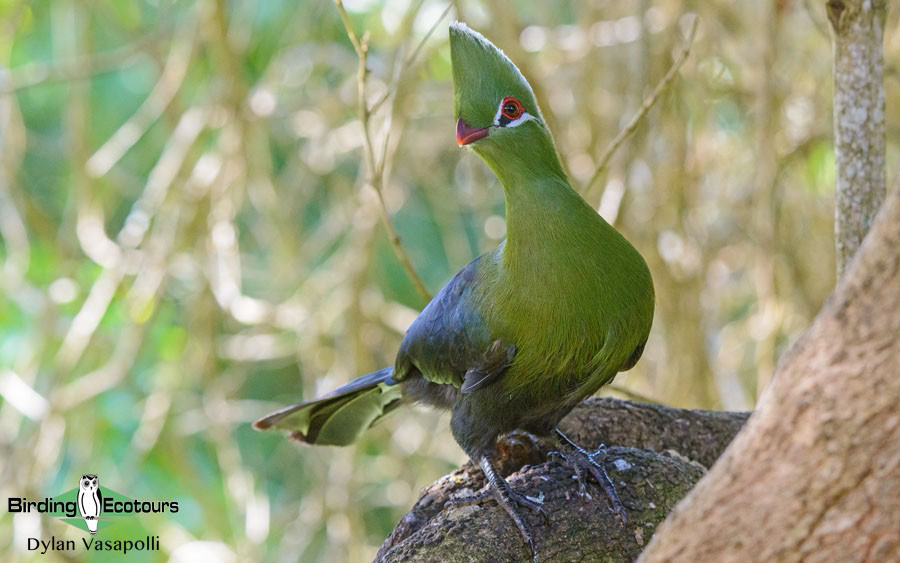
Some of our top targets will include Narina Trogon, Knysna Turaco, Cape Parrot, Lemon Dove, African Emerald Cuckoo, Square-tailed Drongo, Scaly-throated Honeyguide, Black-fronted and Olive Bushshrikes, Orange Ground Thrush, Chorister Robin-Chat, Brown Scrub Robin, White-starred Robin, Yellow-streaked Greenbul, Grey Cuckooshrike, Barratt’s Warbler, Yellow-throated Woodland Warbler, Forest Canary, Swee Waxbill, Green Twinspot, and so many more! We may also luck onto the mighty Crowned Eagle, which hunts Blue Monkeys and other large prey species in the forests. We should see the more common Long-crested Eagle and Jackal Buzzard, too.
After a busy day, we will return to our comfortable hotel, where we should hear African Wood Owl and even the secretive Buff-spotted Flufftail at night.
Overnight: Magoebaskloof
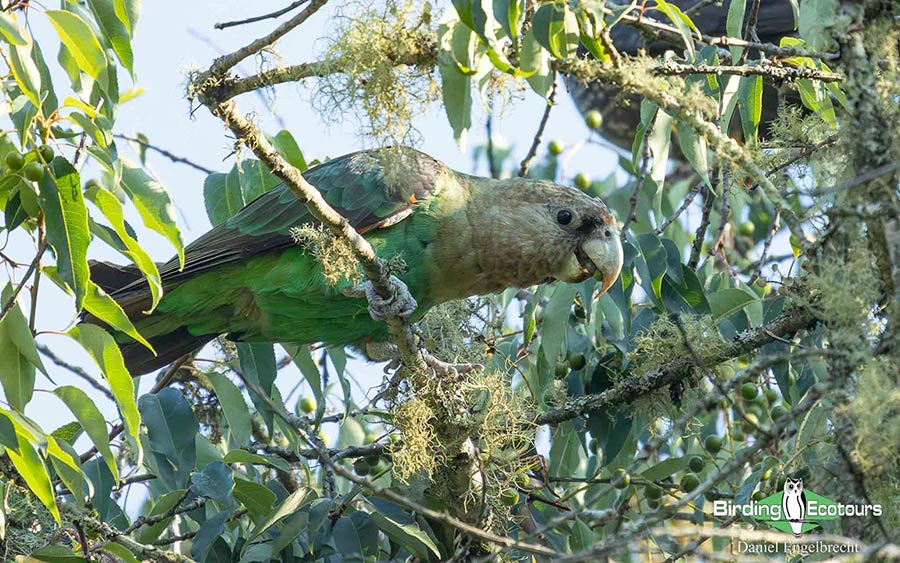
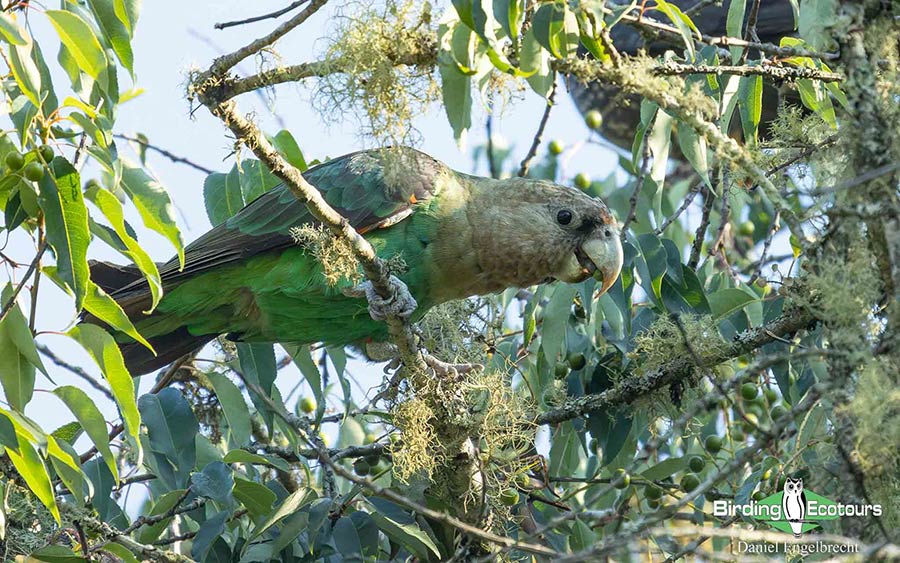 The endemic Cape Parrot occurs in the forests of Magoebaskloof.
Day 5. Magoebaskloof and Tzaneen birding
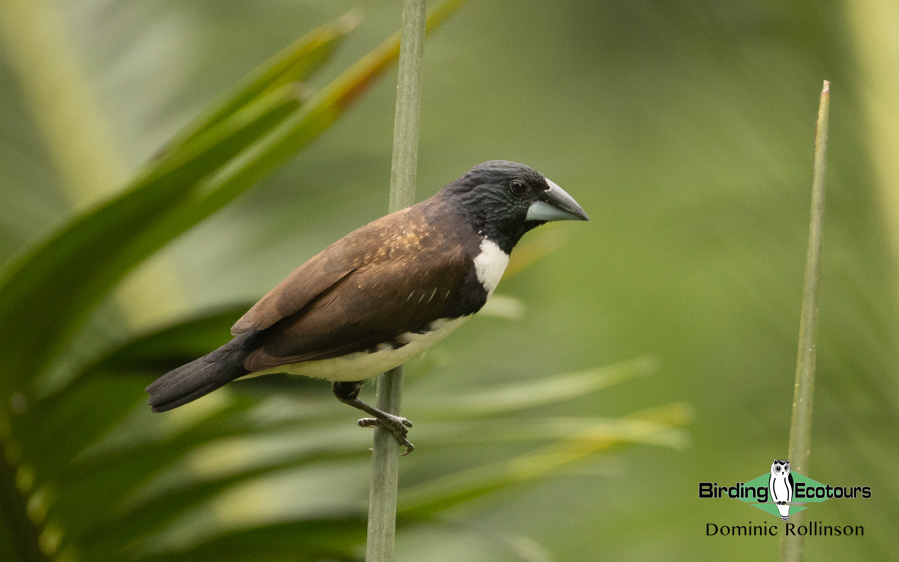
Our plan today is to spend the morning birding the Afrotemperate forests, targeting any species we may have missed yesterday, and improving our views of some of these secretive denizens. After an early morning session in the forests, we will drop down into the subtropical lowlands around the town of Tzaneen. We will stop at a few low-water bridges in the area to look for Mountain Wagtail, African Finfoot, and Half-collared Kingfisher, all of which can be challenging to see at the best of times. In Tzaneen, we hope to see the localized Magpie Mannikin and several new trip birds like Purple-crested Turaco, White-browed Robin-Chat, Red-faced Cisticola, Holub’s Golden Weaver, Scarlet-chested and Collared Sunbirds, and African Firefinch, among many others. We will also try for Blue-spotted Wood Dove, which is exceptionally scarce in South Africa.
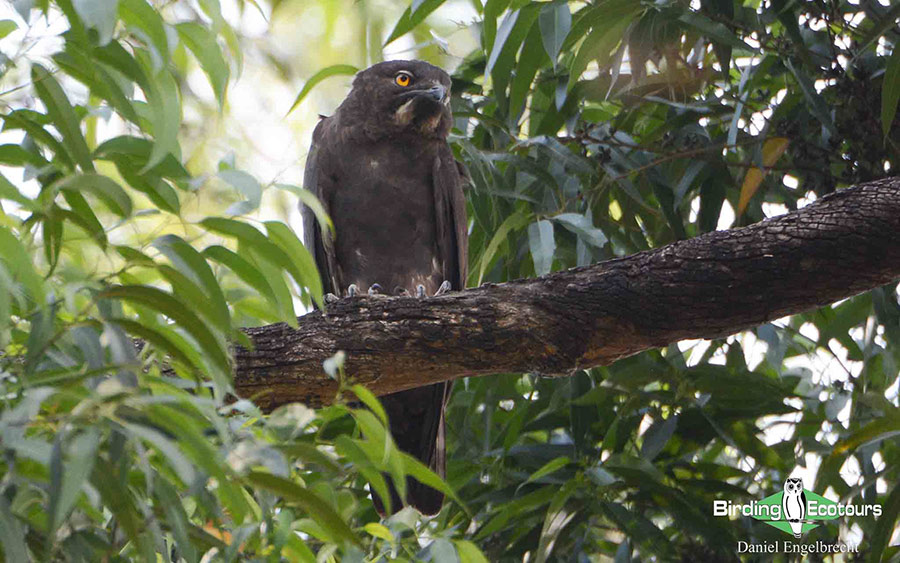
Time dependent, we may bird the mixed woodland habitats east of Tzaneen, where we have a chance at Green-capped Eremomela, Pale Flycatcher, Yellow-throated Longclaw, and Bearded Scrub Robin. In the afternoon, we will stop at a eucalyptus stand where a pair of Bat Hawks have bred for several years. We will return to our accommodation in Magoebaskloof for an early night in anticipation of more exciting birding tomorrow.
Overnight: Magoebaskloof
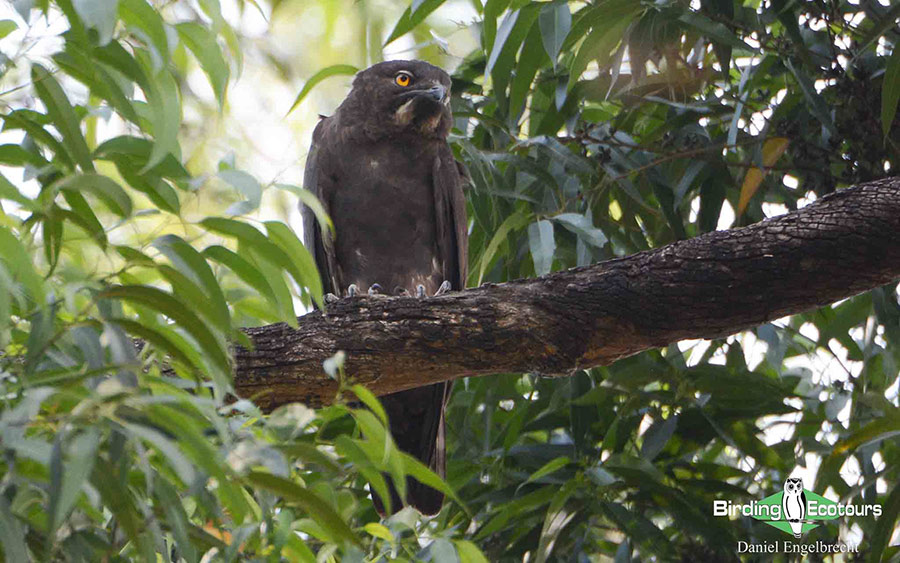 We will look for the scarce Bat Hawk around Tzaneen.
Day 6. Lowveld birding
Today, we will meet up with a local bird guide for what promises to be one of the highlights of the trip. We will make our way east of Magoebaskloof and into the Lowveld, an area of low-lying subtropical woodlands and savanna habitats. On the way, we will keep an eye open for Lilac-breasted Roller, Lizard Buzzard, and Greater Blue-eared Starling on the roadside fences and powerlines. Upon arrival at Hans Merensky Nature Reserve, we will immediately start exploring the Mopani woodlands.
A lengthy list is always expected in this area, and we should kick our list off with African Grey, Southern Yellow-billed, and Southern Red-billed Hornbills, Striped Kingfisher, Emerald-spotted Wood Dove, African Green Pigeon, Bennett’s, Bearded, Golden-tailed, and Cardinal Woodpeckers, Grey-rumped Swallow, Southern Black Tit, Green-capped Eremomela, Grey Penduline Tit, Pale Flycatcher, Green Wood Hoopoe, Purple Roller, Bearded Scrub Robin, White-crested and Retz’s Helmetshrikes, Red-headed Weaver, Red-billed Buffalo Weaver, and Orange-breasted Bushshrike, to name a few.
Birds of prey are well represented here, and we regularly see Bateleur, Tawny, and Wahlberg’s Eagles, African Hawk-Eagle, Black-chested and Brown Snake Eagles, Dark Chanting Goshawk, and Shikra. We also stand a chance of seeing a few vultures, such as Hooded and White-backed Vultures, occasionally joined by small numbers of Cape and Lappet-faced Vultures.
The woodlands here also host several trickier species, which we will focus on finding. These include Bushveld Pipit, African Cuckoo, White-breasted Cuckooshrike, Stierling’s Wren-Warbler, and African Barred Owlet.
In the afternoon, we will make our way back to Magoebaskloof via Tzaneen, attempting to find any remaining targets in the subtropical woodlands.
Overnight: Magoebaskloof
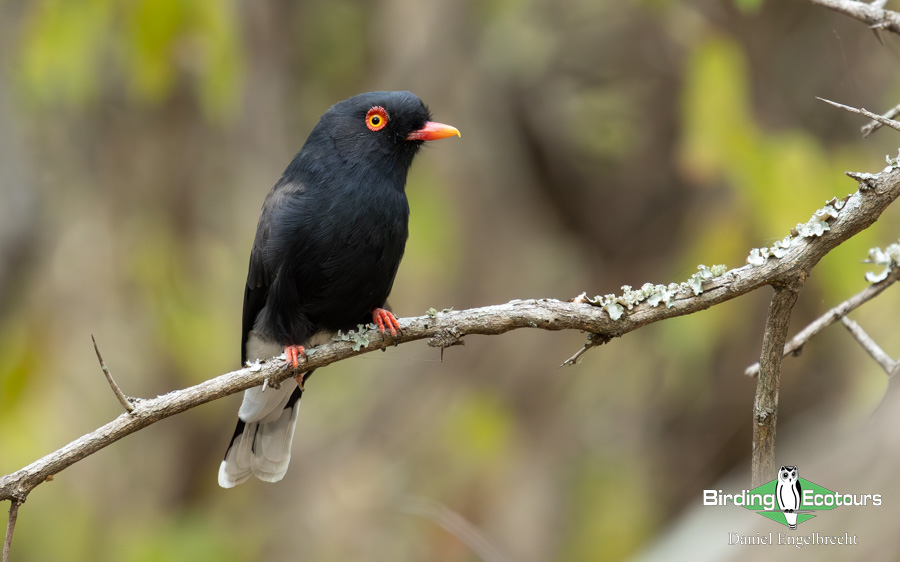 The characterful Retz’s Helmetshrike can be seen during our time in the Lowveld.
Day 7. Magoebaskloof to Dullstroom
After our final breakfast in Magoebaskloof, we will start the scenic drive south towards the charming town of Dullstroom, located in the rolling grasslands of the neighboring Mpumalanga Province. The drive will take at least four hours, and we will pass through a variety of habitats as we travel through spectacular mountain passes along South Africa’s northern escarpment.
We may arrive in Dullstroom in time for a late afternoon birding session at Verloren Vallei Nature Reserve. The grasslands here are likely to yield several new species for us, with possibilities including Denham’s Bustard, Red-winged and Grey-winged Francolins, Pied Starling, Mountain Chat, Eastern Long-billed Lark, Bokmakierie, Banded Martin, and Sentinel Rock Thrush, among others. In the evening, we will try to see the resident pair of Cape Eagle-Owls, which sometimes perch out in the open well before sunset.
Overnight: Dullstroom
Day 8. Dullstroom birding
We will have a full day today to explore the grasslands around Dullstroom. Our targets will include many of the species mentioned on Day 7, and we will have additional chances for some of the highland specials, such as Buff-streaked Chat and Gurney’s Sugarbird, should we have missed them in Limpopo. Another species that we may have a chance to see is the endemic Yellow-breasted Pipit. Although its seasonal movements are poorly understood, most individuals appear to move to lower elevations at this time of the year, but we may luck onto a straggler. We will also keep an eye open for Blue Crane and Southern Bald Ibis, both of which are fairly common in the area. Although Verloren Vallei was once a reliable site for Wattled Crane, the birds have become exceptionally scarce in recent years, and we will require luck to find this rare bird.
Overnight: Dullstroom
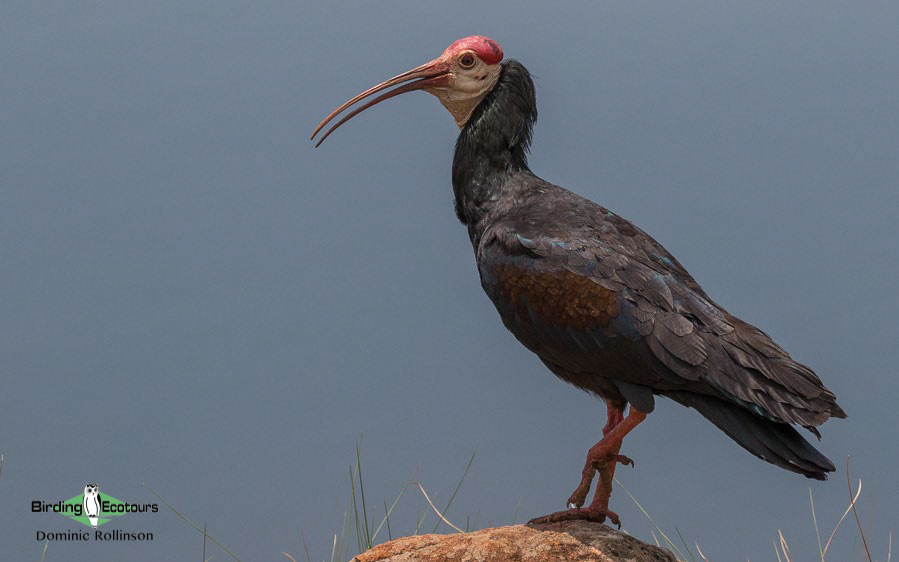
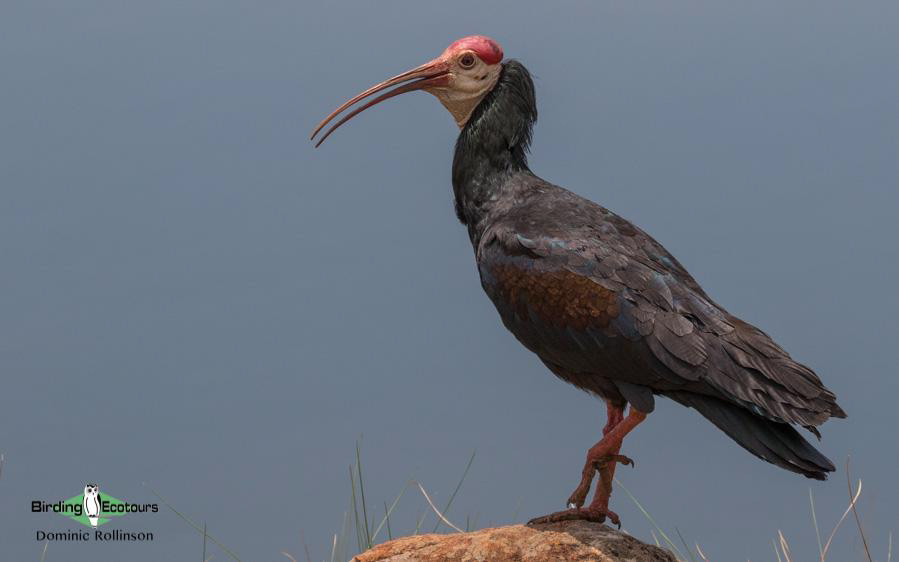 We will search for Southern Bald Ibis in the grasslands around Dullstroom.
Day 9. Dullstroom to Johannesburg, and departure
We may squeeze in a final pre-breakfast birding session around Dullstroom this morning before making our way back to Johannesburg. After just under three hours on the road, we will arrive in Johannesburg and make our way to O.R. Tambo International Airport. You are free to depart at any time after 3:00 p.m.
Overnight: Not included
Please note that the itinerary cannot be guaranteed as it is only a rough guide and can be changed (usually slightly) due to factors such as availability of accommodation, updated information on the state of accommodation, roads, or birding sites, the discretion of the guides, and other factors. In addition, we sometimes have to use a different guide from the one advertised due to tour scheduling or other factors.
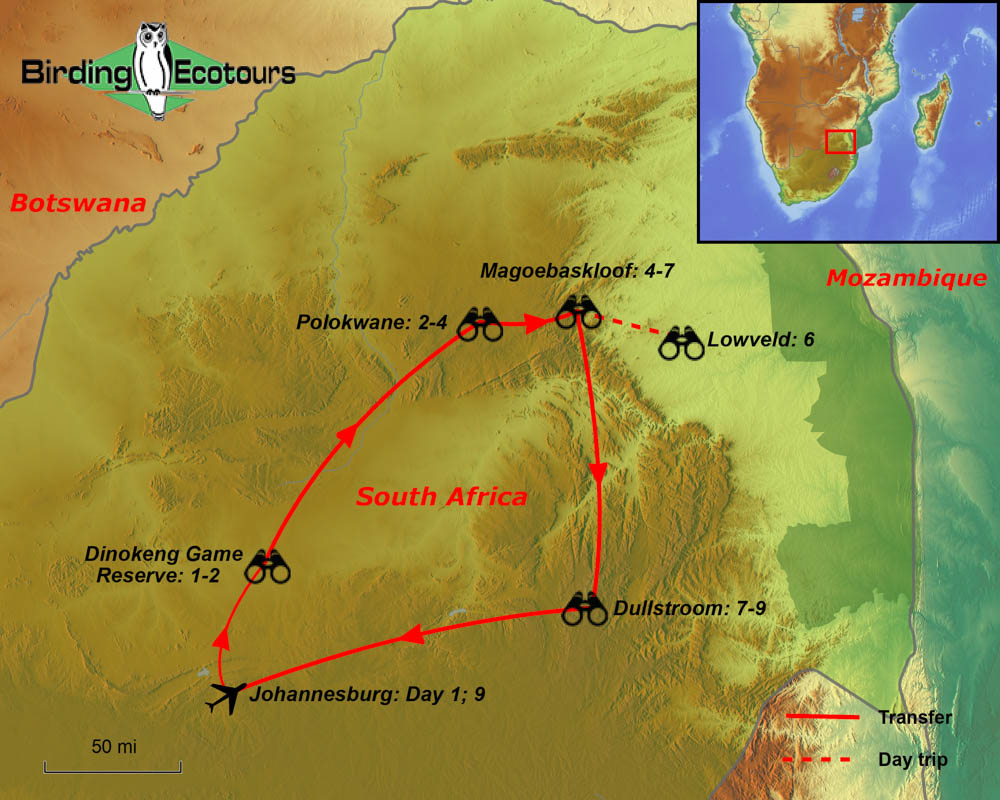
Map
Trip Report
Testimonials
Gallery
General Information
BUDGET SOUTH AFRICA BIRDING TOUR: THE NORTH
TOUR-SPECIFIC INFORMATION
GENERAL INFORMATION ABOUT SOUTH AFRICA CAN BE READ HERE
TOUR OUTLINE
This is the final tour of our budget tour series, which also includes other essential parts of the country; the Northern Cape, Cape Town, and Zululand. Each of our budget tours can be run as stand-alone tours, but combined, they offer an unrivalled budget birding journey across the full breadth of South Africa. This budget South African birding tour focuses on the avian-rich Limpopo and Mpumalanga Provinces, located in the northeast of the country. A variety of diverse habitats will be visited on this tour (starting and ending in Johannesburg), including Polokwane Plateau bushveld, montane grassland, Afromontane Forest, Mopani and riverine woodlands, and several types of mixed woodlands. Each of these habitat types, with their respective avian assemblages, contribute to the impressive array of species on offer on this tour.
PACE OF TOUR
At just over a weeklong and covering large distances, this will be a fairly fast-paced tour. This area of South Africa is extremely diverse, and we will do our best to make the most of our time to enjoy the incredible richness it has to offer.
In some instances, we will be able to meet up for group communal coffee and early breakfasts, before our morning birding. Most mornings are spent birding, followed by lunch either en route or at the accommodation. We will generally spend most of the morning out birding, before stopping for lunch somewhere or at the accommodation. Some days allow for downtime before our afternoon birding; however, on most days we return to birding fairly quickly, depending on the heat and the area we are visiting.
Night birding may also be done on this tour, but, as with all our tours, these are optional, and you are welcome to opt out of any nocturnal excursions that the guide may offer.
The guide discusses the daily plan with the group in detail each evening. Note that we do retain a sense of flexibility, within reason, to allow for us to better maximize your birding experience.
WALKING AND STYLE OF BIRDING
A large portion of our birding will be done from the vicinity of the vehicle, often stopping at specific spots and spending time in the area searching for our specific targets. Some of the sites, such as Magoebaskloof, have forest trails that we will walk along. We should keep the walks to no longer than two miles (3.2 kilometers). However, the day in the Lowveld can be a bit longer. This remains flexible and will depend on participants’ fitness levels and the target birds still to be found.
LENGTH OF DRIVES
The drives between each of our bases are roughly 2–3 hours long and, unlike many of our other southern African tours, there are no full-day travel days on this tour. That being said, one or two of the travel days can be up to four hours of driving.
SAFETY
Throughout this tour, we spend most of our time in areas frequented by tourists and are deemed to be safe. However, we suggest not leaving valuables in the unattended vehicle, particularly when stopping in towns. If you are unsure about the safety of an area, please ask your guide to clarify.
HEALTH, PESTS AND DANGEROUS ANIMALS
When on walking trails, we advise wearing long pants and using tick repellent on your legs, socks and shoes as there could be ticks around. Ticks in South Africa, fortunately, do not carry Lyme disease, but a bite may lead to tick-bite fever which is a far less threatening disease with generally no major long-term consequences.
We advise against touching or petting any stray dogs in rural areas on the off chance that they have rabies. Rabies is uncommon in South Africa, though present in some areas.
*Note that dangerous animals and venomous snakes and scorpions etc., are all possible, and these are all discussed in greater detail under the “South Africa General Information” document.
Malaria
Taking place in May, this tour falls outside the wet season, so the risk of contracting malaria is low. However, it would still be advised to take anti-malaria medication for this tour. Any one of the following three drugs is highly effective (albeit not 100 %, due to resistant strains of malaria) as protection against malaria: MalaroneÒ (atovaquone/proguanil), Doxycycline, and LariumÒ (mefloquine).
In addition to medication, the following measures can also be taken: using mosquito repellent spray, wearing long-sleeved shirts and trousers when out in the field, particularly near stagnant water, and wearing long sleeves at night, when malaria (Anopheles) mosquitoes are most active.
If you still manage to contract malaria, despite taking the above precautions, it can generally be treated easily soon after symptoms are detected with appropriate medication. Flu-like symptoms developing within weeks of the tour ending are indicative that you may have contracted malaria.
TRANSPORTATION
A 14-seater minibus will be used for the duration of the tour. We will follow a seat-rotation policy every day to ensure fair viewing opportunities to everyone throughout the tour (your guide will explain further at the start of the tour). Our small group size ensures that everyone gets a window seat and that we do not have to tow a trailer, giving us better maneuverability while birding.
We will provide airport transfers to participants on the first and final days of the tour, which are included in the tour cost. Should you arrive in South Africa earlier than that or prolong your stay in South Africa after the tour, those transfers would be at your own expense. We will, however, help arrange transfers wherever they may be needed.
DOMESTIC FLIGHTS
There are no domestic flights required on this birding tour. The tour will start and end at OR Tambo International Airport in Johannesburg.
ACCOMMODATION
We stay in good quality comfortable lodges and hotels throughout this tour. Please note that, because this is a budget tour, the accommodation may not be of the same standard as on our regular tours, but it will still be of a good quality.
An important note is that South African buildings are not heated as effectively as they are in Europe or North America (and often not heated at all), so we advise you to bring adequate warm clothing, particularly for sleeping.
ELECTRICITY
Room lighting is often low wattage, so bring a good-quality torch/flashlight if you plan to read in bed.
It is good practice to bring international adapters, as many establishments are changing their plug outlets to better align with international clients, and this is an aspect we do not have control over.
WEATHER
This tour takes you through regions of differing climes. The lower areas such as Tzaneen are usually hot and humid (average daily temperatures can reach 86 °F (30 °C)), being subtropical and at low altitude. Conversely, areas such as Magoebaskloof are at higher altitude on the escarpment and are therefore much cooler (temperatures can drop to 46 °F (8 °C) at night).
This tour falls in autumn, when weather conditions across this region can be unpredictable. Even though eastern South Africa gets most of its rainfall from November onwards, we may still get some rain along our route, particularly in the mountains of the escarpment. Therefore, we advise packing for warm, cold, and wet weather on this tour, to cover all bases.
WHAT TO BRING: CLOTHING AND OTHER ITEMS
Please see our blog on ‘What to bring on a birding tour’ which will help you pack for this South Africa birding tour.
Download Budget South Africa: The North Tour-Specific Information