- Duration:
- 20 days
- Group Size:
- 5–8
- Tour Start:
- Accra
- Tour End:
- Accra
Please note that we have lots of ground to cover on this tour, and sometimes driving distances are quite long.
Ghana Birding Tour: Upper Guinea Forest to the Sahel
Details
2028
15 January–03 February
Per person sharing
$8,600 USD
£6,675 GBP / €7,784 EUR
Single supplement
$1,200 USD
£931 GBP / €1,086 EUR
2029
15 January–03 February
Per person sharing
$9,250 USD
£7,179 GBP / €8,372 EUR
Single supplement
$1,320 USD
£1,025 GBP / €1,195 EUR
Itinerary
Download ItineraryGhana Birding Tour: Upper Guinea Forest to the Sahel
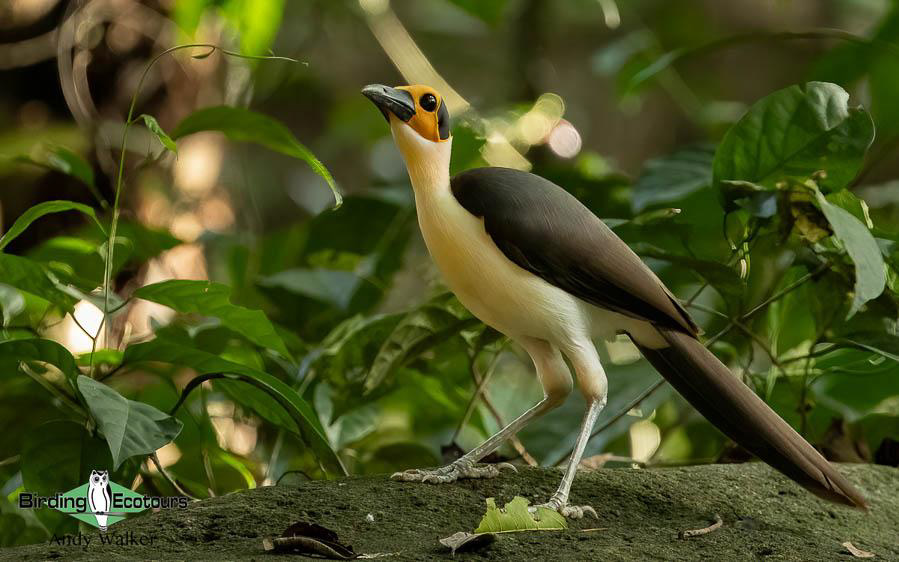
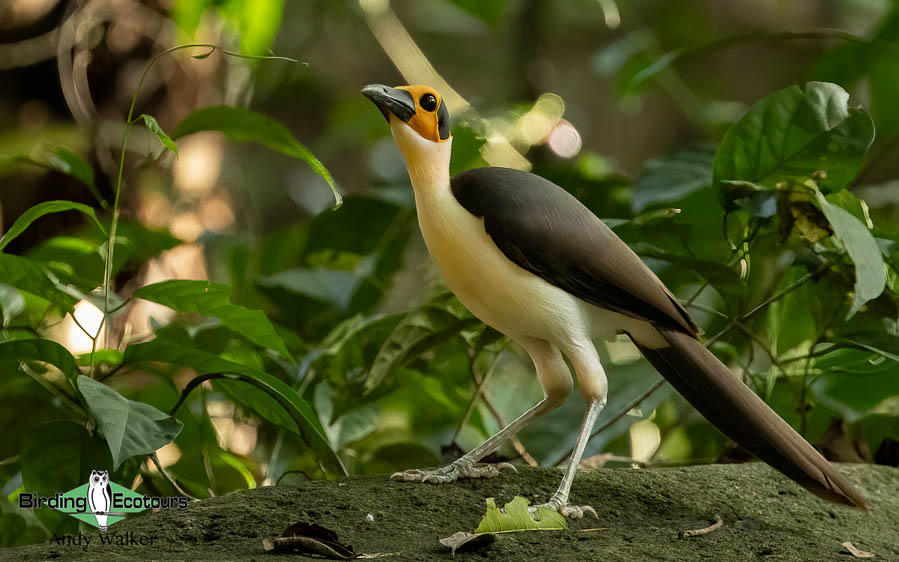 White-necked Rockfowl is one of our special targets on this Ghana birding tour.
Overview
Ghana is arguably the best country in which to begin your birding in West Africa. Its huge range of habitats is easily accessible and all the special birds, including the charismatic White-necked Rockfowl (Yellow-headed Picathartes), are amazingly well staked-out. While a lot of birders start their West African birding with a visit to the tiny Gambia, the larger and more varied Ghana has a great deal more to offer, including a mammoth 180 of the “Guinea-Congo Rainforest” birds (which will basically all be life-birds for anyone who has not yet been to West Africa) and 12 of the 15 Upper Guinea Forest endemics (which are restricted to a much smaller part of West Africa, i.e. part of the Bulge of Africa). These Upper Guinea endemics can be found in neighboring countries, but access and birding infrastructure and information are less developed compared with Ghana, and travel for English-speakers is significantly more difficult.
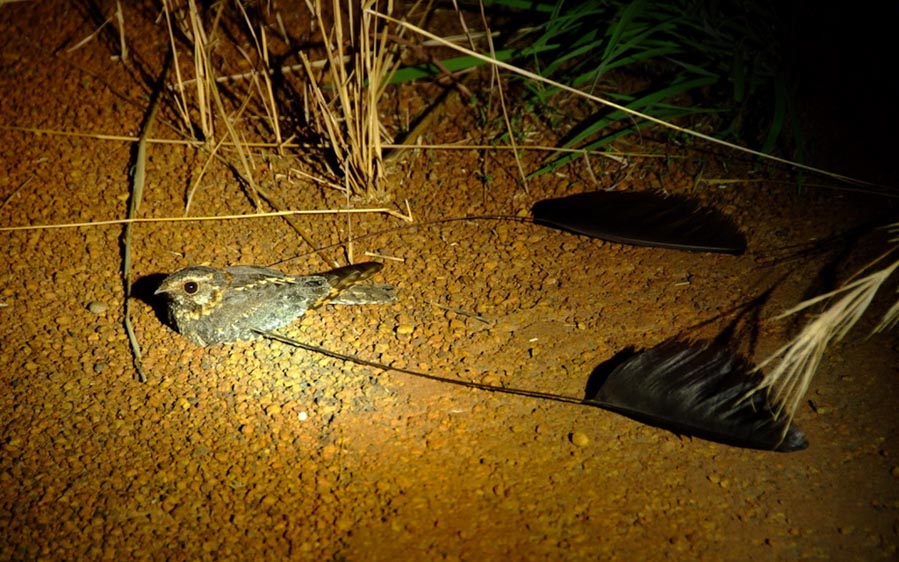
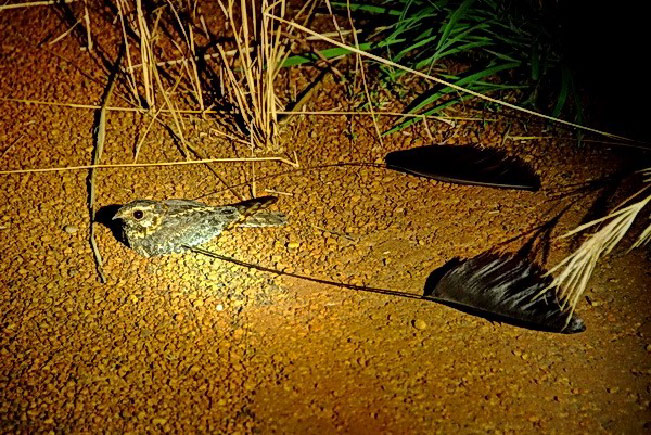 Ghana must rank as one of the best countries to find the incredible Standard-winged Nightjar (photo Don Cowan (past tour participant)).
Ghana certainly has a wide range of different habitats, and we look not only for forest birds at sites including one of Africa’s most impressive canopy walkways in Kakum National Park, but we also look for some charismatic arid-area birds. We spend several days exploring the mosaic of open wooded savannas of the fabulous Mole National Park. This is the country’s premier wildlife reserve, and megafauna such as African Elephant are a regular feature (often bathing at the pools visible in front of our hotel).
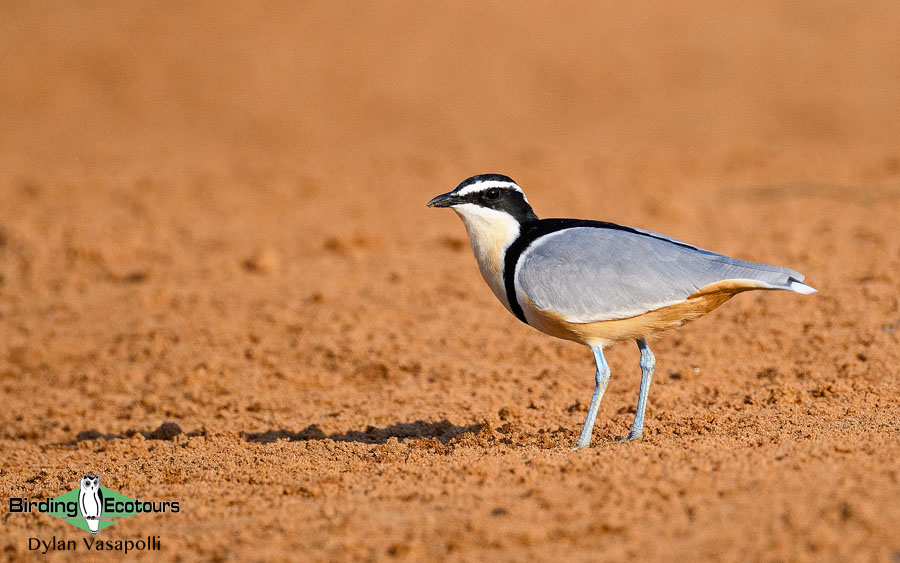
We also dip our toes into the Sahel zone (and some of its specials) up on the White Volta River along the border with Burkina Faso. Both Standard-winged Nightjar and the incomparable Egyptian Plover are other highly-desirable and major targets on this tour, that is likely to feature a further 400 species of birds.
Detailed Itinerary (20 days/19 nights)
Day 1. Arrival into Accra
This is your arrival day into Accra, and you can arrive at your leisure. There are no formal plans for birding today as most flights tend to arrive in the evening.
Overnight: Accra hotel
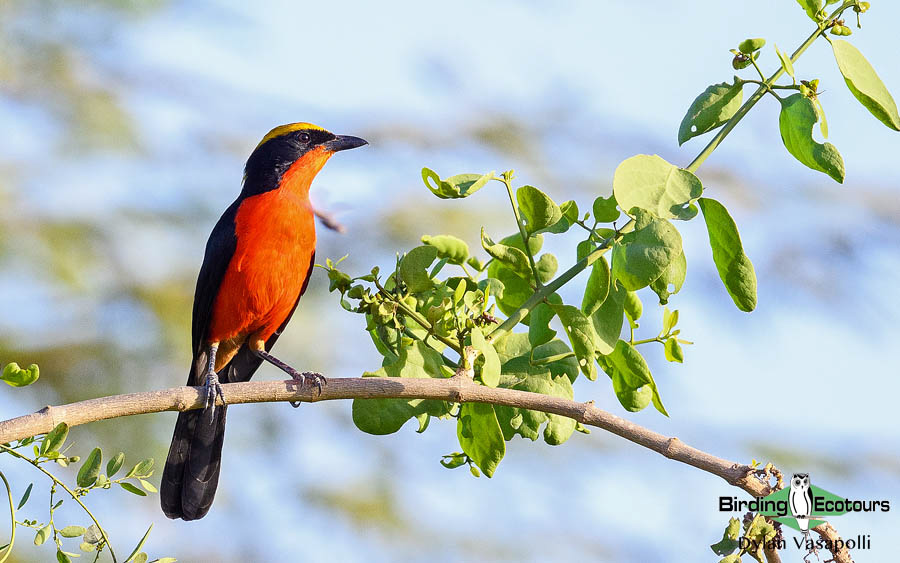 While common, the gaudy Yellow-crowned Gonolek is sure to be an early tour highlight.
Day 2. Birding Shai Hills, and transfer to the Atewa Range
Our first day birding in Ghana will be spent at the fabulous Shai Hills Resource Reserve, on the outskirts of Accra. Covering a wide mix of open, wooded habitats, it is an excellent place to begin the tour, with good views of many species likely and an easy introduction to African birding. We will familiarize ourselves with common species such as Western Plantain-eater, Green Wood Hoopoe, African Grey Hornbill, White-throated Bee-eater, Blue-bellied Roller, Yellow-fronted Tinkerbird, Yellow-crowned Gonolek, Northern Puffback and Northern Black Flycatcher. We should also be exposed to the first of the more special birds of the tour, with the likes of Violet Turaco, Bearded Barbet, Senegal Parrot, Oriole Warbler and Splendid Sunbird all possible, while this is also arguably the best place in the country to see the shy Stone Partridge and Mocking Cliff Chat. All in all, we’re going to see many species during the course of the day with our daily list likely to be more than 100 species.
In the afternoon, we will make the transfer to the Atewa Range, and we should arrive with some time to spare in the afternoon. Should we have enough time, we’ll likely have a short walk in the farmbrush and scrubby habitat on the edge of the forest, where we’ll be on the lookout for the likes of specials such as Marsh Tchagra, Orange-cheeked Waxbill and Compact Weaver, amongst more widespread species.
Overnight: Atewa Range hotel
Day 3. Full day hike up the Atewa Range
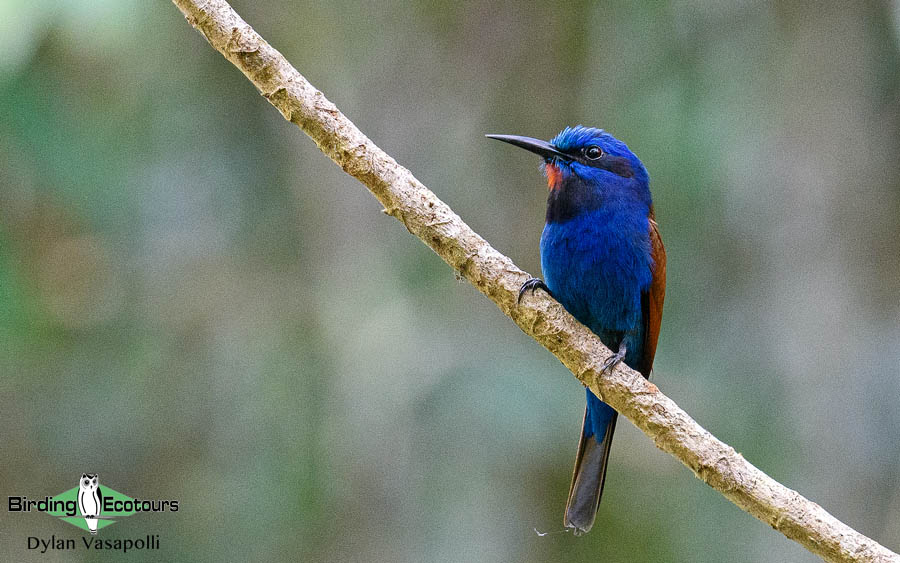
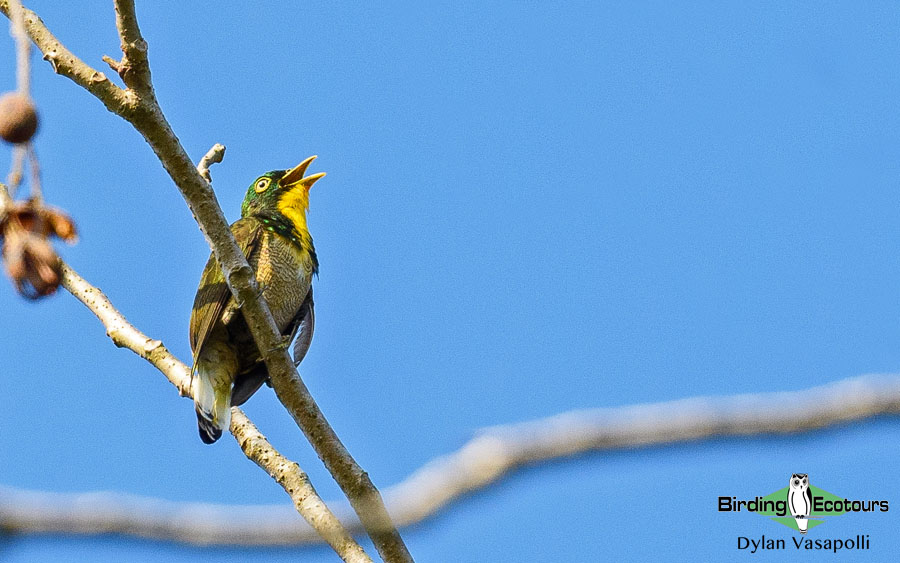
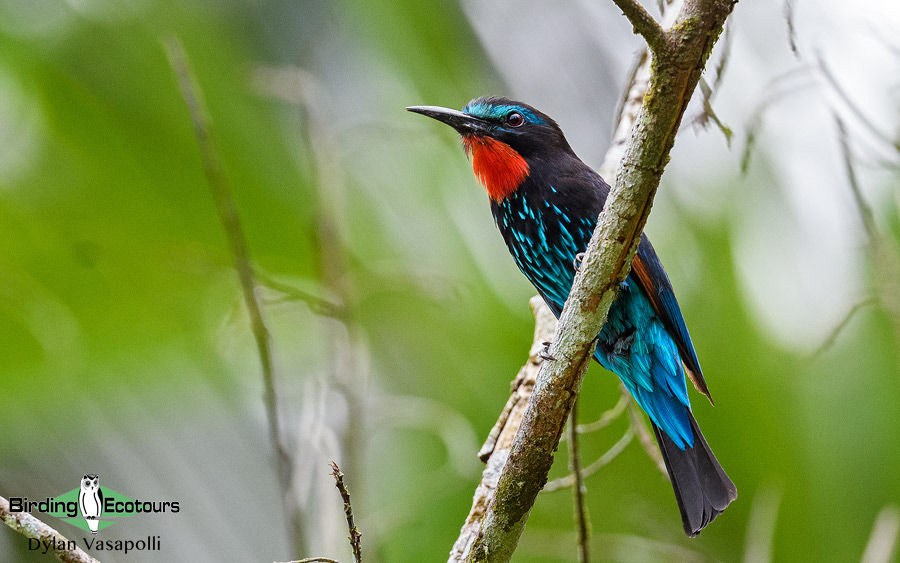
We set off early to maximize the cooler hours of the day, as we embark on a full day hike up the Atewa Range. Note that this is a challenging hike, both in terms of distance and terrain. The hike takes us through varying types of forest habitat, beginning in more open forest-edge habitat before gradually ascending into taller, more mature stands of forest. The more mature stands of forest hold such prized specials as Nimba and Tessmann’s Flycatchers, and the scarce Yellow-footed Honeyguide. We will also seek out the stunning Blue-moustached Bee-eater, arguably the best site in the country for this bird, along with Yellow-throated Cuckoo, Chocolate-backed Kingfisher, Red-cheeked Wattle-eye, Kemp’s Longbill, Violet-backed Hyliota, Finsch’s Rufous Thrush and White-tailed Alethe.
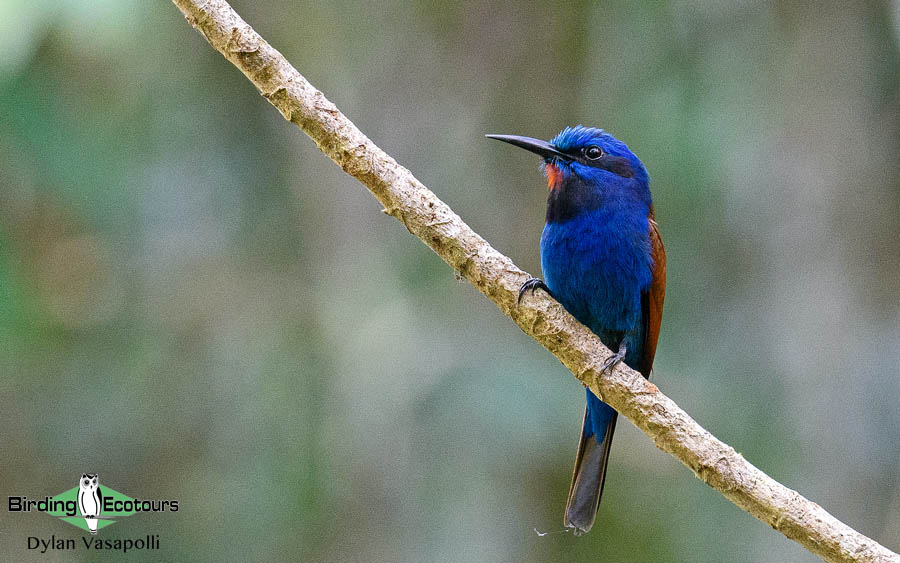 The scarce Blue-moustached Bee-eater occurs in the Atewa Range forests.
Keeping an eye to the skies overhead often reveals Cassin’s Hawk-Eagle. Forest birding can be challenging, with the forest often quiet for long periods before suddenly bursting into life as a flock moves through that leaves us scrambling to pick out all the different birds as quickly as possible. As this will be our first exposure to West African forest birding, new birds of all sorts will be seen, and we’re going to encounter a wide range of other species including various tinkerbirds, greenbuls, sunbirds and flycatchers (and so much more). After a long, but exciting day hiking up and down the Atewa Range, we’ll return to our hotel for some much-needed rest (and a cold beer) in the afternoon, reflecting on an exciting day of forest birding!
Overnight: Atewa Range hotel
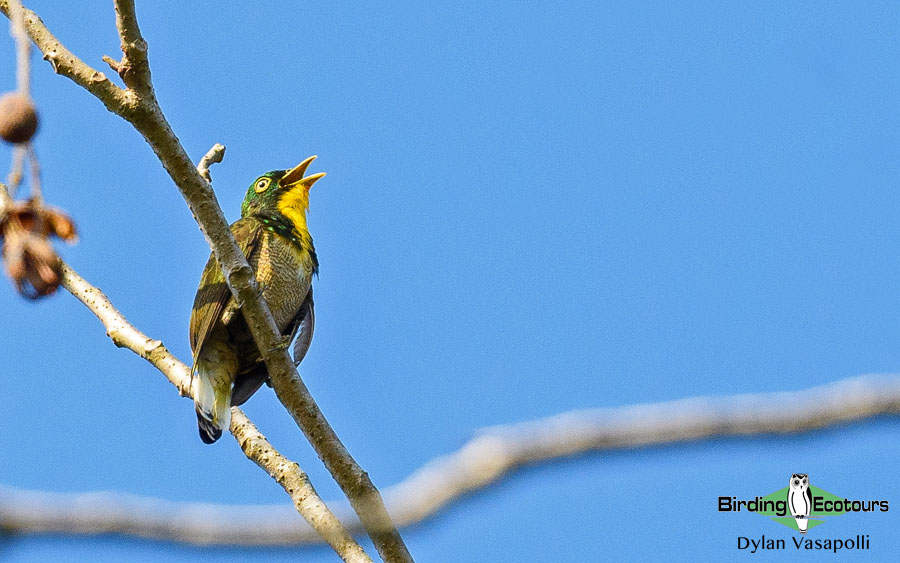 The diminutive Yellow-throated Cuckoo can play ‘hide-and-seek’ at times.
Day 4. Birding back to Accra
We have a fairly flexible day, as we ultimately transfer back to Accra. Our morning will likely be spent around the always-birdy farmbrush and scrubby habitat, on the outskirts of the Atewa Range – and we may even venture into the forest edge habitat on the beginning of the trail – all depending on the birds we’re still searching for. We will have the likes of Lowland Sooty Boubou, Blue Malkoha, Black Bee-eater, Red-billed Helmetshrike and Puvel’s Illadopsis firmly on our radar. We will also have repeat opportunities for species such as the dazzling Red-cheeked Wattle-eye and Kemp’s Longbill should we have missed them during our full-day hike.
We will also try to spend a bit of time in the afternoon at the Sakumono Lagoon, on the beachfront in Accra, where we’re likely to add a great number of various waterbirds to our burgeoning list. The tides will determine what shorebirds/waders we see, but the possibilities are many and include several godwits, stints, sandpipers, shanks and plovers. Several terns and gulls are usually present, and we’re also all but guaranteed to find our first Western Reef Herons and Pied Kingfishers. Content after another good day’s birding, we’ll make our way to our city hotel and settle in for the evening.
Overnight: Accra hotel
Day 5. Transfer to Kakum National Park, birding Winneba en-route
We have an early start to help avoid the notorious Accra traffic, as we make our way westwards to the mighty Kakum National Park, where we will spend three nights. This is a fairly long drive, but we will break it up with birding stops at the Winneba Lagoon and the surrounding Winneba Plains. The lagoon is also tidal, and much will depend on the times of the tides when we’re present there, but a wide range of waterbirds are possible. The Winneba Plains support a slightly different suite of birds, and in particular we’ll be on the lookout for Moustached Grass Warbler, Red-winged Prinia, Flappet Lark, Copper Sunbird, Yellow-mantled Widowbird and Yellow-throated Longclaw, amongst others. Time permitting, we’re also likely to get a short spell of birding in the scrubby areas surrounding our lodge, where various weavers and greenbuls are possible, along with the above-mentioned Winneba Plains species, while we may even get our first views of the spectacular Rosy Bee-eater as they fly about acrobatically overhead.
Overnight: Rainforest Lodge, Jukwa (or similar)
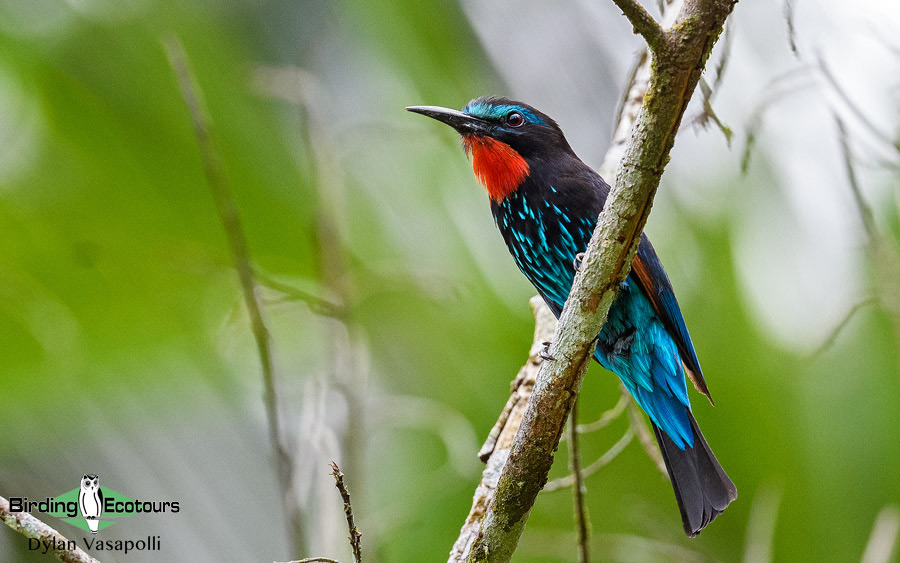 Many bright and colorful bee-eaters can be seen on this tour – this Black Bee-eater (surely the most attractive!) can be seen in most forest patches throughout the tour.
Days 6–7. Birding the fabulous Kakum National Park
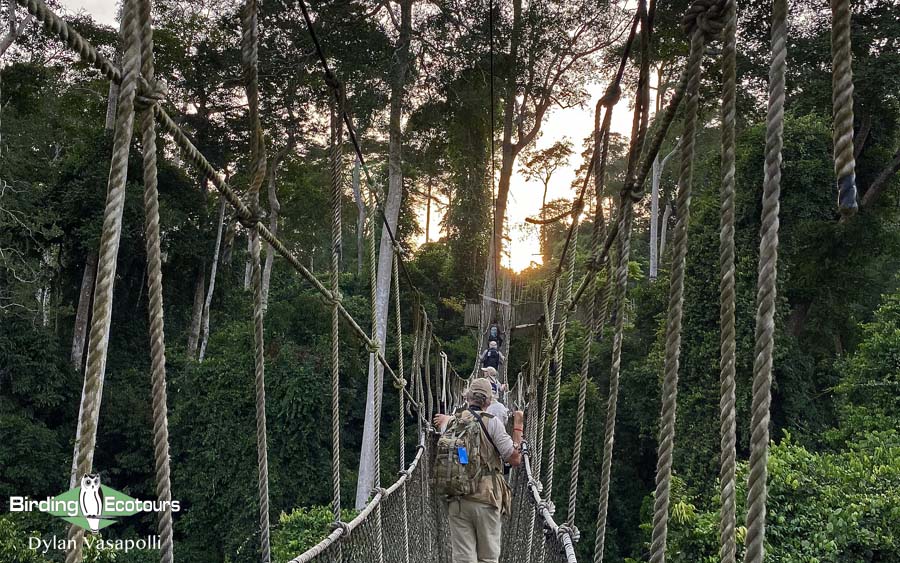
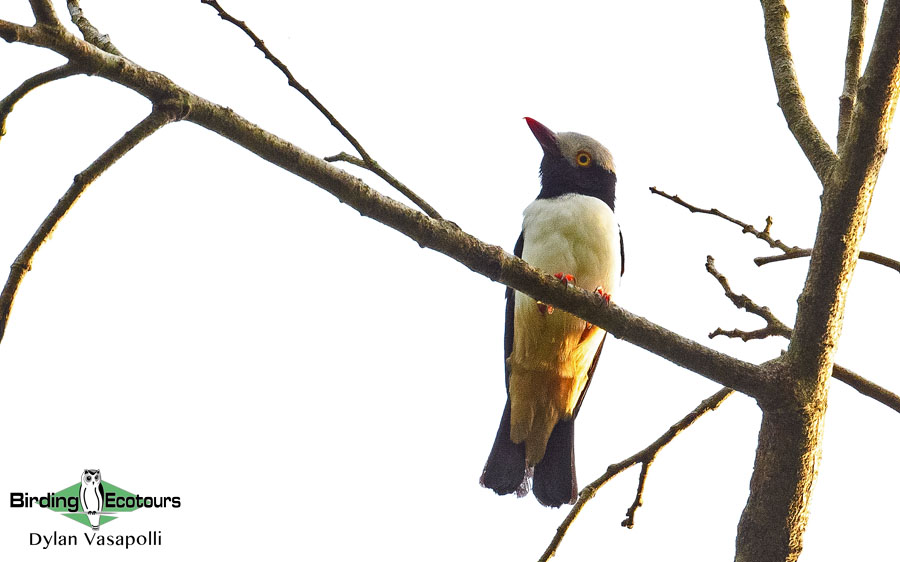
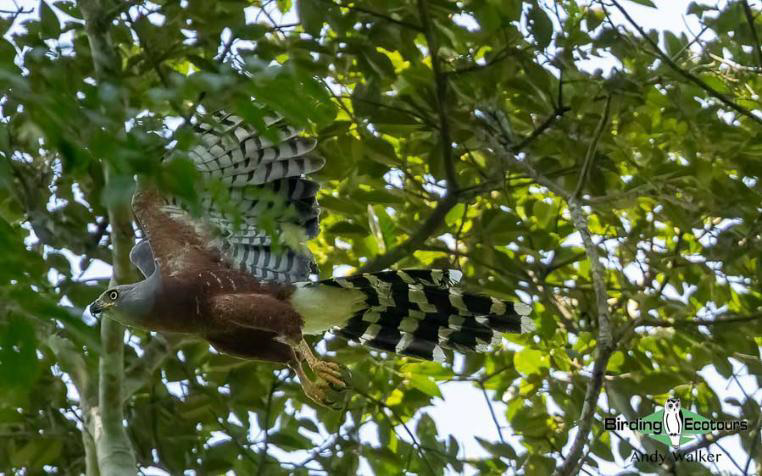
We’ll spend a good amount of time birding the nearby canopy walkway of Kakum National Park, which makes seeing some of the canopy birds much easier than usual! Please be aware that it is a very steep, rocky ascent to get to the walkway (and return from it). Our time spent on the canopy walkway usually includes the likes of Blue Cuckooshrike, Grey Parrot (it’s truly wonderful seeing this popular cage bird in the wild!), three nigrita species (interesting West African finches), the truly magnificent Long-tailed Hawk, Congo Serpent Eagle, Violet-backed Hyliota, Forest Penduline Tit, Tit Hylia, the beautiful Yellow-spotted Barbet and the strangely named Hairy-breasted Barbet, Brown-cheeked Hornbill and the monstrous Black-casqued Hornbill (it’s quite something to hear their heavy wingbeats), White-headed and Forest Wood Hoopoes, Rufous-crowned Eremomela, Chestnut-capped Flycatcher, Sharpe’s Apalis, West African Batis and a host of other West African birds. Ussher’s Flycatcher is often present as they hawk insects from the wires keeping the walkway upright.
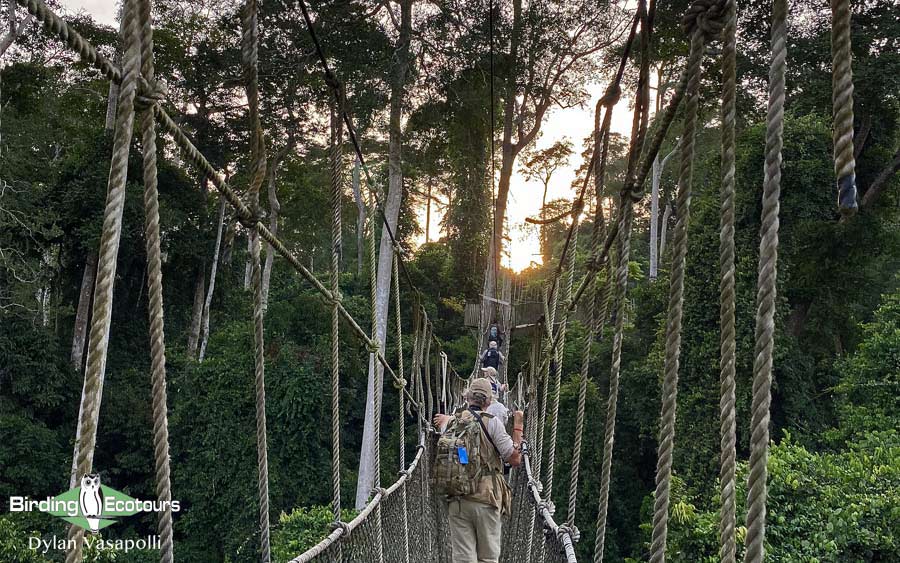 Sunrise on the canopy walkway in Kakum National Park provides unparalleled views.
We’ll also be sure to spend enough time birding from the forest floor in the surrounding sections of the park, and in the general area. One of the biggest stars is always Rosy Bee-eater, the beauty of which almost defies belief. Blue-headed Wood Dove, Blue-throated Roller, Orange-breasted Forest Robin, Red-billed Helmetshrike, and Yellow-billed Turaco are also wonderfully colorful. It’s a paradise for hornbills, and we hope to get acquainted with Western Long-tailed and Piping Hornbills, in addition to the other species mentioned above. Two species of bristlebill (unusually good-looking greenbuls) are usually present. White-spotted Flufftail skulks on the forest floor but is not quite as elusive as most other flufftail species. Melancholy and Fire-bellied Woodpeckers, and various cuckoos, including the brilliant Olive Long-tailed Cuckoo and the equally amazing (rather tiny) Yellow-throated Cuckoo, are quite possible.
White-tailed Alethe is often seen on the forest floor. Two bat-like swift species, Sabine’s and Cassin’s Spinetails, flutter over the forest, and if we’re very lucky, we may see the rare Black Spinetail as well. The list continues, though, as we might also see Black-winged Oriole, Purple-throated Cuckooshrike, Black-bellied Seedcracker, Willcocks’s Honeyguide, and plenty more. Night birding in this area can generate Long-tailed and Brown Nightjars, and both Akun and Fraser’s Eagle-Owls.
Overnight: Rainforest Lodge, Jukwa (or similar)
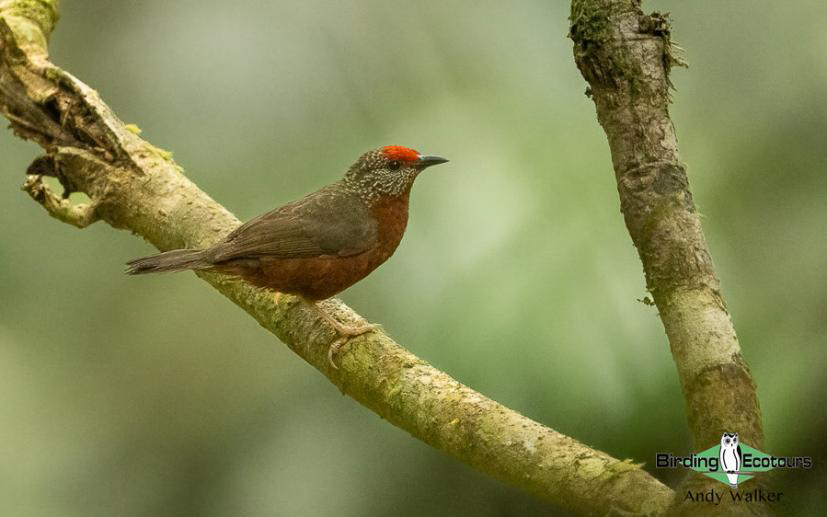
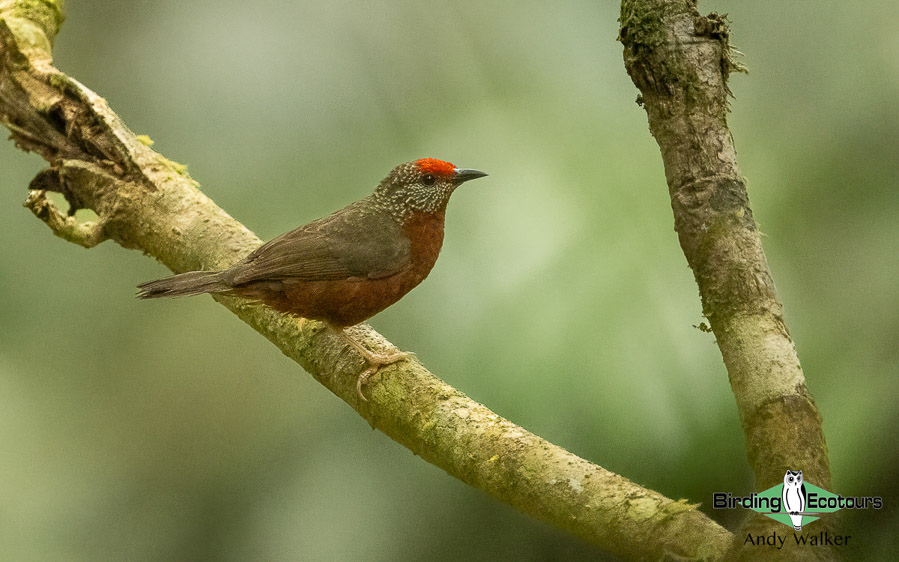 Red-fronted Antpecker is a tough and highly desired forest dweller.
Days 8–10. Ankasa National Park – supreme West African forest birding
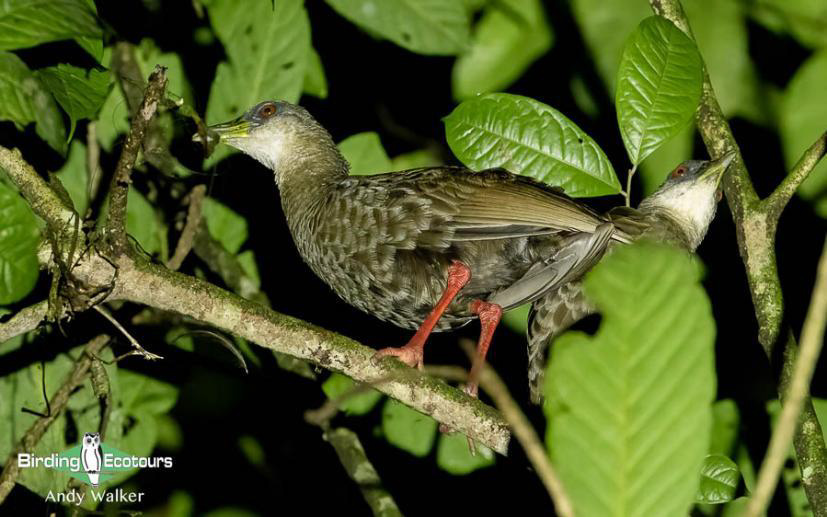
The still wild Ankasa National Park has the most pristine forest of the trip, and it’s worthwhile for the star birds we find here. Our accommodation and the food here are also excellent. White-breasted Guineafowl might put in an appearance, but this is an extremely difficult bird to pin down and we’ll need a good dose of luck. Nkulengu Rail will get a lot of attention from us, and hopefully we’ll manage to get decent visuals on this species (usually at night on their roosts). Grey-throated Rail and the scarce Spot-breasted Ibis are also possible.
Very beautiful kingfishers abound. We might see Shining-blue Kingfisher beside a quiet pond, and we usually also find White-bellied Kingfisher and Chocolate-backed Kingfisher. These waterbodies inside the forest may also produce Hartlaub’s Duck, African Finfoot or White-crested Tiger Heron.
We have stacks of greenbuls to find, including the sought-after Yellow-bearded and Western Bearded Greenbuls, and two bristlebill species. We will also attempt to see the ultra-shy Rufous-winged and Blackcap Illadopsis, with their pleasant, liquid calls, not to mention Black-throated Coucal, the truly huge Great Blue Turaco, Lagden’s Bushshrike, Blue-headed and Dusky Crested Flycatchers, and Crowned Eagle. Red-fronted Antpecker is always a big star should we be lucky enough to find it, as are groups of Red-billed Dwarf Hornbills and the displaying Rufous-sided Broadbill. With some dedicated searching, Red-chested Owlet can be seen, and the shy Orange-breasted Forest Robin, while common, will take much patience to see well.
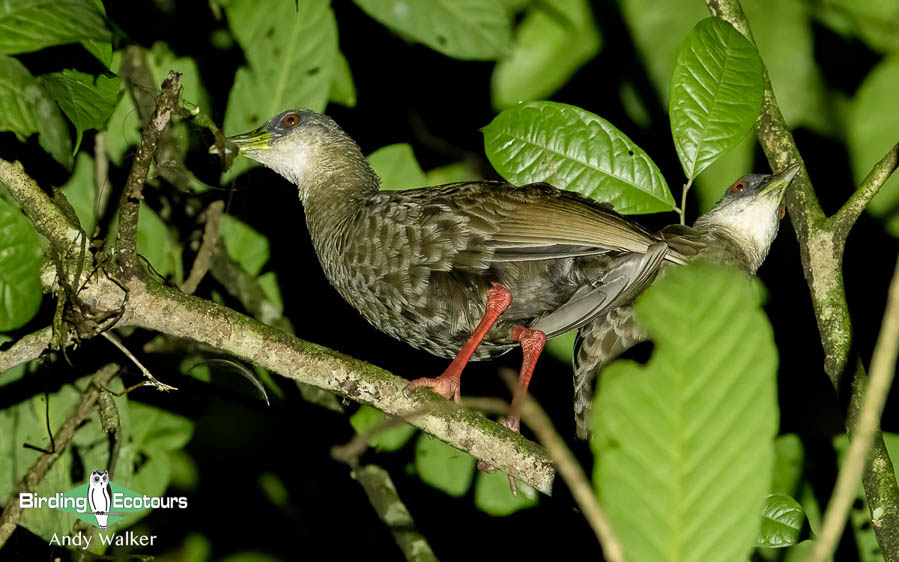 Nkulengu Rail is a mega African species we’ll try very hard for during our time at Ankasa.
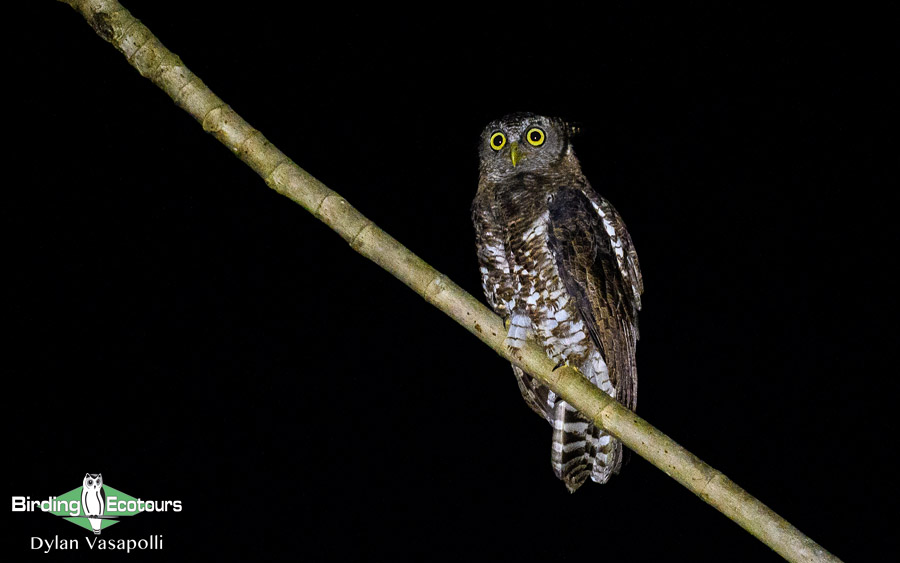
Akun and Fraser’s Eagle-Owls occur, and should we still need these species, we’ll be sure to put some time in during evenings to track them down. We might even get really lucky while spotlighting and find something unusual like a roosting Latham’s Francolin!
Overnight: Ankasa Reserve Lodge, Ankasa (or similar)
Day 11. Ebi Mangroves and Brenu Beach en-route to Jukwa
We’ll likely spend the morning birding in the Ankasa National Park (depending on what we still need) before we start heading back eastward to Jukwa. Nearby wetland areas usually deliver further prized species including African Pygmy Goose, Hartlaub’s Duck, Allen’s Gallinule, Orange Weaver and both Reichenbach’s and Mangrove Sunbirds. Next on the agenda are some desirable species in the Brenu Beach area, such as Pied-winged and Preuss’s Cliff Swallow, the brightly colored, absolutely brilliant, rather strange Oriole Warbler, Marsh Tchagra, and Baumann’s Olive Greenbul. Depending on how we’ve done with the owls on the trip so far, we have further chances for the sought-after Akun and Fraser’s Eagle-Owls after dinner.
Overnight: Rainforest Lodge, Jukwa (or similar)
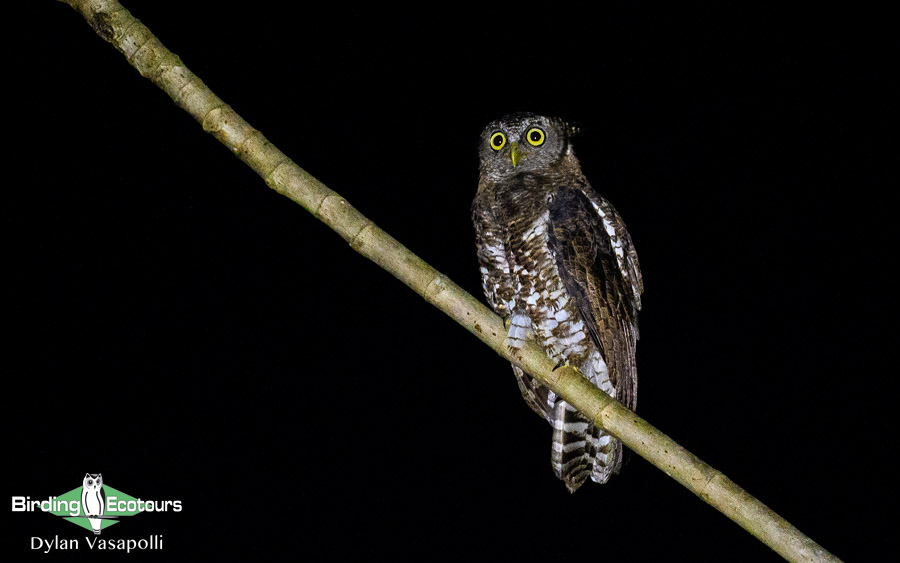 Night time searches during the trip will hopefully turn up the scarce Akun Eagle-Owl (pictured) along with others like Fraser’s Eagle-Owl.
Day 12. White-necked Rockfowl (Picathartes) vigil – the most anticipated day of the trip
The two species of charismatic, cave-roosting and cave-nesting rockfowl (picathartes) are both restricted to the rainforests of West and Central Africa and belong to a unique bird family, making them highly sought-after targets for birders. The site we visit is arguably the best place on earth to find White-necked Rockfowl – we have had a 100% success rate so far – as we patiently wait in the late afternoon for the birds to come to their roosting and nesting site deep in the forest.
While this is easily the main target for the day (and probably the trip!), it is a day that will likely feature many other birding stops as we make our way up to the Bonkro village for the rockfowl. Birding nearer Kakum National Park in the morning may yield the likes of White-spotted Flufftail, Red-cheeked Wattle-eye, Tit Hylia, Blue-shouldered Robin-Chat and Black-bellied Seedcracker, amongst others. A stop further along at the Pra River will also hopefully yield the ‘West African race’ of Rock Pratincole, along with White-bibbed Swallow. We’ll arrive in the afternoon at Bonkro, and make our way to their roost towards the end of the day.
Overnight: Picathartes Guesthouse, Bonkro (or similar)
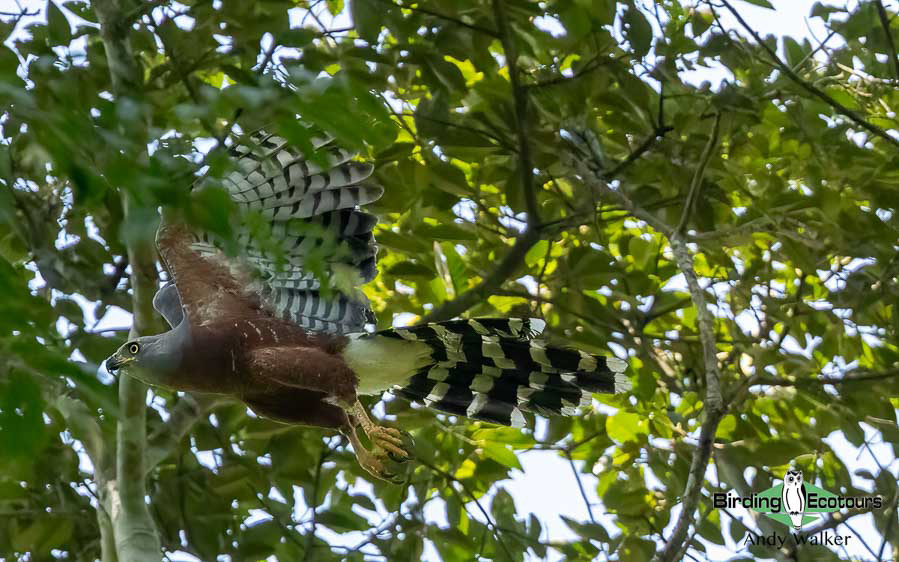 The highly sought-after (and very shy) Long-tailed Hawk is difficult to pin-down. Bonkro and Bobiri Butterfly Reserves are two of the better sites to find this bird.
Day 13. Birding Bonkro and Bobiri Butterfly Reserve
After our memorable evening watching the strange and incomparable White-necked Rockfowl, we have the morning to spend birding and exploring this excellent forest patch. While the rockfowls are unlikely to be seen this morning, we will focus our efforts on trying to find the other tricky species that occur. Blue Cuckooshrike whistles from the canopy, while Red-billed Helmetshrike flop lazily over clearings and, with some careful searching, both the tiny Lemon-bellied Crombec and scarce Kemp’s Longbills can be coaxed from the thickets. Several forest weavers, namely the localized Preuss’s Weaver along with Maxwell’s Black and Yellow-mantled Weavers are also reliably sought here.
We will make the transfer to the sprawling town of Kumasi, where we will spend the night – but not before ensuring we get some quality time in at the local Bobiri Butterfly Reserve. While the butterfly show is good, the birding is even better here, and slowly walking along the road will be sure to net us many exciting species. Foremost of our targets is likely to be Black Dwarf Hornbill and the tiny African Piculet. This is also a great site for the mega Long-tailed Hawk, and it should give us further chances for the likes of Narina Trogon, Forest Wood Hoopoe, Yellow-footed Honeyguide, Chestnut-capped Flycatcher and White-tailed Alethe, amongst others. Difficult-to-see Latham’s Francolins are also possible here, but seeing this shy ground-dwelling bird requires a big dose of luck.
Overnight: Kumasi hotel
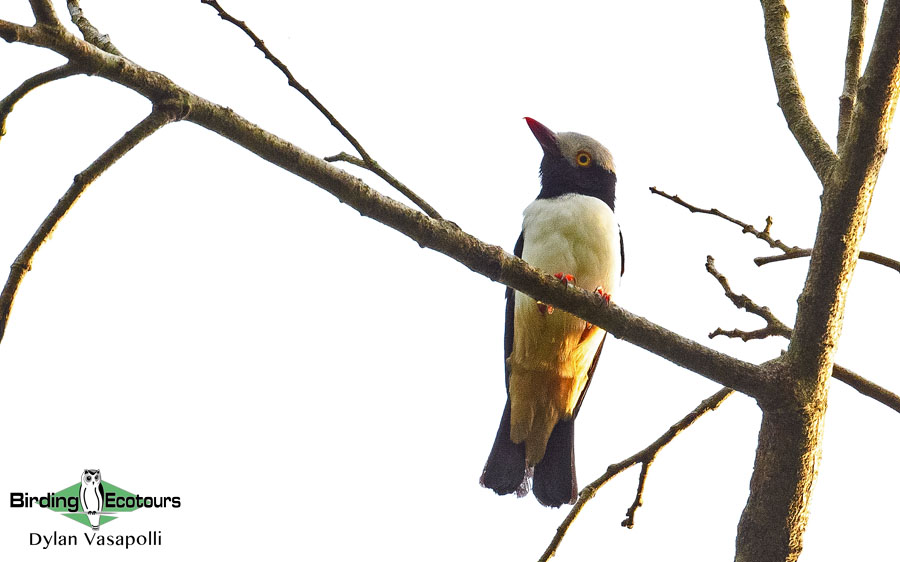 The scarce Red-billed Helmetshrike, like other members of the helmetshrike family, are always entertaining and well enjoyed by the group.
Days 14–16. Mole National Park – from forests to savanna
En route to the savannas and dry woodlands of Mole National Park, we stop at Opra Forest, where the massive Fiery-breasted Bushshrike is a real highlight. Other possibilities include the hulking Thick-billed Cuckoo and tiny Cassin’s Honeybird, along with a variety of other species. The drive to Mole takes up much of the day, and we expect to arrive during the afternoon. This superb game reserve in northern Ghana offers a whole new suite of birds, as well as elephants, crocodiles, and plenty of other wildlife.
The truly spectacular Standard-winged Nightjar is one of Mole’s most famous avian specials and requires dedicated night drives to find. The West and Central African endemic, Forbes’s Plover, is also sought here, sometimes alongside the scarce Sun Lark. If we’re lucky, White-throated Francolin, Abyssinian Ground Hornbill, Four-banded Sandgrouse and the nomadic Rufous-rumped Lark can be seen in these more open areas as well.
We will be sure to spend some time birding the more mature wooded areas, both around the hotel, and further afield. Core targets in this environment will be the scarce African Spotted Creeper (more of a miombo woodland bird in southern Africa), White-fronted Black Chat, the difficult trio of Emin’s Shrike, and Rufous and Dorst’s Cisticolas, along with Fine-spotted Woodpecker, White-crested Helmetshrike, White-breasted Cuckooshrike and Brown-rumped Bunting. More common and beautiful species also abound, and we’re likely to see Red-throated Bee-eater, Bearded Barbet, Grey-headed Kingfisher, African Golden Oriole, the extravagant Long-tailed Glossy Starling, White-crowned Robin-Chat, both Pygmy and Beautiful Sunbirds (with their extravagantly long tails) and a number of colorful finches including Red-winged Pytilia, Orange-cheeked and Lavender Waxbills, Black-faced and Bar-breasted Firefinches and if we’re lucky an Exclamatory Paradise Whydah.
The wetland in front of our hotel regularly brings in African Elephants and often has a wide range of birds, including African Openbill and Senegal Thick-knee in attendance. Raptors can also be sought in the park, and we’ll be sure to keep an eye out for Beaudouin’s Snake Eagle, Western Banded Snake Eagle, White-headed Vulture, Bateleur and the dry-country specialist, Grasshopper Buzzard. Our night time searches for Standard-winged Nightjar are likely to produce other species, and in particular, we’ll keep an eye out for African Scops and Northern White-faced Owls and Greyish Eagle-Owl, along with Long-tailed Nightjar.
Overnight: Mole Motel, (or similar) with a view over Mole National Park’s savanna.
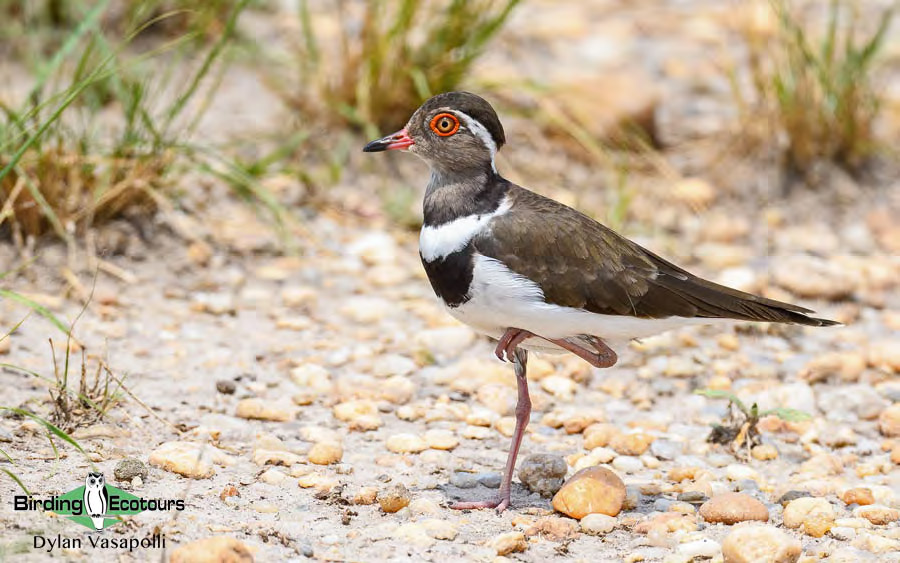 Forbes’s Plover is a special of equatorial West Africa, occurring on the dry plains in Mole.
Day 17. Transfer to Bolgatanga, via Tongo Hills
After two full days, and a final morning today, of safari drives and walks in Mole National Park, we’ll bid farewell to this fine reserve, and journey right the way to the Burkina Faso border in the far north of the country. While we have a fair drive ahead, there’ll be time for birding stops, with targets in the increasingly arid vegetation including Red-necked Falcon, the good-looking Fox Kestrel, the well-named Rock-loving Cisticola, Chestnut-backed Sparrow-Lark, striking Mocking Cliff Chat and Gosling’s Bunting.
Overnight: Bolgatanga hotel
Day 18. Egyptian Plover on the White Volta River
We make an excursion right to the northern border of the country, where we look for what is usually regarded as another of the top birds of our Ghana birding tour – the spectacularly plumaged Sahelian special, Egyptian Plover. The dry and arid habitats up here are different from anything we will have encountered so far, meaning we’re bound to add a lot of other birds to our growing list. The pickings include a number of seedeaters such as White-billed Buffalo Weaver, African Silverbill, the aptly named Cut-throat Finch, White-rumped Seedeater etc. However, the stunning Abyssinian Roller, with its spectacular tail streamers and bright colors, and the even more dazzling Northern Carmine Bee-eater are generally the most admired. Black-headed Lapwing and Four-banded Sandgrouse are usually very popular, though, and if we’re lucky, we may also find Greater Painted-snipe, African Green Bee-eater and Yellow Penduline Tit, amongst many more.
Overnight: Bolgatanga hotel
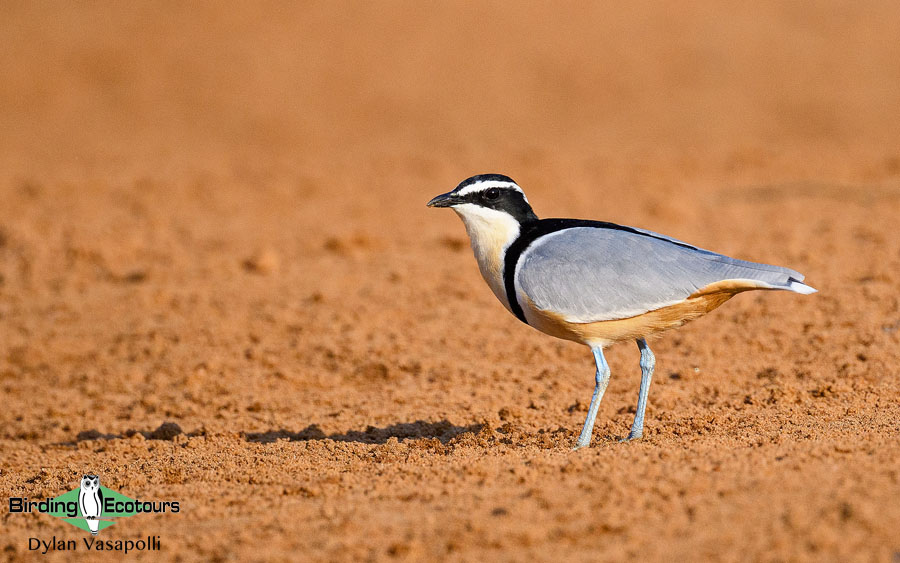 Egyptian Plovers are usually present on the White Volta River in the north of the country. This is another big attraction for birders and make this one of the most desired species on the trip.
Day 19. Flight to Accra
We have a final morning of birding available to us in the Bolgatanga area – searching for any species we may still need (which might include African Green Bee-eater), before we make the drive to Tamale. From Tamale, we will catch a domestic flight back to Accra in the afternoon (cutting out an otherwise long and arduous two-day drive).
Once back in Accra, we’ll settle in at our comfortable hotel, and reminisce about the good times and excellent birds we’ll have found.
Overnight: Accra hotel
Day 20. Departure from Accra
The day is set aside for your departure, and you are welcome to depart at your leisure. The tour officially ends after breakfast with no birding activity included.
Overnight: Not included
Please note that the itinerary cannot be guaranteed as it is only a rough guide and can be changed (usually only slightly) due to factors such as availability of accommodation, updated information on the state of accommodation, roads, or birding sites, the discretion of the guides and other factors. In addition, we sometimes have to use a different international guide from the one advertised due to tour scheduling or other factors.
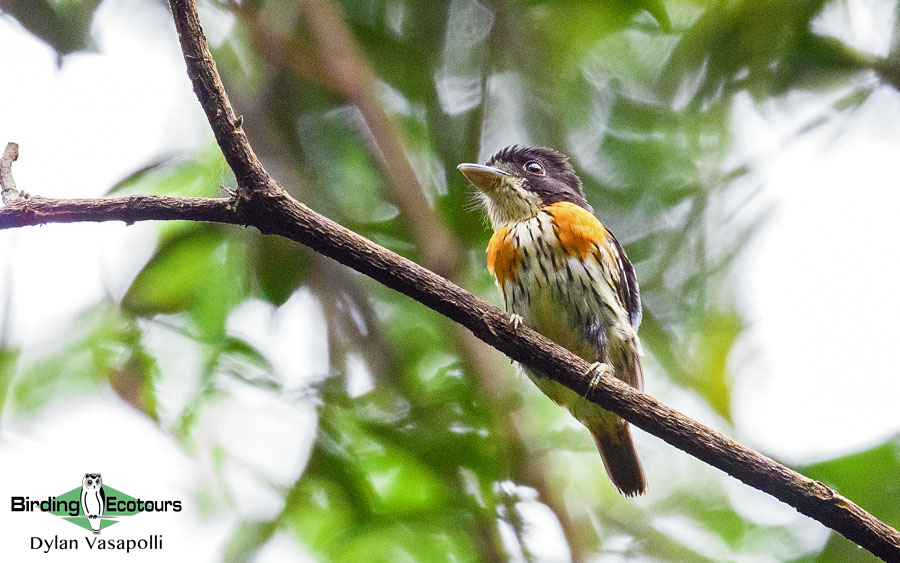 Watching a Rufous-sided Broadbill displaying is a highlight in the forests of Ghana. This is one of many sought-after species we’ll be searching for on this exciting and comprehensive Ghana birding tour.
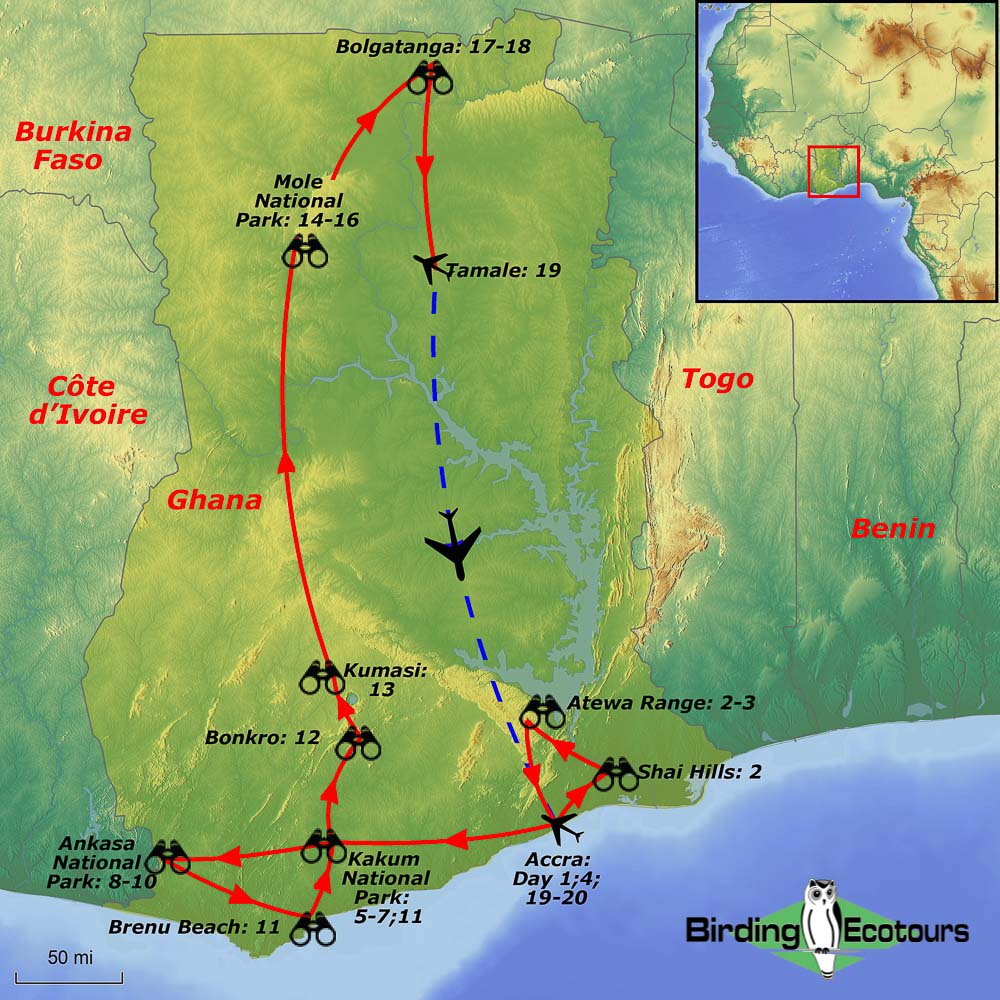
Map
Testimonials
Gallery
General Information
Ghana: Upper Guinea Forest to the Sahel
General Information
INTRODUCTION
Ghana is arguably the best and most accessible country from which to access West Africa. Many highly sought-after species can be found here, and virtually nowhere else, and indeed makes this an exciting birding tour. This tour begins and ends in the capital city, Accra (on the Ghanaian coastline). The bulk of the birding takes places in forests, with almost all birding on the tour being on our feet, out walking. Forest birding can be difficult with quick views of most birds in a dark environment skulking, or high against the canopy flitting about. Some time is also spent in more arid open wooded environments farther north in the country which generally allows for easier birding. Photography opportunities are usually very poor in the forests, though are better in the more open northern regions.
It needs to be stressed that this is a challenging tour, with oppressive heat and humidity, which takes a toll. Travel is also slow in this rural African country, and there are several long travel days with little birding possible.
PASSPORT AND VISA
Your passport must be valid for a period of at least six months after the date of your arrival in Ghana. Please make sure that there is at least one full empty page available in your passport. Please make sure that you also bring a photocopy of your passport, to be kept in a different location from your passport, in case of loss. Most non-African countries require a visa which needs to be arranged in advance, while most African countries are either exempt or can obtain a visa on arrival. Please make sure you find out accordingly, and well in advance of your tour.
Birding Ecotours can assist in providing documentation to confirm your participation on the tour, in support of your visa application. The onus is on you, as a client, to secure your visa to travel here.
TRAVEL INSURANCE
We require (see Birding Tours Terms and Conditions – Birding Ecotours) that you purchase trip cancellation insurance in case you have to cancel due to illness just prior to the tour departure date, to protect yourself against accidents, illness, loss of valuables, luggage etc. and travel interruptions or delays of all kinds. Allianz Travel and Generali Global Assistance are two options to consider.
HEALTH/MALARIA
Please carefully read the Center for Disease Control (CDC) information for travelers to Ghana (or your government’s equivalent health travel advice for Ghana). Below we have mentioned a couple of specific items but first and foremost kindly be advised by the updated information at the above link.
Required immunizations for travel to Ghana: yellow fever vaccine.
It is recommended that you are up to date with all routine vaccines, such as polio and measles-mumps-rubella (MMR). Additionally, it is also recommended getting vaccines for Hepatitis A and B, meningitis, rabies and typhoid. Please keep in mind that if you have not had any of these, one should make sure that you have been inoculated at least six weeks prior to your trip to take full effect.
Malaria
We strongly recommend anti-malaria drugs for travel to Ghana. Note that as per the CDC, Chloroquine prophylaxes are not effective here. The following are recommended chemoprophylaxis: atovaquone-proguanil, doxycycline, mefloquine and tafenoquine. Please consult with your doctor.
Mosquito repellant, long trousers/jeans and long-sleeved shirts, particularly at night when malaria (Anopheles) mosquitos bite, are advised, in addition to the drugs.
MEDICAL CONDITIONS
Please make sure that you are covered with medical insurance in case of an emergency while on these trips. Without insurance the cost of medical care can be extremely high.
Please notify us at the time of registering for the tour of any medical conditions you think we should know about (including allergies, heart conditions, epilepsy, etc.). This will greatly help us to cater to your needs.
WATER/FOOD
We provide unlimited bottled water in the tour vehicles, and you are welcome to take water from the vehicle for evenings when not provided in the hotel rooms. More expensive bottled water at restaurants is excluded from the tour cost and is for your account, but (again) you can take water from our tour vehicle whenever you want.
The bulk of our breakfasts and lunches will be enjoyed at our hotels and lodges throughout the tour (including roadside restaurants for some lunches). Very occasionally, packed breakfasts and packed lunches will be required as well (but this is infrequent). Dinners are always held at our hotels or lodges.
Kindly note that breakfasts are usually held early in the morning (before sunrise and our birding; between 05h00-06h00). There are generally big gaps between meals (6+ hours), and bringing various snacks (such as cereal bars, trail mix etc.) is recommended.
As always, please do inform us if you have any food allergies or other dietary requirements. Kindly note, that we cannot guarantee these can be accommodated throughout the tour. Ghana is a rural African country that has extremely limited availability (or none at all) of specialist foods (such as for gluten intolerance etc.). If you have special requirements/allergies, we kindly ask if you can bring along appropriate/replacement foods, as it is often impossible to purchase in the country.
A special note needs to be made that meals are often prepared on the ‘spicier’ side, regardless of requests to have no/mild spice. Meals are generally not very exciting, consisting of largely rice, a limited sampling of vegetables, chicken or fish.
CURRENCY AND MONEY
The Ghanaian cedi (GH₵) is the official currency, and it is suggested to ensure you have sufficient cash in local currency to cover expenses such as drinks, tips, and for other items of a personal nature (such as gifts). Credit cards are not widely accepted for payment.
You will only be able to exchange currency at the airport upon your arrival in Ghana however if you need to withdraw money this can be done at the airport upon your arrival or when we pass through larger towns during the tours. Visa and Mastercard are accepted for drawing cash from ATMs. Note: US and Canadian dollars, pound sterling and euros cannot be used for purchases.
WEATHER
Conditions will be hot and very humid throughout the tour. The forested coastal regions (from the coast until Kumasi) experience high temperatures (nearing 400C/1000F) with high and oppressive humidity. In the northern regions (Mole NP and Bolgatanga) we can expect high temperatures (nearing 450C/1100F) with low humidity. As always, it is good practice to ensure you have some warmer clothes, as some folks may feel the need for a jersey/jacket in the evenings, and a raincoat. Although we visit during the dry season, unseasonal rain is not impossible.
Please be aware that the high heat and humidity make this tour challenging.
ELECTRICITY
The standard voltage is 240 V. If you intend to recharge video batteries etc. in your hotel room you will need an international adapter. Note that in Ghana, the power plug sockets generally make use of either Type D, or Type G (see link).
All of our hotels/lodges will have access to electricity throughout the day/night, and many have backup generators, in case of power failures or power outages. Remember, this is rural Africa, and sometimes the electricity does go out.
A good torch will also be useful if you fancy joining us for a night walk or drive. If you intend to do any trips, you’d be advised to bring at least one good torch, preferably with a strong beam. All the places we will stay at will have electrical outlets for chargers and laptops.
INTERNET/WIFI
Most of the hotels and lodges we stay at have access to Wi-Fi internet, and cell signal. Kindly note that in many places, the Wi-Fi is not accessible from your rooms, but only the main reception area/dining area.
Please note that our lodgings at Ankasa and Bonkro have extremely limited cell service (virtually non-existent), and no Wi-Fi.
LENGTH OF DRIVES
Kindly note that this tour takes place in a third-world country, and roads are often narrow, potholed and very busy. Do not expect highways and quick travel between destinations. Unfortunately, this does mean we will spend quite a bit of time in the vehicles, travelling to and from birding sites, and transiting between destinations. Additionally, there are a few days with particularly long drives (more than half the day) – such as transitioning up to Mole National Park and Bolgatanga.
Air-conditioning is available in our tour vehicles.
Some roads can be dusty so please consider bringing a scarf (or other measures) in case you are birding along an unpaved road and a car goes past putting up dust.
WALKING
There is a lot of walking needed on this tour. Almost all our birding sites require birding from foot, as opposed to from vehicles, and will require us being on our feet for several hours at a time. Much of our birding is done in forests, and we do have to venture off trail (into the forest/bush) to track down certain species regularly. The high heat and humidity generally make walking a challenge.
Participants should be able to manage these conditions, and most importantly be comfortable on their feet for many hours at a time.
Note that the Kakum Canopy Walkway is high above the ground, and requires one to navigate many very steep stairs to get to the top. The full day hike up the Atewa Range is also very challenging (probably the most challenging day of the trip) with a steep dirt-track ascent required for the entire journey up (at least four miles (six kilometers) each way).
PACE OF TOUR
This is a very intense tour, with long days required virtually every day.
We will generally start the days off early, with a pre-dawn breakfast, before spending the full morning birding – as we try to maximize the morning coolness, before the heat sets in. We usually return to our hotels/lodges for a lunch-break (and a short siesta during the oppressive midday heat). We then typically resume in the mid/late afternoons, but note that the afternoons are usually hot. Kindly be aware that due to the rural nature of Ghana, most of our birding sites require some driving to reach from our hotels/lodging.
Several nocturnal trips are also undertaken to search for various nightjars, owls and other exciting nocturnal creatures.
It is possible to opt out of some activities, should you not feel up for it, but this generally won’t be possible on the days where we transit between accommodations.
ACCOMMODATION
Please note that the accommodation used on this tour ranges from ‘standard’ to ‘basic’ (and below the standard we use on virtually all our other tours, especially those we use on our southern/East African tours). Despite this, en-suite bathroom facilities are available throughout the tour. Ankasa Reserve Lodge is an exception, as this is an upmarket, high-quality lodge.
Kindly be aware that two new establishments; Ankasa Reserve Lodge and Picathartes Guesthouse (in Bonkro) have limited rooms, and depending on total participants and the structure of single versus sharing clients, participants may need to share rooms. These two new lodges are necessary as they cut out a significant amount of what would otherwise be extra driving time.
WHAT TO BRING
Clothing Casual and informal dress is fine in the hotels. Loose lightweight, breathable field clothing works best, with a warm fleece or jacket for cooler weather. As mentioned before, it is good practice to bring some warmer clothing, certainly a minimum of a warm fleece and a rain jacket. Rain is always a possibility, so an umbrella and or rain gear is always useful to have.
* Note that cotton clothing is suggested (versus the quick-dry nylon clothing) due to cotton being more breathable in the high heat and humidity expected.
Laundry can be done at all establishments throughout the tour (at your expense) – but please note that a lead time of at least one day is needed (it is therefore impossible to get laundry done if we stay at a hotel/lodge for only a single night – but is possible if we have two nights or longer).
Sunglasses, sunhat and sunscreen (rated SPF 30 or higher) are essential. A pair of trousers or a long skirt, and a long-sleeved shirt should be included to help protect against forest vegetation and the sun. Swimwear can be brought as there are swimming pools at some of the lodges.
We would recommend lightweight walking boots for when out on foot, and bringing a second pair is often useful. Please ensure that whatever footwear you bring, that it is comfortable, as much time is spent on your feet on this tour. You might like to consider sandals/Tevas as well, for use around the hotels/lodges.
Do not forget – BINOCULARS, prescription drugs (also bring the generic names for these drugs), toiletries, prescription glasses (and a spare pair), insect repellant, camera, flashlight, batteries (for electronic equipment and chargers for the re-chargeable batteries), plug adaptors, alarm clock, mosquito repellant, money pouch, field guide(s), a soft-sided duffle-style luggage bag is recommended (hard-sided luggage is not always ideal), daypack/backpack, and your favorite road snacks!
Key documents and cash – Passports, your travel or health insurance cards (you can send us copies to file in case of emergency), credit cards – Visa and Mastercard are best – see above, US dollars, euro or pounds can be exchanged for local currency at the airport as you arrive into the country (if you prefer not to simply draw from ATMs), cash for drinks, gifts, tips, items of a personal nature etc.
Luggage – Due to restricted space in the vehicles, please pack as lightly as possible. A medium-sized, soft-sided duffle bag (not the hard-sided cases) works best for packing in the vehicles. This allows us to better fit the bags. Please bring a daypack to keep items that you wish to use or need on a daily basis. Additionally, we make use of a domestic flight to transfer back to Accra, and there is usually a limit imposed of one check-in bag, weighing ~40 pounds (20 kilograms) per person.
Download Ghana: Upper Guinea Forest to the Sahel Information