- Duration:
- 9 days
- Group Size:
- 4–8
- Tour Start:
- Miami
- Tour End:
- Miami
Birding Tour USA: Florida Peninsula – Southern Specials and the Keys
Details
2027
24 April – 02 May
Per person sharing
$5,257 USD
£4,141 GBP / €4,913 EUR
Single supplement
$1,113 USD
£877 GBP / €1,041 EUR
2028
25 April – 03 May
Per person sharing
$5,290 USD
£4,167 GBP / €4,943 EUR
Single supplement
$1,150 USD
£906 GBP / €1,075 EUR
Itinerary
Download ItineraryFlorida Peninsula: Southern Specials and the Keys
On a map, the finger-like state of Florida protrudes prominently from the continental United States, reaching south towards the Caribbean just barely missing Cuba 90 miles (c. 140 kilometers) beyond. To the north, frost-hardy, temperate deciduous forest dominates, while warm bodies of water surround the rest of the state. Together, both climate and geography isolate Florida from the rest of the country. Because of its geographically unique position, Florida is a crossroads between the temperate northern latitudes and the sultry Caribbean tropics with almost tropical forest-like habitat resulting in some fantastic bird watching opportunities. Indeed, about a dozen bird species of West Indian origin reach the northern limits of their range here, while many species typical of more northern latitudes reach the southern edge of their range in Florida. Many of the West Indian species live nowhere else in the United States. We also time our tour in late April, when spring migration peaks and the national parks, botanical gardens and residential areas are teeming with bird life, potentially augmenting our trip list with a wide variety of colorful warblers and charismatic shorebirds.
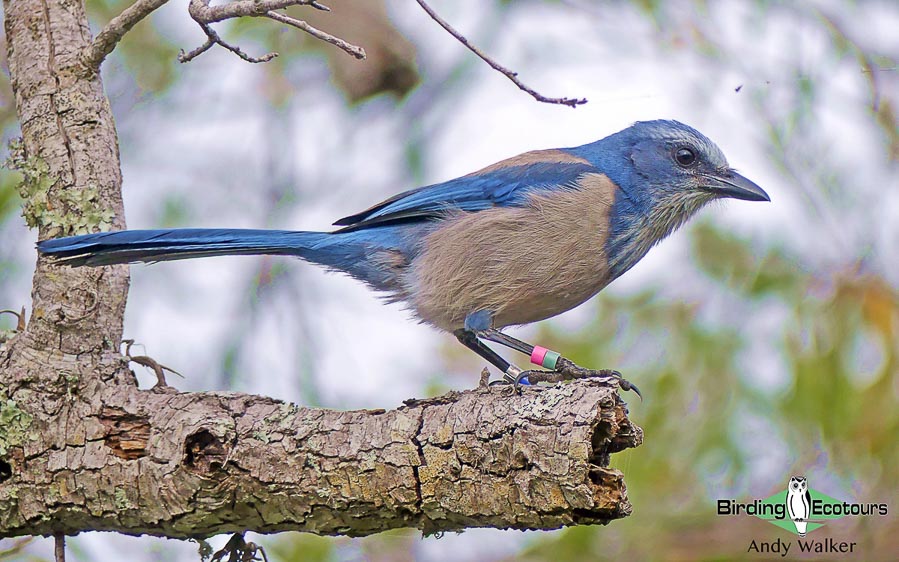
Florida Scrub Jay is a charismatic and quizzical species.
On this tour, we cover the southern two thirds of the state comprehensively in search of the many special birds on offer. We begin by exploring Miami, a city with a decidedly Caribbean flair, in search of several established exotics such as Spot-breasted Oriole, White-winged Parakeet and Red-whiskered Bulbul. In the central/western part of the state, pinelands feature a specialized avian community, including Red-cockaded Woodpecker, Brown-headed Nuthatch and Bachman’s Sparrow. We also explore nearby oak scrub for Florida’s only endemic bird, Florida Scrub Jay. On the last leg of our journey, we explore the tropical hardwood hammocks and mangrove swamps of the Florida Keys in search of Caribbean specials such as Mangrove Cuckoo, White-crowned Pigeon and Black-whiskered Vireo. We also take a day trip to Dry Tortugas National Park, where Sooty Tern and Brown Noddy breed in their thousands. With some luck, many of the sites we visit on this tour may be alive with migrant songbirds, and there is always a chance for a vagrant from the Caribbean like a La Sagra’s Flycatcher or a Western Spindalis to show up.
Itinerary (9 days/8 nights)
Day 1. Arrival in Miami
After arriving at Miami International Airport, you will be transferred to a nearby hotel for the night.
Overnight: Miami
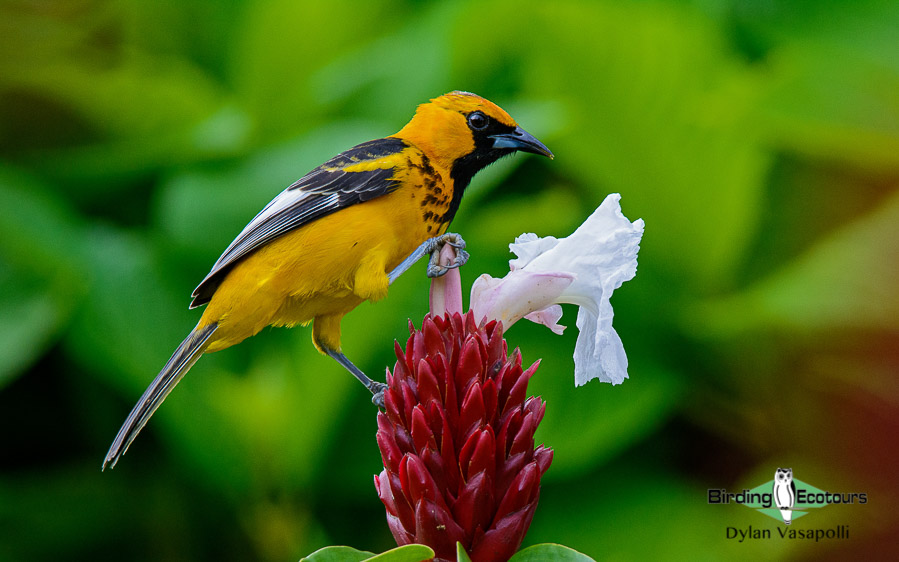 Spot-breasted Oriole is one of the many exotics we will target in the Miami area.
Day 2. Miami and the Palm Beach Area
The nearly tropical climate and exotic vegetation of the Miami-Fort Lauderdale metropolitan area offers a unique landscape of opportunity for a myriad of introduced bird species from all over the world. We spend our first morning in Florida exploring this urban landscape in search of ABA-countable exotics such as Grey-headed Swamphen, Spot-breasted Oriole, White-winged Parakeet, Red-whiskered Bulbul, and Common Myna. However, introduced species are only a small fraction of the avifauna of Miami, a county which claims one of the longest bird lists east of the Mississippi River. Parks, preserves, and even parking lots provide opportunities to see native species like Grey Kingbird, White-crowned Pigeon, and more, along with a supporting cast of migrant songbirds.
After a delicious lunch at a local spot in Miami, we will head north to Green Cay Wetlands and Wakodahatchee Wetlands, two artificially created wetlands that host nearly all of Florida’s water-associated specials: Black-bellied Whistling Duck, Least Bittern, Limpkin, Anhinga, Purple Gallinule, the incredibly beautiful Roseate Spoonbill and more. The rookeries at Wakodahatchee Wetlands should be active at this time of year, providing excellent birding photographic opportunities of nesting herons, egrets, ibises, and storks.
Overnight: West Palm Beach
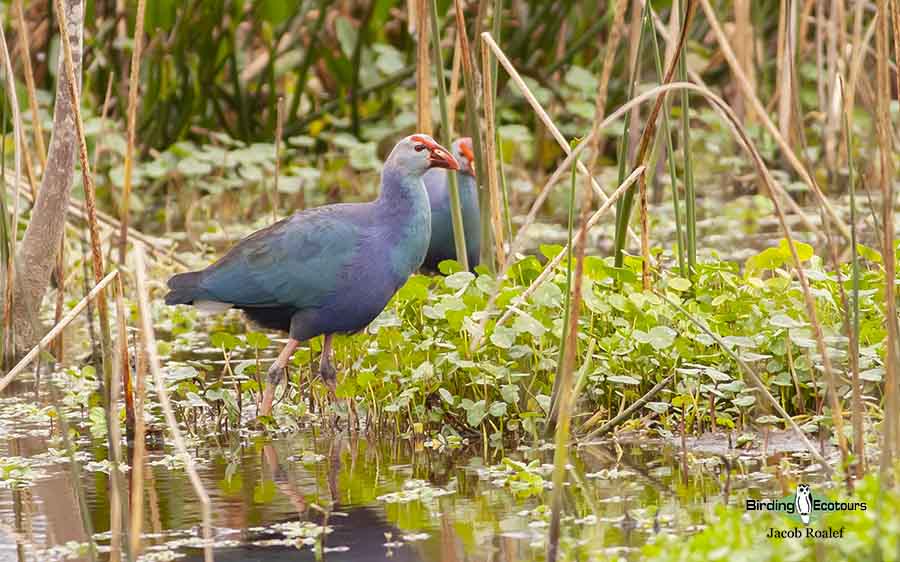 The Palm Beach area usually holds decent numbers of Grey-headed Swamphens.
Day 3. Ocean side to gulf side
We will spend the morning hours birding the ocean (east) side of the Florida peninsula at several local parks, hoping to catch a new batch of migrant songbirds. Depending on how we faired with waders the previous day and how migration fairs for the day, we may head to Loxahatchee National Wildlife Refuge for species such as Roseate Spoonbill, Snail Kite and a shot at Smooth-billed Ani. After lunch, we will spend the slower afternoon birding hours driving across the middle of Florida towards Fort Myers. The late afternoon and evening hours will be spent birding the gulf (west) side of the peninsula, searching the coastline for shorebirds including Snowy, Piping and Wilson’s Plovers, American Oystercatcher, Willet and more.
Overnight: Fort Myers
Day 4. Babcock-Webb and Tamiami Trail
Today will be an early start to ensure our sunrise arrival at the Fred C. Babcock/Cecil M. Webb Wildlife Management Area. This huge tract of land hosts a wide variety of habitats including Florida slash pine, a favorite of several special bird species. We will spend the better part of the morning exploring these pines in search of Red-cockaded Woodpecker, Bachman’s Sparrow and Brown-headed Nuthatch. Following a successful morning at Babcock-Webb, we will then explore one or two other locations to search for the endemic Florida Scrub Jay. Where we go will depend on recent trends and timing.
Afterwards, we start our journey southeast across the peninsula via the Tamiami Trail to Homestead, passing through Big Cypress National Preserve and the northern edge of Everglades National Park. Sites along this road provide excellent opportunities to see King Rail and Snail Kite for our growing trip list.
Overnight: Homestead
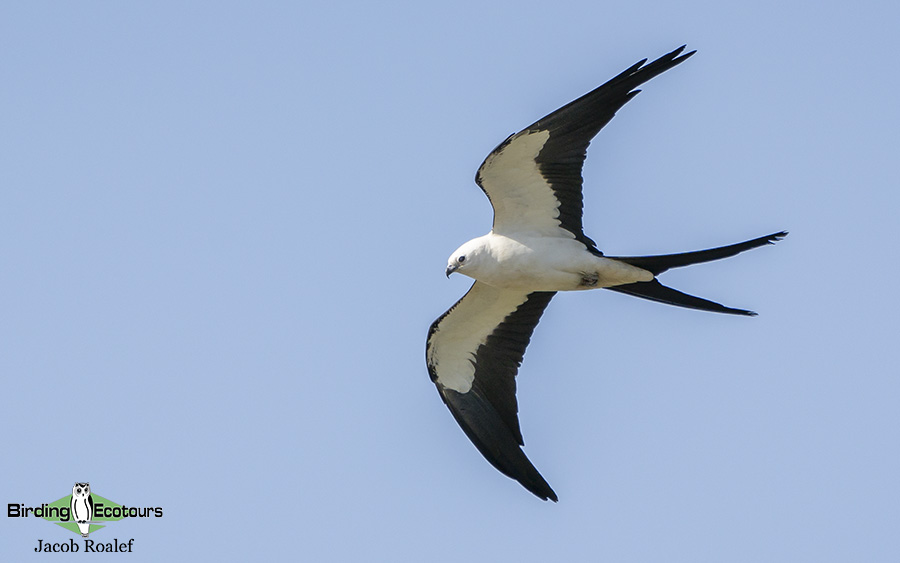 The majestic Swallow-tailed Kite is often encountered on this tour.
Day 5. Everglades National Park
Published in 1947, Marjory Stoneman Douglas’s The Everglades: River of Grass highlighted the uniqueness of the Everglades. Lying at the southern tip of the state, the Everglades is a vast, subtropical sawgrass prairie broken only by cypress domes, tropical hardwood hammocks, pinelands and mangrove swamps. There is nowhere else in the United States with such a decidedly tropical suite of habitats. We bird throughout the day along the length of the main park road that terminates in flamingo campground, exploring these various habitats for several birds, difficult or impossible to see anywhere else in the country, like “Cape Sable” Seaside Sparrow and Shiny Cowbird. American Crocodile is possible at the marina in Flamingo. There will also be an optional birding session after dark to look for Eastern Screech Owl, Barred Owl and Chuck-will’s-widow.
Overnight: Homestead
Day 6. Florida Keys
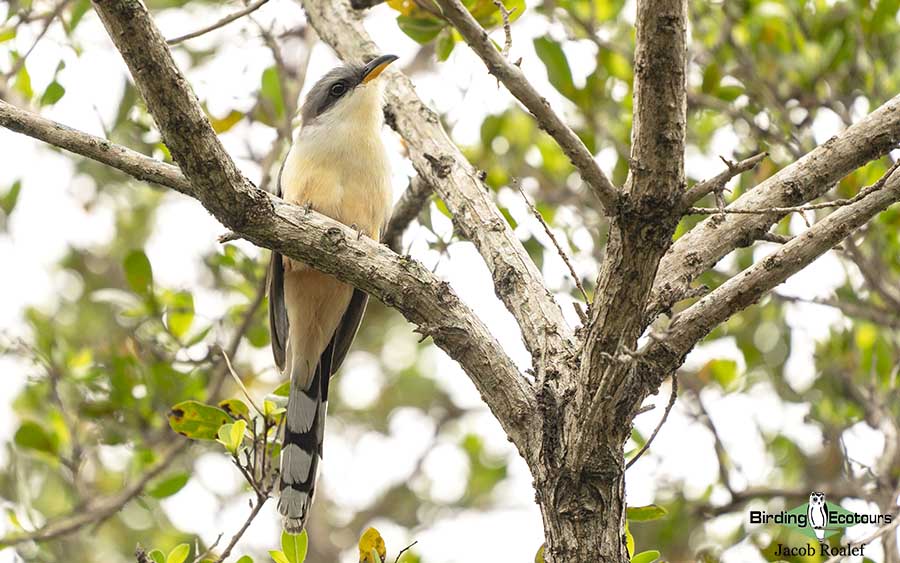
After an early breakfast, we will drive along Card Sound Road to Dagny Johnson Key Largo Hammock Botanical State Park, making a brief stop at a patch of mangroves along the way to look for the Florida race of Prairie Warbler and the Cuban race of American Yellow Warbler. Once slated to become a housing development, Dagny Johnson Key Largo Hammock Botanical State Park protects one of the largest tracts of tropical hardwood hammock in Florida. It is also an important breeding ground for several target species on our tour, particularly the elusive Mangrove Cuckoo and the vociferous Black-whiskered Vireo. For the rest of the day we will keep our schedule open as we make our way south to Key West, to accommodate the presence (or absence) of migrant songbirds or even the possibility of chasing a Caribbean vagrant. Regardless of the status of migration, we visit a breeding colony of Roseate Tern in Marathon and stand vigil in the evening for Antillean Nighthawk in Key West.
Overnight: Key West
Day 7. Dry Tortugas National Park
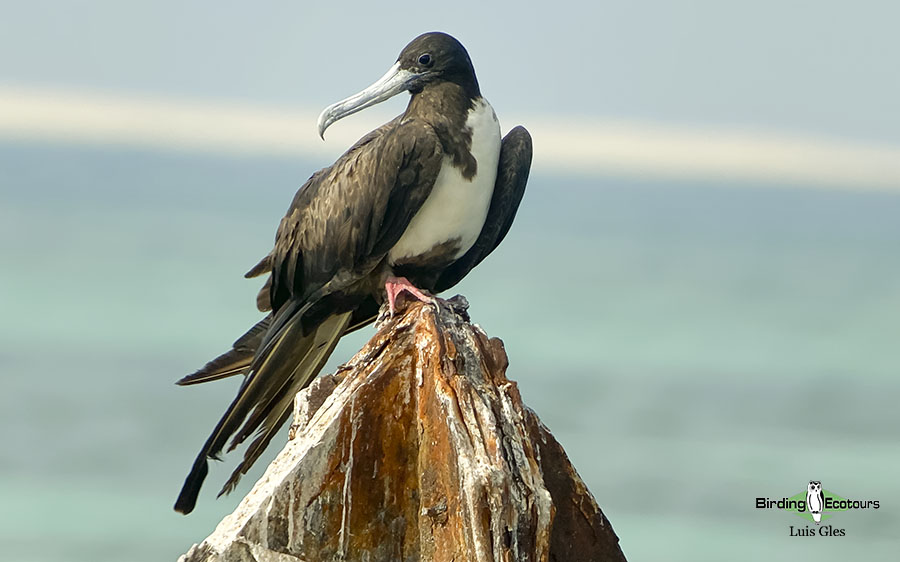
Seventy miles (c. 110 kilometers) west of Key West, the Dry Tortugas National Park consists of a series of tiny coralline islands surrounded by the shimmering aquamarine waters of the Gulf of Mexico. Among birders, these islands are particularly famous for having the only nesting colonies of Brown Noddy, Sooty Tern, Magnificent Frigatebird and Masked Booby in the contiguous United States. We reach these islands via the Yankee Freedom II catamaran on a day trip.
Upon arrival at Garden Key, we have about four hours to enjoy the cacophony and bustle of activity from the seabird colonies on nearby Bush Key as well as marvel at impressive Fort Jefferson, the largest masonry structure in the Western Hemisphere. Due to the isolation of these islands from any land, the parade grounds of this grand fort function as a welcoming oasis for exhausted migratory songbirds including warblers, cuckoos, flycatchers, vireos, tanagers, and buntings. On our return voyage to Key West we make sure to stop at nearby Hospital Key to see the colony of Masked Booby.
We spend a second night in Key West to hopefully allow some time to relax and admire this famous town and perhaps to visit Ernest Hemingway’s home for example.
Overnight: Key West
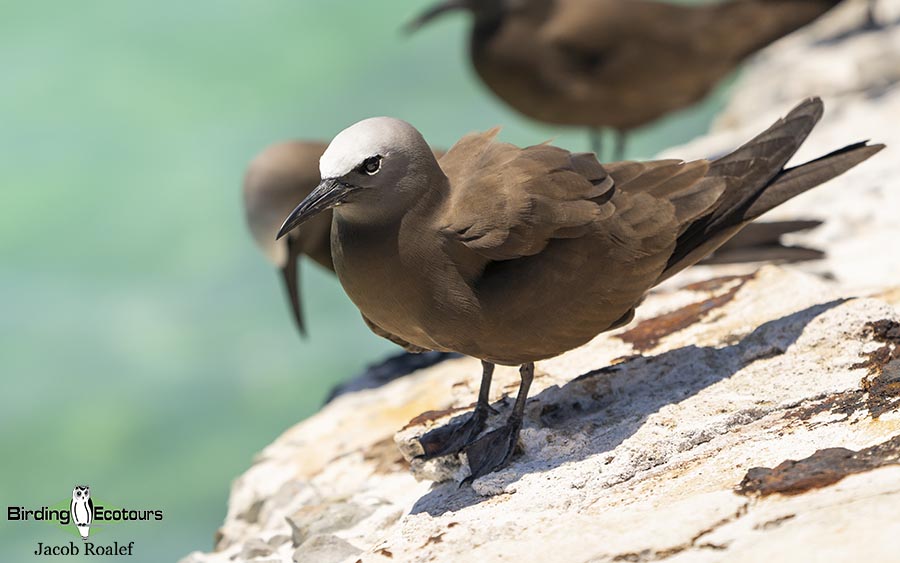 Brown Noddy will certainly be a highlight of the Dry Tortugas.
Day 8. Florida Keys to Homestead
We drive north back towards Miami, stopping at various state parks and preserves in the Florida Keys to look for species we may have missed (possibly a Bald Eagle or two). Perhaps we’ll find some new migrant songbirds and breeding specials or maybe we’ll even chance upon finding a Caribbean stray (we’ll be checking the e-bird reports frequently to see what’s around!). We also usually make a stop at the National Key Deer Refuge to see the miniature and endemic Key Deer, the smallest subspecies of White-tailed Deer and the smallest deer in North America. This will be a flexible day so that we can chase any reported rarities, and we will keep ourselves wired to any special sightings.
Overnight: Homestead
Day 9. Transfer to Miami International Airport
After some optional early morning birding, looking for any bird species we may have missed, we drive back (less than an hour when there is no traffic) to Miami to catch our flights home.
Please note that the itinerary cannot be guaranteed as it is only a rough guide and can be changed (usually slightly) due to factors such as availability of accommodation, updated information on the state of accommodation, roads, or birding sites, the discretion of the guides, and other factors. In addition, we sometimes have to use a different guide from the one advertised due to tour scheduling or other factors.
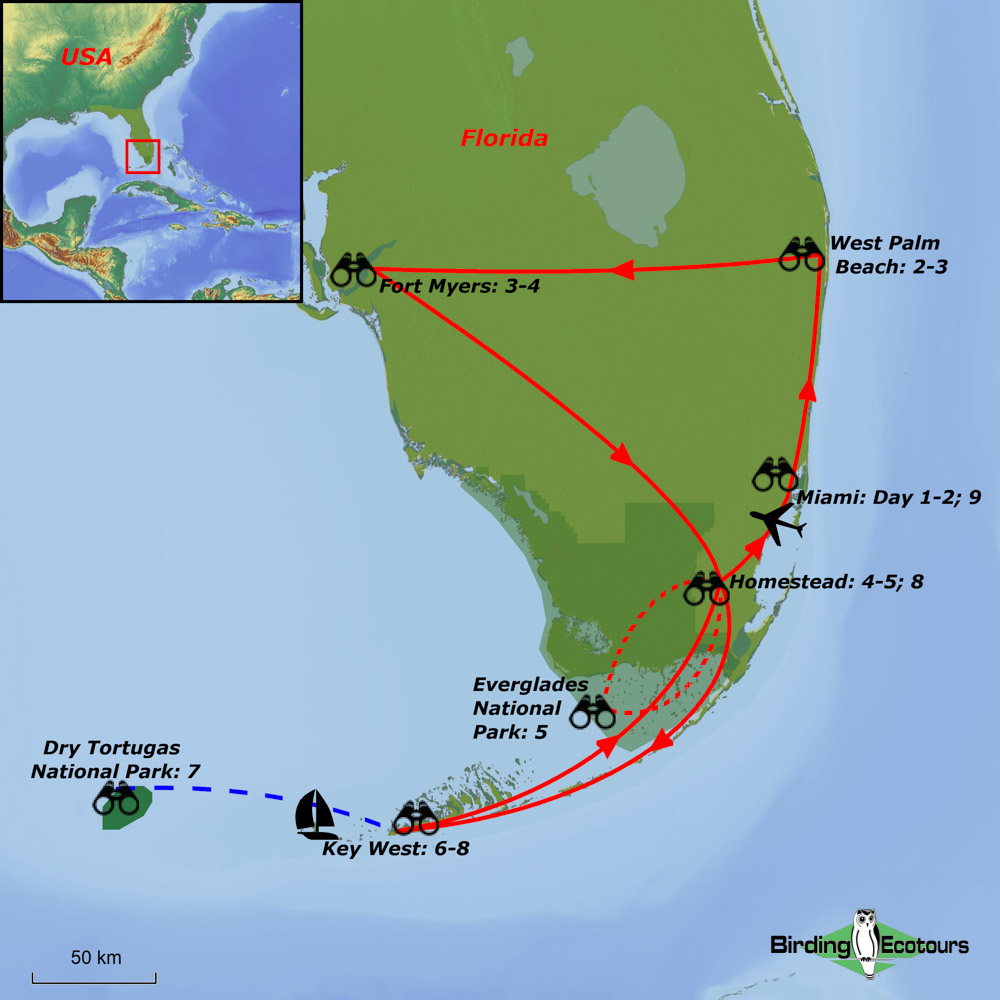
Map
Testimonials
Gallery
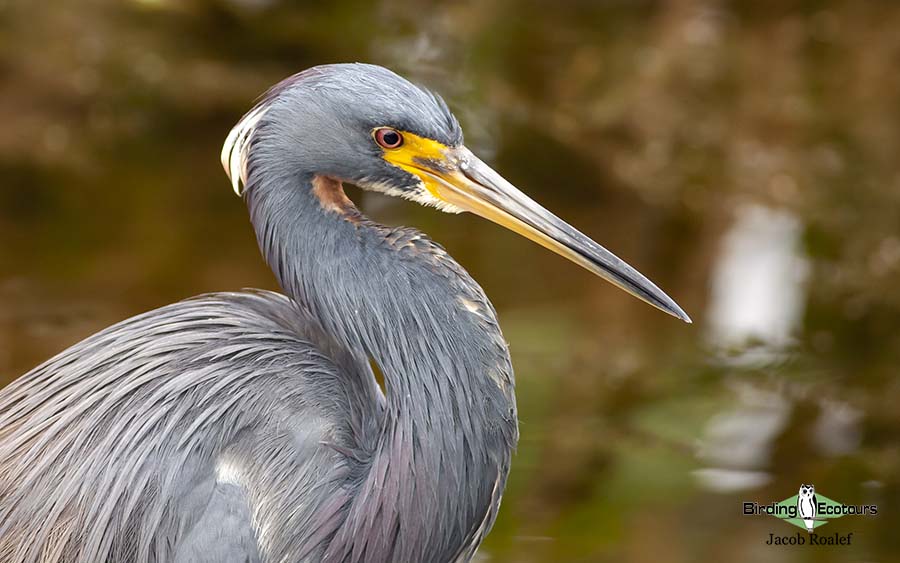
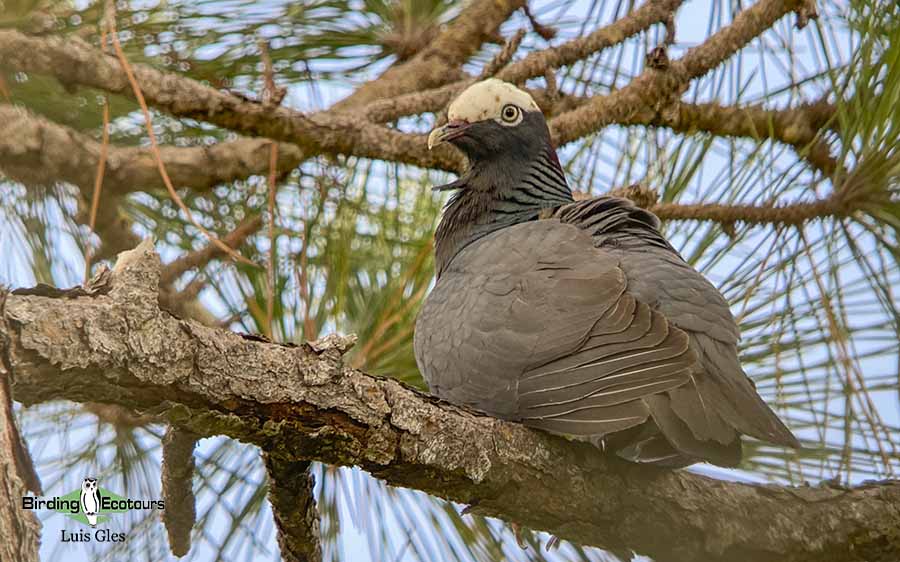
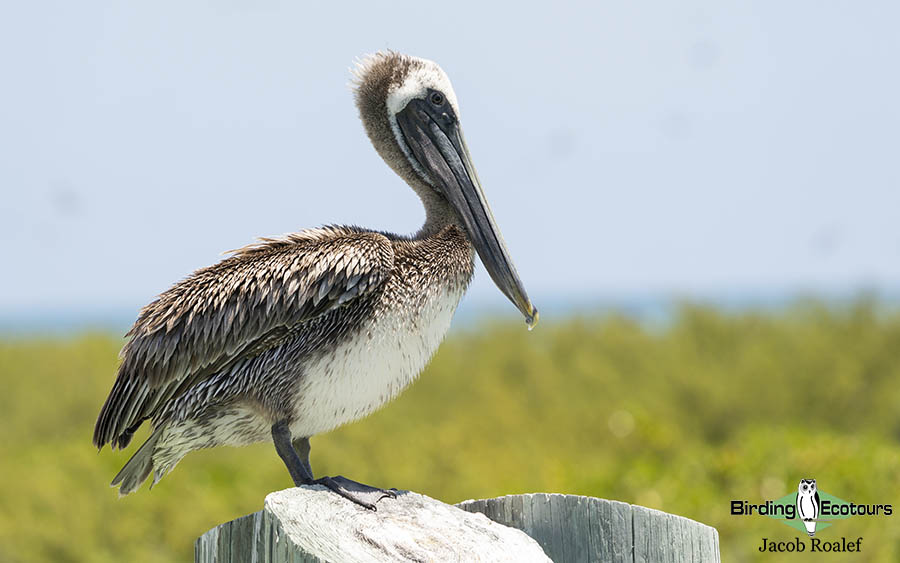
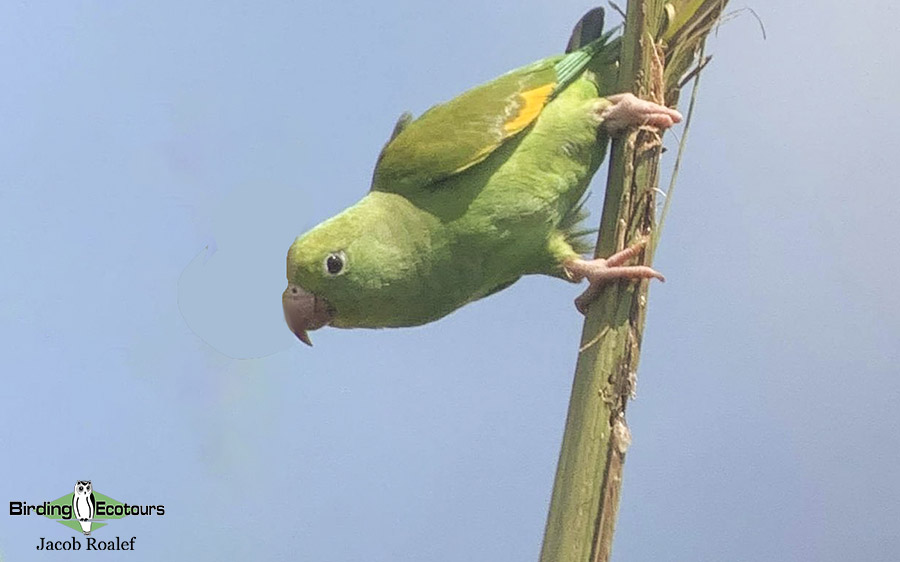
General Information
USA: Florida Peninsula– Southern Specials and the Keys
Tour-specific Information
PASSPORT AND VISA
For US citizens, no visas or passports are required. You will need to bring along a government issued ID as they are sometimes required for hotels.
Non-United States citizens will require a valid passport to enter the country, and some may require a tourist visa. Please consult with your local US Embassy for more details and information. You may need to show your ID/passport at various hotels and for the boat departures on this tour.
TRAVEL INSURANCE
We strongly encourage you to purchase trip cancellation or interruption insurance in case you have to cancel due to illness or for any other reason, as tour payments are non-refundable as per our terms and conditions. We advise you to get a plan which covers all your medical care and evacuation back to your country of residence, repatriation, and trip cancellation due to illness just prior, or any other reason.
HEALTH
Florida poses no major health risks and there only a few potential minor items to consider. There is a boat ferry (approximately two hours each way) which typically is smooth sailing but if you are prone to seasickness, it is best to pack the needed medication. Additionally, some of the drives can be long and pose similar issues. Climate can pose small issues but overall, the temperatures tend to be pleasant with a consistent breeze and plenty of water will be made available. Mosquitoes and other biting insects can be present, especially in wet swampy areas, so we recommend insect repellent and appropriate clothing to help with this. Your guide will inform you when they think things might be particularly “buggy”.
MEDICAL CONDITIONS
Please make sure that you are covered by medical insurance in case of an emergency while on this trip. Without insurance the cost of medical care can be extremely high. Please notify us at the time of registering for this tour of any medical conditions you think we should know about (including allergies, heart conditions, epilepsy, etc.). This will greatly help us to cater to your needs and to update emergency services if required.
WEATHER/CLIMATE
The weather in Florida in April can range from 70–90 °F (21–32 °C) during the day with nights remaining mild and warmer. Rain and thunderstorms can occur at any moment, so it is best to be prepared with a waterproof jacket. Just as quickly as clouds can appear, they can dissolve, leaving behind a wave of hot and humid conditions. Wind is typically present, especially near water, with a gentle breeze felt most of the time.
ACCOMMODATIONS
We will be staying at comfortable hotels throughout the tour.
COMMUNICATIONS
Our hotels should have decent access to Wi-Fi throughout the trip and phone service is typically fine near these areas and in the larger more populated cities. There are times throughout the trip where we will be out driving through the swamps between destinations so service can be lost there. Additionally, out on the boat and Dry Tortugas, service will be spotty.
PHYSICAL REQUIREMENTS AND PACE OF TOUR
Overall, this tour is labeled as fairly easy from a physical requirement perspective. All hiking will be on flat ground with an occasional stray to more sandy trails. There will always be an option to remain back with the vehicle if needed. There are no long hikes on this tour (all less than one mile). There are a few drives of distance but none lasting longer than three hours and those drives do have birding and restroom stops planned to break things up.
WHAT TO BRING
Please kindly read the general list of what to bring on a birding tour, here.
Layers and waterproof gear are always a good idea when preparing for a wide variety of possible weather conditions, and we consider them essential on this tour. We also do recommend bringing Dramamine or other motion sickness medications if you need them as there are longer drives in the vehicle and the ferry ride. Also, please bring along a face mask (or a few) to ensure we are able to follow local guidelines during the Covid-19 pandemic as they will be required in certain areas.
Do not forget – Binoculars, prescription drugs (also bring the generic names for these drugs), toiletries, prescription glasses (and a spare pair), sunglasses, camera, batteries (for electronic equipment and chargers for re-chargeable batteries if required), alarm clock, money pouch, field guide(s), daypack.
Key Documents and Cash – Passports, your travel or health insurance cards, photocopies of which can be carried by the tour leader in case of emergency, Covid-19 vaccine card (or photo/copy), credit cards (see info above). US dollars for drinks, gifts, tips, items of a personal nature, etc., which are not included in the tour cost.
LUGGAGE
There should be enough space for each participant to bring one medium-sized suitcase as well as a personal bag to keep at their seat with them. Please do be mindful with large cameras or tripods if you choose to bring these along.

Download Florida Peninsula: Southern Specials and the Keys Tour-specific Information