- Duration:
- 12 days
- Group Size:
- 4-8
- Tour Start:
- London, England (Heathrow Airport)
- Tour End:
- London, England (Heathrow Airport)
United Kingdom Birding Tour: England Fall Migration Special
Details
Dates & Costs
On request
Itinerary
Download ItineraryUnited Kingdom Birding Tour: England Fall Migration Special
Situated on the northwestern edge of Europe and the Western Palearctic biogeographical zone, the United Kingdom (UK) is blessed (as a result of the Gulf Stream) with an exciting fall season as common migrant species are occasionally joined by much rarer and more exotic vagrants. As such, we have designed this England birding tour to focus not only on the spectacle of migration of common species but also as a tour where we can look for our own rare vagrants along the east coast of England.
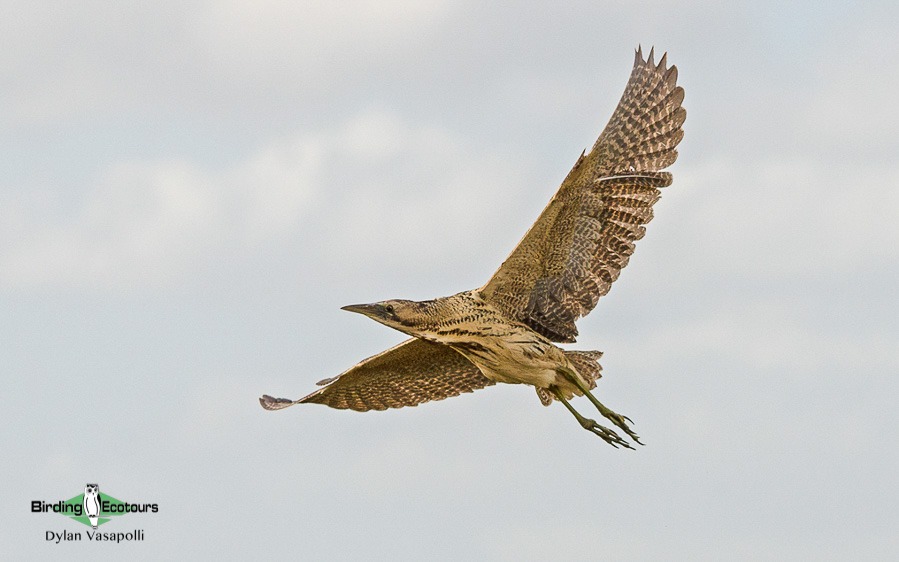 Eurasian Bittern is one of our secretive targets on this trip.
This birding tour of the eastern side of England will occur during the mid-fall period and will focus on finding a wide range of resident species and numerous fall migrants. Overwintering wildfowl, shorebirds (called waders in these parts), gulls, thrushes, finches, tits, buntings, and other passerines from northern and eastern Europe and further east into Asia will swell the number of birds usually present in the country and provide an interesting suite of species to chase after.
Some of our targets will include Whooper Swan, Tundra (Bewick’s) Swan, Pink-footed Goose, Tundra Bean Goose, Greater White-fronted Goose, Greater Scaup, Smew, Long-tailed Duck, Common Scoter, Velvet Scoter, Caspian Gull, Yellow-legged Gull, Iceland Gull, Glaucous Gull, Mediterranean Gull, Purple Sandpiper, European Golden Plover, Fieldfare, Redwing, Black Redstart, Horned (Shore) Lark, Snow Bunting, Lapland Longspur (Lapland Bunting), Twite, Brambling, Hawfinch, and with luck, as it is an irruptive species, Bohemian Waxwing, one of the best-looking birds in Europe.
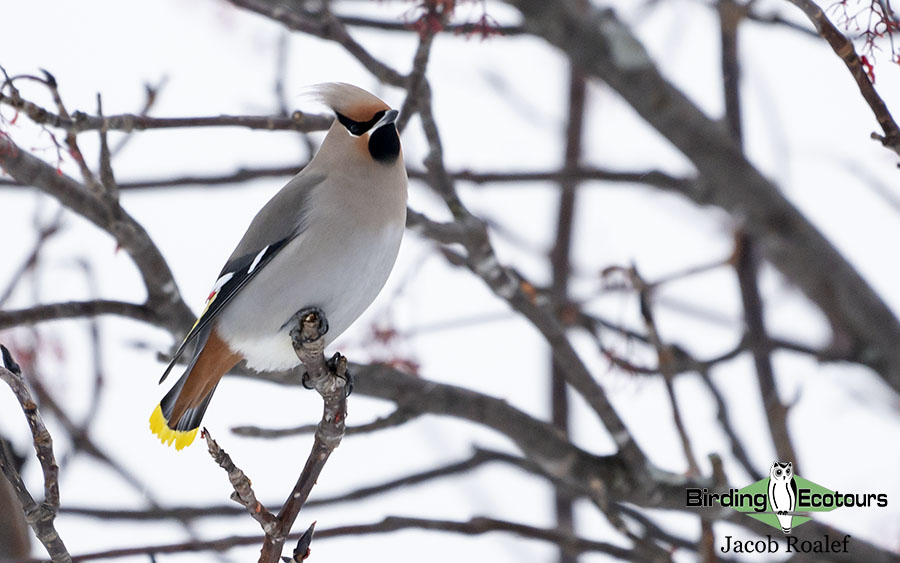 Bohemian Waxwing is a striking species which arrives from Scandinavia to spend the winter in England.
There are many rare, scarce, very localized, or just plain secretive species in England, and we will target lots of these during the tour, including Bearded Reedling (Bearded Tit), Eurasian Bittern, Hen Harrier, Ruff, Eurasian Spoonbill, Willow Ptarmigan (Red Grouse), Black Grouse, Jack Snipe, Water Rail, Eurasian Woodcock, Short-eared Owl, Long-eared Owl, Common Kingfisher, and Common Crane.
For a visiting birder, or anyone interested in bird photography, this England birding tour will offer great views of some of the common and gorgeous resident birds present in the United Kingdom, such as European Robin, Eurasian Bullfinch, Eurasian Blue Tit, Great Tit, European Nuthatch, European Greenfinch, European Goldfinch, Common Blackbird, Song Thrush, Northern Lapwing, Western Marsh Harrier (at impressive roost sites), Red Kite, and many more. Our “Common Birds of the UK” blog series provides an illustrated look at the common garden, farmland and woodland, and wetland and coastal birds of the UK. These birds will also form an exciting part of this tour for anyone not familiar with the birds of the region.
Finally, we will also search for rare vagrants. Species we could bump into include Yellow-browed Warbler, Pallas’s Leaf Warbler, Dusky Warbler, Radde’s Warbler, Red-flanked Bluetail, Pectoral Sandpiper, Lesser Yellowlegs, Black Scoter, and Olive-backed Pipit.
After a hard day’s birding, we will get to enjoy the fabulous hospitality of traditional hotels throughout our stay. At this time of year we can expect hearty food and roaring log fires, just the tonic after the brisk weather that the east coast of the UK can offer up during fall.
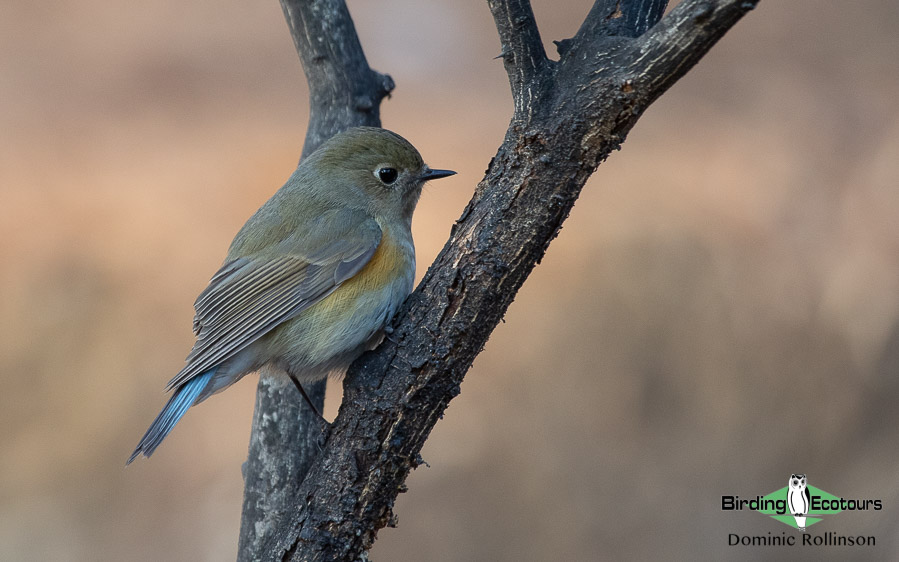 Finding a beautiful Red-flanked Bluetail would surely be the highlight of our England bird watching tour. We will search the best coastal areas in Norfolk and Suffolk for this stunning vagrant species.
Itinerary (12 days/11 nights)
Day 1. Arrival in London and transfer to a hotel near Heathrow Airport
After your arrival in London (Heathrow) during the day, you will transfer to our hotel with time at your leisure. In the evening, we will gather for our group welcome meal. If you wish to explore the many tourist attractions that London has to offer (such as Big Ben and the Palace of Westminster, Buckingham Palace, St Paul’s Cathedral, Tower Bridge, The Natural History Museum, and many more), please organize an early arrival or late departure. We can assist in arranging your plans for these activities should you need any help.
Overnight: Heathrow Airport area, London
Days 2 – 4. Birding Norfolk and Suffolk
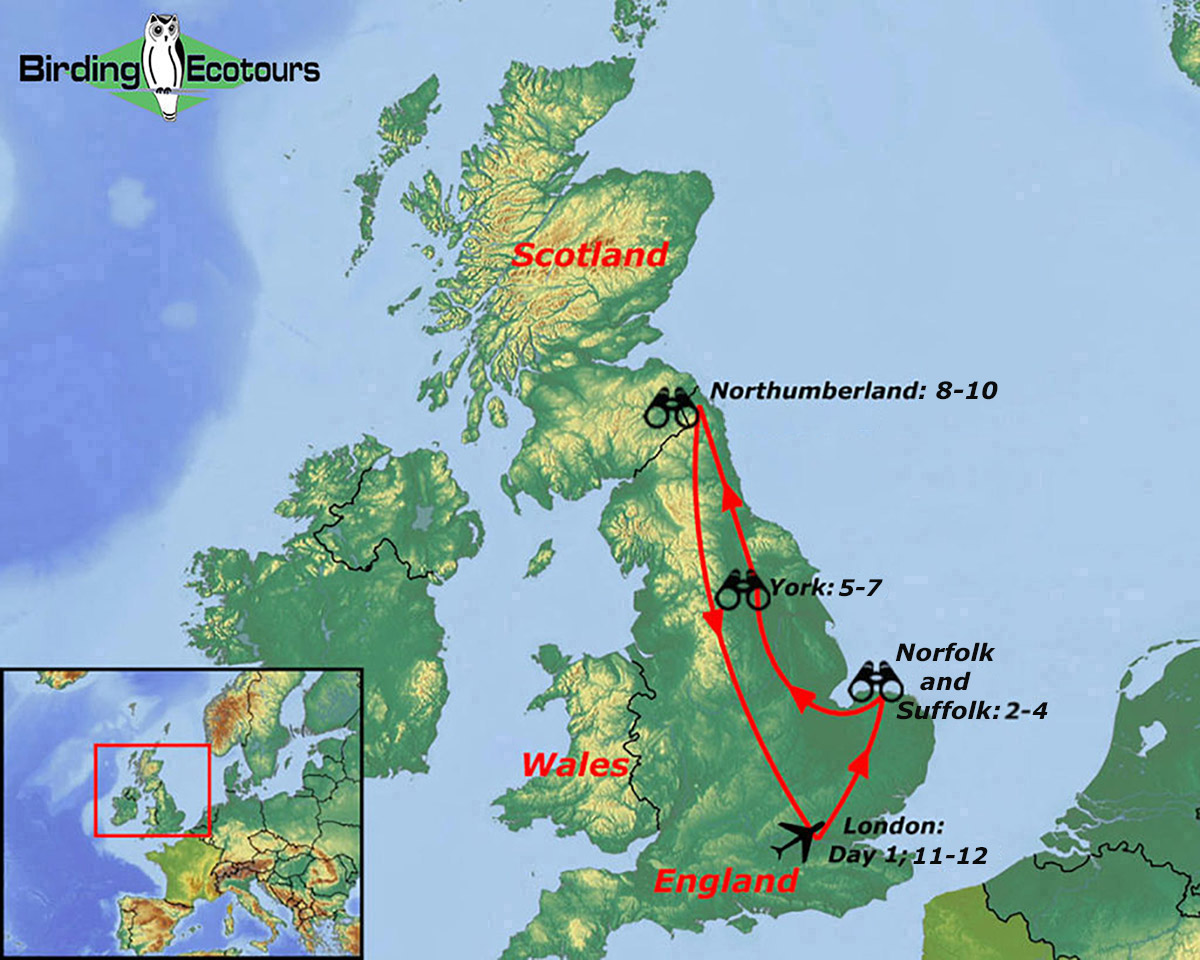
We will leave London and travel to our base in the county of Norfolk for the next three nights. Our base will be great for exploring Norfolk and neighboring Suffolk over the coming days. Our journey from London will get our birding underway immediately as we drive northeast, with a few strategic stops planned along the way!
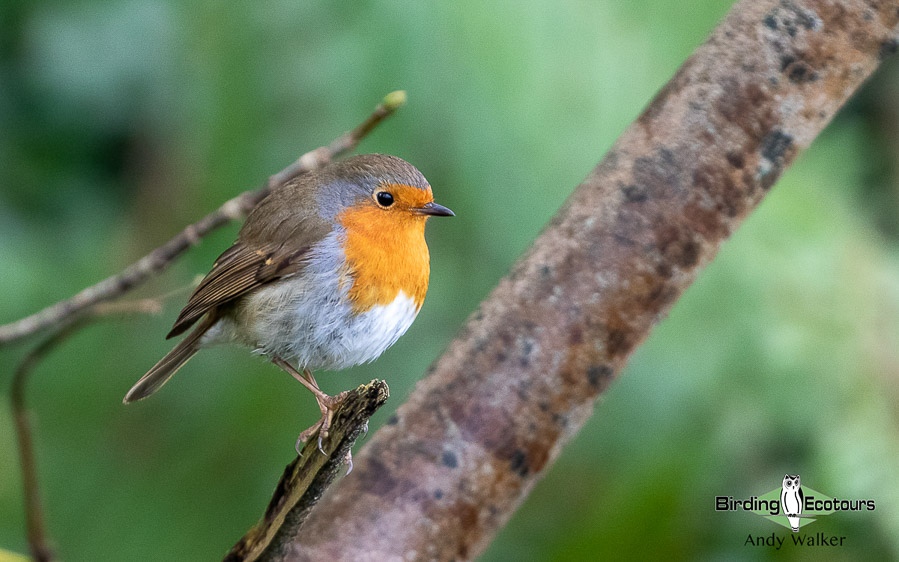 European Robin, a beautiful and widespread species.
The region is rightly considered one of the best birding areas in the whole of the United Kingdom and great for a varied selection of birds. Some of the coastal and inland reserves we will likely visit during our time in the area include Royal Society for the Protection of Birds (RSPB) Titchwell Marsh reserve, RSPB Lakenheath Fen reserve, RSPB Snettisham reserve, RSPB Minsmere reserve, Norfolk Wildlife Trust (NWT) Cley and Salthouse Marshes, NWT Hickling Broad and Marshes, Wildfowl and Wetland Trust (WWT) Welney Wetland Centre, Thetford Forest, and Holkham Hall and Estate, among many others.
Early in our England bird watching tour we will likely see a range of common species that will become very familiar, such as Eurasian Blue Tit, Great Tit, European Goldfinch, Eurasian Bullfinch, Common Wood Pigeon, and Eurasian Magpie. We will also find our first overwintering Fieldfare and Redwing. At this time of the year many of the Common Blackbirds, Song Thrushes, and European Robins present in the UK will be of continental European origin.
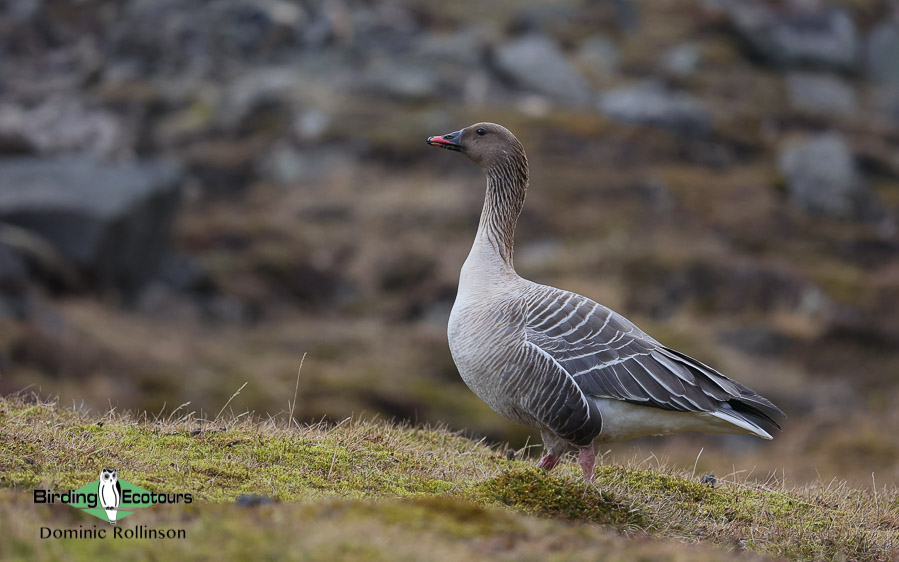 Large flocks of Pink-footed Geese may be seen in Norfolk and Suffolk.
While birding in Norfolkand Suffolk we will seek out the vast array of wildfowl on offer. This should include flocks of Pink-footed Geese and Greylag Geese (the former forming flocks in the thousands) as well as scarcer species such as Brant Goose (the dark-bellied form known as Dark-bellied Brent Goose), Barnacle Goose, Tundra Bean Goose, and Greater White-fronted Goose. Sometimes the geese flocks in Norfolk (and further north when birding later in the tour) can contain a scarcity or rarity and we will keep our eyes firmly peeled for anything unusual.
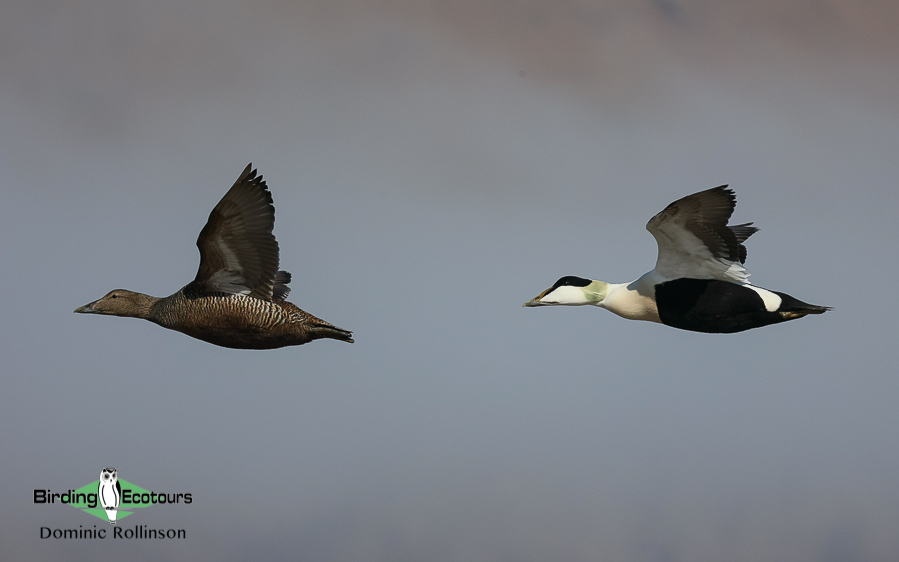
Other wildfowl we are likely to see include Whooper Swan, Tundra (Bewick’s) Swan, Mute Swan, Common Shelduck, Common Scoter, Velvet Scoter, Common Eider, Long-tailed Duck, Tufted Duck, Greater Scaup, and Common Pochard. With luck we might even find Smew, a scarce winter visitor to the UK.
The shorebird spectacle along the coasts of Norfolk and Suffolk at this time of year can be remarkable, particularly at high tide, and we will make sure to check out some roost sites. Impressive numbers of Red Knot, Bar-tailed Godwit, Eurasian Oystercatcher, Eurasian Curlew, Sanderling, Dunlin, and other species such as Common Ringed Plover, European Golden Plover, Northern Lapwing, and Grey Plover will be likely. Nearby marsh habitat could hold the locally scarce Spotted Redshank with abundant Common Redshank and Common Snipe easily found. We may even spot an overwintering Green Sandpiper.
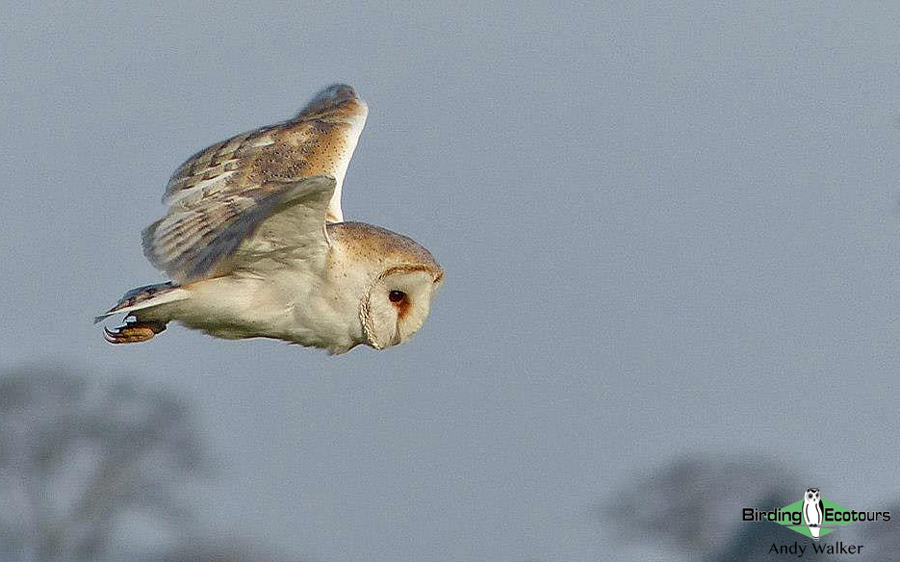
Raptors feature heavily during this period, with several species forming communal roosts. While most of the species mentioned could be bumped into during the course of regular birding, we will look at roost sites for Western Marsh Harrier (pleasingly common these days), Hen Harrier, Peregrine Falcon, Merlin, Common Kestrel, Eurasian Sparrowhawk, and sometimes Rough-legged Buzzard (an irruptive winter visitor) or White-tailed Eagle (a species that is expanding its range in the country due to recent national reintroduction programs and an increasing, and thus wandering, population in Europe). We will also have no problem finding the spectacular Red Kite, a species that is bouncing back tremendously after years of persecution, probably one of the best-looking birds of prey in the UK. While we wait at the roost sites, we may also find some of the secretive species of the area like Short-eared Owl, Western Barn Owl, Common Crane, Eurasian Spoonbill, and Eurasian Bittern.
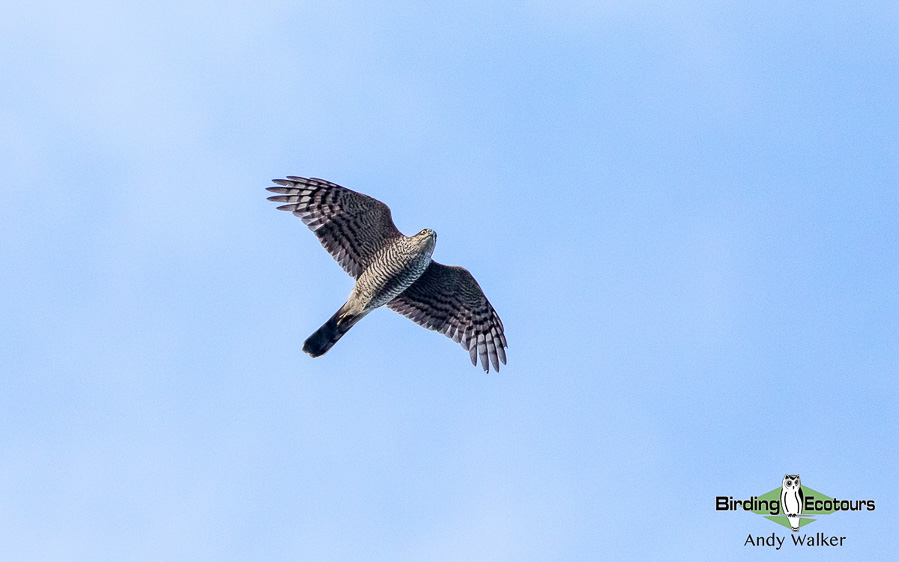 A close-quartering Eurasian Sparrowhawk, a spectacular sight!
Several of the beaches and surrounding marshlands support some interesting passerines such as Snow Bunting, Twite, Horned (Shore) Lark, European Rock Pipit, Water Pipit, and Meadow Pipit, while the local farmland may hold Eurasian Skylark, Common Reed Bunting, Yellowhammer, Corn Bunting, and mixed finch flocks. The woodland may support Tawny Owl, Eurasian Jay, European Green Woodpecker, and Great Spotted Woodpecker. Woodland slightly inland from the coast along the Norfolk and Suffolk border, such as the Thetford Forest area, offers some birds more difficult elsewhere, such as Red (Common) Crossbill, Lesser Spotted Woodpecker, Hawfinch, Common Firecrest, Eurasian Nuthatch, Eurasian Siskin, Lesser Redpoll, Marsh Tit, and maybe even overwintering Great Grey Shrike.
There are so many more birds to consider in this part of the UK, ranging from the localized Dartford Warbler, present in a few coastal heathland areas, to an interesting mix of naturalized species such as Rose-ringed Parakeet, Mandarin Duck, and Egyptian Goose. We will search for as many species as possible during our time in this excellent birding area.
Finally, we will be on the lookout for rare fall vagrants from North America and from Asia. While these are not guaranteed, we will be sure to visit the best areas where we might find these highly prized species, with highlights including Yellow-browed Warbler, Pallas’s Leaf Warbler, Red-flanked Bluetail, and Dusky Warbler.
Overnight (three nights): Norfolk
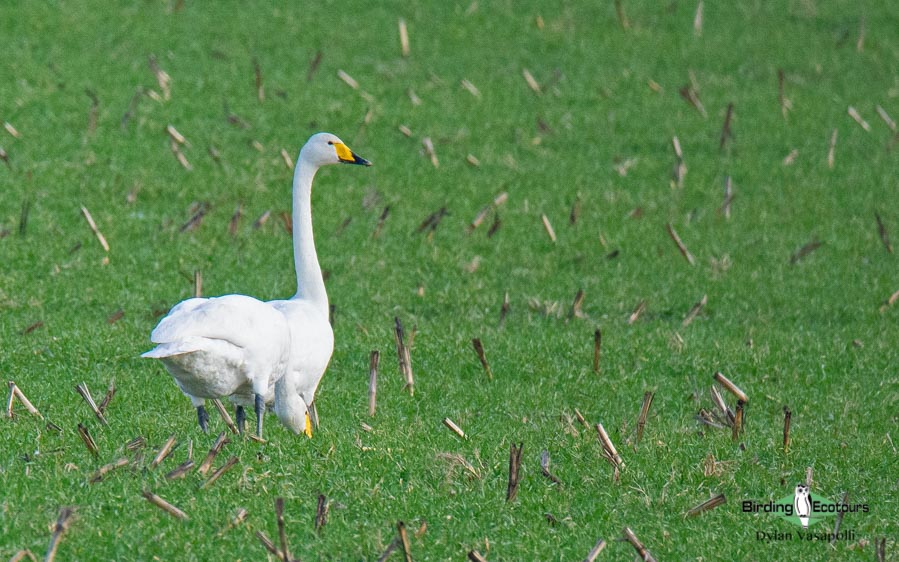 Whooper Swans are elegant winter visitors to the United Kingdom.
Day 5. Transfer between Norwich and the city of York
We will travel between Norfolk and York after a final morning birding in East Anglia. We will likely stop at one or two locations on the way which may yield specific target species, and we will select these at the time, based on up-to-date local information. We might take a coastal route or a more inland route, depending on what is around and what we “need”. There are several waterbodies along the route that sometimes hold interesting species, and we may be able to find something along the lines of Whooper Swan, Smew, Black-throated Loon (Black-throated Diver), Common Loon (Great Northern Diver), Red-throated Loon (Red-throated Diver), Horned (Slavonian) Grebe, or Black-necked (Eared) Grebe.
In the afternoon we will arrive in York, a fascinating and beautiful ancient-walled city packed full of historical and cultural features (York Minster, Clifford’s Tower, Jorvik Viking Center, York Dungeons, The Shambles, The National Railway Museum, churches, and so much more) and we will be sure to fit in some time to explore this, one of Britain’s greatest and oldest cities. We will be based here for the next three nights while we spend time birding in wonderful Yorkshire, another of the UK’s great birding counties.
Overnight: York
Days 6 – 7. Yorkshire birding
We will spend two full days exploring some of the many birding hotspots of North Yorkshire and East Yorkshire from our base in York (as well as around the excellent York area). Some of the usually exceptional sites for winter birding that we might visit include Yorkshire Wildlife Trust (YWT) Askham Bog, YWT Wheldrake Ings, North York Moors National Park, RSPB Blacktoft Sands reserve, RSPB Fairburn Ings reserve, and RSPB Bempton Cliffs reserve.
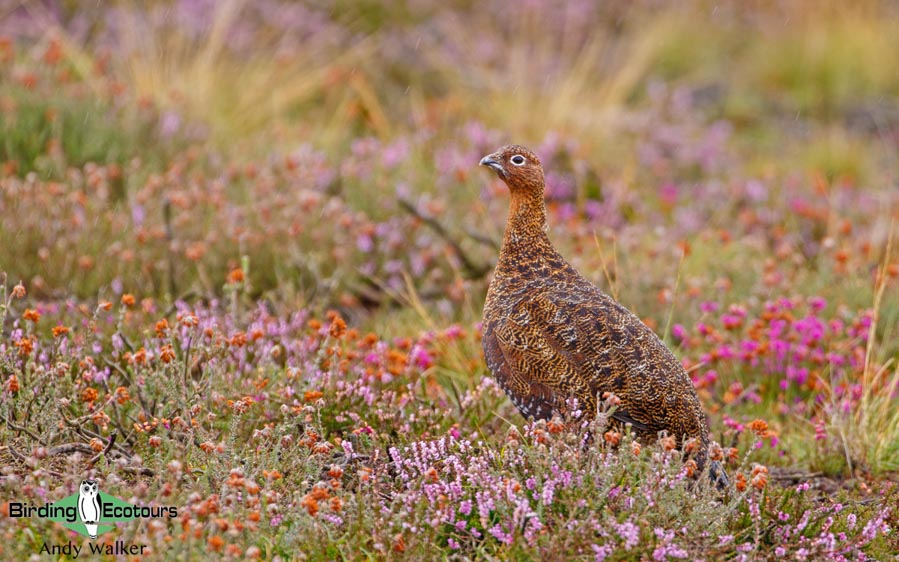 Willow Ptarmigan, or Red Grouse as it is known in the United Kingdom, is an attractive endemic subspecies or species, depending on your taxonomic standpoint.
We will concentrate our efforts on some of the species unlikely to have been seen earlier in the tour with the York area being good for the rapidly declining trio of Willow Tit, Eurasian Tree Sparrow, and Corn Bunting. We might even find those three species close to our accommodation, along with a great assortment of other farmland and woodland birds. The area around our accommodation is also excellent for a wide range of shorebirds (waders) and waterfowl. A large flock of Whooper Swans overwinter in the area (and occasionally attracts the rarer Tundra (Bewick’s) Swan). Pink-footed Goose is frequent, as too is Greater White-fronted Goose, and occasionally scarcer species too. The York area is usually excellent for Jack Snipe and Ruff so we will look for those too.
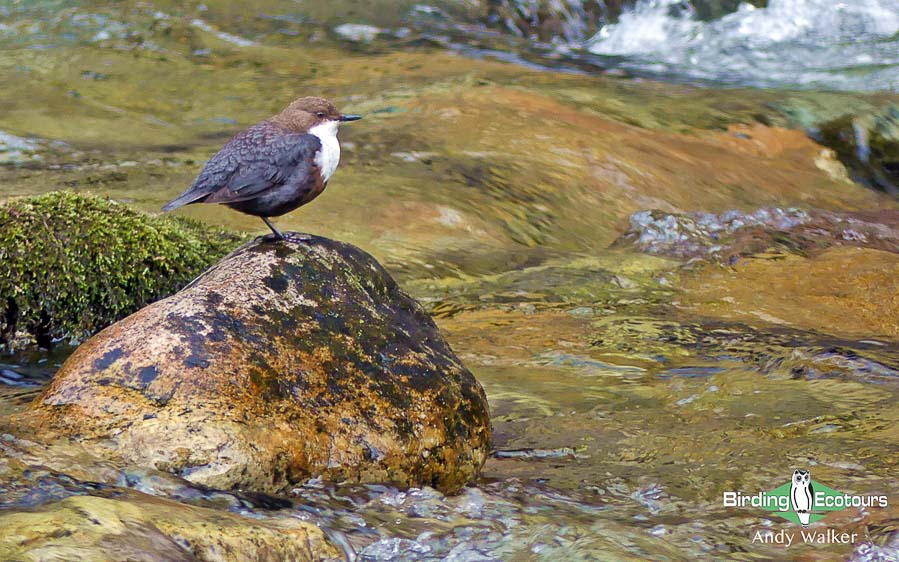
We will drive through the beautiful North York Moors National Park, which offers the chance to find the scotica subspecies of Willow Ptarmigan, considered a full species by Avibase Taxonomic Concepts and known as Red Grouse, which would make it an endemic to the United Kingdom. The upland rivers here also hold White-throated Dipper, always a highlight.
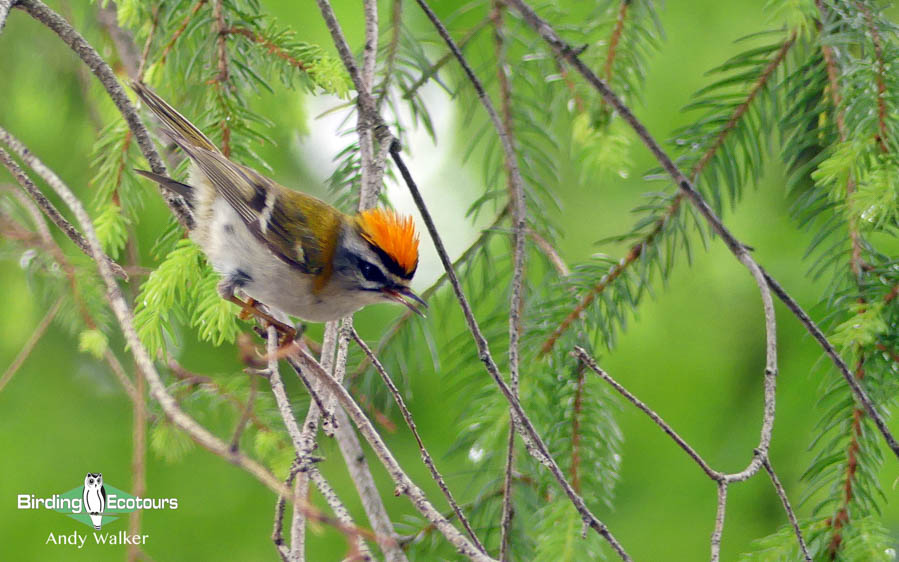 We hope to find Common Firecrest during the tour. It has a shocking flash of color on its head!
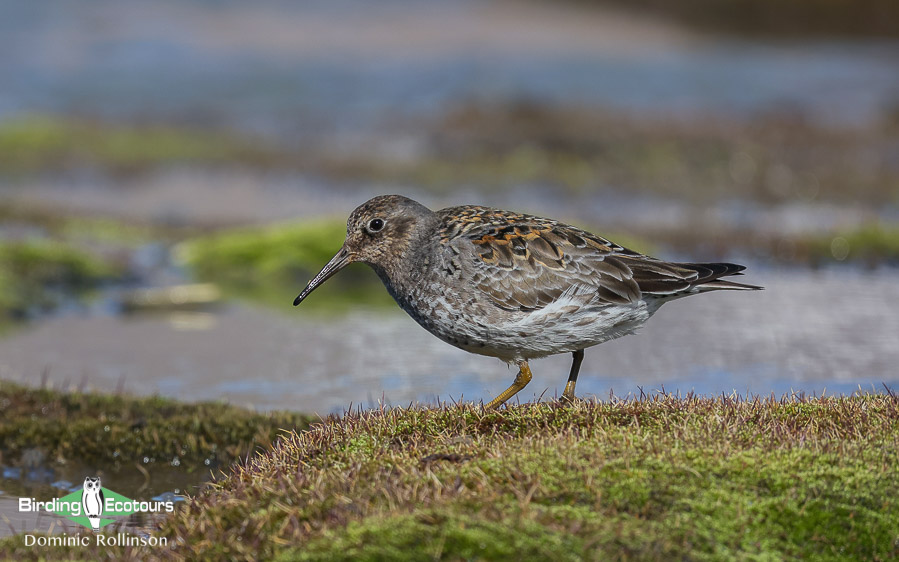
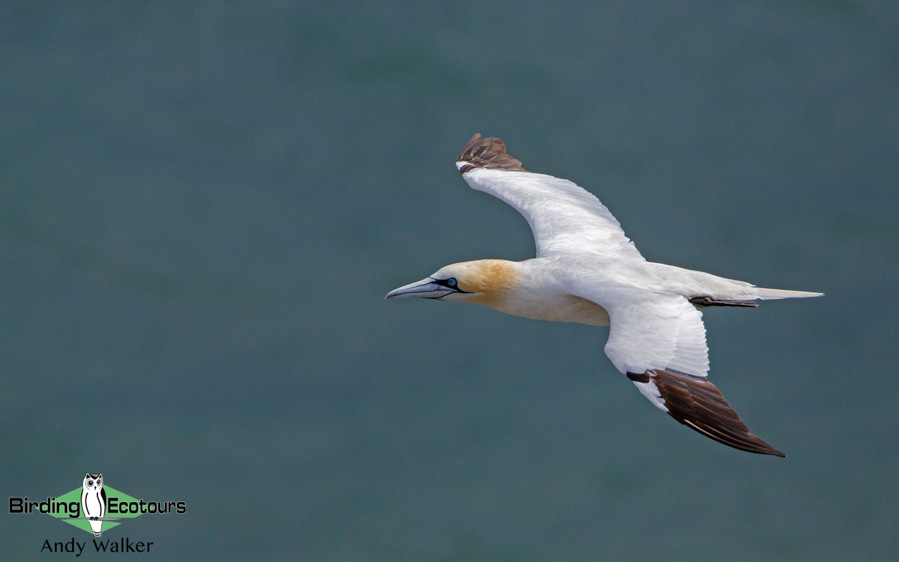
From the moors we will traverse our way down to the coast, where at this time of the year we might find Iceland Gull or Glaucous Gull hiding in amongst hundreds of European Herring Gulls (of which we should see two subspecies). We could also see species such as Purple Sandpiper, Ruddy Turnstone, and European Shag which might be more difficult further south – these species are likely to be easier the further north we go, depending on how the weather has been ahead of the tour. We will also look for seaducks, grebes, loons (divers), and auks that may still be offshore, such as Common Murre (Common Guillemot) and Razorbill. We should also find Northern Gannet, Northern Fulmar, and Black-legged Kittiwake along the coast. As we are exploring the seashore, we will also look out for European Rock Pipit, Lapland Longspur (Lapland Bunting), Snow Bunting, and Horned (Shore) Lark.
It will be highly likely that we will have seen a huge range of interesting passerines (and other birds) whilst birding in Norfolk, and Suffolk, and Yorkshire will give further opportunities for a range of scarce species. Depending on what we still “need” (or would like to try and see again), we could also look for Bearded Reedling (Bearded Tit), Lesser Spotted Woodpecker, European Stonechat, Water Pipit, Red (Common) Crossbill, Common Redpoll, Eurasian Bittern, Spotted Redshank, Little Egret, Great Egret, Little Gull, Mediterranean Gull, and Common Kingfisher.
Gull roosts around the York area may enable us to see, amongst others, Common Gull (split from Mew Gull of North America, which is also now renamed to Short-billed Gull, following the IOC 11.2 update), Yellow-legged Gull, Caspian Gull, Iceland Gull, and Glaucous Gull.
Overnight (two nights): York
Day 8. Transfer between Yorkshire and Northumberland
This will be a travel day as we move between York and our base near Alnwick, Northumberland (another impressive place – Alnwick Castle and Alnwick Gardens are definitely worth exploring). Our journey will take us cross-country, and we will keep our eyes peeled for the stunning Black Grouse, a rare, localized, and highly protected species in England.
Overnight: Alnwick
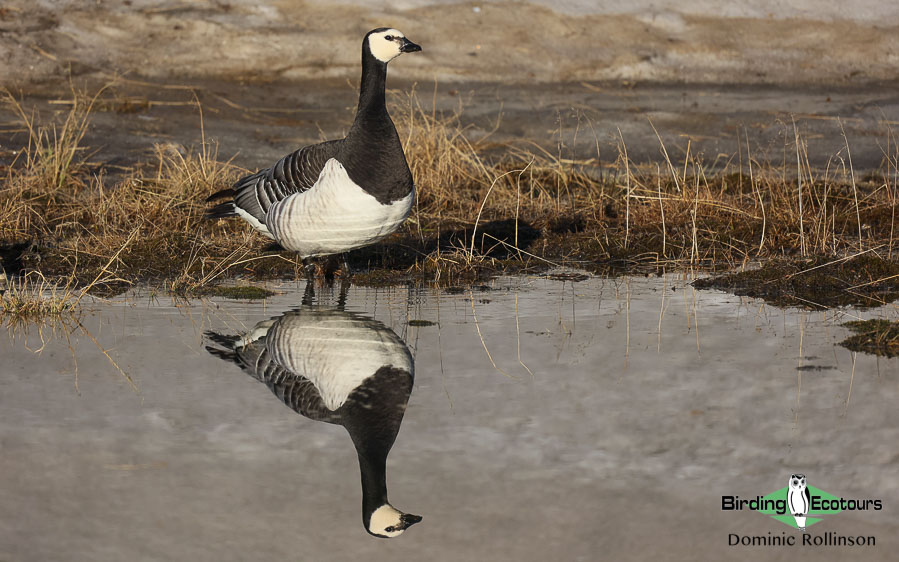 We will look for Barnacle Goose along the Northumberland Coast.
Days 9 – 10. Northumberland Coast
We will have two full days birding in Northumberland. We can expect similar species to those listed above, but some coastal birding here should give us different geese, such as Brant Goose (Pale-bellied Brent Goose here rather than the Dark-bellied Brent Goose seen further south) and Barnacle Goose on the mudflats, along with Common Shelduck and a wide range of shorebirds, such as Bar-tailed Godwit, Eurasian Curlew, Eurasian Oystercatcher, Grey Plover, and others. We should also get further chances for Horned (Slavonian) Grebe, Common Loon (Great Northern Diver), Red-throated Loon (Red-throated Diver), Black-throated Loon (Black-throated Diver), Purple Sandpiper, Ruddy Turnstone, Sanderling, and maybe a lingering European Shag, Great Skua, Black-legged Kittiwake, or Northern Gannet. Alcids, including Atlantic Puffin, will also hopefully be around. Red Kite and recently arrived Rough-legged Buzzard from Europe are also possible.
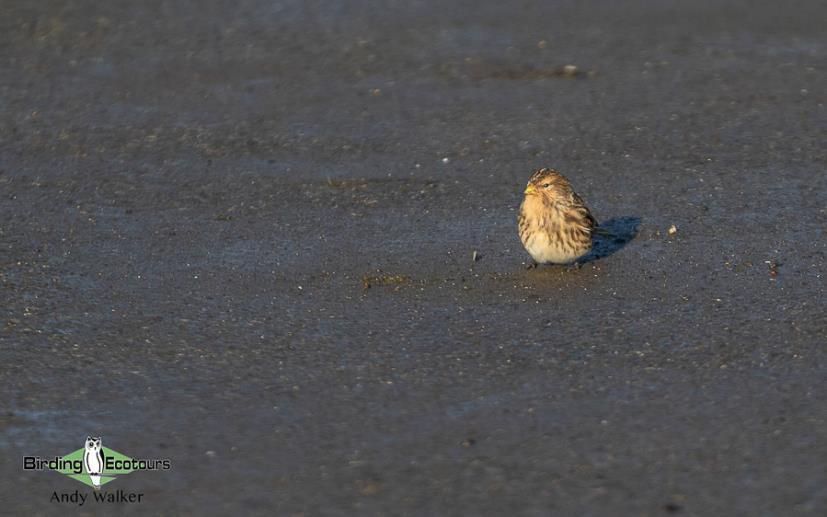
Interesting passerines possible here could include Snow Bunting, Lapland Longspur (Lapland Bunting), Bohemian Waxwing, Horned (Shore) Lark, European Rock Pipit, and Twite among the more common and widespread resident, and aforementioned, winter migrant species.
Large flocks of Common Scoter overwintering along the coast of Northumberland should have arrived by now, and these often include other common species, such as Red-breasted Merganser, Velvet Scoter, Long-tailed Duck, and Common Eider, but may also contain the odd surprise of something much rarer, like King Eider, Black Scoter, or White-winged Scoter. We will be sure to keep a careful eye on that possibility over the course of our stay.
While in Northumberland, we will bird at some spectacular sites, none more so than the Holy Island of Lindisfarne. This island is reached via a drivable causeway, the mudflats packed with birds, the sea often swarming, and the island itself a bit of a fall rarity magnet. We will be keeping our eyes peeled for a wide range of birds whilst here. Other sites we will check out (that are no less impressive really), include Beadnell Bay, Bamburgh Castle, and Northumberland Wildlife Trust (NWT) East Chevington reserve.
Overnight (two nights): Alnwick
Day 11. Northumberland to London
We will have a final morning birding session in Northumberland before we drive south towards London where the tour will conclude. We will pay careful attention to the local rare-bird news (such as Birdguides, Surfbirds, and Rare Bird Alert) and see if we can add something interesting along the route, maybe some newly arrived Bohemian Waxwing or something else exciting.
Overnight: Heathrow Airport area, London
Day 12. International departure
This is a non-birding day with international departures from Heathrow.
Please note that the itinerary cannot be guaranteed as it is only a rough guide and can be changed (usually slightly) due to factors such as availability of accommodation, updated information on the state of accommodation, roads, or birding sites, the discretion of the guides and other factors. In addition, we sometimes have to use a different guide from the one advertised due to tour scheduling or other factors.
Map
Gallery
General Information
UNITED KINGDOM: ENGLAND FALL MIGRATION SPECIAL
TOUR-SPECIFIC INFORMATION
GENERAL INFORMATION ABOUT THE UNITED KINGDOM CAN BE READ HERE
TOUR OUTLINE
This set departure United Kingdom (UK) fall birding tour will start and end in London. The tour will enjoy excellent fall birding, featuring a wide range of resident species and numerous winter visitors. Wildfowl, shorebirds, gulls, and numerous exciting passerines from northern and eastern Europe and further east into Asia provide an interesting list of birds to look for on this bird-filled yet also relaxed-pace tour.
As we travel through the east of England, birding in Norfolk, Suffolk, Lincolnshire, Yorkshire, Durham, and Northumberland, we will also find an impressive array of sites of important cultural heritage, such as churches, cathedrals, and castles, as well as visit historic cities such as Norwich, York, and Alnwick.
WEATHER/CLIMATE
Fall in the UK is generally cool, wet, windy, and cloudy. Temperatures at night rarely drop below 14 °F (-10 oC) and in the day rarely rise above 59 °F (15 °C). Precipitation can be plentiful throughout the season, though snow is relatively infrequent despite the country’s high latitude.
DAILY ACTIVITIES, PHYSICAL REQUIREMENTS, AND TOUR PACE
This is a relaxed pace tour though we do cover the whole of the east coast of England north of London, up to almost to the Scottish Borders. During the tour, sunrise will be around 08:00hrs and sunset around 16:30hrs. This will mean particularly early starts and late finishes to the day’s birding will not be necessary for the most part. Most of the tour is spent in the lowlands and at sea-level, though we will spend time in higher elevations, but these are still rather low and are unlikely to provide any constraints to anyone. Our United Kingdom: Ultimate Spring Tour is a faster-paced more intensive birdwatching tour, with a different set of birds possible.
A great deal of our birding will be undertaken at established nature reserves, such as those managed and operated by the Royal Society for the Protection of Birds (RSPB) and regional wildlife trusts and organizations, such as Norfolk Wildlife Trust, Yorkshire Wildlife Trust, and Northumberland Wildlife Trust, among others. Most of the reserves we visit have good facilities, such as trail networks, viewing blinds (hides), and visitor centers often (including gift shops and cafes). These reserves often allow great views of many species and can also offer good photographic opportunities. It is however important to note that this set departure tour is not designed as a photographic tour, if you would like a custom photography tour for you or a group of friends, please let us know as we can put together something specific for you.
DOMESTIC FLIGHTS
There are no domestic flights included in this tour.
ACCOMMODATION
We will be staying in comfortable bed-and-breakfast (B&B) accommodation for most of the tour, with the exception of the beginning/end of the tour when we overnight in a hotel near Heathrow airport in London. All accommodation on this tour has private rooms and bathroom facilities.
WHAT TO BRING: CLOTHING
In addition to the clothing mentioned in the general information document, please make sure you bring clothing suitable for cold, wind, and rainy weather. This would include suitable waterproof clothing (e.g. jacket and trousers) and layers to provide extra heat, such as thermal trousers and shirt, and sweaters (jumpers), fleece, and over-jacket. A woolly (beanie) hat, scarf/snood, and gloves will be extremely useful and probably essential.
WHAT TO BRING: OTHER ITEMS
In addition to the items listed in the general information document, a thermos flask for keeping hot water/hot drinks is recommended for maintaining heat throughout the day. Hand warmer packets can be useful if the conditions are particularly cold.

United Kingdom General Information
Download UK: England Fall Migration Special Tour Information