- Duration:
- 10 days
- Group Size:
- 6
- Tour Start:
- Kilimanjaro International Airport near Arusha
- Tour End:
- Kilimanjaro International Airport near Arusha
Northern Tanzania Birding Tour – Africa’s Ultimate Safari & Savanna Birding Adventure
Details
2027
28 April – 07 May
Per person sharing
$6,720 USD
£5,346 GBP / €6,275 EUR
Single supplement
$720 USD
£572 GBP / €672 EUR
This tour is full, please consider booking early for 2028.
2028
28 April – 07 May
Per person sharing
$7,260 USD
£5,775 GBP / €6,780 EUR
Single supplement
$780 USD
£621 GBP / €729 EUR
2029
28 April – 07 May
Per person sharing
$7,840 USD
£6,237 GBP / €7,321 EUR
Single supplement
$840 USD
£668 GBP / €784 EUR
Itinerary
Download ItineraryNorthern Tanzania Birding Tour – Africa’s Ultimate Safari & Savanna Birding Adventure
If you could visit Africa only once, this would undoubtedly be the tour to take. Our Northern Tanzania birding safari is designed to showcase the very best of Africa in just ten days, combining iconic wildlife spectacles with outstanding birding. Where else can you see Lion, Leopard, and Cheetah, witness the breathtaking Great Wildebeest Migration, and see a hundred bird species in a single day? Add the chance to gaze upon Mount Kilimanjaro, Africa’s highest mountain, and to explore two of the world’s most famous wildlife destinations – the Serengeti and the spectacular Ngorongoro Crater – and it quickly becomes clear why northern Tanzania ranks among the finest safari destinations on Earth.
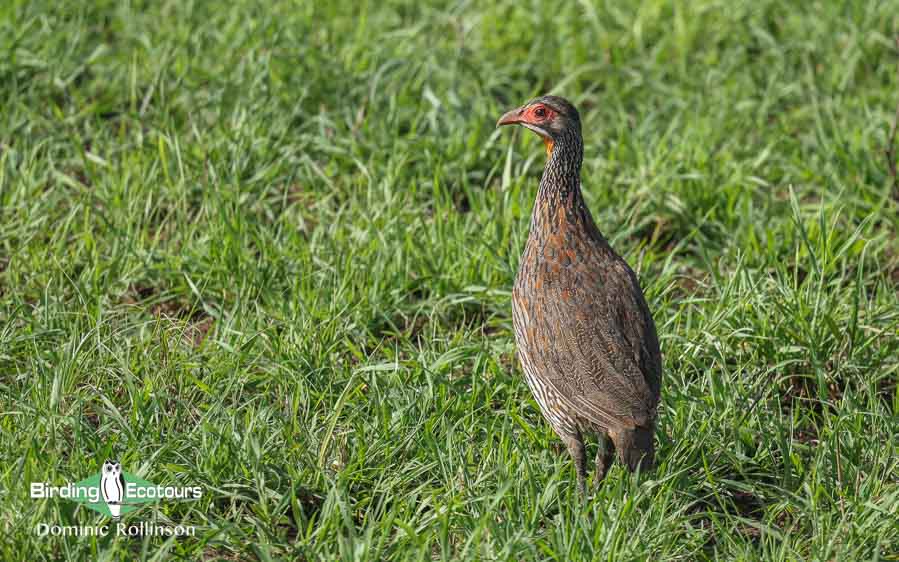 Grey-breasted Spurfowl, a highly localized Tanzanian endemic.
We enjoy easy yet exceptionally rewarding savanna birding on this tour as we target several localized and endemic species, typically with good photographic opportunities along the way. This tour offers one of the finest introductions to Africa’s wildlife and birds available anywhere on the continent.
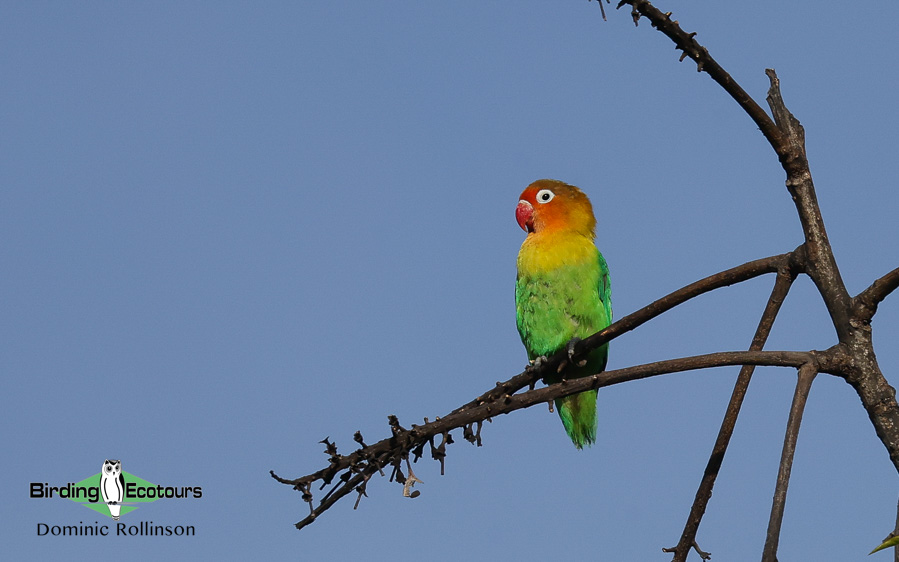
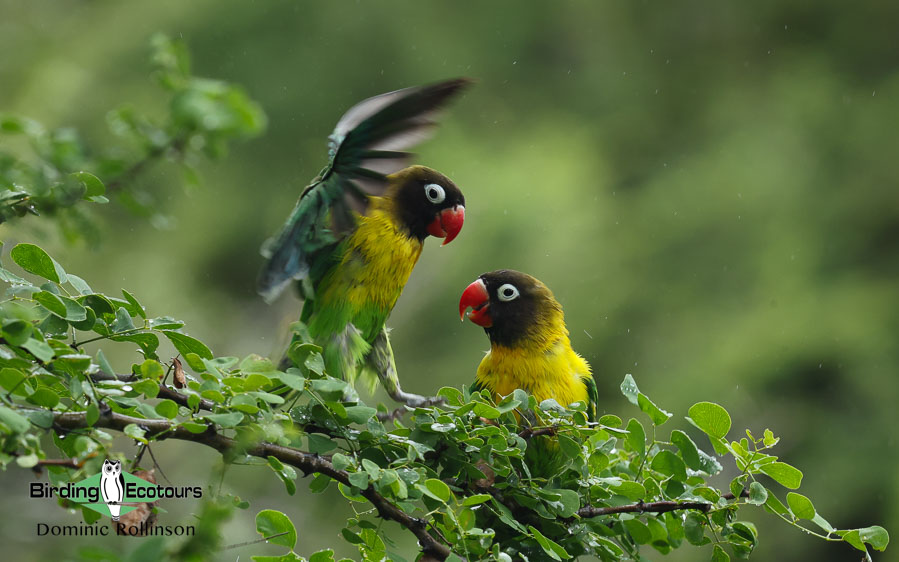 The endemic Yellow-collared Lovebird is one of our many colorful targets on this trip.
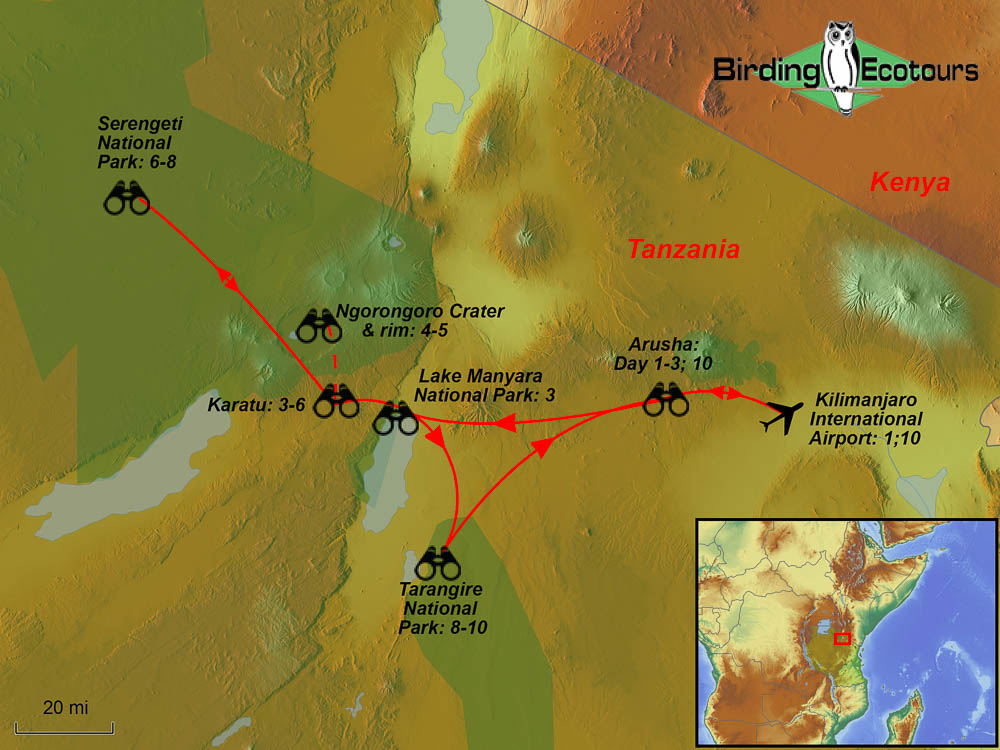
We begin this tour at Kilimanjaro International Airport near Arusha. Flying into this airport, weather permitting, you might get views of Africa’s highest mountain. From here, we visit the Lark Plains, north of Arusha, for some highly localized species, including the endemic Beesley’s Lark and Athi Short-toed Lark. Next, we travel to the famed Ngorongoro Crater, enjoying Lake Manyara National Park en route. The crater is a truly unforgettable destination, offering a classic African wildlife experience. Before leaving the Ngorongoro Conservation Area, we spend a day birding the forests on the crater rim, targeting several range-restricted species such as Brown Woodland Warbler, African Hill Babbler, and Mbulu White-eye.
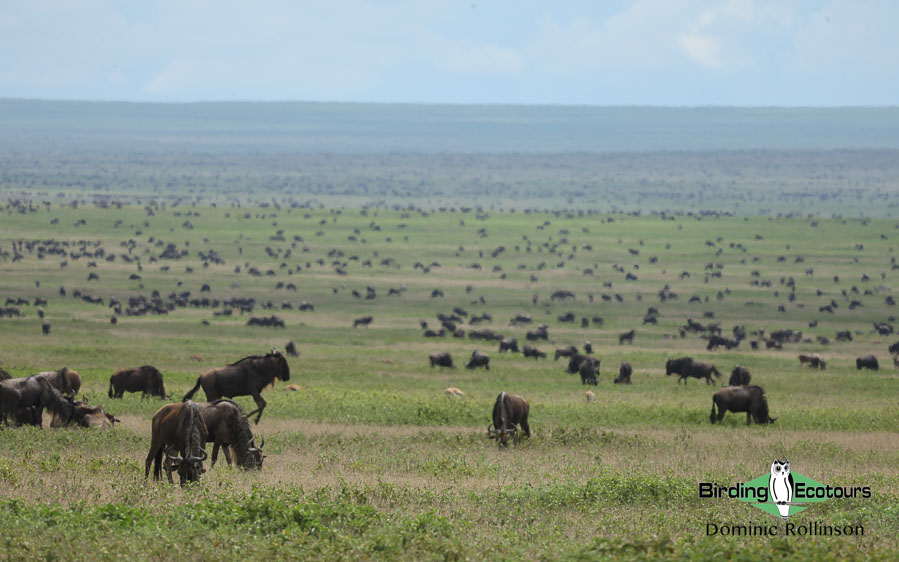
We then head to the spectacular Serengeti National Park, where the iconic African mammals truly shine. Here, we encounter high densities of Lion, African Savanna Elephant, and, of course, the breathtaking Great Wildebeest Migration. At the same time, the Serengeti is home to several highly sought-after, range-restricted birds, including Maasai Apalis, Fischer’s Lovebird, Rufous-tailed Weaver, Red-throated Tit, and Grey-crested Helmetshrike, alongside a wide variety of more widespread African species.
Finally, we spend two nights in Tarangire National Park, an area famous for its enormous concentrations of African Savanna Elephants and iconic Baobab trees. Here, we search for Northern Pied Babbler, Yellow-collared Lovebird, Pangani Longclaw, and Ashy Starling, among others. Northern Tanzania boasts an impressive diversity of localized birds, and this tour offers an unforgettable combination of Africa’s classic mammal spectacles and its unique endemic avifauna, making it the perfect introduction to the continent for both birders and wildlife enthusiasts of all levels.
If you’d like to experience even more of Tanzania’s remarkable birding, consider joining our 23-day Tanzania: Remote Endemics of the Eastern Arc tour. This exciting adventure takes us into some of the most remote corners of Tanzania’s Eastern Arc Mountains, as well as the white-sand beaches and coastal forests of Pemba Island, in search of some of Africa’s most enigmatic and sought-after birds. Along the way, we target more than 30 endemics, including the near-mythical Udzungwa Forest Partridge.
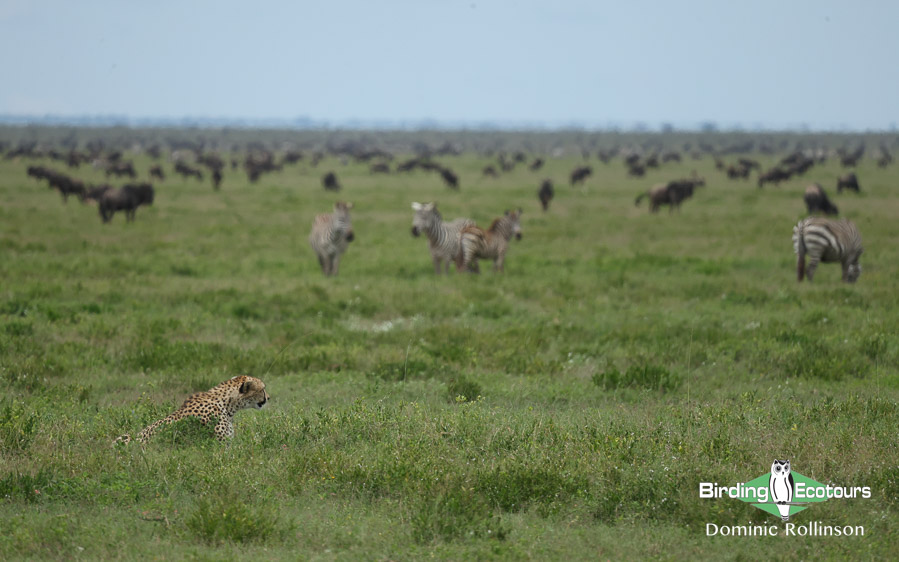 Tanzania must rank as one of the best countries on Earth for Cheetah, which take advantage of the massive herds of migrating wildebeest!
Itinerary (10 days/9 nights)
Day 1. Arrival in Arusha
Today is your arrival day into Arusha’s Kilimanjaro International Airport and you can arrive at any time, as we don’t have any planned birding on this day. Leisurely birding around the lodge grounds may, however, produce African Black Duck, Silvery-cheeked Hornbill, White-eared and Brown-breasted Barbets, Black-throated Wattle-eye, Grey-Olive Greenbul, Kenrick’s Starling, Rüppell’s Robin-Chat, Mountain Wagtail and the localized Taveta Weaver.
Overnight: Ngare Sero Mountain Lodge, or similar, Arusha
Day 2. Birding the Lark Plains
Our first full day of birding on this tour is certainly an exciting one as we make an early start, heading north out of Arusha (with Mount Meru as a backdrop) for a full day of fantastic plains and dry-country birding. Weather-permitting, we will enjoy distant views of Africa’s highest mountain, Mount Kilimanjaro, rising out of the vast African plain.
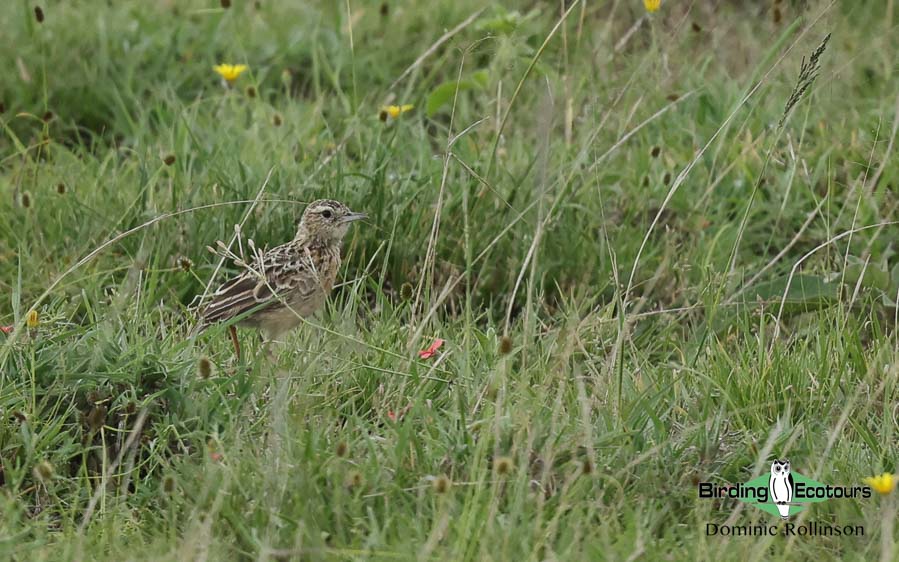
We will spend time birding the (aptly named) Lark Plains for the rare and localized Beesley’s Lark (less than 200 remaining) along with a host of other lark species, including Fawn-colored, Short-tailed, Athi Short-toed, and Rufous-naped Larks and Fischer’s Sparrow-Lark. Other species we will keep an eye out for on the plains include Kori Bustard, Eastern Chanting Goshawk, Greater Kestrel, Temminck’s and Double-banded Coursers, Yellow-throated and Chestnut-bellied Sandgrouse, Abyssinian and Capped Wheatears, Taita Fiscal, and numerous others.
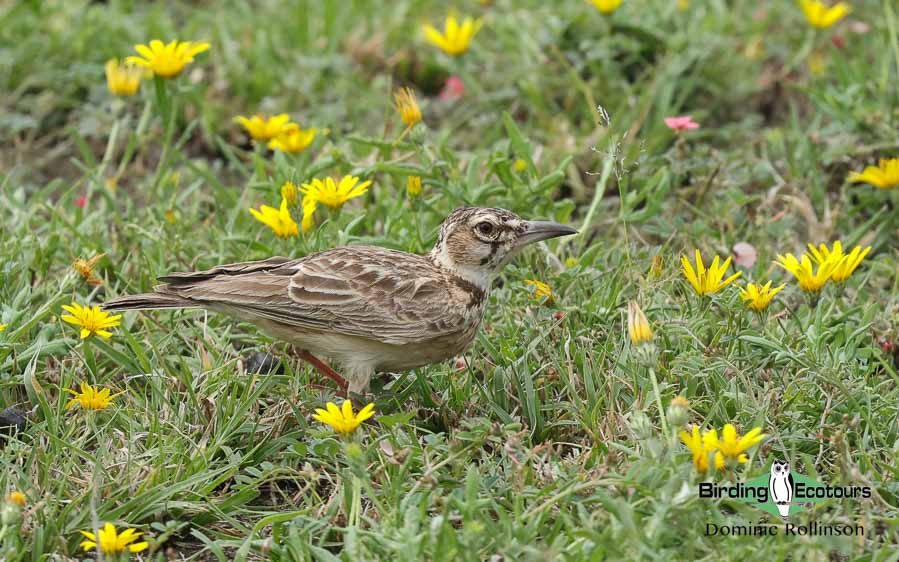 The distinctive Short-tailed Lark will be searched for alongside the rare Beesley’s Lark.
Many Serengeti-type birds can also be found here in the grassland and dry woodland habitat. Red-throated Tit is possible, as are some fine barbet species. We also hope to see our first mousebirds, in the form of Speckled and Blue-naped Mousebirds (with White-headed Mousebird occasionally seen). The colonially nesting Grey-capped Social Weaver is always a delight, and we may see (and hear the loud call of) Nubian Woodpecker. Other species to look out for in the woodlands include Mouse-colored Penduline Tit, Red-fronted Prinia, Grey Wren-Warbler, Rosy-patched Bushshrike, Spotted Palm Thrush, Beautiful Sunbird, Pale White-eye, Kenya Sparrow, Black-faced Waxbill and Southern Grosbeak-Canary. After birding the area for most of the day, we eventually head back to Arusha for the night.
Overnight: Ngare Sero Mountain Lodge, or similar, Arusha
Day 3. Lake Manyara birding and transfer to Karatu
After breakfast we will make our way out of Arusha and arrive at Lake Manyara National Park in the late morning. Here we usually add quite a number of birds to our list and will enjoy a picnic lunch while being distracted by many exciting bird species. In the forested areas we’ll be on the lookout for Narina Trogon, Grey Cuckooshrike, Mountain Wagtail, Crowned Hornbill, and the huge Silvery-cheeked Hornbill, among others. In the more open woodland, we should hopefully find Spotted Palm Thrush, Red-and-yellow Barbet, White-bellied Tit, Banded Parisoma, Rufous Chatterer, Rufous-tailed Weaver, Steel-blue and Straw-tailed Whydahs, and Purple Grenadier. The reserve is particularly good for raptors and some of our targets today include Lappet-faced and White-backed Vultures, Bateleur, Crowned Eagle, African Hawk-Eagle, African Goshawk, Verreaux’s Eagle-Owl and the diminutive Pearl-spotted Owlet.
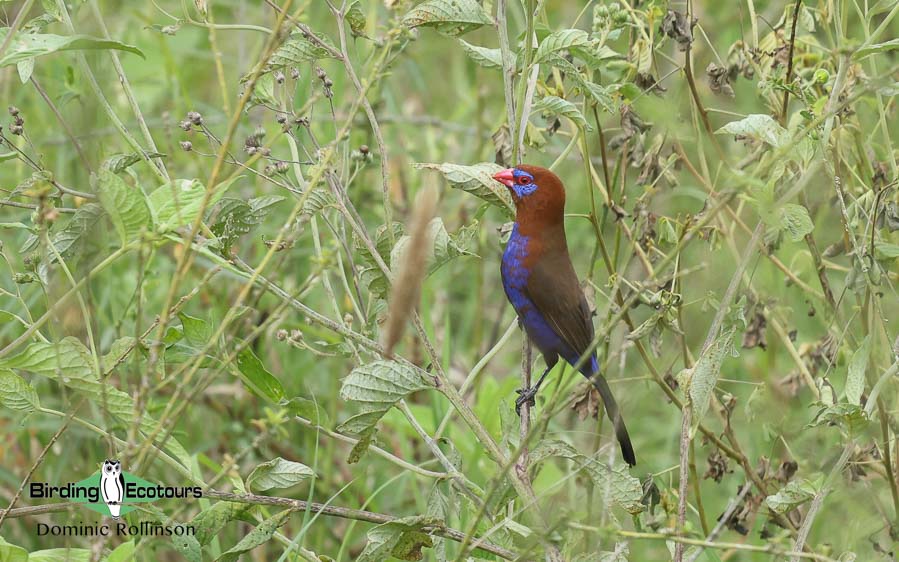 The gorgeous Purple Grenadier is readily encountered in northern Tanzania.
Depending on water levels, the shallow alkaline lake will be visited to enjoy the flocks of both Greater and Lesser Flamingos along with Great White Pelican, the massive Goliath Heron, and many other ducks, storks, and herons. After a few hours in the reserve, we will transfer to our lovely lodge on the outskirts of the nearby town of Karatu, which will be our base for the next three nights.
Overnight: Karatu
Day 4. The unforgettable Ngorongoro Crater
Today we have the full day to bird the Ngorongoro Crater and crater rim which will prove to be a sure trip highlight. Descending into the crater floor is truly an unforgettable experience. There’s a very high density of Lion and large herbivores, some of them seemingly trapped by the natural enclosure formed by this huge, nicely intact caldera. About 25,000 large mammals, which also include Black Rhinoceros and a pool with Common Hippopotamus, inhabit the crater floor. With luck we might also see some of the smaller predators, like Serval, Bat-eared Fox, and African Golden Wolf, which was formerly classified as an African variant of the Eurasian Golden Jackal but now is thought to be more closely related to the Grey Wolf. As always, however, our main focus is on birds, although we stop for the other wildlife too, and we expect many additions to our growing bird list – Lesser Flamingo, Grey Crowned Crane, Abdim’s Stork, Black-bellied and Kori Bustards, Pectoral-patch Cisticola, Rufous-tailed Weaver, Rosy-throated Longclaw, and many others are expected.
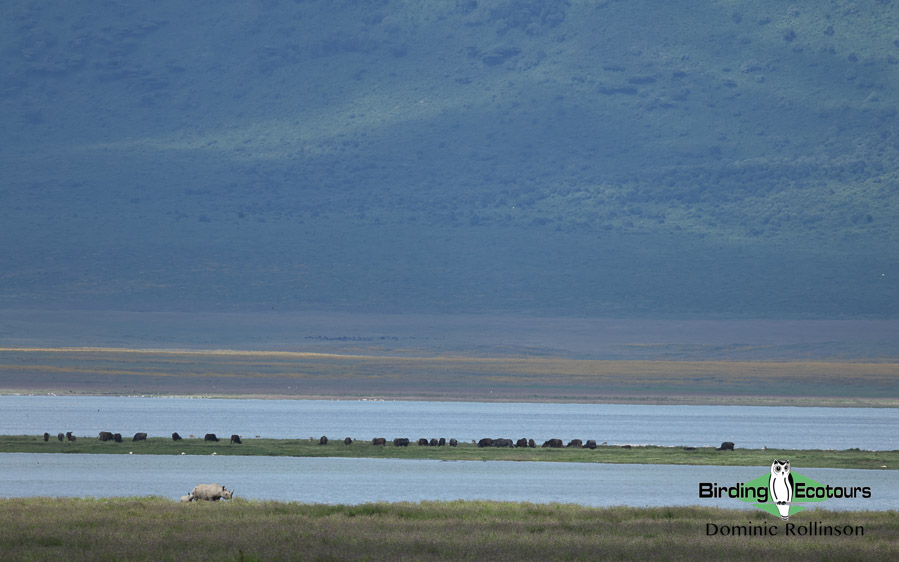 Black Rhinoceros in the picturesque Ngorongoro Crater.
Large African animals, spectacular birds (of a staggering variety), and stunning scenery combine to make this one of the most incredible wildlife experiences on Earth; the rim of this crater rises an incredible 2,000 feet (600 meters) above the plain at the bottom (which has a diameter of 15 miles (24 kilometers)).
The forested sections of the crater rim will also be birded, looking for localized specials such as Golden-winged Sunbird, Brown-headed Apalis, and the curious Oriole Finch, which we may also be lucky enough to encounter here. Other species to look out for here include Eastern Bronze-naped Pigeon, Dusky Turtle Dove, Grey-capped Warbler, Eastern Double-collared Sunbird, White-eyed Slaty Flycatcher, Brown-backed Woodpecker, Mbulu White-eye, and Thick-billed Seedeater.
Overnight: Karatu
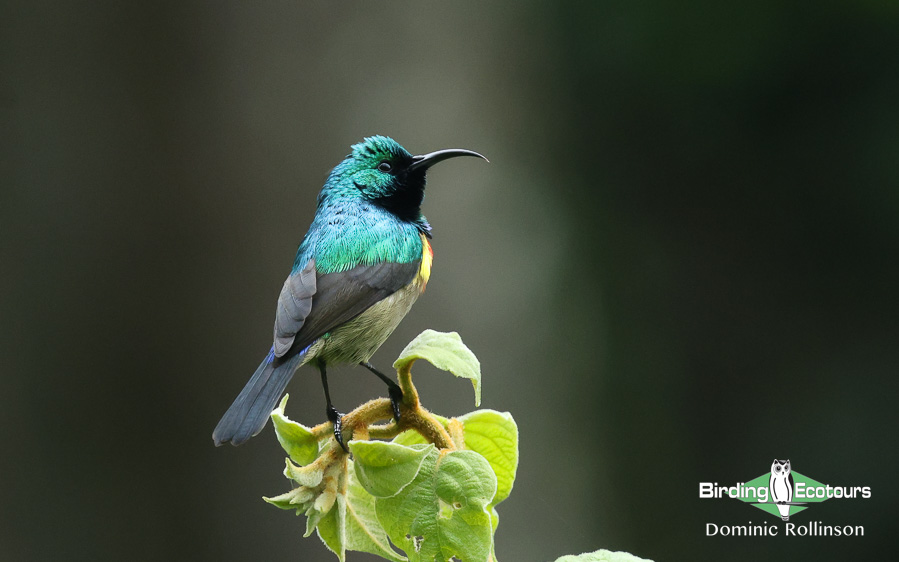 The attractive Eastern Double-collared Sunbird.
Day 5. Birding the lush forests of the Ngorongoro Crater rim
Today we will visit the Endoro section of Ngorongoro Conservation Area as well as the splendid Gibb’s Farm, which is a great place for lunch and to add new birds to the growing list. This morning’s birding will be quite different from the rest of the trip as we enjoy some fine forest birding while walking the Elephant Caves Trail. Highlights of this morning will hopefully include, Narina Trogon, Moustached Tinkerbird, Pallid and Scaly-throated Honeyguides, African Broadbill, Purple-throated Cuckooshrike, Black-fronted Bushshrike, Blue-mantled Crested Flycatcher, Brown-headed Apalis, Grey-capped Warbler, Black-headed Mountain Greenbul, Brown Woodland Warbler, African Hill Babbler, Mbulu White-eye, Grey-headed Nigrita and Red-throated Twinspot. We will keep an eye out overhead for the likes of Ayres’s Hawk-Eagle, Black Sparrowhawk, Augur Buzzard and Nyanza Swift. The prehistoric-looking Schalow’s Turaco adds a spectacular flash of crimson and green, and, if one gets a good view, its spectacular crest leaves even a hardened birder gob smacked.
We will enjoy lunch in the wonderful, relaxed atmosphere of Gibb’s Farm which is normally full of birds. After lunch we will bird the large property where we hope to find Cinnamon-chested Bee-eater, Dusky Turtle Dove, White-tailed Blue Flycatcher, White-eyed Slaty Flycatcher, Green-headed Sunbird, Holub’s Golden Weaver, Black-and-white Mannikin, Southern Citril and Yellow-bellied Waxbill.
Overnight: Ngorongoro Crater rim lodge
Days 6-7. Serengeti: wildebeest, predators, and a dazzling array of spectacular birds
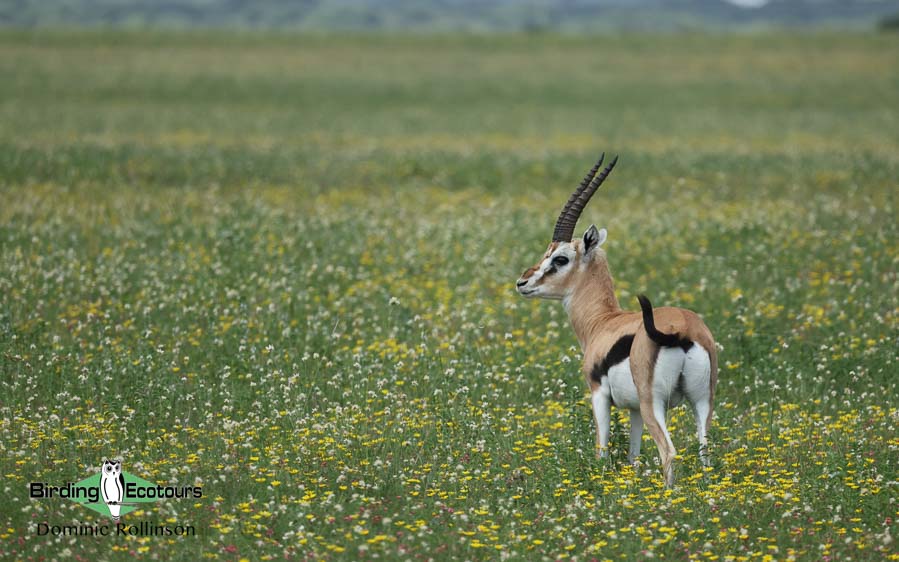
This morning we embark on a spectacular journey that few people will ever forget. If you’ve never been to Africa before, you’re likely to be amazed by African Savanna Elephant, Cape Buffalo, and the sheer number of bird species. After an exciting drive we’ll reach the Serengeti, where we enjoy the huge and impressive wildebeest migration, not to mention the large numbers of Plains Zebras and Thomson’s Gazelles. Other megafauna that we’ll search for include Tsessebe (Topi), Common Eland, Grant’s Gazelle, Bohor Reedbuck, and Maasai Giraffe. This is one of the best places on the planet to see big cats – we’ve sometimes seen Lion, Leopard, and Cheetah in a single day, as well as some of the smaller cats such as Serval and Caracal. Finding a kill should allow us to see a good number of vulture species, such as Rüppell’s, White-backed, Lappet-faced, White-headed, and Hooded Vultures.
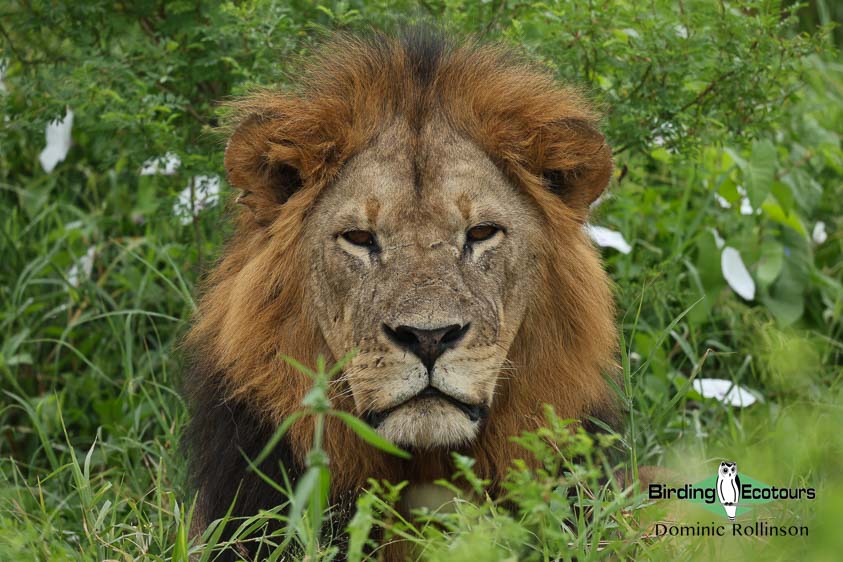 The Serengeti supports large numbers of Lions.
Birds of prey are common here, including the most colorful of the world’s eagles, Bateleur. Secretarybird regally roams the plains searching for its serpentine prey, while Common Ostrich tries to be regal but without much success. Smaller birds are everywhere, and so many of them are brightly colored – such as Little Bee-eater, Purple Grenadier, Lilac-breasted Roller, Hildebrandt’s Starling, Beautiful Sunbird, and many others. Other target species that we will look for in the plains and open savanna of the Serengeti include White-bellied Bustard, Coqui Francolin, Temminck’s Courser, Dark Chanting Goshawk, Pygmy Falcon and Pangani Longclaw.
Interestingly, the Serengeti is home to quite a few extremely localized bird species. One of these is Maasai Apalis, which favors the weird whistling-thorn habitat that we’ll visit for this species; it only occurs here and over the border into Kenya. Red-throated Tit, Fischer’s Lovebird, and Grey-crested Helmetshrike are other range-restricted species we will look for in the Serengeti. Other important target birds here include Rufous-tailed Weaver and the Tanzanian endemics, Tanzanian Red-billed Hornbill and Grey-breasted Spurfowl. The huge Kori Bustard can be seen roaming the grasslands throughout the Serengeti plains.
Overnight: Serengeti
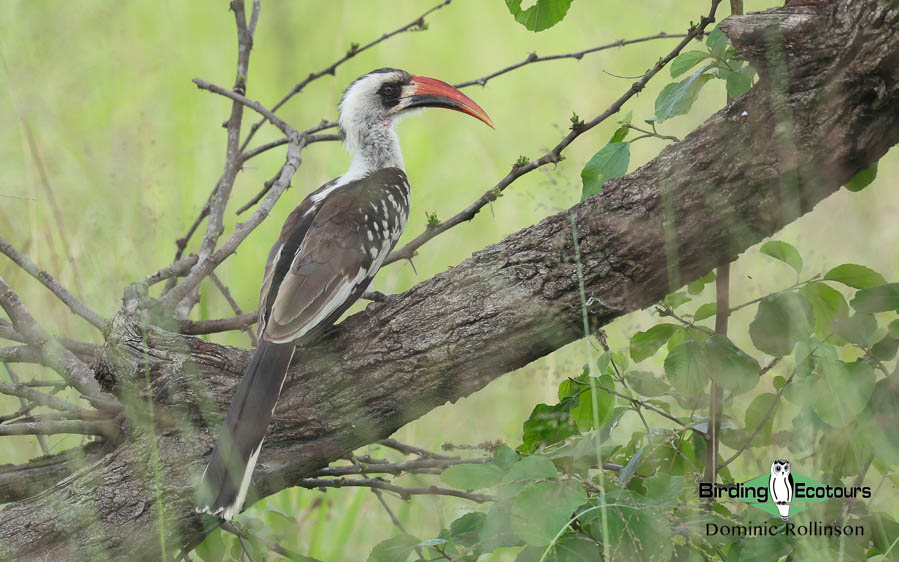 Tanzanian Red-billed Hornbill – a Tanzanian endemic.
Day 8. Transfer to Tarangire National Park
After breakfast, we make the drive back through the animal-filled plains of the Serengeti where we will again hopefully enjoy further looks at massive herds of migrating wildebeest, zebra and gazelle. We may also have time to look for any remaining bird targets before we finally leave this wildlife haven.
After a long day on the road, we will make it to Tarangire National Park, a breathtaking landscape of red-stained elephants (from the soil), towering baobabs, savanna-clad hills, and winding rivers: the real Africa as far as scenery goes. Here at magnificent Tarangire National Park we have some localized northern Tanzania specials and endemics to target: Yellow-collared Lovebird, the long-tailed Ashy Starling, and the charismatic Northern Pied Babbler, which we usually manage to find. In Acacia woodlands around the park, we should encounter Von der Decken’s and Northern Red-billed Hornbills, Yellow-necked and Red-necked Spurfowl, Black-faced Sandgrouse, Bearded Woodpecker, Abyssinian Scimitarbill, Eastern Violet-backed Sunbird and many others. We may also come across larger terrestrial birds like Secretarybird, White-bellied, Hartlaub’s and Buff-crested Bustards, and the massive Southern Ground Hornbill, while Common Ostrich puts them all to shame, as far as size goes. If sufficient rains have arrived in the area Tarangire can be a good place to look for Black Coucal and Dwarf Bittern. The massive Baobabs dotted throughout the landscape host good numbers of Mottled Spinetail which use the hollows within old trees to build their nests.
The Tarangire River (after which the park is named) attracts good numbers of waterbirds including the likes of White-faced Whistling Duck, Knob-billed Duck, Saddle-billed Stork, Hamerkop and Grey Crowned Crane which may be seen as we traverse this wonderful park.
Overnight: Tarangire National Park
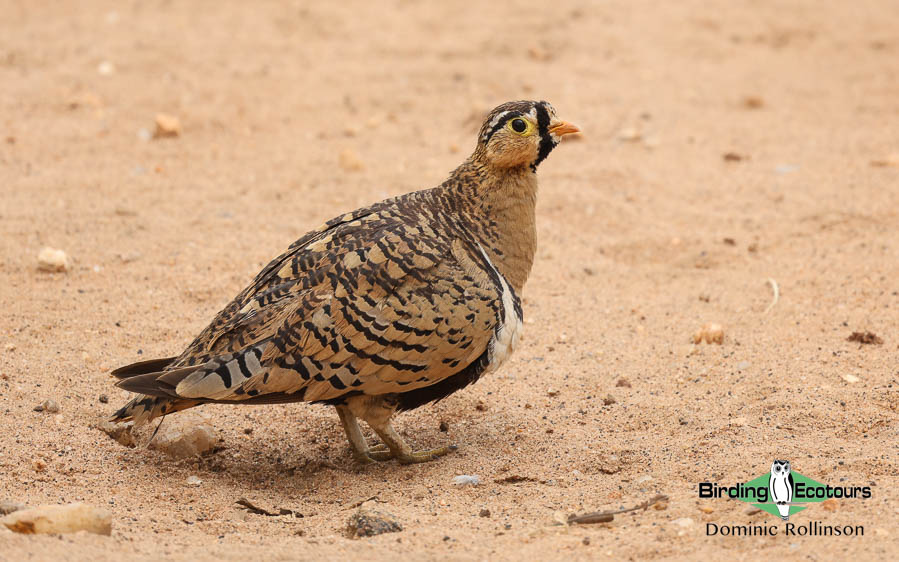 We often find Black-faced Sandgrouse in Tarangire National Park.
Day 9. Full day in Tarangire National Park
This will be the final full day of our Tanzanian birding safari and we will spend the day looking for any remaining target species (as described under Day 8) as well as enjoying the fine wildlife-viewing that is possible in Tarangire. We will likely end the afternoon enjoying a sundowner drink on the lodge’s balcony which overlooks the Tarangire River, while being harassed by cheeky Ashy Starlings, with African Scops Owls giving their soft purr-like call as the sun sets.
Tarangire offers night drives to enjoy some of the area’s nocturnal birds and wildlife and, although these drives are not included in the tour price, it is possible to join one of these exciting drives. Some of the nocturnal species which may be seen at night include Verreaux’s Eagle-Owl, Southern White-faced Owl, Bronze-winged and Three-banded Coursers, East African Springhare, Northern Lesser Galago and African Savanna Hare.
Overnight: Tarangire National Park
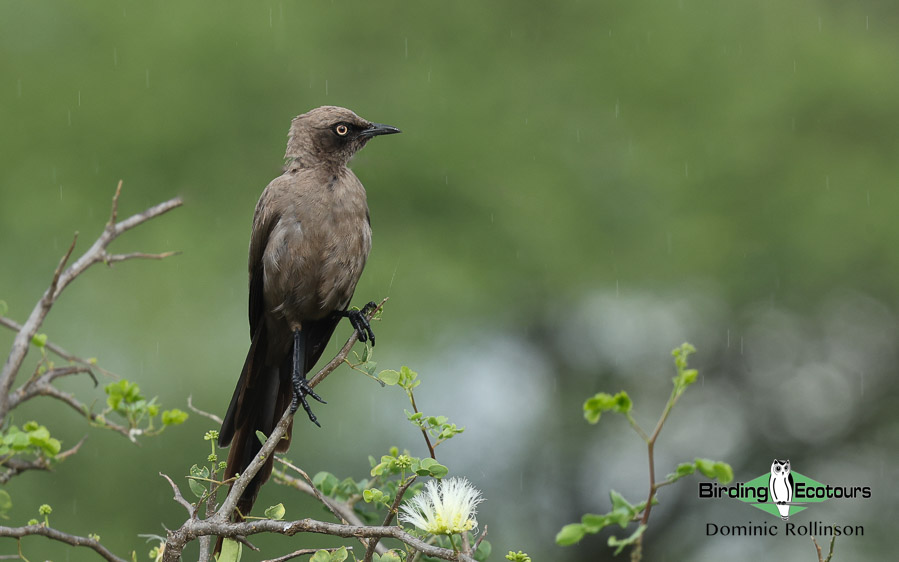 Ashy Starlings are numerous in Tarangire National Park.
Day 10. Departure from Arusha
Unfortunately, today marks the end of an incredible ten days in northern Tanzania. After breakfast we will make our way to Kilimanjaro International Airport, just outside of Arusha, from where our flights will depart. It is a roughly four-hour drive to Arusha, so please do not book flights any earlier than 3pm.
Overnight: not included
Please note that the itinerary cannot be guaranteed as it is only a rough guide and can be changed (usually slightly) due to factors such as availability of accommodation, updated information on the state of accommodation, roads, or birding sites, the discretion of the guides and other factors. In addition, we sometimes have to use a different guide from the one advertised due to tour scheduling or other factors.
Map