01-08 MARCH 2026
By Chris Lotz
This was a a custom version of our Cambodia tour.
Overview
Cambodia is a remarkable birding destination, as six extremely rare species can usually be seen with remarkable ease here. These Critically Endangered (IUCN designation) birds are Bengal Florican, two ibises and three vultures. As we expected, we did see all six of these birds, very nicely. White-rumped Falcon is also a major target in Cambodia, and we enjoyed seeing it a couple of times on this trip. This Cambodia birding tour nicely complements our Vietnam set departure trip. It contributes many lowland species that are not included on our Vietnam itinerary, during which 80% of our time is spent seeking localized birds of the highlands. Needless to say, it worked very well for us to precede our set departure Vietnam trip with a private 8-day Cambodia pre-tour. This also gave us the opportunity to admire the unbelievable Angkor Wat temple complex, and other spectacular ancient temples.
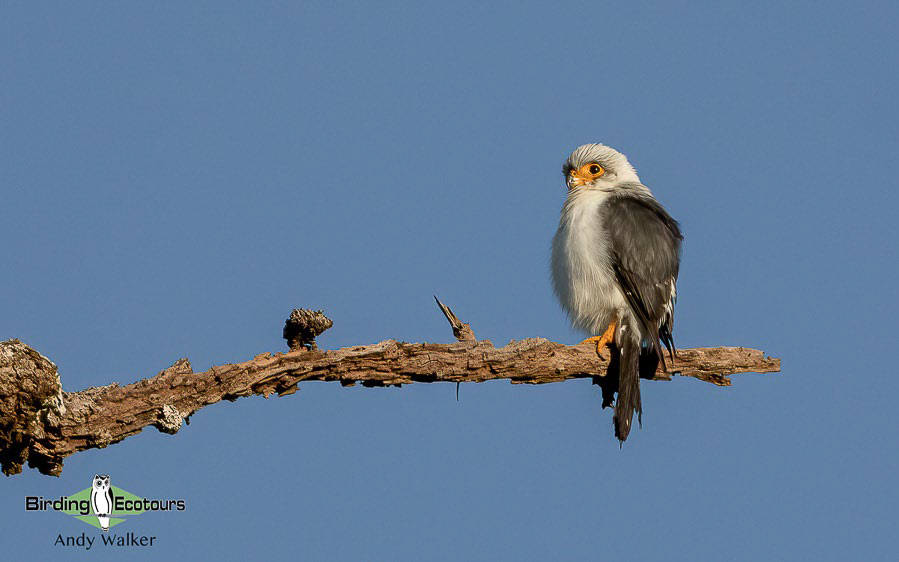
White-rumped Falcon, one of the major targets of any Cambodia birding tour.
In addition to the very rare species mentioned above, we also saw a great many other excellent birds, like White-browed Crake, two pratincole species, Asian Golden Weaver and two other weaver species, an array of brightly-colored barbet, bee-eater, kingfisher, roller, parakeet, minivet, sunbird, leafbird, oriole and other species, woodpeckers including the gorgeous Black-headed Woodpecker, Burmese Nuthatch, numerous warbler species, a lot of bulbuls, many raptors and a few owls, and stacks more (please see the eBird trip report, and the complete bird list at the end of this report). Photos in this report are from previous trips except for the Angkor Wat photo.
Mammals, reptiles, butterflies and other animals also featured very prominently on this amazing tour of Cambodia (again, see the end of this report for lists of these), as did excellent food; all in all it was a fantastic experience with a great group of people.
Detailed Report
Day 1, 1st March 2026. Arrival in Siem Reap
The group arrived this afternoon and we decided to rest up at our luxurious hotel after our marathon flights, in preparation for an early start the next morning. We did start getting acquainted with some of Cambodia’s more ubiquitous birds around here, including Common Tailorbird and Eurasian Tree Sparrow.
Day 2, 2nd March 2026. Sightseeing and birding at Angkor Wat
We started the day with a sunrise visit to the world’s largest religious monument, the spectacular 12th-century Khmer temple, Angkor Wat. The surrounding forest happens to be great for birding, so we were also able to make a good start on our Cambodian bird list. There were excellent species around, including Green-billed Malkoha, Asian Barred Owlet, Coppersmith Barbet, Lineated Barbet, Red-breasted Parakeet, Ashy Minivet, Greater Racket-tailed Drongo, Dark-necked Tailorbird, Asian Brown Flycatcher, Hainan Blue Flycatcher, Taiga Flycatcher, Ornate Sunbird and Common Hill Myna. A couple of Blue Rock Thrushes sat on the walls of the temple complex, while a pair of White-throated Rock Thrushes gave good views inside the nearby forest. Edible-nest (Germain’s) Swiftlet, Oriental Pratincole and the attractive Black Baza flew overhead.
After a great morning, we went back to the hotel for lunch and a rest during the heat of the day. At the start of our afternoon sightseeing (and birding) session, we stopped briefly near the Royal Palace where we saw some dazzling Scarlet-backed Flowerpeckers. We then headed to the remarkably decorated Bayon Temple at Angkor Thom, the “Tomb Raider temple”. It took us some time to explore this temple, including the many remarkable carvings, and at times we got distracted by some good birds in and around the ruins, such as Red-breasted Parakeet, Ashy Drongo (the white-cheeked form), Lineated Barbet, Black Baza again, and a few others.
We then returned to Angkor Wat, making brief stops along the way to look at a pair of Plain-backed Sparrows (this is a pretty sparrow species, despite its name), an attractive Chestnut Munia and several others. We found a Spotted Owlet at its usual roost just outside the temple complex. A couple of us saw a Common Iora and there were a few Ornate Sunbirds around.Beautiful Indochinese Rollers showed at close range. We ended the day admiring a sunset at Angkor Wat before returning to the hotel for dinner.
In addition to the birds we saw today, there were also some good mammals around: Cambodian Striped Squirrel, Finlayson’s Squirrel, Northern Pig-tailed Macaque, and Long-tailed Macaque.

The forest around the impressive Angkor Wat temple complex is great for birding
Day 3, 3rd March 2026. The Bengal Florican Conservation Area and Sen Russey Treb Park
This was an amazing day with sightings of some of the world’s rarest birds. In the morning, we headed to the Bengal Florican Grasslands where we found a small flock of Sarus Cranes, a flock of Spot-billed Pelicans on a power pylon (really strange!), graceful Oriental Pratincoles, a Painted Stork, gaudy Asian Green Bee-eaters and Blue-tailed Bee-eaters, unusual Black-collared Starlings, a couple of (Red-spotted) Bluethroats, Amur Stonechats and our first of many Paddyfield Pipits and Singing Bushlarks.
We then reached the Bengal Florican area and found four of these Critically Endangered (IUCN) birds. The global population of these small bustards is less than 1,000 individuals and is declining (see here for more details). There were many other great birds around, including a couple of Small Buttonquails that flushed in front of us as we drove, and a Blue-breasted Quail that ran under a bush and then flushed.
Gorgeous Pied Harriers including some spectacularly striking males, and many Eastern Marsh Harriers, quartered low over the grassland. Striated Grassbirds, Pied Bushchats, Siamese Pied Starlings, a Streaked Weaver building a nest and many other birds showed too. Three skulking Lanceolated Warblers showed after a bit of patience, as did a Manchurian Reed Warbler, a declining, Vulnerable (IUCN) species. There were many Red Avadavats and a few Scaly-breasted Munias around.
After a very successful session at the Bengal Florican Grasslands, we spent some of the heat of the day driving to Sen Russey Treb Park. Many new birds awaited us in this new area, including Vernal Hanging Parrot, Chinese Francolin, Red Collared Dove, Crested Treeswift, Asian Woolly-necked Stork, Chestnut-headed Bee-eater, Common Flameback, Grey-breasted Prinia and numerous others. The star of the show was another Critically Endangered (IUCN) species, Giant Ibis, which we saw as it came to roost. The global population of this species numbers fewer than 200 birds, and they are declining (see here for more information).
We ended the day with some early evening birding before dinner, seeing an Eastern Barn Owl and hearing a couple of Savanna Nightjars.
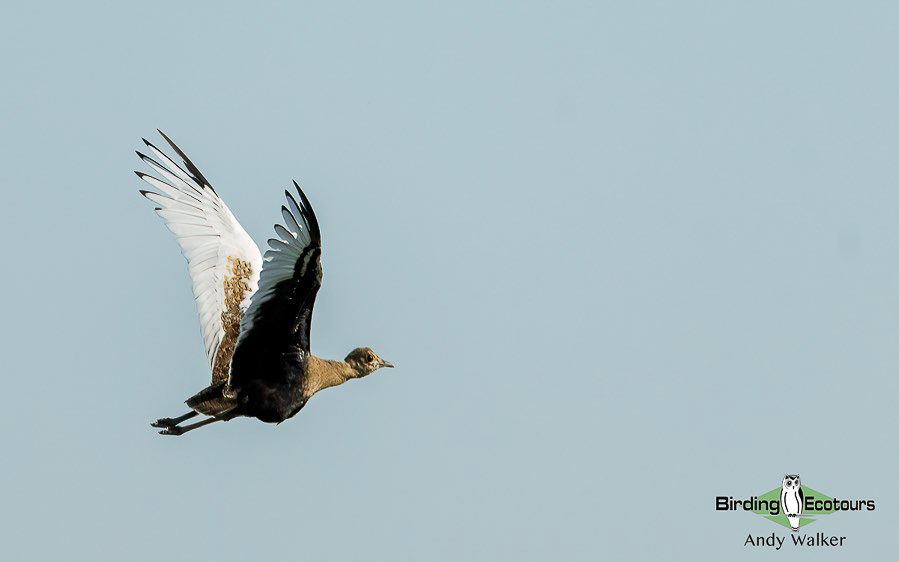
Another major target in Cambodia, the Critically Endangered Bengal Florican
Day 4, 4th March 2026. Sen Russey Treb Park, Critically Endangered vultures and onwards to the Mekong River
We started the day with a pair of Eastern Barn Owls at our hotel, along with Ashy Woodswallows, Scaly-breasted Munias and a few other good birds.
We then headed back to the Sen Russey Treb Park to look for our main target, White-rumped Falcon, and we were not disappointed, getting scope views of a female with her beautiful chestnut head. The dry forest here was full of other great birds, including two species of woodshrike, three species of cuckooshrike, four species of minivet, dazzlingly colorful Black-headed Woodpeckers (such beauties!) and Grey-capped Pygmy Woodpeckers, Common Hoopoe, Golden-fronted Leafbird, Bar-winged Flycatcher-shrike, very cooperative, stunning Burmese Nuthatches and various others.
We then drove onwards to the Veal Krous Vulture Restaurant. Here we added yet more Critically Endangered birds to our growing list, in the form of Red-headed Vultures (two of them), White-rumped Vulture (more than 15) and Slender-billed Vultures (at least five). Chestnut-tailed Starlings also foraged in the vicinity of the vulture restaurant, and a cooperative pair of Rufescent Prinias were nearby.
We then drove to the mighty Mekong River, where we stayed at a hotel overlooking the river, greatly anticipating the next day.
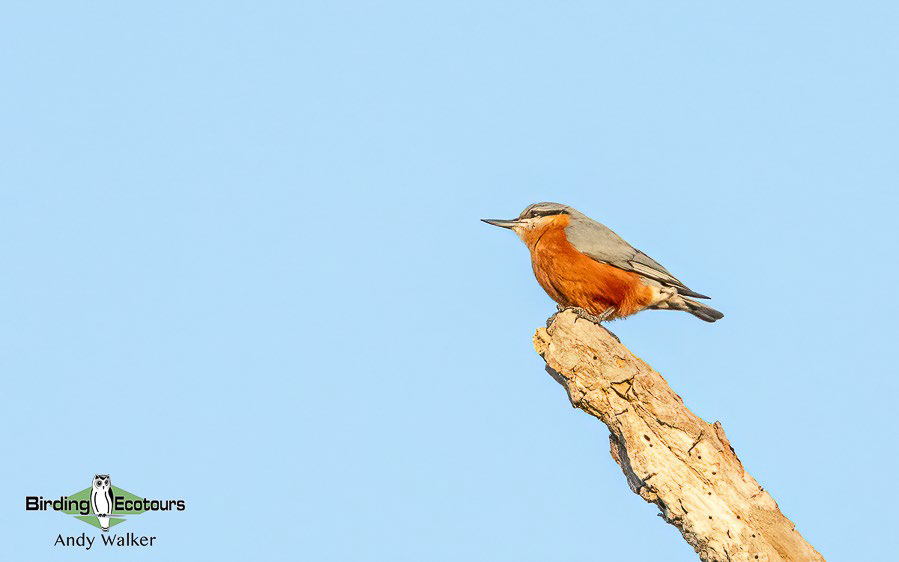
The attractive and personality-filled Burmese Nuthatch is quite easy to find here.
Day 5, 5th March 2026. Rare birds and mammals along the Mekong River
We started the day with six White-shouldered Ibis (less than 700 of these remain, see more information here)! The ibis site was very birdy, and we added some great species to our growing list, including Indochinese Bushlark, Brown Prinia, Vinous-breasted Myna, Great Myna and a couple of vocal Indian Cuckoos, which only Stephen saw (but we all saw one flying over us calling, on our Vietnam set departure birding tour just after this private Cambodia trip).
We then embarked on a boat trip on the Mekong River, finding the localized, Near-threatened (IUCN) Mekong Wagtail, along with River Tern, River Lapwing, Common Sandpiper, numerous herons and egrets, Osprey, Brahminy Kite, Oriental Pied Hornbill, Common Kingfisher, White-throated Kingfisher, a great many Pied Kingfishers, and a spectacular Greater Racket-tailed Drongo.
In the afternoon, we did a boat trip further south along the Mekong River to see Endangered (IUCN) Irawaddy Dolphins, and spent some time with a pair of them and their very small baby! What a privilege to spend time with these rare animals. We also added a couple of new species to our bird list during this boat trip: Indian Cormorant and Grey-throated Martin.
On our way to our hotel for the night, we stopped at a place for Small Pratincoles and found about 25 of them. We scoped a beautiful Peregrine sitting on the same sand bank as the pratincoles. We also saw about a dozen Indian Spot-billed Ducks here and had brief views of a vocal Dusky Warbler and of a not so vocal Oriental Reed Warbler. Common Iora showed well, as did a Malaysian Pied Fantail.
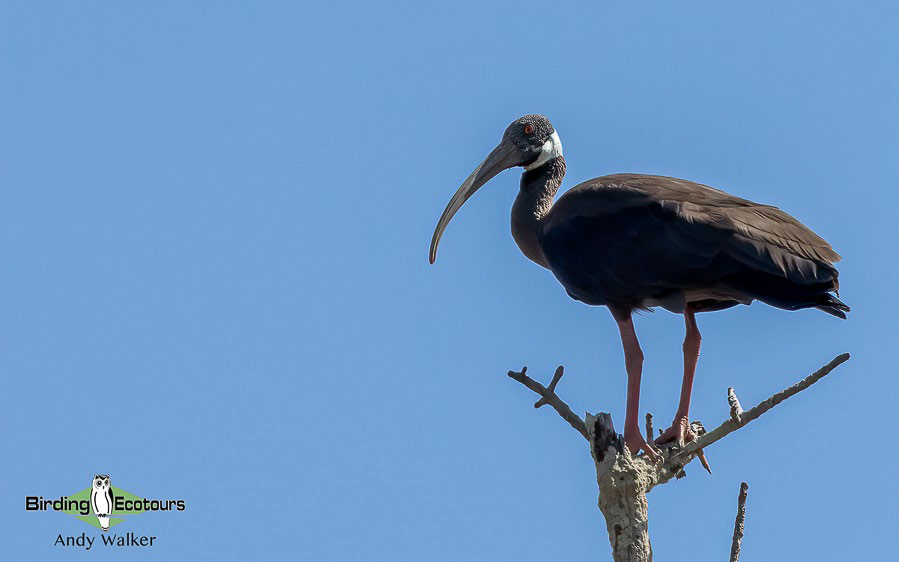
White-shouldered Ibis, one of two Critically Endangered ibis species Cambodia is famous for.
Day 6, 6th March 2026. Kampong Cham to the Coral-billed Ground Cuckoo hide (blind)
We started the day with some easy birding near our hotel with the main target, Cambodian Tailorbird showing very well, as expected. This recently described species is endemic to south-eastern Cambodia. There were a lot of other nice birds around, including Small Pratincoles (much closer up than yesterday’s ones), Racket-tailed Treepies, a Green-billed Malkoha that showed very well through the scope, Yellow-bellied Prinia, numerous Blue-tailed Bee-eaters, Eurasian Kestrel and various other birds.
After checking out of our hotel, we embarked on a five-hour drive to put ourselves in position for looking for Coral-billed Ground Cuckoo the next morning – so exciting! We broke the journey with a couple of birding stops, the best one being at Banteay Srei. Here we got great views of a number of new trip birds, including White-browed Crake, Lesser Whistling Duck, Cotton Pygmy Goose, and Bronze-winged Jacana.
Day 7, 7th March 2026. Coral-billed Ground Cuckoo hide
We spent the morning birding in the Changkran Roy Community Forest. Our first birding session was from one of the bird hides (blinds) where our main target was Coral-billed Ground Cuckoo which, unfortunately, we only heard (two individuals) with no sightings. With solid rain during the night, unfortunately the birds just didn’t show although they’d been reliable for many consecutive days before we arrived. Another jewel that we heard only was Blue-winged Pitta. But there were a number of great birds around that did show very well, including a lot of close-up, beautiful Asian Emerald Doves, Puff-throated Babblers (more subtly beautiful), Scaly-breasted Partridge, spectacular (and close-up) Greater Racket-tailed Drongos and stunning White-rumped Shamas. A couple of Northern Tree Shrews walked around looking for food.
After the session in the blind, we walked around a bit. It was bulbul central, with an abundance of Black-crested, Black-headed and Stripe-throated Bulbuls. There were also a lot of raptors including stunning Black Bazas, a Crested Goshawk, a couple of Shikras, a Crested Serpent-Eagle, and an Oriental Honey Buzzard.
An afternoon visit to the hide was very productive and we got super-close views of a lot of nice species. There were a few Hainan Blue Flycatchers around, and at least ten Siberian Blue Robins, a couple of them stunning adult males. We had five different bulbul species all together and pretty close-up: Puff-throated, Black-crested, Stripe-throated, Streak-eared and Grey-eyed Bulbuls. A Pale-legged Leaf Warbler only put in a brief appearance. A stunning male White-throated Rock-Thrush showed very well, but briefly.
Day 8, 8th March 2026. Birding Changkran Roy, Bantseay and back to Siem Reap
We spent another morning session in the Coral-billed Ground Cuckoo hide today but unfortunately didn’t even hear it. We heard some other good species including Brown Boobook, Red Junglefowl and Laced Woodpecker.
Some new trip birds showed on the roadside near the hide, including Blue-eared Barbet, Green-eared Barbet, Van Hasselt’s Sunbird and a number of others we’d seen earlier in the trip.
A fascinating tour of Banteay Sreitemple also generated a few good birds. We managed to clinch our first Chinese Pond Heron of the trip as it was coming into breeding plumage (in winter plumage it is tough to differentiate from Javan Pond Heron). A Yellow-browed Warbler and then, later, a vocal Pale-legged Leaf Warbler, both showed well. We saw many other birds we’d already seen earlier in the trip, the cutest being a young Red-breasted Parakeet begging for food half out of its nest (a hole in a huge tree).
We ended the day south of Siem Reap, where the main target was a breeding colony of Asian Golden Weavers that showed very well, the males in beautiful plumage. Many Painted Storks and a fair number of Asian Openbills flew over. Racket-tailed Treepies with their strange-shaped tails, beautiful blue eyes and silvery bills, were great to admire through the scope.
We then checked into our very comfortable hotel (where we started the trip a week ago) for 24 hours of relaxing before our flight to Vietnam to start our set departure tour there.
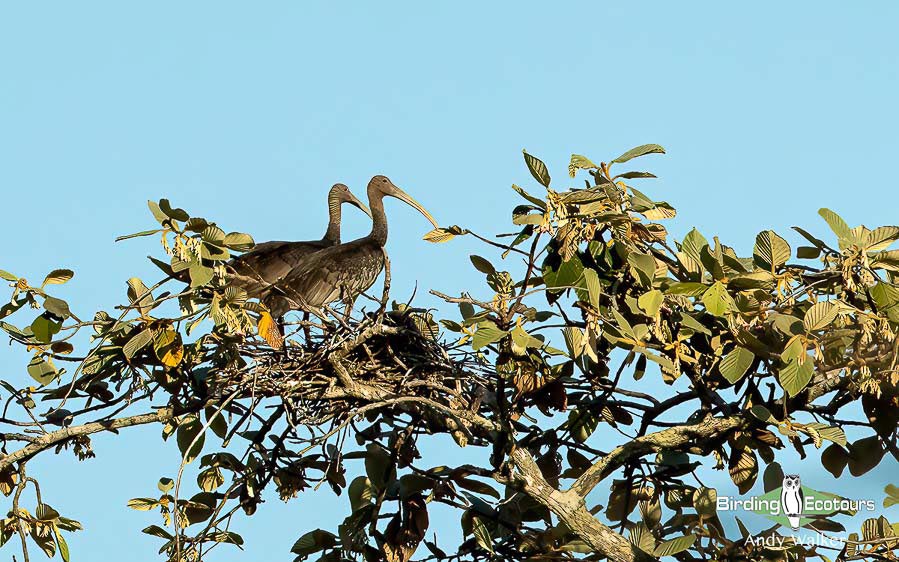
Giant Ibis is one of six Critically Endangered bird species we saw on this tour.
Bird List – Following IOC (Version 15.1/February 2025)
Birds ‘heard only’ are marked with (H) after the common name, all other species were seen. The following notation after species names is used to show conservation status following BirdLife International: CR = Critically Endangered, EN – Endangered, VU = Vulnerable.
| Common name | Scientific name |
| Ducks, Geese, Swans (Anatidae) | |
| Lesser Whistling Duck | Dendrocygna javanica |
| Cotton Pygmy Goose | Nettapus coromandelianus |
| Indian Spot-billed Duck | Anas poecilorhyncha |
| Pheasants & Allies (Phasianidae) | |
| Green-legged Partridge | Tropicoperdix chloropus |
| Red Junglefowl (H) | Gallus gallus |
| Chinese Francolin | Francolinus pintadeanus |
| King Quail | Synoicus chinensis |
| Nightjars (Caprimulgidae) | |
| Savanna Nightjar | Caprimulgus affinis |
| Treeswifts (Hemiprocnidae) | |
| Crested Treeswift | Hemiprocne coronata |
| Swifts (Apodidae) | |
| Edible-nest Swiftlet | Aerodramus fuciphagus |
| Asian Palm Swift | Cypsiurus balasiensis |
| Cuckoos (Cuculidae) | |
| Greater Coucal | Centropus sinensis |
| Coral-billed Ground Cuckoo – EN (H) | Carpococcyx renauldi |
| Green-billed Malkoha | Phaenicophaeus tristis |
| Asian Koel | Eudynamys scolopaceus |
| Indian Cuckoo (H) | Cuculus micropterus |
| Pigeons, Doves (Columbidae) | |
| Rock Dove | Columba livia |
| Red Collared Dove | Streptopelia tranquebarica |
| Spotted Dove | Spilopelia chinensis |
| Common Emerald Dove | Chalcophaps indica |
| Zebra Dove | Geopelia striata |
| Rails, Crakes & Coots (Rallidae) | |
| White-browed Crake | Poliolimnas cinereus |
| Cranes (Gruidae) | |
| Sarus Crane – VU | Antigone antigone |
| Grebes (Podicipedidae) | |
| Little Grebe | Tachybaptus ruficollis |
| Buttonquail (Turnicidae) | |
| Common Buttonquail | Turnix sylvaticus |
| Plovers (Charadriidae) | |
| River Lapwing | Vanellus duvaucelii |
| Red-wattled Lapwing | Vanellus indicus |
| Jacanas (Jacanidae) | |
| Bronze-winged Jacana | Metopidius indicus |
| Sandpipers, Snipes (Scolopacidae) | |
| Common Sandpiper | Actitis hypoleucos |
| Marsh Sandpiper | Tringa stagnatilis |
| Common Greenshank | Tringa nebularia |
| Coursers, Pratincoles (Glareolidae) | |
| Small Pratincole | Glareola lactea |
| Oriental Pratincole | Glareola maldivarum |
| Gulls, Terns, Skimmers (Laridae) | |
| Whiskered Tern | Chlidonias hybrida |
| River Tern – VU | Sterna aurantia |
| Storks (Ciconiidae) | |
| Asian Openbill | Anastomus oscitans |
| Painted Stork | Mycteria leucocephala |
| Black Stork | Ciconia nigra |
| Cormorants, Shags (Phalacrocoracidae) | |
| Little Cormorant | Microcarbo niger |
| Indian Cormorant | Phalacrocorax fuscicollis |
| Ibises, Spoonbills (Threskiornithidae) | |
| White-shouldered Ibis – CR | Pseudibis davisoni |
| Giant Ibis – CR | Pseudibis gigantea |
| Herons, Bitterns (Ardeidae) | |
| Little Egret | Egretta garzetta |
| Little Heron | Butorides atricapilla |
| Chinese Pond Heron | Ardeola bacchus |
| Great Egret | Ardea alba |
| Medium Egret | Ardea intermedia |
| Eastern Cattle Egret | Ardea coromanda |
| Grey Heron | Ardea cinerea |
| Purple Heron | Ardea purpurea |
| Pelicans (Pelecanidae) | |
| Spot-billed Pelican | Pelecanus philippensis |
| Ospreys (Pandionidae) | |
| Osprey | Pandion haliaetus |
| Kites, Hawks, Eagles (Accipitridae) | |
| Black-winged Kite | Elanus caeruleus |
| Black Baza | Aviceda leuphotes |
| Crested Honey Buzzard | Pernis ptilorhynchus |
| Red-headed Vulture – CR | Sarcogyps calvus |
| White-rumped Vulture – CR | Gyps bengalensis |
| Slender-billed Vulture – CR | Gyps tenuirostris |
| Crested Serpent Eagle | Spilornis cheela |
| Short-toed Snake Eagle | Circaetus gallicus |
| Changeable Hawk-Eagle | Nisaetus cirrhatus |
| Crested Goshawk | Lophospiza trivirgata |
| Shikra | Tachyspiza badia |
| Pied Harrier | Circus melanoleucos |
| Eastern Marsh Harrier | Circus spilonotus |
| Brahminy Kite | Haliastur indus |
| Rufous-winged Buzzard | Butastur liventer |
| Barn Owls (Tytonidae) | |
| Eastern Barn Owl | Tyto javanica |
| Owls (Strigidae) | |
| Northern Boobook (H) | Ninox japonica |
| Spotted Owlet | Athene brama |
| Asian Barred Owlet | Glaucidium cuculoides |
| Hoopoes (Upupidae) | |
| Eurasian Hoopoe | Upupa epops |
| Hornbills (Bucerotidae) | |
| Oriental Pied Hornbill | Anthracoceros albirostris |
| Rollers (Coraciidae) | |
| Indochinese Roller | Coracias affinis |
| Kingfishers (Alcedinidae) | |
| White-throated Kingfisher | Halcyon smyrnensis |
| Common Kingfisher | Alcedo atthis |
| Pied Kingfisher | Ceryle rudis |
| Bee-eaters (Meropidae) | |
| Blue-tailed Bee-eater | Merops philippinus |
| Chestnut-headed Bee-eater | Merops leschenaulti |
| Asian Barbets (Megalaimidae) | |
| Lineated Barbet | Psilopogon lineatus |
| Green-eared Barbet | Psilopogon faiostrictus |
| Blue-eared Barbet | Psilopogon cyanotis |
| Coppersmith Barbet | Psilopogon haemacephalus |
| Woodpeckers (Picidae) | |
| Grey-capped Pygmy Woodpecker | Yungipicus canicapillus |
| Laced Woodpecker (H) | Picus vittatus |
| Black-headed Woodpecker | Picus erythropygius |
| Common Flameback | Dinopium javanense |
| Caracaras, Falcons (Falconidae) | |
| White-rumped Falcon | Neohierax insignis |
| Common Kestrel | Falco tinnunculus |
| Peregrine Falcon | Falco peregrinus |
| Old World Parrots (Psittaculidae) | |
| Blossom-headed Parakeet | Psittacula roseata |
| Red-breasted Parakeet | Psittacula alexandri |
| Vernal Hanging Parrot | Loriculus vernalis |
| Pittas (Pittidae) | |
| Blue-winged Pitta | Pitta moluccensis |
| Vangas & Allies (Vangidae) | |
| Bar-winged Flycatcher-shrike | Hemipus picatus |
| Large Woodshrike | Tephrodornis virgatus |
| Common Woodshrike | Tephrodornis pondicerianus |
| Woodswallows, Butcherbirds & Allies (Artamidae) | |
| Ashy Woodswallow | Artamus fuscus |
| Ioras (Aegithinidae) | |
| Common Iora | Aegithina tiphia |
| Cuckooshrikes (Campephagidae) | |
| Small Minivet | Pericrocotus cinnamomeus |
| Scarlet Minivet | Pericrocotus speciosus |
| Ashy Minivet | Pericrocotus divaricatus |
| Swinhoe’s Minivet | Pericrocotus cantonensis |
| Rosy Minivet | Pericrocotus roseus |
| Oriental Cuckooshrike | Coracina javensis |
| Black-winged Cuckooshrike | Lalage melaschistos |
| Indochinese Cuckooshrike | Lalage polioptera |
| Figbirds, Old World Orioles, Piopios (Oriolidae) | |
| Black-hooded Oriole | Oriolus xanthornus |
| Black-naped Oriole | Oriolus chinensis |
| Drongos (Dicruridae) | |
| Greater Racket-tailed Drongo | Dicrurus paradiseus |
| Hair-crested Drongo | Dicrurus hottentottus |
| Ashy Drongo | Dicrurus leucophaeus |
| Black Drongo | Dicrurus macrocercus |
| Fantails (Rhipiduridae) | |
| White-browed Fantail | Rhipidura aureola |
| Malaysian Pied Fantail | Rhipidura javanica |
| Monarchs (Monarchidae) | |
| Black-naped Monarch | Hypothymis azurea |
| Shrikes (Laniidae) | |
| Brown Shrike | Lanius cristatus |
| Crows, Jays (Corvidae) | |
| Racket-tailed Treepie | Crypsirina temia |
| Eastern Jungle Crow | Corvus levaillantii |
| Larks (Alaudidae) | |
| Singing Bush Lark | Mirafra javanica |
| Indochinese Bush Lark | Plocealauda erythrocephala |
| Bulbuls (Pycnonotidae) | |
| Grey-eyed Bulbul | Iole propinqua |
| Black-headed Bulbul | Brachypodius melanocephalos |
| Black-crested Bulbul | Rubigula flaviventris |
| Streak-eared Bulbul | Pycnonotus conradi |
| Stripe-throated Bulbul | Pycnonotus finlaysoni |
| Yellow-vented Bulbul | Pycnonotus goiavier |
| Sooty-headed Bulbul | Pycnonotus aurigaster |
| Swallows, Martins (Hirundinidae) | |
| Sand Martin | Riparia riparia |
| Dusky Crag Martin | Ptyonoprogne concolor |
| Barn Swallow | Hirundo rustica |
| Eastern Red-rumped Swallow | Cecropis daurica |
| Leaf Warblers (Phylloscopidae) | |
| Yellow-browed Warbler | Phylloscopus inornatus |
| Dusky Warbler | Phylloscopus fuscatus |
| Two-barred Warbler | Phylloscopus plumbeitarsus |
| Pale-legged Leaf Warbler | Phylloscopus tenellipes |
| Reed Warblers & Allies (Acrocephalidae) | |
| Oriental Reed Warbler (H) | Acrocephalus orientalis |
| Manchurian Reed Warbler – VU | Acrocephalus tangorum |
| Grassbirds & Allies (Locustellidae) | |
| Lanceolated Warbler | Locustella lanceolata |
| Cisticolas & Allies (Cisticolidae) | |
| Zitting Cisticola | Cisticola juncidis |
| Golden-headed Cisticola | Cisticola exilis |
| Brown Prinia | Prinia polychroa |
| Rufescent Prinia | Prinia rufescens |
| Grey-breasted Prinia | Prinia hodgsonii |
| Yellow-bellied Prinia | Prinia flaviventris |
| Plain Prinia | Prinia inornata |
| Common Tailorbird | Orthotomus sutorius |
| Dark-necked Tailorbird | Orthotomus atrogularis |
| Cambodian Tailorbird (Endemic) | Orthotomus chaktomuk |
| Babblers, Scimitar Babblers (Timaliidae) | |
| Chestnut-capped Babbler | Timalia pileata |
| Pin-striped Tit-Babbler (H) | Mixornis gularis |
| Large Scimitar Babbler (H) | Erythrogenys hypoleucos |
| Ground Babblers (Pellorneidae) | |
| Puff-throated Babbler | Pellorneum ruficeps |
| Laughingthrushes & Allies (Leiothrichidae) | |
| White-crested Laughingthrush (H) | Garrulax leucolophus |
| Fairy-bluebirds (Irenidae) | |
| Asian Fairy-bluebird (H) | Irena puella |
| Nuthatches (Sittidae) | |
| Burmese Nuthatch | Sitta neglecta |
| Starlings, Rhabdornises (Sturnidae) | |
| Common Hill Myna | Gracula religiosa |
| Great Myna | Acridotheres grandis |
| Common Myna | Acridotheres tristis |
| Vinous-breasted Myna | Acridotheres leucocephalus |
| Black-collared Starling | Gracupica nigricollis |
| Siamese Pied Myna | Gracupica floweri |
| Chestnut-tailed Starling | Sturnia malabarica |
| Chats, Old World Flycatchers (Muscicapidae) | |
| Oriental Magpie-Robin | Copsychus saularis |
| White-rumped Shama | Copsychus malabaricus |
| Asian Brown Flycatcher | Muscicapa dauurica |
| Hainan Blue Flycatcher | Cyornis hainanus |
| Siberian Blue Robin | Larvivora cyane |
| Taiga Flycatcher | Ficedula albicilla |
| White-throated Rock Thrush | Monticola gularis |
| Blue Rock Thrush | Monticola solitarius |
| Pied Bush Chat | Saxicola caprata |
| Amur Stonechat | Saxicola stejnegeri |
| Leafbirds (Chloropseidae) | |
| Golden-fronted Leafbird | Chloropsis aurifrons |
| Flowerpeckers (Dicaeidae) | |
| Scarlet-backed Flowerpecker | Dicaeum cruentatum |
| Sunbirds (Nectariniidae) | |
| Ruby-cheeked Sunbird (H) | Chalcoparia singalensis |
| Brown-throated Sunbird | Anthreptes malacensis |
| Van Hasselt’s Sunbird | Leptocoma brasiliana |
| Purple Sunbird | Cinnyris asiaticus |
| Ornate Sunbird | Cinnyris ornatus |
| Old World Sparrows, Snowfinches (Passeridae) | |
| Eurasian Tree Sparrow | Passer montanus |
| Plain-backed Sparrow | Passer flaveolus |
| House Sparrow | Passer domesticus |
| Weavers, Widowbirds (Ploceidae) | |
| Asian Golden Weaver | Ploceus hypoxanthus |
| Streaked Weaver | Ploceus manyar |
| Baya Weaver | Ploceus philippinus |
| Waxbills, Munias & Allies (Estrildidae) | |
| Scaly-breasted Munia | Lonchura punctulata |
| Chestnut Munia | Lonchura atricapilla |
| Red Avadavat | Amandava amandava |
| Wagtails, Pipits (Motacillidae) | |
| Mekong Wagtail | Motacilla samveasnae |
| Paddyfield Pipit | Anthus rufulus |
| Olive-backed Pipit | Anthus hodgsoni |
| Total seen | 181 |
| Total heard only | 11 |
| Total recorded | 192 |
Mammal List – Following Mammal Watching (April 2024)
The following notation after species names is used to show conservation status following the IUCN Red List: EN = Endangered, VU = Vulnerable.
| Common name | Scientific name |
| Old World Monkeys (Cercopithecidae) | |
| Long-tailed Macaque – VU | Macaca fascicularis |
| Northern Pig-tailed Macaque – VU | Macaca leonina |
| Squirrels (Sciuridae) | |
| Finlayson’s Squirrel | Callosciurus finlaysonii |
| Cambodian Striped Squirrel | Tamiops rodolphii |
| Old World Fruit Bats (Pteropodidae) | |
| Large Flying Fox | Pteropus vampyrus |
| Sheath-tailed Bats (Emballonuridae) | |
| Black-bearded Tomb Bat | Taphozous melanopogon |
| Mongooses (Herpestidae) | |
| Javan Mongoose | Urva javanica |
| Oceanic Dolphins (Delphinidae) | |
| Irrawaddy Dolphin – EN | Orcaella brevirostris |
| Total | 8 |
Reptile List – Following Reptiles of the World (October 2023)
| Common name | Scientific name |
| Dragons (Agamidae) | |
| Orange-winged Flying Lizard | Draco maculatus |
| Skinks (Scincidae) | |
| Bronze Mabuya | Eutropis macularia |
| Total | 2 |
Amphibian List
| Common name | Scientific name |
| Asian Common Toad | Duttaphyrynus melanostictus |
| Total | 1 |
Butterfly list
| Common Name | Scientific Name |
| Common Line Blue | Prosotas nora |
| Grey Pansy | Junonia atlites |
| Common Imperial | Cheritra freja |
| Plain Tiger Butterfly | Danaus chrysippus |
| Five-bar Swordtail | Graphium antiphates |
| Fluffy Tit | Zeltus amasa |
| Common Yeoman | Cirrochroa tyche |
| Common Tiger Butterfly | Danaus genutia |
| Peacock Pansy | Junonia almana |
| Sullied Brown Sailer | Neptis nata |
| Common Pierrot | Castalius rosimon |
| Straight Pierrot | Caleta roxus |
| White Orange Tip | Ixias marianne |
| Clipper | Parthenos sylvia |
| Great Mormon | Papilio agenor |
| Double-branded Crow Butterfly | Euploea sylvester |
| Common Bluebottle | Graphium sarpedon |
| Striped Albatross | Appias libythea |
| Tree Yellow | Gandaca harina |
| Chain Swordtail | Graphium aristeus |
| Common Jay | Graphium doson |
| Spotted Zebra | Graphium megarus |
| Yellow Orange Tip | Ixias pyrene |
| Total | 23 |
List of other interesting arthropods
| Common Name | Scientific Name |
| Fishing Spider | Dolomedes mizhoanus |
| Asian Weaver Ant | Oecophylla smaragdina |
| Cicada (no common name) | Dundubia nagarasingna |
| Asian Army Ant | Dorylus orientalis |
| Millipede (no common name) | Antheromorpha festiva |
| Black Dwarf Honey Bee | Apis andreniformis |
| Asian Honey Bee | Apis cerana |
| Total | 7 |
This is a sample trip report. Please email us ([email protected]) for more trip reports from this destination.