16 – 22 NOVEMBER 2025
By Andrew Walker
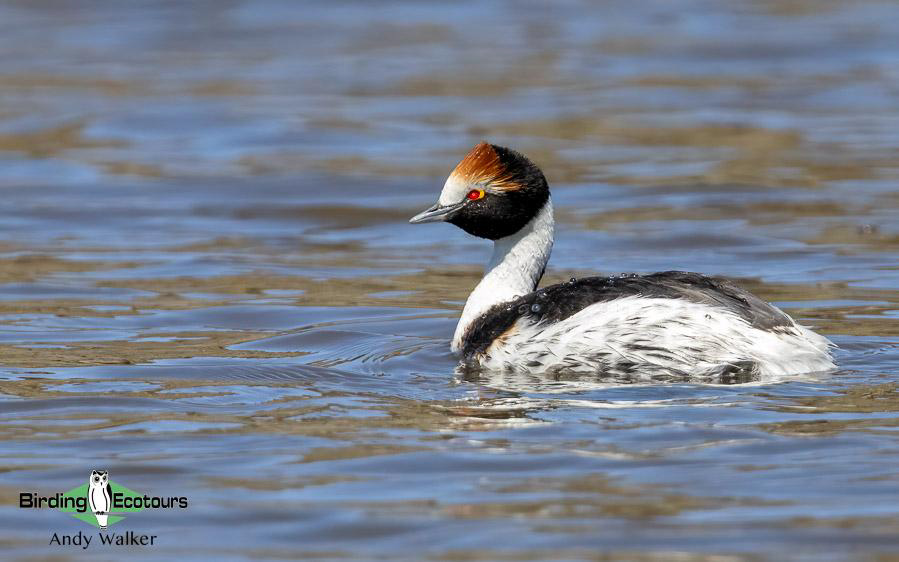
After views like this, it was no surprise that Hooded Grebe was voted “bird of the trip”!
Overview
This short Southern Patagonia birding tour started in El Calafate on the 16th of November 2025 and ended back there on the 22nd of November 2025. We spent time birding in the wetlands around El Calafate, visited part of the spectacular Los Glaciares National Park near El Chaltén (including the famous area around Mount Fitz Roy), and then visited the Strobel Plateau, where we birded the vast, seemingly endless steppes. It wouldn’t be Patagonia without some “weather”, however apart from one pretty foul day (gales and heavy rain), we got really lucky and had several glorious sunny and practically wind-free days. We sampled lots of great local food, stayed in some nice hotels and on a working estancia (farm), and saw some seriously beautiful landscapes.
We recorded 95 bird species on this southern Patagonia birdwatching tour (all were seen) and you can also see our eBird trip report, here. Bird and animal lists for this southern Patagonia birding tour follow the report.
While we don’t record too many species on this tour (compared to say our northwest Argentina tour or our northeast Argentina tour), the species found on this tour are of incredibly high quality and most-wanted birds for many world birders, and included the likes of Magellanic Plover, a monotypic shorebird family found only in southern Argentina and Chile, the Critically Endangered (BirdLife International/IUCN) and rapidly declining Hooded Grebe, the relatively recently rediscovered Austral Rail, and one of South America’s largest woodpeckers, the impressive Magellanic Woodpecker.
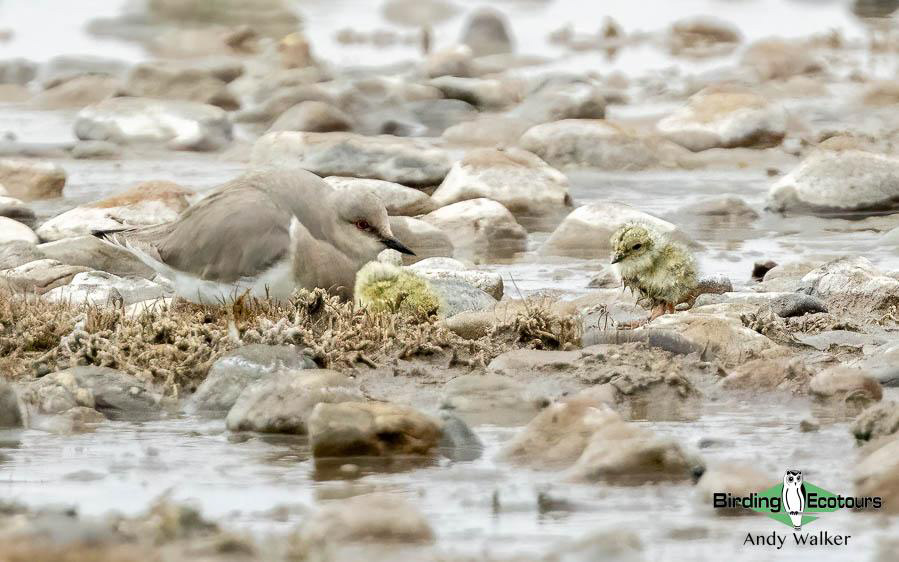
Watching a pair of Magellanic Plovers tending to their young chicks provided an amazing start to our southern Patagonia tour.
In addition to the above main tour targets, other non-passerine highlights (of which there were many) seen during the southern Patagonia tour included: Lesser (Darwin’s) Rhea, Patagonian Tinamou, Flying Steamer Duck, Bronze-winged Duck, Chiloe Wigeon, Silvery (Patagonian) Grebe, Magellanic Oystercatcher, Red-chested Dotterel, Tawny-throated Dotterel, Two-banded Plover, Grey-breasted Seedsnipe, Least Seedsnipe, Magellanic Snipe, South American Tern, Black-faced Ibis, Andean Condor, Cinereous Harrier, Black-chested Buzzard-Eagle, Austral Pygmy Owl, Chilean Flicker, White-throated Caracara, and Austral Parakeet. All of these showed really well and most were busy in the middle of their breeding season so we got to observe a great deal of breeding behavior and lots of cute chicks!
Passerine highlights seen during the tour were just as impressive, and included: White-throated Treerunner, Band-tailed Earthcreeper, Scale-throated Earthcreeper, Common Miner, Thorn-tailed Rayadito, Austral Canastero, White-throated Cachalote, Black-throated Huet-huet, Magellanic Tapaculo, Austral Negrito, Spectacled Tyrant, Fire-eyed Diucon, Chocolate-vented Tyrant, Rufous-tailed Plantcutter, Chilean Swallow, Grass Wren, Patagonian Mockingbird, Austral Thrush, Long-tailed Meadowlark, Patagonian Yellow Finch, Patagonian Sierra Finch, and Diuca Finch.
We also found several great animals during this southern Patagonia tour, such as Chilla (South American Grey Fox), Culpeo, South Andean Huemul (South Andean Deer), Guanaco, and Southern Mountain Cavy.

The landscapes we were birding in during our southern Patagonia tour were incredible, here the group paused for a photo with the famous Mount Fitz Roy in the background.
Detailed Report
Day 1, 16th November 2025. Arrival in El Calafate and afternoon birding in El Calafate
The group arrived in El Calafate in the morning, some folks having completed our exciting northeast Argentina tour prior to joining this tour. Everyone met for a delicious lunch in this tourist town and we discussed the plans for the tour. The sight of attractive Black-faced Ibises walking around the town and nesting right next to our hotel was a fantastic start.
After lunch we headed out for a short birding session on the edge of town along the shores of Lake Argentino (Lago Argentino), prior to some forecast poor weather. Ahead of the rain arriving we made a beeline straight for an area where our local guide knew of a recently breeding pair of Magellanic Plovers. After checking out the last known area for them we were delighted to see the pair of adult birds – one of the most-wanted birds of the trip (see photo in tour summary). However, really careful scanning of the rocky lake shore gave us the added bonus of two extremely cute and tiny Magellanic Plover chicks, exceptionally well camouflaged. Occasionally the adult birds would bring small food items to the chicks, which was a sight to behold. After enjoying the views of these top birds, reluctantly, but with the knowledge poor weather was coming, and a dire forecast for the following day, we left these unique almost dove-like plovers (they are in their own monotypic family) to look for some of the other specials of the area.
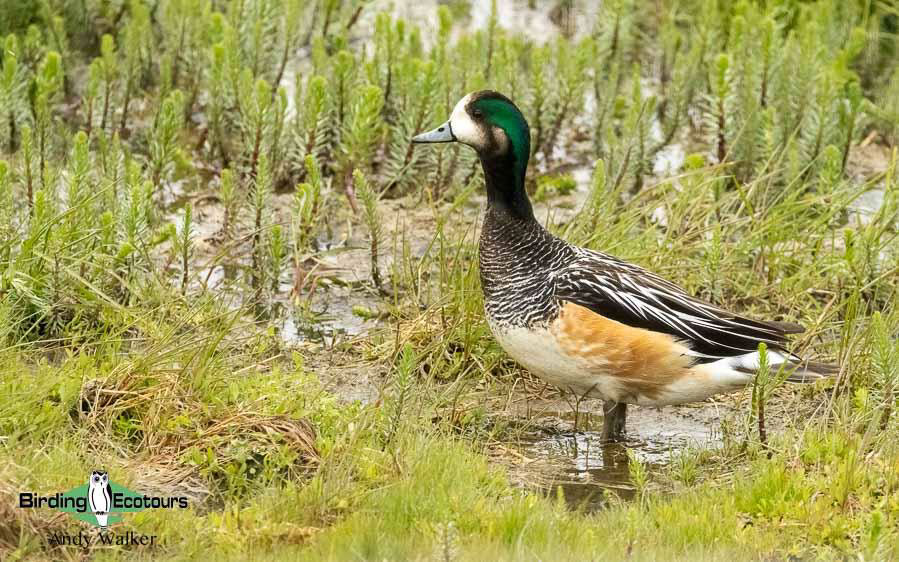
Chiloe Wigeon was one of several attractive ducks seen well during the tour.
It was hard to miss Upland Geese, they were literally everywhere, with hundreds of individuals of this highly sexually dimorphic species seen, and seen well. The males are gleaming white with patches of black, whereas the females are a beautiful mix of rufescent-based colors. In amongst this more abundant goose species, were a handful of the smaller, and equally pretty Ashy-headed Geese. Equally elegant, were the numerous Black-necked Swans, many with cygnets. As we explored further, we found gorgeous Chiloe Wigeon, the less spectacular, but equally welcome Crested Duck, along with the widespread Yellow-billed Teal and Yellow-billed Pintail. Scanning an area of marsh gave us our first Two-banded Plovers of the tour, another really attractive species, as well as displaying Southern Lapwing and Magellanic Snipe, and overwintering migrant Baird’s Sandpipers, which were numerous. Kelp Gulls flew overhead, as did South American Terns, Crested Caracara, Chimango Caracara, and strikingly pale grey Cinereous Harriers. Both Blue-and-white Swallows and Chilean Swallows were busily hawking insects low over the lake and quite a few Chilean Flamingos were feeding along the shore, most were juvenile birds, however there were a couple of bright pink individuals present.
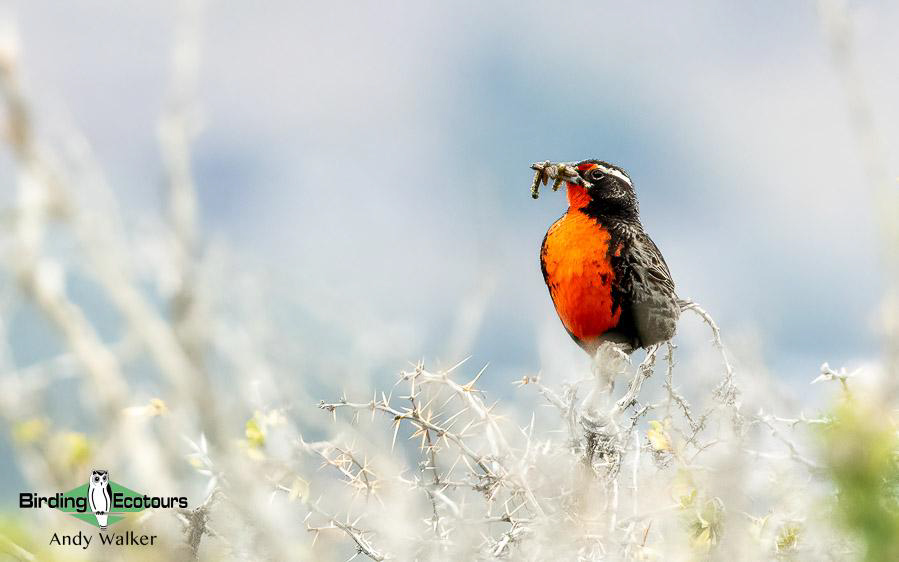
Long-tailed Meadowlark was a popular species during the tour and provided a splash of color.
Several interesting passerines were recorded, and as this was our first birding session most were new for everyone, and included Spectacled Tyrant, Austral Negrito, Sharp-billed Canastero, Correndera Pipit, Black-chinned Siskin, Rufous-collared Sparrow, Long-tailed Meadowlark, and Mourning Sierra Finch. Very satisfied (and a little cold and starting to get wet) we decided to head back to the hotel for dinner and our first checklist session. What a great start to this southern Patagonia tour, with Magellanic Plover firmly in the bag too!
Day 2, 7th November 2025. Birding in El Calafate
We were meant to spend the day visiting Los Glaciares National Park (ice field section), however a severe storm warning was put in place and the park was closed for safety reasons, and in addition, the roads of the area were all also closed due to heavy rain and extremely strong winds. All through the night we could hear the wind ripping around our hotel, and when we awoke it was clear we were going to be lucky to get any birding in during the day.
However, after a late and relaxed breakfast watching the rain showers come through, we decided to chance our arm in the mid-morning, and this was a good move as we managed to get an hour or so of relatively dry birding in. We were restricted to the El Calafate town area due to the road closures, so headed back to the lake shore, but went to a different section from the previous day. Our first stop was at a flooded river, where we had close views of Chiloe Wigeon, Ruddy (Andean) Duck, Red-gartered Coot, Black-crowned Night Heron, Black-faced Ibis, Spectacled Tyrant, Austral Thrush, Chilean Swallow, and Buff-winged Cinclodes. We took a slow drive in our bus while another rain shower pelted down on us, and as the shower passed we found an area of reedbeds, where five Cinereous Harriers were present. We saw a male in display flight, and shortly after saw a pair mating, a pretty cool sight with the birds at very close range. Further exploration by bus yielded Patagonian Mockingbird, Long-tailed Meadowlark, and Grey-hooded Sierra Finch. A stop to scan the lake shore was tough given the now increasing wind and rain, though a distant Magellanic Plover was seen. By late morning the rain won and we returned to the hotel for lunch and the hope that things might improve in the afternoon.
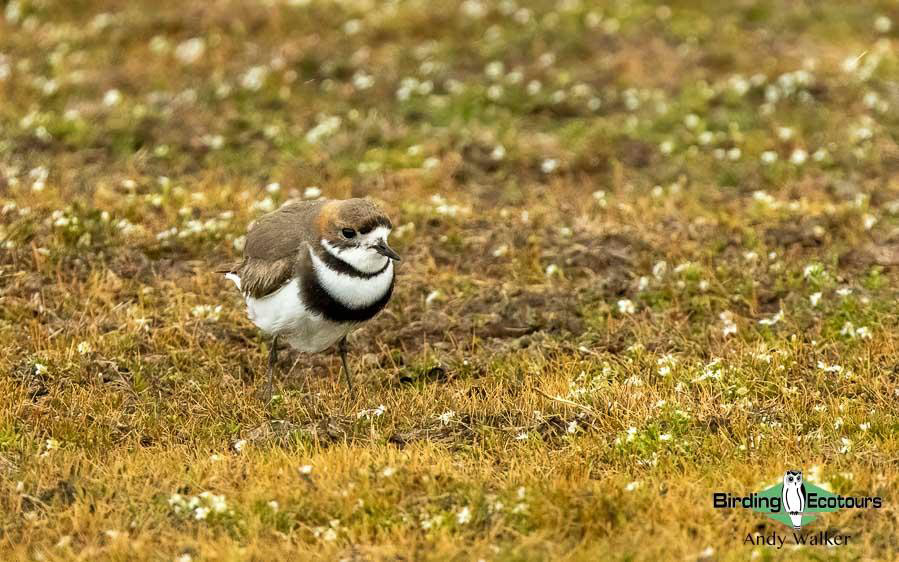
Two-banded Plovers were nesting on the marsh and showed well.
By the middle of the afternoon we decided it would be worth another try, the forecast was for slightly improved weather, but the reality for most of our birding session was that it was not much better! However, we persisted. We covered the same ground as the morning but nothing extra was really noted, and the wind had picked up substantially and was making things a bit too tough, so we decided to try the other side of the bay and this paid huge dividends. We managed to secure a dry period in a sheltered section of the bay and had wonderful close looks at several species, including Upland Goose, Ashy-headed Goose, Black-necked Swan, Chiloe Wigeon, Crested Duck, Chilean Flamingo, Magellanic Snipe, Baird’s Sandpiper, White-rumped Sandpiper, Buff-winged Cinclodes, and Cinnamon-bellied Ground Tyrant. As a final throw of the dice we decided to check one final area, it was a more exposed section of the bay and with the rain coming quickly towards us we continued scanning and found another of our big tour highlights, Rufous-chested Dotterel. A flock of twelve birds was feeding in a marshy area, along with plenty of nesting Two-banded Plovers. We repositioned ourselves to get a bit closer to the dotterels, which gave good scope views. A few of us tried to get closer to the birds and, remarkably, they just ignored us and carried on feeding, allowing a nice close approach. The only problem was the rain, which came back with a vengeance, just as we were getting into position to photograph the Rufous-chested Dotterels! We made the best of the situation and then retired hastily to the bus to dry out, thrilled by the sighting.
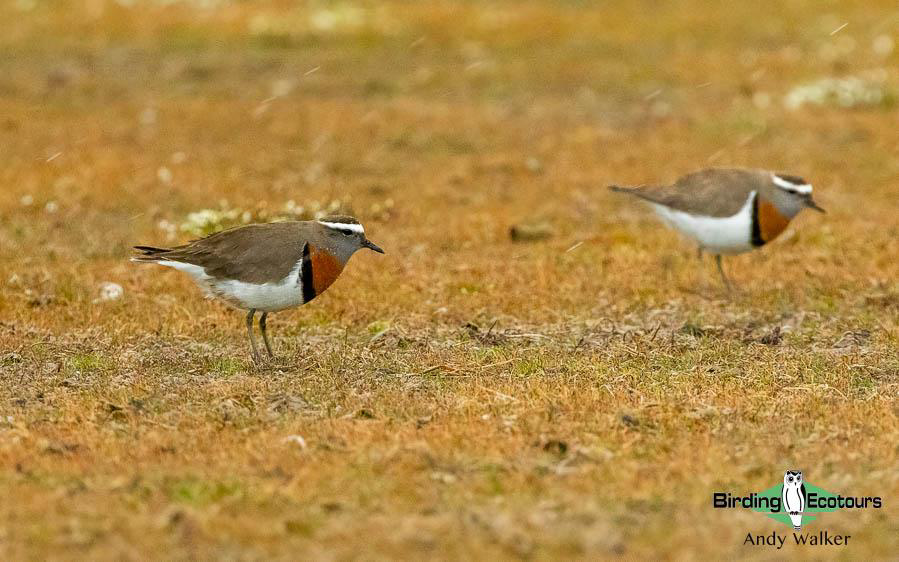
Rufous-chested Dotterels were found feeding on the marsh, despite poor weather conditions.
It had been a tough day due to the weather, but several truly great species had been seen during our limited birding sessions. We enjoyed a nice warming dinner and prepared for our trip to El Chaltén the following day, hoping for improved weather and more great Patagonian birds.
Day 3, 18th November 2025. El Calafate to El Chaltén (birding Los Glaciares National Park)
We awoke to a much more promising day. The hills surrounding our accommodation in El Calafate were covered in a light dusting of snow, but the wind and rain of the previous day had gone and the nesting Black-faced Ibises looked a lot happier with everything! After breakfast we departed the town and commenced our two hour drive to El Chaltén. We made a few stops along the way, including one to soak in an incredible view of the impressive Los Glaciares National Park (Lake Viedma area), including the commanding Mount Fitz Roy peak (also known as Cerro Chaltén) at 11,171 feet (3,405 meters). Here we also saw our first Andean Condors of the tour, which looked even more impressive than usual with the mountain in the background.
After checking into our accommodation we headed out in Los Glaciares National Park for our picnic lunch. A couple of stops along the way gave us sightings of Austral Parakeet, Chilean Elaenia, Austral Negrito, Austral Thrush, Black-chinned Siskin, Plumbeous Sierra Finch, and Patagonian Sierra Finch. We decided to have our picnic lunch at Chorrillo del Salto, a pretty glacier-fed cascade set amid peaks and woodland. While eating our picnic we found the rare South Andean Huemul (South Andean Deer), and while exploring the woodland near the waterfall we found nesting Chilean Flicker, strikingly plumaged White-throated Treerunner, nesting Thorn-tailed Rayadito, Chilean Swallow, and more (very showy) Patagonian Sierra Finches.
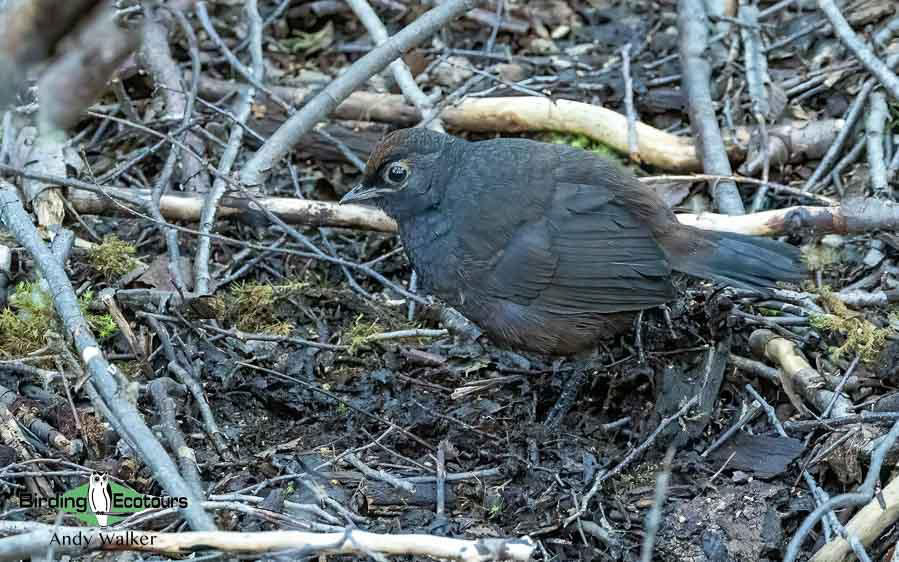
The bulky Black-throated Huet-huet thrilled us after a nervous wait for it to come into view.
After this birding session we took a long drive along the Las Veultas River, which was in flood and in fast flow. We made several stops, however the birding had quietened down massively, which was surprising given it was the first day of decent weather in a few days. We persisted however, picking up further views of some of the aforementioned species, and then we finally got our rewards near the end of the day when we found and saw the shy and secretive Magellanic Tapaculo, followed shortly thereafter by the rotund Black-throated Huet-huet (another tapaculo), which we watched at close range with its interesting feeding methods. Our next bird was one of our main tour targets, and we were treated to excellent views of the most-wanted Magellanic Woodpecker, a huge and impressive looking primarily black, crested woodpecker, with various amounts of red and white coloring depending on age and sex. We had a flock of four birds that showed very nicely for us. Buoyed by these tapaculo and woodpecker sightings in quick succession, our journey back to our accommodation was much more jovial than it had been an hour earlier! To top our day off we found a pair of Bronze-winged Ducks on a small flooded area at dusk. We rounded the day off with a rather late dinner and some fantastic lemon meringue pie (huge thanks Claudia and Richard for providing another tour highlight!).
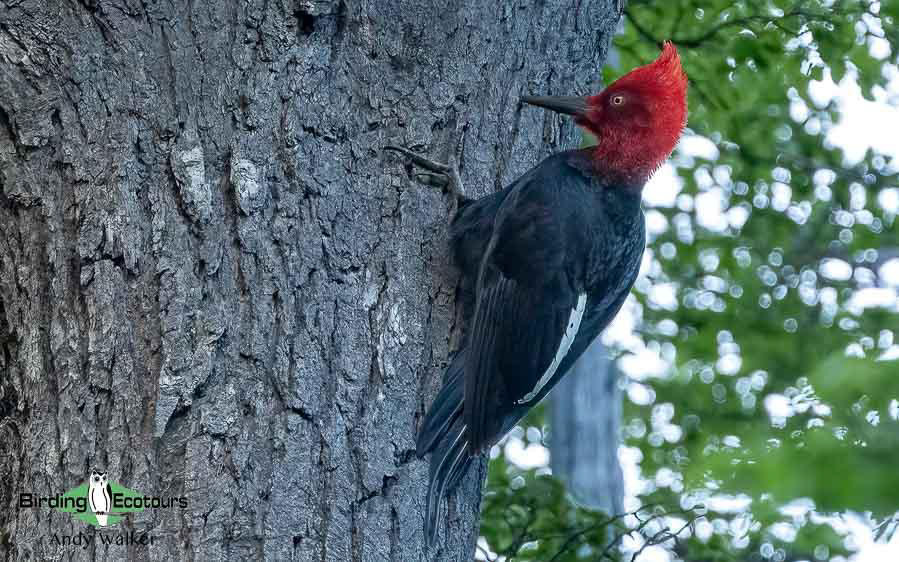
One of the most anticipated birds on the tour, Magellanic Woodpecker showed well in the early evening.
Day 4, 19th November 2025. El Chaltén to Estancia la Angostura
We had a long drive to get from El Chaltén to Estancia la Angostura, which was to be our base for the next three nights. We first made a couple of birding stops around El Chaltén town, where we had excellent views of Chilean Flicker and some rather cute baby Southern Lapwings, along with a bright male Long-tailed Meadowlark, and several other common birds. We stopped to take in some more views of Mount Fitz Roy and the other impressive snow-capped peaks and, while doing so, had a really nice look at a vocal Austral Pygmy Owl. Nearby, while taking in a different viewpoint, we saw our target Austral Canastero, which showed well (as well as further looks at Sharp-billed Canastero that we’d seen earlier in the tour).
We got some hours into our drive and made a stop for lunch, and while doing so had good views of displaying Grey-breasted Seedsnipe and a very close Least Seedsnipe that walked out on the road in front of us. Here we got more looks at Mourning Sierra Finch, our first Patagonian Yellow Finches of the tour, and a delightful Southern Mountain Cavy (a small guinea-pig like mammal). A few further stops along the way resulted in sightings of Lesser (Darwin’s) Rhea, White-throated Caracara, Band-tailed Earthcreeper, and Chocolate-vented Tyrant. We also saw plenty of Guanacos along the drive, including several pairs with gangly legged babies, still trying to find their feet!
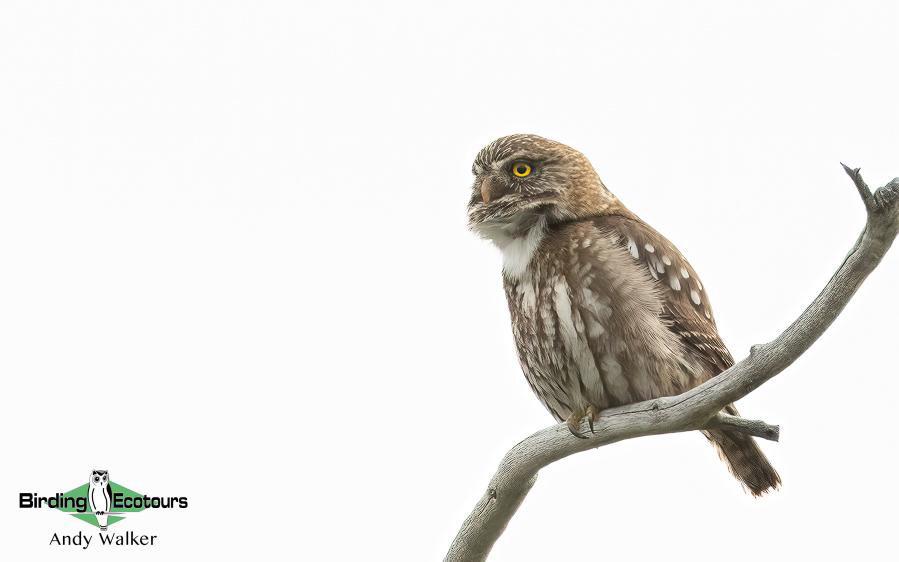
We enjoyed some great views of Austral Pygmy Owl near El Chaltén.
On our arrival at our accommodation, a few of the group took a look around the grounds, having some very good views of nesting Cinereous Harrier and a range of wildfowl including Upland Goose, Silver Teal, and Chiloe Wigeon.
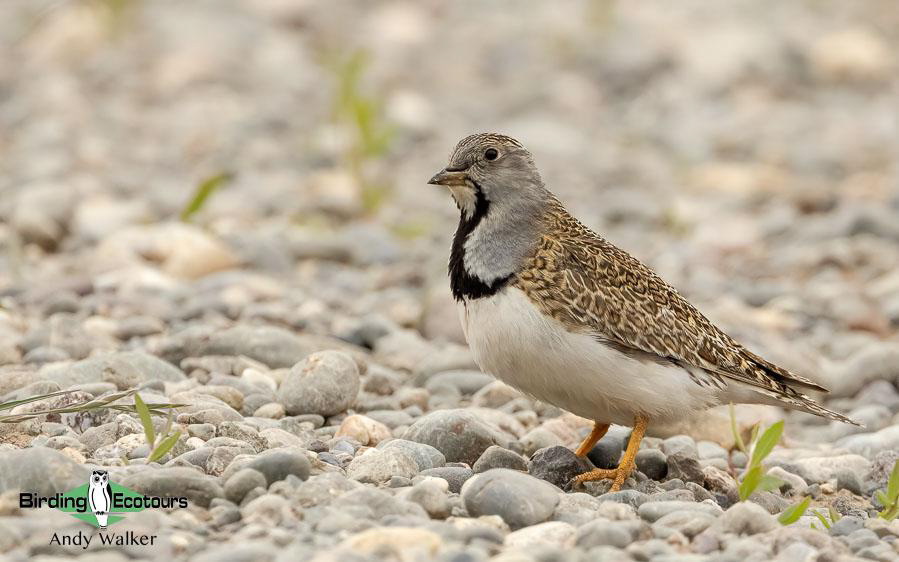
Least Seedsnipe gave exceptionally close views while we ate our picnic lunch.
Day 5, 20th November 2025. Strobel Plateau for Hooded Grebe
We had an absolutely sensational day of birding in southern Patagonia today and we got really lucky with great weather. There was hardly any wind and it was nice and sunny, almost warm too!
We had an early morning pre-breakfast birding session near our accommodation where we heard, then saw, the rare Austral Rail. A single bird walked along the edge of a reedbed where it would occasionally pause, giving some reasonable views (great views really, given the usual secretive nature of this species). The reedbed and surrounding wetland was busy with birds, and we saw Wren-like Rushbird, Spectacled Tyrant, and Yellow-winged Blackbird. A small number of waterfowl were present too, such as Upland Goose, Chiloe Wigeon, and Silver Teal. Black-faced Ibis, Chimango Caracara, and Cinereous Harrier were also all rather noticeable, as usual.
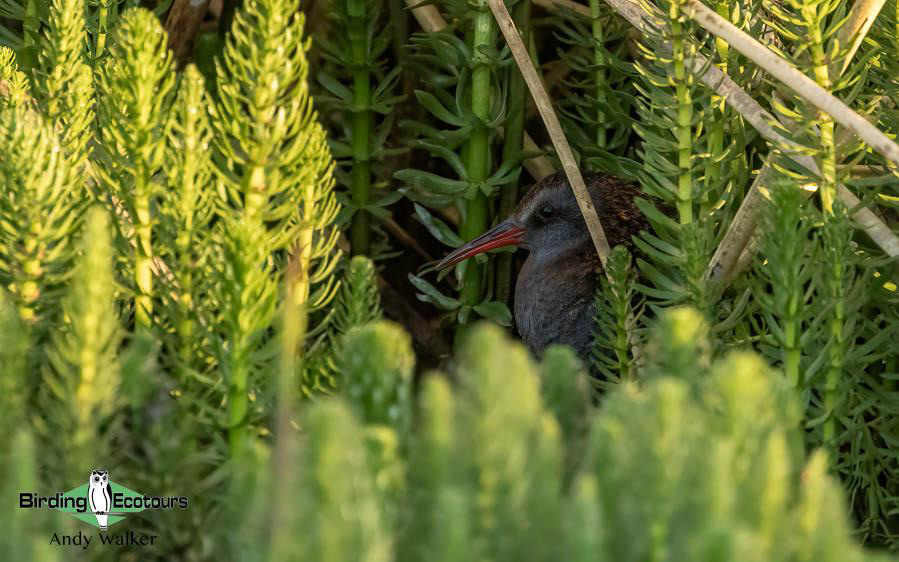
Getting to see the secretive Austral Rail was a huge tour highlight.
After breakfast we got started with our main event of the day, and one of the big deals of the whole tour, our visit to the lakes on the Strobel Plateau. After about two hours of driving we arrived at our birding site, and quickly got some good scope views of the secretive Patagonian Tinamou, two birds were stood together in a rocky field and were very well camouflaged. A short while later we arrived at our hiking spot, where we commenced an approximately 1 mile (1.7 kilometer) hike to a series of small waterbodies. As the anticipation grew, we crested a ridge and came to view a lake dotted with small white birds, Hooded Grebes! We scoped the birds so that everyone could see this Critically Endangered (BirdLife International/IUCN) and most-wanted species (which must rate as one of the best grebes in the world). We then carefully, slowly, and quietly made our way closer to the lake shore, where we then spent a magical hour watching, at close range, 22 of these gorgeous birds feeding, displaying, sleeping, and just getting on with their daily lives. It was incredible. By some careful positioning we were able to get ourselves into a good position for quality views and photos. It was a real honor and privilege to watch these rare birds.
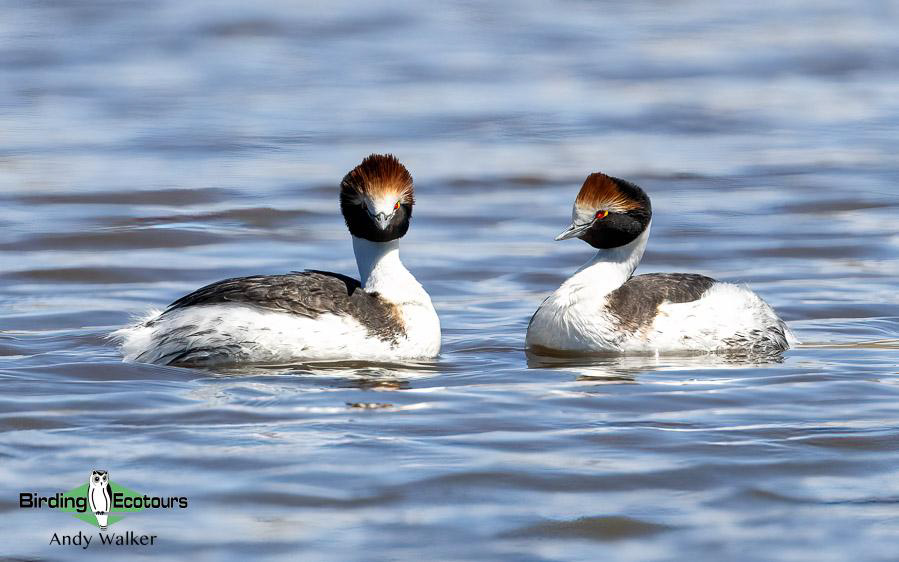
We couldn’t have hoped for better views of Hooded Grebes, it was a wonderful encounter. To spend some real quality time with such a rare bird was a real pleasure.
While the Hooded Grebes were the main reason for our visit to the waterbodies, we also saw the interesting Patagonian subspecies of Silvery Grebe (which looks very different from the more widespread subspecies). Other species noted here included Flying Steamer Duck (a pair with babies), a pair of Crested Ducks, and a nesting pair of White-throated Caracaras.
After enjoying the Hooded Grebe spectacle and the other birds around the lakes, we hiked back to the vehicles for a picnic lunch and a well-deserved rest. In the afternoon we slowly made our way back to our accommodation, picking up Lesser (Darwin’s) Rhea, Tawny-throated Dotterels, Least Seedsnipe, Grey-breasted Seedsnipe, Common Miner, Chocolate-vented Tyrant, and lots of other birds along the way.
We had seen some fantastic birds during the day, but we also got to see some of the real life challenges faced by the animals of the area. We saw plenty of Guanacos (dead and alive), a Culpeo out hunting, and we saw a Chilla (South American Grey Fox) catch a baby Lesser (Darwin’s) Rhea right in front of us. We also saw another pair of Chillas (South American Grey Foxes) with several young fox cubs out in full view, and had several others scouring their territories for any opportunity of a meal.
It had been an incredible day and one which will live long in the memory. It was also very pleasing to know that some of our tour fees go towards the foundation studying and protecting the rare Hooded Grebe, so that hopefully this declining species can be helped in its recovery.
Day 6, 21st November 2025. Estancia la Angostura
We had a much more relaxed day birding around Estancia la Angostura after the previous long and tiring days. This leisure was afforded to us after such a great previous day and some pretty much perfect weather meaning we had found all of our major and very tough targets.
After a late breakfast we commenced some birding around the estancia grounds and enjoyed repeat sightings of the usual wildfowl, such as the ever-present Upland Geese, Chiloe Wigeon, Silver Teal, and Red-gartered Coot. A showy White-tufted Grebe gave nice views, and this attractive species seemed tiny compared to the much larger Hooded Grebes we had enjoyed seeing so much the previous day. As usual, several pairs of Cinereous Harriers were patrolling the area, and the noisy Black-faced Ibises were in attendance.
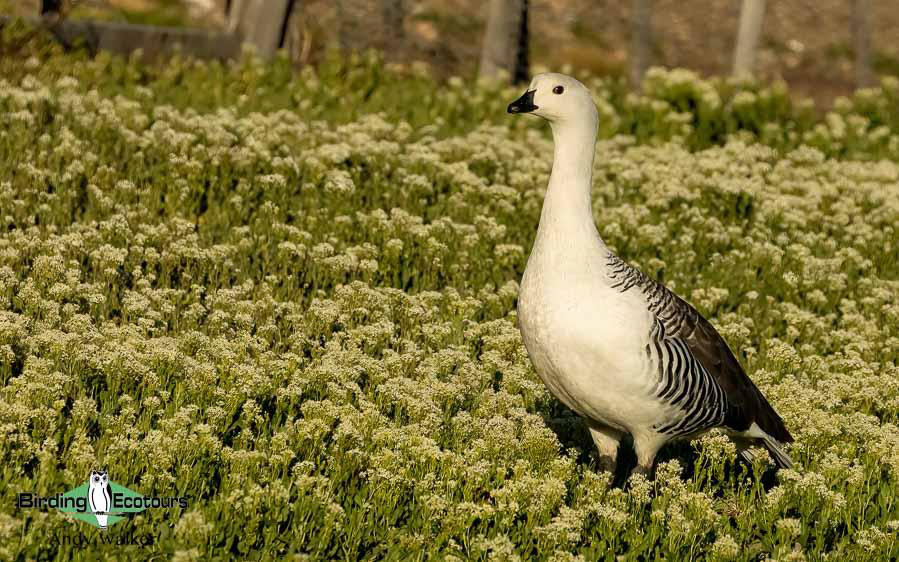
Upland Goose was our most frequently encountered species during the tour.
We spent some time working some scrub and bushes where, after some solid effort, we found the Argentinian endemic, White-throated Cachalote, a large furnariid (ovenbird). A couple of pairs of Plain-mantled Tit-Spinetails were discovered too, one of which was nesting in a gate post, and both Scale-throated Earthcreeper and Sharp-billed Canastero were seen fairly well! Several flycatchers were present and included a brief Great Shrike Tyrant, and the more showy Austral Negritos and Spectacled Tyrants. We saw more Mourning Sierra Finches, along with a close up Patagonian Yellow Finch, and a pair of Diuca Finches. Patagonian Mockingbirds were rather evident and kept gaining our attention by posing atop distant bushes! Crested Caracaras were flying over and causing the usual disruption that this species seems to generate everywhere they go, and Chimango Caracaras were numerous and doing the same. A small flock of Brown-hooded Gulls were noted flying over some distant waterbodies while our final new bird of the morning birding session was a nesting Variable Hawk seen at close range in a low bush.
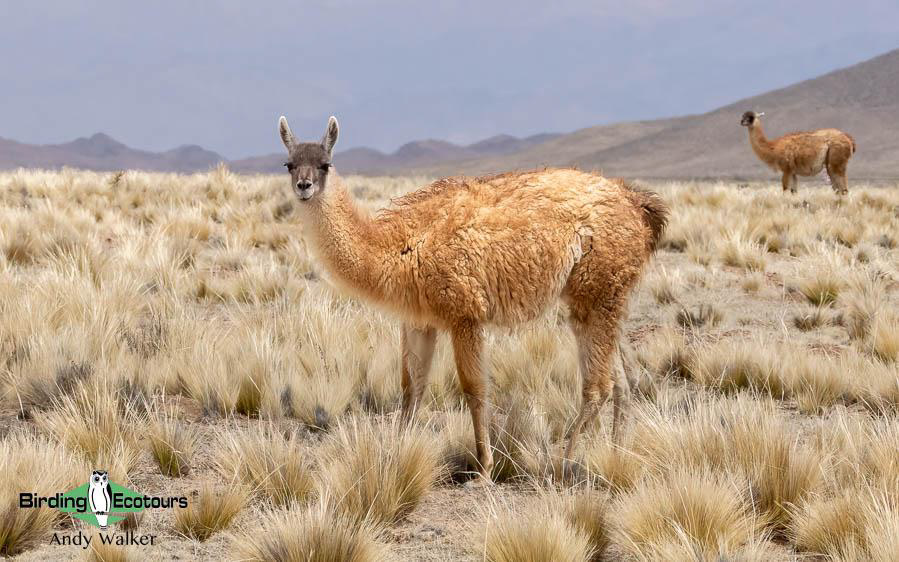
We saw hundreds of Guanacos during the tour, an interesting member of the Camelidsfamily.
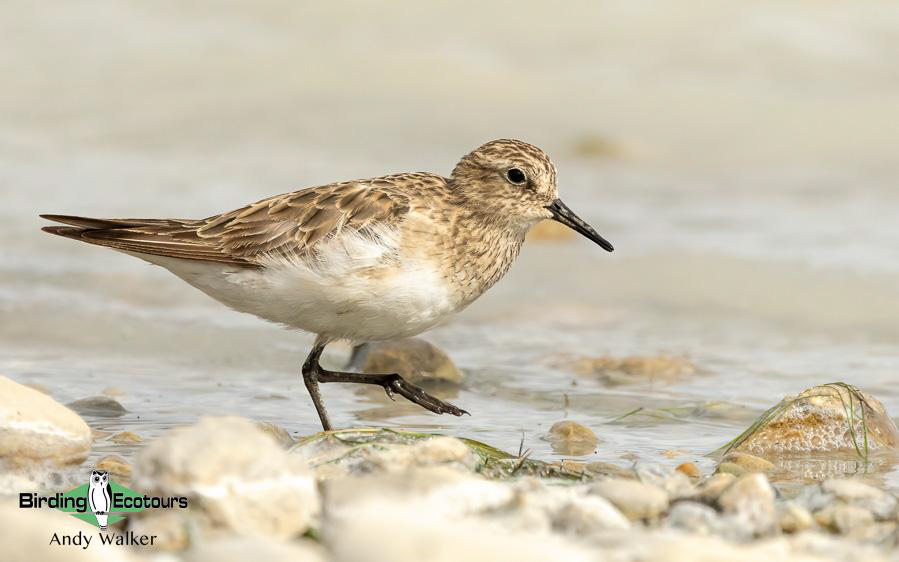
Overwintering Baird’s Sandpipers gave extremely close views as they fed along a lake shore.
After lunch and a siesta, we headed back out birding in the late afternoon. We visited a small lake near our accommodation and spent some time scanning the area, though the wind had increased and it wasn’t as warm as it had seemed earlier in the day. We had some very close views of a feeding flock of overwintering Baird’s Sandpipers, they were totally unconcerned with our presence as they fed. We enjoyed working our way through an assortment of wildfowl, gaining our best views of the tour of Flying Steamer Ducks, along with Upland Goose, Chiloe Wigeon, Yellow-billed Pintail, and Ruddy (Andean) Ducks. Austral Negritos and Diuca Finches were noted around the lakeshore, however the best bird of the afternoon was a nesting Magellanic Oystercatcher, which we found by total chance when one (unseen to this point), got off its nest and chased a couple of people away on the opposite side of the lake to where we were birding! Driving back to our accommodation we also saw a couple more Lesser (Darwin’s) Rheas. Back at the accommodation, before dinner, we saw a Neotropic Cormorant and several Brown-hooded Gulls overhead, along with the usual suspects like nesting Cinereous Harrier, the Upland Geese pair with their young in tow, and a gorgeous pair of Chiloe Wigeons, which were seen feeding in their favorite part of the marsh right up until dark.
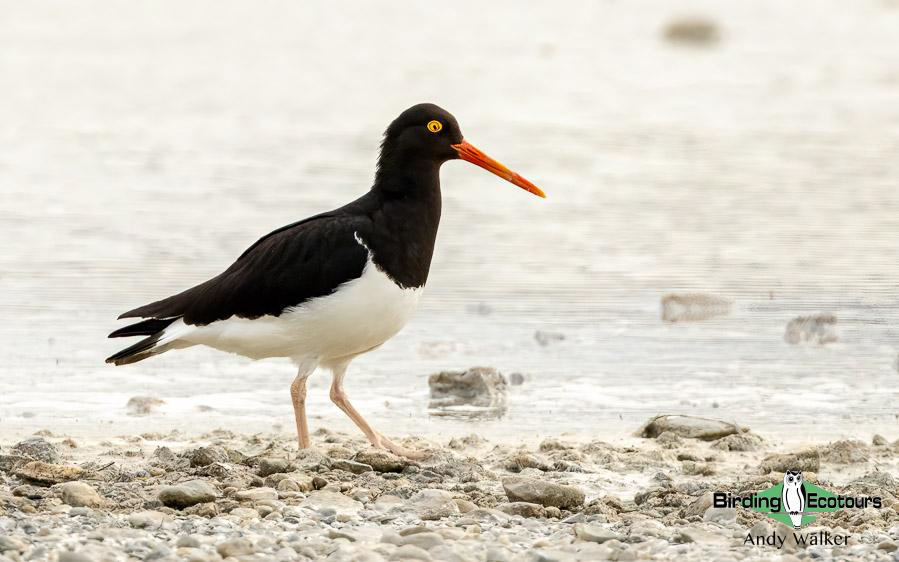
Magellanic Oystercatcher was the final new species of the tour and was a most fortuitous find.
Day 7, 22nd November 2025. Estancia la Angostura to El Calafate where tour concluded
We departed Estancia la Angostura after breakfast for the long drive back to El Calafate. The drive took around five hours and we arrived in El Calafate in the middle of the afternoon when this exciting southern Patagonia birding tour ended. Several Lesser (Darwin’s) Rheas, Least Seedsnipes, and Chillas (South American Grey Foxes) were seen along the way.
We had a long discussion over “bird of the trip” with everyone in the group having an excellent list of quality birds chosen for their own and varied reasons, which was really great to hear about. Overall, the top birds (in order!) were chosen to be Hooded Grebe, Magellanic Plover, Magellanic Woodpecker, Austral Rail, and Andean Condor. A huge thank you to everyone for making this such a fun tour to be part of, I look forward to birding with you all again, soon!
Bird List – Following IOC (15.1) (March 2025)
All species were seen. Common names with an alternative common name in parenthesis indicate name changes/splits/lumps following the announcement of the new AviList v2025 global bird checklist. The following notation after species names is used to show conservation status following BirdLife International: CR = Critically Endangered, VU = Vulnerable.
| Common Name | Scientific Name |
| Rheas (Rheidae) | |
| Lesser Rhea | Rhea pennata |
| Tinamous (Tinamidae) | |
| Patagonian Tinamou | Tinamotis ingoufi |
| Ducks, Geese, Swans (Anatidae) | |
| Black-necked Swan | Cygnus melancoryphus |
| Flying Steamer Duck | Tachyeres patachonicus |
| Upland Goose | Chloephaga picta |
| Ashy-headed Goose | Chloephaga poliocephala |
| Crested Duck | Lophonetta specularioides |
| Bronze-winged Duck | Speculanas specularis |
| Silver Teal | Spatula versicolor |
| Cinnamon Teal | Spatula cyanoptera |
| Chiloe Wigeon | Mareca sibilatrix |
| Yellow-billed Pintail | Anas georgica |
| Yellow-billed Teal | Anas flavirostris |
| Andean Duck (Ruddy Duck) | Oxyura ferruginea |
| Pigeons, Doves (Columbidae) | |
| Rock Dove [Feral Pigeon] | Columba livia [dom.] |
| Eared Dove | Zenaida auriculata |
| Rails, Crakes & Coots (Rallidae) | |
| Austral Rail – VU | Rallus antarcticus |
| Red-gartered Coot | Fulica armillata |
| White-winged Coot | Fulica leucoptera |
| Grebes (Podicipedidae) | |
| White-tufted Grebe | Rollandia rolland |
| Silvery Grebe | Podiceps occipitalis |
| Hooded Grebe (Endemic) – CR | Podiceps gallardoi |
| Flamingos (Phoenicopteridae) | |
| Chilean Flamingo | Phoenicopterus chilensis |
| Magellanic Plover (Pluvianellidae) | |
| Magellanic Plover – VU | Pluvianellus socialis |
| Oystercatchers (Haematopodidae) | |
| Magellanic Oystercatcher | Haematopus leucopodus |
| Plovers (Charadriidae) | |
| Tawny-throated Dotterel | Oreopholus ruficollis |
| Rufous-chested Dotterel | Zonibyx modestus |
| Southern Lapwing | Vanellus chilensis |
| Two-banded Plover | Anarhynchus falklandicus |
| Seedsnipes (Thinocoridae) | |
| Grey-breasted Seedsnipe | Thinocorus orbignyianus |
| Least Seedsnipe | Thinocorus rumicivorus |
| Sandpipers, Snipes (Scolopacidae) | |
| Magellanic Snipe | Gallinago magellanica |
| Baird’s Sandpiper | Calidris bairdii |
| White-rumped Sandpiper – VU | Calidris fuscicollis |
| Gulls, Terns, Skimmers (Laridae) | |
| South American Tern | Sterna hirundinacea |
| Brown-hooded Gull | Chroicocephalus maculipennis |
| Kelp Gull | Larus dominicanus |
| Cormorants, Shags (Phalacrocoracidae) | |
| Neotropic Cormorant | Nannopterum brasilianum |
| Ibises, Spoonbills (Threskiornithidae) | |
| Black-faced Ibis | Theristicus melanopis |
| Herons, Bitterns (Ardeidae) | |
| Black-crowned Night Heron | Nycticorax nycticorax |
| New World Vultures (Cathartidae) | |
| Andean Condor – VU | Vultur gryphus |
| Kites, Hawks, Eagles (Accipitridae) | |
| Cinereous Harrier | Circus cinereus |
| Variable Hawk | Geranoaetus polyosoma |
| Black-chested Buzzard-Eagle | Geranoaetus melanoleucus |
| Owls (Strigidae) | |
| Austral Pygmy Owl | Glaucidium nana |
| Woodpeckers (Picidae) | |
| Chilean Flicker | Colaptes pitius |
| Magellanic Woodpecker | Campephilus magellanicus |
| Caracaras, Falcons (Falconidae) | |
| Crested Caracara | Caracara plancus |
| Chimango Caracara | Milvago chimango |
| White-throated Caracara | Phalcoboenus albogularis |
| American Kestrel | Falco sparverius |
| African & New World Parrots (Psittacidae) | |
| Austral Parakeet | Enicognathus ferrugineus |
| Ovenbirds (Furnariidae) | |
| Common Miner | Geositta cunicularia |
| White-throated Treerunner | Pygarrhichas albogularis |
| Band-tailed Earthcreeper | Ochetorhynchus phoenicurus |
| Wren-like Rushbird | Phleocryptes melanops |
| Scale-throated Earthcreeper | Upucerthia dumetaria |
| Buff-winged Cinclodes | Cinclodes fuscus |
| Thorn-tailed Rayadito | Aphrastura spinicauda |
| Plain-mantled Tit-Spinetail | Leptasthenura aegithaloides |
| Austral Canastero | Asthenes anthoides |
| Cordilleran Canastero | Asthenes modesta |
| Sharp-billed Canastero | Asthenes pyrrholeuca |
| White-throated Cacholote (Endemic) | Pseudoseisura gutturalis |
| Tapaculos (Rhinocryptidae) | |
| Black-throated Huet-huet | Pteroptochos tarnii |
| Magellanic Tapaculo | Scytalopus magellanicus |
| Tyrant Flycatchers, Calyptura (Tyrannidae) | |
| Chilean Elaenia | Elaenia chilensis |
| Spot-billed Ground Tyrant | Muscisaxicola maculirostris |
| Cinnamon-bellied Ground Tyrant | Muscisaxicola capistratus |
| Austral Negrito | Lessonia rufa |
| Spectacled Tyrant | Hymenops perspicillatus |
| Fire-eyed Diucon | Pyrope pyrope |
| Chocolate-vented Tyrant | Neoxolmis rufiventris |
| Great Shrike-Tyrant | Agriornis lividus |
| Cotingas (Cotingidae) | |
| Rufous-tailed Plantcutter | Phytotoma rara |
| Swallows, Martins (Hirundinidae) | |
| Chilean Swallow | Tachycineta leucopyga |
| Blue-and-white Swallow | Pygochelidon cyanoleuca |
| Wrens (Troglodytidae) | |
| Grass Wren | Cistothorus platensis |
| Southern House Wren | Troglodytes musculus |
| Mockingbirds, Thrashers (Mimidae) | |
| Patagonian Mockingbird | Mimus patagonicus |
| Thrushes (Turdidae) | |
| Austral Thrush | Turdus falcklandii |
| Old World Sparrows, Snowfinches (Passeridae) | |
| House Sparrow | Passer domesticus |
| Wagtails, Pipits (Motacillidae) | |
| Correndera Pipit | Anthus correndera |
| Finches, Euphonias (Fringillidae) | |
| Black-chinned Siskin | Spinus barbatus |
| New World Sparrows (Passerellidae) | |
| Rufous-collared Sparrow | Zonotrichia capensis |
| Oropendolas, New World Orioles, Blackbirds (Icteridae) | |
| Long-tailed Meadowlark | Leistes loyca |
| Shiny Cowbird | Molothrus bonariensis |
| Austral Blackbird | Curaeus curaeus |
| Yellow-winged Blackbird | Agelasticus thilius |
| Tanagers & Allies (Thraupidae) | |
| Mourning Sierra Finch | Rhopospina fruticeti |
| Patagonian Yellow Finch | Sicalis lebruni |
| Grey-hooded Sierra Finch | Phrygilus gayi |
| Patagonian Sierra Finch | Phrygilus patagonicus |
| Plumbeous Sierra Finch | Geospizopsis unicolor |
| Diuca Finch | Diuca diuca |
| Total seen | 95 |
| Total heard only | 0 |
| Total recorded | 95 |
Mammal List
| Common Name | Scientific Name |
| Hares and Rabbits (Leporidae) | |
| European Hare | Lepus europaeus |
| Cavies (Caviidae) | |
| Southern Mountain Cavy | Microcavia australis |
| Canids (Canidae) | |
| Culpeo | Lycalopex culpaeus |
| Chilla (South American Grey Fox) | Lycalopex grisea |
| Deer (Cervidae) | |
| South Andean Huemul (South Andean Deer) | Hippocamelus bisulcus |
| Camelids (Camelidae) | |
| Guanaco | Lama guanicoe |
| Total seen | 6 |
Reptile List
| Common Name | Scientific Name |
| Smooth Anoles (Leiosauridae) | |
| Smooth-headed Patagonian Lizard | Diplolaemus bibronii |
| Total seen | 1 |
This is a sample trip report. Please email us ([email protected]) for more trip reports from this destination.