17 AUGUST–03 SEPTEMBER 2026
By Dominic Rollinson
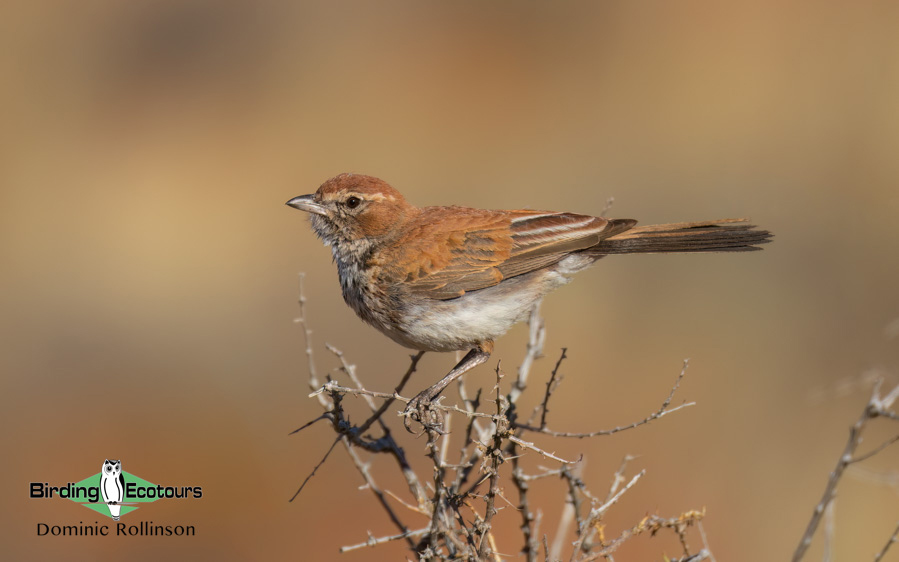
This tour had a heavy focus on arid South African specials such as this Red Lark.
Overview
This private western South Africa birding adventure covered an impressive range of habitats, from the vast Kalahari and arid Northern Cape deserts to the fynbos-clad mountains, coastal wetlands, forests, and the spectacular coastline of the Western Cape. Over 18 days we explored some of South Africa’s premier birding destinations, enjoying excellent birding, memorable wildlife encounters, stunning scenery, and a remarkable diversity of habitats. By the tour’s end, we had recorded 317 bird species alongside a fine selection of mammals, reptiles, and other wildlife.
Our journey began in the Kalahari region around Upington and the Kgalagadi Transfrontier Park, where classic desert birds such as Burchell’s Sandgrouse, Crimson-breasted Shrike, Southern Pied Babbler, Secretarybird, Pygmy Falcon, and Red-necked Falcon featured prominently. The park also produced excellent mammal sightings, including Lion, Cheetah, Meerkat, African Wildcat, and Southern Giraffe. Particularly memorable were our views of Southern White-faced Owl and the surprise discovery of a rare Red-breasted Swallow within the park.
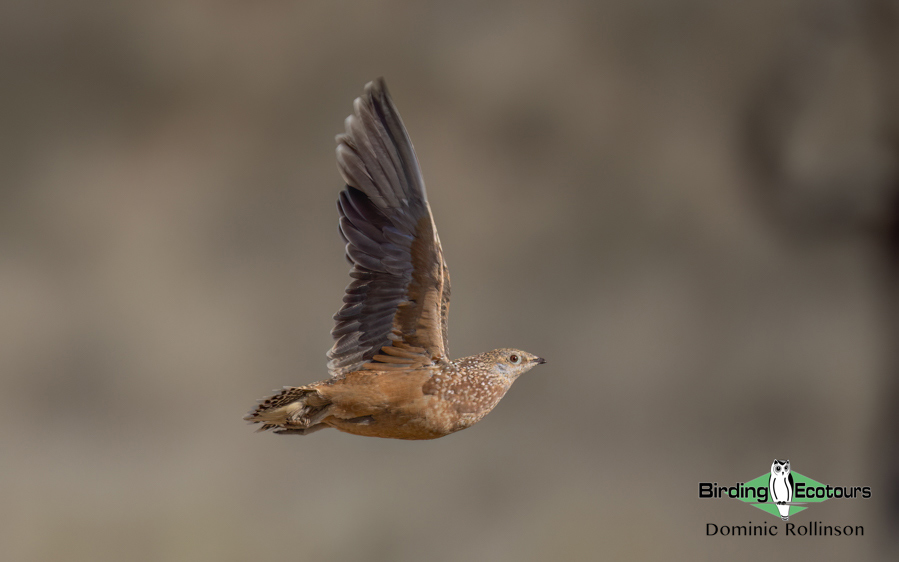
We had lovely views of Burchell’s Sandgrouse in the Kgalagadi as they came down to drink at various waterholes within the park.
Continuing south through Augrabies and Pofadder, we enjoyed a productive period targeting Northern Cape specials. Highlights included Namaqua Warbler, Rosy-faced Lovebird, Black Harrier, Sclater’s Lark, Black-eared Sparrow-Lark, Karoo Korhaan, Cape Eagle-Owl, Ludwig’s Bustard, Burchell’s Courser, and the highly localized Red Lark (see the front cover image). The Orange River also provided excellent birding, including African Black Duck and an unexpected African Clawless Otter.
The West Coast leg added a completely different flavor to the tour. Around Port Nolloth and Alexander Bay we found the localized Dune Lark, while coastal birding produced African Oystercatcher, Greater Flamingo, White-chinned Petrel, Bank Cormorant, and a variety of shorebirds. Further south, at Lambert’s Bay, we enjoyed close views of the immense Cape Gannet colony and were exceptionally fortunate to see a vagrant Australasian Gannet among them. Nearby wetlands and salt pans delivered Chestnut-banded Plover, Red-necked Phalarope, and large numbers of waterbirds.
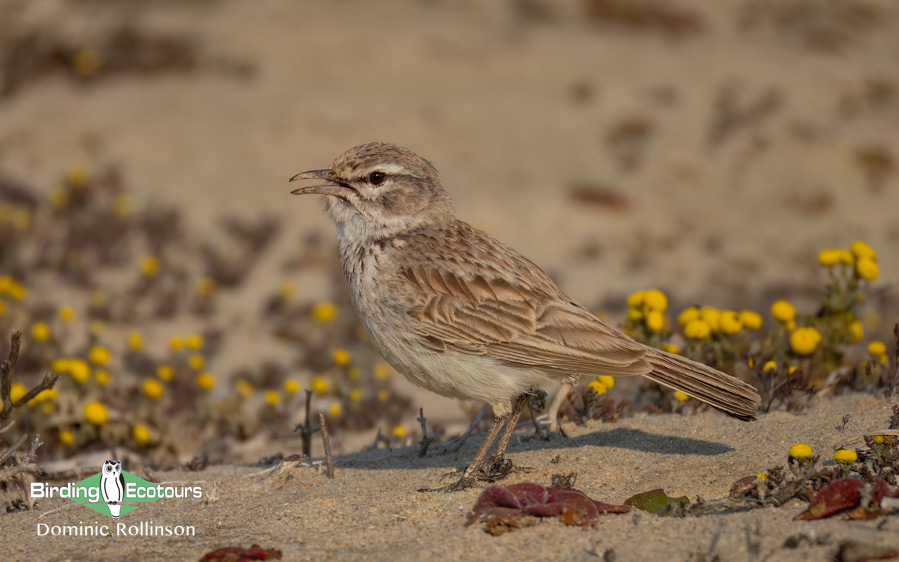
Dune Lark was yet another lark target on this tour.
West Coast National Park and the surrounding lowlands contributed several sought-after Western Cape species, including Grey-winged Francolin, Marsh Owl, Cape Longclaw, African Rail, Southern Black Korhaan, Cloud Cisticola, Red-chested Flufftail, and Blue Crane. These productive grassland and wetland habitats contrasted perfectly with the deserts visited earlier in the trip.
A major highlight was our time in and around Grootvadersbosch Forest, where we connected with some of South Africa’s most desirable forest endemics: Knysna Woodpecker, Knysna Warbler and Forest Buzzard. Here we also connected with Tambourine Dove, Cape Siskin, Victorin’s Warbler, and several other forest specials. The Overberg region also produced Bontebok, Mountain Zebra, and numerous Blue Cranes, further emphasizing the remarkable diversity of the tour.
The final days around Cape Town delivered a fitting conclusion. We enjoyed excellent views of Cape endemics such as Cape Rockjumper, Cape Sugarbird, Protea Canary, and Orange-breasted Sunbird, while Betty’s Bay offered close views of the Critically Endangered African Penguin colony. A vagrant Allen’s Gallinule near Cape Town provided one of the trip’s most exciting rarities, and Brown-backed Honeybird became the final major addition to Melanie’s target list. Time spent around the Cape Peninsula, Kirstenbosch Botanical Garden, and Cape Point provided a beautiful backdrop to the closing stages of a highly successful birding tour.
Overall, the tour was a tremendous success, combining excellent birding, numerous South African endemics and regional specials, memorable mammals, spectacular scenery, and a wonderful variety of habitats across western South Africa.
A detailed daily account can be read below, and the full bird, mammal and reptile lists are located at the end of the report. More photos and details can be found in the eBird trip report, here.
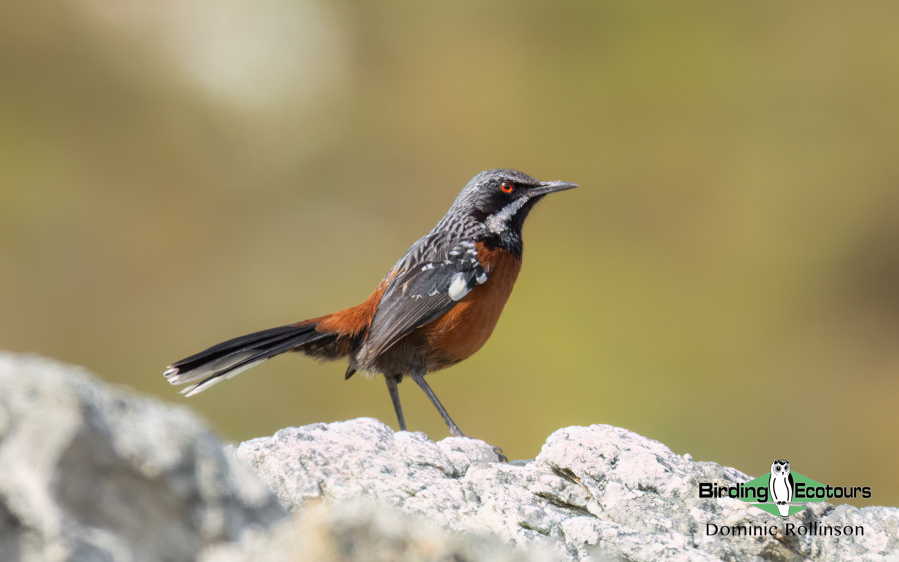
Cape Rockjumper was seen in the Cape Fold Mountains at Rooi Els.
Detailed Report
Day 1, 17th August 2026. Upington to Kgalagadi, birding en route
An early morning collection from Melanie’s lovely hotel along the banks of the Orange River, saw us starting the trip list with the likes of White-backed and Red-faced Mousebirds, Cardinal Woodpecker and Orange River White-eye. For our first proper birding we decided to bird a dirt road northwest of Upington which proved to be incredibly productive. Over the course of a couple of hours we had notched up a good bird list including South African Shelduck, Namaqua Sandgrouse, Northern Black (White-quilled Bustard) Korhaan, Pale Chanting Goshawk (our first of many), Acacia Pied Barbet, Fawn-colored, Eastern Clapper and Pink-billed Larks, Rufous-eared Warbler, Desert Cisticola, Chat Flycatcher and Dusky Sunbird.
Afterwards, we bought some supplies in Upington and started the journey northward towards the Kgalagadi Transfrontier Park. We took our time and made a few stops in the open plains north of Upington which added Double-banded Courser, Kalahari Scrub Robin and Sociable Weaver and then stopped at a lodge outside of Askham for our lunch and some birding.
We enjoyed a pleasant lunch while constantly being distracted by birds around the property such as Brubru, Crimson-breasted Shrike, Ashy Tit, Black-chested Prinia, Chestnut-vented Warbler, Red-billed Oxpecker (heard only), Groundscraper Thrush, Black-throated Canary and Black-faced Waxbill. Far and away our best sighting here was a pair of Red-billed Spurfowl which were seen running across the lawns, a rare sighting for the area.
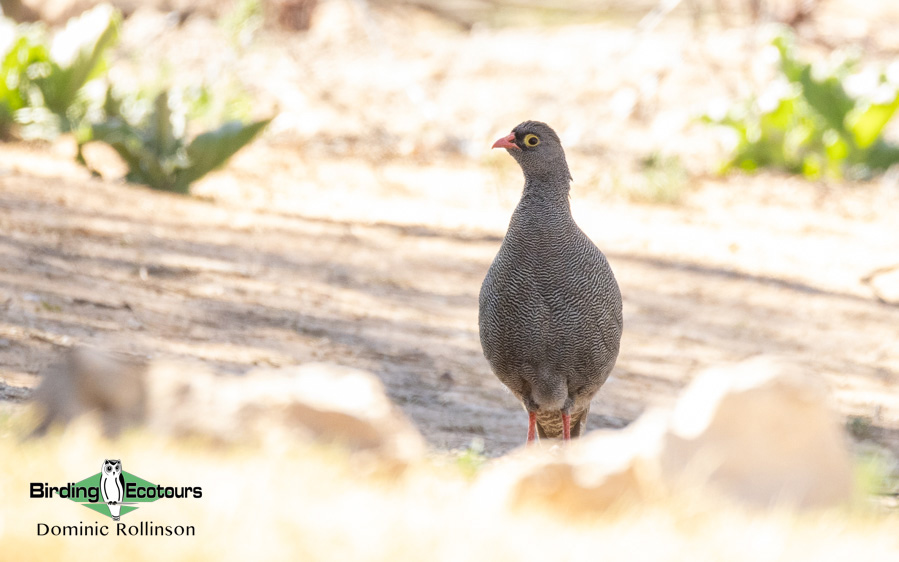
Red-billed Spurfowl was an unexpected find near Askham on the way to the Kgalagadi Transfrontier Park.
After lunch, we birded a nearby dry riverbed which again proved very productive as we added the likes of Crowned Lapwing, Gabar Goshawk, White-backed Vulture, Common Hoopoe, Common Scimitarbill, Southern Yellow-billed Hornbill, Lilac-breasted Roller, Marico Flycatcher and Red-billed Buffalo Weaver, with the highlight being a group of nine Southern Pied Babblers.
We then continued north to our lodge just outside the gates of the Kgalagadi Transfrontier Park where we were based for the next four nights and our exploration of the park. After a busy and productive first day, we discussed the trip over dinner before calling it a night.
Days 2-4, 18th–20th August 2026. Kgalagadi Transfrontier Park birding
Over the next three days, we birded the Kgalagadi Transfrontier Park daily, entering the park at first light and leaving in the late afternoon. General birding and game viewing in the park was excellent with some of the commoner and more widespread bird species including Kori Bustard, Common Ostrich, Secretarybird, Namaqua Sandgrouse, Northern Black Korhaan, Bateleur, Tawny Eagle, Gabar Goshawk, Swallow-tailed Bee-eater, Greater Kestrel, Lanner Falcon, Crimson-breasted Shrike, Fawn-colored Lark, African Red-eyed Bulbul and Cape Starling.
Of course, we found a great assortment of mammals during our three days in the Kgalagadi with common sightings including Springbok, Hartebeest, Blue Wildebeest, Gemsbok (Southern Oryx), South African Ground Squirrel, Meerkat as well as Common Slender and Yellow Mongooses. Less frequently encountered species included Lion, Cheetah, Black-backed Jackal, Spotted Hyena, African Wildcat, Southern Giraffe and Common Warthog.
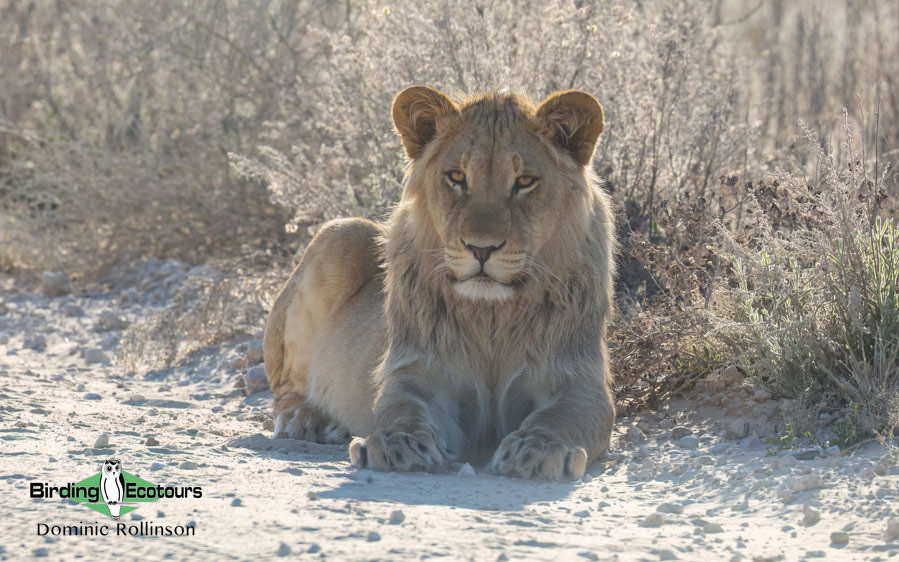
We had a couple fantastic Lion sightings during our time in the Kgalagadi.
On one of the days we made a trip out to Mata Mata Rest Camp which is around 70 miles (115 kilometers) from the entrance gate at Twee Rivieren Rest Camp. Along this route we added a few more special species such as Burchell’s Sandgrouse, Red-necked Falcon, Pygmy Falcon, Black-chested Snake Eagle, Spotted Thick-knee, Spotted Eagle-Owl and Purple Roller. The big surprise along the drive to Mata Mata was a single Red-breasted Swallow seen swoop-drinking from a waterhole, a very rare bird in the park. We enjoyed lunch in Mata Mata Rest Camp and sat at the bird hide during the heat of the day and watched seedeaters such as Black-throated Canary, Red-headed Finch and Red-billed Quelea coming down to drink. The drive back was mostly uneventful although we added Red-crested Korhaan (Bustard) as well as a couple of Southern Giraffes. Another exciting find on our way back was a Puff Adder which we watched slowly crossing the road.
On our final day in the park, we made our way to the northeast towards Nossob Rest Camp, which was another long drive, but we thoroughly enjoyed it. We had Kgalagadi favorites such as Red-necked Falcon, Pygmy Falcon, Secretarybird, Tawny Eagle, Bateleur, with a few Booted Eagles seen too, another new trip bird. We were very excited to see a group of cars up ahead and discovered the source of the traffic jam when we noticed four Lions lazing about on the road, often even sheltering in the shade of cars. It’s always a pleasure to see these large cats up close and personal. We then spent a couple of hours birding around Nossob Camp, again enjoying our lunch in the camp’s bird hide. Our main target in Nossob was Southern White-faced Owl which we found easily; after having gazed into the depths of every second acacia tree over the last few days, this was a major relief. We were not so lucky with African Scops Owl which had been roosting in the same spot the last few days but had relocated its day roost spot unfortunately. The camp was rather birdy, and we also found Common Hoopoe, Crimson-breasted Shrike, Ashy Tit, Red-headed Finch and Shaft-tailed Whydah.
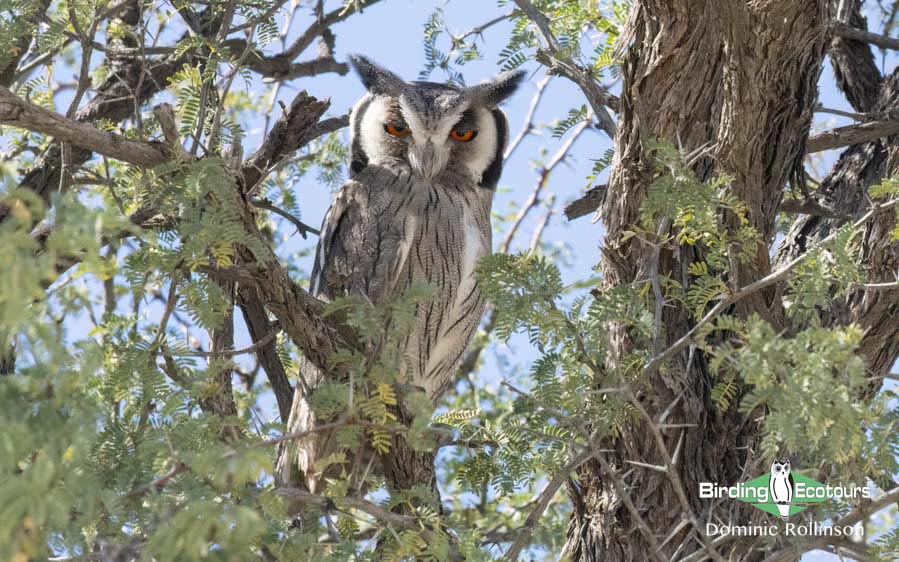
Southern White-faced Owl showed well at its day roost in Nossob Rest Camp.
Day 5, 21st August 2026. Transfer to Augrabies
After three full days mostly driving around the park, it was a pleasure to be able to stretch our legs and do some birding on foot. We packed our bags and headed south to bird a dry riverbed near Askham which was full of birds this morning. We spent a good hour birding here and managed to find the likes of Pearl-spotted Owlet, Acacia Pied Barbet, Brubru, Ashy Tit, Chestnut-vented Warbler, Southern Pied Babbler, Groundscraper Thrush, Marico Flycatcher, Red-billed Buffalo Weaver, as well as Black-faced and Violet-eared Waxbills.
We then made our way south to Upington, where we picked up some supplies and headed a little further west to the small town of Keimoes where we ate our lunch while out birding. Here, we easily found Rosy-faced Lovebirds which posed nicely for our cameras. We then pressed on to Augrabies Falls National Park where we were based for the next two nights.
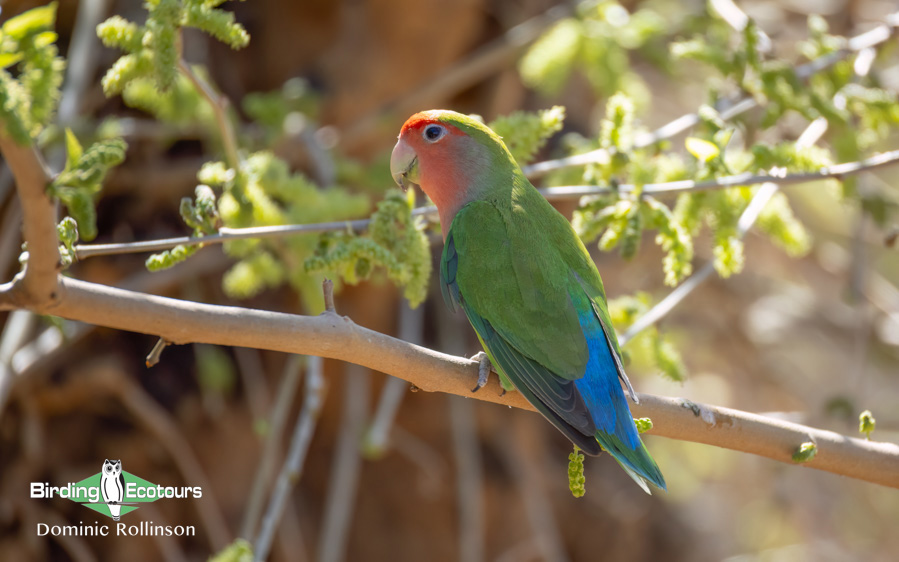
Rosy-faced Lovebird added a splash of color along the Orange River at Keimoes.
We spent the afternoon birding around the rest camp and campground and managed to find Namaqua Warbler without too much difficulty with some nice bonuses including Pearl-breasted Swallow, Lesser Honeyguide, Golden-tailed Woodpecker, Common Reed Warbler, Fiscal Flycatcher and Cape Robin-Chat seen too. Once it had cooled down a bit, we spent time enjoying the impressive falls which were a little lower than usual, with Pale-winged Starlings, Peregrine Falcons and Broadley’s Flat Lizards keeping us entertained around the falls.
Later that evening we had a braai (barbecue) for dinner while we enjoyed a lovely sunset in a stunningly pretty setting.
Day 6, 22nd August 2026. Augrabies birding and relaxed afternoon
This morning we took a drive out into the park and enjoyed the fantastic scenery that the park has to offer. We also managed to find a few of Melanie’s target species with the morning’s highlights including Cape Spurfowl, Crested Barbet, Karoo Long-billed Lark, White-throated Canary and Golden-breasted, Cinnamon-breasted, Cape and Lark-like Buntings. Another highlight of the morning was a particularly confiding pair of Klipspringer antelope which posed nicely before bouncing off across the rocky landscape.
We had always set today aside as a rest day (although we knew we couldn’t give up a morning of birding) but did take the remainder of the afternoon off. We met in the late afternoon to watch the rugby game between the Springboks and the All Blacks and grab some dinner. Unfortunately, the Springboks ended up losing which left most of rugby-watchers very disappointed, although Melanie was quietly celebrating (being a New Zealander).
Day 7, 23rd August 2026. Transfer to Pofadder, birding en route
After the previous day’s relaxed schedule, it was time to get back into hardcore birding and continue ticking off Melanie’s targets. We left Augrabies relatively early and had a go at finding Buffy Pipit which had been seen in the area recently. Unfortunately after a good effort we had to give up empty-handed and started making our way along backroads to Pofadder.
The idea behind taking the backroads to Pofadder was to hopefully bump into Black-eared Sparrow-Larks which can often be tricky birds to track down. After a number of false alarms (so many Grey-backed Sparrow-Larks around) we eventually found a displaying male and as we got closer to Pofadder they were actually quite numerous. We were also pleased to find a Black Harrier while driving through the open plains.
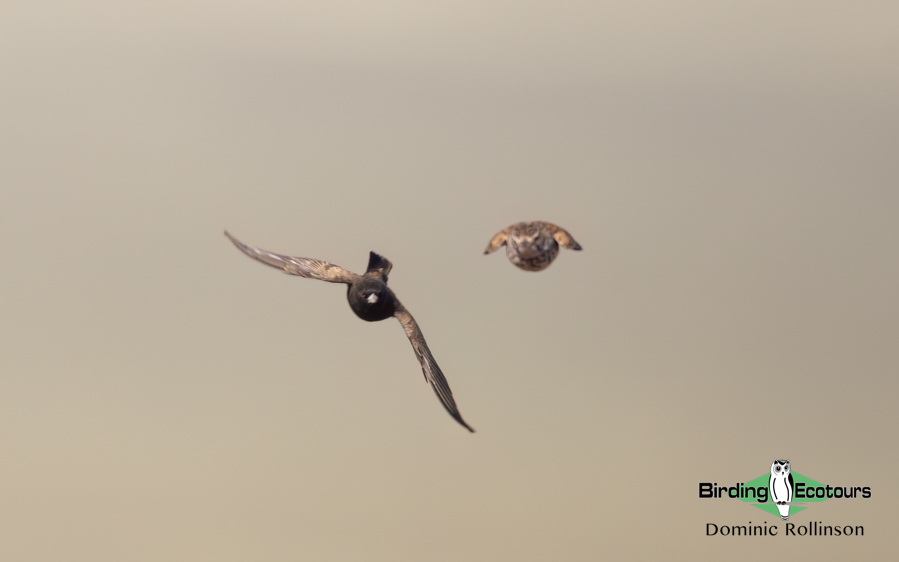
Male Black-eared Sparrow-Larks were seen chasing females around throughout our time in the Pofadder area.
On our way to Pofadder we also decided to sit quietly at a drinking trough and, as we had hoped, a few Sclater’s Larks came in to drink and gave us fantastic views of this scarce desert nomad. While we were waiting for the larks, we also enjoyed close views of Namaqua Dove, Grey-backed Sparrow-Larks and Lark-like Buntings. Before getting into Pofadder in the mid-afternoon, we also managed to find a group of three Stark’s Larks and a single Karoo Korhaan which showed wonderfully well for us.
It had been a long, but highly productive, drive from Augrabies and so we took some time off in the heat of the early afternoon and met again in the late afternoon for a drive south of Pofadder. As we drove through the plains, we were delighted to flush a single Common Quail which was one of Melanie’s big targets. At a rocky outcrop further south we had good looks at calling Cinnamon-breasted Warbler as well as our first Grey-backed Cisticolas of the trip. Shortly before sunset we arrived at our carefully chosen dinner spot, where we would eat our takeaway pizzas for dinner. As we were enjoying our pizza we heard the rasping call of a Cape Eagle-Owl and soon thereafter it flew out and continued to call from a prominent rock where we enjoyed lovely scope views. It was the perfect way to end a long but highly productive day of Northern Cape birding.
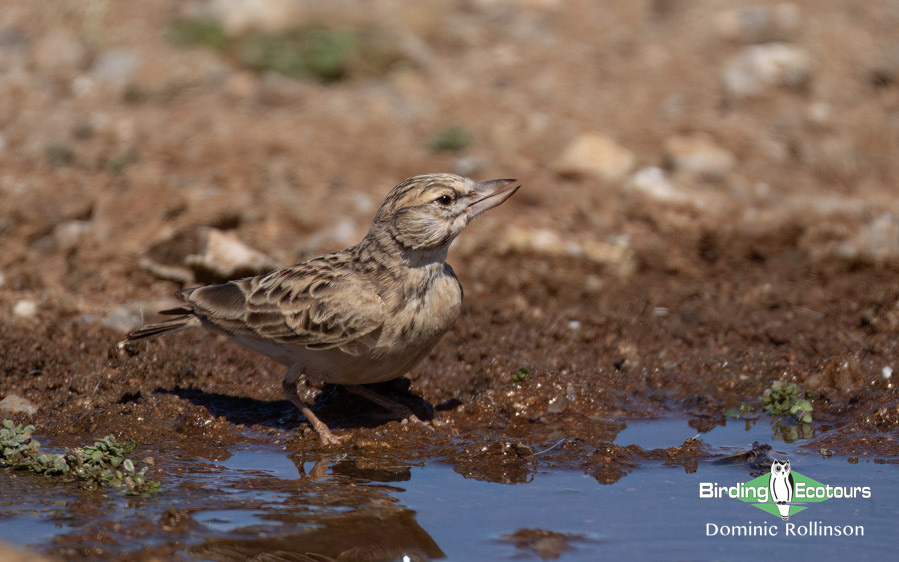
Sclater’s Lark is one of the toughest of the Northern Cape arid specials.
Day 8, 24th August 2026. Pofadder birding
We left in the dark, armed with breakfast packs, to target our last few of the area’s specials and headed out to a private farm west of Pofadder. We made our way through the farm’s open grassy plains (with good numbers of Stark’s Larks and Black-eared Sparrow-Larks about) and eventually arrived at our breakfast spot at the base of some red-sand dunes. Once we had had our breakfast we walked up into the dunes and had amazing views of displaying Red Larks with large numbers of Black-eared Sparrow-Larks also in the dune fields.
We then made our way out of the farm and were relieved to find Burchell’s Courser and a distant Ludwig’s Bustard, after we had spent a lot of time that morning scanning for these two nomadic species. Other good birds seen during our time on the farm included Lanner Falcon, Greater Kestrel, Karoo Korhaan, Spike-heeled Lark and Red-headed Finch.
We decided to go have our lunch back at the same trough we had visited yesterday and sure enough the Sclater’s Larks stopped by and gave us further excellent views, as did the same species as yesterday; Namaqua Dove, Grey-backed Sparrow-Larks, Yellow Canaries and Lark-like Buntings.
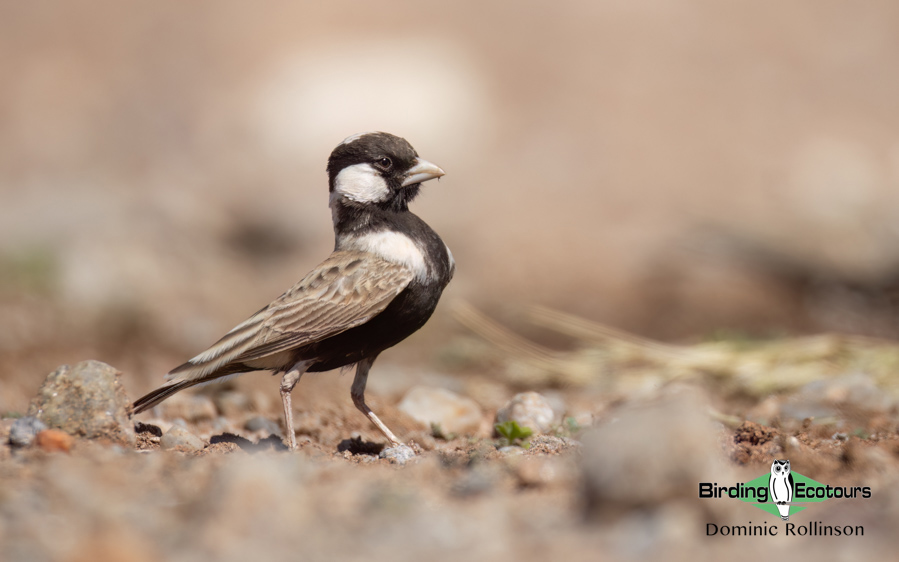
Grey-backed Sparrow-Larks were highly numerous in the Pofadder area.
For the rest of the afternoon, we targeted our last few remaining targets for the area. Short-toed Rock Thrushes were one of these targets and I’ve seen them a few times over the years in random locations in Pofadder and was confident we would be able to find them. A couple of hours later, after countless loops around town, we still hadn’t had a sniff of the rock thrushes. Our afternoon’s efforts didn’t leave us entirely empty-handed though as we added Bradfield’s Swift in amongst the aerial-feeder flocks.
Day 9, 25th August 2026. Onseepkans and Pofadder birding
This morning we decided to visit the Orange River on the Namibia-South Africa border to see if we could find Short-toed Rock Thrush and anything else that might be in the lusher vegetation along the edge of South Africa’s longest river. We again could not find the rock thrush but had a wonderful morning’s birding and enjoyed the drastic change in habitat. Some of the morning’s highlights included African Black Duck, Goliath Heron, Bradfield’s Swift, White-fronted Bee-eater, Rosy-faced Lovebird, Namaqua Warbler and Pin-tailed Whydah. We were also delighted to watch an African Clawless Otter as it went about feeding in the river.
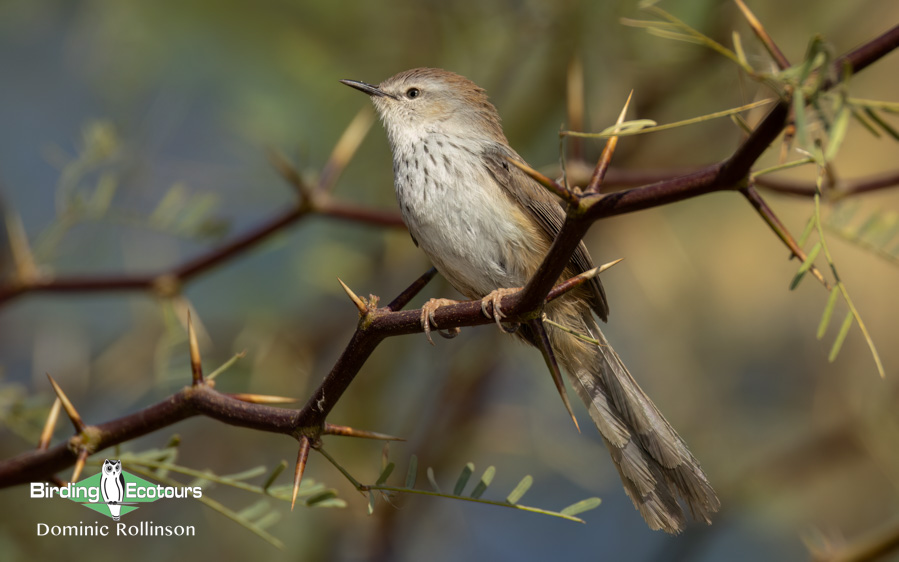
Namaqua Warblers were very common and confiding along the Orange River at Onseepkans.
After some time off in the early afternoon back at our hotel, we did a long loop southwest of Pofadder, again in the hopes of finding the dreaded rock thrush. Yet again, we failed and decided it was probably not meant to be, but did enjoy seeing the likes of Mountain Chat, Ant-eating Chat, Bokmakierie and Rock Kestrel.
That evening after dinner we took a drive out to look for nocturnal wildlife with Melanie getting to grips with using the thermal scope and promptly spotted a couple of Bat-eared Foxes and some Scrub Hares.
Day 10, 26th August 2026. Transfer to Springbok, birding en route
We had one final unsuccessful loop around town this morning for the rock thrush before heading west towards Springbok. We arrived in the mid-morning and spent the rest of the morning in Goegap Nature Reserve, just outside of town. This small reserve is normally draped in a kaleidoscope of colors at this time of the year, but after the unusually early rains this year, the blooms were well over which was a bit disappointing. However, we had our target birds to find, so we soon got over the disappointment and set about driving the reserve.
We found Karoo Eremomelas without too much difficulty as well as Large-billed, Red-capped and Karoo Larks. Layard’s Warbler played along nicely as did a particularly showy Nicholson’s Pipit. We could, however, not find any Black-headed Canaries despite a good search of the reserve. We had our lunch in the reserve and were delighted when two tiny specks in the sky turned into Verreaux’s Eagles – another tour target. Melanie did well to spot a distant pair of (Cape) Mountain Zebras which were surprisingly well camouflaged in the thick vegetation. Around the reserve we also enjoyed seeing many cute Rock Hyraxes and found a few colonies of Brants’s Whistling Rats and could even hear their high-pitched whistles.
In the afternoon, we drove a road southeast of town in the hopes of finding Black-headed Canary which unfortunately still would not show. It was, however, a very enjoyable afternoon and some of the highlights included Cape Bulbul, Grey Tit and more Layard’s Warblers. We ended the day with nice looks at calling Freckled Nightjar as the sun was setting.
Day 11, 27th August 2026. Port Nolloth and Springbok birding
We left our accommodation before sunrise to ensure we could arrive on the coast at Port Nolloth soon after sunrise and were excited about the prospect of some coastal birding and coastal desert birding. We arrived at the Port Nolloth sewage works and were happy to find a good assortment of waterfowl such as South African Shelduck, Blue-billed Teal, Maccoa Duck and Cape Shoveler. In the surrounding dunes we found Cape Long-billed Lark, Tractrac Chat, Grey Tit and Rufous-eared Warbler which all showed incredibly well.
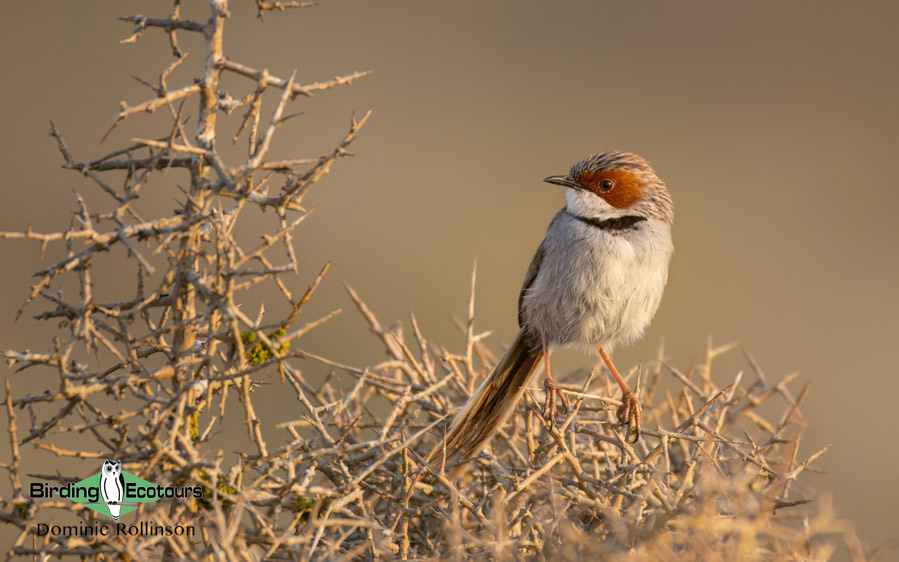
Rufous-eared Warblers were especially obliging at Port Nolloth.
We decided to move away from the sewage works to eat our breakfast and overlooked the Atlantic Ocean as we got stuck into our impressive breakfast packs (which also turned into lunch packs). Here, we spotted African Oystercatcher, White-fronted Plover, Hartlaub’s Gull and Greater Crested Tern, while a quick sea watch added a few White-chinned Petrels.
After our quick breakfast stop, we moved into the dunes a little north of Port Nolloth and soon found a very confiding pair of Dune Larks which we enjoyed following through the desert for a while. In the area we also found Red-capped and Cape Long-billed Larks and Capped Wheatear.
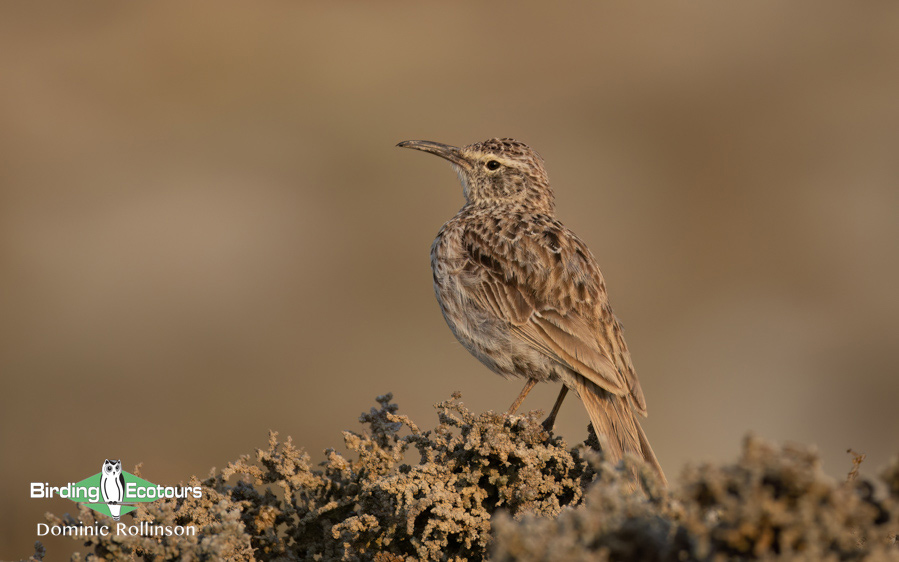
The large Cape Long-billed Lark was seen well in the small dunes near Port Nolloth, and we enjoyed watching it perform its impressive aerial display.
Continuing north of Port Nolloth to Alexander Bay we headed down to the coast at the Orange River mouth and spent some time birding the mudflats here. We had hoped for an early returning Damara Tern but unfortunately, they must have still been further north off the west coast of Africa, and we had to accept that we were just too early in the season for this species. The birding here was highly productive though and we added an assortment of new trip birds with some of the highlights being Bar-tailed Godwit, Caspian, Common and Sandwich Terns, Greater Flamingo and Pied Avocet.
For our final birding for the morning, we headed back south to Port Nolloth and then to the small coastal village of McDougall’s Bay where some scanning of the coastline added Bank and Crowned Cormorants, Ruddy Turnstone, Grey Plover, Eurasian Whimbrel and a small group of Black-necked Grebes bobbing around in the surf.
Later that afternoon we headed into the Kamieskroon Hills south of Pofadder where we eventually found a flock of Black-headed Canaries as well as a single Yellow Bishop. That evening we celebrated another successful day with a tasty braai on our final night in the Northern Cape.
Day 12, 28th August 2026. Transfer to Langebaan, birding en route
Today we had a great deal of ground to cover, as we made our way south to Langebaan and had several targets to look for en route. We left Springbok early and stopped at a site just south of Springbok where we heard calling Cape Clapper Larks the previous afternoon. It didn’t take long until a bird was seen displaying near to us and we enjoyed good looks. We then moved a little further south to see if we could improve our views of Black-headed Canaries. The birds were still feeding in the same area as yesterday but unfortunately, we did not really improve our views from yesterday, and then decided to move on.
A fuel stop at Garies gave us a cooperative Malachite Sunbird and Klaas’s Cuckoo, both target birds for Melanie. We then arrived at our Protea Canary stop and as we got out the vehicle, we could hear a bird singing and soon thereafter we managed great looks at this tricky Cape endemic. We celebrated by enjoying our lunch (with a Fairy Flycatcher as a nice distraction) and then hit the road again and made our way towards the coast at Lambert’s Bay.
Arriving at Bird Island on the edge of Lambert’s Bay we were confronted by the huge mass of breeding Cape Gannets which were a delight to watch at close quarters. We hoped to also see one of the vagrant Australasian Gannets within the colony but were told by rangers that one had just left. We scanned the colony for a while and just as we were heading back, we got called back into the hide and were shown one of the vagrant Australasian Gannets. We couldn’t believe our luck!
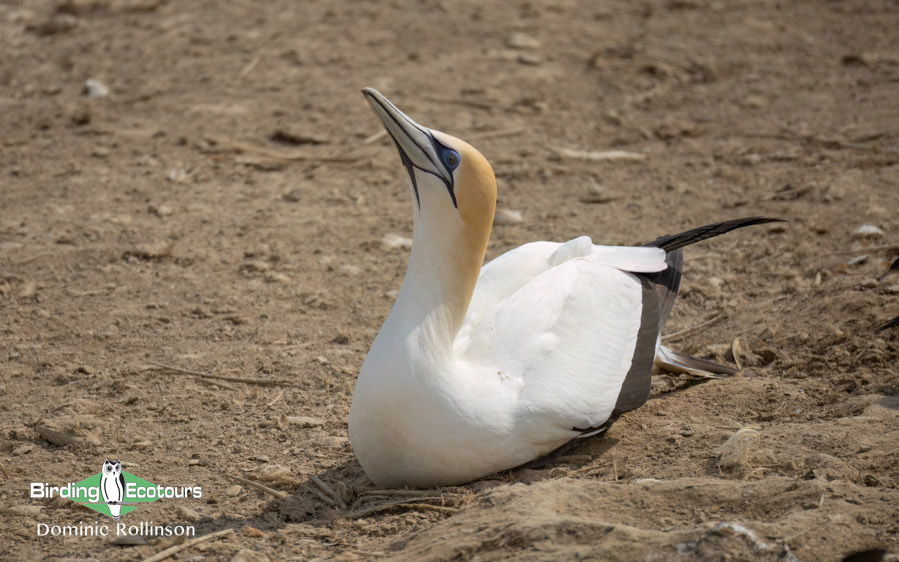
This vagrant Australasian Gannet was seen in the Cape Gannet colony at Lambert’s Bay.
We continued south and arrived at Velddrif where we birded the salt pans and easily found good numbers of the highly attractive Chestnut-banded Plover as well as Kittlitz’s Plover and Common Ringed Plover. While here we also found the long-staying Red-necked Phalarope which has now likely been at this site for over a decade.
We then made our way towards Jacob’s Bay, ticking a pair of Sickle-winged Chats en route. At Jacob’s Bay we enjoyed good looks at the large wintering colony of Antarctic Terns with Spotted Thick-knee, Cape Penduline Tit and Karoo Lark all seen in the surrounding strandveld vegetation.
This ended a whirlwind day of birding and travel, and we eventually arrived at our Langebaan accommodation shortly before dark.
Day 13, 29th August 2026. West Coast birding
The whole morning was spent birding in West Coast National Park and soon after entering the park we found our first target, a confiding pair of Grey-winged Francolins feeding along the roadside. We then moved to the Geelbek area where we had great views of a Marsh Owl, a tricky bird to find in the Cape. We also flushed a Common Quail as we walked and had great views of a few displaying Cape Longclaws.
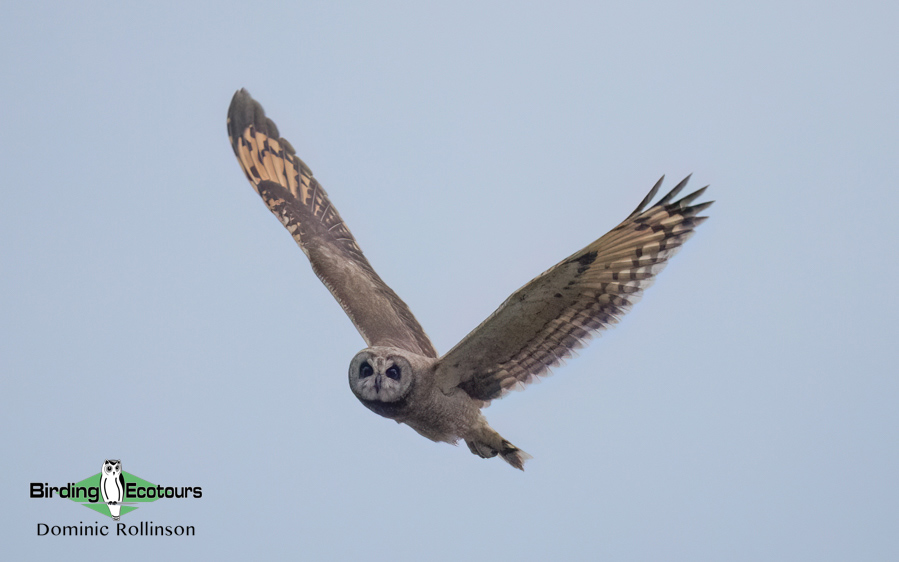
Marsh Owl showed very well in West Coast National Park.
For our breakfast stop, we attempted to eat our huge breakfast packs in one of the bird hides, but had to give up and decided to leave some of it for lunch. The breakfast was excellent and certainly plentiful. While scanning the mud flats of Langebaan Lagoon we picked out Pied Avocet, Grey Plover, Eurasian Whimbrel, Bar-tailed Godwit, Common Greenshank, Curlew Sandpiper, Little Stint and some larger species including the likes of Great White Pelican, Greater Flamingo and Little Egret. West Coast National Park offers some of the best wader watching in the country, however, with this trip taking place in early-spring, many of the birds were still in their breeding grounds in the Northern Hemisphere.
We made a couple more stops in bird hides in the park and added species such as African Rail, Black Crake, Rufous-breasted Sparrowhawk (an unusual bird for the park), Southern Black Korhaan as well as Eurasian Oystercatcher, a long-staying vagrant which has been in Langebaan Lagoon for the last couple of years now.
With our targets out of the way, we decided to take the afternoon off and then met again in the late afternoon to watch the next rugby match between the Springboks and the All Blacks while enjoying our dinner. This time, the Springboks prevailed, much to the restaurant’s delight with Melanie taking the loss very gracefully indeed.
Day 14, 30th August 2026. Transfer to Grootvadersbosch Forest, birding en route
Today was to be another action-packed day of birding and travel and we again set off before dawn, with our stop in the Darling area where we soon found our target, Cloud Cisticola. In the nearby fields we spotted a few Blue Cranes, with a pair of Capped Wheatears seen too.
We then moved on to the Darling Hills Road where a Red-chested Flufftail cooperated fantastically for us, and we also improved our views of Southern Black Korhaan with Grey-winged Francolin recorded here too.
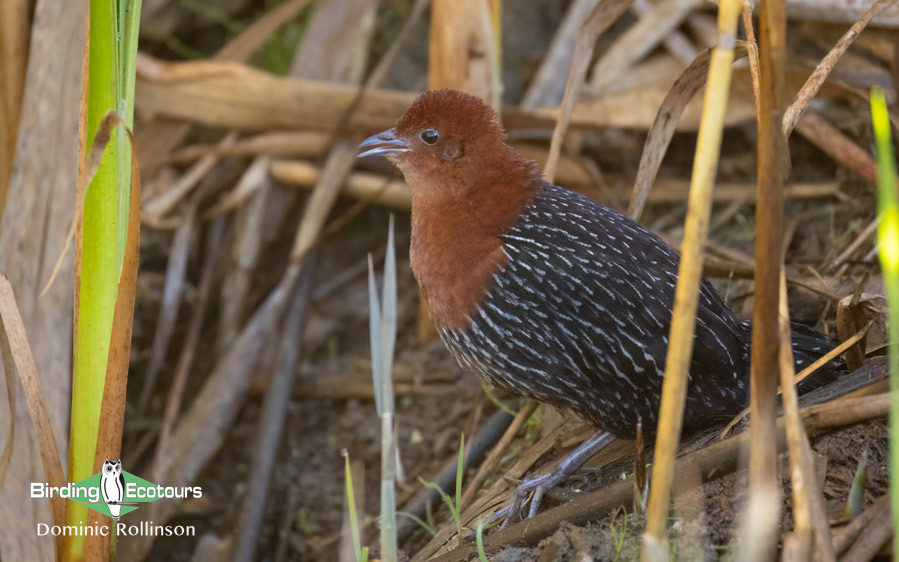
We couldn’t have asked for better views of Red-chested Flufftail along the Darling Hills Road.
We’d been checking local rare bird groups and in the last couple of days an Allen’s Gallinule had been discovered at Strandfontein Sewage Works outside of Cape Town. This was a lifer for Melanie, so we decided to head to Cape Town and look for the bird. We arrived in the late morning, not ideal timing for a rallid, and joined the group of twitchers watching the reedbeds waiting for the bird to emerge. Unfortunately, after a couple of hours of waiting we had to move on and make our way east. While waiting for the gallinule we did, however, see Fulvous Whistling Duck, Southern Pochard, Squacco Heron (another vagrant at the works) and Yellow-billed Egret, all of which were new trip birds.
It was then a long drive east through the wheat fields of the Overberg towards Grootvadersbosch Forest where we were based for the next two nights. We stopped in some fields outside of the forest where I had recently seen Quailfinch but despite a good search we could not find any of these tiny and tricky-to-see birds. After a long day out, we then checked into our accommodation and enjoyed a lovely home-cooked meal for dinner.
Day 15, 31st August 2026. Grootvadersbosch Forest birding
Knysna Woodpecker, Knysna Warbler and Forest Buzzard were our big targets for the morning and by the late morning we had found all three, with Knysna Warbler only showing briefly (typical with this species) and Melanie doing well to spot the Forest Buzzards. Another big bonus was getting good looks at Tambourine Dove, a bird which can be tough to see well, as they are normally only seen shooting through the trees and occur at low densities in the area. While birding the forest for the morning we also had fantastic looks at a group of feeding Cape Siskins and Forest Canaries and further added Brimstone Canary, African Olive Pigeon, Lemon Dove, Cape Batis, Blue-mantled Crested Flycatcher, Yellow-throated Woodland Warbler, Greater Double-collared Sunbird and Streaky-headed Seedeater to our already impressive trip list. In the mountain fynbos on the edge of the forest we had excellent looks at the skulking Victorin’s Warbler and much improved our views of Verreaux’s Eagle as a pair flew overhead. A female Southern Bushbuck was a pleasant surprise as we drove along the edge of the forest.
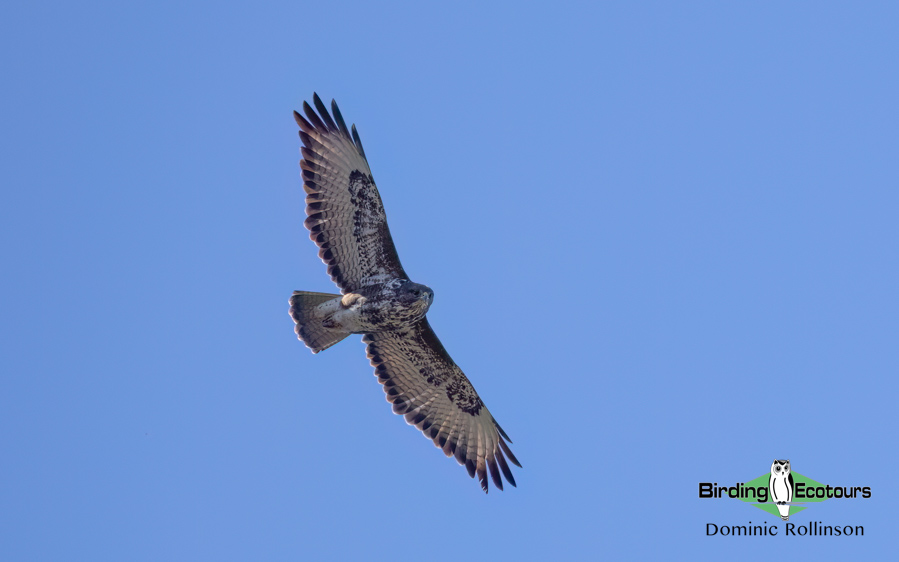
Forest Buzzard as seen above Grootvadersbosch Forest.
We then headed back to the farm for a lovely sit-down breakfast and then again tried the same fields as the previous day for Quailfinch, which again eluded us. With our forest targets in the bag we took some time off over lunch and then decided to head to Bontebok National Park near Swellendam in the hopes of finding Quailfinch. We spent a good few hours driving the reserve’s various roads but still could not find the Quailfinches, we did however, have some good birding here and found Denham’s Bustard, Hamerkop, African Fish Eagle, Yellow Bishop and Cape Longclaw. On our drive through the park we came across a few good mammals including Bontebok and (Cape) Mountain Zebra.
Another late-afternoon walk through the same fields in the hopes of finding Quailfinch still did not produce the goods, and we concluded that the birds must have moved on from the area. As a consolation prize, we did see a pair of Rhebok in the fields here.
That evening we birded the stand of Eucalyptus trees near our accommodation where we had good looks at Fiery-necked Nightjar and African Wood Owl. A great way to end another highly productive day of birding.
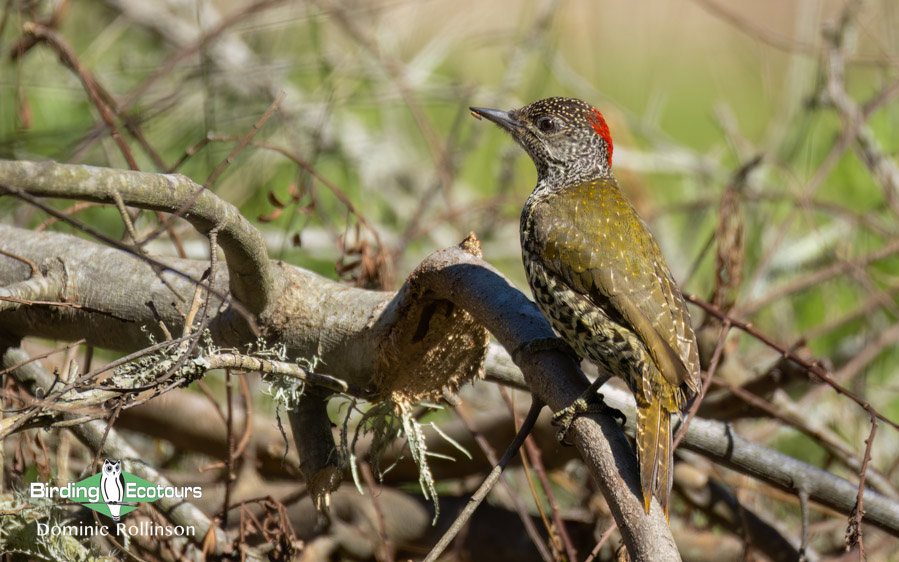
Knysna Woodpecker was another one of our targets at Grootvadersbosch Forest.
Day 16, 1st September 2026. Overberg birding and transfer to Cape Town
In a last-ditch effort to find Quailfinch, we birded the farmlands around Elim but unfortunately our target still eluded us, and we decided it was time to give up on this one. We did, however, have some lovely birding in the area and had great looks at Cape Clapper Lark and Cape Long-billed Lark, both of which were formerly considered separate species. We then birded the edge of a wetland which saw us add Glossy Ibis, White-faced Whistling Duck, African Spoonbill and many Blue Cranes in the surrounding fields.
Next up was Sandberg Fynbos Reserve where we hoped to find the rare Fynbos Buttonquail. We walked the area for a while but eventually gave up as our chances of finding the bird with just two of us were slim. We did enjoy seeing several Denham’s Bustards in the area though.
Heading west, we went through the small town of Betty’s Bay where we stopped to enjoy the comical African Penguins. We then popped into Rooi Els where Cape Rockjumper showed very well for us with a male bird seen foraging low down close to the road as well as a few Cape Siskins in the area. We also enjoyed seeing a few showy Cape Sugarbirds, another important Cape endemic.
We then headed to our accommodation in Cape Town and checked in in the late afternoon after a busy couple of days birding in the Overberg.
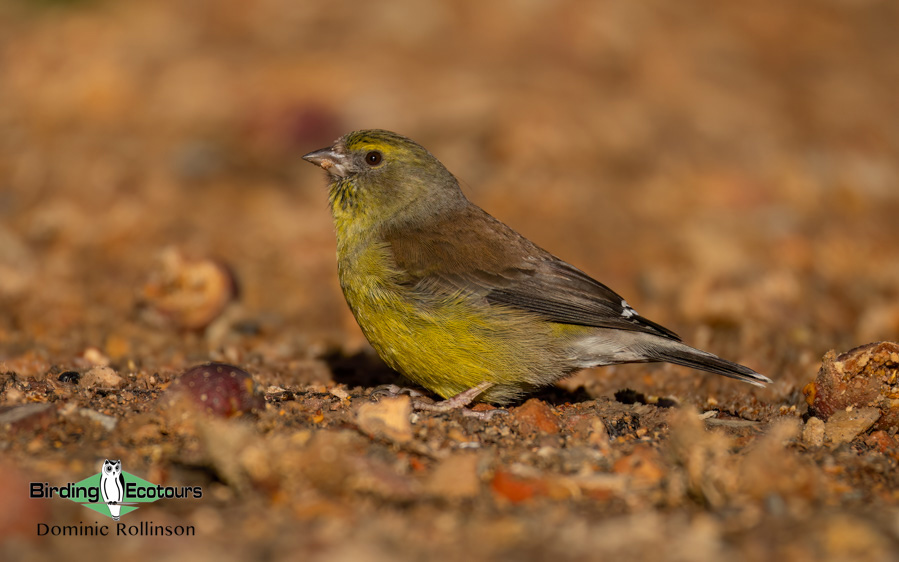
Cape Siskins were seen a couple of times on the tour, including this exceptional sighting on the edge of Grootvadersbosch Forest.
Day 17, 2nd September 2026. Cape Town birding
After a brief disappearance, the Allen’s Gallinule had been rediscovered the previous day and so we headed back to Strandfontein Sewage Works and were there at dawn. We were the only birders on site until a friend arrived a bit later and spaced ourselves out scanning the reeds. After a while I got a call from my friend to say he could see the Allen’s Gallinule and so we moved across and soon saw the bird and watched it as it quietly fed in the reeds, constantly getting harassed by Common Moorhens. We also saw African Swamphen while birding at the sewage works which was a surprisingly late addition to our trip list.
After our early success we headed into the city to a site where I have had good success with Brown-backed Honeybird. It took a while, but we eventually had great looks at a single Brown-backed Honeybird which was to be Melanie’s final lifer of the trip. Here, we also added African Black Swift, African Harrier-Hawk, Black Sparrowhawk, Amethyst Sunbird and Southern Boubou.
With all our Cape Town target birds already seen, we decided we would visit a few tourist attractions for the day (always keeping an eye out for birds along the way) and I dropped Melanie at the base of Table Mountain for her to enjoy the cable car up. It was a fine spring’s morning in Cape Town and Melanie had great views over the city and beyond. While up the mountain Melanie photographed a Black Girdled Lizard which is endemic to the Cape Peninsula.
I then picked up Melanie and we headed for an enjoyable sit-down lunch (a rarity on this tour) at Kirstenbosch Botanical Garden. After our lunch, we took a walk around the picturesque garden and enjoyed some great birding. Highlights from our couple of hours wandering around the garden included Cape Spurfowl, Brown-backed Honeybird (of course, we were to see them again without even targeting them), Olive Woodpecker, Sombre Greenbul, Southern Double-collared Sunbird, Bronze Mannikin and Swee Waxbill. We then headed to a nearby forest patch on the eastern slopes of Table Mountain where we easily found a Eurasian Chaffinch, an introduced species to the Cape Town area.
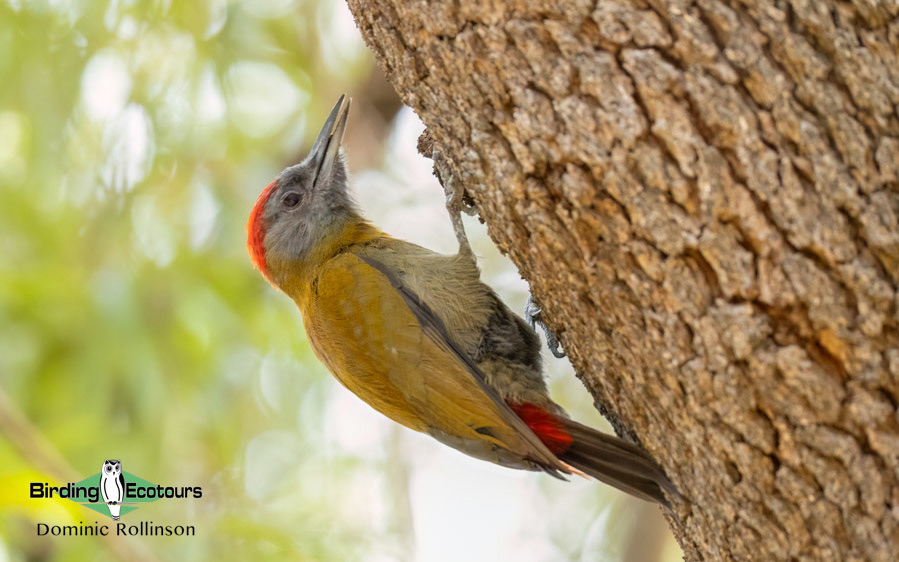
The cooperative male Olive Woodpecker was seen in Kirstenbosch.
Before we headed out for dinner that evening at the V&A Waterfront, we popped into Greenpoint Park where we easily found Black-crowned Night Heron and Water Thick-knee, another two birds for the trip list. We also enjoyed a pleasant walk along the Sea Point promenade as the sun was setting. After an excellent seafood dinner we returned to our hotel for the final night of the tour.
Day 18, 3rd September 2026. Cape Town birding and tour conclusion
For the final day of the tour we headed to Rondevlei Nature Reserve where we enjoyed a pleasant walk along the reserve’s trail visiting several of the bird hides as we went. Some of our top birds here included White-backed Duck, Southern Pochard, Great Crested Grebe, African Marsh Harrier, Malachite Kingfisher and Greater Striped Swallow.
We then made our way south along the Cape Peninsula enjoying Chapman’s Peak Drive as we went. A quick sea watch at Kommetjie yielded a few White-chinned Petrels and Sooty Shearwaters but not too much else.
Arriving at Cape Point, the weather had closed in, and the winds were now incredibly strong and so we were mostly limited to birding and sightseeing from the car. We watched the Afro-Australian Fur Seals on the rocks at Cape of Good Hope while sheltering from the wind. We then saw a few Bontebok and Common Eland throughout the reserve as well as a couple of Plain-backed Pipits that were seemingly hanging on for dear life in the ferocious wind.
I then dropped Melanie in Simon’s Town, where she was based for the next few nights, which concluded another highly enjoyable and productive birding tour. We excitedly chatted about our next planned birding tour together – bring on India 2028!
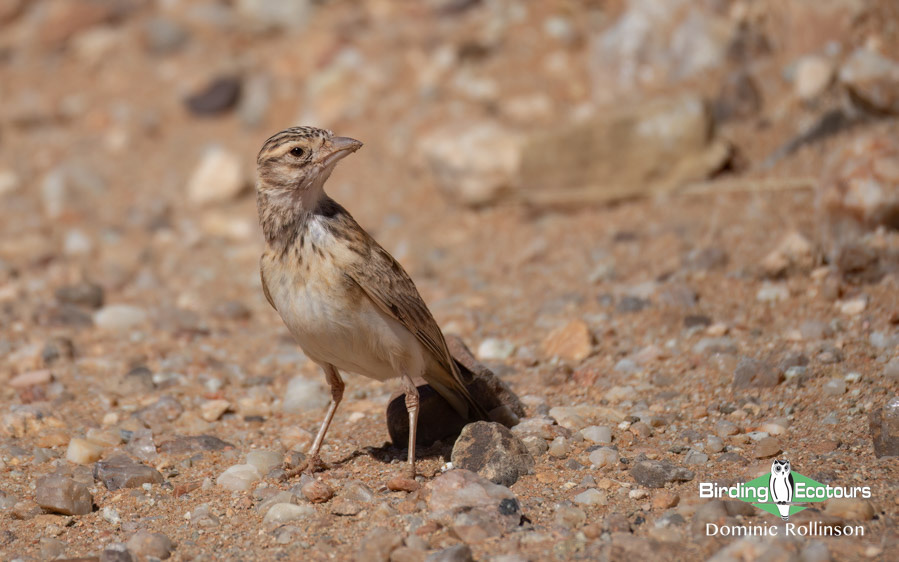
This Stark’s Lark was seen in the Northern Cape – one of 17 lark species we saw on this tour.
Bird List – Following IOC Version 15.2 (April 2026)
Birds ‘heard only’ are marked with (H) after the common name, all other species were seen.
The following notation after species names is used to show conservation status following the IUCN Red List: CR = Critically Endangered, EN = Endangered, VU = Vulnerable.
| Common name | Scientific name |
| Ostriches (Struthionidae) | |
| Common Ostrich | Struthio camelus |
| Ducks, Geese, Swans (Anatidae) | |
| White-faced Whistling Duck | Dendrocygna viduata |
| Fulvous Whistling Duck | Dendrocygna bicolor |
| White-backed Duck | Thalassornis leuconotus |
| Spur-winged Goose | Plectropterus gambensis |
| Egyptian Goose | Alopochen aegyptiaca |
| South African Shelduck | Tadorna cana |
| Blue-billed Teal | Spatula hottentota |
| Cape Shoveler | Spatula smithii |
| African Black Duck | Anas sparsa |
| Yellow-billed Duck | Anas undulata |
| Cape Teal | Anas capensis |
| Red-billed Teal | Anas erythrorhyncha |
| Southern Pochard | Netta erythrophthalma |
| Maccoa Duck – EN | Oxyura maccoa |
| Guineafowl (Numididae) | |
| Helmeted Guineafowl | Numida meleagris |
| Pheasants & Allies (Phasianidae) | |
| Grey-winged Francolin | Scleroptila afra |
| Common Quail | Coturnix coturnix |
| Red-billed Spurfowl | Pternistis adspersus |
| Red-necked Spurfowl (H) | Pternistis afer |
| Cape Spurfowl | Pternistis capensis |
| Nightjars (Caprimulgidae) | |
| Fiery-necked Nightjar | Caprimulgus pectoralis |
| Freckled Nightjar | Caprimulgus tristigma |
| Swifts (Apodidae) | |
| African Palm Swift | Cypsiurus parvus |
| Alpine Swift | Tachymarptis melba |
| African Black Swift | Apus barbatus |
| Bradfield’s Swift | Apus bradfieldi |
| Little Swift | Apus affinis |
| White-rumped Swift | Apus caffer |
| Bustards (Otididae) | |
| Kori Bustard | Ardeotis kori |
| Ludwig’s Bustard – EN | Neotis ludwigii |
| Denham’s Bustard | Neotis denhami |
| Karoo Korhaan | Heterotetrax vigorsii |
| Red-crested Korhaan | Lophotis ruficrista |
| Southern Black Korhaan – VU | Afrotis afra |
| Northern Black Korhaan | Afrotis afraoides |
| Cuckoos (Cuculidae) | |
| Klaas’s Cuckoo | Chrysococcyx klaas |
| Sandgrouse (Pteroclidae) | |
| Namaqua Sandgrouse | Pterocles namaqua |
| Burchell’s Sandgrouse | Pterocles burchelli |
| Pigeons, Doves (Columbidae) | |
| Rock Dove | Columba livia |
| Speckled Pigeon | Columba guinea |
| African Olive Pigeon | Columba arquatrix |
| Lemon Dove | Columba larvata |
| Red-eyed Dove | Streptopelia semitorquata |
| Ring-necked Dove | Streptopelia capicola |
| Laughing Dove | Spilopelia senegalensis |
| Tambourine Dove | Turtur tympanistria |
| Namaqua Dove | Oena capensis |
| Flufftails & Forest Rails (Sarothruridae) | |
| Red-chested Flufftail | Sarothrura rufa |
| Rails, Crakes & Coots (Rallidae) | |
| African Rail | Rallus caerulescens |
| Common Moorhen | Gallinula chloropus |
| Red-knobbed Coot | Fulica cristata |
| Allen’s Gallinule | Porphyrio alleni |
| African Swamphen | Porphyrio madagascariensis |
| Black Crake | Zapornia flavirostra |
| Cranes (Gruidae) | |
| Blue Crane – VU | Grus paradisea |
| Grebes (Podicipedidae) | |
| Little Grebe | Tachybaptus ruficollis |
| Great Crested Grebe | Podiceps cristatus |
| Black-necked Grebe | Podiceps nigricollis |
| Flamingos (Phoenicopteridae) | |
| Greater Flamingo | Phoenicopterus roseus |
| Stone-curlews, Thick-knees (Burhinidae) | |
| Spotted Thick-knee | Burhinus capensis |
| Water Thick-knee | Burhinus vermiculatus |
| Oystercatchers (Haematopodidae) | |
| African Oystercatcher | Haematopus moquini |
| Eurasian Oystercatcher | Haematopus ostralegus |
| Stilts, Avocets (Recurvirostridae) | |
| Black-winged Stilt | Himantopus himantopus |
| Pied Avocet | Recurvirostra avosetta |
| Plovers (Charadriidae) | |
| Grey Plover – VU | Pluvialis squatarola |
| Common Ringed Plover | Charadrius hiaticula |
| Three-banded Plover | Charadrius tricollaris |
| Blacksmith Lapwing | Vanellus armatus |
| Crowned Lapwing | Vanellus coronatus |
| Kittlitz’s Plover | Anarhynchus pecuarius |
| Chestnut-banded Plover | Anarhynchus pallidus |
| White-fronted Plover | Anarhynchus marginatus |
| Sandpipers, Snipes (Scolopacidae) | |
| Eurasian Whimbrel | Numenius phaeopus |
| Bar-tailed Godwit | Limosa lapponica |
| Red-necked Phalarope | Phalaropus lobatus |
| Common Sandpiper | Actitis hypoleucos |
| Common Greenshank | Tringa nebularia |
| Ruddy Turnstone | Arenaria interpres |
| Curlew Sandpiper – VU | Calidris ferruginea |
| Little Stint | Calidris minuta |
| Coursers, Pratincoles (Glareolidae) | |
| Double-banded Courser | Rhinoptilus africanus |
| Burchell’s Courser | Cursorius rufus |
| Gulls, Terns, Skimmers (Laridae) | |
| Caspian Tern | Hydroprogne caspia |
| Antarctic Tern | Sterna vittata |
| Common Tern | Sterna hirundo |
| Sandwich Tern | Thalasseus sandvicensis |
| Greater Crested Tern | Thalasseus bergii |
| Grey-headed Gull | Chroicocephalus cirrocephalus |
| Hartlaub’s Gull | Chroicocephalus hartlaubii |
| Kelp Gull | Larus dominicanus |
| Penguins (Spheniscidae) | |
| African Penguin – CR | Spheniscus demersus |
| Petrels, Shearwaters, Diving Petrels (Procellariidae) | |
| White-chinned Petrel – VU | Procellaria aequinoctialis |
| Sooty Shearwater | Ardenna grisea |
| Gannets, Boobies (Sulidae) | |
| Cape Gannet – EN | Morus capensis |
| Australasian Gannet | Morus serrator |
| Anhingas, Darters (Anhingidae) | |
| African Darter | Anhinga rufa |
| Cormorants, Shags (Phalacrocoracidae) | |
| Reed Cormorant | Microcarbo africanus |
| Crowned Cormorant | Microcarbo coronatus |
| Bank Cormorant – EN | Phalacrocorax neglectus |
| Cape Cormorant – EN | Phalacrocorax capensis |
| Great Cormorant | Phalacrocorax carbo |
| Ibises, Spoonbills (Threskiornithidae) | |
| African Sacred Ibis | Threskiornis aethiopicus |
| Hadada Ibis | Bostrychia hagedash |
| Glossy Ibis | Plegadis falcinellus |
| African Spoonbill | Platalea alba |
| Herons, Bitterns (Ardeidae) | |
| Black-crowned Night Heron | Nycticorax nycticorax |
| Little Egret | Egretta garzetta |
| Squacco Heron | Ardeola ralloides |
| Yellow-billed Egret | Ardea brachyrhyncha |
| Western Cattle Egret | Ardea ibis |
| Grey Heron | Ardea cinerea |
| Black-headed Heron | Ardea melanocephala |
| Goliath Heron | Ardea goliath |
| Hamerkop (Scopidae) | |
| Hamerkop | Scopus umbretta |
| Pelicans (Pelecanidae) | |
| Great White Pelican | Pelecanus onocrotalus |
| Secretarybird (Sagittariidae) | |
| Secretarybird – EN | Sagittarius serpentarius |
| Kites, Hawks, Eagles (Accipitridae) | |
| Black-winged Kite | Elanus caeruleus |
| African Harrier-Hawk | Polyboroides typus |
| White-backed Vulture – CR | Gyps africanus |
| Bateleur – EN | Terathopius ecaudatus |
| Black-chested Snake Eagle | Circaetus pectoralis |
| Martial Eagle – EN | Polemaetus bellicosus |
| Booted Eagle | Hieraaetus pennatus |
| Tawny Eagle – VU | Aquila rapax |
| Verreaux’s Eagle | Aquila verreauxii |
| Gabar Goshawk | Micronisus gabar |
| Pale Chanting Goshawk | Melierax canorus |
| Rufous-breasted Sparrowhawk | Accipiter rufiventris |
| Black Sparrowhawk | Astur melanoleucus |
| Black Harrier – EN | Circus maurus |
| African Marsh Harrier | Circus ranivorus |
| Black Kite | Milvus migrans |
| African Fish Eagle | Icthyophaga vocifer |
| Jackal Buzzard | Buteo rufofuscus |
| Forest Buzzard | Buteo trizonatus |
| Owls (Strigidae) | |
| Pearl-spotted Owlet | Glaucidium perlatum |
| Southern White-faced Owl | Ptilopsis granti |
| Marsh Owl | Asio capensis |
| Cape Eagle-Owl | Bubo capensis |
| Spotted Eagle-Owl | Bubo africanus |
| African Wood Owl | Strix woodfordii |
| Mousebirds (Coliidae) | |
| Speckled Mousebird | Colius striatus |
| White-backed Mousebird | Colius colius |
| Red-faced Mousebird | Urocolius indicus |
| Hoopoes (Upupidae) | |
| Eurasian Hoopoe | Upupa epops |
| Wood Hoopoes (Phoeniculidae) | |
| Common Scimitarbill | Rhinopomastus cyanomelas |
| Hornbills (Bucerotidae) | |
| Southern Yellow-billed Hornbill | Tockus leucomelas |
| African Grey Hornbill | Lophoceros nasutus |
| Rollers (Coraciidae) | |
| Purple Roller | Coracias naevius |
| Lilac-breasted Roller | Coracias caudatus |
| Kingfishers (Alcedinidae) | |
| Malachite Kingfisher | Corythornis cristatus |
| Pied Kingfisher | Ceryle rudis |
| Bee-eaters (Meropidae) | |
| Swallow-tailed Bee-eater | Merops hirundineus |
| White-fronted Bee-eater | Merops bullockoides |
| African Barbets (Lybiidae) | |
| Crested Barbet | Trachyphonus vaillantii |
| Acacia Pied Barbet | Tricholaema leucomelas |
| Honeyguides (Indicatoridae) | |
| Brown-backed Honeybird | Prodotiscus regulus |
| Lesser Honeyguide | Indicator minor |
| Woodpeckers (Picidae) | |
| Golden-tailed Woodpecker | Campethera abingoni |
| Knysna Woodpecker | Campethera notata |
| Cardinal Woodpecker | Dendropicos fuscescens |
| Olive Woodpecker | Dendropicos griseocephalus |
| Caracaras, Falcons (Falconidae) | |
| Pygmy Falcon | Polihierax semitorquatus |
| Rock Kestrel | Falco rupicolus |
| Greater Kestrel | Falco rupicoloides |
| Red-necked Falcon | Falco chicquera |
| Lanner Falcon | Falco biarmicus |
| Peregrine Falcon | Falco peregrinus |
| Old World Parrots (Psittaculidae) | |
| Rosy-faced Lovebird | Agapornis roseicollis |
| Wattle-eyes, Batises (Platysteiridae) | |
| Cape Batis | Batis capensis |
| Pririt Batis | Batis pririt |
| Bushshrikes (Malaconotidae) | |
| Bokmakierie | Telophorus zeylonus |
| Olive Bushshrike (H) | Chlorophoneus olivaceus |
| Southern Boubou | Laniarius ferrugineus |
| Crimson-breasted Shrike | Laniarius atrococcineus |
| Brubru | Nilaus afer |
| Drongos (Dicruridae) | |
| Fork-tailed Drongo | Dicrurus adsimilis |
| Monarchs (Monarchidae) | |
| Blue-mantled Crested Flycatcher | Trochocercus cyanomelas |
| Shrikes (Laniidae) | |
| Southern Fiscal | Lanius collaris |
| Crows, Jays (Corvidae) | |
| House Crow | Corvus splendens |
| Cape Crow | Corvus capensis |
| Pied Crow | Corvus albus |
| White-necked Raven | Corvus albicollis |
| Rockjumpers (Chaetopidae) | |
| Cape Rockjumper | Chaetops frenatus |
| Fairy Flycatchers (Stenostiridae) | |
| Fairy Flycatcher | Stenostira scita |
| Tits, Chickadees (Paridae) | |
| Ashy Tit | Melaniparus cinerascens |
| Grey Tit | Melaniparus afer |
| Penduline Tits (Remizidae) | |
| Cape Penduline Tit | Anthoscopus minutus |
| Larks (Alaudidae) | |
| Spike-heeled Lark | Chersomanes albofasciata |
| Karoo Long-billed Lark | Certhilauda subcoronata |
| Cape Long-billed Lark | Certhilauda curvirostris |
| Black-eared Sparrow-Lark | Eremopterix australis |
| Grey-backed Sparrow-Lark | Eremopterix verticalis |
| Sabota Lark | Calendulauda sabota |
| Fawn-colored Lark | Calendulauda africanoides |
| Karoo Lark | Calendulauda albescens |
| Red Lark – VU | Calendulauda burra |
| Dune Lark | Calendulauda erythrochlamys |
| Cape Clapper Lark | Corypha apiata |
| Eastern Clapper Lark | Corypha fasciolata |
| Sclater’s Lark | Spizocorys sclateri |
| Stark’s Lark | Spizocorys starki |
| Pink-billed Lark | Spizocorys conirostris |
| Large-billed Lark | Galerida magnirostris |
| Red-capped Lark | Calandrella cinerea |
| Bulbuls (Pycnonotidae) | |
| Terrestrial Brownbul | Phyllastrephus terrestris |
| Sombre Greenbul | Andropadus importunus |
| African Red-eyed Bulbul | Pycnonotus nigricans |
| Cape Bulbul | Pycnonotus capensis |
| Swallows, Martins (Hirundinidae) | |
| Black Saw-wing | Psalidoprocne pristoptera |
| Brown-throated Martin | Riparia paludicola |
| Large Rock Martin | Ptyonoprogne fuligula |
| Pearl-breasted Swallow | Hirundo dimidiata |
| White-throated Swallow | Hirundo albigularis |
| Greater Striped Swallow | Cecropis cucullata |
| Red-breasted Swallow | Cecropis semirufa |
| Crombecs, African Warblers (Macrosphenidae) | |
| Cape Grassbird | Sphenoeacus afer |
| Long-billed Crombec | Sylvietta rufescens |
| Victorin’s Warbler | Cryptillas victorini |
| Leaf Warblers (Phylloscopidae) | |
| Yellow-throated Woodland Warbler | Phylloscopus ruficapilla |
| Reed Warblers & Allies (Acrocephalidae) | |
| Lesser Swamp Warbler | Acrocephalus gracilirostris |
| Common Reed Warbler | Acrocephalus scirpaceus |
| Grassbirds & Allies (Locustellidae) | |
| Knysna Warbler – VU | Bradypterus sylvaticus |
| Little Rush Warbler | Bradypterus baboecala |
| Cisticolas & Allies (Cisticolidae) | |
| Grey-backed Cisticola | Cisticola subruficapilla |
| Levaillant’s Cisticola | Cisticola tinniens |
| Neddicky | Cisticola fulvicapilla |
| Zitting Cisticola | Cisticola juncidis |
| Desert Cisticola | Cisticola aridulus |
| Cloud Cisticola | Cisticola textrix |
| Black-chested Prinia | Prinia flavicans |
| Karoo Prinia | Prinia maculosa |
| Namaqua Warbler | Phragmacia substriata |
| Bar-throated Apalis | Apalis thoracica |
| Rufous-eared Warbler | Malcorus pectoralis |
| Cinnamon-breasted Warbler | Euryptila subcinnamomea |
| Yellow-bellied Eremomela | Eremomela icteropygialis |
| Karoo Eremomela | Eremomela gregalis |
| Sylviid Babblers (Sylviidae) | |
| Layard’s Warbler | Curruca layardi |
| Chestnut-vented Warbler | Curruca subcoerulea |
| White-eyes (Zosteropidae) | |
| Orange River White-eye | Zosterops pallidus |
| Cape White-eye | Zosterops virens |
| Laughingthrushes & Allies (Leiothrichidae) | |
| Southern Pied Babbler | Turdoides bicolor |
| Sugarbirds (Promeropidae) | |
| Cape Sugarbird | Promerops cafer |
| Starlings, Rhabdornises (Sturnidae) | |
| Common Myna | Acridotheres tristis |
| Common Starling | Sturnus vulgaris |
| Wattled Starling | Creatophora cinerea |
| Cape Starling | Lamprotornis nitens |
| Pied Starling | Lamprotornis bicolor |
| Red-winged Starling | Onychognathus morio |
| Pale-winged Starling | Onychognathus nabouroup |
| Oxpeckers (Buphagidae) | |
| Red-billed Oxpecker (H) | Buphagus erythrorynchus |
| Thrushes (Turdidae) | |
| Olive Thrush | Turdus olivaceus |
| Karoo Thrush | Turdus smithi |
| Chats, Old World Flycatchers (Muscicapidae) | |
| Karoo Scrub Robin | Tychaedon coryphoeus |
| Kalahari Scrub Robin | Cercotrichas paena |
| Chat Flycatcher | Agricola infuscatus |
| Fiscal Flycatcher | Sigelus silens |
| Marico Flycatcher | Bradornis mariquensis |
| African Dusky Flycatcher | Muscicapa adusta |
| Cape Robin-Chat | Dessonornis caffer |
| Cape Rock Thrush | Monticola rupestris |
| African Stonechat | Saxicola torquatus |
| Karoo Chat | Emarginata schlegelii |
| Tractrac Chat | Emarginata tractrac |
| Sickle-winged Chat | Emarginata sinuata |
| Ant-eating Chat | Myrmecocichla formicivora |
| Mountain Chat | Myrmecocichla monticola |
| Capped Wheatear | Oenanthe pileata |
| Familiar Chat | Oenanthe familiaris |
| Sunbirds (Nectariniidae) | |
| Orange-breasted Sunbird | Anthobaphes violacea |
| Amethyst Sunbird | Chalcomitra amethystina |
| Malachite Sunbird | Nectarinia famosa |
| Southern Double-collared Sunbird | Cinnyris chalybeus |
| Greater Double-collared Sunbird | Cinnyris afer |
| Dusky Sunbird | Cinnyris fuscus |
| Old World Sparrows, Snowfinches (Passeridae) | |
| Cape Sparrow | Passer melanurus |
| Southern Grey-headed Sparrow | Passer diffusus |
| House Sparrow | Passer domesticus |
| Weavers, Widowbirds (Ploceidae) | |
| Red-billed Buffalo Weaver | Bubalornis niger |
| White-browed Sparrow-Weaver | Plocepasser mahali |
| Sociable Weaver | Philetairus socius |
| Scaly-feathered Weaver | Sporopipes squamifrons |
| Cape Weaver | Ploceus capensis |
| Southern Masked Weaver | Ploceus velatus |
| Red-billed Quelea | Quelea quelea |
| Southern Red Bishop | Euplectes orix |
| Yellow Bishop | Euplectes capensis |
| Waxbills, Munias & Allies (Estrildidae) | |
| Bronze Mannikin | Spermestes cucullata |
| Swee Waxbill | Coccopygia melanotis |
| Black-faced Waxbill | Brunhilda erythronotos |
| Common Waxbill | Estrilda astrild |
| Red-headed Finch | Amadina erythrocephala |
| Violet-eared Waxbill | Granatina granatina |
| Green-winged Pytilia | Pytilia melba |
| Indigobirds, Whydahs (Viduidae) | |
| Pin-tailed Whydah | Vidua macroura |
| Shaft-tailed Whydah | Vidua regia |
| Wagtails, Pipits (Motacillidae) | |
| Cape Wagtail | Motacilla capensis |
| African Pied Wagtail | Motacilla aguimp |
| Cape Longclaw | Macronyx capensis |
| African Pipit | Anthus cinnamomeus |
| Nicholson’s Pipit | Anthus nicholsoni |
| Plain-backed Pipit | Anthus leucophrys |
| Finches, Euphonias (Fringillidae) | |
| Eurasian Chaffinch | Fringilla coelebs |
| Forest Canary | Crithagra scotops |
| Black-throated Canary | Crithagra atrogularis |
| Cape Siskin | Crithagra totta |
| Yellow Canary | Crithagra flaviventris |
| Brimstone Canary | Crithagra sulphurata |
| Streaky-headed Seedeater | Crithagra gularis |
| White-throated Canary | Crithagra albogularis |
| Protea Canary | Crithagra leucoptera |
| Cape Canary | Serinus canicollis |
| Black-headed Canary | Serinus alario |
| Buntings (Emberizidae) | |
| Lark-like Bunting | Emberiza impetuani |
| Cinnamon-breasted Bunting | Emberiza tahapisi |
| Cape Bunting | Emberiza capensis |
| Golden-breasted Bunting | Emberiza flaviventris |
| Species seen | 317 |
| Species heard only | 3 |
| Total species recorded | 320 |
Mammal List – Following Mammalwatching.com (November 2024)
The following notation after species names is used to show conservation status following the IUCN Red List: VU = Vulnerable.
| Common name | Scientific name |
| Hyraxes (Procaviidae) | |
| Rock Hyrax | Procavia capensis |
| Old World Monkeys (Cercopithecidae) | |
| Vervet Monkey | Chlorocebus pygerythrus |
| Chacma Baboon | Papio ursinus |
| Hares and Rabbits (Leporidae) | |
| Scrub Hare | Lepus saxatilis |
| Dassie Rats (Petromuridae) | |
| Noki | Petromus typicus |
| Squirrels (Sciuridae) | |
| South African Ground Squirrel | Geosciurus inauris |
| Old World Mice and Rats (Muridae) | |
| Four-striped Grass Rat | Rhabdomys pumilio |
| Brants’s Whistling Rat | Parotomys brantsii |
| Mustelids (Mustelidae) | |
| African Clawless Otter | Lutra capensis |
| Eared Seals (Otariidae) | |
| Afro-Australian Fur Seal | Arctocephalus pusillus |
| Canids (Canidae) | |
| Black-backed Jackal | Lupulella mesomelas |
| Bat-eared Fox | Otocyon megalotis |
| Felids (Felidae) | |
| Cheetah – VU | Acinonyx jubatus |
| African Wildcat | Felis lybica |
| Lion – VU | Panthera leo |
| Mongooses (Herpestidae) | |
| Yellow Mongoose | Cynictis penicillata |
| Cape Gray Mongoose | Herpestes pulverulentus |
| Common Slender Mongoose | Herpestes sanguineus |
| Meerkat | Suricata suricatta |
| Hyaenas (Hyaenidae) | |
| Spotted Hyena | Crocuta crocuta |
| Equines (Equidae) | |
| Mountain Zebra – VU | Equus zebra |
| Bovids (Bovidae) | |
| Hartebeest | Alcelaphus buselaphus |
| Blue Wildebeest | Connochaetes taurinus |
| Bontebok | Damaliscus pygargus |
| Springbok | Antidorcas marsupialis |
| Steenbok | Raphicerus campestris |
| Gemsbok | Oryx gazella |
| Klipspringer | Oreotragus oreotragus |
| Rhebok | Pelea capreolus |
| Common Eland | Tragelaphus oryx |
| Greater Kudu | Tragelaphus strepsiceros |
| Southern Bushbuck | Tragelaphus sylvaticus |
| Giraffes and Okapi (Giraffidae) | |
| Southern Giraffe – VU | Giraffa giraffa |
| Suids (Suidae) | |
| Common Warthog | Phacochoerus africanus |
| Species seen | 34 |
Reptile List – Following Reptiles of the World (October 2023)
| Common name | Scientific name |
| Vipers (Viperidae) | |
| Puff Adder | Bitis arietans |
| Girdle-tail Lizards (Cordylidae) | |
| Black Girdled Lizard | Cordylus niger |
| Broadley’s Flat Lizard | Platysaurus broadleyi |
| Skinks (Scincidae) | |
| Kalahari Tree Skink | Trachylepis spilogaster |
| Tortoises (Testudinidae) | |
| Angulate Tortoise | Chersina angulata |
| Species seen | 5 |
This is a sample trip report. Please email us ([email protected]) for more trip reports from this destination.