20 JANUARY – 3 FEBRUARY 2026
By Dylan Vasapolli
Overview
This South India tour which took place during January and February 2026 delivered an outstanding exploration of the Western Ghats and adjoining lowlands, combining high-quality endemic birding with a rich supporting cast of widespread Indian species and memorable mammal encounters. Beginning in Kochi, we made our way inland to Thattekad, before working progressively through Periyar, the highlands of Munnar and Eravikulam, the dry woodlands of Chinnar, the Nilgiri plateau around Ooty, and eventually on toward the mature open woodlands of Mudumalai. The tour covered a fine cross-section of habitats, from lowland riverine forest and evergreen foothill jungle to montane shola-grassland mosaics and dry deciduous woodland.
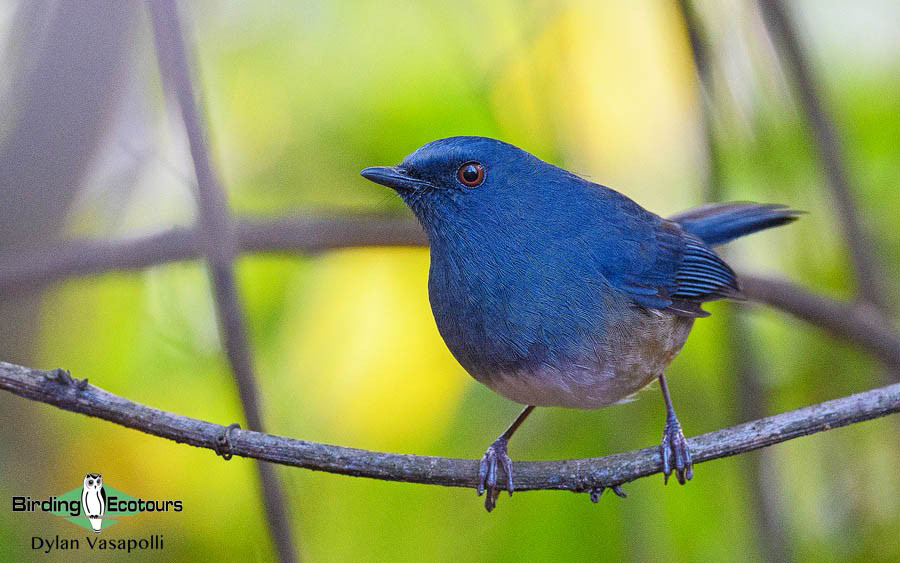
The ultra-localized Nilgiri Blue Robin (Sholakili) gave us exceptional views in the Ooty highlands, after a bit of work.
The tour ran mostly smoothly throughout, with logistics flowing well despite several longer transfer days and busy holiday traffic around Republic Day. Even where minor access changes occurred, these were taken in our stride and did not materially affect the birds seen. Importantly, the weather had no negative impact on the birding. While we encountered fog in the highlands and warm conditions in the lowlands, bird activity remained consistently good and allowed us to connect with nearly all of our major targets. The diversity of landscapes and consistency of sightings all combined to make this an exciting and highly successful journey through one of India’s most rewarding natural regions.
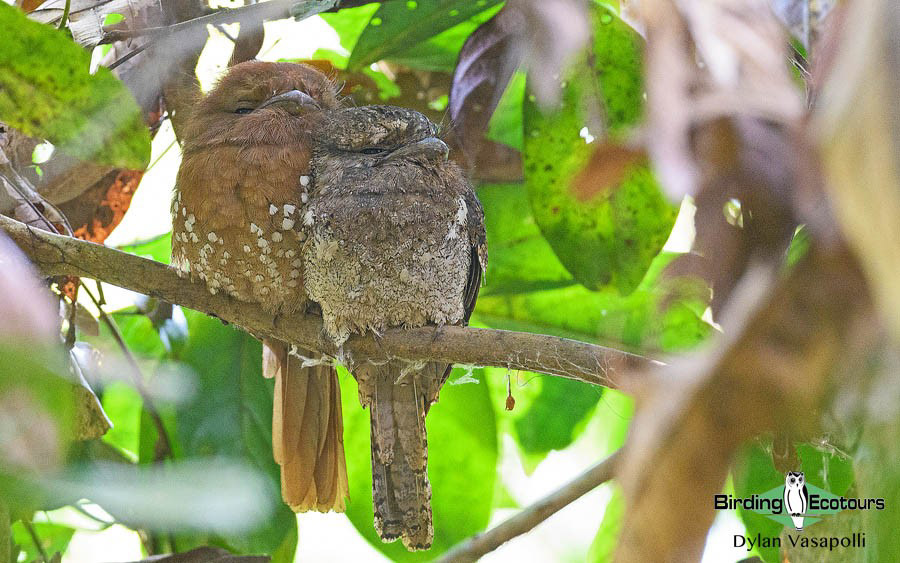
A pair of Sri Lanka Frogmouths perched quietly – these strange birds are a top tour target and showed well to us early on in the tour around Thattekad.
Our time spent in the Western Ghats yielded many of the range-restricted highlights that make this mountain chain one of Asia’s premier biodiversity hotspots, while the drier zones added a contrasting suite of species and habitats. Among the most significant avian highlights were Sri Lanka Frogmouth, Wayanad and Palani Laughingthrushes, Nilgiri Blue Robin, White-bellied Blue Robin, Black-and-orange Flycatcher, Nilgiri Wood Pigeon, Yellow-throated Bulbul, Malabar Trogon and Painted Bush Quail. Our nocturnal successes added further depth, while a strong supporting cast of hornbills, woodpeckers, parakeets, bee-eaters, cuckoos and forest passerines kept every day lively. Mammals added significantly to the experience. Most notably, we were thrilled with memorable encounters with three of India’s most sought-after large mammals: Sloth Bear, Dhole and Asian Elephant.
A detailed daily account can be read below, and the various species lists are located at the end of the report. You can also access our eBird trip report here.
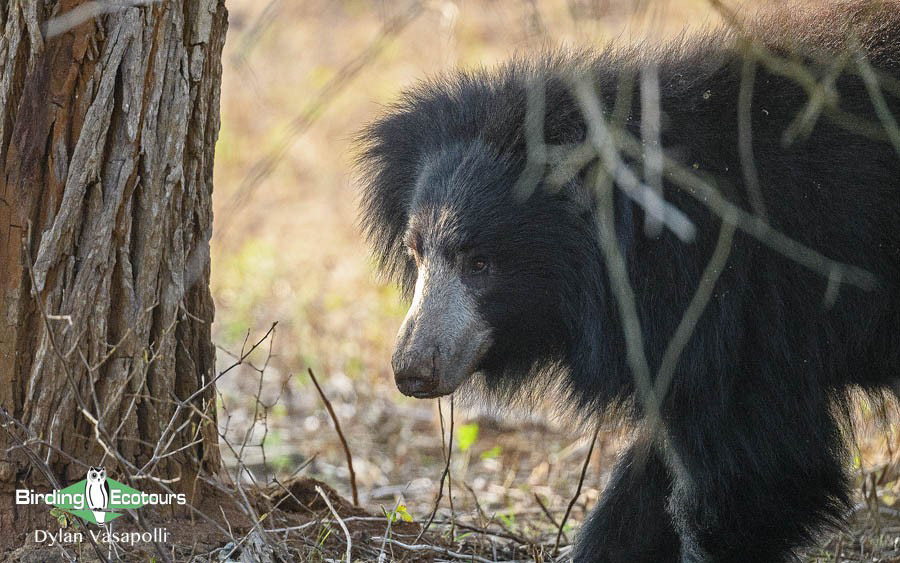
Mammals like this Sloth Bear were a welcome addition to the birding.
Detailed Report
Day 1, 21stJanuary 2026. Birding from Kochi to Thattekad
With the clients Patrick and Gilda having arrived into Kochi the previous evening, we started the day and trip off sedately with a leisurely breakfast. Following which, we loaded up and headed the short distance inland to Thattekad, where the birding would effectively start. A heat of the day stroll around the lovely wooded environs of our riverside camp gave us our first birds. The endemic (and ultra-common) White-cheeked Barbet was plentiful, and we also got acquainted with other common and widespread species like Whiskered Tern, Indian Pond Heron, Crested Serpent Eagle, Brahminy Kite, Bronzed Drongo, Rufous Treepie and Jungle Babbler.
Following lunch and a short break, we ventured out for our first proper birding spell – into some excellent nearby forest. We stepped out the car and barely moved for the next 30 minutes as bird after bird kept us busy. Early highlights went to the snazzy Malabar Starling and a fine Orange-headed Thrush, while a trio of owls was scarcely believable with multiple Jungle Owlets, a pair of roosting Brown Boobooks and a fiery-looking Brown Fish Owl all seen minutes apart. We were ecstatic with how things had started, and it simply continued. The localized Blue-winged (Malabar) Parakeet was seen, before we added further great birds like Heart-spotted Woodpecker, Malabar Grey Hornbill, Vernal Hanging Parrot, Black-hooded Oriole and Fork-tailed Drongo-Cuckoo. We ended off in a flurry with a stunning male Asian Fairy-bluebird, several of the long-tailed White-bellied Treepies and a massive Indian (Malabar) Giant Squirrel, while our Malabar Woodshrike views left us wanting a bit more. We eventually made it back to the car and loaded back up and continued to our owling site. We waited a short while for dusk to properly settle in, with the likes of Green Imperial Pigeon and more White-bellied Treepies keeping us company (along with several calling Indian Pittas that kept out of sight). A Spot-bellied Eagle-Owl began calling and only provided us with brief flight views as it moved through the giant trees, while nearby we found a perched Jerdon’s Nightjar which gave us stunning and walk-away views. We drove off to another site, where we found our last remaining target, Mottled Wood Owl, without too much difficulty. Continuing with the trend today, we had unbeatable views of these scarce birds and left them in peace and retired for our dinner.
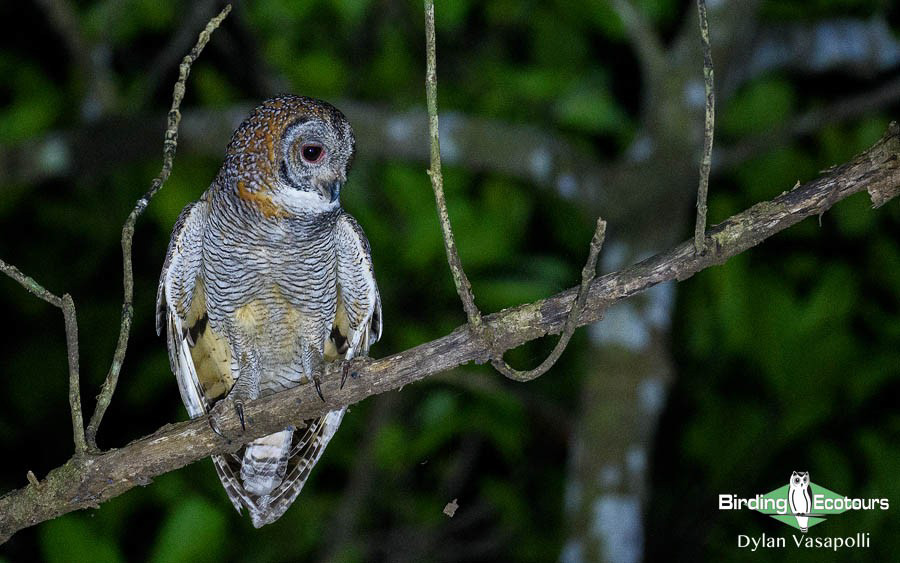
This excellent Mottled Wood Owl sighting rounded off an exciting first day of birding.
Day 2, 22nd January 2026. Full day of endemic birding around Thattekad
After an early-morning breakfast, we loaded up and headed on towards the Thattekad Bird Sanctuary, where we would spend the morning. Following on from where we left things yesterday, we had a quick-fire morning session with loads of birds around. The exposed snags were full of bright Malabar Barbets, while Grey-fronted Green Pigeons jostled for position. It took some patience but we eventually got onto the localized Malabar Imperial Pigeon, while also enjoying a perched Crested Goshawk. Several others that we had seen yesterday, like Malabar Grey Hornbill, Indian Golden Oriole and Asian Fairy-bluebird were also milling about. A small grouping of Flame-throated Bulbuls showed well, while overhead we picked up a single White-rumped Spinetail with a group of Indian Swiftlets. We then started exploring some of the vine thickets in the forest and in no time were face to face with an excellent pair of Sri Lanka Frogmouths. This is always a critical target for tours in the south of India, and we reveled in our views. We then struck gold finding another major target, when we picked up a male Malabar Trogon perched quietly in the sub-canopy. Some patience then resulted in us finding the female and we noticed she was busy excavating the nest cavity. We watched the female throw out some of the cavity wood, before they changed places and we watched the male do the same thing. What an excellent sighting! We eventually left them in peace as they tended to their nest and carried onwards. We enjoyed several bright Crimson-backed Sunbirds, including a female nest-building as well, along with some exciting activity which yielded the likes of Brown-capped Pygmy Woodpecker, Black-naped Monarch, Indian Paradise Flycatcher, Brown-cheeked Fulvetta, Malabar Woodshrike and Bar-winged Flycatcher-shrike, amongst others. Our local guide then set off to try and track down the notoriously tough Sri Lanka Bay Owl. Unfortunately, the known birds had seemingly abandoned their known stakeouts, and hadn’t been seen in some weeks, and we were unable to find any birds. A fine White-bellied Woodpecker however, put on an excellent display for us to keep us entertained.
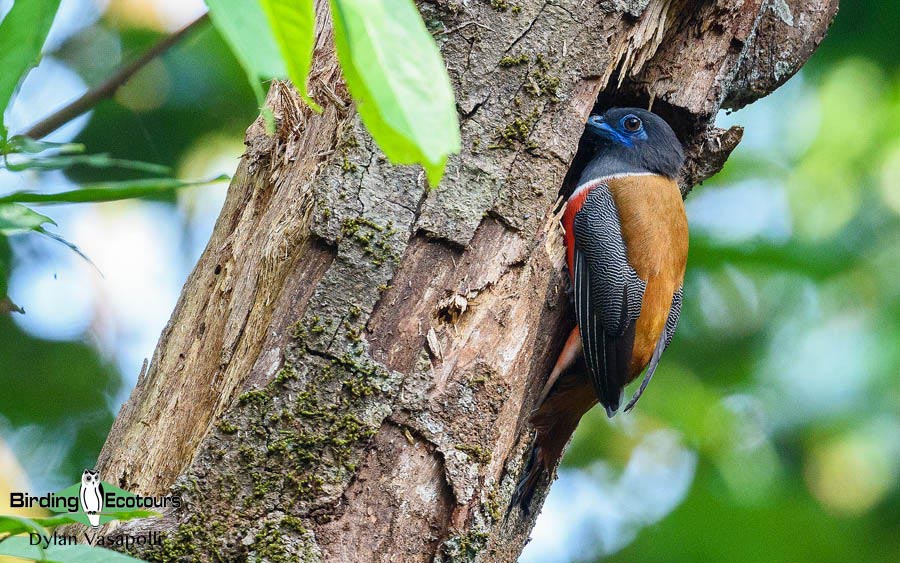
The male Malabar Trogon about to take a turn excavating the nest hole – the female having just completed her turn.
With our morning spent, we retired back to our lodge for a lunch break in the midday period. For our afternoon, we ventured to another site where we tried for some thicket species, like the tricky Grey-headed Bulbul. Despite a long search, we were unable to find any but did well with our first views of the endemic Grey Junglefowl and found an amazing pair of Indian Pittas that put on a wonderful show, perching at length and giving us all manner of views. A few more widespread species we were now familiar with kept us company, while we added delightful Asian Green Bee-eaters and our first Asian Woolly-necked Storks. We retired down to the river edge for dusk, watching a constant procession of egrets and the like commuting to their evening roosts. Just as it was getting dark, we picked up on some movement nearby and found a lovely Indian Scops Owl – one of our night-time targets. Just as if on cue, a Great Eared Nightjar began calling but, try as we might, we were unable to see this bird as it kept its distance from us. We eventually called it a night and retired back to our camp.
Day 3, 23rdJanuary 2026. Second full day of endemic birding around Thattekad
We had our now customary early breakfast, before heading off to start the day. This morning, we explored the network of trails stemming out from the main Thattekad Bird Sanctuary. We had done remarkably well for the birds already, and there weren’t too many critical targets still remaining for us, but we nonetheless enjoyed a good morning. Things started off with some familiar sights like White-bellied Treepie and a pair of Heart-spotted Woodpeckers, before we spent some time with three Malabar Trogons all showing well. We finally picked up on the call of Grey-headed Bulbul, one of our remaining targets, but they proved difficult to see, as is usual with this shy species. No matter what we did, we couldn’t get them into the open for long enough for us to properly see them and had to make do with very brief looks. Other birds kept us company with multiple Golden-fronted Leafbirds and Crimson-backed Sunbirds constantly vying for attention.
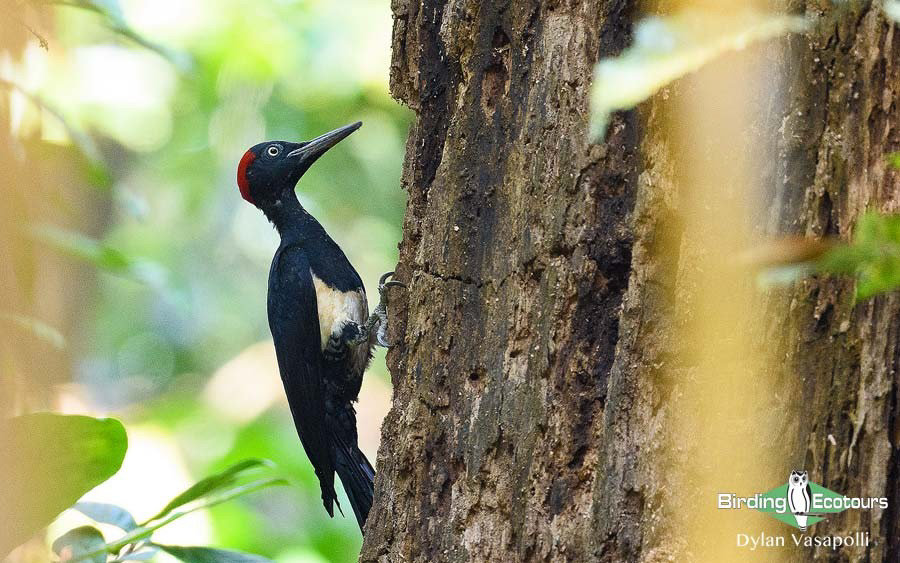
We enjoyed multiple excellent views of the large White-bellied Woodpecker.
We then set about looking for some other difficult birds like Black-backed Dwarf Kingfisher and Forest Wagtail, and almost immediately found a Forest Wagtail walking about in the leaflitter – but it didn’t hang around long and disappeared before everyone could see it. We carried on looking for quite some time, striking out on the kingfisher, before calling it here and moving to another site. We wanted to try again for another tough bird, Blue-eared Kingfisher, and spent a while working various sections of quiet forest streams, but alas, no kingfisher either. Yet more Malabar Trogons and a fine pair of White-bellied Woodpeckers were an admirable supporting cast. We retired for our midday lunch break, before resuming in the afternoon.
We spent the afternoon exploring a different segment of trails from where we had been in the morning, and bird activity was high despite the heat, helped by the numerous fruiting, seeding and flowering trees in the area. Although there was little new about, masses of drongos, orioles, treepies, parakeets, mynas, woodpeckers, bee-eaters, starlings and the like were about. We tried hard for Grey-headed Bulbul again but came up empty handed. As the day died down, we watched over the Periyar River enjoying large numbers of waterbirds commuting to their evening roosts, before an excellent Great Eared Nightjar put in an appearance and flew right over us, bringing an end to the day.
Day 4, 24thJanuary 2026. Transfer to Thekaddy and birding Periyar Tiger Reserve
Following our excellent success with virtually all of the lowland specials possible around Thattekad, we opted to have the morning off, meeting for a later breakfast before gathering our things and loading up. We had a bit of a drive to get down south to Thekaddy, on the edge of the Periyar Tiger Reserve. We arrived in time for lunch and had a quick rest at our comfortable hotel before meeting for our afternoon excursion into the park.
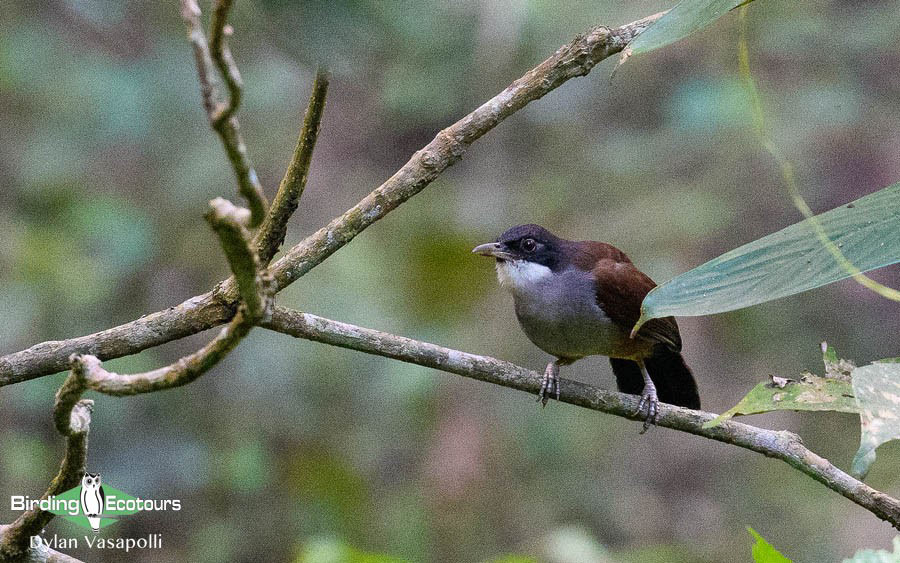
Wayanad Laughingthrush is a shy bird, and the main reason for venturing to Periyar.
We met up with our park ranger, donned our obligatory leech socks, and headed off into the stunning hills and forests of Periyar. We set off up a steep trail, picking up some of our familiar birds along the way, and continued for a while before reaching our set gulley. Here we set about trying to track down the ultra-difficult Wayanad Laughingthrush, and soon we were ushered over by our ranger who had picked up a pair. We got some fleeting glimpses, and set in for a bit of a wait, with a Rusty-tailed Flycatcher keeping us company. Eventually, the birds came back down, and gave us a much better look, albeit still very briefly, before melting back into the dense thickets on the steep slopes.
We paused at a large bird party nearby where the treetops were adorned with Nilgiri Flowerpeckers and Malabar Starlings, while multiple Malabar Flamebacks and a fine Rufous Woodpecker worked the trunks, and tiny Dark-fronted Babblers jumped through the low bushes. We also did well to pick up a Jungle Owlet well hidden in the tree, while we enjoyed our first Malabar Whistling Thrush and Indian Scimitar Babbler as well. We heard from another birding group of another group of laughingthrushes that was seen and opted to try for it as well. After a short walk, though steep as is typical of the area, we were in the zone, and in no time picked up on another group of Wayanad Laughingthrushes. The birds were fortunately headed downhill and progressively got closer to us, and into more open environs, and with some patience we were rewarded with the most incredible views of arguably one of the toughest Western Ghats endemics. The flock we were following kept swelling in size as more and more birds seemed to come out the thickets, and soon we had close to 30 birds jostling about in front of us. We could barely believe our good fortune and had a few excited high fives to celebrate.
While almost all of our attention was focused on the laughingthrushes, lots of other high-quality birds were present in the area, and we enjoyed a fine supporting cast of others like White-bellied Treepie, Malabar Parakeet, Malabar Woodshrike, Malabar Barbet, and others like another Rufous Woodpecker and Indian Scimitar Babbler. We eventually made our way out the reserve, with it having officially closed some 30 minutes ago already, but we were waved out with no hassles, and thanked our excellent park ranger for an unbeatable afternoon.
Day 5, 25thJanuary 2026. Full day in and around Periyar
Unfortunately, we were not allowed into the section of the park we had planned for the morning, frustratingly, and had to make do with birding the outskirts. We eventually managed to navigate our way to a marsh at the edge of the woodlands where we spent quite a while enjoying the many birds constantly around. Early highlights went to a showy Malabar Whistling Thrush, along with a few new birds like Tickell’s Blue Flycatcher and Common Iora. We then picked up on a fine Pin-tailed Snipe walking about the marshes and enjoyed it for a while. Another bird then materialized and we were thrilled when it walked out some more and showed itself in all its splendor – a Ruddy-breasted Crake! After that surprise we settled back in, watching the comings and goings of everything else, also picking up further new birds like Indian Cuckooshrike and Dusky Crag Martin, while enjoying many of the other Western Ghats specials we were accustomed to, like Malabar Barbet and Malabar Grey Hornbill. We opted for a leisurely afternoon, with no birding plans for the rest of the day.
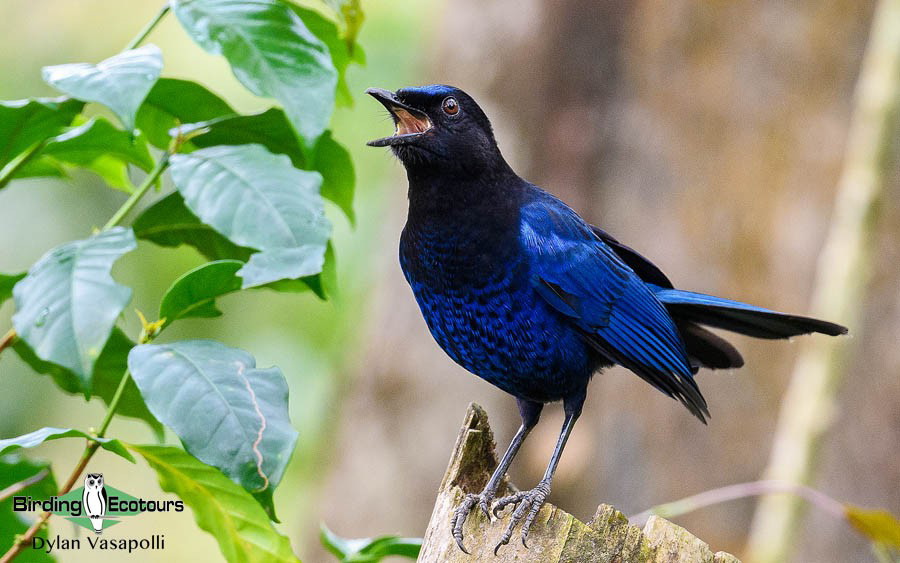
The beautiful Malabar Whistling Thrush is a common species in more montane areas.
Day 6, 26thJanuary 2026. Transfer to Munnar and birding the highland forests of Munnar
We were greeted by low fog as we made our way out from Periyar towards Munnar. The winding drive was quite slow as we were taking it easy with the thick fog for most of the journey. Right on cue for our planned stop at the Lockhart Gap, the fog cleared and we could see the sun and sky again. It was Republic Day, and the roads around here were heaving with people and cars, either/or milling about, dancing randomly and stopping at will – all adding to the chaos as is typical of India. We worked the area for a bit – coming up trumps with a fine Black Eagle overhead, while a stakeout of the rubbish pile gave us our first male Black-and-orange Flycatcher – a stunning endemic. We eventually pushed on to our comfortable guesthouse, where we checked in and had some rest over the midday period.
We reconvened in the afternoon, where some excellent birds kept us busy around the grounds with an excellent male Indian Blue Robin the standout species. We headed up to the Deshadan Resort, where a flowering coral tree pulled in a wide range of birds including numerous Indian White-eyes, Purple Sunbirds, Vernal Hanging Parrots and several bulbuls amongst others. A pair of Nilgiri Flycatchers were seen nearby and showed well, as did a magnificent soaring Bonelli’s Eagle. We worked some of the surrounding forest, which was a bit quiet to start off with. While enjoying some fidgety Square-tailed Bulbuls, a Nilgiri Wood Pigeon flew in and landed close by. We were able to track it down and enjoyed some great views of this somewhat unpredictable species. As if that wasn’t enough, we soon latched onto another mega target – White-bellied Blue Robin (Sholakili), which was feeding on some berries. The end of the day was simply filled with birds, as we had to pull ourselves away from this exciting bird, as our first Palani Laughingthrushes jumped into view and stole the attention. Here we also added others like Indian Black-lored Tit, Ashy Prinia and Common Rosefinch and masses of Alpine Swifts overhead, while other species regularly around included yet more Vernal Hanging Parrots, White-cheeked Barbet and some comical Velvet-fronted Nuthatches running on the road right up towards us. With the sun setting, we eventually retired back to our guesthouse, smiling from ear to ear after our superb afternoon!
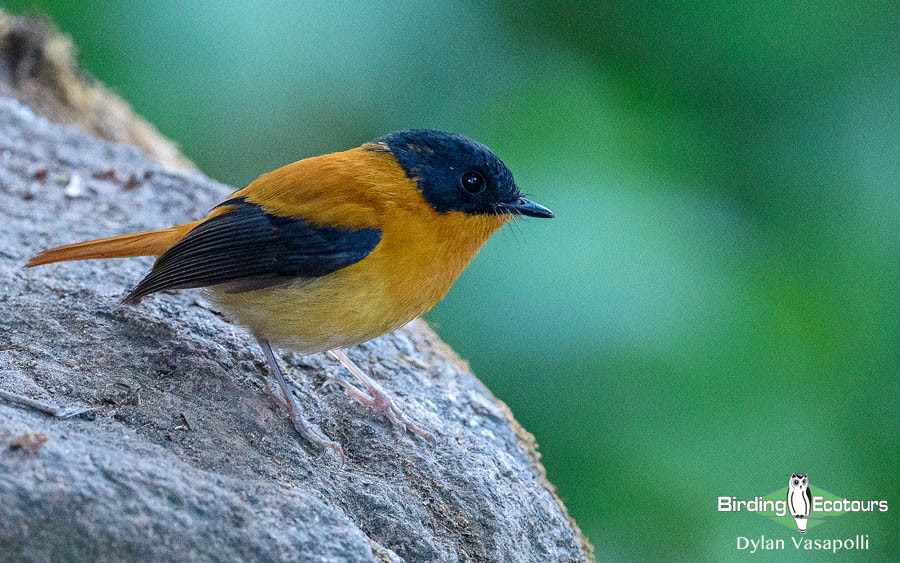
The endemic Black-and-orange Flycatcher is a stunning special of the Western Ghats.
Day 7, 27thJanuary 2026. Birding Eravikulum National Park, and surrounds
Sunrise found us out at our first birding stop, a short distance from our hotel. A few Palani Laughingthrushes were busy in the thickets, but little else was about in the cold. We added Long-tailed Shrike to our list, while a few Grey Wagtails energetically bounced along the road. We then moved on up towards Eravikulum National Park, where we enjoyed some good chai tea while we waited for the opening time. The nearby forests were birdy and gave us excellent views of Black-and-orange Flycatcher, Nigiri Flycatcher and a fine Nilgiri Wood Pigeon. Soon we were in and on the bus headed to the top, before the crowds descended on the place. Nilgiri Pipits were pretty showy, and we saw several birds on many occasions. We also spent some time watching Hill Swallows collecting mud for their nests at close range, while a troop of Nilgiri Langurs played in the trees. A close Nilgiri Tahr was also enjoyed. Aside from the regular species like Palani Laughingthrush, Indian Blackbird, Pied Bush Chat and both Greenish Warbler and Tickell’s Leaf Warbler, birding was tough. Painted Bush Quails frustrated us by calling close by for ages, but always out of sight in the thick brush. An excellent Large-scaled Pit Viper was a major highlight expertly found by our local guide. With the crowds starting to set in, we made our way back down the mountain, noting Black Eagle, Common Buzzard and Common Kestrel. Once we eventually got out the park, we unsuccessfully tried for Nilgiri Thrush at several nearby areas, before calling it a day and having a midday break back at our hotel.
We met up for a spell of late afternoon birding once more and headed out to try for Rufous Babbler nearby. A Common Hawk-Cuckoo showed as soon as we stepped out the car, and a short walk later, we found our hoped-for Rufous Babblers, with a small party showing well. We then headed into the forested mountains closer to our guesthouse, where we spent the rest of the day – though the birds were on the quiet side, and little of interest was about, aside from all the usual species.
Day 8, 28thJanuary 2026. Second full day for Munnar and surrounds birding
We had an early start once more as we tried for some of our missing species. Nilgiri Thrush played hard ball and went unseen, despite a few attempts at tracking it down. On the plus side, we found an extremely cooperative White-bellied Blue Robin (Sholakili), which gave us outstanding views. We also enjoyed more good birds like Palani Laughingthrush, Black-and-orange Flycatcher, Indian Black-lored Tit and Velvet-fronted Nuthatch, amongst other more common species. We then devoted our attention to finding Painted Bush Quail and sadly came up empty-handed once more. With the sun beating down, and bird activity having all but dried up, we called it for the morning and returned for a break. We opted for an afternoon break, allowing the group a bit of rest.
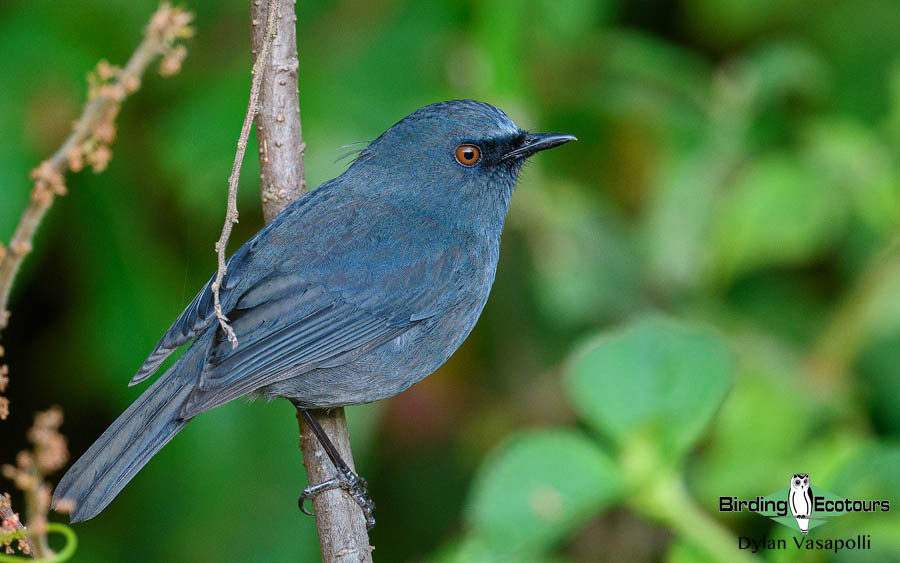
White-bellied Blue Robin (like the cover image species, Nilgiri Blue Robin) is another highly range-restricted species essentially confined to the wider Munnar area.
Day 9, 29thJanuary 2026. Chinnar Wildlife Sanctuary birding
We departed Munnar early on, as we made our way to the Chinnar Wildlife Sanctuary, where we would spend the day (and night). A few stops along the way gave us the likes of an excellent male Grey Junglefowl and others like Indian Blue Robin. We soon arrived into the mixed deciduous woodlands of Chinnar, excited for all the new birds that we could find. We wasted no time and almost immediately got onto our main target, Yellow-throated Bulbul. White-browed Bulbuls nearby gave us a good comparison, as we enjoyed a host of other new birds with Coppersmith Barbet, Small Minivet, White-bellied Drongo and a mixed party of White-rumped and Scaly-breasted Munias all showing well. Brown-headed Barbet, another target of the area, began calling, but proved a little trickier to find. Our persistence was eventually rewarded and we got some good views of a few birds. A fine Changeable Hawk-Eagle flying overhead was also enjoyed, along with others we had seen previously like Chestnut-headed Bee-eater, Thick-billed Flowerpecker and Purple Sunbird. At the headquarters, we sorted out the arrangements for our afternoon walk and then checked into our comfortable hotel nearby for a midday lunch break.
In the afternoon, we found ourselves down in the mixed woodlands in the company of our park ranger, as we set off on our walk through the reserve. Things were a bit quiet early on, as it was still pretty hot, but we enjoyed our first White-rumped Shamas and Tufted Grey Langurs. A calling Grey-headed Bulbul took a while to be coaxed from its thickets but showed well in the end (we had tried earlier on the trip around Thattekad). We also enjoyed repeat views of some of our new birds for today, with excellent Coppersmith Barbets showing well multiple times, along with White-bellied Drongo and Small Minivet. As it started cooling down, the bird activity increased dramatically, and we quickly started adding new birds with the likes of Indian Robin, Common Woodshrike, White-browed Fantail and the stunning Bay-backed Shrike. A fine Black Eagle passed right overhead, and as we made our way into a new area, quickly added Grey-bellied Cuckoo, Asian Green Bee-eater, comical Yellow-billed Babblers and a Yellow-crowned Woodpecker. Birds were coming in thick and fast, and before we knew it, we were up over 60 species for our afternoon walk. We eventually called it and made our way back to our hotel. We were distracted by many Indian Peafowls crossing the road, along with a massive Gaur.
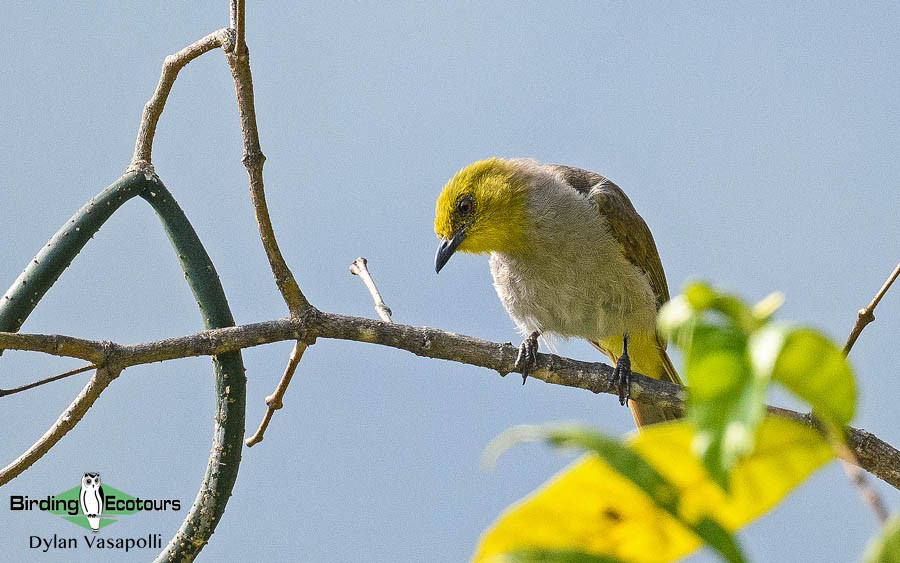
Yellow-throated Bulbul is another target along this routing.
Day 10, 30thJanuary 2026. Long drive to Ooty, and local birding
We were up and out the hotel early, as we had a long drive on the cards – making our way to the highlands of Ooty (though this would take more than half the day). An early highlight passing through the birdy Chinnar Wildlife Sanctuary was a stunning and close-up Blue-faced Malkoha. We made good progress, with a few stop-breaks every so often, and one at a productive wetland next to the road which was heaving with birds. In between the number of herons, egrets, sandpipers and ducks, we enjoyed our first Indian Spot-billed Ducks, along with fine Black-winged Stilts and comparative views between the similar Green and Wood Sandpipers. The edges held a few Western Yellow Wagtails and several flocks of Rosy Starlings, amongst the many more widespread and common waterbirds. Stops in the drier farmlands along the way produced our first Indian Roller and others like Large Grey Babbler. We eventually called into Ooty in time for a late lunch and short rest. Some local birding nearby in the late afternoon was excellent with the busy Doddabetta Peak area producing some of our much-wanted specials. Confiding Nilgiri Laughingthrushes showed easily, while the shy Nilgiri Blue Robin (Sholakili) gave us only the most fleeting of glimpses – we’d need to try again. A stakeout produced several pairs of the attractive Painted Bush Quails right on cue – and the one pair walked right up to us giving us unparalleled views! We rounded off the day by trying for the Nilgiri Blue Robin once more and were handsomely rewarded with fine views in the late afternoon light.
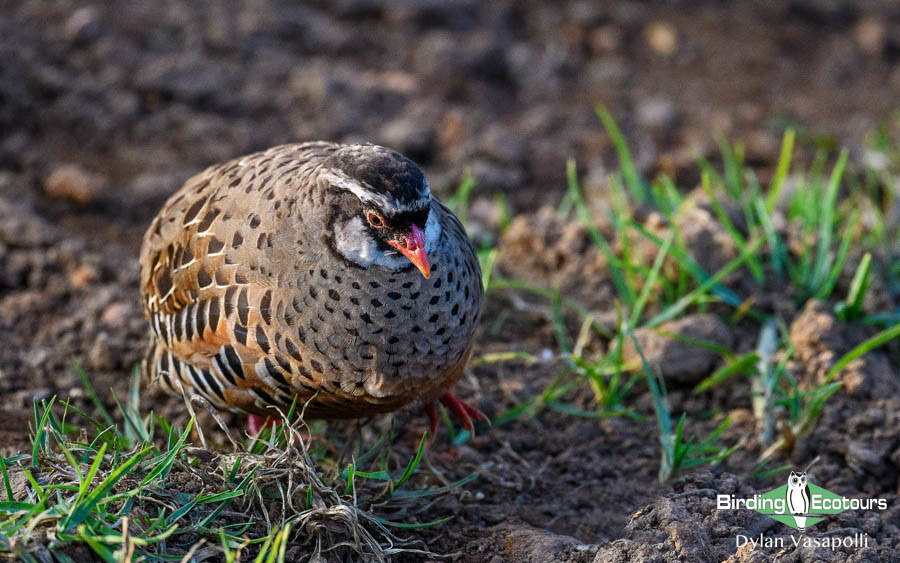
A male Painted Bush Quail strolled right past us near to Ooty.
Day 11, 31stJanuary 2026. Birding Ooty and transfer to Mudumalai Tiger Reserve
We met early in the morning once more and headed out to the local botanical gardens for a short walk. It was pretty chilly and activity was low. We hunted high and low for Kashmir Flycatcher for some time but sadly drew a blank. Little else of interest was around, and we eventually called it time and headed back to our hotel for breakfast and to checkout. Feeling a bit more sated, we headed to some nearby forests, where we patiently waited for the shy and regularly missed Nilgiri Thrush to hopefully put in an appearance. An early, but brief, sighting kept us excited, but local police soon came by and asked us to clear out as an important dignitary was coming through. We drove around a little bit to kill some time and were soon able to return to our spot, with it now opened. We didn’t have to wait long before Ajomon ushered us over to where the Nilgiri Thrush was feeding. It was deep in, and we had to take a short walk to all see it, but we got some good views of this mega bird, before it melted back into the undergrowth. We then undertook the long windy drive down to Mudumalai Tiger Reserve, where we were to spend the next two nights.
The road was heaving with traffic and was pretty slow going, but we eventually arrived in time for a late lunch. Following a short rest, we set out on an afternoon walk (followed by a drive). The birding was a bit slow, but we enjoyed watching some bright male Plum-headed Parakeets feeding, while a pair of stunning Indian Nuthatches worked the nearby limbs. A Jerdon’s Leafbird kept himself pretty well concealed for most of the time, and we also notched up our first Brahminy Starlings. A fruiting tree held masses of Coppersmith Barbets, but little else. We also enjoyed being almost constantly surrounded by beautiful Chital, abundant in the area. We then set off on our drive – restricted to the vehicle as we were in the Mudumalai Tiger Reserve. A large dam held a huge flock of Asian Woolly-necked Storks, along with a lone Painted Stork. We slowly drove through the dry scrubby woodlands and came to an abrupt halt when we spotted a Sloth Bear moving through. The animal eventually came right up next to the road and gave us all great views. Sadly though, word got out, and we (and the animal) were inundated with people and jeeps, and the animal’s distress became obvious, and we let it be as it retreated back into the scrub. We picked up a small group of Yellow-footed Green Pigeons sat in a tree and a close up White-browed Fantail was our last sighting before calling it a day.
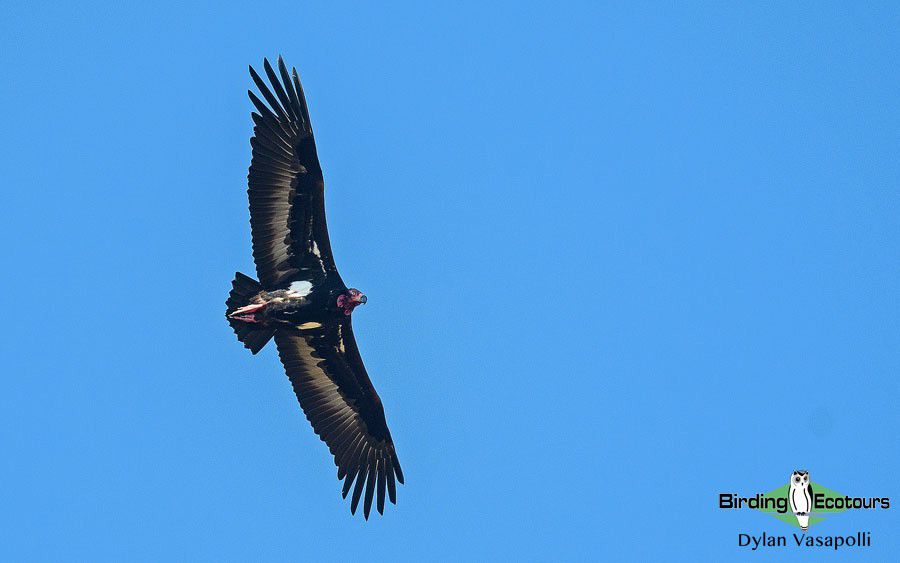
A fine Red-headed Vulture soared right over us. Mudumalai is excellent for many vultures.
Day 12, 1st February 2026. Full day birding Masinagudi and surrounds
Following our customary early breakfast, we set off with our local guide to target some of the area’s specials. First up were the dry rocky slopes of Temple Hill, where we quickly found our hoped-for Malabar Lark and enjoyed our first Blue Rock Thrush,as well as others like Indian Robin. Some distant movement caught our attention, and we could hardly believe it when it morphed into a Dhole (Asian Wild Dog). In no time, there were three Dholes running around, territory marking and being a bit playful – all the more exhilarating with us being on foot, though the animals kept well clear of us. We watched them for a time, taking in this great sighting, before carrying on with our birding walk. A few Yellow-wattled Lapwings were seen in some open areas, as were a pair of Grey Francolins. Gilda flushed up a nightjar as we walked, and we tracked where it landed, and enjoyed some great looks at an Indian Nightjar. We tried a different spot for White-naped Woodpecker, but this gave us the run-around and we couldn’t find one during the course of the morning. The birding was generally excellent and there were always birds to keep us company, with quite a few new trips and a host of others we were well-familiar with now. A pair of Yellow-eyed Babblers perched up in some dense thickets, while a Pale-billed Flowerpecker sat exposed in the open for a while. We did well to track down another roosting nightjar – this time a fine Jungle Nightjar.
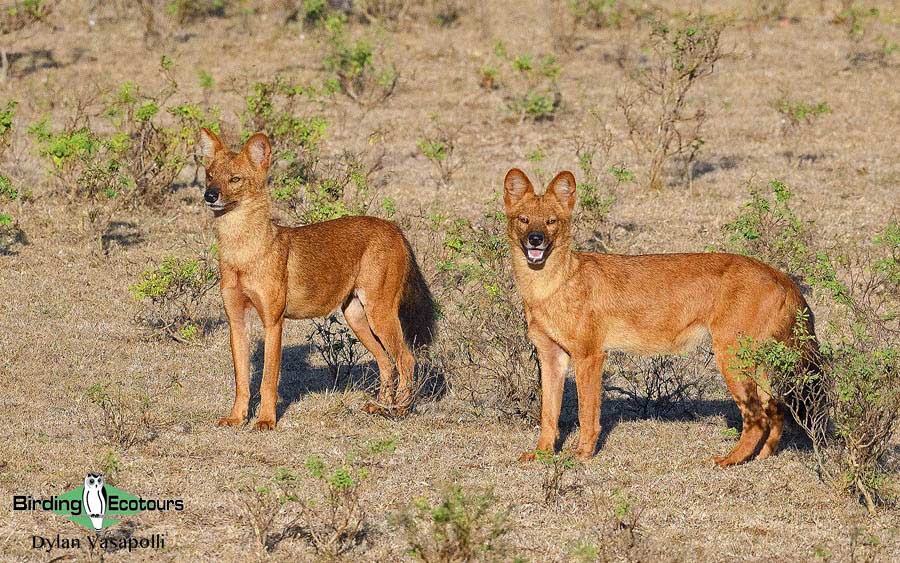
Our morning got off to a great start with this exciting Dhole sighting.
With the morning coming to a close and the heat properly setting in, it was a great time for raptors and vultures to be flying about and we weren’t disappointed. Several large flocks of soaring vultures were seen, and bit by bit they came closer to us and a few graced us with extremely close flyby views, coming just over us. Indian Vultures were the dominant birds, but we also saw several stunning Red-heaved Vultures and a few White-rumped Vultures. We also had many eagles, including multiple Greater Spotted Eagles and a Steppe Eagle, along with many of the common Crested Serpent Eagles. We retired back to our lodge for a midday break and lunch.
We reconvened in the afternoon for a last walk through the surrounding area. It was hot and sunny when we first got going, and little was out and about, though we did track down a cute pair of Spotted Owlets. We were primarily after the difficult White-naped Woodpecker, and spent time exploring all of their favored haunts, sadly without any success. We did find other woodpeckers like Streak-throated and Brown-capped Pygmy Woodpeckers, and Black-rumped Flameback, but not the one we were after. Thickets in the area also produced a few new birds for us like Spot-breasted Fantail and Asian Koel (both at long last), while several Indian Pittas showed extremely well for us. We were also treated to a flyby from a group of eagles and picked out both Indian Spotted and Greater Spotted Eagles. We retired back to our lodge and settled in for the evening after a good day of birding.
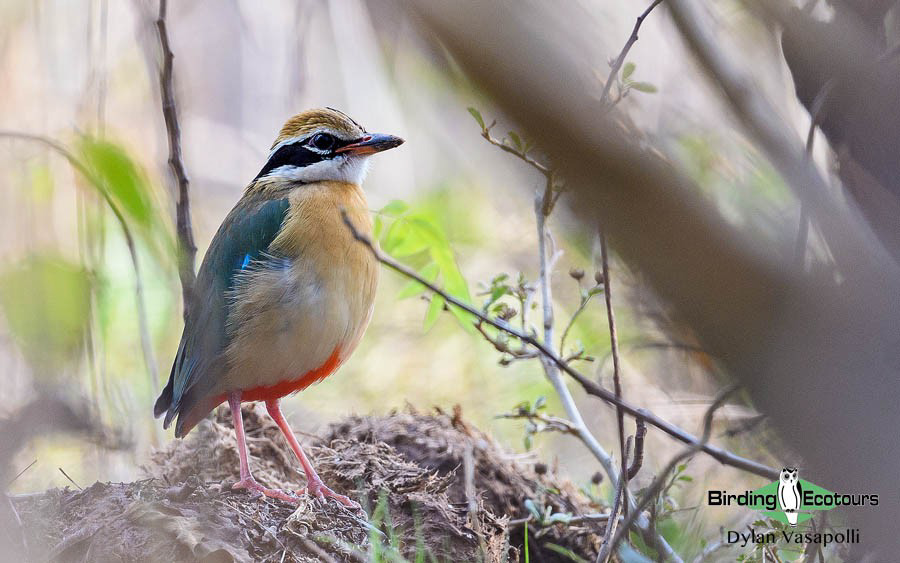
Indian Pittas showed well on several occasions during the trip.
Day 13, 2nd February 2026. Birding to Mysuru
The penultimate day of the tour had arrived and would see an almost full day of birding. We started things off early with a search for the scarce White-bellied Minivet in the wider Masinagudi area near to our lodge. It was a cool, misty morning, with little activity and few birds about and we missed the minivet. After breakfast at our lodge, we loaded up our things and were treated to another special as presumably the same pack of Dhole (Asian Wild Dogs) as we had seen yesterday came haring through the lodge grounds in search of food – sending the resident Chital (Spotted Deer) running away! We worked our way out of the Mudumalai and Bandipur Tiger Reserves, stopping at a roadside dam that gave us a few new shorebirds including Spotted Redshank and Temmincks Stint, and some commoner waterbirds like Red-naped Ibis and Indian Spot-billed Duck. We made good progress towards Ranganathittu Bird Sanctuary, and arrived in time to have our picnic lunch, before undertaking the always excellent boat trip here. This allowed us to get up close and personal with the huge rookery of birds that breed in all the trees at the sanctuary. Hundreds of Painted Storks, Asian Openbill, Spot-billed Pelicans, Indian and Little Cormorants, Little, Great and Medium Egrets, Purple and Grey Herons all dominate the surrounds. With some careful scanning, we also picked up many Black-crowned Night Herons tucked away, along with an excellent Great Thick-knee and some nesting River Terns. There were also many Mugger Crocodiles about, with some particularly large specimens seen. Back on land, we took a quick walk and promptly found Forest Wagtail foraging about, which gave us great looks, along with some other familiar birds like Spot-breasted Fantail and Tickell’s Blue Flycatcher.
We checked into our grand palace hotel in Mysuru, before heading out for the late afternoon into the nearby farmlands. This was a great way to end things up, as it was incredibly birdy. A fine party of Red Avadavats showed well, drinking from a small puddle as soon as we got out the car, before we slowly eked out more new birds like Wire-tailed Swallow and Chestnut-tailed Starling. We found a few Jerdon’s Bush Larks about which also gave us great views, while Plain Prinias and Indian Silverbills bounced around commonly. Another of our targets here was Indian (Rock) Eagle-Owl and, sadly, the bird was extremely flighty and we ended up only hearing the bird as it disappeared away. Lots of other familiar birds like Asian Green Bee-eater, Eurasian Hoopoe and Indian Robin kept us company throughout. We retired back at the end of a good day and reflected on the good trip we had enjoyed.
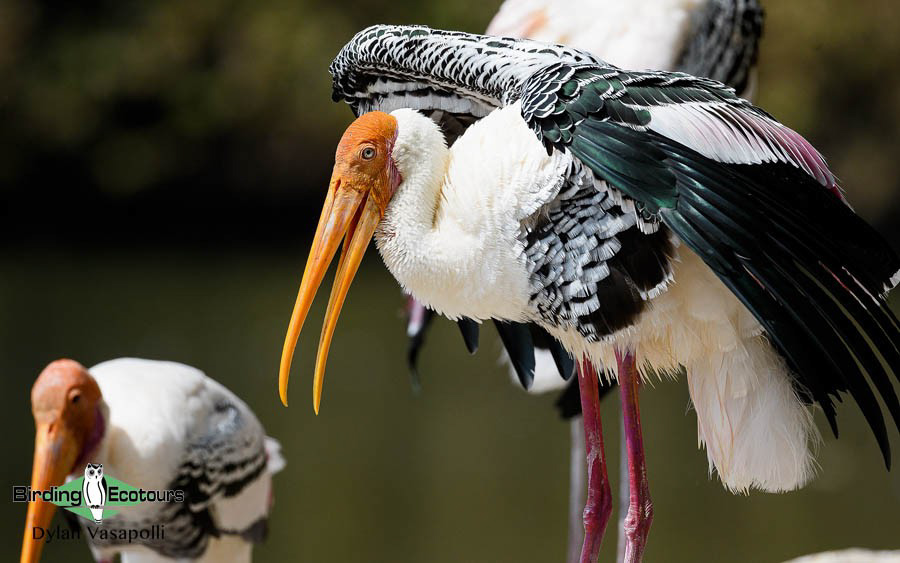
Painted Storks are one of many waterbirds that breed en-masse at Ranganathittu – the boat trip here is a wonderful spectacle, and a great way to round off the trip!
Day 14, 3rdFebruary 2026. Transfer to Bengaluru and departure
This was a travel day with no birding done or planned. We had a leisurely start around Mysuru, before getting on the road, and transiting through to Bengaluru, where the tour came to an end with our afternoon departures from the airport.
Bird List – Following IOC 15.1 (March 2025)
Birds ‘heard only’ are marked with (H) after the common name, all other species were seen.
The following notation after species names is used to show conservation status following the IUCN Red List:
CR = Critically Endangered, EN = Endangered, VU = Vulnerable.
| Common name | Scientific name |
| Ducks, Geese, Swans (Anatidae) | |
| Lesser Whistling Duck | Dendrocygna javanica |
| Indian Spot-billed Duck | Anas poecilorhyncha |
| Pheasants & Allies (Phasianidae) | |
| Indian Peafowl | Pavo cristatus |
| Grey Junglefowl | Gallus sonneratii |
| Grey Francolin | Ortygornis pondicerianus |
| Painted Bush Quail | Perdicula erythrorhyncha |
| Nightjars (Caprimulgidae) | |
| Great Eared Nightjar | Lyncornis macrotis |
| Jungle Nightjar | Caprimulgus indicus |
| Jerdon’s Nightjar | Caprimulgus atripennis |
| Indian Nightjar | Caprimulgus asiaticus |
| Frogmouths (Podargidae) | |
| Sri Lanka Frogmouth | Batrachostomus moniliger |
| Treeswifts (Hemiprocnidae) | |
| Crested Treeswift | Hemiprocne coronata |
| Swifts (Apodidae) | |
| Indian Swiftlet | Aerodramus unicolor |
| White-rumped Spinetail | Zoonavena sylvatica |
| Asian Palm Swift | Cypsiurus balasiensis |
| Alpine Swift | Tachymarptis melba |
| Little Swift | Apus affinis |
| Cuckoos (Cuculidae) | |
| Greater Coucal | Centropus sinensis |
| Blue-faced Malkoha | Phaenicophaeus viridirostris |
| Asian Koel | Eudynamys scolopaceus |
| Grey-bellied Cuckoo | Cacomantis passerines |
| Fork-tailed Drongo-Cuckoo | Surniculus dicruroides |
| Common Hawk-Cuckoo | Hierococcyx varius |
| Pigeons, Doves (Columbidae) | |
| Rock Dove | Columba livia |
| Nilgiri Wood Pigeon | Columba elphinstonii |
| Eurasian Collared Dove | Streptopelia decaocto |
| Spotted Dove | Spilopelia chinensis |
| Laughing Dove | Spilopelia senegalensis |
| Common Emerald Dove | Chalcophaps indica |
| Grey-fronted Green Pigeon | Treron affinis |
| Yellow-footed Green Pigeon | Treron phoenicopterus |
| Green Imperial Pigeon | Ducula aenea |
| Malabar Imperial Pigeon | Ducula cuprea |
| Rails, Crakes & Coots (Rallidae) | |
| Common Moorhen | Gallinula chloropus |
| Eurasian Coot | Fulica atra |
| Ruddy-breasted Crake | Zapornia fusca |
| White-breasted Waterhen | Amaurornis phoenicurus |
| Grebes (Podicipedidae) | |
| Little Grebe | Tachybaptus ruficollis |
| Stone-curlews, Thick-knees (Burhinidae) | |
| Great Stone-curlew | Esacus recurvirostris |
| Stilts, Avocets (Recurvirostridae) | |
| Black-winged Stilt | Himantopus himantopus |
| Plovers (Charadriidae) | |
| Little Ringed Plover | Charadrius dubius |
| Yellow-wattled Lapwing | Vanellus malabaricus |
| Red-wattled Lapwing | Vanellus indicus |
| Sandpipers, Snipes (Scolopacidae) | |
| Pin-tailed Snipe | Gallinago stenura |
| Common Sandpiper | Actitis hypoleucos |
| Green Sandpiper | Tringa ochropus |
| Wood Sandpiper | Tringa glareola |
| Spotted Redshank | Tringa erythropus |
| Temminck’s Stint | Calidris temminckii |
| Gulls, Terns, Skimmers (Laridae) | |
| Whiskered Tern | Chlidonias hybrida |
| River Tern – VU | Sterna aurantia |
| Storks (Ciconiidae) | |
| Asian Openbill | Anastomus oscitans |
| Painted Stork | Mycteria leucocephala |
| Asian Woolly-necked Stork | Ciconia episcopus |
| Anhingas, Darters (Anhingidae) | |
| Oriental Darter | Anhinga melanogaster |
| Cormorants, Shags (Phalacrocoracidae) | |
| Little Cormorant | Microcarbo niger |
| Indian Cormorant | Phalacrocorax fuscicollis |
| Great Cormorant | Phalacrocorax carbo |
| Ibises, Spoonbills (Threskiornithidae) | |
| Black-headed Ibis | Threskiornis melanocephalus |
| Red-naped Ibis | Pseudibis papillosa |
| Eurasian Spoonbill | Platalea leucorodia |
| Herons, Bitterns (Ardeidae) | |
| Black-crowned Night Heron | Nycticorax nycticorax |
| Little Egret | Egretta garzetta |
| Indian Pond Heron | Ardeola grayii |
| Great Egret | Ardea alba |
| Medium Egret | Ardea intermedia |
| Eastern Cattle Egret | Ardea coromanda |
| Grey Heron | Ardea cinerea |
| Purple Heron | Ardea purpurea |
| Pelicans (Pelecanidae) | |
| Spot-billed Pelican | Pelecanus philippensis |
| Kites, Hawks, Eagles (Accipitridae) | |
| Black-winged Kite | Elanus caeruleus |
| Black Baza | Aviceda leuphotes |
| Crested Honey Buzzard | Pernis ptilorhynchus |
| Red-headed Vulture – CR | Sarcogyps calvus |
| White-rumped Vulture – CR | Gyps bengalensis |
| Indian Vulture – CR | Gyps indicus |
| Crested Serpent Eagle | Spilornis cheela |
| Changeable Hawk-Eagle | Nisaetus cirrhatus |
| Black Eagle | Ictinaetus malaiensis |
| Indian Spotted Eagle | Clanga hastata |
| Greater Spotted Eagle – VU | Clanga clanga |
| Steppe Eagle – EN | Aquila nipalensis |
| Bonelli’s Eagle | Aquila fasciata |
| Crested Goshawk | Lophospiza trivirgata |
| Shikra | Tachyspiza badia |
| Black Kite | Milvus migrans |
| Brahminy Kite | Haliastur indus |
| Common Buzzard | Buteo buteo |
| Owls (Strigidae) | |
| Brown Boobook | Ninox scutulata |
| Spotted Owlet | Athene brama |
| Jungle Owlet | Glaucidium radiatum |
| Oriental Scops Owl (H) | Otus sunia |
| Indian Scops Owl | Otus bakkamoena |
| Indian Eagle-Owl (H) | Bubo bengalensis |
| Brown Fish Owl | Ketupa zeylonensis |
| Spot-bellied Eagle-Owl | Ketupa nipalensis |
| Mottled Wood Owl | Strix ocellata |
| Trogons (Trogonidae) | |
| Malabar Trogon | Harpactes fasciatus |
| Hoopoes (Upupidae) | |
| Eurasian Hoopoe | Upupa epops |
| Hornbills (Bucerotidae) | |
| Malabar Grey Hornbill – VU | Ocyceros griseus |
| Rollers (Coraciidae) | |
| Indian Roller | Coracias benghalensis |
| Oriental Dollarbird | Eurystomus orientalis |
| Kingfishers (Alcedinidae) | |
| Stork-billed Kingfisher | Pelargopsis capensis |
| White-throated Kingfisher | Halcyon smyrnensis |
| Common Kingfisher | Alcedo atthis |
| Bee-eaters (Meropidae) | |
| Asian Green Bee-eater | Merops orientalis |
| Blue-tailed Bee-eater | Merops philippinus |
| Chestnut-headed Bee-eater | Merops leschenaulti |
| Asian Barbets (Megalaimidae) | |
| Brown-headed Barbet | Psilopogon zeylanicus |
| White-cheeked Barbet | Psilopogon viridis |
| Malabar Barbet | Psilopogon malabaricus |
| Coppersmith Barbet | Psilopogon haemacephalus |
| Woodpeckers (Picidae) | |
| Speckled Piculet | Picumnus innominatus |
| Heart-spotted Woodpecker | Hemicircus canente |
| Brown-capped Pygmy Woodpecker | Yungipicus nanus |
| Yellow-crowned Woodpecker | Leiopicus mahrattensis |
| White-bellied Woodpecker | Dryocopus javensis |
| Lesser Yellownape | Picus chlorolophus |
| Streak-throated Woodpecker | Picus xanthopygaeus |
| Black-rumped Flameback | Dinopium benghalense |
| Malabar Flameback | Chrysocolaptes socialis |
| Rufous Woodpecker | Micropternus brachyurus |
| Caracaras, Falcons (Falconidae) | |
| Common Kestrel | Falco tinnunculus |
| Peregrine Falcon | Falco peregrinus |
| Old World Parrots (Psittaculidae) | |
| Plum-headed Parakeet | Psittacula cyanocephala |
| Blue-winged Parakeet | Psittacula columboides |
| Rose-ringed Parakeet | Psittacula krameri |
| Vernal Hanging Parrot | Loriculus vernalis |
| Pittas (Pittidae) | |
| Indian Pitta | Pitta brachyura |
| Vangas & Allies (Vangidae) | |
| Bar-winged Flycatcher-shrike | Hemipus picatus |
| Malabar Woodshrike | Tephrodornis sylvicola |
| Common Woodshrike | Tephrodornis pondicerianus |
| Woodswallows, Butcherbirds & Allies (Artamidae) | |
| Ashy Woodswallow | Artamus fuscus |
| Ioras (Aegithinidae) | |
| Common Iora | Aegithina tiphia |
| Cuckooshrikes (Campephagidae) | |
| Small Minivet | Pericrocotus cinnamomeus |
| Orange Minivet | Pericrocotus flammeus |
| Indian Cuckooshrike | Coracina macei |
| Black-headed Cuckooshrike | Lalage melanoptera |
| Figbirds, Old World Orioles, Piopios (Oriolidae) | |
| Black-hooded Oriole | Oriolus xanthornus |
| Indian Golden Oriole | Oriolus kundoo |
| Drongos (Dicruridae) | |
| Bronzed Drongo | Dicrurus aeneus |
| Greater Racket-tailed Drongo | Dicrurus paradiseus |
| Ashy Drongo | Dicrurus leucophaeus |
| White-bellied Drongo | Dicrurus caerulescens |
| Black Drongo | Dicrurus macrocercus |
| Fantails (Rhipiduridae) | |
| White-spotted Fantail | Rhipidura albogularis |
| White-browed Fantail | Rhipidura aureola |
| Monarchs (Monarchidae) | |
| Black-naped Monarch | Hypothymis azurea |
| Indian Paradise Flycatcher | Terpsiphone paradisi |
| Shrikes (Laniidae) | |
| Bay-backed Shrike | Lanius vittatus |
| Brown Shrike | Lanius cristatus |
| Long-tailed Shrike | Lanius schach |
| Crows, Jays (Corvidae) | |
| Rufous Treepie | Dendrocitta vagabunda |
| White-bellied Treepie | Dendrocitta leucogastra |
| House Crow | Corvus splendens |
| Indian Jungle Crow | Corvus culminatus |
| Fairy Flycatchers (Stenostiridae) | |
| Grey-headed Canary-flycatcher | Culicicapa ceylonensis |
| Tits, Chickadees (Paridae) | |
| Cinereous Tit | Parus cinereus |
| Indian Black-lored Tit | Machlolophus aplonotus |
| Larks (Alaudidae) | |
| Jerdon’s Bush Lark | Plocealauda affinis |
| Malabar Lark | Galerida malabarica |
| Bulbuls (Pycnonotidae) | |
| Yellow-browed Bulbul | Acritillas indica |
| Square-tailed Bulbul | Hypsipetes ganeesa |
| Grey-headed Bulbul | Brachypodius priocephalus |
| Flame-throated Bulbul | Rubigula gularis |
| White-browed Bulbul | Pycnonotus luteolus |
| Yellow-throated Bulbul | Pycnonotus xantholaemus |
| Red-whiskered Bulbul | Pycnonotus jocosus |
| Red-vented Bulbul | Pycnonotus cafer |
| Swallows, Martins (Hirundinidae) | |
| Dusky Crag Martin | Ptyonoprogne concolor |
| Hill Swallow | Hirundo domicola |
| Barn Swallow | Hirundo rustica |
| Wire-tailed Swallow | Hirundo smithii |
| Eastern Red-rumped Swallow | Cecropis daurica |
| Leaf Warblers (Phylloscopidae) | |
| Tickell’s Leaf Warbler | Phylloscopus affinis |
| Green Warbler | Phylloscopus nitidus |
| Greenish Warbler | Phylloscopus trochiloides |
| Large-billed Leaf Warbler | Phylloscopus magnirostris |
| Reed Warblers & Allies (Acrocephalidae) | |
| Clamorous Reed Warbler | Acrocephalus stentoreus |
| Blyth’s Reed Warbler | Acrocephalus dumetorum |
| Booted Warbler | Iduna caligata |
| Cisticolas & Allies (Cisticolidae) | |
| Grey-breasted Prinia | Prinia hodgsonii |
| Ashy Prinia | Prinia socialis |
| Plain Prinia | Prinia inornata |
| Common Tailorbird | Orthotomus sutorius |
| Sylviid Babblers (Sylviidae) | |
| Lesser Whitethroat | Curruca curruca |
| Parrotbills & Allies (Paradoxornithidae) | |
| Yellow-eyed Babbler | Chrysomma sinense |
| White-eyes (Zosteropidae) | |
| Indian White-eye | Zosterops palpebrosus |
| Babblers, Scimitar Babblers (Timaliidae) | |
| Dark-fronted Babbler | Dumetia atriceps |
| Indian Scimitar Babbler | Pomatorhinus horsfieldii |
| Alcippe Fulvettas (Alcippeidae) | |
| Brown-cheeked Fulvetta | Alcippe poioicephala |
| Laughingthrushes & Allies (Leiothrichidae) | |
| Nilgiri Laughingthrush | Montecincla cachinnans |
| Palani Laughingthrush | Montecincla fairbanki |
| Large Grey Babbler | Argya malcolmi |
| Rufous Babbler | Argya subrufa |
| Jungle Babbler | Argya striata |
| Yellow-billed Babbler | Argya affinis |
| Wayanad Laughingthrush | Pterorhinus delesserti |
| Fairy-bluebirds (Irenidae) | |
| Asian Fairy-bluebird | Irena puella |
| Nuthatches (Sittidae) | |
| Velvet-fronted Nuthatch | Sitta frontalis |
| Indian Nuthatch | Sitta castanea |
| Starlings, Rhabdornises (Sturnidae) | |
| Southern Hill Myna | Gracula indica |
| Jungle Myna | Acridotheres fuscus |
| Common Myna | Acridotheres tristis |
| Chestnut-tailed Starling | Sturnia malabarica |
| Malabar Starling | Sturnia blythii |
| Brahminy Starling | Sturnia pagodarum |
| Rosy Starling | Pastor roseus |
| Thrushes (Turdidae) | |
| Nilgiri Thrush | Zoothera neilgherriensis |
| Orange-headed Thrush | Geokichla citrina |
| Indian Blackbird | Turdus simillimus |
| Chats, Old World Flycatchers (Muscicapidae) | |
| Oriental Magpie-Robin | Copsychus saularis |
| Indian Robin | Copsychus fulicatus |
| White-rumped Shama | Copsychus malabaricus |
| Brown-breasted Flycatcher | Muscicapa muttui |
| Asian Brown Flycatcher | Muscicapa dauurica |
| Nilgiri Blue Robin | Sholicola major |
| White-bellied Blue Robin | Sholicola albiventris |
| Nilgiri Flycatcher | Eumyias albicaudatus |
| Blue-throated Blue Flycatcher | Cyornis rubeculoides |
| White-bellied Blue Flycatcher | Cyornis pallidipes |
| Tickell’s Blue Flycatcher | Cyornis tickelliae |
| Malabar Whistling Thrush | Myophonus horsfieldii |
| Indian Blue Robin | Larvivora brunnea |
| Rusty-tailed Flycatcher | Ficedula ruficauda |
| Black-and-orange Flycatcher | Ficedula nigrorufa |
| Blue Rock Thrush | Monticola solitarius |
| Pied Bush Chat | Saxicola caprata |
| Leafbirds (Chloropseidae) | |
| Jerdon’s Leafbird | Chloropsis jerdoni |
| Golden-fronted Leafbird | Chloropsis aurifrons |
| Flowerpeckers (Dicaeidae) | |
| Thick-billed Flowerpecker | Pachyglossa agilis |
| Pale-billed Flowerpecker | Dicaeum erythrorhynchos |
| Nilgiri Flowerpecker | Dicaeum concolor |
| Sunbirds (Nectariniidae) | |
| Purple-rumped Sunbird | Leptocoma zeylonica |
| Crimson-backed Sunbird | Leptocoma minima |
| Purple Sunbird | Cinnyris asiaticus |
| Old World Sparrows, Snowfinches (Passeridae) | |
| Yellow-throated Sparrow | Gymnoris xanthocollis |
| House Sparrow | Passer domesticus |
| Waxbills, Munias & Allies (Estrildidae) | |
| Indian Silverbill | Euodice malabarica |
| Scaly-breasted Munia | Lonchura punctulata |
| Black-throated Munia | Lonchura kelaarti |
| White-rumped Munia | Lonchura striata |
| Red Avadavat | Amandava amandava |
| Wagtails, Pipits (Motacillidae) | |
| Forest Wagtail | Dendronanthus indicus |
| Western Yellow Wagtail | Motacilla flava |
| Grey Wagtail | Motacilla cinerea |
| White-browed Wagtail | Motacilla maderaspatensis |
| Paddyfield Pipit | Anthus rufulus |
| Nilgiri Pipit – VU | Anthus nilghiriensis |
| Finches, Euphonias (Fringillidae) | |
| Common Rosefinch | Carpodacus erythrinus |
| Species seen: | 248 |
| Species heard: | 2 |
| Total recorded: | 250 |
Mammal List – Following Mammalwatching.com (Oct. 2025)
Mammals ‘heard only’ are marked with (H) after the common name, all other species were seen.
The following notation after species names is used to show conservation status following the IUCN Red List:
EN = Endangered, VU = Vulnerable.
| Common name | Scientific name |
| Elephants (Elephantidae) | |
| Asian Elephant – EN | Elephas maximus |
| Old World Monkeys (Cercopithecidae) | |
| Bonnet Macaque – VU | Macaca radiata |
| Nilgiri Langur – VU | Semnopithecus johnii |
| Tufted Gray Langur | Semnopithecus priam |
| Hares and Rabbits (Leporidae) | |
| Indian Hare | Lepus nigricollis |
| Squirrels (Sciuridae) | |
| Indian Palm Squirrel | Funambulus palmarum |
| Jungle Palm Squirrel | Funambulus tristriatus |
| Indian Giant Squirrel | Ratufa indica |
| Sri Lankan Giant Squirrel | Ratufa macroura |
| Old World Fruit Bats (Pteropodidae) | |
| Indian Flying Fox | Pteropus medius |
| Bears (Ursidae) | |
| Sloth Bear – VU | Melursus ursinus |
| Canids (Canidae) | |
| Dhole – EN | Cuon alpinus |
| Mongooses (Herpestidae) | |
| Indian Gray Mongoose | Urva edwardsii |
| Bovids (Bovidae) | |
| Nilgiri Tahr – EN | Nilgiritragus hylocrius |
| Gaur – VU | Bos gaurus |
| Deer (Cervidae) | |
| Chital | Axis axis |
| Sambar – VU | Rusa unicolor |
| Northern Red Muntjac | Muntiacus vaginalis |
| Suids (Suidae) | |
| Eurasian Wild Pig | Sus scrofa |
| Species seen: | 19 |
Reptile List – Following Reptiles of the World (Nov. 2025)
The following notation after species names is used to show conservation status following the IUCN Red List:
VU = Vulnerable.
| Common name | Scientific name |
| Crocodiles (Crocodylidae) | |
| Mugger Crocodile – VU | Crocodylus palustris |
| Vipers (Viperidae) | |
| Large-scaled Pit Viper | Craspedocephalus macrolepis |
| Species seen: | 2 |
This is a sample trip report. Please email us ([email protected]) for more trip reports from this destination.