11 – 19 JANUARY 2026
By Jacob Roalef
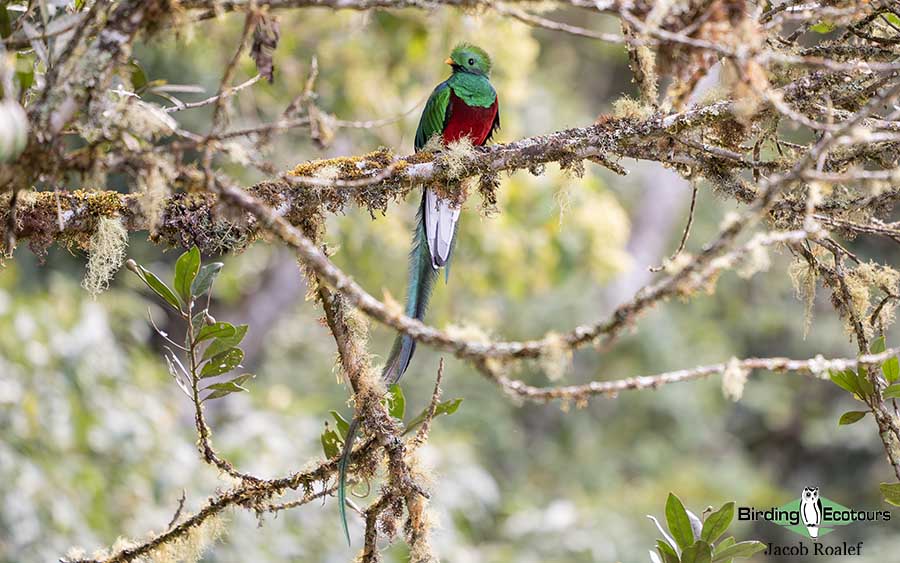
Few birds can compete with the Resplendent Quetzal in terms of beauty and awe!
Overview
This nine-day tour offered an excellent introduction to Costa Rica’s remarkable birdlife and wildlife. We explored a wide range of habitats, from Caribbean lowlands to high-elevation cloud forest, with stops at places such as La Paz Waterfall Gardens, La Selva Biological Station, Cope wildlife reserve, Savegre Valley, Paraíso Quetzal, and Los Quetzal National Park. Traveling at a relaxed pace, we combined feeder watching, easy walks, and roadside birding, making this an ideal neotropical experience for both newer and more experienced birders.
While this tour is designed to be a bit more relaxed, it is still packed with standout species and an impressive total bird list for the shorter duration. In Costa Rica, remarkable birds seem to be around every corner. A total of 261 bird species were seen, with nine more being heard-only species, making for a total of 270 species recorded on the trip. Bird highlights were numerous and included Resplendent Quetzal, Great Potoo, Fiery-throated Hummingbird, Sunbittern, King Vulture, Bare-shanked Screech-Owl, White-whiskered Puffbird, Red-headed Barbet, Chestnut-colored Woodpecker, Crested and Spectacled Owls, Scarlet and Great Green Macaws, Ruddy Treerunner, Rufous-browed Peppershrike, Timberline Wren, Golden-browed Chlorophonia, Spangle-cheeked Tanager and many more. In addition to birds, Costa Rica hosts a plethora of other amazing wildlife. We enjoyed many incredible sightings like Strawberry Poison Dart Frog, Eyelash Pit Viper, Brown-throated Three-toed Sloth, Hoffman’s Two-toed Sloth, and more. Full bird and mammal checklists can be found at the end of the report.
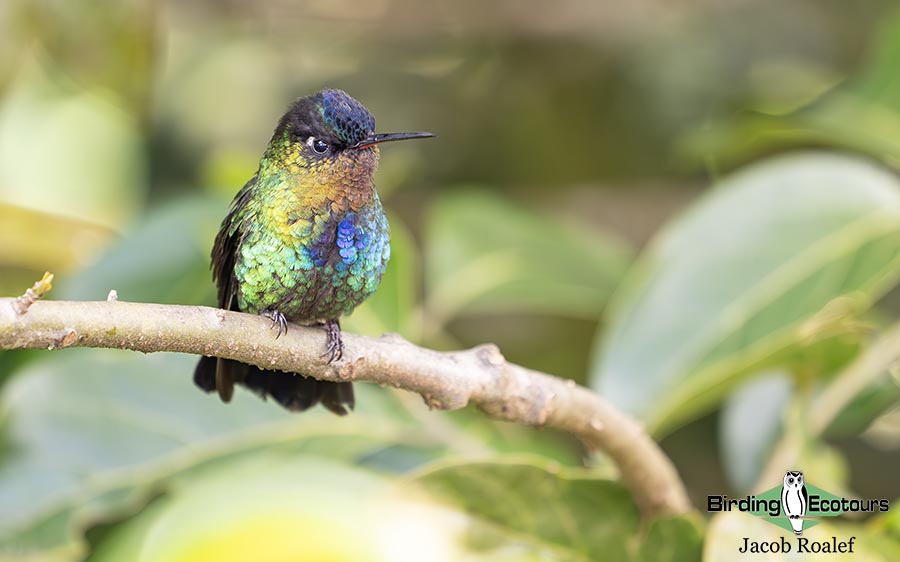
Fiery-throated Hummingbird is a species full of personality and is always a favorite.
Detailed Report
Day 1, 11th January 2026. Arrival and birding Hotel Bougainvillea
While today was mainly meant to serve as an arrival day and for folks to rest and adjust after international travel, several participants arrived early so we decided to do a little birding around the grounds of Hotel Bougainvillea together. Our pre-breakfast walk gave us our first taste of some of the more common species on offer in this amazingly birdy country like Social Flycatcher, Hoffmann’s Woodpecker, Brown Jay, Rufous-tailed Hummingbird, and Blue-grey Tanager. We did manage to find a few highlight species as well such as Mottled Owl, Lesson’s Motmot, and White-eared Ground Sparrow. The remainder of the morning and into the afternoon was on your own, but we met up again just before dinner for a little more birding on the grounds. This time we had a bit more of our group together, so we caught them up on the species seen earlier that morning and we found some new and exciting birds as well, like Common Squirrel-Cuckoo and White-tailed Kite. By dinnertime, the whole group had arrived, and we all enjoyed introductions and getting to know each other as the tour had now officially kicked off.
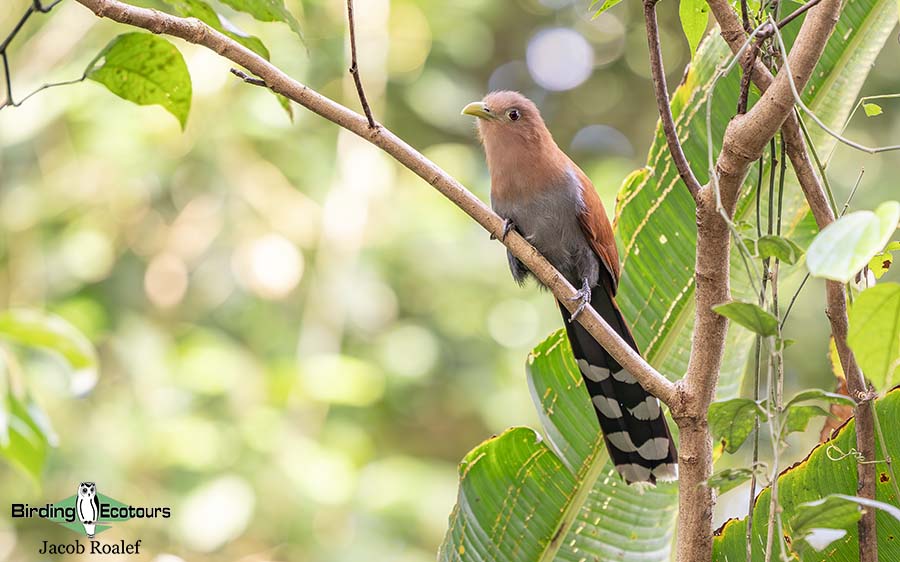
We had several great looks at Common Squirrel-Cuckoo on this trip.
Day 2, 12th January 2026. La Paz Waterfalls and Cinchona feeders
We started the day with another pre-breakfast walk around Hotel Bougainvillea, where we caught up on several key species that some of the later arrivals had missed the day before, including Mottled Owl, Lesson’s Motmot, and White-eared Ground Sparrow. While it was great to have everyone all caught up on the trip list together, the real excitement of the morning came in the form of a Rufous-browed Peppershrike. This little bird was calling frequently but made our lives difficult as we tried for a look. With enough perseverance, we managed to score some views of this excellent bird. After a well-earned breakfast, coffee, and checkout, we officially began our tour of Costa Rica.
It was going to be a long travel day with some excellent birding locations planned along the way. Of course, we would also find birds en route and make a few brief stops and views when possible. On the way to our first stop, La Paz Waterfall Gardens, we managed to spot a few nice species such as Short-tailed Hawk and Volcano Hummingbird before we arrived at the park. This was our first real experience at a hummingbird feeder site, with Purple-throated Mountaingems, Green-crowned Brilliants, Violet Sabrewings, Green Thorntails, Black-bellied Hummingbirds, and Green Hermits darting all around us. We also enjoyed excellent views of the endemic Coppery-headed Emerald. Reluctantly, we finally pulled ourselves away for lunch at the café. As we finished lunch, a bold Slaty-backed Nightingale-Thrush hopped onto one of our tables, giving us an unforgettable close view. With full stomachs, we then set off on a short hike to view the impressive La Paz Falls.
It wasn’t long before we got into a nice mixed flock in the forest that even had us backtrack slightly as the birds moved through. We managed to find many excellent species like Costa Rican Warbler, Grey-breasted Wood-Wren, Spotted Barbtail, Prong-billed Barbet, and Yellow-thighed Brushfinch. The rest of the way to the falls was a bit quiet, but of course, the falls themselves were worth the hike. Next on the schedule was a quick visit to some excellent feeders at Cinchona next door. This little café area hosted some incredible birds such as White-bellied Mountaingem, Black Guan, Red-headed Barbet, Blue-throated (Northern Emerald) Toucanet, and Silver-throated Tanager. It was getting later in the day now and we still had a decent bit of ground to cover to reach our hotel. We managed a few brief stops along the way at various river areas and picked up some nice species like Louisiana Waterthrush, Buff-rumped Warbler, Yellow-bellied Flycatcher, and Torrent Tyrannulet. We made it to the lodge in time for check-in and dinner as we soaked in what was a fantastic first full day of birding in Costa Rica.
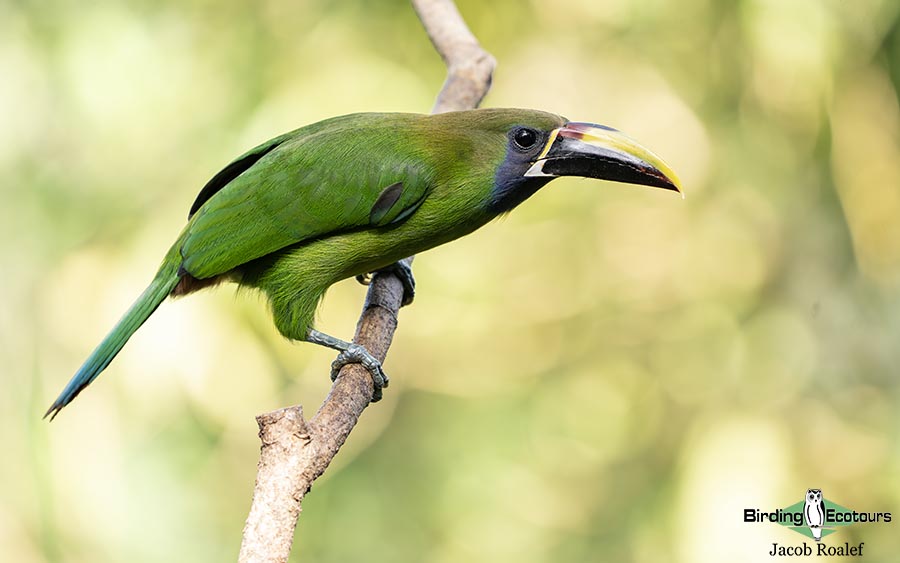
The stunning Blue-throated (Northern Emerald) Toucanet came in at Cinchona.
Day 3, 13th January 2026. La Quinta and La Selva Biological Station
The morning began in classic Costa Rican fashion: breakfast, coffee, and excellent birds. We enjoyed the feeder setup at La Quinta while waiting for breakfast, where a great variety of species came to the fruit, including Black-cheeked Woodpecker, Red-throated Ant-Tanager, Piratic Flycatcher, Green Honeycreeper, and Bananaquit. After breakfast and a final gear check, we headed to La Selva Biological Station and spent the morning birding along the entrance road and east of the Puerto Viejo River. It was a superb morning, with highlights including Great Green Macaw, Common Squirrel Cuckoo, Great Curassow, Stripe-breasted Wren, and Double-toothed Kite. We then sprayed our boots and set off onto the station’s trail network. We found a sleepy Hoffman’s Two-toed Sloth not far from the start of the trail. As we watched, it woke and began to move quickly through the trees, how strange for a sloth. We soon realized why when we looked up and saw storm clouds rolling in, so we hiked back to the nearby shelter to wait out the rain and get a bit of a natural history lesson of the park. It wasn’t too long before the rain broke and we were out birding again. This post-rain period yielded plenty of great species for us like Chestnut-colored Woodpecker, White-whiskered Puffbird, Semiplumbeous Hawk, Graceful Black-throated Trogon, and Rufous-tailed Jacamar. The morning had come and gone, and it was time to head back to the lodge for lunch, but first we made a quick stop to visit a Great Green Macaw sitting on its nest, what a treat!
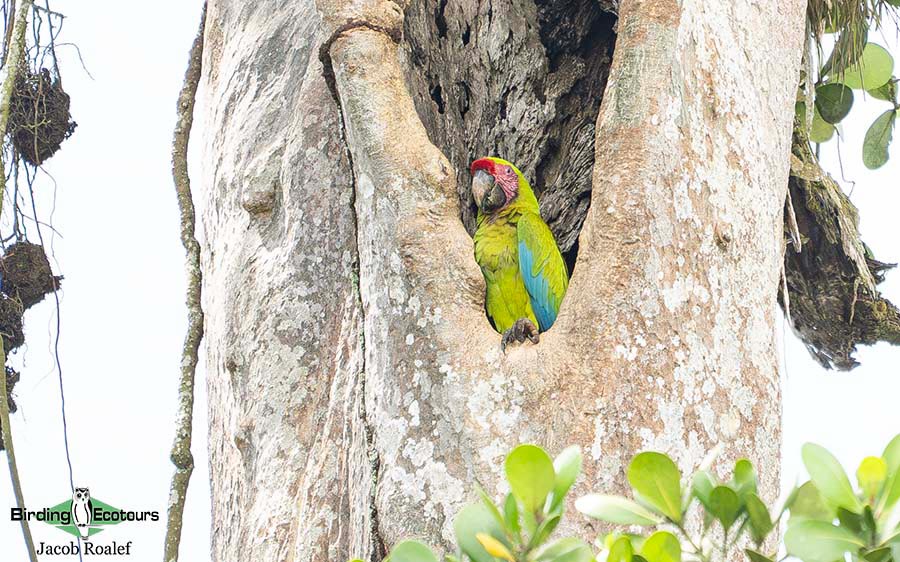
This Great Green Macaw was sitting on a nest when we spotted it.
After lunch, we returned to La Selva to bird the trails on the far side of the river. It was a little quiet in the heat of the afternoon, but we pressed on and explored the various trails here. We picked up several nice species like Red-capped Manakin, Ochre-bellied Flycatcher, White-whiskered Puffbird, Broad-billed Motmot, Crested Guan, and Slaty-tailed Trogon. As sunset approached, we waited for dark as the Yellow-throated Toucans called in the distance and prepared for bed. Our nighttime birding adventure netted us a loud Middle American Screech Owl that even made a few brief flash appearances as well as Common Pauraque along the road. Not a bad evening of birding, but it was time for dinner and sleep back at the lodge.
Day 4, 14th January 2026. Sarapiquí Birding and Cope’s Reserve
Today started with about an hour of pre-breakfast birding along the river. We scanned as the birds woke up to get their day started and we found White-crowned Parrot, Mealy Amazon, Amazon Kingfisher, Masked Tityra, and more. A lovely start to the day, but now it was time for coffee and breakfast back at the lodge with the usual suspects of Scarlet-rumped Tanager and Cinnamon-bellied Saltator. We spent the rest of the morning birding various backroads in the Sarapiquí area. Our first stop netted us a stunning Bat Falcon as well as a gorgeous Scarlet Macaw and our first Brown-throated Three-toed Sloth. We also managed to add several new species at the next few stops like Fasciated Tiger Heron, White-throated Flycatcher, Red-breasted Meadowlark, Long-tailed Tyrant, and Roadside Hawk. It was a great morning to be out and birding, but now it was time to head back for lunch and a small break.
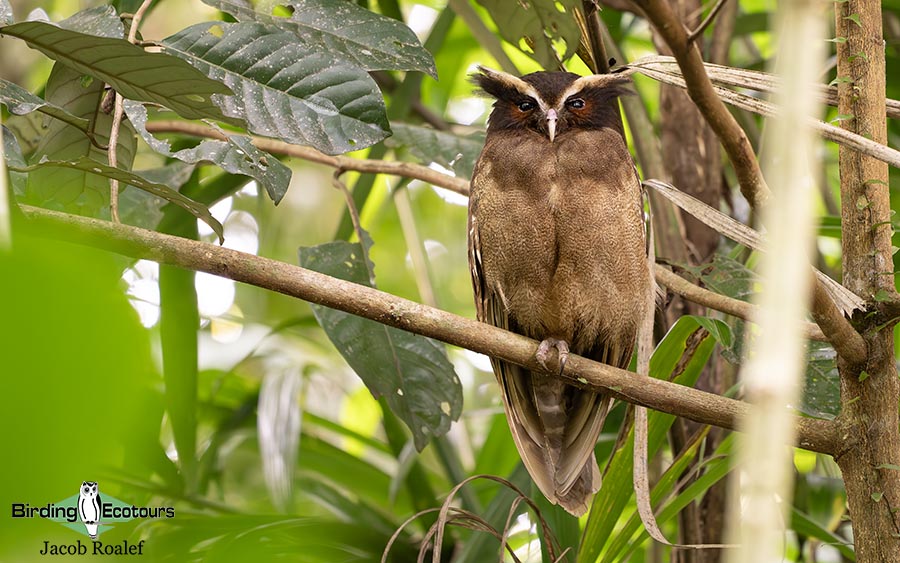
We hiked through the woods to see this sleepy Crested Owl.
We spent the rest of the day at Cope’s Reserve, an excellent site with both feeders and nearby forest habitat. At the feeders, we enjoyed close views of White-necked Jacobin, Green-breasted Mango, Bronze-tailed Plumeleteer, and Long-billed Hermit, along with other species such as Russet-naped Wood-Rail, Keel-billed Toucan, Red-legged, Shining, and Green Honeycreepers, and Chestnut-headed Oropendola. After watching the feeders, we headed into the forest, where Cope showed us a pair of roosting Spectacled Owls. After this, we loaded up as Cope took us to another property, this time for Crested Owl! What an incredible afternoon with two species of roosting owls. Of course, the owls were a highlight, but we spotted many other great species during this time as well such as Rufous-winged Woodpecker, Cinnamon Becard, Brown Jay, Golden-hooded Tanager, and Bare-throated Tiger Heron. On the way back to Cope’s house, our driver Alex drove by one of his known stops for another roosting nocturnal bird. Success, we found the Great Potoo snoozing on its branch, how awesome! We made it back to Cope’s house for a little coffee and tasty empanadas and to enjoy his feeders a little more before heading back to our hotel. Along the way, we made a quick stop at a small wetland and picked up Northern Jacana and Killdeer for our trip list and to wrap up a nice day of birding.
Day 5, 15th January 2026. Sarapiquí to the cloud forest
Today was primarily a travel day to get from the Caribbean lowlands up to the cloud forests in the mountains. We made one final check along the river in the Sarapiquí before breakfast and enjoyed a large flock of over 20 Great Green Macaws as they flew by in the morning hours. Other species included Pale-billed Woodpecker, Mistletoe Tyrannulet, Blue Dacnis, Blue-black Grassquit, and King Vulture. It was then back to the hotel for breakfast and to gather luggage and say goodbye to the area. We made it through San Jose after a bit of traffic and up into the mountains around lunch where we stopped at Casa Dowii, a fantastic place to eat and bird. The weather was much chillier up here and the clouds and wind had picked up, but we watched the feeders from inside and noticed the shift in species assemblage with the likes of Mountain Thrush, Common Chlorospingus, and Chestnut-capped Brushfinch. After our lunch and tasty coffees, we pressed onwards to Miriam’s, another great feeder location in the Savegre Valley. The weather had improved by now and the sun was even poking through, and the birds here did not disappoint. Close-up views of species like Talamanca Hummingbird, White-throated Mountaingem, Acorn Woodpecker, Large-footed Finch, Flame-colored Tanager, and more, was amazing. Just before we were ready to move on to our lodge, a brilliant, glowing Golden-browed Chlorophonia dropped in under the feeders and gave us a quick look before disappearing again. What a jaw-dropping stunner of a bird. We loaded up and made it to Savegre Lodge where we spent some time checking in, getting unpacked and settled before dinner after what was a long travel day mixed with some excellent birds.
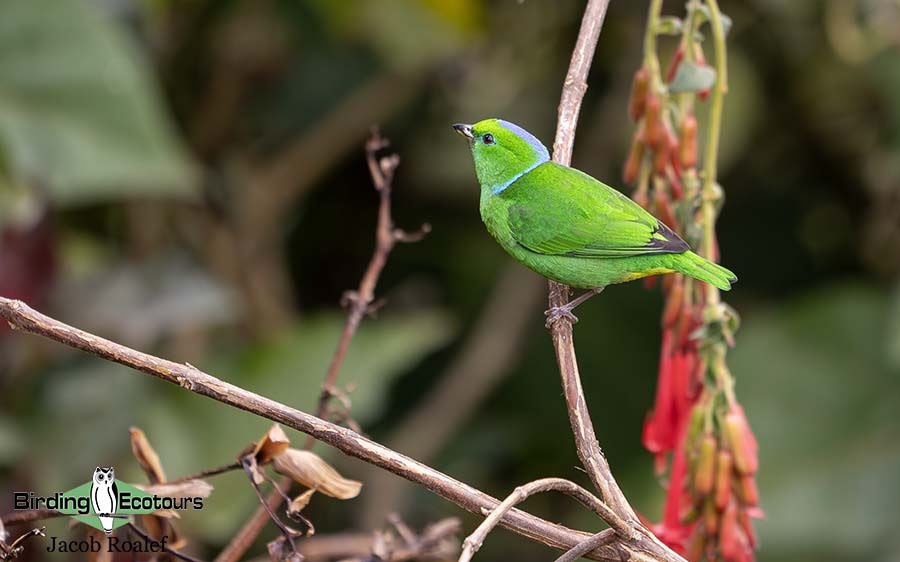
The glow of the Golden-browed Chlorophonia really stands out.
Day 6, 16th January 2026. Savegre Valley
We were up early in search of what was arguably the trip’s top prize. After a short hike, we reached a good vantage point among several avocado trees and waited for the star attraction to appear. Fortunately, it did not take long before we were admiring the stunning Resplendent Quetzal! This bird put on quite a show for the large audience there to see it. We all just soaked it up for as long as our stomachs would allow, before heading back to the hotel for breakfast and more coffee. After we filled up, we did a little birding around the ground of Savegre Lodge and found some nice species like Stripe-tailed Hummingbird, Long-tailed Silky-Flycatcher, and Sooty-capped Chlorospingus. From here, we took some 4×4 vehicles up the hill to the oak forest to spend the remainder of the morning. It is always much nicer to drive uphill and then walk back downhill while birding. At the top of the hill, we got onto several Flame-throated Warblers as well as Collared Redstart and Black-faced Solitaire. During our descent, we managed to get into a few small mixed flocks which were comprised of Ruddy Treerunner, Yellowish and Golden-bellied Flycatchers, Yellow-winged Vireo, Sulphur-winged Parakeet, and Spot-crowned Woodcreeper. After a lovely morning hike, we arrived at the bottom of the hill and back to the lodge for a tasty lunch.
The afternoon was spent birding along the road in the Savegre Valley. Activity level was a bit low, but we managed to get into a small flock which consisted of Black-capped and Tufted Flycatchers, Ochraceous Wren, Black-billed Nightingale-Thrush, and Flame-throated Warbler. The weather began to make a turn which started with just a light drizzle at first. We pressed on but most of the birds were not a fan of this rain and neither were the birders. We made an attempt at a few targets but the weather continued to be a hassle, so we packed it up and headed back to the hotel to enjoy a tasty dinner together and celebrate our Resplendent Quetzal sighting, as well as the other great birds we saw today!
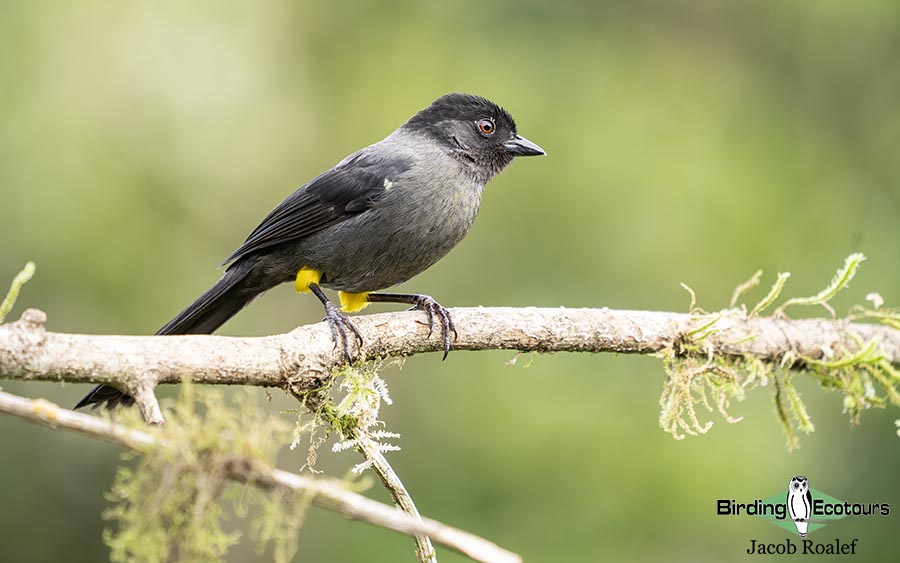
Everyone loved the yellow pants on the Yellow-thighed Brushfinch.
We headed off around 4pm and birded along the roadside where we found Collared Redstart and a Purple-throated Mountaingem which was rarity for our elevation level. It was time to wait until dusk, so we began working on our checklist when suddenly we heard several Dusky Nightjars sounding off outside the bus. We filed out in search of them, and we managed to spot them a few times in the road. We began to walk the roadside, and it wasn’t long before a Bare-shanked Screech-Owl called. We managed to track this fantastic species down and get great views of it. A successful night birding session called for some celebration at dinner and a good night’s sleep!
Day 7, 17th January 2026. Los Quetzals National Park and Cerro de la Muerte
A little pre-breakfast birding around the hotel grounds netted us a new species in the form of Scintillant Hummingbird, not a bad way to start the day. After we filled up on coffee and typical Costa Rican breakfast, we headed off to Los Quetzals National Park. We spent the next two and a half hours birding Providencia Road while the vehicle followed behind us. It was a lovely walk and soon we had a flock of Barred Parakeets flying over. Sadly, they never stopped for us to see them perched, but we did get into several nice mixed flocks which hosted Ruddy Treerunner, Buffy Tuftedcheek, Volcano Hummingbird, Black-cheeked Warbler, Mistletoe Tyrannulet, and more. We came across a lovely Timberline Wren, and after a bit of patience, we managed some great views of this challenging species. The clouds and mist began to move in towards the end of our time here, but we heard a Silvery-throated Jay just before leaving. It made a single flight across the road and then disappeared, with no luck to get it to come out again in the mist. It was time to call it and head to lunch. At Paraíso Quetzal Lodge, we enjoyed the hummingbird feeders while waiting for lunch. The stars of the show were the many Fiery-throated Hummingbirds darting around us, though Volcano and Talamanca Hummingbirds, Lesser Violetear, and White-throated Mountaingem also put on a fine display. We also spotted a Mountain Elaenia before sitting down to eat.
After eating, we enjoyed the feeders a little longer before taking a short hike downhill to the gardens here. We added a Ruddy-capped Nightingale-Thrush, along with Large-footed Finch and Black-capped Flycatcher, before packing up and heading up to the high elevation of Cerro de la Muerte. Up here there wasn’t much bird activity, however, we were mainly after one species in particular. After a bit of searching, we came across an accommodating Volcano Junco, a specialist of these high elevations. We all enjoyed this eerie looking sparrow before heading back down the mountain to our final spot of the evening. Off we went for a short sunset walk to see what we could find as we waited for dark. Things were fairly quiet until, all of a sudden, we stumbled into an excellent mixed flock. The highlight here had to be a Spangle-cheeked Tanager, but we also enjoyed Flame-colored Tanager, Blackburian Warbler, Brown-capped Vireo, and more. As darkness developed, we turned our attention to the calls of a Bare-shanked Screech-Owl. With some patience and careful planning, we managed to spotlight this incredible bird down low for epic views and photo opportunities. An absolutely priceless moment and what a way to cap off our day. It was now time to make the drive back to the lodge and catch up with a later dinner and rest.
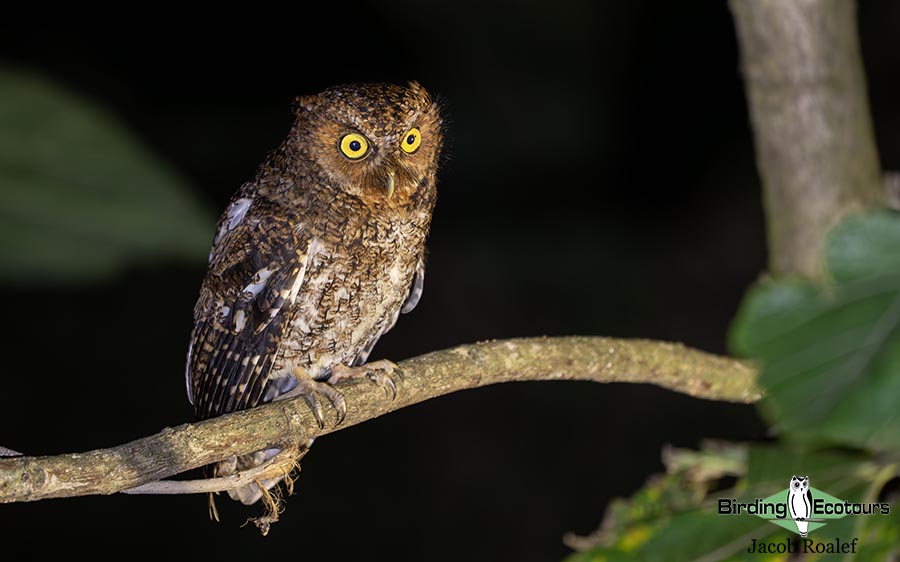
We had an incredible view of this Bare-shanked Screech-Owl.
Day 8, 18th January 2026. Los Quetzals National Park and back to San Jose
On our final full day, we decided to leave the mountains and do some birding in the lowlands outside of San Jose. The forecast didn’t look great, so our hope was to get out of the clouds, rain, and mist and enjoy some sun and hopefully new species. So, after breakfast, we checked out and headed down to a small-town square park in Paraíso. It didn’t take long to find our target here as a pair of Tropical Screech Owls were roosting, oblivious to what was going on underneath. We continued to the area around Ujarras where we found several great species like Hook-billed Kite, Green Ibis, and Rose-breasted Grosbeak. It was now time for lunch at a lovely little restaurant located right on a beautiful lake. After we ate, we explored the grounds a bit and came across a stellar mixed flock that was just loaded with birds. We birded this area for over an hour and enjoyed species such as Blue-vented Hummingbird, Golden-Olive Woodpecker, Streak-headed Woodcreeper, Cabanis’s Wren, Tropical Parula, Slaty Flowerpiercer, and more. It was finally time to make our way back through San Jose to our final hotel of the trip. Of course, we still somehow made this exciting with a Wood Stork sighting out of the window while we drove along, and a Sunbittern tucked in along a stream that crossed the road. We arrived at Hotel Robledal with enough time to check in and then investigate the property for a few minutes before dinner, which netted us a nice pair of Lineated Woodpeckers. A great cap to a nice day birding. We all enjoyed our final dinner together as we shared some of our favorite birds and moments of the trip.
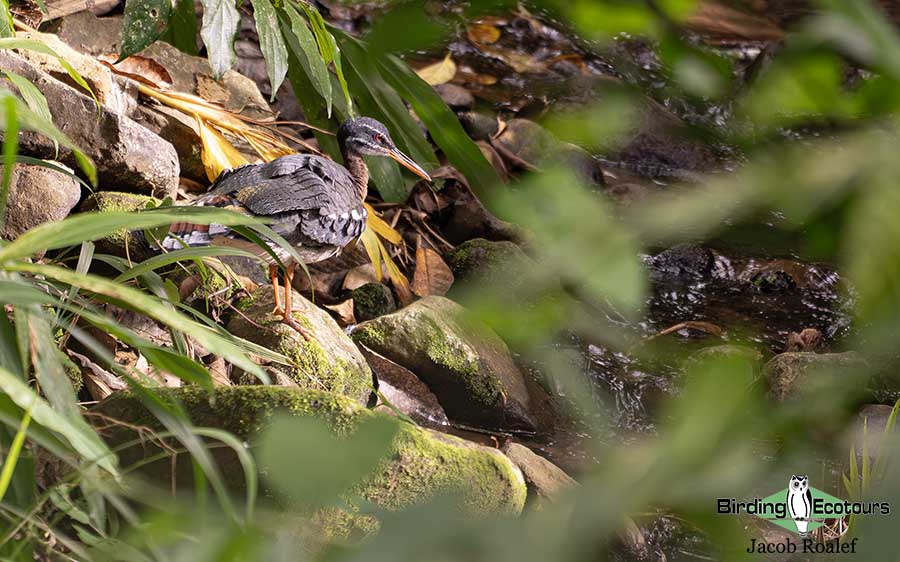
This Sunbittern was extremely well hidden along the creek edge.
Day 9, 19th January 2026. Departure from San Jose
Our trip came to a close this morning with transfers to the San Jose airport. Some of us left before breakfast, but those with slightly later flights managed to squeeze in a little last-minute birding around the grounds of Hotel Robledal. We picked up Ferruginous Pygmy-Owl and Spot-breasted Oriole to add a few more to the trip total and enjoyed some other species as well like Cinnamon-bellied Saltator, and Rufous-backed Wren. It was time to say our goodbyes after what was an amazing trip in the neotropics!
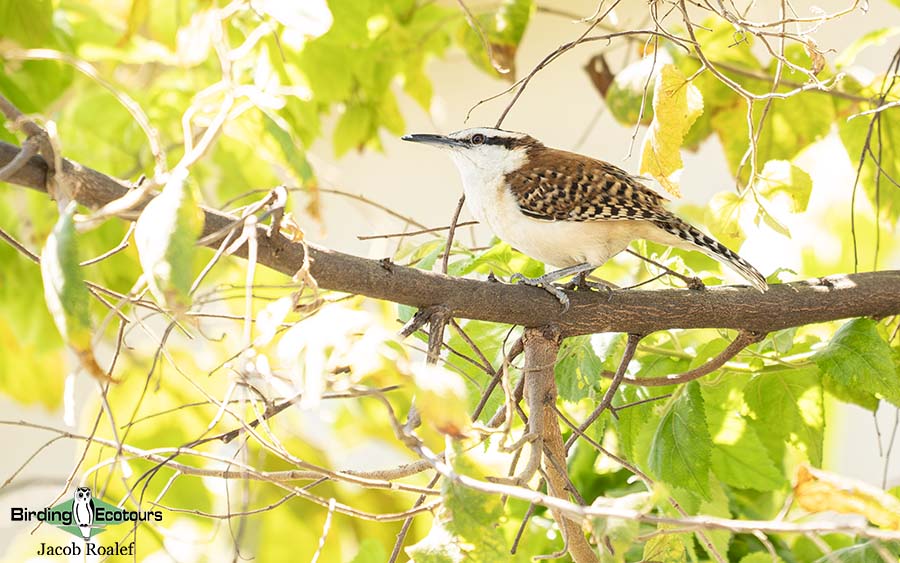
The boisterous Rufous-backed Wren is always fun to observe.
Bird List – Following IOC (15.1)
Birds ‘heard only’ are marked with (H) after the common name, all other species were seen.
The following notation after species names is used to show conservation status following BirdLife International: EN = Endangered, VU = Vulnerable.
| Common Name | Scientific Name |
| Tinamous (Tinamidae) | |
| Great Tinamou (H) | Tinamus major |
| Ducks, Geese, Swans (Anatidae) | |
| Muscovy Duck | Cairina moschata |
| Chachalacas, Curassows, Guans (Cracidae) | |
| Great Curassow | Crax rubra |
| Grey-headed Chachalaca | Ortalis cinereiceps |
| Crested Guan | Penelope purpurascens |
| Black Guan | Chamaepetes unicolor |
| Nightjars (Caprimulgidae) | |
| Pauraque | Nyctidromus albicollis |
| Dusky Nightjar (H) | Antrostomus saturatus |
| Potoos (Nyctibiidae) | |
| Great Potoo | Nyctibius grandis |
| Swifts (Apodidae) | |
| White-collared Swift | Streptoprocne zonaris |
| Grey-rumped Swift | Chaetura cinereiventris |
| Vaux’s Swift | Chaetura vauxi |
| Hummingbirds (Trochilidae) | |
| White-necked Jacobin | Florisuga mellivora |
| Band-tailed Barbthroat | Threnetes ruckeri |
| Green Hermit | Phaethornis guy |
| Long-billed Hermit | Phaethornis longirostris |
| Lesser Violetear | Colibri cyanotus |
| Purple-crowned Fairy | Heliothryx barroti |
| Green-breasted Mango | Anthracothorax prevostii |
| Green Thorntail | Discosura conversii |
| Green-crowned Brilliant | Heliodoxa jacula |
| Talamanca Hummingbird | Eugenes spectabilis |
| Fiery-throated Hummingbird | Panterpe insignis |
| White-bellied Mountaingem | Lampornis hemileucus |
| Purple-throated Mountaingem | Lampornis calolaemus |
| White-throated Mountaingem | Lampornis cinereicauda |
| Volcano Hummingbird | Selasphorus flammula |
| Scintillant Hummingbird | Selasphorus scintilla |
| Violet Sabrewing | Campylopterus hemileucurus |
| Bronze-tailed Plumeleteer | Chalybura urochrysia |
| Coppery-headed Emerald (Endemic) | Microchera cupreiceps |
| Stripe-tailed Hummingbird | Eupherusa eximia |
| Black-bellied Hummingbird | Eupherusa nigriventris |
| Scaly-breasted Hummingbird | Phaeochroa cuvierii |
| Blue-vented Hummingbird | Saucerottia hoffmanni |
| Rufous-tailed Hummingbird | Amazilia tzacatl |
| Blue-chested Hummingbird | Polyerata amabilis |
| Cuckoos (Cuculidae) | |
| Groove-billed Ani | Crotophaga sulcirostris |
| Common Squirrel-Cuckoo | Piaya cayana |
| Pigeons, Doves (Columbidae) | |
| Rock Dove (Introduced) | Columba livia |
| Scaled Pigeon | Patagioenas speciosa |
| Band-tailed Pigeon | Patagioenas fasciata |
| Pale-vented Pigeon | Patagioenas cayennensis |
| Red-billed Pigeon | Patagioenas flavirostris |
| Short-billed Pigeon | Patagioenas nigrirostris |
| Inca Dove (H) | Columbina inca |
| Ruddy Ground Dove | Columbina talpacoti |
| White-tipped Dove | Leptotila verreauxi |
| White-winged Dove | Zenaida asiatica |
| Rails, Crakes & Coots (Rallidae) | |
| Russet-naped Wood Rail | Aramides albiventris |
| Plovers (Charadriidae) | |
| Killdeer | Charadrius vociferus |
| Jacanas (Jacanidae) | |
| Northern Jacana | Jacana spinosa |
| Sandpipers, Snipes (Scolopacidae) | |
| Spotted Sandpiper | Actitis macularius |
| Sunbittern (Eurypygidae) | |
| Sunbittern | Eurypyga helias |
| Storks (Ciconiidae) | |
| Wood Stork | Mycteria americana |
| Cormorants and Shags (Phalacrocoracidae) | |
| Neotropic Cormorant | Nannopterum brasilianum |
| Ibises, Spoonbills (Threskiornithidae) | |
| Green Ibis | Mesembrinibis cayennensis |
| Herons, Egrets, and Bitterns (Ardeidae) | |
| Bare-throated Tiger Heron | Tigrisoma mexicanum |
| Fasciated Tiger Heron | Tigrisoma fasciatum |
| Boat-billed Heron (H) | Cochlearius cochlearius |
| Yellow-crowned Night Heron | Nyctanassa violacea |
| Little Blue Heron | Egretta caerulea |
| Snowy Egret | Egretta thula |
| Green Heron | Butorides virescens |
| Great Egret | Ardea alba |
| Western Cattle Egret | Ardea ibis |
| Great Blue Heron | Ardea herodias |
| New World Vultures (Cathartidae) | |
| King Vulture | Sarcoramphus papa |
| Black Vulture | Coragyps atratus |
| Turkey Vulture | Cathartes aura |
| Kites, Hawks, Eagles (Accipitridae) | |
| White-tailed Kite | Elanus leucurus |
| Hook-billed Kite | Chondrohierax uncinatus |
| Grey-headed Kite | Leptodon cayanensis |
| Double-toothed Kite | Harpagus bidentatus |
| Roadside Hawk | Rupornis magnirostris |
| Semiplumbeous Hawk | Leucopternis semiplumbeus |
| Grey Hawk | Buteo plagiatus |
| Broad-winged Hawk | Buteo platypterus |
| Short-tailed Hawk | Buteo brachyurus |
| Red-tailed Hawk | Buteo jamaicensis |
| Owls (Strigidae) | |
| Ferruginous Pygmy Owl | Glaucidium brasilianum |
| Bare-shanked Screech Owl | Megascops clarkii |
| Tropical Screech Owl | Megascops choliba |
| Middle American Screech Owl | Megascops guatemalae |
| Spectacled Owl | Pulsatrix perspicillata |
| Crested Owl | Lophostrix cristata |
| Mottled Owl | Strix virgata |
| Trogons (Trogonidae) | |
| Resplendent Quetzal | Pharomachrus mocinno |
| Slaty-tailed Trogon | Trogon massena |
| Gartered Violaceous Trogon | Trogon caligatus |
| Graceful Black-throated Trogon | Trogon tenellus |
| Kingfishers (Alcedinidae) | |
| Amazon Kingfisher | Chloroceryle amazona |
| Green Kingfisher | Chloroceryle americana |
| Ringed Kingfisher | Megaceryle torquata |
| Jacamars (Galbulidae) | |
| Rufous-tailed Jacamar | Galbula ruficauda |
| Puffbirds (Bucconidae) | |
| White-whiskered Puffbird | Malacoptila panamensis |
| Motmots (Momotidae) | |
| Lesson’s Motmot | Momotus lessonii |
| Broad-billed Motmot | Electron platyrhynchum |
| New World Barbets (Capitonidae) | |
| Red-headed Barbet | Eubucco bourcierii |
| Toucan Barbets (Semnornithidae) | |
| Prong-billed Barbet | Semnornis frantzii |
| Toucans (Ramphastidae) | |
| Blue-throated Toucanet | Aulacorhynchus caeruleogularis |
| Collared Aracari | Pteroglossus torquatus |
| Keel-billed Toucan | Ramphastos sulfuratus |
| Yellow-throated Toucan | Ramphastos ambiguus |
| Woodpeckers (Picidae) | |
| Acorn Woodpecker | Melanerpes formicivorus |
| Black-cheeked Woodpecker | Melanerpes pucherani |
| Hoffmann’s Woodpecker | Melanerpes hoffmannii |
| Yellow-bellied Sapsucker | Sphyrapicus varius |
| Hairy Woodpecker (H) | Leuconotopicus villosus |
| Rufous-winged Woodpecker | Piculus simplex |
| Golden-olive Woodpecker | Colaptes rubiginosus |
| Chestnut-colored Woodpecker | Celeus castaneus |
| Lineated Woodpecker | Dryocopus lineatus |
| Pale-billed Woodpecker | Campephilus guatemalensis |
| Caracaras, Falcons (Falconidae) | |
| Crested Caracara | Caracara plancus |
| Yellow-headed Caracara | Milvago chimachima |
| Laughing Falcon | Herpetotheres cachinnans |
| American Kestrel | Falco sparverius |
| Bat Falcon | Falco rufigularis |
| African & New World Parrots (Psittacidae) | |
| Barred Parakeet | Bolborhynchus lineola |
| Orange-chinned Parakeet | Brotogeris jugularis |
| Brown-hooded Parrot | Pyrilia haematotis |
| White-crowned Parrot | Pionus senilis |
| Red-lored Amazon | Amazona autumnalis |
| Sulphur-winged Parakeet | Pyrrhura hoffmanni |
| Mealy Amazon | Amazona farinosa |
| Olive-throated Parakeet | Eupsittula nana |
| Great Green Macaw – CR | Ara ambiguus |
| Scarlet Macaw | Ara macao |
| Finsch’s Parakeet (Crimson-fronted) | Psittacara finschi |
| Ovenbirds (Furnariidae) | |
| Plain-brown Woodcreeper | Dendrocincla fuliginosa |
| Wedge-billed Woodcreeper | Glyphorynchus spirurus |
| Streak-headed Woodcreeper | Lepidocolaptes souleyetii |
| Spot-crowned Woodcreeper | Lepidocolaptes affinis |
| Buffy Tuftedcheek | Pseudocolaptes lawrencii |
| Spotted Barbtail | Premnoplex brunnescens |
| Ruddy Treerunner | Margarornis rubiginosus |
| Antbirds (Thamnophilidae) | |
| Black-crowned Antshrike (H) | Thamnophilus atrinucha |
| Fasciated Antshrike | Cymbilaimus lineatus |
| Tapaculos (Rhinocryptidae) | |
| Silvery-fronted Tapaculo (H) | Scytalopus argentifrons |
| Tyrant Flycatchers, Calyptura (Tyrannidae) | |
| Mountain Elaenia | Elaenia frantzii |
| Yellow Tyrannulet | Capsiempis flaveola |
| Yellow-bellied Elaenia | Elaenia flavogaster |
| Torrent Tyrannulet | Serpophaga cinerea |
| Mistletoe Tyrannulet | Zimmerius parvus |
| Ochre-bellied Flycatcher | Mionectes oleagineus |
| Common Tody-Flycatcher | Todirostrum cinereum |
| Black Phoebe | Sayornis nigricans |
| Northern Tufted Flycatcher | Mitrephanes phaeocercus |
| Northern Tropical Pewee | Contopus bogotensis |
| Yellow-bellied Flycatcher | Empidonax flaviventris |
| White-throated Flycatcher | Empidonax albigularis |
| Yellowish Flycatcher | Empidonax flavescens |
| Black-capped Flycatcher | Empidonax atriceps |
| Piratic Flycatcher | Legatus leucophaius |
| Social Flycatcher | Myiozetetes similis |
| Grey-capped Flycatcher | Myiozetetes granadensis |
| Great Kiskadee | Pitangus sulphuratus |
| White-ringed Flycatcher (H) | Conopias albovittatus |
| Golden-bellied Flycatcher | Myiodynastes hemichrysus |
| Boat-billed Flycatcher | Megarynchus pitangua |
| Tropical Kingbird | Tyrannus melancholicus |
| Great Crested Flycatcher | Myiarchus crinitus |
| Bright-rumped Attila (H) | Attila spadiceus |
| Manakins (Pipridae) | |
| White-collared Manakin | Manacus candei |
| Red-capped Manakin | Ceratopipra mentalis |
| Tityras, Becards, Sharpbill (Tityridae) | |
| Black-crowned Tityra | Tityra inquisitor |
| Masked Tityra | Tityra semifasciata |
| Cinnamon Becard | Pachyramphus cinnamomeus |
| Vireos, Greenlets, Shrike-babblers (Vireonidae) | |
| Rufous-browed Peppershrike | Cyclarhis gujanensis |
| Lesser Greenlet | Pachysylvia decurtata |
| Philadelphia Vireo | Vireo philadelphicus |
| Brown-capped Vireo | Vireo leucophrys |
| Yellow-winged Vireo | Vireo carmioli |
| Crows, Jays (Corvidae) | |
| Brown Jay | Cyanocorax morio |
| Silvery-throated Jay | Cyanolyca argentigula |
| Silky-flycatchers (Ptiliogonatidae) | |
| Long-tailed Silky-flycatcher | Ptiliogonys caudatus |
| Swallows, Martins (Hirundinidae) | |
| Mangrove Swallow | Tachycineta albilinea |
| Grey-breasted Martin | Progne chalybea |
| Northern Rough-winged Swallow | Stelgidopteryx serripennis |
| Southern Rough-winged Swallow | Stelgidopteryx ruficollis |
| Blue-and-white Swallow | Pygochelidon cyanoleuca |
| Barn Swallow | Hirundo rustica |
| Wrens (Troglodytidae) | |
| Band-backed Wren | Campylorhynchus zonatus |
| Rufous-backed Wren | Campylorhynchus capistratus |
| Cabanis’s Wren | Cantorchilus modestus |
| Bay Wren | Cantorchilus nigricapillus |
| Stripe-breasted Wren | Cantorchilus thoracicus |
| Southern House Wren | Troglodytes musculus |
| Ochraceous Wren | Troglodytes ochraceus |
| Timberline Wren | Thryorchilus browni |
| White-breasted Wood Wren | Henicorhina leucosticta |
| Grey-breasted Wood Wren | Henicorhina leucophrys |
| Mockingbirds, Thrashers (Mimidae) | |
| Tropical Mockingbird | Mimus gilvus |
| Thrushes (Turdidae) | |
| Black-faced Solitaire | Myadestes melanops |
| Wood Thrush | Hylocichla mustelina |
| Slaty-backed Nightingale-Thrush | Catharus fuscater |
| Swainson’s Thrush | Catharus ustulatus |
| Black-billed Nightingale-Thrush | Catharus gracilirostris |
| Ruddy-capped Nightingale-Thrush | Catharus frantzii |
| Sooty Thrush | Turdus nigrescens |
| Mountain Thrush | Turdus plebejus |
| Clay-colored Thrush | Turdus grayi |
| Old World Sparrows, Snowfinches (Passeridae) | |
| House Sparrow (Introduced) | Passer domesticus |
| Finches, Euphonias (Fringillidae) | |
| Lesser Goldfinch | Spinus psaltria |
| Golden-browed Chlorophonia | Chlorophonia callophrys |
| Yellow-crowned Euphonia | Euphonia luteicapilla |
| Yellow-throated Euphonia | Euphonia hirundinacea |
| Olive-backed Euphonia | Euphonia gouldi |
| Tawny-capped Euphonia | Euphonia anneae |
| New World Sparrows (Passerellidae) | |
| Sooty-capped Chlorospingus | Chlorospingus pileatus |
| Common Chlorospingus | Chlorospingus flavopectus |
| Orange-billed Sparrow | Arremon aurantiirostris |
| Chestnut-capped Brushfinch | Arremon brunneinucha |
| Volcano Junco | Junco vulcani |
| Rufous-collared Sparrow | Zonotrichia capensis |
| Large-footed Finch | Pezopetes capitalis |
| White-eared Ground Sparrow | Melozone leucotis |
| White-naped Brushfinch | Atlapetes albinucha |
| Yellow-thighed Brushfinch | Atlapetes tibialis |
| Oropendolas, Orioles, Blackbirds (Icteridae) | |
| Red-breasted Meadowlark | Leistes militaris |
| Chestnut-headed Oropendola | Psarocolius wagleri |
| Montezuma Oropendola | Psarocolius montezuma |
| Baltimore Oriole | Icterus galbula |
| Red-winged Blackbird | Agelaius phoeniceus |
| Bronzed Cowbird | Molothrus aeneus |
| Melodious Blackbird | Dives dives |
| Great-tailed Grackle | Quiscalus mexicanus |
| New World Warblers (Parulidae) | |
| Louisiana Waterthrush | Parkesia motacilla |
| Black-and-white Warbler | Mniotilta varia |
| Flame-throated Warbler | Oreothlypis gutturalis |
| Tennessee Warbler | Leiothlypis peregrina |
| Kentucky Warbler | Geothlypis formosa |
| American Redstart | Setophaga ruticilla |
| Tropical Parula | Setophaga pitiayumi |
| Bay-breasted Warbler | Setophaga castanea |
| Blackburnian Warbler | Setophaga fusca |
| American Yellow Warbler | Setophaga aestiva |
| Chestnut-sided Warbler | Setophaga pensylvanica |
| Black-throated Green Warbler | Setophaga virens |
| Buff-rumped Warbler | Myiothlypis fulvicauda |
| Chestnut-capped Warbler | Basileuterus delattrii |
| Black-cheeked Warbler | Basileuterus melanogenys |
| Costa Rican Warbler | Basileuterus melanotis |
| Wilson’s Warbler | Cardellina pusilla |
| Slate-throated Whitestart | Myioborus miniatus |
| Collared Whitestart | Myioborus torquatus |
| Cardinals & Allies (Cardinalidae) | |
| Flame-colored Tanager | Piranga bidentata |
| Summer Tanager | Piranga rubra |
| Red-throated Ant Tanager | Driophlox fuscicauda |
| Rose-breasted Grosbeak | Pheucticus ludovicianus |
| Tanagers & Allies (Thraupidae) | |
| Green Honeycreeper | Chlorophanes spiza |
| Red-legged Honeycreeper | Cyanerpes cyaneus |
| Shining Honeycreeper | Cyanerpes lucidus |
| Blue Dacnis | Dacnis cayana |
| Cinnamon-bellied Saltator | Saltator grandis |
| Buff-throated Saltator | Saltator maximus |
| Bananaquit | Coereba flaveola |
| Yellow-faced Grassquit (H) | Tiaris olivaceus |
| Crimson-collared Tanager | Ramphocelus sanguinolentus |
| Scarlet-rumped Tanager | Ramphocelus passerinii |
| Variable Seedeater | Sporophila corvina |
| Thick-billed Seed Finch | Sporophila funerea |
| Slaty Flowerpiercer | Diglossa plumbea |
| Blue-black Grassquit | Volatinia jacarina |
| Blue-grey Tanager | Thraupis episcopus |
| Palm Tanager | Thraupis palmarum |
| Golden-hooded Tanager | Stilpnia larvata |
| Spangle-cheeked Tanager | Tangara dowii |
| Silver-throated Tanager | Tangara icterocephala |
| Total Seen | 261 |
| Total Heard | 9 |
| Total Recorded | 270 |
Mammal List
| Common Name | Scientific Name |
| Three-toed Sloths (Bradypodidae) | |
| Brown-throated Three-toed Sloth | Bradypus variegatus |
| Two-toed Sloths (Choloepodidae) | |
| Hoffmann’s Two-toed Sloth | Choloepus hoffmanni |
| Spider, Howler, and Woolly Monkeys (Atelidae) | |
| Mantled Howler – VU (H) | Alouatta palliata |
| Central American Spider Monkey – EN | Ateles geoffroyi |
| Cebid Monkeys (Cebidae) | |
| White-faced Capuchin – VU | Cebus capucinus |
| Agoutis and Acouchis (Dasyproctidae) | |
| Central American Agouti | Dasyprocta punctata |
| Squirrels (Sciuridae) | |
| Red-tailed Squirrel | Sciurus granatensis |
| Variegated Squirrel | Sciurus variegatoides |
| Raccoons, Coatis, and Allies (Procyonidae) | |
| White-nosed Coati | Nasua narica |
| Peccaries (Tayassuidae) | |
| Collared Peccary | Dicotyles tajacu |
| Total seen | 10 |
This is a sample trip report. Please email us ([email protected]) for more trip reports from this destination.