- Duration:
- 18 days
- Group Size:
- 4–6
- Tour Start:
- Durban
- Tour End:
- Johannesburg
Subtropical South Africa Birding Tour: Comprehensive Eastern South Africa
Details
2026
14–31 October
Per person sharing
R138,422 ZAR
$9,015 USD / £6,664 GBP / €7,771 EUR
Single supplement
R26,561 ZAR
$1,730 USD / £1,279 GBP / €1,491 EUR
This tour is full, please consider booking early for 2027.
2027
14–31 October
Per person sharing
R139,500 ZAR
$9,086 USD / £6,716 GBP / €7,831 EUR
Single supplement
R27,000 ZAR
$1,759 USD / £1,300 GBP / €1,516 EUR
2028
14–31 October
Per person sharing
R146,900 ZAR
$9,568 USD / £7,072 GBP / €8,247 EUR
Single supplement
R27,400 ZAR
$1,785 USD / £1,319 GBP / €1,538 EUR
2029
14–31 October
Per person sharing
R158,000 ZAR
$10,291 USD / £7,606 GBP / €8,869 EUR
Single supplement
R27,900 ZAR
$1,818 USD / £1,343 GBP / €1,567 EUR
Itinerary
Download ItinerarySubtropical South Africa Birding Tour: Comprehensive Eastern South Africa
This is a premium tour with open safari vehicles in Kruger and enough time to stop for mammals while accumulating a large bird list
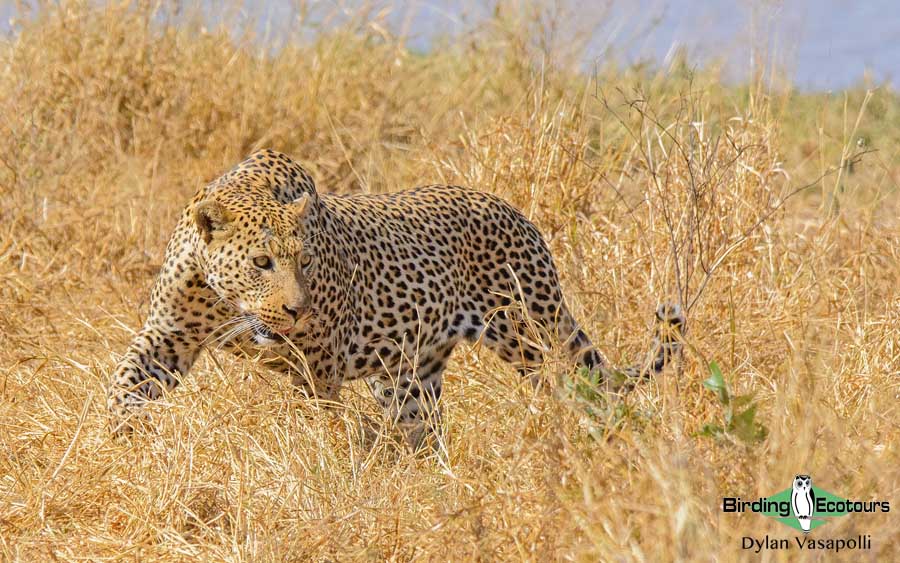
This subtropical (eastern) South Africa birding tour provides a representative sample of the very best that African birding can offer. Large numbers of species will be seen (the typical bird list for this adventure is in the range of 400 – 450 species for our October departures when migrants are present). Among these many birds, we encounter a lot of South African endemics such as the numerous localized denizens of the scenically spectacular Drakensberg Escarpment (the imposing “Barrier of Spears” as locals call it). Apart from yielding hundreds of bird species, this dream African experience also provides the possibility of seeing Lion, Cheetah, Leopard, African Elephant, White and Black Rhinoceros, Hippopotamus, Giraffe, Burchell’s Zebra, multiple antelope species, Nile Crocodile, and many other large (and small) animal species, with breathtaking scenery as a backdrop. We also often get feedback that the accommodation on this tour is great and indeed South Africa has an unsurpassed infrastructure of brilliant value B&Bs/lodges as well as good roads, compared to anywhere else in Africa.
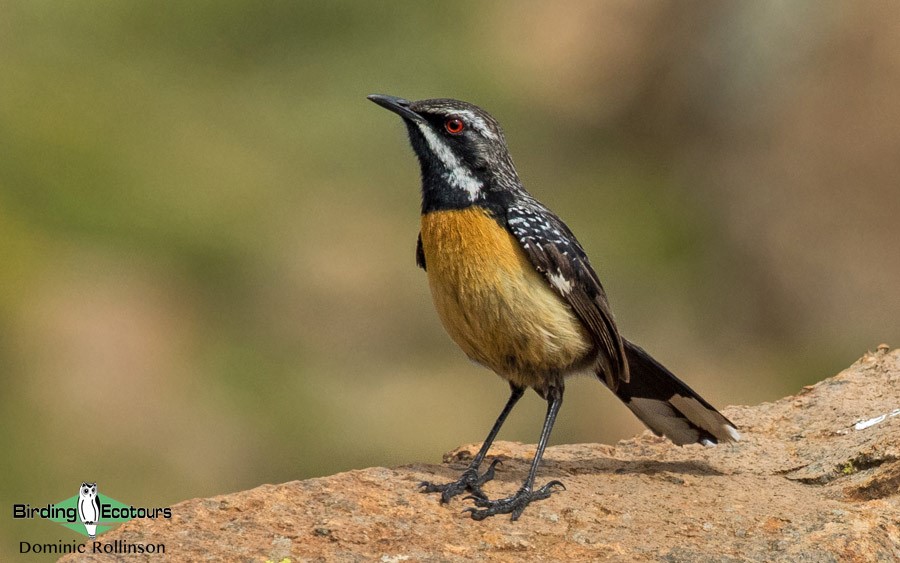 The stunning Drakensberg Rockjumper occurs only in southern Africa and is one of the most-wanted specials of this tour!
We start this birding safari with an arrival in Durban on the east coast of South Africa, bounded by the warm Indian Ocean. Durban must be one of the “birdiest” cities on earth, and here we spend time looking for subtropical coastal species. We then head inland to the KwaZulu-Natal midlands and the foothills of the spectacular Drakensberg area of the Great Escarpment, where temperate forest and high-altitude grassland birds abound. The rare Cape Parrot is one of the targets (which, interestingly, cannot be found on our Cape birding tour despite its name), as are the beautiful Green Twinspot, two dapper ground thrush species (Spotted and Orange Ground Thrushes), the dazzling Narina Trogon, the impressively beautiful Green Twinspot, and, last but not least, the Vulnerable, declining Blue Swallow (what a truly spectacular-looking hirundine!). We then ascend the heights of the Drakensberg into Lesotho via Sani Pass, an amazing road that gives access from the base of the escarpment right up to the high plateau at 10,000 feet (over 3,000 meters), with different endemics appearing as elevation increases – near the base are birds such as Bush Blackcap, then as one ascends Gurney’s Sugarbird, Ground Woodpecker, Sentinel Rock Thrush, and the shining, metallic Malachite Sunbird appear, followed eventually by high-plateau species including Drakensberg Rockjumper, Drakensberg Siskin, and Bearded Vulture (which we often see across the border in the tiny kingdom of Lesotho).
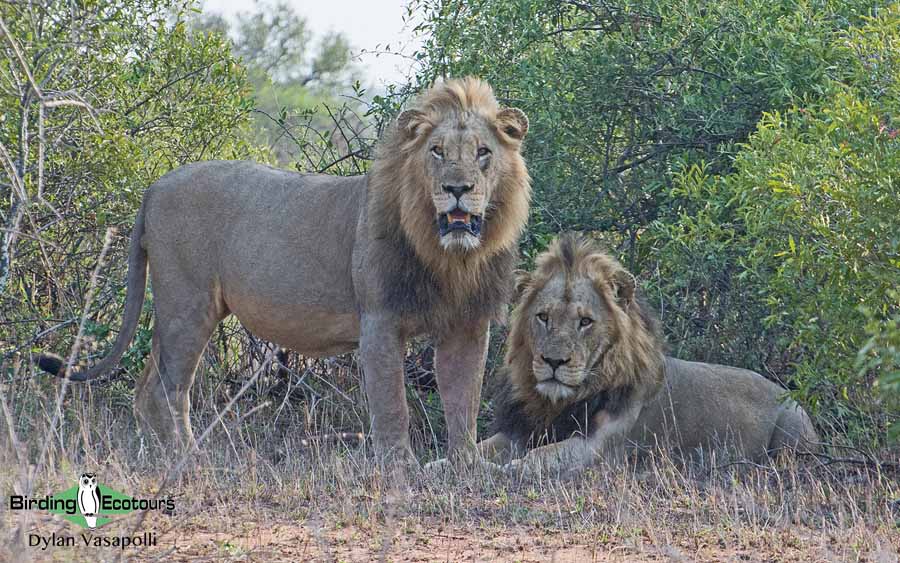 Majestic Lions, one of Africa’s most iconic mammals, should be seen on this tour!
Zululand, probably the most bird-diverse corner of South Africa, is next on our agenda, and not only does it have a great many species, but there are several very localized ones, basically only occurring here and in southern Mozambique – e.g. Pink-throated Twinspot, Lemon-breasted Canary and Neergaard’s Sunbird. This also is big mammal country and one of the world’s strongholds for Black and White Rhinoceros, is very good for Leopard, and also hosts a variety of mammals not likely to be seen in Kruger – including Samango Monkey, Nyala, the absolutely tiny Suni antelope, etc.
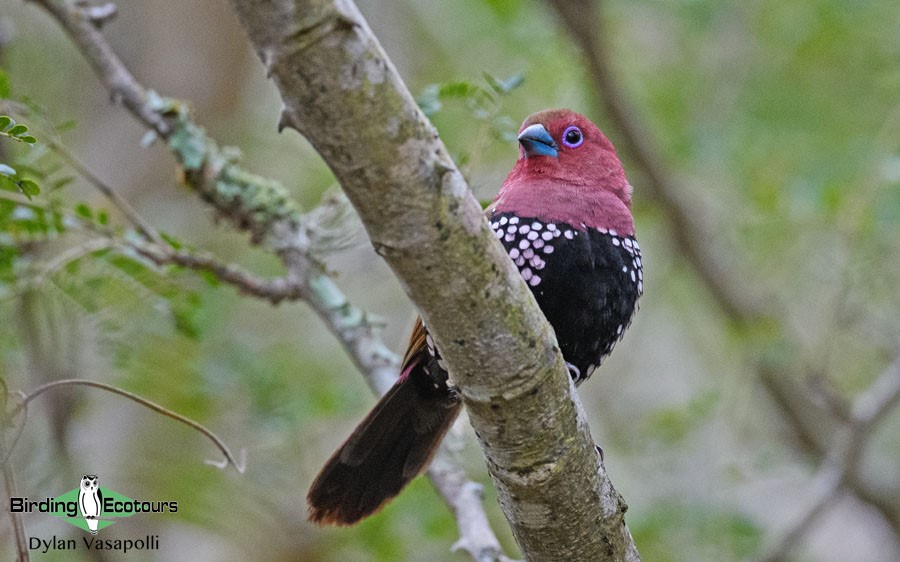 Pink-throated Twinspot is one of the specials of the Zululand region.
We then ascend to the legendary (among birders seeking endemics) Wakkerstroom highlands, and eventually we reach the Kruger National Park, one of the world’s greatest game parks, which is not only teaming with African megafauna but also has a brilliant bird list of over 500 species, many of them large and spectacular (e.g. a bunch of stork, raptor and owl species not to mention bustards and Secretarybird) or brightly-colored (e.g. all the barbets, bee-eaters, rollers, hoopoes and kingfishers): African birding is a feast for the eyes.
Before flying home out of Johannesburg, we sample an area which gives access to some Kalahari-type birds, meaning we usually add a disproportionally large number of species to our already large bird list right at the end of the trip – these include such beauties as the shockingly brightly-colored Crimson-breasted Shrike, the very striking Southern Pied Babbler, Violet-eared Waxbill, Black-cheeked Waxbill, Kalahari Scrub Robin, the amazingly beautiful Long-tailed Paradise Whydah, and a plethora of others.
We have specially crafted this unusually comprehensive birding tour of mega-diverse (from both a bird and mammal point of view) Eastern South Africa, allowing us sufficient time to adequately cover and explore all the key areas, without compromising on rushed visits which lack the time required to both find and enjoy the birds on offer. To further add to the experience, this tour uses open-top safari vehicles for the two full days in the Kruger National Park which ensures guests make the most of their time in the African bush. As always, we also err on the side of superior accommodation, and we therefore call this a “premium” tour yet the overall price is still reasonable mainly because South Africa is arguably the best value country on the entire continent.
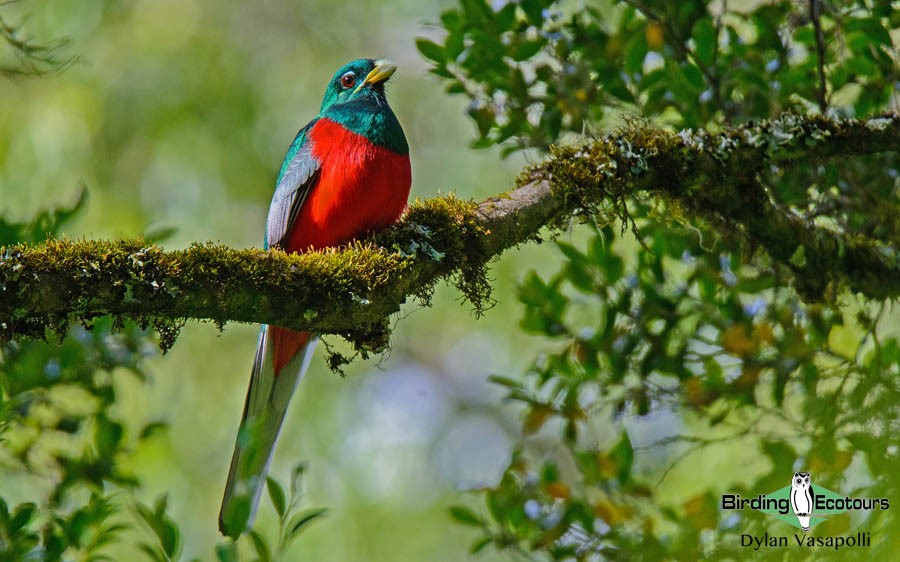 We have a number of chances to see the stunning Narina Trogon on this tour!
Our October subtropical South Africa tour each year can be combined with our preceding Best of Cape Town and Beyond – endemics, seabirds and more if you want to see a good proportion of South Africa’s birds (the Cape Town area is very different from eastern South Africa and complements it very nicely, with a different suite of endemics and other birds!). This trip can also be combined with our Namibia, Okavango and Victoria Falls Birding Adventure afterwards, which in turn can be combined with our Zimbabwe Birding Tour; if you combine all these trips you’ll definitely experience a stunning southern African mega tour that will leave you with an impressive bird list (not to mention mammals and other fauna and flora). While this subtropical South Africa trip is one of the best ones for seeing big and small African mammals (although we still markedly focus on birds, of course, but do build in enough time to stop for each mammal species we encounter as well), if you want more time in one of the world’s greatest game parks, then we should also mention an alternative, our Kruger National Park and Escarpment birding (and mammal) tour.
Itinerary (18 days/17 nights)
Day 1. Arrival in Durban and transfer to Pennington on the south coast
Your international flight (or local flight if you are joining us from our preceding Best of Cape Town and Beyond Birding Tour) arrives in Durban (King Shaka International Airport), and we transfer out of the city to a small coastal village. We kindly ask for your flight to arrive around midday (or we can book an extra night for you in Durban before the tour starts). For those joining both our Western Cape and Subtropical (Eastern) South Africa birding tours, the Birding Ecotours office will advise/help book you onto the exact domestic flight required to join these tours, so that the group can travel together.
Following your arrival, the group will have lunch locally, before undertaking a short transfer south of the city, to the small coastal village of Pennington. Here we are conveniently based right next door to the excellent Umdoni Park, which will give us a great introduction to the common birds of the area, while also providing us access to excellent coastal forest, where we can begin searching for some sought-after species. We will likely have the afternoon available to explore the trails at Umdoni Park, covering a mix of coastal forest and open woodland. Some of the more conspicuous species we’re likely to find include the gaudy Purple-crested Turaco and the bright Red-capped Robin-Chat, while we’re likely to come across a number of barbets, flycatchers, sunbirds (including the tiny Collared Sunbird) and weavers.
Overnight: Botha House, Pennington
Day 2. Pennington to Underberg, birding en route
We have the morning available to further explore the stunning subtropical coastal forests of Umdoni Park. As we will likely already have become acquainted with many of the more common species of the area, we can now focus on some of the more sought-after species occurring here, such as Crowned Eagle (Africa’s heaviest and most powerful eagle, which sometimes breeds in the park), the incredibly beautiful South African endemic Knysna Turaco, the equally dazzling Narina Trogon, the personality-filled Green Malkoha, the localized Brown Scrub Robin and the jewel-like Green Twinspot.
We will then spend the remainder of the day gradually heading deeper inland, ultimately arriving at our base in the Underberg district, set in the Drakensberg foothills, in the late afternoon. There are a variety of routes we can take to reach Underberg, however, our first stop will likely be for some forest birding where we target a range of localized specials. We will also be sure to dedicate some time today to finding the stunning Blue Swallow (the swallows have become rare in South Africa, and, depending on their recent whereabouts, we may only be able to try for them on Day 4). The dense temperate evergreen Ingeli or Xumeni Forests will also likely feature as a stop today, and here we will be able to sample our first patch of Afro-montane (mountain) forest. While these forests can be quiet at times, persistence and patience are well rewarded, and we stand excellent chances at finding some top specials, including the likes of Bush Blackcap, Orange Ground Thrush, White-starred Robin, Olive Bushshrike, Yellow-throated Woodland Warbler, Barratt’s Warbler, Swee Waxbill and Forest Canary, all of which are regular here. While Cape Parrots do occur here, they are scarce and best sought on Day 4 of this itinerary. The forest surrounds are not to be excluded, and host further excellent birding, with species such as Grey Crowned Crane, Red-chested Flufftail, African Yellow Warbler, Wailing Cisticola and the spectacular Long-tailed Widowbird all possible. Eventually we will arrive at our comfortable base in the Underberg region, where we will begin preparing for one of the most anticipated, and arguably best days of the trip tomorrow, as we bird the famous Sani Pass!
Overnight: Sani Valley Lodge, Himeville
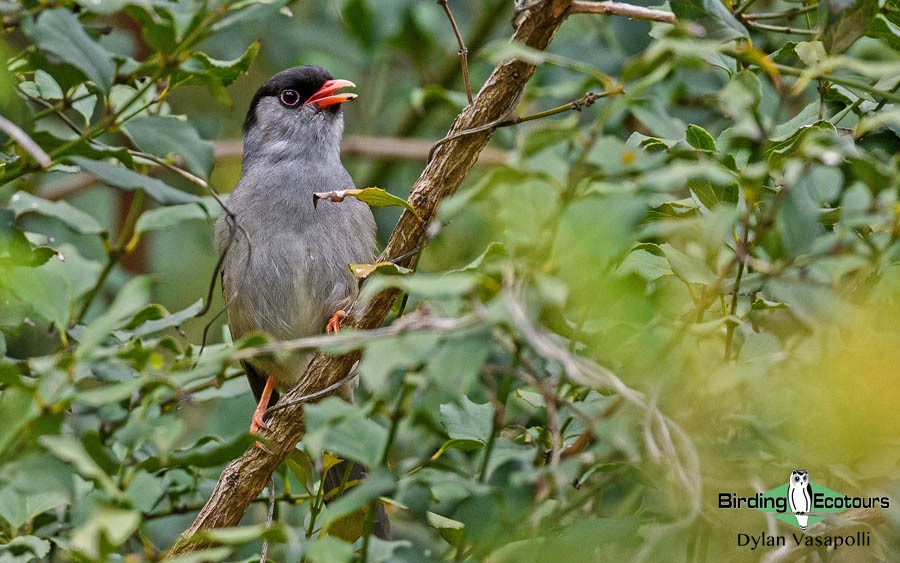 The secretive Bush Blackcap occurs in the foothills of the Drakensberg Mountains!
Day 3. Birding day trip up the Sani Pass and into Lesotho
This is one of the most spectacular birding adventures one can embark on. We spend a full day, taking along picnic breakfasts and lunches, ascending the Sani Pass and travelling into Lesotho (passports required), which gives amazing access to most of the Drakensberg endemics within the space of a single day. The “barrier of spears” (as the Drakensberg is known to locals) is impressive, to say the least, and the scenery today is amazing as we gradually ascend from the foothills up to the plateau. The birdlife changes as altitude increases with Red-necked Spurfowl, Brown-backed Honeybird, Drakensberg Prinia, Bush Blackcap (if we missed it the previous day) and Cape Grassbird occurring in the lower thickets (consisting largely of ouhout or “old wood”, a bush species that looks older than it is because of its gnarled bark). Moving into the higher ‘Protea belt’, these are replaced by Malachite Sunbird and Gurney’s Sugarbird, with a supporting cast of Grey-winged Francolin, Ground Woodpecker, Cape Rock Thrush, Buff-streaked Chat, Yellow Bishop, and if we’re lucky, the scarce Fan-tailed Grassbird (Broad-tailed Warbler) and the enigmatic Short-tailed Pipit (occurring on grassy slopes). As we reach the top of the pass and the high-altitude plateau, these birds are eventually replaced by the stunning and charismatic Drakensberg Rockjumper (arguably the most emblematic bird of the pass), Sentinel Rock Thrush, Mountain and African Rock Pipits and Drakensberg Siskin. At the top of the plateau we cross the border into the mountain kingdom of Lesotho, and will briefly explore the plains that run across this rugged landscape, where we will search for Southern Bald Ibis, and some species more typical of the Karoo region further to the west, such as Large-billed Lark, Sickle-winged Chat, Grey Tit, Layard’s Warbler (Tit-babbler), Fairy Flycatcher, Karoo Prinia and Karoo Scrub Robin. Occasionally a pair of Bearded Vulture nest nearby, and we hope to see this glorious bird up on the plateau. After a long day we eventually descend the mountain for a well-deserved dinner (and a toast to all the endemics).
Overnight: Sani Valley Lodge, Himeville
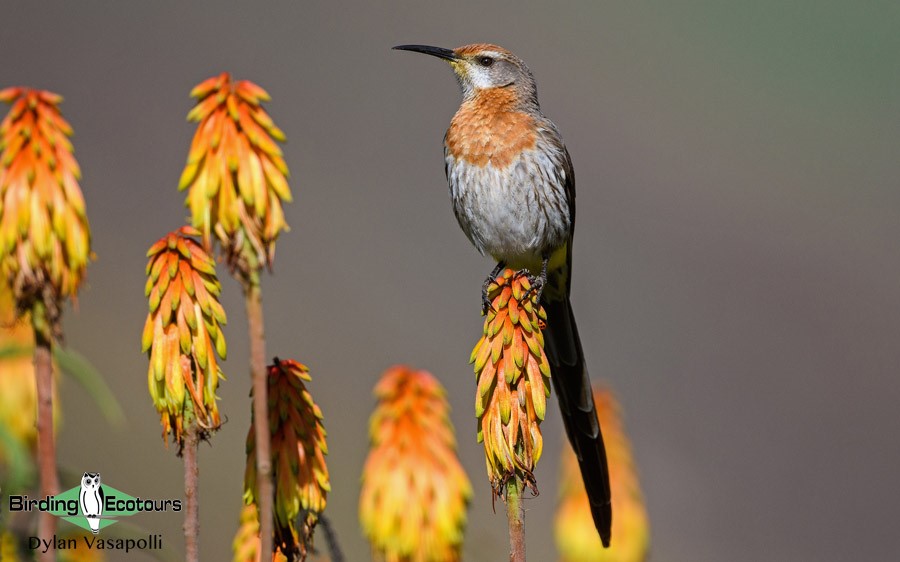 Gurney’s Sugarbird is one of many highly sought-after birds occurring in the Drakensberg!
Day 4. Birding the Underberg area, and transfer to Eshowe
We have the morning available to bird the greater Underberg region, which will likely see us visiting a variety of grassland, wetland and forest sites. The rare Wattled Crane will be one of our main targets, as they breed locally within the area, but they are nomadic and difficult to find, and we will need some luck to come across this prized bird. Cape Parrot also occur in some of the montane forest patches in the area and will be another key target for the morning. If required, we can also dedicate some time today to finding Blue Swallow. This region is a very birdy area and we’re likely to come across a great many species across the morning ranging from more widespread birds such as Levaillant’s Cisticola, Cape Weaver and Common Waxbill, to more difficult species such as Long-crested Eagle, Denham’s Bustard and Pale-crowned Cisticola. We also have further chances for a similar suite of species to those occurring in the Ingeli or Xumeni Forests (Day 2), should we have missed any of those targets. After a fulfilling morning, we will begin our drive northwards to the small village of Eshowe, where we will likely arrive in the afternoon, with an entire new suite of special birds awaiting us.
Overnight: Birds of Paradise B&B, Eshowe
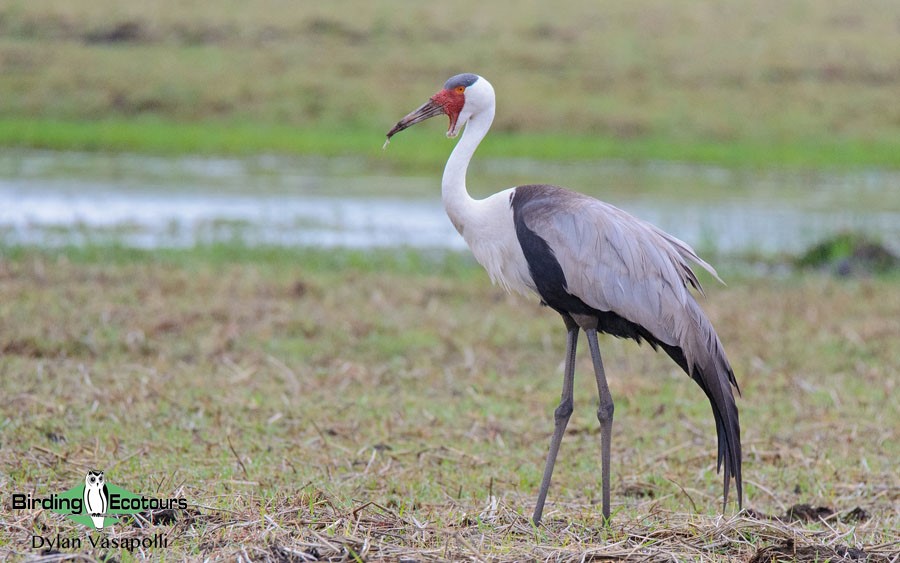 Wattled Crane is a rare species in South Africa, and will be a major target on this tour!
Day 5. Birding Eshowe and surrounds
We have a full day to explore a number of sites within Eshowe, and some lying a bit further afield, which will likely include the Dlinza Forest Aerial Boardwalk, Entumeni Forest, Ongoye Forest, and the coastal town of Mtunzini. Our day will likely start off at the Dlinza Forest, located right in the heart of Eshowe, where the secretive and highly sought-after Spotted Ground Thrush will be one of the main targets. While slowly walking the forest trails, listening for the tell-tale call of the thrushes, we are sure to come across many other birds, and in particular we’ll keep an eye out for Green Malkoha, Lemon and Tambourine Doves, Scaly-throated Honeyguide, Grey Cuckooshrike, Common Square-tailed Drongo, Chorister Robin-Chat, Dark-backed Weaver and the prized Green Twinspot. The forest also features a canopy walkway and tower, and we’ll be sure to spend time up here, as it is a great area to see the rare Eastern Bronze-naped Pigeon (although we will need some luck to see this bird), while more regular birds seen above the forest include African Goshawk, Trumpeter Hornbill, Crowned Hornbill, White-eared Barbet and Black-bellied Starling.
Entumeni Forest acts as a wonderful backup to many of these species, while also holding a small population of the highly prized African Broadbill, although as ever, some luck is needed. Ongoye Forest is a bit further afield and preserves the only southern African population of Green Barbet (with the nearest population found roughly ~1000miles/1600kilometres further north in Malawi and northern Mozambique) – this localized population being of particular interest as it’s a separate subspecies, at times split into a full species restricted to a single forest here at Ongoye! A similar suite of forest birds occurs here as in Dlinza Forest, along with the star of the show, Green Barbet.
The coastal town of Mtunzini presents us with a different, coastal, habitat set, and along with it, a different assemblage of bird species. While our core target here will be the vegetarian Palm-nut Vulture, we’re also likely to find a wide array of other species such as Woolly-necked Stork, Black-throated Wattle-eye, Rufous-winged Cisticola, Purple-banded Sunbird and Yellow-throated Longclaw, amongst many others.
Overnight: Birds of Paradise B&B, Eshowe
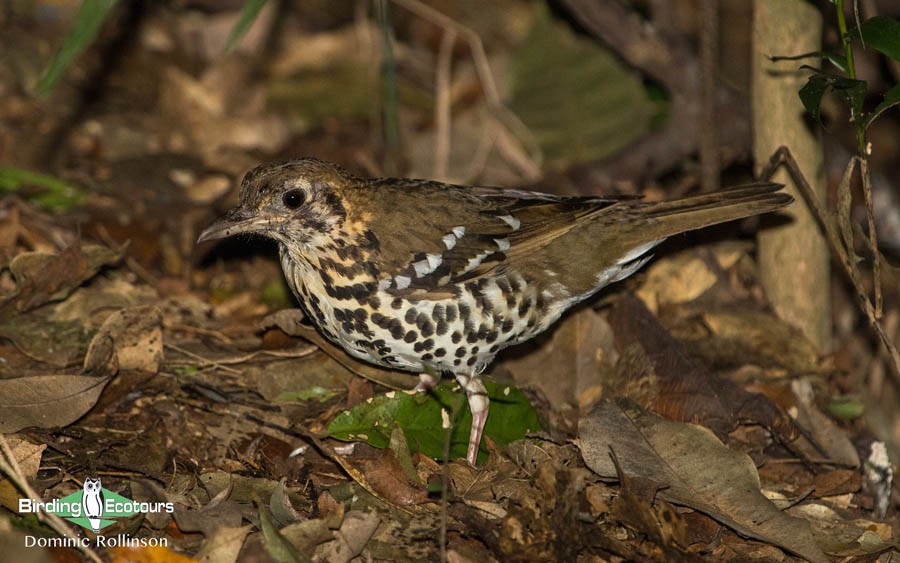 The scarce Spotted Ground Thrush is a big target while we’re based in Eshowe.
Day 6. Birding around Eshowe and transfer to St Lucia
We have the full morning available to continue birding this area, searching for any of the species we may still need, as mentioned under Day 5 above. We have a short transfer (roughly two hours) to reach our next destination – the lovely coastal village of St Lucia, where we will be based for two nights, and we will likely arrive in the early afternoon. St. Lucia is a wild place, where hippos can still roam the streets at night and Thick-tailed Galagos (Bush Babies) cry from the tree-lined main street at night. This village is completely surrounded by a World Heritage Site, the Isimangaliso Wetland Park, and is a truly phenomenal birding area. Our afternoon will likely see us investigating the estuary and the surrounding coast. Although tidal to some degree, the estuary is largely cut off from direct access to the ocean and as such doesn’t fluctuate heavily. During low-water periods, a number of shorebirds/waders occur here and we’ll be on the lookout for species such as Grey, Common Ringed and White-fronted Plovers, Eurasian Whimbrel, Ruddy Turnstone, Terek, Curlew and Marsh Sandpipers, Common Greenshank and Little Stint. Occasionally rarer species turn up, such as Bar-tailed Godwit, and Greater and Lesser Sand Plovers. There is often a large tern roost present here, and one of our main targets will be the scarce Lesser Crested Tern, while more common species include Greater Crested (Swift), Sandwich, Caspian, Common and Little Terns. The estuary area also supports an array of other waterbirds, and we’re likely to see the impressive Goliath Heron here, with a supporting cast including Grey Heron and Great and Little Egrets, while Yellow-billed Stork is regular along with Pink-backed Pelican. The impressive Saddle-billed Stork can also be seen, but is easier to find in the Kruger National Park later in the tour. Vocal African Fish Eagles are never far away, with a number of pairs breeding in the area. The reedbeds host colonies of the prized Southern Brown-throated and Eastern Golden (Yellow) Weavers. The estuary is also home to Nile Crocodiles, and quite a few pods of Hippopotamuses, some of which call the St Lucia village home, and can even be seen in the evenings walking around the town grazing on lawns!
Overnight: St Lucia Wetlands Guest House, St Lucia
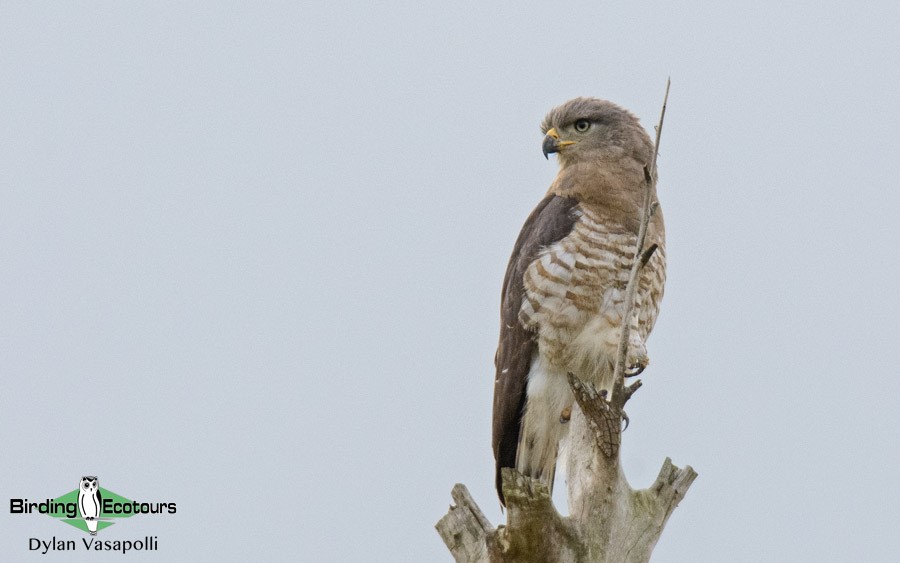 Southern Banded Snake Eagle is one of the localized, scarce species we’ll keep an eye out for around St Lucia.
Day 7. Birding the UNESCO World Heritage Site, Isimangaliso Wetland Park
We will spend the day exploring the wonderful Isimangaliso Wetland Park, which is a UNESCO World Heritage Site, and will likely spend time in both the Eastern and Western Shores section of the park. While primarily consisting of coastal grassland, patches of coastal forest occur as well, and host a fine array of unique and special birds which we’ll spend time trying to find. These include the sought-after Southern Banded Snake Eagle, the glorious Livingstone’s Turaco, Narina Trogon, Woodward’s Batis, the spectacular (but difficult-to-see) Gorgeous Bushshrike, Brown Scrub Robin, Eastern Nicator, localized Rudd’s Apalis and Grey Waxbill, among others. We won’t ignore the more open areas, as they do also host some great birds and birding; some of the species we’ll be sure to keep an eye out for include Black-bellied Bustard, Senegal Lapwing, Collared Pratincole, Croaking Cisticola, Lemon-breasted Canary, and with some luck, Rosy-throated Longclaw. A number of raptors hunt over these open areas, and it’s a great place to see a wide range of these species. These open areas also support good numbers of Swamp Nightjar, and with some birding in strategic areas after dark, we stand a good chance of finding this prized bird.
Not to be forgotten, this park also supports a wide array of mammals, and we may see such charismatic species as African Elephant, African Buffalo and Giraffe, along with antelope such as Waterbuck, Impala and the dainty Red Duiker. This is also a great area to see the scarce Blue (Samango) Monkey, while species such as Leopard and White Rhinoceros will require a bit more luck to find. This is a very birdy park, and we’re sure to rack up a high list of birds for the day.
Overnight: St Lucia Wetlands Guest House, St Lucia
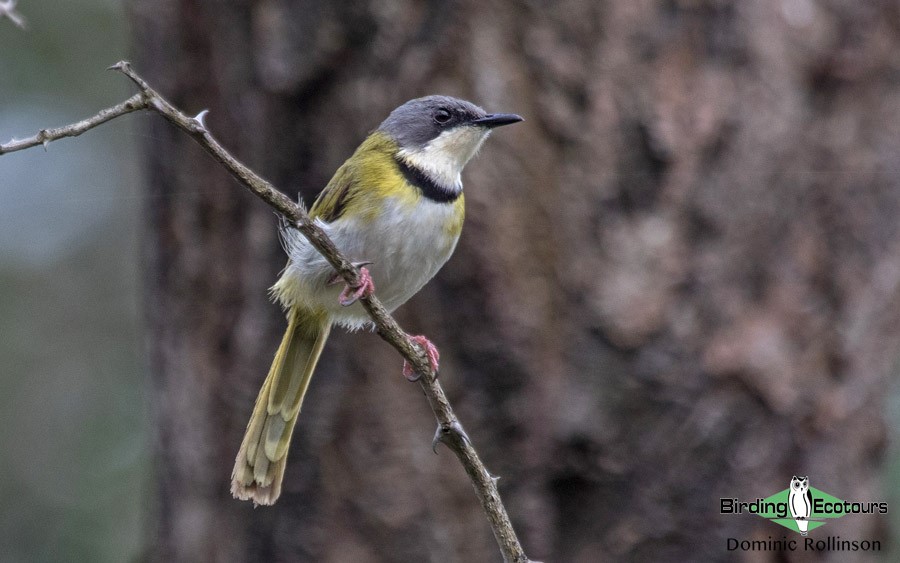 Rudd’s Apalis is another Zululand specialty we should get whilst traversing the region!
Day 8. Birding St Lucia and transfer to Hluhluwe
We have the morning available to bird around the village, and in particular, along the lovely iGwalagwala Trail, which passes through some excellent coastal forest. Although we should have seen many of these specials the previous day, it serves as an excellent backup for species we could have missed, including some very localized birds like Livingstone’s Turaco, Woodward’s Batis, Brown Scrub Robin, Rudd’s Apalis and Grey Waxbill, while also offering chances for species such as Buff-spotted Flufftail (with some luck and patience), Green Malkoha, Blue-mantled Crested Flycatcher, Yellow-bellied Greenbul, Terrestrial Brownbul and others. Strange-looking Crested Guineafowl are a common sight around the village as well and are sure to keep us entertained.
We have another short transfer (also roughly two hours) to get to the Hluhluwe area, where we’ll be based for two days, as we explore the mega-diverse but compact Mkhuze Game Reserve and surrounds. This is arguably one of the finest birding sites in southern Africa and certainly has a legendary status. We’ll likely arrive at our comfortable lodge in the early afternoon, and may explore some of the surrounding open areas, such as Mpempe Pan or the Nibela Peninsula this afternoon still. The birding here can be excellent, and some of the species we’re likely to see include Black-winged and Senegal Lapwings (sometimes offering great comparative views of these similar birds, both of them scarce and local), Collared Pratincole, Grey-rumped Swallow, all three locally occurring Longclaws (Cape, Yellow-throated and Rosy-throated), and the highly range-restricted Lemon-breasted Canary. A wide array of ducks, geese, herons, egrets and other waterbirds can also be seen here.
Our lodge itself also hosts some excellent birding and we’re likely to become acquainted with a number of sand forest specials here (sand forest is a delightful, localized habitat typical of Zululand and southern Mozambique, and contains some top birds). The highly sought-after Pink-throated Twinspot occurs commonly around the lodge and will be one of our main targets here. A number of other sought-after birds, which we may not yet have seen, are possible here as well, including Green Malkoha, Red-fronted Tinkerbird, Rudd’s Apalis, Eastern Nicator, Bearded Scrub Robin, White-throated Robin-Chat and Purple-banded Sunbird. More widespread species found here include a wide array of cuckoos, including African Emerald-, Klaas’s, Red-chested and Black, Striped Kingfisher, Orange-breasted Bushshrike, Black-crowned Tchagra, Black Cuckooshrike, Southern Black Tit, Violet-backed Starling, Pale Flycatcher, Scarlet-chested Sunbird and Golden-breasted Bunting, amongst others. Noisy Thick-tailed Greater Galagos (Bushbaby) wake up in the evenings, and can often be seen around the lodge. We’ll enjoy a good evening meal, in preparation for another excellent day in the heart of Zululand.
Overnight: Umkhumbi Lodge, Hluhluwe
Day 9. Birding Mkhuze Game Reserve and surrounds
We will undertake a day trip into the nearby Mkhuze Game Reserve (armed with picnic breakfast and lunch). This tiny reserve is one of the premier birding sites in the country. One is only allowed out of the van in designated areas (because of the presence of dangerous African megafauna), and so we will focus our birding on the excellent hides (and walkways to them), picnic sites and around the rest camp, where we are free to get out and walk around. This incredible reserve has a wide array of habitats, ranging from bushveld through to sand forest, and open wetlands, and we’ll explore all of these habitats during our day. The sand forest is home to our main targets, which will include the likes of Pink-throated Twinspot (if not seen previously), Neergaard’s Sunbird and Gorgeous Bushshrike, among other prized birds such as Rudd’s Apalis, African Pygmy Kingfisher, Red-fronted Tinkerbird, the diminutive Grey Penduline Tit, Eastern Nicator, the attractive Stierling’s Wren-Warbler and Dusky Indigobird. The large Nsumo Pan also offers excellent birding, supporting a wide array of waterbirds, and depending on the water levels at the time, the pan supports one of the only breeding colonies of Pink-backed Pelicans in South Africa. Other species to be found here include the likes of the sought-after African Pygmy Goose and African Openbill while more regular birds include White-faced Whistling Duck, Black Crake, Water Thick-knee, African Jacana, Whiskered Tern, African Spoonbill, Squacco and Black Herons and Pied Kingfisher. The trees on the edge of the pan support the dazzling Broad-billed Roller, along with an array of woodpeckers, kingfishers, barbets, honeyguides, bushshrikes, flycatchers, robins, sunbirds and weavers. Pel’s Fishing Owl do occur in the area, but are nomadic and very rarely seen, and are more reliable on our tour to the Okavango Delta in Botswana/northern Namibia.
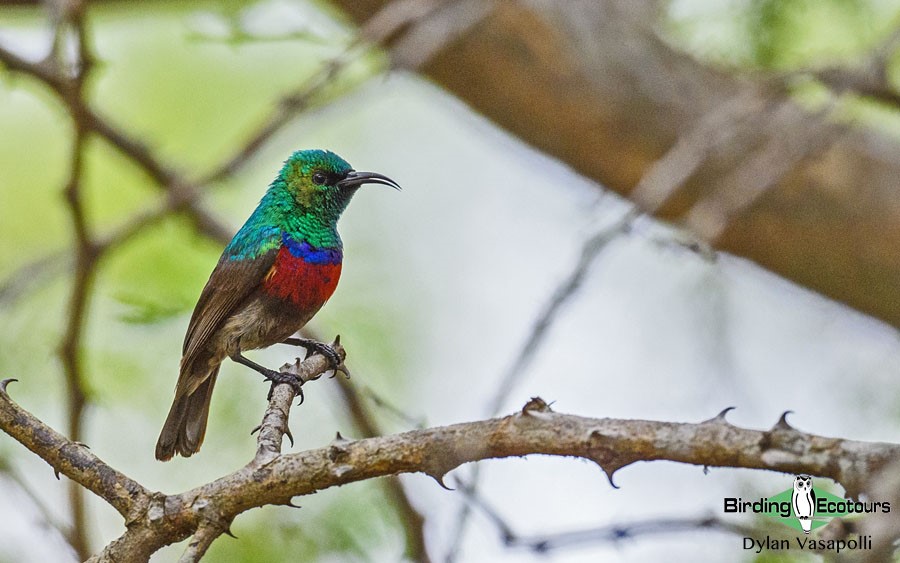 The rare Neergaard’s Sunbird is one of the top targets of Mkhuze, and indeed the tour!
The park will also allow us to increase our raptor list, being an excellent area for some of the more iconic bushveld species such as Bateleur and Martial Eagle, while White-backed Vultures are never far away. The bushveld areas are not to be ignored, and are home to species such as Common Scimitarbill, Southern Yellow-billed Hornbill, Lilac-breasted Roller, Chinspot Batis, Brubru, Sabota Lark, Long-billed Crombec, Burnt-necked Eremomela, Red-billed Oxpecker (often catching a ride on large mammals), Kurrichane Thrush, Blue Waxbill and Green-winged Pytilia, among others.
In addition to all these excellent birds, Mkhuze also offers a wide selection of mammals including the full complement of big game species. While mammals such as Lion, Cheetah, African Wild Dog, Leopard, African Elephant and Black and White Rhinoceros occur, they are scarce and we’ll need some luck to find these. More commonly seen species include an array of antelope, including the spectacular Nyala, along with Greater Kudu and the ever-charismatic Plains Zebra. The diminutive Suni antelope can also be seen in the sand forest.
This is sure to be an excellent day, with a high number of birds and mammals seen. We’ll return to our comfortable lodge for a well-deserved dinner later in the afternoon.
Overnight: Umkhumbi Lodge, Hluhluwe
Day 10. Birding Hluhluwe and transfer to Wakkerstroom
We have the morning available to bird the excellent grounds of our lodge, or some other nearby areas, such as False Bay Nature Reserve, should any target species still be outstanding – these may include the likes of the difficult African Broadbill and Neergaard’s Sunbird. We’ll then begin the fairly long drive (4 hours+), to get to our next destination, Wakkerstroom, set in the montane grassland belt at high altitude. This is another one of the premier birding destinations in the country, and is a must for any world birder, as it hosts a number of prized endemic birds. Wakkerstroom is a lovely, quaint and charmingly small village located along the Drakensberg escarpment, and as such is fairly high in elevation (only just below 6500ft/2000m). We will likely only arrive in the afternoon and may begin exploring the area slightly lower in elevation located to the east of the town. Here, a number of species not regularly seen in the immediate vicinity of the town can be seen and include the likes of the curious southern African race of White-bellied Bustard (known locally as Barrow’s Korhaan, split by some authorities), and Cloud Cisticola. We’re also sure to get our eye in on some of the other more widespread grassland species occurring in the area, such as Swainson’s Spurfowl, Cape Crow, Spike-heeled and Red-capped Larks, South African Cliff Swallow, Banded Martin, Cape Grassbird, Pied Starling, Ant-eating Chat, Capped Wheatear, Red-collared Widowbird, Cape Longclaw and Cape Canary, amongst others.
Overnight: Forellenhof Guest Farm, Wakkerstroom
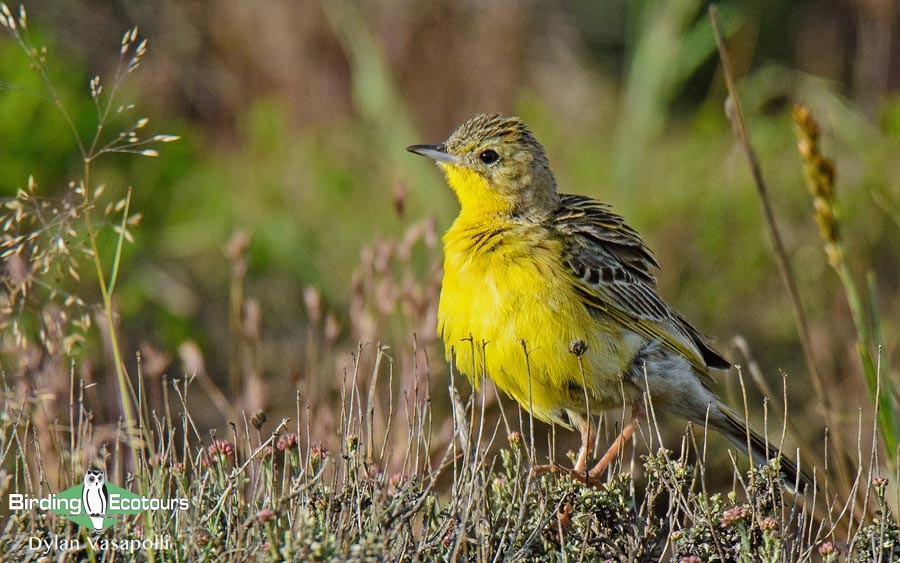 The highly sought-after endemic Yellow-breasted Pipit can be seen around Wakkerstroom!
Day 11. Birding the Wakkerstroom area
We will have a full day of birding the upland grasslands and wetlands surrounding Wakkerstroom, and we usually make use of a local guide. Our day will center around the three ‘big’ targets of the Wakkerstroom area – Rudd’s and Botha’s Larks and Yellow-breasted Pipit. These endemic species are all rare and localized, with the grasslands around Wakkerstroom proving one of the few and only reliable locations to find these prized species. The entire area is particularly species-rich with many of the following likely: Red-winged and Grey-winged Francolins, Southern Bald Ibis, Denham’s Bustard, Blue Korhaan, Eastern Long-billed, Pink-billed and Eastern Clapper Larks, Pale-crowned and Wing-snapping Cisticolas, Nicholson’s Pipit and Cape Bunting. The wetlands in the area are home to a number of birds, and amongst others we will search for White-backed and Maccoa Ducks, African Rail, Red-chested Flufftail (with some patience), African Snipe and Little Bittern. Aside from these, many other more widespread grassland species feature here, from Blue and Grey Crowned Cranes, to a variety of raptors, cisticolas, larks, widowbirds, weavers and more. Areas of woodland line some of the ravines and valleys, and these provide us with further species such as Red-throated Wryneck, Bokmakierie, Lazy Cisticola, Drakensberg Prinia, along with Bush Blackcap and Barratt’s Warbler in the wooded areas. We will also be sure to keep our eyes to the sky for raptors such as the tricky Rufous-breasted Sparrowhawk, along with Black Sparrowhawk, and African Marsh and Black Harriers. This is also a great area for aerial feeders (swifts, swallows and martins), and we’ll also keep an eye out for the tricky Horus Swift, along with Alpine and African Black Swifts.
While few of Africa’s larger mammals are found here, this area is a great place to find smaller mammal species such as the charming Meerkat as well as Yellow Mongoose and Common Duiker. After dark, we can also try for Marsh Owl, and if we’re lucky, the rare African Grass Owl.
Overnight: Forellenhof Guest Farm, Wakkerstroom
Day 12. Birding Wakkerstroom, and transfer to the Kruger National Park
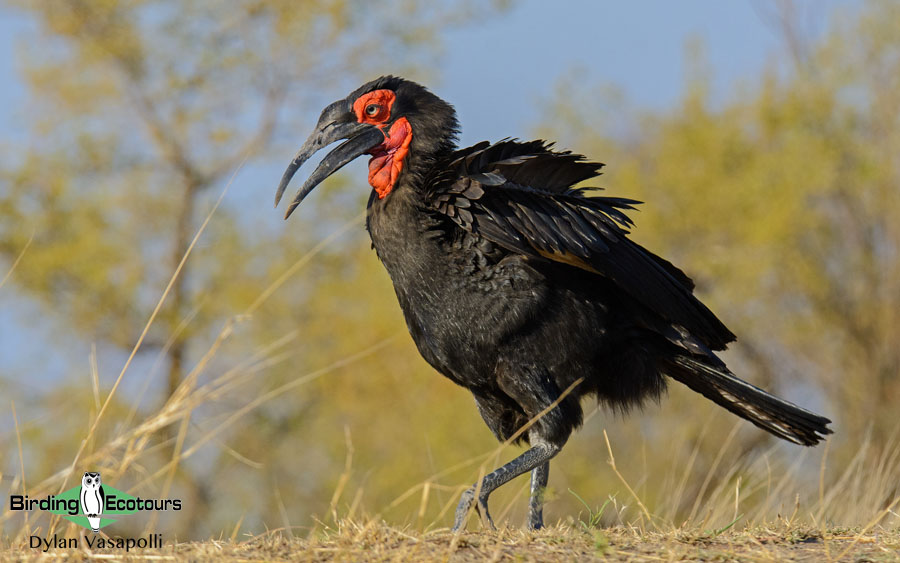
We have the morning available to try for any highland birds we may still be missing, before having to gather our things and set off to our next destination. We have arguably the longest drive of the trip today (roughly 6 hours), but the reward is that we’ll eventually arrive in one of Africa’s greatest game parks – the Kruger National Park. We will spend three nights in this great park attempting to find as many of the birds and mammals mentioned below as possible, along with enjoying a great safari experience. The mammal and bird diversity here is nothing short of staggering. African Elephant, Hippopotamus, Lion, Leopard, Cheetah, African Wild Dog (now extremely rare but regularly sighted in the park), both White and Black Rhinoceros, Giraffe, and a stack of antelopes and smaller mammals will all be sought. Nile Crocodile is quite common in many of the park’s waterbodies. The park is absolutely full of birds as well, including a mega-diversity of raptors (ranging from the tiny Little Sparrowhawk to the massive Lappet-faced Vulture, and a great many in between), an array of storks, the most admired being Saddle-billed Stork, while on the other end of the spectrum ‘the undertaker’ Marabou Stork, and other large birds such as Southern Ground Hornbill. Indeed, the raptors and other large birds thrive here, as there is such a vast amount of conserved and wild land, allowing them to breed largely away from human disturbance – making this a stronghold for these species in South Africa. A great many other species occur, and include a number of francolins, cuckoos, hornbills, rollers, mousebirds, kingfishers, bee-eaters, woodpeckers, bushshrikes, flycatchers, robin-chats, starlings, waxbills, firefinches, canaries and buntings. The diversity of birds and mammals in the park has to be seen to be believed, and we will accumulate a long list of species during our stay in the park.
Overnight: Skukuza lodging, Kruger National Park (or similar)
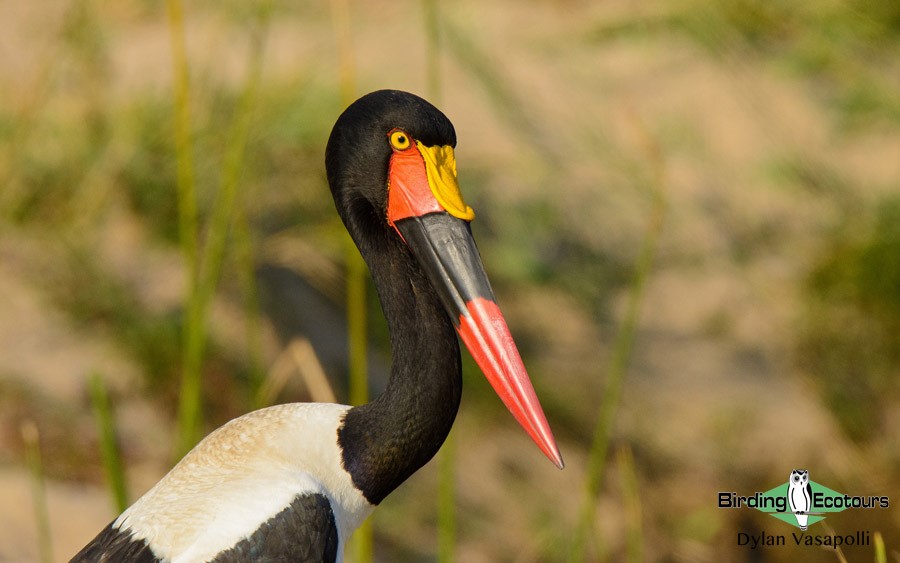 Kruger is home to a vast array of birds as well, including the Saddle-billed Stork!
Days 13 – 14. Birding the Kruger National Park
Making use of open-top safari vehicles, ideal for bird and game viewing in Kruger, we have two full days to explore the southern areas of this iconic park. Our exact routes may vary depending on which rest camp(s) we stay at, but we stand good chances at finding most of the above-mentioned (Day 12) species. We will also have the opportunity to undertake optional night drives (at your own cost), which can produce some of the scarcer nocturnal birds, such as Bronze-winged Courser and Verreaux’s Eagle-Owl, and mammals such as African Civet, South African Large-spotted Genet and perhaps even Serval.
Overnight: Skukuza lodging, Kruger National Park (or similar)
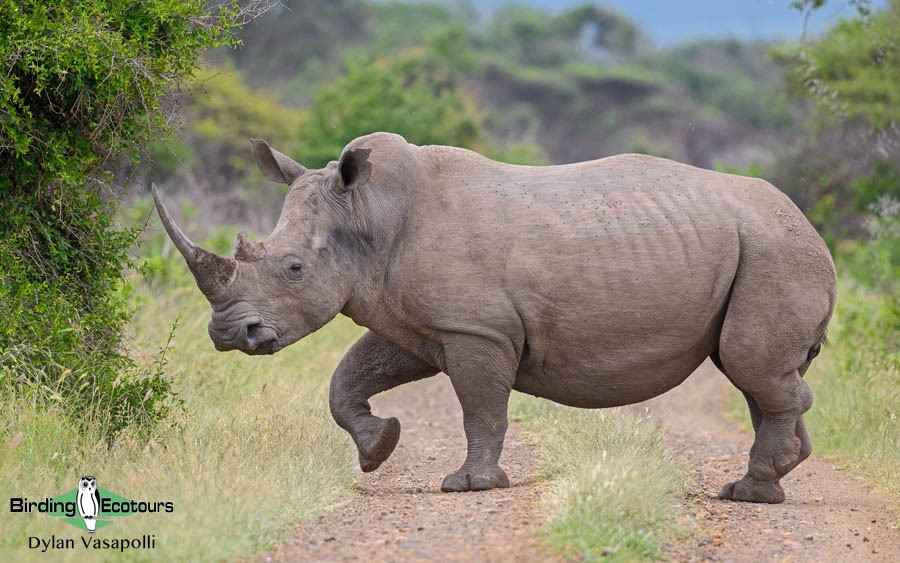 Whilst in Kruger, mammals, such as this White Rhinoceros, are major targets!
Day 15. Birding Kruger, with a transfer to Dullstroom
We have our final morning available to spend within Kruger, before having to exit this wonderful area, and continue onto our next destination, that being Dullstroom, located in the highlands of the northern Drakensberg escarpment. The drive will likely be around 3 hours and should see us arriving with time to spare in the afternoon, where we’ll check into our very comfortable lodge and acquaint ourselves with the area and some of its birds. Dullstroom is a small, charming village which plays host to a number of specials which we’ll be targeting during our time here. Foremost amongst these is the rare Cape Eagle-Owl, which we will attempt to track down this evening.
Overnight: Linger Longer Country Retreat, Dullstroom
Day 16. Birding Dullstroom, and transfer to Rust de Winter
We have the morning available for some final birding around Dullstroom and surrounds. We usually focus our efforts on the nearby Verloren Vallei Nature Reserve, which hosts some of the most pristine montane grassland in the area. While we should have seen many of the species occurring here previously on the trip in the other highland areas (Wakkerstroom and Sani Pass), this stunning area offers us an excellent backup for a number of scarce and prized birds, such as Wattled Crane, Secretarybird, Denham’s Bustard, Red-winged Francolin, Southern Bald Ibis, Black-winged Lapwing, Gurney’s Sugarbird, Eastern Long-billed Lark and Yellow-breasted Pipit.
We will eventually make our way onwards to our final destination, Rust de Winter, and have a relatively lengthy transfer (roughly 4 hours) to get here. We will likely take an ‘off-the-beaten-path’ route to get here, visiting some of the superb mixed broad-leafed woodlands north-east of Pretoria, which support some localized and scarce species. Here we can search for Shelley’s Francolin, Melodious and Fawn-colored Larks, Green-capped Eremomela, Short-toed Rock Thrush, Tinkling Cisticola, Bushveld Pipit and Red-headed Weaver. If conditions are right, we may also be able to find the incredibly difficult White-backed Night Heron and Half-collared Kingfisher. We will eventually arrive at our comfortable lodge located in the Rust de Winter district in the late afternoon.
Overnight: Golden Impalas Bush Resort, Dinokeng Game Reserve
Day 17. Birding Zaagkuilsdrift, Kgomo-Kgomo and Rust de Winter
We will spend the last full day of the tour birding the rich “acacia”-dominated savannas and other habitats of the area. We usually focus our efforts on the superb Zaagkuilsdrift Road, which offers a great transect through this habitat, and puts us in an excellent position to find some of the many more typical Kalahari edge type species that occur here. The road continues on for a while through bird-rich savannah before arriving at a floodplain, which also hosts some excellent species, but birding here is very much dependent on the conditions (usually dry on our October tours). This is another of the country’s premier birding sites, with a huge diversity of birds, and we’re sure to build up an extensive list of species. Some of the Kalahari-type birds we’ll try for include Northern Black Korhaan, Crimson-breasted Shrike, Southern Pied Babbler, Kalahari Scrub Robin, Barred Wren-Warbler, Chestnut-vented Warbler (Tit-babbler), Cape Penduline Tit, Burnt-necked Eremomela, Marico Flycatcher, Violet-eared and Black-faced Waxbills, Great Sparrow, Cut-throat Finch, Scaly-feathered Weaver (Finch), White-browed Sparrow-Weaver, Shaft-tailed Whydah and Yellow Canary. These are just a few of the many birds occurring in the thornveld, and the usually dry (at this time of the year) and open lands around the floodplain can support interesting birds such as Temminck’s Courser and Caspian Plover.
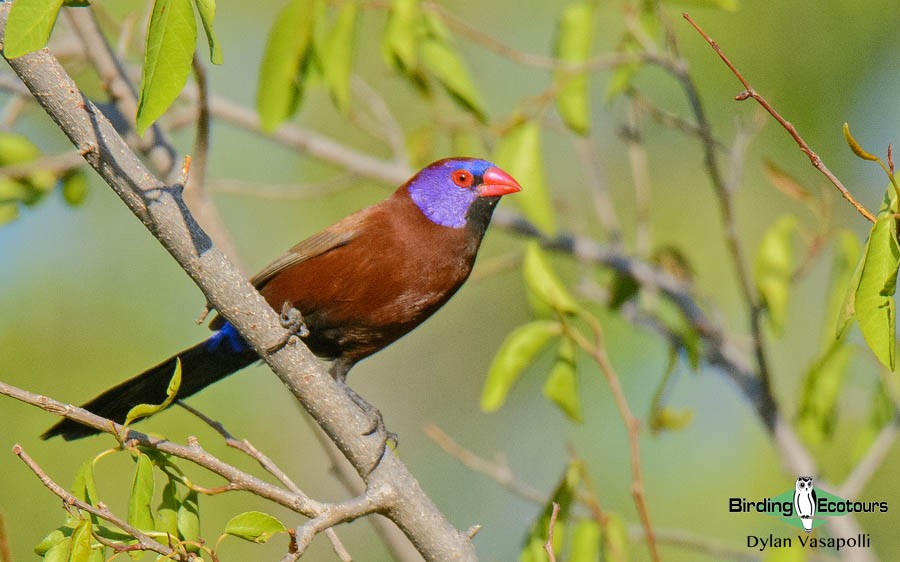 The stunning Violet-eared Waxbill is one of the specials of the Zaagkuildrift area!
The nearby Rust de Winter area supports a similar suite of birds to those mentioned above. This is also a great area to get to grips with owls, and some dedicated nocturnal searching may produce the likes of Western Barn, Southern White-faced and African Scops Owls, while the larger Spotted and Verreaux’s Eagle-Owls do occur in the area as well. The dainty and partly diurnal Pearl-spotted Owlet is ever-present too, sometimes surrounded by a host of passerines mobbing it (which is useful to us as it means we can accumulate a lot of bird species fast!). We’ll eventually settle in for our last dinner together, reminiscing about all the excellent birds we’ve experienced over the course of this tour.
Overnight: Golden Impalas Bush Resort, Dinokeng Game Reserve
Day 18. Transfer to Johannesburg and departure
We have the morning available to bird and explore the surrounds at our leisure, and being no more than 2 hours away from the main Johannesburg Airport (OR Tambo International Airport), we do not have very far to travel today. The tour will conclude at the airport later in the day.
We kindly ask that you book your international flight to depart after 3 p.m. today.
Please note that the itinerary cannot be guaranteed as it is only a rough guide and can be changed (usually slightly) due to factors such as availability of accommodation, updated information on the state of accommodation, roads, or birding sites, the discretion of the guides and other factors. In addition, we sometimes have to use a different guide from the one advertised due to tour scheduling, or other factors.
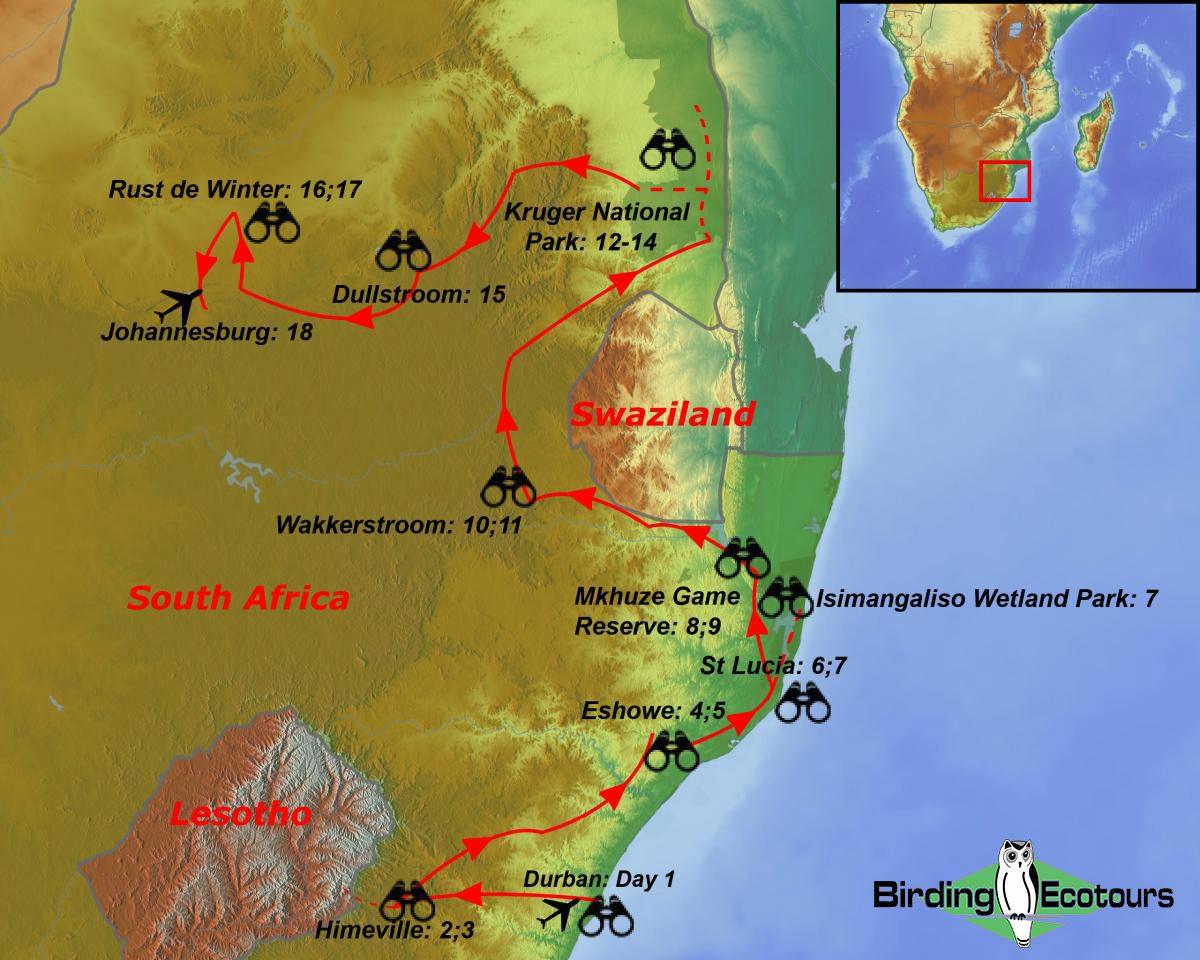
Map
Testimonials
Gallery
General Information
SUBTROPICAL SOUTH AFRICA BIRDING TOUR
TOUR-SPECIFIC INFORMATION
GENERAL INFORMATION ABOUT SOUTH AFRICA CAN BE READ HERE
TOUR OUTLINE
This 18-day subtropical South Africa birding tour gives you the opportunity to see a great many South African endemics and near-endemics while also giving you a thoroughly enjoyable safari experience (in Kruger National Park) where we could see exciting large game species, such as Lion, Leopard and African Elephant. This tour takes you from the KwaZulu-Natal coast to the heights of the Drakensberg Mountains, to the rich lowlands of Zululand, northwards to the world-famous Kruger National Park and finally to a drier bushveld area north of Johannesburg where we encounter several Kalahari bird specials.
PACE OF TOUR
This South African birding tour is a lengthy tour which may be tiring at times. In particular, this tour takes place in the spring/early summer period and as such our days are usually long and full, and we are constantly looking for new birds every day (this productive tour usually yields 400-450 bird species). This is an intense and fast-paced tour.
To ensure we take advantage of the early morning peak in bird activity, we will often leave the accommodation armed with simple (but adequate) breakfast packs, however, we will still likely enjoy a few delicious sit-down breakfasts on this tour. Similarly, lunches will often involve lunch packs, or simpler sandwiches/wraps which we eat while out birding (usually enjoying a picnic lunch) rather than a large sit-down meal. Occasionally, brunch is a better option, and this is likely as well. A range of snacks is usually available to participants. We do this so that we do not waste large amounts of time during the day when we could otherwise be out birding. Although these meals may be simpler, we will always ensure you are well fed so that you do not go hungry. Dinner is usually the main meal of the day, and will of course be a sit-down meal and are generally of a good standard.
It is possible to opt out of some activities, such as various morning and afternoon excursions. On some days, however, this won’t be possible (please do ask your tour leader for specifics).
There will be the option for night birding excursions on this birding tour, however, (as with most of our birding excursions) these trips are not mandatory and we strongly recommend sitting out if you are finding the tour too tiring. Guided night drives are possible to book in Kruger National Park (where we are not allowed to drive around at night), however, these would be at your own expense and are only booked on the tour itself.
We generally ensure that we do have some meaningful down-time regularly on the tour, particularly on our non-travel days, while on the days when we travel between accommodation, there is less time for down-time (as this is otherwise spent traveling between destinations).
The guide discusses the daily plan with the group in detail each evening. Note that we do retain a sense of flexibility within reason, to allow for us to better maximize your birding experience.
WALKING AND STYLE OF BIRDING
The tour is generally considered ‘easy’ in terms of physical exertion. It does not involve a great deal of walking, or many prolonged periods of time where we will be walking/standing/on our feet. Any walks that we do are generally less than two miles (3.2 kilometers), and usually under three hours in length.
- The notable exception is a roughly two-mile (~3.5 kilometer) walk (round-trip, some of which is uphill) at 6,500 feet (2,000 meters) altitude when we go look for Rudd’s Lark near Wakkerstroom.
- We will also walk around at altitude (maximum 10,000 feet/3,200 meters) in the Drakensberg, however these walks are usually very quick and short, and we are never far from our vehicles.
For large portions of the trip most of the birding is vehicle-based, where we are driving along roadside routes, stopping strategically and opportunistically to look for various birds. We are normally always able to jump out the vehicle and bird from around/near the vehicle undertaking short walks (10-30 minutes generally), to see the birds.
Kindly note, we are restricted to our vehicles in the “Big Game Parks” (Kruger National Park, Isimangaliso Wetland Park and Mkhuze Game Reserve, on this tour). In these parks, it is illegal to alight from one’s vehicle outside of designated areas, because of the presence of large, dangerous animals such as lions and elephants, amongst others. We are therefore restricted to the vehicle, except at areas like picnic sites and rest camps. During our time in these parks, we thus spend large portions of the day in the vehicle on safari drives, but we also spend time doing birding walks around the rest camps (and picnic areas/bird blinds) where we are allowed out.
In Kruger National Park we usually make use of an open-safari vehicle to better enhance our game viewing.
LENGTH OF DRIVES
There are a few days in which there are long drives, made even longer with lunch/birding/fuel stops, however most drives when not moving between accommodation involve far less travel. Some of the longer transfers of this trip include
- Pennington to Drakensberg,
- Drakensberg to Eshowe,
- Mkhuze area to Wakkerstroom,
- Wakkerstroom to Skukuza, and
- Skukuza to Dullstroom.
The above are all full-day drives. We’ll likely leave in the morning (e.g. 8 am) and spend the whole day traveling and birding en route to our overnight accommodation, likely arriving in the late afternoon (e.g. 5 pm).
SAFETY (INCLUDING ALTITUDE SICKNESS)
This tour does not spend much time in large cities and we generally stay in tourist areas which are considered safe. While out birding, we may visit some areas which are less safe than others, however, we will be mostly vehicle-based in these areas and will only visit these areas if we deem them safe. We suggest rather not leaving personal items of value in the vehicle while it is unattended, if you are ever in doubt, please just check with the tour leader.
We spend time at altitude in the Drakensberg Mountains (maximum 10,000 feet/3,200 meters) where altitude sickness could perhaps be a problem, however, we only head into the high mountains for the day which is not normally long enough for altitude sickness to be a problem.
HEALTH, PESTS AND DANGEROUS ANIMALS
While out birding on foot in some areas there could be ticks around, and so it is mostly recommended to wear long trousers and check yourself for ticks after the day out in the field. Additionally, it is a good idea to spray your legs/trousers and particularly boots/socks with anti-tick spray. There is no risk of Lyme Disease in South Africa, however, African tick bite fever is a possibility which is generally much less severe than most other tick-borne diseases.
Rabies (although rare) does still exist in some areas in South Africa and although the chances of you encountering rabid animals is very low on this trip, we strongly advise against touching/petting domestic animals while out in rural areas. Please consult with your tour leader if you are ever unsure though.
*Note that dangerous animals (like Lions, Elephants) and venomous snakes and scorpions etc., are all possible, and these are all discussed in greater detail under the “South Africa General Information” document.
Malaria
We strongly recommend anti-malaria drugs for the Zululand and Kruger National Park portions of this tour, from Day 6 onwards. Any one of the following three drugs are highly affective (albeit not 100 %, due to resistant strains of malaria) as malaria preventative measures:
Malarone (atovaquone/proguanil),
Doxycyxline, and
Larium (mefloquine).
Mosquito repellant, long trousers/jeans and long-sleeved shirts, particularly at night when malaria (Anopheles) mosquitos bite, are advised, in addition to the drugs.
In the unlikely event that one still contracts malaria after taking anti-malaria drugs and other precautions, the disease can still be easily treated if diagnosed soon after symptoms develop: suspect malaria if flu-like symptoms develop within a few weeks/months of visiting South Africa. If it is malaria, it can be treated with an alternative to the prophylactic that you chose.
TRANSPORTATION
Depending on the final group size, we will likely use a 14-seater minibus on this subtropical South Africa birding tour, ensuring everybody has a window seat. We have reduced the maximum group size to six participants to avoid having to tow a trailer which gives us further flexibility and opportunities while out birding. As with our other birding tours, we will use a seat rotation policy within the vehicle which will be explained to you by your tour leader at the start of the tour.
Airport transfers are included in the tour price for transfers taking place on the first day of the tour and the final day of the tour however would be for your own expense if you arrive on days preceding/following the tour. We will happily help arrange any of these transfers.
This tour includes the use of an open safari vehicle for our full days within the Kruger National Park. This vehicle greatly enhances our game viewing experiences whilst in the park.
Air-conditioning is available in our tour vehicles.
DOMESTIC FLIGHTS
There are no domestic flights on this birding tour, although you would need to catch a domestic flight, should you be joining our Best of Cape Town and Beyond birding tour which immediately precedes this tour.
ACCOMMODATION
The accommodation on this tour (as with all our South African tours) is of a good to excellent quality. It is worth noting that buildings in South Africa are often not heated like they are in North America and Europe, etc., and so for colder evenings (such as potentially in the Drakensberg and Dullstroom) it may be worth packing warmer sleeping clothes.
During our three nights in Kruger National Park we stay in government-run accommodation in a rest camp (Skukuza) within the park which means that the accommodation for these nights is a little more basic than elsewhere on tour, however, still of a good standard. We stay in the park itself to ensure the full safari experience and so that we can be out in the park early to optimize our birding.
Should you wish to arrive a day or two before the start of the tour, we strongly suggest staying at Botha House in Umdoni Park, where we are staying for our first night on tour. It is an idyllic place to start the tour and has some fantastic birding and views right on the doorstep. Please contact the Birding Ecotours office to help organize this for you.
It is possible to get laundry washed at most of the establishments used on this tour, with the following notable:
- It is not possible to get laundry done within the Kruger National Park.
- Many establishments will only take laundry if we have a minimum of two nights, and the laundry is provided on the first day/arrival day.
ELECTRICITY
Lighting in rooms tends to be low wattage (especially in Kruger National Park), so you might like to bring a good quality torch/flashlight if you like reading in bed!
It is good practice to bring international adapters, as many establishments are changing their plug outlets to better align with international clients, and this is an aspect we do not have control over.
WEATHER
This tour takes place during the South African spring when we can expect varied weather conditions, from wind and rain to high heat and humidity, and possibly even cold temperatures. Although this tour takes place in October, with eastern South Africa receiving most of its rainfall between November and March, we can still expect some rain (and wind) at this time of the year, especially during our time in the province of KwaZulu-Natal. Because of the likelihood of rain, we suggest bringing preventative gear (like a poncho, rain jacket).
It is also very possible that we experience hot and humid conditions without any rainfall on this tour with average daily high temperatures in Kruger being 86oF (30oC) at this time of the year. Conversely, it can get cold in the Drakensberg Mountains where the daily average low is around 48oF (9oC).
Excessive heat waves (with temperatures over 100oF (40oC)) with high humidity, and snow fall, have all been experienced on this tour in the past.
In summary, it is worth packing clothing for both cold and warm weather on this tour, the weather is unfortunately unpredictable at this time of the year.
WHAT TO BRING: CLOTHING AND OTHER ITEMS
Please see our blog on ‘What to bring on a birding tour’ which will help you pack for this subtropical South Africa birding tour.