- Duration:
- 11 days
- Group Size:
- 4–8
- Tour Start:
- Guatemala City
- Tour End:
- Guatemala City
Birding Tour Guatemala: Highland Specials and Horned Guan
Details
2027
02–12 March
Per person sharing
$7,370 USD
£5,855 GBP / €6,903 EUR
Single supplement
$531 USD
£422 GBP / €498 EUR
Itinerary
Download ItineraryGuatemala: Highland Specials and Horned Guan
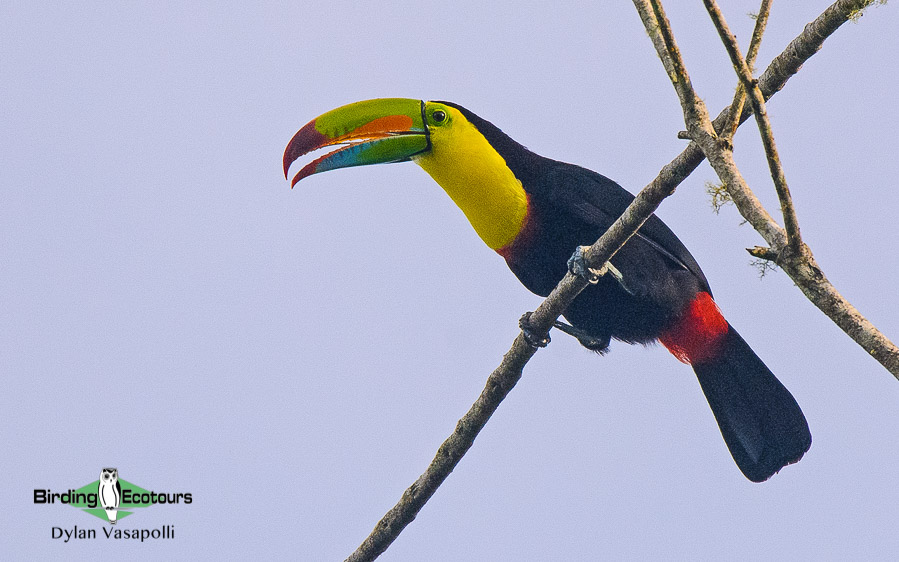
Guatemala is an underrated birding destination and among the most remarkable avian countries in Central America. It offers visitors a rich avifauna including classic Central American jewels like the splendid and highly sought Resplendent Quetzal, Tody Motmot, Turquoise-browed Motmot and Keel-billed Toucan. It also boasts localized near endemics shared only with the Chiapas region of Mexico, such as the handsome Pink-headed Warbler, Belted Flycatcher, Azure-rumped Tanager and the enigmatic Horned Guan.
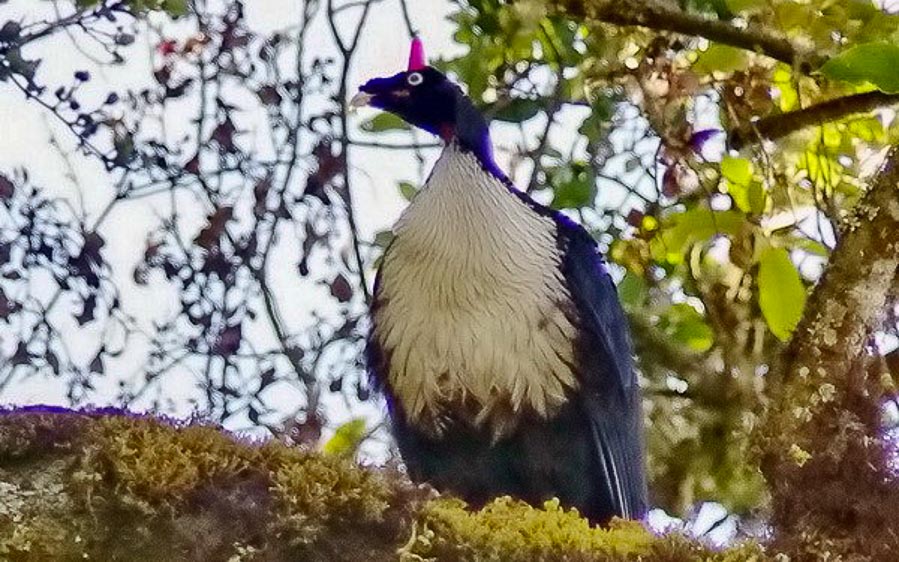 Horned Guan is considered the holy grail of Central American birds and is the main target of our trip.
Other northern Central America specials (shared only with Nicaragua, El Salvador and Honduras) such as Fulvous Owl, Highland Guan, White-bellied Chachalaca, Brown-backed Solitaire, Rufous-browed Wren, Blue-throated Motmot and Blue-and-white Mockingbird are easily found here.
Our trip starts in Guatemala City and explores the Sierra de Cuchumatanes, home of the Goldman’s Warbler. For many years this was considered one of the true Guatemalan endemics, but an isolated population was recently found in Chiapas, Mexico. Today some authorities recognize it as a full species, while others treat it as a subspecies of Yellow-rumped Warbler, which is also a target of our trip. We will spend several days birding the montane forests looking for highland specials. The scenery here is incredible.
Have you ever heard the expression “The Horned Guan Death March”? An apt description indeed because until a few years ago the only way to see this bird in Guatemala was to make a 03:00 a.m. start and hike up the steep slopes of the Atitlan Volcano. This strenuous endeavor was suitable only for the very fit, making the species an unattainable dream for many birders. The good news is that Horned Guan has been found in the forests around the Tacaná Volcano in an area accessible by car. Join us on this 11-day tour in search of this extraordinary bird, while enjoying Guatemala’s active volcanoes, world-class coffee, rich gastronomy, and vibrant Mayan culture.
This 11-day tour is easily combined with our Guatemala: Tikal and Mayan Rainforest Highlights tour to create a comprehensive Guatemala experience.
Itinerary (11 days/10 nights)
Day 1. Arrival in Guatemala City
Upon arriving in Guatemala City, you will be transferred to the hotel.
Overnight: Hotel Barceló, Guatemala City
Day 2. Flight to Huehuetenango and transfer to La Alfalfa area
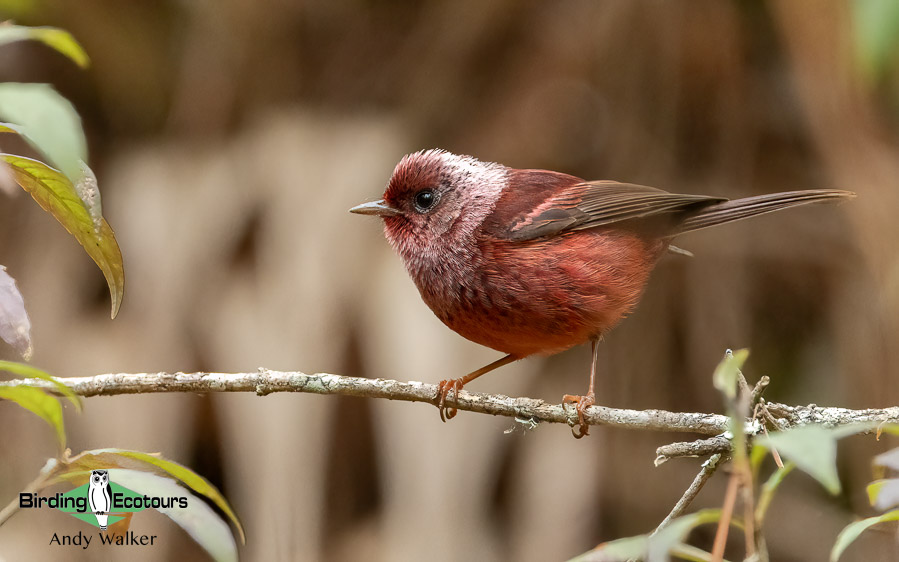
Today we start our adventure flying to the city of Huehuetenango located in the foothills of the Sierra de Cuchumatanes, a large mountain range in the northern part of the state bordering Sierra de Chiapas, Mexico. We will head directly to the La Alfalfa area at Unicornio Azul Lodge where we spend the whole day birding the lodge grounds and the route to the lodge looking for incredible species including the beautiful Pink-headed Warbler, one of the most wanted species in Guatemala.
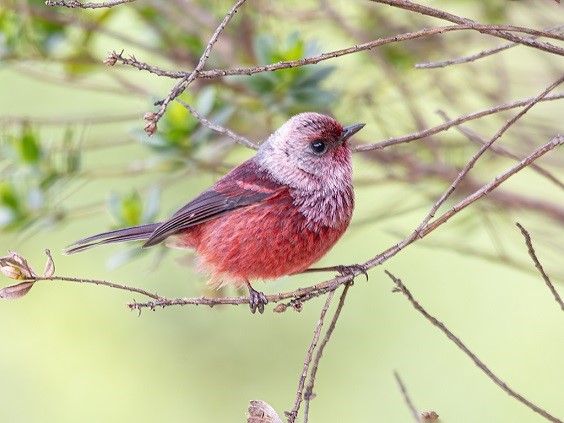 The stunning Pink-headed Warbler is one of the stars of our Guatemala birding tour (photo Renato Fernandez).
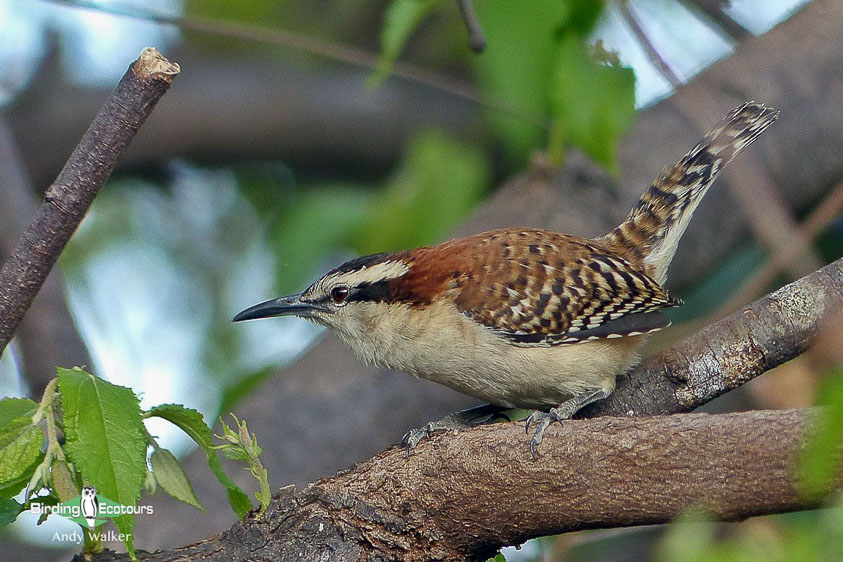
Other top species around Unicornio Azul Lodge include Buff-breasted Flycatcher, Crescent-faced Warbler, Rock Wren, Brown-backed Solitaire, Great Silky-flycatcher, Rufous-browed Wren, Black-capped Swallow, Blue-throated Motmot, Hermit Warbler, Steller’s Jay, Northern Flicker, White-eared Hummingbird, Mexican Violetear, Greater Pewee, Velasquez Woodpecker, Cinnamon-bellied Flowerpiercer, Black Thrush, Grace’s Warbler, Brown Creeper, Black-headed Siskin, Broad-tailed Hummingbird, Black-throated Jay, Spot-crowned Woodcreeper, Yellow-eyed Junco, and Spotted Towhee. At night we will try for the Mexican Whip-poor-will and, if we are lucky, for the enigmatic and seldom seen Unspotted Saw-whet Owl.
Overnight: Unicornio Azul Lodge, La Alfalfa
Day 3. Expoloring Todos Los Santos
Today we make a special excursion to explore Todos los Santos in the Cuchumatanes in search of the localized and range-restricted Goldman’s Warbler, found only in this part of the country and with an isolated small population in Mexico.
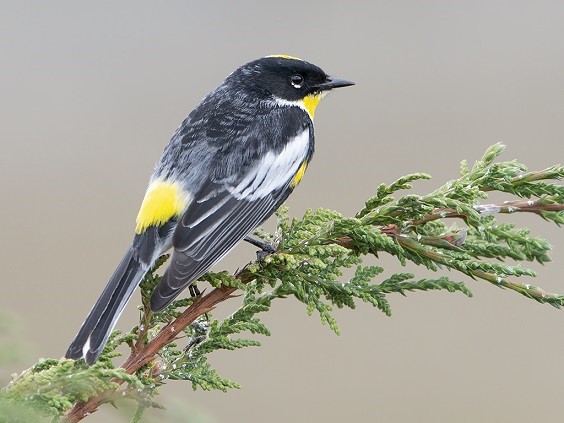 Goldman’s Warbler is another localized target (photo Renato Fernandez).
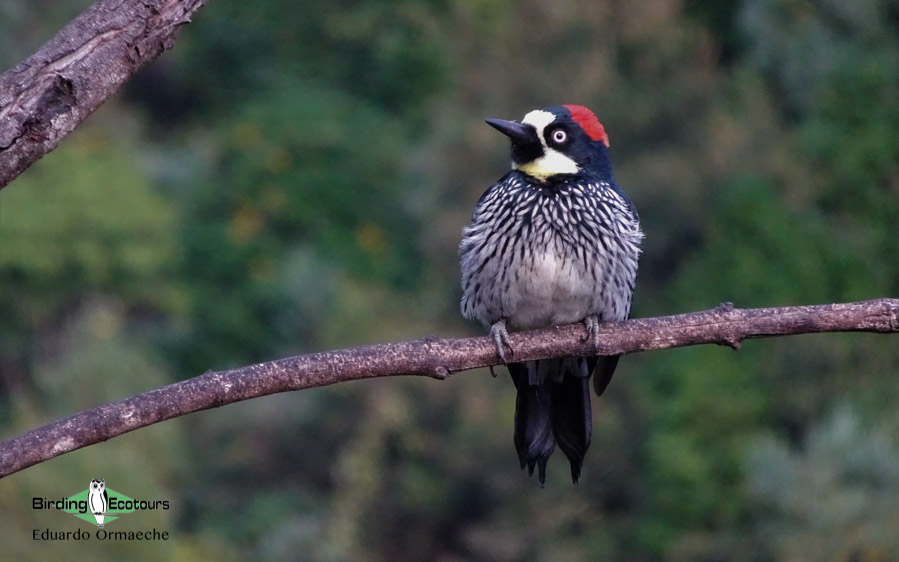
Our visit to Todos los Santos aims for Black-capped Siskin, Yellow-eyed Junco, Rufous-collared Robin, Northern Raven, Hutton’s Vireo, Red Crossbill, Golden-crowned Kinglet, Singing Quail, Eastern Bluebird, Acorn Woodpecker, Hairy Woodpecker, Ruddy-capped Nightingale-Thrush, Bushtit, Violet-green Swallow, Bushy-crested Jay, Black-vented Oriole, Red-faced Warbler and others.
Overnight: Unicornio Azul Lodge, La Alfalfa
Day 4. Union Reforma birding
Today we leave the lodge and start our drive to the base of Tacaná Volcano and spend the afternoon birding the remote Union Reforma site. Here in the humid montane forest, we look for Highland Guan, Amethyst-throated Hummingbird, Mountain Trogon, Blue-throated Motmot, White-throated Hummingbird, Chestnut-sided Shrike-Vireo, Rufous-browed Wren, Blue-headed Vireo and Ruddy-capped Nightingale-Thrush. We focus on the shy Blue-and-white Mockingbird, Rivoli’s Hummingbird, Green-throated Mountaingem, Northern Tufted Flycatcher, Pine Siskin, Mountain Elaenia and Flame-colored Tanager. We stay overnight in the basic Sibinal Lodge.
Overnight: Sibinal Lodge, Sibinal
Day 5. Tacaná Volcano and the search for the Horned Guan
We begin before dawn in a convoy of 4×4 vehicles, driving up to the Tacaná Volcano to look for the sought after Horned Guan. This is the primary target of the day but we should have other avian encounters with species such as Broad-tailed Hummingbird, Steller’s Jay, Wilson’s Warbler, Townsend’s Warbler, Chestnut-capped Brushfinch, Hammond’s Flycatcher, Mountain Thrush, Golden-browed Warbler, Garnet-throated Hummingbird, and Crescent-chested Warbler.
Overnight: Sibinal Lodge, Sibinal
Day 6. Transfer to San Rafael
Today we leave Sibinal and transfer to San Rafael de la Cuesta, arriving in the afternoon. If time permits, we might get some interesting species such as Collared Trogon, Orange-billed Nightingale-Thrush, Brown-capped Vireo, Spotted Woodcreeper, Black-headed Saltator, Scaly-throated Foliage-gleaner, Guatemalan Tyrannulet and Bushy-crested Jay.
Overnight: Victorias Hotel, San Rafael de la Cuesta
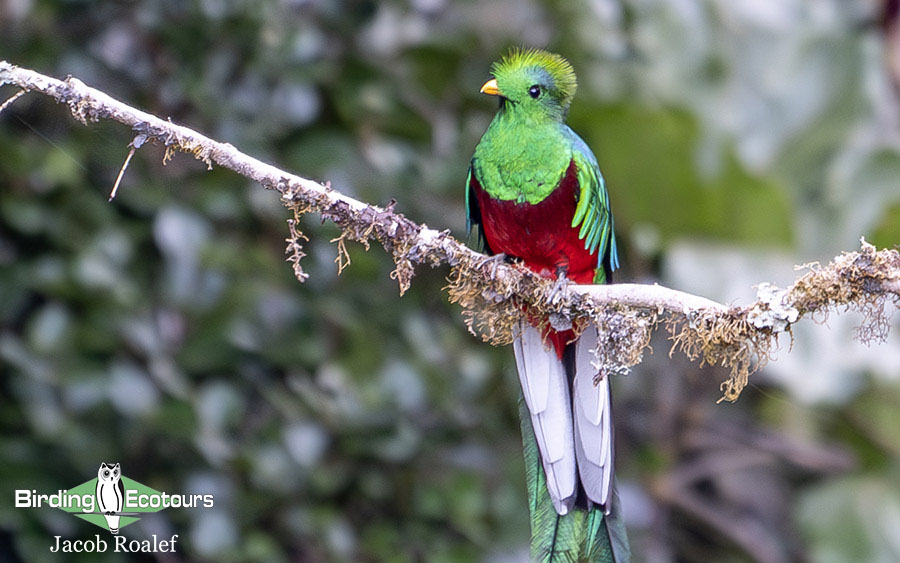 Resplendent Quetzal, the iconic bird of Central America.
Day 7. San Rafael and transfer to Los Tarrales Natural Reserve
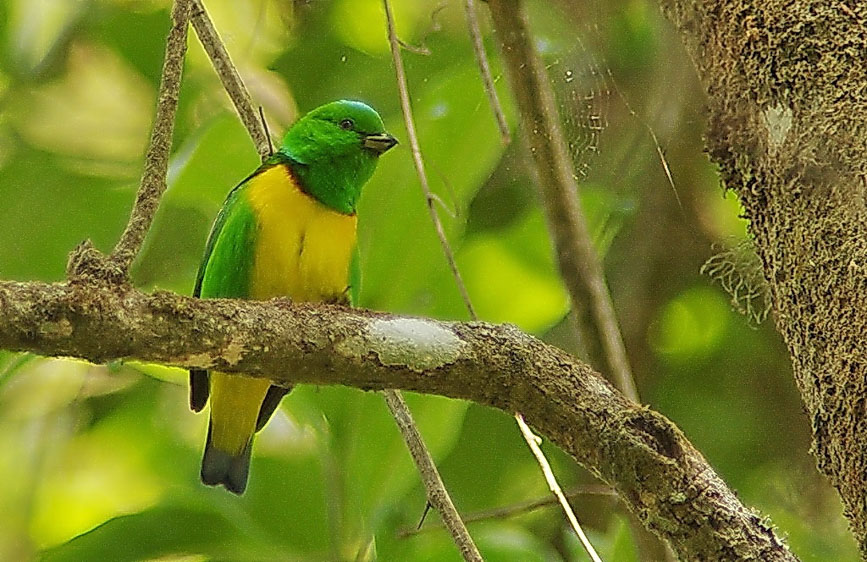
Another early start to explore Refugio El Quetzal where, with luck, we’ll see the splendid male Resplendent Quetzal. Other targets for this area are the localized Azure-rumped Tanager and the handsome Blue-crowned Chlorophonia, Emerald-chinned Hummingbird, Rose-throated Becard, Black-throated Green Warbler, Black-and-white Warbler, Worm-eating Warbler, Yellow-throated Euphonia, Slate-throated Whitestart, Northern Emerald Toucanet, Olive Warbler, Sparkling-tailed Woodstar, Red-tailed Hawk, Western Tanager, Ruddy Foliage-gleaner, and others. Then we will transfer to Los Tarrales Natural Reserve. At night we will try for the Northern Potoo and Mottled Owl.
Overnight: Los Tarrales Natural Reserve
Day 8. Los Tarrales Natural Reserve
We have a full day to explore Los Tarrales Natural Reserve to look for Long-tailed Manakin, Tody Motmot, White-bellied Chachalaca, Lesson’s Motmot, Orange-chinned Parakeet, Spot-breasted Oriole, Scrub Euphonia, Crested Guan, Turquoise-browed Motmot, Gartered Trogon, Rufous-and-white Wren, Collared Aracari, Masked Tityra, Sungrebe, Least Grebe, Cinnamon-bellied Saltator and others. At night we will try for Black-and-white Owl.
Overnight: Los Tarrales Natural Reserve
Day 9. Belted Flycatcher and transfer to Antigua
We then leave Tarrales and head to the dry, steep slopes above Lake Atitlán in search of the range-restricted Belted Flycatcher. Despite habitat loss, a few birds still breed in the area and we will attempt to locate them here. Other interesting species here include Blue-and-white Mockingbird. The hike to see the Belted Flycatcher may be strenuous but the reward should be worth it.
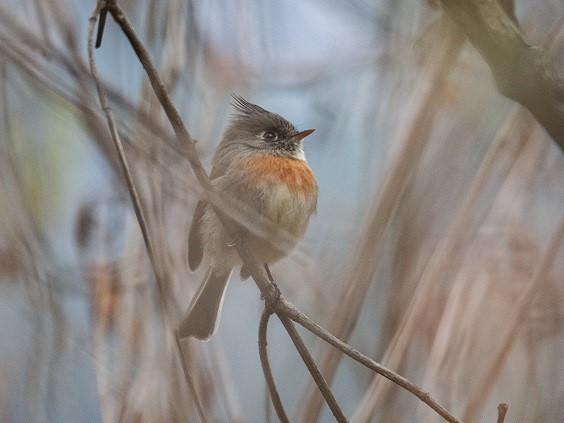 Belted Flycatcher, another localized special of this tour (photo Renato Fernandez).
Then we will be transferred by ferry across the Atitlan Lake (once habitat of the now extinct Atitlan Grebe) to get our vehicle and head to Antigua. If time permits, we will visit the bird feeders at El Pilar to get views of hummingbirds like Rufous Sabrewing and Beryline Hummingbird, and Green-throated Mountaingem.
Overnight: Antigua
Day 10. Finca del Pilar Reserve and transfer to Guatemala City
A predawn start to visit Finca del Pilar Reserve in search of the most wanted Fulvous Owl. Other birds include White-eared Ground Sparrow, Rufous-browed Wren, Blue-throated Motmot, Chestnut-sided Shrike-Vireo, Brown-backed Solitaire, Singing Quail, Mountain Trogon, Northern Emerald Toucanet, Inca Dove, Bushtit, Black-capped Swallow, Band-backed Wren, Black-headed Siskin, Elegant Euphonia, Black-vented Oriole, White-naped Brushfinch, Chestnut-capped Warbler, Squirrel Cuckoo, Philadelphia Vireo, and Cinnamon Hummingbird. After lunch, we transfer to Guatemala City.
Overnight: Hotel Barceló, Guatemala City
Day 11. Transfer to the airport for flight home or connect with the Tikal Tour
Today we transfer to the airport to catch our international flight home or continue with the Birding Tour Guatemala: Tikal and Mayan Rainforest Highlights tour.
Please note that the itinerary cannot be guaranteed as it is only a rough guide and can be changed (usually slightly) due to factors such as availability of accommodation, updated information on the state of accommodation, roads, or birding sites, the discretion of the guides and other factors. In addition, we sometimes have to use a different international guide from the one advertised due to tour scheduling.
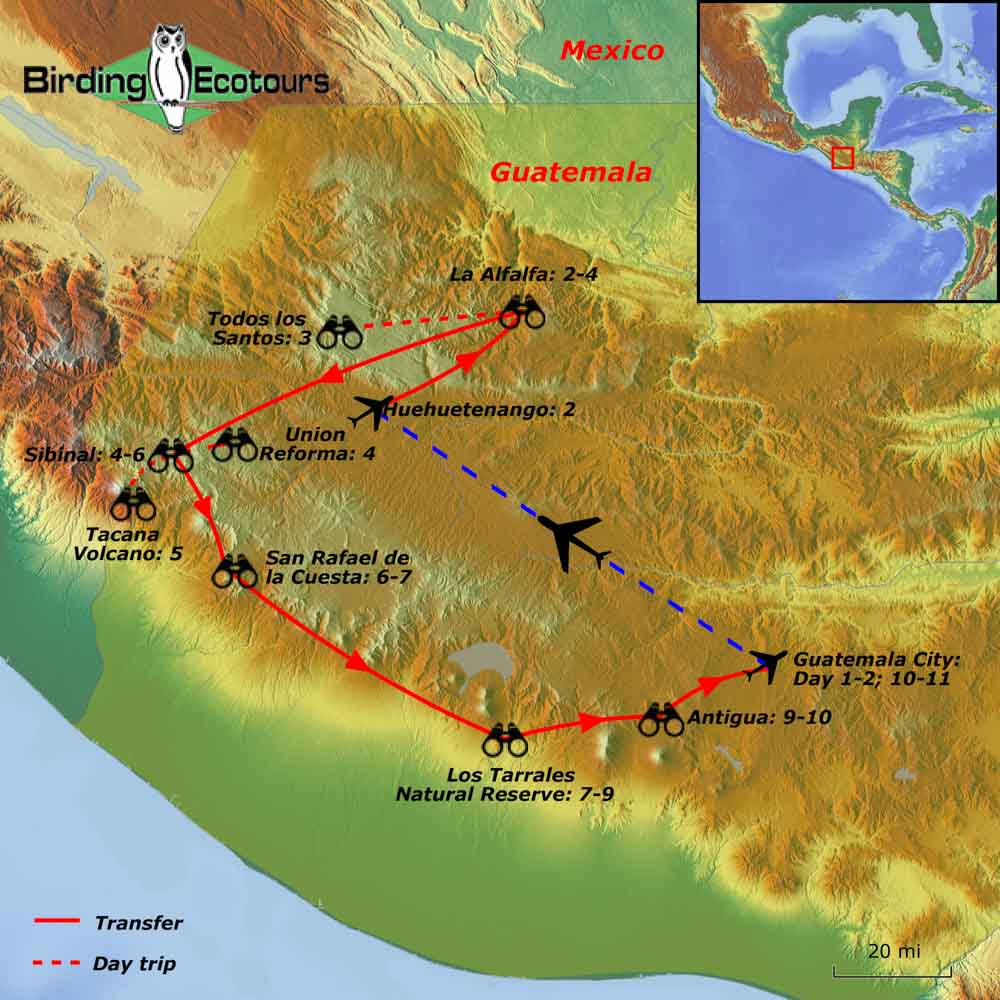
Map
Gallery
General Information
GUATEMALA: GENERAL INFORMATION
MEDICAL AND TRIP CANCELLATION INSURANCE
We strongly encourage you to purchase trip cancellation or interruption insurance in case you have to cancel due to illness or for any other reason, as tour payments are non-refundable as per our terms and conditions. We advise you to get a plan that will cover all of your medical care and evacuation back to your country of residence.
MONEY
We recommend carrying US dollars. Please do not bring US dollar bills that are damaged in any way (broken tips and edges, ink marks, pieces of tape, etc.). Most businesses and individuals will not accept damaged bills. Travelers’ checks/cheques are difficult to change, and it is not possible to do this everywhere, especially in remote areas. It would be very difficult and time consuming to have to look for financial institutions where you can cash travelers’ checks during the tour. Since this is almost an all-inclusive tour, you would only need minimal cash to cover personal expenses like drinks, laundry service, phone calls from the hotels, bar expenses, souvenirs and gifts you want to take home, or any non-mandatory gratuities you may want to give to any person who you think has provided exceptional service. During our tour, neither ATM machines nor places to exchange US$ to Q (Quetzales, the local currency) are easy to find. We recommend that you bring some US$ and draw local currency at the ATM at the airport when you arrive in the country. Depending on your arrival time, some of the exchange houses at the airport will be open and we advise you to change currency there. Please note that credit cards are not accepted everywhere, especially in remote locations.
MEALS
During our Guatemala tours, we will either eat breakfast at the lodges that make breakfast available very early, or we will leave the lodge with a cup of coffee and have a packed or field breakfast in the field to maximize birding time. Most of the lunches are served at the lodges or in restaurants. This depends a lot on the day’s schedule. The dinners are always hot meals, either in the lodges or in hotel restaurants. In restaurants, there are two menu options, one of which is always a vegetarian meal. In the lodges we have a fixed meal. Please let us know in advance about any dietary restrictions or preferences you may have. Often, on the last day in Guatemala, we have an a la carte meal.
We have found that Guatemalan cuisine is one of the most delicious and varied in the whole of Central America and the coffee is some of the finest in the region.
Bottled water during the trip is included in the tour price. Drinks, including soft drinks, fruit juices, alcoholic beverages, and beer are not included in the tour price.
ACCOMMODATION
We always aim to book the best accommodation available for our tours, to provide our clients with a memorable holiday. It is generally comfortable but not luxurious. In some remote regions, the lodges only offer basic accommodation; in these areas we either stay in these more basic lodges or even family homes, to ensure we have the best chances of finding our key target species. Where the birding sites are near to cities, we generally stay in better accommodation in the cities where possible.
Note on bedrooms: The price of our tour is per person sharing a twin bedroom. Most of our clients, even some couples, prefer to have their own bed to ensure a better sleep after a long day out birding. The standard matrimonial or double bed in South America is the normal double bed size, which might be too small for some people. Bedrooms with queen/king-size beds are normally found only in city hotels and are more expensive, and we do not include these rooms in the tour price. If you prefer to upgrade your room, the hotel will charge the difference directly to you (subject to availability). This surcharge is not included in the tour price.
HEALTH
Please refer to the Center for Disease Control website for health advice (including about malaria and vaccinations). Please also consult with your physician or your local travel clinic for recommendations. While not a requirement for entry into Guatemala (unless you are arriving from an infected area in another country), a yellow fever vaccination is a good idea for most people traveling to less developed and/or tropical countries, and the vaccination is valid for ten years. Hepatitis A, B and C, as well as polio, tetanus, rabies and typhoid protection is advised. Dengue fever is very infrequent and is transmitted by day-flying Aedes mosquitoes infected with the dengue virus. There is no prophylaxis against dengue fever, therefore proper clothing and use of insect repellent, especially in lowland areas, is the best protection. Diarrhea is always a tricky hazard whilst traveling in South America. Although some travelers do escape untouched, we ask you to consult your doctor and bring some medication to treat diarrhea, such as Imodium or Ciprofloxacin 500mg. We recommend drinking only bottled water and not eating in street shops where hygiene standards are low. Follow your tour leader’s suggestions.
We carefully select the places where we go for meals. We ask you to clean your hands using hand sanitizer. Please note that sometimes the dramatic change from your normal diet might result in some mild stomach or digestive abnormalities that may disappear in a short time. Should nausea and/or fever follow, there may be a real diarrhea problem. Again, please ask your doctor what they recommend is best for you. Please do let us know about any medical condition you have, such as diabetes, asthma, allergies, heart conditions, or knee problems. Please also include phobias or anything you think we should know, so that we can take care of you and suggest what is best for you, so that you can have an enjoyable trip.
INSECTS
Insects should not be a big problem along most of our route, but they can be more abundant in the lowlands. We recommend that you wear loose-fitting long pants and long-sleeved shirts and keep insect repellent handy. Spraying your feet, socks, shoes, and the lower portion of pants with insect repellent will help reduce a problem with chiggers. Chiggers are burrowing mites that are well-spread throughout the Americas in hot areas. They occur on grass, and even though they do not spread any kind of disease, their bites produce long-term itching as an allergic reaction.
WHAT TO BRING
Kindly read our general list of what to bring on a birding tour here. The tour leader will usually have a spotting scope for general use of all participants. However, we ask you to take brief views of the birds in order to allow all tour participants to have good views, especially of elusive species. If you like to enjoy longer scope views of species, you might consider bringing your own scope. Digiscoping is not allowed with the tour leader’s scope. Please do not bring any military camouflage, as that conveys an inappropriate image to police and military personnel: a likelihood at highway checkpoints. Please avoid nylon or plastic jackets and/or rainwear of similar materials. Noisy clothing is annoying to others and may frighten birds, especially when owling.
SECURITY
Even though Guatemala has unfortunately had a bad reputation for crime for many years, the Guatemalan countryside in all areas that we visit is now considered safe and you will find that Guatemalans everywhere are friendly and helpful. However, cities such as Guatemala City and Flores experience the same problems as large cities everywhere, and you should take precautions to safeguard personal belongings such as money, passport and optical equipment. We recommend using money belts or security pouches worn inside your clothing. Avoid walking at night without informing your tour leader and don’t walk around big cities displaying binoculars and big cameras.
ELECTRICITY
Different electrical plug-in sockets are present in Guatemala, such as Type A, B, G and I. The voltage is usually 120 volts. We strongly recommend bringing a surge protector and a universal adaptor to fit your electric devices into all kinds of sockets.
PASSPORT AND VISA
A passport valid for at least six months beyond your planned departure from Guatemala is required. We recommend having a few blank pages; some countries require a full page for the stamp in your passport. Bring a few Xerox copies of your passport and details of your Consular Representative in Guatemala as well. Citizens of the USA, Canada, Australia, New Zealand, the UK, the EU, and Latin America do not currently require a visa to enter Guatemala. This may change so please check carefully. Citizens of any other country should check with their local Guatemalan Consulate about what requirements there are to get into Guatemala.
TOUR VEHICLES & SEAT ROTATION
We mostly use vans (Mercedes Sprinters) for all our Guatemala tours when we have more than 4 participants on the tour. We do occasionally switch to 4×4 vehicles when negotiating rougher sections of road. At Birding Ecotours, we employ a seat rotation policy on all our small-group set departure tours. This will ensure everybody has equal opportunities throughout the tour. Unfortunately motion sickness will not excuse you from our seat rotation policy and thus if you are prone to motion sickness you should ensure that you bring the necessary medication. We also require that you are fit and flexible enough to maneuver yourself to the back of the vehicle. Tour participants should also be considerate about what extra equipment they bring into the general seating area of the vehicle (rather than the luggage section). We request, from both a comfort and a safety point of view, that general thoroughfares and/or extra seats are not obstructed with camera equipment, tripods, etc.