- Duration:
- 18 days
- Group Size:
- 5 – 8 (but we invariably guarantee the trip with 4 or rarely 3)
- Tour Start:
- Walvis Bay, Namibia
- Tour End:
- Victoria Falls, Zimbabwe
Namibia, Okavango, and Victoria Falls Birding Adventure
Details
2026
02 – 19 November
Per person sharing
R167,812 ZAR
$10,801 USD / £8,056 GBP / €9,332 EUR
Single supplement
R22,400 ZAR
$1,442 USD / £1,075 GBP / €1,245 EUR
This trip is full, please consider booking early for 2027
2027
02 – 19 November
Per person sharing
R186,271 ZAR
$11,989 USD / £8,941 GBP / €10,359 EUR
Single supplement
R24,864 ZAR
$1,600 USD / £1,194 GBP / €1,383 EUR
Itinerary
Download ItineraryNamibia, Okavango and Victoria Falls Birding Adventure
November 2026/2027
This exceptional 18-day birding adventure takes us through three different countries, offering a rich tapestry of breathtaking and varied landscapes. Our journey begins in the coastal Namib Desert at Walvis Bay, where towering dune fields (home to sought-after, localized near-endemics) meet rich lagoons teeming with flamingos, pelicans, shorebirds, and regional specials like Damara Tern and Chestnut-banded Plover. The Erongo Mountains of the beautiful Namib Escarpment are next on our itinerary, and here we search for Rosy-faced Lovebird, Herero Chat, Rockrunner, Monteiro’s Hornbill, Damara Red-billed Hornbill, the batis-like, although largely terrestrial, White-tailed Shrike, and other charismatic species of northern Namibia.
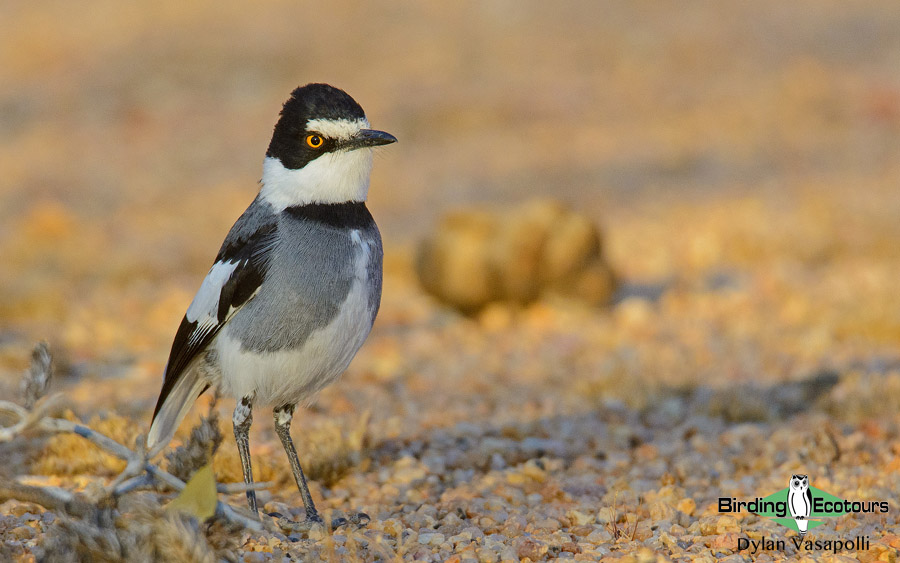 The cute White-tailed Shrike is a sought-after Namibian near-endemic.
Eventually we leave the desert and enter the grassland, savanna, and woodland of one of Africa’s greatest game parks, Etosha National Park. This is one of the world’s best places to see Black Rhinoceros and big cats, along with a good assortment of other African megafauna. It is also excellent for a fine range of very special birds, such as Namibia’s dazzling national bird, Crimson-breasted Shrike, the world’s heaviest flying bird, Kori Bustard, the diminutive Pygmy Falcon, and many more.
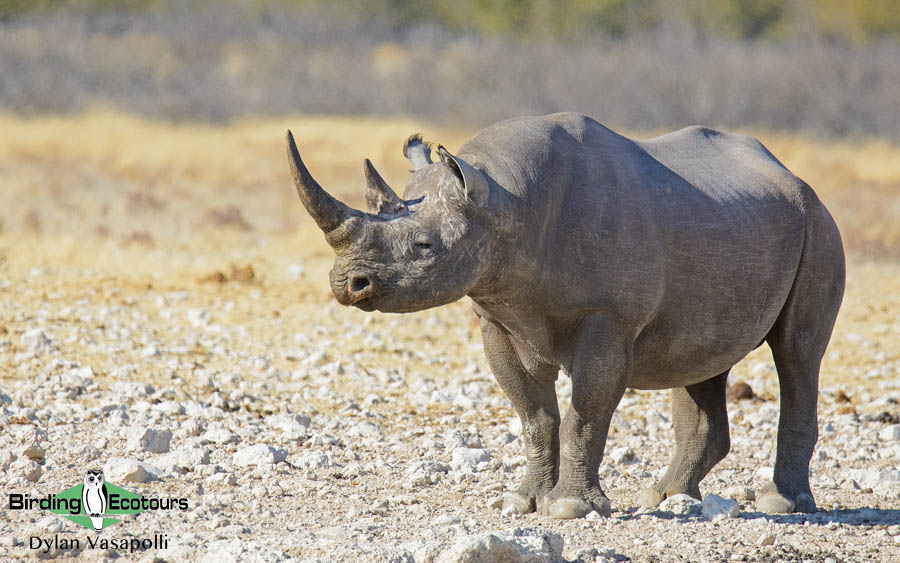
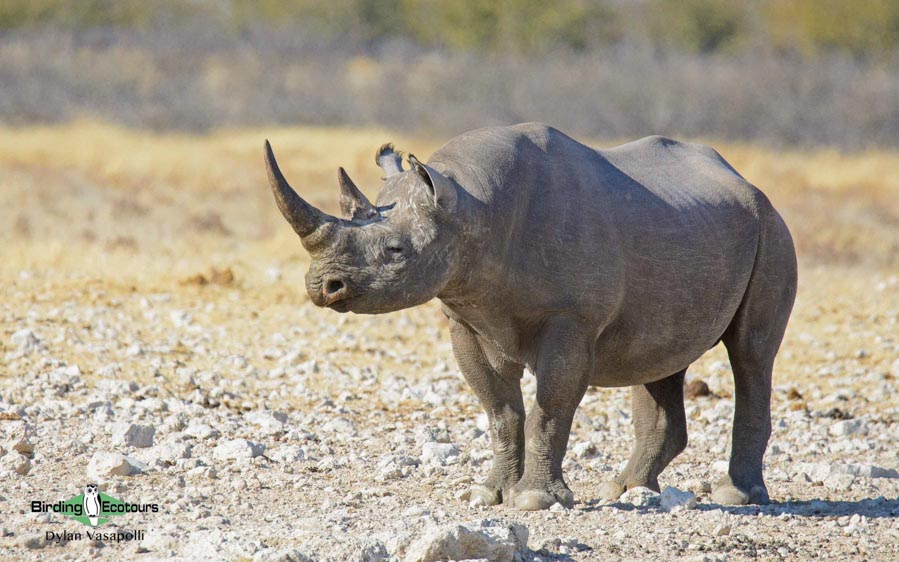 Etosha National Park is full of game and is an especially good area to see Black Rhinoceros.
After Etosha, we head into an incredibly bird-diverse tropical corner of Namibia, the Kavango East and Zambezi Regions (formerly the Caprivi Strip), and the adjacent panhandle of the Okavango Delta, which falls just within the borders of Botswana. The magnificent wetlands, riparian forests, and woodlands in these parts support Pel’s Fishing Owl (this is the world’s most reliable area for this iconic species), Rock Pratincole, White-backed Night Heron, African Finfoot, Slaty Egret, Southern Carmine Bee-eater, and literally hundreds of other spectacular species. Finally, we bird around the impressive Victoria Falls for yet another rich assemblage of birds. We typically record close to 400 bird species on this tour of varied habitats – and we also get one of the highest mammal lists of any of our tours on this transect.
This tour can be combined with our premium Comprehensive Subtropical/Eastern South Africa Birding Tour which precedes this tour, for a 35-day Southern African adventure and even, preceding that, our Best of Cape Town and Beyond Birding Tour for an even longer, 42-day Southern African mega tour. Another possibility is to combine it with our Best of Madagascar: 14-day Birding and Wildlife Tour.
Itinerary (18 days, 17 nights)
Day 1. Birding Walvis Bay, Swakopmund, and the Namib Desert
We ask that you arrive the previous day (Day 0) to ensure a travel buffer and to ensure we can spend the first day birding and targeting some of the area’s near-endemic larks. If you only arrive on Day 1, you might miss some of the area’s target species.
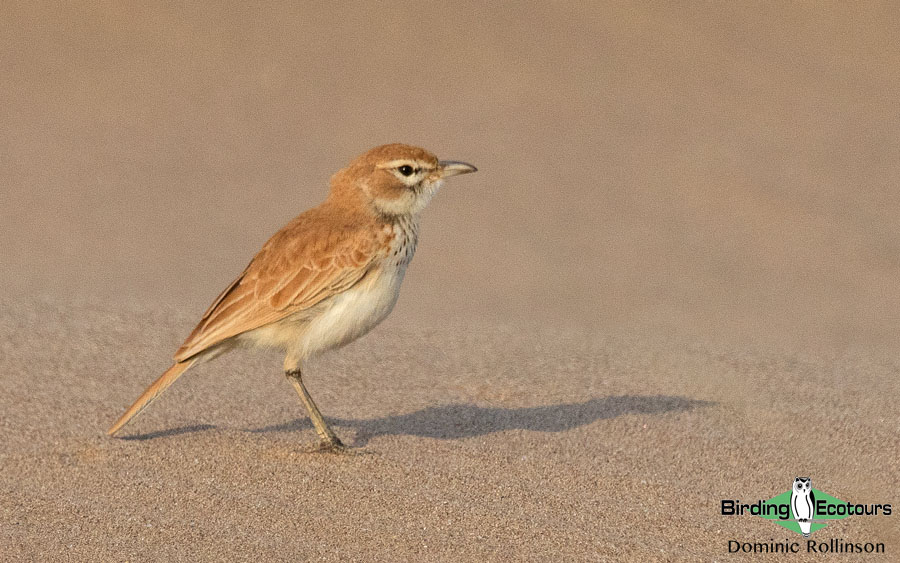 Dune Lark, a Namibian near-endemic, should be seen around Walvis Bay.
The first site we usually visit is the picturesque red sand dune habitat around the village of Rooibank, in the middle of the Namib Desert. Here we target the Namibian near-endemic Dune Lark, once considered a Namibian endemic but now treated as conspecific with Barlow’s Lark. While looking for the larks, we will get the trip list rolling with Bokmakierie, Greater Striped Swallow, Acacia Pied Barbet, Cape Sparrow, and other widespread species. Later in the morning, we usually search the plains around Swakopmund for Gray’s Lark, a very pale Namib Desert special. We usually then head out into the Namib Desert to enjoy the bizarre Welwitschia plant, a long-lived, Namib Desert endemic, as well as the almost pure-white desert form of Tractrac Chat.
We spend two nights in Walvis Bay, right on the edge of the bay, renowned for its dazzling bird spectacles. Here, one may witness thousands of flamingos (both Greater and Lesser Flamingos in equal numbers), painting the lagoons pink, while Eurasian shorebirds arrive in seasonal waves and Great White Pelicans glide majestically across the water.
Overnight: Walvis Bay
Day 2. Coastal birding at Walvis Bay
Today we take a boat trip on Walvis Bay Lagoon that is focused mainly on marine mammals, such as Afro-Australian Fur Seal, Common Bottlenose Dolphin, the localized Heaviside’s Dolphin, and sometimes Humpback Whale. Of course birds are never far away and on this trip we often see Black and Damara Terns, Cape and Crowned Cormorants, Great White Pelican, as well as pelagic species such as White-chinned Petrel, Sooty Shearwater, Parasitic Jaeger, and even the occasional African Penguin.
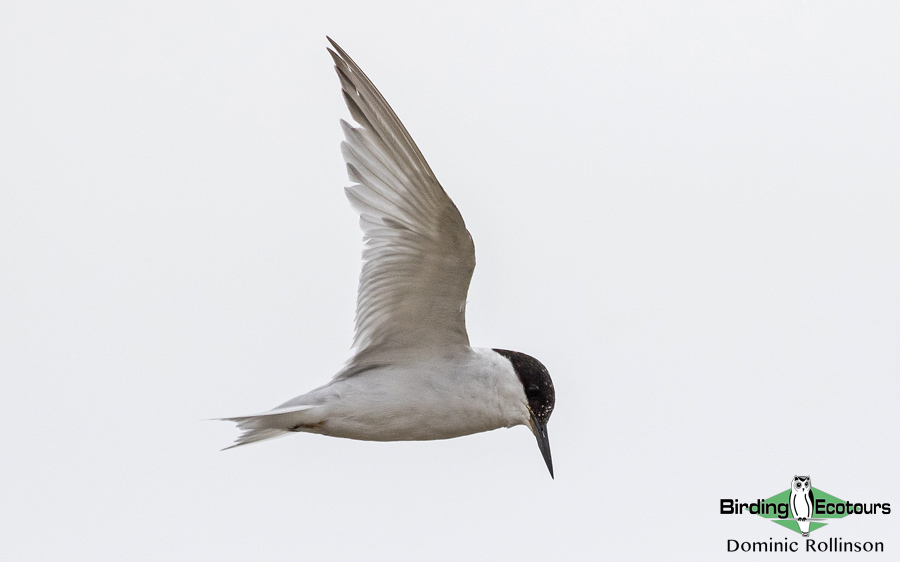 Damara Tern is found in small numbers around Walvis Bay.
We will then spend much time birding the Walvis Bay Lagoon and salt works which has some of Africa’s finest wader watching/shorebirding, with masses of Palearctic migrants usually around. Among our waterbird targets, will be Chestnut-banded Plover, African Oystercatcher, Black-necked Grebe, Cape Teal, and an assortment of migrant shorebirds.
While in Walvis Bay, we will make sure we find Orange River White-eyes in the lush gardens around town; the Namibian coast being the only area for this species on this itinerary.
Overnight: Walvis Bay
Day 3. The Namib Escarpment via the Spitzkoppe
Heading inland and northward we start encountering some spectacular mountains. The Spitzkoppe (the “Matterhorn of Namibia”) in particular is a huge inselberg that rises abruptly from the desert plain. The flat surrounding areas of the Namib Desert are good for Rüppell’s Korhaan, Namaqua Sandgrouse, Karoo Long-billed and Stark’s Larks as well as the scarce and nomadic Ludwig’s Bustard. The lightly wooded mountain slopes are where we search for the enigmatic Herero Chat, Pririt Batis, Rosy-faced Lovebird, Monteiro’s Hornbill, Layard’s Warbler, and many others.
As we ascend into the Namib Escarpment within the rugged Erongo Mountains, the landscape shifts to dramatic rocky outcrops and boulder-strewn slopes. This habitat provides a stronghold for raptors, with Verreaux’s Eagle soaring overhead and African Hawk-Eagle often seen patrolling the cliffs. Amid the rocks and scrub, the delicate Kirk’s Dik-dik, a tiny antelope with large eyes, frequently makes an appearance, adding a touch of charm to the wilderness.
Overnight: Ai-Aiba – The Rock Painting Lodge, Omaruru
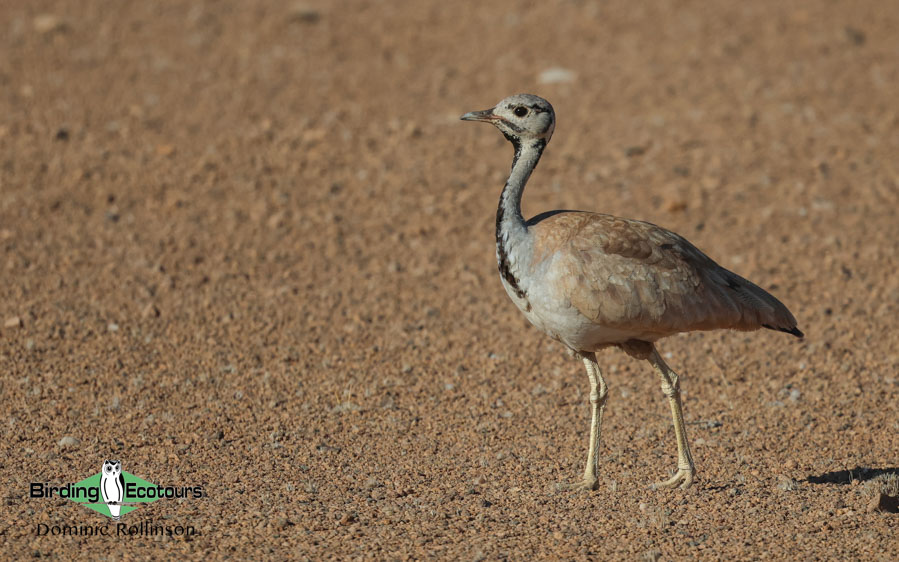 Another Namib Desert special we’ll search for on this tour, Rüppell’s Korhaan.
Day 4. Birding the Namib Escarpment
Today we have the full day to continue birding the Erongo Mountains of central Namibia. White-tailed Shrike, Hartlaub’s Spurfowl, Rüppell’s Parrot, and Rockrunner are four of the superstars of the show – all of them are very localized (occurring only in Namibia and a small part of Angola) and full of personality. Quite a number of brightly colored seedeaters also vie for attention around the lodge, such as Black-faced Waxbill and Red-headed Finch. We might also see Kaokoveld Slender Mongoose, Greater Kudu, (Hartmann’s) Mountain Zebra, or another mammal or two.
We will likely bird a nearby dry riverbed for another shot at Rüppell’s Parrot in the afternoon and then bird the tall riparian forest for the likes of Damara Red-billed Hornbill, Groundscraper Thrush, and Bearded Woodpecker.
Overnight: Ai-Aiba – The Rock Painting Lodge, Omaruru
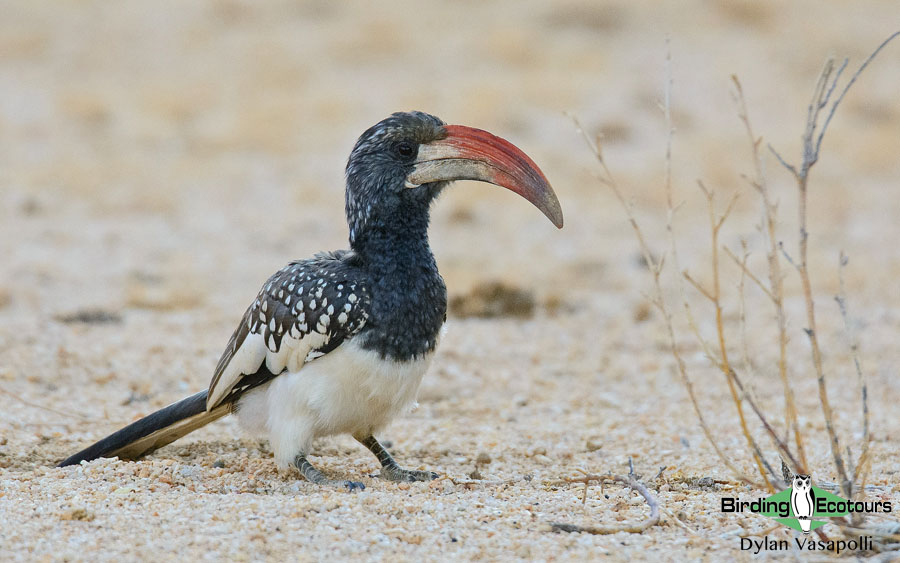
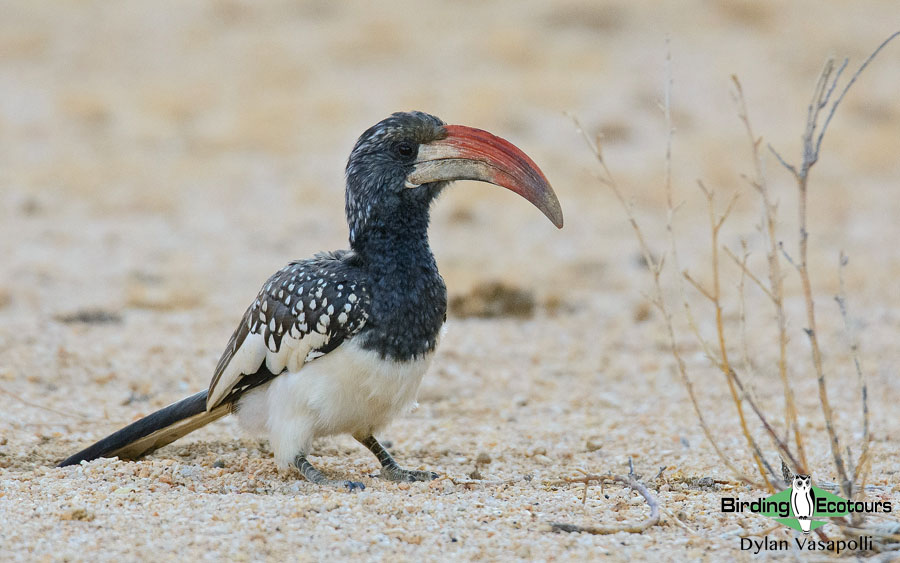 The near-endemic Monteiro’s Hornbill usually provides excellent views in the Namib Escarpment.
Day 5. Bird and wildlife viewing in central Etosha National Park
Etosha is rightly considered one of Africa’s finest game parks. During our time in this amazing park, we will partake in an open-top game drive which is always a lovely way to experience the area’s birds and wildlife. This is prime mammal country, where African Elephant, Black Rhinoceros, large herds of Springbok, Gemsbok, Plains Zebra, and many other herbivores lurk. There are also predators and scavengers around too, such as, Lion, Spotted Hyena, and Black-backed Jackal, with Cheetah, Leopard, and African Wild Cat occasionally seen too.
Although we stop to look at mammal species, birding is still the main focus. Kori Bustard and its smaller relative, Northern Black Korhaan, are both common. Secretarybird and an absolute stack of raptors and vultures are always much in evidence. Etosha is one of the best sites for the handsome Double-banded Courser, with the scarcer Burchell’s and Temminck’s Coursers on our radar too. The unbelievably huge nests of Sociable Weaver are features of the area, sometimes with Pygmy Falcon taking up residence in the same nests.
Overnight: Okaukuejo Camp, central Etosha
Day 6. Bird and wildlife viewing in central Etosha National Park
We will have the full day in this impressive park to bird the open plains and various waterholes. We hope to find Rufous-eared Warbler, Desert Cisticola, Cape Penduline Tit, Yellow Canary, and an assortment of lark species, including Eastern Clapper, Stark’s, Sabota, Pink-billed, and Rufous-naped Larks, as well as larger and more brightly colored species such as Crimson-breasted Shrike, Gabar Goshawk, Greater Kestrel, Lappet-faced Vulture, and Namaqua Sandgrouse.
Overnight: Okaukuejo Camp, central Etosha
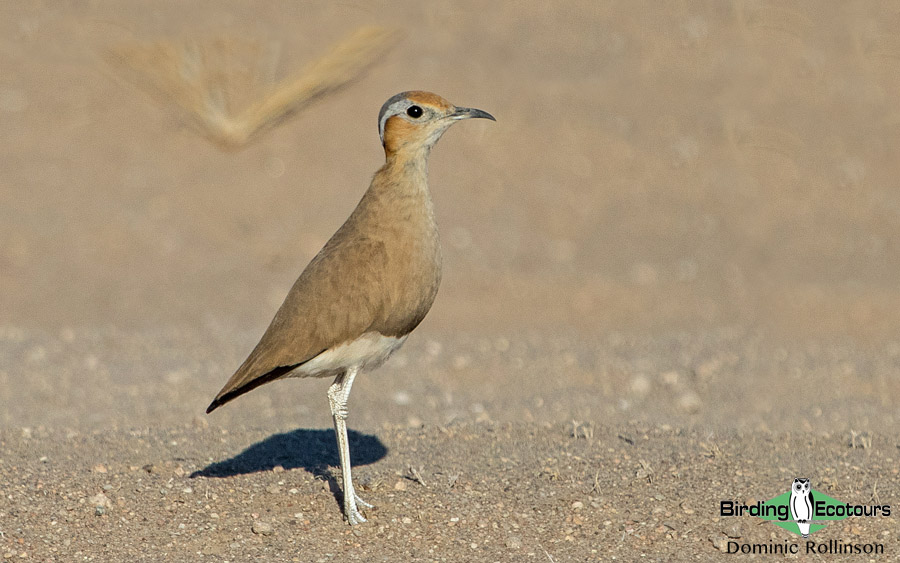 We’ll search for the scarce Burchell’s Courser in Etosha National Park.
Day 7. Central to eastern Etosha National Park
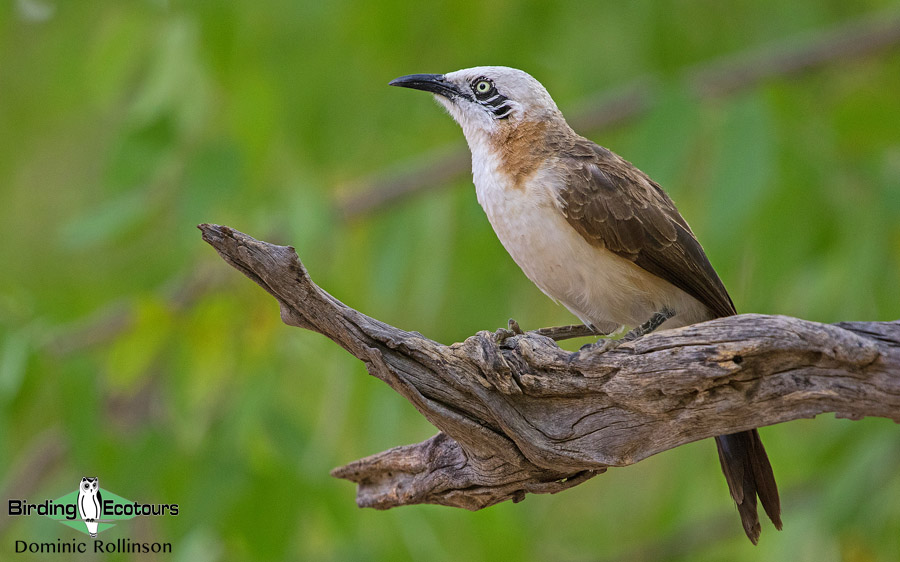
Today we make our way from the central section of the park to the eastern edge. We will likely stop at Halali Rest Camp as we head through the park. This rest camp is an excellent place to find owls, and we often find the tiny African Scops Owl, and then also others such as the beautiful Southern White-faced Owl at their daytime roosts. Here, our key targets are Bare-cheeked Babbler and Violet Wood Hoopoe, with Halali being a reliable spot for these two Namibian near-endemics. Other commonly seen woodland species here include White-crested Helmetshrike, Southern White-crowned Shrike, Southern Red-billed Hornbill (often Damara x Southern hybrids) and occasionally Shikra.
As we continue farther east the bird species change gradually, and we hope to find Secretarybird, Red-necked Falcon, as well as the scarce duo of Burchell’s Courser and Caspian Plover. Around our lodge we should see Black-faced Babbler, Crimson-breasted Shrike, White-browed Scrub Robin, Black-faced Waxbill, Bearded Woodpecker, Pearl-spotted Owlet, Orange-breasted Bushshrike, and other widespread woodland species.
Overnight: Namutoni Gate area, eastern Etosha
Day 8. Full day in eastern Etosha National Park
We will have most of the day to enjoy the birds and wildlife of eastern Etosha. We will likely head up to the grasslands of Andoni Plains to look for Blue Crane, (a small, isolated population of this regal species exists in Etosha), Pink-billed Lark, Eastern Clapper Lark, Burchell’s Sandgrouse, and Burchell’s Courser. The dry woodlands in the area often host Red-crested Korhaan, Southern Pied Babbler, Barred Wren-Warbler, and Violet-eared Waxbill. In the late afternoon we will have some time to bird the woodlands around our lodge.
Overnight: Namutoni Gate area, eastern Etosha
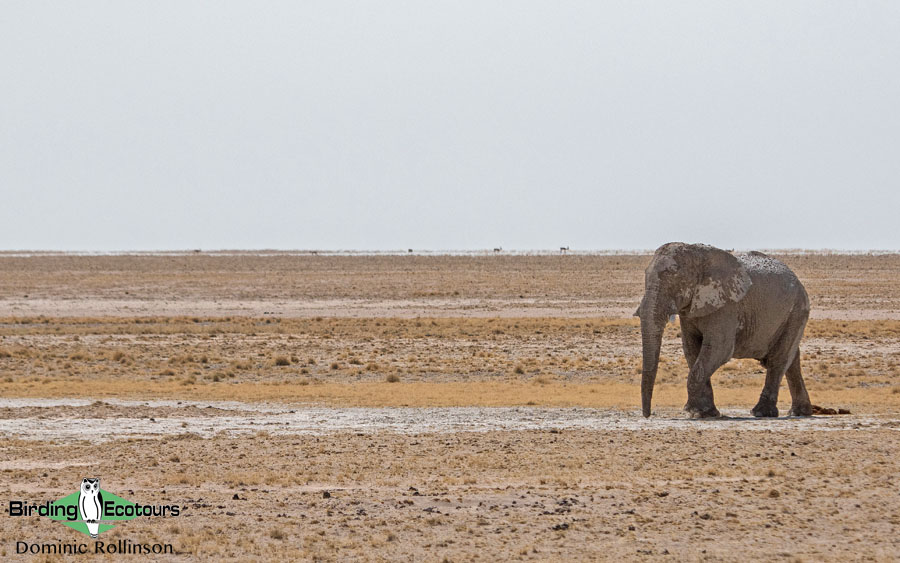 Etosha National Park is one of Africa’s great game parks, and is a major highlight of the tour!
Day 9. Transfer to and birding around Rundu
As we continue eastward the landscape becomes less arid, and today we start seeing some well-developed woodlands for the first time during our tour. We will likely arrive at our lodge in the late afternoon where the birding is very productive and we are likely to find a plethora of new birds for our trip list. Some of these might include African Jacana, Yellow-billed Stork, African Openbill, Senegal Coucal, Black-collared Barbet, White-browed Robin-Chat, Woodland and Malachite Kingfishers, Hartlaub’s Babbler, and Swamp Boubou.
Overnight: Rundu area
Day 10. Into northeastern Namibia
After some early-morning birding we will make the relatively short transfer to the Mahango area, which is incredibly biodiverse. En route, we will also bird the wetlands around Rundu for Collared Pratincole, Blue-billed Teal, Greater Painted-snipe, and perhaps even Lesser Moorhen and Lesser Jacana.
We stay at a lodge near the tiny but impressively diverse Mahango Game Reserve, a protected area within Bwabwata National Park. Species to look for around the lodge include Meyer’s Parrot, Mosque Swallow, Bradfield’s Hornbill, Mourning Collared Dove, White-browed Robin-Chat, Swamp Boubou, Southern Yellow White-eye, Brown Firefinch, and many others.
Overnight: Divundu area
Day 11. Divundu and Mahango birding
We spend the morning birding the tall woodlands east of Rundu which are home to some tricky birds, such as Rufous-bellied Tit (which can be very thin on the ground and tough to find) as well as Sharp-tailed Starling and Souza’s Shrike; two tough birds of human-modified woodland. There is a plethora of other highly prized woodland birds to be found here, such as Yellow-fronted Tinkerbird, White-breasted Cuckooshrike, African Golden Oriole, Green-capped Eremomela, Fawn-colored Lark, Tinkling Cisticola, Arnot’s Chat and many others.
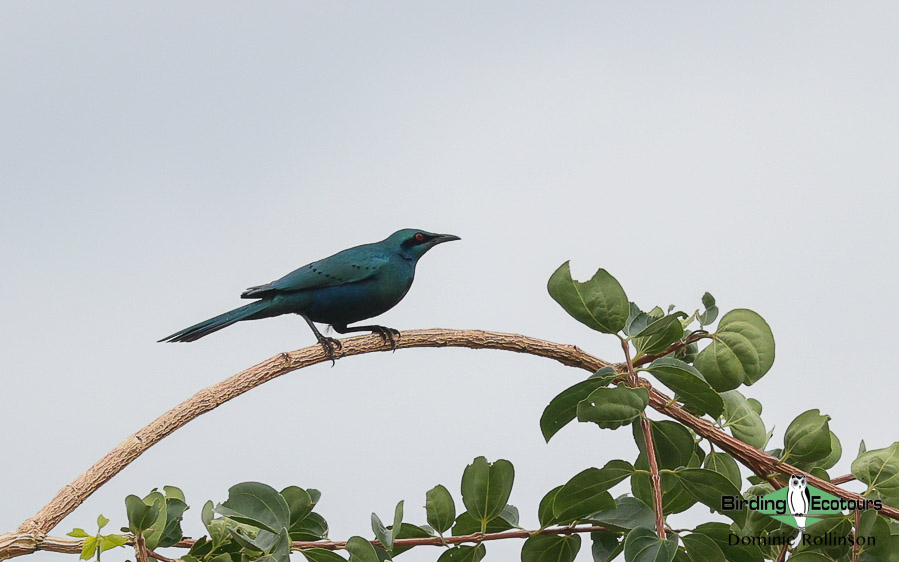 The range-restricted Sharp-tailed Starling is one of the prized denizens found in the tall woodlands of northeastern Namibia.
We will likely spend the afternoon in the Mahango Game Reserve, enjoying birds such as Long-toed Lapwing, Collared Pratincole, Wattled Crane, Swainson’s Spurfowl, Slaty Egret, Martial Eagle, Swallow-tailed Bee-eater, Yellow-billed Oxpecker, Violet-eared Waxbill, the oversized Coppery-tailed Coucal, several spectacular weavers with their bright yellow plumage and amazing nests, Greater Painted-snipe, and Grey-rumped Swallow. Here we are likely to add a great many new birds to our list, along with new mammals. African Buffalo occurs here, but not in Etosha, and this is also one of the best places in the world to find the rare Roan Antelope and Sable Antelope.
Overnight: Divundu area
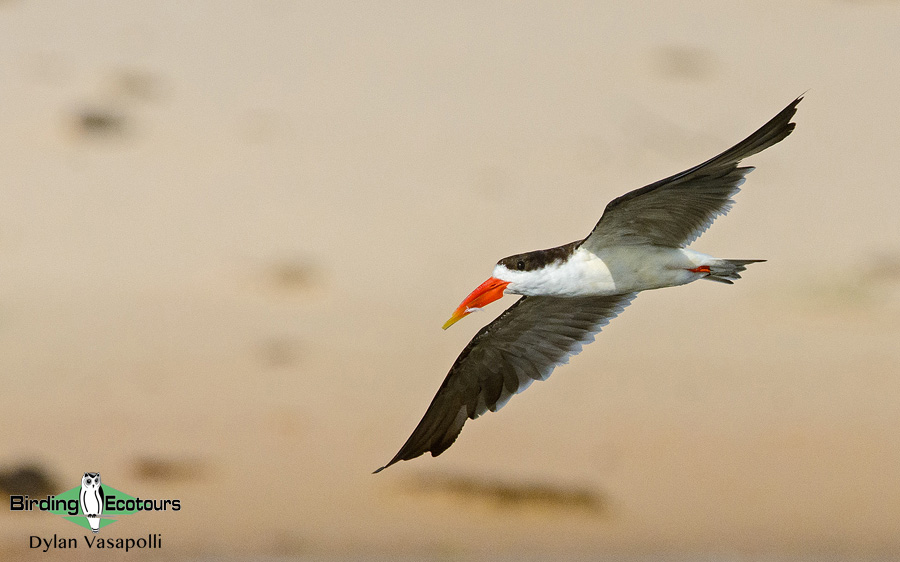 The striking African Skimmer is regularly seen around the Okavango Panhandle.
Day 12. Into Botswana: the Okavango Panhandle
The Botswana border is only a short drive away. After crossing, we enter a more open, overgrazed habitat, which is, interestingly, the best place to see the localized Bradfield’s Hornbill. At Drotsky’s Cabins, Hippopotamus grunts echo at night as they graze around the lodge grounds — a reminder not to walk after dark, as this is Africa’s most dangerous animal. The lodge grounds are a haven for birdlife, and we can expect to find Hartlaub’s Babbler, White-browed Coucal, and Meves’s Starling, with African Barred Owlet in the nearby woodlands. Brown Firefinch and its more common cousins, Red-billed Firefinch and Blue Waxbill, often feed on the lawns while the liquid calls of Swamp Boubou and bubbling coucal calls add greatly to the atmosphere. While we sleep this evening, we may be lucky enough to hear the deep booming call of the legendary Pel’s Fishing Owl, our target for the next day.
Overnight: Drotsky’s Cabins, Shakawe, Botswana
Day 13. A full day in Botswana
We spend a lot of time birding by boat today as we slowly cruise the upper panhandle of the Okavango Delta. This day is usually excellent for photography, as we are able to closely approach many birds and animals from the boat, and highlights include Pel’s Fishing Owl, Slaty Egret, White-backed Night Heron, African Skimmer, African Pygmy Goose, Long-toed Lapwing, Coppery-tailed Coucal, Chirping Cisticola, Greater Swamp Warbler, and Southern Carmine Bee-eater. We may also be lucky enough to encounter the rare, swamp-dwelling Sitatunga antelope.
In the nearby dry woodlands or lush riparian forests we hope to find African Barred Owlet, Narina Trogon, Retz’s Helmetshrike, Grey-headed Kingfisher, African Golden Oriole, and Crested Francolin, among others.
Overnight: Drotsky’s Cabins, Shakawe, Botswana
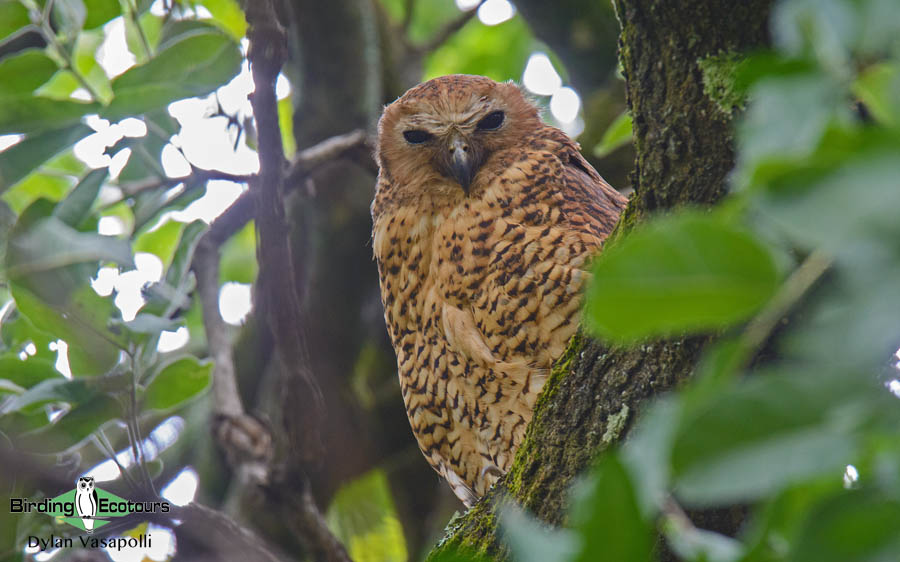
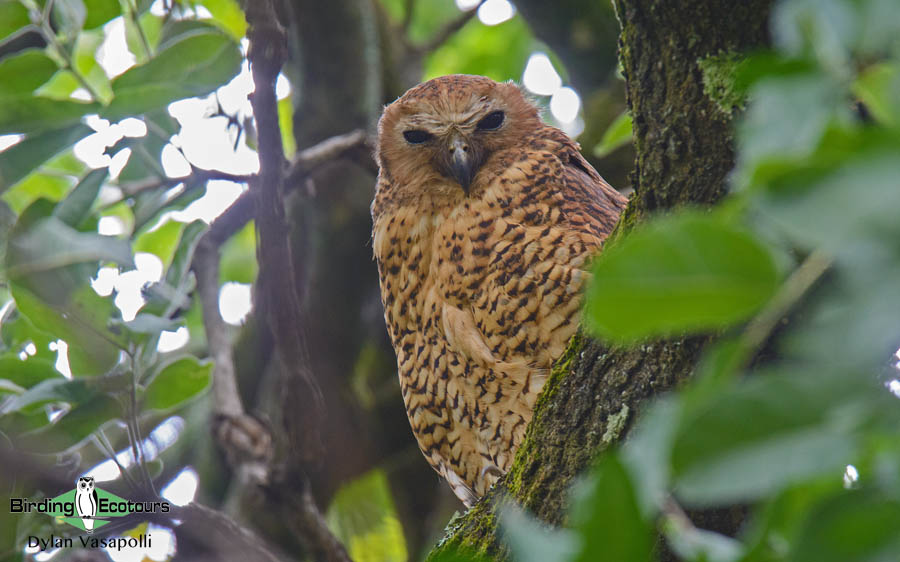 The Okavango Delta is surely the best place in the world to find Pel’s Fishing Owl!
Day 14. Back into Namibia and continuing east
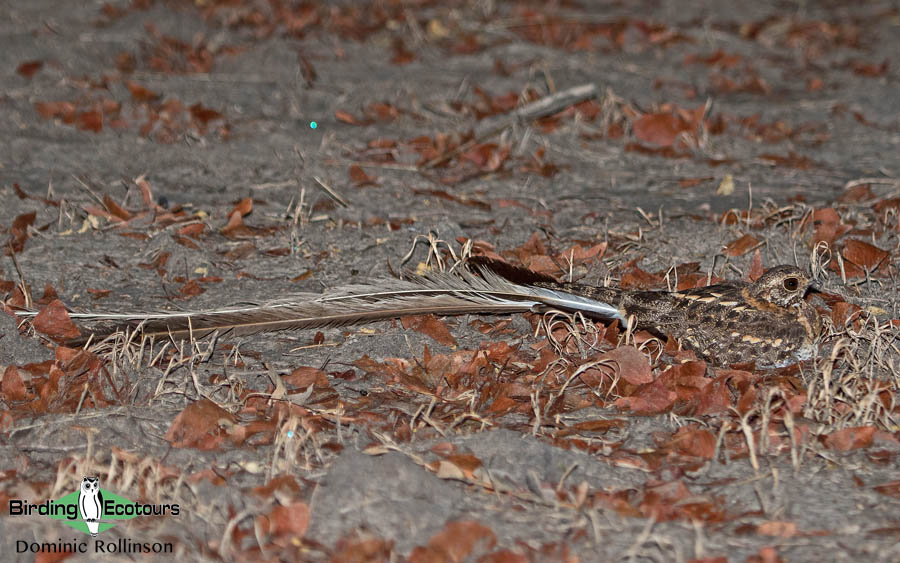
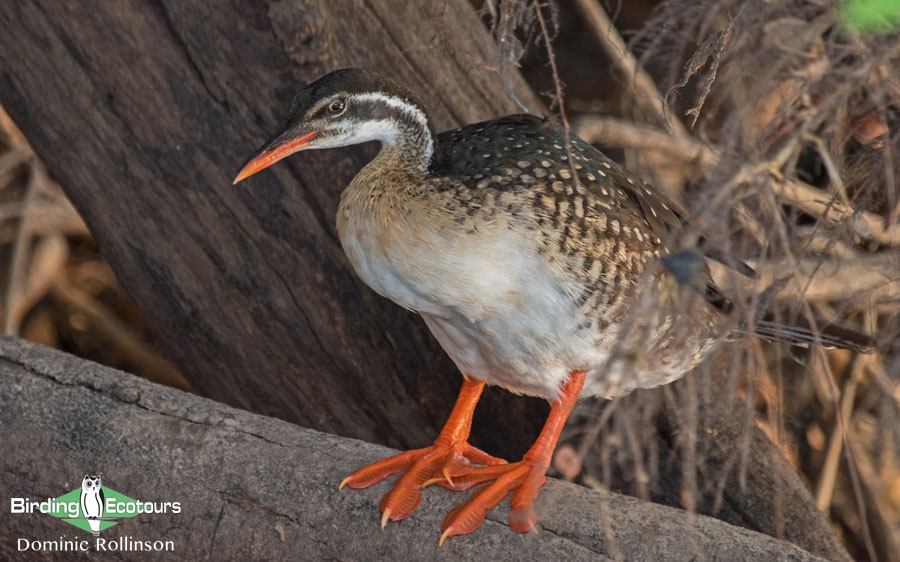
We continue birding the wetlands and woodlands of this bird-rich corner of Namibia. We spend two nights on the banks of the Zambezi River, from where we can do boat trips and birding drives. A late-afternoon boat trip along the Zambezi is extremely productive and usually produces great sightings of African Finfoot, White-backed Night Heron, Half-collared Kingfisher, White-crowned Lapwing, African Skimmer, and Rock Pratincole. We often head out this evening to look for night birds such as African Wood and Western Barn Owls and a host of nightjars including Fiery-necked, Square-tailed, and the spectacular Pennant-winged Nightjar!
Overnight: Katima Mulilo
Day 15. Birding around Katima Mulilo
Today we will devote the day to explore the productive woodlands in far northeastern Namibia around Katima Mulilo. Pale-throated Greenbul was discovered as a breeding bird on the Namibia/Zambia border (the Namibian side) in 2015, hundreds of miles south of its previously known range, and is one of today’s targets. Olive Woodpecker, Schalow’s Turaco, Green Wood Hoopoe, Broad-billed Roller, Southern Carmine Bee-eater, Trumpeter Hornbill, and Western Banded Snake Eagle all occur in the riparian vegetation along the banks of the Zambezi River.
In the surrounding woodlands we search for Racket-tailed Roller, Black-crowned Tchagra, Copper Sunbird, Striped Kingfisher, Grey-headed Bushshrike, Tropical Boubou, Flappet Lark, Jameson’s Firefinch, Grey Penduline Tit, and Lizard Buzzard.
Seasonal pans and floodplains in the area are explored for Blue-billed Teal, Rosy-throated Longclaw, White-backed Duck, Lesser Jacana, Rufous-bellied Heron, Luapula Cisticola, and perhaps even Black Coucal.
Overnight: Katima Mulilo
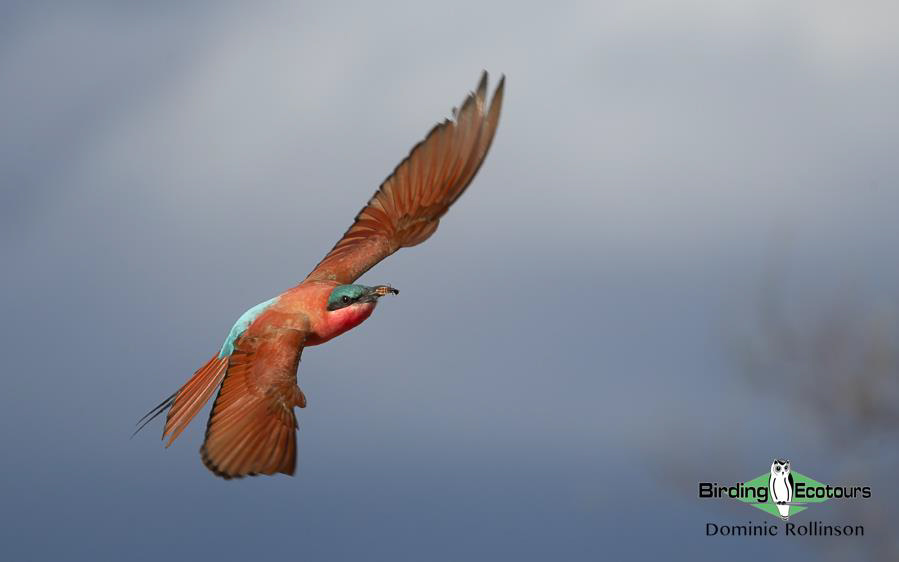 We usually visit a spectacular Southern Carmine Bee-eater breeding colony on this tour.
Days 16–17. Into Zimbabwe and birding Victoria Falls
After some final early morning birding around Katima Mulilo we transfer east, ultimately bound for Victoria Falls, in Zimbabwe. We have two border crossings to negotiate, and we anticipate reaching Victoria Falls only in the mid-afternoon of Day 16 – mostly a travel day. As we head further east, we will pass through more broad-leafed woodland, occasionally seeing groups of the scarce Southern Ground Hornbills on the roadside, but don’t expect much else on the transfer.
On our day around Victoria Falls we’ll spend the morning on an open-top game drive at a nearby nature reserve where we hope to find the likes of Hooded Vulture, Lizard Buzzard, Striped Kingfisher, Broad-billed Roller, African Golden Oriole, Jameson’s Firefinch and many others.
Of course, we’ll spend some time admiring Victoria Falls, ‘the smoke that thunders’, but it’s important to note that the whole area has spectacularly rich birdlife, so we’ll add a lot of new birds to our list near the end of the tour. Birding around the busy town, along the grounds of our lodge, is extremely productive with regular sightings of Collared Palm Thrush, Natal Spurfowl, Bearded Scrub Robin, Schalow’s Turaco, Western Banded Snake Eagle, Trumpeter Hornbill, Olive Woodpecker, and other species along the Zambezi River.
Overnight: Victoria Falls, Zimbabwe
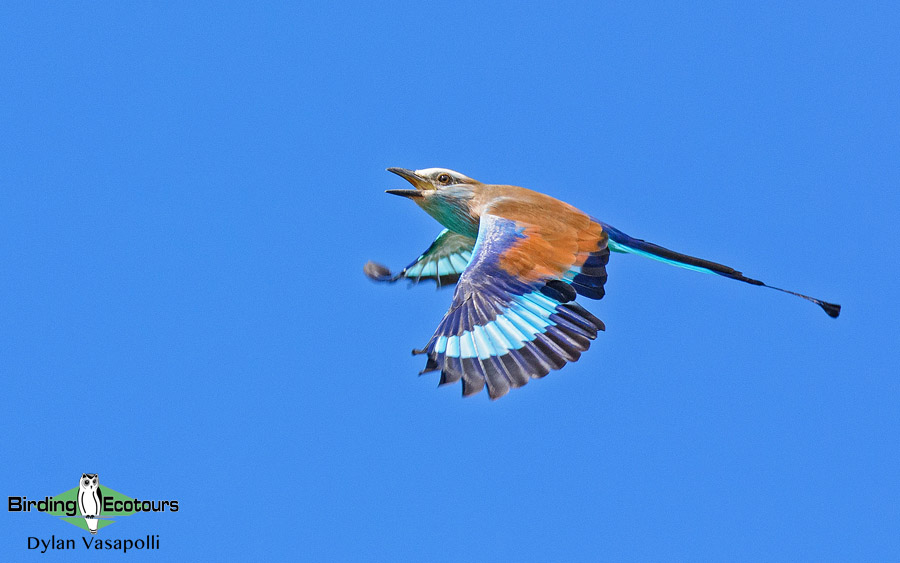 Racket-tailed Roller can be seen in tall woodlands in the final week of the tour.
Day 18. Departure
The tour comes to an end after breakfast, and no activities are included today, apart from an optional pre-breakfast birding walk. You are welcome to depart Victoria Falls, Zimbabwe at your leisure.
Please note that the itinerary cannot be guaranteed as it is only a rough guide and can be changed (usually slightly) due to factors such as availability of accommodation, updated information on the state of accommodation, roads, or birding sites, the discretion of the guides, and other factors. In addition, we sometimes have to use a different guide from the one advertised due to tour scheduling or other factors.
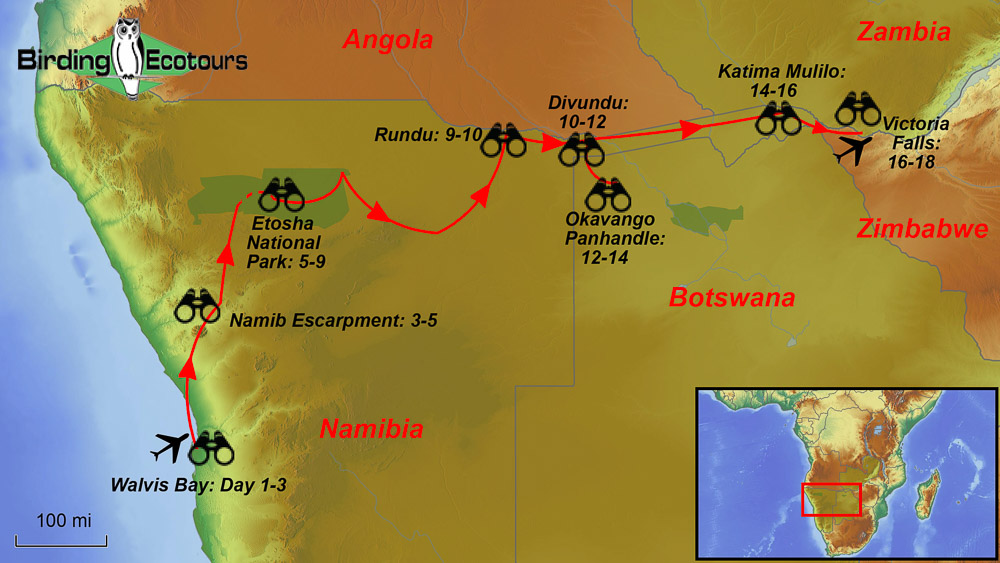
Map
Testimonials
Gallery
General Information
BIRDING TOUR NAMIBIA, OKAVANGO AND VICTORIA FALLS: TOUR-SPECIFIC INFORMATION
TOUR OUTLINE
This 18-day birding adventure includes three countries, Namibia, Botswana, and Zimbabwe. In Namibia we bird the coastline along the Namib Desert and Namibian Escarpment for a host of species that inhabit only northern Namibia and southern Angola. In addition, we will see one of the greatest shorebird spectacles on the African continent at Walvis Bay (plus find localized species such as Damara Tern and Chestnut-banded Plover). Further north, we spend a few days in Namibia’s famous Etosha National Park where we enjoy a host of dry-country birds and other charismatic animals. We also bird the woodlands, rivers, and swamps of the Caprivi Strip and Botswana’s Okavango Delta, which are inhabited by a phenomenal diversity of birds including the enigmatic Pel’s Fishing Owl. Birding around the stunning Victoria Falls can also be very rewarding. The entire trip mixes truly unforgettable birding with impressive and unbelievably diverse scenery. Although the trip focuses on near-endemics and specials, we will end up with an impressive list of other birds as well as loads of mammals.
PACE OF TOUR
This Namibia, Okavango and Victoria Falls birding tour is lengthy and may be tiring at times. In particular, this tour takes place in the early summer period and as such our days are usually long (with regular early starts) and full, and we are constantly looking for new birds every day (this productive tour usually yields around 400 bird species).
To ensure we take advantage of the early morning peak in bird activity, we will occasionally leave the accommodation with simple (but adequate) breakfast packs, however, we will still likely enjoy many delicious sit-down breakfasts on this tour (often taken later in the morning, after our early morning birding session). Similarly, lunches will often involve lunch packs, or simpler sandwiches/wraps which we eat while out birding or traveling, rather than a large sit-down meal. We use this approach for breakfasts and lunches to avoid wasting valuable birding time during the day when we could otherwise be out birding. Although these meals may be simpler, we will always ensure you are well fed, so that you do not go hungry. Additionally, a range of snacks is usually available to participants, and can be bought at fuel station stops, etc. Dinner is usually the main meal of the day, and will of course be a sit-down meal and is generally of a very good standard (although sometimes vegetarian options are a little limited).
It is possible to opt out of some activities, such as various morning and afternoon excursions, and rather just enjoy some down-time or birding around camp. On some days, however, this won’t be possible (please do ask your tour leader for specifics).
There will be the option for night birding excursions on this birding tour, however, (as with most of our birding excursions) these trips are not mandatory and we strongly recommend sitting out if you are finding the tour too tiring. Guided night drives are possible to book in Etosha National Park (where we are not allowed to drive around at night), however, these would be at your own expense and are only booked on the tour itself (at the camp’s reception).
We generally ensure there is regular, meaningful down-time on the tour, particularly on our non-travel days, while on the days when we travel between accommodation, there is less time for down-time (as this is otherwise spent traveling between destinations).
The guide discusses the daily plan with the group in detail each evening. Note that we do retain a sense of flexibility, within reason, to allow for us to better maximize your birding experience.
WALKING AND STYLE OF BIRDING
The tour is generally considered ‘easy to moderate’ in terms of physical exertion. It does not involve a great deal of walking, or many prolonged periods of time where we will be walking/standing/on our feet. Any walks that we do are generally less than two miles (3.2 kilometers), and usually under two hours in length.
- The notable exception is the full morning that we spend out birding in the woodlands west of Divundu where we will be on our feet for longer periods and walking through quite sandy soil at times. This morning does not involve one long walk, but rather a series of shorter walks from the vehicle, which may last 1-2 hours at a time and can get tiring.
For large portions of the trip most of the birding is vehicle-based, where we are driving along roadside routes, stopping strategically and opportunistically to look for various birds and animals. We are normally always able to jump out the vehicle and bird from around/near the vehicle, undertaking short walks (10-30 minutes), to see the birds.
Kindly note, we are mostly restricted to our vehicle in Etosha National Park, and, to a lesser degree, Mahango Game Reserve. In these parks, it is illegal to alight from one’s vehicle outside of designated areas, because of the presence of large, dangerous animals such as lions and elephants, amongst others. We are therefore restricted to the vehicle, except at areas like picnic sites and rest camps. During our time in these parks, we thus spend large portions of the day in the vehicle on safari drives, but we also spend time doing birding walks around the rest camps (and picnic areas) where we are allowed out of the vehicle.
In Etosha National Park and in a game reserve near Victoria Falls we make use of an open-top safari vehicle for the morning, to better enhance our game viewing experience.
LENGTH OF DRIVES
There are a few days in which there are long drives, made even longer with lunch/birding/fuel stops, however, most drives when not moving between accommodation involve far less travel. Some of the longer transfers of this trip include
- Eastern Etosha to Rundu area
- Shakawe to Katima Mulilo
- Katima Mulilo to Victoria Falls (including two border crossings)
The above drives may take most of the day to complete. We’ll likely leave in the morning (e.g. 8 am) and spend the most of the day traveling and birding en route to our overnight accommodation, likely arriving in the late afternoon (e.g. 4 pm).
SAFETY
Although you will find that the people of Namibia, Botswana, and Zimbabwe are generally friendly, helpful and kind, crime is always a possibility (as it is virtually worldwide). While out birding, we may visit some areas which are less safe than others, however, we will be mostly vehicle-based in these areas and will only visit these areas if we deem them safe. We urge you to be aware that crime is possible (although unlikely) throughout the trip – please take very good care of your personal belongings and don’t leave valuables visible in the vehicle when no one is with it.
HEALTH, PESTS AND DANGEROUS ANIMALS
We will be visiting areas inhabited by venomous snakes, although as usual, we will be very lucky to even see a snake, and the likelihood of anybody getting bitten by a snake is low, however it is always worth being aware of their presence. We recommend hiking boots, jeans/long trousers, and a good dose of care to minimize the danger of snakebites. We do not take anti-venom on our tours but will try and rush you to a private hospital if you do get bitten (although we will often be in extremely remote places); your own travel insurance (especially medical insurance) is crucial.
While out birding on foot in some areas there could be ticks around, and so it is mostly recommended to wear long trousers and check yourself for ticks after the day out in the field. Additionally, it is a good idea to spray your legs/trousers and particularly boots/socks with anti-tick spray. There is no risk of Lyme Disease in Namibia, Botswana or Zimbabwe, however, African tick bite fever is a possibility which is generally much less severe than most other tick-borne diseases.
Rabies (although rare) does still exist in some areas in southern Africa and although the chances of you encountering rabid animals is very low on this trip, we strongly advise against touching/petting domestic animals while out in rural areas. Please consult with your tour leader if you are ever unsure though.
In game reserves, where large predators freely lurk, it is illegal for very good reasons to alight from one’s vehicle except in rest camps and picnic areas. Scorpions and spiders may also cause problems.
Malaria and other diseases
We strongly recommend taking anti-malaria precautions. Any of the following three drugs is highly effective as a malaria preventative measure (albeit not 100 % due to resistant strains of malaria):
Malarone® (atovaquone/proguanil),
Doxycycline, and
Lariam® (mefloquine).
Mosquito repellent, long trousers/jeans, and long-sleeved shirts, particularly at night when malaria (Anopheles) mosquitoes bite, are advised in addition to the drugs.
In the unlikely event that one still contracts malaria, after taking anti-malaria drugs and other precautions, the disease can still be easily treated, if diagnosed soon after symptoms develop: suspect malaria if ‘flu-like’ symptoms develop within a few months after the tour. If it is malaria, it can be treated with an alternative to the prophylactic that you chose.
The Centers for Disease Control (CDC) website, offers advice on how to further prevent contracting malaria while traveling.
Please also carefully read the CDC’s health notices for traveling in Namibia and Botswana. You can also take a look at the CDC’s health notices for Zimbabwe, but please be aware that we only venture into a tiny part of Zimbabwe near Botswana/Namibia, so the countrywide text for Zimbabwe does not really apply to this tour – the Botswana and especially Namibia sections are far more relevant here.
Please note, proof of Yellow Fever vaccination is required to enter Namibia, Botswana and Zimbabwe if you have visited a country with a risk of Yellow Fever transmission (see list of countries with risk of Yellow Fever transmission here). It is now widely accepted that Yellow Fever inoculation lasts as a lifetime vaccine (but you will still need to produce the certificate, even if it shows as a technically expired date).
TRANSPORTATION
Depending on the final group size, we will likely use a modified 12-seater minibus on this birding tour, ensuring everybody has a window seat. As with our other birding tours, we will use a seat rotation policy within the vehicle which will be explained to you by your tour leader at the start of the tour. Air-conditioning is available in our tour vehicle.
We will use a transfer company for the journey from Katima Mulilo (Namibia) to Victoria Falls (Zimbabwe) who will help facilitate (and speed up) our two border crossings on this drive.
Airport transfers are included in the tour price for transfers taking place on the first day of the tour and the final day of the tour, but would be for your own expense if you arrive on days preceding/following the tour. We will happily help arrange any of these transfers.
This tour includes the use of an open-top safari vehicle for a morning drive within Etosha National Park and in a game reserve near Victoria Falls.
Another exciting element of this tour is that we will enjoy several boat trips. These boat trips are an excellent way to view and approach birds and other wildlife and access areas that we would otherwise be unable to access. For our Walvis Bay boat trip, we mostly stay within the bay, where the water is flat, however, we do often exit the bay (for around 30 minutes), where it can get a little choppy at times. If you are especially prone to seasickness, you might want to consider anti-seasickness medication, although we have never had any previous problems with seasickness on this boat trip.
The other boat cruises are on smaller, private boats along the Okavango and Zambezi Rivers and are a thoroughly enjoyable and tranquil way to see birds and wildlife, which are especially popular with photographers.
DOMESTIC FLIGHTS
There are no domestic flights required for this tour.
INTERNATIONAL BORDER CROSSINGS AND VISAS
This tour covers three different countries (Namibia, Botswana and Zimbabwe) and requires us to make four border crossings (in addition to arrivals/departures at airports). These border crossings do not take particularly long to cross, although the crossing into Zimbabwe can sometimes take a bit longer.
All three countries require your passport to be valid for at least six months after your departure from the country and you will also need at least three blank pages in your passport (your passport will gain a few extra stamps on this trip, so please consider this when checking the number of blank pages in your passport).
Namibia visa: Citizens of most nationalities (except a few African nationalities) will need a tourist visa to visit Namibia which is valid for 90 days. A visa on arrival application can be made online (here) before arrival in Namibia. You need to make sure you get a multiple-entry visa as we exit Namibia and then re-enter after two nights in Botswana. The accepted visa will need to be printed and produced at your port of entry. We suggest you make your visa on arrival online application one month prior to arriving in Namibia, and the e-visa should be granted within a day or two after submitting the application and making payment.
You can also obtain a visa upon your arrival in Namibia, however, this can be quite time-consuming, and we strongly suggest obtaining the visa before your arrival, as some airlines don’t always allow boarding without being shown a visa.
Botswana visa: Most (including USA, UK, Canada and Australia) nationals do not require a visa to enter Botswana, however, it is important to check visa requirements for your nationality (see here).
Zimbabwe visa: Most (including USA, UK, Canada and Australia) nationals will need to purchase a visa at the port of entry (while on tour) and are not required to apply for an e-visa before entering Zimbabwe. We strongly recommend bringing cash (US$30-US$90 depending on nationality and visa length) as sometimes the credit card facilities may be down. Some nationalities will, however, need to apply in advance, and the list can be seen here.
ACCOMMODATION
The accommodation on this tour is of a good to excellent quality.
During our two nights in Etosha National Park we stay in government-run accommodation in a rest camp (Okaukuejo) within the park which means that the accommodation for these nights is a little more basic than elsewhere on tour, however, is still of a good standard. We stay in the park itself to ensure the full safari experience and so that we can be out in the park early to optimize our birding. The floodlit waterhole at Okaukuejo Camp is another massive drawcard to staying here, as you are able to sit and watch animals and birds come and go the whole night long, and this waterhole has produced some very special sightings over the years.
Should you wish to arrive a day or two before the start of the tour, we strongly suggest staying at Flamingo Villas in Walvis Bay, where we are staying for our first two nights on tour. It is a lovely place with views of the Walvis Bay lagoon (and its many flamingos and shorebirds) right from your doorstep. Please contact the Birding Ecotours office to help organize this for you.
It is possible to get laundry washed at most of the establishments used on this tour, with the following considerations:
- It is not possible to get laundry done within Etosha National Park.
- Many establishments will only take laundry if we have a minimum of two nights, and the laundry is provided on the first day/arrival day.
ELECTRICITY
Electricity throughout the three countries is 220-240V. If you intend to recharge camera batteries etc. in your hotel room you will need an international adapter (three round prongs in a triangular pattern, ITA Type D/M for Namibia, ITA Type D/G for Botswana, and ITA Type D/G for Zimbabwe). ITA Type C plugs are also widespread throughout Namibia, Botswana and Zimbabwe. Note: If you are from North America or elsewhere, that does not use 220-240V electricity, then do check all equipment that you plan on charging to see if it is 110/120–220/240V compatible. If that is the case, you only need an adaptor to plug the US/Canadian/etc. plugs into. If your equipment is only listed as 110-120V then you will need a converter to convert the electric current to 220-240V.
MONEY AND ATMS
Namibian currency (Namibian dollars) can be obtained from ATM machines in Walvis Bay, soon after your arrival in Namibia, and can also be obtained from ATM machines throughout Namibia when we stop at fuel stations etc. However, please try to limit your ATM withdrawals as it can be an unnecessary inconvenience (and may result in additional international charges). We do not recommend withdrawing local currency in Botswana (Botswanan pula) as we will only be here for two nights and payments can be made with cards. In Zimbabwe we recommend carrying some US dollars (the unofficial currency), especially for acquiring your visa at the border post.
Please note, that card payment facilities should be available throughout the tour, and cash will likely only be needed for tipping.
WEATHER
Namibia’s climate is typical of semi-desert terrain; hot days, and cool nights. The coastal regions are cooled by the cold Benguela Current, causing fog and inhibiting rainfall. With 300 days of sunshine on average per year, Namibia is truly a sunny place. Only during the summer months from November to April does rain occur, mostly as thunderstorms. The interior enjoys two rainy seasons: the short season is between October and December, marked by frequent thunderstorms. The longer season is from mid-January to April. Summer is from October to April. Temperatures can reach 110 ºF (43 ºC), while dropping at night to cool levels. Average daily temperatures range from 68 to 93 ºF (20-34 ºC). Winter is from May to September with wonderful warm days, which are contrasted by very cold nights when temperatures often drop to below freezing.
On this trip (taking place in summer) we expect very hot weather in the desert. Further east toward Victoria Falls (including Botswana) we expect hot and humid weather. The weather can be surprisingly cool on the coast, even in summer, so please be prepared for all weather but generally expect heat to be the main problem. It might rain, but since the areas visited are typically dry, we don’t expect it to interrupt birding very much.
SOME THINGS WE RECOMMEND YOU BRING
Please see our blog on ‘What to bring on a birding tour’ which will help you pack for this Namibia, Okavango and Victoria Falls birding tour.
Clothing specific to this tour
In Namibia, Botswana, and Zimbabwe we expect the weather to be warm to very hot during the day, and often mild at night. We do this tour at the best time for birds, but the disadvantage is the heat. However, the coast can sometimes be foggy and quite cool, and we recommend bringing sweaters, windbreakers, and long pants at least for the coastal part of the trip. Inland the Namib Desert is often extremely hot, but dry, whereas the Caprivi can be very hot and humid, even at night. So hot weather clothes are recommended, but long trousers, hiking boots, and long sleeves, although uncomfortable in hot weather, will help prevent insect and snake bites and sunburn. There is a chance of rain, especially in the Caprivi, the Okavango and at Victoria Falls.
FIELD GUIDES
Birds
Please refer to our online resource for field guides and apps.
Mammals
Stuarts’ Field Guide to Mammals of Southern Africa by Chris and Mathilde Stuart, Struik Publishers. 2015
Smithers’ Mammals of Southern Africa – a field guide. Edited by Peter Apps. 1996
Reptiles
Field Guide to Snakes and other Reptiles of Southern Africa by Bill Branch, Struik Publishers. 1998 – Excellent
Butterflies
Field Guide to Butterflies of South Africa by Steve Woodhall, 440-page paperback. 2005 – the best of those available
Sasol First Field Guide to Butterflies and Moths of Southern Africa by Simon von Noort, 56-page paperback. 1999
Insects
Field guide to Insects of South Africa by Mike Picker, Charles Griffiths and Alan Weaving. 3rd Edition. Struik Publishers. 2019
IMPORTANT
Check whether your tour operator is legal in Namibia – please read this carefully.

Download Namibia, Okavango and Victoria Falls Tour-specific Information