28 OCTOBER – 14 NOVEMBER 2025
By Eduardo Ormaeche
Overview
This tour report describes an 18-day private trip to Chile focused on three main areas, namely the Central Andes around Santiago de Chile, a week in the famous Torres del Paine National Park looking for the mighty Puma, or Mountain Lion, and finally concluding with a four-day visit to the beautiful islands of Chiloé on the shores of Puerto Montt in southern Chile. This was a great trip, focused on seeing and photographing birds and wildlife, together with admiring the natural beauty and scenery at an easy and relaxed pace.
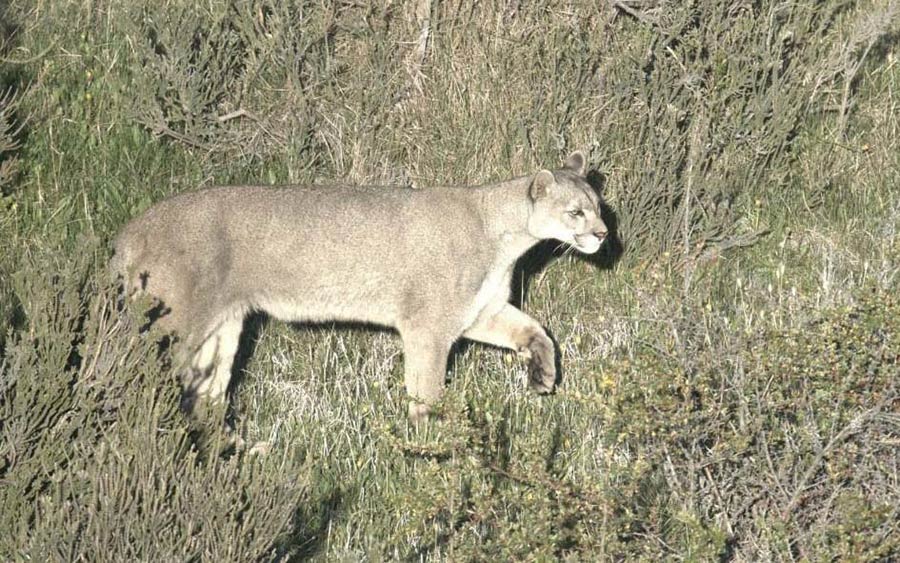
Puma was the highlight of our Torres del Paine National Park visit (photo Joi Inbody).
We recorded 178 of the 450 bird species found in Chile, which represents 60% of the species that breed in the country. Our trip list included several iconic species of South America, such as Andean Condor, Torrent Duck, Giant Hummingbird, Inca Tern, Humboldt Penguin, Black-headed Duck, Black-necked Swan, Peruvian Pelican, Lesser Rhea and Diademed Sandpiper-Plover.
We recorded a great selection of specials, like all the Rhinocryptidae (tapaculos) possible on this route, including White-throated Tapaculo, Moustached Turca, Dusky Tapaculo, Magellanic Tapaculo, Ochre-flanked Tapaculo, Black-throated Huet-huet, and the charismatic Chucao Tapaculo. Other great birds included good views of Crag Chilia, Dusky-tailed Canastero, Chilean Seaside Cinclodes, Chilean Flicker, Striped Woodpecker, Magellanic Penguin, Austral and Slender-billed Parakeets, Austral Pygmy Owl, Rufous-legged Owl, the recently described Pincoya Storm Petrel, Southern Giant Petrel, Black-browed Albatross, Bronze-winged Duck, Chilean Hawk, Rufous-headed Goose, Rufous-chested and Tawny-throated Dotterels and Chocolate-vented Tyrant, to name a few.
We saw 14 species of mammals, including daily Puma sightings in Torres del Paine National Park, and some unusual and rarely seen creatures like Humboldt’s hog-nosed Skunk, Southern Pudu and Southern Monito del Monte.
It was simply amazing birding in such a lovely country, offering modern infrastructure, easy travel, and top-quality, pristine bird habitats. We followed in the footsteps of Charles Darwin, from the shores of the Pacific coast bordering the cold waters of the Humboldt Current, across the dry and Mediterranean wine valleys, to the snow-capped mountains at the top of the Andes, to the vast plains of Patagonia, and the lush temperate rainforest on Chiloé Island.
We invite you to look at our Chile tours and join us on our next adventure!
Detailed Report
Day 1, 28th October 2025. Batuco Wetlands
We began our Chile tour at freshwater wetlands near Santiago, enjoying relaxed birding in pristine surroundings. Highlights included flocks of Chiloe Wigeon—named after Chiloé Island (“place of seagulls” in the Huilliche language)—alongside Black-necked Swan, Silver Teal, Yellow-billed Pintail, Cinnamon Teal, Lake Duck, and the unusual Black-headed Duck, a brood parasite that lays its eggs in the nests of Red-fronted and Red-gartered Coots.
Also near these wetlands, we saw our first California Quail, which is common in the central region of Chile, after its introduction in the late 19th century. I was pleased to bird in such a pristine bird reserve, with great scenery, free of people, pollution and “favelas” (slums) that are common in large cities around this kind of habitat. In fact, except for a small amount of litter in Santiago, we saw no garbage during the trip; central and southern Chile must be one of the cleanest birding destinations in Latin America. Here, we obtained great views of Chilean Swallow, Chilean Mockingbird, Austral Thrush, Chimango Caracara, the obligatory Burrowing Owl, Cinereous Harrier, Black-chested Buzzard-Eagle, Cocoi Heron, Black-crowned Night Heron, Western Cattle Egret, Great Egret, Neotropic Cormorant, Pied-billed Grebe, White-tufted Grebe (of the race chilensis), White-faced Ibis, Picui Ground Dove, West Peruvian Dove, American Barn Owl, and our first Andean Condor (Chile’s national bird, as well as the national bird of Colombia, Ecuador and Bolivia).
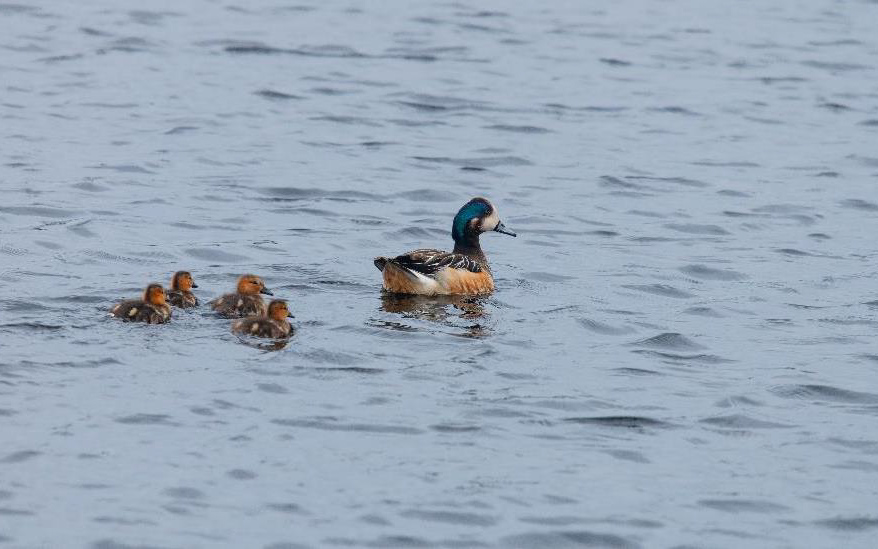
Chiloe Wigeon with ducklings in tow were a treat on our first day (photo Joi Inbody).
While exploring the wetlands, we had superb but brief views of a Stripe-backed Bittern flying into the reeds and disappearing. We encountered our first Coypu (also known as Nutria) which we prefer to call Coypu to avoid confusion, as “nutria” in Spanish is the word for “otter”. We enjoyed several good views of Coypu in its natural habitat. After a pleasant morning, we returned to Santiago de Chile for a short, private, and tailor-made city tour that introduced Chile’s social history.
Day 2, 29th October 2025. Birding wetlands and Casablanca wine tasting
After a good night’s sleep at our comfortable hotel in Santiago, we drove north of the city to explore some freshwater ponds. At our first stop we found Austral Blackbird, West Peruvian Dove, Eared Dove, Red-fronted Coot, Red-gartered Coot, Black-necked Stilt, Southern Lapwing, Plumbeous Rail, Yellow-winged Blackbird, Diuca Finch, Long-tailed Meadowlark and an enormous Giant Hummingbird (of the nominate gigas race), always a pleasure to see.
Our next stop was at the Maipu River estuary near San Antonio, where we visited a beautiful bird reserve. Once again, I take my hat off to how the Chileans preserve their wetland bird reserves, the great facilities for visitors, cleanliness, and protection are fantastic to see. This is a prime example of how private projects seem to be obtaining better results than government action, in terms of conservation. While here, we spotted the elusive Dusky Tapaculo, great for viewing but difficult to photograph, as well as Tufted Tit-Tyrant and Plain-mantled Tit-Spinetail (of the nominate race aegithaloides), which showed very well. We also scored with the handsome Many-colored Rush Tyrant (one of Joi’s favorites), and Wren-like Rushbird.
We saw a great variety of wetland species, including Brown-hooded Gull, Black Skimmer, American Oystercatcher, Lesser Yellowlegs, Black-necked Stilt, Kelp Gull, Grey-hooded Gull, and Grey Gull. We had our first Thorn-tailed Rayadito, a truly handsome furnariid, which behaved well but was too active for a good photo. We also saw several White-crested Elaenia, a potential split as ‘Chilean Elaenia’, Fire-eyed Diucon (the scientific name of the genus and the species comes from the Greek purōpēs, meaning “eye of fire”). Here, we also had views of our first Austral Negrito.
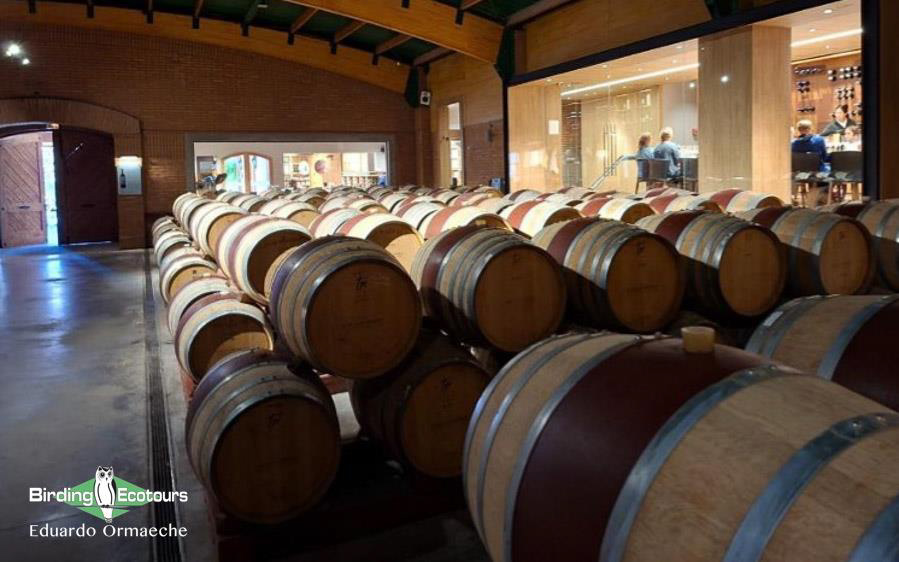
Viñas del Bosque Wine Reserves.
Later we headed inland to the dry valleys, where we visited the Casablanca and El Bosque vineyards and restaurant. We had a delicious lunch, then toured the vineyards, learning about wine production. We concluded with a superb wine tasting, the Chardonnays and Shiraz (Pequeñas), the Pinot Noir and the sparkling wine were all worthy of medals (in my humble opinion). Chilean wine is truly fabulous and deserves its worldwide recognition. We then returned to our accommodation for the night.
Day 3, 30th October 2025. Coastal birding and transfer to Santiago
Our day began at Concón, a scenic beach framed by rocky cliffs. Here we sought two specials: the striking Inca Tern, often considered the world’s most beautiful tern, and the endemic Chilean Seaside Cinclodes. Both species performed superbly, offering excellent views.
We then moved to another freshwater wetland reserve where we added a couple of new birds, including the good-looking Spot-flanked Gallinule and the shy Des Murs’s Wiretail. This was only known in southern Chile until a couple of decades ago, when this central Chilean population was discovered. It is named after the 19th century French ornithologist Marc Athanase Parfait Eillet des Murs.
Several Coscoroba Swans showed very well (the name ‘Coscoroba’ is onomatopoeic). We saw Pied-billed, White-tufted and Great Grebes (this last one of the nominate race major). We had more views of Cinnamon Teal, White-cheeked Pintail, Chiloe Wigeon, Red Shoveler, Lake Duck, Black-headed Duck, Picui Ground Dove, White-faced Ibis, Variable Hawk, Chimango Caracara, and our first Rufous-tailed Plantcutters, with good views of both males and females.
After lunch we moved to the pleasant beach resort of El Algarrobo, where we had nice views of Peruvian Pelican, Peruvian Booby, Red-legged Cormorant, Guanay Cormorant, Blackish Oystercatcher, Blue-and-white Swallow, Turkey Vulture and the near endemic Humboldt Penguin. Sadly, at the very time we were touring there, Chile’s Environment Ministry reclassified the species as Endangered. Chile is home to 80% of the world population of this species and Chilean scientists estimate that their numbers have dwindled to fewer than 20,000 individuals. This is due to new threats like avian flu and the impact of climate change, in addition to the usual reasons like marine pollution, overfishing, etc. The wildlife highlight was a couple of shy Marine Otters swimming in the shallow waters in front of us, looking for seafood in the kelp of the Pacific Ocean shores. We returned to Santiago for a rest and a delicious dinner in our comfortable hotel.
Day 4, 31st October 2025. El Yeso reservoir
Today we went to explore the famous Yeso Road reservoir in the Andes above Santiago de Chile. This scenic site, surrounded by mighty snow-capped mountains, is the most accessible site to look for the sought-after Diademed Sandpiper-Plover. This is a special high elevation-breeding wader which can be seen here at 9,500 feet (2,900 meters) elevation. This is at comparatively low elevation when compared to other classic sites for the species, such as at Marcapomacocha in Peru, at 15,400 feet (4,750 meters), and the Lizoite mountain pass in Argentina, at 13,450 feet (4,100 meters). We indeed had great success with the species, but I’ll describe the day from the beginning.
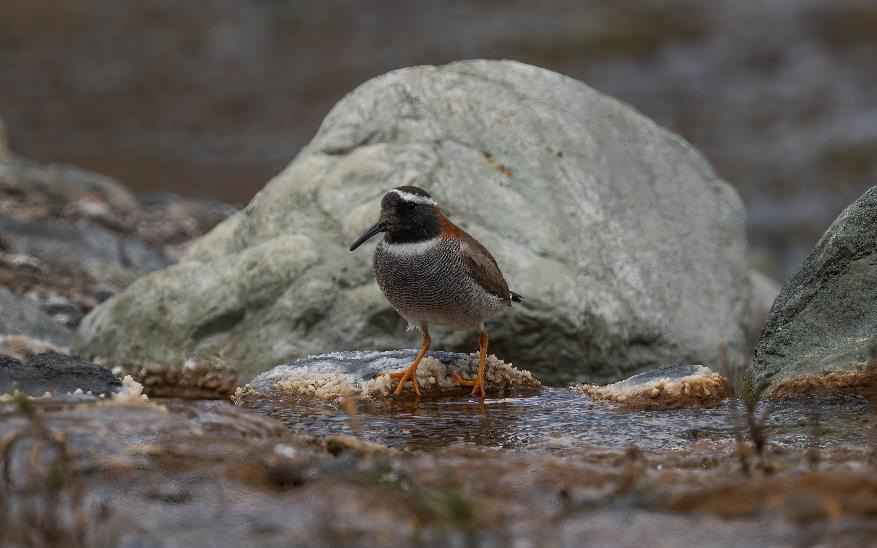
Diademed Sandpiper-Plover, a true gem of the Andes (photo Joi Inbody).
We started driving across the mountains and quickly added Black-chinned Siskin, Grey-hooded Sierra Finch, and Torrent Duck here of the nominate race armata, which is found only in central and southern Chile and western Argentina. The next target was Crag Chilia, another central Chile endemic and a rocky hillside furnariid special. As soon as we started to gain elevation, we found Andean Goose and Magellanic Snipe, Yellow-billed Pintail, Grey-breasted Seedsnipe, Plumbeous Sierra Finch, Buff-winged Cinclodes and Greater Yellow Finch.
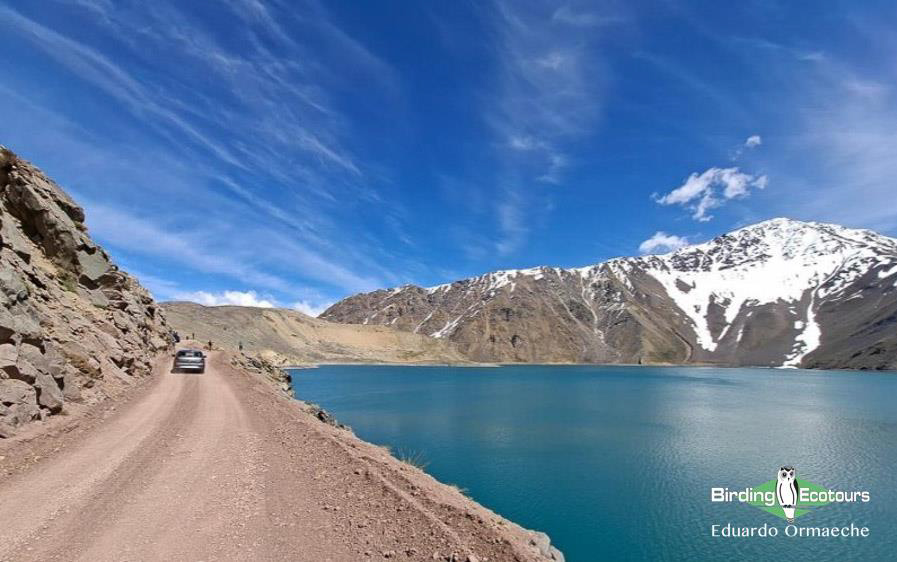
Embalse El Yeso above the Andes of Santiago.
Before getting to La Vega, at the end of the road, we found Rufous-banded Miner, Scale-throated Earthcreeper, Ochre-naped, White-browed and Spot-billed Ground Tyrants, Sharp-billed Canastero, Black-winged Ground Dove, a single, brief Band-tailed Sierra Finch, and more cooperative Mourning Sierra Finch. At La Vega, we saw the famous trail used by Charles Darwin in the 19th century to cross the high Andes on his legendary trip to South America. Then we found a couple of Diademed Sandpiper-Plovers with chicks! The excitement could not have been greater.
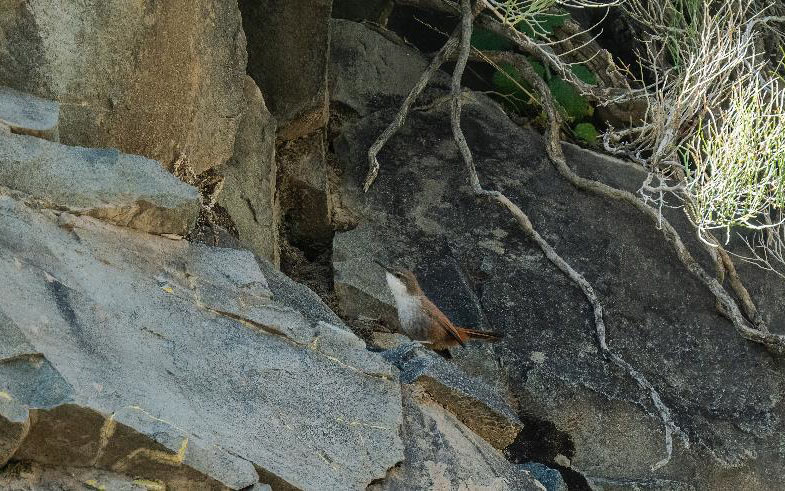
The endemic Crag Chilia put on a show for us (photo Joi Inbody).
After a picnic lunch at this great spot we started the drive back, making a few stops along the road. We soon spotted an active colonial nest with a Coruro, an endemicrodent of central Chile. Then we returned to Santiago to our comfortable hotel.
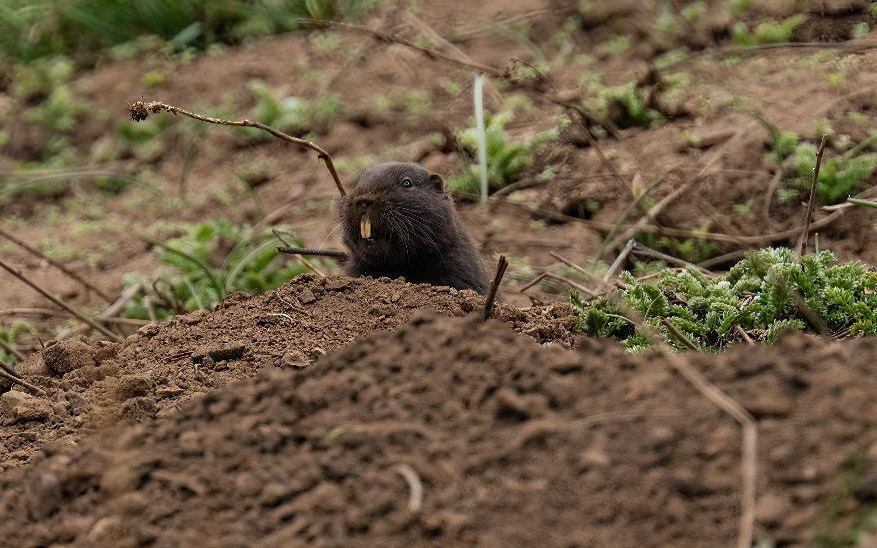
The Coruro is an endemic rodent from Chile (photo Joi Inbody).
Day 5, 1st November 2025. Yerba Loca and Los Farellones
Today we had another early start to explore the different habitats and sections of the Andes above Santiago, on the way to the famous ski resort Los Farellones. Starting at low elevation, we looked for the endemic Chilean Tinamou which unfortunately didn’t show up. We had to be careful while birding on the road, since it was very early on a national holiday and some people were driving fast on the country roads. We continued to the Yerba Loca Nature Sanctuary, where we were received by a pair of Lesser Horned Owls at their daytime roost.We then added species such as Mourning Sierra Finch, a pair of Striped Woodpeckers mating, a single distant Band-tailed Sierra Finch, a Harris’s Hawk, our first Austral Pygmy Owl,which provided a nice show but kept a little distant, and our first encounter with the magnificent Moustached Turca. This charismatic and unique tapaculo species is found only in central Chile, and we could observe its natural behavior well, not limited to brief sightings only. We tried hard for the elusive White-throated Tapaculo, another endemic of central Chile but, after multiple attempts, only Joi and Jean Paul managed to see this skulker.
Further up we encountered Plain-mantled Tit-Spinetail, the endemic Dusky-tailed Canastero, Tufted Tit-Tyrants the first Chilean Mockingbird, and Chilean Flicker. We viewed Black-chested Buzzard-Eagle and a nice Andean Fox (also known as Culpeo Fox), a widespread canid species in South America that we had seen together before in northwest Argentina.
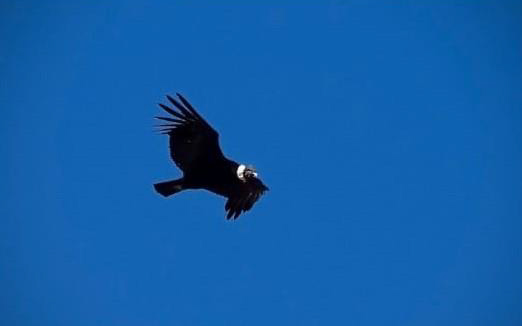
Andean Condor soaring above the Andes (photo by Donna Nordstrom).
We continued exploring the upper parts of the Los Farellones ski resort and saw Yellow-rumped Siskins in flight, Black-billed Shrike-Tyrant, Chimango Caracara, a single Mountain Caracara, Rufous-banded Miner, and a nice Variable Hawk on a nest. Of course, we had plenty of Andean Condor sightings, including a few juveniles at close range. On the way down we stopped and photographed Southern Viscacha.
Day 6, 2nd November 2025. Flight to Punta Arenas and transfer to Cerro Castillo
We were transferred to the airport for an early 3½ hour flight to Punta Arenas (1,350 miles / 2,180 kilometers away, at the end of the continent). This is the nearest airport to the famous Torres del Paine National Park. Our plan was to explore the park and some of the areas around Punta Arenas and the Strait of Magellan for a few days. We arrived at Punta Arenas and met Sebastian, our local guide and driver for the next week. We drove directly to Cerro Castillo in Torres del Paine; it was a long drive of around four hours on a very windy Patagonian day. We made only one stop on the way to get lunch, but we saw birds like Lesser Rhea, here of the nominate race, which is considered a different species by some authorities. Furthermore, we saw Black-necked Swan, Upland Goose, Crested Duck, Magellanic Oystercatcher, Red-gartered Coot, Chilean Flamingo, Black-faced Ibis, Andean Condor, Southern Lapwing and Long-tailed Meadowlark. We arrived at Ovejero Patagonico, our comfortable base for the next three nights, in the heart of the Patagonian steppes.
Day 7, 3rd November 2025. Lago Sarmiento and Cerro Castillo
One of the main targets of this Patagonian adventure was to find and photograph the mighty Puma, also known as Mountain Lion, in what must be the best place in the world to see this species. However, this morning we decided not to start looking for Pumas and to rather catch up with birds after yesterday’s long drive coming from Santiago. We birded around the Mirador, where we saw Lesser Rhea, Baird’s Sandpiper, Brown-hooded Gull, Black-faced Ibis, Cinereous Harrier, Upland Goose, Crested Caracara, Austral Negrito, Chilean Swallow, Chilean Mockingbird, Rufous-collared Sparrow, Rufous-tailed Plantcutter, and Mourning Sierra Finch.
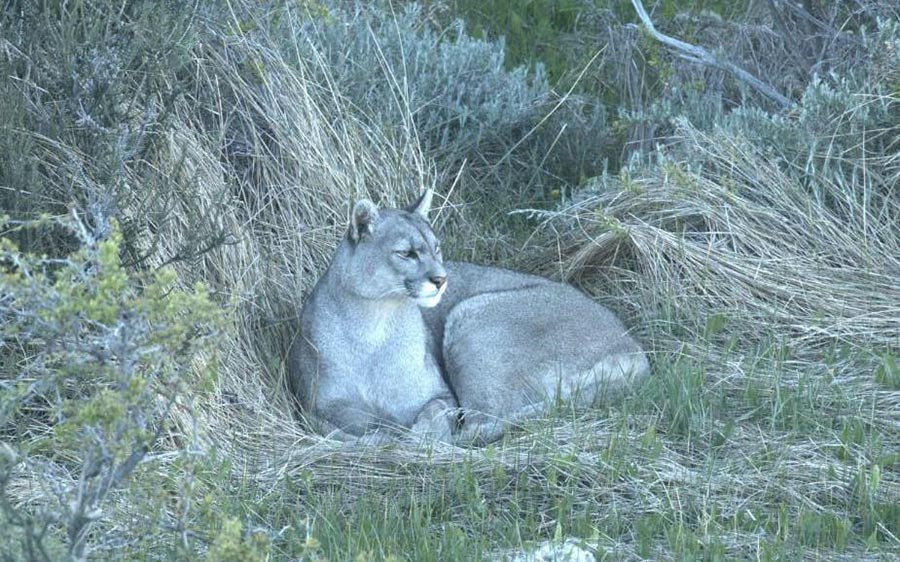
Puma in Torres del Paine National Park (photo Joi Inbody).
While chance encounters with Pumas are possible along park roads, the most reliable approach is to explore private buffer-zone lands with professional trackers. These experts dedicate extensive time to monitoring individual animals and coordinate discreetly with their groups, greatly increasing the likelihood of daily sightings. These logistics increase the price of the tour, but it is well worth it to give daily encounters with Pumas. In the afternoon, we went up to the Cerro Castillo area where, with the help of our outstanding Puma tracker, we enjoyed premium views of a Puma having a siesta not far from a very well-hidden Guanaco carcass that the Puma had covered with branches after a predawn killing. We sat for almost an hour, at a good distance, to see if the Puma would become active and feast on its prey, but eventually returned to our lodge at 7 pm, with the Puma still resting.
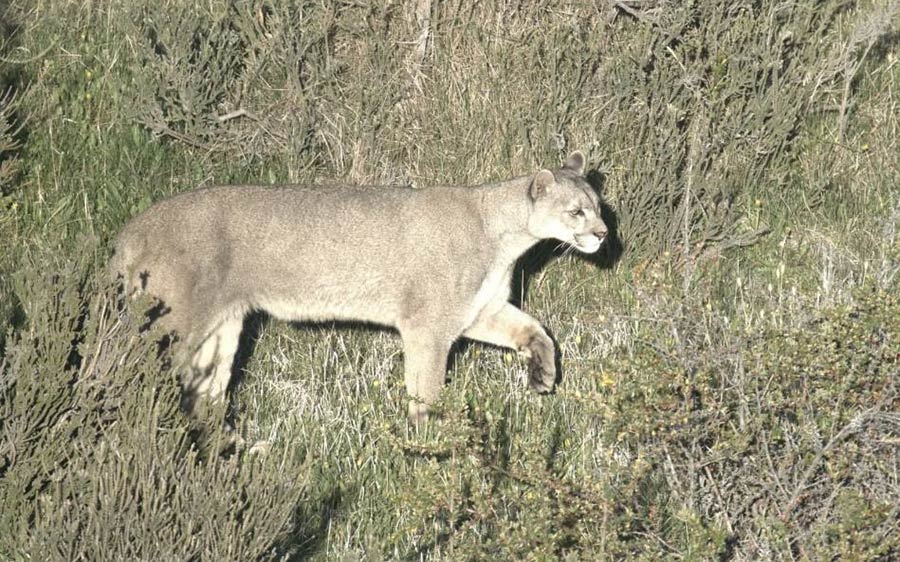
Torres del Paine offers the best chances in the world to see Puma (photo Joi Inbody).
Day 8, 4th November 2025. Cerro Castillo and Laguna Sarmiento
We left our hotel before dawn to explore an area located about an hour’s drive away, where our Puma tracker had advised us to go. Fortunately, we had a 4×4 vehicle capable of driving along the rough tracks which led to private land in the heart of the Patagonian steppes. We reached the place where our tracker was waiting for us and then walked about 300 feet (100 meters) along a relatively steep but fairly easy route. We couldn’t believe how close we got to a female Puma, she allowed long views and good photos and never looked worried by our presence, rather keeping track of a hare in the bush. What an amazing moment that we will remember forever!
In the afternoon we encountered Large Hairy Armadillo,a new mammal for the trip, and several Guanacos, Lesser Rheas, Upland Geese and other usual suspects.
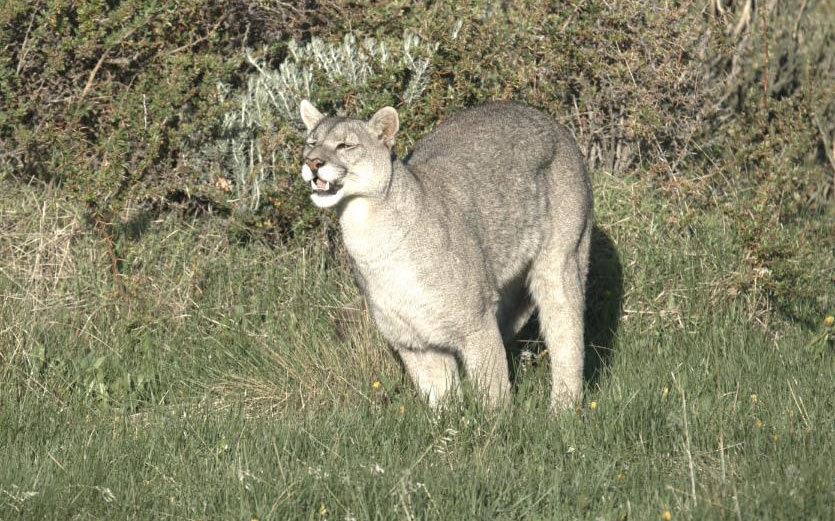
Puma in Torres del Paine National Park (photo Joi Inbody).
Day 9, 5th November 2025. Torres del Paine National Park
Today we had our final Puma encounter, this time an individual near the public road, so there was quite a crowd and we had to look from a distance. We had scheduled three days to try for Puma, with great logistics we had encounters on every one of these days.
We left the Cerro Castillo area and drove towards the Torres del Paine National Park, where we enjoyed amazing vistas of incredible peaks and lakes, the park truly is one of the highlights of South America. We had our first encounter with Austral Parakeet, a near endemic found only in Chile and Argentina, here of the race minor.
We went to our next hotel, which stands in a unique spot surrounded by a lake and the snow-capped mountains. We had an easy afternoon birding around the hotel and found Great Grebe, here of the endemic race navasi. We also found Andean Condor, Austral Thrush, Southern House Wren, Patagonian Sierra Finch, Black-chinned Siskin, White-crested (Chilean) Elaenia, Thorn-tailed Rayadito, Dark-bellied Cinclodes, Chilean Flicker, Upland Goose, and Flying Steamer Duck.
Day 10, 6th November 2025. Torres del Paine and Lake Grey
This morning we drove towards the entrance of the park to look for the localized Austral Rail which, despite our best efforts remained heard only. (The participants didn’t want to bother the bird too much with the tape and were happy with the heard record). Here we also had Grass Wren (of the race hornensis), Red-gartered Coot, Black-necked Swan, Upland Goose, White-tufted Grebe, Crested Duck, Fire-eyed Diucon, and Bronze-winged Duck (which is also known as Spectacled Duck).
A highlight of the morning was a superb view of Austral Pygmy Owl at a close distance, hunting and preying on a lizard. In the afternoon we explored the woodlands around Lake Grey, located about an hour’s drive from the hotel. The natural beauty and landscapes were stunning. During our walk we had good views of Magellanic Tapaculo, Thorn-tailed Rayadito, Austral Parakeet, and Patagonian Sierra Finch.
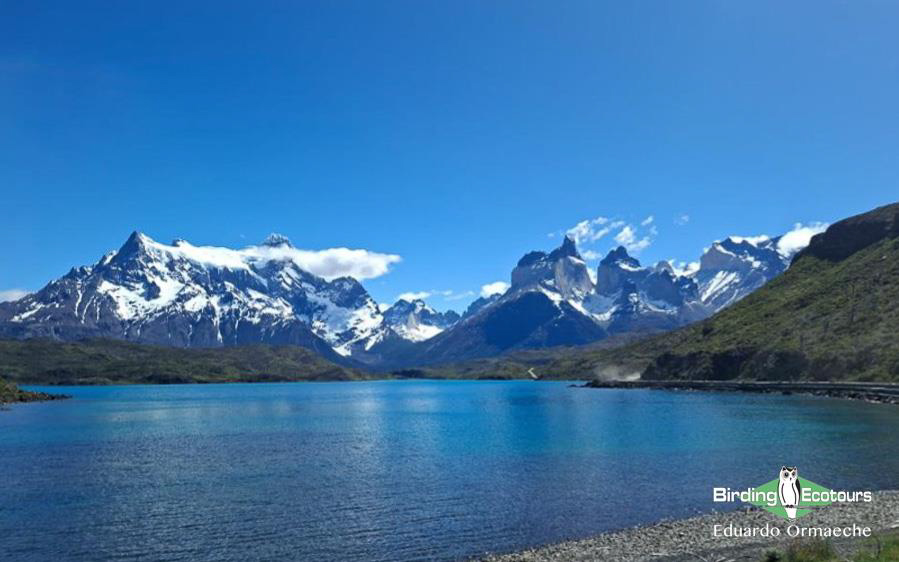
The spectacular Torres del Paine mountain chain.
We checked the shores of the eastern part of Lake Grey and had great views of the most wanted Two-banded Plover, as well as Bronze-winged Duck (Spectacled Duck), Yellow-billed Teal, Black-faced Ibis, Chilean Flamingo, South American Tern, Baird’s Sandpiper, and Flying Steamer Duck.
Day 11, 7th November 2025. Transfer to Punta Arenas
This morning we left the national park after a glorious five days here, driving all the way back to Punta Arenas retracing our earlier route via Puerto Natales, where we stopped to refuel and do some shopping. We enjoyed lunch at the restaurant and then explored a remote road in the middle of the steppes – it felt like we were in the middle of nowhere. We didn’t see any other people or vehicles for the next few hours and the birding was outstanding. We added great species like the localized and near endemic Chocolate-vented Tyrant, White-bridled Finch, Common Miner, and Correndera Pipit. Rufous-chested Dotterel provided a great moment as we watched a couple in full breeding plumage next to their nest. The last bird along this productive track was Tawny-throated Dotterel, an austral resident which migrates to central South America during winter. Back in Punta Arenas we had a nice, and funny, encounter with three South American Grey Foxes next to a gas station.
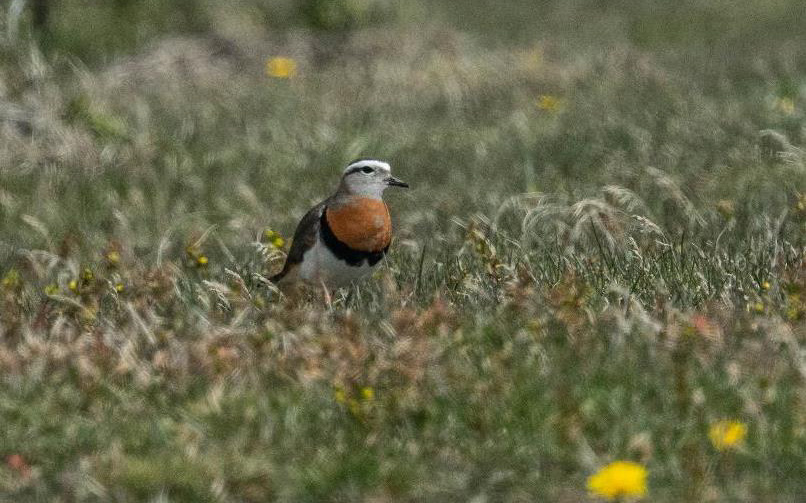
Rufous-chested Dotterel (photo Joi Inbody).
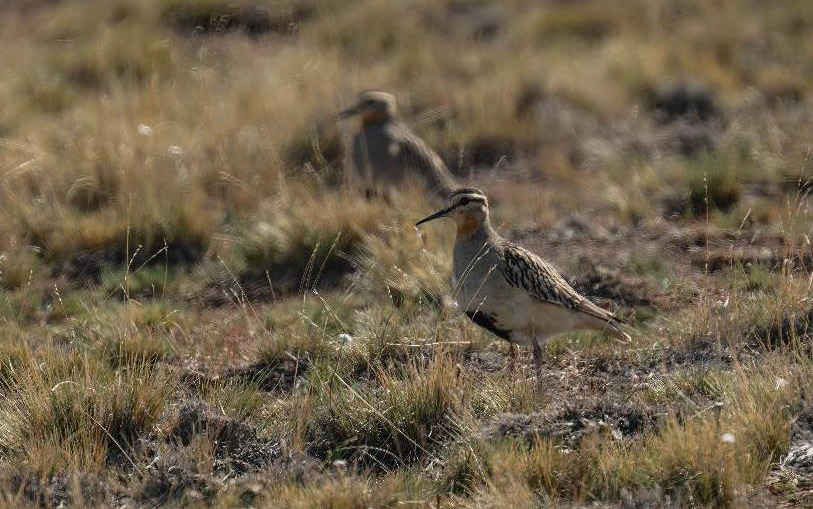
Tawny-throated Dotterel (photo Joi Inbody).
Day 12, 8th November 2025. Magallanes and Punta Carrera
On our last day in Punta Arenas we went to explore some birding sites along the southern coast, where we had a great morning enjoying species such as Magellanic Oystercatcher with chicks, Chilean Skua, South American Tern, Dolphin Gull, Imperial Shag, Southern Giant Petrel, Black-browed Albatross, Flightless Steamer Duck and the scarce Ruddy-headed Goose. We explored some forested areas where we had another Magellanic Tapaculo and Ashy-headed Goose. By late morning the bird activity became very quiet, and the wind picked up, so we returned to town for a free afternoon to download photos and get ready for the final leg of the trip.
Day 13, 9th November 2025. Flight to Puerto Montt and transfer to Chilóe
We flew to Puerto Montt, a beautiful Chilean city surrounded by the Osorno, Calbuco and Yates volcanoes. It was immortalized in the lyrics of the popular song “Puerto Montt” by Los Iracundos, a popular Hispanic American pop and bolero band from the 60s. We met the lodge staff at the airport and started the long five-hour drive to the splendid Tepuhueico Lodge, a truly unknown gem, hidden in the Valdivian rainforest. Our plan was to spend four nights at this lodge and explore the surroundings, including the nearby forest with 800-year-old trees, and to enjoy the birds and wildlife from the comfort of the lodge.
It’s not easy to get there but it is certainly well worth it! After arrival at Puerto Montt, one takes a ferry to the famous Chiloé Island, which was visited and explored by Charles Darwin in the 19th century on his famous journey through South America. During the 25-minute ferry ride we had brief but good views of Magellanic Penguin, Peruvian Pelican, Imperial Shag, South American Tern, and Brown-hooded Gull. We also had good views of a single South American Fur Seal.
We arrived at our cozy lodge and immediately checked into our rooms, which had an amazing view of the forest. There were some good birds around, including Fire-eyed Diucon, Austral Thrush, dozens of White-crested (Chilean) Elaenias, and Green-backed Firecrown, which was common around the lodge but not easy to photograph since it was always very active. A target that was seen very well this afternoon, and provided repeated good views, was the endemic Slender-billed Parakeet.
Dinner was exquisite, as were all the meals we had during our stay at this lovely lodge. The food was outstanding, and the chef and the manager came to the table to explain the menu carefully. This was truly an amazing experience of hospitality and warmth!
Day 14, 10th November 2025. Tepehueico Lodge
The plan for the day was to explore and bird some areas around the lodge and within the park where very few visitors go and are reserved for researchers. It was a great day from beginning to end, with one of our mammal targets seen just outside the lodge. The poorly known Southern Pudu is native to the Valdivian Forest in southern Chile and adjacent Argentina and is the second smallest deer in the world after its relative, Northern Pudu, from the Andes of northern South America. We saw seven different individuals and they were active every day, both during the day and at night. Chiloé Island holds a high density of this species indeed.
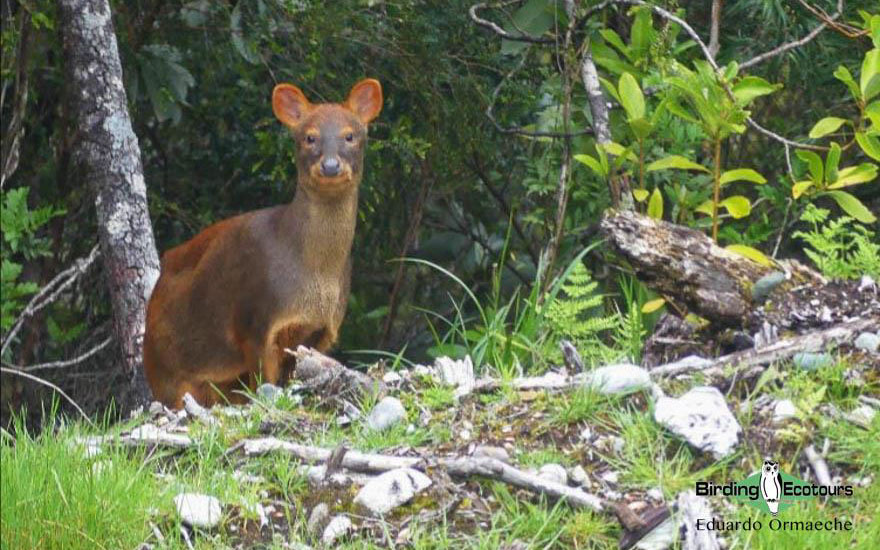
The rare Southern Pudu (photo Eduardo Ormaeche).
The bird diversity is not very high but includes all Rhinocryptidae (tapaculo) members possible in southern Chile. We had an amazing encounter with Chucao Tapaculo. This was one of our favorite tapaculos and showed very well but was hard to photograph well because of the dark forest conditions and the shy behavior of the bird. Nevertheless, Joi managed to photograph this handsome bird feeding right out in the open.
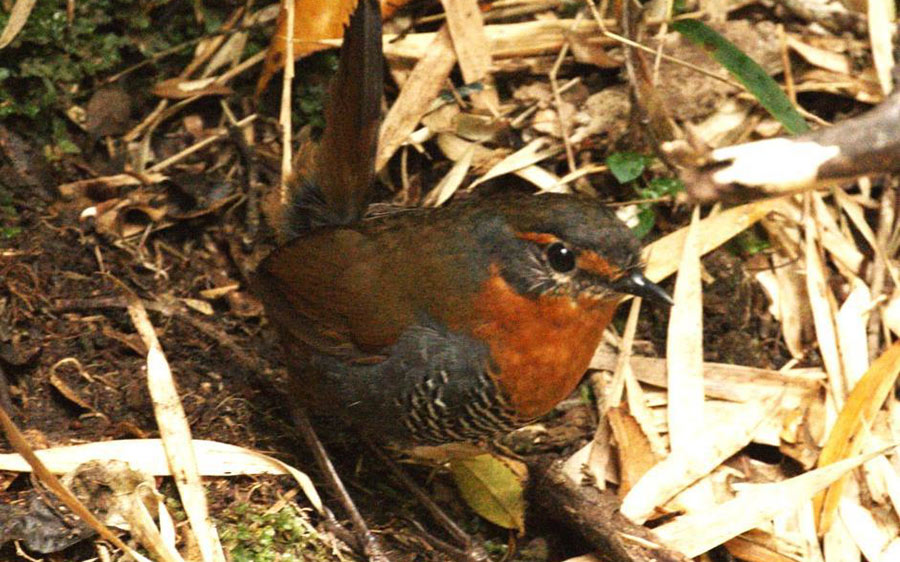
Chucao Tapaculo (photo Joi Inbody).
At dusk (9 pm) we had an incredible session with the near-endemic Chilean Hawk, enjoying a late kill. During the night we spotted a couple of Rufous-legged Owls, this was an extraordinary sighting with them calling from the top of the trees. Additionally, our lodge guide found the mythical Monito de Monte (Colocolo Opossum), the second smallest marsupial and just slightly larger than Long-tailed Planigale. This was an extraordinary sighting because this animal is not easy to see, fortunately we knew about it from reading “The Flight of the Condor” by Michael Andrews and based on the 1982 BBC documentary of the same name.
Day 15, 11th November 2025. Tepehueico Lodge
We explored several spots in the reserve, including the Cascade Trail, which is surrounded by majestic forest of mañios or Podocarpus nubigenus, with trees that are over 800 years old. This beautiful spot has one of the coolest hikes I have done in years, it was a privilege to enjoy the forest all by ourselves. We had new birds, including Black-throated Huet-huet, and Ochre-flanked, Chucao, and Magellanic Tapaculos. In addition, we saw White-crested (Chilean) Elaenia, Patagonian Sierra Finch, Chilean Pigeon, Chimango Caracara, Thorn-tailed Rayadito, Austral Thrush, and Chilean Swallow.
At night we tried for the endemic Darwin’s Fox and the seldom-seen Kodkod Cat, but we didn’t have success and gave up after searching for two hours after dinner.
Day 16, 12th November 2025. Tepehueico Lodge
For our last full day on the island, we explored the coastal zone of the reserve and some rivers outside of the reserve, trying to find Southern River Otter and additional birds and wildlife. We had a busy morning driving through the islands, enjoying being outdoors and seeing the usual birds we had seen before. Sadly, we dipped on the otter, arriving late at a place where a tracker had spotted one about 30 minutes before we arrived. We saw a huge South American Sea Lion along the river not far from the coast. We enjoyed a tasty pizza for lunch and then retreated to the lodge in the afternoon. We tried hard for nocturnal wildlife, but again without success. We saw the same Rufous-legged Owl pair we had seen last night. We were happy with our attempt and could not be happier with what we had seen, and with our wonderful experience at this fantastic place.
Day 17, 13th November 2025. Transfer to Puerto Montt and flight to Santiago
We had a long drive back to Ancud to catch the ferry back to Puerto Montt. Along the drive we saw more bird species, including Rock Shag (also known as Magellanic Cormorant), South American Tern, Imperial Shag, Dolphin and Brown-headed Gulls, Peruvian Pelican, Magellanic Penguin, Sooty Shearwater, and a glimpse of Magellanic Diving Petrel, and Pincoya Storm Petrel, a special bird species from Chiloé waters and only recently described in 2013. It is named after a water spirit in local mythology. Back in Puerto Montt we were transferred to the airport and flew back to Santiago, where we had our final supper together as a group, to toast another successful private Birding Ecotours trip.
Day 18, 14th November 2025. Departure
We were transferred to the airport and flew home.
Bird List – Following IOC (15.1) (March 2025)
All species were seen. Common names with an alternative common name in parentheses indicate name changes/splits/lumps following the announcement of the new AviList version 2025 global bird checklist.
The following notation after species names is used to show conservation status following BirdLife International: VU = Vulnerable.
| Common Name | Scientific Name |
| Rheas (Rheidae) | |
| Lesser Rhea | Rhea pennata |
| Ducks, Geese, Swans (Anatidae) | |
| Coscoroba Swan | Coscoroba coscoroba |
| Black-necked Swan | Cygnus melancoryphus |
| Flying Steamer Duck | Tachyeres patachonicus |
| Fuegian Steamer Duck | Tachyeres pteneres |
| Torrent Duck | Merganetta armata |
| Andean Goose | Chloephaga melanoptera |
| Upland Goose | Chloephaga picta |
| Ashy-headed Goose | Chloephaga poliocephala |
| Ruddy-headed Goose | Chloephaga rubidiceps |
| Crested Duck | Lophonetta specularioides |
| Bronze-winged Duck | Speculanas specularis |
| Silver Teal | Spatula versicolor |
| Cinnamon Teal | Spatula cyanoptera |
| Red Shoveler | Spatula platalea |
| Chiloe Wigeon | Mareca sibilatrix |
| White-cheeked Pintail | Anas bahamensis |
| Yellow-billed Pintail | Anas georgica |
| Yellow-billed Teal | Anas flavirostris |
| Black-headed Duck | Heteronetta atricapilla |
| Ruddy Duck | Oxyura ferruginea |
| Lake Duck | Oxyura vittata |
| Pigeons, Doves (Columbidae) | |
| Rock Dove [Feral Pigeon] | Columba livia [dom.] |
| Chilean Pigeon | Patagioenas araucana |
| Black-winged Ground Dove | Metriopelia melanoptera |
| Picui Ground Dove | Columbina picui |
| Eared Dove | Zenaida auriculata |
| West Peruvian Dove | Zenaidameloda |
| Rails, Crakes & Coots (Rallidae) | |
| Plumbeous Rail | Pardirallus sanguinolentus |
| Austral Rail (H) – VU | Rallus antarcticus |
| Red-gartered Coot | Fulica armillata |
| Red-fronted Coot | Fulica rufifrons |
| White-winged Coot | Fulica leucoptera |
| Spot-flanked Gallinule | Porphyriops melanops |
| Grebes (Podicipedidae) | |
| White-tufted Grebe | Rollandia rolland |
| Great Grebe | Podiceps major |
| Pied-billed Grebe | Podilymbus podiceps |
| Flamingos (Phoenicopteridae) | |
| Chilean Flamingo | Phoenicopterus chilensis |
| New World Quail (Odontophoridae) | |
| California Quail | Callipepla californica |
| Hummingbirds (Trochilidae) | |
| Giant Hummingbird | Patagona gigas |
| Green-backed Firecrown | Sephanoides sephaniodes |
| Cuckoos (Cuculidae) | |
| Groove-billed Ani | Crotophaga sulcirostris |
| Oystercatchers (Haematopodidae) | |
| American Oystercatcher | Haematopus palliatus |
| Blackish Oystercatcher | Haematopus ater |
| Magellanic Oystercatcher | Haematopus leucopodus |
| Stilt (Recurvirostridae) | |
| Black-necked Stilt | Himantopus mexicanus |
| Plovers (Charadriidae) | |
| Tawny-throated Dotterel | Oreopholus ruficollis |
| Rufous-chested Dotterel | Zonibyx modestus |
| Diademed Sandpiper-Plover | Phegornis mitchellii |
| Southern Lapwing | Vanellus chilensis |
| Two-banded Plover | Anarhynchus falklandicus |
| Seedsnipes (Thinocoridae) | |
| Grey-bellied Seedsnipe | Thinocorus orbignyianus |
| Least Seedsnipe | Thinocorus rumicivorus |
| Sandpiper (Scolopacidae) | |
| Hudsonian Whimbrel | Numenius hudsonicus |
| Magellanic Snipe | Gallinago magellanica |
| Wilson’s Phalarope | Phalaropus tricolor |
| Lesser Yellowlegs | Tringa flavipes |
| Greater Yellowlegs | Tringa melanoleuca |
| Sanderling | Calidris alba |
| Baird’s Sandpiper | Calidris bairdii |
| Gulls, Terns, Skimmers (Laridae) | |
| Black Skimmer | Rynchops niger |
| Inca Tern | Larosterna inca |
| Snowy-crowned Tern | Sterna trudeaui |
| South American Tern | Sterna hirundinacea |
| Royal Tern | Thalasseus maximus |
| Brown-headed Gull | Chroicocephalus brunnicephalus |
| Grey-headed Gull | Chroicocephalus cirrocephalus |
| Dolphin Gull | Leucophaeus scoresbii |
| Grey Gull | Leucophaeus modestus |
| Kelp Gull | Larus dominicanus |
| Skuas (Stercorariidae) | |
| Chilean Skua | Stercorarius chilensis |
| Penguins (Spheniscidae) | |
| Humboldt Penguin – VU | Spheniscus humboldti |
| Magellanic Penguin | Spheniscus magellanicus |
| Albatrosses (Diomedeidae) | |
| Black-browed Albatross | Thalassarche melanophris |
| Petrels, Diving Petrels (Procellariidae) | |
| Southern Giant Petrel | Macronectes giganteus |
| Sooty Shearwater | Ardenna grisea |
| Magellanic Diving Petrel | Pelecanoides magellani |
| Boobies, Gannets (Sulidae) | |
| Peruvian Booby | Sula variegata |
| Cormorants, Shags (Phalacrocoracidae) | |
| Red-legged Cormorant | Poikilocarbo gaimardi |
| Imperial Shag | Leucocarbo atriceps |
| Rock Shag | Leucocarbo magellanicus |
| Neotropic Cormorant | Nannopterum brasilianum |
| Guanay Cormorant | Leucocarbo bougainvilliorum |
| Ibises (Threskiornithidae) | |
| American White-faced Ibis | Eudocimus albus |
| Black-faced Ibis | Theristicus melanopis |
| Herons, Egrets (Ardeidae) | |
| Stripe-backed Bittern | Botaurus involucris |
| Black-crowned Night Heron | Nycticorax nycticorax |
| Little-blue Heron | Egretta caerulea |
| Snowy Egret | Egretta thula |
| Western Cattle Egret | Ardea ibis |
| Great Egret | Ardea alba |
| Cocoi Heron | Ardea cocoi |
| Pelicans (Pelecanidae) | |
| Peruvian Pelican | Pelecanus thagus |
| American Vultures (Cathartidae) | |
| Andean Condor | Vultur gryphus |
| Black Vulture | Coragyps atratus |
| Turkey Vulture | Cathartes aura |
| Kites, Hawk, Eagles (Accipitridae) | |
| Chilean Hawk | Astur chilensis |
| Cinereous Harrier | Circus cinereus |
| Harris’s Hawk | Parabuteo unicinctus |
| Variable Hawk | Geranoaetus polyosoma |
| Black-chested Buzzard- Eagle | Geranoaetus melanoleucus |
| Barn Owls (Tytonidae) | |
| American Barn Owl | Tyto furcata |
| Owls (Strigidae) | |
| Burrowing Owl | Athene cunicularia |
| Austral Pygmy Owl | Glaucidium nana |
| Lesser Horned Owl | Bubo magellanicus |
| Rufous-legged Owl | Strix rufipes |
| Kingfishers (Alcedinidae) | |
| Ringed Kingfisher | Megaceryle torquata |
| Woodpeckers (Picidae) | |
| Striped Woodpecker | Veniliornis lignarius |
| Chilean Flicker | Colaptes pitius |
| Caracaras, Falcons | |
| Crested Caracara | Caracara plancus |
| Chimango Caracara | Milvago chimango |
| Mountain Caracara | Phalcoboenus megalopterus |
| African & New World Parrots (Psittacidae) | |
| Austral Parakeet | Enicognathus ferrugineus |
| Slender-billed Parakeet | Enicognathus leptorhynchus |
| Ovenbirds (Furnariidae) | |
| Rufous-banded Miner | Geositta rufipennis |
| Common Miner | Geositta cunicularia |
| White-throated Treerunner | Pygarrhichas albogularis |
| Crag Chilia | Ochetorhynchus melanurus |
| Wren-like Rushbird | Phleocryptes melanops |
| Scale-throated Earthcreeper | Upucerthia dumetaria |
| Buff-winged Cinclodes | Cinclodes fuscus |
| Grey-flanked Cinclodes | Cinclodes oustaleti |
| Dark-bellied Cinclodes | Cinclodes patagonicus |
| Chilean Seaside Cinclodes | Cinclodes nigrofumosus |
| Thorn-tailed Rayadito | Aphrastura spinicauda |
| Des Murs’s Wiretail | Sylviorthorhynchus desmurii |
| Plain-mantled Tit-Spinetail | Leptasthenura aegithaloides |
| Dusky-tailed Canastero | Pseudasthenes humicola |
| Sharp-billed Canastero | Asthenes pyrrholeuca |
| Tapaculos (Rhinocryptidae) | |
| Black-throated Huet-huet | Pteroptochos tarnii |
| Moustached Turca | Pteroptochos megapodius |
| White-throated Tapaculo | Scelorchilus albicollis |
| Chucao Tapaculo | Scelorchilus rubecula |
| Ochre-flanked Tapaculo | Eugralla paradoxa |
| Dusky Tapaculo | Scytalopus fuscus |
| Magellanic Tapaculo | Scytalopus magellanicus |
| Tyrants, Flycatchers (Tyrannidae) | |
| Chilean Elaenia | Elaenia chilensis |
| Southern Beardless Tyrannulet | Camptostoma obsoletum |
| Tufted Tit-Tyrant | Anairetes parulus |
| Many-colored Rush Tyrant | Tachuris rubrigastra |
| Vermillion Flycatcher | Pyrocephalus obscurus |
| Spot-billed Ground Tyrant | Muscisaxicola maculirostris |
| Ochre-naped Ground Tyrant | Muscisaxicola flavinucha |
| White-browed Ground Tyrant | Muscisaxicola albilora |
| Black-fronted Ground Tyrant | Muscisaxicola frontalis |
| Austral Negrito | Lessonia rufa |
| Spectacled Tyrant | Hymenops perspicillatus |
| Fire-eyed Diucon | Pyrope pyrope |
| Chocolate-vented Tyrant | Neoxolmis rufiventris |
| Black-billed Shrike Tyrant | Agriornis montanus |
| Great Shrike-Tyrant | Agriornis lividus |
| Cotingas (Cotingidae) | |
| Rufous-tailed Plantcutter | Phytotoma rara |
| Swallons, Martins (Hirundinidae) | |
| Chilean Swallow | Tachycineta leucopyga |
| Blue-and-white Swallow | Pygochelidon cyanoleuca |
| Barn Swallow | Hirundo rustica |
| Wrens (Troglodytidae) | |
| Grass Wren | Cistothorus platensis |
| Southern House Wren | Troglodytes musculus |
| Mockingbirds (Mimidae) | |
| Chilean Mockingbird | Mimus thenca |
| Thrushes (Turdidae) | |
| Austral Thrush | Turdus falcklandii |
| Old World Sparrows (Passeridae) | |
| House Sparrow | Passer domesticus |
| Pipits (Motacillidae) | |
| Correndera Pipit | Anthus correndera |
| Finches, Euphonias, (Fringillidae) | |
| Black-chinned Siskin | Spinus barbatus |
| Yellow-rumped Siskin | Spinus uropygialis |
| New World Sparrows (Passerellidae) | |
| Rufous-collared Sparrow | Zonotrichia capensis |
| American Blackbirds (Icteridae) | |
| Long-tailed Meadowlark | Leistes loyca |
| Shiny Cowbird | Molothrus bonariensis |
| Austral Blackbird | Curaeus curaeus |
| Yellow-winged Blackbird | Agelasticus thilius |
| Tanagers (Thraupidae) | |
| Mourning Sierra Finch | Rhopospina fruticeti |
| Band-tailed Sierra Finch | Rhopospina alaudina |
| Grassland Yellow Finch | Sicalis luteola |
| Greater Yellow Finch | Sicalis auriventris |
| Grey-hooded Sierra Finch | Phrygilus gayi |
| Patagonian Sierra Finch | Sicalis lebruni |
| White-bridled Finch | Melanodera melanodera |
| Plumbeous Sierra Finch | Geospizopsis unicolor |
| Blue-and-yellow Tanager | Rauenia bonariensis |
| Diuca Finch | Diuca diuca |
| Total seen | 177 |
| Total heard only | 1 |
| Total recorded | 178 |
Mammal List
| Monito de Monte (Microbiotheriidae) | |
| Southern Monito del Monte | Dromiciops gliroides |
| Hairy Armadillos (Chlamyphoridae) | |
| Large Hairy Armadillo | Chaetophractus villosus |
| Cricetidae rodents (Cricetidae) | |
| Chilean Climbing Rat | Irenomys tarsalis |
| Coruro (Octodontidae) | |
| Coruro | Spalacopus cyanus |
| Viscachas, Chinchillas (Chinchillidae) | |
| Southern Viscacha | Lagidium viscacia |
| Rabbits, Hares (Leporidae) | |
| European Hare | Lepus europaeus |
| Coipu, Spiny Rats (Echimyidae) | |
| Coypu | Myocastor coypus |
| Camelids (Camelidae) | |
| Guanaco | Lama guanicoe |
| Deers (Cervidae) | |
| Southern Pudu | Pudu puda |
| Wild Cats (Felidae) | |
| Puma | Felis concolor |
| Weasel Family (Mustelidae) | |
| Marine Otter | Lontra felina |
| Skunk, Stink Badgers (Mephitidae) | |
| Humboldt’s Hog-nosed Skunk | Conepatus humboldtii |
| Sealions (Otariidae) | |
| South American Sea Lion | Otaria flavescens |
| South American Fur Seal | Arctocephalus australis |
| Total seen | 14 |
Reptile List
| Common Name | Scientific Name |
| Thin Tree Lizard Liolaemus tenuis | |
| Dark Lizard | Liolaemus chiliensis |
| Total seen | 2 |
This is a sample trip report. Please email us ([email protected]) for more trip reports from this destination.