16 – 20 JANUARY 2026
By Andrew Walker

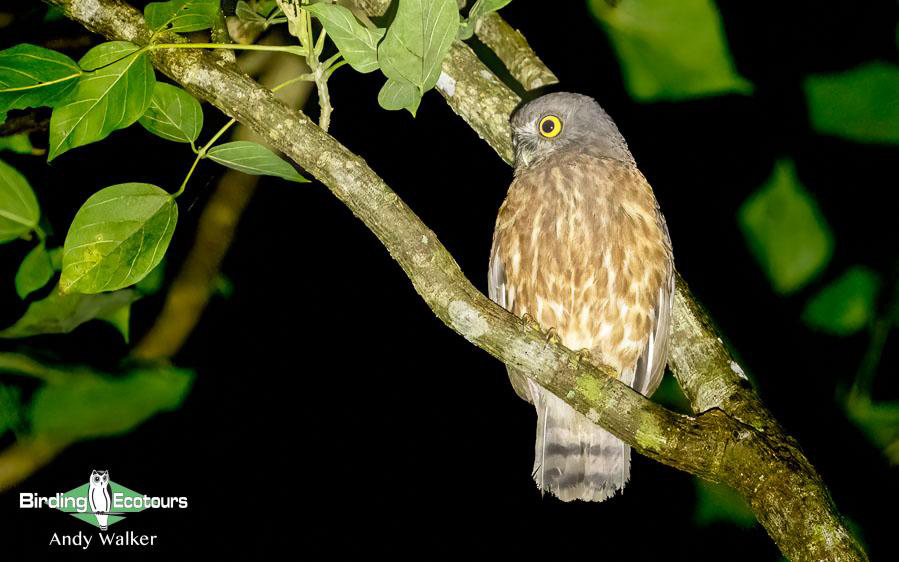
The Andaman Islands endemic Hume’s Boobook gave us great views during our Andaman Islands birding tour (as it also did on our previous tour).
Overview
The Andaman and Nicobar Islands, an Indian territory situated at the merging of the Bay of Bengal and the Andaman Sea, comprise approximately 570 islands divided into three districts: Nicobar, South Andaman, and Middle and North Andaman districts.
This tour focused exclusively on South Andaman Island, home to all of the region’s endemic bird species. The islands’ geographic isolation has fostered the evolution of numerous unique avian endemics. Twenty endemics are currently recognized as occurring on the main Andaman Islands and this short birding tour was focused on finding all of them, along with several interesting endemic sub-species, some of which may be elevated to full species status in the future.
We recorded 121 bird species on this Andaman birdwatching tour (two were heard only) and you can also see our eBird trip report, here. Bird and animal lists for this Andaman Islands birding tour follow the report. We saw all 20 Andaman Islands endemic bird species. Some of the most popular endemic species seen on the tour include the rare and secretive Andaman Crake, the large mainly black Andaman Woodpecker with its striking red crown, and multiple nightbirds, including Andaman Masked Owl, Hume’s Boobook, Andaman Boobook, Andaman Scops Owl, and Andaman Nightjar. Endemic doves and pigeons were well represented during our birding and included the furtive Andaman Wood Pigeon and pretty Andaman Green Pigeon. While the only endemic raptor on the island, the Andaman Serpent Eagle showed at very close range. Interesting and attractive endemic passerines seen well included Andaman Cuckooshrike, Andaman Treepie, Andaman Shama, and White-headed Starling.
We also focused our attention on endemic subspecies, seeing a good number, including Oriental (Walden’s) Scops Owl, Ruddy Kingfisher, and Scarlet Minivet to name a few.

Andaman Crake is one of the tougher Andaman Islands endemic birds.
Detailed Report
Day 1, 16thJanuary 2026. Birding at Kalatang forest, Sippighat wetlands, and Chidiyatapu forest
Due to everyone arriving the previous day, we were able to start birding in the morning, rather than the afternoon as we usually do on this tour.
We drove north to get to our first Andaman Islands birding site (unfortunately the ferry crossings were closed for the duration of our stay on the island, so we had to drive the windy roads to get to the north for our birding in that area). Along the way, we gained a brief look at a close-up, roadside Andaman Coucal – our first of many endemics for the day/trip. Driving through some arable farmland, we noted common and widespread species such as Red Collared Dove, Eastern Cattle Egret, Brown Shrike, and the ubiquitous Common Myna.
On reaching our forest birding destination we first focused on trying to see the rare Andaman Crake, however we only heard one a couple of times, and the stakeout area was busy with people, dogs, and an assortment of vehicles! Chances of success at the time were considered to be low, so we spent the next couple of hours looking for other species. We had further looks at several Andaman Coucals, along with nicely perched views of Andaman Cuckoo-Dove, Andaman Cuckooshrike, Andaman Drongo, Andaman Bulbul, White-headed Starling, Andaman Shama, and Andaman Flowerpecker – a nice selection of endemics. Most of these species allowed prolonged looks, and a few even posed nicely for photographs. An Andaman Woodpecker was heard drumming in the distance but was too far away to see, unfortunately. We would have to wait for another time to view the endemic woodpecker and crake.
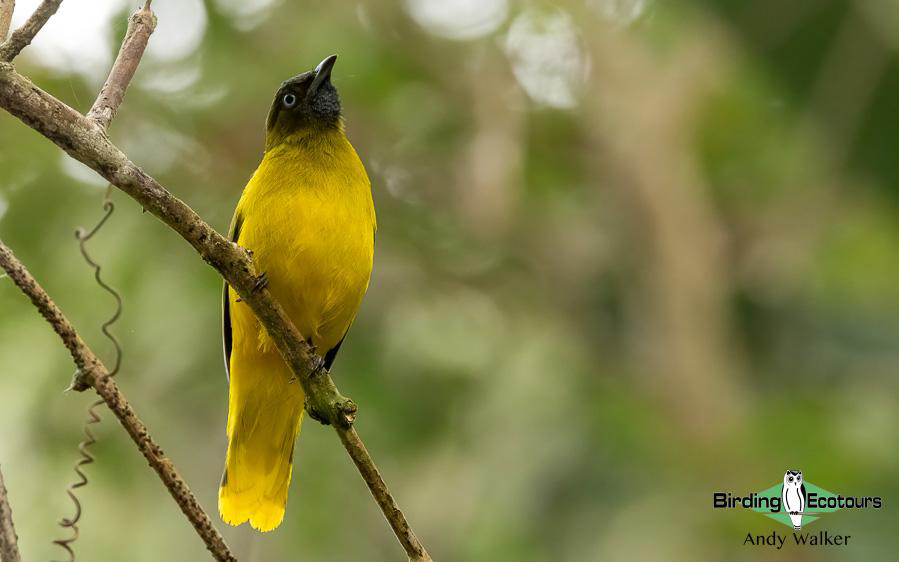
The delightfully common Andaman Bulbul is an attractive Andaman Islands endemic.
While looking for the Andaman endemic birds, we picked up several other interesting and often attractive species, including some of distinct endemic sub-species status (some found just on the Andaman Islands and some shared with the nearby Nicobar Islands or other close small islands in the region and most easily seen here than elsewhere). Some of these species include Common Emerald Dove, Green Imperial Pigeon, White-breasted Waterhen, Ruddy Kingfisher, Chestnut-headed Bee-eater, Freckle-breasted Woodpecker, Red-breasted Parakeet, Long-tailed Parakeet, Scarlet Minivet, Black-naped Oriole, Greater Racket-tailed Drongo, Black-naped Monarch, Red-whiskered Bulbul, Asian Fairy-bluebird, Asian Glossy Starling, and Orange-headed Thrush. A trio of migrant warblers (Arctic Warbler, Dusky Warbler, and Greenish Warbler) were all seen and heard, while Indian Cuckoos were very vocal but not showy and Asian Koels were very showy but not vocal (for a change!).
After our morning forest birding, we drove back to our hotel for a siesta and lunch. Along the way we stopped at a wetland that was holding a couple of hundred Andaman Teals, another good endemic seen well. Here, we found a drake Northern Pintail (an Andaman Islands rarity), plenty of Lesser Whistling Ducks, and a host of Grey-headed (Purple) Swamphens, Common Moorhens, gorgeous Pheasant-tailed Jacanas, Great Egrets, Medium Egrets, Little Egrets, Pacific Golden Plovers, Wood Sandpipers, Common Greenshank, and Common Sandpiper. One of the other highlights here was the sightings we had of a family group of White-bellied Sea Eagles – these huge and impressive birds gave great views.
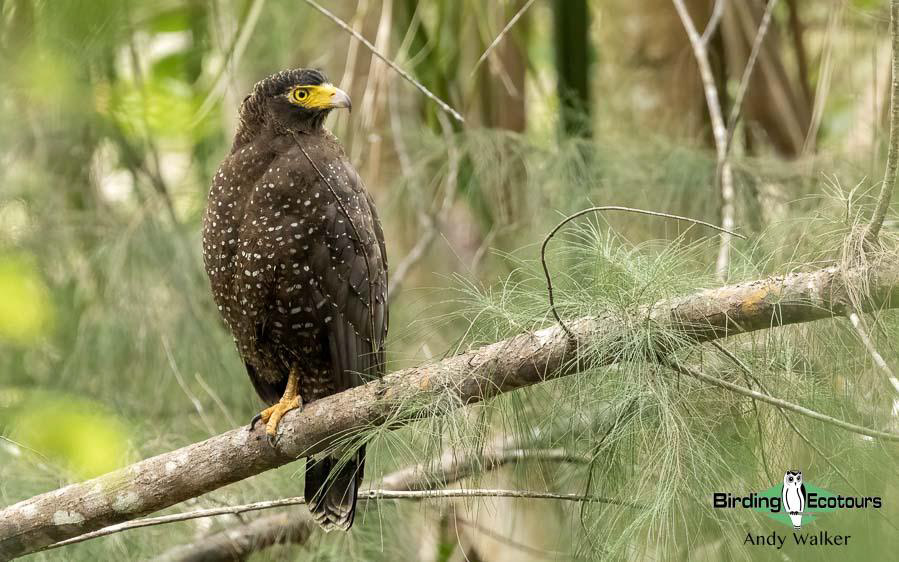
The endemic Andaman Serpent Eagle showed very nicely.
Our afternoon birding saw us visiting some forest in the south of the island. An enjoyable easy walk was highly productive and we scored great views of both perched Andaman Serpent Eagle and perched Crested Serpent Eagle. The sightings were right after each other and allowed careful study of the key differences of these raptors (the former an endemic species and the latter an endemic subspecies). Our main target for the afternoon was the tough Andaman Wood Pigeon, and after a while of working through sightings of lots of Green Imperial Pigeons and a scattering of Andaman Green Pigeons (another new endemic), we were rewarded with prolonged views of our Andaman Wood Pigeon target. Viewing the bird was tricky as it was feeding deep in the subcanopy. However, with patience (and the scope), we were all able to get good views, and eventually, it even perched out in the open briefly for some photos. While looking for our main targets, we also found Andaman Coucal, Alexandrine Parakeet, Red-breasted Parakeet, Oriental Magpie-Robin, and Asian Brown Flycatcher.
As dusk came we repositioned ourselves to a new area and walked about until we found a pair of endemic Hume’s Boobooks, the first bird was a little distant, but the second bird gave great close views at eye level. Here too we had what appeared to be an intriguing three-way fight between three species of snakes! We continued birding nearby and located the calls, and then observed one of the island’s tougher nightbirds, Andaman Masked Owl – a real beauty of an owl too. After this we needed to head back to our hotel for dinner and bed after a long, but successful, first day of Andaman Islands birding.
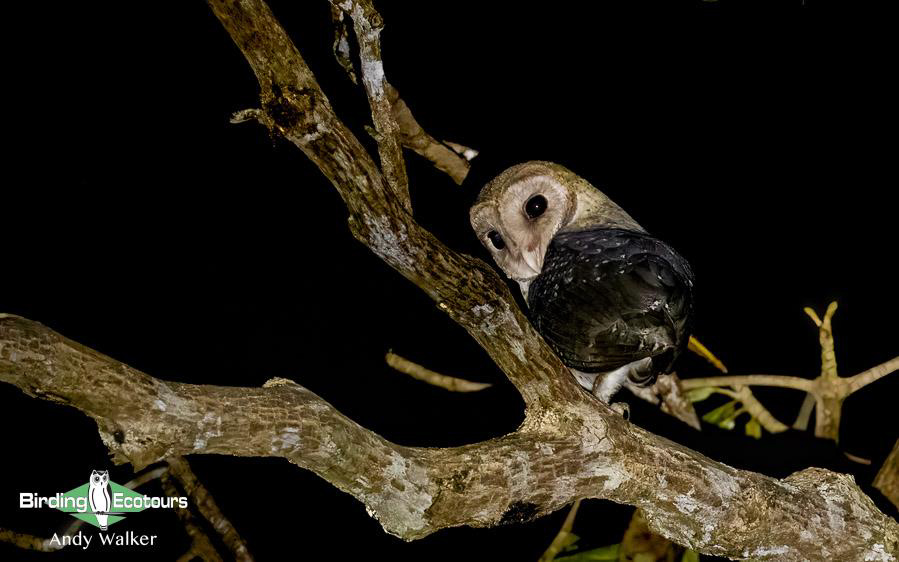
Andaman Masked Owl is another of the tougher of the endemic birds, but we had a good, but brief view.
Day 2, 17thJanuary 2026. Birding at Kalatang forest, Sippighat wetlands, Ograbraj Wetlands, and Ferragunj forest
We left our hotel early again and followed the same procedure as the previous day with the main objective being to find two key endemics that we had “heard only” the previous day. Our first birding was back at the stakeout from the previous morning. Thankfully this morning the stakeout was quieter with less people and vehicles in the area and this time after a very short wait we were rewarded by a sighting of the rare and secretive Andaman Crake. The crake walked out across a small gravel road and showed nicely. Thrilled by this sighting we took a walk around the nearby area where we improved our views of Andaman Bulbul, Orange-headed Thrush, and Andaman Cuckooshrike, as well as seeing many of the birds seen the previous morning at the same spot.
After taking a short walk around various sections of the forest we heard a distant Andaman Woodpecker calling, a bit like we had the previous morning. Today we spent more time focusing on the calls and got into a good position for viewing the immediate area and, after a bit of patience, we were pleased with sightings of at least two out of the three birds that were present. Very happy with these Andaman Woodpecker views, and in combination with all of the other high quality birds we had seen during the morning, we decided to head back to the accommodation for a rest and some lunch.
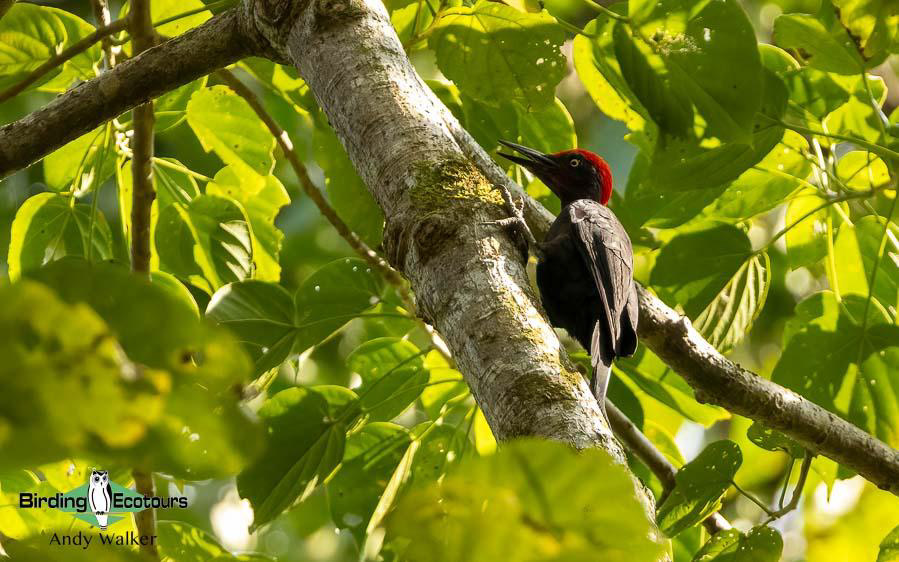
Always a top target, the endemic Andaman Woodpecker put on a nice show for us.
Along the way to the hotel we made a couple of brief roadside stops in open farmland, finding Pacific Golden Plover, Pin-tailed Snipe, Brown-backed Needletail, Plume-toed Swiftlet, Edible-nest Swiftlet, Chestnut-headed Bee-eater, Brown Shrike, Eastern Yellow Wagtail, and best of all, another family group of six White-bellied Sea Eagles which showed even better than the family group we had seen elsewhere the previous day.
In the afternoon we visited a wetland site and added a lot of new birds to our trip list. We had an impressive sight of a large flock of Andaman Teals flying around the waterbody and saw several shorebird species, including Eurasian Whimbrel, Black-tailed Godwit, Pin-tailed Snipe, Common Redshank, Terek Sandpiper, and Long-toed Stint. The periphery of the waterbody held Stork-billed Kingfisher, Common Kingfisher, White-throated Kingfisher, Mangrove Whistler, Amur (Siberian) Stonechat, Eastern Yellow Wagtail, Richard’s Pipit, and Red-throated Pipit.
As dusk approached we drove out to a different forested area, where, once dark, we saw our final two endemic owls – Andaman Boobook and Andaman Scops Owl. Here we also distantly heard Oriental (Walden’s) Scops Owl, the Andaman Islands endemic subspecies of this widespread Asian bird. As time was now getting on, we headed back to our hotel for a late buffet dinner.
The endemic Andaman Boobook also showed well.
Day 3, 18thJanuary 2026. Birding at Chidiyatapu forest and Port Blair
We started our morning birding with the aim of connecting with our final diurnal endemic of the tour and for that we decided to visit Chidiyatapu forest again. Along the way we spotted a pair of Collared Kingfishers fighting over a crab that one of the pair had caught. As we drove into the forest we had brief sightings of Andaman Shama and then shortly after, while driving, we heard the distinctive calls of drongos and treepies. We quickly got out of the vehicle and then saw a small flock of Andaman Drongos and our main target, Andaman Treepie. They were actively foraging in the treetops but moved on quickly. We decided to drive into the forest a bit further in the direction of where the flock had flown and a short while later we were enjoying much better and more prolonged views of a flock of at least 14 Andaman Treepies. They were still actively foraging, but much lower down and we were satisfied with our views of our final Andaman Islands endemic target.
During the course of the morning we gained further views of many other species we had seen over the last couple of days, including improved looks at some, such as prolonged Stork-billed Kingfisher sighting. After our birding we headed back to our hotel for lunch and a siesta.
In the late afternoon we visited a nearby harbor where we scanned the mudflats and saw Eurasian Curlew, Eurasian Whimbrel, Common Redshank, and Little Heron. However, the main reason for our visit here was to look for Daurian Starling and we noted several flocks of varying size come into the nearby mangroves to roost. Interestingly, within the largest flock of Daurian Starlings that flew in to roost, were three vagrant Chestnut-cheeked Starlings and two vagrant Rosy Starlings, a nice tour bonus.
Moving locations into the hills for dusk, we were soon watching Oriental (Walden’s) Scops Owl and our final endemic of the tour, Andaman Nightjar. After a couple of brief sightings from multiple individuals we rounded off our night with fantastic close looks at one confiding individual.

We enjoyed sensational and close-up views of the endemic Andaman Nightjar.
Day 4, 19thJanuary 2026. Birding at Chidiyatapu forest and Sippighat wetlands
We had a final morning birding around Chidiyatapu forest and visited a different area of the Sippighat wetlands and the afternoon was spent relaxing at our hotel. On our way south we stopped along the coast where we found a small gathering of shorebirds preparing to roost over high tide. We picked out Greater Sand Plover and Tibetan Sand Plover among the more numerous Pacific Golden Plovers and Common Redshanks and while here we also noted Pacific Reef Heron, Stork-billed Kingfisher, and Collared Kingfisher.
As we drove around the Chidiyatapu forest area again, we gained further looks at many of the woodland birds we had enjoyed over previous days, but did get our best views of the attractive White-headed Starling and less attractive Andaman Coucal of the tour. We also found Changeable Hawk-Eagle, White-breasted Woodswallow, and White-rumped Munia.
After our final forest birding session we visited the wetlands, where we found numerous shorebirds, including Tibetan Sand Plover, Common Greenshank, Marsh Sandpiper, Wood Sandpiper, Curlew Sandpiper, Red-necked Stint, Long-toed Stint, Pin-tailed Snipe, Common Snipe, and Eurasian Curlew. There were brief Yellow Bittern and Indian Pond Heron sightings, and the marsh was busy with Eastern Yellow Wagtails and an assortment of egrets. The most interesting sightings pertained to a couple of harriers that were quartering over the marsh, with one each of Pied Harrier and Eastern Marsh Harrier seen. This proved to be the end of the birding as the temperatures ramped up and we decided to enjoy some time relaxing at the hotel.
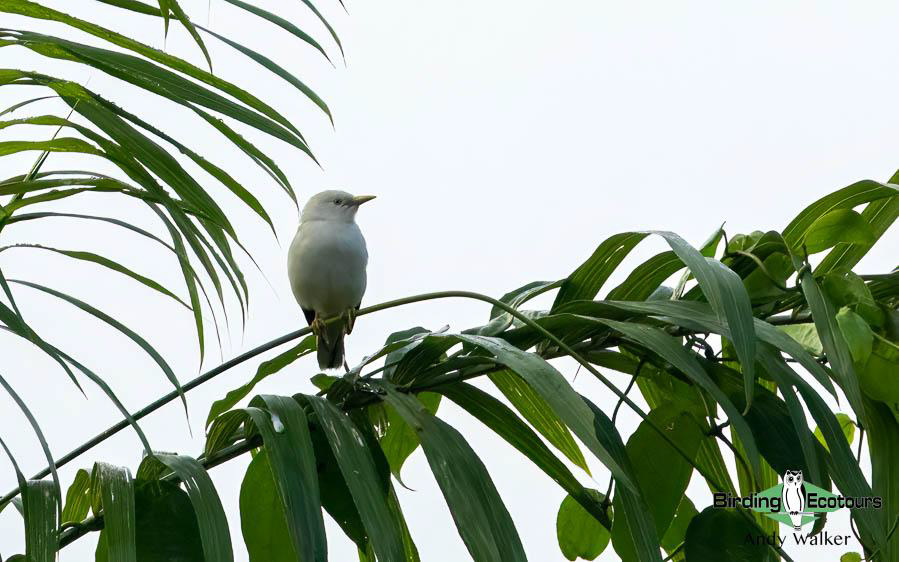
The endemic White-headed Starling was one of seven starling species recorded on the tour. We found all five regularly occurring species as well as two vagrant species!
Day 5, 20thJanuary 2026. Departure from Port Blair
After a relaxing breakfast and morning spent in our hotel, we finished up the tour with some of the group flying over to southern India to commence our Western Ghats and Nilgiri Endemics Indian birding tour. The Andaman Islands birding tour had been great fun with very good sightings of all 20 currently recognized endemic birds.
Bird List – Following IOC (15.1) (March 2025)
Birds ‘heard only’ are marked with (H) after the common name, all other species were seen. Common names with an alternative common name in parenthesis indicate name changes/splits/lumps following the announcement of the new AviList v2025 global bird checklist. The following notation after species names is used to show conservation status following BirdLife International: VU = Vulnerable.
| Common Name | Scientific Name |
| Ducks, Geese, Swans (Anatidae) | |
| Lesser Whistling Duck | Dendrocygna javanica |
| Northern Pintail | Anas acuta |
| Andaman Teal (Endemic) | Anas albogularis |
| Nightjars (Caprimulgidae) | |
| Andaman Nightjar (Endemic) | Caprimulgus andamanicus |
| Swifts (Apodidae) | |
| Plume-toed Swiftlet | Collocalia affinis |
| Edible-nest Swiftlet | Aerodramus fuciphagus |
| Brown-backed Needletail | Hirundapus giganteus |
| Cuckoos (Cuculidae) | |
| Andaman Coucal | Centropus andamanensis |
| Asian Koel | Eudynamys scolopaceus |
| Violet Cuckoo (H) | Chrysococcyx xanthorhynchus |
| Indian Cuckoo (H) | Cuculus micropterus |
| Pigeons, Doves (Columbidae) | |
| Rock Dove [Feral Pigeon] | Columba livia [dom.] |
| Andaman Wood Pigeon (Endemic) | Columba palumboides |
| Red Collared Dove | Streptopelia tranquebarica |
| Andaman Cuckoo-Dove (Endemic) | Macropygia rufipennis |
| Common Emerald Dove | Chalcophaps indica |
| Andaman Green Pigeon (Endemic) | Treron chloropterus |
| Green Imperial Pigeon | Ducula aenea |
| Rails, Crakes & Coots (Rallidae) | |
| Common Moorhen | Gallinula chloropus |
| Grey-headed Swamphen (Purple Swamphen) | Porphyrio poliocephalus |
| Andaman Crake (Endemic) | Rallina canningi |
| White-breasted Waterhen | Amaurornis phoenicurus |
| Plovers (Charadriidae) | |
| Pacific Golden Plover | Pluvialis fulva |
| Tibetan Sand Plover | Anarhynchus atrifrons |
| Greater Sand Plover | Anarhynchus leschenaultii |
| Jacanas (Jacanidae) | |
| Pheasant-tailed Jacana | Hydrophasianus chirurgus |
| Sandpipers, Snipes (Scolopacidae) | |
| Eurasian Whimbrel | Numenius phaeopus |
| Eurasian Curlew | Numenius arquata |
| Black-tailed Godwit | Limosa limosa |
| Pin-tailed Snipe | Gallinago stenura |
| Common Snipe | Gallinago gallinago |
| Terek Sandpiper | Xenus cinereus |
| Common Sandpiper | Actitis hypoleucos |
| Marsh Sandpiper | Tringa stagnatilis |
| Wood Sandpiper | Tringa glareola |
| Common Redshank | Tringa totanus |
| Common Greenshank | Tringa nebularia |
| Curlew Sandpiper – VU | Calidris ferruginea |
| Long-toed Stint | Calidris subminuta |
| Red-necked Stint | Calidris ruficollis |
| Herons, Bitterns (Ardeidae) | |
| Yellow Bittern | Botaurus sinensis |
| Pacific Reef Heron | Egretta sacra |
| Little Egret | Egretta garzetta |
| Little Heron | Butorides atricapilla |
| Indian Pond Heron | Ardeola grayii |
| Great Egret | Ardea alba |
| Medium Egret | Ardea intermedia |
| Eastern Cattle Egret | Ardea coromanda |
| Purple Heron | Ardea purpurea |
| Kites, Hawks, Eagles (Accipitridae) | |
| Crested Serpent Eagle | Spilornis cheela |
| Andaman Serpent Eagle – VU (Endemic) | Spilornis elgini |
| Changeable Hawk-Eagle | Nisaetus cirrhatus |
| Pied Harrier | Circus melanoleucos |
| Eastern Marsh Harrier | Circus spilonotus |
| Brahminy Kite | Haliastur indus |
| White-bellied Sea Eagle | Icthyophaga leucogaster |
| Barn Owls (Tytonidae) | |
| Andaman Masked Owl (Endemic) | Tyto deroepstorffi |
| Owls (Strigidae) | |
| Hume’s Boobook (Endemic) | Ninox obscura |
| Andaman Boobook (Endemic) | Ninox affinis |
| Andaman Scops Owl (Endemic) | Otus balli |
| Oriental Scops Owl | Otus sunia |
| Rollers (Coraciidae) | |
| Oriental Dollarbird | Eurystomus orientalis |
| Kingfishers (Alcedinidae) | |
| Stork-billed Kingfisher | Pelargopsis capensis |
| Ruddy Kingfisher | Halcyon coromanda |
| White-throated Kingfisher | Halcyon smyrnensis |
| Collared Kingfisher | Todiramphus chloris |
| Common Kingfisher | Alcedo atthis |
| Bee-eaters (Meropidae) | |
| Blue-tailed Bee-eater | Merops philippinus |
| Chestnut-headed Bee-eater | Merops leschenaulti |
| Woodpeckers (Picidae) | |
| Freckle-breasted Woodpecker | Dendrocopos analis |
| Andaman Woodpecker – VU (Endemic) | Dryocopus hodgei |
| Old World Parrots (Psittaculidae) | |
| Red-breasted Parakeet | Psittacula alexandri |
| Long-tailed Parakeet – VU | Psittacula longicauda |
| Alexandrine Parakeet | Psittacula eupatria |
| Vernal Hanging Parrot | Loriculus vernalis |
| Woodswallows, Butcherbirds & Allies (Artamidae) | |
| White-breasted Woodswallow | Artamus leucorynchus |
| Cuckooshrikes (Campephagidae) | |
| Small Minivet | Pericrocotus cinnamomeus |
| Scarlet Minivet | Pericrocotus speciosus |
| Andaman Cuckooshrike (Endemic) | Coracina dobsoni |
| Whistlers & Allies (Pachycephalidae) | |
| Mangrove Whistler | Pachycephala cinerea |
| Figbirds, Old World Orioles, Piopios (Oriolidae) | |
| Black-naped Oriole | Oriolus chinensis |
| Drongos (Dicruridae) | |
| Greater Racket-tailed Drongo | Dicrurus paradiseus |
| Andaman Drongo (Endemic) | Dicrurus andamanensis |
| Black Drongo | Dicrurus macrocercus |
| Monarchs (Monarchidae) | |
| Black-naped Monarch | Hypothymis azurea |
| Shrikes (Laniidae) | |
| Brown Shrike | Lanius cristatus |
| Crows, Jays (Corvidae) | |
| Andaman Treepie – VU (Endemic) | Dendrocitta bayleii |
| House Crow | Corvus splendens |
| Eastern Jungle Crow (Large-billed Crow) | Corvus levaillantii |
| Bulbuls (Pycnonotidae) | |
| Andaman Bulbul (Endemic) | Brachypodius fuscoflavescens |
| Red-whiskered Bulbul | Pycnonotus jocosus |
| Swallows, Martins (Hirundinidae) | |
| Pacific Swallow | Hirundo javanica |
| Barn Swallow | Hirundo rustica |
| Eastern Red-rumped Swallow | Cecropis daurica |
| Leaf Warblers (Phylloscopidae) | |
| Yellow-browed Warbler | Phylloscopus inornatus |
| Dusky Warbler | Phylloscopus fuscatus |
| Greenish Warbler | Phylloscopus trochiloides |
| Arctic Warbler | Phylloscopus borealis |
| Reed Warblers & Allies (Acrocephalidae) | |
| Oriental Reed Warbler | Acrocephalus orientalis |
| Black-browed Reed Warbler | Acrocephalus bistrigiceps |
| Fairy-bluebirds (Irenidae) | |
| Asian Fairy-bluebird | Irena puella |
| Starlings, Rhabdornises (Sturnidae) | |
| Asian Glossy Starling | Aplonis panayensis |
| Common Hill Myna | Gracula religiosa |
| Common Myna | Acridotheres tristis |
| Daurian Starling | Agropsar sturninus |
| Chestnut-cheeked Starling | Agropsar philippensis |
| White-headed Starling (Endemic) | Sturnia erythropygia |
| Rosy Starling | Pastor roseus |
| Thrushes (Turdidae) | |
| Orange-headed Thrush | Geokichla citrina |
| Chats, Old World Flycatchers (Muscicapidae) | |
| Oriental Magpie-Robin | Copsychus saularis |
| Andaman Shama (Endemic) | Copsychus albiventris |
| Asian Brown Flycatcher | Muscicapa dauurica |
| Amur Stonechat (Siberian Stonechat) | Saxicola stejnegeri |
| Flowerpeckers (Dicaeidae) | |
| Andaman Flowerpecker (Endemic) | Dicaeum virescens |
| Sunbirds (Nectariniidae) | |
| Ornate Sunbird | Cinnyris ornatus |
| Old World Sparrows, Snowfinches (Passeridae) | |
| House Sparrow | Passer domesticus |
| Waxbills, Munias & Allies (Estrildidae) | |
| White-rumped Munia | Lonchura striata |
| Wagtails, Pipits (Motacillidae) | |
| Eastern Yellow Wagtail | Motacilla tschutschensis |
| Grey Wagtail | Motacilla cinerea |
| Richard’s Pipit | Anthus richardi |
| Red-throated Pipit | Anthus cervinus |
| Total seen | 119 |
| Total heard only | 2 |
| Total recorded | 121 |
Mammal List
| Common Name | Scientific Name |
| Squirrels (Sciuridae) | |
| Northern Palm Squirrel | Funambulus pennantii |
| Total seen | 1 |
Reptile List
| Common Name | Scientific Name |
| Colubrid Snakes (Colubridae) | |
| Oriental Rat Snake | Ptyas mucosa |
| Black Copper Rat Snake | Coelognathus flavolineatus |
| Checkered Keelback | Fowlea piscator |
| Dragons (Agamidae) | |
| Oriental Garden Lizard | Calotes versicolor |
| Typical Geckos (Gekkonidae) | |
| Asian House Gecko | Hemidactylus frenatus |
| Andaman Giant Gecko | Gekko verreauxi |
| Monitor Lizards (Varanidae) | |
| Common Water Monitor | Varanus salvator |
| Mud Snakes (Homalopsidae) | |
| Asian Bockadam | Cerberus rynchops |
| Total seen | 8 |
This is a sample trip report. Please email us ([email protected]) for more trip reports from this destination.