- Duration:
- 11 days
- Group Size:
- 4-5
- Tour Start:
- Edinburgh Airport, Scotland
- Tour End:
- Edinburgh Airport, Scotland
United Kingdom Birding Tour: Highlands and Islands of Scotland in Spring
Details
2027
27 May–06 June
Per person sharing
£6,000 GBP
$8,442 USD / €7,512 EUR
Single supplement
£1,260 GBP
$1,772 USD / €1,577 EUR
2028
27 May-06 June
Per person sharing
£6,360 GBP
$8,949 USD / €7,963 EUR
Single supplement
£1,335 GBP
$1,878 USD / €1,672 EUR
Itinerary
Download ItineraryUnited Kingdom Birding Tour: Highlands and Islands of Scotland in Spring
Scotland forms the northernmost part of the United Kingdom (UK) and is fringed by hundreds of islands around its coast (mainly the north and west coasts). Scotland offers a range of habitats that are rare or absent elsewhere in the UK, including high alpine and mountain landscapes, expansive upland heather moorland, vast inaccessible coastal cliffs ideal for seabirds, and large ancient Caledonian pine forests. Combining this with comfortable accommodation throughout, vibrant culture, breathtaking landscapes, and amazing wildlife encounters, Scotland is a truly exciting prospect for birdwatchers.
The UK endemic Scottish Crossbill is found exclusively in Scotland while Red Grouse, a more widespread UK endemic, can be easily seen in Scotland. This small-group spring birding tour begins and ends in the historic Scottish capital, Edinburgh, and is perfectly timed to coincide with the return of many migratory species and the peak of the breeding season for a wide range of birds. This Scottish bird tour links up perfectly with our preceding England in Spring birding tour.
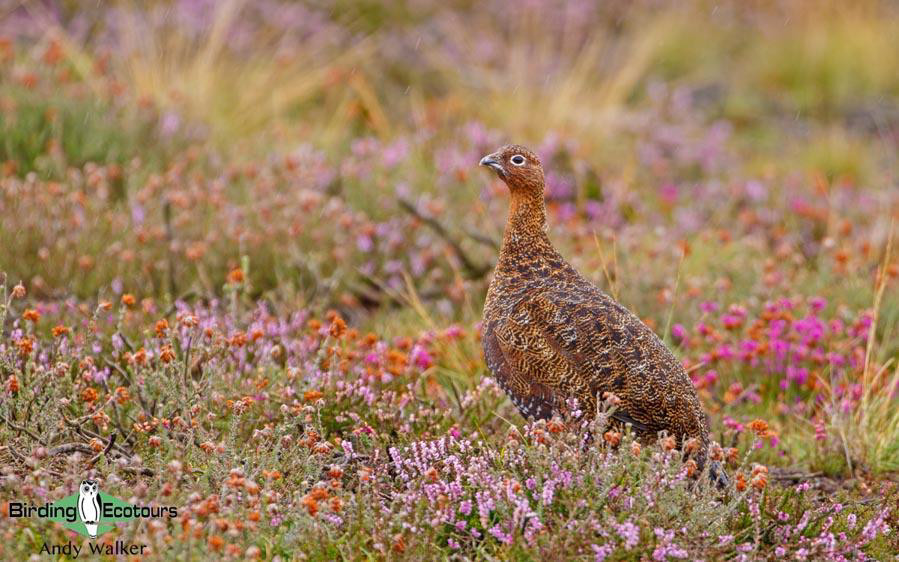 We hope to see the United Kingdom’s endemic Red Grouse while birding in the Scottish Highlands.
Our Highlands and Islands of Scotland in Spring birding tour starts in Edinburgh, we then transfer through breathtaking landscapes towards the Inner Hebrides (along the west coast). On our way, we will get to grips with some of the more common species found throughout Scotland, such as Common Eider, Red-breasted Merganser, Eurasian Whimbrel, European Robin, Coal Tit, Eurasian Nuthatch, and Common Reed Bunting, while targeting Osprey, Red Squirrel, and Eurasian Beaver. We then have three nights on the amazing Isle of Mull, one of the Inner Hebrides, where we will target a long list of outstanding species, many rare within northwest Europe. Top targets include Golden Eagle, White-tailed Eagle, Hen Harrier, Short-eared Owl, Atlantic Puffin, Black Guillemot, Common Loon (Great Northern Diver), Corn Crake, Twite, Eurasian Otter, and cetaceans such as Harbor Porpoise and Common Bottlenose Dolphin. As part of our time on Mull we will visit the quaint Isle of Iona and its white sand beaches, and enjoy a boat cruise to look for seabirds.
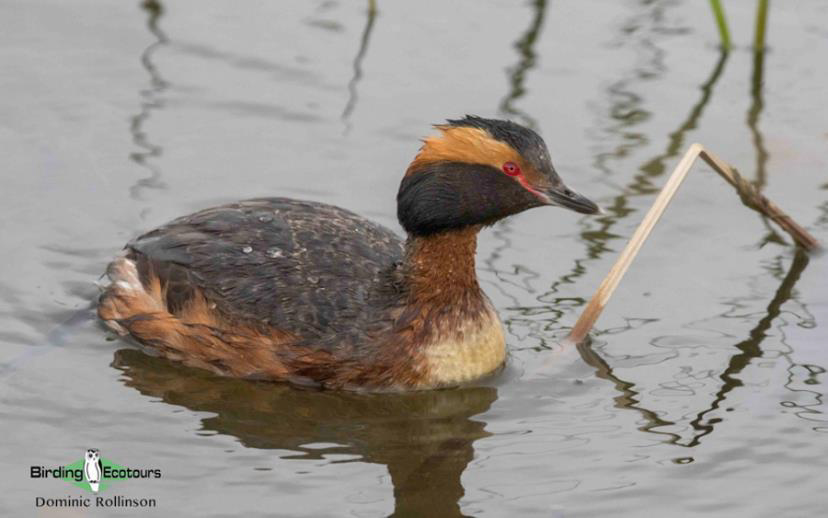 Beautifully adorned Horned Grebe breed in the Scottish Highlands.
The second half of the tour takes place in the Scottish Highlands, where we explore dramatic landscapes ranging from alpine environments to ancient pine forests and picturesque lochs (lakes) of the Cairngorms National Park. Up in the mountains we seek high-altitude breeders such as Rock Ptarmigan, Eurasian Dotterel, and breeding plumage Snow Bunting, while in the lush forests below, species like Crested Tit, Wood Warbler, European Pied and Spotted Flycatchers, White-throated Dipper, Scottish and Red Crossbills, and Pine Marten. Taking a break from the Cairngorms, we visit remote lochs and glens (narrow valleys) for Horned Grebe, Red-throated Loon, Common Goldeneye, and we have more chances for Golden and White-tailed Eagles, before targeting waterfowl, seabirds, and wading birds along the coast of the Moray Firth. We conclude our tour by focusing on specialist heather moorland species such as Red Grouse, Black Grouse, and Merlin, before transferring south again to Edinburgh.
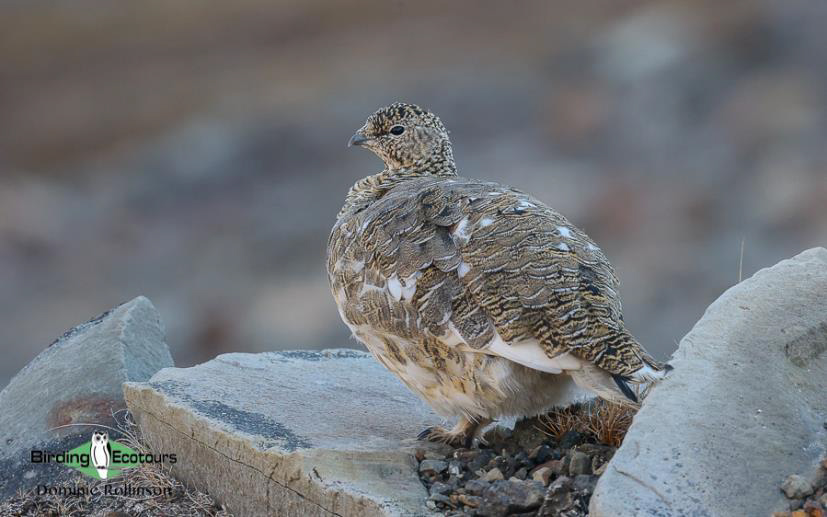 Rock Ptarmigan is a subtly beautiful species, and a major tour target while we explore the Cairngorms Mountains.
Scotland has long been a favorite destination for birdwatchers and nature enthusiasts, offering dramatic landscapes, rich cultural traditions, and excellent birding and wildlife experiences across the country. From historic castles and tartan to world-famous whisky, Scotland provides an unforgettable setting for a birding holiday. We also recommend extending your stay in Edinburgh to experience some of what this fascinating city offers. This tour can be combined with our England birding tour immediately before this Scotland trip.
Itinerary (11 days/ 10 nights)
Day 1. Arrival to Edinburgh Airport
A non-birding day, with your arrival into Edinburgh Airport. The rest of the day will be at your leisure. We will meet in our hotel near the airport for a welcome dinner together in the evening. If you have just taken part in our England in Spring birding tour, we will arrive at the hotel in the early afternoon and you will have the afternoon at leisure.
Overnight: Dakota Edinburgh, Edinburgh, or similar
Day 2. Loch Lomond, and travel to Argyll
We will drive west and north of Edinburgh to Crinan, in Argyll. This drive will take most of the day, with frequent birding stops and time to admire the breathtaking landscapes — lush woodlands, picturesque lochs (lakes), and quaint villages nestled among towering emerald hills. We will begin birding en route, and we will know we have arrived in true Scotland when roadside Carrion Crows are replaced by Hooded Crows.
Our first main stop will be at the largest freshwater loch in Scotland, Loch Lomond, which stretches 24 miles (39 km) in length. We will visit the Royal Society for the Protection of Birds (RSPB) Loch Lomond reserve, and our main target here will be Osprey, which, after becoming extinct in the UK in the early 1900s, returned to breed in 1954. We should also encounter common and widespread species such as Mute Swan, Common Merganser, and songbirds including Eurasian Magpie, Barn Swallow, Western House Martin, Eurasian Wren, Common Blackbird, Mistle Thrush, European Robin, White Wagtail, European Goldfinch, and Common Reed Bunting.
Continuing towards Crinan, we will stop at several lochs to search for Common Eider, Common Shelduck, Red-breasted Merganser, and Grey Heron. In coastal areas, we will look for shorebirds (waders) and seabirds such as Eurasian Oystercatcher, Eurasian Whimbrel, Common Sandpiper, Common Redshank, Common Tern, and gulls including Black-headed, Common, European Herring, Lesser Black-backed, and Great Black-backed Gulls. We aim to arrive at our comfortable hotel with time to explore the local area, where good birding is possible nearby. Over dinner, we will enjoy stunning views across the bay towards the Inner Hebrides.
Overnight: Crinan Hotel, Argyll, or similar
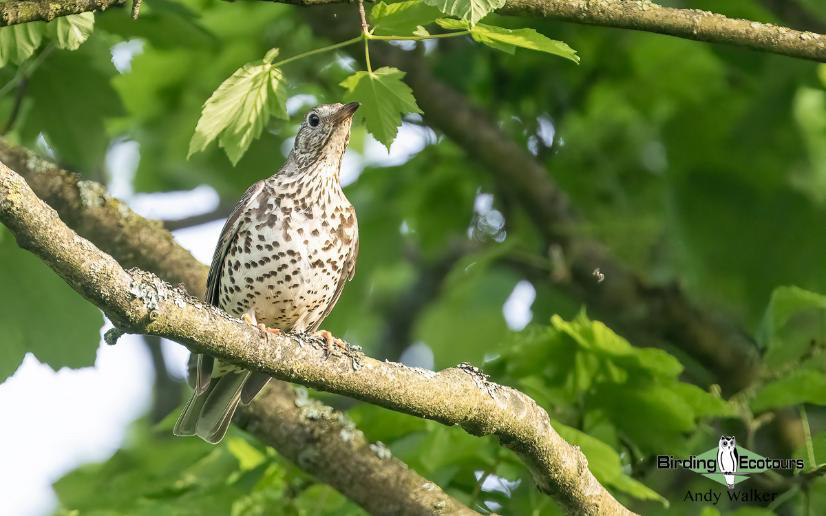 The large Mistle Thrush is a common species seen in Scotland and has a distinctive call.
Day 3. Argyll Beaver Centre, and birding the Isle of Mull
In the early morning, we will visit the delightful Argyll Beaver Centre. Here, we hope to encounter the reintroduced Eurasian Beaver and enjoy close views of the characterful Red Squirrel, along with many woodland bird species such as Great Spotted Woodpecker, Coal Tit, Great Tit, Eurasian Blue Tit, Eurasian Nuthatch, Song Thrush, and Eurasian Siskin. Wetter areas and surrounding scrub may host migratory warblers too, with Sedge, Common Grasshopper, Willow, Garden Warblers, Common Chiffchaff, and Eurasian Blackcap all possible. This will surely be an early tour highlight, as the Beaver Centre is a peaceful place to spend time.
Later in the morning we will drive north, through dramatic scenery, to board the ferry from Oban to the Isle of Mull, the second-largest island in the Inner Hebrides and our destination for the next three nights. The ferry crossing is an event in itself, with Black Guillemot and Common Eider often seen at the harbor, and Common Murre, Black-legged Kittiwake, Common Gull, Arctic Tern, Common Tern, Northern Gannet, Great Cormorant, and European Shag regularly encountered during the journey. There is also a good chance of spotting Manx Shearwater or a cetacean such as Harbor Porpoise.
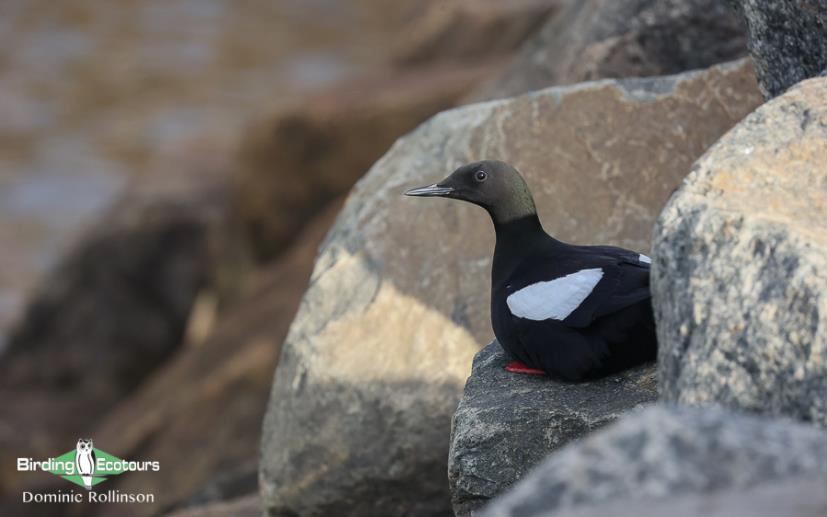 We will look for stylish Black Guillemot, or Tysties as they are known locally, while on the ferry between Oban and the Isle of Mull.
Once we dock at Craignure, we drive north towards Tobermory, Mull’s colorful capital. We will bird along Mull’s long and spectacular coastline, searching in particular for White-tailed Eagle and Eurasian Otter. Other species we are likely to encounter include Common Loon, Common Shelduck, Red-breasted Merganser, Common Cuckoo, Common Ringed Plover, Northern Lapwing, Eurasian Skylark, Common Whitethroat, Meadow, European Rock, and Tree Pipits, and Common Linnet. On arrival in Tobermory, famed for its painted buildings and picturesque harbor, we check in to our plush hotel for a three-night stay.
Overnight: Harbour Guest House, Isle of Mull, or similar
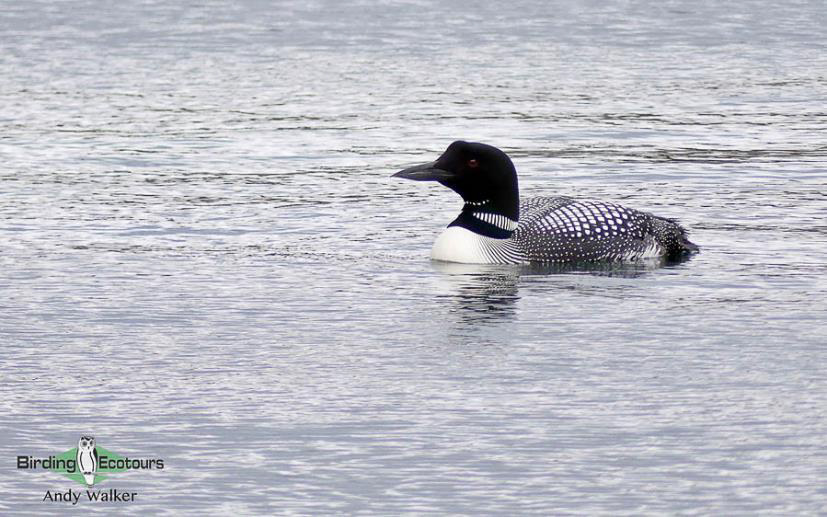 The breeding plumage of Common Loon is stunning!
Day 4. Seabird boat cruise
We have an exciting day ahead. With an early departure, our group will board a boat cruise from Tobermory Harbor. Here, we will seek the brilliant Atlantic Puffin, which, at this time of year, breeds on nearby rock stacks and will be sporting its colorful beak. Aside from puffins, there are many other targets we hope to encounter on the trip, such as Parasitic Jaeger, Great Skua, Razorbill, Common Murre, Northern Fulmar, Manx Shearwater, Northern Gannet, Common Loon, Arctic and Common Terns, and six species of gull. We also have a chance of White-tailed Eagle and Osprey from the boat, and could encounter Grey or Harbor Seals, and cetaceans such as Common Minke Whale, and Common or Common Bottlenose Dolphins.
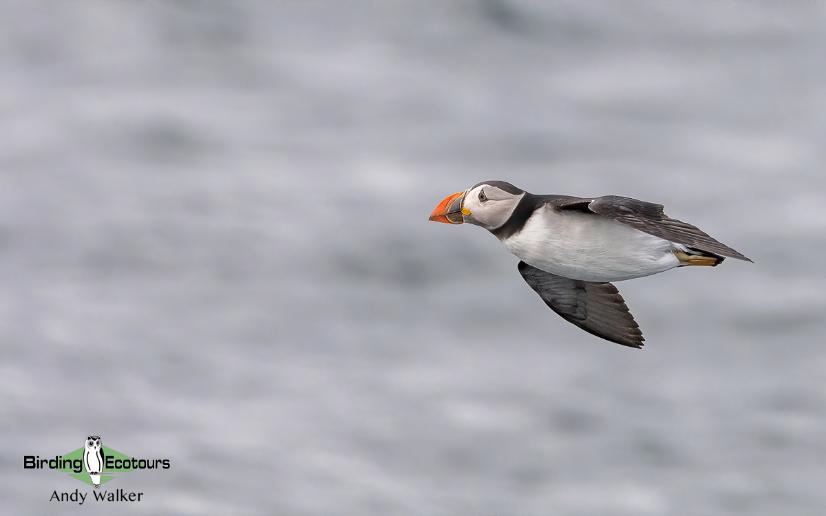 We hope to get close to the characterful Atlantic Puffin on a boat trip off the Isle of Mull.
Once on dry land, we will have some down time before venturing out again, exploring Mull’s diverse landscapes, from its rugged mountains and rolling moorland to its sandy beaches. Our main target for the afternoon will be the impressive Golden Eagle, a brilliant species that can be found at a few locations on Mull. We will make a special effort to visit some of these. We will also be on the lookout for many other species, such as those listed as targets for the afternoon on Day 3.
Overnight: Harbour Guest House, Isle of Mull, or similar
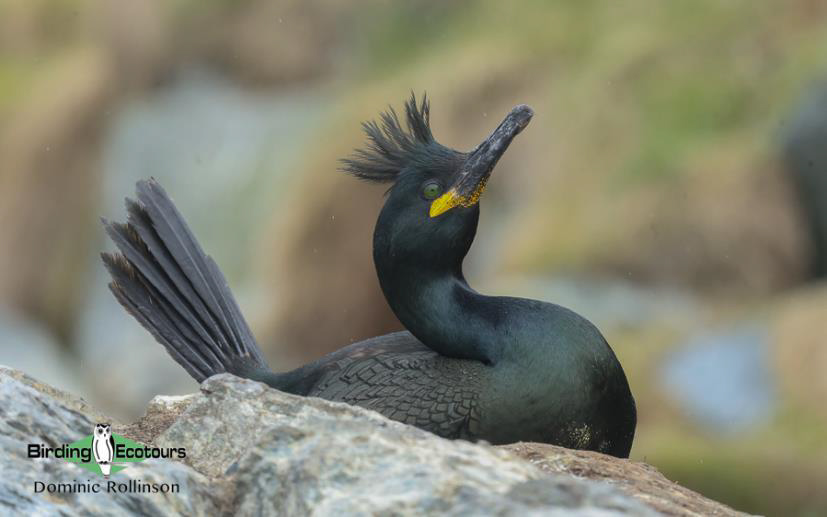 European Shag is a beautiful species when you see it up close!
Day 5. Birding the Isle of Iona
With an early start, we travel to Mull’s southwest tip to catch a ferry to the Isle of Iona. This small island is best known for its early Christian monastery and its tranquil white sand beaches. Our journey will be well timed, as our main target on Iona, the Corn Crake, is perhaps the hardest bird we hope to connect with on the tour. Though they breed in good numbers on Iona they are super-secretive and we may only hear their distinctive crex crex call – hence their scientific name of Crex crex. We will certainly try our best to see one of these elusive birds in the hay and silage fields, or iris beds on the isle. We will likely visit the Abbey and Nunnery, one of Scotland’s most sacred sites, as the area around it is great for Twite, and holds a population of hybrid Rock and Feral Doves, which are unfortunately not pure Rock Doves even though they look almost identical to them!
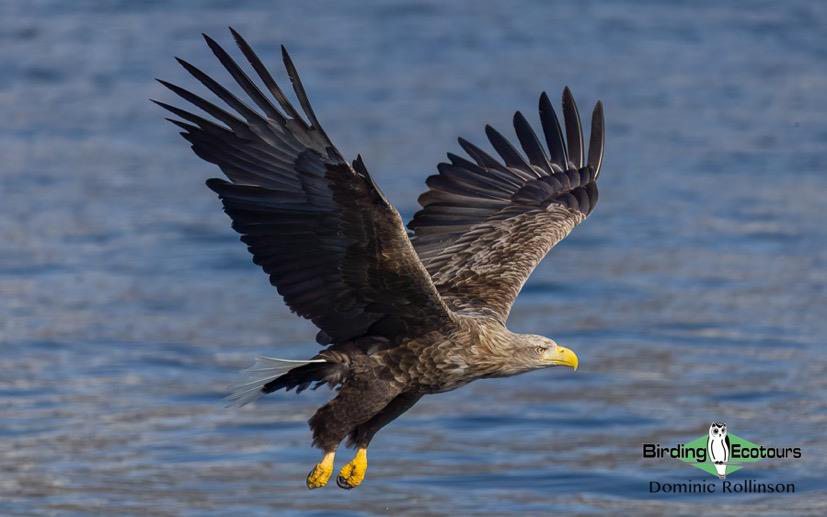 The Isle of Mull is an excellent place to see White-tailed Eagle.
Once back on Mull, we will take a more leisurely journey back to Tobermory, where we plan to bird some of the best habitat on Mull. In particular, we will be looking for White-tailed Eagle, Hen Harrier, Short-eared Owl, and Eurasian Otter, among the more common species.
Overnight: Harbour Guest House, Isle of Mull, or similar
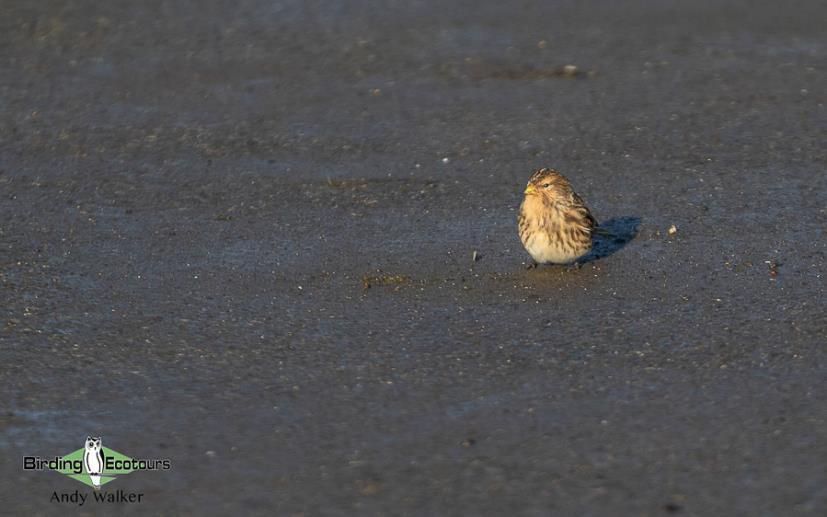 Twite is a tiny finch and it is rare in Scotland, confined only to high elevations or remote islands, but there is a healthy population on the Isle of Iona.
Day 6. Departure from Mull and travel to the Highlands
We will have a more relaxed morning after our early start the previous day. After breakfast we will slowly travel south towards the ferry port, birding Mull along the way. We will focus on any remaining targets, which, due to their low abundance, may include Golden or White-tailed Eagles, Hen Harrier, or Short-eared Owl. We will have another opportunity to see Black Guillemot on the ferry to the mainland, before beginning our transfer to the beautiful Cairngorms National Park.
The journey will take most of the afternoon, as we travel slowly across the breathtaking Scottish Highlands and birdwatch along the way. This is a vast and sparsely populated region, characterized by dramatic landscapes made up of rugged mountains, glistening lochs, and remote glens which are a haven for some of the United Kingdom’s rarest wildlife. On the journey, we will keep a lookout for Osprey, Common Goldeneye, Eurasian Curlew, Eurasian Oystercatcher, and the UK endemic Red Grouse. Our hotel for the next four nights is on the edge of a town nestled on the River Spey, a place well known for its whisky distilleries and excellent access to some of the best birding sites in the Cairngorms.
Overnight: The Speyside Hotel, Grantown-On-Spey, or similar
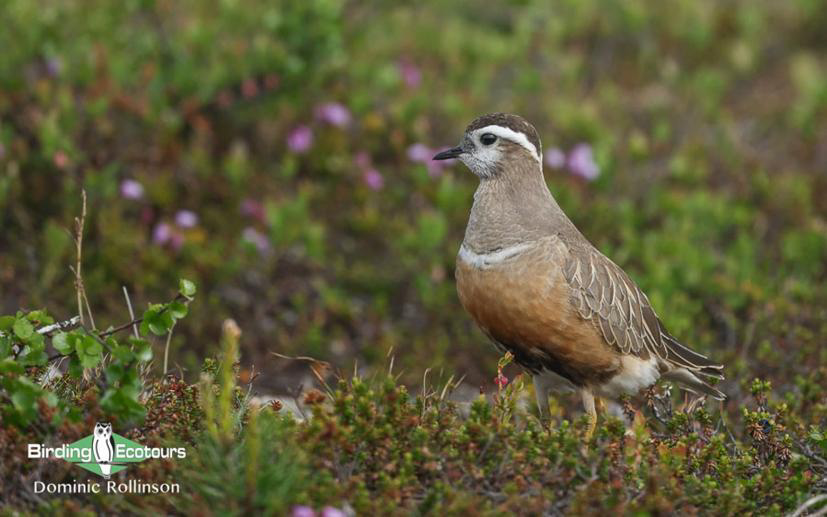 We will target Eurasian Dotterel at the top of the Cairngorms Mountain.
Day 7. Montane birding in the Cairngorms
As one of Scotland’s highest plateaus, the Cairngorm Mountains boast a number of alpine species that are rare elsewhere in the United Kingdom. Under the shadow of Cairn Gorm, the 4,084 feet (1,244 meter) peak that gives the range its name, we will spend the full day birding this tundra-like environment. We will target the alpine breeders found here, such as Rock Ptarmigan, Red Grouse, Eurasian Dotterel, Ring Ouzel, Northern Wheatear, Snow Bunting, and Mountain Hare. We plan to board Scotland’s only funicular railway, which will take us from the base station to the very appropriately named Ptarmigan Station at 3,600 feet (1,097 meters). From here, we will be well within the range of our target species. Aside from the birding, the panoramic views across the valleys below are breathtaking. This day will certainly be a highlight of the tour, and we will toast our birding successes at the UK’s highest restaurant at Ptarmigan Station.
Overnight: The Speyside Hotel, Grantown-On-Spey, or similar
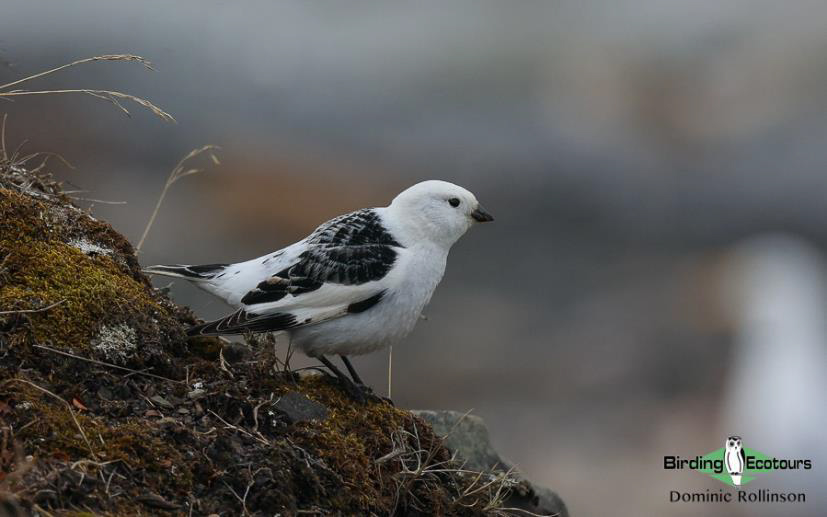 Snow Bunting is beautiful in its summer plumage.
Day 8. Abernethy Forest and an evening of mammal watching
We have a full day exploring the Abernethy National Nature Reserve, one of the largest remaining remnants of the ancient Caledonian Pine Forest. We will visit the RSPB’s Loch Garten reserve. This picturesque freshwater loch, in the heart of Abernethy Forest, is surrounded by stunning Caledonian pinewood landscapes and became famous as the successful reintroduction site of Osprey to Scotland in the 1950s. Here, and along other trails through the Abernethy Forest, we will search for Crested Tit, Wood Warbler, Eurasian Treecreeper, Eurasian Nuthatch, European Pied and Spotted Flycatchers, White-throated Dipper, Common Redstart, Tree Pipit, Eurasian Siskin, Redpoll, and both Scottish and Red Crossbills, the former being Scotland’s only endemic bird species (Red Grouse is more widespread in the UK). We may also come across the charming Red Squirrel and, if we are incredibly lucky, we might happen upon a rogue Western Capercaillie, though we will not be targeting them, as they are now extremely rare in Scotland and unfortunately close to extinction as a UK breeding species.
After some time to relax at our comfortable hotel near Aviemore, we will return to a hide in the forest this evening to watch for nocturnal wildlife such as Eurasian Badger and Pine Marten. We will also look for Tawny Owl and Eurasian Woodcock after leaving the hide.
Overnight: The Speyside Hotel, Grantown-On-Spey, or similar
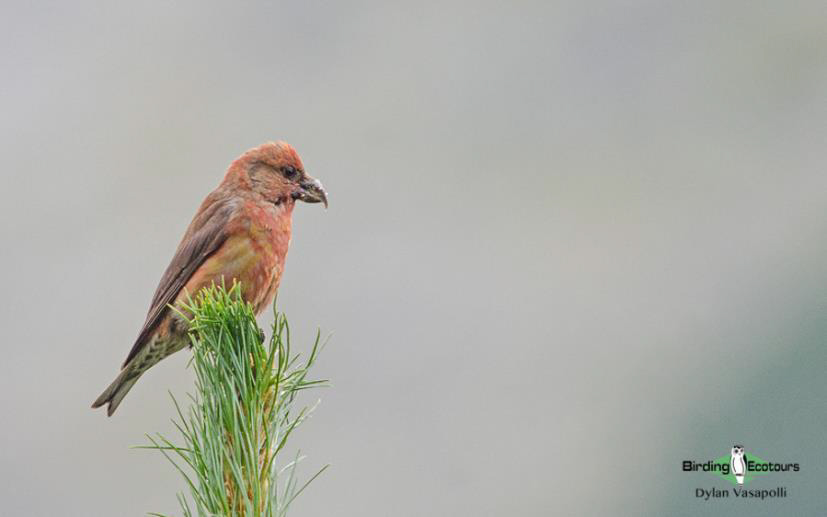 There are three crossbill species possible in the forests around Abernethy, and while we hope to find the rare endemic Scottish Crossbill and the rare in the UK Parrot Crossbill, the Red Crossbill (pictured here) is more abundant.
Day 9. Exploring the lochs, valleys, and coast of the Scottish Highlands
After our late night, we will have a slower start to the morning. After breakfast we will travel north to the remote Loch Ruthven, a stronghold for Red-throated Loon and Horned Grebe, both of which look beautiful at this time of year in their breeding plumage. Depending on our success with birds of prey, we may then opt to visit the dramatic Findhorn Valley. This glacially carved valley with its steep-sided cliffs, is not only an impressive sight, but is also home to Golden Eagle, White-tailed Eagle, Osprey, and Red Kite.
This afternoon, we will take a break from Scottish Highland birding and visit the coast at the inlet of the Moray Firth near Inverness. This area, characterized by tidal flats, sandy shores, and rolling dunes, is excellent for waterbirds such as gulls, terns, herons, shorebirds (waders), and ducks, and is famous for its very active Common Bottlenose Dolphin population, which feeds close to the shore. Species we could add to our growing trip list here include Common Shelduck, Eurasian Teal, Tufted Duck, Eurasian Wigeon, Bar-tailed Godwit, Red Knot, Dunlin, and perhaps a lingering Pink-footed Goose or Long-tailed Duck from the winter. In addition to the waterbirds, the surrounding fields offer a chance to see some grassland species such as Rook, Eurasian Tree Sparrow, European Greenfinch, Corn Bunting, and Yellowhammer. After a varied day of birding, we will return to our accommodation for our final night based near Aviemore.
Overnight: The Speyside Hotel, Grantown-On-Spey, or similar
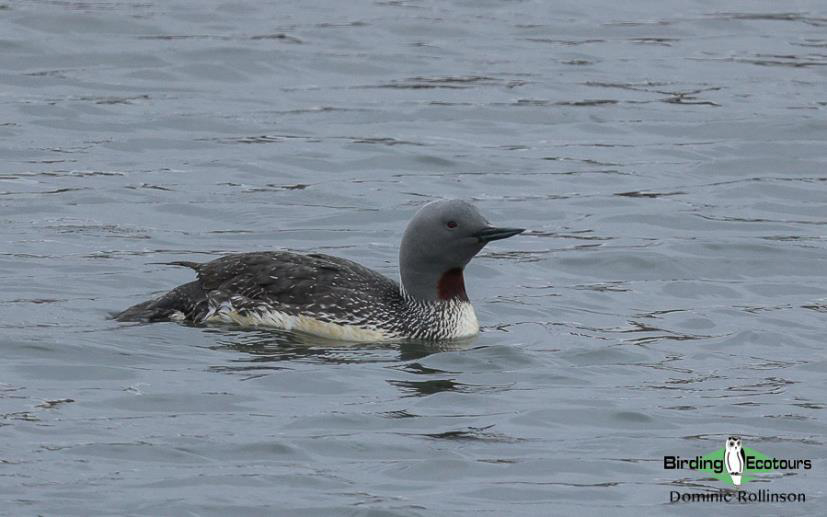 Red-throated Loon breed on Lochs throughout the Scottish Highlands.
Day 10. Birding in the Scottish Highlands
This morning will be spent visiting the heather moorland that dominates much of the uplands in this area, with our main targets being Merlin, and Red and Black Grouse. The lekking season of the Black Grouse will likely be coming to an end, but we may be lucky and find a few displaying males. After trying for grouse, we will visit a loch where Black-throated Loon (Arctic Diver) breed. These beautiful loons are the third loon species we try for during this Scotland tour.
The remainder of this penultimate day will be flexible, with a wide variety of options available to us. Should we have missed any notable birds in Abernethy Forest or at the top of the Cairngorms Mountain, we will return to these areas or try alternative sites. Rock Ptarmigan, for example, can be tricky, and we may choose to try another alpine area to the south if we have yet to encounter it. Alternatively, given the excellent birding throughout the Scottish Highlands, we may explore new sites, such as a marshland, as we travel south. Whatever we decide, time will be put to good use, as there are many excellent birds still possible.
Overnight: The Inn on the Tay, Pitlochry, or similar
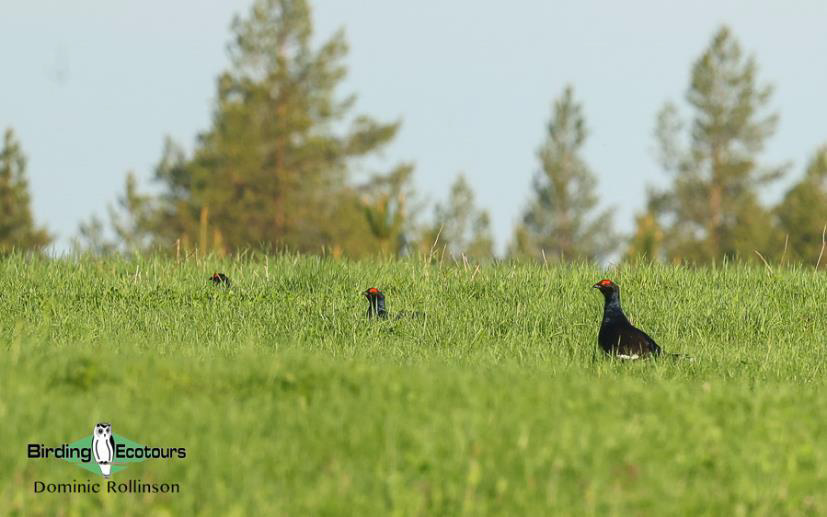 We will target the smart looking Black Grouse while staying near Aviemore.
Day 11. Transfer to Edinburgh
A non-birding day. Following a spectacular week and a half, the tour will conclude at noon after we transfer back to Edinburgh Airport.
Please note, we ask that you try to book flights out of Edinburgh after 3 pm, to allow for the necessary travel time (at least two hours to the airport) and flight check-in formalities. Please discuss flight times with us before you book anything. You might like to also consider extending your stay to explore Edinburgh city.
Overnight: Not included
Please note that the itinerary cannot be guaranteed as it is only a rough guide and can be changed (usually slightly) due to factors such as availability of accommodation, updated information on the state of accommodation, roads, or birding sites, the discretion of the guides and other factors. In addition, we sometimes have to use a different guide from the one advertised due to tour scheduling or other factors.
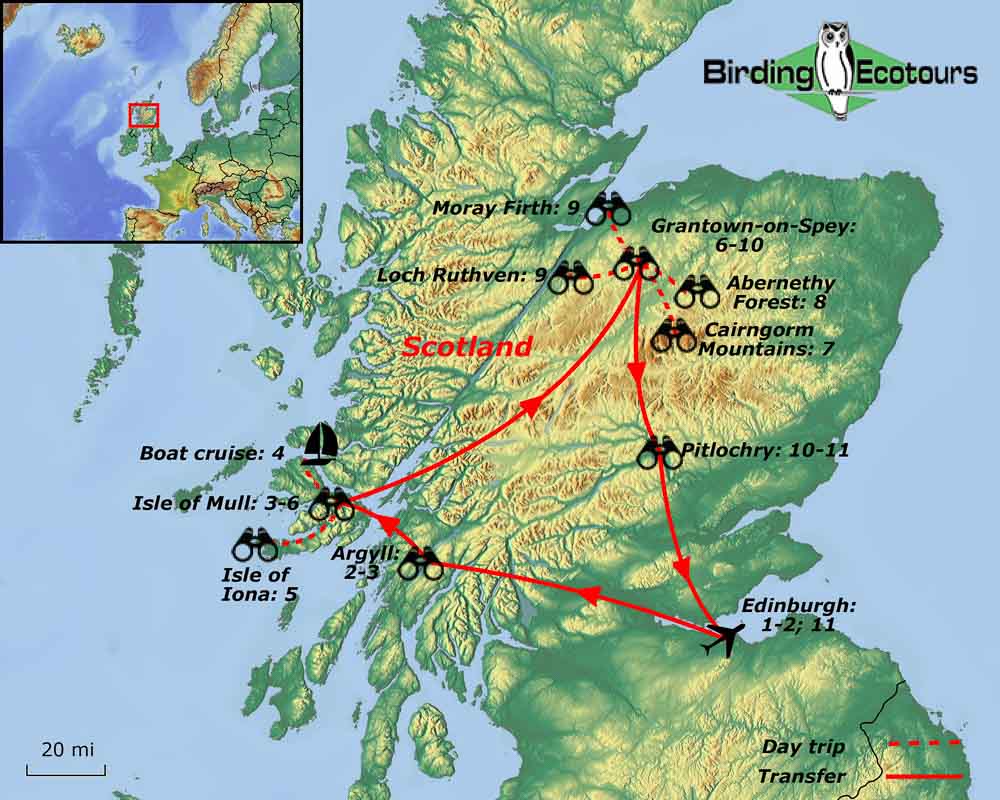
Map
Testimonials
Gallery
General Information
UNITED KINGDOM BIRDING TOUR: HIGHLANDS AND ISLANDS OF SCOTLAND IN SPRING
TOUR-SPECIFIC INFORMATION
GENERAL INFORMATION ABOUT THE UNITED KINGDOM CAN BE READ HERE
TOUR OUTLINE
On this United Kingdom (UK) birdwatching tour, we visit the best birding sites in Scotland to enjoy fantastic European species in their beautiful spring breeding plumage. The tour targets Scotland’s iconic wildlife, including the endemic Red Grouse, Corn Crake, Red-throated Loon, Atlantic Puffin, White-tailed Eagle and mammals such as Eurasian Red Squirrel and Pine Marten. Throughout the tour we stay in charming hotels, often with wonderful views across the surrounding landscapes, while enjoying welcoming hospitality, hearty Scottish food, and some of the most picturesque scenery in the UK.
We begin the tour in the Scottish capital, Edinburgh, before taking a scenic drive west, stopping at Loch Lomond for Osprey, and continuing past forested lochs to Argyll. Here we enjoy some woodland birding before searching for reintroduced Eurasian Beaver, before continuing north along the twisting coastline to Oban. We board a ferry for a three-night stay on the Isle of Mull, one of the Inner Hebrides, often accompanied by Black Guillemot and other coastal species. Over the next three days we explore the wide landscapes of Mull, including moorland, conifer woodland, isolated beaches, and towering sea cliffs, searching for Hen Harrier, Short-eared Owl, and Eurasian Otter. One day we take a boat trip to visit a nearby Atlantic Puffin colony, giving us close views of these charismatic seabirds, and we also hope to see nesting White-tailed Eagle while on the water. Another day we visit the tiny island of Iona, arguably the best place in the UK to see Corn Crake, and we will also visit the historic abbey grounds where Twite are often found.
Departing the Isle of Mull, we travel through the breathtaking Highlands of Scotland to the Cairngorms, where we are based for the next four nights. Here we explore the high mountains in search of Rock Ptarmigan, Ring Ouzel, and Snow Bunting, while in Abernethy Forest we look for Crested Tit, Wood Warbler, and the endemic Scottish Crossbill. The surrounding lochs, valleys, and moorlands hold Black Grouse, Horned Grebe, and Golden Eagle. At night we will visit a wildlife hide in hopes of seeing Pine Marten, and possibly Tawny Owl. Some of our last birding will be at the Moray Firth coastline where we look for seabirds, waterbirds, shorebirds (waders), and grassland species before heading south where the tour ends in Edinburgh.
DAILY ACTIVITIES, PHYSICAL REQUIREMENTS, AND TOUR PACE
The pace of our Scotland in spring birding tour varies. The tour begins with two days of single-night stays and longer journeys in our tour vehicle as we transfer from Edinburgh to Argyll, and then onward to the Isle of Mull. After this we spend three nights on the Isle of Mull, followed by a four-night stay in the Cairngorms, where the pace is slower with less time spent traveling. The tour then ends with a one-night stay while returning to Edinburgh. The itinerary is designed to maximize birding opportunities, and we will try to connect with some incredible yet elusive species such as Corn Crake and Black Grouse, which require very early starts. We will also search for Tawny Owl and Eurasian Beaver in the evening and visit a mammal watching hide in hopes of seeing Pine Marten, so there are some late finishes during the tour. All night wildlife watching is entirely optional, and anyone who prefers not to join may rest at the hotel. These early starts and late finishes are balanced by slower paced days between them to allow for rest and recovery.
Our days typically begin at around 06:00 hrs., though this will vary depending on the activity. Usually we will have breakfast at the hotel before departing for birding, and mornings following evening activities will have later breakfasts. On some of the busier days, such as the day trip to the Isle of Iona, we will take a packed breakfast to allow for an early start. Lunches will usually be enjoyed out rather than returning to the hotel, and we will make the most of the excellent cafés found throughout Scotland. On some afternoons we will return to the hotel for a few hours to rest before heading out again. This tour does involve some longer drives, and on certain days we will spend most of the day out birding, using the vehicle as a base, for example when we transfer between Edinburgh and Argyll, and between the Isle of Mull and Aviemore.
Our birdwatching will vary throughout Scotland. At times we will enjoy roadside birding, stopping when we reach interesting habitat, find a target species, or simply to appreciate the stunning landscapes. At other times we will be mainly on foot when exploring larger reserves such as Loch Lomond or Abernethy Forest, or when visiting the Isle of Iona, where all birding will be on foot after leaving the ferry. At times we will also be stationary, either waiting at a hide or scanning the coast for shorebirds (waders). During the tour we will also take several ferries and a marine boat trip, which will give us opportunities to see seabirds and coastal species up close. Please see the ‘Scottish Marine Birdwatching Boat Trip’ section below for more details.
The tour is generally considered easy to moderate in terms of physical effort. The more demanding activities relate either to the length of time spent on foot away from the vehicle, or to walking uphill in the Cairngorm Mountains, or to reach the Atlantic Puffin colony. For these activities, walking sticks or hiking poles may be helpful for those who prefer extra stability and are recommended for anyone who feels unsteady on their feet, as your safety is our top priority. Other birding days will be physically easy and largely vehicle or boat-based, with short walks along quiet roads and frequent birding stops.
SPECIES RECORDING (BIRD LISTS AND ANIMAL LISTS)
Ahead of the tour we will email you a detailed daily itinerary complete with meeting/arrival instructions. We will provide you with a printed blank diary page within the itinerary document so that you can note down any names of birding sites that you may want to log. On the first night of the tour you will be provided with a printed version of the same itinerary. Each evening your tour leader will go through this with you to let you know any specifics to be aware of for the following day (e.g. clothes and equipment needed, breakfast time, time for leaving hotel, key target birds we will be looking for, etc.).
Attached to the itinerary document will be a bird list and list of other animals possible on the tour (or a blank list to write them in as we go). We follow the latest IOC (International Ornithological Congress taxonomy) for birds and International Union for Conservation of Nature (IUCN) for all other animals recorded during the tour so all itineraries and checklists follow these taxonomies.
Each evening we will go through the daily bird and animal lists, logging all the species from the day. The listing session is optional, we realize that some of our clients aren’t fussed about the listing aspect, but others are. If you do not want to take part in the nightly bird list that is perfectly fine, but it is a useful way to remember what was seen during the day, so recommended.
Birding Ecotours leaders maintain eBird checklists from all birding activities during a tour (from unexpected roadside stops to planned birding activities). Tour leaders will share these eBird lists with all participants who use eBird, if desired. Just make sure to provide your eBird user details to the tour leader at the beginning of the tour for us to be able to do this, unfortunately we can’t retrospectively go back and share past checklists after the tour. We will also provide you with an eBird trip report for the tour where we will add our photos taken on the tour and you are welcome to include your own too.
After the tour you will be emailed a PDF copy of a written trip report, this will be in the form of an illustrated daily diary and will include a complete checklist of all wildlife recorded. If the tour leader manages to get any interesting photographs these will be included in the trip report. Leader photos may also be added to our Flickr page and will be added into a ‘trip report gallery’ which you can view, download, and share.
PASSPORT, VISA, AND ENTRY REQUIREMENTS
Many visitors to the UK do not require a visa for short tourist visits, but do now need to obtain a UK Electronic Travel Authorization (ETA) before travel. This includes citizens of the United States, Canada and Australia. An ETA permits multiple visits to the UK for stays of up to six months at a time and is usually valid for two years. Applications must be completed online before travel and be linked to the passport used for the application. Most ETA applications are approved quickly, often within minutes, though travelers should allow up to three working days for approval. You can use this link for more information and to apply.
Entry to the UK is generally granted provided you have:
- A passport valid for the entire duration of your stay in the UK
- An approved UK ETA
- A return or onward flight ticket
- Proof of sufficient funds for your stay
Entry and exit rules can change at short notice, so it is essential to check the latest information on the UK government immigration website before departure. Do not assume you will be eligible to travel without first confirming the current requirements. Please confirm details via your own government’s travel advice, see here for the US, here for Canada, and here for Australia. Citizens of other countries should check their own governments’ advice and contact their nearest embassies or consulates for the most up-to-date regulations and requirements.
Please make sure that you bring a photocopy of your passport with you on the tour, kept in a different location from your original passport in case of loss or damage. This can be stored with other important documents such as travel insurance details and emergency contact information. Digital copies stored securely online can also be useful.
The UK enforces customs and security regulations. Please review the relevant customs guidance before travel and check current airline security rules regarding luggage and restricted items.
TRAVEL INSURANCE
As per our standard Terms and Conditions, we strongly recommend that you purchase comprehensive trip cancellation insurance to protect against unexpected events that might cause delays and interruptions to travel. Your insurance should also cover illness, medical issues, accidents, repatriation, loss of luggage or valuable items, flight delays/cancellations, and ideally medical evacuation included. Failure to purchase adequate insurance could be costly if something unexpected occurs.
HEALTH, VACCINATIONS AND SAFETY
The UK is considered a very safe destination for travelers, with excellent healthcare infrastructure and low risks from infectious diseases or dangerous wildlife. We recommend that you are up to date with routine vaccinations before traveling to the UK, including measles, mumps, and rubella, diphtheria, tetanus, whooping cough, polio, chickenpox, and influenza. No special vaccines are required for travel to the UK, but travelers should review the latest CDC traveler guidance before departure to ensure routine vaccinations are current.
As per our general Terms and Conditions, please notify us when registering for this tour of any medical conditions that we should be aware of. Medical care in the UK is widely available and throughout most of the tour we will be within reasonable distance of major hospitals in cities such as Edinburgh, Glasgow, and Inverness. While on the Isle of Mull we will be further from larger hospitals, though there are still local medical facilities available on the island. Free treatment through the UK’s National Health Service is only available to residents and certain visa holders, and tourists should expect to be charged for medical treatment. As such it is essential that you have comprehensive travel insurance covering medical treatment, hospitalization, and evacuation if required, as many hospitals or clinics may request payment upfront for treatment.
Scotland has very few dangerous animals, but small biting insects and ticks can be a nuisance throughout spring and summer. Midges are common in the Highlands and western coastal regions and can be bothersome, particularly in warmer and calm weather conditions. Ticks may also be present in grassy or wooded habitats and can occasionally transmit diseases such as Lyme disease. We recommend checking for ticks after spending time in grassy or forested areas.
Crime levels in the UK are generally lower than in the United States, and visitors rarely experience serious issues. Petty crime such as pickpocketing or bag snatching can occasionally occur in busy public areas, or at major tourist sites. As in any country, it is sensible to keep valuables out of sight, remain aware of your surroundings in crowded places, and avoid leaving belongings unattended.
FOOD AND WATER
Tap water is safe to drink throughout the UK, and to reduce the amount of plastic waste generated during the tour we recommend bringing a refillable water bottle to take out in the field. Mealtimes will generally fall within normal eating hours, though they may vary depending on our birding and travel plans. If you need to eat at a specific time of day, for example to coincide with medication, you may wish to bring snacks to supplement the meals provided. We will not make regular stops at convenience stores, but there will be opportunities to purchase items when time allows.
Dietary preferences will be well catered for throughout the tour. Scottish cuisine is hearty, often featuring dishes based around locally sourced ingredients such as salmon, lamb, beef, potatoes, and seasonal vegetables. Fresh seafood is widely available along the coast, while traditional meals include soups, stews, and meat dishes served with potatoes or bread. Vegetarian options are also widely available. We typically have breakfast and dinner at our accommodation, with lunch taken at cafés or restaurants during the day after morning birding. On some occasions we may provide packed breakfasts for convenience.
CURRENCY
The official currency of the UK is the Pound Sterling (GBP). Credit and debit cards, including Visa and MasterCard are widely accepted throughout the UK, and most travelers will find they can pay for nearly everything by card. As such, most clients will not need to carry cash during the tour. If you would prefer to have some cash for minor purchases or gratuities, it is easy to withdraw money from an ATM either at the airport on arrival or later in towns we pass during the tour. A small amount of local cash may be useful for personal expenses not included in the tour costs and for any gratuities. See the full list of what is and is not included in the itinerary document.
WEATHER/CLIMATE
Scotland forms the northern part of the UK and is bordered by the Atlantic Ocean, the North Sea, and the Irish Sea. Its high northern latitude, combined with varied topography including mountains, glens, islands, and extensive coastlines results in a cool temperate maritime climate. We visit Scotland in late May and early June, the best period for birding when days are long and temperatures are generally mild and comfortable. Average daytime temperatures during this period typically range from around 54 to 66°F (12 to 19°C), while evenings are noticeably cooler, usually dropping to around 45 to 52°F (7 to 11°C). In the Cairngorm Mountains we will reach elevations of 3,600 feet (1,097 meters) or more, where temperatures may fall to around 39°F (4°C) and winds can make conditions feel colder. Weather in Scotland can change quickly, and it is likely that we will encounter some rain at some point during the tour, so visitors should be prepared for a mix of sunshine, cloud, wind, and occasional rain.
ELECTRICITY AND COMMUNICATION
The power plug sockets in the UK are Type G, which are also used in Ireland, Malaysia, Singapore, Hong Kong, Kenya, and several other countries. The standard voltage in the UK is 230 volts (V) and the standard frequency is 50 hertz (Hz). Further details can be found here.
Adaptors will likely be needed for visitors from overseas. Most modern electronic devices such as phone chargers, laptops, and camera battery chargers are designed to operate on a wide voltage range (typically 100-240 V), meaning they will only require a simple plug adaptor to be used safely in the UK. If you plan to bring appliances that only operate on 100-127 V (as is common in the US, Canada, and parts of South America), you may require a voltage converter in addition to a plug adaptor.
All hotels we use have Wi-Fi, and mobile phone coverage is generally good near towns and urban areas but can be patchy when we are on the islands and in the mountains. For those wishing to purchase an electronic SIM card for the tour, the mobile network EE typically provides good coverage throughout Scotland.
TRANSPORTATION AND LUGGAGE
We will use a 9-seater minivan throughout the tour, allowing everyone to have a window seat. When transferring between hotels, your luggage will travel with us in the back of the vehicle. A medium-sized, soft-sided, and robust duffel bag is likely to be the best option for the tour. You will be expected to load and unload your own bags as we move between locations during the tour.
SCOTTISH MARINE BIRDWATCHING BOAT TRIP
Our Scotland tour includes an exciting six-hour marine wildlife watching boat trip departing from Tobermory harbor. During this trip we hope to see seabirds such as Great Skua, Northern Gannet, gulls, terns, and White-tailed Eagle, as well as cetaceans such as Common Minke Whale. We will visit the small Treshnish Isles, home to a colony of charismatic Atlantic Puffin, along with many other breeding seabirds. We will disembark and walk a short distance uphill to the colony (approx. 15-minute slow walk), and spend around two hours on land enjoying close views of the breeding seabirds. We will have a packed lunch on the islands, and the boat has toilet facilities on board. Please also refer to the ‘What to take on the boat trip’ section below.
The boat trip explores sheltered coastal waters between the islands, so sea conditions are usually calm and the trip normally proceeds as planned. On rare occasions, unfavorable weather or sea conditions may mean the trip cannot go ahead. If the trip cannot run, we will instead spend additional time exploring the beautiful Isle of Mull. If you prefer not to take part in the marine boat trip, you may remain at our accommodation and enjoy some relaxed birding or free time around Tobermory.
In addition to this boat trip, we take two return ferry crossings during the tour. One is a car ferry from Oban on the mainland to Craignure on the Isle of Mull, and the other is a passenger ferry for our day trip to the Isle of Iona. These crossings provide excellent wildlife watching opportunities, and we will keep an eye out for species such as Black Guillemot and Harbor Porpoise.
ACCOMMODATION
We use good quality hotels and bed and breakfasts throughout our time in Scotland, most of which are small independent properties with plenty of character and charm. All accommodations have private en-suite bathrooms with hot water, 24-hour electricity, Wi-Fi, and heating. Laundry services are available at some of the larger hotels we use.
Occasionally we may need to use alternative accommodation to our preferred choices for reasons beyond our control, but we will provide a full list of accommodation details ahead of the tour. At Birding Ecotours we use a good standard of hotel and room for our birding tours, and these are well received by our participants. If you would like to upgrade to a higher category of room, such as a superior or luxury option, this may be possible in some locations depending on availability. Please note there will be an additional charge for room upgrades, and we recommend contacting us as early as possible to discuss the available options.
WHAT TO BRING:
Clothing
In Scotland the weather is generally mild but can change quickly, so layered clothing works best. Quick-drying clothes in muted colors are ideal, and bringing several layers will allow you to adjust to changing conditions throughout the day. Mornings can be cool, particularly when birding in the mountains or along the coast, so a warm layer such as a fleece or jumper is essential. A waterproof jacket is also strongly advised, as rain is likely at some point during the tour.
Long pants and long-sleeved shirts are useful both for warmth and for protection against biting insects. Light-colored clothing may help deter midges, and wearing socks pulled up over your pants can help create a barrier against insects and ticks when walking through grassy or wooded areas. We recommend bringing two pairs of footwear – walking shoes or lightweight hiking boots for birding, and a second pair of comfortable shoes for travel days, allowing your main footwear to dry if conditions are wet.
Equipment
Binoculars and a camera are highly recommended. A telescope is not necessary, as your guide will carry a good scope throughout the tour. If you are unsteady on your feet or concerned about uneven ground, a walking stick or hiking pole is strongly recommended and may be essential when birding in the Cairngorm Mountains or Abernethy Forest. We will spend several evenings searching for Scotland’s elusive mammals and Tawny Owl, so a flashlight or headlamp will be helpful for moving around after dark. A small daypack and reusable water bottle is also recommended.
Insect repellent is strongly advised, as midges can be bothersome, particularly in the evenings and in damp forested areas. Some participants may also wish to bring a head net. A dry bag can help protect valuables and camera equipment during our boat trip or in the event of heavy rain. Carrying a small personal first aid kit may also be worthwhile for minor cuts, blisters, or insect bites.
What to take on the boat trip
Weather can change quickly at sea. As we will be traveling in a partially covered boat, it can feel cool and breezy even on otherwise mild days, so a warm layer and a waterproof jacket are advisable. Sunglasses can also be helpful, as glare off the water can be bright when conditions are sunny. Footwear should be comfortable and practical, such as walking shoes or lightweight hiking shoes with good grip, to help when getting on and off the boat and when walking up to the Atlantic Puffin colony. A protective cover for binoculars and camera equipment can also be useful in case of sea spray or light rain. Although sea conditions are usually calm in the sheltered waters where we travel, those who are prone to seasickness may wish to bring suitable medication as a precaution.
FIELD GUIDES
The Collins Bird Guide (Svensson, Mullarney, and Zetterström, 2023) is by far the best field guide for Scotland, and all of Europe. It is widely regarded as the standard reference for bird identification in the Western Palearctic, and covers all species likely to be encountered on this Scotland tour. The guide features exceptionally clear and detailed illustrations, showing multiple plumages and flight views, with concise text and distribution maps placed alongside the plates, making it very effective for use in the field. The main drawback is its size and weight, but the Collins Bird Guide is also available as a mobile app, which many will prefer as it provides the same high-quality illustrations and information without the need to carry the physical book.
The Field Guide to Mammals of Europe, North Africa and the Middle East (Aulagnier, Haffner, Mitchell-Jones, Moutou, and Zima, 2025) is an excellent reference for anyone interested in the mammals encountered on this tour. It provides clear and authoritative species accounts covering identification, habitat, behavior, and distribution, supported by high-quality illustrations and detailed range maps. It is best regarded as a reference guide rather than a field guide to carry while birding, and is ideal for use in the vehicle or for evening study.
Field Guide to the Amphibians and Reptiles of Britain and Europe (Speybroeck, Beukema, Bok, and Van Der Voort, 2018) is the most up to date and comprehensive field guide to the amphibians and reptiles of Europe. It covers around 220 species with useful identification text, excellent color illustrations, photographs, and detailed distribution maps. While these groups are not a major focus of our Scotland tour, this guide is an excellent reference for anyone interested in the herpetofauna of Britain and Europe.
USEFUL APPS AND WEBSITE RESOURCES
Merlin – an app that can help you identify birds by sight (from photos) and sound (from recordings) and is a useful tool to aid bird identification. The app is being expanded all the time with new data and regional information so is worth keeping an eye on. We recommend downloading the Middle East pack for this tour.
eBird – there is a wealth of information contained on this website and the mobile app is now excellent and useful too. Photo, video, and sound galleries are available for practically every species in the world through The Cornell Lab of Ornithology’s Macaulay Library.
Aves Vox – a good app that enables the downloading of bird songs and calls from the xeno-canto website onto your cell phone.
IOC World Bird List – this website contains all the latest details on the world of global bird taxonomy. You can read about newly described species, splits (creation of a new species) and lumps (deletion of a species) of existing species, and plenty of other important information.
Birds of the world – a brilliant website that contains information for all global bird species, with information on identification, distribution, habitat, behavior and more. While the site is less useful for species identification than a field guide, it provides a detailed overview alongside photographs, maps, videos and audio recordings.
Highlands And Islands of Scotland in Spring General Information