- Duration:
- 13 days
- Group Size:
- 5–8
- Tour Start:
- Anchorage
- Tour End:
- Anchorage
Alaska birding tour: Vast Beauty – Nome, Denali, Seward
Details
2027
14 – 26 June
Per person sharing
$9,157 USD
£7,289 GBP / €8,619 EUR
Single supplement
$2,247 USD
£1,789 GBP / €2,115 EUR
2028
14 – 26 June
Per person sharing
$9,706 USD
£7,727 GBP / €9,137 EUR
Single supplement
$2,381 USD
£1,895 GBP / €2,242 EUR
Itinerary
Download ItineraryAlaska birding tour: Vast Beauty – Nome, Denali, Seward
Alaska birding tours offer one of the world’s most amazing combinations of stellar birds, jaw-dropping mammals, and breathtaking scenery, which will leave any nature enthusiast ecstatic! The variety of habitats offer a constant scenic backdrop as we travel through the arctic tundra, along numerous pristine lakes and rivers, past an assortment of distant (and some near) glaciers, and of course through sections of the mighty boreal forest. A stunning mountain view is never too far away, with the mightiest coming from Denali itself, North America’s highest peak. Do not forget the incredible experience of near 24-hour days with the sun almost never truly setting. The list of large-mammal possibilities is an impressive one, ranging from the tundra of Denali National Park to the waters of Resurrection Bay with Grizzly Bear, Moose, Orca (Killer Whale), Humpback Whale, Sea Otter, Reindeer (Caribou), and Thinhorn Sheep (Dall’s Sheep) all on the list, as well as many others.
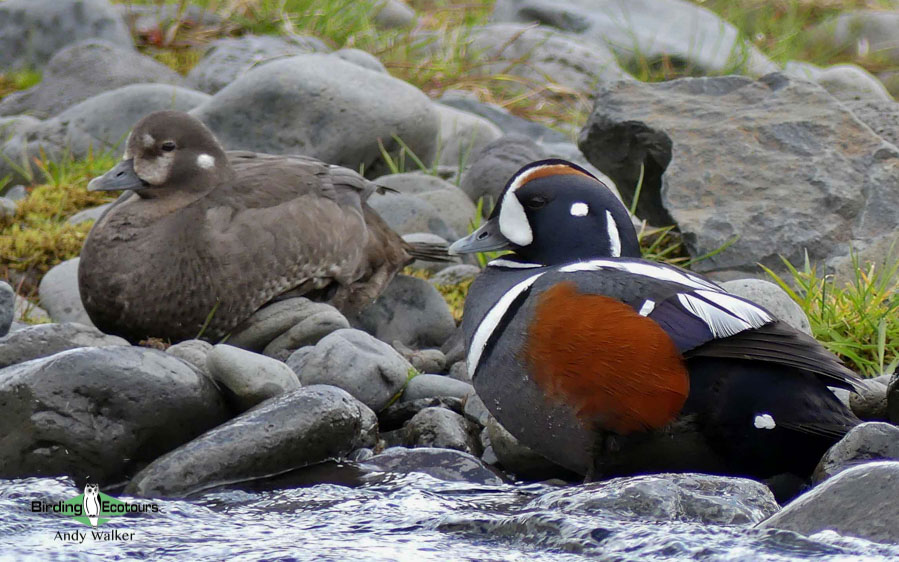
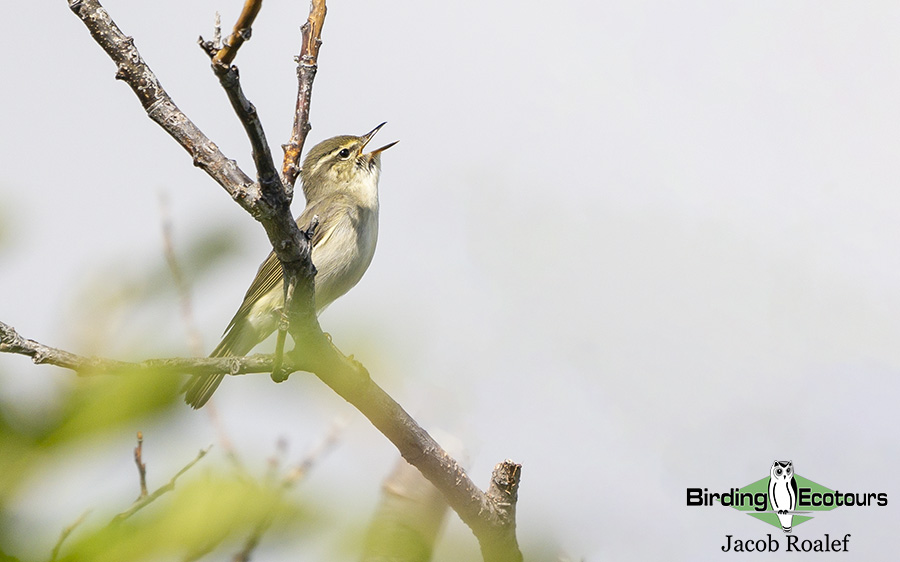
Then of course there is the wide array of fantastic birds that use these bountiful summer Arctic habitats for their nesting and breeding season. Birds include Bald Eagle, Horned and Tufted Puffins, Ancient and Kittlitz’s Murrelets, Long-tailed and Harlequin Ducks, Aleutian Tern, all four amazing Eider species (Steller’s, Spectacled, King, and Common), all three Jaeger species (Parasitic, Long-tailed, and Pomarine), Bristle-thighed Curlew, Emperor Goose, and many others which can be found on or above the waters and bays, not to mention true stunners like Snowy Owl, Arctic Warbler, Gyrfalcon, Bluethroat, American Dipper, and Willow and Rock Ptarmigans in the tundra and alpine areas. There are indeed very few places that could challenge the scenery, birds, and other wildlife found in the majesty of Alaska.
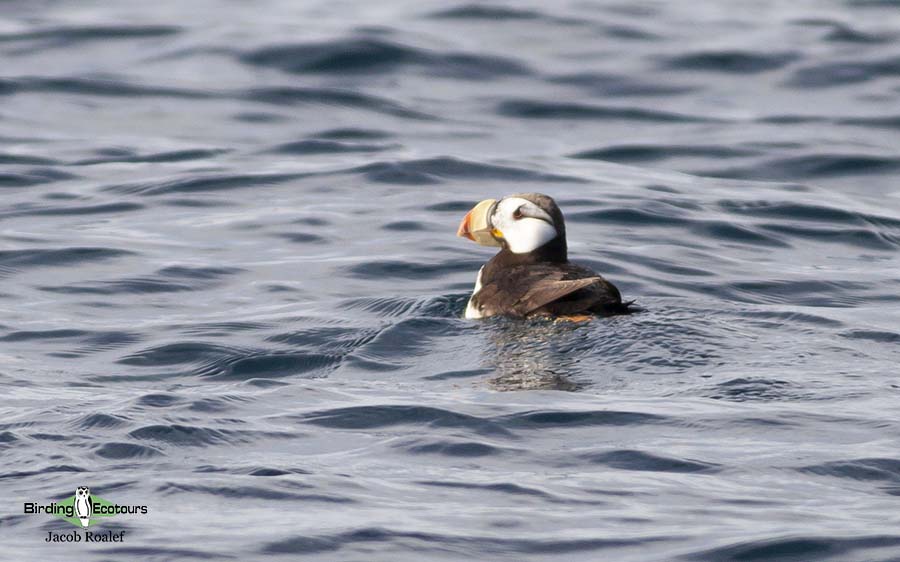 We will visit a large colony of Horned Puffins while in Seward.
This trip can be combined with our extension tour Utqiagvik (Barrow): Top of the World, which immediately follows this one.
Itinerary (13 days/12 nights)
Day 1. Arrival in Anchorage
You arrive at the Ted Stevens Anchorage International Airport by 6 p.m., where you will use the shuttle to the hotel. There will be introductions and an orientation about our upcoming trip during our first dinner together.
Overnight: Anchorage
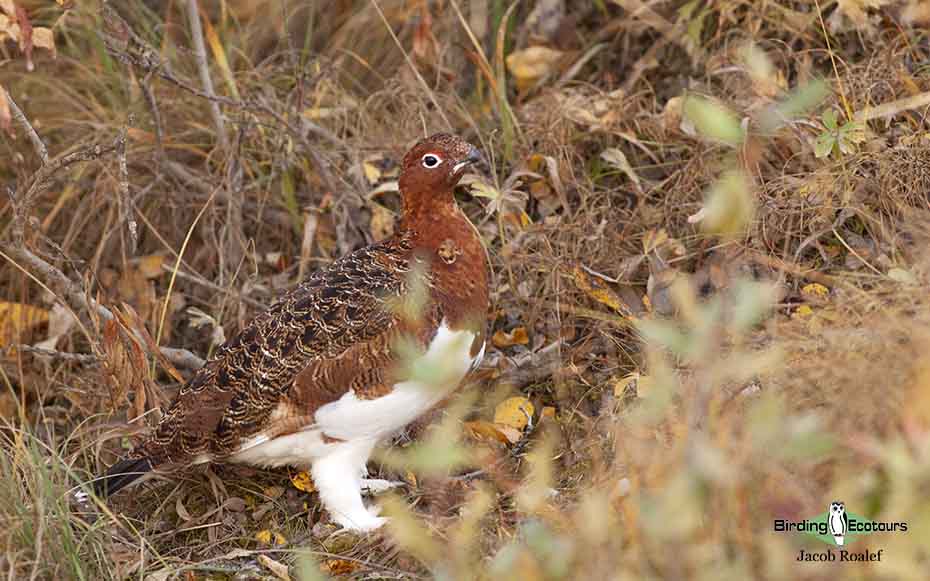 The striking Willow Ptarmigan is one of the top targets on this trip.
Days 2 – 4. Birding the wonders of Nome
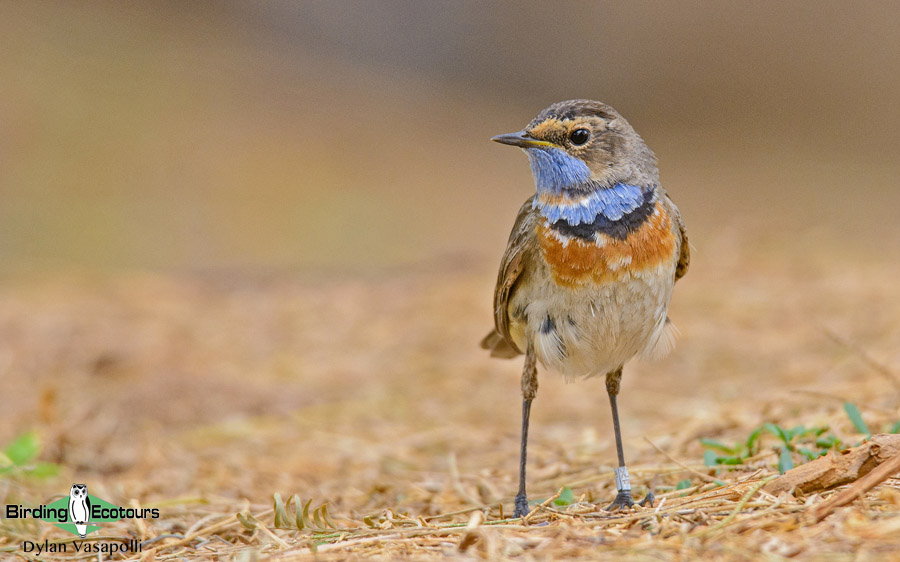
Using the hotel shuttle we will arrive at the Anchorage airport and catch our flight to the amazing birding destination that is Nome. Some of the best birding in all of Alaska can be found here during the tail end of migration, with breeding birds setting up territories and the potential of a stray species still high. Species such as Arctic Loon, Bristle-thighed Curlew, Aleutian Tern, Parasitic and Long-tailed Jaegers, Bluethroat, and Red Phalarope are a few of the top targets for our time here. There are three main roads that extend from the central town, and we will spend each of our days exploring these 60-plus-mile (97-plus-kilometer) roads that stretch through the beautiful arctic tundra. The evenings will be spent around the town with time for some birding. There is so much birding potential here in Nome with additional species like Alder Flycatcher, Eastern Yellow Wagtail, Pacific Golden Plover, Common Eider, Bar-tailed Godwit, and Northern Wheatear, plus a shot at Muskox. During our three-plus days in Nome we will be able to fully explore everything that this amazing location has to offer.
Overnight: Nome
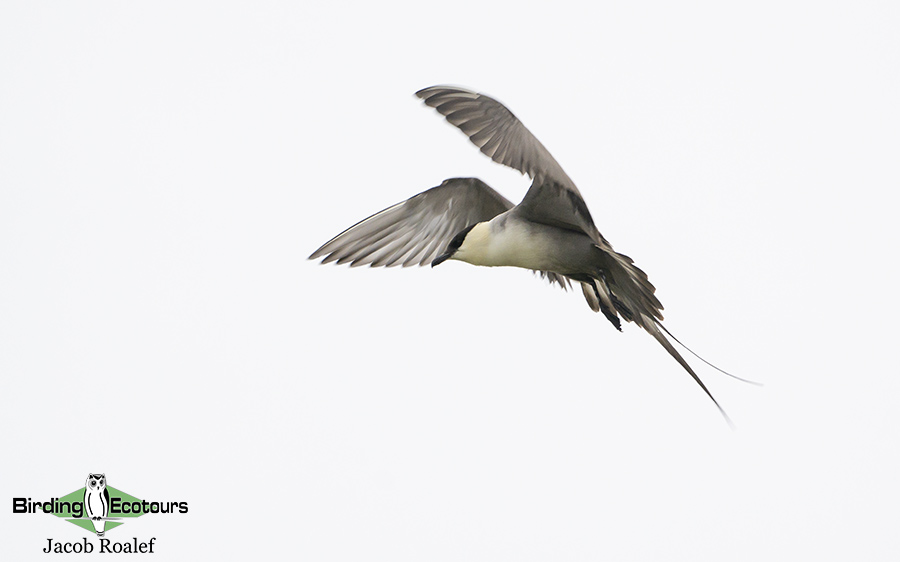 The dainty Long-tailed Jaeger
Day 5. Back to Anchorage
We’ll spend the morning birding around Nome for the final time, targeting any potential species we might be missing. From there we will take an afternoon flight back to Anchorage and pick up our rental vehicle, when we will likely see a few species near the airport and in town like Black-billed Magpie and Northern Raven. The remainder of the evening will be spent on dinner and getting comfortable in the hotel for a good night’s rest and recovery after a great time in Nome.
Overnight: Anchorage
Day 6. Kenai Peninsula
Today we will be traveling a few hours south to Seward with plenty of birding stops planned along the way. First is a morning of birding around the Anchorage area at Westchester Lagoon. A few pairs of Red-necked Grebes nest on this good-sized lake, with the possibility of other waterfowl and shorebird species like Hudsonian Godwit, Northern Shoveler, and Greater Scaup. Next we will head to another local park for a relaxing stroll that should produce Boreal Chickadee, Two-barred (White-winged) Crossbill, Golden-crowned Sparrow, and many others. From here we will continue working south toward Seward with a brief stop in the small town of Whittier. In order to access the town we must drive through America’s longest tunnel, just over 2.5 miles (4 kilometers) long, where we will be treated to views of Prince William Sound. We will scan the waters for species like Pigeon Guillemot, Glaucous-winged Gull, Harlequin Duck, and Harbor Seal, while enjoying American (Northwestern) Crows scattered around town. We’ll then make the rest of the drive to Seward, where we will eat dinner and settle into the hotel for the evening.
Overnight: Seward
Day 7. Seward Pelagic trip and Resurrection Bay
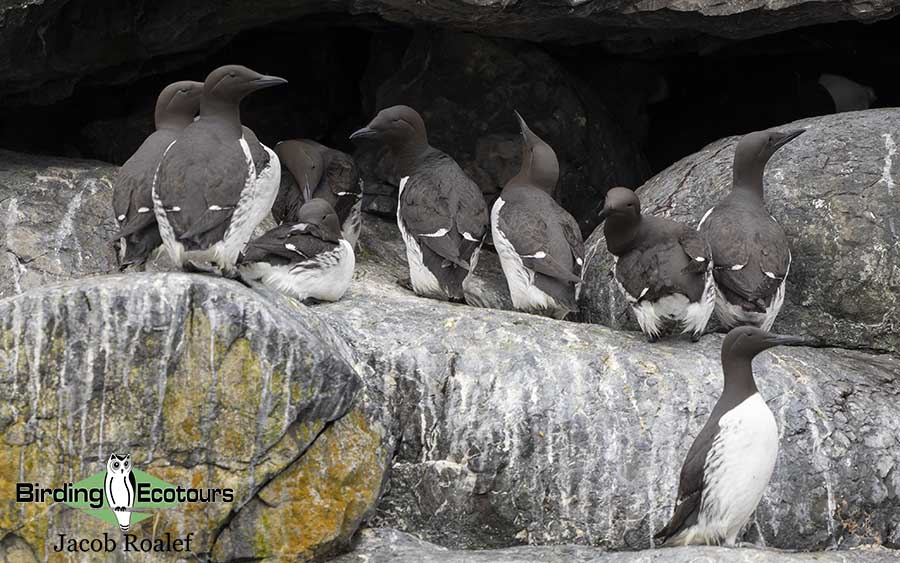
Today is very exciting as we spend most of it on the waters of Resurrection Bay, looking for loads of amazing seabirds and the potential for incredible marine mammals as well. The scenery of the bay is simply stunning, with large rock outcroppings scattered throughout and various glaciers in the surrounding mountains. We will visit colonies of both Tufted and Horned Puffins as well as Thick-billed and Common Murres. In addition, In addition, Red-faced Cormorant and a few other alcids are likely, like Ancient Murrelet, Marbled Murrelet, and even the rare Kittlitz’s Murrelet spends time in these waters during the summer. Thousands of Black-legged Kittiwakes enjoy the bay and are always a treat to see in their various plumage states. The chance at amazing marine mammals keeps the excitement alive, with Steller Sea Lion and Sea Otter as likely species with the chance at Dall’s Porpoise, Humpback Whale, and even the incredible Orca (Killer Whale)! After our time on the boat we will check out a few areas nearby before having dinner in town and settling in for the evening. This is also a good time to catch up on rest if needed or do a bit of laundry.
Overnight: Seward
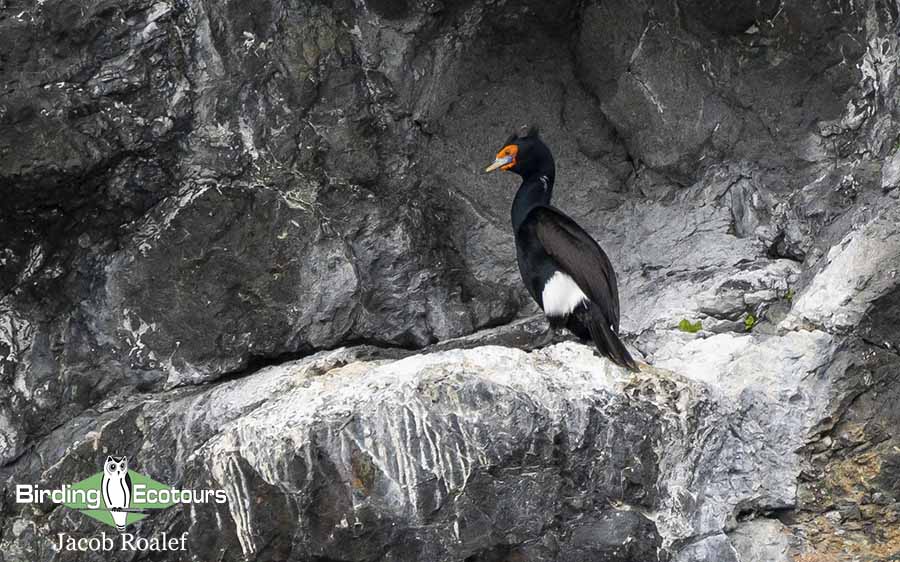 Sea birds, like Red-faced Cormorant, can be seen in Resurrection Bay.
Day 8. From Seward back to Anchorage
We start the day birding around the town of Seward, exploring the airport mudflats for species like Mew Gull, Semipalmated Sandpiper, and other shorebirds. We’ll also check out the areas surrounding Lowell Point, which hold a small population of Chestnut-backed Chickadee as well as other species like Varied Thrush, Pacific Wren, and Steller’s Jay. There is also the chance for a Sea Otter being close to shore or some auk species hanging close to nearby rocks. On our way back to Anchorage we’ll make several stops along the famous Potter Marsh Bird Sanctuary as we scan for nesting Arctic Terns, Green-winged Teal, Wilson’s Snipe, and others plus some amazing scenic views. We will have dinner in Anchorage before making our way to Wasilla for the night to help give us a head start for the next day.
Overnight: Wasilla
Day 9. Hatcher Pass to Healy
Today we’ll make the long, but scenic, drive toward Denali via Hatcher Pass. We’ll pass through a variety of habitats and elevations on this drive through the south-east Talkeetna Mountains. Fast-flowing streams along the roadside are common, with nesting American Dippers taking residence. Eventually we will reach some large open areas of tundra, where we will stop along the road when we spot something like perhaps a flock of Grey-crowned Rosy Finches or a Willow Ptarmigan strutting along. Once we are back on the main road we will stop again briefly at Byer’s Lake in Denali State Park for a brief hike, hoping for the likes of Northern Goshawk to bust through the forest and for a scan of the lake, where Trumpeter Swan and Common Loon should be nesting. Finally we’ll arrive in the small town of Healy for dinner and check into the hotel for the evening.
Overnight: Healy
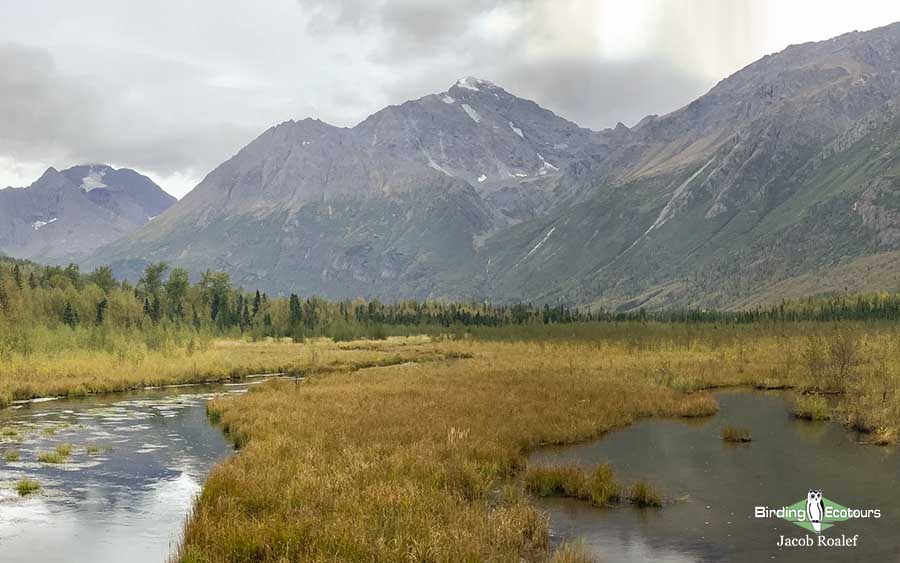 This tour will feature some stunning Alaskan scenery.
Day 10. Denali National Park
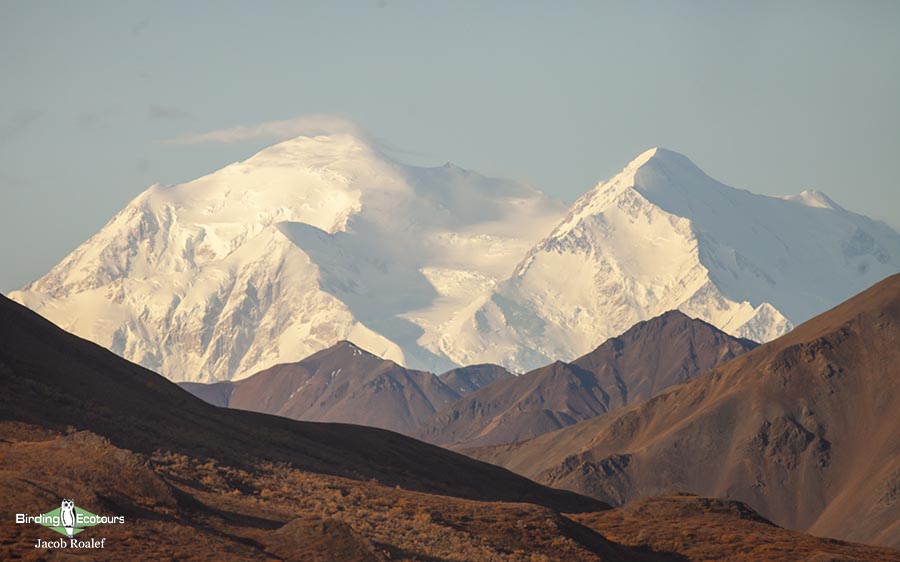
On one of the most exciting days of the trip today we will travel into the pristine Denali National Park. There is only a single, 90-plus-mile (150-plus-kilometer) road into and out of the park, and standard vehicles are not allowed past mile number 15. We will instead take one of the park’s tour buses, with our final destination of the day being at mile 66. Denali is best-known for its large-mammal sightings, spectacular tundra views, and of course Mount Denali (formerly Mt. McKinley) itself. The odds are good of seeing incredible wildlife like Grizzly Bear, Moose, Reindeer (Caribou), and Thinhorn Sheep (Dall’s Sheep) with the off chance at a rare mammal sighting as well. Views of Denali can be hit-or-miss, since it is so tall (20,000-plus feet/7000 meters) that it regularly creates its own weather conditions, often obstructing views with clouds and only occasionally peeking out. Then of course there are chances for some great birds like Golden Eagle and Gyrfalcon soaring in the thermals or a Willow Ptarmigan hopping through the scrub. Overall this national park is certainly a memorable one. After our bus returns, we will explore the nature center a bit and then head for dinner.
Overnight: Healy
Day 11. Birding the Denali Highway
We’ll spend the day cruising along the 135 miles/216 kilometers of scenic alpine tundra on the Denali Highway. This mostly dirt road offers some amazing opportunities to experience some of Alaska’s nesting species in a peaceful solitude. We will make stops in a variety of habitat zones. Trumpeter Swan, Tundra Swan, and Harlequin Duck are found on the multitude of lakes and ponds along with various nesting shorebirds such as American Golden Plover, Whimbrel, and Wandering Tattler. We will become weary of Long-tailed-Jaeger nests while we search carefully for nesting Smith’s Longspur. Throughout the drive we should see and hear recently arrived Arctic Warblers as well as the chance for a ptarmigan or grouse crossing, with numerous species possible. Eventually we will arrive in the Paxson area for the evening and dinner.
Overnight: Paxson
Day 12. Back to Anchorage
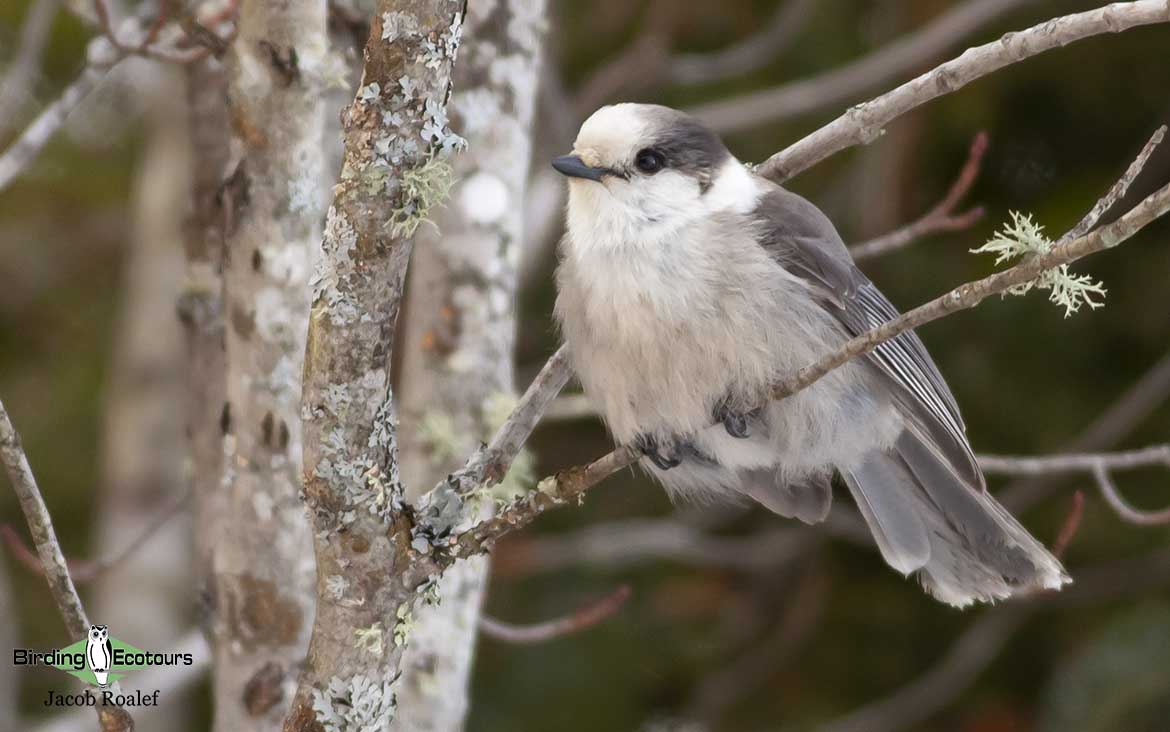
We will return to Anchorage today via the Richardson and Glenn Highways. Today we will target and focus on any tundra/alpine species we may have missed on previous days. The drive takes us through some beautiful sections of the boreal forest, giving us a chance for a Northern Hawk-Owl perched up high or a Spruce Grouse on the edge of the road. There are a few campgrounds to wander through that host all the typical boreal species, like Boreal Chickadee, American Three-toed Woodpecker, Canada Jay, and Pine Grosbeak. We will finally make it back to Anchorage for our final dinner of what was surely an amazing trip.
Overnight: Anchorage
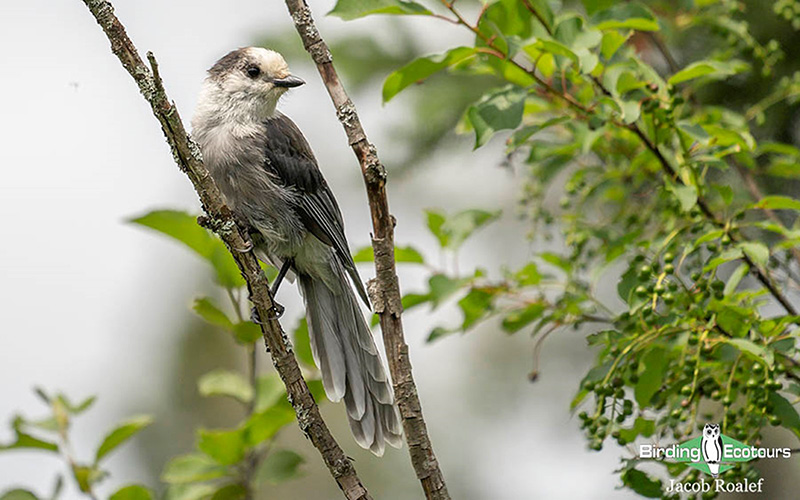 The cute Canada Jay is one of our many boreal targets.
Day 13. Tour concludes, extension begins
The main Alaska tour concludes this morning with transport to the Anchorage airport. Some of the participants may fly back home, while others may board the flight to Utqiagvik for the tour extension.
Please note that the itinerary cannot be guaranteed as it is only a rough guide and can be changed (usually slightly) due to factors such as availability of accommodation, updated information on the state of accommodation, roads, or birding sites, the discretion of the guides and other factors. In addition, we sometimes have to use a different international guide from the one advertised due to tour scheduling.
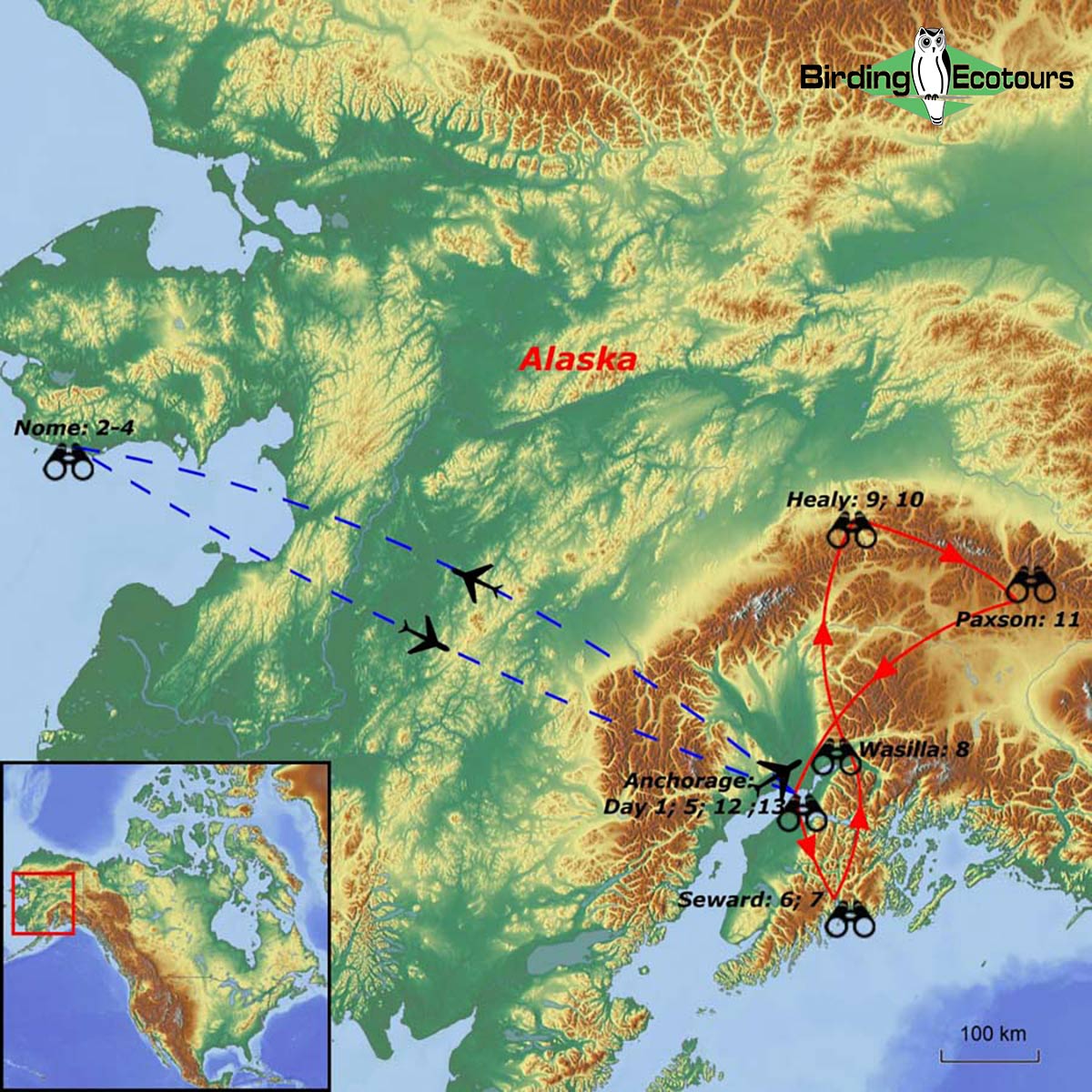
Map
Testimonials
Gallery
General Information
BIRDING TOURS USA: ALASKA GENERAL INFORMATION
PASSPORT AND VISA
For US citizens, no visas or passports are required. You will need to bring along a government issued ID as they are sometimes required for hotels.
Non-United States citizens will require a valid passport to enter the country, and some may require a tourist visa. Please consult with your local US Embassy for more details and information. You may need to show your ID/passport at various hotels and for the boat departures on this tour.
TRAVEL INSURANCE
We strongly encourage you to purchase trip cancellation or interruption insurance in case you have to cancel due to illness or for any other reason, as tour payments are non-refundable as per our terms and conditions. We advise you to get a plan which covers all your medical care and evacuation back to your country of residence, repatriation, and trip cancellation due to illness just prior, or any other reason.
HEALTH
Alaska does not pose any major health risk. Ample layers will help combat the unpredictable weather conditions and colder temperatures/wetter days. Water will be available throughout the tour and please feel free to bring your own reusable bottle to refill throughout the tour as the drinking water here is safe. There is always the potential for encounters with large mammals on this tour, however, they pose minimal risk if encounters with them are handled correctly. Your tour leader will give instructions and help with any questions to prepare for any potential encounter. Insects can be an annoyance and an issue in June, so we recommend bringing along repellent with higher levels of DEET and appropriate clothing.
MEDICAL CONDITIONS
Please make sure that you are covered by medical insurance in case of an emergency while on this trip. Without insurance the cost of medical care can be extremely high. Please notify us at the time of registering for this tour of any medical conditions you think we should know about (including allergies, heart conditions, epilepsy, etc.). This will greatly help us to cater to your needs and update emergency services if required.
WEATHER/CLIMATE
The weather in Alaska in June can vary drastically from 70° F (21° C) down to the 20° F (-7° C). The coasts are generally cooler/cold ranging from 30-50° F (-1-10° C) and the interior is a bit warmer from 50-70° F (10-21° C). Temperatures can get into the freezing levels in Nome all the way through late June. Layers and warms clothing options are a must to help with the wide range of conditions. Waterproof and rain gear are essential to ensure comfort while on the tour as it can rain or snow at any time and staying warm and dry during your time in Alaska will help you enjoy the tour. Issues with climate generally stem from inadequate gear. Proper waterproof layers, hats, gloves, and shoes/boots are highly recommended. Everyone is different with their tolerances to weather conditions so please bring along what you will need to help yourself stay comfortable.
ACCOMMODATIONS
We will be staying at comfortable hotels throughout the tour. Some may be slightly more basic than standard for mainland USA but still comfortable and providing everything needed.
COMMUNICATIONS
Our hotels should have decent access to Wi-Fi throughout the trip and phone service is typically fine near these areas and in the larger more populated cities. There are times throughout the trip where we will be out in the wilderness so do expect to lose coverage at some points. Nome is also a remote area so service and Wi-Fi can be questionable at times, depending on carriers.
PHYSICAL REQUIREMENTS AND PACE OF TOUR
Most of the birding will be done along roadsides or paved trails with hiking/walking requirements considered easy aside from one or two specific hikes for target species including Bristle-thighed Curlew and Smith’s Longspur. These hikes involve difficult and uneven terrain and potentially wet conditions and channels to cross.
There is also a lot of driving involved with this tour as we are covering a huge amount of ground (Alaska is massive), but of course there will be birding stops along the way. We will be stopping at restrooms whenever possible, however some drives and locations are fairly remote so a stop with nature may be needed at times.
Most mornings will begin around 6:30-7:00am with potential for a few earlier starts. We will continue birding for most of the day with some optional after-dinner birding at times. The days are very long at this time of year with sunset sometimes not occurring until midnight or later.
LUGGAGE
There should be enough space for each participant to bring one medium-sized suitcase as well as a personal bag to keep at their seat with them. Please do be mindful with large cameras or tripods if you choose to bring these along.
WHAT TO BRING
Please kindly read the general list of what to bring on a birding tour, here.
Layers and waterproof gear are always a good idea when preparing for a wide variety of possible weather conditions, and we consider them essential on this tour. We also do recommend bringing Dramamine or other motion sickness medications if you need them as there are long drives in the vehicle and a scheduled boat trip out of Seward.
Do not forget – Binoculars, prescription drugs (also bring the generic names for these drugs), toiletries, prescription glasses (and a spare pair), sunglasses, camera, batteries (for electronic equipment and chargers for re-chargeable batteries if required), alarm clock, money pouch, field guide(s), and a daypack.
Key Documents and Cash – Passports, your travel or health insurance cards, photocopies of which can be carried by the tour leader in case of emergency, credit cards (see info above). US dollars for drinks, gifts, tips, items of a personal nature, etc., which are not included in the tour cost.