21 FEBRUARY–01 MARCH 2026
By Jacob Roalef
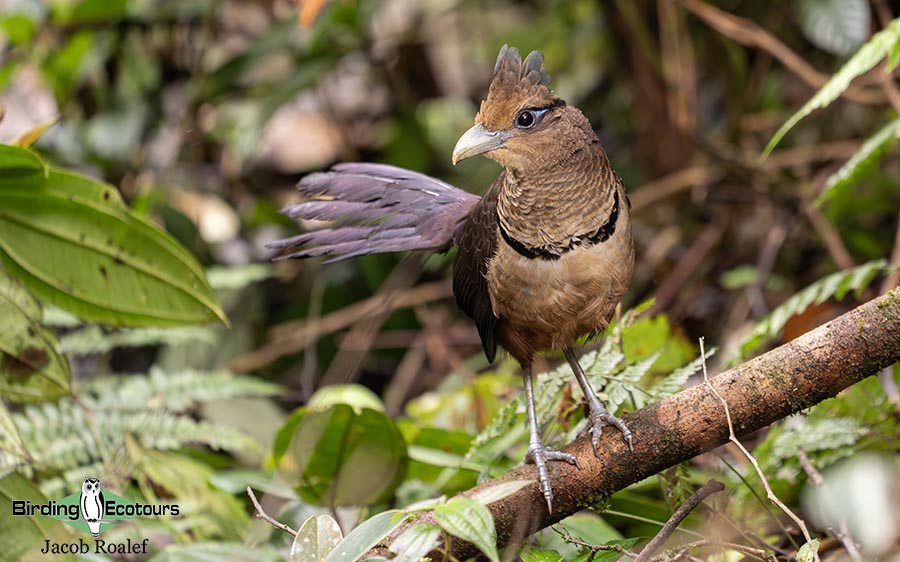
The mythical Rufous-vented Ground Cuckoo was certainly the star of the trip!
Overview
Designed as the second chapter in our introduction to Neotropical birding series, this nine-day Costa Rica escape offered the perfect antidote to the northern winter. Over the course of the tour, we moved through an impressive sweep of habitats, from the dry northern Pacific lowlands to lush Caribbean foothills and slopes, mid-elevation rainforest, riverine wetlands, and bird-rich waterways explored by boat. Along the way, we visited a superb lineup of birding sites, including Arenal Lodge and Observatory, Cinchona Feeders, Heliconias Lodge, Celeste Mountain Lodge, Tapir Valley Nature Reserve, Caño Negro Wildlife Refuge, Medio Queso wetlands, Bogarin Reserve, San Luis Canopy, and more. Much of the birding was relaxed and accessible, taking place along roadsides, well-maintained trails, and lively feeder stations, making this an ideal and rewarding introduction to the color, variety, and excitement of birding in the Neotropics.
From lowland wetlands and river channels to forested foothills and cloudier slopes, Costa Rica’s remarkable habitat variety kept the birding lively throughout the tour and delivered an outstanding species list for such a short trip. Highlights included Rufous-vented Ground Cuckoo, Snowcap, Ocellated Antbird, Great Potoo, Olivaceous Piculet, Thicket Antpitta, Yellow-tailed Oriole, Pinnated Bittern, Tody Motmot, Great Curassow, Blue-and-Gold Tanager, Long-tailed Tyrant, Black-and-White Owl, Ornate Hawk-Eagle, Yellow-breasted Crake, and more!
In total, we recorded 290 bird species, plus six additional heard-only species. Costa Rica also provided excellent wildlife sightings, with mammal highlights including Northern Tamandua, White-faced Capuchin, Central American Tapir, and Brown-throated Three-toed Sloth. Full bird and mammal checklists appear at the end of this report. For more exciting birding in this remarkable country, see our Costa Rica Escape Part I and Costa Rica Pacific Rainforest trips.
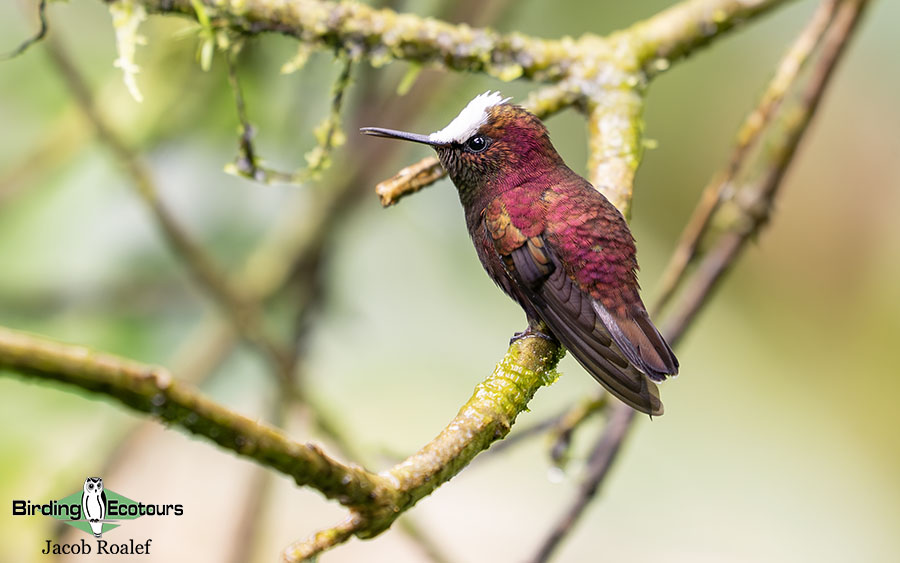
The adorable Snowcap gave us a great show.
Detailed Report
Day 1, 21st February 2026. Hotel Bougainvillea and welcome dinner
Today was arrival day, and by mid-afternoon everyone had reached the hotel and settled in. Before dinner, the group walked the grounds of Hotel Bougainvillea and began building our first official trip list, getting familiar with common Costa Rican species such as Clay-colored Thrush, Hoffmann’s Woodpecker, Red-billed Pigeon, Great Kiskadee, and Social Flycatcher. The standout sightings were a Mottled Owl roosting deep in the bamboo and the impressive Lesson’s Motmot, a regular around the hotel grounds. We then gathered for our first dinner and introductions before the main adventure began the following morning.
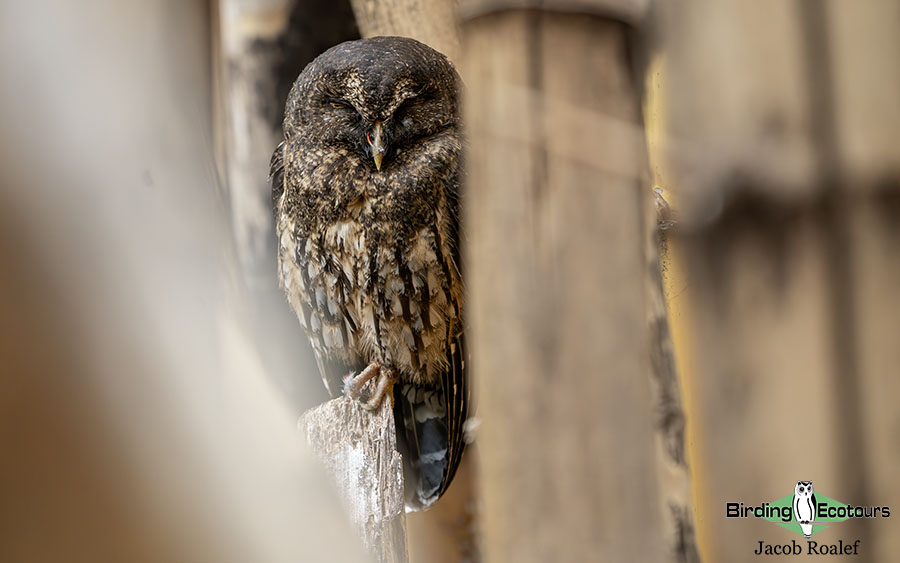
This Mottled Owl was sleeping deep in the bamboo stand.
Day 2, 22nd February 2026. Cinchona and Medio Queso to Caño Negro
Before breakfast, we made one last circuit of the Hotel Bougainvillea grounds in search of new species. The early effort was worthwhile, adding the tricky White-eared Ground Sparrow, Philadelphia Vireo, Brown Jay, White-tailed Kite, Cinnamon-bellied Saltator, and Melodious Blackbird. We had a long day ahead of us, so we fueled up with breakfast, packed our things, and headed off. After about an hour and a half, we made our first stop to stretch our legs and enjoy the amazing birds on offer at the Cinchona Feeder station. During our visit we enjoyed many amazing species like Red-headed Barbet, Northern Emerald Toucanet, Buff-fronted Quail-Dove, Violet Sabrewing, and Crimson-collared Tanager. From here, we pressed on to cover more ground and make it to our lunch stop. Of course, we managed to spot some birds on route like White Hawk, Black Phoebe, Eastern Meadowlark, and Tropical Mockingbird.
Following a tasty lunch, we reached the Medio Queso wetlands in the mid-afternoon, greeted almost immediately by a beautiful Black-collared Hawk along the entrance road. Soon we were aboard our small boat, easing out into the marsh to see what the wetlands would reveal. The first major highlight came quickly: a Pinnated Bittern tucked into the reeds beside the boat, giving us a memorable look at this normally elusive species. As we continued through the waterways, the list grew steadily with Snail Kite, Northern Jacana, Least Grebe, Amazon Kingfisher, Bare-throated Tiger-Heron, and more. One especially rewarding moment came when we tracked down a calling Yellow-breasted Crake; with patience, everyone eventually saw this tiny rail as it slipped through the marsh vegetation. After securing many of the waterbirds, we turned our attention to the surrounding scrub and added several excellent songbirds, including Gray-crowned and Olive-crowned Yellowthroats, Nicaraguan Grackle, and Orchard Oriole. We also kept watch overhead, and at last one of the many Turkey Vultures resolved into a Lesser Yellow-headed Vulture. With daylight fading and Caño Negro still ahead, we loaded up and continued onward. The after-dark drive produced one final surprise: a superb Great Potoo hunting near a light and then perching on a telephone pole, a perfect bird to close out the day before supper at the hotel.
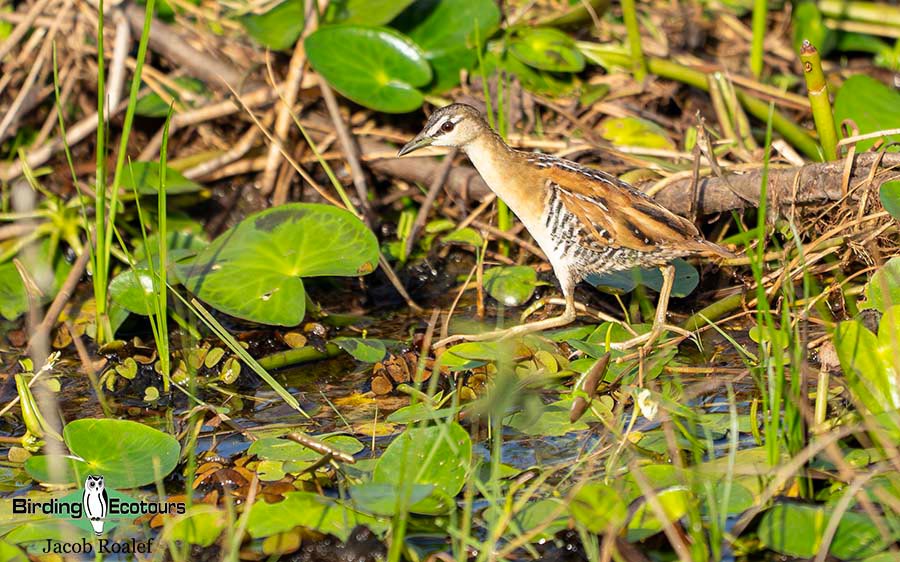
With patience, we all managed excellent views of the elusive Yellow-breasted Crake.
Day 3, 23rd February 2026. Caño Negro and transfer to Heliconias Lodge
The day opened before sunrise with a Common Pauraque calling just outside our rooms. While some opted for a slower start, part of the group headed into town for an hour of pre-breakfast birding, and the effort quickly paid off with Collared Aracari, Slaty-tailed Trogon, White-winged Becard, Spot-breasted Wren, Greenish Elaenia, Black-striped Sparrow, and more. We returned to the hotel to reunite with the rest of the group, enjoy breakfast and coffee, and watch the feeding station attract Keel-billed Toucan, Russet-naped Wood-Rail, Yellow-throated Euphonia, Red-legged Honeycreeper, and other species. Then it was time to board our boat for a memorable cruise along the Río Frío. The three-hour river trip was outstanding, with birds seemingly everywhere—herons, kingfishers, raptors, and even forest species along the banks. By the end of the morning, we had tallied 75 species from the boat alone. Among the many highlights were Boat-billed Heron, Wood Stork, Tricolored Heron, Roseate Spoonbill, Limpkin, Anhinga, Great Antshrike, Lineated Woodpecker, Black-crowned and Masked Tityras, Mangrove Swallow, Slate-headed Tody-Flycatcher, Canebrake Wren, Ringed and Amazon Kingfishers, Yellow-tailed Oriole, and many more. It was an exceptional morning on the water. Afterward, we returned to the lodge for lunch, gathered our belongings, checked out, and continued toward our next lodge.
We spent some time along the way to bird various dirt roads and areas to target a few more key species. Our first stop netted some great birds like Olivaceous Piculet, Yellow Tyrannulet, and Giant Cowbird. During our second stop, we hiked for a bit and noted more new trip birds like Pied Puffbird, Red-lored Amazon, Northern Tropical Pewee, and Blue-black Grassquit. It had been sprinkling on and off during our efforts, so we packed it up and headed off. While on route to the next hotel, we spotted a suspicious speck off in the distance and sure enough, a Bat Falcon was perched nicely for us to enjoy along with a few Lesser Swallow-tailed Swifts circling high. The final excitement for the day came in the form of a mammal as a Northern Tamandua was just waltzing along the side of the road! What an incredible sight to cap off a great day.
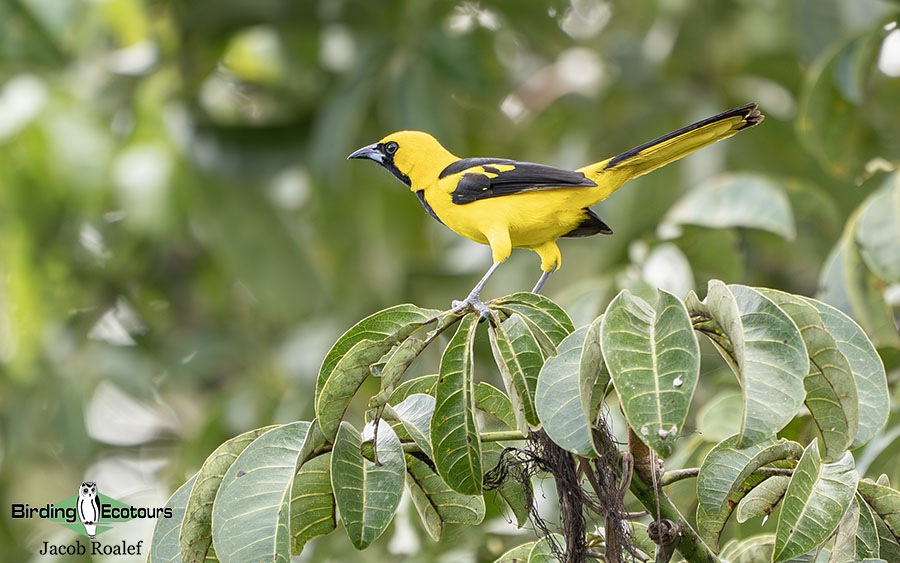
This Yellow-tailed Oriole was a surprise during our boat ride.
Day 4, 24th February 2026. Tapir Valley
It was a foggy and windy morning with just a mist in the air, which made any pre-breakfast birding slow and unenjoyable. Instead, we watched some fruit feeders from the window while we sipped our coffee and enjoyed White-throated Magpie-Jay, Montezuma Oropendola, and Hepatic Tanager. After a hearty breakfast, we headed to nearby Tapir Valley for a full morning in this excellent birding area. The outing proved highly productive, with more than 50 species recorded. We began at a fruiting fig tree alive with a mixed flock, carefully sorting through the activity to find Rufous-winged Tanager, White-collared Manakin, Scarlet-thighed Dacnis, and Dusky-capped Flycatcher. From there, we followed the well-kept trails to the feeder station, where close views of Great Curassow, Collared Aracari, Chestnut-headed Oropendola, Yellow-throated Toucan, and Yellow-throated Euphonia kept us entertained.
Once we had enjoyed the feeders, we continued along the trails to the observation platform. Although rain had settled in, the birds remained active, and we added excellent sightings of Snowcap, Black-crested Coquette, and Rufous Mourner. Our walk also produced several additions to the trip list, including Rufous-tailed Jacamar, Long-tailed Tyrant, White Hawk, Stripe-breasted Wren, and Mealy Amazon. Back near the entrance, the staff kindly led us to a sleeping Central American Tapir, the valley’s namesake and a memorable mammal highlight. In the afternoon, we returned to Tapir Valley under slightly improved weather and found more new birds, including Blue-black Grosbeak, Golden-hooded Tanager, Rufous Motmot, Gray-capped Flycatcher, and Cinnamon Becard. Despite the rain, it was an excellent day of birding in the valley.
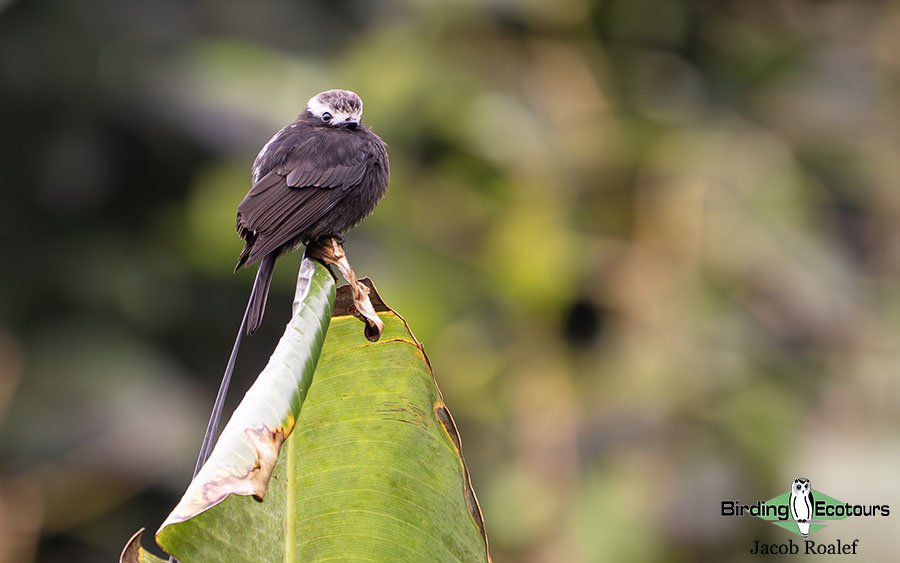
The cute yet fierce Long-tailed Tyrant gave us some excellent views.
Day 5, 25th February 2026. Heliconias Lodge and transfer to Arenal
The morning began much like the previous one, with breakfast and excellent feeder watching. More than a dozen Chestnut-headed Oropendolas swept in to enjoy the fruit set out by the hotel staff, providing a lively start despite the lingering mist and wind. We then headed onto the trails at Heliconias Lodge, where the birding was steady rather than fast-paced, but still produced several rewarding species, including Golden-crowned Warbler, Carmiol’s Tanager, Nightingale Wren, Spotted Antbird, Keel-billed Motmot, and Scaled Pygmy-Tyrant. Continuing deeper along the trail, we searched and listened carefully for our main target until, at last, it answered from the dense forest. After some patient scanning, we found a narrow opening through the vegetation and finally locked onto the tiny star of the morning: Tody Motmot. This species can be remarkably elusive, so we felt fortunate to enjoy such a view. From there, we made our way back to the lodge for lunch, packed up, and began the drive to our next hotel in La Fortuna. A Bronzed Cowbird along the route added one more new bird for the trip before heavier rain greeted us on arrival, giving everyone a welcome chance to settle in and relax before dinner.
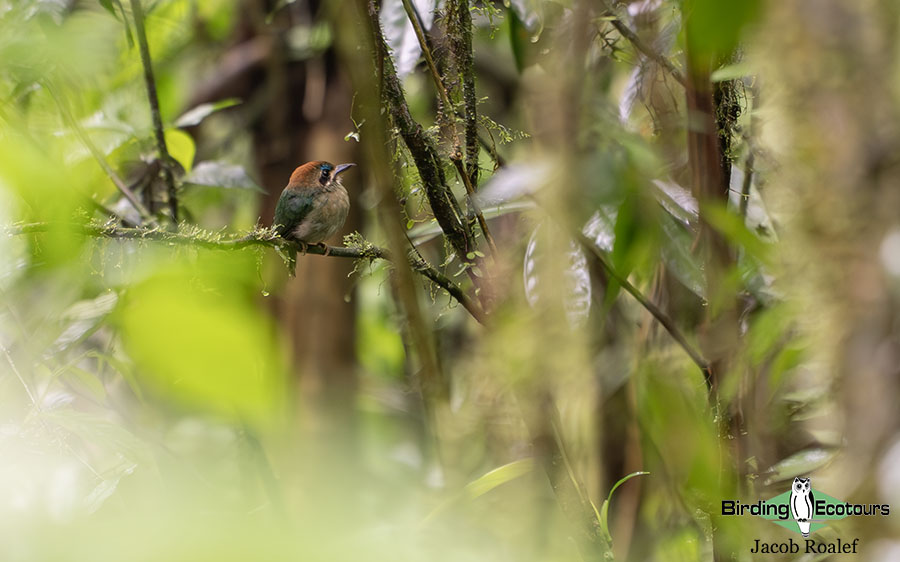
We needed the perfect angle to see this Tody Motmot hidden in the jungle.
Day 6, 26th February 2026. Arenal Observatory Lodge
Some of us set out early for a round of pre-breakfast birding on the lodge trails, and the morning quickly proved worth the effort. In the soft early light, the forest was alive with activity, producing Broad-billed Motmot, Sulphur-rumped and Slaty-capped Flycatchers, Buff-rumped Warbler, Tropical Parula, and more. The standout moment came when a Thicket Antpitta emerged from the undergrowth and briefly crossed the narrow trail right in front of us. After breakfast and coffee, we set off for Arenal Observatory Lodge, but the entrance road soon slowed our progress with yet more birds. A quick detour into the forest rewarded us with Bare-crowned Antbird, Yellow-billed Cacique, Stripe-breasted Wren, and Red-throated Ant-Tanager. Eventually, we reached the lodge in time for lunch and fresh fruit at the feeders, where the observation platform was busy with Bay-headed, Emerald, Silver-throated, and Golden-hooded Tanagers, Montezuma Oropendola, Brown Jay, Baltimore Oriole, and more. The real excitement came in the form of two raptors as a King Vulture flew by low overhead and a stunning Ornate Hawk-Eagle dropped into the nearby trees and remained perched long enough for extended close views.
With the feeders behind us, it was time to explore the vast Arenal property and see what its mix of flower gardens, forest edges, and dense jungle would produce. The morning turned out to be remarkably productive, and by the time we had to move on, we had recorded 82 species. Highlights came steadily, including Rufous-winged Woodpecker, Streak-crowned Antvireo, Slaty Antwren, Tawny-faced Gnatwren, Pale-vented Thrush, and many more. It was a superb day to experience Arenal and the surrounding area. On the way back to the lodge, we still had just enough time for a quick stop along Arenal Dam road. As we arrived, our driver picked out a stunning Laughing Falcon perched on a branch over the road, giving us excellent close views. The same stretch also produced Buff-throated Saltator, Bare-crowned Antbird, Broad-billed Motmot, and White Hawk. After such a full day, and with another long one ahead, we returned to the hotel for a short rest and dinner.
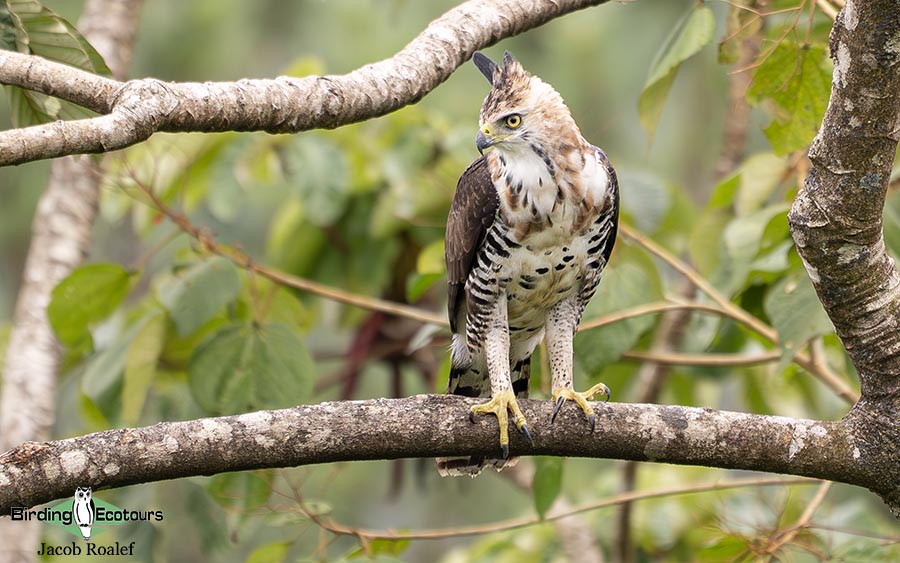
Few birds are as impressive as the stunning Ornate Hawk-Eagle.
Day 7, 27th February 2026. San Luis Canopy and Private Finca
Some new and exciting information had come in the previous day about an opportunity to visit an ant swarm on a private farm, so with some careful planning, we rerouted our plans and itinerary a bit to visit San Luis Canopy this morning and get onto the private finca nearby. This meant quite an early departure and longer drive, but we were all up for the exciting prospect. We grabbed some coffee and breakfast on the road and arrived at San Luis Canopy in time for open. Here we enjoyed the incredible feeders for an hour or so and these never disappoint with species like Collared Trogon, Blue-and-gold, Bay-headed, and Emerald Tanagers, Green Hermit, Tawny-capped Euphonia, Bright-rumped Attila, and White-fronted Amazon all on offer. Finally, it was our time to visit the private property nearby, so we made the hike down to where the army ant swarm was. It didn’t take long before the incredible Rufous-vented Ground Cuckoo made an appearance in the bush. We all clamored for a look which felt silly as it then walked right into the open and gave an amazing display for what felt like an eternity. It was fantastic to watch this incredible bird forage on larger prey that scattered to get away from the ants. While the Rufous-vented Ground Cuckoo was certainly the star, it wasn’t the only bird on offer in the area and we found Barred Forest-Falcon, Ocellated and Bicolored Antbirds, Plain-brown Woodcreeper, Rufous-browed Tyrannulet, White-throated Shrike-Tanager, and more. An incredible morning full of even more incredible birds. It was back up to the canopy feeders for a bit more enjoyment while we ate lunch and then made the longer drive back to La Fortuna.
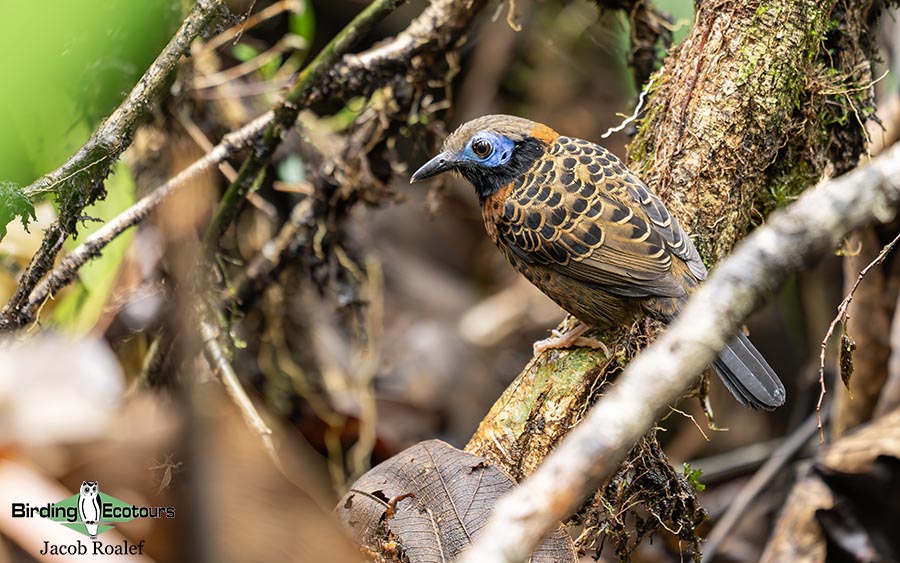
The bizarre Ocellated Antbird was another top highlight of this ant swarm.
After lunch we headed over to Bogarin Reserve to spend a few hours birding. We spent some time at the feeders near the entrance which were loaded with birds like Gray-headed Chachalaca, Red-legged and Green Honeycreepers, Black-headed Saltator, and Scarlet-rumped Tanager. After some relaxing time here, we ventured out along the many trails here. Not far from the feeders, a male Brown-throated Three-toed Sloth explored the canopy trees. Our hike yielded plenty of good birds such as Pacific Screech-Owl, Kentucky Warbler, Black-and-white Owl, Rufous-tailed Jacamar, Streak-headed Woodcreeper, and others. We circled back round to the feeder station for one final look before heading back to the hotel for supper after a hugely successful day birding.
Day 8, 28th February 2026. San Ramón to Hotel Robledal
Our final full day had a lot of ground to cover, so we hit the road very early to arrive in the San Ramón area just after sunrise. Here we birded a local guide’s feeders for a bit and noted Black Guan, Yellow-faced Grassquit, Common Chlorospingus, and Rufous-collared Sparrow, before heading off in search of more birds. Unfortunately, the weather was not on our side today with misty clouds rolling through and high winds which made for poor visibility and birding. This wouldn’t deter our efforts however, so we pressed onwards. Along the entrance road, our local guide made a quick stop to search for a special owl in the area and luck was on our side as we all managed views of the brilliant Bare-shanked Screech-Owl. A truly excellent bird. We continued to our main target and just as we were walking into the area, a female Three-wattled Bellbird flew overhead and quickly disappeared. Sadly, the views were fleeting and those who were lagging might have missed it altogether. Weather was not helping and despite our efforts and patience, the bellbird was a no-show for the remainder of our time. Of course, we still managed to find a few other species like Brown Jay, Sulphur-bellied Flycatcher, Broad-winged Hawk, Ochraceous Wren, and Golden-olive Woodpecker. Alas, it was finally time to call it on our search, so we turned around and headed back to the vehicle.
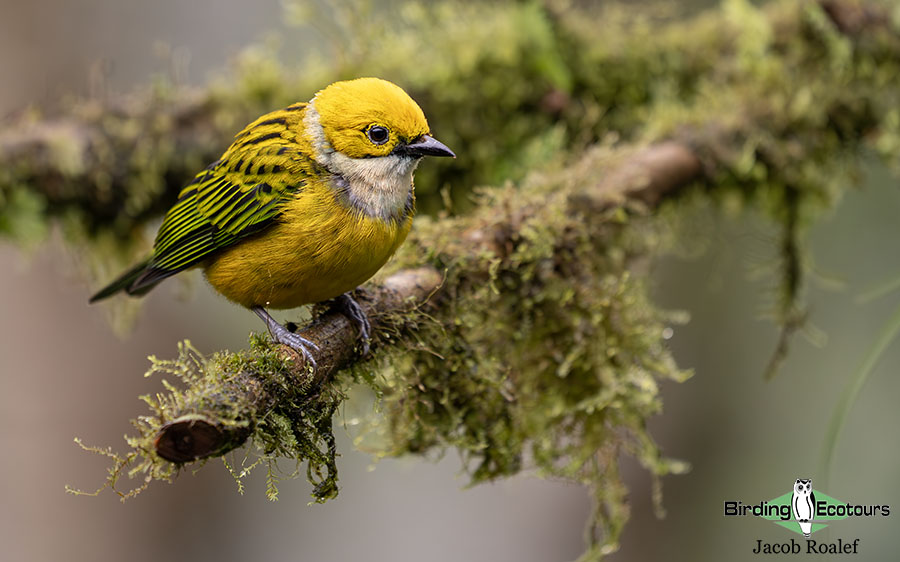
Silver-throated Tanager was one of many colorful birds on offer at close range.
We began the long, traffic-filled journey back to San José, but still managed a bit more birding at lunch as we ventured off a back trail and made a nice list which included Cabanis’s Wren, Orange-billed Nightingale-Thrush, White-eared Ground Sparrow, Golden-winged Warbler, and Common Tody-Flycatcher. We finally arrived at Hotel Robledal with enough daylight still to get settled in and do a quick bit of birding around the grounds here. We managed some nice views of species like Ferruginous Pygmy-Owl, Plain-capped Starthroat, Cinnamon Hummingbird, Spot-breasted Oriole, Rufous-backed Wren, and more. Time for drinks and our final dinner together as we shared some of our favorite bird sightings and moments from the trip.
Day 9, 1st March 2026. Departure from San José
The trip ended this morning with transfers from the hotel to San José airport. Those with later flights had time for a final walk around the hotel grounds, where they enjoyed species such as Cinnamon Hummingbird, Lineated Woodpecker, and Spot-breasted Oriole. This last birding session was a fitting close to a wonderful Costa Rica tour filled with memorable birds, mammals, and experiences.
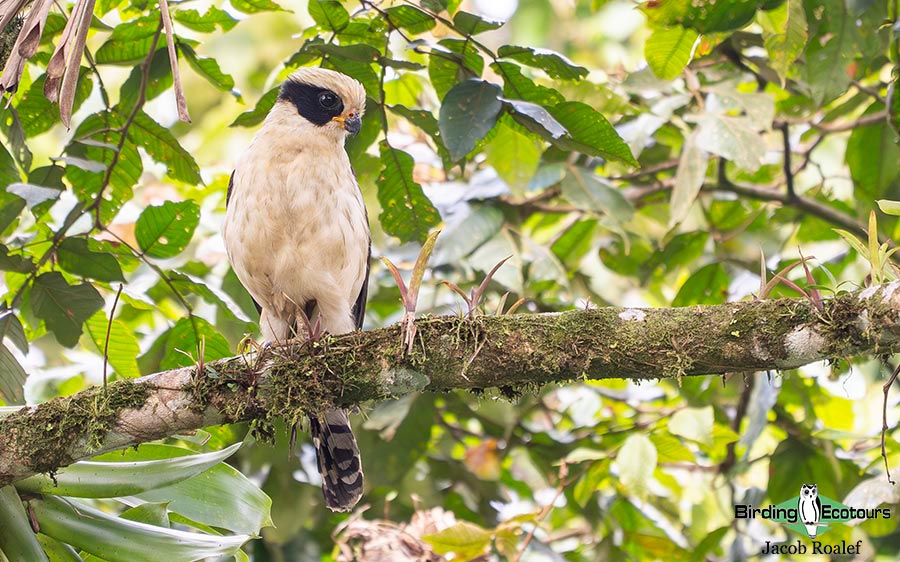
Our group enjoyed fantastic views of Laughing Falcon this year.
Bird List – Following IOC 15.1 (March 2025)
Birds ‘heard only’ are marked with (H) after the common name, all other species were seen.
The following notation after species names is used to show conservation status following the IUCN Red List: CR = Critically Endangered, NT = Near Threatened.
| Common Name | Scientific Name |
| Ducks, Geese, Swans (Anatidae) | |
| Black-bellied Whistling-Duck | Dendrocygna autumnalis |
| Muscovy Duck | Cairina moschata |
| Blue-winged Teal | Spatula discors |
| Chachalacas, Curassows, Guans (Cracidae) | |
| Gray-headed Chachalaca | Ortalis cinereiceps |
| Crested Guan | Penelope purpurascens |
| Black Guan | Chamaepetes unicolor |
| Great Curassow | Crax rubra |
| Nightjars (Caprimulgidae) | |
| Pauraque | Nyctidromus albicollis |
| Potoos (Nyctibiidae) | |
| Great Potoo | Nyctibius grandis |
| Swifts (Apodidae) | |
| Gray-rumped Swift | Chaetura cinereiventris |
| Lesser Swallow-tailed Swift | Panyptila cayennensis |
| Hummingbirds (Trochilidae) | |
| White-necked Jacobin | Florisuga mellivora |
| Band-tailed Barbthroat | Threnetes ruckeri |
| Green Hermit | Phaethornis guy |
| Green-breasted Mango | Anthracothorax prevostii |
| Black-crested Coquette | Lophornis helenae |
| Green-crowned Brilliant | Heliodoxa jacula |
| Plain-capped Starthroat | Heliomaster constantii |
| Ruby-throated Hummingbird | Archilochus colubris |
| Violet-headed Hummingbird | Klais guimeti |
| Violet Sabrewing | Campylopterus hemileucurus |
| Bronze-tailed Plumeleteer | Chalybura urochrysia |
| Crowned Woodnymph | Thalurania colombica |
| Snowcap | Microchera albocoronata |
| Scaly-breasted Hummingbird | Phaeochroa cuvierii |
| Cinnamon Hummingbird | Amazilia rutila |
| Rufous-tailed Hummingbird | Amazilia tzacatl |
| Blue-throated Goldentail | Chlorestes eliciae |
| Cuckoos (Cuculidae) | |
| Groove-billed Ani | Crotophaga sulcirostris |
| Rufous-vented Ground Cuckoo | Neomorphus geoffroyi |
| Mangrove Cuckoo (H) | Coccyzus minor |
| Squirrel Cuckoo | Piaya cayana |
| Pigeons, Doves (Columbidae) | |
| Rock Pigeon | Columba livia |
| Pale-vented Pigeon | Patagioenas cayennensis |
| Red-billed Pigeon | Patagioenas flavirostris |
| Short-billed Pigeon | Patagioenas nigrirostris |
| Inca Dove | Columbina inca |
| Ruddy Ground Dove | Columbina talpacoti |
| Blue Ground Dove | Claravis pretiosa |
| White-tipped Dove | Leptotila verreauxi |
| Gray-chested Dove | Leptotila cassinii |
| Gray-headed Dove | Leptotila plumbeiceps |
| Buff-fronted Quail-Dove | Zentrygon costaricensis |
| White-winged Dove | Zenaida asiatica |
| Rails, Crakes & Coots (Rallidae) | |
| Uniform Crake (H) | Amaurolimnas concolor |
| Russet-naped Wood-Rail | Aramides albiventris |
| Common Gallinule | Gallinula galeata |
| American Coot | Fulica americana |
| Yellow-breasted Crake | Hapalocrex flaviventer |
| White-throated Crake (H) | Laterallus albigularis |
| Limpkin (Aramidae) | |
| Limpkin | Aramus guarauna |
| Stilts and Avocets (Recurvirostridae) | |
| Black-necked Stilt | Himantopus mexicanus |
| Plovers (Charadriidae) | |
| Southern Lapwing | Vanellus chilensis |
| Jacanas (Jacanidae) | |
| Northern Jacana | Jacana spinosa |
| Sandpipers, Snipes (Scolopacidae) | |
| Spotted Sandpiper | Actitis macularius |
| Least Sandpiper | Calidris minutilla |
| Grebes (Podicipedidae) | |
| Least Grebe | Tachybaptus dominicus |
| Pied-billed Grebe | Podilymbus podiceps |
| Storks (Ciconiidae) | |
| Wood Stork | Mycteria americana |
| Anhingas, Darters (Anhingidae) | |
| Anhinga | Anhinga anhinga |
| Cormorants and Shags (Phalacrocoracidae) | |
| Neotropic Cormorant | Nannopterum brasilianum |
| Ibises, Spoonbills (Threskiornithidae) | |
| White Ibis | Eudocimus albus |
| Glossy Ibis | Plegadis falcinellus |
| Green Ibis | Mesembrinibis cayennensis |
| Roseate Spoonbill | Platalea ajaja |
| Herons, Egrets, and Bitterns (Ardeidae) | |
| Pinnated Bittern | Botaurus pinnatus |
| Least Bittern | Ixobrychus exilis |
| Bare-throated Tiger-Heron | Tigrisoma mexicanum |
| Great Blue Heron | Ardea herodias |
| Great Egret | Ardea alba |
| Snowy Egret | Egretta thula |
| Little Blue Heron | Egretta caerulea |
| Tricolored Heron | Egretta tricolor |
| Cattle Egret | Bubulcus ibis |
| Green Heron | Butorides virescens |
| Black-crowned Night-Heron | Nycticorax nycticorax |
| Boat-billed Heron | Cochlearius cochlearius |
| New World Vultures (Cathartidae) | |
| King Vulture | Sarcoramphus papa |
| Black Vulture | Coragyps atratus |
| Turkey Vulture | Cathartes aura |
| Lesser Yellow-headed Vulture | Cathartes burrovianus |
| Ospreys (Pandionidae) | |
| Osprey | Pandion haliaetus |
| Kites, Hawks, Eagles (Accipitridae) | |
| White-tailed Kite | Elanus leucurus |
| Swallow-tailed Kite | Elanoides forficatus |
| Ornate Hawk-Eagle | Spizaetus ornatus |
| Cooper’s Hawk | Accipiter cooperii |
| Northern Harrier | Circus hudsonius |
| Black-collared Hawk | Busarellus nigricollis |
| Snail Kite | Rostrhamus sociabilis |
| Roadside Hawk | Rupornis magnirostris |
| White Hawk | Pseudastur albicollis |
| Gray Hawk | Buteo plagiatus |
| Broad-winged Hawk | Buteo platypterus |
| Short-tailed Hawk | Buteo brachyurus |
| Owls (Strigidae) | |
| Bare-shanked Screech-Owl | Megascops clarkii |
| Pacific Screech-Owl | Megascops cooperi |
| Ferruginous Pygmy-Owl | Glaucidium brasilianum |
| Mottled Owl | Strix virgata |
| Black-and-white Owl | Strix nigrolineata |
| Trogons (Trogonidae) | |
| Slaty-tailed Trogon | Trogon massena |
| Black-headed Trogon | Trogon melanocephalus |
| Collared Trogon | Trogon collaris |
| Motmots (Momotidae) | |
| Tody Motmot | Hylomanes momotula |
| Lesson’s Motmot | Momotus lessonii |
| Rufous Motmot | Baryphthengus martii |
| Keel-billed Motmot | Electron carinatum |
| Broad-billed Motmot | Electron platyrhynchum |
| Kingfishers (Alcedinidae) | |
| Ringed Kingfisher | Megaceryle torquata |
| Belted Kingfisher | Megaceryle alcyon |
| Amazon Kingfisher | Chloroceryle amazona |
| American Pygmy Kingfisher | Chloroceryle aenea |
| Green Kingfisher | Chloroceryle americana |
| Puffbirds (Bucconidae) | |
| Pied Puffbird | Notharchus tectus |
| Jacamars (Galbulidae) | |
| Rufous-tailed Jacamar | Galbula ruficauda |
| New World Barbets (Capitonidae) | |
| Red-headed Barbet | Eubucco bourcierii |
| Toucans (Ramphastidae) | |
| Blue-throated Toucanet | Aulacorhynchus caeruleogularis |
| Collared Aracari | Pteroglossus torquatus |
| Keel-billed Toucan | Ramphastos sulfuratus |
| Yellow-throated Toucan | Ramphastos ambiguus |
| Woodpeckers (Picidae) | |
| Olivaceous Piculet | Picumnus olivaceus |
| Black-cheeked Woodpecker | Melanerpes pucherani |
| Hoffmann’s Woodpecker | Melanerpes hoffmannii |
| Smoky-brown Woodpecker | Dryobates fumigatus |
| Rufous-winged Woodpecker | Piculus simplex |
| Golden-olive Woodpecker | Colaptes rubiginosus |
| Lineated Woodpecker | Dryocopus lineatus |
| Caracaras, Falcons (Falconidae) | |
| Laughing Falcon | Herpetotheres cachinnans |
| Barred Forest-Falcon | Micrastur ruficollis |
| Crested Caracara | Caracara plancus |
| Yellow-headed Caracara | Milvago chimachima |
| Bat Falcon | Falco rufigularis |
| African & New World Parrots (Psittacidae) | |
| Olive-throated Parakeet | Eupsittula nana |
| Orange-chinned Parakeet | Brotogeris jugularis |
| Brown-hooded Parrot | Pyrilia haematotis |
| White-fronted Parrot | Amazona albifrons |
| Red-lored Parrot | Amazona autumnalis |
| Mealy Parrot | Amazona farinosa |
| Great Green Macaw – CR | Ara ambiguus |
| Finsch’s Parakeet (Crimson-fronted) | Psittacara finschi |
| Typical Antbirds (Thamnophilidae) | |
| Fasciated Antshrike (H) | Cymbilaimus lineatus |
| Great Antshrike | Taraba major |
| Barred Antshrike | Thamnophilus doliatus |
| Russet Antshrike | Thamnistes anabatinus |
| Streak-crowned Antvireo | Dysithamnus striaticeps |
| Slaty Antwren | Myrmotherula schisticolor |
| Dusky Antbird | Cercomacroides tyrannina |
| Bare-crowned Antbird | Gymnocichla nudiceps |
| Chestnut-backed Antbird | Poliocrania exsul |
| Dull-mantled Antbird | Sipia laemosticta |
| Spotted Antbird | Hylophylax naevioides |
| Bicolored Antbird | Gymnopithys bicolor |
| Ocellated Antbird | Phaenostictus mcleannani |
| Antpittas (Grallariidae) | |
| Thicket Antpitta | Hylopezus dives |
| Ovenbirds (Furnariidae) | |
| Plain-brown Woodcreeper | Dendrocincla fuliginosa |
| Wedge-billed Woodcreeper | Glyphorynchus spirurus |
| Northern Barred-Woodcreeper | Dendrocolaptes sanctithomae |
| Spotted Woodcreeper | Xiphorhynchus erythropygius |
| Streak-headed Woodcreeper | Lepidocolaptes souleyetii |
| Northern Plain Xenops | Xenops minutus |
| Western Woodhaunter | Automolus virgatus |
| Manakins (Pipridae) | |
| White-collared Manakin | Manacus candei |
| Cotingas (Cotingidae) | |
| Three-wattled Bellbird | Procnias tricarunculatus |
| Tityras, Becards, Sharpbill (Tityridae) | |
| Northern Schiffornis (H) | Schiffornis veraepacis |
| Masked Tityra | Tityra semifasciata |
| Black-crowned Tityra | Tityra inquisitor |
| Cinnamon Becard | Pachyramphus cinnamomeus |
| White-winged Becard | Pachyramphus polychopterus |
| Royal Flycatchers and Allies (Onychorhynchidae) | |
| Sulphur-rumped Flycatcher | Myiobius sulphureipygius |
| Tyrant Flycatchers, Calyptura (Tyrannidae) | |
| Slaty-capped Flycatcher | Leptopogon superciliaris |
| Rufous-browed Tyrannulet | Phylloscartes superciliaris |
| Scale-crested Pygmy-Tyrant | Lophotriccus pileatus |
| Slate-headed Tody-Flycatcher | Poecilotriccus sylvia |
| Common Tody-Flycatcher | Todirostrum cinereum |
| Northern Beardless-Tyrannulet | Camptostoma imberbe |
| Yellow Tyrannulet | Capsiempis flaveola |
| Greenish Elaenia | Myiopagis viridicata |
| Yellow-bellied Elaenia | Elaenia flavogaster |
| Bright-rumped Attila | Attila spadiceus |
| Rufous Mourner | Rhytipterna holerythra |
| Dusky-capped Flycatcher | Myiarchus tuberculifer |
| Great Crested Flycatcher | Myiarchus crinitus |
| Great Kiskadee | Pitangus sulphuratus |
| Boat-billed Flycatcher | Megarynchus pitangua |
| Social Flycatcher | Myiozetetes similis |
| Gray-capped Flycatcher | Myiozetetes granadensis |
| Sulphur-bellied Flycatcher | Myiodynastes luteiventris |
| Piratic Flycatcher | Legatus leucophaius |
| Tropical Kingbird | Tyrannus melancholicus |
| Fork-tailed Flycatcher | Tyrannus savana |
| Tropical Pewee | Contopus cinereus |
| Yellow-bellied Flycatcher | Empidonax flaviventris |
| Willow Flycatcher | Empidonax traillii |
| Yellowish Flycatcher | Empidonax flavescens |
| Black Phoebe | Sayornis nigricans |
| Long-tailed Tyrant | Colonia colonus |
| Vireos, Greenlets, Shrike-babblers (Vireonidae) | |
| Ochre-crowned Greenlet | Tunchiornis ochraceiceps |
| Lesser Greenlet | Pachysylvia decurtatus |
| Yellow-throated Vireo | Vireo flavifrons |
| Philadelphia Vireo | Vireo philadelphicus |
| Crows, Jays (Corvidae) | |
| White-throated Magpie-Jay | Calocitta formosa |
| Brown Jay | Psilorhinus morio |
| Swallows, Martins (Hirundinidae) | |
| Mangrove Swallow | Tachycineta albilinea |
| Blue-and-white Swallow | Pygochelidon cyanoleuca |
| Southern Rough-winged Swallow | Stelgidopteryx ruficollis |
| Gray-breasted Martin | Progne chalybea |
| Barn Swallow | Hirundo rustica |
| Gnatcatchers (Polioptilidae) | |
| Tawny-faced Gnatwren | Microbates cinereiventris |
| White-lored Gnatcatcher | Polioptila albiloris |
| Wrens (Troglodytidae) | |
| Nightingale Wren | Microcerculus philomela |
| Black-throated Wren | Pheugopedius atrogularis |
| Spot-breasted Wren | Pheugopedius maculipectus |
| Stripe-breasted Wren | Cantorchilus thoracicus |
| Cabanis’s Wren | Cantorchilus modestus |
| Canebrake Wren | Cantorchilus zeledoni |
| Bay Wren | Cantorchilus nigricapillus |
| White-breasted Wood-Wren | Henicorhina leucosticta |
| Song Wren (H) | Cyphorhinus phaeocephalus |
| Rufous-naped Wren | Campylorhynchus rufinucha |
| Southern House Wren | Troglodytes musculus |
| Ochraceous Wren | Troglodytes ochraceus |
| Mockingbirds, Thrashers (Mimidae) | |
| Tropical Mockingbird | Mimus gilvus |
| Thrushes (Turdidae) | |
| Orange-billed Nightingale-Thrush | Catharus aurantiirostris |
| Black-headed Nightingale-Thrush | Catharus mexicanus |
| Wood Thrush | Hylocichla mustelina |
| Pale-vented Thrush | Turdus obsoletus |
| Clay-colored Thrush | Turdus grayi |
| Old World Sparrows, Snowfinches (Passeridae) | |
| House Sparrow (Introduced) | Passer domesticus |
| Finches, Euphonias (Fringillidae) | |
| Golden-browed Chlorophonia | Chlorophonia callophrys |
| Yellow-throated Euphonia | Euphonia hirundinacea |
| Tawny-capped Euphonia | Euphonia anneae |
| New World Sparrows (Passerellidae) | |
| Common Chlorospingus | Chlorospingus flavopectus |
| Black-striped Sparrow | Arremonops conirostris |
| Orange-billed Sparrow | Arremon aurantiirostris |
| Chestnut-capped Brushfinch | Arremon brunneinucha |
| Rufous-collared Sparrow | Zonotrichia capensis |
| White-eared Ground Sparrow | Melozone leucotis |
| Oropendolas, Orioles, Blackbirds (Icteridae) | |
| Eastern Meadowlark | Sturnella magna |
| Yellow-billed Cacique | Amblycercus holosericeus |
| Chestnut-headed Oropendola | Psarocolius wagleri |
| Montezuma Oropendola | Psarocolius montezuma |
| Black-cowled Oriole | Icterus prosthemelas |
| Orchard Oriole | Icterus spurius |
| Yellow-tailed Oriole | Icterus mesomelas |
| Spot-breasted Oriole | Icterus pectoralis |
| Baltimore Oriole | Icterus galbula |
| Red-winged Blackbird | Agelaius phoeniceus |
| Bronzed Cowbird | Molothrus aeneus |
| Giant Cowbird | Molothrus oryzivorus |
| Melodious Blackbird | Dives dives |
| Great-tailed Grackle | Quiscalus mexicanus |
| Nicaraguan Grackle | Quiscalus nicaraguensis |
| New World Warblers (Parulidae) | |
| Northern Waterthrush | Parkesia noveboracensis |
| Golden-winged Warbler | Vermivora chrysoptera |
| Black-and-white Warbler | Mniotilta varia |
| Tennessee Warbler | Leiothlypis peregrina |
| Gray-crowned Yellowthroat | Geothlypis poliocephala |
| Olive-crowned Yellowthroat | Geothlypis semiflava |
| Common Yellowthroat | Geothlypis trichas |
| Kentucky Warbler | Geothlypis formosa |
| Tropical Parula | Setophaga pitiayumi |
| Blackburnian Warbler | Setophaga fusca |
| American Yellow Warbler | Setophaga petechia |
| Chestnut-sided Warbler | Setophaga pensylvanica |
| Buff-rumped Warbler | Myiothlypis fulvicauda |
| Golden-crowned Warbler | Basileuterus culicivorus |
| Canada Warbler | Cardellina canadensis |
| Wilson’s Warbler | Cardellina pusilla |
| Slate-throated Redstart | Myioborus miniatus |
| Cardinals & Allies (Cardinalidae) | |
| Hepatic Tanager | Piranga flava |
| Summer Tanager | Piranga rubra |
| Red-throated Ant-Tanager | Habia fuscicauda |
| Carmiol’s Tanager | Chlorothraupis carmioli |
| Blue-black Grosbeak | Cyanoloxia cyanoides |
| Tanagers & Allies (Thraupidae) | |
| Blue-and-gold Tanager | Bangsia arcaei |
| Blue-gray Tanager | Thraupis episcopus |
| Palm Tanager | Thraupis palmarum |
| Golden-hooded Tanager | Stilpnia larvata |
| Rufous-winged Tanager | Tangara lavinia |
| Bay-headed Tanager | Tangara gyrola |
| Emerald Tanager | Tangara florida |
| Silver-throated Tanager | Tangara icterocephala |
| Green Honeycreeper | Chlorophanes spiza |
| Blue-black Grassquit | Volatinia jacarina |
| White-throated Shrike-Tanager – NT | Lanio leucothorax |
| Crimson-collared Tanager | Ramphocelus sanguinolentus |
| Scarlet-rumped Tanager | Ramphocelus passerinii |
| Red-legged Honeycreeper | Cyanerpes cyaneus |
| Scarlet-thighed Dacnis | Dacnis venusta |
| Bananaquit | Coereba flaveola |
| Yellow-faced Grassquit | Tiaris olivaceus |
| Thick-billed Seed-Finch | Sporophila funerea |
| Variable Seedeater | Sporophila corvina |
| Morelet’s Seedeater | Sporophila morelleti |
| Black-headed Saltator | Saltator atriceps |
| Buff-throated Saltator | Saltator maximus |
| Cinnamon-bellied Saltator | Saltator grandis |
| Total seen: | 290 |
| Total heard: | 6 |
| Total recorded: | 296 |
Mammal List – Following Mammalwatching.com (November 2025)
Mammals ‘heard only’ are marked with (H) after the common name, all other species were seen.
The following notation after species names is used to show conservation status following the IUCN Red List: EN = Endangered, VU = Vulnerable.
| Common Name | Scientific Name |
| Three-toed Sloths (Bradypodidae) | |
| Brown-throated Three-toed Sloth | Bradypus variegatus |
| Anteaters (Myrmecophagidae) | |
| Northern Tamandua | Tamandua mexicana |
| Spider, Howler, and Woolly Monkeys (Atelidae) | |
| Mantled Howler – VU (H) | Alouatta palliata |
| Central American Spider Monkey – EN | Ateles geoffroyi |
| Cebid Monkeys (Cebidae) | |
| White-faced Capuchin – VU | Cebus capucinus |
| Agoutis and Acouchis (Dasyproctidae) | |
| Central American Agouti | Dasyprocta punctata |
| Squirrels (Sciuridae) | |
| Red-tailed Squirrel | Sciurus granatensis |
| Variegated Squirrel | Sciurus variegatoides |
| Raccoons, Coatis, and Allies (Procyonidae) | |
| White-nosed Coati | Nasua narica |
| Tapirs (Tapiridae) | |
| Central American Tapir – EN | Tapirus bairdii |
| Peccaries (Tayassuidae) | |
| Collared Peccary | Dicotyles tajacu |
| Total seen: | 10 |
| Total heard: | 1 |
| Total recorded: | 11 |